The sitter who wrote that her portrait no longer looked like her: Cecilia Gallerani and the Lady with an Ermine
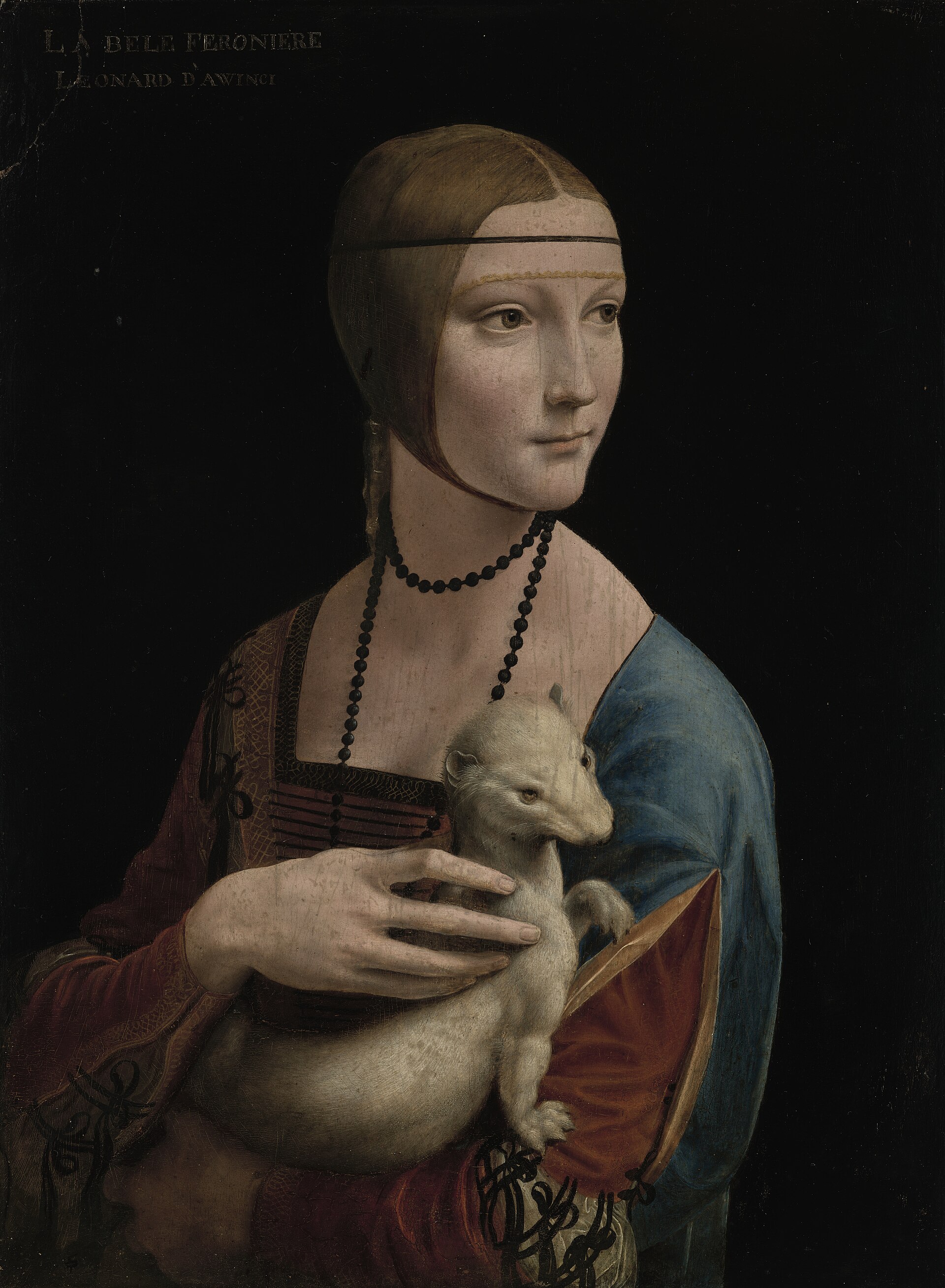
Cecilia Gallerani's own letter of 1498 says her Leonardo portrait no longer looked like her. No document from her lifetime describes the Krakow panel that carries her name.
Records in this piece: Lady with an Ermine (Portrait of Cecilia Gallerani), Girl with a Pearl Earring
On this page 6 sections
ContentsClose
In short
- The only recorded sentence by Cecilia Gallerani about a portrait of herself, in her letter to Isabella d'Este of 29 April 1498, says it was made at an imperfect age and that she had since changed so much that no one would connect the picture to her.
- No surviving document from her lifetime describes the Krakow panel: neither Bellincioni's sonnet, printed in 1493 after his death on 12 September 1492, nor the two letters of April 1498 mention an animal or a composition. The name on the panel is therefore an inference, which the Italian national biography states as a hypothesis and the museum states as confirmed.
- The inference rests on a Greek pun on her surname, the Order of the Ermine, the sitter's apparent age and an argument made around 1900. A published dissent of 2021 would free the picture from her and push it as late as about 1508.
- The documents for her life are rich and uneven: her birth in 1473, her son in 1491 and her education in letters are well attested, while her death date, her wedding year and her poems are not.
The museum's collection page names Cecilia Gallerani as fact, and the national biography calls it a hypothesis
The National Museum in Krakow's collection page for Lady with an Ermine says that the subject of the painting is Cecilia Gallerani, who lived c. 1473-1536 and was a lady-in-waiting and mistress of Ludovico Sforza, Duke of Milan. It adds that the sitter's identity was uncertain until around 1900 and was confirmed only at the end of the nineteenth century, through archival research that included letters from Cecilia to Isabella d'Este and a sonnet by Bernardo Bellincioni.
The Italian national biography is less sure. Carlo Alberto Bucci, writing the entry on Gallerani for the Dizionario Biografico degli Italiani in 1998, calls the identification of her with the Krakow panel the most credited hypothesis today and adds that it is, most of the time, stated in doubtful form (our translation). The two texts describe the same evidence. One calls it confirmation and the other calls it a hypothesis.
Our record of the picture, leonardo-lady-with-an-ermine-czartoryski, sides with the cautious reading: it files the attribution to Leonardo as accepted and the sitter as an inference, not a documented fact. This article tests that record against the paper. The claim it makes is narrow. Cecilia Gallerani is one of the best-documented women of her century, yet no document from her lifetime describes the Krakow panel, and the only recorded sentence she wrote about a portrait of herself says it no longer looked like her.
What the documents say about Cecilia Gallerani herself
Cecilia Gallerani was born in Milan in the first months of 1473, according to Bucci, probably in the parish of San Simpliciano where her parents Fazio Gallerani and Margherita Busti had lived since 1455. Our record notes that English-language sources, among them Wikipedia, often say Siena. Bucci traces Fazio's family to Sienese patricians who had branched to Milan, which may be where that habit comes from, but he gives Milan as her birthplace. Her father served the Sforza state as ambassador to Florence from 1467 and to Lucca three years later, and he died on 5 December 1480. In December 1483 her mother promised her in marriage to Giovanni Stefano Visconti, a man 24 years older, and the promise was formally dissolved in June 1487.
The relationship with Ludovico enters the record through an ambassador. On 8 November 1490 Giacomo Trotti, the envoy of Ferrara, wrote to his duke that Ludovico kept a lover in the castle who was, in Trotti's words as Bucci quotes them, pregnant and beautiful as a flower. Ludovico married Beatrice d'Este on 16 January 1491. Cecilia's son Cesare was born on 3 May 1491; Bucci and Julia Cartwright's 1903 biography of Beatrice d'Este agree on that day. Bucci then reports that Ludovico gave her the fief of Saronno on 18 May and found her a husband, Count Lodovico Bergamini, whom she married in 1492. Cartwright puts the wedding in July 1491 instead. Cartwright is the older and less careful source, but the disagreement is real and we do not settle it.
The museum says Cecilia and her son were dismissed from court because of Ludovico's engagement to Beatrice, and gives no year. Bucci judges it likely that she stayed in the castle at least until the following year and says she was certainly not out of Ludovico's favour. He also records a household of her own in the Palazzo Carmagnola, where she received the ambassadors of Venice on 14 September 1496. Of her education he writes that contact with Bellincioni and the learned circle at court drew her to letters, and that she learned to write Latin verse, as Matteo Bandello reports in one of his novelle. In 1512 she wrote to the humanist Giangiorgio Trissino, enclosing a sonnet of hers that is now lost and asking him for his little work on the widowed state and on the education of children. When Ludovico fell in 1499 she and her husband found refuge with Isabella d'Este at Mantua, and she later returned to Milan, where she went on living among poets and men of letters. Her death date is not known. Bucci, following the genealogist Calvi, writes that she seems to have lived until about 1536.
April 1498: the one recorded sentence she wrote about her portrait
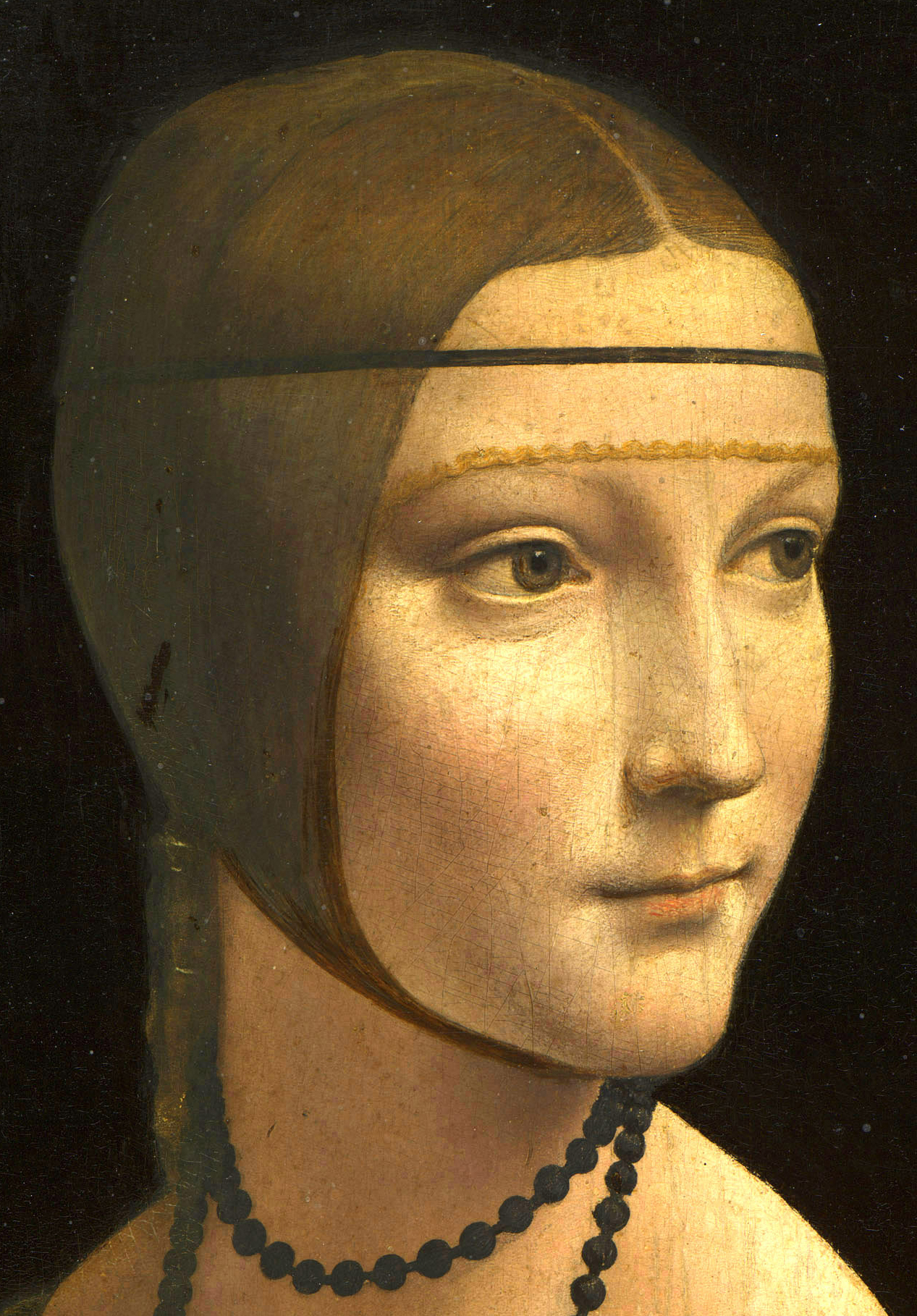
In April 1498 the sitter's own voice reaches us in one letter, written in answer to another about a portrait of her by Leonardo. On 26 April Isabella d'Este wrote from Mantua, in Julia Cartwright's English translation, that she had that day seen some fine portraits by Giovanni Bellini. Talk had turned to Leonardo, and she wished to compare his work with them. Remembering that he had painted Cecilia's likeness, she asked her to send the picture by a messenger on horseback so that she could compare the two masters and also see Cecilia's face again. She promised to return it.
Cecilia answered from Milan on 29 April. She sent the portrait without delay and would send it more gladly if it were more like her. That, she wrote, was no fault of the master, for she did not believe there was another painter equal to him in the world. It was because the portrait was made, in Cartwright's words, when she was at so young and imperfect an age. Since then she had changed altogether, so that, in the same translation, if Isabella saw the picture and herself together she would never dream it could be meant for her. We could not open the Mantua State Archive's 2019 transcription of the Italian, so the gloss 'young' is Cartwright's and we cannot place it in the original. Bucci paraphrases the letter as referring to her youth (giovinezza) and Boesten-Stengel as a youthful age, so 'an imperfect age' is the safe reading.
A third letter, of 18 May, answers thanks that Isabella had evidently sent. Cecilia writes that there was no need to thank her, since everything she has is at Isabella's pleasure (Bucci quotes the Italian as ogni mie cosa, con me insieme, sono alli piaceri de quella). Bucci takes it as an indication that the picture came back to her and stayed her property. The point for this article is what the letters do not contain. Neither of the April letters describes the picture, and neither mentions an animal. The table sets out the documents usually cited and what each one says; the letter of 18 May is left out because it does not mention the picture.
| Evidence | Date | Names Cecilia | Mentions an animal |
|---|---|---|---|
| Bellincioni sonnet, headed as on the portrait of Madona Cicilia by Maestro Leonardo | Printed 15 July 1493 | Yes | No |
| Isabella d'Este to Cecilia, asking to borrow her portrait | 26 April 1498 | Yes | No |
| Cecilia to Isabella, sending it and saying it no longer looks like her | 29 April 1498 | Yes | No |
| Inscription on the Krakow panel: LA BELE FERONIERE / LEONARD D'AWINCI | Added later, undated | No | Not applicable |
How the Krakow panel got her name around 1900
The Krakow panel was tied to Cecilia Gallerani by an argument made around 1900, not by a document from her lifetime. Albert Boesten-Stengel, writing in 2021, dates the move to 1900 and to the Polish art historian Jan Boloz Antoniewicz, and notes that since then almost every publication has leaned on Bellincioni's sonnet as the supposed eyewitness to the picture's identity and date.
The sonnet, printed in Bellincioni's Rime in Milan on 15 July 1493, tells Nature not to be angry that Vinci has portrayed one of her stars, and says the picture makes Cecilia seem to listen and not speak ("par che ascolti & non fauella"). It also says her eyes make the sun look dim and that she will seem more alive and more beautiful to later ages. It gives no pose and names no animal. Bucci lists the other supports: the Greek word for the animal, which echoes her surname (the museum gives the Greek as gale), in the way Leonardo had already tied Ginevra de' Benci to the juniper; Ludovico's Order of the Ermine, which Bellincioni's sonnet CXXVII echoes with the phrase bianco ermellino; and the look of the sitter, whom Bucci says seems about seventeen. Born in 1473, Cecilia was between about fifteen and seventeen in 1488-90, the years to which Bucci dates the work. The museum dates the order to 1488. Boesten-Stengel gives 1486, and we have not found the document that settles it.
The dissent is serious and sits against the museum. Boesten-Stengel argues that the verses of the sonnet describe a different composition. He thinks the letters of 1498 may not refer to the Krakow picture either. He holds that the panel could have been finished as late as about 1508 for a different sitter, Claude de France, whom he proposes. We cannot weigh his case against the technical evidence here. On our reading it shows that the name on the label depends on one inference: that the only Leonardo portrait of Cecilia known to have existed is the one that survives. Bucci states it with a hedge, and he writes that already in the nineteenth century her Leonardo portrait had been recognised in several paintings, none of them by Leonardo.
A named sitter and an unnamed one: Lady with an Ermine beside Girl with a Pearl Earring
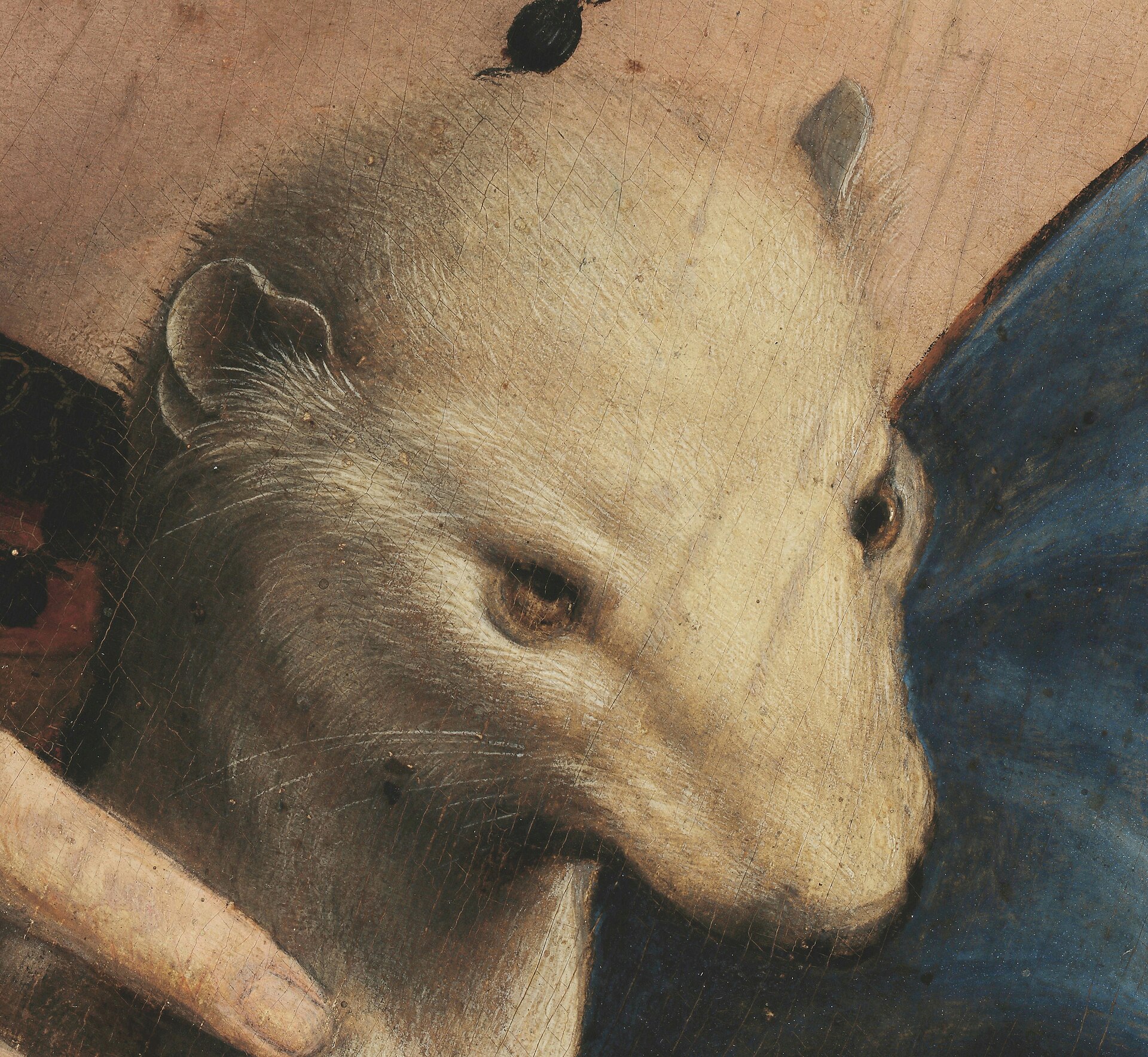
Our archive holds two famous heads that fail in opposite directions. Vermeer's Girl with a Pearl Earring, on the Mauritshuis's own account, is not a portrait but a tronie, a painting of an imaginary figure, so there is no sitter to lose, and our record notes that no identification of the girl has been established. Lady with an Ermine is the reverse. Its sitter has a name, a biography, a house and a son, and the name reaches the panel through reasoning rather than through any paper that describes it.
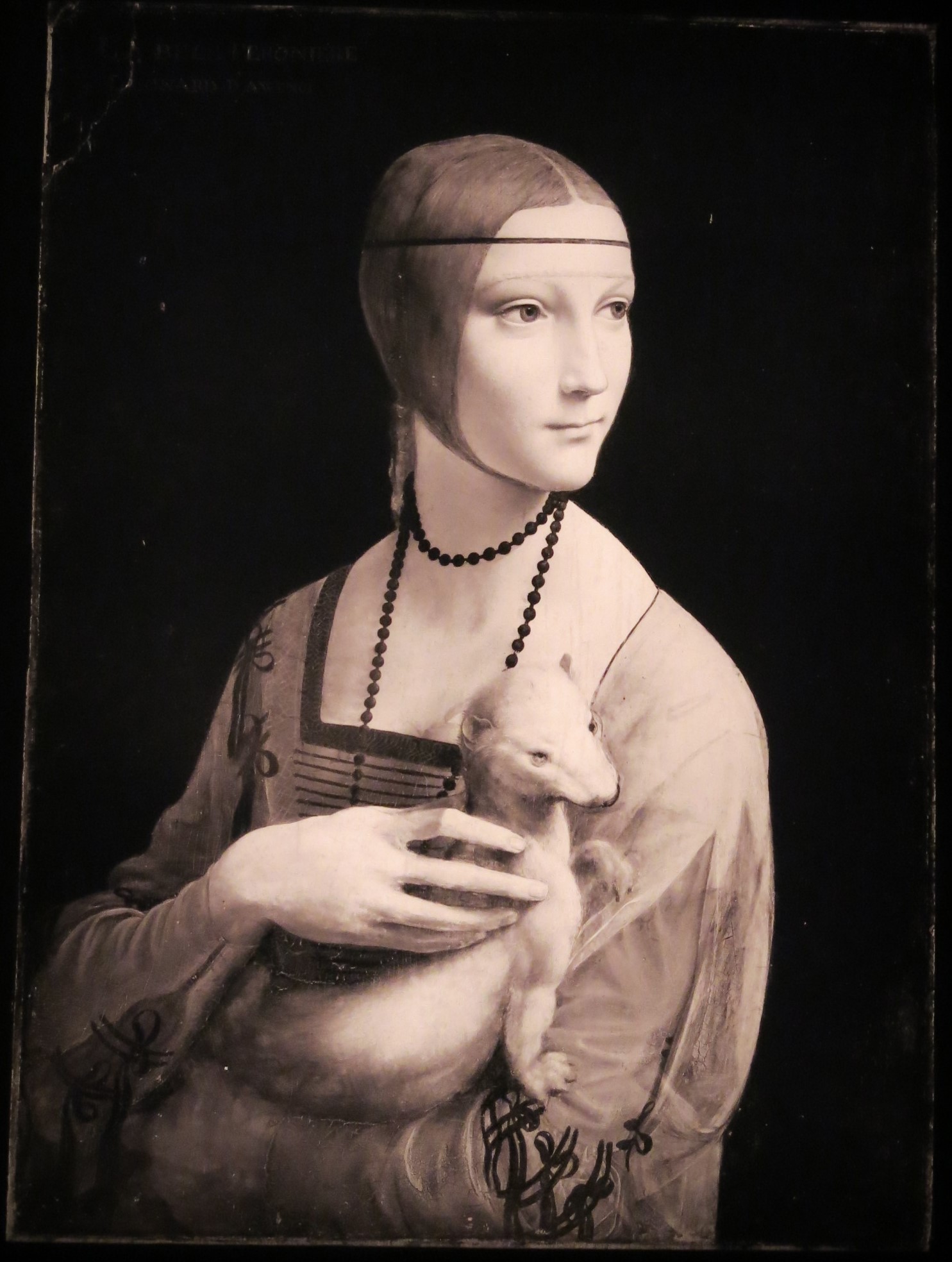
What the object itself offers is physical. The plate below shows infrared reflectograms of the panel as displayed at the Louvre in 2019-20 (a photograph by the Commons user Tangopaso; the file does not say who made them). Infrared records what lies under the paint, not who sat for it. The museum's own page puts the identification down to archival research on the letters and the sonnet, not to anything on the panel. That is why the question stays open, and why a caption that gives her name needs an inference attached.
What is not known about Cecilia Gallerani and her portrait
Several basic facts about Cecilia Gallerani and her portrait are not known, and the sources disagree on others. Her death date is not recorded: about 1536 is a genealogist's report. Her own poetry is lost, so the reputation the museum reports (it quotes the phrase light of the Italian language) rests on others' praise and not on texts we can read. Where the portrait was between her lifetime and the purchase of the panel in Italy around 1800, which the museum records, is not documented in anything we read.
The disagreements are as important. The date of the panel runs from about 1488-90 on Bucci's stylistic dating to about 1508 on Boesten-Stengel's. Ludovico's entry into the Order of the Ermine is 1488 or 1486. Cecilia's wedding to Bergamini is 1492 or July 1491. Whether she was dismissed from court on Ludovico's engagement, as the museum says, or stayed on, as Bucci thinks likely, is open. None of this lowers the value of the documents. It means the story told on gallery walls has been smoothed, and the smooth version is the one we should not repeat without its qualifiers. We have inferred nothing about what Cecilia felt about the picture, her likeness, Ludovico or Beatrice beyond the one sentence she wrote.
Questions
The National Museum in Krakow names her as Cecilia Gallerani, mistress of Ludovico Sforza. The Dizionario Biografico entry on her calls that the most credited hypothesis, usually stated with doubt, because no document from her lifetime describes the Krakow panel.
In a letter to Isabella d'Este of 29 April 1498 she said she would send it more gladly if it looked more like her, because it was painted at an imperfect age and she had since changed so much that nobody would think it was meant for her.
No. The sonnet, printed in 1493 after Bellincioni's death on 12 September 1492, says the portrait by Leonardo makes Cecilia seem to listen and not speak. It names no animal, which is why Albert Boesten-Stengel argued in 2021 that it may describe a different composition.
The date is not known. Bucci quotes a nineteenth-century genealogist who thought she lived until about 1536, and the museum gives the same year, but neither rests on a dated document that we could read.
Sources
- 1National Museum in Krakow, collection page 'Lady with an Ermine' (Leonardo da Vinci; entry by Dorota Dec and Janusz Walek). mnk.pl/en/...
- 2Carlo Alberto Bucci, 'Gallerani, Cecilia', Dizionario Biografico degli Italiani, vol. 51 (1998), Treccani. treccani.it/enciclopedia/...
- 3Julia Cartwright, Beatrice d'Este, Duchess of Milan, 1475-1497 (London, 1903), Project Gutenberg: English translation of the letters of 26 and 29 April 1498 and an early account of Cecilia. Out of date on several facts; used for the translation and as a second source on Cesare's birth date. gutenberg.org/cache/...
- 4Albert Boesten-Stengel, 'Ein Bildnis der Claude de France? Antike und Heraldik in Leonardos Dame mit Hermelin', Folia Historiae Artium, Seria Nowa 19 (2021), pp. 31-62, with English summary; prints the 1493 text of Bellincioni's sonnet. pau.krakow.pl/FHA/...
- 5Mauritshuis, The Hague, collection page for Johannes Vermeer, Girl with a Pearl Earring (inv. 670): 'not a portrait, but a tronie'. mauritshuis.nl/en/...
More in The Women Behind the Art
The partWhat Serena Lederer Actually Bought, Commissioned and Hosted for Klimt
Serena Lederer did not buy Klimt's estate. The Klimt Foundation, Sotheby's and a provenance report show what she commissioned, bought and hosted.
The Woman in the Rokeby Venus Is Nameless and Her Attacker Explained Herself Repeatedly
No document names a woman in Velazquez's Rokeby Venus. Mary Richardson, who slashed it in 1914, explained her choice in a statement, a memoir and...
What the Opera Paid Marie van Goethem
The model for Degas's Little Dancer is documented in a payroll and two lines of his handwriting.