The Woman in the Rokeby Venus Is Nameless and Her Attacker Explained Herself Repeatedly
No document names a woman in Velazquez's Rokeby Venus. Mary Richardson, who slashed it in 1914, explained her choice in a statement, a memoir and later interviews.
Records in this piece: The Toilet of Venus ('The Rokeby Venus'), The Coronation Chair
On this page 6 sections
ContentsClose
In short
- No source read names a woman in the Rokeby Venus: the 1651 Coronel inventory the Gallery links to it says 'a nude woman', and the mistress story joins a documented affair to a canvas without a document between them.
- Mary Richardson's 1914 statement, printed in The Times on 11 March and its opening sentence reprinted by The Spectator on 14 March, argues an exchange of the most beautiful woman in mythology for Emmeline Pankhurst and says nothing against the nude.
- The complaint about men gaping at the picture comes from later interviews, one dated to 1952 by two secondary writers, 38 years after the act, and no original text of any of them was read.
- The Spectator of 14 March 1914 counts seven injuries, six clean cuts and one ragged bruise, which may reconcile later counts of six, seven and eight.
One 1651 inventory calls the figure 'a nude woman' and no source names her
No document read for this article names any woman who sat for Velazquez's Rokeby Venus, and the sources do not agree that there was one.
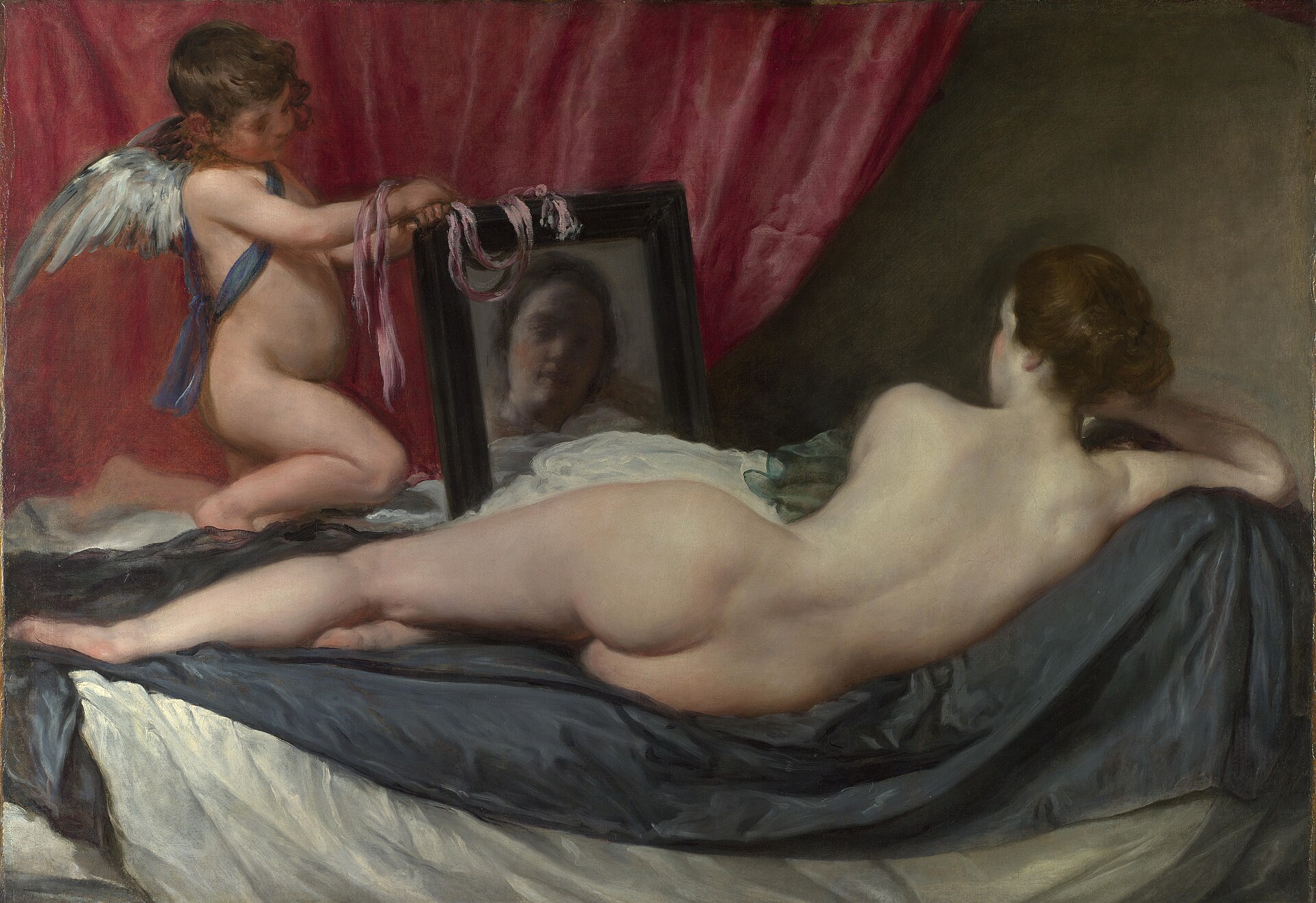
The National Gallery says the canvas does seem to be the picture in a 1651 household inventory of the Spanish painter and art dealer Domingo Guerra Coronel, where it is not said to be by Velazquez and is described simply as 'a nude woman' (the Spanish is una muger desnuda). The Gallery's formal provenance dates the picture's first appearance to the June 1651 inventory of Gaspar de Haro instead, and the sources read do not agree on the order of the two entries. The Gallery also says the reflection in the mirror is blurred and we cannot see who she really is. It suggests that Velazquez may have wanted Venus not to be an identifiable person. Elsewhere in the same text the Gallery asks, without answering, whether she was a real woman whose identity he wanted to keep hidden.
What exists instead is a documented affair. The Gallery's artist page says that on his second Italian journey Velazquez had an affair that produced an illegitimate child and delayed his return to Spain, and the Gallery's page on the painting lists Jennifer Montagu's 1983 note on his illegitimate son Antonio in The Burlington Magazine in its bibliography. The artist page also says he painted the Venus in Italy for the Marques de Eliche, while the Gallery's page on the painting says it is not sure when or where the picture was made. English Wikipedia, which is a tertiary source, records a claim that the painting shows a mistress, says the work is widely thought to have been painted from life and adds that the identity of any model remains speculative.
So the mistress story joins two things that no document read here joins: a woman the Gallery says Velazquez had an affair with and a canvas that names no woman. The inventory entry says a nude woman and no more than that, and the archive can say no more.
| Source | What it says |
|---|---|
| Coronel inventory, 1651 (as reported by the National Gallery) | 'A nude woman', painter not named in that entry |
| National Gallery, page on the painting | Face blurred; perhaps meant not to be identifiable; asks whether a real woman was hidden |
| National Gallery, artist page | An affair and an illegitimate child in Italy; no woman named |
| English Wikipedia (tertiary) | Claim that she was his mistress; identity speculative |
Mary Richardson explained her choice of the Venus in a statement, a memoir and later interviews
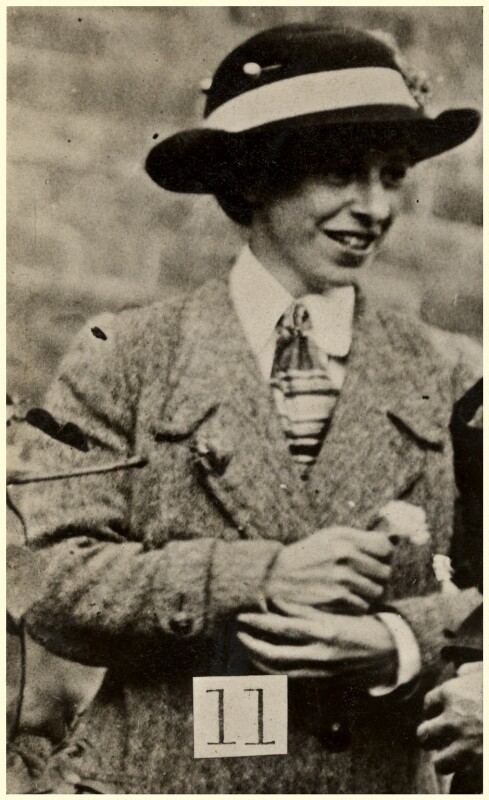
Mary Richardson, a Canadian-born member of the Women's Social and Political Union, slashed the Rokeby Venus on 10 March 1914 and explained why in 1914, again in her 1953 memoir and again in interviews that The Art Newspaper places in the 1950s and 1960s.
She was out of Holloway Prison on temporary release under the Cat and Mouse Act, according to the Birmingham Suffragettes project, and Emmeline Pankhurst had been arrested the day before, according to Philip McCouat's article in the Journal of Art in Society. The Birmingham project counts nine arrests for Richardson in all, the Suffrage Resources database records nine entries while saying her arrest records are conflicting, and the Spectator has her saying in March 1914 that it was the tenth time in a year she had been brought before a magistrate.
Her own later account, quoted by the Birmingham project, says she bought an axe the night Pankhurst was arrested, carried it up her sleeve on a chain of safety pins, waited about an hour in the galleries and got in four more blows after the first one broke the glass. She also says she had sent a plan to Christabel Pankhurst beforehand and that the reply was to carry it out, and that Emmeline Pankhurst's arrest is what made her act that day. Those are her statements to an interviewer years afterwards and nothing read here confirms them independently.
The picture she chose had been bought for the nation. The Spectator, writing four days after the attack, said the National Art-Collections Fund had paid 45,000 pounds for it in 1906.
The 1914 statement argues from beauty and justice and never mentions the nude
Richardson's statement of 11 March 1914 offers the Venus as a price, and it says nothing against the picture or against the woman in it.
As reproduced from The Times of 11 March on the Monstrous Regiment of Women blog, it begins: 'I have tried to destroy the picture of the most beautiful woman in mythological history as a protest against the Government for destroying Mrs Pankhurst, who is the most beautiful character in modern history.' It goes on that justice is an element of beauty as much as colour and outline on canvas, and that any outcry over the picture is hypocrisy as long as people allow the destruction of Pankhurst and other beautiful living women. The Spectator of 14 March 1914 independently prints the same opening sentence and says it was issued through the Women's Social and Political Union, so the first sentence does not rest on one blog.
The Pankhurst in the sentence is Emmeline, the founder of the Union with her daughter Christabel, and McCouat says she was arrested the day before the attack. The Birmingham project says the attack was provoked by that arrest, a re-arrest in Glasgow. The statement of 1914 asks the reader to weigh a woman in prison against a woman in oil.
Read as written, the argument is an exchange: a mythological woman for a living one. The text as reproduced does not describe the body in the picture, does not mention men looking at it and does not say the nude offended her. McCouat, whose account follows Lynda Nead's, reads the statement the same way, as a claim that a painted representation of physical beauty counts for less than a real embodiment of moral beauty, and notes that most of the press read the act as a violence done to a woman and missed the point of the exchange.
The later accounts add a cash value and a dislike of the picture and of the way men looked at it
Two reasons that are absent from the 1914 statement as reproduced appear in Richardson's later recollections: that the picture was worth a great deal of money, and that she disliked the picture or the way men looked at it. Three reasons is a simplification, since the later accounts vary.
The money reason is the one that fits the statement best. In the interview years later quoted by the Birmingham project she says she wanted her protest to carry a financial point, drawing a parallel between the public's indifference to Pankhurst's slow destruction and the destruction of a financially valuable object, and that the picture was highly prized for its worth in cash. McCouat says her autobiography, Laugh a Defiance (London 1953), also made the picture's high value a stand-in for Pankhurst's, and The Art Newspaper reports the same point from interviews of the 1950s and 1960s. The National Gallery's own bibliography lists that book, at pages 165 to 173, among its references for the picture.
The complaint about viewers is the most quoted. Retrospect Journal and Alberti's Window both date it to a 1952 interview, in which she is reported to have said she did not like the way men visitors gaped at the painting all day long. McCouat gives a slightly different wording and calls it an interview given decades later, citing Nead's 1992 book. The Art Newspaper says that in interviews of the 1950s and 1960s she said she disliked seeing women used as nudes in paintings and the picture being gloated over by men, and the Birmingham project quotes her saying she disliked the painting. None of the pages read here gives the original text of any of these interviews, so the words and dates rest on secondary writers. Wikipedia's summary of Helena Wojtczak's 2025 biography adds a caution that applies to every one of these recollections: it says none of the stories in the memoir is entirely true. That book could not be read for this article.
Nothing in this proves that any of the accounts is false. It means the complaint about male viewers, the reason repeated most by the secondary writers read here, comes from the telling furthest from the act and cannot be checked against a text from March 1914. The 1914 statement can.
The count of cuts and the price of the damage came from the Keeper, and the sources disagree on the count
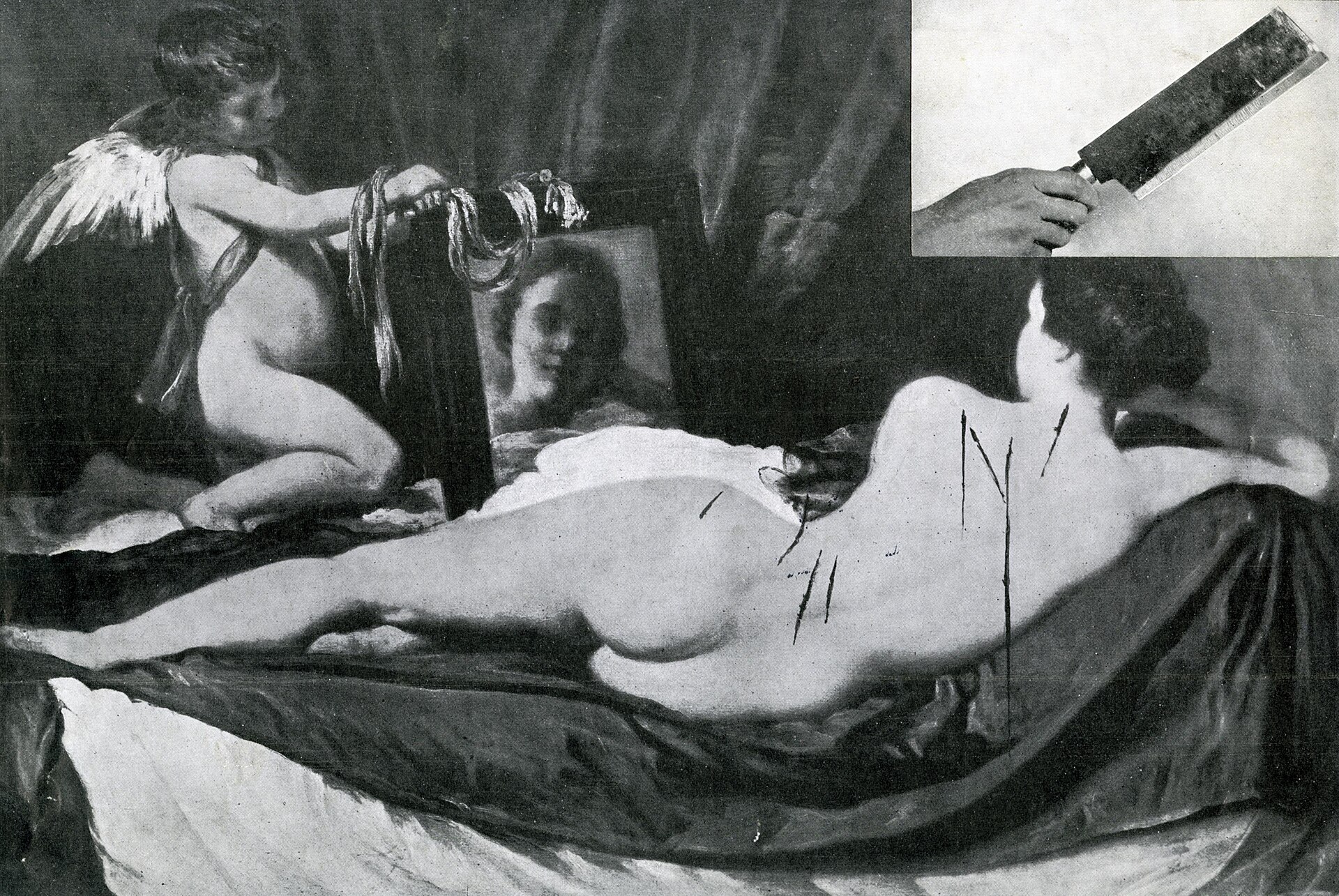
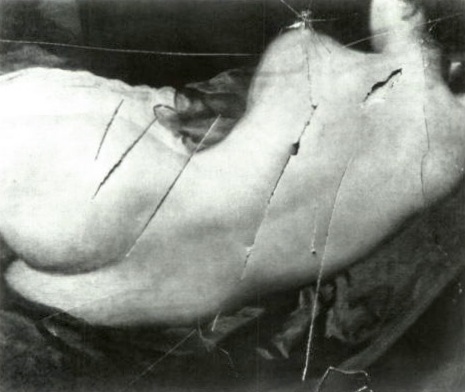
The Spectator of 14 March 1914 says Richardson cut the canvas in seven places, six of them clean cuts and the seventh a ragged bruise, and that the Keeper put the loss in market value at between 10,000 and 15,000 pounds. The figure is read from a garbled line in the Spectator's scanned text and from McCouat, who gives it as 10,000 to 15,000 pounds.
It names the Keeper as Mr Hawes Turner, Keeper and Secretary of the National Gallery. The Gallery's own list of keepers shows Hawes Harison Turner in the post from 1898 to 1914. Against the 45,000 pounds the National Art-Collections Fund paid in 1906, that is roughly between a fifth and a third of the price, set by the institution and not by Richardson.
Counts differ between sources. The London Museum catalogue text for a Central News photograph of Richardson leaving court says seven wounds, while a 2023 Art Newspaper article says eight gashes. The Spectator's bruise may reconcile six clean cuts with seven wounds, though it does not explain The Art Newspaper's eight. The Gallery's condition report, which none of these sources quotes, is what would settle it.
| Source | Count given |
|---|---|
| The Spectator, 14 March 1914 | Seven places: six clean cuts and one ragged bruise |
| London Museum catalogue text | Seven wounds |
| The Art Newspaper, November 2023 | Eight gashes |
She was sentenced to six months, and the attack was followed by more attacks on pictures
Richardson was sentenced to six months in Holloway for the attack, and she was released on 6 April with recurring appendicitis, according to the London Museum. Its own description misdates the attack to 4 March while its title and the other sources say 10 March.
The sources read here do not agree on the court. The Spectator reports that she was committed for trial at Bow Street on the afternoon of the attack with bail refused, and also that she was sentenced to six months by the time it went to press on 14 March. McCouat says she was convicted of malicious damage on the next day. A court report would settle which court passed the sentence and on which day; none was read.
The Union answered the cost argument in its own words. McCouat quotes it as saying that the Rokeby Venus had, because of Richardson's act, acquired a new human and historic interest, and that for evermore the picture would be a sign and a memorial of women's determination to be free. The Art Newspaper prints the same sentence and gives it to Christabel Pankhurst. McCouat adds that both sides probably overstated their case about the picture's long-term value.
The attack was not the first on pictures, since McCouat records women breaking glass over thirteen paintings at Manchester Art Gallery in 1913. He counts fourteen more paintings slashed after it and nine women arrested between March and July 1914. The archive holds a second object from that season. The Coronation Chair record carries the bomb that went off at Westminster Abbey on 11 June 1914, which contemporary reporting attributed to the suffragette movement; that record says no prosecution or named individual is documented for it, and this article does not go beyond that.
The file is uneven. It holds no recorded woman in the picture and a canvas that one inventory called a nude woman. It holds, on the other side, a woman with a chopper who left a dated statement, a memoir and an interview. Only the statement can be set beside a 1914 magazine.
Questions
No source read for this article names her. The National Gallery notes that the face in the mirror is blurred and asks whether a real woman was hidden, and the 1651 Coronel inventory entry it links to the picture says 'a nude woman'. A claim that she was Velazquez's mistress in Italy rests on a documented affair and no document naming a model.
In her statement of 11 March 1914 she said it was a protest against the Government for destroying Emmeline Pankhurst, whom she called the most beautiful character in modern history. Later accounts add that the picture was valuable in cash terms and that she disliked the painting or the way men looked at it; one such interview is dated to 1952 by secondary writers.
Six months' imprisonment, according to The Spectator of 14 March 1914 and the London Museum, which says she was released on 6 April with recurring appendicitis. The sources read do not say which court passed the sentence.
Counts differ. The Spectator of 14 March 1914 says seven places, six of them clean cuts and one a ragged bruise; the London Museum says seven wounds; a 2023 Art Newspaper article says eight gashes.
Sources
- 1The National Gallery, London, 'The Toilet of Venus (The Rokeby Venus)', NG2057: overview, in-depth text, provenance and bibliography. nationalgallery.org.uk/paintings/...
- 2The National Gallery, London, artist page 'Diego Velazquez 1599-1660', biography and bibliography (Montagu 1983). nationalgallery.org.uk/artists/...
- 3The Spectator, 14 March 1914, page 3, notice of the mutilation of the Rokeby Velazquez (Spectator Archive). archive.spectator.co.uk/article/...
- 4'Mary Raleigh Richardson (died 7 November 1961)', Monstrous Regiment of Women blog, reproducing 'Miss Richardson's Statement', The Times, 11 March 1914. monstrousregimentofwomen.com/2016/...
- 5Philip McCouat, 'From the Rokeby Venus to Fascism Pt 1: Why did suffragettes attack artworks?', Journal of Art in Society. artinsociety.com/from-the-rokeby-venus-to-fascism-pt-1-wh...
- 6London Museum, object 50.82/1393, Central News photograph, Mary Richardson leaving for police court, 10 March 1914, with catalogue text. londonmuseum.org.uk/collections/...
- 7'Slashing the Rokeby Venus', Fight for the Right: the Birmingham Suffragettes project blog, 19 December 2012 (quotes Richardson's later account). birminghamsuffragettes.wordpress.com/2012/...
- 8Retrospect Journal, 'The Painted Question, The Iconoclast Answer' (dates the gaping remark to a 1952 interview). retrospectjournal.com
- 9Alberti's Window, 'Wednesday, June 19th, 2013' (dates the remark to 1952 and cites the BBC series The Private Life of a Masterpiece). albertis-window.com
- 10The National Gallery, London, 'Keepers' (list of Keepers, Hawes Harison Turner 1898-1914). nationalgallery.org.uk/about-us/...
- 11Louis Jebb, 'How Velazquez's Rokeby Venus became a symbol of public pride and then political protest', The Art Newspaper, 8 November 2023. theartnewspaper.com/2023/...
- 12Women's Suffrage Resources, database entry 'Miss Mary Raleigh Richardson' (nine recorded entries; records conflicting). suffrageresources.org.uk/database/...
- 13Wikipedia (English), 'Mary Richardson'. en.wikipedia.org/wiki/...
- 14Wikipedia (English), 'Rokeby Venus'. en.wikipedia.org/wiki/...
More in The Women Behind the Art
The partThe sitter who wrote that her portrait no longer looked like her: Cecilia Gallerani and the Lady with an Ermine
Cecilia Gallerani's own letter of 1498 says her Leonardo portrait no longer looked like her.
What Serena Lederer Actually Bought, Commissioned and Hosted for Klimt
Serena Lederer did not buy Klimt's estate. The Klimt Foundation, Sotheby's and a provenance report show what she commissioned, bought and hosted.
What the Opera Paid Marie van Goethem
The model for Degas's Little Dancer is documented in a payroll and two lines of his handwriting.