What the Name al-Mawsili Tells You About Where It Was Made
Two signed ewers, a pyxis and a candlestick carry or borrow the name al-Mawsili. What the name proves about Mosul, and where the museums place each piece.
Records in this piece: Luxury Ewer Extending Good Fortune to the Owner, Ewer with Inscription, Horsemen, and Vegetal Decoration, Pyxis Depicting Standing Saints or Ecclesiastics and the Entry into Jerusalem with Christ Riding a Donkey, Tripod Candlestick
On this page 6 sections
ContentsClose
In short
- Both signed ewers name Mosul only through a name of origin attached to a man. Ahmad al-Dhaki signs himself al-Mawsili in the year 620 (1223), and his apprentice 'Umar ibn al-Hajji Jaldak names the master as al-Mawsili in 623 (1226). Neither inscription gives a street, a workshop or a patron's city.
- The museums read the same name two ways. Cleveland's catalogue line says Iraq, possibly Mosul, while its description says the master is of Mosul. The Met's page for the apprentice ewer says the master was originally from Mosul and files the ewer under probably Mosul.
- Two scholars use the same signatures to put the workshop in different towns. D. S. Rice, as a summary of his reconstruction has it, looked to Artuqid territory and possibly Amid in the 1220s, and Julian Raby argued in 2012 for a workshop in Mosul. A reviewer of Raby's essay regrets that no technical analysis of the metals was used.
- Unsigned pieces take their place from style, and the places move. The Met files its pyxis under Syria while its own label text derives such brasses from al-Mawsili artists, and the Met's data on its candlestick has run from the first half of the fourteenth century to 1250-1300, probably Syria or northern Iraq.
Four inlaid brasses in this archive carry the name, borrow it or never mention it
The four thirteenth-century inlaid brasses in this archive's records show that a name pointing to Mosul on an object and an attribution to Mosul by a museum are two separate things. Two of the objects are signed with the name al-Mawsili, one is filed by its Museum under a different place although the Museum's own label text links the group to al-Mawsili artists, and one has been dated twice. The table puts what each says or is said to say beside where its holder places it.
| Object | What the inscription or Museum text names | Date | Where the museum places it |
|---|---|---|---|
| Ewer, Cleveland Museum of Art, 1956.11 | Work of Ahmad al-Thaki, the engraver, al-Mawsili, in the year 620 | 1223 | Iraq, possibly Mosul, Zangid or Artugid Period, 13th Century |
| Ewer, Metropolitan Museum of Art, 91.1.586 | 'Umar ibn al-Hajji Jaldak, apprentice of Ahmad al-Dhaki al-Naqqash al-Mawsili, year 623 | 1226 | Attributed to Iraq, probably Mosul |
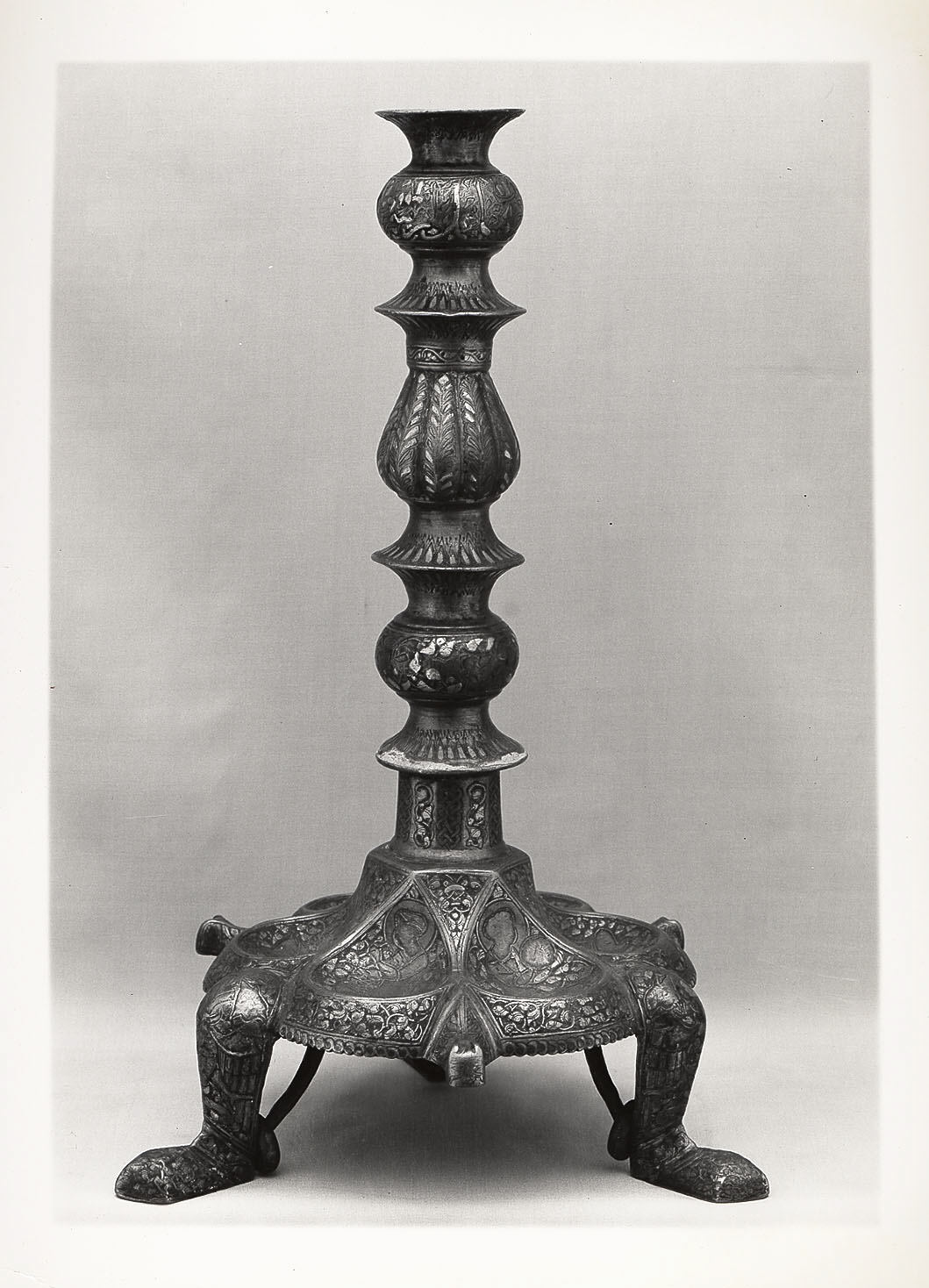
| Tripod candlestick, Metropolitan Museum of Art, 91.1.572 | Made for an affluent Mamluk named Sharaf al-Din 'Abd al-Rahman, according to the Museum's text | 1250-1300 | Attributed to probably Syria or northern Iraq |
| Pyxis, Metropolitan Museum of Art, 1971.39a, b | No maker named in the Museum's text; its general label refers to brasses signed by al-Mawsili artists or made in their style | Mid- to late 13th century | Attributed to Syria |
The master signed himself al-Mawsili and called his work engraving
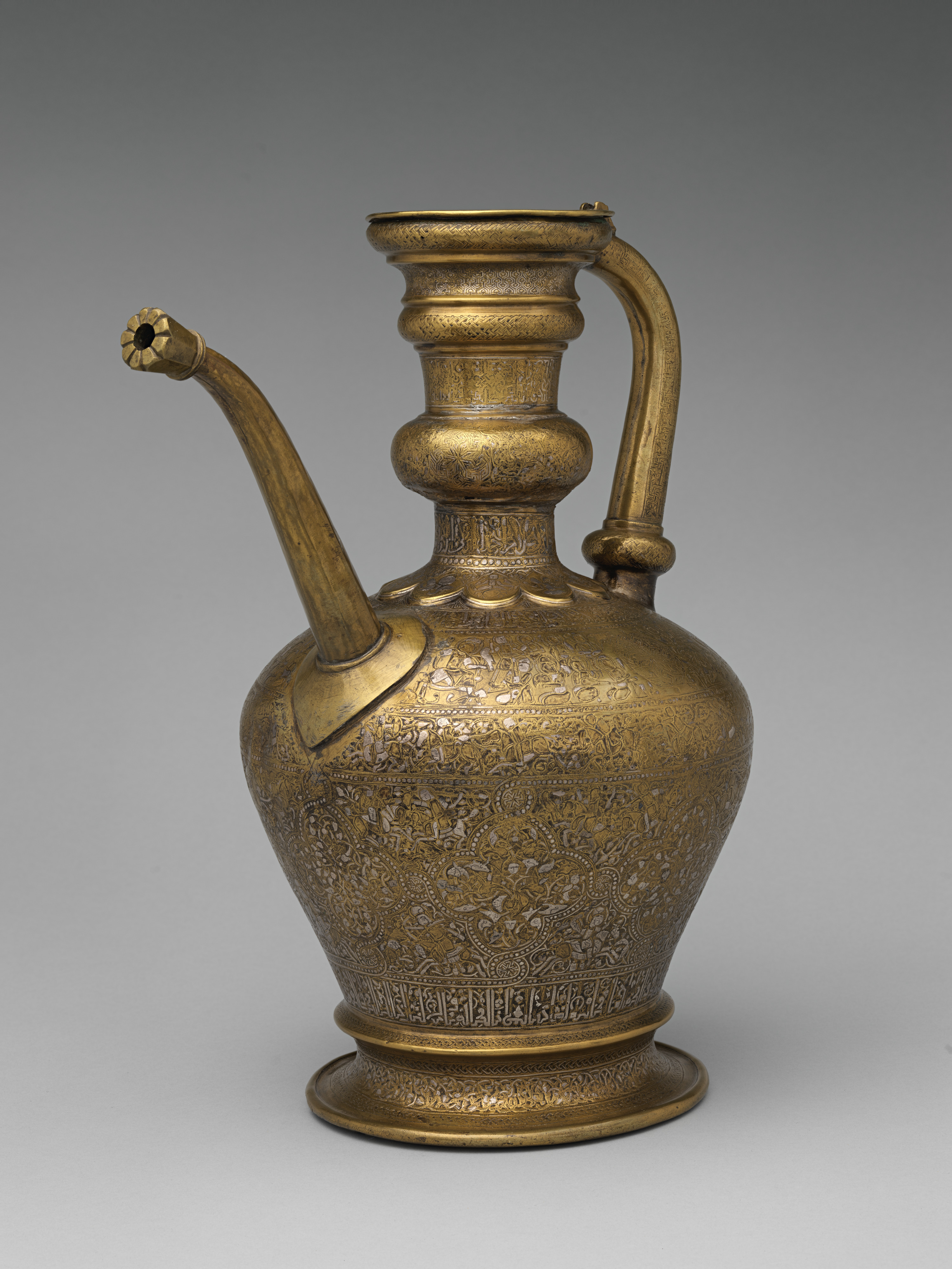
The Cleveland ewer is signed and dated by a man who gives his craft and his name of origin and does not give a place of work. The Museum's inscription record reads the neck band as the work of Ahmad al-Thaki, the engraver, al-Mawsili, in the year 620, followed by a wish of glory to the owner, and a second band at the base of the handle repeats the name without the date. The year 620 is 1223 in the Gregorian calendar.
The word al-Mawsili is a nisba, an Arabic adjective of relation, and here it means of Mosul. Whether it records where the man was born, where he trained or where his shop stood is not stated by the inscription. The word engraver also limits the claim, because metalwork of this class was made in stages and a signature on a dated ewer speaks for one of them.
Cleveland's own record says two things about the master. Its culture line reads Iraq, possibly Mosul, Zangid or Artugid Period, 13th Century, and its description says the ewer was signed by the master craftsman Ahmad al-Dhaki of Mosul. The first is the more careful sentence. The Museum's inscription notes also record that the foot is a later addition and that later owners scratched their own names into the neck, and the ewer came to Cleveland in 1956 from the New York dealer Raphael Stora with no earlier owner recorded.
The apprentice's ewer records a relationship and the Met reads it as an origin
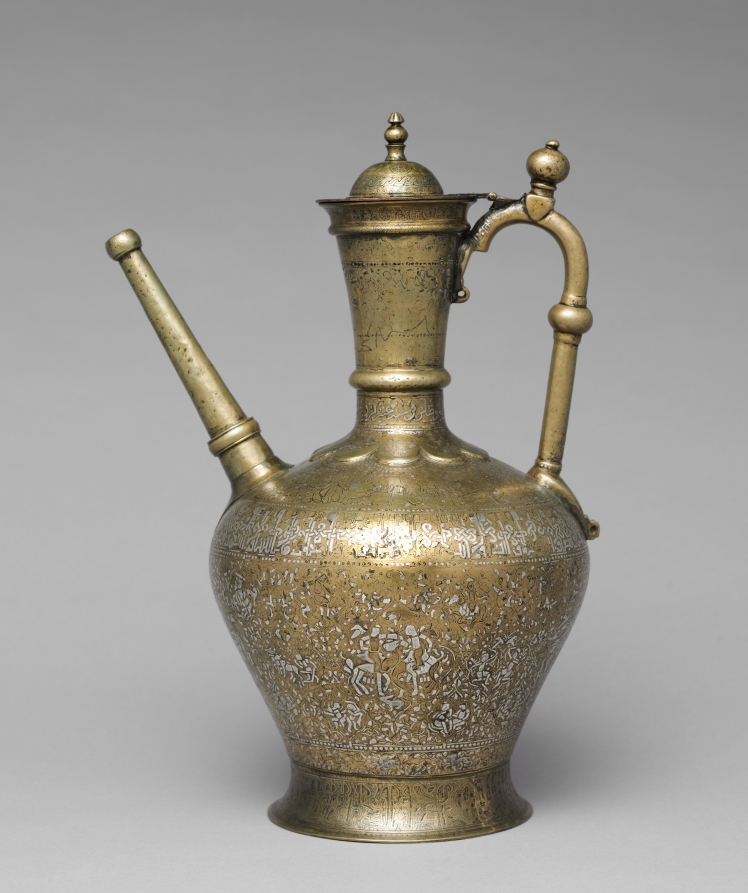
The Metropolitan Museum's ewer of 1226 preserves a sentence in which an apprentice names his master, and the Museum's page turns the master's name of origin into a statement of origin. The neck inscription, as the Museum quotes it, reads: made by 'Umar ibn al-Hajji Jaldak, the apprentice of Ahmad al-Dhaki al-Naqqash al-Mawsili, in the year 623 [1226 CE]. The Museum's text then says that Ahmad al-Mawsili, originally from Mosul in Upper Mesopotamia, was a famous metalworker who had a number of pupils, and its geography field says attributed to Iraq, probably Mosul.
The inscription itself says none of that about Mosul. It gives a relationship, a master and a date, and the place is the Museum's reading of the master's epithet. The ewer entered the Metropolitan in the bequest of Edward C. Moore in 1891, and nothing is recorded of it for the 665 years before.
Howayda Al-Harithy's article of 2001 in the Bulletin of SOAS is built on this object. Her abstract says D. S. Rice had focused on a group of five objects from the workshop of Ahmad al-Dhaki between 620 and 640 AH (1223 and 1242), that Rice described the Ibn Jaldak ewer only briefly because he did not have access to it, and that she examines the ewer closely to revisit the origin of the Mawsili school of metalwork. The abstract does not say what she concluded.
Rice placed the workshop in the Artuqid north and Raby placed it in Mosul
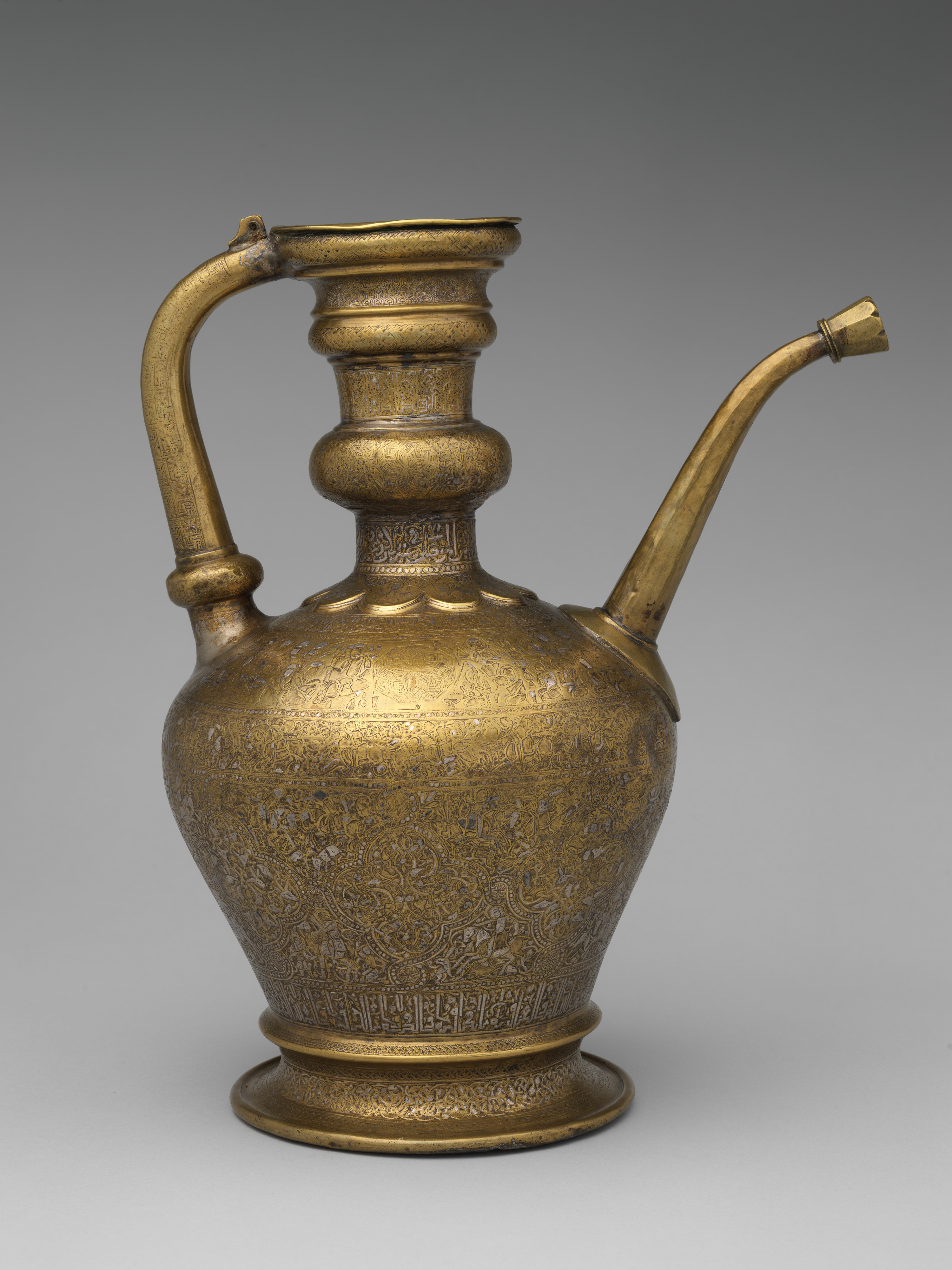
Two leading studies read the same signatures and place the workshop of Ahmad al-Dhaki in different towns, because the signatures give a name of origin and no address. Rice's study of 1957 in Ars Orientalis grouped the objects. The Wikipedia article on the master, a tertiary source that summarises Rice's reconstruction, says Rice thought that in the 1220s the master and Ibn Jaldak probably worked in a town under Artuqid control, possibly Amid, because a candlestick by Ibn Jaldak bears an ownership incision naming al-Malik al-Mas'ud, and that they were probably not in Mosul, the capital of the rival Badr al-Din Lu'lu'.
Julian Raby's essay of 2012, The Principle of Parsimony and the Problem of the Mosul School of Metalwork, argues the opposite. The review of it by Bulle Tuil-Leonetti says Raby builds his case for an inlaid-metal workshop at Mosul by surveying theories since the early nineteenth century, reanalysing the inscribed corpus, identifying workshop marks, and comparing the Mosul pieces with the workshops that descended from it in Damascus and Cairo and with the figural decoration of Mosul manuscripts. The Wikipedia article quotes Raby as saying the master was surely not in Amid in the 1220s.
The reviewer finds the systematic approach convincing and regrets one absence: Raby did not use technical criteria for the metals, which she says would sharpen dates and relations between pieces. No compositional analysis of the Cleveland ewer's brass or silver is known to the sources read for this article, and none of the Met ewer. Until one exists, the name al-Mawsili can be argued to mean a place of work or a place of origin, and both readings are in the literature.
An unsigned pyxis is filed under Syria while the Museum's own label points to Mosul artists
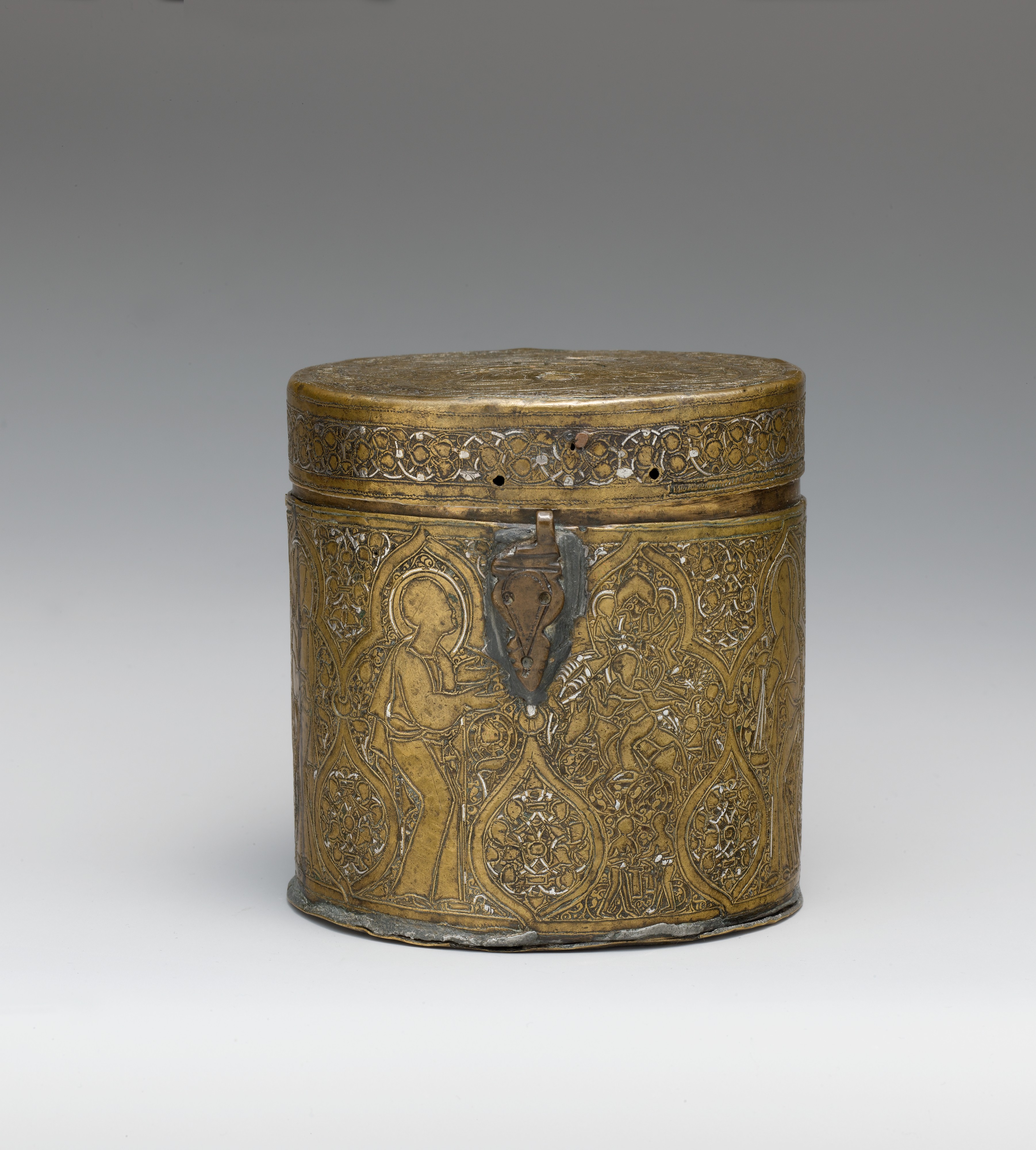
The Metropolitan Museum's pyxis of the thirteenth century carries no maker's name in the Museum's text and is attributed to Syria, although the Museum's label text for the group describes the tradition as al-Mawsili. The label says that during the thirteenth century luxurious inlaid brasses signed by al-Mawsili artists from Mosul, or made in their style, began to show Christian motifs, and that some pieces may have been ordered by local Christian patrons and others as souvenirs for Crusader knights.
The box is a small lidded brass cylinder 10.5 cm high with figures under arches and a scene of Christ entering Jerusalem on a donkey. It came to the Museum through the Rogers Fund in 1971. Its place is set by style and by the company it keeps, and the Museum's own words show the difficulty: the phrase made in their style does not say where the piece was made.
The pyxis shows why a name on an object and a place in a catalogue should be kept in separate columns. A museum can write that a tradition came from Mosul and file a piece from the tradition under Syria without contradicting itself, because the first statement is about a style and the second is about a guess at a workshop.
The candlestick has been dated twice and its record keeps both
The Metropolitan Museum's tripod candlestick shows how far a place and a date can move when the attribution rests on style. The Museum's current page reads 1250-1300 and attributed to probably Syria or northern Iraq, and says the piece was made for an affluent Mamluk named Sharaf al-Din 'Abd al-Rahman. A copy of the Museum's data exported to Wikimedia Commons still gives the date as the first half of the fourteenth century.
This archive's record traces the change to a catalogue entry by the curator Deniz Beyazit in the Museum's 2021 volume Collecting Inspiration: Edward C. Moore at Tiffany and Co., which argues from style and from heraldry and not from a new inscription. The candlestick has been in the Museum since 1891, and no owner before Moore is recorded.
For a reader of the archive the practical rule is plain. The record for each of these four brasses states what the object itself says, then what the museum says, then who has argued otherwise, and dates each statement. A place that moved once can move again, and a record that shows both dates lets the next change be read as a change.
Questions
It is a nisba, an Arabic adjective of relation, meaning of Mosul. The Metropolitan Museum's label text describes brasses signed by al-Mawsili artists from Mosul. Whether the word marks a maker's birthplace, his training or his place of work is argued, and the inscriptions on the ewers do not say.
Scholars disagree. As summarised on Wikipedia, D. S. Rice thought the workshop was probably in Artuqid territory, possibly Amid, in the 1220s. Julian Raby argued in 2012 that a workshop existed at Mosul. Cleveland's catalogue line says only that Mosul is possible.
The neck inscription says it was made by 'Umar ibn al-Hajji Jaldak, the apprentice of Ahmad al-Dhaki al-Naqqash al-Mawsili, in the year 623, which is 1226 CE. The Museum attributes it to Iraq, probably Mosul. It entered the Museum in 1891 with the Edward C. Moore bequest.
No. The Museum's inscription record says the foot is a later addition, and later owners scratched their names into the neck. The ewer was bought by the Museum in 1956 from the New York dealer Raphael Stora.
Sources
- 1Cleveland Museum of Art, Open Access API, record for accession 1956.11 (object 133460): inscriptions, culture line, description and provenance. openaccess-api.clevelandart.org/api/...
- 2Metropolitan Museum of Art, object page for 91.1.586, 'Umar ibn al-Hajji Jaldak, Ewer with Inscription, Horsemen, and Vegetal Decoration: inscription as quoted by the Museum, geography and credit line. metmuseum.org/art/...
- 3Metropolitan Museum of Art, object page for 91.1.572, Tripod Candlestick: date 1250-1300, geography, patron named in the Museum's text. metmuseum.org/art/...
- 4Metropolitan Museum of Art, object page for 1971.39a, b, Pyxis Depicting Standing Saints or Ecclesiastics and the Entry into Jerusalem: geography and the Museum's label text on al-Mawsili brasses. metmuseum.org/art/...
- 5Howayda Al-Harithy, 'The ewer of Ibn Jaldak (623/1226) at the Metropolitan Museum of Art: the inquiry into the origin of the Mawsili School of metalwork revisited', Bulletin of SOAS 64, no. 3 (2001), abstract. cambridge.org/core/...
- 6Bulle Tuil-Leonetti, review of Julian Raby, 'The Principle of Parsimony and the Problem of the Mosul School of Metalwork' (2012), Abstracta Iranica 34-36 (2017), document 16. journals.openedition.org/abstractairanica/...
- 7Wikipedia, 'Ahmad al-Dhaki al-Mawsili'. en.wikipedia.org/wiki/...
- 8Wikimedia Commons, File:Tripod Candlestick MET 91.1.572.jpeg, file page carrying the Museum's earlier data (date first half 14th century). commons.wikimedia.org/wiki/...

More in Attribution and Authenticity
The partPaintings Draw the Attribution Fights, but Glass Is Disputed Far More Often
Seven of 45 paintings carry a disputed attribution and seven of 16 glasses do. No print does. A table of 330 records by object type.
The Name on an Instrument Covers More Than One Maker
A harpsichord with a false Ruckers rose, a Couchet rebuilt to pass, the oldest piano with a 1938 soundboard and a harp with a legend.
The Name on the Map Is an Argument: Four Early Maps
The Catalan Atlas is catalogued as 'Abraham Cresques ?'. The Carta Marina survives once, the Tabula Rogeriana only in later copies, the Paris...