Luxury Ewer Extending Good Fortune to the Owner
Ahmad al-Dhaki al-Mawsili · 620 AH (1223)
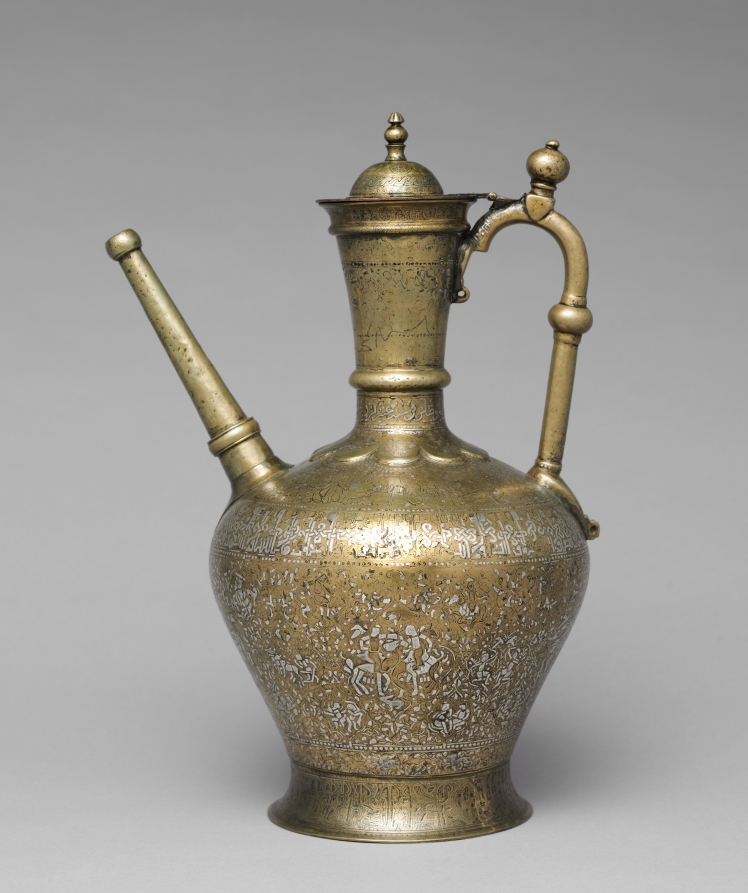
The ewer signed by Ahmad al-Dhaki al-Mawsili in the year 620 (1223): brass inlaid with silver, 37.9 cm high overall, with the later lid, base and foot. The medallion band is worn and most silver is lost. Museum's primary image, CC0.
| Artist | Ahmad al-Dhaki al-Mawsili |
|---|---|
| Date | 620 AH (1223) |
| Medium | Brass inlaid with silver; lid and base added later |
| Dimensions | Overall height 37.9 cm; diameter 26.6 cm; diameter of base 14.5 cm |
| Where it is now | The Cleveland Museum of Art, Cleveland, Ohio, Gallery 116 (Islamic art)last confirmed |
| Inventory number | 1956.11 (Cleveland Open Access object ID 133460); cited as 56.11 in the 1985 Freer catalogue |
| Attribution | AcceptedThe maker is named by the neck inscription, which the museum translates as 'Work of Ahmad al-Thaki, the engraver, al-Mawsili, in the year 620', so authorship and date are not in question. Full note |
| Object type | Islamic metalwork |
| Period | Islamic, Jazira, thirteenth century (Zangid or Artuqid period) |
| Cases | Has a provenance gap |
| Inscriptions | Neck (naskh): 'Work of Ahmad al-Thaki, the engraver, al-Mawsili, in the year 620 and glory to my owner.' Handle base (naskh): 'Work of Ahmad al-Thaki al-Mawsili.' Shoulder (plaited animated kufic): wishes of good fortune and peace to the owner. Foot (naskh, later): not deciphered. Scratched graffiti of later owners: 'Husayn ibn Qasim' and 'Usta al-Muhtasib [?]'. |
| Owners on record | 4 links3 documented, 1 unknown |
| Sources | 15 cited |
About this record Last verified · 15 sources cited · Change log
On this page 9 sections
ContentsClose
A brass ewer inlaid with silver, signed by the engraver Ahmad al-Dhaki al-Mawsili and dated 620 of the Islamic calendar (1223), now in the Cleveland Museum of Art. It is the earliest dated piece of a workshop that D. S. Rice grouped in 1957, and the argument over where that workshop stood, Mosul or the Artuqid territories to the north, has run from Rice to Julian Raby's 2012 reply without a settled answer.
The vessel is a composite. Its lid, base and foot are later than its body, most of the silver is gone and two later owners scratched their names on its neck. It came to Cleveland in 1956 from the New York dealer Raphael Stora, whose firm dealt chiefly in Gothic and Renaissance objects; nothing is recorded of its history in the 733 years before.
Provenance
Each link is graded. Documented: a cited source supports it. Disputed: the identification is argued but not established. Unknown: no owner for that span, and the gap is not smoothed into a narrative. The grades in the glossary.
- 620 AH (1223 on the museum's reckoning) -Workshop of Ahmad al-Dhaki al-Mawsili; patron not nameddocumented
Neck inscription names the engraver, the year 620 and 'my owner' without naming one. The maker and date are documented by the signature; the place of manufacture is disputed between Mosul and the Artuqid territories and is not stated on the object.2358
- 1223 - before 1956Unknown; later owners scratched 'Husayn ibn Qasim' and 'Usta al-Muhtasib [?]' on the neckunknown
No owner, sale, collector or location is recorded for roughly 733 years. The graffiti prove at least two later owners and are undated; the lid, base, foot and parts of the spout and neck were replaced at unknown dates by unknown hands. No export or customs record is known.235
- before 1956 - 1956Raphael Stora (1888-1963), dealer, New Yorkdocumented
The museum's provenance names Stora as the seller. How and when he acquired the ewer is unknown. His firm, R. Stora and Company (1931-1963), specialised in sculpture and decorative arts, Gothic and Renaissance. The price is not published in any source consulted.211
- 1956 - presentThe Cleveland Museum of Art, Cleveland, Ohiodocumented
Accession 1956.11, John L. Severance Fund. Listed as number 710 in the 1958 museum handbook; illustrated in Rice 1957 and in the museum's later handbooks. The museum's page lists it in Gallery 116.1212
Technical evidence
| Attribution note | The maker is named by the neck inscription, which the museum translates as 'Work of Ahmad al-Thaki, the engraver, al-Mawsili, in the year 620', so authorship and date are not in question. The place is. The museum's culture line reads 'Iraq, possibly Mosul, Zangid or Artugid Period, 13th Century'. D. S. Rice (1957) placed the workshop in Artuqid territory, possibly Amid, in the 1220s, and Julian Raby (2012) argued it was in Mosul; the inscription gives only the nisba al-Mawsili. Lid, base and foot are later additions. |
|---|---|
| Object | Ewer, brass inlaid with silver; the museum notes the lid and base were added later.12 |
| Dimensions | Overall height 37.9 cm (14 15/16 in.); diameter 26.6 cm (10 1/2 in.); diameter of base 14.5 cm (5 11/16 in.). The 1999 AMICO entry gives 'overall 37.9 cm x 20.6 cm', a second figure not explained there and not carried in the museum's present record.123 |
| Date | Neck inscription gives the year 620 of the Islamic calendar; the museum gives 1223. No month or day is stated in the inscription.12 |
| Neck inscription | Naskh: 'Work of Ahmad al-Thaki, the engraver, al-Mawsili, in the year 620 and glory to my owner.'23 |
| Handle inscription | Naskh band at the base of the handle: 'Work of Ahmad al-Thaki al-Mawsili.'23 |
| Shoulder inscription | Plaited animated kufic: a list of wishes for the owner including good luck, learning, prosperity, pride, generosity, justice, blessings and everlasting peace.2 |
| Foot inscription | Naskh band on the foot, which is a later addition; the museum says it has not yet been deciphered.23 |
| Later owners' graffiti | Scratched on the neck and read by the museum as 'Husayn ibn Qasim' and 'Usta al-Muhtasib [?]'. Undated.23 |
| Later additions | Museum: lid and base. Wikipedia (tertiary): base, lower part of the spout, lid and uppermost neck ring. The foot is recorded as later in the museum's inscription note.25 |
| Condition | Heavily weathered; most of the original silver inlay is lost but the band pattern remains legible. No conservation report was found.35 |
| Decoration | One broad band of multilobed medallions on an arabesque ground: falconry, hunting, dancing and musicians per the museum; 30 medallions in three rows of 10 per Wikipedia.125 |
| Accession | 1956.11, John L. Severance Fund. Cleveland Open Access object ID 133460. Cited as '56.11' in the 1985 Freer catalogue.26 |
| Image rights | Museum image set released as CC0; one primary image and 13 alternate views on the Open Access record.12 |
Images
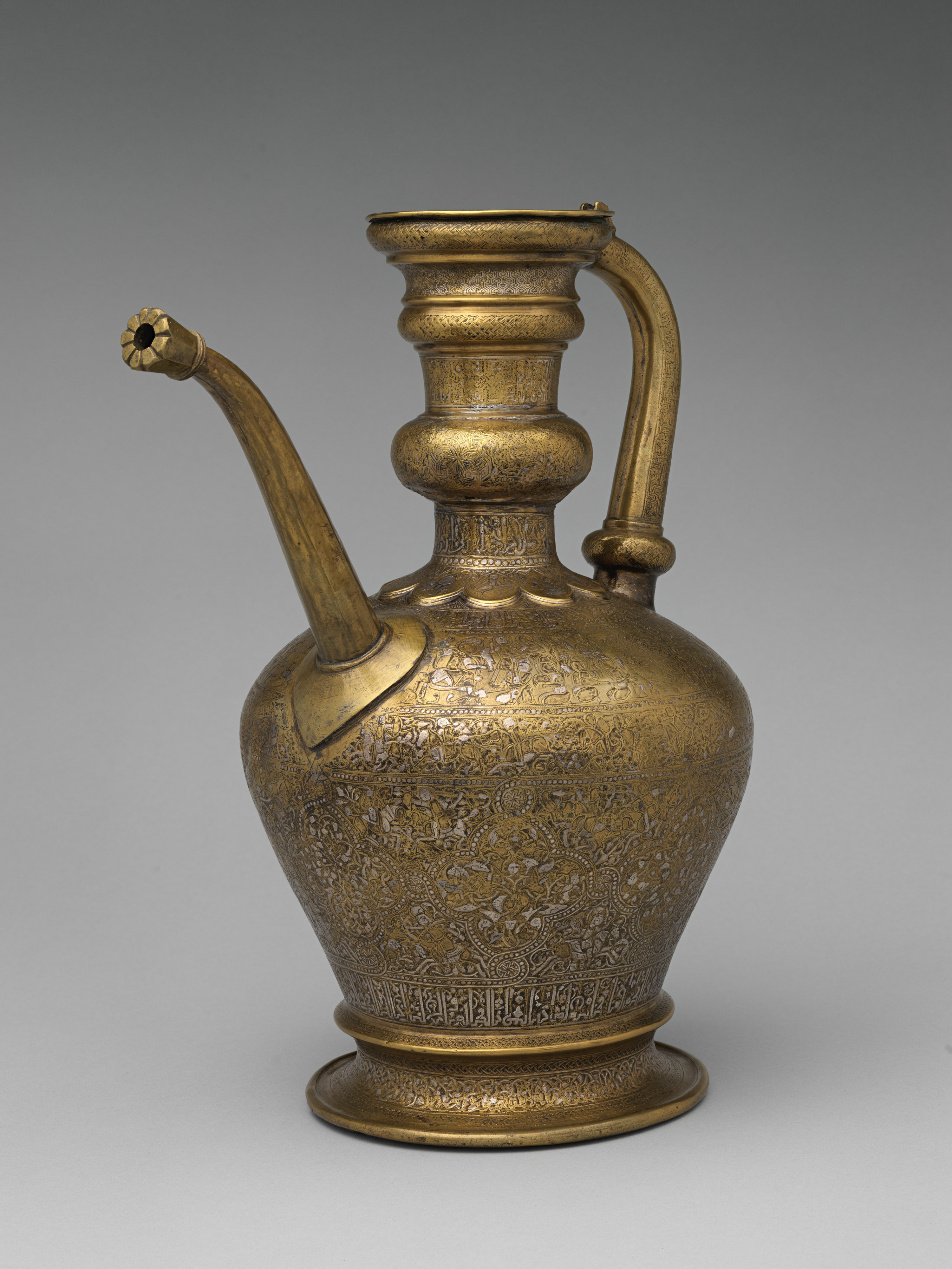
The record in full
Chapter 1A brass ewer that names its maker and its year
The Cleveland Museum of Art catalogues this vessel as Luxury Ewer Extending Good Fortune to the Owner, accession number 1956.11.
The Cleveland Museum of Art catalogues this vessel as Luxury Ewer Extending Good Fortune to the Owner, accession number 1956.11. It is brass inlaid with silver, 37.9 centimetres high overall, 26.6 centimetres across the body and 14.5 centimetres across the base, and the museum gives it a date of 1223, which is the year 620 of the Islamic calendar as the neck inscription records it. It entered the collection in 1956 through the John L. Severance Fund and is listed on the museum's own page in Gallery 116, Islamic art.
Its importance in the literature comes from the neck. Most inlaid brass of the thirteenth century is anonymous. This ewer carries the name of the man who engraved it, a date, and a nisba, al-Mawsili, that has been argued over for seventy years: it can mean 'of Mosul' and was read by earlier scholars as proof that the vessel came from a workshop in that city. The 1999 catalogue entry for the object, held in the AMICO consortium database, calls the 620 inscriptions 'the earliest recorded signatures' of its maker. It is the anchor of a group of five inlaid brasses that D. S. Rice assembled in 1957 under the name of that maker, and so it sits at the start of one of the central quarrels in Islamic metalwork studies, over whether a Mosul school ever existed in the form the older books described.
The decoration is a single broad band around the body of medallions set against an arabesque ground. The museum describes vignettes of daily and courtly life: falconry, hunting, dancing and several groups of musicians. Much of the silver that once made the scenes legible is gone. What remains is a heavily weathered brass surface in which the architecture of the design, bands of large and small medallions, can still be read. The vessel as it stands is also a composite, and that fact matters as much as the signature (see the section on what was added later).
Chapter 2Four inscriptions, one scratched name and an undeciphered foot
The museum's structured record lists the inscriptions one by one.
The museum's structured record lists the inscriptions one by one. A band on the neck, in naskh, reads in the museum's translation: 'Work of Ahmad al-Thaki, the engraver, al-Mawsili, in the year 620 and glory to my owner.' A second naskh band at the base of the handle repeats the name in shorter form: 'Work of Ahmad al-Thaki al-Mawsili.' A band on the shoulder, in plaited animated kufic, is a catalogue of wishes addressed to whoever owned the vessel: good luck, learning, commanding respect, prosperity, pride, generosity, faithfulness, affection, glory, survival, justice, blessings, exaltedness, everlasting peace and charitable giving. The Cleveland translation has 'prosperity' twice; the Arabic is not given in the sources consulted.
A fourth band runs round the foot, again in naskh. The foot is one of the later additions to the vessel, and the museum records that the inscription on it 'has not yet been deciphered.' That is an unusual thing to say about a replacement part: someone, at an unknown date, made a new foot and put writing on it, and nobody has yet reported what the writing says.
Finally, the neck carries two roughly scratched graffiti of later owners, read by the museum as 'Husayn ibn Qasim' and 'Usta al-Muhtasib [?]', the second with the museum's own query mark. The museum's public page singles this out as a 'did you know' note: later owners roughly scratched their names into the ewer. Neither graffito has a date in the sources consulted.
The signature carries no place of manufacture. The inscription says al-Mawsili, 'the Mosuli', and nothing else about where the engraver worked. Everything built on the words 'of Mosul' rests on that one adjective.
Chapter 3The name on the neck
Three spellings of the maker's name circulate and they are one man.
Three spellings of the maker's name circulate and they are one man. The museum's inscription record and the AMICO entry write al-Thaki, a transliteration that renders the Arabic letter as th. The museum's attribution field and most of the secondary literature write al-Dhaki. The 1985 Freer Gallery catalogue by Esin Atil, W. T. Chase and Paul Jett expands the name to Ahmad ibn Umar al-Dhaki al-Mawsili and describes him as the head of an atelier. The epithet, according to the Wikipedia article (a tertiary source, to be replaced by Rice 1957 and Raby 2012 in full), means 'the sagacious'.
The neck inscription calls him 'the engraver'. That is a self-description of the craft the signature claims: the person who cut the design, rather than the caster or the patron. Metalwork of this class was made in stages and by different hands, and the signature on a dated ewer is therefore a claim about one stage. The sources consulted do not say how the casting, hammering and inlaying of this particular vessel were divided, and the record does not guess.
Wikipedia, citing Rice, says the maker ran an atelier with a younger associate, Abu Bakr Umar ibn Hajji Jaldak, whom it calls a ghulam and then qualifies as 'probably not a slave but more of an assistant.' That man is the signer of the Metropolitan Museum's ewer of 623 AH (1226), listed by the Museum under accession 91.1.586. The link between the two men is documented by the Metropolitan ewer and the later literature, not by anything on the Cleveland vessel.
Chapter 4Thirty medallions and what they show
The Cleveland description gives the scenes as falconry, hunting, dancing and groups of musicians, within multilobed medallions on a ground of interwoven arabesque.
The Cleveland description gives the scenes as falconry, hunting, dancing and groups of musicians, within multilobed medallions on a ground of interwoven arabesque. The AMICO entry adds a size logic: the large medallions carry everyday life, the small ones musicians, dancers or hunters. The Wikipedia article is more specific and, being a tertiary source, should be checked against Rice's plates: it counts thirty medallions in three rows of ten and lists, in the central row, hunting scenes (one with a blowgun, which it calls rare in Islamic art), an agricultural scene, two riders on camels, musicians, pastoral scenes including a shepherd playing a flute, and a young man reclining on a couch at an outdoor festivity.
The two descriptions overlap but do not match line for line. The museum lists falconry and dancing; Wikipedia lists agriculture, camels and a shepherd. The most likely reading is that each is a partial list of thirty vignettes, but no source consulted lays all thirty out, and this record does not reconcile them. The 13 alternate photographs on the museum's open-access object record, published with the first image, would be the way to settle it.
What the scenes were for is simple to state and the sources do not complicate it. The museum says the ewer 'was produced for luxury clientele'. The imagery belongs to a courtly repertoire of hunting, music and feasting that appears on inlaid brass of the period generally, and the shoulder band wishes the owner a long list of blessings. Nothing in the sources consulted proposes a hidden or esoteric programme behind the medallions or the wishes, and none is proposed here. The absence of one is itself the finding: this is a prestige vessel for pouring water or another liquid at a wealthy table, decorated in the manner expected of its class and addressed to its owner in the formulas of the time.
No patron is named. Whoever the 'my owner' of the neck inscription was, the text does not say, and the sources consulted do not identify them.
Chapter 5What was added later, and what was lost
The Cleveland catalogue states in its technique line: 'lid and base added later.' It repeats the point on the foot: the foot is a later addition.
The Cleveland catalogue states in its technique line: 'lid and base added later.' It repeats the point on the foot: the foot is a later addition. The Wikipedia article is more detailed and lists the base, the lower part of the spout where it joins the body, the lid and the uppermost ring of the neck. It adds that the vessel has been heavily weathered and that most of its original silver inlay has been lost.
These statements describe an object assembled from the original body and several replacement parts. The measured height of 37.9 centimetres is the height of the vessel as it now stands, so it includes the later lid and base. The museum does not publish the original height or the original form of the spout. Neither does it publish when or by whom the replacements were made. They could have been made in the thirteenth century or the nineteenth, in the Middle East or in New York, and no conservation report is recorded in the sources consulted. The 1999 AMICO entry already described the date as '1223; lid and base are later additions', so the composite state was known and catalogued before the museum's present record was written.
The practical consequence is for anyone using the ewer as evidence. The silhouette, the proportions of the neck and the form of the spout cannot be treated as the maker's without checking which parts are original. The engraved medallion bands on the body and the signature on the neck are the evidence of the 1223 workshop; the lid, base, foot and lower spout are not.
Chapter 6The workshop that Rice reconstructed
David Storm Rice (1913 to 1962, according to the Royal Asiatic Society's obituary notice by R.
David Storm Rice (1913 to 1962, according to the Royal Asiatic Society's obituary notice by R. H. Pinder-Wilson, published in 1963) published 'Inlaid Brasses from the Workshop of Ahmad al-Dhaki al-Mawsili' in the second volume of Ars Orientalis in 1957, pages 283 to 326. The Cleveland Museum's own bibliography records that the article mentions and reproduces the ewer on pages 287 to 300, with figures and several plates. The ewer had entered the museum the year before, which means it passed from a New York dealer's stock into the scholarly literature within roughly twelve months, and it did so as the earliest dated object of Rice's group.
Howayda Al-Harithy's abstract of her 2001 article on the Metropolitan Museum's ewer describes the group as five objects, dated between 620 and 640 of the Islamic calendar (1223 to 1242), of which the Cleveland ewer of 620 is the first. Wikipedia names among the workshop's works the Metropolitan ewer of 623 by the associate Ibn Jaldak, a basin now in the Louvre made for the Ayyubid sultan al-Adil II and an ewer of 640; the abstract does not list all five. The 1985 Freer Gallery catalogue, in its entry for a ewer made by a different craftsman in 1232, places Ahmad ibn Umar al-Dhaki's atelier among those active about 1220 to 1250 and gives the Cleveland ewer as its figure 47, 'dated 1223', next to the Metropolitan's figure 48, 'dated 1226'. Both captions read, in the catalogue's own words, 'Made by Ahmad b. Umar al-Dhaki al-Mawsili' and 'Made by Umar b. Hajji Jaldak.'
Rice's reconstruction of the career is, as summarised by Wikipedia, mobile. He placed the workshop in the 1220s in territory held by the Artuqids, possibly at Amid, on the evidence of a candlestick by Ibn Jaldak inscribed with the title al-Malik al-Mas'ud, and then moved the master to Mamluk-ruled Syria or Egypt after the fall of the Artuqid principalities in 1232, to find new patrons. On this reading the Louvre basin shows adaptation to Syrian and Egyptian taste, and the ewer of 1242 shows more. The Cleveland ewer, dated three years before Ibn Jaldak's, is the Mesopotamian beginning of that line.
The date matters for another reason. In 1223 and 1226 the pair of Cleveland and Metropolitan ewers are, on the sources consulted, the only dated pieces made before the 1230s that carry the workshop name. Any argument about where the workshop stood in the 1220s rests on them and on the candlestick.
Chapter 7Mosul or Amid: the argument Raby reopened
The question 'where was it made' is the live dispute.
The question 'where was it made' is the live dispute. The Wikipedia article reports that Julian Raby, in his 2012 essay 'The Principle of Parsimony and the Problem of the Mosul School of Metalwork' (in Metalwork and Material Culture in the Islamic World, edited by Venetia Porter and Mariam Rosser-Owen, pages 11 to 85), criticised some of Rice's assumptions. He argued that the master probably worked in Mosul, that his workshop exported pieces to distant princes, and, in a sentence the article quotes, that he 'was surely not in Amid/Diyarbakir in the 1220s, as Rice proposed'. The article adds that Raby pointed to a geometric octagon and a relief rosette that recur on works by other craftsmen who style themselves al-Mawsili.
The octagon is the same hinge on which Raby's wider case turns. A review of the volume by Bulle Tuil-Leonetti, published in French, summarises the essay as arguing that an inlaid-metalwork workshop did exist in Mosul, reviewing earlier theories that date from the early nineteenth century, reanalysing the inscriptions and identifying several workshop marks. The reviewer finds the systematic approach convincing and regrets the absence of technical analysis of the metals, which she says could refine dates and relationships between objects. That regret is a point to remember here: no published compositional analysis of this ewer's brass or silver is known to the sources consulted.
Against both Rice and Raby sits the museum's own hedge. Its culture line reads 'Iraq, possibly Mosul, Zangid or Artugid Period, 13th Century.' The word 'possibly' qualifies Mosul, and the two periods named are the two political settings that the literature has proposed for the workshop: Zangid for Mosul under its Zangid line and Artuqid for the Artuqid territories to the north where Rice looked. The museum does not say which it prefers. Its prose description, meanwhile, calls the ewer 'signed by the master craftsman Ahmad al-Dhaki of Mosul' with no qualification. The same museum record therefore says both 'possibly' and 'of Mosul', and a reader should take the culture line, which is the more careful of the two, as the museum's position.
The wider question is statistical as much as historical. Wikipedia's article on the metalworking of Mosul, again as a tertiary source, notes that of 35 signed pieces, 27 identify their maker as al-Mawsili, and that older claims that the Mongol sack of 1256 ended the industry have been disproved. The nisba is common and it is the object of the debate. If the adjective is a workshop mark, a name of origin that travelled with its bearer, or a trade epithet, the ewer's place of manufacture changes with it. Al-Harithy's 2001 article uses the apprentice's ewer at the Metropolitan Museum as what she calls 'a turning point' for revisiting the origin of the Mawsili school; her abstract does not state her conclusion, and the full text was not accessible for this record.
No scholar consulted claims to settle the matter. The record's position is that the maker is certain from the signature and that the place is open.
Chapter 8From a New York dealer to Cleveland, 1956
The museum's provenance has two lines: Raphael Stora (1888 to 1963), New York, sold to the Cleveland Museum of Art, before 1956; and the Cleveland Museum of Art, from 1956.
The museum's provenance has two lines: Raphael Stora (1888 to 1963), New York, sold to the Cleveland Museum of Art, before 1956; and the Cleveland Museum of Art, from 1956. That is all. The credit line is the John L. Severance Fund and the year of accession is 1956. No price has been published in any source consulted, no invoice or date within 1956 is given, and the museum's page flags that the provenance 'may not be current'.
Stora is a revealing name to find on an Islamic brass. The Frick Collection's Archives Directory describes R. Stora and Company as a dealer and gallery run by Raphael Stora, active from 1931 to 1963, based in New York with a second house in Paris, the M. and R. Stora Gallery, specialising in sculpture and decorative arts, 'particularly Gothic and Renaissance objects', with much of its business done directly with museums. The Getty Research Institute holds the Stora Art Galleries stock sheets, ledger and auction catalogue for 1937 to 1963, according to the same entry. A Middle Eastern inlaid ewer is outside that stated specialty. Whether Stora bought it as a stray in a wider purchase, took it on consignment or traded outside his usual field is not known. The stock sheets would show it, and they have not been consulted for this record.
Where Stora got it is unknown. For 733 years between the date on the neck and the first named owner, the object has no recorded history except what it says about itself: its later owners' names, its replaced parts and its worn silver. No sale, no collector, no dealer and no export document is recorded before the dealer. In particular no source consulted gives a country or year of departure from the Middle East, and the record does not assume one. A sale from a New York dealer to a New York or Ohio buyer would not itself have triggered any export application, and no earlier crossing of a border is documented in either direction.
The 1958 Cleveland handbook lists the vessel as number 710, the 'Silver inlaid Brass Ewer' inscribed with the name of Ahmad ad-Dhaki 'the engraver of Mosul', dated 1223 (the caption is read here from an OCR text of the handbook and the spelling has not been checked against the printed page). It sits between a bronze partridge from north-eastern Iran and a Syrian tray. It was thus in the permanent display within two years of its arrival.
Chapter 9Naming, numbers and the risk of confusion
The ewer has carried several names and numbers, and migrating titles are a direct source of version confusion in this field.
The ewer has carried several names and numbers, and migrating titles are a direct source of version confusion in this field. In 1958 the handbook calls it the silver inlaid brass ewer, number 710. The Freer Gallery catalogue of 1985 cites it as 'Cleveland Museum of Art, 56.11', the pre-current form of 1956.11. The 1999 AMICO database entry titles it simply 'Ewer', attributing the inscription to 'Ahmad al-Thaki' and giving the size as a diameter of 26.6 centimetres and an overall measurement of 37.9 by 20.6 centimetres; the second figure is not explained in the entry and the museum's present record does not carry it. The present title, Luxury Ewer Extending Good Fortune to the Owner, is the museum's interpretive title and not a name from the inscription, although it paraphrases the shoulder wishes and the neck's 'glory to my owner'.
Do not confuse it with the Metropolitan Museum's ewer of 1226 by the associate Ibn Jaldak, accession 91.1.586, which is of similar type and is in a separately published record; with the Blacas ewer in the British Museum, signed by Shuja ibn Mana al-Mawsili in 1232; with the 1232 ewer in the Freer Gallery made by Qasim ibn Ali for Amir Shihab al-Din; or with the museum's own twelve-sided ewer with sphinxes (accession 1945.27), a different vessel of a different tradition that sits in the same gallery. The ewer here is the one with the 620 neck date.
The Wikipedia article on al-Dhaki states that a later owner, the Yemeni prince Husayn ibn Muhammad ibn Ahmad, left a mark dated 1775 on the Louvre basin. That mark belongs to the Louvre basin and not to this ewer; search summaries of the article have misattributed it, so it is stated here to prevent the error. No dated owner's mark is recorded on the Cleveland ewer in any source consulted.
Chapter 10Cited, lent and photographed: the object's afterlife
The museum's bibliography for the ewer is long for a vessel of its size and shows how it travelled through the literature.
The museum's bibliography for the ewer is long for a vessel of its size and shows how it travelled through the literature. It follows Rice's study (1957) with the museum's own handbooks (1958, 1966, 1969 and 1978), William Milliken's 'Early Byzantine Silver' in the museum's Bulletin (1958, reproduced on page 88), Dorothy G. Shepherd's article 'An Early Inlaid Brass Ewer from Mesopotamia' in the Bulletin (volume 46, number 1, 1959, pages 2 and 4 to 10), Malcolm Vaughan's 'Fine Mesopotamian Metalwork' in The Connoisseur (June 1959), Umberto Scerrato's Metalli Islamici (1966, number 40), the Hayward Gallery's The Arts of Islam (1976, catalogue number 195), Shepherd again in 1978 on a thirteenth-century Spanish tomb treasure (mentioned on pages 123 and 133), Alvise Zorzi's Marco Polo: Venezia e l'Oriente (1981), Eva Baer's Metalwork in Medieval Islamic Art (1983), the Freer catalogue (1985), the Penguin Art and Architecture of Islam, 650-1250 (1987), Sophie Makariou's catalogue for the Institut du monde arabe (2001, number 113), Ruba Kana'an's chapter 'The Biography of a Thirteenth-century Brass Ewer from Mosul' in God Is Beautiful and Loves Beauty (Yale University Press, 2013, pages 177 to 194) and Irvin Cemil Schick's essay on calligraphy at Dumbarton Oaks (2016, page 175). The Cleveland record does not itself say what any of these entries argue, and only the Freer catalogue was read in full text for this record.
The exhibition history on the museum's record is three entries: The Arts of Islam at the Hayward Gallery, London, 8 April to 4 July 1976; L'Orient de Saladin at the Institut du monde arabe, Paris, 22 October 2001 to 10 March 2002; and the museum's own rotation Art of the Islamic World, 21 May 2021 to 31 May 2022. The sources consulted do not say what the ewer was shown next to in London or Paris.
Kana'an's chapter title suggests the approach: it treats the vessel as an object with a life, not only a signature. That approach suits this ewer, because the life after 1223 is written on its body in replaced parts, a vanished inlay and scratched names, and it is the part of its history that a catalogue entry on a signed work usually leaves out. The chapter itself was not accessible for this record and the museum's page lists it as reproducing the ewer on page 180.
The museum's open-access programme releases the primary image and thirteen further views of the object as CC0 images, which is how the plate on this page is sourced. A student can therefore study the thirty medallions from the museum's own photographs without a permissions request.
Chapter 11What remains unresolved
Three things are fixed. The ewer carries a signature and a year: 620 of the Islamic calendar, 1223 on the museum's reckoning, made by Ahmad al-Dhaki al-Mawsili, who calls himself the engraver.
Three things are fixed. The ewer carries a signature and a year: 620 of the Islamic calendar, 1223 on the museum's reckoning, made by Ahmad al-Dhaki al-Mawsili, who calls himself the engraver. It reached Cleveland in 1956 from a New York dealer, Raphael Stora. And its lid, base, foot and part of its spout and neck are later than the body.
Everything else is open, and the open questions below are the working list. The most consequential is place: a vessel that is the earliest dated piece of a named workshop cannot give the workshop an address, because the inscription gives none, and the two scholars who have written most directly on the question, Rice and Raby, disagree about where the workshop stood. The next is time: seven centuries of ownership are known only from scratched names. The third is physical: the replacement parts have never been dated in any published source consulted. None of the three is a gap in effort. They are the points at which the documents run out.
The artist
Ahmad ibn Umar al-Dhaki al-Mawsili
Almost nothing is known of the man except what his own inscriptions and one associate's say. He signed this ewer in the year 620 of the Islamic calendar as 'the engraver' and wished glory to its owner, and the museum catalogues him as 'Iraqi, Mosul, active early 1200s?' with its own query. His workshop's reconstruction is the work of one scholar in 1957 and its relocation the work of another in 2012. What follows sets out what is documented, what is argued and who disagrees.
Related works
| Work | Relation | Where it is |
|---|---|---|
| Ewer with Inscription, Horsemen, and Vegetal Decoration (dated 623 AH/1226) Umar ibn al-Hajji Jaldak | Signed by the associate of the maker of the Cleveland ewer; three years later; same type. Brass inlaid with silver and black compound, 36.8 cm high; Edward C. Moore bequest, 1891. A separate record on this site covers it. | Metropolitan Museum of Art, New York, accession 91.1.586 |
| Basin made for the Ayyubid sultan al-Adil II Workshop of Ahmad al-Dhaki al-Mawsili | Attributed to the same workshop by Rice; dated c. 1238 to 1240. Details are from Wikipedia and the Louvre inventory number was not verified. The 1775 owner's mark mentioned in the literature belongs to this basin and not to the Cleveland ewer. | Musee du Louvre, Paris |
| Ewer of 640 AH (1242) Workshop of Ahmad al-Dhaki al-Mawsili | The latest piece in Rice's group; heavily altered. Whether these are one object under successive owners is not established in the sources consulted. | Formerly Octave Homberg collection per Wikipedia; the Freer catalogue lists a Keir Collection ewer dated 1242 |
| The Blacas Ewer (dated 1232) Shuja ibn Mana al-Mawsili | Explicitly says it was made in Mosul; the reference point for the whole Mosul school debate. A separate record on this site covers it. | British Museum, London |
| Ewer made by Qasim ibn Ali for Amir Shihab al-Din (dated Ramadan 629 AH, 1232) Qasim ibn Ali, apprentice of Ibrahim ibn Mawaliya al-Mawsili | A contemporary ewer of the same type by a different atelier; the Freer catalogue illustrates the Cleveland ewer in its entry. Per Atil, Chase and Jett 1985, catalogue entry 16, pp. 120-121. | Freer Gallery of Art, Smithsonian, Washington |
Open questions
- Where was the ewer made: Mosul, as Raby argues, Amid or another centre of the Artuqid territories, as Rice proposed, or somewhere else in the Jazira? The signature names only the nisba and the museum's own record says 'possibly Mosul'.
- Who owned the ewer between 1223 and the sale by Raphael Stora, and how did a dealer who specialised in Gothic and Renaissance objects come to hold it? The Stora stock sheets at the Getty Research Institute have not been consulted for this record.
- When, where and by whom were the lid, base, foot, lower spout and top neck ring replaced, and was the replacement a thirteenth-century repair or a later restoration? No conservation report is recorded in the sources consulted.
- What does the inscription on the later foot say, and what does it show about the ewer's use after its first owner?
- Who were Husayn ibn Qasim and the second owner whose name the museum reads with a query, and when were their names scratched on the neck?
- Why is a 1223 Mesopotamian ewer reproduced on page 88 of William Milliken's 1958 article 'Early Byzantine Silver' in the museum's Bulletin, as the museum's own bibliography records?
- Does a metallurgical analysis of the brass and silver exist for this vessel? Raby's reviewer regrets its general absence from the field, and the sources consulted report none.
- Are the Homberg ewer of 1242 named in the literature on this workshop and the Keir Collection ewer of 1242 listed in the 1985 Freer catalogue one and the same object?
Questions about this object
What is Luxury Ewer Extending Good Fortune to the Owner?
Luxury Ewer Extending Good Fortune to the Owner is an islamic metalwork, dated 620 AH (1223). Medium: Brass inlaid with silver; lid and base added later.
Who made Luxury Ewer Extending Good Fortune to the Owner, and is the attribution settled?
The attribution to Ahmad al-Dhaki al-Mawsili is recorded here as accepted. The maker is named by the neck inscription, which the museum translates as 'Work of Ahmad al-Thaki, the engraver, al-Mawsili, in the year 620', so authorship and date are not in question. The place is. The museum's culture line reads 'Iraq, possibly Mosul, Zangid or Artugid Period, 13th Century'. D. S. Rice (1957) placed the workshop in Artuqid territory, possibly Amid, in the 1220s, and Julian Raby (2012) argued it was in Mosul; the inscription gives only the nisba al-Mawsili. Lid, base and foot are later additions.
Where is Luxury Ewer Extending Good Fortune to the Owner now?
The Cleveland Museum of Art, Cleveland, Ohio, Gallery 116 (Islamic art). Inventory number 1956.11 (Cleveland Open Access object ID 133460); cited as 56.11 in the 1985 Freer catalogue. Last confirmed 18 November 2026. Purchase through the John L. Severance Fund, 1956, from Raphael Stora, New York. Gallery location from the museum's own collection page; whether the ewer is on view today is not verified.
What is still unknown about Luxury Ewer Extending Good Fortune to the Owner?
Where was the ewer made: Mosul, as Raby argues, Amid or another centre of the Artuqid territories, as Rice proposed, or somewhere else in the Jazira? The signature names only the nisba and the museum's own record says 'possibly Mosul'.
Sources
- 1Cleveland Museum of Art, collection page for 1956.11, 'Luxury Ewer Extending Good Fortune to the Owner' (title, culture, medium, dimensions, credit line, gallery location, description, open-access statement). clevelandart.org/art/...
- 2Cleveland Museum of Art Open Access API, object 133460 (accession 1956.11): provenance, inscriptions with translations, 21-item citation list, exhibition history, CC0 flag, image set. openaccess-api.clevelandart.org/api/...
- 3AMICO / David Rumsey archive, 1999 Cleveland Museum of Art catalogue entry 'Ewer' by Ahmad al-Thaki (earliest recorded signatures; foot band; later owners; dimensions). amica.davidrumsey.com/amico199907-35302.html
- 4Google Arts and Culture, Cleveland Museum of Art object page for the ewer (restates the museum's inscription, later additions and Stora provenance). artsandculture.google.com/asset/...
- 5Wikipedia, 'Ahmad al-Dhaki al-Mawsili'. en.wikipedia.org/wiki/...
- 6Esin Atil, W. T. Chase and Paul Jett, Islamic Metalwork in the Freer Gallery of Art (Smithsonian Institution, 1985), full text on the Internet Archive; entry 16, pp. 120-121, figs. 47-48 and note on Rice 1957a. archive.org/stream/...
- 7Howayda Al-Harithy, 'The ewer of Ibn Jaldak (623/1226) at the Metropolitan Museum of Art: the inquiry into the origin of the Mawsili School of metalwork revisited', Bulletin of SOAS 64:3 (2001), pp. 355-368; abstract only. cambridge.org/core/...
- 8Bulle Tuil-Leonetti, review of Porter and Rosser-Owen (eds.), Metalwork and Material Culture in the Islamic World (2012), summarising Julian Raby's essay 'The Principle of Parsimony and the Problem of the Mosul School of Metalwork', pp. 11-85. Secondary; Raby's own text was not accessible. journals.openedition.org/abstractairanica/...
- 9Wikipedia, 'Blacas ewer'. en.wikipedia.org/wiki/...
- 10Wikipedia, 'History of metallurgy in Mosul'. en.wikipedia.org/wiki/...
- 11Frick Collection, Archives Directory for the History of Collecting in America, 'R. Stora and Company'. research.frick.org/directory/...
- 12The Cleveland Museum of Art Handbook, 1958, full text (OCR) on the Internet Archive; entry 710. archive.org/details/...
- 13Islamic Metal museum gallery hub, card for 1956.11. Aggregator; attribution follows museum records. islamicmetal.com/en/...
- 14Metropolitan Museum of Art Collection API, object 444586 (accession 91.1.586), ewer of Umar ibn al-Hajji Jaldak. collectionapi.metmuseum.org/public/...
- 15R. H. Pinder-Wilson, 'D. S. Rice (1913-1962)', Journal of the Royal Asiatic Society 95:1-2 (April 1963), pp. 121-123; bibliographic page only. cambridge.org/core/...
Last verified · Published
Change log
18 November 2026 - Record created at the house standard: researched narrative, technical evidence, maker dossier, graded provenance chain, prices with hammer and premium separated, related works, open questions and sources.