Ewer with Inscription, Horsemen, and Vegetal Decoration
`Umar ibn al-Hajji Jaldak · 623 AH / 1226 CE
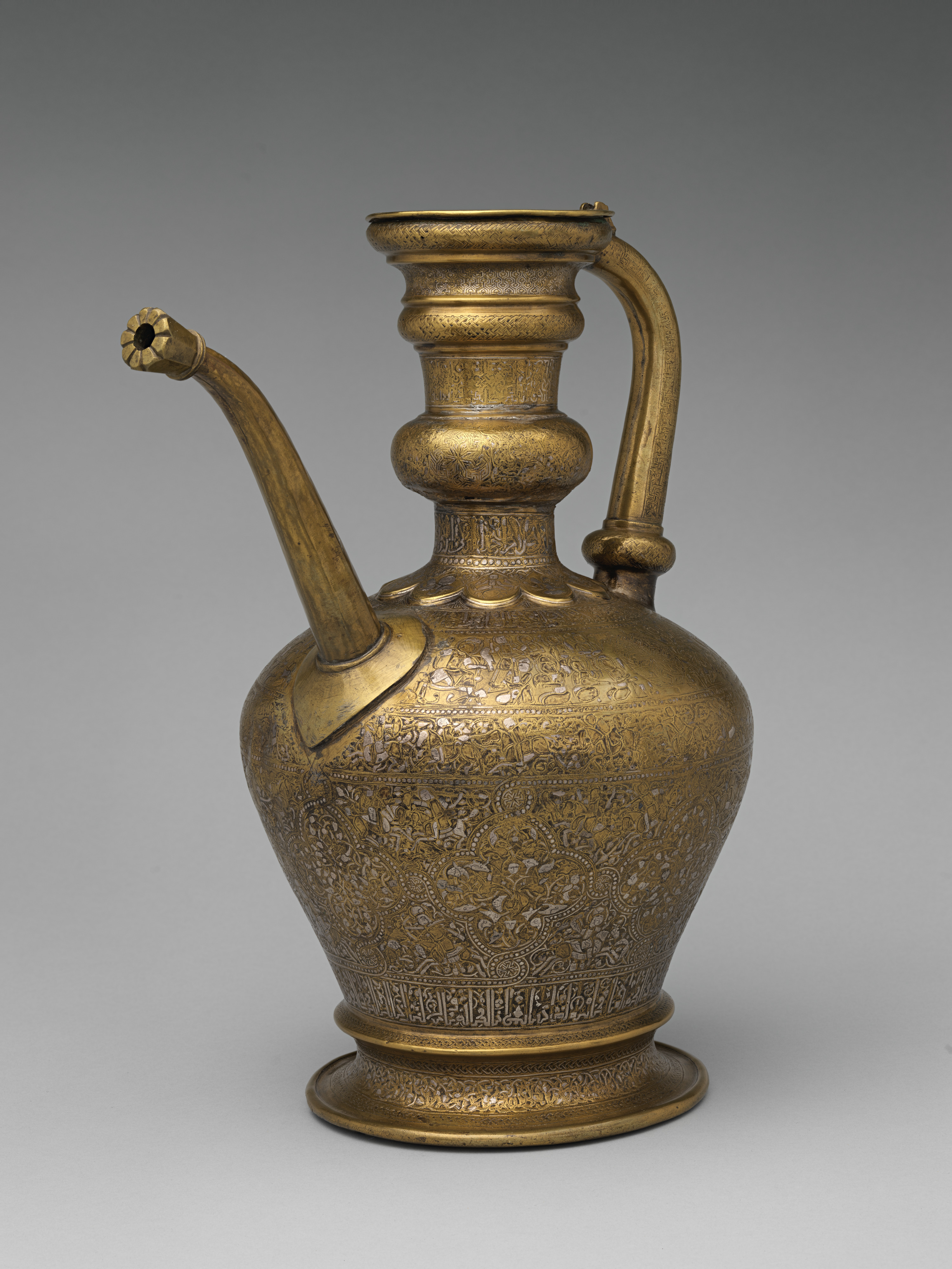
The ewer, dated 623 AH/1226 CE. Brass inlaid with silver and a black compound, with a band of horsemen in roundels around the body and an inscription band around the neck.
| Artist | `Umar ibn al-Hajji Jaldak |
|---|---|
| Date | 623 AH / 1226 CE |
| Medium | Brass, inlaid with silver and a black compound |
| Dimensions | H. 36.8 cm (14 1/2 in.); W. 30.6 cm (12 1/16 in.); Diam. 21.3 cm (8 3/8 in.) |
| Where it is now | Metropolitan Museum of Art, New York, Department of Islamic Artlast confirmed 18 September 2026 |
| Inventory number | 91.1.586 (object ID 444586) |
| Attribution | AcceptedThe maker names himself in his own dated inscription, so authorship of the ewer is not in question. Full note |
| Object type | Islamic metalwork |
| Period | Jazira/Mosul school, Ayyubid era, early thirteenth century |
| Cases | Has a provenance gap |
| Inscriptions | Around the neck, in Arabic: 'Made by `Umar ibn al-Hajji Jaldak, the apprentice of Ahmad al-Dhaki al-Naqqash al-Mawsili, in the year 623 [1226 CE].' No patron, owner or dedicatee is named. |
| Owners on record | 4 links3 documented, 1 unknown |
| Sources | 13 cited |
About this record Last verified 18 September 2026 · 13 sources cited · Change log
On this page 9 sections
ContentsClose
A brass ewer inlaid with silver and a black compound, dated by its own neck inscription to 623 AH/1226 CE and signed by a maker, `Umar ibn al-Hajji Jaldak, who names himself the apprentice of a documented master, Ahmad al-Dhaki al-Naqqash al-Mawsili. It is one of the objects D.S. Rice used in the 1950s to build the case for a distinct 'Mosul school' of inlaid metalwork, a framework that hardened quickly into near-orthodoxy and has since been re-tested, through this very object, by Howayda Al-Harithy, and defended in more qualified form by Julian Raby.
Nothing beyond this single inscription documents the apprentice who signed it, and nothing documents this ewer's owners for the six and a half centuries between 1226 and its appearance in Edward C. Moore's New York collection. Moore, Tiffany and Co.'s chief silver designer and one of the first serious American collectors of Islamic art, left it to the Metropolitan Museum in his 1891 bequest, where it has remained, catalogued and on public record, ever since.
Provenance
Each link is graded. Documented: a cited source supports it. Disputed: the identification is argued but not established. Unknown: no owner for that span, and the gap is not smoothed into a narrative. The grades in the glossary.
- 623 AH/1226 CE -`Umar ibn al-Hajji Jaldak (maker)documented
Dated and signed by the maker in his own inscription, which also names his teacher, Ahmad al-Dhaki al-Naqqash al-Mawsili. No patron, owner or place of manufacture is named in the text.12
- - 1891Unknownunknown
No owner, dealer, sale or location is documented between 1226 and the object's appearance in Edward C. Moore's New York collection by the time of his death in 1891. Moore is documented as having acquired Islamic art through dealers and venues including Siegfried Bing, Samuel P. Avery, Alessandro Castellani, Samuel Colman, Albert Goupil, and the Paris, Vienna and Philadelphia world's fairs of 1867-1889, but no source consulted ties any of these specifically to this object.1011
- by 1891 - 1891Edward C. Mooredocumented
Moore died 2 August 1891 at Hastings-on-Hudson, New York, leaving his collection, including roughly four hundred works from the Islamic world, to the Metropolitan Museum. It remains the largest single body of Islamic material the Museum has received from one donor.11011
- 1891 - presentMetropolitan Museum of Art, New Yorkdocumented
Accessioned as 91.1.586, Edward C. Moore Collection, Bequest of Edward C. Moore, 1891. The Museum's own Collection API confirms isPublicDomain: true and gives no indication of deaccession, loan disposal or removal from the collection.1
Technical evidence
| Attribution note | The maker names himself in his own dated inscription, so authorship of the ewer is not in question. What is graded here is the place of manufacture. The Metropolitan Museum's own catalogue records it as 'Attributed to Iraq, probably Mosul,' and that attribution rests on the nisba 'al-Mawsili' carried by the maker's teacher and on stylistic grouping with other inlaid brasses of the same circle, not on any statement in the ewer's own inscription. Unlike the Blacas Ewer of 1232, whose text explicitly says it was made in Mosul, this ewer names no place of manufacture at all. Howayda Al-Harithy's 2001 study revisits exactly this gap between assumption and evidence through close examination of this object. |
|---|---|
| Medium | Brass, inlaid with silver and a black compound.12 |
| Dimensions | H. 36.8 cm (14 1/2 in.); W. 30.6 cm (12 1/16 in.); Diam. 21.3 cm (8 3/8 in.).1 |
| Inscription | A single band around the neck, in Arabic, naming the maker, his teacher and the year of manufacture. No patron, owner or place of manufacture is named.23 |
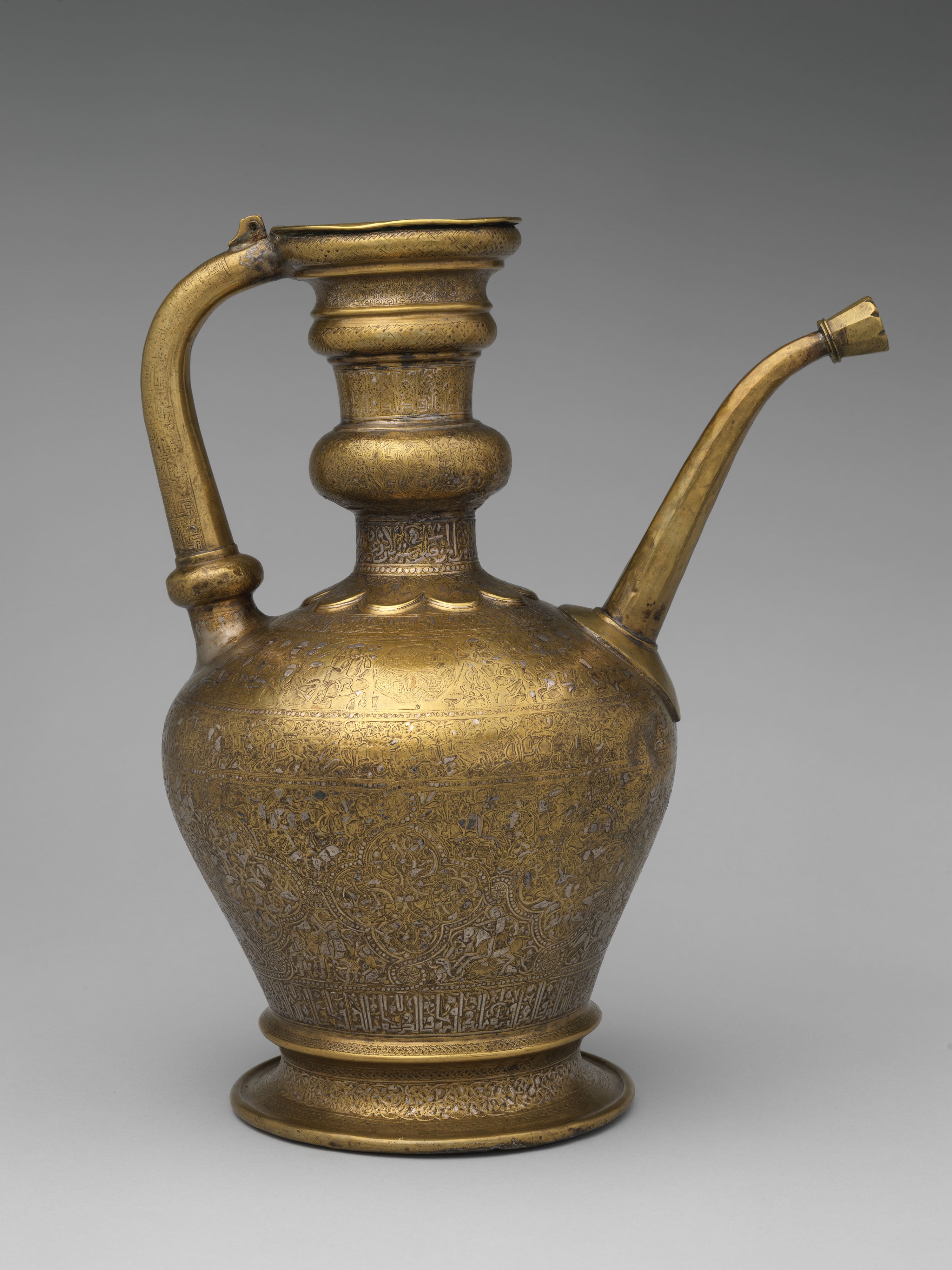
| Decorative program | A band of horsemen set in roundels around the body, against scrolling vegetal ornament; the object's own Museum title names this decoration directly.12 |
| Classification and accession | Classified by the Museum as Metal, Department of Islamic Art. Accession number 91.1.586, object ID 444586, accessioned 1891 as part of the Edward C. Moore bequest.1 |
| Attribution basis | The Museum's own geography field records 'Attributed to Iraq, probably Mosul.' This rests on the 'al-Mawsili' nisba carried by the maker's teacher and on stylistic grouping with other inlaid brasses of the same circle, not on any place-of-manufacture statement in this object's own inscription.1378 |
Images
The record in full
Chapter 1What it is
The ewer stands 36.8 centimeters high, 30.6 centimeters wide and 21.3 centimeters in diameter at its widest point, worked in brass and inlaid with silver and a black compound.
The ewer stands 36.8 centimeters high, 30.6 centimeters wide and 21.3 centimeters in diameter at its widest point, worked in brass and inlaid with silver and a black compound. The Metropolitan Museum catalogues it under a title that describes its own decoration plainly: 'Ewer with Inscription, Horsemen, and Vegetal Decoration.' A band of mounted figures set in roundels runs around the body against a ground of scrolling vegetal ornament, and a further band of inscription runs around the neck.
It belongs to a small, closely studied group of inlaid brass vessels made in the Jazira, the upper reaches of the Tigris and Euphrates, in the early thirteenth century, for pouring water or wine in a household wealthy enough to own metalwork finished to this standard. The inlay is what made such an object legible from across a room and valuable enough to be kept: silver, hammered as wire and sheet into chased grooves, set off by a filled black ground so the pattern read clearly even in lamplight.
Chapter 2The inscription and the two names it carries
The neck inscription gives, in the maker's own words, exactly two names and a date: 'Made by `Umar ibn al-Hajji Jaldak, the apprentice of Ahmad al-Dhaki al-Naqqash al-Mawsili, in the year 623 [1226...
The neck inscription gives, in the maker's own words, exactly two names and a date: 'Made by `Umar ibn al-Hajji Jaldak, the apprentice of Ahmad al-Dhaki al-Naqqash al-Mawsili, in the year 623 [1226 CE].' It names no patron, no owner and no place of manufacture. Everything documented about the man who made this object comes from this one sentence.
The relationship it records is explicit and unusual to have preserved at all: an apprentice, naming himself as an apprentice, on a finished and dated commercial object. Signed apprentice work is rare enough in this period that the inscription is treated as primary evidence for how metalworking workshops in the Jazira actually organized labor and training, not only for who made this particular ewer.
Chapter 3Dating the ewer
623 AH runs, in the Gregorian calendar, from roughly late December 1225 to mid-December 1226; the Metropolitan Museum's own object record gives the corresponding date range as 1225 to 1227.
623 AH runs, in the Gregorian calendar, from roughly late December 1225 to mid-December 1226; the Metropolitan Museum's own object record gives the corresponding date range as 1225 to 1227. The ewer therefore falls three years after the earliest securely dated work associated with the same master, Ahmad al-Dhaki's own signed ewer of 620 AH/1223 CE, now in the Cleveland Museum of Art.
D.S. Rice's foundational study grouped five inlaid brasses to this master's circle, spanning roughly 620 to 642 AH (1223 to 1242/43 CE): the Cleveland ewer, this ewer, a basin now in the Louvre made for the Ayyubid sultan al-Adil II around 1238 to 1240, and the so-called Homberg ewer of 640 AH/1242 CE, among others. This object sits early in that sequence, close to the master's own earliest documented work.
Chapter 4The master: Ahmad al-Dhaki al-Naqqash al-Mawsili
Ahmad al-Dhaki is the only figure in this story with more than a single inscription to his name.
Ahmad al-Dhaki is the only figure in this story with more than a single inscription to his name. His epithet 'al-Dhaki' translates as 'the sagacious.' His own signed ewer of 1223, now titled by the Cleveland Museum 'Luxury Ewer Extending Good Fortune to the Owner,' carries a shoulder inscription wishing its unnamed owner good fortune, prosperity and peace, and is decorated with a wide band of medallions showing scenes of courtly and daily life, including one of the few known depictions of blowgun hunting in Islamic art.
Beyond Cleveland and the Louvre basin, a further ewer known as the Homberg ewer, dated 1242, is heavily altered, with a replaced spout and lost inlay, and shows Christian iconography that has been read as evidence of the workshop's contact with Syrian Christian patrons or craftsmen. Across roughly twenty years, this is the entire documented output of the master under whom `Umar ibn al-Hajji Jaldak names himself an apprentice.
Chapter 5D.S. Rice and the making of the Mosul school
The scholar who first grouped these objects and gave the milieu its name was David Storm Rice (1913-1962), in 'Inlaid Brasses from the Workshop of Ahmad al-Dhaki al-Mawsili,' published in Ars...
The scholar who first grouped these objects and gave the milieu its name was David Storm Rice (1913-1962), in 'Inlaid Brasses from the Workshop of Ahmad al-Dhaki al-Mawsili,' published in Ars Orientalis in 1957. Rice's own reconstruction of the master's career was more mobile than the label that later attached to it: he proposed that al-Dhaki worked in Artuqid-controlled territory, possibly Amid, during the 1220s, and relocated toward Syria and Egypt only after the Artuqid principalities collapsed around 1232 and he needed new patrons.
Rice's wider body of work through the 1950s built the case for a distinct, named 'Mosul school' of inlaid metalwork, flourishing above all under the patronage of Badr al-Din Lu'lu', the atabeg who held effective power in Mosul from the 1210s and formal rulership from 1233. Several other pieces from this circle carry inscriptions recording their manufacture for Badr al-Din Lu'lu' by name. This ewer does not; it is linked to the group only through its maker's declared apprenticeship to al-Dhaki.
Chapter 6From hypothesis to near-orthodoxy, and a question reopened
Within a matter of years, the 'Mosul school' framework that began as Rice's own carefully qualified reconstruction had become close to received wisdom in the literature on Islamic metalwork: a single...
Within a matter of years, the 'Mosul school' framework that began as Rice's own carefully qualified reconstruction had become close to received wisdom in the literature on Islamic metalwork: a single named city, a single dominant patron, a lineage of named masters and apprentices. Howayda Al-Harithy's 2001 article in the Bulletin of SOAS, 'The ewer of Ibn Jaldak (623/1226) at the Metropolitan Museum of Art: the inquiry into the origin of the Mawsili School of metalwork revisited,' returns to that hardened consensus through close re-examination of this specific object, which she frames as 'a turning point in the development of Mawsili metalwork and a key piece to the puzzle.'
Julian Raby's later essay, 'The Principle of Parsimony and the Problem of the Mosul School of Metalwork' (2012), works the same ground from the opposite direction: rather than starting from Rice's Mosul attribution and testing it, Raby surveys the competing theories that had accumulated since these objects first entered European collections in the nineteenth century, identifies workshop marks across the inscribed corpus, and argues that a genuine Mosul atelier remains the most economical explanation for the evidence, while also tracing how the same inlay technique was carried outward and reproduced in Damascus and Cairo. By 2012, according to a review of Raby's essay, few scholars any longer dismissed the Mosul attribution outright, but fewer still treated it as a closed, single-city monopoly; the 'school' survives in the literature as a real but more porous and exported tradition than Rice's original naming implied.
Chapter 7What the decoration says, and does not say
The roundels of mounted horsemen and the surrounding vegetal scrollwork place this ewer within an established visual vocabulary of courtly self-presentation that recurs across the same workshop's...
The roundels of mounted horsemen and the surrounding vegetal scrollwork place this ewer within an established visual vocabulary of courtly self-presentation that recurs across the same workshop's output; Ahmad al-Dhaki's own Cleveland ewer carries a comparable band of courtly and hunting scenes in medallions. No source consulted publishes a detailed identification of what the individual roundels on this specific ewer show beyond the generic description in the Museum's own title, and this record does not invent one.
No patron is named, no dedicatee is named, and no source consulted proposes a hidden or esoteric program behind the horsemen and scrollwork. Read plainly, the decoration is ordinary luxury courtly imagery of the kind this workshop produced repeatedly for a market of buyers who wanted to be associated with mounted, princely leisure, whether or not any specific patron commissioned this particular piece. The absence of anything more specific is itself the honest finding here.
Chapter 8The gap: 1226 to 1891
Between the date on the ewer and its appearance in a documented American collection, no owner, sale, dealer or location is recorded in any source consulted for this record.
Between the date on the ewer and its appearance in a documented American collection, no owner, sale, dealer or location is recorded in any source consulted for this record. Six and a half centuries separate the inscription from the next fact that can be attached to the object.
This is not unusual for portable metalwork of this period and value, which moved through households, markets and, eventually, the nineteenth-century European trade in Islamic art without the kind of paper trail that later attaches to paintings passing through named auction houses. The gap is recorded here as a gap.
Chapter 9Edward C. Moore and the 1891 bequest
Edward C. Moore (30 August 1827 - 2 August 1891) trained in his father's New York silversmithing shop, became the exclusive supplier of silver to Tiffany and Co.
Edward C. Moore (30 August 1827 - 2 August 1891) trained in his father's New York silversmithing shop, became the exclusive supplier of silver to Tiffany and Co. in the 1850s, and moved his own manufactory into Tiffany in 1868, where he served as artistic director and chief silver designer until his death at his summer home in Hastings-on-Hudson. He collected across Islamic, Japanese, Greek and Roman decorative art, assembling roughly sixteen to seventeen hundred objects over his career, at a time when there was essentially no American market or institutional interest in Islamic art specifically.
He is recorded as having built his collection through personal and professional networks both in New York and abroad, including the dealers and connoisseurs Siegfried Bing, Samuel P. Avery, Alessandro Castellani, Samuel Colman and Albert Goupil, through private sales and public auctions in Paris and London, through the New York firms Tiffany and Co., A.A. Vantine and Co. and George A. Leavitt and Co., and through the world's fairs of Paris (1867, 1878, 1889), Vienna (1873) and Philadelphia (1876). No source consulted for this record ties any of these specific channels to the acquisition of this ewer. How and when Moore obtained it is not documented.
Chapter 10In the Moore bequest at the Met
Moore's 1891 bequest brought more than two thousand objects to the Metropolitan Museum, of which roughly four hundred were from the Islamic world: ceramics, glass and metalwork alongside jewelry...
Moore's 1891 bequest brought more than two thousand objects to the Metropolitan Museum, of which roughly four hundred were from the Islamic world: ceramics, glass and metalwork alongside jewelry, embroidery, papier-mache and wood. It remains, by the Museum's own account, the largest and most comprehensive single body of Islamic material ever to enter the collection, assembled before there was any real domestic market for it.
This ewer is one of several pieces of Islamic metalwork from that same 1891 accession year still catalogued and published individually by the Museum, alongside a basin with figural imagery (accession 91.1.521) and a tripod candlestick (accession 91.1.572), both separately recorded elsewhere in this corpus. All three entered the Museum together, in the same gift, from the same collector, in the same year, though nothing in the sources consulted connects their individual acquisition histories to one another before 1891.
Chapter 11What is unresolved
Two separate gaps sit inside this record and neither should be smoothed over.
Two separate gaps sit inside this record and neither should be smoothed over. The first is documentary: nothing is known about this ewer's whereabouts, owners or market history between 1226 and 1891, and nothing beyond this single inscription is known about the apprentice who signed it. The second is historiographical: the 'Mosul school' that this object is filed under was itself built, revised and partly re-tested by named scholars working across five decades, from Rice's original 1957 grouping through Al-Harithy's 2001 re-examination of this specific piece to Raby's 2012 defense of a qualified version of the attribution.
What is certain is narrower and more solid than either debate: a named apprentice, working under a named master, dated his own work to a specific year, and that object has been in one public collection, without interruption or dispute, for the century and a third since 1891.
The artist
`Umar ibn al-Hajji Jaldak
Everything documented about `Umar ibn al-Hajji Jaldak comes from a single sentence he wrote about himself, on a single object. No other inscription, document or later reference bearing his name has been identified in the sources consulted for this record. What can be said about him is therefore said almost entirely through the one relationship he chose to record: his apprenticeship to a named master.
Related works
| Work | Relation | Where it is |
|---|---|---|
| The Blacas Ewer Shuja' ibn Man'a al-Mawsili | The other dated anchor piece for Mosul-school chronology, made six years later in 1232 Unlike this ewer, the Blacas Ewer's own inscription explicitly states it was made in Mosul; before a comparable example surfaced in 1997, it was the only inlaid brass of the period to say so in its own text. | British Museum, London (1866,1229.61) |
| Luxury Ewer Extending Good Fortune to the Owner Ahmad al-Dhaki al-Naqqash al-Mawsili | The teacher's own signed and dated ewer, made three years earlier The earliest of the five inlaid brasses D.S. Rice grouped to this workshop, and the only securely documented work by the master under whom `Umar ibn al-Hajji Jaldak names himself an apprentice. | Cleveland Museum of Art (1956.11) |
| Basin with Figural Imagery Unattributed | Entered the Metropolitan Museum in the same 1891 Edward C. Moore bequest A separate Islamic metalwork record in this corpus; grouped here only by shared accession year and donor, not by workshop or maker. | Metropolitan Museum of Art, New York (91.1.521) |
| Tripod Candlestick Unattributed | Entered the Metropolitan Museum in the same 1891 Edward C. Moore bequest A separate Islamic metalwork record in this corpus; grouped here only by shared accession year and donor, not by workshop or maker. | Metropolitan Museum of Art, New York (91.1.572) |
Open questions
- How and when did Edward C. Moore acquire this ewer? No dealer, sale or date is documented before his 1891 bequest to the Metropolitan Museum.
- Where was `Umar ibn al-Hajji Jaldak active before or after 1226? No other work bearing his name has been identified in the sources consulted.
- Was Ahmad al-Dhaki working in Mosul itself in the 1220s, in Artuqid territory, or moving between the two? Rice and Raby give different answers and the question is not settled in the literature consulted.
- What, specifically, do the horsemen roundels on this ewer depict? No published iconographic breakdown of this object's own decoration, beyond the Museum's generic title, was found in the sources consulted.
- Has this ewer been exhibited since 1891, including in the Metropolitan Museum's own exhibitions built around the Moore bequest? No exhibition record for this specific object was found in the sources consulted.
- Did the ewer originally have a hinged lid, as some contemporary Jaziran ewers did, and if so, when was it lost? Condition and completeness are not discussed in the sources consulted.
Questions about this object
What is Ewer with Inscription, Horsemen, and Vegetal Decoration?
Ewer with Inscription, Horsemen, and Vegetal Decoration is an islamic metalwork, dated 623 AH / 1226 CE. Medium: Brass, inlaid with silver and a black compound.
Who made Ewer with Inscription, Horsemen, and Vegetal Decoration, and is the attribution settled?
The attribution to `Umar ibn al-Hajji Jaldak is recorded here as accepted. The maker names himself in his own dated inscription, so authorship of the ewer is not in question. What is graded here is the place of manufacture. The Metropolitan Museum's own catalogue records it as 'Attributed to Iraq, probably Mosul,' and that attribution rests on the nisba 'al-Mawsili' carried by the maker's teacher and on stylistic grouping with other inlaid brasses of the same circle, not on any statement in the ewer's own inscription. Unlike the Blacas Ewer of 1232, whose text explicitly says it was made in Mosul, this ewer names no place of manufacture at all. Howayda Al-Harithy's 2001 study revisits exactly this gap between assumption and evidence through close examination of this object.
Where is Ewer with Inscription, Horsemen, and Vegetal Decoration now?
Metropolitan Museum of Art, New York, Department of Islamic Art. Inventory number 91.1.586 (object ID 444586). Last confirmed 18 September 2026. Verified directly against the Museum's own Collection API (object 444586: accessionNumber 91.1.586, accessionYear 1891, isPublicDomain true) and its public collection page. No report of deaccession, loan disposal or removal was found in the sources consulted.
What is still unknown about Ewer with Inscription, Horsemen, and Vegetal Decoration?
How and when did Edward C. Moore acquire this ewer? No dealer, sale or date is documented before his 1891 bequest to the Metropolitan Museum.
Sources
- 1Metropolitan Museum of Art, Collection API, object 444586 (accession 91.1.586). collectionapi.metmuseum.org/public/...
- 2Metropolitan Museum of Art, '`Umar ibn al-Hajji Jaldak, Ewer with Inscription, Horsemen, and Vegetal Decoration,' online collection catalogue. metmuseum.org/art/...
- 3Howayda Al-Harithy, 'The ewer of Ibn Jaldak (623/1226) at the Metropolitan Museum of Art: the inquiry into the origin of the Mawsili School of metalwork revisited,' Bulletin of SOAS 64, no. 3 (October 2001): 355-368. Consulted via abstract; full text not accessible in this research session. cambridge.org/core/...
- 4D.S. Rice, 'Inlaid Brasses from the Workshop of Ahmad al-Dhaki al-Mawsili,' Ars Orientalis 2 (1957): 283-326. jstor.org/stable/...
- 5Julian Raby, 'The Principle of Parsimony and the Problem of the Mosul School of Metalwork,' in Metalwork and Material Culture in the Islamic World: Art, Craft and Text (2012). Consulted via published review; full text blocked in this research session. journals.openedition.org/abstractairanica/...
- 6R.H. Pinder-Wilson, 'D.S. Rice (1913-1962),' Journal of the Royal Asiatic Society 95, no. 1-2 (April 1963). cambridge.org/core/...
- 7Wikipedia, 'Ahmad al-Dhaki al-Mawsili.' Tertiary source, flagged for replacement with Rice 1957 and Raby 2012 in full; used here for the workshop chronology and the Rice/Raby locational debate. en.wikipedia.org/wiki/...
- 8Wikipedia, 'Blacas ewer.' Tertiary source, used for comparison only. en.wikipedia.org/wiki/...
- 9British Museum, 'The Blacas ewer,' Islamic World collection database, object 1866,1229.61. islamicworld.britishmuseum.org/collection/...
- 10The Magazine Antiques, 'Cosmopolitan Craftsman' (Edward C. Moore). themagazineantiques.com/article/...
- 11Wikipedia, 'Edward C. Moore (silversmith).' Tertiary source, flagged for replacement with the Metropolitan Museum's own Moore-bequest catalogue; used here for life dates and the scale of the bequest. en.wikipedia.org/wiki/...
- 12Cleveland Museum of Art, Open Access API, object 133460 (accession 1956.11), 'Luxury Ewer Extending Good Fortune to the Owner.' openaccess-api.clevelandart.org/api/...
- 13Wikipedia, 'History of metallurgy in Mosul.' Tertiary source, used only for the fact that other pieces from the same workshop circle name Badr al-Din Lu'lu' as patron in their own inscriptions. en.wikipedia.org/wiki/...
Last verified 18 September 2026 · Published 18 September 2026
Change log
18 September 2026 - Record created at the house standard: researched narrative, technical evidence, maker dossier, graded provenance chain, prices with hammer and premium separated, related works, open questions and sources.