Tripod Candlestick
Unidentified metalworking workshop in the al-Mawsili tradition · 1250-1300 (current Met catalogue); previously catalogued as first half of the 14th century
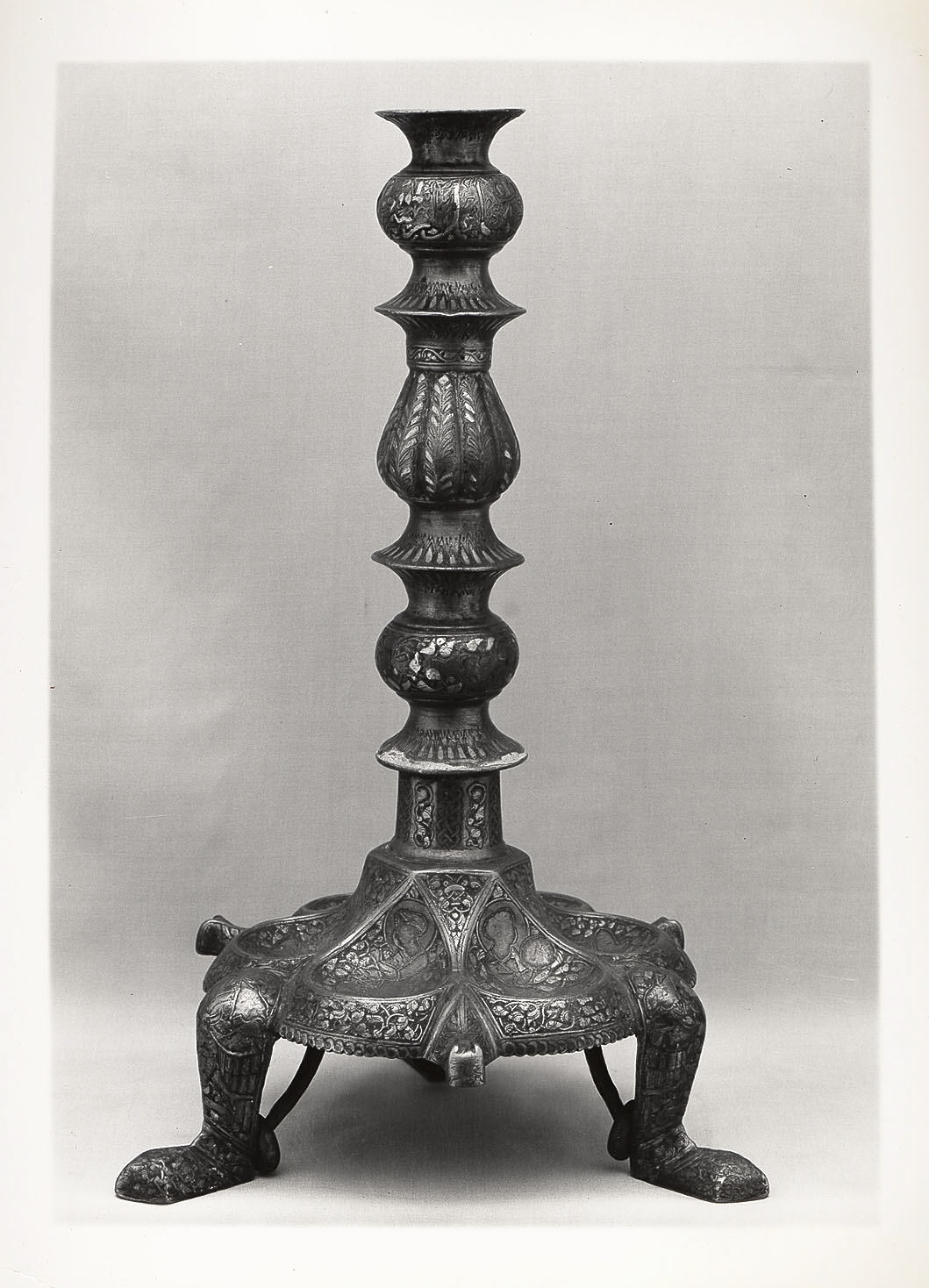
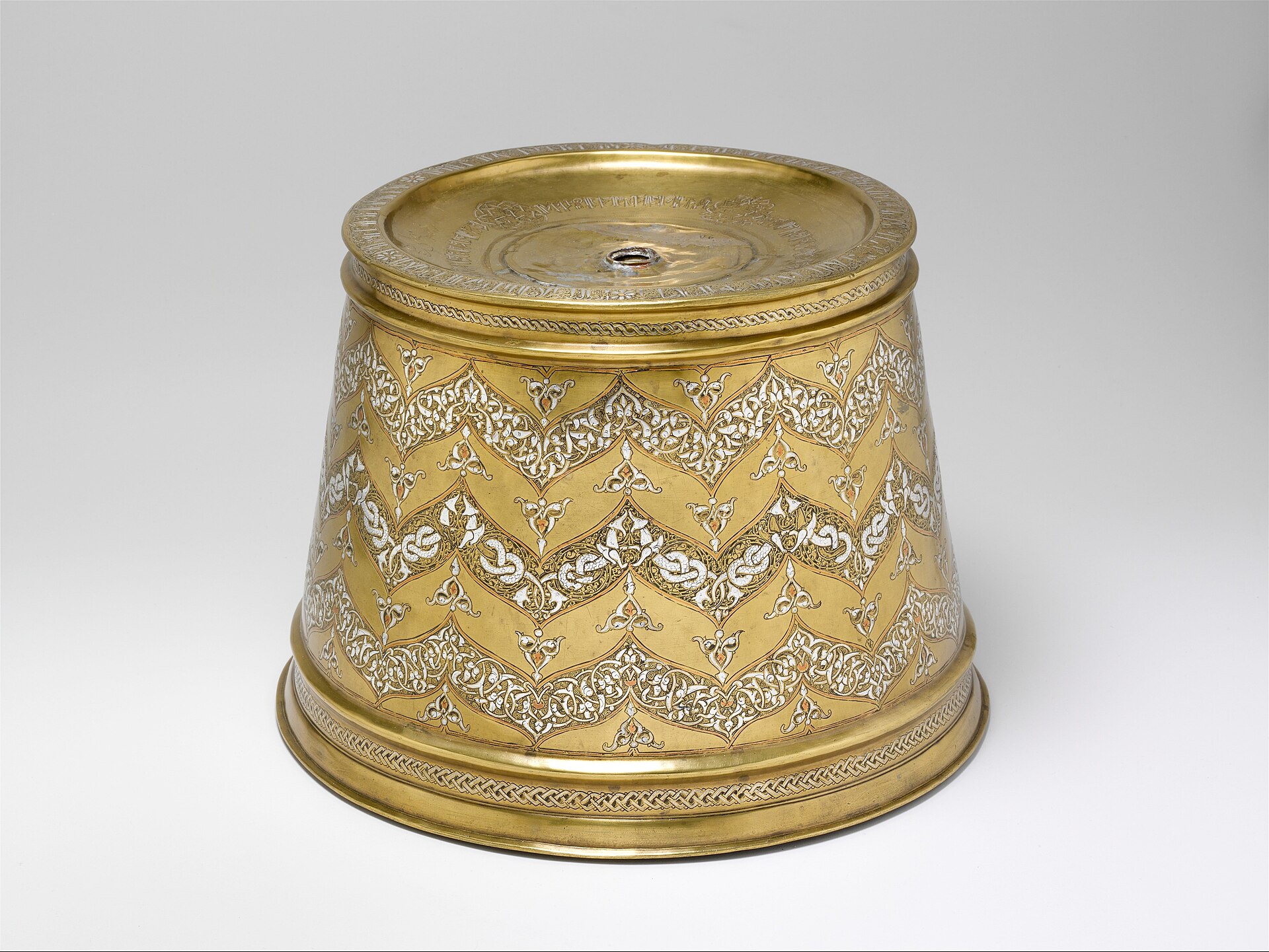
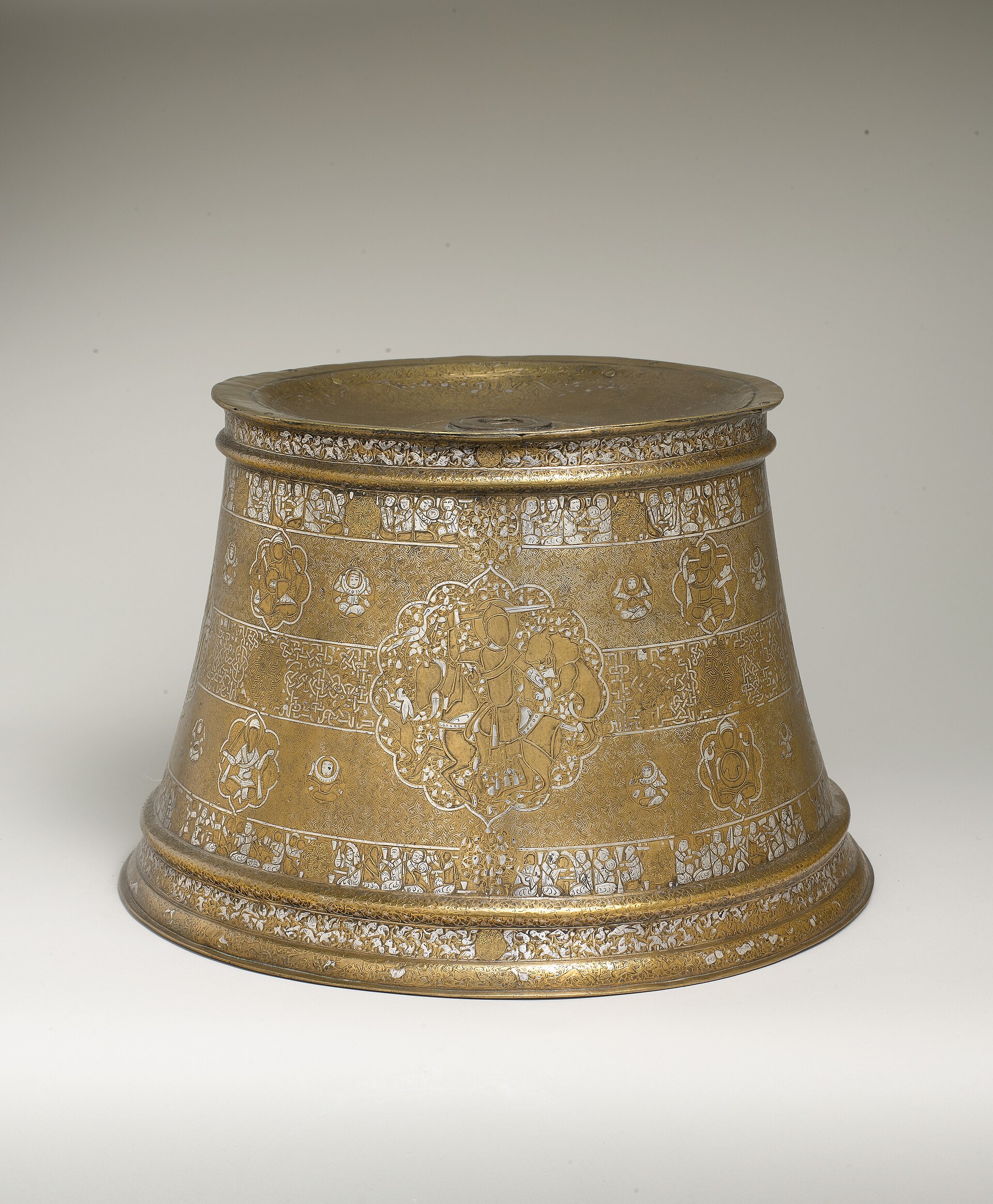
The candlestick described in this record. Brass inlaid with silver, gold, and black compound, probably Syria or northern Iraq, 1250-1300. Edward C. Moore Collection, Bequest of Edward C. Moore, 1891.
| Artist | Unidentified metalworking workshop in the al-Mawsili tradition |
|---|---|
| Date | 1250-1300 (current Met catalogue); previously catalogued as first half of the 14th century |
| Medium | Brass; cast, then inlaid with silver, gold, and a black compound |
| Dimensions | H. 12 5/8 in. (32 cm); Diam. 7 1/2 in. (19.1 cm) |
| Where it is now | The Metropolitan Museum of Art, New York, Islamic Art department, on view in Gallery 454 at The Met Fifth Avenuelast confirmed |
| Inventory number | Accession number 91.1.572 (object ID 444525 is a different, similar candlestick; this object's object ID is 444572) |
| Attribution | DisputedThe Metropolitan Museum's own cataloguing of this piece has moved. Full note |
| Object type | Islamic metalwork |
| Period | Islamic, Ayyubid-to-early-Mamluk transition in Syria or the Jazira, second half of the 13th century |
| Cases | Disputed attribution · Has a provenance gap |
| Inscriptions | Arabic dedicatory inscription on the upper bulb of the neck: "Of what was made to order for our Lord, the illustrious, the well-served Sharaf al-Din 'Abd al-Rahman." Translation credited by the Museum to HMcA, 1945. |
| Owners on record | 4 links3 documented, 1 unknown |
| Sources | 9 cited |
About this record Last verified · 9 sources cited · Change log
On this page 10 sections
ContentsClose
A brass candlestick standing on three cast feet, inlaid with silver, gold, and black compound, made for a named patron, Sharaf al-Din 'Abd al-Rahman, whose dedicatory inscription runs around the neck. The Metropolitan Museum has dated and located it two different ways in its own published catalogues: first half of the fourteenth century and Egypt in 1981, second half of the thirteenth century and probably Syria or northern Iraq in 2021. The later, current attribution ties its heraldic double-headed eagles to Badr al-Din Baysari, a Syrian Mamluk amir who died in 1298, though the link to this candlestick's own patron is a proposal, not a documented fact.
It has been in the Metropolitan Museum since 1891, part of the roughly 400 Islamic objects Edward C. Moore left the Museum out of a collection he assembled as a source of design ideas for Tiffany and Co. No owner before Moore is recorded, and nothing is published about how or when he acquired it.
Provenance
Each link is graded. Documented: a cited source supports it. Disputed: the identification is argued but not established. Unknown: no owner for that span, and the gap is not smoothed into a narrative. The grades in the glossary.
- 1250-1300 -Made to order for Sharaf al-Din 'Abd al-Rahmandocumented
The dedicatory inscription on the neck names the original patron, an unidentified dignitary titled 'our Lord, the illustrious, the well-served.' Nothing else about him is recorded on the object or, so far as this research found, in the published literature beyond the proposal that he may have served under the Mamluk amir Badr al-Din Baysari (d. 1298), which is argued, not documented.23
- - by 1891Unknownunknown
No owner is documented between the candlestick's manufacture in the second half of the thirteenth century and its presence in Edward C. Moore's New York collection by the time of his death in 1891. How, when, and through which dealer or route it left the Islamic world is not published in any source consulted for this record.12
- - 1891Edward C. Moore (1827-1891), New Yorkdocumented
Moore was the design director of Tiffany and Co. and one of the earliest serious American collectors of Islamic art, assembling roughly 400 Islamic objects among more than 2,000 pieces from around the world that he used as source material for Tiffany's silver designs. This candlestick is catalogued as object no. 110 in the Museum's 2021 study of that collection. No acquisition date, dealer, or price for this specific piece is published.125
- 1891 - presentThe Metropolitan Museum of Art, New Yorkdocumented
Bequeathed to the Museum on Moore's death in 1891 as part of the Edward C. Moore Collection. It has remained in the Museum's Islamic Art department continuously since, was shown in the Museum's own 1981-82 presentation of the Smithsonian's traveling exhibition 'Renaissance of Islam: Art of the Mamluks,' and is currently on view in Gallery 454.12
Technical evidence
| Attribution note | The Metropolitan Museum's own cataloguing of this piece has moved. When exhibited in 1981-82 in 'Renaissance of Islam: Art of the Mamluks' it was dated first half of the fourteenth century and attributed to Egypt. The Museum's current online catalogue entry, written by curator Deniz Beyazit for the 2021 volume Collecting Inspiration: Edward C. Moore at Tiffany and Co., redates it to the second half of the thirteenth century (displayed as 1250-1300) and reattributes it to probably Syria or northern Iraq, on the grounds of style and the heraldic double-headed eagle inlaid on each leg. Beyazit further proposes, without asserting it as fact, that the named patron inscribed on the neck, Sharaf al-Din 'Abd al-Rahman, may have been in the service of the Syrian Mamluk amir Badr al-Din Baysari (d. 1298), whose personal emblem was the double-headed eagle. That link is argued, not documented: no inscription on the object names Baysari, and no independent record ties the two men together. |
|---|---|
| Material and technique | Brass, cast, then inlaid with silver, with small highlights in gold, and with a black compound used to pick out fine engraved lines.12 |
| Dimensions | H. 12 5/8 in. (32 cm); Diam. 7 1/2 in. (19.1 cm).1 |
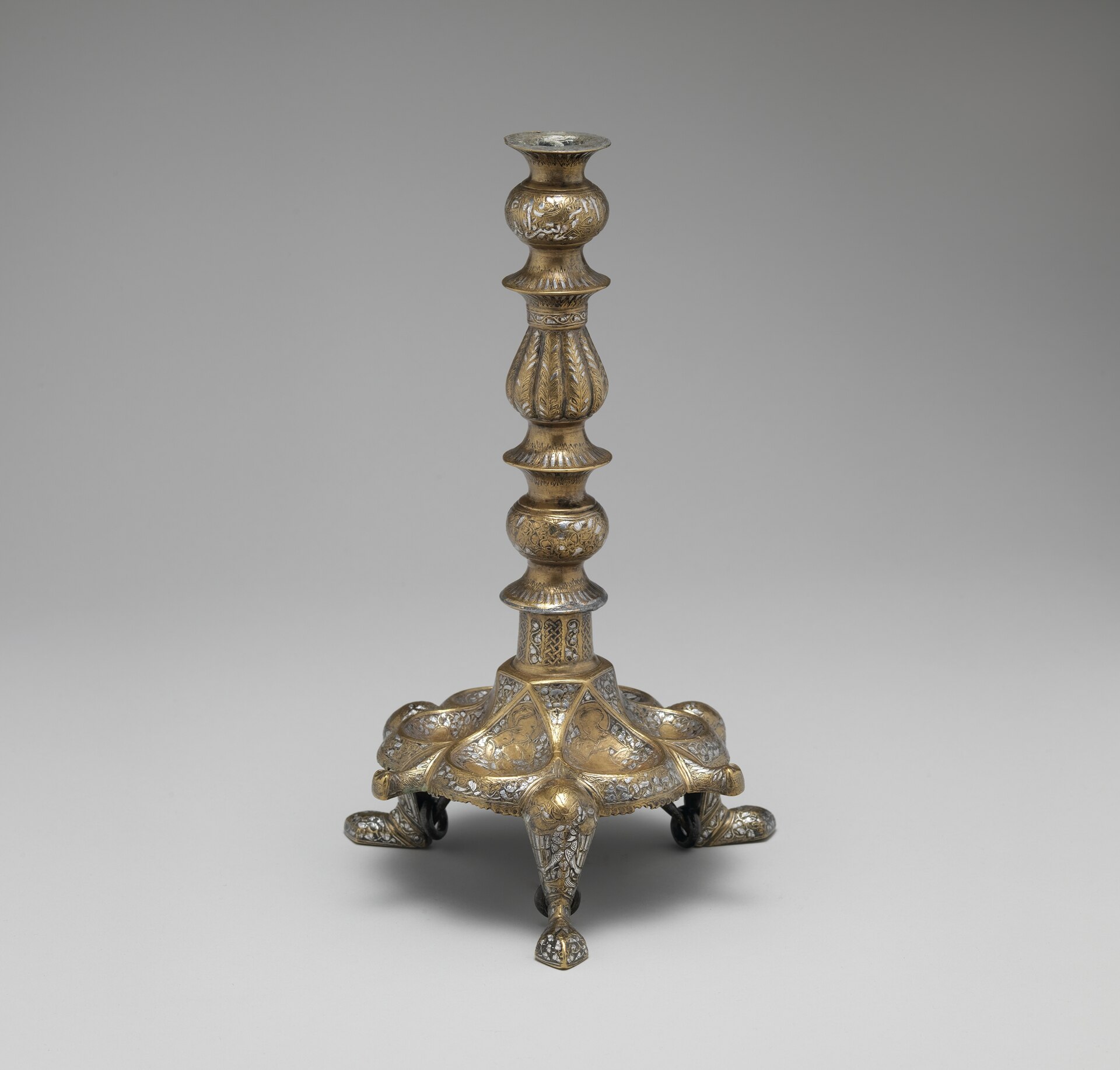
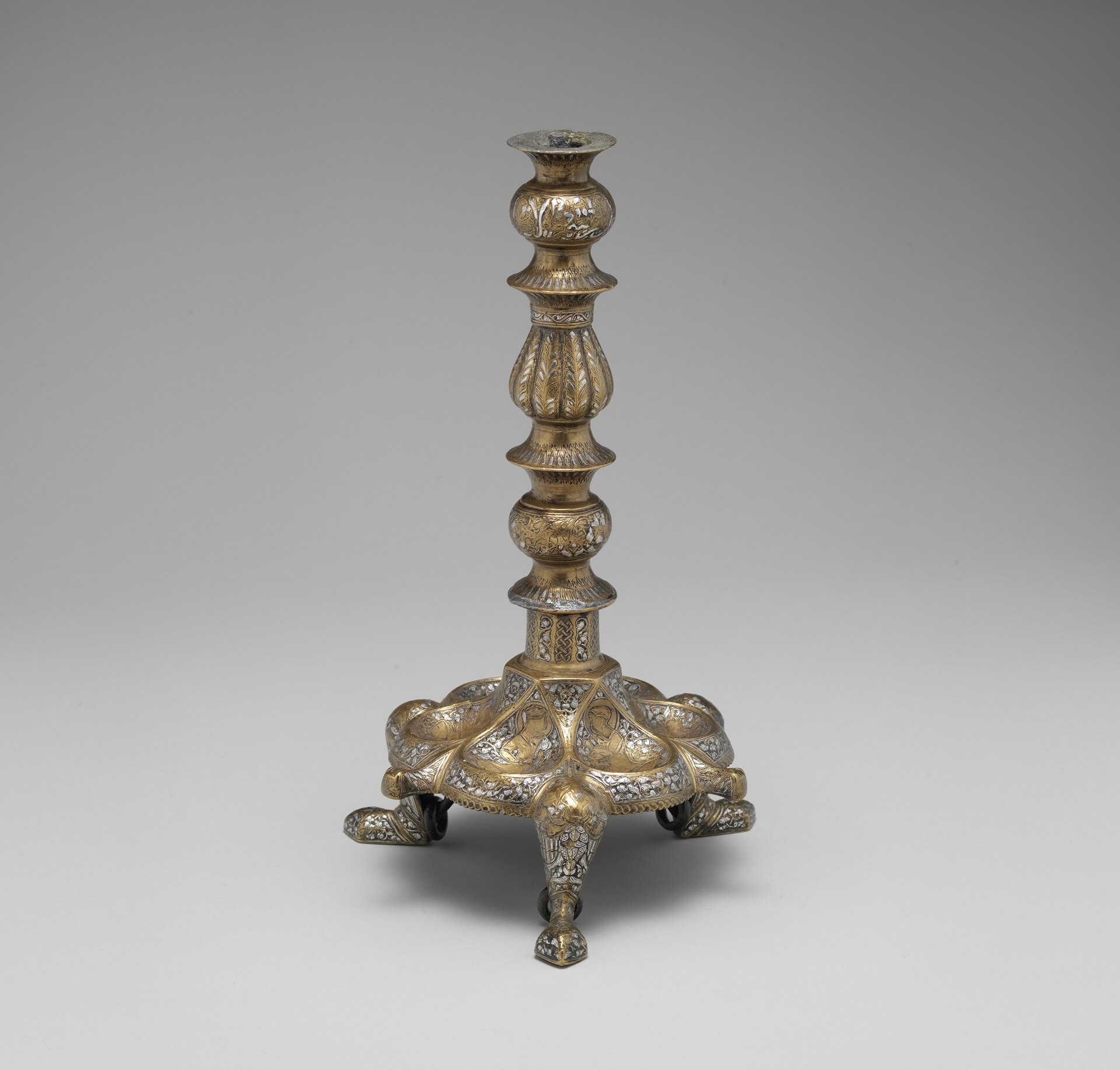
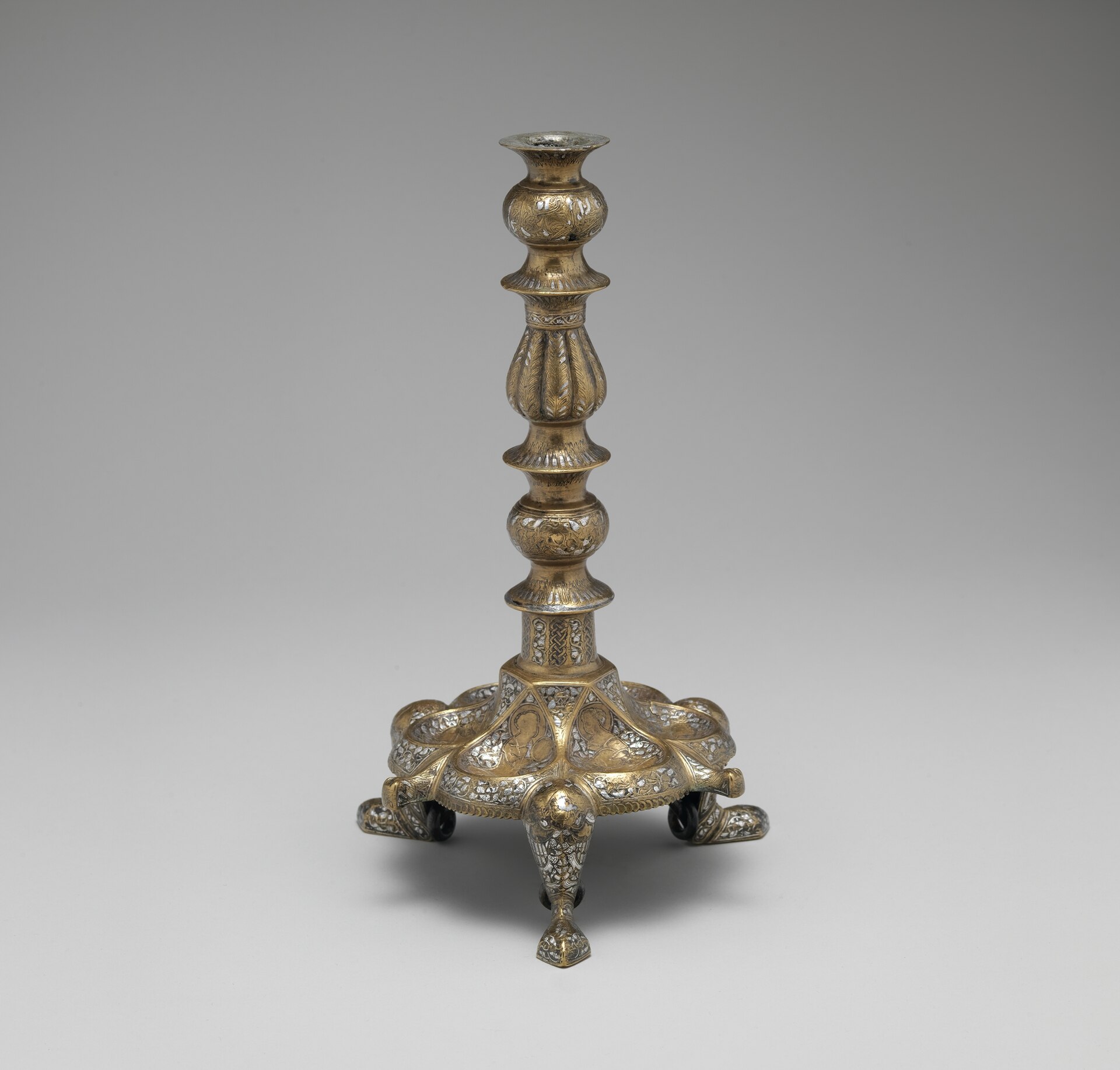
| Form | An elongated neck rising through three superimposed bulb-and-lobe elements from a wide, six-lobed rosette base standing on three cast feet, rather than the single flared conical base typical of the type that succeeded it.2 |
| Chain rings | A ring is attached to the back of each of the three legs, allowing a chain to be fastened to the object.2 |
| Inscription | Arabic dedicatory inscription on the upper bulb of the neck: "Of what was made to order for our Lord, the illustrious, the well-served Sharaf al-Din 'Abd al-Rahman." Translation credited by the Museum to HMcA, 1945.2 |
| Figural decoration | Each lobe of the base carries a seated, cross-legged figure inlaid in silver; the drop-shaped units between the lobes carry an enthroned ruler holding a wine cup and musicians playing flute, tambour, and oud, and another figure drinking - the repertoire the Museum calls the courtly cycle.2 |
| Heraldic emblems | A double-headed eagle is inlaid on the knee of each of the three legs; lion heads decorate the knobs between the lobes of the base. Both motifs were used across the medieval eastern Mediterranean as emblems of rulership and protection, and, in the case of the double-headed eagle, as the personal heraldic device of specific named amirs, including Badr al-Din Baysari.23 |
| Dating evidence for the gold inlay | Gold inlay of the kind found sparingly on this piece began to be used in Islamic metalwork only in the middle of the thirteenth century; the earliest datable example cited in the Museum's own scholarship is a Mosul ewer dated 1246, which bears on the current dating of this candlestick to the second half of that century.2 |
| Display | On view at The Met Fifth Avenue, Gallery 454, Islamic Art department.12 |
Images
The record in full
Chapter 1What it is
A brass candlestick 32 centimetres tall, standing on three cast feet rather than the single flared base typical of most Islamic candlesticks of the period, its surfaces inlaid with silver, with small...
A brass candlestick 32 centimetres tall, standing on three cast feet rather than the single flared base typical of most Islamic candlesticks of the period, its surfaces inlaid with silver, with small highlights of gold, and with a black compound used to set off fine engraved detail. A ring on the back of each leg would have let a chain be attached, presumably to secure or suspend the object, or perhaps to link it to a matching second candlestick.
The profile rises from the tripod base through a shaft built, in the Museum's own description, of three distinct superimposed elements that read as either stacked flower vases or a row of mosque lanterns, up to a wide socket at the top that held the candle itself. The base is a six-lobed rosette; each lobe carries a seated, cross-legged figure inlaid in silver, and the drop-shaped units between the lobes carry musicians. It is a small, portable, expensive object, made to stand in a room and be looked at as much as to give light.
Chapter 2A form on its way out
The Museum's own catalogue entry places this tripod shape in a specific typological sequence.
The Museum's own catalogue entry places this tripod shape in a specific typological sequence. The elongated shaft rising from a wide, lobed foot standing on three legs relates to a Byzantine prototype, and forms like it were common across the early and medieval Islamic world into the thirteenth or fourteenth century. After that point, candlesticks with a single truncated conical base became the standard shape, a change the Museum illustrates by cross-referencing this exact object against another piece from the same Moore bequest, a candlestick base now catalogued separately as a later, truncated type. The tripod form this candlestick represents was, in other words, already becoming old-fashioned within its own lifetime.
Some related tripod candlesticks carry feet cast as lions or other felines. This one does not: its feet are plain, and the double-headed eagle sits on the knee of each leg rather than replacing the foot itself.
Chapter 3How the decoration was made and what it means
The Museum's catalogue entry places this candlestick in the style of inlaid metalworking associated with the so-called al-Mawsili school, the tradition of brass and bronze inlay that took its name...
The Museum's catalogue entry places this candlestick in the style of inlaid metalworking associated with the so-called al-Mawsili school, the tradition of brass and bronze inlay that took its name from craftsmen working in and trained in Mosul before it spread with them across Syria and Egypt after the Mongol destruction of Mosul in the 1260s. Gold inlay of the kind used sparingly here, on the small dots along the lower edges of the base's lobes, is itself a dating tool: the technique began to be used only in the middle of the thirteenth century, and the earliest datable example the Museum's own scholarship cites is a Mosul ewer dated 1246.
The imagery belongs to what Museum scholarship calls the courtly cycle, a repertoire of images that decorated the household objects of the medieval Islamic ruling elite: an enthroned sovereign, shown frontally, sits on a simple raised throne holding a wine cup to his chest while musicians play flute, tambour, and oud around him, and another figure drinks. This is not narrative in the sense of illustrating a specific event or story. It is an image of an ideal, the leisured, protected, musical life of a ruler and his court, repeated across a whole class of luxury metalwork rather than invented for this one object. The double-headed eagle worked into each leg and the lion heads set into the knobs between the base's lobes belong to the same visual language: both were used across the medieval eastern Mediterranean, by Christian and Muslim patrons alike, as emblems of rulership and protection, and both were also used as personal heraldic devices by specific individuals. Nothing in the object or the published scholarship suggests a religious or devotional programme beyond this ordinary, secular vocabulary of courtly power; the absence of anything more esoteric is itself the finding.
Chapter 4The inscription and its unidentified patron
An Arabic inscription runs around the upper bulb of the neck: "Of what was made to order for our Lord, the illustrious, the well-served Sharaf al-Din 'Abd al-Rahman." The formula is a standard one...
An Arabic inscription runs around the upper bulb of the neck: "Of what was made to order for our Lord, the illustrious, the well-served Sharaf al-Din 'Abd al-Rahman." The formula is a standard one for luxury commissions of the period, naming the patron for whom the object was made rather than the craftsman who made it. Beyond the title and name given here, nothing else about Sharaf al-Din 'Abd al-Rahman is recorded on the object itself.
The Museum's current catalogue entry proposes, carefully hedged, that this patron may have been in the service of Badr al-Din Baysari, an important Syrian Mamluk amir who died in 1298 and whose personal heraldic emblem was the double-headed eagle that appears on each of this candlestick's three legs. That is an argued connection resting on shared iconography, not a documented one: no source consulted for this record shows the two men's names linked in any text, contract, or independent inscription. It is a proposal worth recording as exactly that.
Chapter 5Two different catalogues, two different objects on paper
This candlestick has been dated and placed by the Metropolitan Museum itself in two incompatible ways.
This candlestick has been dated and placed by the Metropolitan Museum itself in two incompatible ways. When it was shown in the Museum's own 1981-82 presentation of the Smithsonian's traveling exhibition Renaissance of Islam: Art of the Mamluks, curated with Esin Atil's catalogue, it was dated to the first half of the fourteenth century and attributed to Egypt; a 2017 bulk export of the Museum's own data, since donated to Wikimedia Commons, still carries that dating, and a later stock-photograph reproduction preserves the same wording along with a medium description that does not mention gold inlay at all.
The Museum's current online catalogue entry, written by curator Deniz Beyazit for the 2021 volume Collecting Inspiration: Edward C. Moore at Tiffany and Co., supersedes that: it redates the piece to the second half of the thirteenth century, displayed on the object page as 1250-1300, and reattributes it to probably Syria or northern Iraq rather than Egypt, arguing from style and from the Baysari heraldry rather than from any new inscription or technical finding. The Museum's own live database record was not brought into line with this 2021 published redating until very recently, weeks before this record was written. Both readings are the Museum's own; this record treats the newer one as the Museum's current position, states plainly that it replaced an older one, and does not pretend the question is closed, since the later reading itself depends on an argued, not a documented, historical link.
Chapter 6Edward C. Moore and the collection that brought it to New York
Nothing is documented about this candlestick's ownership between its manufacture in the thirteenth century and its presence, by 1891, in the New York collection of Edward C.
Nothing is documented about this candlestick's ownership between its manufacture in the thirteenth century and its presence, by 1891, in the New York collection of Edward C. Moore. Moore, who lived from 1827 to 1891, was the design director who built Tiffany and Co.'s reputation for originality in silver during the late nineteenth century, and he was also one of the earliest serious American collectors of art from across the Islamic world, gathering roughly four hundred such objects, in ceramics, glass, and inlaid metalwork from Egypt, Syria, and Iran, among more than two thousand objects of every kind that he assembled chiefly as source material for Tiffany's designers rather than as a scholarly collection in its own right.
This candlestick is catalogued as object number 110 in the Museum's own 2021 study of that collection, illustrated among more than 170 examples the book presents from it. No source consulted for this record publishes when, where, or from whom Moore acquired this specific piece, or what he paid for it; that transaction, if it was ever documented, has not surfaced in the literature this record was able to check.
Chapter 7Into the Museum, and there since
Moore's death in 1891 brought his entire collection to the Metropolitan Museum of Art as a bequest, and this candlestick has remained continuously in the Museum's Islamic Art department since.
Moore's death in 1891 brought his entire collection to the Metropolitan Museum of Art as a bequest, and this candlestick has remained continuously in the Museum's Islamic Art department since. Aside from its 1981-82 appearance in the Museum's own Mamluk exhibition, no other loan, exhibition, or period of storage is recorded in the sources consulted. It carries no history of theft, wartime loss, litigation, or export dispute, and none of the modern cultural-property mechanisms that apply to more recently or more contentiously acquired material - because it left whatever context it was made in, and entered American private hands, decades before any of those mechanisms existed. That absence is itself worth stating plainly rather than passing over.
Chapter 8What comparable pieces are worth now
This candlestick has never been sold at auction and there is no market value attached to it; it has been museum property since 1891.
This candlestick has never been sold at auction and there is no market value attached to it; it has been museum property since 1891. But the class of object it belongs to has a live market, and a dramatic one. In October 2021, Sotheby's London sold a different, privately owned thirteenth-century silver-inlaid brass candlestick base, attributed to Mosul and dated to around 1275, for 6.6 million pounds, reported as roughly 9.1 million US dollars - a price described at the time as a record for any work of Islamic art at auction, achieved after sustained competitive bidding. That piece had been in a single European private collection since the 1960s and had recently been on loan to the Metropolitan Museum itself; it is not part of the Moore bequest and is not the same object, or the same object type, as the candlestick described in this record, which is a complete tripod candlestick rather than a base. It is cited here only to show what serious, competitively contested demand for this general class of Mosul-tradition inlaid metalwork looks like when a genuinely fine example does reach the open market, which this candlestick, safely inside a public collection for over 130 years, never will.
Chapter 9On view, and still being written about
The candlestick is currently on view at The Met Fifth Avenue, in Gallery 454 of the Islamic Art department, and remains public domain and free to reproduce under the Museum's open-access policy.
The candlestick is currently on view at The Met Fifth Avenue, in Gallery 454 of the Islamic Art department, and remains public domain and free to reproduce under the Museum's open-access policy. It continues to draw fresh scholarly attention: beyond the 2021 Collecting Inspiration catalogue entry that reset its dating and attribution, it is cited again in a 2026 essay, 'Between Fact and Fantasy,' in the exhibition catalogue Orientalism, published by Yale University Press - a sign that the object is being actively used in current thinking about how nineteenth-century American collectors like Moore approached, and represented, the Islamic world, rather than sitting as settled, closed history.
Chapter 10What is still unresolved
The largest open question is the simplest one: nobody knows, on the evidence published so far, exactly where or under whose rule this candlestick was made, only that the Museum's own best current...
The largest open question is the simplest one: nobody knows, on the evidence published so far, exactly where or under whose rule this candlestick was made, only that the Museum's own best current guess is probably Syria or northern Iraq in the second half of the thirteenth century, revising an equally official earlier guess of Egypt in the following century. Nobody knows whether its patron, Sharaf al-Din 'Abd al-Rahman, really served the Mamluk amir whose emblem decorates the piece, or simply shared a taste for a fashionable heraldic motif that carried no personal connection at all. And nobody knows how the candlestick travelled from a workshop in Syria or the Jazira into a Gilded Age New York silver designer's collection, a journey of some six centuries that the historical record, at least as this research was able to establish it, simply does not cover.
The artist
Unidentified metalworking workshop in the al-Mawsili tradition, probably Syria or northern Iraq, second half of the 13th century
No maker's name, workshop stamp or signature survives on this candlestick. The inscription on its neck names only the patron for whom it was made, not the hand that made it, and the Museum's own attribution of where and when has changed once already on stylistic grounds alone. What follows is a reconstructed context, not a biography: the tradition this object belongs to, the grounds on which it has been placed and re-placed within that tradition, and the limits of what that placement can actually prove.
Exhibited
- 1981-1982Renaissance of Islam: Art of the Mamluks (suppl. no. 6)The Metropolitan Museum of Art, New York, November 21, 1981 - January 10, 1982
Related works
| Work | Relation | Where it is |
|---|---|---|
| Candlestick Base with Interlacing Dragons Unidentified metalworking workshop | From the same Edward C. Moore bequest; explicitly cited in this object's own catalogue entry as an example of the later, truncated single-base candlestick type that superseded the tripod form A different object and a different form (a base, not a complete tripod candlestick). Not to be confused with the candlestick described in this record. | The Metropolitan Museum of Art, New York, accession 91.1.561 |
| Candlestick with Enthronement Scene Unidentified metalworking workshop | Also from the Edward C. Moore bequest, dated by the Museum to the second quarter of the thirteenth century and attributed to Iraq; shares the enthroned-ruler-with-wine-cup image from the same courtly repertoire A different, earlier object. Listed by the Museum itself as a related work to this one. | The Metropolitan Museum of Art, New York, accession 91.1.563 |
| Unnamed silver-inlaid brass candlestick base, attributed to Mosul, c. 1275 Unidentified Mosul-tradition metalworking workshop | Same general workshop tradition and approximate date; sold at auction for a record price for Islamic art, providing market comparanda for the class of object Not part of the Edward C. Moore collection and not affiliated with the Metropolitan Museum beyond a recent loan exhibition. A different object; included here only for market context. | Private collection (sold Sotheby's London, October 2021) |
| Freer Canteen Unidentified workshop of the Mosul tradition of inlaid metalwork | Same broad Mosul-tradition inlaid-metalwork lineage and comparable date range, already catalogued on this site A different object and a different form (a canteen, not a candlestick). Cross-referenced for readers comparing Mosul-tradition workshop practice across object types. | Freer Gallery of Art, Smithsonian Institution, Washington, D.C. |
Open questions
- Where, precisely, was this candlestick made? The Museum's own attribution has moved from Egypt (1981) to probably Syria or northern Iraq (2021), and no technical or metallurgical study resolving the question was found in the sources consulted.
- Was the patron, Sharaf al-Din 'Abd al-Rahman, actually connected to the Mamluk amir Badr al-Din Baysari, whose heraldic emblem decorates the piece? The Museum's own catalogue entry presents this as a proposal, not a documented fact.
- How and when did the candlestick leave the Islamic world and enter Edward C. Moore's collection? No dealer, date, or route of acquisition is published in any source consulted.
- Has the object undergone any conservation treatment since entering the Museum in 1891? No conservation record was found.
- Was the ring on the back of each leg part of the object's original design, or a later addition? Its function - a chain, presumably - is described but its date is not.
- Does a matching second candlestick survive? Candlesticks of this type and value were sometimes made or used in pairs, and none is identified as a pair to this one in the sources consulted.
Questions about this object
What is Tripod Candlestick?
Tripod Candlestick is an islamic metalwork, dated 1250-1300 (current Met catalogue); previously catalogued as first half of the 14th century. Medium: Brass; cast, then inlaid with silver, gold, and a black compound.
Who made Tripod Candlestick, and is the attribution settled?
The attribution to Unidentified metalworking workshop in the al-Mawsili tradition is recorded here as disputed. The Metropolitan Museum's own cataloguing of this piece has moved. When exhibited in 1981-82 in 'Renaissance of Islam: Art of the Mamluks' it was dated first half of the fourteenth century and attributed to Egypt. The Museum's current online catalogue entry, written by curator Deniz Beyazit for the 2021 volume Collecting Inspiration: Edward C. Moore at Tiffany and Co., redates it to the second half of the thirteenth century (displayed as 1250-1300) and reattributes it to probably Syria or northern Iraq, on the grounds of style and the heraldic double-headed eagle inlaid on each leg. Beyazit further proposes, without asserting it as fact, that the named patron inscribed on the neck, Sharaf al-Din 'Abd al-Rahman, may have been in the service of the Syrian Mamluk amir Badr al-Din Baysari (d. 1298), whose personal emblem was the double-headed eagle. That link is argued, not documented: no inscription on the object names Baysari, and no independent record ties the two men together.
Where is Tripod Candlestick now?
The Metropolitan Museum of Art, New York, Islamic Art department, on view in Gallery 454 at The Met Fifth Avenue. Inventory number Accession number 91.1.572 (object ID 444525 is a different, similar candlestick; this object's object ID is 444572). Last confirmed 31 August 2026. The Museum's own object page and Open Access API record for object 444572, both current as of this record's research.
What is still unknown about Tripod Candlestick?
Where, precisely, was this candlestick made? The Museum's own attribution has moved from Egypt (1981) to probably Syria or northern Iraq (2021), and no technical or metallurgical study resolving the question was found in the sources consulted.
Sources
- 1The Metropolitan Museum of Art, Open Access Collection API, object record for object ID 444572 (accession 91.1.572), retrieved 2026-08-31. collectionapi.metmuseum.org/public/...
- 2The Metropolitan Museum of Art, 'Tripod Candlestick,' object page, catalogue entry by Deniz Beyazit, plus the Signatures/Inscriptions, Provenance, Exhibition History and References panels. metmuseum.org/art/...
- 3Atil, Esin. Renaissance of Islam: Art of the Mamluks (Nahdat al-fann al-islami fi al-ahad al-mamluki). Washington, D.C.: Smithsonian Institution Press, 1981, exhibition checklist no. 6. Cited from the Museum's own bibliography and exhibition history in source 2; the exhibition catalogue itself was not independently examined and should be consulted directly before this record is relied on for the 1981 dating and Egypt attribution, and for the identification of the double-headed eagle as Badr al-Din Baysari's heraldic emblem. metmuseum.org/art/...
- 4Beyazit, Deniz, Maryam Ekhtiar, and Asher Ethan Miller. 'Between Fact and Fantasy.' In Orientalism. New Haven and London: Yale University Press, 2026, p. 216. Cited from the Museum's own bibliography in source 2; not independently examined. metmuseum.org/art/...
- 5The Metropolitan Museum of Art, publication page for Collecting Inspiration: Edward C. Moore at Tiffany and Co., ed. Medill Higgins Harvey (New York: The Metropolitan Museum of Art, 2021), listing this candlestick among the objects illustrated in the volume and giving Moore's dates and collecting activity. metmuseum.org/met-publications/...
- 6Wikimedia Commons, File:Tripod Candlestick MET 91.1.572.jpeg, file and licensing page, confirming CC0 status and the Museum as the source of the upload. commons.wikimedia.org/wiki/...
- 7Alamy stock image caption, image ID 2HJ12C1, reproducing the Museum's earlier catalogue text for this object ('first half 14th century,' 'Attributed to Egypt,' medium given without gold inlay). A commercial stock-photo reseller, not a primary or scholarly source; used here only as evidence that the Museum's own cataloguing of this piece changed, and should be replaced with a dated copy of the Museum's earlier public record if one can be located. alamy.com/tripod-candlestick-first-half-14th-century-the-...
- 8Muslim Heritage, 'A Candlestick Base Sold for $9.1 Million!' - on the October 2021 Sotheby's London sale of an unrelated, privately owned Mosul-tradition candlestick base, used here only as market comparanda for the class of object. muslimheritage.com/candlestick-base
- 9Arab News, 'Candlestick breaks Sotheby's record for sale of an 'Islamic object' at $9.1 million.' Independent corroboration of the same 2021 sale, with the sale date given as October 27, 2021 (Muslim Heritage gives October 28; the discrepancy is unresolved in the sources consulted). arabnews.com/node/...

Last verified · Published
Change log
31 August 2026 - Record created at the house standard: researched narrative, technical evidence, maker dossier, graded provenance chain, prices with hammer and premium separated, related works, open questions and sources.