Pyxis Depicting Standing Saints or Ecclesiastics and the Entry into Jerusalem with Christ Riding a Donkey
Unknown metalworker(s), Ayyubid Syria or the Jazira (al-Mawsili tradition) · mid- to late 13th century
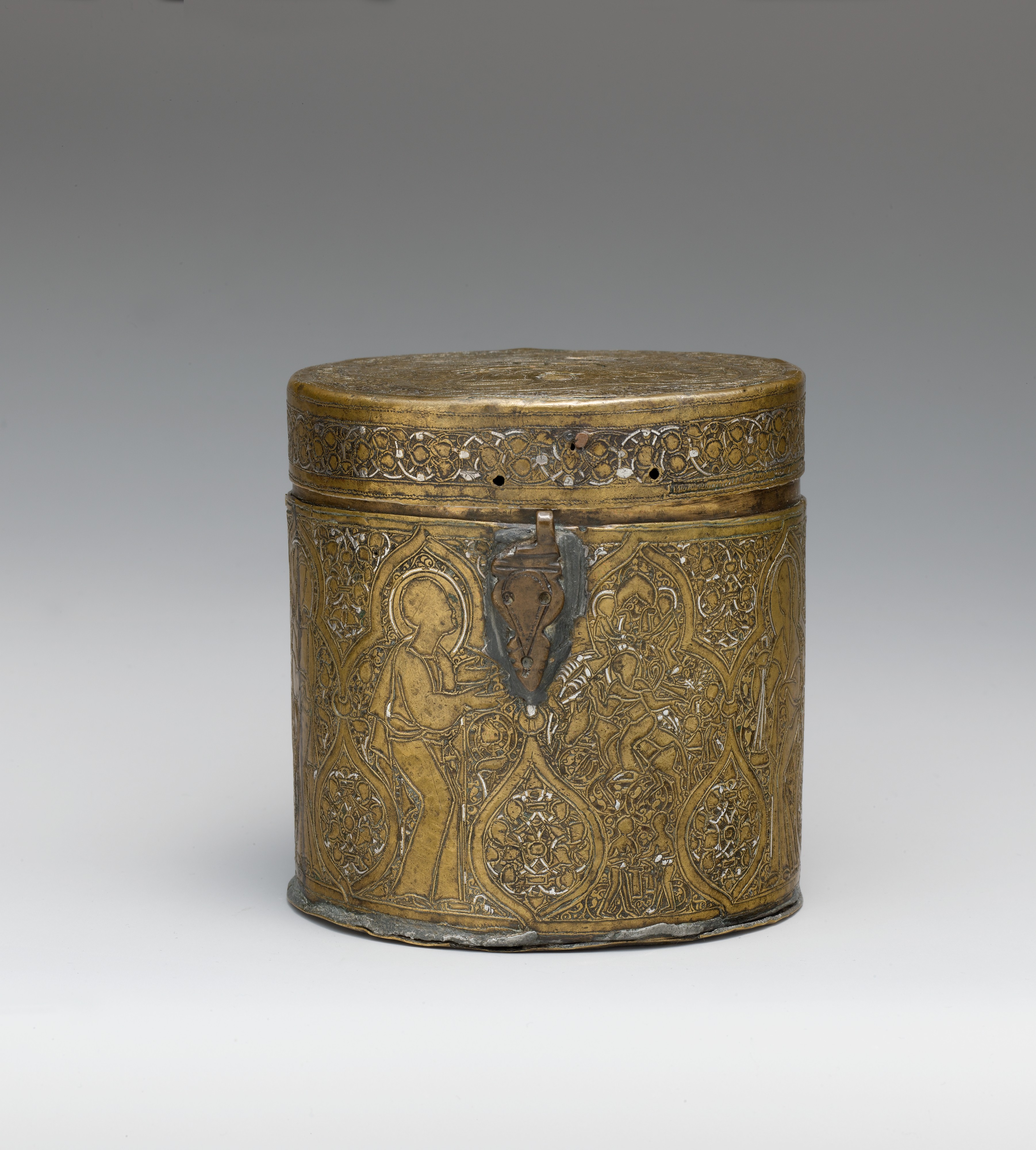
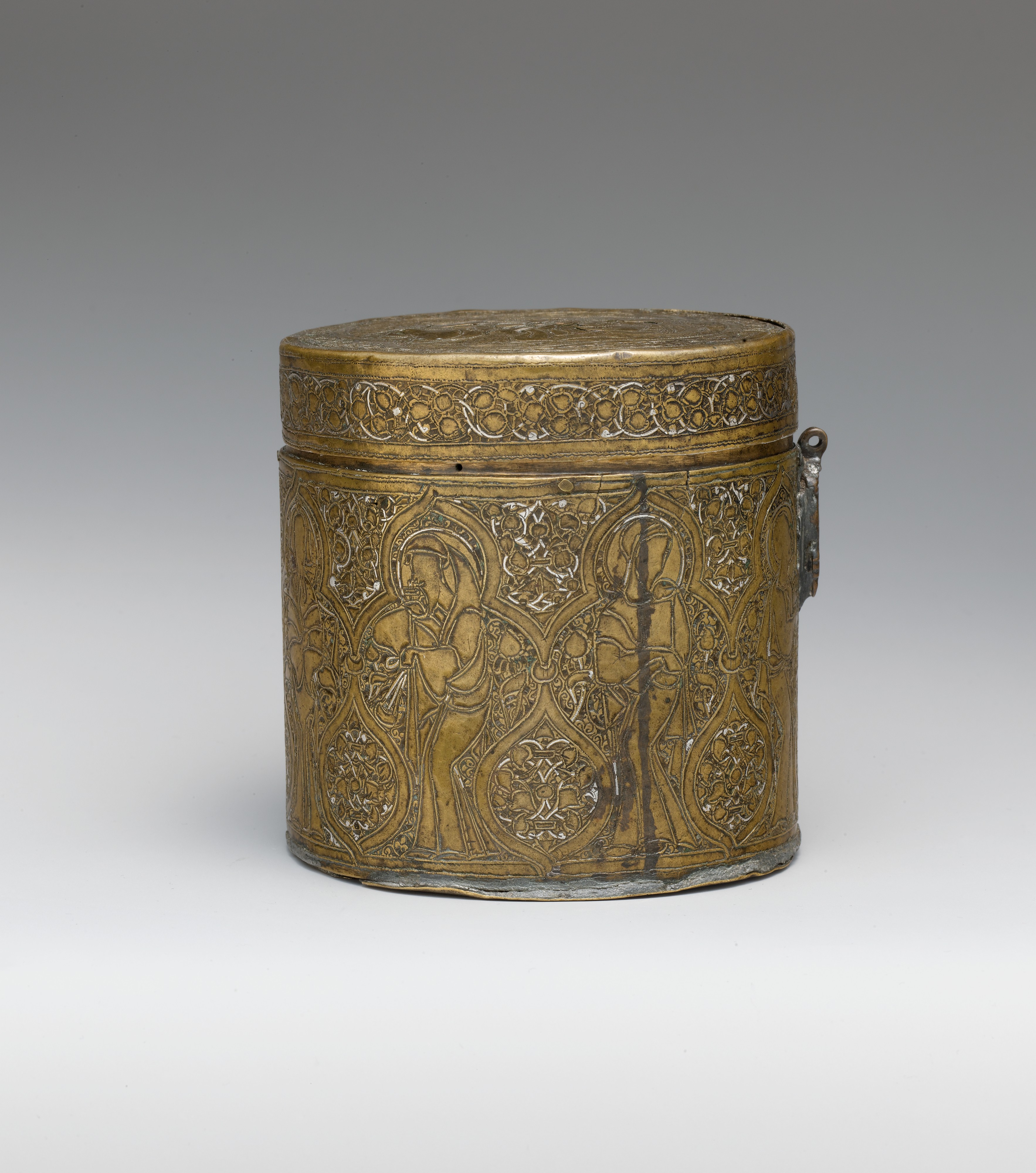
This IS the pyxis described in this record: the lidded brass cylinder with eight figures under arches, in the Museum's own primary photograph.
| Artist | Unknown metalworker(s), Ayyubid Syria or the Jazira (al-Mawsili tradition) |
|---|---|
| Date | mid- to late 13th century |
| Medium | Brass; hammered, engraved, inlaid with silver |
| Dimensions | Height 4 1/8 in. (10.5 cm); diameter 4 1/16 in. (10.3 cm); weight 13.9 oz. (394.1 g), box and lid together |
| Where it is now | Metropolitan Museum of Art, New York, Department of Islamic Art; not on view per the Museum's online recordlast confirmed |
| Inventory number | 1971.39a, b (Met object ID 452211) |
| Attribution | DisputedThe Metropolitan Museum's data reads 'Attributed to Syria', and Kenney (2011) says scholars generally attribute the group to Ayyubid Syria. Full note |
| Object type | Islamic metalwork |
| Period | Ayyubid (Syria or the Jazira), mid- to late 13th century |
| Cases | Disputed attribution · Has a provenance gap |
| Inscriptions | None. The Museum's 2016 entry notes that the decoration omits epigraphy, unlike the comparable boxes in London and Cairo. |
| Owners on record | 11 links10 documented, 1 unknown |
| Sources | 16 cited |
About this record Last verified · 16 sources cited · Change log
On this page 10 sections
ContentsClose
A small lidded brass box, 10.5 cm high, hammered, engraved and once richly inlaid with silver, made in the 13th century in the Ayyubid-era tradition of Syria and the Jazira. Eight figures stand under trilobed arches around the drum, one of them Christ entering Jerusalem on a donkey, and a woman sits on the ground with a child on the lid. The Metropolitan Museum attributes it to Syria and allows Mosul for the group; nobody has shown where it was made, for whom, or why.
Its documented history begins in the collection of Count Grigory Stroganoff, catalogued in Rome in 1911. It passed to the dealer Hassan Khan Monif, to Joseph Brummer in 1940, to his estate sale at the Parke-Bernet Galleries on 20 April 1949 (catalogued there as a Persian bronze of the 14th century), to the dealer Hagop Kevorkian and his foundation, and to the Museum at Sotheby's, London, on 8 December 1970. The lid has been reworked and most of the silver is gone. This record keeps the documented chain, the argued attributions and the open questions apart.
Provenance
Each link is graded. Documented: a cited source supports it. Disputed: the identification is argued but not established. Unknown: no owner for that span, and the gap is not smoothed into a narrative. The grades in the glossary.
- mid- to late 13th century - by 1910Unknown maker and unknown first ownerunknown
No inscription, signature or dedication survives. Patron, workshop, city and first owner are not documented. The Museum attributes the box to Syria; its 2016 text also allows Mosul for the group.11314
- by 1910 - 1910Count Grigory Sergeievich Stroganoff (1829-1910), Romedocumented
The Met's provenance gives Count Gregoire Stroganoff, Rome, until death in 1910, and cites the 1911 catalogue by Pollak and Munoz (vol. II, p. 531, pl. CXLIII). The 1949 Brummer catalogue instead says 'Collection Stroganoff, St. Petersburg', so the place is disputed. How and when the count acquired the box is not documented.1311
- 1910 - by 1940Stroganov family, by descentdocumented
The Met records 'by descent, Stroganov Family (in 1911)'. The heirs are not named and the date the box left the family is not documented.1
- by 1940 - 1940Hassan Khan Monif, New Yorkdocumented
The Met names Monif as owner until 1940 and the seller to Brummer. The 1949 catalogue gives 'From H. K. Monif, New York'. When and how he obtained the box from the Stroganov family is not documented. His only independent trace found is a 1927 exhibition listing in Chicago.1312
- 1940 - 14 April 1947Joseph Brummer, New Yorkdocumented
Brummer, born 1883, died 14 April 1947 according to Wikipedia. Price paid in 1940 is not recorded in sources read.17
- 1947 - 20 April 1949Estate of Joseph Brummerdocumented
The sale was held by order of the executors. The catalogue's printed order of sale places the pyxis in the first session.3
- 20 April 1949 - 1949Parke-Bernet Galleries, New York (sale 1059, Part I, first session, lot 82)documented
The catalogue entry (described as Persian, XIV Century, from Collection Stroganoff and H. K. Monif) is in the sequence immediately before lot 83. The Met gives lot 82 and the buyer. The price is not recorded in sources read.134
- 1949 - 10 February 1962Hagop Kevorkian, New Yorkdocumented
Kevorkian died in Paris on 10 February 1962. He also sold the Freer Canteen to the Freer Gallery in 1941.168
- 1962 - 8 December 1970The Kevorkian Foundation, New Yorkdocumented
The Met records 'by descent to the Kevorkian Foundation, New York (1962-70)'. Wikipedia lists a separate Parke-Bernet sale of Foundation property on 9 May 1970; the Met's sale for this box is Sotheby's, London.16
- 8 December 1970 - 1971Sotheby's, London, Kevorkian Collection, no. 73documented
Cited in the Met's provenance and references (Kevorkian Collection, London, 1970, lot 73, p. 36). Price, currency of any private arrangement and the buyer's premium are not recorded in sources read.1
- 1971 - presentThe Metropolitan Museum of Art, New Yorkdocumented
Rogers Fund, 1971. Not on view according to the Museum's online record.12
Prices realised
| Date | Sale | Estimate | Result | Note |
|---|---|---|---|---|
| 20 April 1949 | Parke-Bernet Galleries, New York (Brummer estate, Part I, sale 1059, first session) | None printed; priced catalogues were offered at one dollar per session. | Hammer Not found. Lot 82 in the Museum's provenance; printed catalogue is unpriced. With premium No buyer's premium appears in the conditions of sale. The buyer paid the purchase price plus a 2 per cent New York City sales tax unless exempt; the digitised text of the entry shows no asterisk for the 20 per cent federal excise tax. US dollars (sale held in New York; sum not recorded) | Sold strictly as exhibited with no warranty of authenticity or condition, and with restoration assumed. Buyer recorded by the Met as Hagop Kevorkian. |
| 8 December 1970 | Sotheby's, London (Kevorkian Foundation, no. 73) | Not found. | Hammer Not found. With premium Not found. Not recorded; sale held in London | Purchased for the Metropolitan Museum; the credit line is Rogers Fund, 1971. The Met record gives no price. |
Hammer is the price at which the bidding stopped; with premium adds the fee the house charges the buyer on top. Hammer price and buyer's premium in the glossary.
Technical evidence
| Attribution note | The Metropolitan Museum's data reads 'Attributed to Syria', and Kenney (2011) says scholars generally attribute the group to Ayyubid Syria. Beyazit (2016) adds that recent research on the Freer canteen confirms Mosul as an important centre of production for the group. The box has no inscription, so neither place is documented. The 1949 sale catalogue called it Persian and 14th century. |
|---|---|
| Object type | Lidded cylindrical box (pyxis), two parts: a, the box; b, the lid. Open Access object name 'Box'.12 |
| Material and technique | Brass; hammered, engraved, inlaid with silver. The 1997 entry says it was made from a single sheet of brass, with base and lid worked separately and the lid made in one piece. The Museum's conservator says the engraved ground would have received a black organic inlay and a silver inlay.21516 |
| Dimensions | Height 4 1/8 in. (10.5 cm); diameter 4 1/16 in. (10.3 cm); weight 13.9 oz. (394.1 g), for a and b together.2 |
| Date | Mid- to late 13th century (Open Access range 1250 to 1299). The 1949 sale catalogue gave the 14th century.23 |
| Geography | 'Attributed to Syria' in the Museum's data. The 2016 entry says Mosul was likewise an important centre of production for the group.213 |
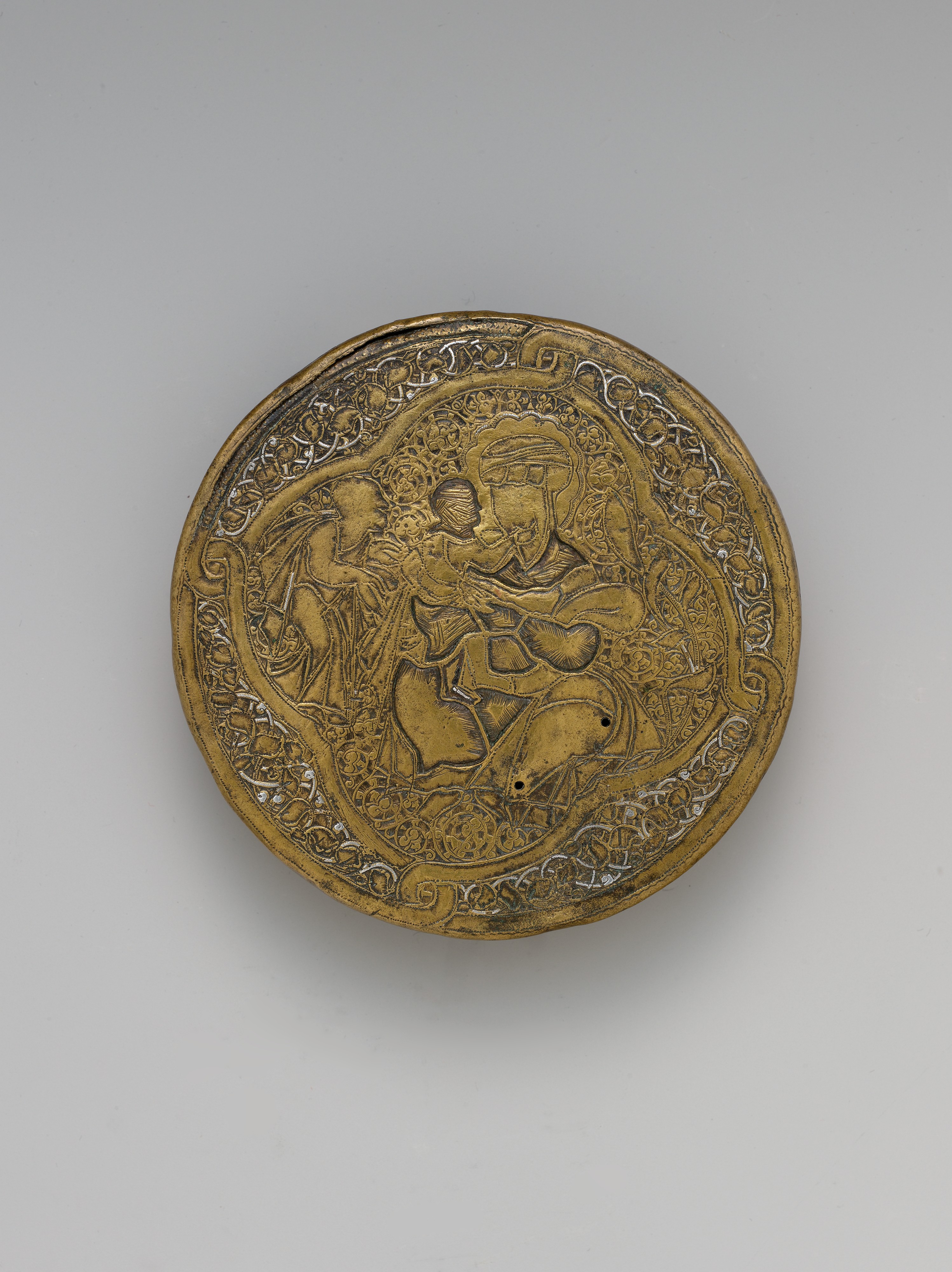
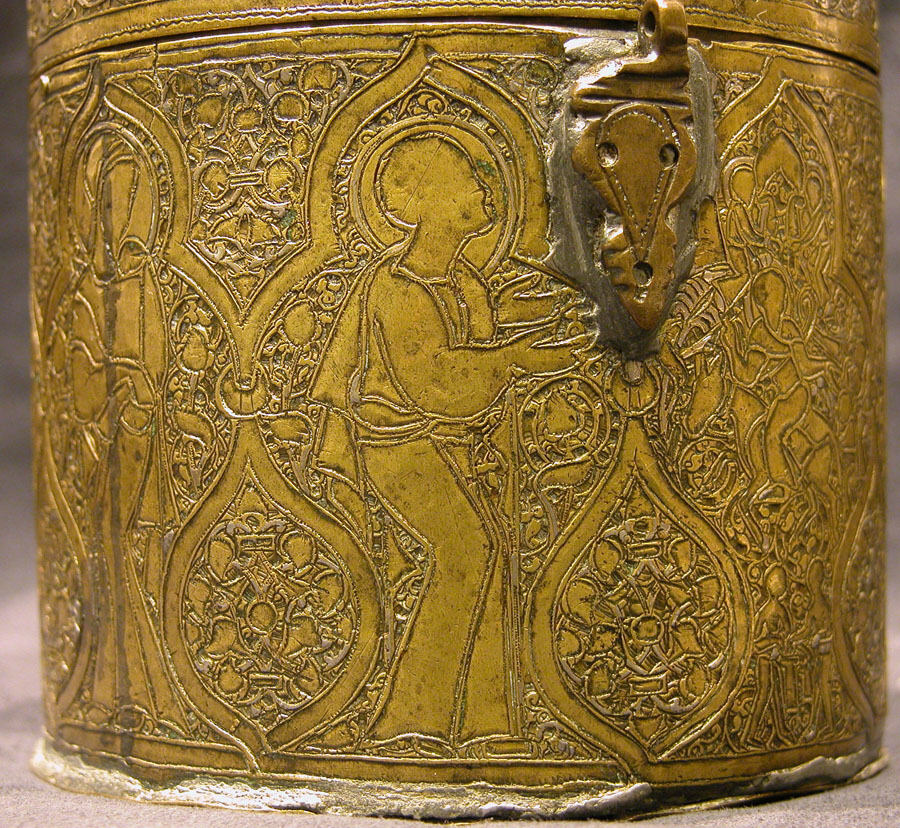
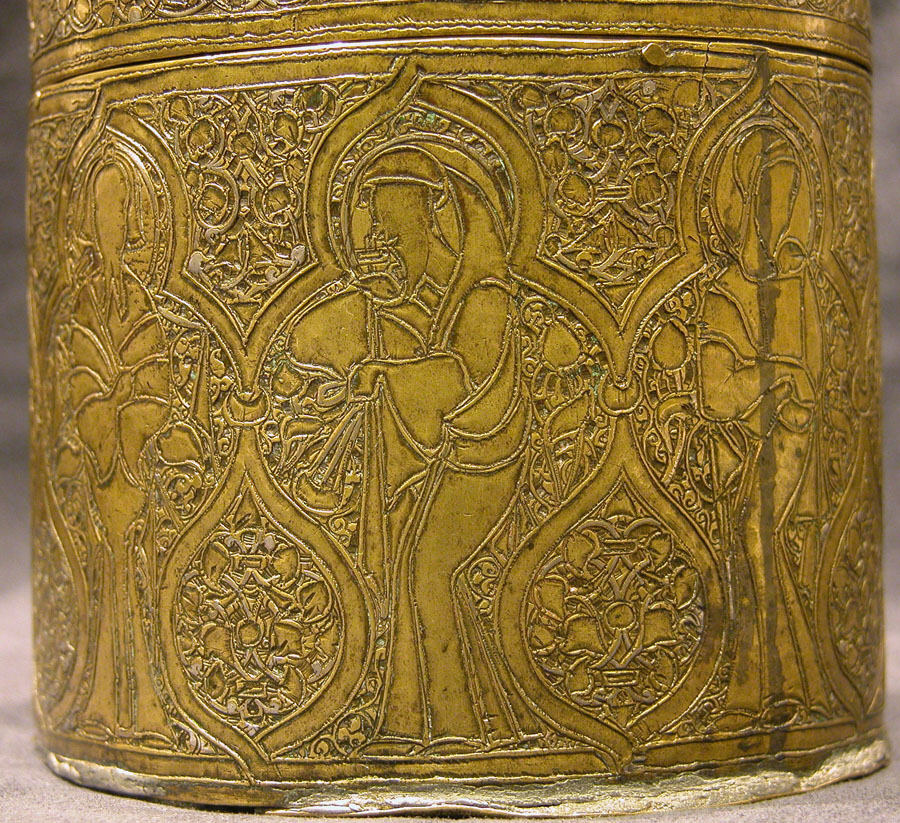
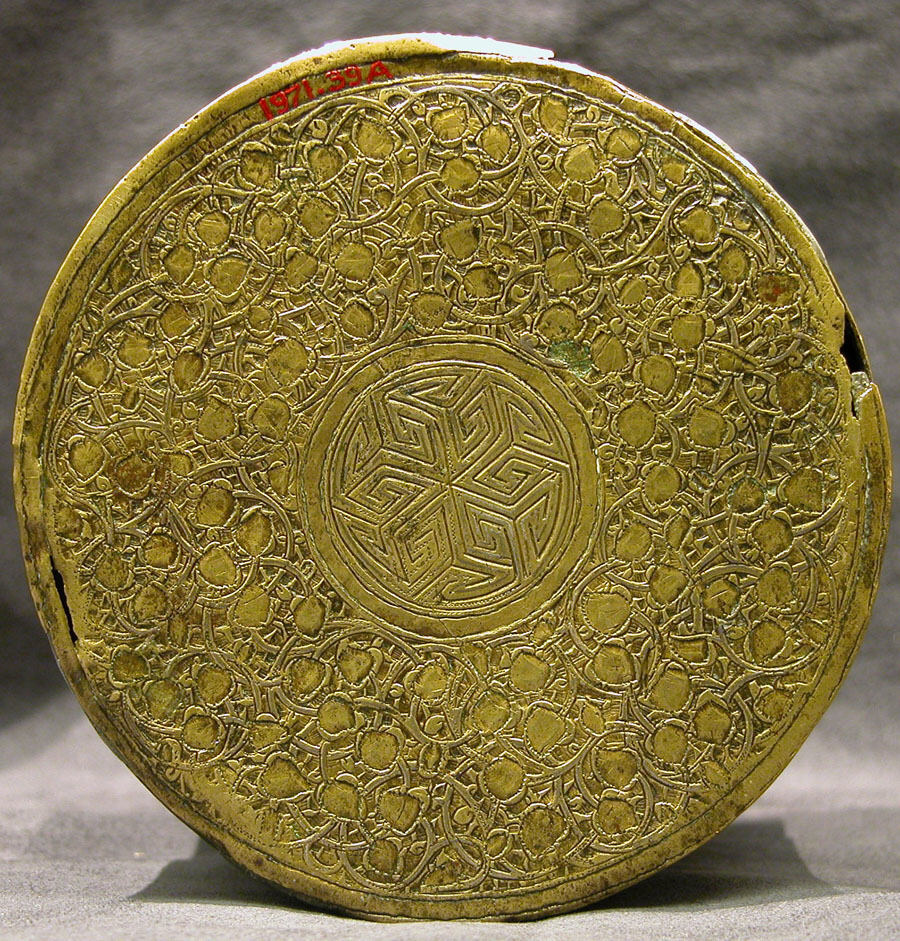
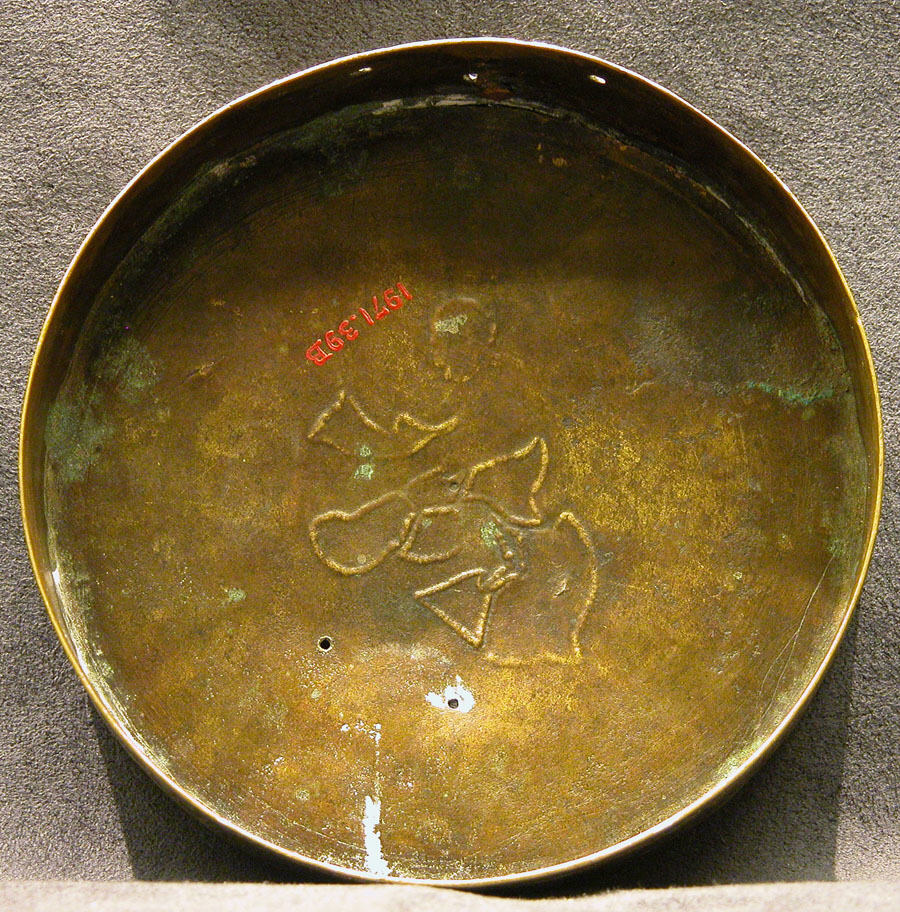
| Decoration | Eight trilobed arches on the body, seven with single figures and one with the Entry into Jerusalem, on a ground of dense arabesque scrolls. Lid: seated woman with child. Underside: a small roundel with a six-pointed star of Y-frets.131415 |
| Inscriptions | None. The 2016 entry notes that the surface omits epigraphy, unlike the comparable boxes in London and Cairo.13 |
| Condition and alteration | Most inlay missing; engraved detail effaced by abrasive polishing; silver worn away or removed. The lid shows evidence of reworking, in the Museum's phrase 'in the modern period'. No date or analysis for the reworking published.13141516 |
| Accession and credit | 1971.39a, b; Rogers Fund, 1971; Open Access object ID 452211. Not on view per the Museum's online record.12 |
| Licence of images | Public domain; the Open Access API marks isPublicDomain true.2 |
Images
The record in full
Chapter 1A brass box the size of a fist that carries a Christian programme in an Islamic medium
The Metropolitan Museum's accession 1971.39a, b is a lidded cylindrical box, a pyxis, 10.5 cm high and 10.3 cm across, weighing 394.1 g.
The Metropolitan Museum's accession 1971.39a, b is a lidded cylindrical box, a pyxis, 10.5 cm high and 10.3 cm across, weighing 394.1 g. The Museum describes the material as brass, hammered, engraved and inlaid with silver, and dates it to the mid- to late 13th century, with a geography of 'Attributed to Syria' [1][2]. Everything about the way it was made belongs to the Islamic inlaid-metalwork tradition: a single sheet of brass formed into a drum, a separately worked base and lid, engraved arabesque scrolls cut back to receive silver and a black organic filling. Everything about what it shows belongs to the Christian world: eight figures under arches, one of them Christ entering Jerusalem on a donkey, and on the lid a seated woman holding a child [1][15].
That combination is the whole reason the object is argued about. The Met's own catalogue entries place it in a small group of 13th-century inlaid brasses decorated with Gospel scenes and standing saints or ecclesiastics, objects that sit beside courtly and astrological themes more usual in the Seljuq era [1][13]. This record is about one box in that group. It follows what the box physically is, what scholars have said about where and for whom it was made, and the documented line of owners from a Roman count's collection to a New York auction house, a dealer-collector and finally the Museum [1][3].
A caution on names runs through the whole record. The Met's object entry is titled 'Pyxis Depicting Standing Saints or Ecclesiastics and the Entry into Jerusalem with Christ Riding a Donkey'. Its object type in the Open Access data is simply 'Box' [2]. A different Met catalogue heads the same piece 'Cylindrical Box' [15], and a 1949 auction catalogue called it a 'Persian Silver-Damascened and Engraved Bronze Pyxis with Figures of Saints' [3]. All four labels point at one object. A reader who meets only one of them should not assume it is a different box.
Chapter 2Eight arches, one procession and a lid: what the surface shows
The body is dominated by a suite of eight interlacing trilobed arches set against dense arabesque foliage, each enclosing a figure, except that one arch holds the Entry into Jerusalem [13].
The body is dominated by a suite of eight interlacing trilobed arches set against dense arabesque foliage, each enclosing a figure, except that one arch holds the Entry into Jerusalem [13]. In that arch Christ rides a donkey and is accompanied by three pairs of figures: one pair below him spreading garments, one behind him carrying branches and an angelic pair above holding a canopy. The Met's 2016 entry observes that the canopy detail compares with Islamic depictions of enthroned rulers, and the 1997 entry likewise sees an image similar to secular throne scenes in manuscripts from northern Mesopotamia [13][15].
Opposite the Entry sits the only figure shown fully frontal. He wears a chasuble, has a long bifurcated beard and holds a cross at a slant across his body. The two figures flanking him turn their faces and censers toward him, which is how the designer gave him weight [13][14]. Of the remaining medallions, the 1997 entry describes the occupants as a figure with an incense burner, a supplicant or a monk, four of them looking toward Christ and two toward the frontal holy man. The 2011 entry adds that a man to the left of the Entry extends his hands toward Christ while a woman twists toward him with her feet turned away [14][15]. The Museum's own studio photographs show haloed figures in long robes, and a metal hasp fixed to the wall of the drum; no source consulted says whether that hasp is original.
The pyxis omits the epigraphy found on the two comparable boxes in London and Cairo. It also omits almost all of the geometric interlace, T- and Y-fret patterns and plaited bands that crowd other inlaid brasses of the period. The 2011 entry calls that absence striking. The only exception it names is one small roundel on the underside of the box, a six-pointed star of Y-frets lost among vegetal scrolls [13][14]. The 1997 entry adds that the box was made from a single sheet of brass subsequently inlaid with silver, with base and lid worked separately and the lid formed in one piece [15].
Chapter 3The lid is the oldest puzzle and also the part most likely to have been altered
Every catalogue entry the Met prints for this object flags the lid.
Every catalogue entry the Met prints for this object flags the lid. It shows a woman seated on the ground, not on a throne, with a child reaching up toward her face. Beyazit (2016) notes that her cross-legged posture recalls depictions of Seljuq rulers and that her bound turban echoes the male headgear characteristic of the local Arab community of Syria and the Jazira [13]. Kenney (2011) points out that, unlike the other figures, the child has no halo, that the woman's halo is lobed in an unusual way and that a turban is more suitable to a man [14]. Carboni (1997) reads the scene as the Virgin and Child with Saint Joseph and adds that the Virgin seems to be seated on a low stool [15].
All three authors say the lid was reworked. Carboni writes that the scene was partially reworked at a later date and that some details are puzzling [15]. Kenney states that the lid displays evidence of reworking [14]. Beyazit says the Virgin and Child are preserved 'despite its reworking in the modern period' [13]. None of the three gives a date, a name or an analysis for the intervention. That is a gap in the published record rather than a finding. The Museum's photograph of the lid's reverse shows the figure faintly visible from behind and two small holes through the sheet; no catalogue entry consulted discusses those holes [1].
The reworking matters because it affects the one image that has driven the strongest interpretations. Kenney reports a remark of Sylvia Auld that a Madonna seated on the ground is a convention of European representations only from the fourteenth century onward [14]. Carboni suggests that a Muslim metalworker may have blended the Virgin and Child with a more familiar image, and he mentions a Shi'i scene of Ali and his sons al-Hasan and al-Husayn; Beyazit's footnote credits the same Ali, al-Hasan and al-Husayn comparison to Carboni's 2001 Paris entry [13][15]. Where the lid has been altered, a reading that turns on the turban, the stool or the missing halo can be building on a later hand rather than the thirteenth-century craftsman.
Chapter 4Mosul, Syria or somewhere else: the attribution has never been settled
The Museum's present position is cautious.
The Museum's present position is cautious. Its geography field reads 'Attributed to Syria' [2]. Kenney (2011) writes that scholars generally attribute most of the group to Ayyubid Syria [14]. Beyazit (2016) goes a step further and writes that scholars tend to associate these objects with Ayyubid Syria, but that recent research on the Freer canteen, one of the masterworks of the group, confirms that Mosul, where the al-Mawsili school emerged under Badr al-Din Lu'lu', was likewise an important centre of production [13]. In other words, the Museum's own 2016 text no longer treats Syria as the only answer and still stops short of a place for this box.
The wider debate is about the Mosul school itself. A Wikipedia survey of the history of metallurgy in Mosul (a tertiary source, to be replaced with the scholarship it cites) reports that of 35 signed pieces 27 name their maker as al-Mawsili and that only eight of those also name a patron and state Mosul as the place of origin. It also reports that about 80 per cent of the objects described as 'of Mosul' were made after the Mongol takeover of about 1256, though it is unclear whether all were made in the city [9]. Beyazit's footnote cites Julian Raby's 2012 essay on the 'principle of parsimony' and the problem of the Mosul school of metalwork as the framework for such questions [13]. This record has not read that essay itself.
Other catalogues that describe the same box or its sisters disagree about date as much as about place. The 1949 sale catalogue put this box under 'Early Persian Objects of Art' as a fourteenth-century piece [3]. The V&A's catalogue gives its sister box 'Syria, mid-13th century' (range 1225 to 1275) while noting that an older gallery label says 14th century [5]. The Met's current date range of 1250 to 1299 sits between the two [2]. Rachel Ward's conclusion, quoted by Kenney, is that the provenance, patronage and meaning of each object in the group should be reassessed individually [14]. This record takes that instruction literally and does not extend any conclusion about the Freer canteen or the Blacas ewer to this box.
Chapter 5Who was it for: a Christian owner, a Crusader souvenir or a Muslim eye
Three published positions sit side by side in the Museum's own text, and they do not agree.
Three published positions sit side by side in the Museum's own text, and they do not agree. The first is that a Christian owned it. Beyazit writes that Christian themes dominate the programme and that this 'suggests with near certainty that the intended owner of the pyxis was Christian' [13]. The second is wider. Both the 2011 and the 2016 entries say that group members were made for a variety of patrons: some ordered by local Christian patrons, others for Crusader knights wanting souvenirs of the Holy Land and others for Muslim patrons who wanted them as diplomatic gifts to Crusader representatives or European potentates, or for their own appreciation [13][14]. The third comes from the Museum's audio guide, in which curator Stefan Heidemann notes that most of the population in the thirteenth century was Muslim, that the artists may have used Christian images as models and that buyers may simply have seen a figure with a child in the arms [16].
These are not three layers of one argument. They are three different answers to the question of who looked at the box. They are argued positions, not documented facts: the box has no inscription, no dedication and no recorded first owner [14]. The label that applies is 'argued', with named scholars on each side, and no source consulted shows one reading displacing the others.
The Heilbrunn Timeline essay on the Ayyubid period gives the context in which all three readings are made. Salah al-Din established the Ayyubid sultanate in 1171, Jerusalem was captured by Muslim forces in 1187, was ceded after a failed treaty and was retaken for good in 1244, and the sultanate gave way to the Mamluks after 1250. The essay itself notes that a group of inlaid pieces made in this period carry Christian scenes [10]. Beyazit reads the group against the complex multicultural milieu of the western Seljuq realm, and the Museum's entries invoke Crusader knights, local Christian patrons and Muslim courts alike [13].
Chapter 6Saint Andrew and the Crusader reading
The frontal figure has been identified as Saint Andrew.
The frontal figure has been identified as Saint Andrew. Beyazit and Kenney both trace this to Eva Baer's 1989 study, and Kenney calls it tentative, resting on the forked beard that other depictions of the apostle show [13][14]. Two possible meanings follow. Beyazit notes that Andrew was the patron saint of the See of Constantinople and of an eponymous Crusader fraternity founded in the 1230s and based in Acre. Beyazit adds that the hair divided into two halves and marked with a dot at the apex is characteristic of depictions of Christian warriors or Crusaders in inlaid metalwork from the region, which Beyazit says further confirms a Crusader connection [13].
Kenney is more careful and describes the Crusader association as tempting and then qualifies it: Andrew is also tied to the founding of the See of Constantinople, and his depiction here could relate to that role instead [14]. This is an honest disagreement in the Museum's own pages. The identification is argued by a named scholar, qualified by another, and not documented by any inscription on the box. The Crusader fraternity reading is a hypothesis built on a hairstyle and a beard, and no source consulted shows a patron of that brotherhood commissioning this or any similar object.
Chapter 7Six centuries of silence, then a documented trail from Rome
No source consulted names an owner of the pyxis between its making in the thirteenth century and the Roman collection of Count Grigory Stroganoff, which was catalogued in 1911 by Ludwig Pollak and...
No source consulted names an owner of the pyxis between its making in the thirteenth century and the Roman collection of Count Grigory Stroganoff, which was catalogued in 1911 by Ludwig Pollak and Antonio Munoz [1]. The Met's provenance line gives the chain from that point as follows: Count Gregoire Stroganoff (Russian), Rome, until his death in 1910; by descent to the Stroganov family in 1911; Hassan Khan Monif, New York, until 1940, when he sold it to Brummer; Joseph Brummer, New York, from 1940 until his death in 1947; Brummer's estate sale at the Parke-Bernet Galleries, New York, 20 April 1949, lot 82, to Hagop Kevorkian; Kevorkian until his death in 1962; the Kevorkian Foundation, New York, 1962 to 1970; and its sale at Sotheby's, London, 8 December 1970, no. 73, to the Metropolitan Museum [1].
Two of those steps can be tested against documents this record has read. First, the Brummer estate catalogue (sale number 1059, first session, Wednesday 20 April 1949) lists the pyxis in the section 'Early Persian Objects of Art', numbers 68 to 107 [3]. The entry that sits immediately before lot 83 matches the object: 'Persian Silver-Damascened and Engraved Bronze Pyxis with Figures of Saints, XIV Century', described as a cylindrical covered jar engraved and inlaid in silver with figures of saints within arabesques, with the Virgin and Child on the cover, 'Rare', height 4 1/8 inches. Its provenance lines read 'Collection Stroganoff, St. Petersburg' and 'From H. K. Monif, New York' [3]. The printed lot number is blurred in the digitised text, but the sequence puts it at 82, which is the number the Museum gives [1][3]. The 4 1/8 inch height is the Museum's 10.5 cm in inches [2].
Second, the catalogue and the Museum disagree on one detail. The catalogue says Stroganoff of St. Petersburg. The Museum says Count Gregoire Stroganoff of Rome. The count in question is almost certainly Grigory Sergeievich Stroganoff (1829 to 1910), whose life dates the National Gallery of Art gives for the owner of works that passed to American museums [11]. The Rome location rests on the Museum's provenance and on its citation of the 1911 Rome catalogue; the catalogue-trade shorthand of 1949 could easily reflect the family's Russian identity rather than the city of the collection. This record does not resolve the discrepancy and grades the Stroganoff link documented as to the family and disputed as to the place.
Chapter 8Stroganoff, Monif and Brummer: the people in the chain
Count Grigory Stroganoff (1829 to 1910) was a Russian collector in Rome.
Count Grigory Stroganoff (1829 to 1910) was a Russian collector in Rome. The National Gallery of Art's provenance page for him lists five works now in Washington, among them an anonymous bronze Mercury and two paintings by Sebastiano Ricci [11]. The 1911 catalogue by Pollak and Munoz, which the Met cites at volume II, page 531, plate CXLIII, is the earliest published appearance of the pyxis that this record can name [1]. It has not been read here. Its content, and whether it gave an origin, date or acquisition source, are unknown.
Hassan Khan Monif is the least documented person in the chain. The Met names him as owner until 1940 and as the seller to Brummer [1]. The Brummer catalogue corroborates the name with the initials H. K. Monif [3]. The only independent trace of him found is a listing by the Arts Club of Chicago of an exhibition titled 'Rare Persian Antiquities from the Collection of Mr. H. Khan Monif', held 4 to 18 January 1927 [12]. That listing says nothing else about him, and no source consulted connects the 1927 exhibition to this box. How the pyxis left the Stroganoff family between 1911 and Monif is not documented.
Joseph Brummer (1883 to 1947) was a Hungarian-born dealer who opened a Paris gallery with his brothers in 1906, moved to New York in the First World War, reopened there in 1921 and specialised in medieval and Renaissance art and antiquities, according to Wikipedia [7]. The foreword to the 1949 catalogue, signed by Leslie A. Hyam of Parke-Bernet, says he amassed objects from Babylonia to Peru with little concern for place of origin and was instrumental in forming the collections of Henry Walters, William Randolph Hearst and the Metropolitan Museum's Cloisters [3]. The Met's provenance gives his ownership of the pyxis as 1940 until his death in 1947 [1]. Wikipedia gives his death as 14 April 1947 and says that over 2,400 remaining lots were sold by Parke-Bernet in 1949 [7].
Chapter 11The cohort: three boxes and a wider group of about twenty objects
Beyazit places the Met pyxis in a group of at least three small cylindrical boxes with lids.
Beyazit places the Met pyxis in a group of at least three small cylindrical boxes with lids. The other two are in the Victoria and Albert Museum, London (320-1866) and the Museum of Islamic Art, Cairo [13]. Carboni wrote in 1997 that there are three surviving Ayyubid boxes with Christian images, that the London and Cairo examples carry inscriptions and that the Met box, which has none, is the most refined of the three [15]. The two catalogues give different inventory numbers for the Cairo box: 225 in the 2016 entry and 15130 in the 1997 entry [13][15]. This record does not choose between them.
The V&A's online record gives the London box the description 'Cylindrical pyxis and cover with depiction of Christians, brass inlaid with silver, Syria, mid-13th century', height 8.5 cm and diameter 8.3 cm. It was 'Purchased from Senor Lucio Gardoa in 1866 for 21 pounds' and acquired in Spain. The V&A reads its central scene as figures in Christian dress with crosses and censers, thought to show the ordination of a kneeling priest, notes that the lid is probably from another vessel and records an Arabic inscription around the top and a pseudo-inscription around the outside [5]. So the closest sister piece was in Spain by 1866, a reminder that objects of this kind travelled west long before the Stroganoff collection formed.
Eva Baer's 1989 study, which Beyazit calls the foundational study, surveyed eighteen metal objects with Christian imagery. Beyazit adds that, according to Rachel Ward (2005), a twentieth object could be added by reading the scene on the Blacas ewer of a figure kissing the hand of an enthroned ruler as Christ washing the feet of the Disciples [13]. The Met's catalogue entry also compares a ewer in the Keir Collection, the 'Homberg ewer', which is dated 1242 and signed by al-Dhaki, and a combination-lock strongbox in the Nasser D. Khalili Collection (MTW 850) [13].
Chapter 12What time has done to the surface
The Museum's audio guide, with conservator Jean-Francois De Laperouse, explains why the box reads so poorly now.
The Museum's audio guide, with conservator Jean-Francois De Laperouse, explains why the box reads so poorly now. The original surface would have been a gold-coloured copper alloy engraved to receive a black organic inlay and a silver inlay, with details such as faces added by engraving. Over time, he says, polishing with very abrasive materials has effaced much of the engraved decoration and sometimes worn the silver away completely, and in other cases the silver was removed at a later time because of its intrinsic value [16]. Kenney adds that the pyxis is missing most of its inlay, yet the figures remain unusually expressive in gesture and pose [14]. The Met's catalogue also says the lid was reworked [13][14][15].
Taken together the three accounts make a physical biography the ownership record cannot supply. A silver-inlaid vessel that was polished hard and stripped of metal, and whose lid was reworked, had a long life in use and in trade before it reached a catalogue. The 1949 catalogue's description as 'silver-damascened' was true of the design and could not have been true of the surface that the photographs show now [3][16]. No condition survey, technical analysis or conservation treatment report was found for the pyxis.
Chapter 13Names, numbers and how the entry has migrated
The title has moved with the interpretation.
The title has moved with the interpretation. In 1949 the pyxis was a Persian bronze of the fourteenth century with figures of saints [3]. In the Museum's present record its descriptive title lists the Entry into Jerusalem and the standing saints or ecclesiastics, and the date has moved to the mid- to late thirteenth century, with a geography of Syria [1][2]. The Museum's 2016 catalogue group heading, 'Inlaid Brasses with Christian Iconograpy' as printed, bundles it with a ewer and a strongbox in two other collections [13].
The numbers that must not be confused are as follows. The Met accession is 1971.39a, b, where a is the box and b the lid, and the Open Access object ID is 452211 [2]. The Brummer sale lot was 82 within sale number 1059 [1][3]. The Sotheby's reference is no. 73 in the Kevorkian catalogue of 1970 [1]. The V&A sister is 320-1866 [5]. The Keir ewer is K.1.2014.82 and the Khalili box MTW 850 [13]. The published literature on the pyxis includes Pollak and Munoz (1911), Schneider (1973), Swietochowski and Jenkins-Madina's Notable Acquisitions 1965 to 1975 (1975), Katzenstein and Lowry (Muqarnas 1, 1983), Baer (1989), Ward (1993) as a related reference, Evans and Wixom (1997), the Institut du Monde Arabe catalogue of 2001, Ekhtiar and others (2011), Canby and others (2016) and Ziade (2017) [1].
Chapter 14Exhibition, publication and the present
The Met's record lists five exhibitions: the Museum fur Islamische Kunst, Berlin, 'The Arts of Islam.
The Met's record lists five exhibitions: the Museum fur Islamische Kunst, Berlin, 'The Arts of Islam. Masterpieces from the M.M.A.', 15 June to 8 August 1981, no. 55; 'The Glory of Byzantium' at the Metropolitan Museum, 11 March to 6 July 1997, no. 285; 'Global Flows' at the Tufts University Art Gallery, Medford, 6 September to 18 November 2012; 'Court and Cosmos: The Great Age of the Seljuqs' at the Metropolitan Museum, 25 April to 24 July 2016, no. 168b; and 'Chretiens d'Orient, 2000 ans d'histoire' at the Institut du Monde Arabe, 26 September 2017 to 14 January 2018 [1]. Two of the Museum's catalogues, Masterpieces from the Department of Islamic Art and Court and Cosmos, are marked on its page as free to download [1].
As of the Museum's online record the box is not on view [1]. The Museum's page also marks it as a Timeline of Art History work, which is why it appears with the essays on the Ayyubid period and the Crusades [1]. Neither the record consulted nor any source read here reports ongoing litigation, restitution claims, an export licence history or a technical study. None is implied. No export licence history was found in the sources read.
Chapter 15What the record cannot say
The ownership record is clear from 1910 and silent before it.
The ownership record is clear from 1910 and silent before it. It does not say who made the box, who first owned it, whether that person was Christian, Muslim or either, how and when it entered the Stroganoff collection, how it left the family, what Monif paid or what Brummer, Kevorkian and the Museum paid. The prices of 1940, 1949 and 1970 are all unrecorded in the sources read. The Museum's own text says what it can and cannot support: an attribution to Syria, a date in the thirteenth century, a Christian programme and an inscription-free design [1][2][13].
That absence is the finding. A small brass box inlaid with silver, made in a Muslim-ruled land by a craftsman who, on the Museum's reading, either did not fully understand the Christian iconography or did not care about its canon, ended up in a Roman count's collection and then in the hands of a dealer who sold to the era's great museums and collectors. Its documented history begins with the Roman collection catalogued in 1911. Everything earlier has to be argued from the object itself, and the scholars who have done so disagree about where it was made, why it looks as it does and who it was for.
The artist
Unknown metalworker(s) of the inlaid-brass tradition of Ayyubid Syria or the Jazira (al-Mawsili school)
No name survives for the maker of this box. It carries no signature and no inscription of any kind, and the Museum's 2011 entry points out that most objects in the Christian-imagery group are anepigraphic and thus yield little documentary information [14]. What can be described is the working tradition the box belongs to, its recorded history and the debate over where its centres were.
Related works
| Work | Relation | Where it is |
|---|---|---|
| Canteen (Freer Canteen) Unknown, Ayyubid Syria or northern Iraq | The best-known object in the Christian-imagery group and a cited point of comparison in the Met's 2016 catalogue entry. Passed through Hagop Kevorkian, who also owned the pyxis. Covered on this site as freer-canteen-smithsonian. Schneider's 1973 article on the canteen illustrated the Met pyxis. | Freer Gallery of Art, Smithsonian Institution, Washington, DC |
| Pyxis and cover with depiction of Christians (320-1866) Unknown, Syria, mid-13th century | One of the three small cylindrical boxes the Met entry places beside its own. Carries an Arabic inscription and a pseudo-inscription. Purchased from Lucio Gardoa in 1866 for 21 pounds and acquired in Spain; the lid is probably from another vessel. | Victoria and Albert Museum, London |
| Cylindrical box (Cairo pyxis) Unknown, Ayyubid | The third box in the Met's group of three. Inscribed. The Met's catalogues cite two different inventory numbers for it, 225 and 15130. | Museum of Islamic Art, Cairo |
| Homberg ewer Al-Dhaki al-Mawsili, dated 1242 | Dated Jaziran ewer with Christian figures, discussed in the same Met catalogue entry as the pyxis. Its spout, lid and entire silver inlay are modern replacements according to the Museum. The entry does not explain the name Homberg. | Keir Collection (K.1.2014.82) |
| Strongbox with combination lock (MTW 850) Unknown, al-Mawsili school in manner | Third object in the Met 2016 entry; standing Christian figures sit in the shadow of courtly imagery. Excluded from Baer's 1989 survey; sold at Christie's, London, 10 October 1989, lot 526. | Nasser D. Khalili Collection, London |
| The Blacas Ewer Unknown, Mosul | Cited for the sculptural rosette and faceted form that support a Mosul attribution for the Homberg ewer, and for the scene Ward reads as Christ washing the feet of the Disciples. Covered on this site as blacas-ewer-british-museum. | British Museum, London (1866,1229.61) |
Open questions
- Who made the box and in which city: Mosul, a Syrian centre or another place? The Museum says Syria in its data and allows Mosul for the group in its 2016 text, and no inscription settles it.
- When was the lid reworked, by whom and why? Three Met catalogue entries say it was reworked and none gives a date, a technical analysis or a before-and-after record. The two small holes through the lid are undiscussed.
- Was the intended owner a Christian, a Crusader knight, a Muslim who valued the imagery or a diplomatic recipient? Beyazit writes 'near certainty' for a Christian owner; Kenney lists several patrons; the audio guide proposes that buyers saw only a figure with a child. No source resolves them.
- Is the frontal figure Saint Andrew, and if so is the reference to the Crusader fraternity in Acre or to the See of Constantinople? Kenney leaves both open.
- What did the 1911 Pollak and Munoz catalogue say about the pyxis? Its content, date and any earlier source named have not been read here, and the Met cites volume II, page 531, plate CXLIII.
- Was the Stroganoff collection that held the pyxis in Rome or St. Petersburg? The Met says Rome; the 1949 catalogue says St. Petersburg.
- How and when did the pyxis leave the Stroganoff family and reach Hassan Khan Monif, and who was Monif? Only a 1927 Chicago exhibition listing and the Met's provenance mention him.
- What did the box sell for in 1949 (Parke-Bernet, lot 82) and in 1970 (Sotheby's, London, no. 73)? Priced catalogues exist for both and have not been seen.
- Which Kevorkian Foundation sale of 1970 was it? Wikipedia lists a Parke-Bernet sale of 9 May 1970; the Met cites Sotheby's, London, 8 December 1970.
- Is any condition survey or technical analysis of the inlay, the alloy or the lid's repair held at the Museum? None was found in the sources read.
Questions about this object
What is Pyxis Depicting Standing Saints or Ecclesiastics and the Entry into Jerusalem with Christ Riding a Donkey?
Pyxis Depicting Standing Saints or Ecclesiastics and the Entry into Jerusalem with Christ Riding a Donkey is an islamic metalwork, dated mid- to late 13th century. Medium: Brass; hammered, engraved, inlaid with silver.
Who made Pyxis Depicting Standing Saints or Ecclesiastics and the Entry into Jerusalem with Christ Riding a Donkey, and is the attribution settled?
The attribution to Unknown metalworker(s), Ayyubid Syria or the Jazira (al-Mawsili tradition) is recorded here as disputed. The Metropolitan Museum's data reads 'Attributed to Syria', and Kenney (2011) says scholars generally attribute the group to Ayyubid Syria. Beyazit (2016) adds that recent research on the Freer canteen confirms Mosul as an important centre of production for the group. The box has no inscription, so neither place is documented. The 1949 sale catalogue called it Persian and 14th century.
Where is Pyxis Depicting Standing Saints or Ecclesiastics and the Entry into Jerusalem with Christ Riding a Donkey now?
Metropolitan Museum of Art, New York, Department of Islamic Art; not on view per the Museum's online record. Inventory number 1971.39a, b (Met object ID 452211). Last confirmed 17 November 2026. Purchased at the Kevorkian Foundation sale, Sotheby's, London, 8 December 1970; accessioned 1971, Rogers Fund.
What has Pyxis Depicting Standing Saints or Ecclesiastics and the Entry into Jerusalem with Christ Riding a Donkey sold for?
Hammer Not found. Lot 82 in the Museum's provenance; printed catalogue is unpriced.; with premium, No buyer's premium appears in the conditions of sale. The buyer paid the purchase price plus a 2 per cent New York City sales tax unless exempt; the digitised text of the entry shows no asterisk for the 20 per cent federal excise tax. Parke-Bernet Galleries, New York (Brummer estate, Part I, sale 1059, first session), 20 April 1949.
What is still unknown about Pyxis Depicting Standing Saints or Ecclesiastics and the Entry into Jerusalem with Christ Riding a Donkey?
Who made the box and in which city: Mosul, a Syrian centre or another place? The Museum says Syria in its data and allows Mosul for the group in its 2016 text, and no inscription settles it.
Sources
- 1Metropolitan Museum of Art, 'Pyxis Depicting Standing Saints or Ecclesiastics and the Entry into Jerusalem with Christ Riding a Donkey', object page (Overview, Catalogue Entry, Provenance, Exhibition History, References, audio transcript), object 452211, read 17 November 2026. metmuseum.org/art/...
- 2Metropolitan Museum of Art Open Access API, object record for objectID 452211: accession, medium, dimensions, weight, credit line, geography, isPublicDomain and image list. collectionapi.metmuseum.org/public/...
- 3Parke-Bernet Galleries, The Notable Art Collection Belonging to the Estate of the Late Joseph Brummer, Part I, sale 1059, New York, 20-23 April 1949 (digitised copy, full text read): foreword, conditions of sale, notice, order of sale and the entry before lot 83 for the pyxis. archive.org/details/...
- 4Internet Archive item record for the Brummer catalogue: sale code 1059, dates, Part II (11-14 May 1949) and Part III (8-9 June 1949). archive.org/metadata/...
- 5Victoria and Albert Museum, record for 320-1866, cylindrical pyxis and cover with depiction of Christians (object O65714). api.vam.ac.uk/v2/...
- 6Wikipedia, 'Hagop Kevorkian' ( source; replace with a biography or the Foundation's sale catalogues). en.wikipedia.org/wiki/...
- 7Wikipedia, 'Joseph Brummer' ( source; replace with a biography or the Brummer Gallery Records finding aid). en.wikipedia.org/wiki/...
- 8Wikipedia, 'Freer Canteen' ( source; Freer Gallery's own provenance record). en.wikipedia.org/wiki/...
- 9Wikipedia, 'History of metallurgy in Mosul' ( source; scholarship it cites, including Raby 2012 and Kana'an 2012). en.wikipedia.org/wiki/...
- 10Metropolitan Museum of Art, Heilbrunn Timeline of Art History, 'The Art of the Ayyubid Period (ca. 1171-1260)'. metmuseum.org/essays/...
- 11National Gallery of Art, Washington, provenance page for Count Grigory Sergeievich Stroganoff (1829-1910). nga.gov/artworks/...
- 12The Arts Club of Chicago, past exhibition listing 'Rare Persian Antiquities from the Collection of Mr. H. Khan Monif', 4-18 January 1927. artsclubchicago.org
- 13Deniz Beyazit, catalogue entry no. 168b in Sheila R. Canby, Deniz Beyazit and Martina Rugiadi, Court and Cosmos: The Great Age of the Seljuqs (New York: Metropolitan Museum of Art, 2016), pp. 265-67, read as reproduced on the Met object page (source 1). metmuseum.org/met-publications/...
- 14Ellen Kenney, catalogue entry no. 102 in Maryam Ekhtiar and others, eds., Masterpieces from the Department of Islamic Art in The Metropolitan Museum of Art (New York, 2011), pp. 138, 152-53, read as reproduced on the Met object page (source 1). metmuseum.org/art/...
- 15Stefano Carboni, catalogue entry no. 285 in Helen C. Evans and William D. Wixom, eds., The Glory of Byzantium (New York: Metropolitan Museum of Art, 1997), pp. 426-27, read as reproduced on the Met object page (source 1). metmuseum.org/art/...
- 16Metropolitan Museum of Art audio guide 6696, 'Pyxis Depicting Christ's Entry into Jerusalem, Part 1', Investigations: Art, Conservation, and Science (curator Stefan Heidemann and conservator Jean-Francois De Laperouse), transcript on the Met object page. metmuseum.org/art/...
Last verified · Published
Change log
17 November 2026 - Record created at the house standard: researched narrative, technical evidence, maker dossier, graded provenance chain, prices with hammer and premium separated, related works, open questions and sources.