The Edition Has a Census and the Copy Has a Gap
Counts of surviving Wicked Bibles and first-edition Principias keep rising. The copies in this archive still have no named owner for 239 to 354 years.
Records in this piece: The Holy Bible, Conteyning the Old Testament and the New (the "Wicked Bible"), Philosophiae Naturalis Principia Mathematica, The Holy Bible, conteyning the Old Testament, and the New, The Aitken Bible (1782)
On this page 5 sections
ContentsClose
In short
- The number of surviving copies of an old book depends on who has searched. In 1953 Henry Macomber put the first edition of Newton's Principia at perhaps not more than 250 copies, and a 2020 census by Mordechai Feingold and Andrej Svorencik identified 387.
- Counts of the 1631 Wicked Bible disagree today. Houston Christian University said in 2024 that 11 copies are believed to survive, and Wikipedia lists 25 known copies after a Rome copy was identified in 2023.
- Four copies in this archive have no named owner for 239 to 354 years between printing and the first point where a source documents the copy itself.
- Copies of one edition differ from each other. The Cambridge Wicked Bible reads 'greatnesse' in Deuteronomy 5:24, where the edition's reported error is 'great-asse', so a fact about the edition is not a fact about the copy.
A copy census gives the edition a number and the copy no history
A census of surviving copies tells a reader how many exist and where they are now, and it says nothing about who held any of them in between. Four printed books in this archive show the difference: each has a well-documented edition and a copy whose chain is blank for more than two centuries.
| Copy | Printed | First documented point for this copy | Years between |
|---|---|---|---|
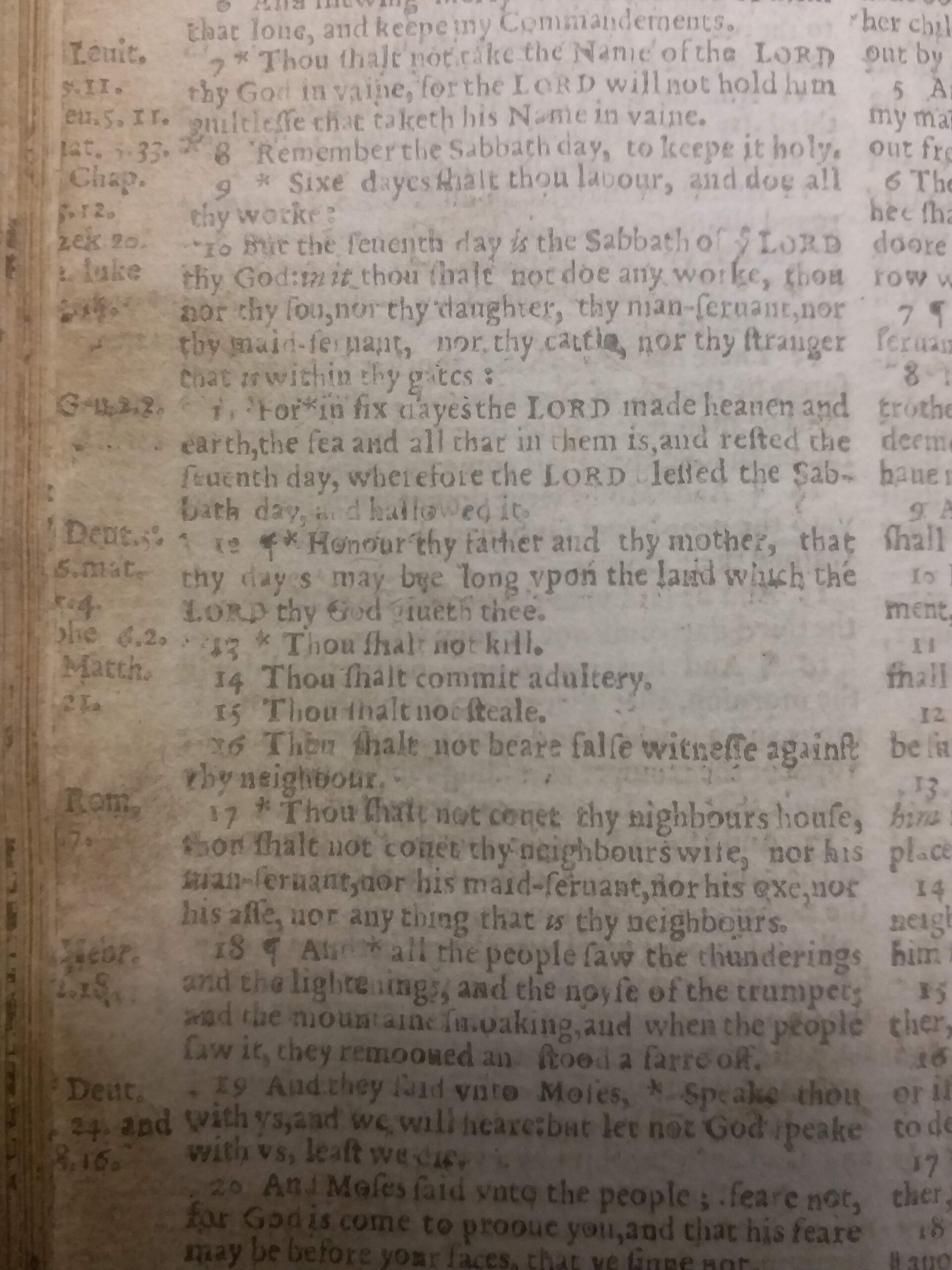
| Wicked Bible, Cambridge University Library | 1631 | Deposit by the Bible Society, 1985 | 354 |
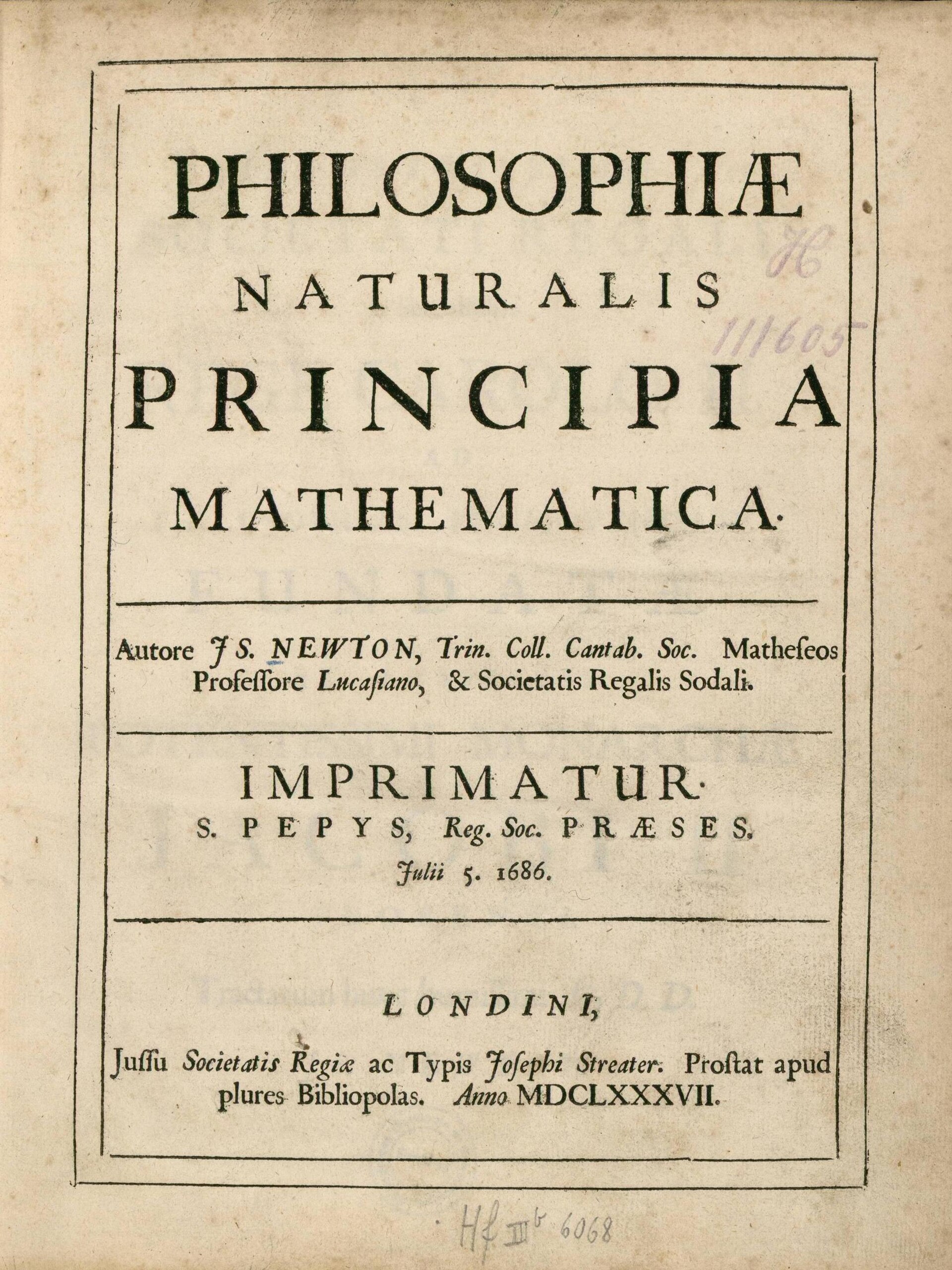
| King James Bible, University of Pennsylvania | 1611 | Gift of T. Edward Ross, 1946 | 335 |
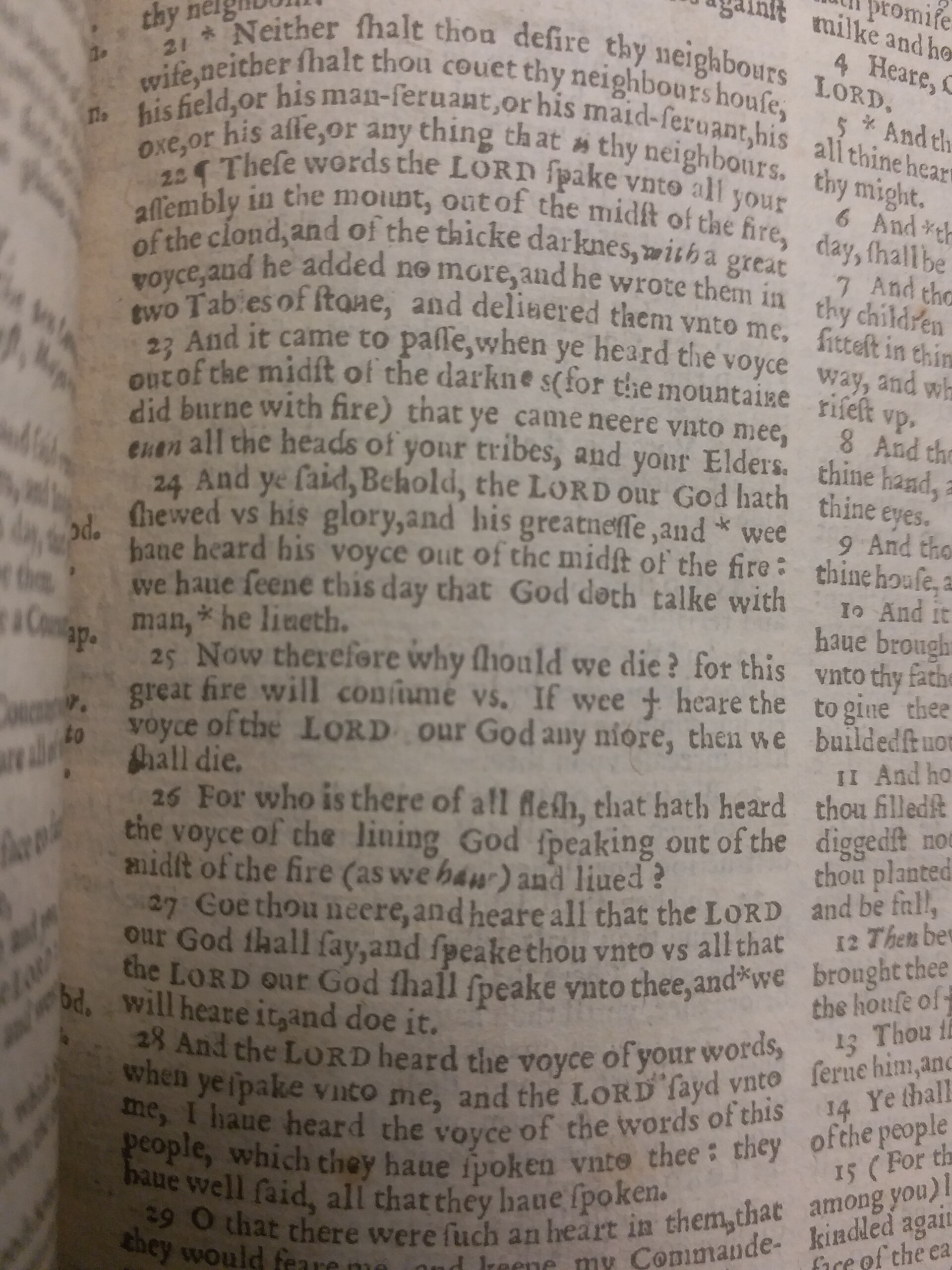
| Principia, Strasbourg, shelfmark H 111.605 | 1687 | Images placed online by the university library, 2006 | 319 |
| Aitken Bible, American Bible Society | 1782 | On display in Philadelphia from 2021, as the archive's record has it | 239 |
The last column is arithmetic on the record's own dates, and the dates are the first ones a source supports, not the first owners there were.
The Wicked Bible count changes with the source and the copies differ
The Wicked Bible was printed in 1631 by Robert Barker and Martin Lucas, and the omission of one word turned the seventh commandment into 'Thou shalt commit adultery'. Houston Christian University's Dunham Bible Museum says the printers were found guilty of negligence by the Star Chamber and fined 300 pounds, that almost all of about 1,000 copies were burned, and that 11 copies are believed to have survived. Wikipedia, a tertiary source, now lists 25 known copies, 18 of them in museums and libraries in Europe, North America and Australasia, and credits a 2023 identification of a copy in the National Central Library of Rome. Neither figure is wrong in the sense of being invented. They come from different searches on different dates, which is exactly why a record should print the date and the source beside any count.
The copy in Cambridge is a different matter, because the photographs show that it differs from the edition as the Dunham museum describes it. Verse 14 of Exodus 20 carries the error. Deuteronomy 5:24 in the same volume reads 'greatnesse', and not the 'great-asse' the museum reports for the edition. Wikipedia adds that in at least three surviving copies an inkblot sits where the letter would be. So the edition's faults vary by copy, and a record has to say what was read in this copy.
Where the copy came from is thinner still. The Bible Society's library was deposited at Cambridge University Library when the Society moved its headquarters to Swindon in 1985, and no source read says when or how this volume entered the Society's collection.
The Principia census more than doubled the count and still names few owners
Newton's Principia was published in London in 1687, and Edmond Halley paid for much of the printing from his own pocket after the Royal Society's funds had gone on an earlier book, the Royal Society says. For generations the first edition was thought small. Henry Macomber's 1953 census of owners suggested perhaps not more than 250 copies, according to the abstract of the 2020 census by Mordechai Feingold and Andrej Svorencik, whose preliminary census identifies 387 copies. The authors read the larger number as pointing to a bigger print run and a wider early readership than had been assumed.
That is a change in what the edition is believed to have been, and it came from counting. The Strasbourg copy sits inside that census as one entry. The archive's record finds no owner or custodian documented for it between 1687 and the placing of images from shelfmark H 111.605 online by the university library in 2006. The title page the library photographed bears the shelfmark and the stamps of its own shelving, which shows where the book is and none of where it has been.
The first named owner of a copy is often the institution that holds it
The University of Pennsylvania's first edition of the King James Bible shows the usual shape. Its catalogue calls it the Great He edition, from the reading in Ruth 3:15, and records that T. Edward Ross gave his Bible collection to the library in 1946 in memory of Lucien Bonaparte Carpenter. Ross's bookplate is the earliest evidence for this copy, and the 335 years before him are blank.
The reading for researchers is plain. A census number is a count of copies and not a list of owners, and each copy needs its own entry with its own earliest dated evidence. Where that evidence is a gift or a deposit, the record should say so, because it tells the reader the chain begins with the institution and not with the book.
What a book record should print beside a count
Every count of surviving copies should carry its source and its date, and every copy should carry the first dated evidence for itself. A reader then sees at once that 11 and 25 are answers from different years, and that none of the four copies here has an owner before the library or collector who first documents it.
It should also record what the copy itself reads. The Cambridge Wicked Bible is a witness to one volume, and the photographs show where it agrees with the edition's reputation and where it doesn't.
Questions
Sources disagree. Houston Christian University's Dunham Bible Museum said in 2024 that 11 copies are believed to survive, and Wikipedia lists 25 known copies, 18 of them in institutions, including one in Rome identified in 2023. The counts come from different searches on different dates.
A 2020 preliminary census by Mordechai Feingold and Andrej Svorencik identified 387 copies. It more than doubled the count implied by Henry Macomber's 1953 census, which suggested perhaps not more than 250.
No. The Cambridge University Library copy shows the seventh commandment with the word 'not' missing, but its Deuteronomy 5:24 reads 'greatnesse' and not the 'great-asse' reported for the edition. Wikipedia notes an inkblot in at least three surviving copies where a letter would be.
Sources
- 1Houston Christian University, 'A Wicked Discovery', 13 February 2024. Used for the Star Chamber fine, the burning of almost all of about 1,000 copies and the figure of 11 survivors. hc.edu/news-and-events/...
- 2Used for the count of 25 known copies, the 2023 Rome identification and the inkblot in at least three copies. en.wikipedia.org/wiki/...
- 3Mordechai Feingold and Andrej Svorencik, 'A preliminary census of copies of the first edition of Newton's Principia (1687)', 2020, abstract. Used for the 387 copies and Macomber's 1953 estimate. authors.library.caltech.edu/records/...
- 4The Royal Society, 'The fishy blunder that nearly prevented Newton's masterpiece from being published', 2012. Used for Halley's funding of the 1687 printing. royalsociety.org/news/...
- 5University of Pennsylvania Libraries, Digital Collections record for the 1611 Holy Bible (Great He edition). Used for the Ruth 3:15 reading and the Ross Bible Collection. colenda.library.upenn.edu/catalog/...
- 6University of Pennsylvania Libraries, 'Ross Bible Collection'. Used for the 1946 gift by T. Edward Ross in memory of Lucien Bonaparte Carpenter. library.upenn.edu/collections/...
- 7Cambridge University Library, 'Bible Society's library', collections page. Used for the Bible Society's library as a collection at Cambridge. lib.cam.ac.uk/collections/...
- 8Used for the opening in July 2021 and closing on 28 March 2024 of the venue where the Aitken Bible copy was shown. en.wikipedia.org/wiki/...
More in Research and Method
The partA Caption Is a Claim: Three Photographs of the Dead
Three photographs of the dead, made in 1858 and 1863, each carried a caption that later evidence cut down.
No Painting, Print, Map or Photograph Here Needs a Credit Line by Licence, and Twelve of Seventeen Clocks Do
Of 334 lead plates, none of 100 paintings, prints, maps and photographs needs a credit line by licence, against 12 of 17 clocks and instruments.
How Much of an Ownership Chain Is Documented Depends on the Object
Of 2,439 provenance links in 330 records, 75 per cent are documented. Clocks reach 83 per cent and arms and armour 65.