The Aitken Bible (1782)
Robert Aitken · 1782
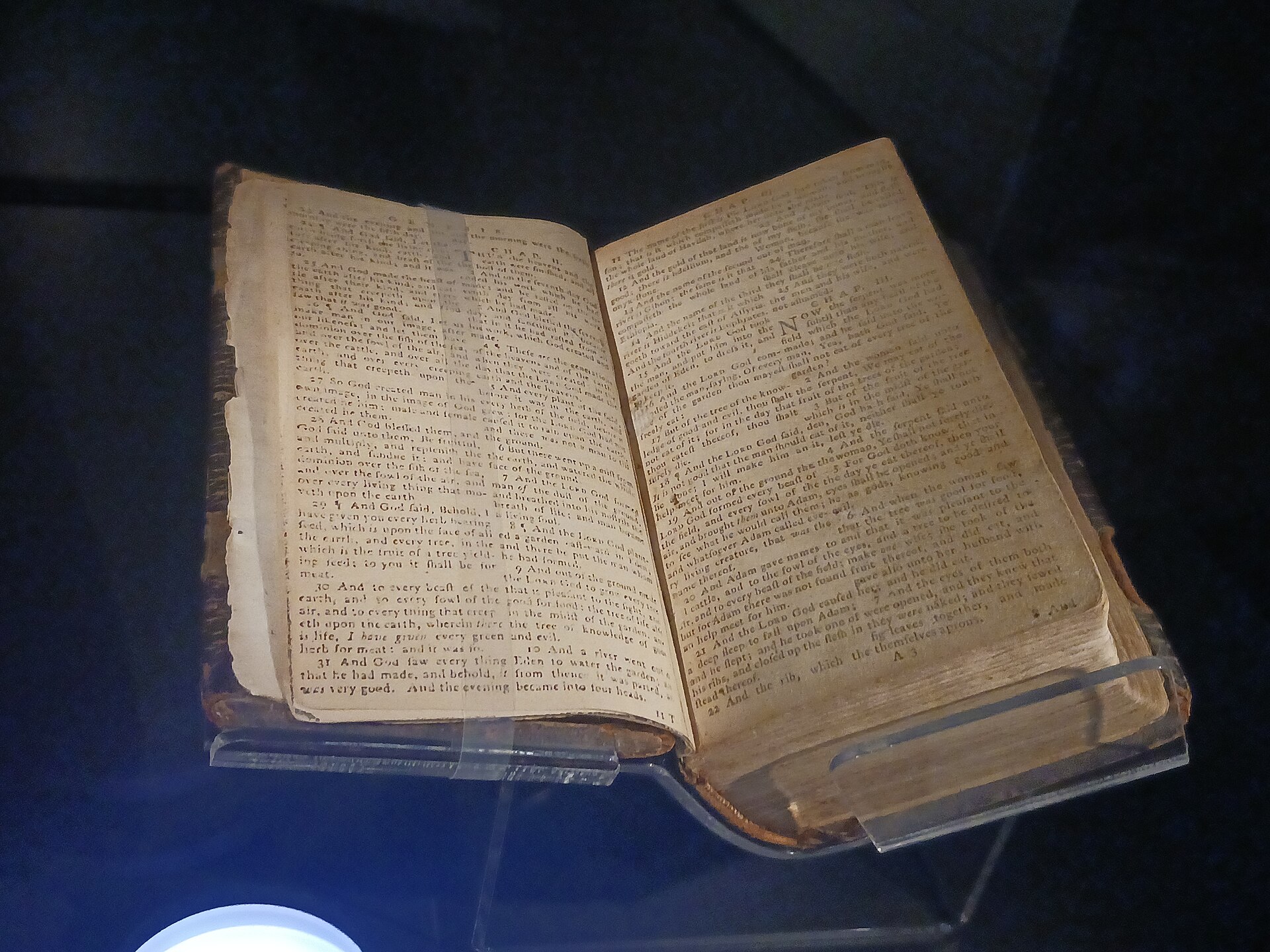
This exact copy, photographed on display at the American Bible Society's Faith and Liberty Discovery Center, Philadelphia, in July 2023, shortly before the center's closure in March 2024.
| Artist | Robert Aitken |
|---|---|
| Date | 1782 |
| Medium | Letterpress printing on paper, complete text of the Old and New Testaments in the King James translation, in a single volume |
| Dimensions | Approx. 15 x 10 cm (6 x 4 in), the pocket octavo format typical of the edition. No institution-published measurement specific to this exact copy was located. |
| Where it is now | American Bible Society, Philadelphia. This copy was most recently on public display at the Society's Faith and Liberty Discovery Center on Independence Mall, which closed on 28 March 2024.last confirmed |
| Inventory number | No publicly published inventory or accession number for this copy was located after genuine search effort. The American Bible Society does not appear to publish an online catalogue of this object. |
| Attribution | AcceptedPrinted and published by Robert Aitken, Philadelphia, 1782, following the Continental Congress resolution of 12 September 1782 that approved and recommended his edition. Full note |
| Object type | Printed book |
| Period | American, Revolutionary War and early republic |
| Cases | Has a provenance gap |
| Inscriptions | None recorded in the sources consulted. |
| Owners on record | 4 links2 documented, 2 unknown |
| Sources | 15 cited |
About this record Last verified · 15 sources cited · Change log
On this page 9 sections
ContentsClose
In 1782, the Philadelphia printer Robert Aitken published the first complete Bible in English printed in the newly independent United States, reprinting the familiar King James text at his own financial risk after wartime trade with Britain cut off the usual supply of imported Bibles. The Continental Congress commended the edition as accurate and recommended it to the public, but funded none of it and granted Aitken no printing monopoly, a distinction Aitken himself tested and lost when Congress later refused his request for an exclusive fourteen-year Bible-printing patent. Once peace reopened the British trade in 1783, cheaper imported Bibles flooded back into the American market and Aitken's edition became a commercial failure that left him deep in debt for the rest of his life.
Of the roughly ten thousand copies Aitken printed, only a few dozen are known to survive. This record is anchored on one of them: a copy that was on public display at the American Bible Society's Faith and Liberty Discovery Center in Philadelphia until the museum's closure in March 2024, and that was photographed there, on the Society's own premises, in July 2023. How this particular copy came into the Society's hands, and exactly where it is kept today, are not documented in any source located for this record; both gaps are recorded here as open questions rather than filled with invented history.
Provenance
Each link is graded. Documented: a cited source supports it. Disputed: the identification is argued but not established. Unknown: no owner for that span, and the gap is not smoothed into a narrative. The grades in the glossary.
- 1782 - 1782Robert Aitken, printer and publisher, Philadelphiadocumented
Printed in Philadelphia in 1782 as part of an edition of about 10,000 copies, following the Continental Congress resolution of 12 September 1782 approving and recommending Aitken's edition.5611
- 1782 - unknownUnrecordedunknown
No source located documents this copy's ownership or whereabouts between its printing in 1782 and its appearance in the American Bible Society's collection. This is consistent with the broader pattern for the edition: the large majority of the roughly 40 to 50 copies known to survive have undocumented custodial histories for most of their existence.67
- by 2021 - 28 March 2024American Bible Societydocumented
On public display at the Society's Faith and Liberty Discovery Center, Philadelphia (opened 2021, closed 28 March 2024). Photographed in the gallery in July 2023 by a Wikimedia Commons contributor; those photographs anchor this record.1212
- 2024 - presentAmerican Bible Societyunknown
The Society has not published, in any source located, a statement on the disposition of the closed museum's collection. No sale, transfer or deaccession has been reported. Continued Society ownership is the reasonable inference from the absence of any such report, but the object's exact current physical location and access status are not confirmed by a published source.1213
Technical evidence
| Attribution note | Printed and published by Robert Aitken, Philadelphia, 1782, following the Continental Congress resolution of 12 September 1782 that approved and recommended his edition. Aitken's own petitions to Congress and his correspondence establish his authorship of the edition beyond dispute. The unresolved question in this record is custodial, not attributional: how and when this particular copy entered the American Bible Society's holdings is not documented in any source located. |
|---|---|
| Format and print run | Single-volume pocket-format Bible containing the complete King James Old and New Testaments. Aitken's own petition on his losses states the edition ran to 10,000 copies.115 |
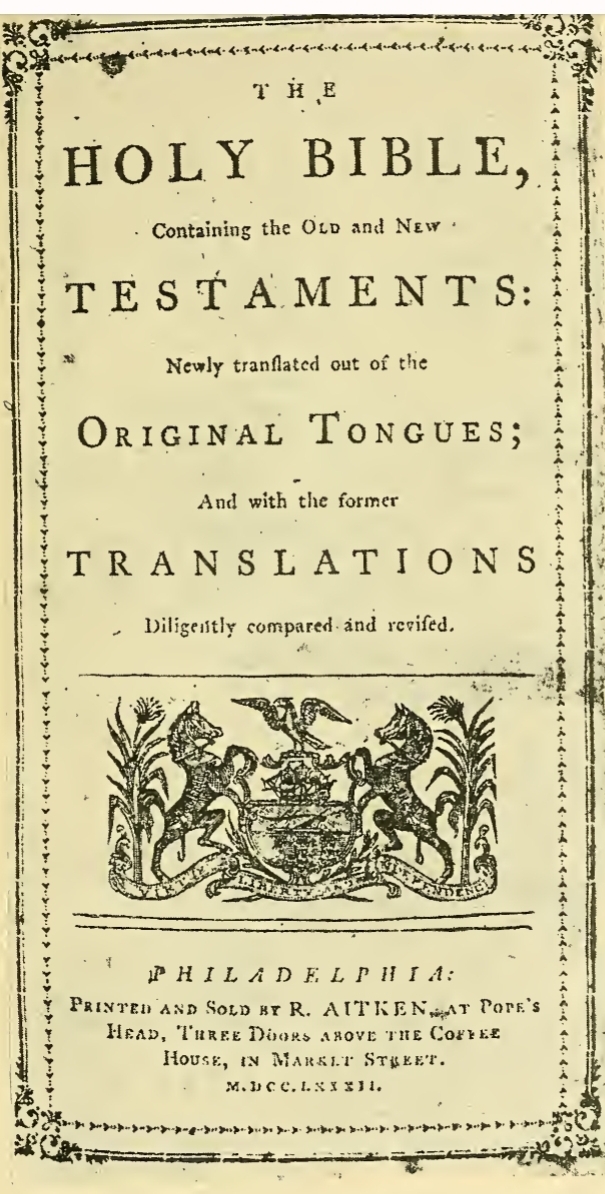
| Title-page text | The Holy Bible, Containing the Old and New Testaments: Newly Translated Out of the Original Tongues, and with the Former Translations Diligently Compared and Revised, printed and sold by Robert Aitken, Philadelphia, 1782.14 |
| Congressional resolution | Passed 12 September 1782: "Resolved, That the United States in Congress assembled, highly approve the pious and laudable undertaking of Mr. Aitken... they recommend this edition of the Bible to the inhabitants of the United States, and hereby authorize him to publish this recommendation in the manner he shall think proper."56 |
| Chaplains' examination | Reviewed by congressional chaplains William White and George Duffield, who reported the work executed with great accuracy and with as few grammatical and typographical errors as could be expected in an undertaking of such magnitude.56 |
| Documented errata | Recorded misprints include "not" for "now" at 2 Kings 7:12, a mislabeled chapter heading in Hosea, and "thy" for "the" at 1 Timothy 4:6.14 |
| This copy's exhibition record | On public display at the American Bible Society's Faith and Liberty Discovery Center, Philadelphia, from the center's 2021 opening until its closure on 28 March 2024. Photographed there in July 2023.1212 |
Images
The record in full
Chapter 1What it is
A single-volume printing of the King James Old and New Testaments, set and printed by Robert Aitken in Philadelphia in 1782.
A single-volume printing of the King James Old and New Testaments, set and printed by Robert Aitken in Philadelphia in 1782. It is not a new translation. Aitken reprinted the familiar English text his customers already knew; what was new was that, for the first time, a complete English-language Bible had been set in type, printed and bound on American soil, by an American printer, under the recommendation of the American Congress rather than the Crown printer's patent that had controlled Bible printing in the English-speaking world for two centuries.
The edition was pocket-sized, of the kind carried in a coat or a knapsack rather than left on a lectern. That size is part of the object's history: small format books get used hard, get lost, get passed down and get thrown away in a way that pulpit folios do not, and it is one reason so few copies of an edition of ten thousand survive today.
Chapter 2A Scottish printer and a wartime shortage
Robert Aitken was born in Dalkeith, Scotland, in 1734 and emigrated to Philadelphia in 1769, where he set up first as a bookseller and then as a printer.
Robert Aitken was born in Dalkeith, Scotland, in 1734 and emigrated to Philadelphia in 1769, where he set up first as a bookseller and then as a printer. He had already put his shop's reputation on the map before the Bible project: in 1775 he launched The Pennsylvania Magazine and hired a recent English immigrant named Thomas Paine as its editor, giving the magazine a circulation greater than any American periodical before it.
The Bible grew directly out of the war. Imported English Bibles, which colonial law and British trade policy had always required Americans to buy from London rather than print themselves, stopped arriving once the Revolution cut off that trade. Aitken had already tested the ground: between 1777 and 1781 his shop printed the first English-language New Testaments produced in the colonies, a smaller and less commercially risky project than a complete Bible. The full Old and New Testament was the next, larger step, undertaken, in his own account, at his own financial risk.
Chapter 3What Congress actually resolved
On 21 January 1781 Aitken petitioned Congress, seeking official government sanction for the Bible he intended to print at his own expense.
On 21 January 1781 Aitken petitioned Congress, seeking official government sanction for the Bible he intended to print at his own expense. Congress referred the manuscript to its chaplains, the Reverend William White and the Reverend George Duffield, for examination. Their report was favourable, and on 12 September 1782 Congress passed a resolution that read, in full: "Resolved, That the United States in Congress assembled, highly approve the pious and laudable undertaking of Mr. Aitken, as subservient to the interest of religion as well as the progress of the arts in this country, and being satisfied from the above report, of his care and accuracy in the execution of the work, they recommend this edition of the Bible to the inhabitants of the United States, and hereby authorize him to publish this recommendation in the manner he shall think proper."
Read closely, the resolution does three specific things and no more: it approves of Aitken's project in general terms, it recommends his particular edition to the public on the strength of the chaplains' accuracy check, and it authorizes Aitken to print the resolution itself as advertising copy. As the historian Katherine Carte has put it, discussing this exact resolution, Congress's approval of a print run was a far different thing from the kind of institutional backing the British Crown gave its own authorized Bible: Congress did not claim any copyright or printing monopoly over the text, the way the British crown did through its King's Printer patent, and it did not treat the edition as an act of state religious policy.
Chapter 4What Congress refused
Congress's resolution was a commendation, not a contract.
Congress's resolution was a commendation, not a contract. It came with no money. Congress did not purchase copies, subsidize the print run, or agree to any of the government-backed arrangements Aitken had hoped for when he petitioned in 1781, which by some accounts included a wish for something like the exclusive printing patent that the King's Printer, Robert Barker, had long held in England. When Aitken went back to Congress in 1789 and asked outright for a fourteen-year exclusive patent to print Bibles in the United States, the request was refused; by then several other American printers were already producing Testaments and Bibles of their own, and no such national monopoly was ever granted to any printer of the English Bible in America.
The distinction matters because it is the one most often collapsed in later retellings: Congress commended one printer's edition as accurate and worth buying. It did not create, endorse or fund an official national Bible, and it explicitly declined, both in 1782 and again in 1789, to give Aitken any of the state backing that would have made his Bible something closer to Britain's Authorized Version.
Chapter 5The chaplains' review and the printing itself
The examination Congress relied on was carried out by two working clergymen already serving as congressional chaplains: William White, later the first American Episcopal bishop of Pennsylvania, and...
The examination Congress relied on was carried out by two working clergymen already serving as congressional chaplains: William White, later the first American Episcopal bishop of Pennsylvania, and George Duffield, a Presbyterian minister. Their report to Congress stated that, having selected and examined passages throughout the work, they judged it executed with great accuracy, with as few grammatical and typographical errors as could be expected in an undertaking of that magnitude.
That last qualification was honest rather than merely diplomatic. Later readers have identified a handful of surviving misprints in copies of the edition, among them "not" printed for "now" at 2 Kings 7:12, a chapter of Hosea mislabeled in its running head, and "thy" printed for "the" at 1 Timothy 4:6. Errors of that kind are ordinary in eighteenth-century hand-set type run off under wartime pressure on limited paper stock; they do not appear to have affected the chaplains' overall judgment of the edition's accuracy, and Aitken's shop is not recorded as having withdrawn or corrected the sheets once printed.
Chapter 6Commercial collapse
Aitken's own account of the edition's cost survives in a petition in which he set out his losses in Continental currency and the print run together: he wrote that he calculated his true loss by...
Aitken's own account of the edition's cost survives in a petition in which he set out his losses in Continental currency and the print run together: he wrote that he calculated his true loss by Continental money at three thousand pounds, and, on the edition of ten thousand Bibles, a further four thousand, adding that from these figures his correspondent could readily judge his situation. Wartime paper and labour, bought and paid in a currency that was depreciating as he worked, had already made the edition expensive before a single copy reached a customer.
The timing then turned against him completely. The Revolutionary War ended in 1783, trade with Britain reopened, and British publishers immediately resumed exporting Bibles to the United States, printed on better paper, in larger and more familiar formats, and without the wartime cost premium Aitken had absorbed. The American market that had justified a domestic edition simply stopped needing one. Aitken reported his losses directly to President Washington in 1790; Washington's secretary, Tobias Lear, replied on the President's behalf expressing sympathy for the losses Aitken had sustained through the depreciation of public securities and, in Lear's words, the large impression of the Bible which you made in the war. By the Museum of the Bible's account of the episode, Aitken's Bible venture ultimately left him tens of thousands of dollars in debt, a debt from which his printing business never fully recovered. A wartime anecdote associated with the project holds that Aitken had to bury his set type in a barn to keep it from British troops occupying Philadelphia; the story is repeated in modern institutional retellings of his career rather than documented in a contemporary record located for this entry.
Chapter 7Survival and rarity
Aitken printed roughly ten thousand copies, the figure he himself used in his own petition on his losses.
Aitken printed roughly ten thousand copies, the figure he himself used in his own petition on his losses. What survives today is a small fraction of that run, though institutions differ on exactly how small. The American Bible Society's own Faith and Liberty Discovery Center, when it displayed this copy, described it as one of about forty known copies of the edition. The Bishop Payne Library at Virginia Theological Seminary, describing the two copies in its own collection, states that of Aitken's estimated ten thousand, fifty survive. Other, less formal accounts put the number lower still, at under thirty. No single current scholarly census reconciling these figures was located in the course of this research; what can be said with confidence is that the surviving population is measured in the tens, not the hundreds, and that every surviving copy is individually significant to the history of American printing and of American religious life.
Chapter 8This copy: from the press to the Faith and Liberty Discovery Center
Beyond its printing in Philadelphia in 1782, this exact copy's early custodial history is undocumented in the sources consulted for this record.
Beyond its printing in Philadelphia in 1782, this exact copy's early custodial history is undocumented in the sources consulted for this record. No source located states when or how it entered the American Bible Society's holdings, and the Society, founded in New York in 1816 and relocated to Philadelphia in 2015, does not appear to publish an online accession record for it. That gap should be stated plainly rather than bridged with a plausible-sounding guess: for the great majority of the roughly forty to fifty surviving Aitken Bibles, the two centuries between 1782 and their appearance in a named twentieth or twenty-first century collection are simply unrecorded, and this copy is no exception.
What is documented is its recent public life. The American Bible Society opened the Faith and Liberty Discovery Center, a forty-thousand-square-foot museum built at a reported cost of sixty million dollars, on Independence Mall in Philadelphia in 2021. This copy of the Aitken Bible was on exhibit there, and it was in that gallery, in July 2023, that a Wikimedia Commons contributor working under the name Kreuz und quer photographed both the bound volume and its title page, releasing both photographs into the public domain under a CC0 dedication. Those two photographs, taken a day apart on 4 and 5 July 2023, are the confirmed images anchoring this record. The Society closed the Discovery Center on 28 March 2024, citing structural limitations at the leased site and the venue's financial sustainability after the disruption of the COVID-19 pandemic years. No source located states what became of the museum's collection after the closure, including this Bible; the Society's own public statements at the time spoke only of an intention to make its content available in a future digitized form, without addressing the physical objects. Absent any report of a sale, loan return or transfer, continued Society ownership is the reasonable inference, but this record does not claim to know the object's present physical location with any more precision than that.
Chapter 9An accurate reprint, not a state religion
The Aitken Bible's meaning at the time it was made is documented, and it is a narrower meaning than the object is sometimes given credit, or blame, for.
The Aitken Bible's meaning at the time it was made is documented, and it is a narrower meaning than the object is sometimes given credit, or blame, for. Aitken was himself a Presbyterian, buried after his death at Market Square Presbyterian Church in Philadelphia, and the two chaplains Congress assigned to examine his manuscript, an Episcopal clergyman and a Presbyterian one, reflect the same religiously plural environment in which the edition was produced and endorsed. Nothing in the 1782 resolution, and nothing in Aitken's own petitions, proposes establishing any single church or doctrine; the resolution's own language ties its approval to the interest of religion in general and the progress of the arts, meaning the printing trade, in the new country, not to any confessional position. Other accounts of the period record that a group of Philadelphia clergy, including Presbyterian ministers Francis Alison and John Ewing and the Reverend William Marshall of the city's Scots Presbyterian Church, separately petitioned Congress in support of ensuring the colonies' supply of Scripture, underscoring that concern for Bible supply during the war crossed denominational lines rather than serving one church's institutional interest.
The clearest documented purpose behind the edition is a practical and civic one: a wartime print run intended, in Aitken's own promotional use of the congressional endorsement, to supply Bibles for the country's inhabitants and, as earlier related New Testament printings of his shop were explicitly marketed, for use in schools. That is a real and stated function, tied to literacy and religious instruction rather than to any esoteric or hidden programme; this record has found no evidence of one, and states that absence as a finding rather than searching further for a mystery that is not there.
Chapter 10After Robert Aitken
Aitken never recovered his losses on the Bible.
Aitken never recovered his losses on the Bible. His later petitions to Congress, seeking first an exclusive fourteen-year Bible-printing patent in 1789 and then an appointment as a government printer in 1791, were refused and tabled respectively. He died in Philadelphia on 15 July 1802, leaving his printing and bookbinding business, and its debts, to his eldest child, Jane Aitken. Jane took over the shop on Third Street and ran it as a printer, bookbinder and bookseller in her own right, producing at least sixty publications over the following decade; the printing historian Isaiah Thomas credited her work with firmly establishing the Aitken name's reputation for excellence, and she is recorded as the only woman binder of comparable skill known from that period in Philadelphia. In 1808 she printed a four-volume English translation of the Septuagint and New Testament prepared by Charles Thomson, the former secretary of the Continental Congress, the first English Bible printed by a woman in the United States. Like her father's edition a generation earlier, Thomson's Bible was a critical success and a commercial failure. The pattern repeats across two generations of the same Philadelphia printing family: an ambitious, accurate, distinctly American edition of Scripture, undertaken at real financial risk, that the market of its own day would not support.
Chapter 11What is unresolved
Three separate gaps sit inside this record rather than being smoothed over.
Three separate gaps sit inside this record rather than being smoothed over. First, this specific copy's custodial history before its appearance at the Faith and Liberty Discovery Center is not documented in any source located. Second, the American Bible Society has not published, so far as this research could establish, any inventory or accession number for the object, nor any statement of where within its operations the object is now kept following the Discovery Center's 2024 closure. Third, the scholarly count of how many 1782 Aitken Bibles survive at all is not settled: the Discovery Center's own descriptive material for this copy said about forty, a specialist seminary library holding two other copies says fifty, and some general accounts say fewer than thirty. None of these gaps is filled with a guess in this record; each is recorded as what it is, an open question about an object whose eighteenth-century origin is, by contrast, unusually well documented.
The artist
Robert Aitken
Robert Aitken was a working Philadelphia printer, not a figure who set out to make history. His documented life is a business ledger of ambitious projects, most of which lost money: a literary magazine that briefly made Thomas Paine's name, the first English New Testaments printed in the colonies, the first complete English Bible printed in the independent United States, and, at the end of his life, mounting debt that he passed to his daughter along with the shop. The Bible that carries his name is best understood inside that career, as the largest and most consequential of a printer's commercial gambles, rather than as a national religious monument he intended to create.
Related works
| Work | Relation | Where it is |
|---|---|---|
| The New Testament of our Lord and Saviour Jesus Christ Robert Aitken | Aitken's earlier, smaller-format New Testament editions, printed 1777-1781, the direct precursor to the 1782 complete Bible The first English-language New Testaments printed in the American colonies. | Various institutional collections |
| Aitken Bible (Green Collection copy) Robert Aitken | A separate surviving copy of the same 1782 edition Documented provenance from an 1798 owner through several private hands to the Green Collection, donated to the Museum of the Bible in 2012. A distinct physical copy from the one in this record. | Museum of the Bible, Washington, D.C. (object BIB.002615) |
| Aitken Bible, two copies (Bishop Payne Library) Robert Aitken | Two further surviving copies of the same 1782 edition Transferred from the General Theological Seminary library. One copy carries a 1911 note recording that its second volume was stolen between 1896 and 1905. Distinct physical copies from the one in this record; no free-licence photograph of either has been located. | Bishop Payne Library, Virginia Theological Seminary |
| Aitken Bible (Library of Congress copy) Robert Aitken | A further surviving copy of the same 1782 edition Reported acquired in 1891 at the sale of the book collection of John R. Baker Sr. This fact could not be independently re-verified by direct access to the Library of Congress's own page during this research and should be confirmed before further reliance. | Library of Congress, Rare Book and Special Collections Division |
| The Holy Bible, Containing the Old and New Testaments (the Thomson Bible) Charles Thomson, printed by Jane Aitken | Printed by Robert Aitken's daughter and successor in the same Philadelphia shop, a generation later 1808, four volumes; the first English translation of the Septuagint printed in America and the first English Bible printed by a woman in the United States. Like her father's Bible, a commercial failure despite critical praise. | Various institutional collections |
Open questions
- How and when did this specific copy enter the American Bible Society's collection? No source located documents its custody between 1782 and its appearance at the Faith and Liberty Discovery Center.
- Does the American Bible Society hold an internal inventory or accession number for this copy? None was found published, despite a genuine search.
- Where is the object physically held now, following the Faith and Liberty Discovery Center's closure on 28 March 2024? No published source addresses the disposition of the museum's collection.
- How many 1782 Aitken Bibles actually survive? Institutional counts range from under 30 to about 40 (the Discovery Center's own figure for this copy) to 50 (Bishop Payne Library), and no reconciling scholarly census was located.
- Does this copy carry any binding, inscription, bookplate or prior owner's mark that would help place it in the object's early history? Not established from the sources consulted.
- What are this copy's own physical measurements and page count? The dimensions given in this record are for the edition generally, drawn from other institutions' copies, not from a published measurement of this specific object.
Questions about this object
What is The Aitken Bible (1782)?
The Aitken Bible (1782) is a printed book, dated 1782. Medium: Letterpress printing on paper, complete text of the Old and New Testaments in the King James translation, in a single volume.
Who made The Aitken Bible (1782), and is the attribution settled?
The attribution to Robert Aitken is recorded here as accepted. Printed and published by Robert Aitken, Philadelphia, 1782, following the Continental Congress resolution of 12 September 1782 that approved and recommended his edition. Aitken's own petitions to Congress and his correspondence establish his authorship of the edition beyond dispute. The unresolved question in this record is custodial, not attributional: how and when this particular copy entered the American Bible Society's holdings is not documented in any source located.
Where is The Aitken Bible (1782) now?
American Bible Society, Philadelphia. This copy was most recently on public display at the Society's Faith and Liberty Discovery Center on Independence Mall, which closed on 28 March 2024. Inventory number No publicly published inventory or accession number for this copy was located after genuine search effort. The American Bible Society does not appear to publish an online catalogue of this object.. Last confirmed 24 September 2026. Ownership is inferred from the Society's own sponsorship and display of this copy at its Faith and Liberty Discovery Center through the center's 2024 closure. No report of a sale, transfer, loan return or deaccession was located. The object's exact present physical location within the Society's operations after the closure is not confirmed by any published source found.
What is still unknown about The Aitken Bible (1782)?
How and when did this specific copy enter the American Bible Society's collection? No source located documents its custody between 1782 and its appearance at the Faith and Liberty Discovery Center.
Sources
- 1Wikimedia Commons, File:Robert Aitken 1782 Bible.jpg, photograph by Kreuz und quer, CC0, taken 4 July 2023 at the Faith and Liberty Discovery Center, Philadelphia. commons.wikimedia.org/wiki/...
- 2Wikimedia Commons, File:Robert Aitken 1782 Bible title page.jpg, photograph by Kreuz und quer, CC0, taken 5 July 2023. commons.wikimedia.org/wiki/...
- 3Wikimedia Commons, File:Robert Aitken (1734-1802).jpg, portrait attributed to Charles Willson Peale, sourced from the Historical Society of Pennsylvania Digital Library, public domain. commons.wikimedia.org/wiki/...
- 4Katherine Carte, 'Revisiting the Aitken Bible', UNC Press Blog, 11 August 2021. uncpressblog.com/2021/...
- 5Wikipedia, 'Robert Aitken (publisher)'. Tertiary source; flagged for replacement with a full scholarly biography of Aitken. en.wikipedia.org/wiki/...
- 6John R. Vile, 'Aitken Bible', The First Amendment Encyclopedia, Middle Tennessee State University, 10 July 2024. firstamendment.mtsu.edu/article/...
- 7Bishop Payne Library, Virginia Theological Seminary, 'Repairing the Aitken Bible'. library.vts.edu/aitken-bible
- 8Compendium (Pennsylvania library consortium blog), 'Rare Collection Library: The Strange Case of the American Bible', 29 March 2016. compendium.ocl-pa.org/rare-collection-library-the-strange...
- 9Museum of the Bible, 'The Aitken Bible' (Book Minute). museumofthebible.org/book-minute/...
- 10Museum of the Bible Collections, 'Aitken Bible', object BIB.002615. collections.museumofthebible.org/artifacts/...
- 11Founders Online, National Archives, George Washington Papers, document 05-05-02-0309 (Tobias Lear to Robert Aitken, on behalf of George Washington). Page did not render fully via direct fetch during this research; content drawn from search-engine indexing of the document and flagged for direct re-verification. founders.archives.gov/documents/...
- 12Wikipedia, 'Faith and Liberty Discovery Center'. en.wikipedia.org/wiki/...
- 13Wikipedia, 'American Bible Society'. en.wikipedia.org/wiki/...
- 14Freeman's, Books and Manuscripts / Rare Americana, Lot 8, '[American Revolution] (Aitken, Robert) The Holy Bible, Containing the Old and New Testaments...'. The live page returned repeated HTTP 429 errors on direct fetch during this research; the title-page transcription and documented errata are drawn from search-engine indexing of this lot description and should be re-verified against the live page. freemansauction.com/auctions/...
- 15'Jane Aitken', History of American Women, 2014. womenhistoryblog.com/2014/...


.jpg)
Last verified · Published
Change log
24 September 2026 - Record created at the house standard: researched narrative, technical evidence, maker dossier, graded provenance chain, prices with hammer and premium separated, related works, open questions and sources.