The Holy Bible, Conteyning the Old Testament and the New (the "Wicked Bible")
Robert Barker and Martin Lucas, His Majesty's Printers · 1631
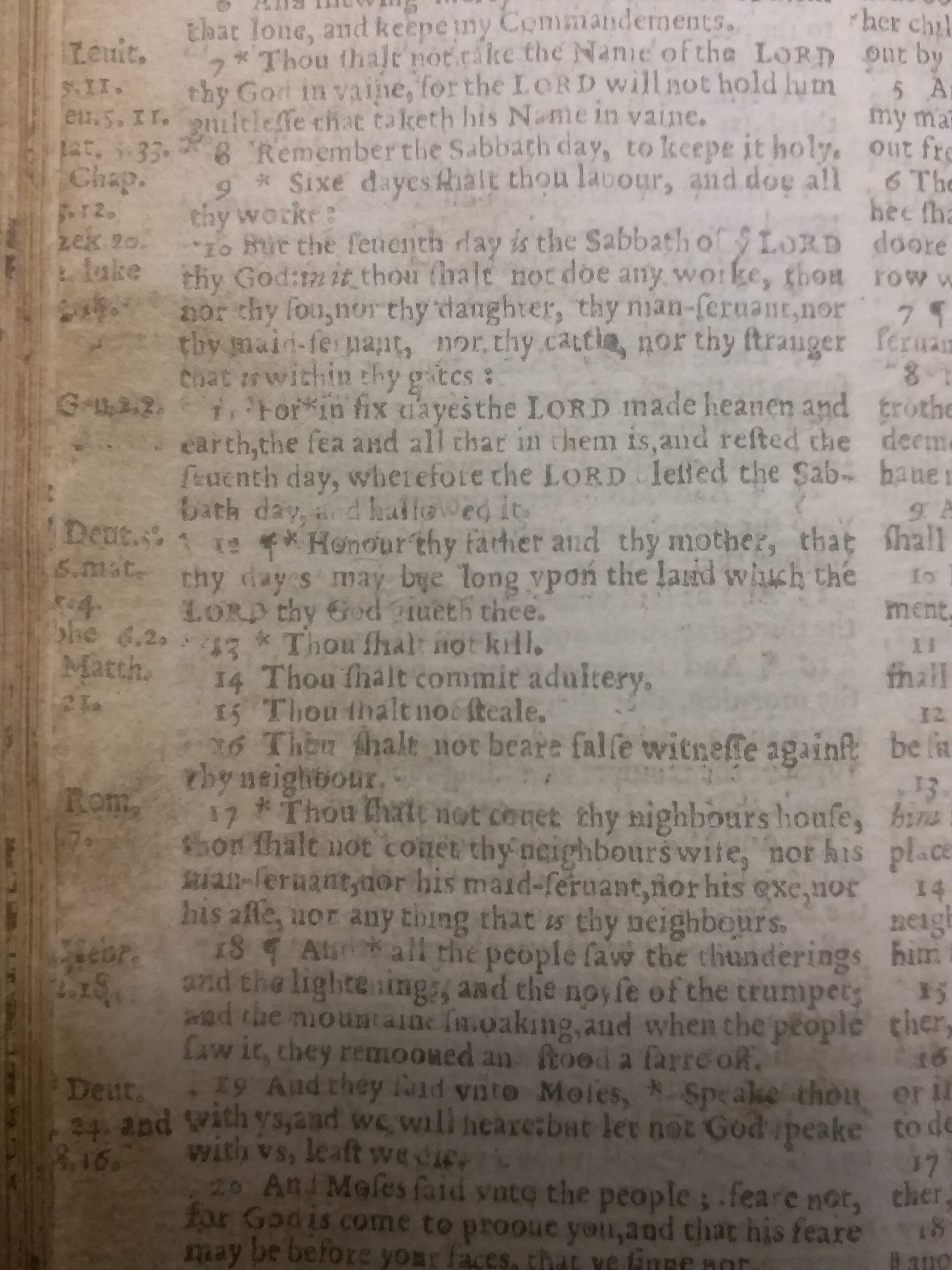
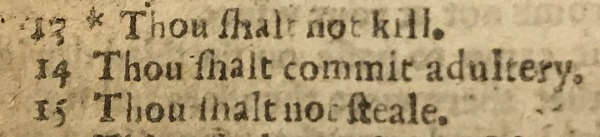
The Seventh Commandment as it appears in this copy: "Thou shalt commit adultery," with the word "not" missing. Photographed directly from the Cambridge University Library copy, shelfmark BSS.201.C31.6. Photograph by Wikimedia contributor Cambsgooseking.
Cambsgooseking, via Wikimedia Commons, CC BY-SA 4.0| Artist | Robert Barker and Martin Lucas, His Majesty's Printers |
|---|---|
| Date | 1631 |
| Medium | Letterpress printing on paper, black-letter and roman type |
| Dimensions | Octavo (8vo); exact leaf and binding measurements for this copy not published in the sources consulted |
| Where it is now | Bible Society's Library, Cambridge University Library, Cambridgelast confirmed |
| Inventory number | BSS.201.C31.6 |
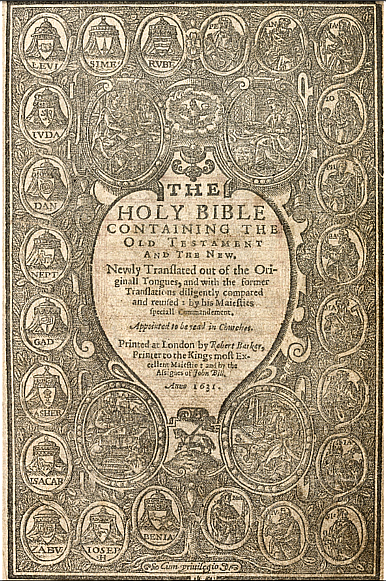
| Attribution | AcceptedThe title page names the printers as Robert Barker, printer to the king's most excellent majesty, and the assigns of John Bill, with Martin Lucas as Barker's partner in the patent from 1631. Full note |
| Object type | Printed book |
| Period | English, seventeenth century |
| Cases | Has a provenance gap |
| Inscriptions | None recorded for this copy in the sources consulted |
| Owners on record | 4 links2 documented, 2 unknown |
| Sources | 22 cited |
About this record Last verified · 22 sources cited · Change log
On this page 11 sections
ContentsClose
In 1631 the King's Printers Robert Barker and his new partner Martin Lucas issued an octavo reprint of the King James Bible in which the compositor dropped a single word from the Seventh Commandment: Exodus 20:14 reads "Thou shalt commit adultery." About a year later the error reached Charles I by way of the Bishop of London, William Laud, and the printers were fined and their edition ordered called in and destroyed. This copy, shelfmark BSS.201.C31.6, belongs to the Bible Society's Library housed at Cambridge University Library. It is one of a growing number of known survivors of a print run usually put at around a thousand; a widely repeated modern claim that Barker lost his royal patent and that the fine directly ruined him does not hold up cleanly against the nearer sources, which show a more tangled and more interesting story.
This record anchors every claim specifically to the Cambridge copy where the evidence allows it, and says plainly where it cannot: the volume's own path into the Bible Society's collection before its 1985 deposit at Cambridge is not documented in any source found for this record.
Provenance
Each link is graded. Documented: a cited source supports it. Disputed: the identification is argued but not established. Unknown: no owner for that span, and the gap is not smoothed into a narrative. The grades in the glossary.
- 1631 -Printed by Robert Barker and Martin Lucas, His Majesty's Printers, Londondocumented
The edition's imprint and the general facts of its 1631 printing and 1632 Star Chamber/High Commission referral are well documented across multiple independent sources. This entry describes the edition's origin, not a specific ownership event for the Cambridge copy.1234
- 1631 - unknownUnrecordedunknown
No source located for this record documents an owner of this specific copy between its 1631 printing and its presence in the Bible Society's Library collection. Given the Bible Society was founded in 1804, this gap covers at minimum 173 years and very likely longer.
- unknown - 1985British and Foreign Bible Society (Bible Society), Londonunknown
The Bible Society's Library and Archive, built up by the Society since its 1804 founding, is documented as a body. This specific volume's date and means of entry into that collection -- purchase, gift, or bequest -- is not documented in any source consulted.11
- 1985 - presentCambridge University Library (Bible Society's Library, on deposit)documented
When the Bible Society moved its operational headquarters to Swindon in 1985, its library and archive were judged unsuited to the new site and were deposited at Cambridge University Library under an agreement between the two bodies, where the collection remains as a named department. The volume was displayed at Cambridge University Library's 2011 exhibition marking the 400th anniversary of the King James Bible.101112
Technical evidence
| Attribution note | The title page names the printers as Robert Barker, printer to the king's most excellent majesty, and the assigns of John Bill, with Martin Lucas as Barker's partner in the patent from 1631. The imprint is not disputed. What is genuinely uncertain is responsibility for the error itself: no surviving record identifies which individual compositor set the line, and a rival-sabotage theory (argued by some modern scholars, denied by neither printer at the time, proven by none) is addressed below rather than folded into the imprint. |
|---|---|
| Format | Octavo (8vo), the standard format for Barker's more affordable Authorized Version reprints of the period, as distinct from the large folio pulpit Bibles his press also produced.22 |
| Type | Black-letter (gothic) body text with roman type used for some paratextual material, consistent with Barker press practice of the period.22 |
| Bibliographic reference numbers | Herbert 444; STC (Short Title Catalogue) 2296; ESTC S161. These three numbers are cross-confirmed independently by the catalogue descriptions of two different auction houses (Sotheby's, 2018, and Bonhams, 2015) offering two different physical copies of the same edition.89 |
| Imprint | London: Robert Barker, printer to the King's most excellent majesty, and by the assigns of John Bill, 1631, with Martin Lucas named as Barker's partner in the patent that year.124 |
| The Exodus 20:14 error | "Thou shalt commit adultery" -- the word "not" is omitted from the Seventh Commandment. Confirmed by direct photograph of this copy.1618 |
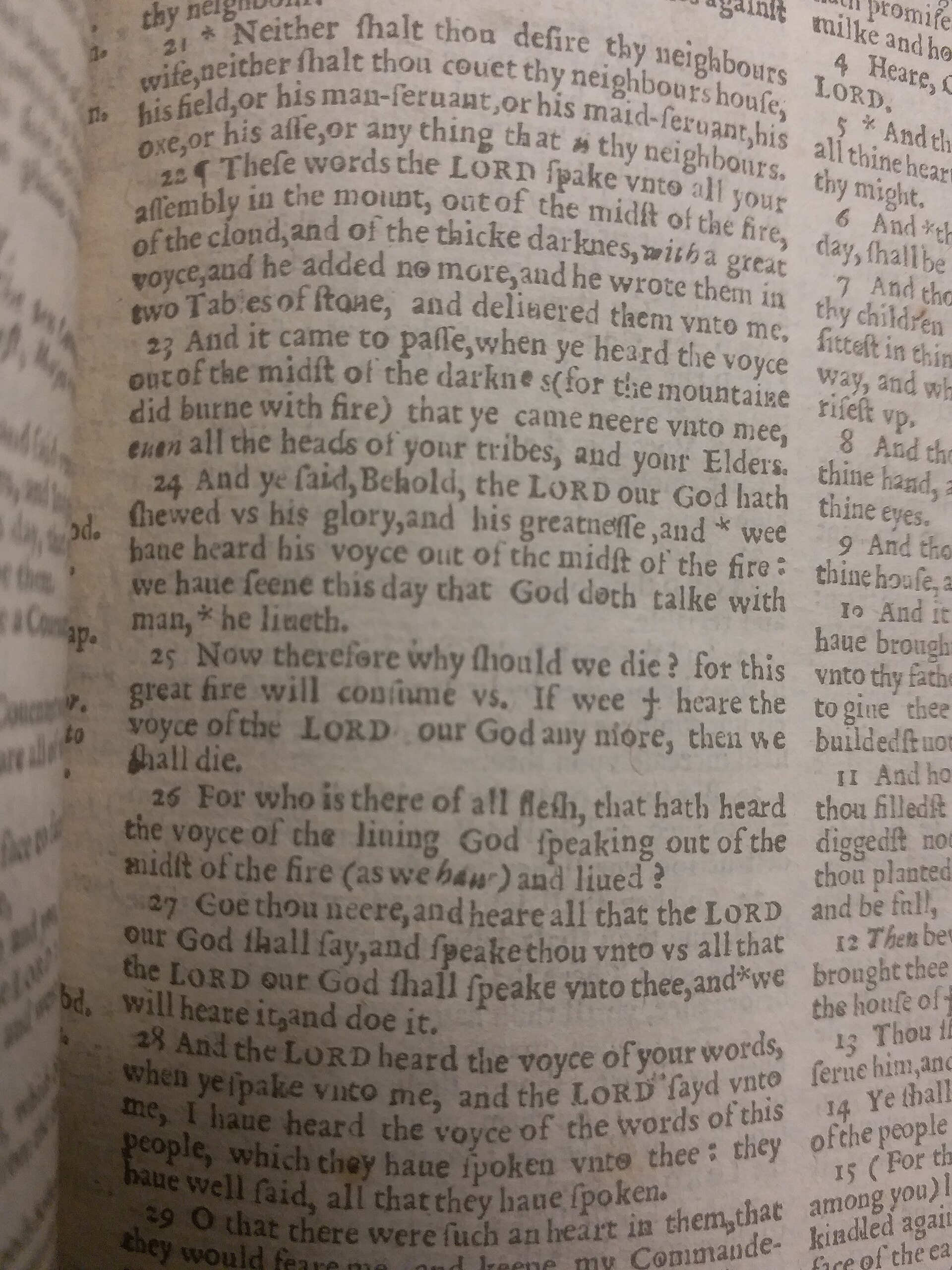
| The Deuteronomy 5:24 reading in this copy | This copy reads "greatnesse" correctly at Deuteronomy 5:24 and does not carry the "great-asse" variant reported elsewhere for this edition, based on a direct photograph of this copy's own page. Whether this reflects a corrected press state or an uneven print run is not established.17 |
| Shelfmark and collection | BSS.201.C31.6, Bible Society's Library, Cambridge University Library. The BSS prefix denotes the Bible Society's own classification, not a Cambridge University Library accession series proper.101116 |
| Binding | Not described for this specific copy in any source consulted; recorded as an open question rather than assumed. |
Images
The record in full
Chapter 1What this copy is
The object is a single printed volume: an octavo edition of the Authorized Version of the Bible, Old and New Testaments in one volume, printed in London in 1631 under the imprint of Robert Barker...
The object is a single printed volume: an octavo edition of the Authorized Version of the Bible, Old and New Testaments in one volume, printed in London in 1631 under the imprint of Robert Barker, printer to the king, and the assigns of John Bill, with Martin Lucas named as Barker's partner in the patent that year. It is set in black-letter and roman type, in the standard octavo format used for a run of ordinary, affordable Authorized Version reprints that Barker's press turned out through the 1620s and 1630s alongside the great folio pulpit Bibles.
This specific exemplar carries the shelfmark BSS.201.C31.6 in the Bible Society's Library, a collection housed at Cambridge University Library since 1985. Two photographs taken directly of this volume and independently verified against Cambridge University Library's own published image of the same opening confirm that it is a genuine, physically present copy of the 1631 edition, open at Exodus 20 with the misprint intact.
No binding description, leaf count, or precise page measurement for this individual copy was located in any source consulted for this record. That is recorded here as a gap, not filled with a figure borrowed from a different institution's copy.
Chapter 2The line that made it famous
Exodus 20:14 in the Authorized Version reads, correctly, "Thou shalt not commit adultery." In this edition the word "not" is missing, so the Seventh Commandment instructs the opposite of what it...
Exodus 20:14 in the Authorized Version reads, correctly, "Thou shalt not commit adultery." In this edition the word "not" is missing, so the Seventh Commandment instructs the opposite of what it means: "Thou shalt commit adultery." The error sits in the middle of the Decalogue, in the single best-known list of prohibitions in the English Bible, which is precisely why it could not be overlooked once anyone noticed it.
A second, less famous error appears elsewhere in the same edition: Deuteronomy 5:24 renders "his glory and his greatness" as "his glory and his great-asse." The Cambridge copy has been photographed specifically at this opening, and the image shows the correct reading, "greatnesse," with no trace of the second error. Whether that means this copy represents a corrected press state, a partially corrected sheet, or simply that the Deuteronomy error did not affect every copy of the print run is not established in the sources consulted; it is recorded here as an observed fact about this specific volume, not extended into a claim about the edition as a whole.
Chapter 3Accident or sabotage
Two serious, low-probability errors landing in the same short edition has prompted a sabotage theory.
Two serious, low-probability errors landing in the same short edition has prompted a sabotage theory. Diana Severance, director of the Dunham Bible Museum, and the historian Gordon Campbell have both suggested that a rival with an interest in stripping Barker and Lucas of their lucrative Bible patent could have deliberately altered the type. Severance's own reasoning is instructive: a single dropped word could be an accident, but a second, equally damaging error in the same small book reads to her as "something else going on."
This is an argued position, not a documented one. No contemporary record identifies a suspect, states a motive with evidence, or proves interference with the type at the compositor's case. Significantly, neither Barker nor Lucas is recorded as having raised sabotage in their own defence when the case against them was heard, which would have been the obvious mitigation to offer a prerogative court. One further detail circulates in recent popular accounts: that an inkblot sits over the missing letter in a small number of surviving copies, as though someone tried to obscure rather than correct the gap. This is reported in modern secondary writing rather than confirmed against a bibliographic collation of the surviving copies, and is flagged here for verification rather than stated as fact.
The plain, unglamorous reading remains available and should not be discarded for the more dramatic one: two men running a large-format Bible-printing operation on tight margins, with hand-set type and inexperienced staff, produced a bad edition. Nothing in the sources found requires a villain.
Chapter 4Why a printing error went to a royal court
The reason this mistake became a matter of state rather than an embarrassing reprint has to do with what the King's Printer's patent actually was.
The reason this mistake became a matter of state rather than an embarrassing reprint has to do with what the King's Printer's patent actually was. Since 1577 the office had been a Crown monopoly, inherited within the Barker family from Robert's father Christopher, giving its holder the sole right to print the English Bible, the Book of Common Prayer, and other officially sanctioned texts. Producing an accurate Bible was therefore not simply good business practice; it was the entire justification for a royal proprietary grant, one already resented and periodically challenged by other stationers such as the bookseller Michael Sparke. A defective Bible put out under that patent was a defect in the Crown's own instrument, not merely poor workmanship, and that is the documented reason the case went to a prerogative court rather than being settled as an ordinary trade dispute.
The man most often named as the one who set the case in motion was, at the time, not yet an archbishop. William Laud had been Bishop of London since 1628 and would not become Archbishop of Canterbury until August 1633, roughly a year or more after this episode. The near-contemporary account, written by Peter Heylyn in 1668, states that the king was made aware of the error "by the Bishop of London" -- that is, by Laud in his pre-1633 office -- after which "Order was given for calling the Printers into the High-Commission." George Abbot, the sitting Archbishop of Canterbury throughout 1631 and 1632 (a much-weakened figure in these years, his authority diminished since a 1621 hunting accident in which he killed a gamekeeper), is separately recorded as having been angered by the errors. The popular modern shorthand that "Archbishop Laud" personally brought the printers before the Star Chamber compresses two different men holding two different offices into one, and gets Laud's own title wrong for the date in question; this record uses the more precise version.
Chapter 5Star Chamber, or High Commission, and the fine
Heylyn's 1668 account, the earliest narrative source located for this record, names the Court of High Commission rather than the Star Chamber as the forum that heard the case, and most modern...
Heylyn's 1668 account, the earliest narrative source located for this record, names the Court of High Commission rather than the Star Chamber as the forum that heard the case, and most modern secondary accounts nonetheless call it a Star Chamber matter. The two courts were closely related instruments of royal and ecclesiastical prerogative and shared personnel, but they were not the same body, and this record notes the discrepancy plainly rather than silently picking the more familiar name.
The fine is usually quoted as a round 300 pounds. The nineteenth-century Dictionary of National Biography entry on Barker, drawing on Samuel Rawson Gardiner's edition of the Star Chamber and High Commission reports, gives a more precise breakdown: Barker was fined 200 pounds and Lucas 100 pounds, and the court ordered that all issued copies be called in so the faulty sheets could be cancelled. The same source adds a detail almost never repeated in popular retellings: the fines were "respited again and again until 1640," and whether the money was ever actually paid is, in Gardiner's own account, questionable. A local history source adds that Barker may instead have been required to supply type to the Oxford and Cambridge university presses in lieu of payment, though this record has not been able to verify that claim against a primary record and flags it as unconfirmed.
A widely quoted modern-currency equivalent for the fine, 58,600 pounds in current terms, appears in Wikipedia's article on the Wicked Bible without a stated conversion method or price index. It is repeated here only as an illustrative order of magnitude, not as a rigorously sourced figure, exactly because the method behind it is not given.
Chapter 6What did not happen to Robert Barker
Popular tellings compress the story into a single clean line: Barker was fined, lost his patent, and was ruined by the Wicked Bible, dying in a debtors' prison as a direct result.
Popular tellings compress the story into a single clean line: Barker was fined, lost his patent, and was ruined by the Wicked Bible, dying in a debtors' prison as a direct result. The nearer sources support a messier and more accurate sequence.
Barker did not lose the office of King's Printer over this affair. He held it until his death in 1645, fourteen years after the Wicked Bible and thirteen after the Star Chamber case. The claim that he and Lucas were "deprived of their printing licence," repeated across several modern secondary sources, is not supported by the documented continuation of Barker's patent and appears to be either an overstatement of a temporary sanction or a conflation with the separate, later erosion of his control over the office through debt and litigation.
His financial decline long predates 1631. By 1620 he was already heavily in debt, his estates mortgaged to his own printing partner, driven above all by the enormous personal cost of financing the 1611 first edition of the King James Bible and by years of litigation with the rival printer Bonham Norton over control and profit of the King's Printing House. He sold his Southlea estate in 1631, the same year as the Wicked Bible, which was very likely a symptom of that older financial strain rather than a consequence of the misprint. In 1635, three years after the Star Chamber case, he mortgaged his share in the office of King's Printer to Miles Fletcher and was committed as a debtor to the King's Bench Prison. That imprisonment is documented as arising from the Fletcher mortgage, not explicitly and directly from the unpaid Wicked Bible fine, though the two financial pressures were plainly compounding on the same man in the same decade. He remained in the King's Bench Prison until his death on 10 January 1644/5 -- that is, January 1645 by modern reckoning. This record treats the Wicked Bible fine and Barker's eventual death in prison as two real, connected but not simply causal, threads in a single financial collapse, rather than as one clean chain of cause and effect.
Chapter 7This copy's own path: what is known and what is not
The shelfmark prefix BSS identifies this volume as part of the Bible Society's Library: the historic library and archive of the British and Foreign Bible Society, founded in 1804.
The shelfmark prefix BSS identifies this volume as part of the Bible Society's Library: the historic library and archive of the British and Foreign Bible Society, founded in 1804. The Society moved its operational headquarters to Swindon in 1985; at that point its library and archive, judged unsuited to the new site, were deposited at Cambridge University Library under an agreement between the two institutions, where they remain a named, separately catalogued department. That deposit history is documented for the collection as a whole.
What is not documented in any source found for this record is the specific path of this individual volume before that point: who owned it, when the Bible Society itself acquired it, whether it came by purchase, bequest, or donation, and whether it passed through any private hands after 1631 that left a written record. Cambridge University Library's own public materials that reference this shelfmark -- a 2020 blog feature from the library's Genizah research unit that uses this Bible as a comparative example of a different kind of textual slip, and the library's 2011 exhibition marking the 400th anniversary of the King James Bible, in which a Wicked Bible was shown -- both treat the volume as an already-settled part of the collection without narrating how it arrived. This record states that gap plainly rather than bridging it with an assumption borrowed from the Bible Society's general collecting history.
Chapter 8How many copies survive: a moving number
The print run is consistently given in modern secondary sources as approximately 1,000 copies, but this record was unable to locate a primary print order, Stationers' Company register entry, or other...
The print run is consistently given in modern secondary sources as approximately 1,000 copies, but this record was unable to locate a primary print order, Stationers' Company register entry, or other contemporary document that actually states this figure; it should be treated as a repeated modern estimate rather than an established documentary fact.
The count of surviving copies has moved substantially over time, and the movement is itself informative about how bibliographic censuses work. A Bonhams sale in 2015 cited the English Short Title Catalogue as listing nine known copies and noted that five had appeared at auction since the Second World War. Other accounts from around the same period speak of "fewer than ten" or "about eleven" surviving copies. The current Wikipedia article, reflecting more recent research, states that twenty-five copies are now known, eighteen of them in institutional collections, with examples recorded in the United Kingdom, the United States, Canada, Ireland, and Italy, spread across institutions that include the British Library, the Bodleian, the John Rylands Library, York Minster Library, the New York Public Library, Yale's Sterling Memorial Library, Princeton, the Lilly Library at Indiana University, the Thomas Fisher Rare Book Library in Toronto, the National Central Library of Rome, the University of Canterbury in New Zealand, the Dunham Bible Museum at Houston Christian University, and the Museum of the Bible. This record gives the range rather than picking a single number, because the number itself has a documented history of revision and may move again.
Chapter 9Other copies at market
No sale of the Cambridge University Library copy has taken place; it is an institutional holding and this section concerns other, physically distinct copies of the same 1631 edition, kept separate...
No sale of the Cambridge University Library copy has taken place; it is an institutional holding and this section concerns other, physically distinct copies of the same 1631 edition, kept separate here exactly to avoid the version confusion this publication exists to prevent.
A copy sold at Bonhams, Knightsbridge, on 11 November 2015 (lot 5) made a hammer price of 25,000 pounds, or 31,250 pounds with buyer's premium; its provenance included a nineteenth-century inscription recording a gift from a John Williams to his nephew J.M. Williams in March 1847. A copy offered at Sotheby's in 2018 (lot 181, Important Books and Manuscripts) carried an estimate of 25,000 to 30,000 US dollars and provenance to a John Ellman Brown of Shoreham-by-Sea, Sussex; the realised hammer price is not published in the sources consulted for this record, though a figure of 56,250 US dollars for a Wicked Bible sale is reported in general modern coverage without being tied conclusively to this specific lot. Both auction houses independently cite the same bibliographic identifiers for the edition -- Herbert 444, STC 2296, and ESTC S161 -- which cross-confirms the reference numbers used throughout this record.
Chapter 10The comparanda: Barker's own history with misprinted Bibles, and others
The Wicked Bible was not the only Authorized Version misprint of the century, and Robert Barker's press was not new to the problem when it happened.
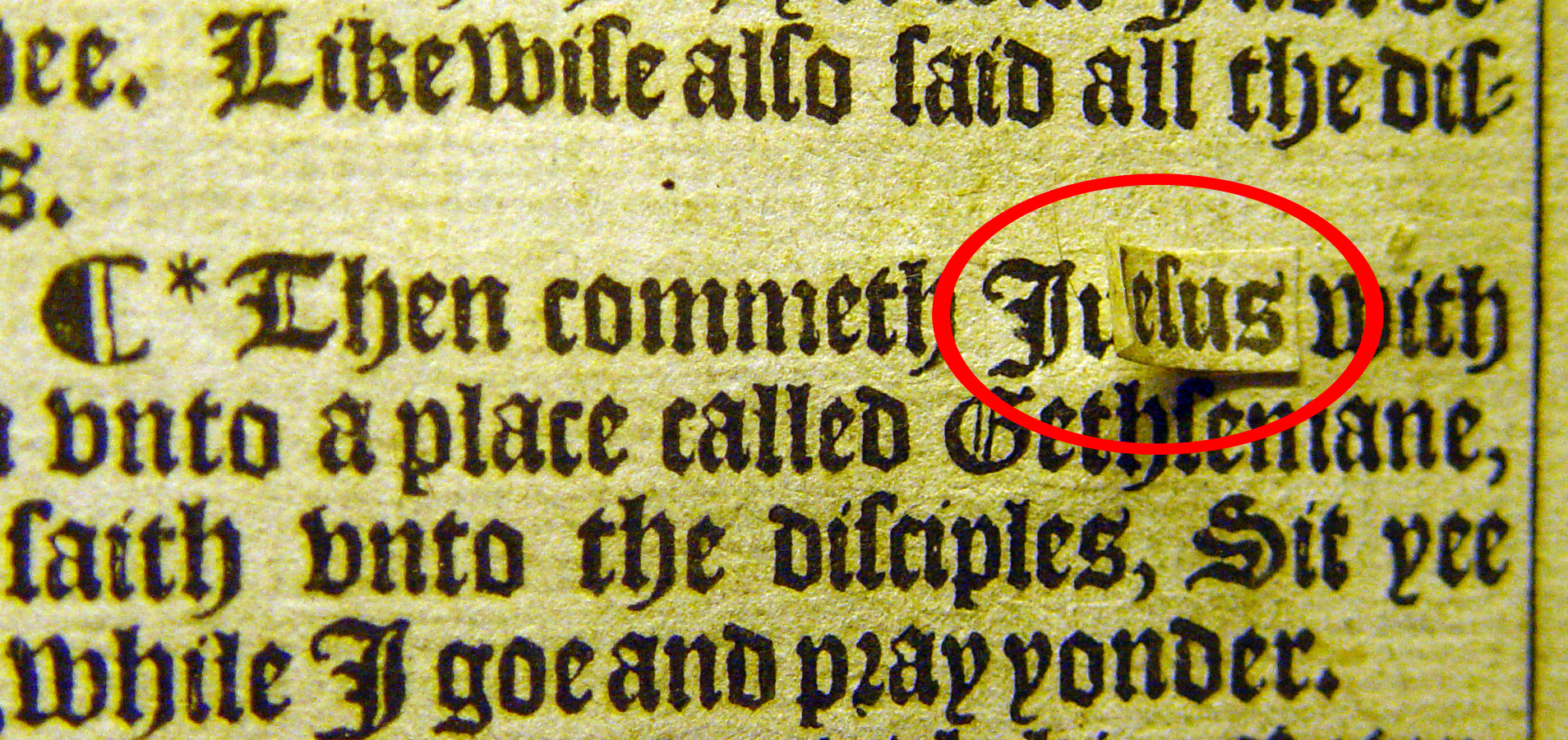
The Wicked Bible was not the only Authorized Version misprint of the century, and Robert Barker's press was not new to the problem when it happened. In 1613, eighteen years before the Wicked Bible, an edition Barker printed rendered Matthew 26:36 with Judas rather than Jesus telling the disciples to sit while he went to pray -- the so-called Judas Bible. A surviving copy at St Mary's Church, Totnes, Devon, shows the error corrected in the ordinary way available to a parish that owned a flawed pulpit Bible: a small slip of paper pasted directly over the misprinted name, rather than the wholesale destruction the 1631 edition suffered.
Later editions produced similar embarrassments without similar consequences. A 1653 Cambridge Press edition dropped "not" from 1 Corinthians 6:9, producing the so-called Unrighteous Bible, which asks rhetorically whether the unrighteous shall inherit the kingdom of God when the verse means the opposite. A 1716 edition rendered Jeremiah 31:34's "sin no more" as "sin on more." John Baskett's 1717 Oxford edition misprinted the chapter heading for the parable of the vineyard in Luke 20 as "the Parable of the Vinegar," giving that edition its own nickname, the Vinegar Bible, despite Baskett's edition otherwise being a large and expensive production. A 1763 edition rendered Psalm 14:1 as "there is a God," reversing the psalm's actual claim that there is no God.
None of these later misprints is recorded, in the sources reviewed for this record, as having produced a Star Chamber or High Commission prosecution of its printer. Whether that is because the Wicked Bible was treated as a genuinely exceptional case -- a fresh, newly formed partnership making a highly public error at a moment when press discipline under Charles I and Laud was tightening -- or simply because the 1630s left better court records than later decades, is not established in the sources consulted and is recorded here as an open question rather than resolved either way.
Chapter 11A claim worth debunking: the Psalm 119 story
A claim circulates online that the 1631 edition also misprinted Psalm 119 to call princes "wicked." This record finds no support for that claim as stated.
A claim circulates online that the 1631 edition also misprinted Psalm 119 to call princes "wicked." This record finds no support for that claim as stated. The actual documented error involving Psalm 119 belongs to a different, unrelated 1612 printing, sometimes called the Printers' Bible, in which Psalm 119:161 was rendered "Printers have persecuted me without cause" instead of "Princes have persecuted me without cause" -- a compositor's substitution of one plural noun for another, not an accusation of wickedness, and not part of the 1631 edition covered by this record. The two errors are unrelated beyond both originating in seventeenth-century Authorized Version printings, and conflating them, as some popular summaries do, is exactly the kind of unverified claim this record was asked to check rather than repeat.
Chapter 12What is still unresolved
No source located for this record identifies who first noticed the missing "not," or precisely when between the edition's 1631 publication and its referral to the king, reported as occurring about a...
No source located for this record identifies who first noticed the missing "not," or precisely when between the edition's 1631 publication and its referral to the king, reported as occurring about a year later. Heylyn's account states only that the king was informed by the Bishop of London; it does not say whether Laud found the error himself, had it brought to him by a cleric, a bookseller, or a reader, or acted on a complaint already circulating. That chain -- discoverer, informant, and the exact date of referral -- is missing from every source consulted and is recorded here as unresolved rather than filled with a plausible guess.
The artist
Robert Barker, His Majesty's Printer, and Martin Lucas, his partner in the patent from 1631
Robert Barker held one of the most valuable and most poisoned offices in English printing: the Crown monopoly on the Bible and the Book of Common Prayer, inherited from his father Christopher Barker in 1599. It had already made and nearly broken him once, through the 1611 King James Bible, before the Wicked Bible finished the job over the following decade. Martin Lucas enters the record only in 1631, as Barker's newly taken partner in the patent, in time to be fined for an error made within months of the partnership beginning. Neither man is well documented as an individual outside these events; what survives is largely the record of the office they held and the two crises it produced.
Exhibited
- 2011Great and Manifold Blessings: The Making of the King James BibleCambridge University Library, Cambridge · A five-month exhibition marking the 400th anniversary of the King James Bible, running to 18 June 2011, in which a Wicked Bible was displayed. Sourced to secondary press coverage rather than a surviving exhibition catalogue entry naming this specific shelfmark; treated here as documented for the collection's Wicked Bible generally.
Literature
- A. S. Herbert, Historical Catalogue of Printed Editions of the English Bible, 1525-1961 (London: British and Foreign Bible Society, 1968), entry 444. The standard modern bibliographic authority for this edition, cited independently by two auction houses. Not independently consulted in full for this record; flagged for direct verification against a library copy of Herbert.
- Samuel Rawson Gardiner, ed., Reports of Cases in the Courts of Star Chamber and High Commission (Camden Society, 1886). The apparent source, via the Dictionary of National Biography, for the precise 200/100-pound fine split between Barker and Lucas and for the detail that the fines were repeatedly respited. Not independently consulted in full for this record; flagged for direct verification.
- Peter Heylyn, Cyprianus Anglicus: Or, the History of the Life and Death of William Laud (London, 1668). The earliest narrative account located naming the Bishop of London's role in reporting the error to Charles I and naming the Court of High Commission as the forum. Known here only through quotation in later secondary sources, not independently consulted in full.
Related works
| Work | Relation | Where it is |
|---|---|---|
| The Holy Bible (King James Version, first edition) Robert Barker | Barker's earlier and far more consequential production, the 1611 folio first edition of the Authorized Version, financed personally by Barker at ruinous cost Already the subject of a separate Iconotheca record (king-james-bible-1611-upenn); the two objects are printed by the same royal printing house twenty years apart and should not be confused with one another. | Multiple institutional holdings, including the Kislak Center, University of Pennsylvania Libraries |
| The Judas Bible (1613) Robert Barker | An earlier Barker misprint edition, in which Judas is named in place of Jesus at Matthew 26:36 Corrected in situ with a pasted slip of paper rather than withdrawn and destroyed, unlike the Wicked Bible eighteen years later. | A surviving corrected copy is held at St Mary's Church, Totnes, Devon |
| The Unrighteous Bible (1653) Cambridge Press | A later, unrelated Authorized Version misprint omitting "not" from 1 Corinthians 6:9 Named for the resulting sense that the unrighteous shall inherit the kingdom of God. | Various institutional and private holdings |
| The Vinegar Bible (1717) John Baskett, Oxford | A later, unrelated misprint mistitling the parable of the vineyard as the parable of the vinegar in a Luke 20 chapter heading Otherwise a large and expensive edition, sometimes itself called the Basketful of Errors. | Various institutional and church holdings, including St Andrew's, Farnham, and St Edmund's, Castleton |
| The Printers' Bible (1612) Unknown Jacobean printer | Frequently confused with the Wicked Bible online; a separate 1612 edition that misprints Psalm 119:161 as "Printers have persecuted me" for "Princes have persecuted me" This record explicitly debunks any claim that this error belongs to the 1631 Wicked Bible edition. | Not established in the sources consulted for this record |
Open questions
- Who first noticed the missing "not" in Exodus 20:14, and on what date between the edition's 1631 publication and the referral to Charles I reported as occurring about a year later? No source located for this record names a discoverer or a precise date.
- How and when did this specific volume, BSS.201.C31.6, enter the British and Foreign Bible Society's collection, and who owned it before that? The collection's 1985 deposit at Cambridge University Library is documented; this individual volume's path into the collection before that date is not.
- Was the GBP 300 Star Chamber (or High Commission) fine against Barker and Lucas ever actually paid? The Dictionary of National Biography, citing Gardiner's Star Chamber reports, states the fine was repeatedly respited until 1640 and that payment is questionable; no source consulted resolves this definitively.
- Does this copy represent a corrected press state for the Deuteronomy 5:24 "great-asse" error, or did that second error never affect the whole print run? This copy's own page has been photographed showing the correct reading, but no full bibliographic collation of surviving copies against press variants was located.
- Is the sabotage theory (a rival printer deliberately altering type to strip Barker and Lucas of the Bible patent) more than a modern inference from the coincidence of two errors in one edition? No contemporary source alleges sabotage, and neither printer raised it in his own defence.
- What is the true current census of surviving copies, and how many are in private versus institutional hands? Published figures range from nine (English Short Title Catalogue, cited in a 2015 sale) to twenty-five (current Wikipedia figure, eighteen institutional), and the number has moved substantially within living memory.
Questions about this object
What is The Holy Bible, Conteyning the Old Testament and the New (the "Wicked Bible")?
The Holy Bible, Conteyning the Old Testament and the New (the "Wicked Bible") is a printed book, dated 1631. Medium: Letterpress printing on paper, black-letter and roman type.
Who made The Holy Bible, Conteyning the Old Testament and the New (the "Wicked Bible"), and is the attribution settled?
The attribution to Robert Barker and Martin Lucas, His Majesty's Printers is recorded here as accepted. The title page names the printers as Robert Barker, printer to the king's most excellent majesty, and the assigns of John Bill, with Martin Lucas as Barker's partner in the patent from 1631. The imprint is not disputed. What is genuinely uncertain is responsibility for the error itself: no surviving record identifies which individual compositor set the line, and a rival-sabotage theory (argued by some modern scholars, denied by neither printer at the time, proven by none) is addressed below rather than folded into the imprint.
Where is The Holy Bible, Conteyning the Old Testament and the New (the "Wicked Bible") now?
Bible Society's Library, Cambridge University Library, Cambridge. Inventory number BSS.201.C31.6. Last confirmed 3 September 2026. Shelfmark confirmed against Cambridge University Library's own photographic captions (the library's Taylor-Schechter Genizah Research Unit 'Fragment of the Month' feature of February 2020 uses the identical shelfmark for its own image of this volume's Exodus 20:14 opening) and against two independent Wikimedia Commons photographs of the same physical volume taken directly at the library.
What is still unknown about The Holy Bible, Conteyning the Old Testament and the New (the "Wicked Bible")?
Who first noticed the missing "not" in Exodus 20:14, and on what date between the edition's 1631 publication and the referral to Charles I reported as occurring about a year later? No source located for this record names a discoverer or a precise date.
Sources
- 1Wikipedia, 'Wicked Bible'. en.wikipedia.org/wiki/...
- 2Wikipedia, 'Robert Barker (printer)'. en.wikipedia.org/wiki/...
- 3Dictionary of National Biography, 1885-1900, 'Barker, Robert (d. 1645)', via Wikisource. en.wikisource.org/wiki/...
- 4Datchet History Group, 'Robert Barker, Printer to Queen Elizabeth I'. datchethistory.org.uk/datchet-people/...
- 5Windsor Local History Group, 'Robert Barker and the 400th Anniversary of the King James Bible'. windsorlocalhistorygroup.org/robert-barker-and-the-400th-...
- 6Houston Christian University, 'A Wicked Discovery' (Dunham Bible Museum), 13 February 2024. hc.edu/news-and-events/...
- 7Museum of the Bible, Collections, 'The Wicked Bible' (artifact 6196). Describes a different physical copy than the one in this record; used here only for comparative auction/provenance context, clearly separated from the Cambridge copy. collections.museumofthebible.org/artifacts/...
- 8Sotheby's, Important Books and Manuscripts, 2018, Lot 181, 'Bible in English [The Wicked Bible]'. sothebys.com/en/...
- 9Bonhams, Fine Books, Atlases, Manuscripts and Photographs, 11 November 2015, Lot 5. bonhams.com/auction/...
- 10Cambridge University Library, Taylor-Schechter Genizah Research Unit, 'Fragment of the Month: February 2020' (by Gary Martin), citing the Wicked Bible, BSS.201.C31.6, as comparative material. lib.cam.ac.uk/collections/...
- 11Cambridge University Library, 'Bible Society's library' collections page, for the 1985 deposit history of the Bible Society's Library and Archive. lib.cam.ac.uk/collections/...
- 12A Deacon's Wife (blog), 'Wicked Bible to go on display', 10 February 2011, citing coverage of the Cambridge University Library exhibition 'Great and Manifold Blessings: The Making of the King James Bible'. adeaconswife.com/2011/...
- 13Boing Boing, 'A 1631 Bible accidentally ordered readers to commit adultery', 9 July 2026, for the sabotage/inkblot claim, presented there as reported rather than proven. boingboing.net/2026/...
- 14Amusing Planet, 'The Wicked Bible', 2022, for print-run figures and comparanda misprint editions (Unrighteous Bible, 'sin on more' 1716 edition, Vinegar Bible, and the 1763 'there is a God' edition). amusingplanet.com/2022/...
- 15Wikipedia, 'British Bible monopolies campaigns', for background on opposition to the King's Printer Bible monopoly. en.wikipedia.org/wiki/...
- 16Wikimedia Commons, File:University of Cambridge Wicked Bible Exodus 20.jpg, photographer Cambsgooseking, verified CC BY-SA 4.0 via the Commons API. commons.wikimedia.org/wiki/...
- 17Wikimedia Commons, File:University of Cambridge Wicked Bible Deuteronomy 5.jpg, photographer Cambsgooseking, verified CC BY-SA 4.0 via the Commons API. commons.wikimedia.org/wiki/...
- 18Wikimedia Commons, File:Wicked bible Ex 20.14 - Wicked Bible, Cambridge University Library BSS.201.C31.6.jpg, credited to Cambridge University Library, verified public domain via the Commons API. commons.wikimedia.org/wiki/...
- 19Wikimedia Commons, File:Wicked Bible Title Page.jpg, credited to thechimerist.com, verified public domain via the Commons API. commons.wikimedia.org/wiki/...
- 20Wikimedia Commons, File:Judas Bible2.jpg, verified CC BY-SA 3.0 via the Commons API, for the 1613 Judas Bible comparanda. commons.wikimedia.org/wiki/...
- 21Wikimedia Commons, File:Vinegar bible.jpg, photographer Victuallers, verified CC BY-SA 3.0 via the Commons API, for the 1717 Vinegar Bible comparanda. commons.wikimedia.org/wiki/...
- 22Aggregate of bookseller and auction-house physical descriptions (Sotheby's 2018 lot 181, Bonhams 2015 lot 5, and general antiquarian-trade listings) independently describing the edition as octavo with black-letter type; used only for edition-level format, not for this specific copy's individual measurements. sothebys.com/en/...


Last verified · Published
Change log
3 September 2026 - Record created at the house standard: researched narrative, technical evidence, maker dossier, graded provenance chain, prices with hammer and premium separated, related works, open questions and sources.