A Caption Is a Claim: Three Photographs of the Dead
Three photographs of the dead, made in 1858 and 1863, each carried a caption that later evidence cut down. What each caption claimed and what corrected it.
Records in this piece: Interior of the Secundra Bagh after the Slaughter of 2,000 Rebels by the 93rd Highlanders and 4th Punjab Regiment, A Harvest of Death, Gettysburg, Pennsylvania, Home of a Rebel Sharpshooter
On this page 5 sections
ContentsClose
In short
- The three captions fail in three different ways. Beato's title anchors a picture to a killing of November 1857 that the camera reached about four months late, Gardner's plate 36 gives one army's dead to the other, and Gardner's plate 41 reports a discovery that the photographers staged.
- The two Gettysburg corrections rest on evidence inside the pictures. The Library of Congress, following William Frassanito, points to a Third Corps diamond badge on plate 36, and the National Park Service describes a body carried about 72 yards to a stone barricade for plate 41.
- The Beato correction is only half settled. The British Library, citing John Fraser, dates the print to March 1858, but whether the bones were arranged is stated as scattered by the Getty and as uncovered by the British Library, and neither quotes a word from Beato.
- The corrections came long after the pictures. Frederick Ray noticed the repeated body in October 1961, and Frassanito's book of 1975 explained both Gettysburg cases, which is 112 years after the negatives were exposed.
Three captions from 1858 to 1866 claim more than the pictures can bear
A caption is a claim made by the person who sold the picture, and each of the three photographs of the dead in this archive carries one that later evidence has cut down. The pictures were made in India in 1858 and at Gettysburg in 1863, by three men working for a public that wanted to see what a battle left behind. The table sets the caption beside what has since been shown, and beside who showed it.
| Picture | What the caption or text claims | What the evidence shows | Who showed it |
|---|---|---|---|
| Felice Beato, Interior of the Secundra Bagh, Lucknow, 1858 | The British Library's copy is titled for the slaughter of 2,000 rebels and the first attack of Sir Colin Campbell in November 1857 | The picture was not made until March 1858, and the remains may have been uncovered or scattered for the camera, which is disputed | John Fraser, as the British Library records it, and the Getty's exhibition text |
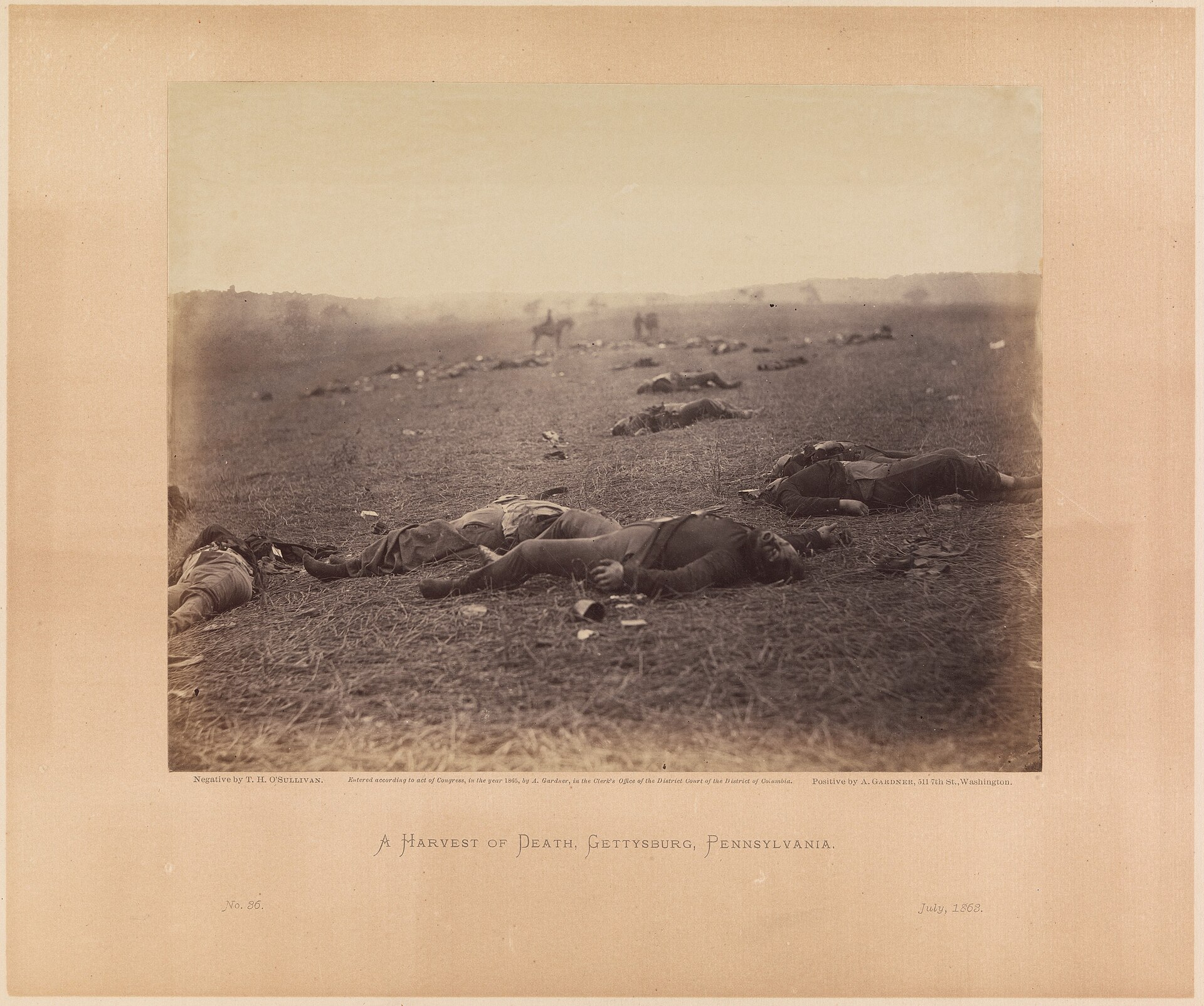
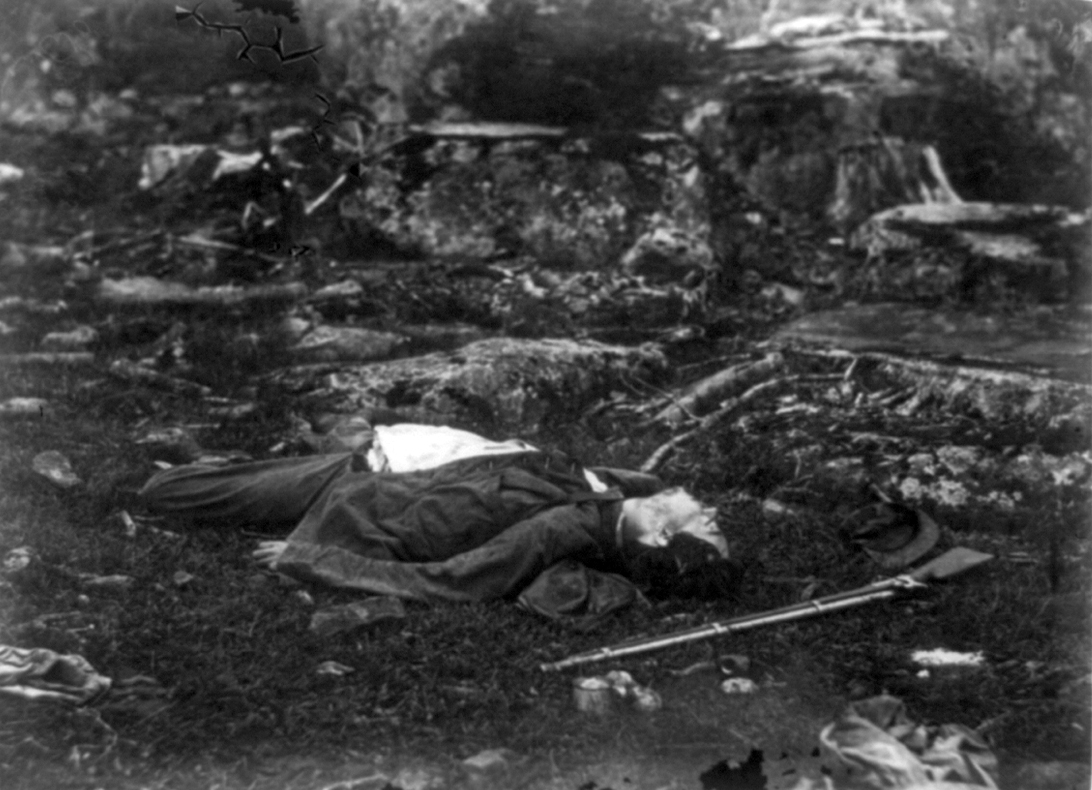
| Plate 36, A Harvest of Death, Gettysburg, July 1863 | Gardner's text calls the dead Confederate troops who paid for their treason | They are Union dead of the Third Corps, the same men seen again in plate 37 from the opposite side | William Frassanito in 1975, as the Library of Congress summarises him |
| Plate 41, Home of a Rebel Sharpshooter, Gettysburg, July 1863 | The photographer found the covert of a rebel sharpshooter and photographed it | The body was carried about 72 yards to a stone barricade and an infantry rifle was added | Frederick Ray in 1961, Frassanito in 1975, and the Gettysburg National Military Park |
Beato's title names the killing of November 1857 and the camera arrived about four months later
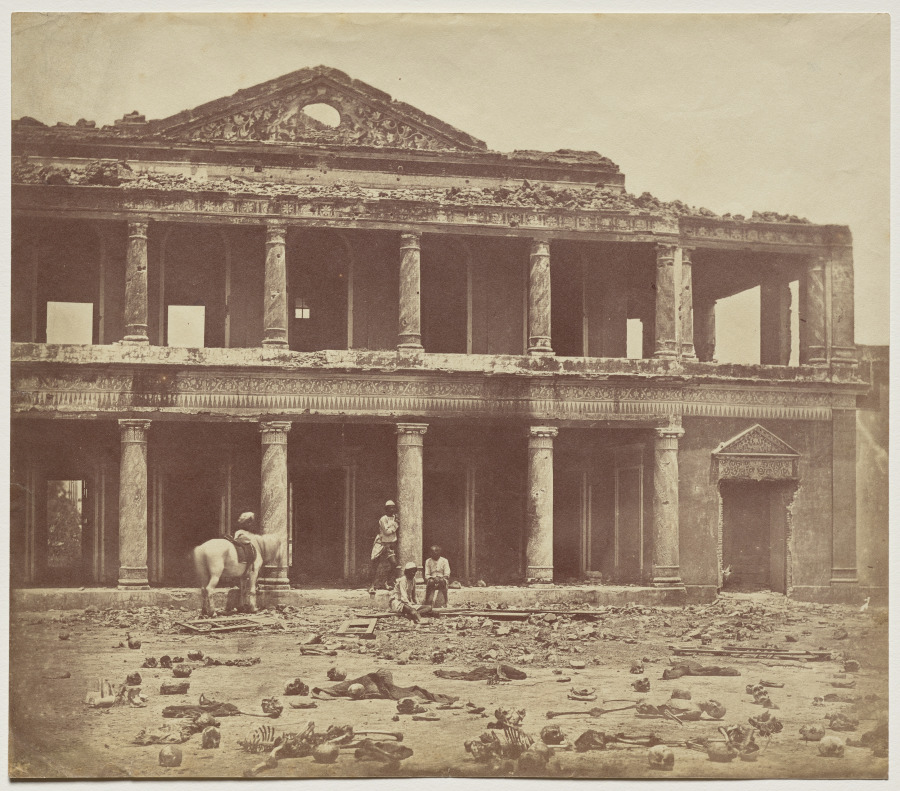
The Cleveland Museum of Art owns an albumen print of 1858 by Felice Beato, titled Interior of the Secundra Bagh after the Slaughter of 2,000 Rebels by the 93rd Highlanders and 4th Punjab Regiment, and the title is a claim about an event that the picture did not witness. Cleveland records the print as accession 2019.170.3, bought in 2019 from the London dealer Prahlad Bubbar after two Christie's sales in 1993 and 2001, and it carries a CC0 open-access licence.
The British Library's catalogue entry for its own print of the view gives the longer caption from Beato's published list, which ends with the first attack of Sir Colin Campbell in November 1857. The same entry says that research by John Fraser indicates Beato did not take the photograph until March 1858. The Getty's online exhibition text agrees on the gap: it says Beato arrived some four months after the killing and that by then the remains had been picked clean by vultures.
The two museums then use different verbs for what Beato did with the bones. The Getty text says Beato is reported to have had the skeletons of the rebels scattered about, to satisfy an appetite for scenes of savage conflict. The British Library entry says he appears to have had previously covered remains exposed for photographic effect. Scattered and uncovered are different acts, and neither entry quotes a letter or a note from Beato. This archive found no document in which he states what he did or why.
So the date has a source that a reader can follow and the arrangement of the bones has only a report. A record of the print should say so in those terms, and Cleveland's own page adds nothing to it: the museum gives the title, the year 1858 and the six-link ownership chain, and does not say whether this particular print was made in 1858 or later.
Gardner's two texts gave one group of dead to both armies
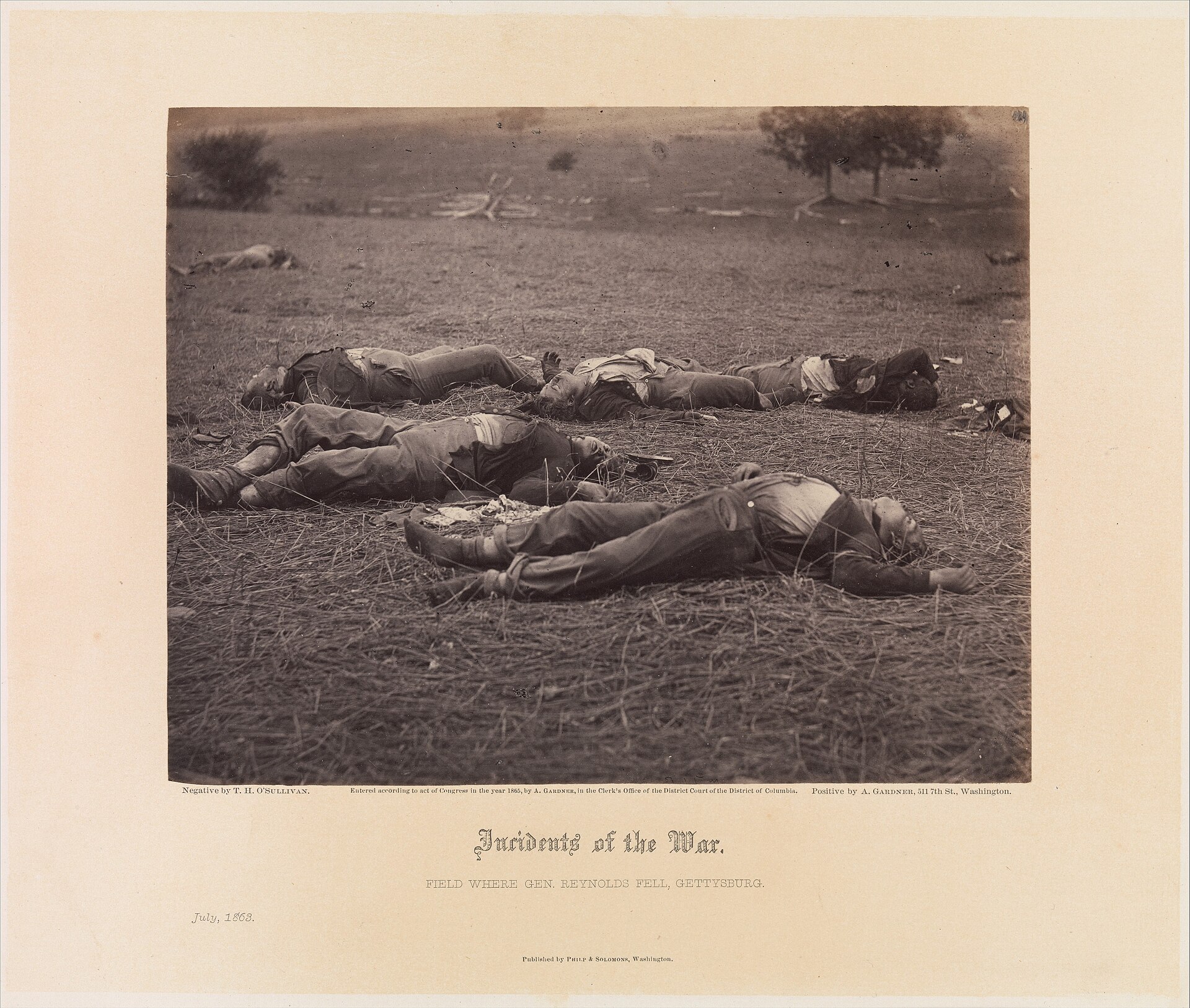
In Gardner's Photographic Sketch Book of the War of 1866, plate 36 and plate 37 show the same field of dead from opposite sides, and the book describes them as the enemy in one and as the Union's own in the other. The Library of Congress essay on the case, which rests on Frassanito's study Gettysburg: A Journey in Time (1975), reports that the text with plate 36 describes dishonored Confederate troops who paid for their treason, while the text with plate 37, titled Field Where General Reynolds Fell, describes Union troops calm in death.
The Library lists the clues that join the two plates. A rumpled piece of clothing shows the diamond badge worn only by soldiers of the Union Third Corps. Numbers mark individual bodies, so a reader can compare the placing of hands and feet from one plate to the other. Other features of the uniforms identified the men as Union to Frassanito. The topography put the scene in open fields near the Rose farm and the Emmitsburg Road, where the Third Corps under Daniel Sickles lost heavily, and General John Reynolds, named in Gardner's title for plate 37, fell at a different place.
The identification of the army is settled by the badge and the uniforms. The exact field is not. This archive's record for the picture lists two other proposed locations, and no man in either plate has been named, because the badge identifies a corps and not a person. The printed mount on the Library's and Harvard's prints credits the negative to Timothy O'Sullivan and the positive to Gardner.
The sharpshooter's nest was composed by the photographers and the caption supplied the story
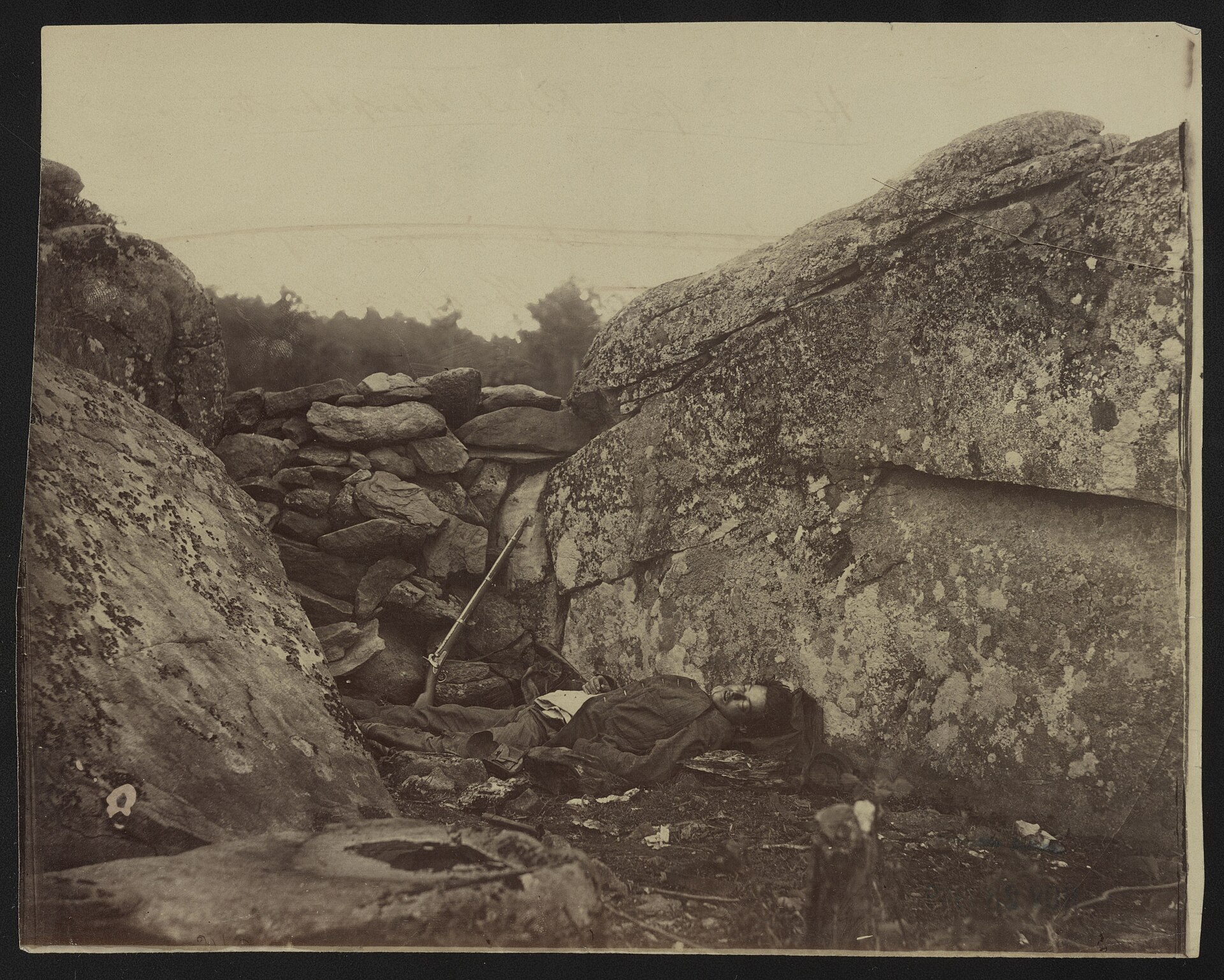
Plate 41 of the Sketch Book, Home of a Rebel Sharpshooter, shows a dead Confederate in a stone barricade at Devil's Den, and the body had been carried there by the photographers. The caption printed with the plate says the photographer, passing over the field, found the covert of a rebel sharpshooter and photographed what he saw. The Gettysburg National Military Park's own blog says the staff know of no other case where a body was moved to compose a photographic story.
The same blog describes the reconstruction that Frassanito made. The body was moved from the place where the man fell to a position behind the stone barricade, a distance of some 72 yards, and two photographs were made there, first a stereoview by James Gibson and then a single-lens picture by Timothy O'Sullivan. The blog adds that a discarded equipment kit and a United States Springfield rifle were placed to make the scene complete and believable. A Springfield is an infantry rifle, so the prop contradicts the word sharpshooter in the title.
The first person to notice the repetition was Frederick Ray, an illustrator of Civil War uniforms for Civil War Times Illustrated, who published a short article in October 1961 showing that one dead man appears in two places. He offered no theory. Frassanito took up Ray's article in 1975 and again in a book of 1995. For well over 90 years, in the blog's words, viewers took in these scenes and believed the man to be two different soldiers.
The credit for plate 41 is a second claim that has come loose. The caption credits Gardner, Gardner's own sales catalogue of 1863, as this archive's record reports it, names O'Sullivan, and the Park's blog describes both Gibson and O'Sullivan at the setup. The man's name is not known. This archive's record treats every proposed identification, including the most recent, as unconfirmed.
A cataloguer can test two of these captions and cannot yet test the third
Each correction of a caption needed a second thing made at the time, either a second picture or a second document, and the three cases differ in whether that second thing exists. Plate 36 was corrected from inside the pair: plate 37 shows the same bodies, the numbers and the badge are on the prints, and anyone can look. Plate 41 was corrected the same way, because the same corpse lies in an earlier picture at the place where it fell. For Beato the second thing is a dated document, which is Fraser's research on when he reached Lucknow, and it fixes the month and says nothing about the bones.
The companion picture for plate 41 is the Library of Congress print of A Sharpshooter's Last Sleep, which is plate 40 of the same book. The two plates are different pictures and must not be listed as copies of each other, because the whole case lies in the difference between them.
A record of a captioned photograph therefore has four jobs. It states the caption as what the maker or the publisher claimed. It names the person who corrected it and says what the correction rests on. It gives the credit exactly as it appears on the print and flags where a later source disagrees. And it leaves open what the evidence does not reach, as the archive's record does for the arrangement of the bones at Lucknow, the day and the field at Gettysburg and the name of the man at Devil's Den.
Questions
That is disputed and no document from Beato settles it. The Getty's exhibition text says he is reported to have had the skeletons scattered, and the British Library catalogue, citing John Fraser, says he appears to have had previously covered remains exposed. Both say the picture was made months after the November 1857 killing.
No. Gardner's text called them Confederate, but the Library of Congress, following William Frassanito's 1975 study, says they are Union dead of the Third Corps. A diamond badge worn only by that corps shows on a piece of clothing, and plate 37 shows the same men from the other side.
Yes. The Gettysburg National Military Park describes Frassanito's reconstruction, in which the photographers carried the body some 72 yards from where the man fell to a stone barricade and placed a Springfield infantry rifle beside him. An earlier photograph shows the same man at the place where he lay.
The sources disagree. The caption in Gardner's Sketch Book credits Gardner, his own 1863 sales catalogue credits Timothy O'Sullivan, and the Park's blog describes James Gibson with a stereo camera and O'Sullivan with a single-lens camera at the same setup.
Sources
- 1Library of Congress, 'The Case of Confused Identity', Does the Camera Ever Lie?, Civil War Glass Negatives and Related Prints (analysis of plates 36 and 37 after William A. Frassanito, Gettysburg: A Journey in Time, 1975, pp. 222-229). loc.gov/static/...
- 2Getty Research Institute, Irresistible Decay, online exhibition text on Felice Beato, Sikandrah Bagh after the Mutiny. getty.edu/research/...
- 3British Library, Photo 27(2), The inside of the Secundra Bagh where 2000 men were killed, catalogue entry citing John Fraser in the Journal of the Society for Army Historical Research. searcharchives.bl.uk/catalog/...
- 4Cleveland Museum of Art, Open Access API, record for accession 2019.170.3: title, date 1858, CC0 status and six-entry provenance. openaccess-api.clevelandart.org/api/...
- 5Gettysburg National Military Park blog, 'The Home of a Rebel Sharpshooter Revisited, Part 1', 7 August 2014. npsgnmp.wordpress.com/2014/...
- 6Gettysburg National Military Park blog, 'The Home of a Rebel Sharpshooter Revisited, Part II', 15 August 2014. npsgnmp.wordpress.com/2014/...
More in Research and Method
The partThe Edition Has a Census and the Copy Has a Gap
Counts of surviving Wicked Bibles and first-edition Principias keep rising. The copies in this archive still have no named owner for 239 to 354 years.
No Painting, Print, Map or Photograph Here Needs a Credit Line by Licence, and Twelve of Seventeen Clocks Do
Of 334 lead plates, none of 100 paintings, prints, maps and photographs needs a credit line by licence, against 12 of 17 clocks and instruments.
How Much of an Ownership Chain Is Documented Depends on the Object
Of 2,439 provenance links in 330 records, 75 per cent are documented. Clocks reach 83 per cent and arms and armour 65.