The Holy Bible, conteyning the Old Testament, and the New
Robert Barker, Printer to the King's Most Excellent Majesty · 1611
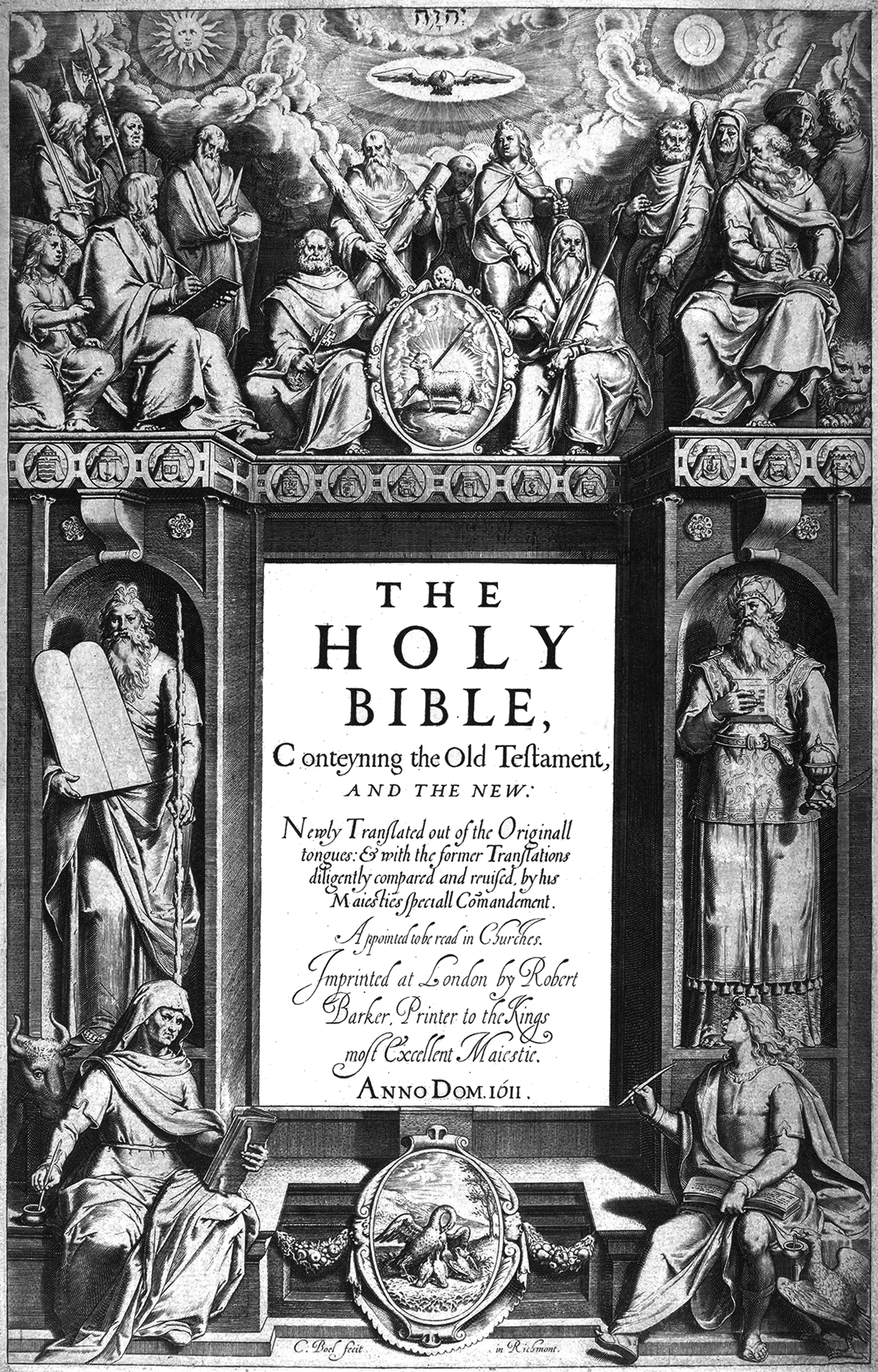
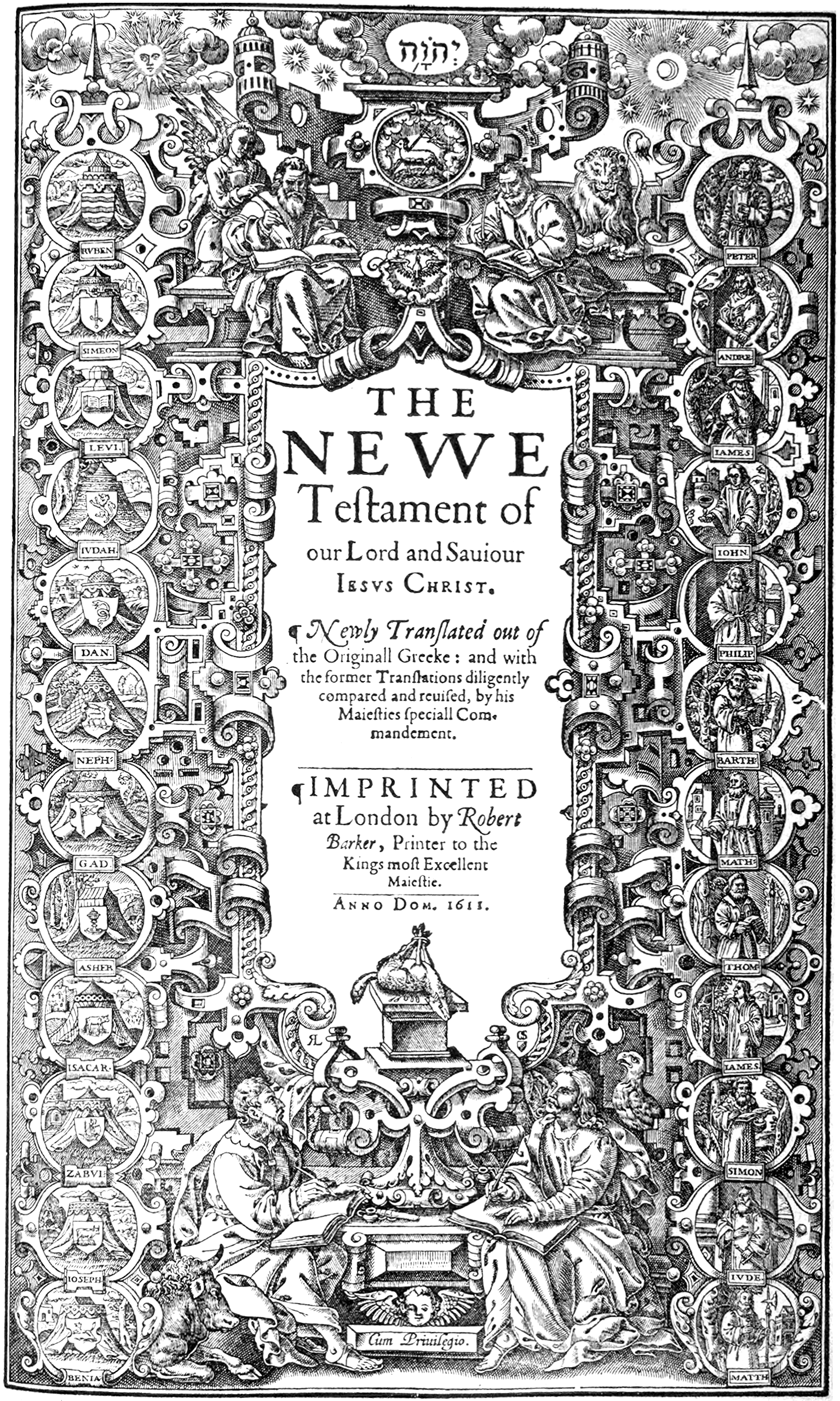
The engraved architectural title page of this copy, engraved by Cornelis Boel. The image's own Commons credit metadata links to the University of Pennsylvania's SCETI digitization of this exact volume; the same volume is independently catalogued under call number Folio BS185 1611 .L65 in both that older digitization record and Penn's current Colenda catalogue record for this copy, confirming this is Penn's own book, not a different institution's exemplar.
| Artist | Robert Barker, Printer to the King's Most Excellent Majesty |
|---|---|
| Date | 1611 |
| Medium | Letterpress printing in black letter (gothic) type on paper, text in two columns, folio format, with engraved architectural title page |
| Dimensions | Folio, approximately 41 cm in height. Width, page count and full collation of this specific copy are not given in the catalogue record consulted. |
| Where it is now | Kislak Center for Special Collections, Rare Books and Manuscripts, University of Pennsylvania Libraries, Philadelphialast confirmed |
| Inventory number | Folio BS185 1611 .L65 (Ross Bible Collection; formerly shelved in the Annenberg Rare Book and Manuscript Library, now part of the Kislak Center) |
| Attribution | AcceptedPrinted by Robert Barker, as stated on the book's own title page: 'Imprinted at London by Robert Barker, Printer to the Kings most Excellent Maiestie. Full note |
| Object type | Printed book |
| Period | English, Jacobean, early seventeenth century |
| Cases | Has a provenance gap |
| Inscriptions | Bookplate of T. Edward Ross, recording the copy's ownership before its 1946 gift to the University of Pennsylvania. |
| Owners on record | 4 links3 documented, 1 unknown |
| Sources | 16 cited |
About this record Last verified · 16 sources cited · Change log
On this page 9 sections
ContentsClose
The University of Pennsylvania's copy of the first edition of the King James Bible, printed in London by Robert Barker in 1611. Penn's own catalogue record identifies it explicitly as a copy of the 'Great HE edition', meaning it carries the uncorrected reading at Ruth 3:15, 'and he went into the citie', that distinguishes the first state of the first printing from the corrected 'she' reading found in the later, separately reset edition usually called the She Bible.
The book has been in Pennsylvania's keeping since 1946, when the accountant and collector T. Edward Ross gave his Bible collection to the university library in memory of Lucien Bonaparte Carpenter. Where the book was for the roughly three and a third centuries before that gift is not recorded in any source consulted for this record.
The He Bible and She Bible are not simply two printings of one edition corrected on the press. Herbert's standard bibliography treats the She Bible as a distinct second edition, dated 1613 on its general title page even though it carries a reused 1611 New Testament title page, and scholars including A.W. Pollard and David Norton have argued that calling them a matched 'pair' misstates the relationship: the She Bible derives from the He Bible, not the reverse. A minority view, associated with F.H.A. Scrivener, has argued the opposite order. Penn's own catalogue record settles only which state its own copy is: this is a He Bible.
Provenance
Each link is graded. Documented: a cited source supports it. Disputed: the identification is argued but not established. Unknown: no owner for that span, and the gap is not smoothed into a narrative. The grades in the glossary.
- 1611 -Printed by Robert Barker, King's Printer, Londondocumented
Printed in 1611 as stated on the book's own title page. This exemplar carries the uncorrected Ruth 3:15 reading 'he went into the citie', identifying it in Penn's own catalogue record as a copy of the 'Great HE edition', the first state of the first printing.1
- 1611 - 1946Unknownunknown
No owner is documented for this specific copy across roughly three and a third centuries between its printing and its appearance in T. Edward Ross's Bible collection. Nothing in the sources consulted names an intermediate owner, a sale, or a place of custody during this period.
- - 1946T. Edward Ross (1868-1963)documented
Ownership is documented by Ross's bookplate, recorded in Penn's catalogue metadata for this copy. Ross, an Irish-born accountant and co-founder of the firm that became Coopers & Lybrand, assembled a collection of medieval manuscripts and printed Bibles that included this book. How and when Ross himself acquired this particular copy is not documented in the sources consulted.12
- 1946 - presentUniversity of Pennsylvania Library (Kislak Center for Special Collections, formerly the Annenberg Rare Book and Manuscript Library)documented
Given to the University of Pennsylvania Library in 1946 by T. Edward Ross, in memory of Lucien Bonaparte Carpenter, as part of the Ross Bible Collection. A catalogue of the collection was published by the library in 1947. The book has remained in Pennsylvania's custody since, held under the same call number, Folio BS185 1611 .L65, in both an earlier Penn digitization record and its current Colenda Digital Repository catalogue record.12315
Technical evidence
| Attribution note | Printed by Robert Barker, as stated on the book's own title page: 'Imprinted at London by Robert Barker, Printer to the Kings most Excellent Maiestie. Anno Dom. 1611.' Barker held the crown's patent as King's Printer and financed the production himself. No translator is named on the book; the text is the collective work of the appointed companies of translators, credited nowhere in the volume itself. |
|---|---|
| Support and printing method | Letterpress on paper, black letter (gothic) type, text set in two columns per page, with marginal notes and cross-references.1 |
| Dimensions | Folio, approximately 41 cm in height. Width and full leaf collation for this specific copy are not given in the source consulted.1 |
| Title page | Engraved architectural title page by Cornelis Boel, depicting the Trinity, the Tetragrammaton, thirteen apostles, Moses and Aaron, the four Evangelists and a pelican-in-piety emblem.1216 |
| Ruth 3:15 reading | Reads 'and he went into the citie', the uncorrected first-state reading that identifies this copy as a 'Great He' Bible, per Penn's own catalogue record.1 |
| Bound accompanying work | John Speed's 'The genealogies recorded in the Sacred Scriptures', London: printed by Robert Barker, 1611, listed as an accompanying item in Penn's catalogue record for this copy.113 |
| Call number | Folio BS185 1611 .L65, Kislak Center for Special Collections, Rare Books and Manuscripts, Rare Book Collection, University of Pennsylvania.13 |
| Provenance mark | T. Edward Ross ownership bookplate, recorded in Penn's catalogue metadata for this copy.1 |
| Bibliographic identity of the edition | The He Bible edition (not this specific copy) is identified in the antiquarian book trade as Herbert 309, ESTC S122347, Pforzheimer 61 and Printing and the Mind of Man 114. These identifiers describe the edition generally, established here from the cataloguing of a different, comparable auctioned exemplar, not from an examination of Penn's own copy.6 |
Images

The record in full
Chapter 1What it is
A single folio volume containing the complete Old and New Testaments and the Apocrypha in the newly commissioned English translation authorized by King James I, printed on paper in black letter...
A single folio volume containing the complete Old and New Testaments and the Apocrypha in the newly commissioned English translation authorized by King James I, printed on paper in black letter (gothic) type, set in two columns per page, with an engraved architectural title page. Penn's catalogue record gives the volume's height as approximately 41 centimetres; it does not give a full collation or leaf count for this specific copy in the description consulted for this record, which is recorded here as an open question rather than assumed.
Bound with the biblical text, as was standard for copies of this edition, is a separate genealogical work with its own title page: John Speed's The Genealogies recorded in the Sacred Scriptures according to euery family and tribe, with the line of Our Saviour Jesus Christ observed from Adam to the Blessed Virgin Mary, also imprinted by Robert Barker in 1611. Penn's catalogue record lists this as an accompanying item bound with the Bible.
Chapter 2The reading that identifies this copy
Penn's own digital catalogue record for this exact book states, in its own cataloguing language, that the copy is of the 'Great HE edition', and cites the diagnostic reading directly: at Ruth 3:15...
Penn's own digital catalogue record for this exact book states, in its own cataloguing language, that the copy is of the 'Great HE edition', and cites the diagnostic reading directly: at Ruth 3:15 the text reads 'and he went into the citie', where the corrected text used in all later printings reads 'she'. That is Penn's own identification of its own object, not an inference drawn by this record from general accounts of the edition.
This detail matters because two textually distinct states of the 1611 printing survive, commonly nicknamed the He Bible and the She Bible after this single pronoun, and copies are not interchangeable: a cataloguer, a dealer or a citing scholar needs to know which one a given book actually is. Penn's record answers that question for this copy directly, so this record does not need to guess.
Chapter 3The He Bible and She Bible: a genuine bibliographical dispute
The popular version of this story treats the He and She readings as a simple printer's slip caught and corrected mid-print-run, within a single edition.
The popular version of this story treats the He and She readings as a simple printer's slip caught and corrected mid-print-run, within a single edition. The scholarship is less tidy than that, and this record follows the scholarship rather than the popular version.
Herbert's Historical Catalogue of Printed Editions of the English Bible, 1525-1961, the standard reference bibliography for editions of the English Bible, catalogues the She Bible separately, under its own number, and states of it: 'Others more correctly style it the "second folio edition, 1613, 1611", inasmuch as it deserves to be reckoned a distinct edition.' The She Bible's general title page is dated 1613; its New Testament title page, reused or reprinted from 1611 stock, still reads 1611, which is why copies are sometimes catalogued under both years. This is a rare-book dealer's citation of Herbert rather than this record's own reading of Herbert's printed text, and is flagged for that reason.
Bible scholar David Norton has objected to calling the two 'He' and 'She' Bibles at all, on the grounds that the nicknames imply the two stand as equals, a pair, when the 1613 She Bible is, in his own description, 'genuinely a second edition' derived from the first. The bibliographer A.W. Pollard made the same point more sharply, objecting that the paired nicknames misleadingly suggest the books form a couple, when in fact, in his words, 'the second is derived from the first, as a child from its parents.' Against this near-consensus, F.H.A. Scrivener is recorded as one of the few scholars who argued the reverse chronology, that the Great She Bible in fact preceded the He Bible. Gordon Campbell has offered a different account of the reading's origin altogether, suggesting that the 'he' reading may descend from a deliberate change made by the Bishops' Bible translators rather than from a simple compositor's slip at the King James printing house, given genuine ambiguity in the underlying Hebrew and in which figure, Boaz or Ruth, the verse's subject is taken to be.
None of this scholarship is settled, and none of it concerns Penn's copy's own identity, which its own catalogue record already answers. It is included here because a reader relying only on the popular one-line summary would come away with a simpler and less accurate account of the textual history than the sources actually support.
Chapter 4Robert Barker and the cost of printing the King's Bible
Robert Barker held the crown's patent as King's Printer, inherited from his father Christopher Barker, who had secured the family's monopoly on printing the English Bible in 1589.
Robert Barker held the crown's patent as King's Printer, inherited from his father Christopher Barker, who had secured the family's monopoly on printing the English Bible in 1589. It fell to Robert Barker to print the newly authorized translation once the translators' work was finished in 1611, and he financed the production himself, without direct funding from the crown, Parliament or the church.
The undertaking did not make him rich. By the account given in Wikipedia's biography of Barker, flagged here as a tertiary source pending a fuller scholarly biography, Barker gained little financial reward from printing what became the most important book in English religious life, and his later career was marked by disputes with rival printers over the Bible-printing patent, culminating in serious financial trouble. In 1631 an edition under his imprint became notorious as the 'Wicked Bible' after the word 'not' was dropped from the seventh commandment, reading 'Thou shalt commit adultery'; Barker and his partner were fined for the error. He was imprisoned for debt and, by this account, died in a debtors' prison in 1643.
The man who printed the book that became the standard English Bible for the next three and a half centuries did not, on the evidence available, profit from having done so.
Chapter 5Why the translation was commissioned
The translation that Barker printed originated at the Hampton Court Conference of January 1604, convened by James I in response to Puritan grievances set out in the Millenary Petition presented at...
The translation that Barker printed originated at the Hampton Court Conference of January 1604, convened by James I in response to Puritan grievances set out in the Millenary Petition presented at his accession. Among the outcomes was a royal commission for a new English translation of the Bible, to be undertaken without the marginal doctrinal notes that had made the Geneva Bible, the most widely read English Bible of the previous generation, objectionable to James on political as much as theological grounds: he regarded some of its notes as hostile to the divinely ordained authority of kings.
The work was divided among six companies of translators, two based at Westminster, two at Cambridge and two at Oxford, each responsible for a defined portion of the text, with a general committee of review meeting at Stationers' Hall in London from 1609. The translators are not named anywhere in the printed book. Their own account of their purpose and method survives in the preface bound into the first edition, 'The Translators to the Reader', discussed below.
Chapter 6The title page as argument, not just decoration
The engraved architectural title page, the work of the Antwerp-trained engraver Cornelis Boel, is not a neutral label.
The engraved architectural title page, the work of the Antwerp-trained engraver Cornelis Boel, is not a neutral label. Its design is, so far as recorded sources describe it, the first title page of an English Bible to depict the Trinity: near the top, the Tetragrammaton, the Hebrew letters for the divine name YHWH, appears above a dove representing the Holy Spirit, within a frame otherwise populated by figures reaching thirteen apostles (the twelve plus Matthias, who replaced Judas, and Paul, who described himself an apostle), each carrying a traditional identifying attribute. Moses and Aaron stand in niches flanking the central text panel, and the four Evangelists occupy the page's four corners with their traditional symbolic animals. At the foot of the page a pelican, in the old iconographic tradition, feeds her young from her own breast, a conventional emblem of Christ's self-sacrifice.
Read together, the programme states a claim about the book's authority before a reader turns past the title page: this translation stands in continuity with Moses and the Law, with the apostolic church, and with the Trinity itself, delivered under royal sanction. The design does not put the king's own image on the page. Its argument for the translation's authority is made through scriptural and ecclesiastical figures, not through James's own portrait.
Chapter 7What the translators said about their own work
The first edition included an eleven-page preface, 'The Translators to the Reader', written by Myles Smith, later Bishop of Gloucester, and printed at the front of the volume ahead of the biblical...
The first edition included an eleven-page preface, 'The Translators to the Reader', written by Myles Smith, later Bishop of Gloucester, and printed at the front of the volume ahead of the biblical text itself. It does not survive in modern editions of the King James Version, having been dropped by publishers over the centuries that followed, but it was part of the book Barker printed in 1611 and is bound into copies of this edition.
In it the translators defend vernacular scripture directly: 'How shall men meditate in that, which they cannot understand? How shall they understand that which is kept close in an unknowen tongue?' They defend revising earlier English translations rather than working from nothing, invoking Jerome's own precedent: 'Doe we condemne the ancient? In no case: but after the endevours of them that were before us, wee take the best paines we can in the house of God.' And they explain their use of marginal notes for genuinely uncertain readings, distinguishing matters of doctrine, which they hold to be clear, from points of translation where, in their words, 'fearefulnesse would better beseeme us then confidence.' They open the whole preface by addressing the king directly, crediting him, 'most dread Sovereign', with having set the project in motion.
This is the translators' own stated account of what the book was for: a scripture the ordinary reader could understand, built openly on the labour of predecessors, honest about points of real uncertainty, and undertaken under royal authority. It is reported here as what they said they believed and intended, not as a settled fact about the text's actual merits.
Chapter 8John Speed's genealogies, bound in and later misread
Bound with the Bible, and listed as an accompanying item in Penn's own catalogue record for this copy, is a separate genealogical work: John Speed's Genealogies recorded in the Sacred Scriptures...
Bound with the Bible, and listed as an accompanying item in Penn's own catalogue record for this copy, is a separate genealogical work: John Speed's Genealogies recorded in the Sacred Scriptures, tracing scriptural family lines from Adam to the Virgin Mary, produced in collaboration with the Hebrew scholar Hugh Broughton and printed, like the Bible itself, by Robert Barker in 1611. Speed held a royal patent, granted in October 1610, to publish the work, and it was bound into copies of the Authorized Version for decades afterward.
Among its illustrations, by later published accounts, was a depiction of Noah's three sons repopulating the world after the Flood: Shem to Asia, Japheth to Europe, Ham to Africa. That reading of Genesis had a documented afterlife its makers did not intend: in later centuries, pro-slavery writers in colonial and antebellum America invoked the so-called Curse of Ham, a separate and much older interpretive tradition applied to Ham's line, to argue a biblical sanction for the enslavement of Africans. That later use belongs to the reception history of the Ham narrative in general, not to Speed's own genealogical chart or to what Speed or Barker intended by including it in 1611, and this record keeps the two apart rather than presenting the later misuse as part of the original object's own meaning.
Chapter 9Provenance: three centuries unaccounted for
Nothing in the sources consulted for this record documents who owned this copy between its printing in 1611 and its appearance, with a T.
Nothing in the sources consulted for this record documents who owned this copy between its printing in 1611 and its appearance, with a T. Edward Ross bookplate, in the Ross Bible Collection formed by the accountant and bibliophile T. Edward Ross. Ross, born in Ireland in 1868 and a co-founder of the accounting firm that became Coopers & Lybrand, assembled a collection of over one hundred printed Bible editions and three medieval manuscripts, ranging from the thirteenth to the twentieth centuries, that also includes Penn's copy of the 1613 She Bible, a different object from the one described in this record.
Ross gave his Bible collection to the University of Pennsylvania Library in 1946, in memory of Lucien Bonaparte Carpenter. A catalogue of the collection, principally the work of Clifford B. Clapp, was published by the university library the following year in an edition of two hundred copies. The book has remained in Pennsylvania's custody since the 1946 gift, held first by what was then the Annenberg Rare Book and Manuscript Library and, following later reorganization of Penn's special collections, by the Kislak Center for Special Collections, Rare Books and Manuscripts, where it is catalogued today under the same call number, Folio BS185 1611 .L65, that appears in the university's older digitization record for the book as well as its current one.
How Ross acquired this particular copy, from whom, and when, is not recorded in any source available for this record. That gap is reported here rather than filled with a plausible guess.
Chapter 10What is still unresolved
Penn's catalogue record establishes which textual state this copy is and where it has been since 1946.
Penn's catalogue record establishes which textual state this copy is and where it has been since 1946. It does not establish the book's history before that gift, its full physical collation, or the state of its binding, and this record does not supply those gaps from other copies' descriptions. A dealer's description of a different He Bible exemplar, cited elsewhere in this record for edition-level bibliographic identifiers, describes that other copy's condition and losses, not this one's, and the two must not be conflated.
The artist
Robert Barker
Robert Barker's name appears on the title page of this book because he held the crown's exclusive patent to print the English Bible, not because he had any hand in its translation. He inherited the King's Printer's patent from his father, Christopher Barker, who had secured it in 1589, and it fell to Robert to print the newly authorized translation once the appointed companies of scholars finished their work in 1611. He financed the printing himself. The undertaking that produced the most reprinted book in the English language left its printer, on the evidence available, financially ruined.
Related works
| Work | Relation | Where it is |
|---|---|---|
| The Holy Bible (the Great She Bible) Robert Barker | Second, corrected edition of the King James Bible, general title dated 1613 with a reused 1611 New Testament title page; carries the corrected 'she' reading at Ruth 3:15 Not this copy. Herbert's Historical Catalogue treats it as a distinct edition rather than a corrected state of the same print run. | Various institutional and private collections, including a separate copy in Penn's own Ross Bible Collection |
| The genealogies recorded in the Sacred Scriptures John Speed, with Hugh Broughton | Companion genealogical work, printed by Robert Barker in 1611 and bound with this copy of the Bible Carries its own title page and imprint; listed as an accompanying item in Penn's catalogue record for this book. | Bound into this copy, Kislak Center, University of Pennsylvania |
| Biblia Latina, the 42-line Bible: the Library of Congress copy Printer of the 42-line Bible, Johann Gutenberg | Not part of the same printing tradition; included here as another printed-Bible record in this archive for comparison of provenance and cataloguing method Roughly 155 years earlier and printed by a wholly different process; no textual or physical link to the King James Bible. | Library of Congress, Washington DC |
| The English Bible, Containing the Old Testament and the New (Doves Press Bible) T. J. Cobden-Sanderson and Sir Emery Walker, the Doves Press | A later, unrelated fine-press English Bible; included here as another printed-Bible record in this archive Printed nearly three centuries after this copy and shares no textual descent from it; the Doves Press edition used Scrivener's Paragraph Bible text, not the 1611 King James text directly. | Library of Congress, Washington DC |
Open questions
- How and when did T. Edward Ross acquire this specific copy? No source consulted documents an owner between the 1611 printing and its appearance in the Ross Collection with Ross's bookplate.
- What is the full collation of this copy: is it complete, and if not, which leaves are missing? Penn's catalogue record as consulted does not give a leaf-by-leaf collation.
- Is the current binding original, a later period binding, or a modern rebinding? Not stated in the source consulted.
- Does this copy show any physical relationship, such as shared paper stock or binder's practice, to Penn's own copy of the 1613 She Bible in the same Ross Collection? Not addressed in any source consulted.
- Which state of the 1611 print run, He or She, actually came first? The near-consensus view (Pollard, Norton) holds the He Bible is prior and the She Bible a derivative second edition; a minority view associated with F.H.A. Scrivener has argued the reverse. The dispute concerns the edition generally, not this specific copy, whose own identity as a He Bible is independently established by Penn's catalogue record.
Questions about this object
What is The Holy Bible, conteyning the Old Testament, and the New?
The Holy Bible, conteyning the Old Testament, and the New is a printed book, dated 1611. Medium: Letterpress printing in black letter (gothic) type on paper, text in two columns, folio format, with engraved architectural title page.
Who made The Holy Bible, conteyning the Old Testament, and the New, and is the attribution settled?
The attribution to Robert Barker, Printer to the King's Most Excellent Majesty is recorded here as accepted. Printed by Robert Barker, as stated on the book's own title page: 'Imprinted at London by Robert Barker, Printer to the Kings most Excellent Maiestie. Anno Dom. 1611.' Barker held the crown's patent as King's Printer and financed the production himself. No translator is named on the book; the text is the collective work of the appointed companies of translators, credited nowhere in the volume itself.
Where is The Holy Bible, conteyning the Old Testament, and the New now?
Kislak Center for Special Collections, Rare Books and Manuscripts, University of Pennsylvania Libraries, Philadelphia. Inventory number Folio BS185 1611 .L65 (Ross Bible Collection; formerly shelved in the Annenberg Rare Book and Manuscript Library, now part of the Kislak Center). Last confirmed 29 August 2026. Call number and holding location taken directly from Penn Libraries' Colenda Digital Repository catalogue record for this item, and cross-confirmed against an archived Penn digitization record (SCETI, Schoenberg Center for Electronic Text and Image) that cites the identical call number and imprint for the same digitized volume.
What is still unknown about The Holy Bible, conteyning the Old Testament, and the New?
How and when did T. Edward Ross acquire this specific copy? No source consulted documents an owner between the 1611 printing and its appearance in the Ross Collection with Ross's bookplate.
Sources
- 1University of Pennsylvania Libraries, Colenda Digital Repository, catalogue record for 'The Holy Bible, conteyning the Old Testament, and the New', London: Robert Barker, 1611 (call number Folio BS185 1611 .L65, Ross Bible Collection, T. Edward Ross provenance, identified as the 'Great HE edition'). colenda.library.upenn.edu/catalog/...
- 2University of Pennsylvania Libraries, 'Ross Bible Collection', notable collections page, for T. Edward Ross's biography and the 1946 gift in memory of Lucien Bonaparte Carpenter. library.upenn.edu/collections/...
- 3Internet Archive Wayback Machine capture (7 June 2007) of the University of Pennsylvania Schoenberg Center for Electronic Text and Image (SCETI) digitization record for 'kjbible', citing the Annenberg Rare Book and Manuscript Library and call number BS185 1611 .L65 for the same imprint. web.archive.org/web/...
- 4Wikimedia Commons, image metadata (API) for File:King-James-Version-Bible-first-edition-title-page-1611.png, whose Credit field links to the University of Pennsylvania SCETI digitization page for this book. commons.wikimedia.org/wiki/...
- 5Wikimedia Commons, image metadata (API) for File:King James Bible (1611) page A2r.xcf and File:King James Bible (1611) page D4v.xcf, whose Credit fields link to the University of Pennsylvania SCETI digitization of this same volume. commons.wikimedia.org/wiki/...
- 6Bonhams, '1611 King James Bible: The Great "He" Bible' (lot description for a different, comparable exemplar; cited here only for edition-level bibliographic identifiers Herbert 309, ESTC S122347, Pforzheimer 61 and Printing and the Mind of Man 114, and for David Norton's characterization of the edition). bonhams.com/auction/...
- 7The Bible at Beinecke (Yale University), 'The Leaf's Gender: The King James Bible and the "She/He Misprint"', for the scholarly debate involving Gordon Campbell, David Norton, A.W. Pollard and F.H.A. Scrivener on the He Bible/She Bible relationship and naming. bibleatbeineckedotcom.wordpress.com/2014/...
- 8Hall's Fine Art, lot description for a 'Great She Bible' (1613/1611), citing Herbert 319 and quoting Herbert's Historical Catalogue on the She Bible's status as a distinct second folio edition. fineart.hallsgb.com/auction/...
- 9Museum of the Bible, 'The "She" Bible' (Book Minute), for an alternative account of the Ruth 3:15 variant's possible origin in Hebrew ambiguity and earlier English translation choices rather than a simple compositor's error. museumofthebible.org/book-minute/...
- 10Wikipedia, 'Robert Barker (printer)'. en.wikipedia.org/wiki/...
- 11Wikipedia, 'King James Version'. en.wikipedia.org/wiki/...
- 12Harry Ransom Center Magazine (University of Texas at Austin), 'In the Galleries: Anatomy of the King James Bible title page', for the engraver Cornelis Boel and the title page's iconographic programme. sites.utexas.edu/ransomcentermagazine/...
- 13Harry Ransom Center Magazine (University of Texas at Austin), 'In the Galleries: John Speed's Postdeluvian Genealogy from the First Edition of the King James Bible', for Speed's genealogical work bound into 1611 King James Bibles, his collaboration with Hugh Broughton, and the later misuse of the Ham narrative by pro-slavery writers. sites.utexas.edu/ransomcentermagazine/...
- 14Wikisource, 'Bible (King James Version, 1611)/Translators to the Reader', primary text of the 1611 preface, for direct quotation of the translators' own stated purpose and method. en.wikisource.org/wiki/...
- 15HathiTrust catalog record for 'A catalogue of the T. Edward Ross collection of Bibles, presented to the University of Pennsylvania Library in memory of Lucien Bonaparte Carpenter' (Philadelphia: University of Pennsylvania Library, 1947), for the existence and authorship of the published 1947 collection catalogue. catalog.hathitrust.org/Record/...
- 16Wikimedia Commons, category listing for File:King-James-Version-Bible-first-edition-title-page-1611.png, confirming the 'Cornelis Boel' category attribution for the title-page engraving. commons.wikimedia.org/wiki/...

Last verified · Published
Change log
29 August 2026 - Record created at the house standard: researched narrative, technical evidence, maker dossier, graded provenance chain, prices with hammer and premium separated, related works, open questions and sources.