Philosophiae Naturalis Principia Mathematica
Isaac Newton · 1687
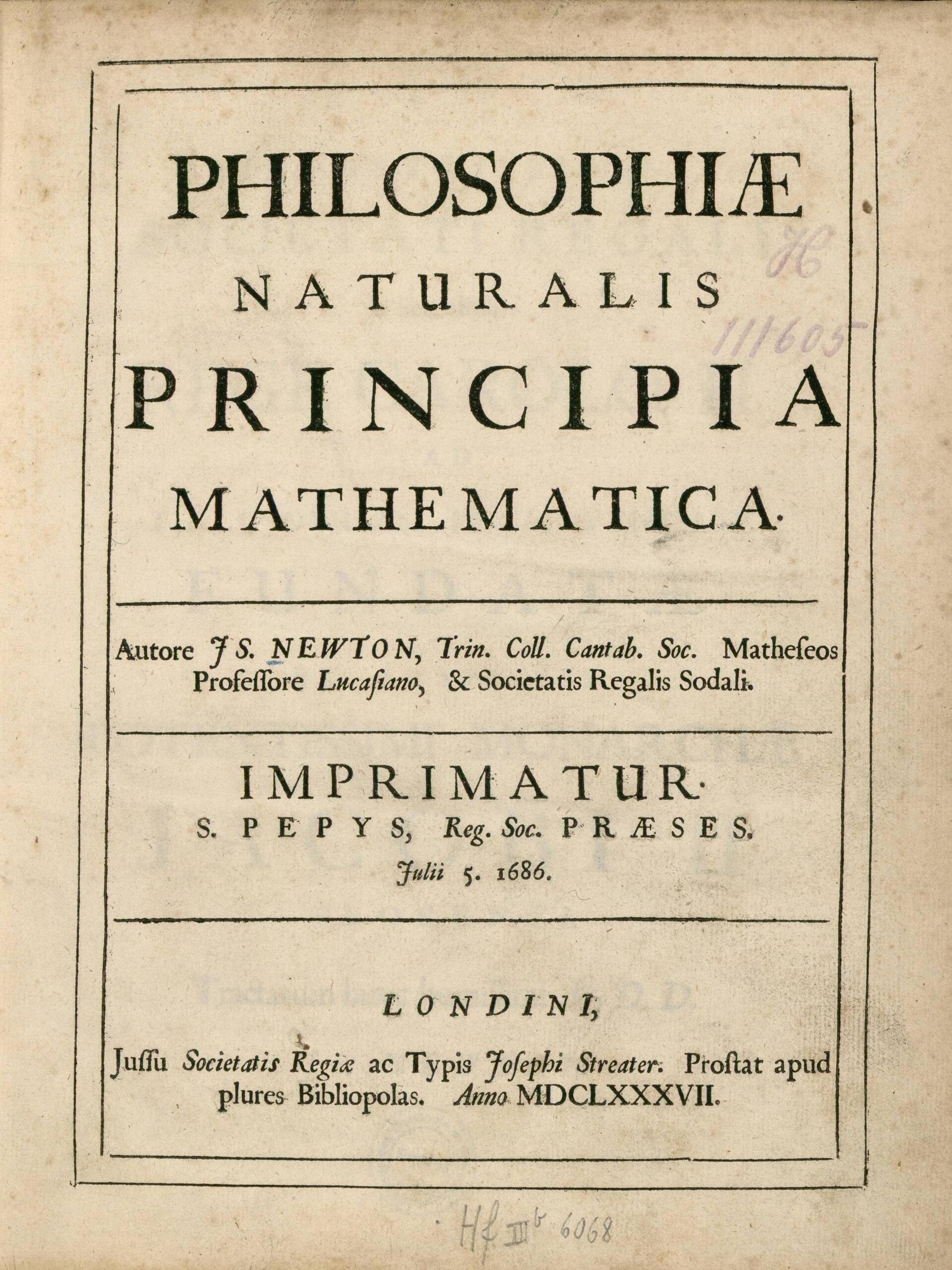
The title-page opening of this specific copy, photographed for the Universite de Strasbourg's own digitisation of the book (shelfmark H 111.605) and released by the library's documentation service. This is the actual object described in this record, not a stock image of the edition.
| Artist | Isaac Newton |
|---|---|
| Date | 1687 |
| Medium | Letterpress printing on laid paper, in Latin, with woodcut diagrams in the text and one folding engraved plate |
| Dimensions | Quarto, approximately 238 x 178 mm as issued (edition format; this copy has not been physically measured for this record) |
| Where it is now | Bibliotheque nationale et universitaire de Strasbourg (BNU), held in deposit within the library service of the Universite de Strasbourglast confirmed |
| Inventory number | Shelfmark H 111.605 |
| Attribution | AcceptedAuthorship is undisputed. Full note |
| Object type | Printed book |
| Period | English scientific revolution, seventeenth century |
| Cases | Has a provenance gap |
| Inscriptions | None recorded in the item's own digitised catalogue entry. Whether this copy carries any owner's inscription, bookplate or manuscript annotation has not been established from the material available for this record. |
| Owners on record | 3 links2 documented, 1 unknown |
| Sources | 17 cited |
About this record Last verified · 17 sources cited · Change log
On this page 9 sections
ContentsClose
A copy of the first edition (1687) of Isaac Newton's Philosophiae Naturalis Principia Mathematica, held today by the Bibliotheque nationale et universitaire de Strasbourg under shelfmark H 111.605. The edition itself has one of the best-documented back-stories in the history of science: written in an eighteen-month burst after a single visit from the astronomer Edmond Halley, nearly wrecked by a priority dispute with Robert Hooke that Newton met by threatening to suppress its most important book, and published only because Halley paid the printing costs himself after the Royal Society's own funds had been sunk into an unsold book about fish.
What this record cannot do, and says so plainly, is complete the story of this particular physical copy. The Strasbourg library's own catalogue gives a shelfmark, a subject classification and a digitisation date of 2006, and nothing about who owned the book before it arrived there, or when. It may descend from the old Strasbourg Academie library that survived the fire of 1870, or it may have been bought fresh by the German university library founded the following year; the library's own record does not say, and this one does not guess on its behalf.
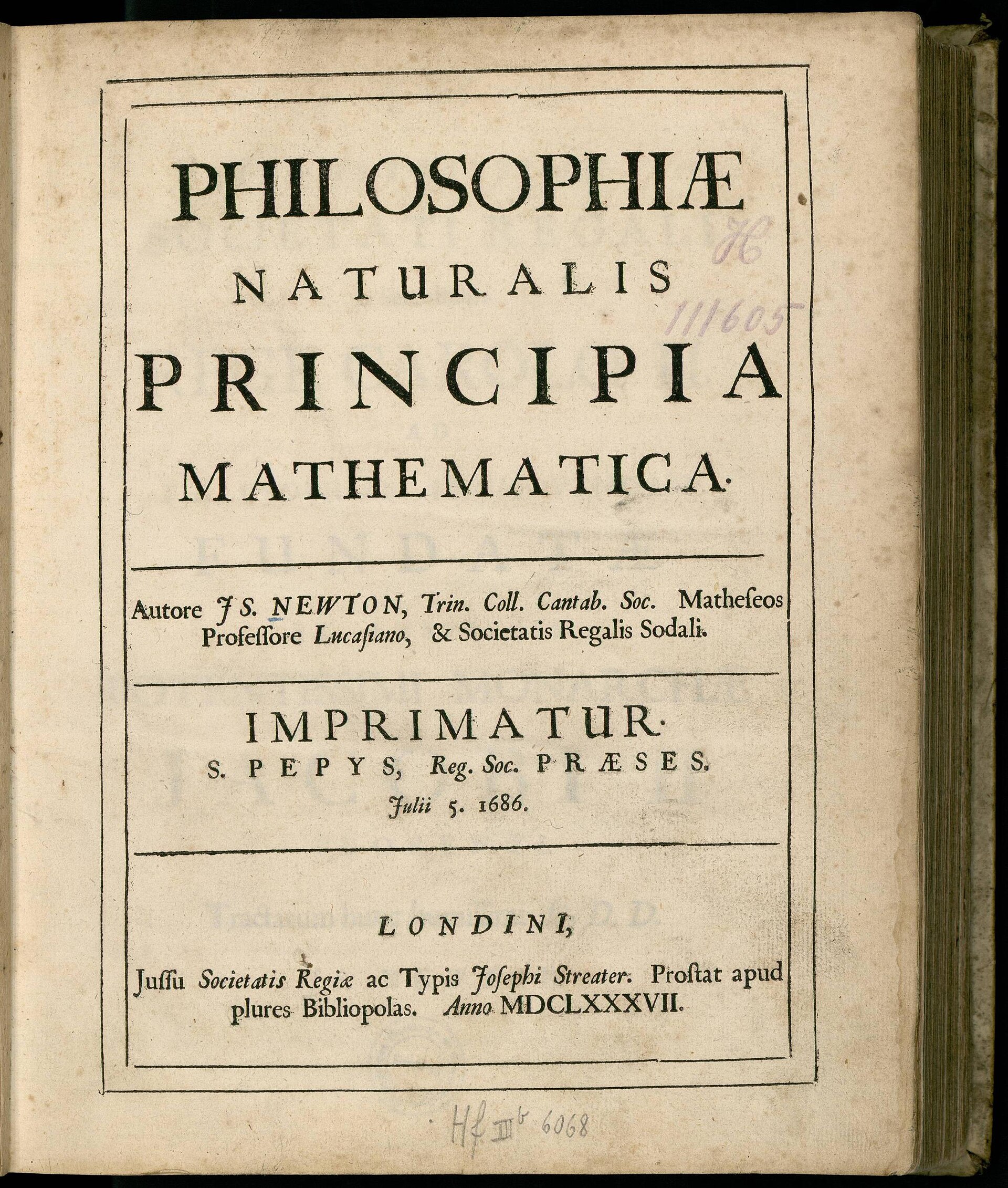
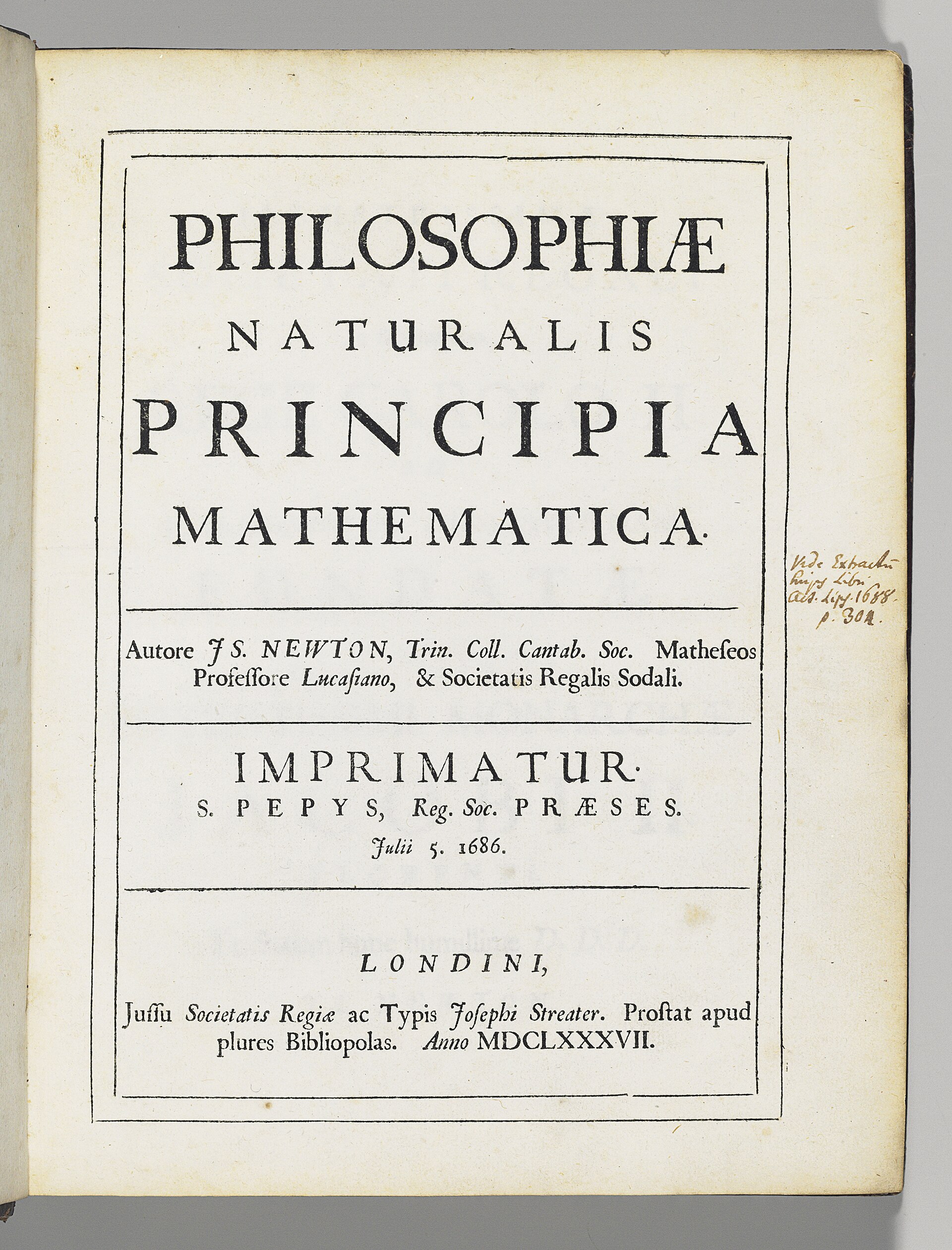
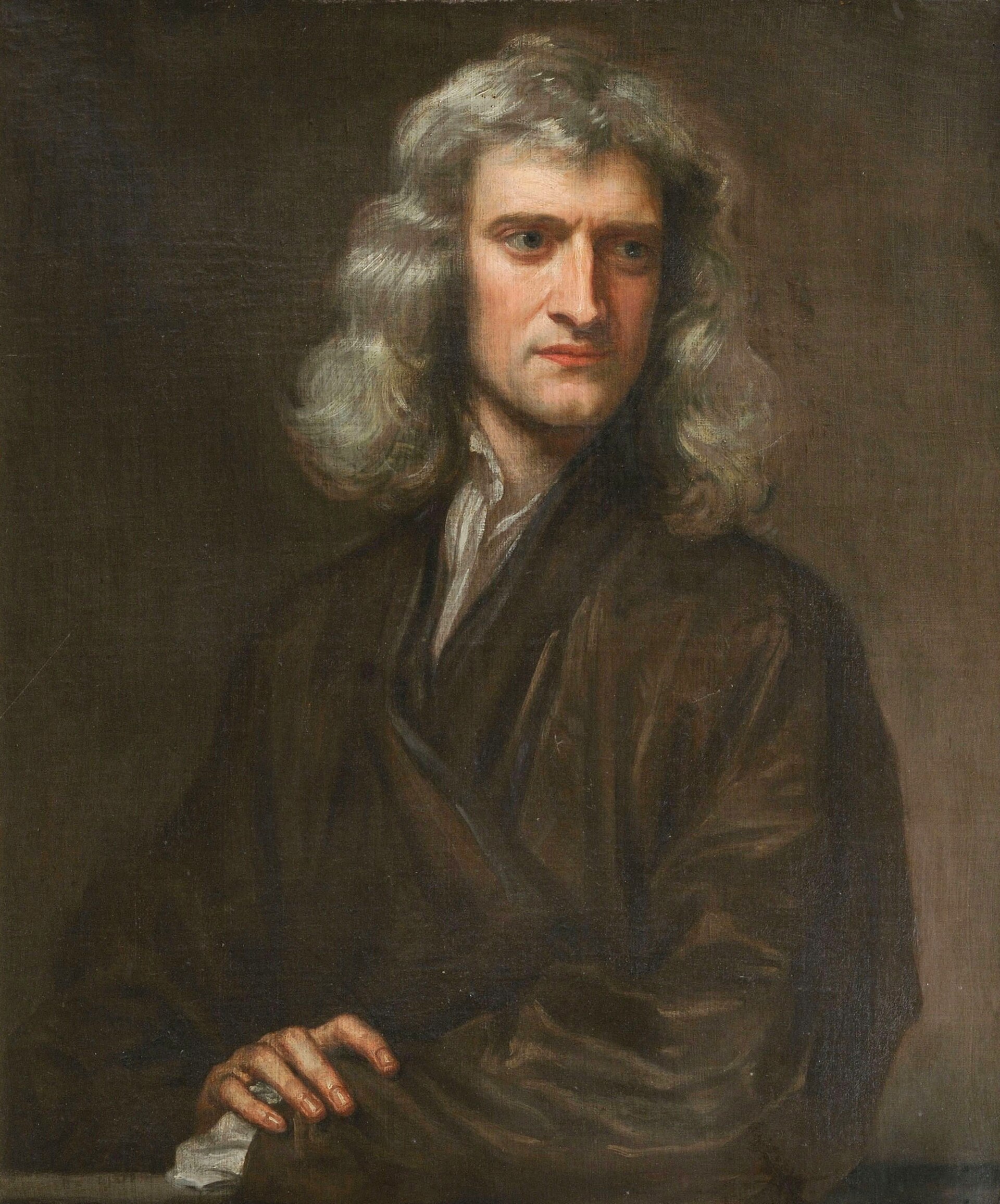
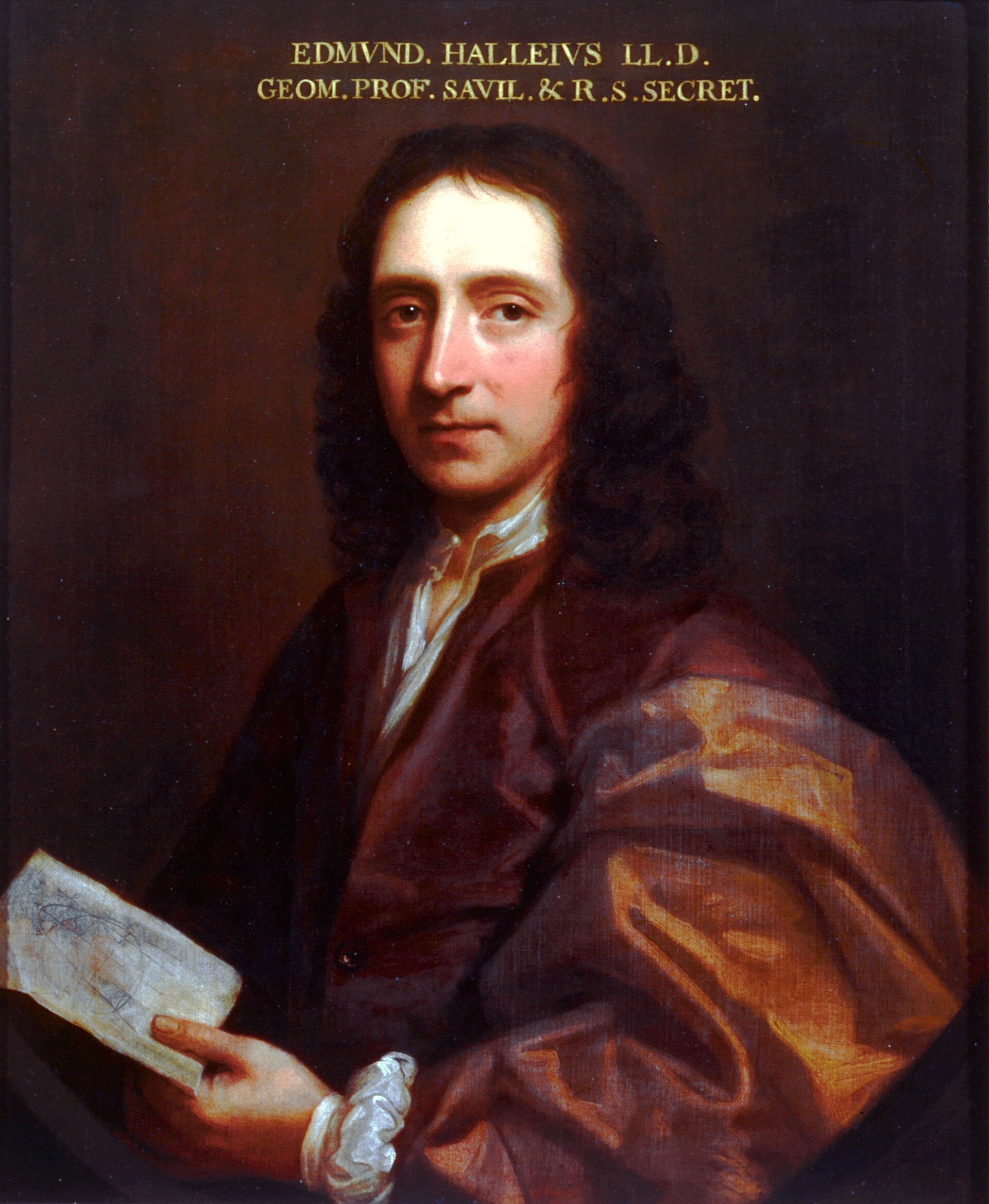
The lead image is a genuine photograph of this copy's own title page, taken from the library's own digitisation. Everything else illustrated here -- a royal presentation copy, a record-priced Continental copy, portraits of Newton and Halley -- is clearly marked as being about the edition or its history in general, not about this specific book.
Provenance
Each link is graded. Documented: a cited source supports it. Disputed: the identification is argued but not established. Unknown: no owner for that span, and the gap is not smoothed into a narrative. The grades in the glossary.
- 1687 -An unidentified purchaser from the Royal Society's 1687 print rundocumented
Printed in London at the press of Joseph Streater for the Royal Society, financed personally by Edmond Halley after the Society's own publication funds were exhausted by the unsold stock of Willughby and Ray's De Historia Piscium (1686). Distributed either through Halley's consignment arrangement with London booksellers or, for a minority of copies, through the bookseller Samuel Smith for export to Continental Europe. This is documented as a fact about the edition into which this copy was printed; no specific first buyer for this individual copy is recorded in any source consulted.12314
- 1687 - 2006Unknownunknown
No owner, purchaser, or intermediate custodian is documented for this copy between its printing in 1687 and its appearance, already under its present shelfmark, in the digitised catalogue of the Universite de Strasbourg. The library's own old scientific collections derive from two distinct general sources -- holdings that survived the pre-1870 Strasbourg Academie library, spared the fire that destroyed the separate municipal library during the Prussian bombardment of 24 August 1870, and holdings purchased or donated after 1871 by the newly founded Kaiserliche Universitats- und Landesbibliothek zu Strassburg. Nothing in this copy's own record indicates which of those two routes applies to it, or whether it arrived by some third route entirely, and this record does not guess.89
- 2006 - presentBibliotheque nationale et universitaire de Strasbourg, held in deposit within the library service of the Universite de Strasbourgdocumented
Held under shelfmark H 111.605, administratively part of the BNU collection but physically catalogued and digitised by the Universite de Strasbourg's own library service, which placed images of the book online on 2 June 2006 as part of the Numistral digital heritage library. The images used in this record are taken from that digitisation.8910
Technical evidence
| Attribution note | Authorship is undisputed. Newton is named on the title page, the manuscript was submitted to the Royal Society in his hand and that of his amanuensis Humphrey Newton, and the book's financing, editing and printing by Edmond Halley in 1686-87 are documented in the Royal Society's own council minutes and in Halley's surviving correspondence with Newton. |
|---|---|
| Format and collation | Quarto, approximately 238 x 178 mm as issued. Collation [A]4 B-Zz4 ***4 Aaa-Ooo4 (final leaf blank), with an errata leaf bound in near the end and one folding engraved plate; set by two compositors, one for Books I-II and one for Book III. These are bibliographical facts about the 1687 edition as such; this copy's own binding and collation have not been independently verified for this record.814 |
| Printer and publisher | Printed by Joseph Streater by order of the Royal Society ('Jussu societatis regiae ac typis Josephi Streater'); sold on consignment through multiple London booksellers, with a separate portion of the edition handled by the bookseller Samuel Smith, chiefly for export to the Continent.8143 |
| Language | Latin throughout, as recorded in the holding library's own catalogue field ('Langue: lat').8 |
| Print run | Long estimated at 300-400 copies (A.N.L. Munby, 1952); the 2020 Feingold-Svorencik census concluded the true figure was probably at least 500 copies, based on the number of copies now located.6814 |
| Title-page states | The edition exists in two issues: a commoner state with an uncancelled two-line imprint ('apud plures Bibliopolas'), and a rarer state with a cancel three-line imprint naming the bookseller Samuel Smith, associated with export to Continental Europe and estimated at one-fifth to one-third of the edition. Which state this copy carries is not established for this record.148 |
| Shelfmark and holding record | Cote H 111.605. Catalogued by the Universite de Strasbourg's digital heritage library under the subjects Physique, Astronomie and Mecanique, with provenance recorded as 'Collection Bnu en depot a l'Universite de Strasbourg' and rights recorded as public domain.8 |
| Digitisation | Digitised and placed online on 2 June 2006 by the Bibliotheques de l'Universite de Strasbourg, as part of the 'Sciences de la matiere et appliquees' collection of the Numistral digital library.8 |
Images
The record in full
Chapter 1A first-edition copy, not a facsimile of the idea of one
This is a copy of the first edition of Isaac Newton's Philosophiae Naturalis Principia Mathematica, printed in London in 1687 at the press of Joseph Streater for the Royal Society, and held today by...
This is a copy of the first edition of Isaac Newton's Philosophiae Naturalis Principia Mathematica, printed in London in 1687 at the press of Joseph Streater for the Royal Society, and held today by the Bibliotheque nationale et universitaire de Strasbourg under the shelfmark H 111.605. It is a physical object with its own particular history, distinct from the abstract idea of 'the Principia' that appears in every history of science textbook. That distinction matters more than usual here: roughly four hundred copies of this edition left the press in 1687, they are not identical, and at least one later reprinting under a different arrangement of the same text (1713) and a further revision (1726) are routinely, and wrongly, conflated with it in popular accounts. This record is about the 1687 text and, so far as the evidence allows, about this specific copy of it.
The book that resulted set out, in three parts, to derive the motion of every body in the universe, falling apples and orbiting planets alike, from a small number of laws of motion and a single law of gravitational attraction. It did so in the language and format of classical geometry: definitions, axioms, propositions and proofs, modelled deliberately on Euclid. That choice of form is itself part of the book's history and is addressed below.
Chapter 2How it came to be written
The immediate cause of the Principia's existence is a single conversation.
The immediate cause of the Principia's existence is a single conversation. In August 1684 the astronomer Edmond Halley travelled to Cambridge to put a question to Newton that had arisen from an argument in a London coffee house between Halley, Robert Hooke and Christopher Wren: if a planet is attracted to the sun by a force that weakens with the square of the distance between them, what shape would its orbit take. Hooke had claimed he could derive the answer but had never produced a proof; Wren had offered a book worth forty shillings to whoever could solve it within two months, and nobody had. Newton answered immediately: an ellipse. Halley asked how he knew. Newton said he had calculated it years before, but could not immediately find the calculation among his papers, and promised to redo it and send it on.
What arrived a few months later was a short manuscript, De Motu Corporum in Gyrum ('On the motion of bodies in orbit'), containing the derivation. Halley recognised at once that it was far more than an answer to a coffee-house wager, and pressed Newton to expand it into a full treatise. Newton, once persuaded, wrote almost continuously for some eighteen months, from late 1684 to the spring of 1686, producing all three books of the Principia. His assistant Humphrey Newton (no relation) later recalled that he often forgot the meals brought to him, worked through the night, and would rise mid-sentence to stand lost in thought before sitting down again to continue writing without having gone anywhere.
Chapter 3Paid for in fish
The Royal Society's council agreed on 19 May 1686 to print the Principia at the Society's own expense, and its manuscript had been formally presented to the Society on 28 April that year.
The Royal Society's council agreed on 19 May 1686 to print the Principia at the Society's own expense, and its manuscript had been formally presented to the Society on 28 April that year. There was, however, no money to do it with. The Society had recently financed a lavish and expensive illustrated natural history, John Ray and Francis Willughby's De Historia Piscium ('The History of Fishes', 1686), which had sold badly and had come close to exhausting the Society's publication funds. On 2 June 1686 the council resolved instead that Halley, then the Society's paid clerk, should bear the printing costs of the Principia himself.
Halley did. He was not a wealthy man, and the sum was a real sacrifice; his own salary as clerk was, for a period, paid partly in unsold copies of the fish book rather than in cash, and when the Principia was finally finished on 5 July 1687, Halley's bonus for seeing it through the press was twenty pounds and seventy more unsold copies of Historia Piscium. Beyond the money, Halley edited the text, proofread it, composed an introductory Latin ode in Newton's honour, wrote an anonymous review to promote it, and personally managed the distribution of presentation copies, including one sent to King James II together with an essay of his own on the theory of tides. Without Halley's money and his patience, there is no serious reason to think the Principia would have been published when it was, or perhaps at all: Newton was, by his own later admission and by the testimony of people who knew him, pathologically reluctant to publish anything.
Chapter 4The quarrel with Hooke
The writing of the Principia was interrupted, and very nearly wrecked, by a priority dispute with Robert Hooke.
The writing of the Principia was interrupted, and very nearly wrecked, by a priority dispute with Robert Hooke. In an exchange of letters in November 1679 and January 1680, Hooke had proposed to Newton that planetary motion might be understood as a combination of a straight-line motion and an attraction toward the sun that weakened, Hooke wrote, 'in a duplicate proportion to the Distance from the Center Reciprocall' -- that is, an inverse-square law. Hooke's suggestion was qualitative. He had no mathematical derivation of what orbit such a force would actually produce, and later admitted as much: 'Now what these several degrees [of attraction] are I have not yet experimentally verified.' Newton, for his part, had already worked out an inverse-square relationship for circular orbits in manuscripts dating from the late 1660s, entirely independently of Hooke.
When the first book of the Principia was read to the Royal Society in the spring of 1686, Hooke accused Newton of having taken the idea from their earlier correspondence. Newton reacted with fury. He wrote to Halley on 20 June 1686 threatening to suppress the Principia's third book -- the 'System of the World', which applied the mathematics of Books I and II to the actual solar system and was, by common agreement, the most important and most saleable part of the whole work -- rather than share credit with a man he believed had contributed nothing but an unproven guess. In that letter he added a bitter postscript on the whole business of scientific dispute: 'Philosophy is such an impertinently litigious Lady that a man had as good be engaged in Law suits as have to with her. I found it so formerly & now I no sooner come near her again but she gives me warning.'
Halley spent weeks talking Newton down, writing careful, flattering letters that acknowledged Hooke's suggestion without conceding that it amounted to a discovery, and pointing out, in effect, that punishing the world by withholding Book III would punish it far more than it would punish Hooke. It worked: Newton relented, kept Book III in the published text, and agreed to a brief acknowledgment, in the Scholium to Proposition 4 of Book I, that Wren, Hooke and Halley had each independently proposed an inverse-square relationship before he demonstrated its consequences mathematically. In the process, however, Newton went back through his draft manuscript and struck out a considerable number of the more direct references to Hooke that earlier versions of the text had contained. The published first edition therefore preserves a carefully minimal, rather than a generous, acknowledgment -- and even that would shrink further in later editions, addressed below.
Chapter 5Written to be hard to argue with
The Principia's difficulty was not an accident of Newton's temperament alone; it was, by his own account, partly a deliberate strategy.
The Principia's difficulty was not an accident of Newton's temperament alone; it was, by his own account, partly a deliberate strategy. He told a correspondent that he had made the book hard on purpose, in his words, 'to avoid being baited by little smatterers in mathematics' -- that is, to put it out of reach of critics who could argue qualitatively, as Hooke had, but could not follow or challenge a rigorous geometrical proof. The choice to write in the synthetic geometric style of Euclid's Elements, rather than in the algebraic notation Newton himself had helped develop through the calculus, served the same end: a geometric proof carried, in the intellectual culture of the 1680s, a claim to certainty that an algebraic derivation did not, and it was far harder for an untrained reader to pick apart.
One thing this first edition of 1687 does not contain, and should not be credited with, is the book's most quoted line of natural theology. The phrase 'hypotheses non fingo' ('I frame no hypotheses') and the General Scholium's argument that the order of the solar system implies the 'dominion' of an intelligent and powerful Being were both added by Newton to the second edition of 1713, edited by Roger Cotes; they are absent from the 1687 text entirely. A reader who has only ever encountered the Principia through that famous phrase has not encountered the book this copy actually contains. This is precisely the kind of edition-blurring this record exists to prevent.
Chapter 6How the edition was printed and sold
Bibliographical study of the first edition -- principally A.N.L.
Bibliographical study of the first edition -- principally A.N.L. Munby's 1952 account of its two title-page states, and William B. Todd's later analytical bibliography -- has established that the Principia exists in two distinct issues. The commoner state carries an uncancelled title page with a two-line imprint reading, in Latin, that the book was to be sold 'apud plures Bibliopolas' ('at several booksellers'), reflecting Halley's initial strategy of placing copies on consignment with a number of London booksellers. A smaller number of copies carry a cancel title page with a three-line imprint that names a single bookseller, Samuel Smith, and reflects Halley's decision to hand a portion of the edition to Smith specifically for export. Smith was an active importer and exporter of scholarly books to the Continent, and the antiquarian bookseller Heinrich Zeitlinger was the first to observe that most surviving 'Smith' copies had, in fact, been sold into Continental Europe rather than Britain. Estimates of what fraction of the edition carried the Smith imprint vary between about one-fifth and one-third, depending on the source.
The book itself was printed in quarto format, collating [A]4 B-Zz4 ***4 Aaa-Ooo4 with the final leaf blank, an errata leaf bound in near the end, and one folding engraved plate; two compositors set the type, one for the first two books and a second, working with too little paper allotted to him, for the third, which needed a supplementary gathering to fit. Munby estimated in 1952 that the edition could not have run to fewer than three hundred copies and may have run to four hundred; the 2020 census discussed below suggests the true figure was higher still, at least five hundred. Which title-page state -- the common consignment issue or the rarer Smith export issue -- this Strasbourg copy carries has not been established for this record; it is a natural place to look for anyone with access to the physical volume, since a Continental export copy would sit naturally alongside a Continental holding.
Chapter 7How many copies survive, and why a presentation copy is not an ordinary copy
For decades the standard reference for the first edition's survival was a 1953 census by Henry Macomber, who worked from the assumption, common at the time, that the print run itself had been small...
For decades the standard reference for the first edition's survival was a 1953 census by Henry Macomber, who worked from the assumption, common at the time, that the print run itself had been small -- 'perhaps not more than 250 copies' -- and identified something under two hundred surviving examples. In 2020 the historians Mordechai Feingold and Andrej Svorencik published a new preliminary census in Annals of Science, built from a decade of correspondence with librarians, archivists and private owners across at least twenty-seven countries. It confirmed the location of 387 copies, more than double Macomber's total, and concluded that the original print run itself must have been considerably larger than previously assumed -- probably five hundred copies or more. The authors argued that this changes the standard account of the book's early reception: a work that could reach several hundred owners across Europe within a few years was not the closely guarded, barely-read curiosity that its reputation for difficulty has often implied.
Not every surviving copy carries the same kind of history, and the distinction matters for how a copy like this one should be read. An ordinary sold copy, distributed through Halley's consignment booksellers or through Samuel Smith's export trade, has a commercial history. A presentation copy -- one of the small number Newton or Halley gave personally to a named recipient, such as the copy sent to King James II alongside Halley's essay on tides -- carries a different, higher-status kind of provenance from the moment it left the press, because its first owner and the circumstance of the gift are documented facts rather than inferences. Nothing in the Strasbourg library's own catalogue record for this copy identifies it as a presentation copy, and this record does not treat it as one; it is presented here as what the evidence supports, an ordinary example of the print run whose early ownership is not documented at all, which is a different and more common condition than either an intact presentation history or a fully reconstructed sale record.
Chapter 8What the edition is worth now
No sale of the Strasbourg copy itself is recorded in any source consulted for this entry, and none should be assumed; it appears to have been an institutional holding, not a market object, for as...
No sale of the Strasbourg copy itself is recorded in any source consulted for this entry, and none should be assumed; it appears to have been an institutional holding, not a market object, for as long as its own record documents. The wider market for the edition is nonetheless useful context for understanding what this copy would represent if it were ever to leave the library. In December 2016, Christie's in New York sold a Continental, 'Smith'-issue copy bound in goatskin -- one of an estimated eighty such copies, against roughly four hundred of the domestic issue -- for 3.7 million US dollars against a pre-sale estimate of one to one and a half million, then the highest price ever paid at auction for a work of science; the auction record does not distinguish a hammer price from the total with premium. That sale followed an English-issue copy that had been presented to King James II, sold in 2013 for 2.5 million dollars. Both figures should be read as prices for copies with either a documented Continental export status or a documented royal presentation -- exactly the kind of added, provable history that the Strasbourg copy, on the evidence gathered here, cannot currently claim either way.
Chapter 9What the library's own record says about this copy
The Universite de Strasbourg's digitised heritage collection lists this book under the title Philosophiae naturalis principia mathematica, author Newton, Isaac, with the original imprint given as...
The Universite de Strasbourg's digitised heritage collection lists this book under the title Philosophiae naturalis principia mathematica, author Newton, Isaac, with the original imprint given as 'Jussu societatis regiae ac typis Josephi Streater' and the date of the original edition as 1687. It carries the shelfmark H 111.605, is catalogued under the subjects Physique, Astronomie and Mecanique, and its provenance field states simply: 'Collection Bnu en depot a l'Universite de Strasbourg' -- that is, it belongs administratively to the Bibliotheque nationale et universitaire de Strasbourg's own collection but is physically held, and was digitised, within the university's separate library service, an arrangement that reflects the layered, sometimes overlapping administrative history of library provision in Strasbourg. The item was put online on 2 June 2006 as part of the 'Sciences de la matiere et appliquees' collection within the Numistral digital library, and its rights are recorded as public domain.
The lead image on this record, and its uncropped colour companion, are drawn directly from that digitisation, sourced by the Wikimedia uploader to the 'Service commun de la documentation de l'Universite de Strasbourg' -- the university library service named in the item's own provenance field. They are, on the evidence available, genuine photographs of this specific physical book's title-page opening, not a stock or generic image of the edition.
Chapter 10What is not documented about this copy
The Strasbourg library's scientific holdings have a documented, two-part general history that is worth setting out honestly, precisely because it explains why this record cannot complete the chain.
The Strasbourg library's scientific holdings have a documented, two-part general history that is worth setting out honestly, precisely because it explains why this record cannot complete the chain. Part of the university's old scientific collection descends from the library of the pre-1870 Strasbourg Academie, which escaped the fire that destroyed the city's separate municipal library during the Prussian bombardment of the night of 24 August 1870 -- a catastrophe that burned some 300,000 volumes, including nearly 4,500 medieval manuscripts, in the old Bibliotheque de la Ville. The other part of the collection was assembled from scratch after 1871 by the newly founded Kaiserliche Universitats- und Landesbibliothek zu Strassburg, which opened with some 200,000 volumes already in place by August of that year and grew rapidly afterward through purchase and donation.
Both of those histories are real and documented for the collection as a whole. Neither is documented for this particular book. The item's own catalogue entry gives a shelfmark, a collection name and a digitisation date, and nothing more: no acquisition date, no purchase or gift record, no named prior owner, and no note of any inscription, bookplate or armorial stamp that might identify one. This record therefore states plainly that it does not know whether this copy survived the 1870 fire as part of the old Academie's holdings, or whether it was acquired new by the library that replaced it after 1871, or when either of those things might have happened. Bridging that gap with either possibility, however plausible either sounds, would be exactly the kind of invented provenance link this publication exists to avoid.
Chapter 11The editions that followed, and why this record stops at 1687
Newton revised the Principia twice more in his lifetime, and the differences are not cosmetic.
Newton revised the Principia twice more in his lifetime, and the differences are not cosmetic. The second edition (Cambridge, 1713) was prepared with the close mathematical assistance of Roger Cotes, who pushed Newton harder on points of rigour than any other collaborator had, and it introduced the General Scholium with its famous 'hypotheses non fingo' and its argument for a governing intelligence behind the order of the cosmos -- material with no counterpart anywhere in the 1687 text. The third and final edition (London, 1726), overseen by Henry Pemberton after Cotes's early death, revised Newton's treatment of the variation of surface gravity with latitude, concluding the earth's density was more uniform than the second edition had allowed, and expanded the discussion of resistance in fluids with new experimental data. Tellingly, even the modest editorial credit Cotes had given Newton in his 1713 preface was dropped from the 1726 edition altogether -- a small final turn in the same pattern of shrinking acknowledgment visible already in the Hooke dispute of 1686.
Two annotated working copies of the Principia associated with Newton's own revisions survive at Cambridge: an interleaved copy with Newton's autograph corrections for the second edition, kept at the Wren Library of Trinity College, and two further interleaved exemplars at Cambridge University Library (shelfmarks Adv.b.39.1 and Adv.b.39.2). A separate group of four copies, including one now at the University of Sydney, were sent out by Newton and Cotes to other mathematicians specifically to catch errors before the second edition went to press. None of this material bears on the Strasbourg copy directly; it is included here because a reader assembling a picture of 'the Principia' from mixed sources is otherwise liable to attach a fact that belongs to 1713 or 1726, or to one of these later working copies, onto the 1687 first edition this record actually describes.
Chapter 12What the 2020 census changed
Feingold and Svorencik's census was not simply a matter of counting harder.
Feingold and Svorencik's census was not simply a matter of counting harder. Its authors argued that the scale of their result -- more than double the previously known number of surviving copies, drawn from at least twenty-seven countries including a cluster of thirty-five previously unrecorded copies found across Slovakia, the Czech Republic, Poland and Hungary -- undermines the long-standing assumption that the Principia's technical difficulty kept it from being read, or even bought, outside a small circle of specialists before the 1730s. A book that reached several hundred documented owners across Europe within a generation of its printing was not, on this evidence, the closely hoarded curiosity its reputation for unreadability has often implied. A Continental-market copy sitting today in a university library on the German-French border, whatever the specific and undocumented route by which it arrived there, is itself a small piece of exactly that wider evidence: not a monument kept apart from ordinary circulation, but one book among several hundred that actually moved.
The artist
Isaac Newton
By the time Halley came to Cambridge in 1684, Newton had already made most of the discoveries that would make him famous -- in optics, in mathematics, in mechanics -- and had published almost none of it. The Principia exists at all because one visitor asked the right question and then spent three years making sure the answer reached print. Everything else about Newton that belongs in this dossier follows from, or explains, that pattern: extraordinary private achievement, and a documented, lifelong reluctance to expose it to argument.
Related works
| Work | Relation | Where it is |
|---|---|---|
| Philosophiae Naturalis Principia Mathematica, presentation copy to King James II Isaac Newton | A separate first-edition copy of the same 1687 printing, personally directed by Newton to be given to the reigning king, sent by Halley together with his own essay on the theory of tides; sold at auction in 2013 for 2.5 million US dollars Illustrates the higher, documented status of a presentation copy against an ordinary sold copy such as the one this record describes. | Private collection (as of the last sale consulted) |
| Philosophiae Naturalis Principia Mathematica, Continental 'Smith'-issue copy Isaac Newton | A separate first-edition copy carrying the rarer three-line 'Smith' imprint associated with export to Continental Europe; sold at Christie's, New York, in December 2016 for 3.7 million US dollars, then the auction record for any work of science The current market benchmark for a documented Continental-issue copy of this edition; hammer price and buyer's premium are not distinguished in the sources consulted. | Private collection (anonymous buyer, 2016) |
| Newton's own annotated first-edition copy Isaac Newton | Newton's personal working copy of the first edition, interleaved with blank pages and carrying his autograph corrections made in preparation for the second edition of 1713 One of several annotated working copies Newton kept; two further interleaved exemplars (Adv.b.39.1 and Adv.b.39.2) are held at Cambridge University Library. | Wren Library, Trinity College, Cambridge |
| Corrector's copy sent out for the second edition Isaac Newton | One of four first-edition copies that Newton and Roger Cotes sent to other mathematicians specifically to catch errors before the 1713 second edition went to press The other three copies in this small group are in the Northern Hemisphere, two at Cambridge University Library and one at Trinity College. | University of Sydney Library |
| Philosophiae Naturalis Principia Mathematica, second edition Isaac Newton, edited by Roger Cotes | Substantially revised successor edition, Cambridge, 1713; added the General Scholium and the phrase 'hypotheses non fingo', neither of which appears in the 1687 first edition this record describes The single most common source of factual conflation with the 1687 first edition in popular accounts. | Multiple institutional and private holdings |
| Philosophiae Naturalis Principia Mathematica, third edition Isaac Newton, edited by Henry Pemberton | Final edition published in Newton's lifetime, London, 1726; revised the treatment of the earth's density and expanded the discussion of fluid resistance, and dropped even Cotes's minimal editorial credit to Newton from the 1713 preface Represents the final state of Newton's own text, forty years removed from the 1687 first edition. | Multiple institutional and private holdings |
| De Historia Piscium (The History of Fishes) Francis Willughby and John Ray | The Royal Society's expensive, poorly-selling 1686 natural history whose unsold stock exhausted the Society's publication funds, directly forcing Edmond Halley to pay for the Principia's printing out of his own pocket The book that, by the Royal Society's own account, nearly prevented the Principia from being printed at all. | Multiple institutional holdings, including the Royal Society |
Open questions
- By what route, and in what year, did this specific copy enter the Strasbourg library's holdings? The item's own catalogue record gives a shelfmark and a digitisation date but no acquisition history.
- Does this copy carry the common two-line 'apud plures Bibliopolas' title-page imprint, or the rarer three-line cancel title naming the bookseller Samuel Smith that is associated with export to Continental Europe? This has not been established without direct bibliographic examination of the physical volume.
- Does the copy carry any owner's inscription, armorial bookplate, or manuscript annotation identifying an earlier private owner? None is recorded in the available digitised catalogue metadata.
- Was this copy part of the pre-1870 Strasbourg Academie library that escaped the fire of 24 August 1870, or was it acquired afresh by the Kaiserliche Universitats- und Landesbibliothek founded in 1871? The general institutional history admits both possibilities and nothing in the item's own record settles which applies here.
- Is the copy complete, including the folding engraved plate and the errata leaf that some first-edition copies now lack through loss or removal? This has not been confirmed from the material examined for this record.
Questions about this object
What is Philosophiae Naturalis Principia Mathematica?
Philosophiae Naturalis Principia Mathematica is a printed book, dated 1687. Medium: Letterpress printing on laid paper, in Latin, with woodcut diagrams in the text and one folding engraved plate.
Who made Philosophiae Naturalis Principia Mathematica, and is the attribution settled?
The attribution to Isaac Newton is recorded here as accepted. Authorship is undisputed. Newton is named on the title page, the manuscript was submitted to the Royal Society in his hand and that of his amanuensis Humphrey Newton, and the book's financing, editing and printing by Edmond Halley in 1686-87 are documented in the Royal Society's own council minutes and in Halley's surviving correspondence with Newton.
Where is Philosophiae Naturalis Principia Mathematica now?
Bibliotheque nationale et universitaire de Strasbourg (BNU), held in deposit within the library service of the Universite de Strasbourg. Inventory number Shelfmark H 111.605. Last confirmed 5 September 2026. The item's own catalogue record in the Universite de Strasbourg's digitised heritage library (Numistral / docnum), which lists the shelfmark, the collection as 'Collection Bnu en depot a l'Universite de Strasbourg', and a digitisation date of 2 June 2006.
What is still unknown about Philosophiae Naturalis Principia Mathematica?
By what route, and in what year, did this specific copy enter the Strasbourg library's holdings? The item's own catalogue record gives a shelfmark and a digitisation date but no acquisition history.
Sources
- 1The Royal Society, 'The fishy blunder that nearly prevented Newton's masterpiece from being published' (2012) royalsociety.org/news/...
- 2Cohen's Introduction to Newton's Principia) kroneckerwallis.com/how-newtons-principia-was-almost-neve...
- 3Halley's Log, 'Halley and the Principia' (2013), a day-by-day chronology of Halley's role in financing, editing and publishing the Principia halleyslog.wordpress.com/2013/...
- 4Wikipedia, 'Hooke-Newton inverse square law controversy'. en.wikipedia.org/wiki/...
- 5Chetham's Library, 'Newton's Principia', 101 Treasures of Chetham's library.chethams.com/collections/...
- 6Feingold, Mordechai, and Andrej Svorencik. 'A Preliminary Census of Copies of the First Edition of Newton's Principia (1687).' Annals of Science 77, no. 3 (2020): 253-348. authors.library.caltech.edu/records/...
- 7MacTutor History of Mathematics, University of St Andrews, biography of Isaac Newton mathshistory.st-andrews.ac.uk/Biographies/...
- 8Numistral / Collections patrimoniales numerisees des bibliotheques de l'Universite de Strasbourg, catalogue record for Philosophiae naturalis principia mathematica (Newton, Isaac), shelfmark H 111.605, consulted via the site's own search interface docnum.unistra.fr
- 9Bibliotheque nationale et universitaire de Strasbourg (BNU) digital collections homepage, for the general history of the university's old scientific holdings (pre-1870 Academie library versus post-1871 Kaiserliche Universitats- und Landesbibliothek acquisitions) and for the 1870 bombardment of the separate municipal library docnum.u-strasbg.fr
- 10Wikimedia Commons, 'File:Newton - Principia (1687), title, p. 5, color.jpg', recording the original source URL of the Strasbourg library's own image server for this copy commons.wikimedia.org/wiki/...
- 11Wikimedia Commons, 'File:Newton's Philosophiae Naturalis Principia Mathematica 1687 (presentation copy to James II).jpg' commons.wikimedia.org/wiki/...
- 12Wikimedia Commons, 'File:Portrait of Sir Isaac Newton, 1689 (brightened).jpg' commons.wikimedia.org/wiki/...
- 13Wikimedia Commons, 'File:Edmund Halley.jpg' commons.wikimedia.org/wiki/...
- 14Jeremy Norman, HistoryofInformation.com, 'Newton's Principia Mathematica and the History of its Original Publication', summarising A.N.L. Munby's 'The Two Title-Pages of the First Edition of Newton's Principia', Notes and Records of the Royal Society of London 10 (1952), and William B. Todd's bibliography of the first three editions in Koyre and Cohen's variorum Principia (1972) historyofinformation.com/detail.php
- 15Cambridge Digital Library / Cambridge University Library, Newton Papers, on Newton's interleaved annotated copies of the Principia (Adv.b.39.1 and Adv.b.39.2) and the Wren Library, Trinity College, copy with Newton's autograph corrections cudl.lib.cam.ac.uk/collections/...
- 16University of Sydney Library, 'Annotated first edition copy of Newton's Principia', on the group of four corrector's copies sent out before the second edition digital.library.sydney.edu.au/nodes/...
- 17Smithsonian Magazine, 'Most Expensive Science Book Sells for $3.7 Million' (2016), on the Christie's sale of a Continental-issue first-edition copy smithsonianmag.com/smart-news/...
,_title,_p._5,_color.jpg)
.jpg)
.jpg)

Last verified · Published
Change log
5 September 2026 - Record created at the house standard: researched narrative, technical evidence, maker dossier, graded provenance chain, prices with hammer and premium separated, related works, open questions and sources.