The Best-Documented Thing About a Walters Object Is the Object
Henry Walters bought four objects in this archive between 1902 and 1929. Two are signed and dated by their makers and one names the archbishop who gave it. The museum's own provenance for a fourth marks the mode of acquisition unknown three times in a single line.
Records in this piece: Potpourri Vase (Vase potpourri a vaisseau), Ewer signed by Yunus ibn Yusuf al-Mawsili, The Amphilochios Paten, Adam and Eve
On this page 9 sections
ContentsClose
In short
- Henry Walters, 1848 to 1931, bequeathed his collection, two buildings and an endowment to the City of Baltimore. The museum was established in 1934 and three of its five buildings are still owned by the city.
- Four objects in this archive came to Baltimore through him, bought in 1902, 1917, 1928 and 1929, across four media and four separate dealer networks.
- The Walters' own provenance for the Sevres nef reads date and mode of acquisition unknown three times, for the Rothschild, Hodgkins and Seligmann steps, and a footnote records that the Rothschild ownership is not confirmed and comes from the seller's own 1927 sale catalogue.
- The same object carries three factory marks fixing 1764 and naming its decorator. The evidence on the underside is firmer than the evidence for any of its owners.
- The Mosul ewer is signed by Yunus ibn Yusuf al-naqqash al-Mawsili and dated AH 644. The museum's entire published ownership history is three names in a single line.
- Recent is not the same as documented. The best-recorded acquisition of the four is the oldest, an 1902 sale with a named vendor, a lot number and a date.
A collector is a chapter of a provenance, and usually the thinnest one
Four objects in this archive were bought by the same man within living memory of published records, and their ownership histories are worse for the period he owned them than for the centuries before. That is the opposite of what anyone expects, and it is visible only because the four sit side by side in one corpus.
Henry Walters, 1848 to 1931, inherited a collection from his father William and enlarged it enormously, buying through New York and Paris dealers across an unusually wide range of material. On his death he left the collection, two buildings and an endowment to the City of Baltimore, and the museum was established in 1934 for the benefit of the public. The institution now holds some 36,000 objects across five historic buildings and is free to enter.
The four objects here are a Byzantine silver paten, an inlaid brass ewer from Mosul, a Sevres porcelain vase in the form of a ship, and a glazed terracotta relief from the della Robbia workshop. They arrive in 1902, 1917, 1928 and 1929, from four different sellers. In three of the four, the object tells you more about itself than the record tells you about the people who owned it.
The phrase that appears three times in one provenance
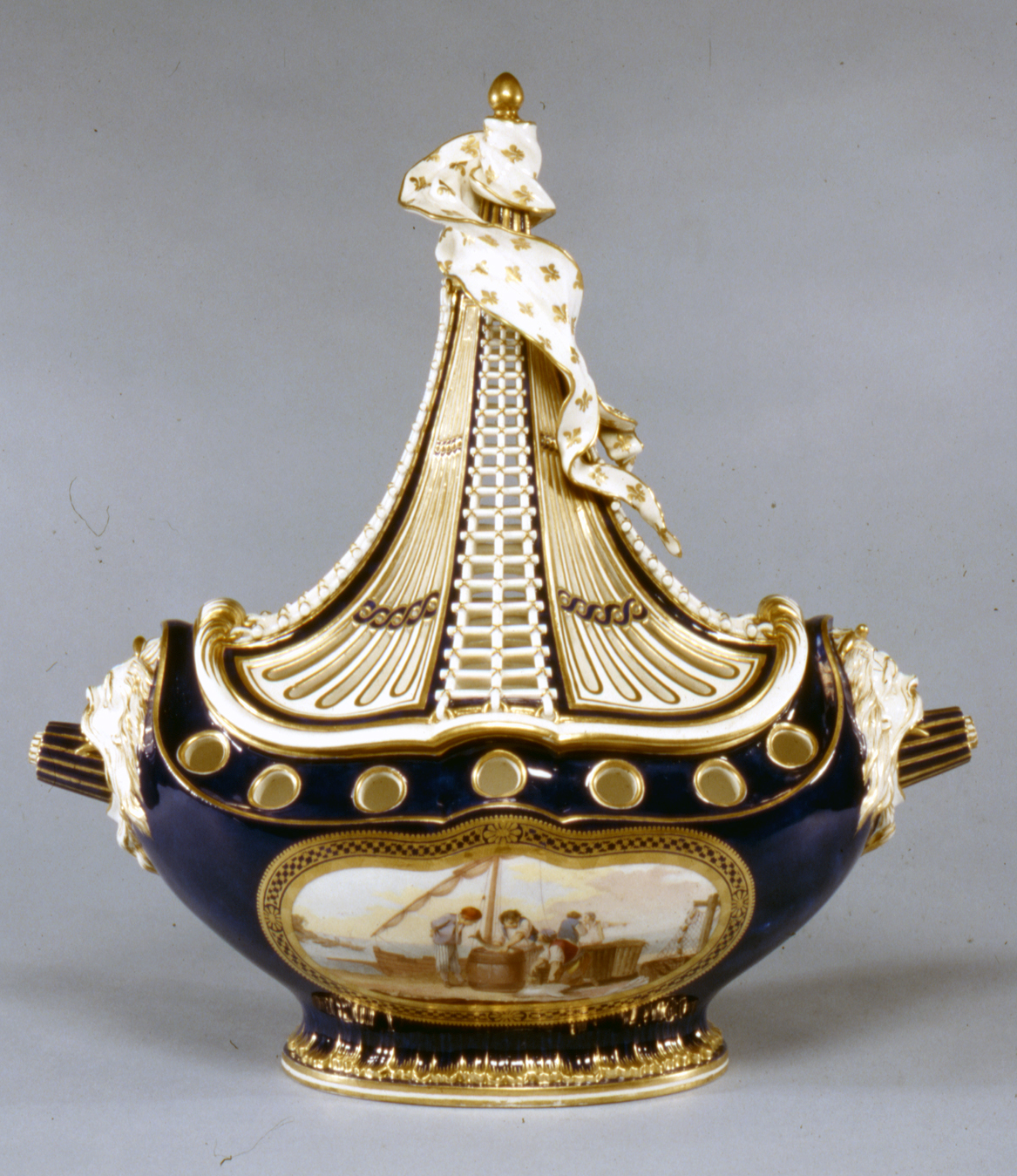
The Walters Art Museum's published provenance for the Sevres nef, accession 48.559, is worth quoting in full because of the phrase it repeats. It reads: Collection of Sir Anthony Nathan de Rothschild, 1st Baronet, 1810 to 1876, date and mode of acquisition unknown; Collection of Edwin Marriott Hodgkins, 1860 to 1932, Paris, by 1927, date and mode of acquisition unknown; with A. Seligmann, Rey and Co., New York, by 1928, date and mode of acquisition unknown; purchased by Henry Walters, Baltimore, 1928; by bequest to the Walters Art Museum, 1931.
Three owners, three admissions. And the museum goes further in a footnote: the Rothschild provenance is not confirmed, and it is given as stated by Edwin Marriott Hodgkins in his own 1927 sale catalogue of Sevres porcelain, where the entry reads formerly in the collection of Sir Anthony de Rothschild. The single most illustrious name in the chain is there on the word of the man who was selling the object.
I want to be clear that the museum is doing this well. Bracketing the uncertainty, naming the source of the claim and citing the vendor's catalogue is exactly right, and a great many institutions would simply have printed Rothschild and moved on. The record is honest. What it is honest about is that it does not know.
Meanwhile the underside of the same vase fixes the year
The vase carries three painted marks in blue on the underside of its base, and between them they do work no part of the ownership record manages. The two interlaced Ls are the Sevres factory mark. The letter L inside them is the manufactory's date letter for 1764. The letter M at their apex is the mark of Jean-Louis Morin, the painter who specialised in marine subjects and who did the dockside scene on the front and the trophy of shell, anchor, oars and trident on the back.
The form is likely to be Jean-Claude Duplessis's, chief designer at Sevres, and the museum says likely rather than certain. Even so: factory, year and decorator, established from the object, against a chain of owners in which three consecutive steps say the mode of acquisition is unknown.
Few examples of the shape survive. The Walters names the Louvre, the Royal Collection, the Wallace Collection, Waddesdon, the Getty, the Frick and the Metropolitan as holding others. It is a rare and conspicuous thing that passed through several of the richest collections in Europe, and nobody wrote down how it moved between them.
An ewer that signs and dates itself, and a provenance of three names
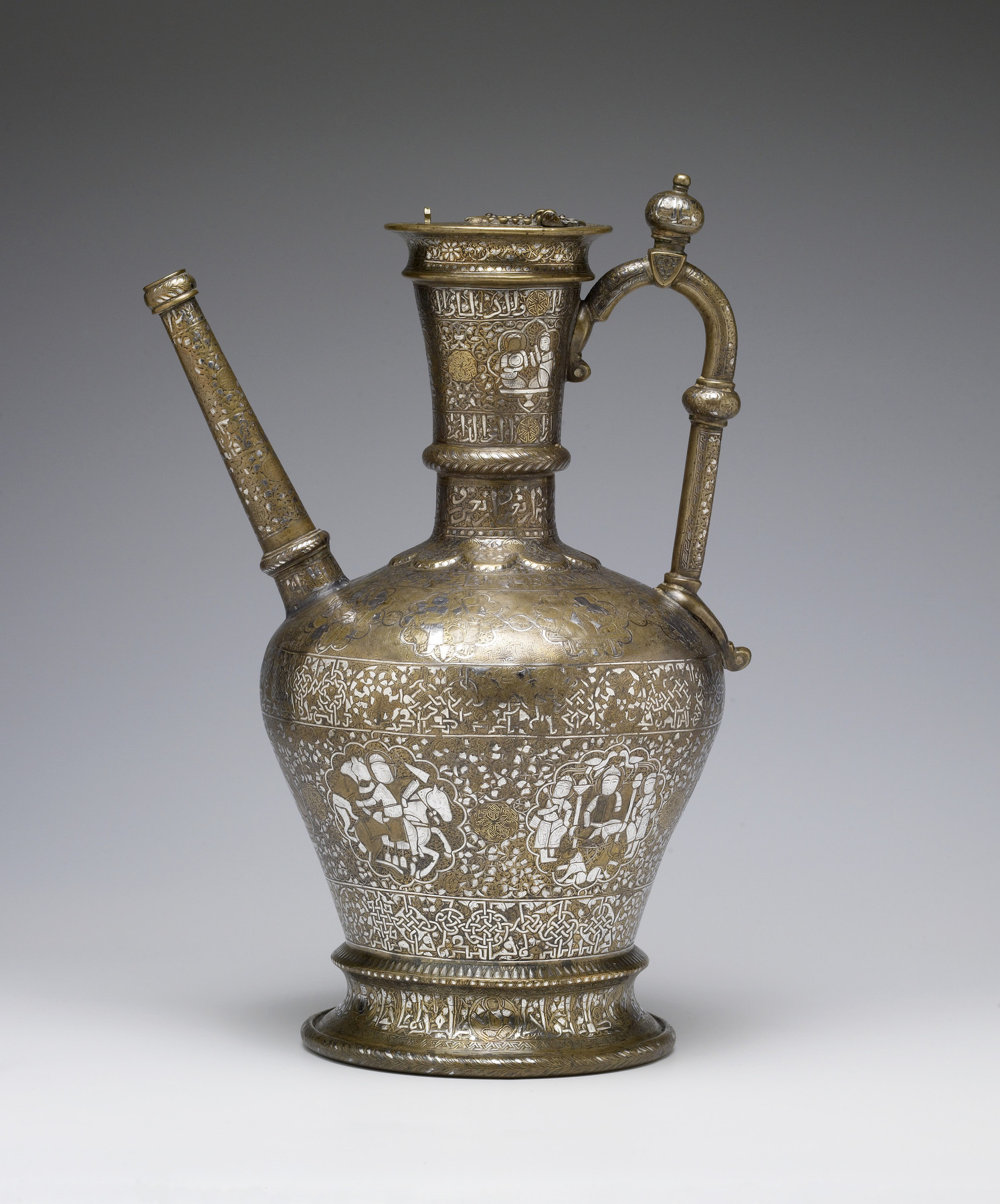
The Mosul ewer, Walters 54.456, carries its maker's signature around the base of the neck: Yunus ibn Yusuf, al-naqqash al-Mawsili, the designer from Mosul, with the date AH 644, 1246 to 1247. The museum reads the accompanying inscription as glory to our lord, the sultan, the royal. Brass with silver and gold inlay, 44.5 centimetres high, with hunters on horseback, musicians under a tree and an enthroned ruler around the body.
The Walters' published provenance for it runs, in its entirety: Dikran Kelekian, New York and Paris; Henry Walters, Baltimore, 1917, by purchase; Walters Art Museum, 1931, by bequest. Three names. Nothing about how Kelekian came by it, nothing before Kelekian, and a gap of some six hundred and seventy years between the date on the object and the first recorded owner.
Our own record carries one more step than the museum prints, and it is graded disputed for a reason that will now be familiar. Kelekian, an Istanbul-born dealer with galleries in New York, Paris, London and Cairo, described the seller in a letter to Walters around 1917 as a former Ottoman Grand Vizier who had owned most of a group of such pieces. That account exists only in the dealer's own letter. The museum does not print it, and on the evidence available that is the right decision.
The paten names its donor and the museum brackets the excavation
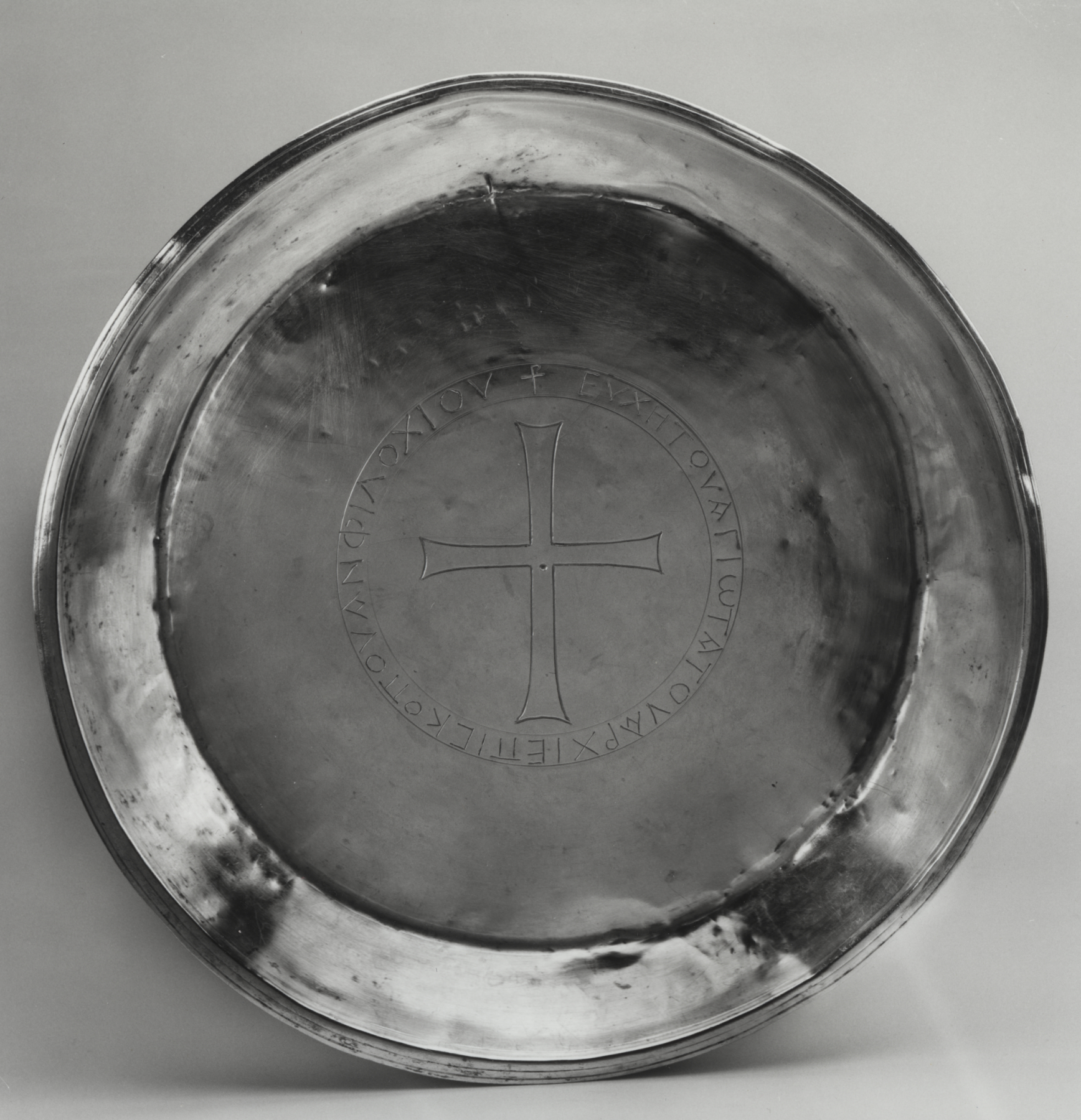
The Amphilochios paten, Walters 57.643, carries an inscription the museum translates as a vow of the most saintly archbishop Amphilochios. The object names the man who gave it, in the third quarter of the sixth century. It is one of twenty-three silver altar vessels believed to have come from the Syrian village of Kurin, the Kaper Koraon of the Greek form, and it is among the largest and heaviest patens of the group.
The museum's provenance opens with a square bracket, which is its way of marking a step it cannot document: excavated in Syria, circa 1908 to 1910. Then Tawfic Abucasem, Hama and Port Said, circa 1913, by purchase; Joseph Brummer, Paris, circa 1928, by purchase; Henry Walters, Baltimore, 1929, by purchase; Walters Art Museum, 1931, by bequest.
Three circas and a bracket in five steps, and the last of the uncertain ones is only sixteen years before the collector's death. Our own record dates Walters's purchase to 1928 or 1929, because the sources we consulted did not agree; the museum's credit line reads acquired by Henry Walters, 1929, and we defer to it while noting that this is a transaction from the twentieth century whose year took work to fix.
The oldest purchase of the four is the best recorded
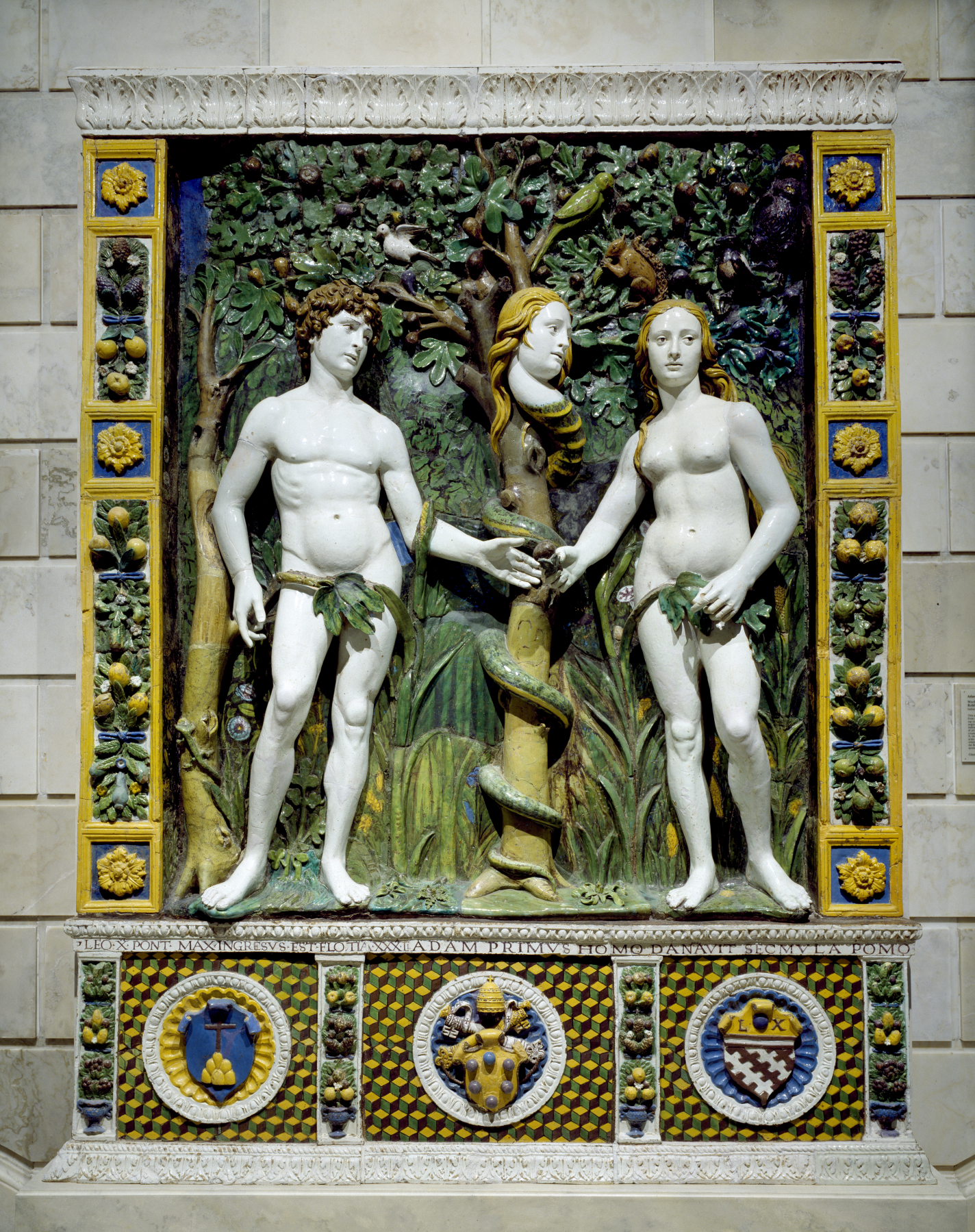
Adam and Eve, the della Robbia workshop relief, is the one Walters acquisition here with a clean transaction behind it. The Walters gives the provenance as Mme Camille Lelong, Paris; the Lelong collection sale, Paris, 1902, number 98; purchased by Henry Walters, Baltimore, 1902; by bequest to the museum. A named owner, a named sale, a lot number and a year.
It is also the earliest of the four by fifteen years, which is the part that should give a reader pause. The assumption that the record gets better as it approaches the present does not hold even inside one collector's buying, let alone across a century.
The relief carries its own complications, and they are about the object rather than its owners. An incomplete inscription on the base suggests it was made for the entry of Pope Leo X into Florence on 30 November 1515, and the Walters says plainly that this cannot be substantiated. The tall yellow-headed plants that some have read as American maize, which would be remarkably early, turn out on recent technical examination to be a replacement from the 1800s in the clearest passage. Even the iconography has a nineteenth-century hand in it.
Four chains, one terminal date
All four provenances end at the same event. Henry Walters died on 30 November 1931 and the collection passed to the City of Baltimore by the terms of his will, so a Byzantine paten, a Mosul ewer, a French vase and a Florentine relief, bought across twenty-seven years from four unconnected sellers, converge on one line and stop generating ownership record altogether.
That is what a bequest does, and it is the point at which the four objects become easy to trace and impossible to learn anything further about. Everything distinguishing them, which dealer, what was paid, what was known at the time, belongs to the years before 1931, and those are exactly the years the record handles worst.
A collector's name in a provenance line therefore does two opposite things at once. It anchors the object firmly to a place and a date, and it closes the file.
How to read a collector in a provenance
Check what the record says about the step before the collector, not the step that names him. The collector's own acquisition is usually the best-documented moment in a modern chain, and it is also the least informative, because it tells you only that a rich man bought something from somebody who had it.
Then look for bracketing and hedging in the institution's own text. Square brackets, circa, by 1927, and phrases like date and mode of acquisition unknown are a museum telling you precisely where its knowledge stops, and they are far more useful than a smooth line. The Walters uses all of them, which is why its records support this article at all.
And do not assume the twentieth century is well documented because it is close. On this evidence the reverse can be true, and the object itself, with its marks, its signature or its dedication, is frequently the most reliable witness in the room.
Why this archive is free to read
We do this for everyone who loves art. The people who have studied it for years, and the people who just stopped to look. Iconotheca exists so that what we learn belongs to all of them.
Nobody pays us for this. No ads, no sponsors, no commercial interest. These works belong to all of us, and we would rather share them with as many people as we can than keep them to ourselves.
If it gave you something today, tell us to keep going. Follow us, leave a like, or write a positive comment. We read every one, and they are what keeps us going.
Questions
Henry Walters, 1848 to 1931, was a Baltimore collector who enlarged the collection begun by his father William T. Walters. He bequeathed the collection, two buildings and an endowment to the City of Baltimore, and the museum was established in 1934.
It means the museum can place an object in someone's collection but cannot say when they got it or how. The Walters Art Museum uses the phrase three times in the single provenance line for its Sevres potpourri vase, accession 48.559.
Because the only source for it is the seller. The museum records that the provenance is not confirmed and that the Rothschild claim is as given by Edwin Marriott Hodgkins in his own 1927 sale catalogue, where the entry states the vase was formerly in the collection of Sir Anthony de Rothschild.
Frequently. The Walters Sevres vase carries factory marks fixing 1764 and naming its decorator, and the Mosul ewer is signed and dated by its maker, while the ownership record for both contains steps the museum marks as unknown or does not print at all.
The earliest one. Adam and Eve was bought at the Lelong collection sale in Paris in 1902 as lot 98, with a named previous owner, a named sale, a lot number and a year, which is more than the 1917, 1928 and 1929 acquisitions carry.
Sources
- 1The Walters Art Museum, object record for Potpourri Vase (Vase potpourri a vaisseau), accession 48.559. Read in full for the three manufacturer's, date and painter's marks on the underside, the 1764 date letter, the attribution of the form to Jean-Claude Duplessis, the decoration by Jean-Louis Morin, the provenance quoted in the text with its three instances of date and mode of acquisition unknown, and footnote 1 recording that the provenance is not confirmed and is as given by Hodgkins in his 1927 catalogue, number 30. art.thewalters.org/object/...
- 2The Walters Art Museum, object record for the Ewer by Yunus ibn Yusuf al-naqqash al-Mawsili, accession 54.456. Read for the signature and AH 644 date around the base of the neck, the inscription translation, the materials and dimensions, and the complete published provenance of three names. art.thewalters.org/object/...
- 3The Walters Art Museum, object record for the Paten, accession 57.643. Read for the inscription translated as a vow of the most saintly archbishop Amphilochios, the third-quarter sixth-century dating, the Kaper Koraon group of twenty-three vessels believed found at Kurin, the bracketed excavation step and the provenance through Tawfic Abucasem and Joseph Brummer to Henry Walters in 1929. art.thewalters.org/object/...
- 4The Walters Art Museum, object record for Giovanni della Robbia, Adam and Eve, accession 27.219. Read for the provenance through Mme Camille Lelong and the 1902 Lelong collection sale, number 98, the coats of arms of Leo X, the Salviati and the Buondelmonti, the unsubstantiated connection to Leo X's entry into Florence on 30 November 1515, and the technical finding that the clearest maize-like passage is an 1800s replacement. art.thewalters.org/object/...
- 5The Walters Art Museum, 'About the Walters Art Museum'. Read for Henry Walters's dates, 1848 to 1931, the bequest of the collection, two buildings and an endowment to the City of Baltimore, the museum's establishment in 1934 for the benefit of the public, the museum's original name of Walters Art Gallery and its change to Walters Art Museum in 2000, the 36,000 objects and five historic buildings, and the city's continuing ownership of three of them. thewalters.org/about/...
- 6Iconotheca, record for the Mosul ewer, for the additional prior-ownership step graded disputed here and not printed by the museum: Dikran Kelekian's own account, given in a letter to Henry Walters around 1917, describing the seller as a former Ottoman Grand Vizier. iconotheca.com/artworks
More in Collectors and Collections
The partThe credit line names the collector, and the accession number tells you what happened
Morgan died in March 1913, and the Metropolitan credits him with gifts made in 1917. The credit line names the collector.
The Longest Ownership Links Here Belong to Owners That Were Not People
The 28 longest institutional ownership links in this archive run 7,434 years between them. Three end in a completed sale.
The Name in the Buyer's Column Is Often an Employee
Across 126 years of sales in this archive the winning bidder is repeatedly not the owner.