Adam and Eve
Workshop of Giovanni della Robbia · ca. 1515 (genuine core); ca. 1870 or before (added sections)
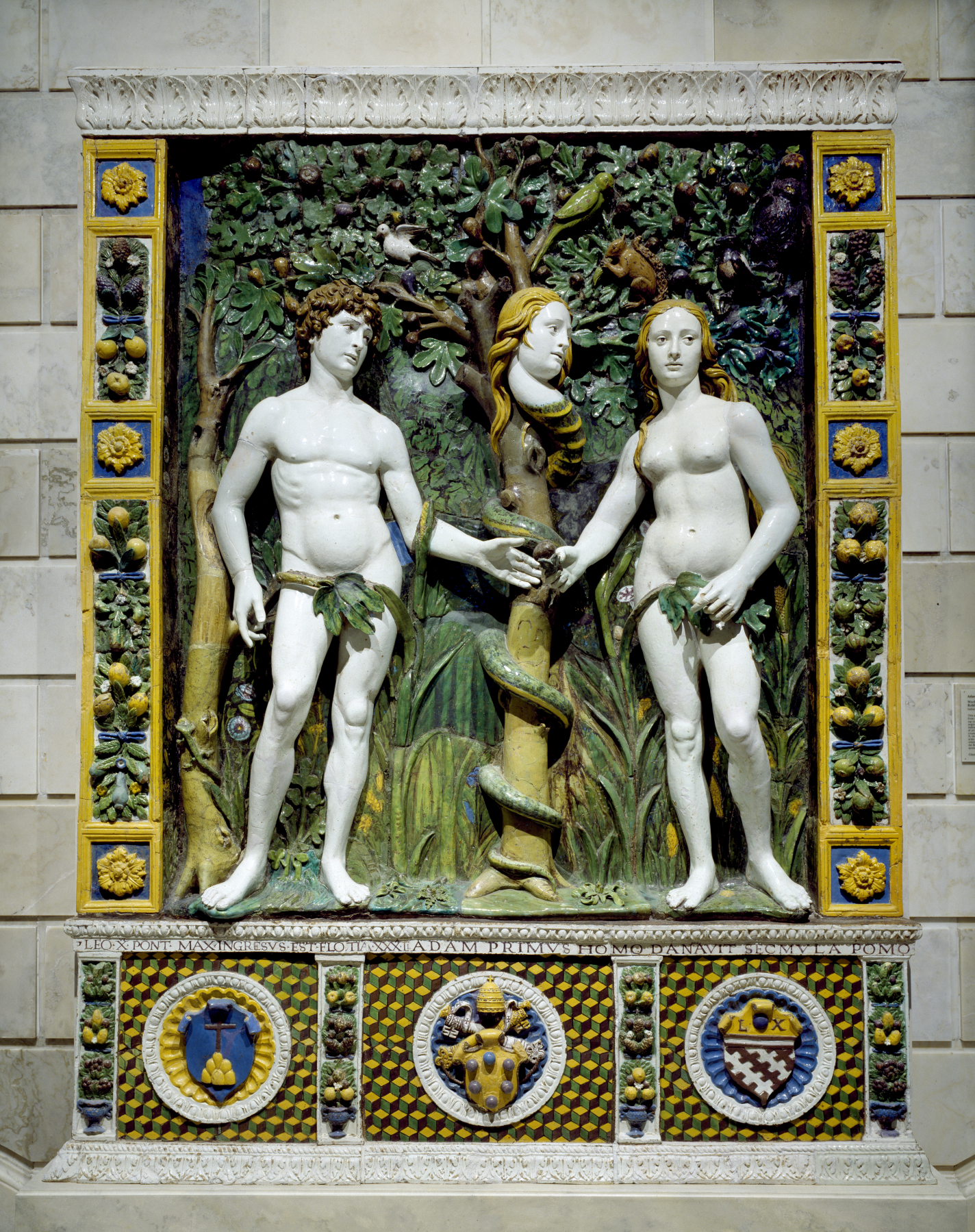
The relief as installed on the stair landing at the Walters Art Museum. The buff-colored genuine sixteenth-century terracotta and the reddish nineteenth-century additions are visually near-indistinguishable at this distance -- which is exactly the point the object's own conservation history makes.
| Artist | Workshop of Giovanni della Robbia |
|---|---|
| Date | ca. 1515 (genuine core); ca. 1870 or before (added sections) |
| Medium | Glazed terracotta (two distinct terracotta bodies and glazing campaigns; see technical notes) |
| Dimensions | 279.5 x 212 cm (110 1/16 x 83 7/16 in.) |
| Where it is now | The Walters Art Museum, Baltimore, Marylandlast confirmed |
| Inventory number | 27.219 |
| Attribution | AcceptedThe surviving early sixteenth-century terracotta is accepted as workshop production of Giovanni della Robbia on grounds of glaze composition, style, and comparison with his documented output; no one disputes that attribution for the genuine core. Full note |
| Object type | Ceramic |
| Period | Italian Renaissance, with a documented nineteenth-century reconstruction campaign |
| Cases | Has a provenance gap |
| Inscriptions | An incomplete Latin dedicatory inscription runs across the predella, naming Leo X and describing Adam as the first man who gave the world the apple (pomo). Cleaning in 2013-2014 revealed gaps and dislocations in the text that had previously been hidden under overpaint; the museum's conservator concluded it must be read as fragmentary, not complete. |
| Owners on record | 9 links8 documented, 1 unknown |
| Sources | 8 cited |
About this record Last verified · 8 sources cited · Change log
On this page 9 sections
ContentsClose
A monumental glazed terracotta relief of Adam and Eve, long catalogued as workshop of Giovanni della Robbia, ca. 1515, and on continuous public display at the Walters Art Museum since 1909. In 2013 accidental damage triggered a conservation study that used x-ray fluorescence spectrometry on the glaze itself, and found that a substantial proportion of the object was not made in the Renaissance at all: it was fabricated, probably in Florence around 1870, and physically spliced onto surviving genuine fragments using techniques borrowed from both maiolica painting and marble restoration.
The reconstruction was caught almost immediately by a South Kensington Museum examiner in 1870, whose damning written report sat unread in a London archive for a century and a half while the relief was sold in Florence, exported to Paris, auctioned at the 1902 Lelong sale, and bought by Henry Walters. It is not an isolated case: a comparable della Robbia retable in the Louvre carries a documented nineteenth-century restoration from the same market moment, when genuine but damaged Della Robbia terracotta was routinely completed for sale rather than sold as fragments.
The Walters' own current catalogue entry now discloses the fabrication candidly. Unresolved: who actually made the additions, what the original monument looked like before it was reduced to fragments, and what Henry Walters paid for it in 1902.
Provenance
Each link is graded. Documented: a cited source supports it. Disputed: the identification is argued but not established. Unknown: no owner for that span, and the gap is not smoothed into a narrative. The grades in the glossary.
- ca. 1515 -Unknown original settingunknown
The genuine sixteenth-century core is associated, by its inscription and by the coats of arms of Leo X, the Salviati, and the Buondelmonti on its predella, with the triumphal entry of the Medici pope Leo X into Florence on 30 November 1515 -- a connection first proposed by Allan Marquand (1911, 1912, 1920). The Walters' own catalogue entry states this specific commission cannot be substantiated. No contract, commission record, or account of the monument's original architectural setting survives.23
- - by 1870Unidentified restorer(s), Italydocumented
X-ray fluorescence glaze analysis and archival research establish that surviving fragments of the genuine sixteenth-century monument were reassembled and completed with newly fabricated glazed terracotta, probably in Italy in 1870 or slightly before. The craftsman or workshop responsible has not been identified.2
- December 1870 - March 1871Offered to the South Kensington Museum, London (via the dealer recorded as "V. Cappelli")documented
Shipped to London and offered for GBP 1,000. Technical examiner Matthew Digby Wyatt filed a report identifying much of the object as recent fabrication disguised to look old; the museum declined to purchase, and the relief was returned to Florence in March 1871. Also described in The Art Journal (London), January-February 1871.2
- by 1884 - 1886Shop of the antiques dealer Angelo Cappelli, Borgo Ognissanti, Florencedocumented
In the shop of Florentine antiques dealer Angelo Cappelli by 1884 at the latest.2
- 1886 - 1886Adele Ristori, Valdarnodocumented
Purchased from Angelo Cappelli's shop by Adele Ristori, described in the sources consulted only as a woman from the Valdarno region of Tuscany.2
- 1886 - 1902Mme Camille Lelong, Parisdocumented
Purchased from Adele Ristori in 1886; its export from Italy to France that year took place despite an effort by Italian authorities to bar it, the legal basis and outcome of which are not detailed in the sources consulted.2
- 8-10 December 1902 - 1902Sold at the Lelong Collection Sale ("Premiere vente"), Galerie Georges Petit, Paris, lot 98documented
The printed sale catalogue reproduces an image of the relief showing it already damaged and grimy, with the predella inscription transcribed in a configuration different from its current reading and explicitly described in the catalogue as incomplete. Hammer price not recorded in any source consulted.2
- 1902 - 1931Henry Walters, Baltimoredocumented
Purchased by Henry Walters at the 1902 Lelong sale. Installed on permanent public display in 1909, when Walters completed his private art gallery in Baltimore, the building that is now the Walters Art Museum. The relief has remained on continuous display since, on a stair landing on Charles Street.23
- 1931 - presentThe Walters Art Museum, Baltimoredocumented
Entered the museum's collection by the bequest of Henry Walters on his death in 1931. Accession number 27.219.3
Technical evidence
| Attribution note | The surviving early sixteenth-century terracotta is accepted as workshop production of Giovanni della Robbia on grounds of glaze composition, style, and comparison with his documented output; no one disputes that attribution for the genuine core. What is not in question, following x-ray fluorescence glaze analysis published by conservator Gregory Bailey in 2018, is that a substantial proportion of the glazed terracotta surface visible today was not made in the Renaissance at all: it was fabricated, probably in Florence around 1870 or slightly before, to complete a damaged and incomplete original. The object on view is therefore a genuine sixteenth-century monument only in part, physically spliced to nineteenth-century material by an unidentified restorer. |
|---|---|
| Support/body | Two physically and chemically distinct terracotta bodies are present: a majority of buff-colored terracotta consistent with genuine della Robbia workshop material, and a smaller but substantial number of fragments in a reddish terracotta identified as nineteenth-century manufacture.2 |
| Glaze, genuine sections | The buff-colored fragments carry a single opaque layer of glaze; composition and colorants are consistent with published reference data for genuine della Robbia workshop glazes.2 |
| Glaze, 19th-century sections | The reddish fragments were glazed twice: an initial overall firing with a white ground, followed by a second, semi-translucent glaze applied in a brushy, impressionistic manner and fired again. This double-firing method is borrowed from maiolica vessel painting, not della Robbia workshop practice.2 |
| XRF instrumentation and method | Portable x-ray fluorescence spectrometry was performed by Gregory Bailey with Dr. Glenn Gates (Walters Art Museum Research Scientist), using a Bruker Tracer III-V (loaned by the Baltimore Museum of Art) and an Elio XRF unit. Twelve sites of similarly colored glaze on each of the two terracotta types were analyzed with the Bruker instrument (120-second acquisition, 40 kV, 4.75 microamps, no filter, in contact with the surface under vacuum, average counts approx. 2,500/sec); the same 24 sites were re-analyzed with the Elio unit under varying parameters.2 |
| Key diagnostic finding | Chromium was identified as a colorant in the green glazes of the reddish (19th-century) terracotta. Chromium is not documented as a colorant in vitreous glazes or glass before approximately 1800, providing chemical proof of post-Renaissance manufacture independent of style or connoisseurship.2 |
| Dimensions | 279.5 x 212 cm (110 1/16 x 83 7/16 in.).3 |
| Assembly and joining | The 19th-century additions were modeled directly against the broken edges of original fragments in a low-shrinkage clay, then detached, fired, and glazed separately before being secured to the relief with tinted plaster and iron pins or staples, then coated overall in wax to disguise the joins. These methods parallel period Italian restoration practice for both ceramic vessels and marble sculpture.2 |
| Inscription | An incomplete Latin dedicatory inscription runs across the predella, naming Leo X and referring to Adam as the first man who gave the world the apple (pomo). The 2013-2014 cleaning revealed gaps and dislocations in the text previously concealed by overpaint; it must be read as fragmentary, not complete.23 |
| Heraldry | The predella's central roundel bears the arms of Pope Leo X (Medici); the flanking roundels bear the arms of the Salviati family and the Buondelmonti family.23 |
| Conservation record | At least ten documented campaigns of treatment between 1958 and 2013: Elizabeth Packard (1958); Peter Michael (1959, 1960); Carol Aiken and Terry Weisser (1974); Carol Snow (1988); Donna Strahan (1998); Meg Craft (2001, 2003); and undated Walters treatment-file entries; followed by Gregory Bailey's year-long documentation, cleaning, and analysis campaign beginning in 2013, published 2017-2018.23 |
Images
The record in full
Chapter 1A Renaissance monument that is not what it appears to be
The Walters Art Museum's Adam and Eve is, by area, one of the largest pieces of glazed terracotta the della Robbia workshop's name is attached to: a wall relief 2.795 meters high and 2.12 meters...
The Walters Art Museum's Adam and Eve is, by area, one of the largest pieces of glazed terracotta the della Robbia workshop's name is attached to: a wall relief 2.795 meters high and 2.12 meters wide, showing the first man and woman flanking the Tree of Knowledge, framed by a garland border of fruit and flowers and set above a predella bearing an inscription and three coats of arms. It has stood on continuous public display in Baltimore since 1909, when Henry Walters completed the private gallery that would become this museum, and it occupies a stair landing between floors on Charles Street, visible from a distance to almost everyone who visits.
What most of those visitors are not told is that a large share of the glazed surface they are looking at was not made in the Renaissance. In 2013 a small fragment of Adam's fig leaf broke off and was never found. The repair job that followed grew, over the next several years, into a full technical investigation by the Walters' own conservation staff, and that investigation used x-ray fluorescence spectrometry on the glaze itself, not connoisseurship, to establish that a substantial portion of the relief was fabricated roughly three and a half centuries after the date usually given for the object, and grafted onto surviving fragments of the genuine sixteenth-century monument. This record follows that finding through the conservator's own published account, and through the provenance trail his research reconstructed back through two Florentine antique dealers, a failed sale to a London museum in 1870, and a Paris auction house in 1902.
Chapter 2The subject and its Renaissance source
The composition shows Adam and Eve standing on either side of the Tree of Knowledge, their hands meeting at the fruit, with a densely modeled screen of foliage behind them and a serpent coiled around...
The composition shows Adam and Eve standing on either side of the Tree of Knowledge, their hands meeting at the fruit, with a densely modeled screen of foliage behind them and a serpent coiled around the trunk between them. Both figures are shown nude and standing in poses that recall antique marble sculpture rather than the draped devotional figures the della Robbia workshop is generally associated with; the Walters' own catalogue entry calls these among the first nudes the workshop produced in glazed terracotta.
The museum's catalogue entry identifies the primary visual source for the composition as Albrecht Durer's engraving of Adam and Eve, dated 1504: the figure poses, the dense wall of forest foliage behind them, and the animals populating the undergrowth are all adapted from the German print, with the roster of animals reduced in the sculpted version. The serpent is given a woman's face resembling Eve's own, a convention with roots in medieval theological commentary that held the devil took the form of a young woman specifically so that Eve would be at ease listening to him -- an explanation, the museum's own text notes, that reflects a period habit of describing women as untrustworthy and easily led. This is a documented medieval exegetical tradition attached to the Genesis account, not a claim about what any particular patron privately believed; no source consulted ties it to a specific commission or individual for this relief.
One detail in the foliage has drawn particular scholarly attention and turns out to be a case study in the object's own compromised evidentiary status. Tall plants with yellow heads of grain in the background have been read by some as maize, or Indian corn, a New World plant that would be startlingly early for European imagery if genuinely of Renaissance date. The Walters' own catalogue entry now states plainly that the clearest of these passages is, in fact, a nineteenth-century replacement -- which means the single most tantalizing iconographic puzzle this object seemed to pose evaporates once the glaze chemistry is taken into account. A find that looked like evidence of early globalization turns out to be evidence of a Victorian restorer's brush instead.
Chapter 3Leo X, the Medici, and a commission that cannot be proven
The predella carries a Latin inscription and three coats of arms in roundels: a central shield bearing the arms of a Medici pope, flanked by the arms of the Salviati family to one side and the...
The predella carries a Latin inscription and three coats of arms in roundels: a central shield bearing the arms of a Medici pope, flanked by the arms of the Salviati family to one side and the Buondelmonti family to the other. Allan Marquand, writing in a series of studies of the della Robbia family between 1911 and 1920, connected this heraldry and the inscription's wording to the triumphal entry of the Medici pope Leo X into his native Florence on 30 November 1515, a lavish, temporary festival of triumphal arches and civic pageantry mounted by the city's leading architects, sculptors, and painters to celebrate Florence's native son ascending to the papacy. On that reading, the relief would have been made to mark the event, with the Salviati and Buondelmonti arms recording two prominent Florentine families' public alignment with the Medici pope.
The Walters' own current catalogue entry is more cautious than Marquand's proposal has sometimes been treated: it states outright that the connection to the 1515 entry, while suggested by the inscription and coats of arms, cannot be substantiated. No commission document, contract, or eyewitness account ties this specific object to that specific event; the argument rests entirely on the combination of heraldry, date, and inscription text. That inscription, moreover, is now known to be fragmentary and dislocated in ways that were hidden by old overpaint until the 2013-2014 cleaning, which weakens rather than strengthens the case for reading its wording as reliable evidence of original intent. The safest statement the evidence supports is that a monument bearing the crests of Leo X, the Salviati, and the Buondelmonti was made in Florence in the general period of the pope's 1515 entry, and that the more specific claim of a direct commission for the event itself is a scholarly proposal, not a documented fact.
Chapter 4How glazed terracotta is supposed to be made, and how this piece was actually finished
The della Robbia family workshop, founded by Luca della Robbia in Florence in the fifteenth century and carried on by his nephew Andrea and grand-nephew Giovanni, was known for a technique of...
The della Robbia family workshop, founded by Luca della Robbia in Florence in the fifteenth century and carried on by his nephew Andrea and grand-nephew Giovanni, was known for a technique of applying colored, opaque glazes to terracotta sculpture, typically fired in a single glazing campaign per section. Giovanni, unlike his father and great-uncle, is one of the few members of the family known to have signed and dated some of his own work, a habit attributed by later scholars to the need to distinguish his output from a growing number of imitators. Attribution within the family workshop remains difficult even for genuine period pieces: a large number of works once given to Andrea, or even to Luca, have since been reassigned to Giovanni's hand or workshop, because father, son, and workshop assistants shared materials, molds, and a broad house style.
Analysis of the Walters relief's own glazed surfaces found two physically and chemically distinct populations of terracotta fused into a single object. The majority of the fragments are a buff-colored terracotta carrying a single opaque layer of glaze, a composition and coloring the Walters' research scientist found consistent with published data on genuine della Robbia workshop glazes. A smaller, but still substantial, group of fragments is made from a reddish terracotta that was glazed twice: first with an overall white ground firing, then finished with a second, semi-translucent glaze applied in a loose, brushy, impressionistic manner and fired again. That two-stage, white-ground-plus-translucent-overglaze method is not a della Robbia workshop technique at all; it is borrowed from maiolica vessel painting, and its presence on this relief represents, in the conservator's words, a fundamental misunderstanding of della Robbia workshop practice on the part of whoever made the additions. The restorers who reconstructed this object were skilled enough to fool visual inspection for well over a century, but they were working from the wrong technical playbook, and that mismatch is what let modern instrumental analysis catch them.
Chapter 5The 2013 damage and the investigation it triggered
In 2013 a palm-sized section of the fig leaf at Adam's waist broke off and was lost; a thorough search of the surrounding gallery spaces never located it.
In 2013 a palm-sized section of the fig leaf at Adam's waist broke off and was lost; a thorough search of the surrounding gallery spaces never located it. Preparing the resulting damage report exposed a larger problem: many other small fragments across the relief were loose or partly detached and at risk of falling, the surface carried a discolored, non-original wax coating trapping a decade of dirt and grime, and multiple campaigns of fill and restoration paint applied over the years no longer matched each other in color or gloss. The relief's location -- a shallow, high-traffic stair landing -- had also limited how thoroughly it could be documented or treated in the past, and had contributed to how long the new damage went unaddressed.
Conservator Gregory Bailey, working as an Andrew W. Mellon Fellow in Conservation at the Walters, initially designed a simple, reversible fill for the missing fig-leaf fragment, expecting it might eventually turn up. It never did. As Bailey researched the object's prior treatment history in the museum's own conservation files, he found that the relief had been treated at least eight times between the 1950s and the 2000s -- by conservators Elizabeth Packard (1958), Peter Michael (1959, 1960), Carol Aiken and Terry Weisser (1974), Carol Snow (1988), Donna Strahan (1998), and Meg Craft (2001, 2003) -- primarily to repair breakage, consolidate loose joins, and refresh an aesthetic already built on layers of older restoration. Written accounts of these campaigns were detailed, but photographic and diagrammatic records were thin, leaving real ambiguity about exactly where and how extensive the underlying damage and restoration were. That gap in the record is what pushed Bailey's project, in consultation with curator Dr. Joaneath Spicer, from a routine repair into a year-long campaign of documentation, cleaning, and scientific analysis, using time and equipment supported by his Mellon fellowship.
Because the object remained on permanent public display throughout, the conditions of the project were unusually constrained. Ladders and lamps had to be set up and struck each working day; no fume extraction was available on the open stair landing, which ruled out volatile organic solvents; and the relief had to look presentable at the end of each session because the space beneath it was used for after-hours museum events. Cleaning tests were run on the museum's closed days, and the full campaign of poulticing, mechanical reduction of old fill, and dirt removal took roughly twelve months of work spread across several days a week.
Chapter 6The chemistry: what the x-ray fluorescence analysis actually found
As cleaning progressed, it became visually apparent that the relief's central figures and upper foliage were assembled from severely damaged, misaligned fragments held together largely with plaster...
As cleaning progressed, it became visually apparent that the relief's central figures and upper foliage were assembled from severely damaged, misaligned fragments held together largely with plaster rather than clean original joins, with several pieces of genuine glazed terracotta seemingly inserted only to fill gaps between larger sections. To test whether this patchwork included outright modern fabrication rather than simply damaged original material, Bailey worked with Dr. Glenn Gates, a research scientist at the Walters, to run portable x-ray fluorescence spectrometry directly on the glazed surfaces, using a Bruker Tracer III-V instrument on loan from the Baltimore Museum of Art and a second, Elio-brand XRF unit. Twelve sites of similarly colored glaze on each of the two visually distinct terracotta types were analyzed with the Bruker instrument (120-second acquisition time, 40 kV, 4.75 microamps, no filter, measured in contact with the surface under vacuum, with average count rates of roughly 2,500 counts per second), and the same 24 sites were re-analyzed with the Elio unit under varying parameters as a cross-check.
The results showed consistent compositional differences between the two terracotta populations that tracked exactly with the visual and technical distinction already noted: the buff-colored fragments' glaze chemistry matched published reference data for genuine della Robbia workshop glazes, while the reddish fragments' glazes did not. The single most decisive piece of evidence was the identification of chromium as a colorant in the green glazes of the reddish terracotta. Chromium is not documented as a colorant used in vitreous glazes or glass before approximately 1800, a chronological marker independently established in the ceramics and glass conservation literature. Its presence in these glazes is, in effect, an internal chemical clock: whatever else can be argued about style or connoisseurship, no green glaze containing chromium as a colorant can have been fired before the technique existed, which places the reddish-terracotta sections firmly in the modern era regardless of how convincingly they were made to resemble Renaissance work to the eye.
Chapter 7How the reconstruction was physically carried out
The physical evidence, once read alongside the chemistry, describes a specific and fairly sophisticated method of fabrication and assembly.
The physical evidence, once read alongside the chemistry, describes a specific and fairly sophisticated method of fabrication and assembly. The nineteenth-century additions were modeled directly against the broken edges of surviving original fragments, in a low-shrinkage clay chosen to fit precisely, then detached from the original before being fired and glazed as independent pieces -- explaining why the new sections fit their neighboring original fragments so closely despite being made in an entirely different century. Once fired, the new and old pieces were joined to the relief and to each other using tinted plaster and iron pins or staples, techniques directly paralleled in contemporary nineteenth-century Italian restoration practice for both ceramic vessels (where restorers commonly threw or built new clay sections directly against a vessel's broken edge before separating them for firing) and marble sculpture (where restorers fitted precisely carved new marble using pointing machines, a technique documented as early as Francesco Carradori's 1802 sculptor's manual). The entire assembly was then given an overall wax coating, a finishing technique also borrowed from period marble restoration practice, whose function was to unify surface sheen and disguise the visual seams between old and new material.
Reading the restoration campaign this way, Bailey's published analysis argues that its underlying logic drew equally on ceramic-repair and marble-restoration convention, suggesting the restorers understood della Robbia glazed terracotta as sitting somewhere between the two crafts -- itself a small piece of evidence about how well, or how imperfectly, mid-nineteenth-century Italian restorers actually understood the workshop's original techniques. The overall effect, calculated or not, was well suited to Victorian taste in collecting: a large, dramatic, ostensibly complete Renaissance monument, rather than a scatter of damaged and unsaleable fragments.
Chapter 8The paper trail: London, 1870, and a museum that said no
Bailey's provenance research, conducted alongside the scientific analysis, traces the object back through the archives of the Victoria and Albert Museum -- known at the time as the South Kensington...
Bailey's provenance research, conducted alongside the scientific analysis, traces the object back through the archives of the Victoria and Albert Museum -- known at the time as the South Kensington Museum -- to December 1870, when the relief was in the hands of a Florence-based dealer recorded in the museum's own correspondence only as "V. Cappelli." Cappelli shipped the object to London and offered it for sale to the South Kensington Museum at the considerable price of 1,000 pounds. No photographs of the object from this moment are known to survive, but the museum's technical examiner, the architect and design writer Matthew Digby Wyatt, filed a detailed written report after inspecting the piece disassembled into its component pieces for shipping, and the object was also described in the January and February 1871 issues of The Art Journal in London, which independently confirms its identity and condition at that date.
Digby Wyatt's verdict, preserved in the museum's own archives and quoted directly in Bailey's published research, was blunt: "I think a little of this is old and a great deal quite modern... It is much made up with plaster and coloured (not fired) in many places. The various pieces are made with... two different kinds of clay -- and colour has been applied in many places to make new material appear old." This is, in effect, an eyewitness confirmation, made within living memory of the reconstruction and by a trained technical examiner with the object in pieces in front of him, of exactly what twentieth-first-century x-ray fluorescence would later prove by chemistry alone: that the object was a hybrid of old and freshly made material, deliberately finished to disguise the difference. The South Kensington Museum declined to purchase it, and the relief was shipped back to Florence in 1871.
This sequence establishes something important for how the object's history should be read: the fabrication was not a modern discovery about an object everyone had always assumed was pure Renaissance work. A qualified nineteenth-century examiner saw through it immediately, in writing, the same decade the restoration was carried out. What later changed was not the evidence but its visibility -- Digby Wyatt's report sat unpublished and unconsulted in a museum archive for roughly a century and a half while the relief was sold, resold, and eventually placed on permanent public display in Baltimore as an apparently intact Renaissance monument.
Chapter 9Florence, Valdarno, and Paris: the object's route to the Lelong sale
After its return to Florence in 1871, the relief's next documented appearance is in the shop of the Florentine antiques dealer Angelo Cappelli, on the Borgo Ognissanti -- a street that was, and...
After its return to Florence in 1871, the relief's next documented appearance is in the shop of the Florentine antiques dealer Angelo Cappelli, on the Borgo Ognissanti -- a street that was, and remains, a center of the Florentine antiques trade. The relief was there by 1884 at the latest, when it was acquired by Adele Ristori, described in the sources consulted only as a woman from the Valdarno region of Tuscany. In 1886 Ristori sold the relief to Mme Camille Lelong, a Paris-based collector, and its export from Italy to France that year took place despite what the scholarly literature describes as an effort by Italian authorities to block it -- a detail that is recorded but not elaborated upon in the sources available for this record, and that raises a real question about what legal mechanism nineteenth-century Italian authorities could and did invoke against the export of a partly modern object of this kind, addressed further below.
The recurrence of the surname Cappelli at both ends of this Florentine episode -- "V. Cappelli" shipping the piece to London in 1870, and Angelo Cappelli holding it in his Borgo Ognissanti shop by 1884 -- is suggestive of a single dealer or family firm operating from the same street across more than a decade, and independent research for this record found a Vincenzo Cappelli operating a comparable antiques and furnishings business at Borgo Ognissanti in the early 1880s. No source consulted, however, explicitly confirms that "V. Cappelli" and Angelo Cappelli were the same individual or the same firm, and this record does not assert that connection as established; it is flagged here as a plausible but unproven link for a future researcher to test against Florentine trade directories or archival records.
What is well documented is that Camille Lelong was a substantial Parisian collector of medieval and Renaissance art. Her collection of objects of art and high curiosity from antiquity, the Middle Ages, and the Renaissance -- including this relief -- was sold at the prominent Galerie Georges Petit in Paris over three days, 8 to 10 December 1902, in a sale covered contemporaneously by the trade periodical Le Bulletin de L'Art; a second sale of her seventeenth- and eighteenth-century furnishings and paintings followed at the same gallery in May 1903. The Lelong sale catalogue itself reproduced an image of the Adam and Eve relief, and the catalogue's own description shows it already damaged and visibly grimy at the time of the sale, with the predella's Latin text transcribed in a configuration different from how it reads today and explicitly noted in the catalogue as incomplete -- independent, contemporary confirmation that the object's condition and fragmentary inscription were not new problems created between 1902 and its arrival at the Walters, but longstanding features of the object as Lelong owned it.
Chapter 10Not an isolated case: the Della Robbia revival market
The Walters relief's reconstruction did not happen in a vacuum.
The Walters relief's reconstruction did not happen in a vacuum. Genuine della Robbia glazed terracotta was in high demand among collectors in the second half of the nineteenth century, both in Italy and among the foreign buyers, especially British and American, who were then acquiring Italian Renaissance art on a large scale; a market that prizes an intact, dramatic monument over a box of damaged fragments creates a direct incentive to complete rather than simply sell what survives. Bailey's published research draws exactly this comparison, citing a 2011 technical study of the large glazed terracotta retable of the Ascension, attributed to the della Robbia workshop and now in the Musee du Louvre, whose nineteenth-century restoration additions that study attributes to the Parisian restoration firm of Alfred Andre, active between roughly 1885 and 1890.
Independent research for this record confirms the outline of that comparandum from the Louvre's own published catalogue entry: the Ascension retable is recorded as having passed from a church in Citta di Castello through the Florentine dealer Stefano Bardini and into the collection of Frederic Spitzer, the Vienna-born Paris dealer-collector, before the Louvre acquired it at the Spitzer sale of 1893; the Louvre's own cataloguing states plainly that the retable was reassembled from original fragments with additions of diverse origin before it reached Spitzer's collection. Alfred Andre himself is independently documented, in a 1994 investigation of his surviving workshop archive, as a prolific fabricator of Renaissance-style decorative art who supplied Spitzer with pieces distributed onward to major collectors including the Rothschild family, and whose workshop retained hundreds of plaster and wax models spanning genuine restorations, faithful reproductions, and outright inventions. That published research does not itself name the Ascension retable among Andre's confirmed attributions, so the specific link between Andre's workshop and that object rests on the 2011 study Bailey cites rather than on anything independently verified for this record; what is independently confirmed is the broader pattern -- a genuine but damaged della Robbia glazed terracotta monument, passing through the international antiquities trade, restored and augmented before reaching a major museum collection, with the restorer's identity only imperfectly recovered decades or a century later. The Walters relief is a second, chemically proven instance of the same phenomenon, not a unique case.
Chapter 11Henry Walters, the Lelong sale, and the shape of his 1902 buying
Henry Walters purchased the Adam and Eve relief in Paris in 1902, at the Lelong sale, lot 98.
Henry Walters purchased the Adam and Eve relief in Paris in 1902, at the Lelong sale, lot 98. That purchase sat within an extraordinary year for Walters as a collector: 1902 was also the year he agreed, in Rome, to buy the entire collection of the Vatican official Don Marcello Massarenti in a single transaction reported at roughly five million Italian lire, then equivalent to about a million dollars -- a purchase of well over a thousand paintings and other objects, many with attributions that later scholarship would substantially revise downward. Set against that scale of acquisition, the Lelong relief was a comparatively modest, individually targeted purchase, made at public auction in Paris rather than through the kind of bulk, single-owner negotiation that produced the Massarenti collection. It shows Walters, in the same twelve months he was assembling the core of what would become his museum's old master painting collection through one enormous private deal, also buying opportunistically and piece by piece on the open auction market for decorative arts that interested him. No source consulted for this record documents the price Walters paid for lot 98 specifically, nor whether he bid himself, through an agent, or through the same channels he used for the Massarenti negotiation; that remains an open question.
The purchase fits a broader, well-documented pattern in American Gilded Age collecting: buyers whose primary interest lay in old master paintings routinely acquired large-scale Italian Renaissance decorative sculpture, and della Robbia glazed terracotta specifically, as a way of filling out galleries with objects that read as unmistakably "Renaissance" to visitors, regardless of how thoroughly any individual piece's condition or completeness had been vetted before purchase. Walters was, by 1902, already an experienced buyer of large quantities of art in a short span of time; nothing in the sources available for this record suggests he had any reason at the point of purchase to suspect the relief's nineteenth-century restoration history, since the evidence that would establish it -- Digby Wyatt's 1870 report -- sat unpublished in a London museum archive that Walters had no occasion to consult.
Chapter 12Treating a hybrid object: the compensation problem
Once Bailey's analysis had established that the Adam and Eve relief was, in his own description, a hybrid object combining fragments of a sixteenth-century monument with nineteenth-century...
Once Bailey's analysis had established that the Adam and Eve relief was, in his own description, a hybrid object combining fragments of a sixteenth-century monument with nineteenth-century restorations in the same material, the conservation project faced a genuine dilemma with no fully satisfactory answer. One option -- disassembling the relief and physically removing the nineteenth-century additions -- was never seriously pursued, both because of the prohibitive cost and labor of freeing the terracotta sections from the concrete, plaster, wooden beams, and iron rebar in which they are now embedded, and because doing so would reduce the object to a pile of disarticulated, authentic but incomplete rubble rather than yield back some cleaner, more original whole. The opposite option -- simply re-disguising the differences between old and new material as prior restorers had always done -- would have preserved a unified, aesthetically pleasing appearance at the cost of continuing to misrepresent the object to its own viewers.
Bailey chose a middle path, guided by the relief's specific physical situation on a stair landing where most visitors experience it only from a distance. Damage and losses were toned and inpainted using reversible Golden Fluid Acrylic paints to present a unified appearance from a normal viewing distance, with only minimal additional filling or resurfacing of existing old fills; up close, however, the differences between the two terracotta bodies, along with visible breaks, restorations, and fill lines, remain deliberately legible rather than disguised. A few areas required judgment calls the published account flags explicitly as speculative: cleaning revealed, on Eve's proper right arm, a broken ridge of terracotta with traces of glaze suggesting an additional lock of hair had originally been modeled there and was later lost, and the conservator, in consultation with the curator, chose to recreate that lock in epoxy putty over a removable barrier layer -- a compensation the published account is careful to label a plausible reconstruction rather than a recovery of known original form. The treatment took roughly a year to complete and left the object, in the conservator's own assessment, more structurally stable and better documented, while explicitly acknowledging that much remains unresolved, including the identity of whoever actually made the nineteenth-century additions.
Chapter 13What the museum tells visitors now
Unlike many institutions that have quietly continued to present a compromised object without qualification, the Walters Art Museum's own current online catalogue entry for accession 27.219 explicitly...
Unlike many institutions that have quietly continued to present a compromised object without qualification, the Walters Art Museum's own current online catalogue entry for accession 27.219 explicitly discloses the nineteenth-century reconstruction, specifically noting, in the context of the disputed maize motif, that recent technical examination concluded the passage in question is a replacement from the 1800s. The museum's conservation record, also published on that same page, lists the full sequence of twentieth-century treatments culminating in an entry describing the object's examination and analysis "to answer questions as to its authenticity and extent of prior restoration." This is a meaningfully more candid public presentation than a bare wall label identifying the piece only as workshop of Giovanni della Robbia, circa 1515, would provide, and it means a member of the public consulting the museum's own online catalogue today, rather than relying on a gallery label alone, can already learn that the object is not what its label date implies. Whether the physical gallery label on the stair landing itself carries the same level of disclosure to an in-person visitor who does not consult the online catalogue is not established by the sources available for this record, and is recorded here as an open question rather than assumed either way.
Chapter 14What remains unresolved
Several questions about this object have no answer in the sources consulted for this record, and are recorded here rather than smoothed over.
Several questions about this object have no answer in the sources consulted for this record, and are recorded here rather than smoothed over. Who actually made the nineteenth-century glazed terracotta additions is unknown: Bailey's research identifies the Florentine dealers who handled the object's sale in 1870 and the 1880s, but explicitly states that attributing the restoration itself to a particular workshop remains unresolved. What the original, complete sixteenth-century monument looked like, and what architectural or devotional context it was built for, cannot be reconstructed from the surviving fragments alone; the restorers who completed it in the nineteenth century are described as having produced a reduced version of the original, which implies the genuine monument was larger or more elaborate than what exists today, but its full original form is lost. The price Henry Walters paid for lot 98 at the 1902 Lelong sale is not published in any source consulted here. The exact legal basis and outcome of the reported Italian effort to block the relief's export in 1886 is recorded only in outline. And the connection this record raises, but does not confirm, between the dealer "V. Cappelli" in 1870 and Angelo Cappelli in the 1880s remains an open lead rather than an established fact.
The artist
Giovanni della Robbia, and the workshop he inherited from his father Andrea della Robbia
The della Robbia name covers three generations of a single Florentine family workshop -- Luca, his nephew Andrea, and Andrea's son Giovanni -- all producing glazed terracotta sculpture from broadly shared materials, molds, and technical knowledge, which makes attribution to an individual hand within the family notoriously difficult even for genuine period work. This object is catalogued as workshop of Giovanni della Robbia precisely because its surviving early sixteenth-century material fits his period and workshop's technical profile without rising to the certainty of a signed, documented commission, and because, as this record's central finding shows, a large share of what a visitor sees today was not made by that workshop, or in that century, at all.
Related works
| Work | Relation | Where it is |
|---|---|---|
| L'Ascension (Ascension retable) Workshop of Andrea della Robbia, with Giovanni della Robbia (?) | The closest documented parallel case: a large glazed terracotta retable reassembled from original fragments with additions of diverse origin before entering the Frederic Spitzer collection; a 2011 technical study cited by Bailey attributes its 19th-century restoration to the Parisian firm of Alfred Andre, active c. 1885-1890. Acquired by the Louvre at the Spitzer sale of 1893. Not the Walters relief, and not to be confused with the Brooklyn Museum's unrelated Resurrection relief below. | Musee du Louvre, Paris |
| Adam and Eve (engraving) Albrecht Durer | Primary visual and compositional source for the Walters relief, per the Walters' own catalogue entry: figure poses, the dense background foliage, and the garden's animal population are adapted from this 1504 print. Dated 1504, eleven years before the date usually given for the Walters relief's genuine core. | Multiple impressions in major print collections (e.g. Metropolitan Museum of Art, National Gallery of Art) |
| Resurrection of Christ Giovanni della Robbia | A separate, much larger (46-section) glazed terracotta relief by the same master, with its own unrelated conservation history. This is NOT the object described in this record and has no connection to its provenance or restoration history. Included solely to prevent confusion between the two separate Giovanni della Robbia conservation projects, both published around the same period: this relief's reconstruction (Bailey, 2017-2018) and the Brooklyn relief's own first full-scale treatment (2015-2016), undertaken for an unrelated exhibition. | Brooklyn Museum, New York |
| Adam and Eve (Temptation) Unidentified German sculptor | An unrelated small alabaster relief of the same generic subject, also in the Walters collection. This is NOT the object described in this record. Different medium (alabaster, not terracotta), different maker (German, 16th century), different acquisition (from Leon Gruel, Paris, 1928, not the 1902 Lelong sale). Included to prevent title-based confusion within the Walters' own collection. | The Walters Art Museum, Baltimore (accession 27.325, not currently on view) |
| Frieze of the Works of Mercy Giovanni della Robbia, with Benedetto and Santi Buglioni | Giovanni della Robbia's other major documented late work, for comparison of a securely attributed, dated commission against this relief's more uncertain workshop attribution. 1525-1529; remains in its original architectural location, unlike the Walters relief. | Ospedale del Ceppo, Pistoia, Italy |
Open questions
- Who physically made the nineteenth-century glazed terracotta additions? Bailey's research names the Florentine dealers who bought and sold the completed object but explicitly could not identify the restorer or workshop responsible for fabricating the new sections.
- What did the original, complete sixteenth-century monument look like, and for what architectural or devotional setting was it made? The restorers are described as having produced a reduced version of the original from an incomplete set of surviving fragments, implying a larger or more elaborate original whose full form is now lost.
- What price did Henry Walters pay for lot 98 at the December 1902 Lelong sale? Not published in any source consulted for this record.
- Is the dealer recorded only as 'V. Cappelli' in the Victoria and Albert Museum's 1870 correspondence the same person as, or a relation of, Angelo Cappelli, who is documented holding the relief in his Borgo Ognissanti shop in Florence by 1884? Independent research located a Vincenzo Cappelli trading at the same Florentine street in the early 1880s, but no source consulted confirms this identification; it is recorded here as a plausible but unproven lead.
- What was the precise legal mechanism by which Italian authorities attempted, unsuccessfully, to block the relief's export to France in 1886? The literature records the attempt but not its legal basis or why it failed.
- Can the fig-leaf fragment lost in the 2013 damage incident still be recovered? It was never located despite a thorough search, and the fill made to replace it was designed to be reversible in case it eventually turns up.
- Does the Walters' physical gallery label on the stair landing disclose the nineteenth-century reconstruction to an in-person visitor as explicitly as the museum's own online catalogue entry now does? Not established by the sources available for this record.
Questions about this object
What is Adam and Eve?
Adam and Eve is a ceramic, dated ca. 1515 (genuine core); ca. 1870 or before (added sections). Medium: Glazed terracotta (two distinct terracotta bodies and glazing campaigns; see technical notes).
Who made Adam and Eve, and is the attribution settled?
The attribution to Workshop of Giovanni della Robbia is recorded here as accepted. The surviving early sixteenth-century terracotta is accepted as workshop production of Giovanni della Robbia on grounds of glaze composition, style, and comparison with his documented output; no one disputes that attribution for the genuine core. What is not in question, following x-ray fluorescence glaze analysis published by conservator Gregory Bailey in 2018, is that a substantial proportion of the glazed terracotta surface visible today was not made in the Renaissance at all: it was fabricated, probably in Florence around 1870 or slightly before, to complete a damaged and incomplete original. The object on view is therefore a genuine sixteenth-century monument only in part, physically spliced to nineteenth-century material by an unidentified restorer.
Where is Adam and Eve now?
The Walters Art Museum, Baltimore, Maryland. Inventory number 27.219. Last confirmed 3 September 2026. By the bequest of Henry Walters, 1931.
What is still unknown about Adam and Eve?
Who physically made the nineteenth-century glazed terracotta additions? Bailey's research names the Florentine dealers who bought and sold the completed object but explicitly could not identify the restorer or workshop responsible for fabricating the new sections.
Sources
- 1Bailey, Gregory. 2018. "The Nineteenth-Century Reconstruction of Giovanni Della Robbia's Adam and Eve." Journal of the Walters Art Museum 73: 70-76. journal.thewalters.org/the-nineteenth-century-reconstruct...
- 2Bailey, Gregory. "Tempting Fate: Treatment of Giovanni della Robbia's Adam and Eve." AIC Objects Specialty Group Postprints, Volume 24 (papers of 2017, published 2019): 77-90. resources.culturalheritage.org/osg-postprints/...
- 3The Walters Art Museum, online collection catalogue. "Adam and Eve," Giovanni della Robbia, ca. 1515, accession 27.219. art.thewalters.org/object/...
- 4Musee du Louvre, collections database. "L'Ascension," workshop of Andrea della Robbia (with Giovanni della Robbia, ?). collections.louvre.fr/en/...
- 5The Art Newspaper. 1994. "Master faker Alfred Andre's cache of evidence revealed." theartnewspaper.com/1994/...
- 6Wikimedia Commons. commons.wikimedia.org/wiki/...
- 7The Walters Art Museum, online collection catalogue. "Adam and Eve (Temptation)," German, 1520-1560, accession 27.325. Consulted for disambiguation only; not the object described in this record. art.thewalters.org/object/...
- 8Wikipedia, "Giovanni della Robbia." source, used only for uncontested biographical dates and lineage; with Marquand's monographs or a current scholarly catalogue. en.wikipedia.org/wiki/...

Last verified · Published
Change log
3 September 2026 - Record created at the house standard: researched narrative, technical evidence, maker dossier, graded provenance chain, prices with hammer and premium separated, related works, open questions and sources.