Ewer signed by Yunus ibn Yusuf al-Mawsili
Yunus ibn Yusuf, called al-naqqash al-Mawsili · 644 AH / 1246-47 CE
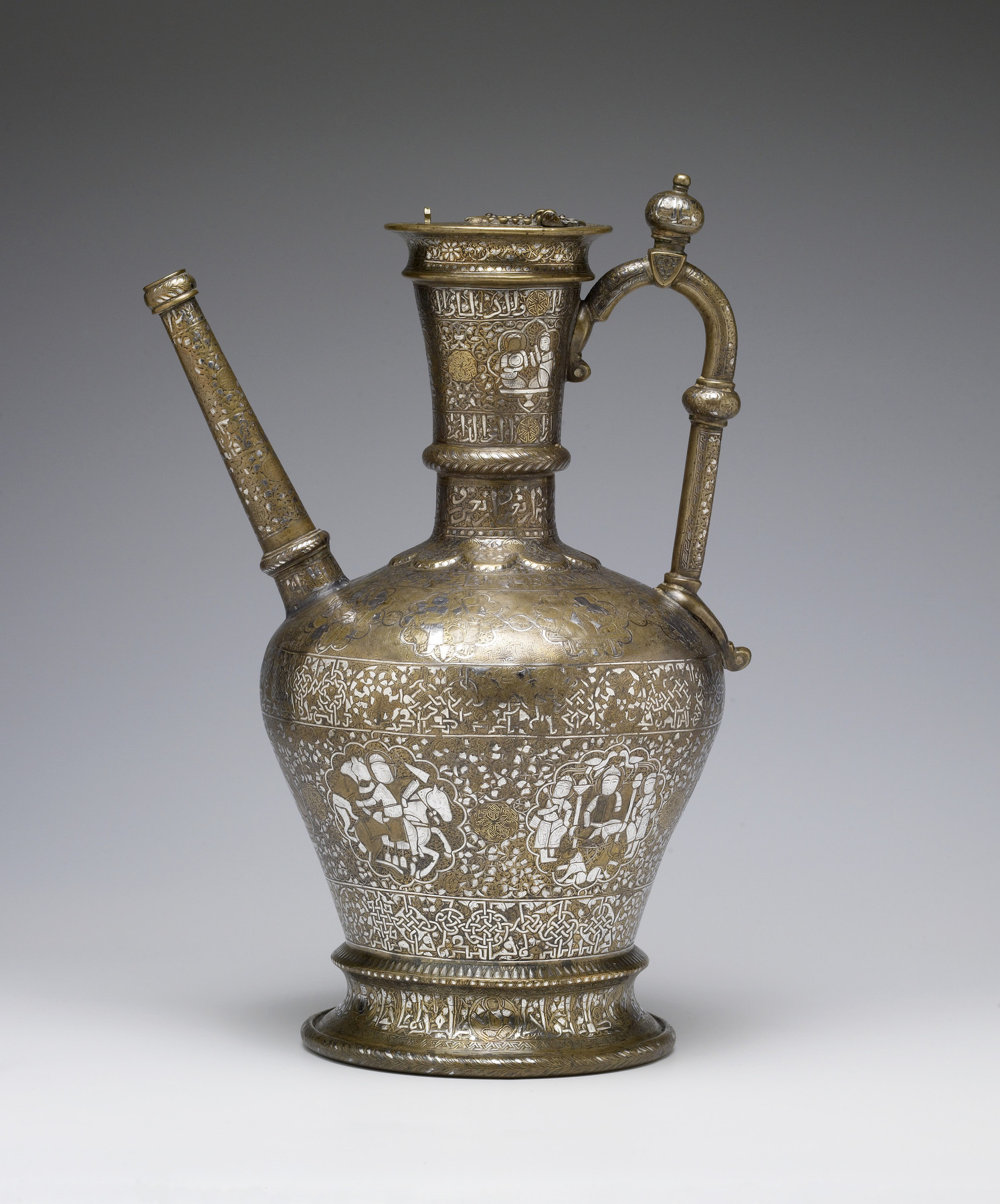
The ewer in full view. Brass, hammered and inlaid with silver and gold, 644 AH / 1246-47 CE, 44.5 cm high.
The Walters Art Museum · Photograph by Walters Gallery of Art · CC BY-SA 4.0| Artist | Yunus ibn Yusuf, called al-naqqash al-Mawsili |
|---|---|
| Date | 644 AH / 1246-47 CE |
| Medium | Brass, hammered and raised, chased and engraved, inlaid with silver and gold, with a black organic resin compound worked into the engraved ground |
| Dimensions | H: 44.5 x W: 31.8 x D: 16.5 cm (17 1/2 x 12 1/2 x 6 1/2 in) |
| Where it is now | The Walters Art Museum, Baltimorelast confirmed |
| Inventory number | 54.456 |
| Attribution | AcceptedSigned and dated by the maker himself in an inscription band around the base of the ewer's neck: Yunus ibn Yusuf al-naqqash al-Mawsili, dated 644 AH. Full note |
| Object type | Islamic metalwork |
| Period | Jazira (greater Mosul region), mid-13th century, within the last full generation of production before the Mongol destruction of Baghdad in 1258 |
| Cases | Has a provenance gap |
| Inscriptions | A signature and date band at the base of the neck: 'Yunus ibn Yusuf al-naqqash al-Mawsili', dated 644 AH (1246-47 CE). A separate benedictory inscription elsewhere on the vessel reads in part 'Glory to our lord, the sultan, the royal...'; the intended honorand's personal name is not given in any source consulted for this record, and the full text and a complete published translation were not located. |
| Owners on record | 6 links4 documented, 1 disputed, 1 unknown |
| Sources | 18 cited |
About this record Last verified · 18 sources cited · Change log
On this page 9 sections
ContentsClose
A brass ewer hammered and inlaid with silver and gold, signed and dated by its maker, Yunus ibn Yusuf al-naqqash al-Mawsili, to 644 AH, 1246-47 CE. Its body carries the standard courtly repertoire of Jaziran luxury metalwork, hunters, musicians and an enthroned ruler, beneath a benedictory inscription to an unnamed sultan. Nothing else is known of Yunus ibn Yusuf beyond this one signature.
It surfaced in the Istanbul art market in the 1910s, reportedly from the collection of a former Ottoman Grand Vizier, and was bought from the dealer Dikran Kelekian by Henry Walters in 1917. It entered the Walters Art Museum through Walters' 1931 bequest of his entire collection to the City of Baltimore; the accession number it carries, 54.456, is an internal classification, not a year, and should not be read as one.
It belongs to the same broad group of al-Mawsili-signed metalwork as the British Museum's Blacas Ewer, made fourteen years earlier, but the two share only a toponymic professional name, not a documented workshop link; and it has no connection at all to the Hermitage's Bobrinski Bucket, a Herat object from an unrelated tradition eighty-three years older. Whether the wider al-Mawsili group represents one continuous Mosul workshop tradition or several independently trained craftsmen who shared a point of origin and a reputation remains an open question in the scholarship, and this ewer's single, workshop-less signature sits at the center of that question rather than resolving it.
Provenance
Each link is graded. Documented: a cited source supports it. Disputed: the identification is argued but not established. Unknown: no owner for that span, and the gap is not smoothed into a narrative. The grades in the glossary.
- 644 AH / 1246-47 CE -Made by Yunus ibn Yusuf, al-naqqash al-Mawsilidocumented
Signed and dated by the maker on the object itself, at the base of the neck.123
- 1246-47 - by 1917Unrecordedunknown
No owner, location or transaction is documented for roughly six and a half centuries between manufacture and the ewer's appearance in the Istanbul art market.1
- unknown, by early 20th century - 1917An unnamed former Ottoman Grand Vizier, Istanbuldisputed
Recorded only through the dealer Dikran Kelekian's own account, given in a letter to Henry Walters around 1917, describing the seller as an ex-Grand Vizier who had owned most of a group of inlaid bronzes also acquired at points by a Baron and by the collector Edward C. Moore. This record accessed the letter's content only through a secondary academic source with an imperfect transcription, and could not verify the Baron's name or confirm the Grand Vizier's identity against a primary document.1517
- 1917 - 1917Sold by the dealer Dikran Kelekiandocumented
Kelekian, an Istanbul-born dealer with galleries in New York, Paris, London and Cairo, sold the ewer to Henry Walters in 1917. Kelekian is separately documented as having formed a substantial part of Walters' Coptic, Early Christian and classical holdings.11314
- 1917 - 1931Henry Walters, Baltimoredocumented
Held in Walters' private Baltimore collection until his death on 30 November 1931.116
- 1931 - presentThe Walters Art Museum, Baltimoredocumented
Entered the museum by Henry Walters' 1931 bequest of his entire collection, building and an endowment to the City of Baltimore; the museum opened to the public in 1934. The accession number 54.456 denotes an internal classification series, not the year of acquisition.116
Technical evidence
| Attribution note | Signed and dated by the maker himself in an inscription band around the base of the ewer's neck: Yunus ibn Yusuf al-naqqash al-Mawsili, dated 644 AH. This is a first-person signature on the object, not a connoisseurship attribution, and it is the only evidence that Yunus ibn Yusuf ever existed. |
|---|---|
| Support | Brass, hammered and raised into a faceted ewer body with a flaring neck.1 |
| Inlay materials | Silver and gold, with a black organic resin compound worked into the engraved ground to set off the metal inlay.1 |
| Dimensions | H: 44.5 x W: 31.8 x D: 16.5 cm (17 1/2 x 12 1/2 x 6 1/2 in).13 |
| Signature and date | Inscribed at the base of the neck: 'Yunus ibn Yusuf al-naqqash al-Mawsili', dated 644 AH (1246-47 CE).123 |
| Benedictory inscription | A separate courtly formula reading in part 'Glory to our lord, the sultan, the royal...'; the honorand's personal name is not given in the sources consulted and the complete text was not located.23 |
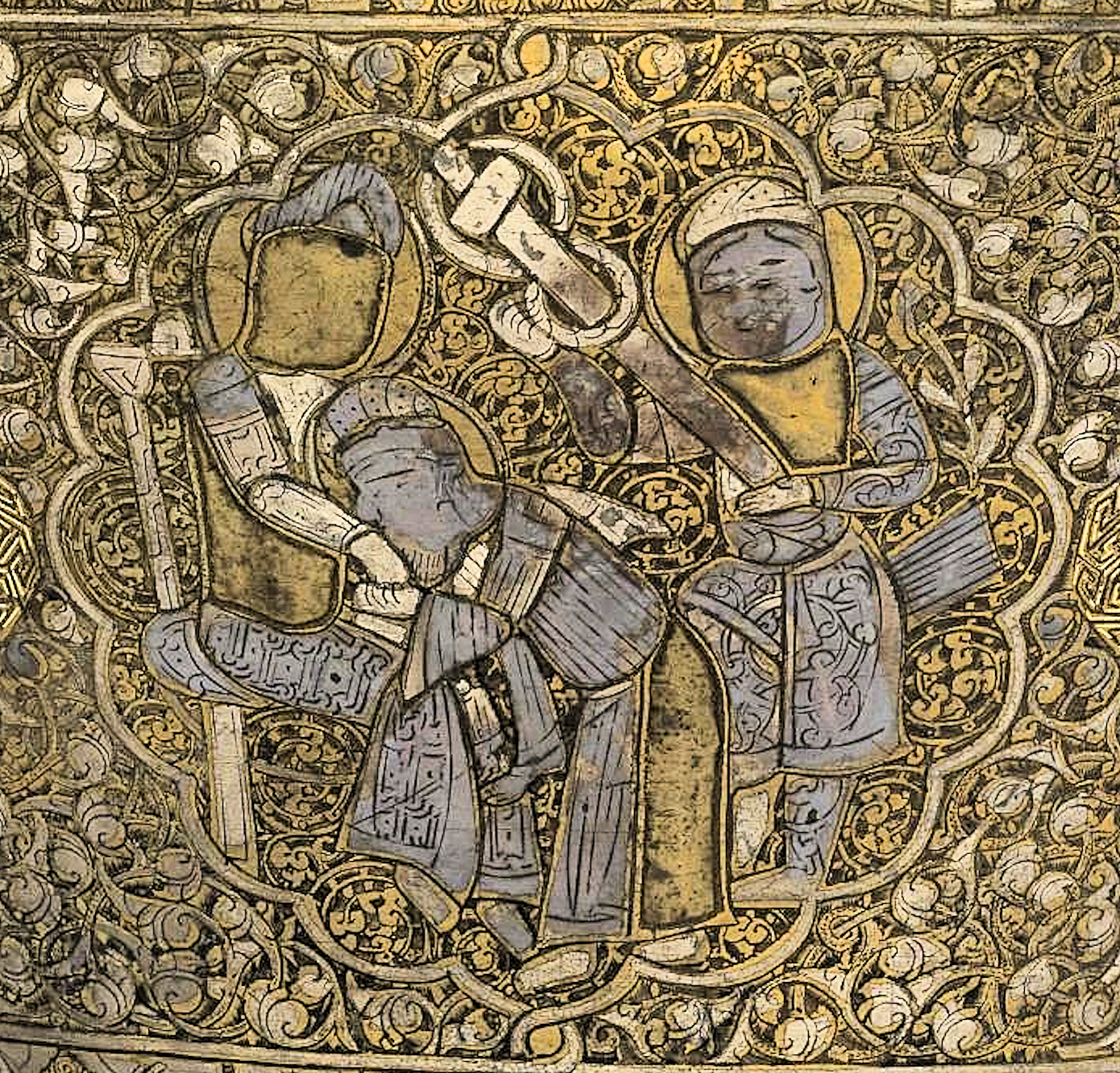
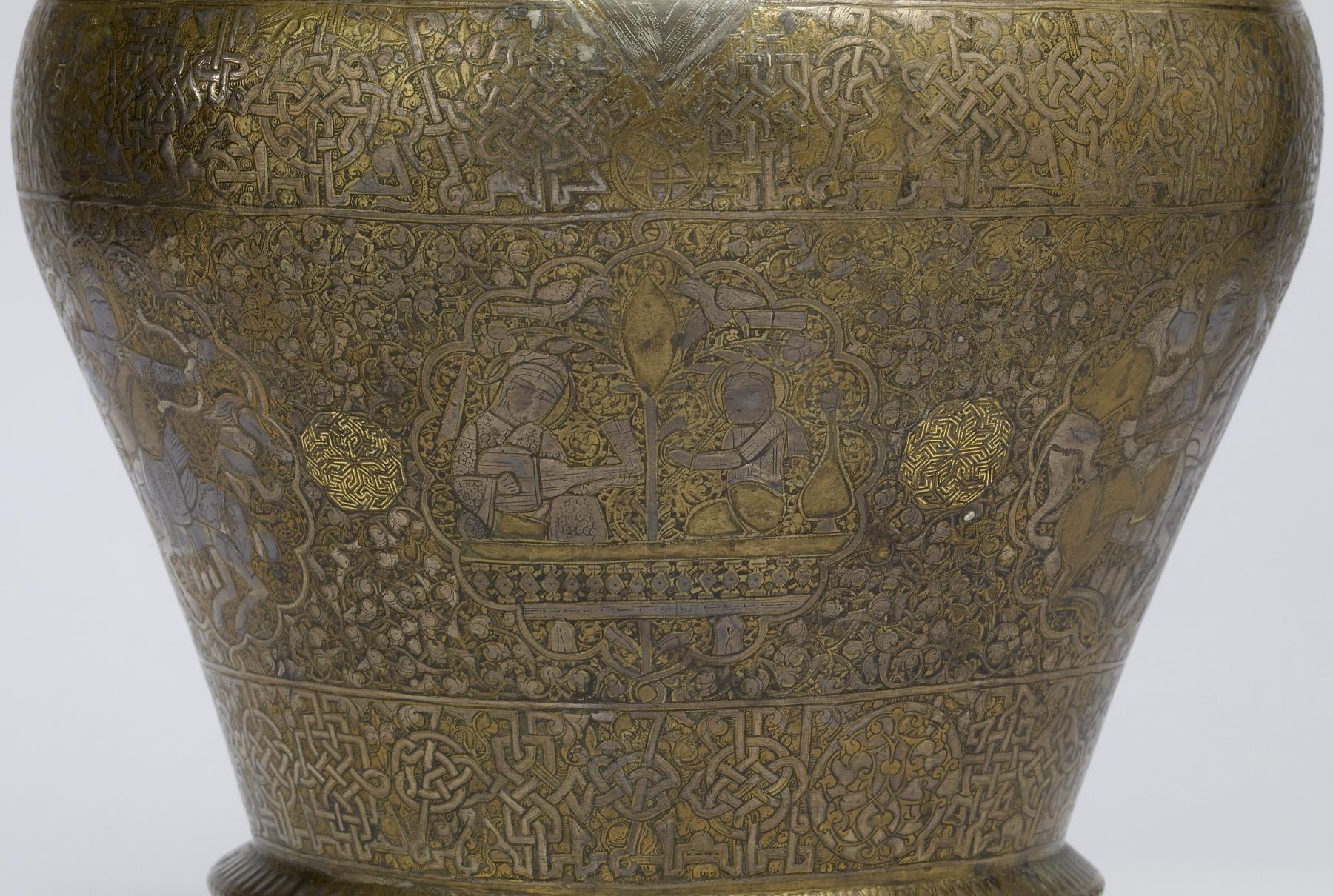
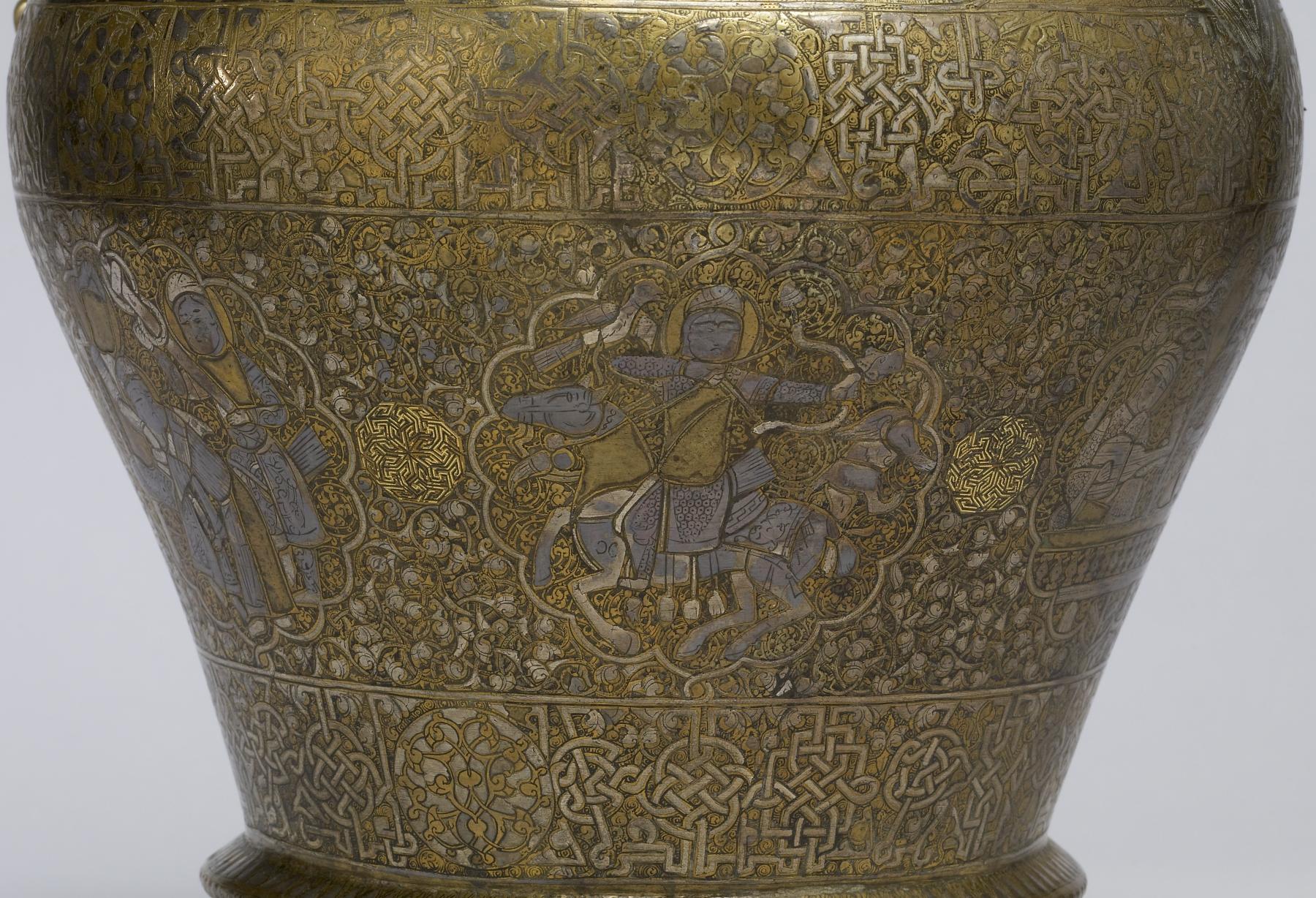
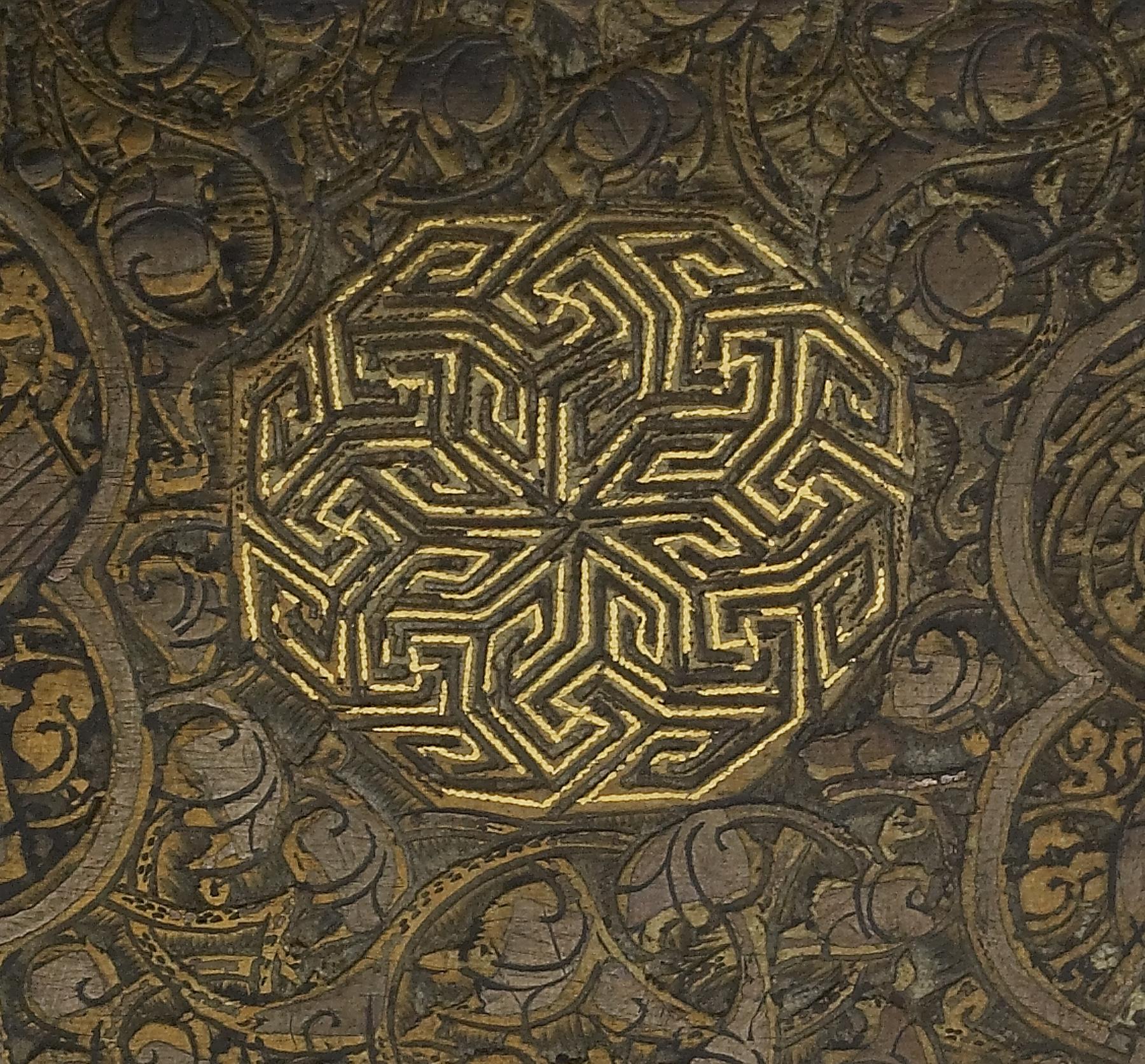
| Decorative program | Scalloped medallions against a fretwork or vegetal ground enclosing hunters on horseback, musicians beneath a tree, and an enthroned ruler with attendants, the standard courtly figural repertoire of Jaziran inlaid brass of this period.12318 |
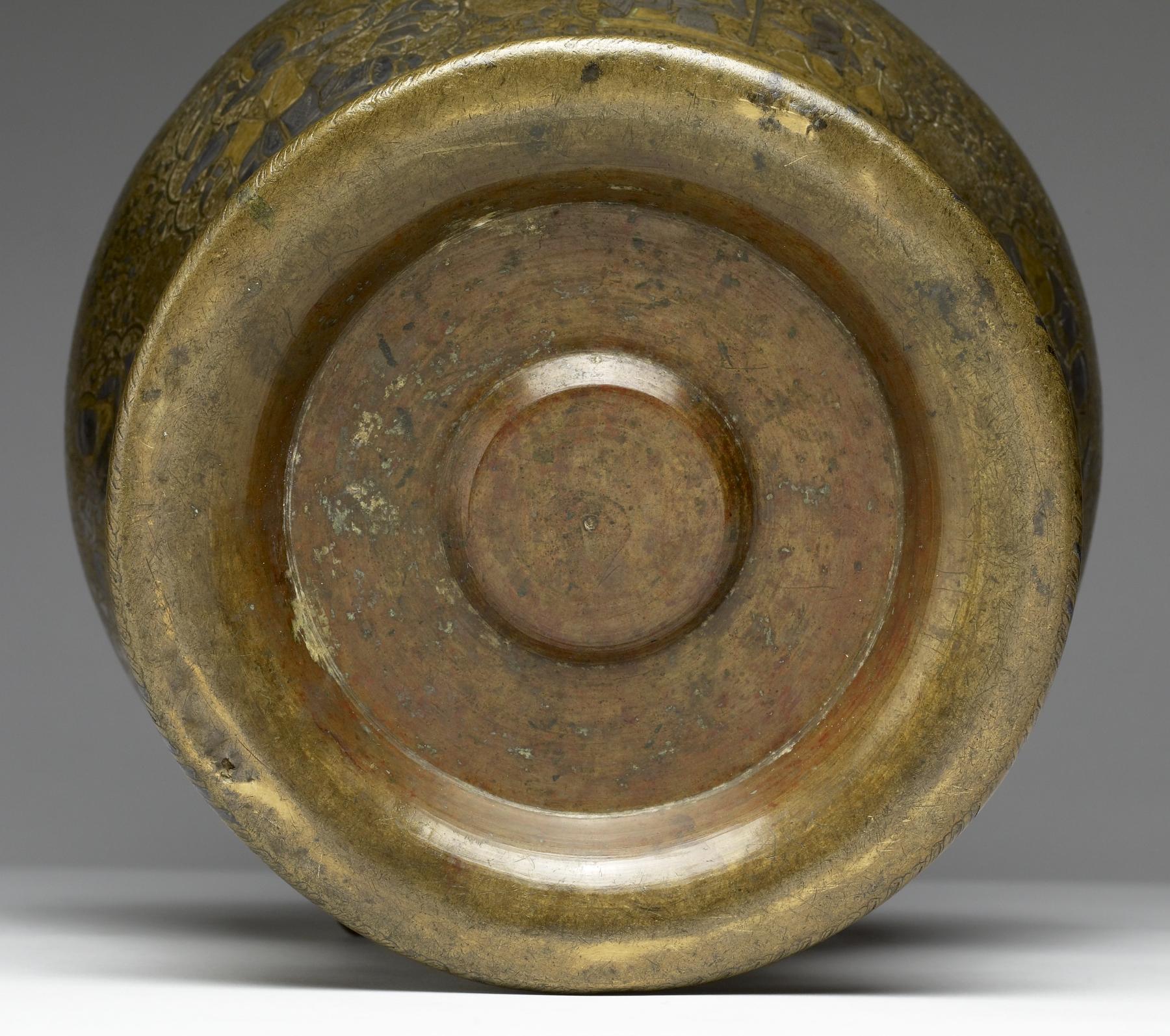
| Condition | Not established from the sources consulted for this record: whether the vessel retains its original handle, spout and foot, or has lost, gained or had restored any element, is unconfirmed and recorded as an open question rather than assumed. |
Images
The record in full
Chapter 1What it is
A tall brass ewer, 44.5 centimetres high, hammered and raised into a faceted body with a flaring neck, then chased and engraved and inlaid with cut silver and gold against a ground darkened with a...
A tall brass ewer, 44.5 centimetres high, hammered and raised into a faceted body with a flaring neck, then chased and engraved and inlaid with cut silver and gold against a ground darkened with a black organic resin so the metal inlay reads clearly against it. It is a water vessel built for a courtly household, not a devotional or funerary object, and its decoration is arranged in registers and medallions running around the neck and body in the standard format of Jaziran inlaid brass of its period.
What sets it apart from the great majority of objects in this class is a single detail cut into the metal at the base of the neck: a name, a trade description and a date. Most Islamic metalwork of this era carries no maker's name at all. This one does, and that is the reason it has a page in this archive rather than sitting anonymously among the hundreds of comparable undated brasses in museum storerooms.
Chapter 2How it was made
The body was raised from a single sheet of brass by hammering, then finished on a series of separate campaigns: chasing and engraving to cut the outlines of the inscription bands and figural...
The body was raised from a single sheet of brass by hammering, then finished on a series of separate campaigns: chasing and engraving to cut the outlines of the inscription bands and figural medallions, followed by the inlay itself, silver and gold sheet and wire cut to shape and hammered into undercut channels, and finally a black resinous compound rubbed into the engraved ground around the inlay to darken it and throw the metal into contrast. This is the standard construction sequence for inlaid Mosul-tradition brass of the twelfth and thirteenth centuries, not a technique unique to this piece.
The combination of silver and gold inlay on the same vessel is worth noting in passing, since a considerable amount of surviving Jaziran brass of this date uses silver alone; where a source can be checked for the specific metals used on a given object, gold tends to be reserved for smaller accents rather than whole fields, and that appears to be the case here as well, though this record has not been able to confirm from the sources consulted exactly which elements of the decoration carry gold as against silver.
Chapter 3The signature
The inscription names the maker as Yunus ibn Yusuf and gives him the professional title al-naqqash, meaning the engraver or the decorator, the craftsman responsible for cutting and inlaying the...
The inscription names the maker as Yunus ibn Yusuf and gives him the professional title al-naqqash, meaning the engraver or the decorator, the craftsman responsible for cutting and inlaying the ornament rather than necessarily the one who raised the brass body itself. He closes his name with the nisba al-Mawsili, of Mosul, tying his training or his working identity to that city, then the leading center of inlaid brass production in the Jazira.
Medieval Islamic artisans overwhelmingly worked anonymously. A signed, precisely dated object naming both a craftsman and his trade is therefore a documentary event in its own right, independent of the quality of the object it appears on, and it is the single fact this record can state about Yunus ibn Yusuf with total confidence.
Chapter 4The decoration program
The body carries a sequence of scalloped medallions set against a fretwork or vegetal ground, enclosing figural scenes: hunters mounted on horseback, musicians seated beneath a tree, and an enthroned...
The body carries a sequence of scalloped medallions set against a fretwork or vegetal ground, enclosing figural scenes: hunters mounted on horseback, musicians seated beneath a tree, and an enthroned ruler attended by figures around him. This is the standard courtly repertoire of thirteenth-century Jaziran inlaid metalwork, sometimes described in the wider literature on Ayyubid and Zangid luxury objects as a cycle of princely pleasures, hunting, music and audience together standing for the ordinary business of rulership rather than illustrating any specific narrative or text. That general framing is well established for this class of object; this record has not located a source that reads the specific medallions on this ewer as anything beyond that conventional courtly vocabulary, and no source consulted proposes a narrative subject, a named ruler portrait, or a text the imagery illustrates.
Running with the figural bands is the benedictory inscription addressed to an unnamed sultan. Dedicatory formulas of this kind were a standard feature of luxury metalwork made for or offered to a court, functioning as a generalized wish for the dominion, glory and long life of whoever received the object, whether or not that person is named elsewhere on the piece. Here, no personal name for the honorand survives in the material available to this record, which is recorded as an open question rather than filled with a guess.
Chapter 5The Mosul school, and what is actually settled about it
Modern scholarship groups a body of signed and dated inlaid brass from this period under the label Mosul school, after the city named in enough of the surviving signatures to make the association...
Modern scholarship groups a body of signed and dated inlaid brass from this period under the label Mosul school, after the city named in enough of the surviving signatures to make the association plausible. The evidentiary base is a set of signed objects spanning roughly the 1220s to the 1280s, several dated and several naming Mosul or the nisba al-Mawsili explicitly. A widely cited count places the number at 27 of 35 signed pieces of this broader corpus carrying the nisba al-Mawsili, with 8 of those 27 giving some further identifying detail beyond the toponymic alone.
What is not settled, and is a live methodological argument rather than a footnote, is whether that shared nisba is evidence of one continuous workshop tradition, in the sense of masters training pupils within a persisting Mosul-based lineage, or whether it instead records a wider and looser phenomenon: individually trained craftsmen who had passed through Mosul at some point, or simply advertised the city's reputation, and who otherwise worked independently, in different cities and different decades, for different patrons. Julian Raby's 2012 essay 'The Principle of Parsimony and the Problem of the Mosul School of Metalwork' takes up exactly this question, re-examining the corpus of signed pieces rather than accepting the school as a single settled unit; this record was able to confirm the essay's existence, title, venue and its general argument through reviews and library records, but was not able to read its full text directly, and its detailed reasoning is flagged here for verification against the original rather than restated as read. What can be said without that caveat is that the underlying uncertainty is real: a shared professional name proves shared origin or training far more securely than it proves a single ongoing workshop.
The historical context that makes this argument matter is the Mongol capture of Baghdad in 1258 and the subsequent pressure on Mosul itself, which scattered Jaziran-trained metalworkers into Syria and Egypt over the following decades, carrying the inlay technique and, in some cases, the nisba al-Mawsili with them long after they had left the city. Yunus ibn Yusuf's ewer, dated 1246-47, was made before that dispersal, in what turned out to be the last full generation of Jaziran production before the disruption. Whether he himself worked in Mosul, or elsewhere in the Jazira while still carrying the nisba, is not established by the object alone.
Chapter 6Distinguishing this ewer from the Blacas Ewer and the Bobrinski Bucket
This corpus already holds two other named, dated pieces of medieval inlaid metalwork, and neither should be confused with this one or with each other.
This corpus already holds two other named, dated pieces of medieval inlaid metalwork, and neither should be confused with this one or with each other. The Blacas Ewer, now in the British Museum, is signed by Shuja ibn Man'a al-Mawsili and dated Rajab 629 AH, April or May 1232, fourteen years before this ewer and, so far as the object's own inscription goes, also made at Mosul. It is a different physical object in a different collection, and no source consulted for this record documents any personal or workshop connection between Shuja ibn Man'a and Yunus ibn Yusuf beyond the shared nisba al-Mawsili itself.
The Bobrinski Bucket, in the State Hermitage Museum, belongs to an entirely separate tradition and is not connected to either Mosul ewer by any named maker. Its own inscription dates it to Muharram 559 AH, December 1163, eighty-three years before this ewer, and names two different craftsmen: Muhammad ibn Abd al-Wahid, who cast it, and Mas'ud ibn Ahmad, who executed its silver and copper inlay. It was made in Herat, in present-day Afghanistan, some two thousand kilometres east of Mosul, and belongs to the Khurasan school of inlaid metalwork, a separately argued regional tradition; neither of its named craftsmen carries the nisba al-Mawsili, and nothing connects them to Yunus ibn Yusuf, to Shuja ibn Man'a, or to Mosul at all.
What links this ewer to the Blacas Ewer, and to a wider group of roughly two dozen other signed pieces, is the shared toponymic nisba al-Mawsili and, more loosely, a shared decorative vocabulary and construction technique current across the Jazira in this period. That is a real and citable connection. It is not the same claim as a documented master-apprentice relationship or a single continuous workshop, and this record does not make that stronger claim for Yunus ibn Yusuf, because no source consulted supports it.
Chapter 7Ownership across seven centuries: the long gap
Between the ewer's manufacture in 1246-47 and its documented appearance in the international art trade by the early twentieth century, no owner, location or transaction is recorded in any source...
Between the ewer's manufacture in 1246-47 and its documented appearance in the international art trade by the early twentieth century, no owner, location or transaction is recorded in any source consulted for this record. That is a gap of roughly six and a half centuries, and it is recorded here as a gap rather than bridged with a plausible-sounding guess about an Ottoman treasury, a Mamluk collection, or a private household, none of which this record can support with a source.
Chapter 8The ex-Grand Vizier and the Istanbul art market
The first point at which this ewer's ownership becomes documented, even partially, is through the dealer Dikran Kelekian's own account.
The first point at which this ewer's ownership becomes documented, even partially, is through the dealer Dikran Kelekian's own account. Writing to Henry Walters around 1917 to encourage the purchase, Kelekian stated that he had bought the piece in Istanbul from a former Ottoman Grand Vizier, whom he described as having owned nearly all of a group of inlaid bronzes also acquired at various points by a Baron and by the American collector and Tiffany & Co. designer Edward C. Moore. This record was able to locate this account only through a secondary academic source quoting Kelekian's correspondence, itself accessed through search-indexed text rather than a directly readable full copy, and the transcription available to this record is imperfect: the Baron's name renders inconsistently across the copies located, and should be checked against the original letter, which is understood to be held among the Walters Art Museum's own curatorial or archival files.
One Ottoman statesman fits the description of a former Grand Vizier active in the relevant period: Gazi Ahmed Muhtar Pasha, who held the office of Grand Vizier in 1912. This record has not been able to confirm that he is the individual Kelekian meant, and treats the identification as a plausible but unverified inference rather than a documented fact.
Chapter 9Kelekian, Walters, and the art market of the 1910s
Dikran Garabed Kelekian, an Armenian dealer born in 1868, established an antiquities business in Istanbul with his brother Kevork around 1892 and went on to open galleries in New York, Paris, London...
Dikran Garabed Kelekian, an Armenian dealer born in 1868, established an antiquities business in Istanbul with his brother Kevork around 1892 and went on to open galleries in New York, Paris, London and Cairo, dealing across Coptic, Islamic and classical material. He is documented as having played a substantial role in forming Henry Walters' Coptic, Early Christian and classical holdings, in addition to this piece, and served a client list that also included George Blumenthal of the Metropolitan Museum. He died in New York in January 1951.
Henry Walters bought the ewer from Kelekian in 1917 for his private Baltimore collection, one of a great many Islamic and late-antique metal vessels he acquired through Kelekian and other dealers across roughly three decades of collecting.
Chapter 10Entering the museum: 1917 to 1931
Henry Walters died on 30 November 1931, leaving his entire collection, roughly twenty-two to twenty-four thousand objects depending on the count used, together with the gallery building and an...
Henry Walters died on 30 November 1931, leaving his entire collection, roughly twenty-two to twenty-four thousand objects depending on the count used, together with the gallery building and an endowment, to the Mayor and City Council of Baltimore for the benefit of the public. The Walters Art Gallery, later the Walters Art Museum, opened to the public as an institution in November 1934, after the Maryland General Assembly incorporated its Trustees in 1933.
The Walters accession number carried by this object, 54.456, is not a year and should not be read as one. The museum's own online catalogue lists other ewers acquired by Henry Walters in different years, including one purchased in 1913 and one in 1929, that carry the same 54-prefixed classification series; the prefix identifies a type or department grouping internal to the Walters' own numbering system, not the year of acquisition. This record notes the correction because the resemblance between '54.456' and a mid-twentieth-century date is an easy and understandable misreading.
Chapter 11What is unresolved, and what is not
No source consulted for this record documents a theft, a wartime loss, an export dispute, or a restitution claim involving this ewer.
No source consulted for this record documents a theft, a wartime loss, an export dispute, or a restitution claim involving this ewer. It left Ottoman territory through an ordinary private sale between a dealer and a private American collector in 1917, decades before the 1970 UNESCO Convention on the means of prohibiting illicit transfer of cultural property, and before the modern state of Iraq, formed from former Ottoman provinces including Mosul in 1921, had any export-control regime of its own to be triggered. That absence of any recorded legal complication is itself a finding, not an oversight in this record's research.
What remains genuinely open is narrower and is recorded in full in the questions below: the identity of the sultan addressed in the benedictory inscription, the ewer's whereabouts for six and a half centuries, the precise identity of the ex-Grand Vizier who sold it into the trade, whether the vessel is complete or has lost or gained elements over time, and where Yunus ibn Yusuf himself sits, or does not sit, in relation to the other named al-Mawsili craftsmen.
The artist
Yunus ibn Yusuf, called al-naqqash al-Mawsili
Yunus ibn Yusuf exists in the historical record as a single signature on a single object. No other work has been located bearing his name, no biographical notice mentions him, and nothing is known of his birth, death, training or later career beyond what he wrote about himself in brass. That is the correct frame for reading every claim in this dossier: an attribution to Yunus ibn Yusuf is an attribution to a name on one dated ewer, not to a documented career.
Related works
| Work | Relation | Where it is |
|---|---|---|
| The Blacas Ewer Shuja ibn Man'a al-Mawsili | Another individually signed and dated al-Mawsili object, made at Mosul fourteen years earlier (Rajab 629 AH / 1232); shares only the nisba al-Mawsili with this ewer, with no documented personal or workshop link between the two makers. A different physical object, a different collection, and a different signature; not to be confused with the Walters ewer. | British Museum, London |
| The Bobrinski Bucket Muhammad ibn Abd al-Wahid (caster) and Mas'ud ibn Ahmad (inlayer) | A separately attested tradition, not a comparandum for the al-Mawsili group: made at Herat in 1163, eighty-three years earlier and roughly 2,000 km east, in the unrelated Khurasan school. Neither named maker carries the nisba al-Mawsili. Included here only to state plainly that it is not connected to this ewer, to the Blacas Ewer, or to Yunus ibn Yusuf by any documented maker, workshop or region. | State Hermitage Museum, St Petersburg |
| Ewer and basin group of Ahmad al-Dhaki al-Mawsili Ahmad al-Dhaki al-Mawsili, with his named assistant Abu Bakr Umar ibn Hajji Jaldak | The best-documented al-Mawsili atelier of the period, spanning roughly 1223 to 1242-43, with a named workshop assistant on record. Offered as the clearest comparandum for what an attested workshop looked like in this tradition, against which Yunus ibn Yusuf's single, workshop-less signature stands out. No source consulted connects this workshop to Yunus ibn Yusuf beyond the shared nisba and period. | Cleveland Museum of Art (1223 ewer); Musee du Louvre (1238-40 basin) |
| Pen box of Ali ibn Yahya al-Mawsili Ali ibn Yahya al-Mawsili | Dated 1255-56 and, on its surfacing in the scholarly record, the second object after the Blacas Ewer to carry an inscription explicitly naming Mosul as the place of manufacture, ending the Blacas Ewer's decades-long uniqueness in that respect. Part of the same named al-Mawsili cluster as Yunus ibn Yusuf. Nine years after this ewer; cited here for the corpus count, not as a stylistic twin. | Victoria and Albert Museum, London |
Open questions
- Who was the sultan addressed in the benedictory inscription? No personal name for the honorand was located in the sources consulted for this record.
- Where was the ewer between its manufacture in 1246-47 and its documented appearance in the Istanbul art market by 1917? No owner is recorded for roughly six and a half centuries.
- Who exactly was the 'ex-Grand Vizier' Kelekian says he bought the piece from in Istanbul, and is he the same Gazi Ahmed Muhtar Pasha who held that office in 1912? This record treats the identification as plausible but unconfirmed.
- Is the ewer complete? Whether it retains its original handle, spout and foot, or has lost, gained or had any element restored, is not established in the sources this record could access.
- Does Yunus ibn Yusuf have any documented relationship, master-apprentice or otherwise, to any other named al-Mawsili craftsman, including Shuja ibn Man'a or Ahmad al-Dhaki al-Mawsili? The scholarship treats this as a genuinely open question about the al-Mawsili group as a whole, not one specific to this object.
- What is the complete text and a full published translation of the benedictory inscription? Only a partial phrase was located in the sources consulted.
Questions about this object
What is Ewer signed by Yunus ibn Yusuf al-Mawsili?
Ewer signed by Yunus ibn Yusuf al-Mawsili is an islamic metalwork, dated 644 AH / 1246-47 CE. Medium: Brass, hammered and raised, chased and engraved, inlaid with silver and gold, with a black organic resin compound worked into the engraved ground.
Who made Ewer signed by Yunus ibn Yusuf al-Mawsili, and is the attribution settled?
The attribution to Yunus ibn Yusuf, called al-naqqash al-Mawsili is recorded here as accepted. Signed and dated by the maker himself in an inscription band around the base of the ewer's neck: Yunus ibn Yusuf al-naqqash al-Mawsili, dated 644 AH. This is a first-person signature on the object, not a connoisseurship attribution, and it is the only evidence that Yunus ibn Yusuf ever existed.
Where is Ewer signed by Yunus ibn Yusuf al-Mawsili now?
The Walters Art Museum, Baltimore. Inventory number 54.456. Last confirmed 27 August 2026. Purchased by Henry Walters from the dealer Dikran Kelekian in 1917; entered the Walters Art Museum by Henry Walters' 1931 bequest of his entire collection to the City of Baltimore, formalized when the museum opened to the public in 1934.
What is still unknown about Ewer signed by Yunus ibn Yusuf al-Mawsili?
Who was the sultan addressed in the benedictory inscription? No personal name for the honorand was located in the sources consulted for this record.
Sources
- 1The Walters Art Museum, online collection catalogue, 'Ewer, 644 AH/AD 1246-1247. Acquired by Henry Walters, 1917, 54.456.' Primary museum catalogue entry; accessed via indexed search text after the live page returned an access error to direct fetch, and cross-checked across multiple independent queries. Flagged for direct re-verification against the live page. art.thewalters.org/object/...
- 2Artsy, 'Yunus ibn Yusuf, "al-naqqash al-Mawsili" | Ewer (1246-1247)'. artsy.net/artwork/...
- 3Google Arts & Culture, 'Ewer', asset page for the Walters ewer of Yunus ibn Yusuf al-naqqash al-Mawsili. artsandculture.google.com/asset/...
- 4Wikimedia Commons, Category:Mosul ewer, dated 1246-47, The Walters Art Museum 54.456. File listing retrieved directly via the MediaWiki API. commons.wikimedia.org/wiki/...
- 5Wikimedia Commons, MediaWiki API imageinfo/ for individual files in the above category, used to verify LicenseShortName, Credit and Artist fields for each image before selection. commons.wikimedia.org/w/...
- 6Wikipedia, 'History of metallurgy in Mosul', for the count of signed pieces carrying the nisba al-Mawsili and the listing of named makers including Yunus ibn Yusuf. en.wikipedia.org/wiki/...
- 7Wikipedia, 'Ahmad al-Dhaki al-Mawsili', for the workshop, named assistant, dated works and the Rice/Raby disagreement over his working location. en.wikipedia.org/wiki/...
- 8Wikipedia, 'Blacas ewer', for the maker, date, and the 'until 1997' uniqueness of its explicit Mosul inscription. en.wikipedia.org/wiki/...
- 9Wikipedia, 'Bobrinski Bucket', for the maker's names (Muhammad ibn Abd al-Wahid and Mas'ud ibn Ahmad), date and place of manufacture (Herat, 1163), used to correct an initial misattribution of this object to Shuja ibn Man'a. en.wikipedia.org/wiki/...
- 10University of Victoria, 'Crafts of Iraq' project, 'Mosul: Inlayers of Metalwork', for the named list of al-Mawsili craftsmen including Yunus b. Yusuf. craftsofiraq.uvic.ca/mosul-inlayers-of-metalwork
- 11University of Victoria, 'Crafts of Iraq' project, 'Mosul: Metalworkers'. craftsofiraq.uvic.ca/mosul-metalworkers
- 12Julian Raby, 'The Principle of Parsimony and the Problem of the Mosul School of Metalwork', in Metalwork and Material Culture in the Islamic World (I.B. Tauris, 2012). Existence, title, venue and general argument confirmed via the Smithsonian repository record and a published review; full text not read directly for this record and flagged for verification. repository.si.edu/handle/...
- 13Wikipedia, 'Dikran Kelekian', for the dealer's biography and career. en.wikipedia.org/wiki/...
- 14Dumbarton Oaks, Bliss-Tyler Correspondence annotations, 'Dikran Garabed Kelekian (1868-1951)', for his documented role forming part of Henry Walters' collection. doaks.org/resources/...
- 15Academic paper referencing archival Kelekian-Walters correspondence of 1917 concerning this ewer's purchase from an ex-Grand Vizier in Istanbul, cited among comparanda in scholarship on the early 20th-century Islamic art market. Accessed only through search-indexed excerpts with apparent OCR inconsistencies in proper names; full text not read directly and the quotation should be checked against the original letter or the paper's published text before further use. academia.edu/53791867/...
- 16Wikipedia, 'Henry Walters', for his death on 30 November 1931 and the bequest of his collection to the City of Baltimore. en.wikipedia.org/wiki/...
- 17Wikipedia, 'Ahmed Muhtar Pasha', consulted to assess whether Gazi Ahmed Muhtar Pasha, Ottoman Grand Vizier in 1912, could be the 'ex-Grand Vizier' named in Kelekian's account. The identification remains unconfirmed. en.wikipedia.org/wiki/...
- 18Eva Baer, Metalwork in Medieval Islamic Art (State University of New York Press, 1983), cited for the general framework of courtly figural iconography (hunting, music, enthronement) in Jaziran and Ayyubid inlaid metalwork. Bibliographic listing consulted; the monograph itself was not read in full for this record and no claim specific to this object is drawn from it. archive.org/details/...
Last verified · Published
Change log
27 August 2026 - Record created at the house standard: researched narrative, technical evidence, maker dossier, graded provenance chain, prices with hammer and premium separated, related works, open questions and sources.