The Amphilochios Paten
Unrecorded Byzantine silversmith(s), Kaper Koraon group · Third quarter of the 6th century (Walters Art Museum dating)
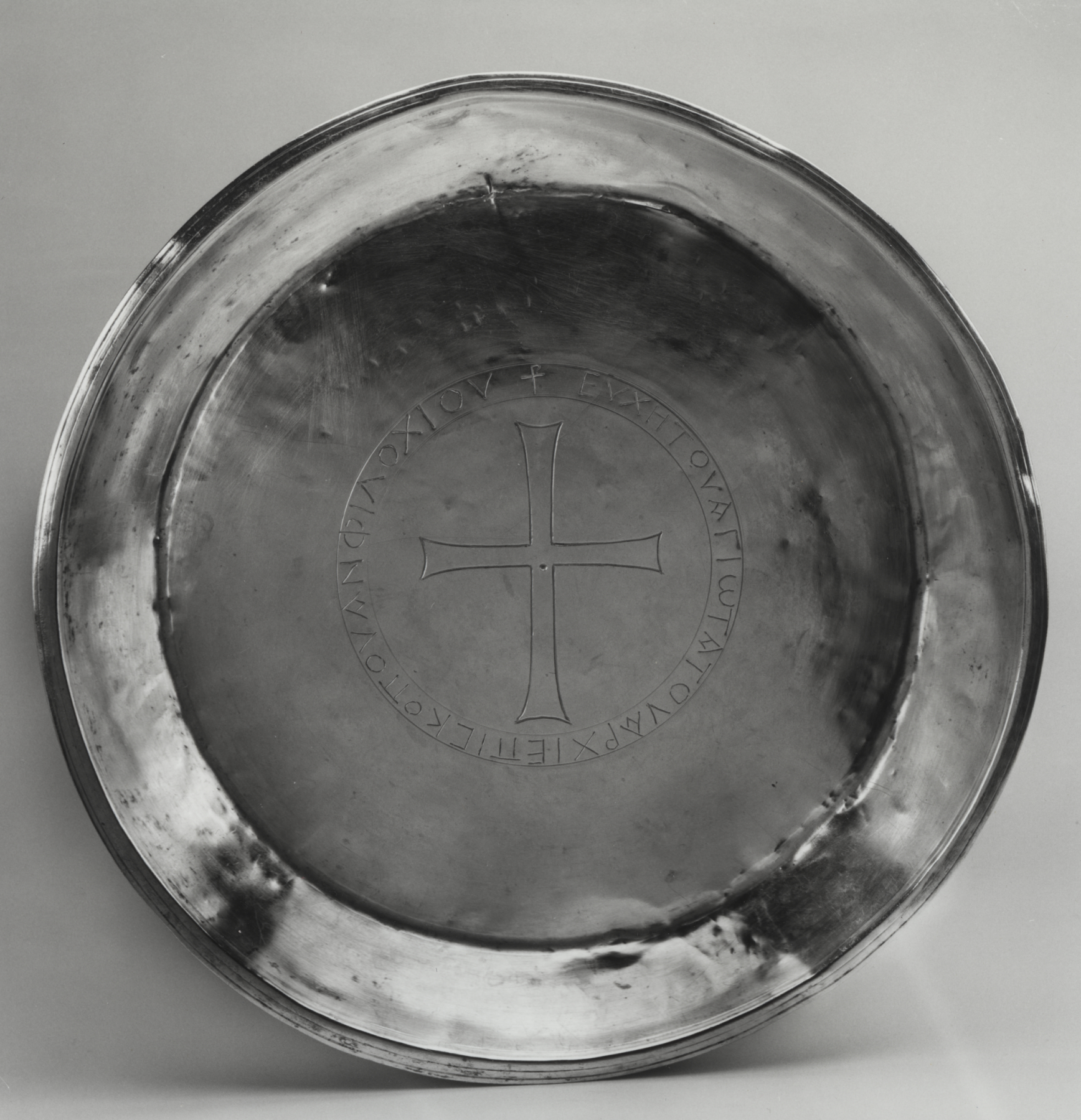
The record subject. Silver, 4 x 41.4 cm, third quarter of the 6th century. Accession 57.643, the Walters Art Museum. Inscribed for the vow of Archbishop Amphilochios.
| Artist | Unrecorded Byzantine silversmith(s), Kaper Koraon group |
|---|---|
| Date | Third quarter of the 6th century (Walters Art Museum dating) |
| Medium | Silver |
| Dimensions | 4 x 41.4 cm (1.5 x 16.2 in), height x diameter |
| Where it is now | The Walters Art Museum, Baltimore, Marylandlast confirmed |
| Inventory number | 57.643 |
| Attribution | UnknownNo maker, workshop or mint is named on the paten. Full note |
| Object type | Silver |
| Period | Early Byzantine, sixth century |
| Cases | Seized, looted or confiscated · Has a provenance gap |
| Inscriptions | Greek, around the rim: '+ Vow of the most saintly archbishop AMPHILOCHIOS' (translation as published by the Walters Art Museum). The technique used to execute the inscription on this specific piece (engraving, niello inlay, or stamping) is not stated in the sources consulted for this record. |
| Owners on record | 6 links5 documented, 1 unknown |
| Sources | 17 cited |
About this record Last verified · 17 sources cited · Change log
On this page 9 sections
ContentsClose
A large, plain silver paten made in Syria in the third quarter of the sixth century to hold the Eucharistic bread, inscribed with the vow of an otherwise little-known archbishop named Amphilochios. It is one of twenty-three pieces of church silver that reached the Walters Art Museum together in 1929, part of a hoard clandestinely dug up around 1908-1910 near the village of Kurin and sold through at least two dealers before Henry Walters bought it.
For decades the group was catalogued under the vague label 'Hama Treasure', after the Syrian city where it surfaced on the market. Marlia Mundell Mango's 1986 catalogue argued, from an inscription naming the place on a companion chalice, that the vessels in fact belonged to the church of Saint Sergios in ancient Kaper Koraon, the Greek name for Kurin. That reattribution reframed a scattered group of art-market silver as the identifiable furnishings of one rural Syrian church, pieces of which are now held, and separately catalogued, by more than one museum.
This record treats the paten on its own evidence: a documented but undocumented-in-detail clandestine find, a firmly documented market and bequest history from 1913 onward, and an honestly incomplete picture of exactly how many vessels belonged to the original hoard and where all of them now are.
Provenance
Each link is graded. Documented: a cited source supports it. Disputed: the identification is argued but not established. Unknown: no owner for that span, and the gap is not smoothed into a narrative. The grades in the glossary.
- - c. 1908-1910Unrecordeddocumented
The fact and approximate date range of a clandestine excavation are documented across the sources consulted, which agree the material was 'photographed in Hama' within this window. No excavator is named, no excavation report survives, and no controlled archaeological record exists for the find in the sources consulted.6
- c. 1908-1910 - c. 1913Unknown intermediariesunknown
How the silver passed from the ground, or from its first finder(s), into the hands of the dealer Tawfic Abucasem is not documented in any source consulted for this record.1
- c. 1913 - c. 1928Tawfic Abucasem, of Hama and Port Saiddocumented
Named in the Walters Art Museum's own published provenance note for this accession group as the dealer who held the material from around 1913.12345
- c. 1928 - 1928 or 1929Joseph Brummer, Parisdocumented
The Walters Art Museum's own provenance note dates Brummer's acquisition to circa 1928 and his sale to Henry Walters to 1929. Dumbarton Oaks' annotation of the same material instead states Brummer acquired the treasure by 1928 and sold it to Walters 'that same year'. The two institutional accounts disagree by about a year; this record states the discrepancy rather than resolving it silently.123456
- 1928 or 1929 - 1931Henry Walters, Baltimoredocumented
Held in Henry Walters's personal collection in Baltimore until his death on 30 November 1931.17
- 1931 - presentThe Walters Art Museum (formerly the Walters Art Gallery), Baltimoredocumented
Passed to the City of Baltimore by the terms of Henry Walters's will. The institution opened to the public as a municipal museum on 3 November 1934.17
Technical evidence
| Attribution note | No maker, workshop or mint is named on the paten. The object carries no signature, and the Walters Art Museum's own public record names no silversmith. What is established is the donor (the inscription names Archbishop Amphilochios), the approximate date (third quarter of the sixth century, on stylistic and comparative grounds), and the findspot region (near the village of Kurin, ancient Kaper Koraon, in Syria). Several related vessels in the same group carry Byzantine control stamps, a state hallmarking system that can date silver independently of style; this record has not found a published statement of whether this particular paten carries such stamps. |
|---|---|
| Medium | Silver.1 |
| Dimensions | 4 x 41.4 cm (1.5 x 16.2 in), height x diameter.1 |
| Inscription | Greek, around the rim: '+ Vow of the most saintly archbishop AMPHILOCHIOS' (Walters Art Museum translation). Execution technique (engraving, niello, or stamping) not stated in the sources consulted.1 |
| Date | Third quarter of the 6th century, on stylistic and comparative grounds; the Walters gives no independent scientific dating for this piece.1 |
| Findspot | Reportedly excavated near the village of Kurin (ancient Kaper Koraon), Syria, circa 1908-1910, as part of a group of 23 silver vessels that reached the Walters together.12346 |
| Control stamps | Not recorded for this piece in the sources consulted. Several related vessels in the same accession group carry Byzantine state control stamps (for example, five stamps inside the foot of chalice 57.642, independently dated 602-610), which can date silver more precisely than style alone; whether this paten carries any is an open question, not assumed either way.2 |
| Photographic rights | The object itself is in the public domain by reason of age. The Wikimedia Commons photograph of it is licensed Creative Commons Attribution-ShareAlike 3.0 Unported and GNU Free Documentation License v1.2+, credited to the Walters Art Museum, consistent with the museum's published open-access rights and reproductions policy.116 |
Images
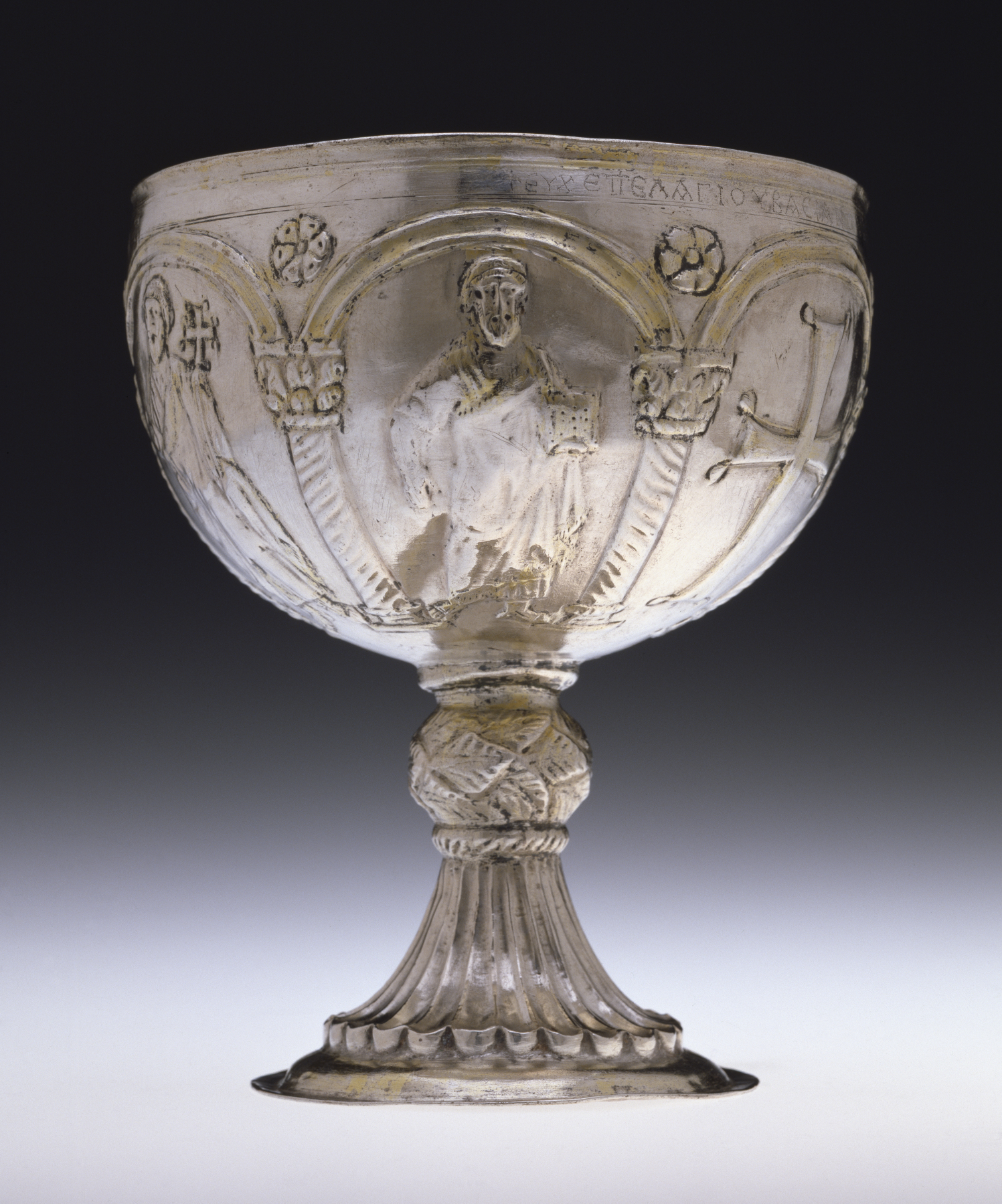
The record in full
Chapter 1What it is
The paten is a shallow silver dish 41.4 centimetres across and only 4 centimetres deep, large enough to have held a substantial quantity of Eucharistic bread for distribution during the Divine...
The paten is a shallow silver dish 41.4 centimetres across and only 4 centimetres deep, large enough to have held a substantial quantity of Eucharistic bread for distribution during the Divine Liturgy. Patens of this kind functioned as the plate on which the consecrated bread, understood in Christian doctrine as the body of Christ, was placed and presented to the congregation. Its size puts it among the largest surviving patens from the group of vessels associated with this find, and the Walters describes it as one of the heaviest, though no weight in grams or troy ounces is published in the sources consulted for this record.
Around the rim runs a Greek inscription giving the vow of the donor. Unlike some of the more elaborately decorated vessels associated with the same group, the museum's own description calls this paten one of the visually simpler pieces despite the donor's high ecclesiastical rank, a point the Walters itself draws out as noteworthy.
Chapter 2The donor's vow
The inscription reads, in the Walters' published translation: '+ Vow of the most saintly archbishop AMPHILOCHIOS.' No further biographical information about this Amphilochios is given in the sources...
The inscription reads, in the Walters' published translation: '+ Vow of the most saintly archbishop AMPHILOCHIOS.' No further biographical information about this Amphilochios is given in the sources consulted; he is identified only by the title he holds in his own dedication.
The word 'vow' is doing real work here. Votive giving, in which a donor pledges an object or its value to a church in fulfillment of a promise made to God, is a documented and ordinary feature of Late Antique Christian practice, and it recurs across the related vessels in this group. A companion chalice in the same Walters accession run, 57.642, is inscribed for 'the prayer and salvation of' three named individuals; another, 57.636, records a 'prayer' of two more donors. Read together, the inscriptions describe a community of individual donors, lay and clerical, giving silver plate to a single rural church in expectation of divine favor or in thanks for it. That this paten was a fulfilled vow, rather than a purchase or a gift with no stated religious motive, is a documented fact about what its donor believed and did, not an inference.
Chapter 3How Byzantine silver like this is dated
The Walters dates the paten to the third quarter of the sixth century primarily on stylistic and comparative grounds.
The Walters dates the paten to the third quarter of the sixth century primarily on stylistic and comparative grounds. A separate and more precise dating tool exists for Byzantine silver of this period: a system of five small stamps, applied by state control offices, that can be read against a reference sequence tied to specific emperors' reigns. The standard reference for this system is Erica Cruikshank Dodd's 'Byzantine Silver Stamps', published by Dumbarton Oaks in 1961; this record has not consulted Dodd's volume directly, and the claim is included here as background on method, not as a specific finding about this paten.
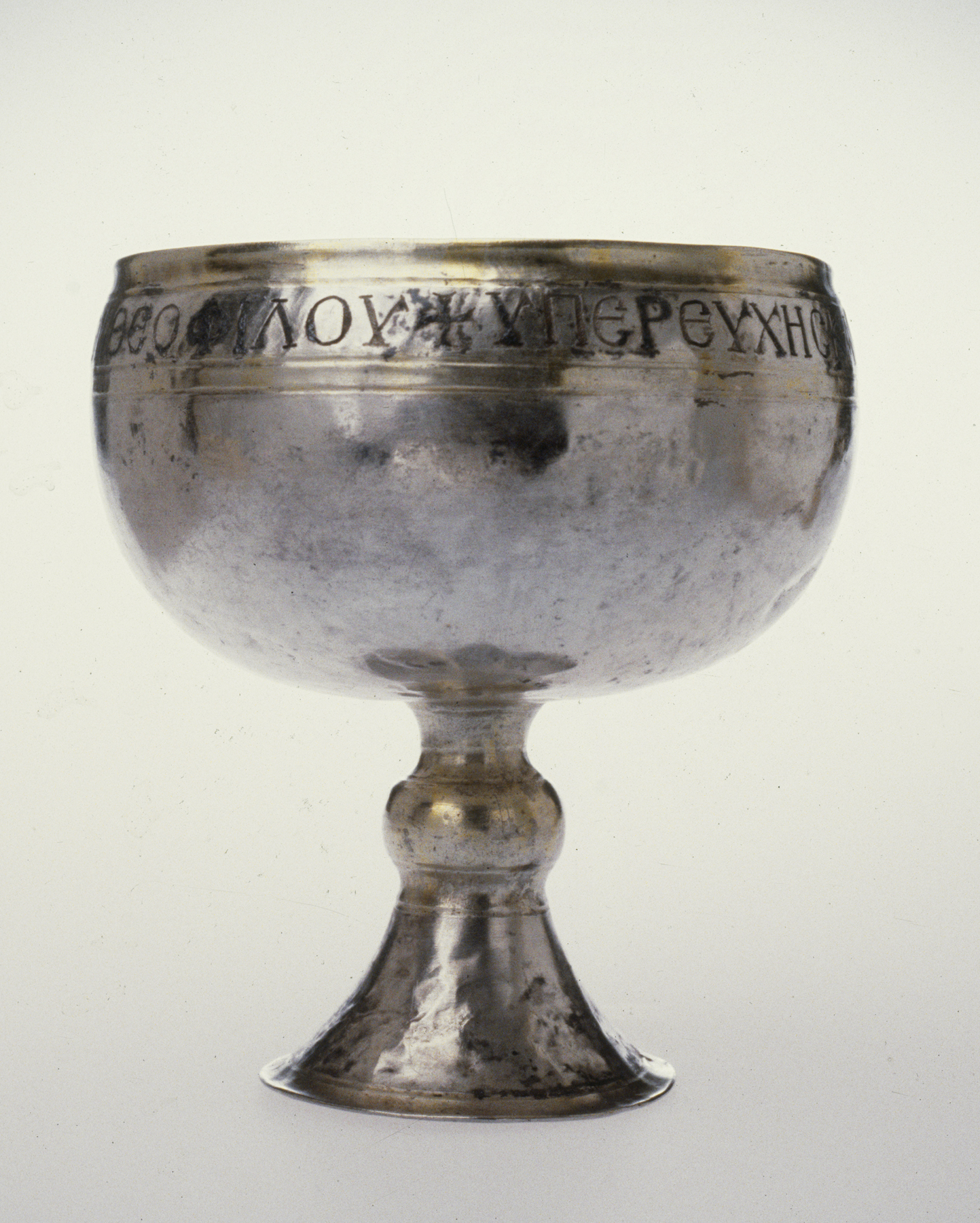
Several vessels associated with this group do carry such stamps: the Walters records five stamps inside the foot of chalice 57.642, for example, which is independently dated 602-610, a full generation later than this paten's stylistic date. That range, from the third quarter of the sixth century to the first decade of the seventh, indicates the church that owned this silver added to its plate over an extended period rather than receiving it all at once. Whether this specific paten carries control stamps of its own is not stated in the Walters record consulted for this entry, and is recorded here as an open question rather than assumed either way.
Chapter 4The excavation near Kurin
What is actually documented about the find is limited, and this record states that plainly rather than smoothing over it.
What is actually documented about the find is limited, and this record states that plainly rather than smoothing over it. Dumbarton Oaks' own annotation of the material describes the vessels as having been 'excavated in Syria sometime between 1908 and 1910 (when it was photographed in Hama)'. No excavation report, no named excavator, and no controlled archaeological record of the find survives in the sources consulted. The find is understood, as with a great deal of clandestinely dug material from this period and region, through the point at which it resurfaces in dealers' hands rather than through any record of the digging itself.
By around 1913 the material was in the possession of Tawfic Abucasem, a figure identified in the Walters' own provenance note as based in Hama and Port Said. How the silver passed from the ground, or from whoever first found it, into Abucasem's hands between about 1910 and 1913 is not documented in any source consulted for this record.
Chapter 5Through the market: Abucasem to Brummer to Walters
From Abucasem the silver passed to Joseph Brummer, the Hungarian-born dealer whose Paris and then New York galleries supplied major American collections, including those of Henry Walters, William...
From Abucasem the silver passed to Joseph Brummer, the Hungarian-born dealer whose Paris and then New York galleries supplied major American collections, including those of Henry Walters, William Randolph Hearst, and the Metropolitan Museum. The Walters' own provenance note for this paten and its companion pieces gives the date of Brummer's acquisition as circa 1928, in Paris, and Henry Walters's purchase as 1929, in Baltimore. Dumbarton Oaks' annotation of the same material states instead that Brummer acquired the treasure by 1928 and 'sold it to Henry Walters that same year.' The two accounts of the Walters purchase disagree by roughly a year; this record has not been able to resolve the discrepancy and states it rather than picking one date silently.
No purchase price for any leg of this chain, Abucasem to Brummer or Brummer to Walters, is published in the sources consulted.
Chapter 6Henry Walters and the bequest
Henry Walters (1848-1931) inherited both a fortune and an art collection from his father, William T.
Henry Walters (1848-1931) inherited both a fortune and an art collection from his father, William T. Walters, on the latter's death in 1894. Henry had trained at Georgetown and at Harvard's Lawrence Scientific School before moving into railroad management, eventually becoming president of the Atlantic Coast Line Railroad after his father's death. He used the resulting wealth to expand the family collection enormously, buying in bulk from dealers across Europe and, by the account given by Dumbarton Oaks, once purchasing the contents of an entire Roman palace comprising over 1,700 objects.
He built a purpose-made palazzo-style museum building adjoining his father's Baltimore property, which opened to the public in 1909, and by his death in 1931 his personal holdings had grown to some 22,000 objects, this paten and its companion vessels among the more recent acquisitions of his final years. His will left the building, its contents and an endowment to the City of Baltimore. The institution opened to the public as a municipal museum on 3 November 1934, three years after his death; the Kaper Koraon vessels entered the collection with that 1931-34 transition, not at the moment of Walters's 1929 purchase.
Chapter 7Joseph Brummer, the dealer
Joseph Brummer (1883-1947) was born in what was then Hungary (Sombor, now in Serbia), studied sculpture in Paris under Rodin, and with his two brothers opened the Brummer Gallery there in 1906...
Joseph Brummer (1883-1947) was born in what was then Hungary (Sombor, now in Serbia), studied sculpture in Paris under Rodin, and with his two brothers opened the Brummer Gallery there in 1906, dealing in Romanesque, Gothic and Renaissance material alongside Egyptian, Greek, Roman and pre-Columbian antiquities. The brothers closed the Paris gallery at the outbreak of the First World War and relocated to New York; Joseph reopened independently in Manhattan in 1921. He is described in the secondary literature as a central figure in supplying early-twentieth-century American museum collections, moving in the same period between ancient and medieval material and the contemporary work of Picasso and Rousseau. His firm's sale of this Syrian silver to Henry Walters sits within that broader pattern of interwar dealer-to-museum transactions, though the specific correspondence or invoice for this transaction, if it survives, was not located for this record.
Chapter 8From 'Hama Treasure' to Kaper Koraon: Mango's reattribution
For most of the twentieth century the group was known in the literature by the name of the market city where it surfaced, the 'Hama Treasure', or, for some related pieces, by an even vaguer 'Antioch...
For most of the twentieth century the group was known in the literature by the name of the market city where it surfaced, the 'Hama Treasure', or, for some related pieces, by an even vaguer 'Antioch region' attribution. Marlia Mundell Mango's 1986 exhibition catalogue, 'Silver from Early Byzantium: The Kaper Koraon and Related Treasures', published by the Walters Art Gallery to accompany an exhibition timed to the 17th International Byzantine Congress at Dumbarton Oaks, argued for a more specific identification: that the church which owned this silver was dedicated to Saint Sergios in the village of Kaper Koraon, the Greek form of the name of the present-day Syrian village of Kurin, and that this, not the market city of Hama, was the plate's original home.
The identification rests on an inscription carried by one of the related vessels, a chalice that names 'the treasure of the Church of St. Sergios of the village of Kaper Koraon' outright. That single line of engraved Greek is the documentary anchor for renaming a dealer-labelled 'treasure' after the actual institution that once owned it. This record has not directly consulted Mango's 1986 catalogue itself; the claims attributed to it here are drawn from museum and reference sources that cite it, and the catalogue is flagged in the sources list below for direct consultation before this record is deepened further.
Chapter 9One treasure, several museums
The Walters holds twenty-three vessels from this find, by its own repeated description across the individual object records for the group.
The Walters holds twenty-three vessels from this find, by its own repeated description across the individual object records for the group. That is not, on the evidence available, the whole of what was found. Dumbarton Oaks in Washington holds a paten, chalice and fan that its own museum catalogue records as having 'been found together at Riha', a separate village south of Aleppo, and its published catalogue text raises, without asserting outright, the possibility that the Riha material and the nearby Stuma, Hama and Antioch-associated finds 'constituted one large group brought together for protective burial' before being divided into smaller market lots after being unearthed. That is an argued position, attributed in the sources consulted to secondary discussion of the material, not a claim made outright by Dumbarton Oaks' own object catalogue entries for its Riha pieces, which describe the Riha find on its own terms without asserting a direct link to the Walters' Kaper Koraon vessels.
Wikipedia's summary of the treasure states, more broadly and without a specific citable event, that pieces have 'dispersed into public and private collections throughout the world' beyond the Walters; that statement is treated here as tertiary and included because it matches the general pattern described by Mango's title itself, 'the Kaper Koraon and Related Treasures', which groups multiple find-labels under one umbrella rather than treating them as unrelated. What can be stated plainly is this: whatever the precise institutional map, this is a genuine, documented case of church silver from a single Syrian village being split by the market and reassembled only on paper, decades later, by a scholar working across more than one museum's holdings.
Chapter 10The Antioch Chalice question, and why it is not pictured here
Readers researching Late Antique Syrian silver will also encounter the so-called 'Antioch Chalice', now at the Metropolitan Museum's Cloisters (accession 50.4), a different and separately catalogued...
Readers researching Late Antique Syrian silver will also encounter the so-called 'Antioch Chalice', now at the Metropolitan Museum's Cloisters (accession 50.4), a different and separately catalogued object covered by its own record in this archive. The two objects have a genuine, documented history of confusion with each other, and this record states the relationship carefully rather than either merging them or ignoring the connection.
The Antioch Chalice was reportedly found in 1910 in the Antioch region, initially published in 1916 with a first-century date under a claim, since abandoned even by its holding museum, that its plain inner cup was the Holy Grail. The Metropolitan Museum's own current catalogue entry hedges the piece's origin as 'Made in Antioch or Kaper Koraon (?)', and general reference sources describe recent scholarship as having argued that the Antioch Chalice could belong to the same church silver group as the Kaper Koraon material. That argued connection is not the same as a documented one, and the Antioch Chalice remains, at the level of accession record, catalogued as a separate object with its own findspot tradition, held by a different museum, under a different accession number, with its own history of misattribution (to the first century, and to the Holy Grail) that has nothing to do with this paten. No image of the Antioch Chalice appears in this record, precisely to avoid the kind of version confusion between related but distinct early Byzantine silver finds that this publication exists to prevent.
Chapter 11Ottoman law, and the claim this record did not find
Syria in 1908-1910 was Ottoman territory, governed for archaeological purposes by the empire's 1884 antiquities regulation (commonly cited in the secondary literature as the Asar-i Atika Nizamnamesi...
Syria in 1908-1910 was Ottoman territory, governed for archaeological purposes by the empire's 1884 antiquities regulation (commonly cited in the secondary literature as the Asar-i Atika Nizamnamesi, associated with Osman Hamdi Bey's reforms of the Imperial Museum administration), which made finds of this kind state property and prohibited their export without official permission. No source consulted for this record documents that the excavation near Kurin was licensed, or that any export permit was sought or granted for the material that reached Abucasem, Brummer and ultimately Henry Walters. The specific legal-historical claim about the 1884 law is drawn from secondary academic discussion rather than from the text of the law itself, which this record has not consulted directly, and is flagged accordingly in the sources below.
What this record did not find, despite a specific search for it, is any documented modern claim, by a named Syrian governmental body or a named scholar, seeking the return of Kaper Koraon material from the Walters Art Museum or any other holding institution. General secondary discussion of the antiquities trade of this period and region raises the topic of source-country title in the abstract, but this record found no named party, no dated statement, and no specific claim addressed to this treasure or this object. Per this publication's standing rule, that absence is reported honestly rather than dressed up as a live dispute that the sources do not actually describe.
Chapter 12What is happening to it now
The paten remains catalogued in the Walters Art Museum's Byzantine holdings under accession 57.643.
The paten remains catalogued in the Walters Art Museum's Byzantine holdings under accession 57.643. No conservation programme, loan, or exhibition specific to this individual piece was located in the sources consulted for this record. The wider group to which it belongs continues to be cited in the scholarly literature on Early Byzantine silver as the reference collection for the type, a role it has held since Mango's 1986 catalogue.
The artist
Unrecorded Byzantine silversmith(s) working for the church of Saint Sergios, Kaper Koraon
No individual maker is named on this paten or on any of its companion vessels in the group. What can be described instead is the system that made and dated silver like this: a workshop tradition operating somewhere in the eastern Mediterranean, working to the standard shapes of Late Antique liturgical plate, whose output for at least some pieces passed through an imperial control-stamping process that today allows scholars to date individual vessels within a few years, independent of stylistic judgement. This dossier covers that system and the group of donors who commissioned from it, in place of a named hand.
Related works
| Work | Relation | Where it is |
|---|---|---|
| Chalice Unrecorded Byzantine silversmith(s), Kaper Koraon group | Same accession group, same original find; inscribed for the prayer and salvation of Theophilus, John, Thomas and Mannos, dated 602-610 by its control stamps One of the two other Walters accessions named as candidate anchors for this record before 57.643 was selected. | The Walters Art Museum, Baltimore (accession 57.642) |
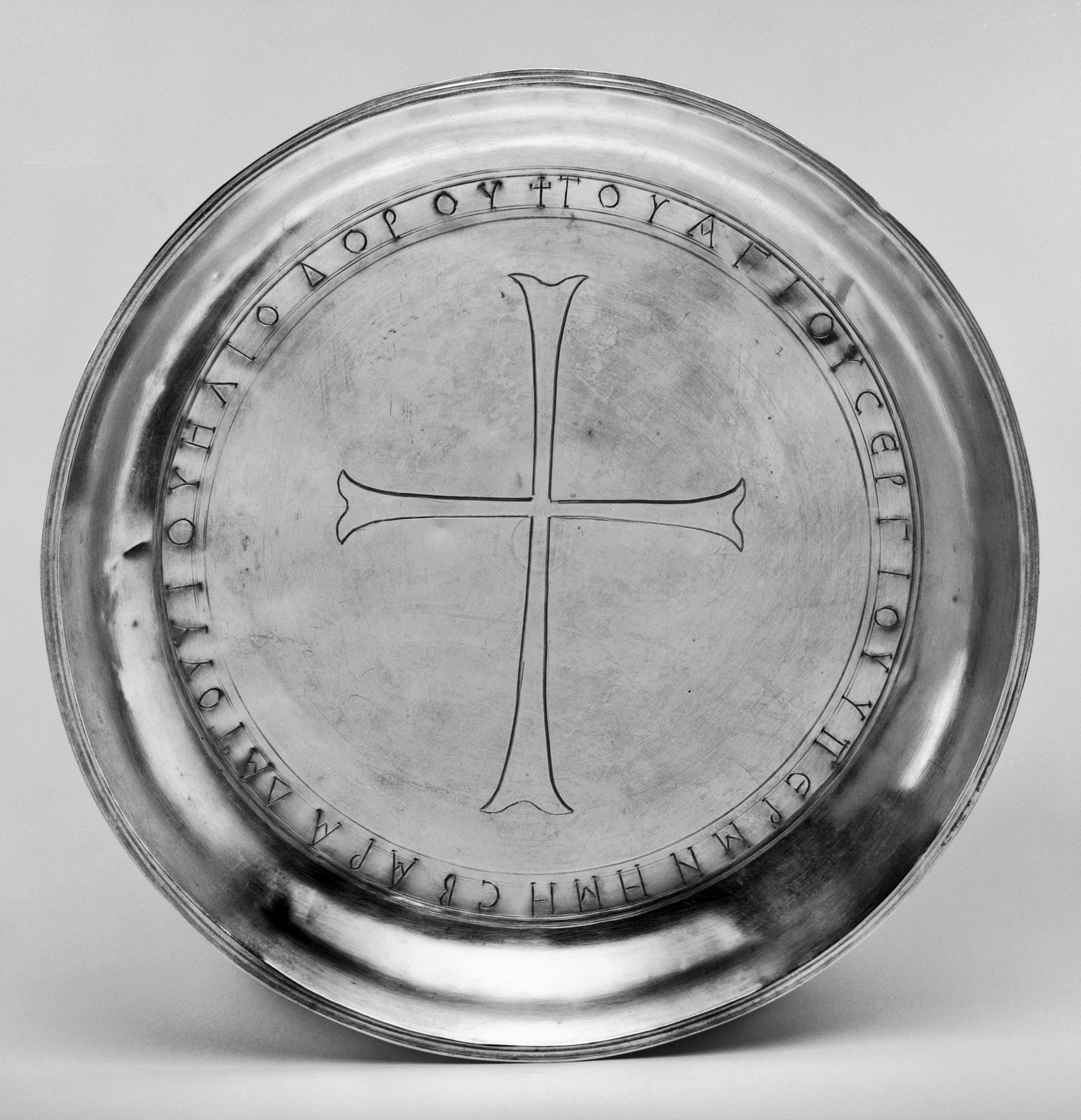
| Paten Unrecorded Byzantine silversmith(s), Kaper Koraon group | Same accession group, same original find, circa 565 Inscribed for the memory of Heliodoros(?), son Baradatos, dedicated to Saint Sergius. | The Walters Art Museum, Baltimore (accession 57.644) |
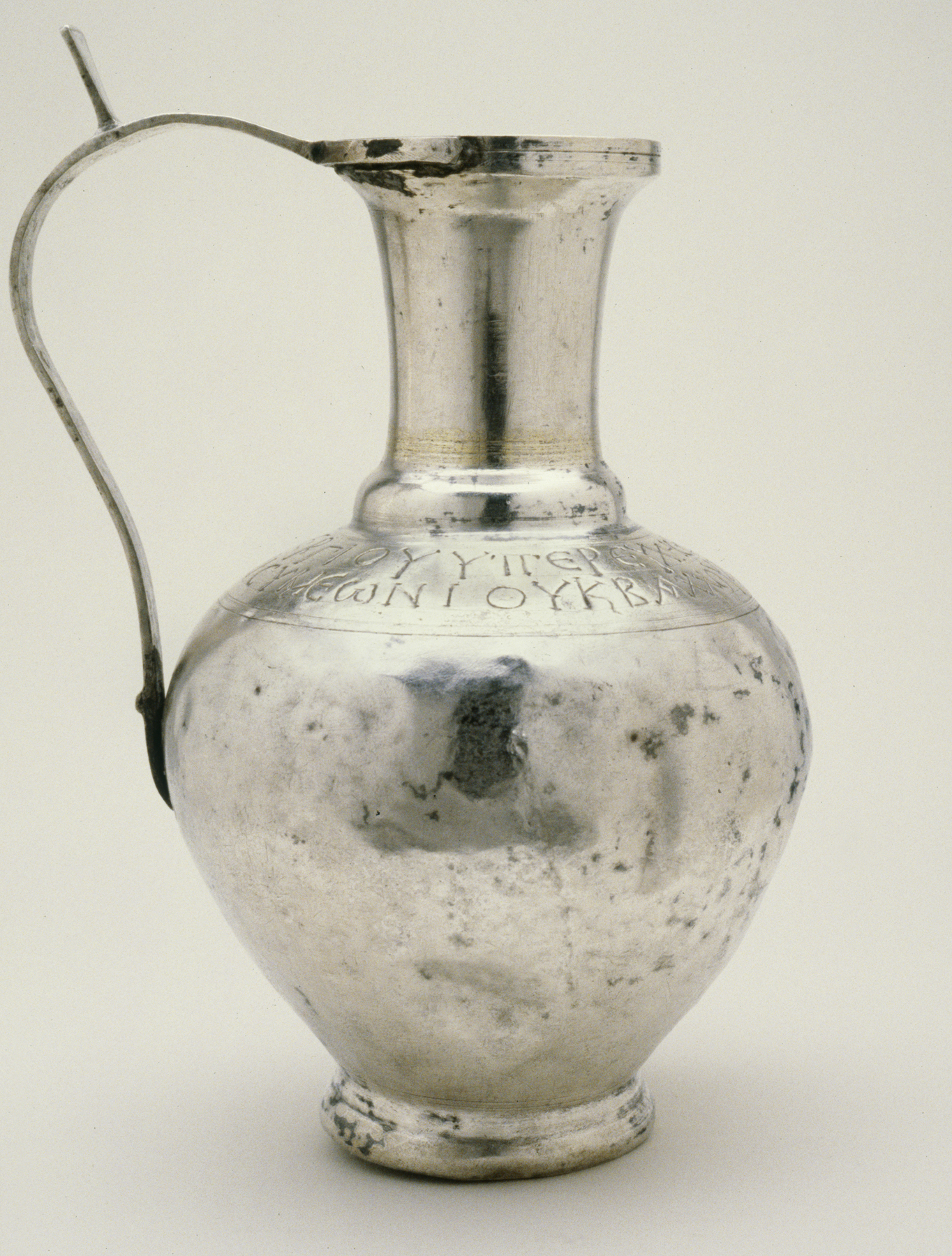
| Ewer Unrecorded Byzantine silversmith(s), Kaper Koraon group | Same accession group, same original find, circa 550 One of the vessels whose inscription names the village of Kaper Koraon outright: 'Ewer of Saint Sergius, prayer of Daniel, Sergius, Symeonus, Bacchus, and prayer of Thomas [from the] village of Kaper Koraon'. | The Walters Art Museum, Baltimore (accession 57.645) |
| Chalice with Apostles Venerating the Cross Unrecorded Byzantine silversmith(s), Kaper Koraon group | Same accession group, same original find, early 7th century The most iconographically elaborate surviving vessel in the Walters portion of the group, showing apostles flanking large crosses; inscribed for Pelagius and Basianus. | The Walters Art Museum, Baltimore (accession 57.636) |
| Paten with the Communion of the Apostles (the 'Riha Paten'), with its companion chalice and liturgical fan Unrecorded Byzantine silversmith(s) | Reportedly found together at Riha, a separate Syrian village; secondary literature has suggested, without institutional confirmation from Dumbarton Oaks' own catalogue, that the Riha find and the Kaper Koraon find may derive from one larger dispersal event Certainty of the link to this paten's find: argued, not documented. | Dumbarton Oaks, Washington, D.C. (BZ.1924.5, BZ.1955.18, BZ.1936.23) |
| The Antioch 'Chalice' Unrecorded silversmith, northern Syria | A separately catalogued object with its own findspot tradition and history of misattribution (to the first century, and to the Holy Grail); some recent scholarship argues it may belong to the same church-silver group as Kaper Koraon, a connection the Metropolitan Museum's own catalogue records only as a hedge ('Made in Antioch or Kaper Koraon (?)') Covered by its own record in this archive (slug: antioch-chalice). Not pictured here; see the note in this record's narrative on why. | The Metropolitan Museum of Art, The Cloisters, New York (accession 50.4) |
Open questions
- Does this specific paten carry Byzantine control stamps, as its companion chalice 57.642 does? The Walters' public record for 57.643 does not state either way.
- What is the total original composition of the find? The Walters consistently describes 23 vessels reaching Baltimore together; broader secondary accounts of the reconstructed Kaper Koraon group cite higher figures, up to several dozen pieces across institutions, that this record has not verified against Mango's 1986 catalogue directly.
- Are all objects now attributed to Kaper Koraon securely from the same original hoard, or has the group been partly reconstructed by stylistic and epigraphic association across market lots once sold separately as the 'Hama', 'Stuma', 'Riha' and 'Antioch' material? Secondary sources argue for a single original deposit; Dumbarton Oaks' own object catalogue for its Riha-associated pieces does not itself assert the connection.
- Is the Metropolitan Museum's Antioch Chalice (accession 50.4) part of the same original church silver as this paten, as some recent scholarship argues, or a genuinely separate find, as its own findspot tradition and the Met's hedged attribution imply?
- What price did Joseph Brummer pay Tawfic Abucasem for the group, and what price did Henry Walters pay Brummer? No figure for either transaction is published in the sources consulted.
- What happened to the silver between its excavation, reportedly circa 1908-1910, and its documented appearance in Tawfic Abucasem's hands circa 1913? The interval is undocumented in every source consulted for this record.
- Was the 1928 date given by Dumbarton Oaks for Henry Walters's purchase, or the 1929 date given in the Walters' own provenance note, correct? The two institutional sources disagree by about a year and this record has not resolved which is right.
- Who was Archbishop Amphilochios, beyond the title he gives himself in his own dedication? No further biographical identification was located in the sources consulted.
Questions about this object
What is The Amphilochios Paten?
The Amphilochios Paten is a silver, dated third quarter of the 6th century (Walters Art Museum dating). Medium: Silver.
Who made The Amphilochios Paten, and is the attribution settled?
The attribution to Unrecorded Byzantine silversmith(s), Kaper Koraon group is recorded here as unknown. No maker, workshop or mint is named on the paten. The object carries no signature, and the Walters Art Museum's own public record names no silversmith. What is established is the donor (the inscription names Archbishop Amphilochios), the approximate date (third quarter of the sixth century, on stylistic and comparative grounds), and the findspot region (near the village of Kurin, ancient Kaper Koraon, in Syria). Several related vessels in the same group carry Byzantine control stamps, a state hallmarking system that can date silver independently of style; this record has not found a published statement of whether this particular paten carries such stamps.
Where is The Amphilochios Paten now?
The Walters Art Museum, Baltimore, Maryland. Inventory number 57.643. Last confirmed 24 August 2026. Bequest of Henry Walters, 1931.
What is still unknown about The Amphilochios Paten?
Does this specific paten carry Byzantine control stamps, as its companion chalice 57.642 does? The Walters' public record for 57.643 does not state either way.
Sources
- 1Wikimedia Commons, 'File:Byzantine - Paten - Walters 57643.jpg', reproducing the Walters Art Museum's catalogue entry for accession 57.643. commons.wikimedia.org/wiki/...
- 2Wikimedia Commons, 'File:Byzantine - Chalice - Walters 57642.jpg', reproducing the Walters Art Museum's catalogue entry for accession 57.642. commons.wikimedia.org/wiki/...
- 3Wikimedia Commons, 'File:Byzantine - Paten - Walters 57644.jpg', reproducing the Walters Art Museum's catalogue entry for accession 57.644. commons.wikimedia.org/wiki/...
- 4Wikimedia Commons, 'File:Byzantine - Ewer - Walters 57645.jpg', reproducing the Walters Art Museum's catalogue entry for accession 57.645. commons.wikimedia.org/wiki/...
- 5Wikimedia Commons, 'File:Byzantine - Chalice with Apostles Venerating the Cross - Walters 57636 - Profile.jpg', reproducing the Walters Art Museum's catalogue entry for accession 57.636. commons.wikimedia.org/wiki/...
- 6Dumbarton Oaks, 'Silver Treasure', annotation to the Bliss-Tyler Correspondence. doaks.org/resources/...
- 7Dumbarton Oaks, 'Henry Walters (1848-1931)', annotation to the Bliss-Tyler Correspondence. doaks.org/resources/...
- 8Dumbarton Oaks, 'Joseph Brummer (1883-1947)', annotation to the Bliss-Tyler Correspondence. doaks.org/resources/...
- 9Dumbarton Oaks Museum, object records for the Riha hoard portfolio (Paten with the Communion of the Apostles, BZ.1924.5; Chalice, BZ.1955.18; Flabellum, BZ.1936.23). museum.doaks.org/objects-1/...
- 10Wikipedia, 'Kaper Koraon Treasure'. en.wikipedia.org/wiki/...
- 11Wikipedia, 'Antioch chalice'. en.wikipedia.org/wiki/...
- 12Marlia Mundell Mango, 'Silver from Early Byzantium: The Kaper Koraon and Related Treasures' (Baltimore: Walters Art Gallery, 1986), edited by Gary Vikan, technical contributions by Carol E. Snow and Terry Drayman Weisser. Bibliographic record only; not directly consulted for this entry. Flagged for direct consultation before this record is deepened further. catalog.hathitrust.org/Record/...
- 13Erica Cruikshank Dodd, 'Byzantine Silver Stamps' (Washington, D.C.: Dumbarton Oaks, 1961). Bibliographic record only; not directly consulted for this entry. Cited as the standard reference for the control-stamp dating method described. archive.org/details/...
- 14Wikipedia, 'Henry Walters'. en.wikipedia.org/wiki/...
- 15Wikipedia, 'Joseph Brummer'. en.wikipedia.org/wiki/...
- 16The Walters Art Museum, 'Image Rights, Reproduction, and Terms of Use', the museum's published open-access and CC0 rights policy for its collection. thewalters.org/about/...
- 17Secondary academic discussion of the 1884 Ottoman Law of Antiquities (Asar-i Atika Nizamnamesi) and its administration under Osman Hamdi Bey. academia.edu/86116280/...


Last verified · Published
Change log
24 August 2026 - Record created at the house standard: researched narrative, technical evidence, maker dossier, graded provenance chain, prices with hammer and premium separated, related works, open questions and sources.