Irises (Kakitsubata-zu)
Ogata Korin · c. 1701-1705
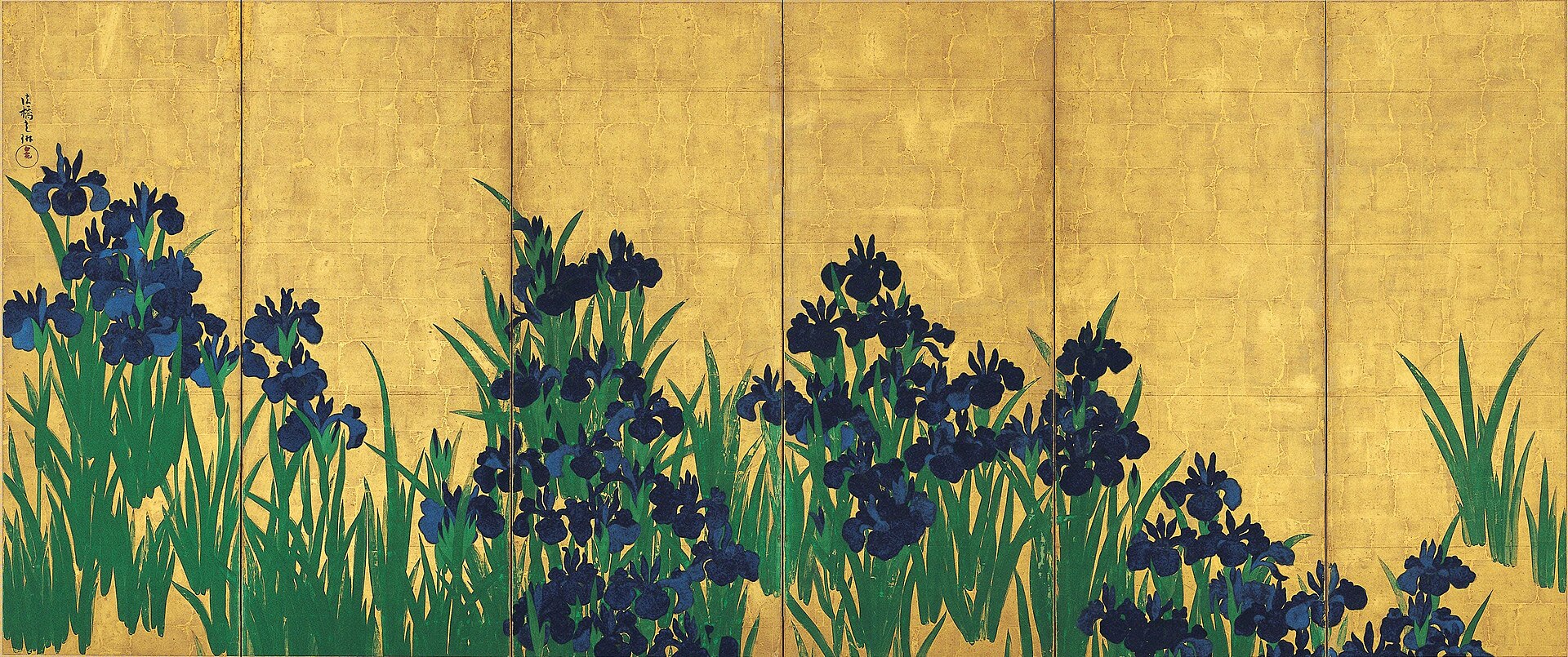
The left of the pair of six-panel screens described in this record. Ink, mineral pigment and gold leaf on paper, 150.9 x 338.8 cm. Nezu Museum, Tokyo, formerly Nishi Honganji, Kyoto. Verified via the Wikimedia Commons API: credited to the Nezu Gallery, artist listed as Ogata Korin, died 1716, license public domain.
| Artist | Ogata Korin |
|---|---|
| Date | c. 1701-1705 |
| Medium | Ink and color (mineral pigments, principally azurite blue and malachite green) on paper, against a ground built from individual squares of gold leaf; pair of six-panel folding screens (byobu) |
| Dimensions | Each screen 150.9 x 338.8 cm (six panels, a pair) |
| Where it is now | Nezu Museum, Tokyolast confirmed |
| Inventory number | Nezu Museum collection database, item id 10301 |
| Attribution | AcceptedUniversally accepted as an autograph work of Ogata Korin's mature period, painted in the years immediately after he was awarded the honorary rank of hokkyo in 1701. Full note |
| Object type | Painting |
| Period | Japan, Edo period, Genroku-Hoei transition (c. 1701-1705) |
| Cases | Has a provenance gap · Export restricted |
| Inscriptions | None documented in the sources consulted. No signature, seal, or dated inscription on the screens is described by the Nezu Museum's own catalogue entry, the Agency for Cultural Affairs record, or the secondary literature reviewed for this record. |
| Owners on record | 5 links3 documented, 2 unknown |
| Sources | 11 cited |
About this record Last verified · 11 sources cited · Change log
On this page 9 sections
ContentsClose
A pair of six-panel gold-ground screens painted by Ogata Korin around 1701-1705, showing nothing but blue irises and green foliage against a shimmering field of individually applied gold leaf squares. The composition stages, by implication only, a celebrated episode from the tenth-century Tales of Ise: irises at a place called Yatsuhashi, the Eight Bridges, where a travelling poet composed an acrostic verse of longing for the wife left behind. Korin's screens omit the bridge and the poet entirely, a deliberate abstraction that later art writing reads as a wager that the viewer already knows the story.
The screens were held by Kyoto's Nishi Honganji temple for over two hundred years before being sold in 1913 and passing, at an undocumented date before 1940, into the collection of the industrialist Nezu Kaichiro. His son founded the Nezu Museum in 1941 to house the family collection, and the screens have remained there since, designated a National Treasure of Japan and shown to the public for only about a month each spring.
Korin painted a second, related pair roughly five to fifteen years later, this one showing the bridge explicitly, now held by the Metropolitan Museum of Art in New York since 1953. The two pairs are one of the most persistently confused version pairs in Japanese art history; this record is about the earlier, bridgeless Nezu pair only, and every image and claim here has been checked against that identification.
Provenance
Each link is graded. Documented: a cited source supports it. Disputed: the identification is argued but not established. Unknown: no owner for that span, and the gap is not smoothed into a narrative. The grades in the glossary.
- c. 1701-1705 -Ogata Korin (painter); possibly the Nijo familyunknown
Painted by Korin in the years immediately after he received the hokkyo rank in 1701. The standard secondary account states the screens were probably made for the Nijo family, but no commission record, contract, or payment document was located, and this record could not independently verify the claim that Korin had personal access to the Nijo family residence beyond the secondary sources consulted. Any Nijo connection to these specific screens is an inference, not a documented commission.157
- - 1913Nishi Honganji Buddhist temple, Kyotodocumented
Held by Nishi Honganji for over two hundred years before being sold by the temple in 1913. The date and circumstances of the screens' original entry into the temple's holdings are not stated in the sources consulted; only the length of custody and the exit year are documented.126
- 1913 - 1940Nezu Kaichiro (1860-1940), industrialist, Diet member and president of Tobu Railwayunknown
The screens entered Nezu Kaichiro's wide-ranging private collection at an unspecified point between the temple's 1913 sale and his death in 1940. No source consulted gives a specific date, price, or intermediary for this acquisition.128
- 1940 - 1941Nezu family foundationdocumented
Following Nezu Kaichiro's sudden death in 1940, his son and heir, also named Kaichiro, established a foundation to preserve the collection and opened the Nezu Museum the following year at its present Minami-Aoyama, Tokyo site.28
- 1941 - presentNezu Museum, Tokyodocumented
Held and displayed by the Nezu Museum since 1941, shown to the public for a limited period, roughly one month, each spring because of the light- and humidity-sensitivity of the paper support and mineral pigments. Designated a National Treasure of Japan in the painting category under the postwar Law for the Protection of Cultural Properties; the specific designation year was not found in the sources consulted.239
Technical evidence
| Attribution note | Universally accepted as an autograph work of Ogata Korin's mature period, painted in the years immediately after he was awarded the honorary rank of hokkyo in 1701. No dispute over authorship was found in the sources consulted. No signature or artist's seal on the screens themselves is described in any source consulted; the attribution rests on unbroken institutional record (Nishi Honganji, then the Nezu family) and on connoisseurship, not on a signed inscription. That gap is recorded here rather than assumed away. |
|---|---|
| Format | Pair of six-panel folding screens (byobu); ink, mineral pigment and gold leaf on paper.124 |
| Dimensions | 150.9 x 338.8 cm per screen, consistent across the Nezu Museum's own catalogue and the Agency for Cultural Affairs record.24 |
| Pigments | Azurite (gunjo) for the ultramarine-toned iris blooms; malachite/verdigris green (rokusho) for the foliage. The palette is restricted to these two mineral pigments plus the gold ground, with no other colour used.1 |
| Gold ground | Built from individual squares of gold leaf applied across the paper in a grid rather than a single continuous sheet, producing an uneven, reflective surface likened in the literature to water.1 |
| Flowers: technique | Similarities among individual blooms indicate a stencil, or a comparably repeatable pattern device, was used to lay out the iris heads before painting.1 |
| Leaves and stems: technique | Described by specialist commentary as painted in the boneless (mokkotsu) manner, without outline, using tarashikomi, wet pigment or ink dropped into a still-wet layer and left to blend and pool. No museum technical/conservation report confirming this at the level of paint-layer analysis was located; treat as documented by written specialist description, not by scientific examination.6 |
| Rank marker | The screens date from shortly after Korin was awarded the honorary title hokkyo (Bridge of the Dharma) in 1701, the third-highest artist's rank of the period, after which he signed some works Hokkyo Korin.67 |
| Signature/inscription | None documented in any source consulted for this record.24 |
Images
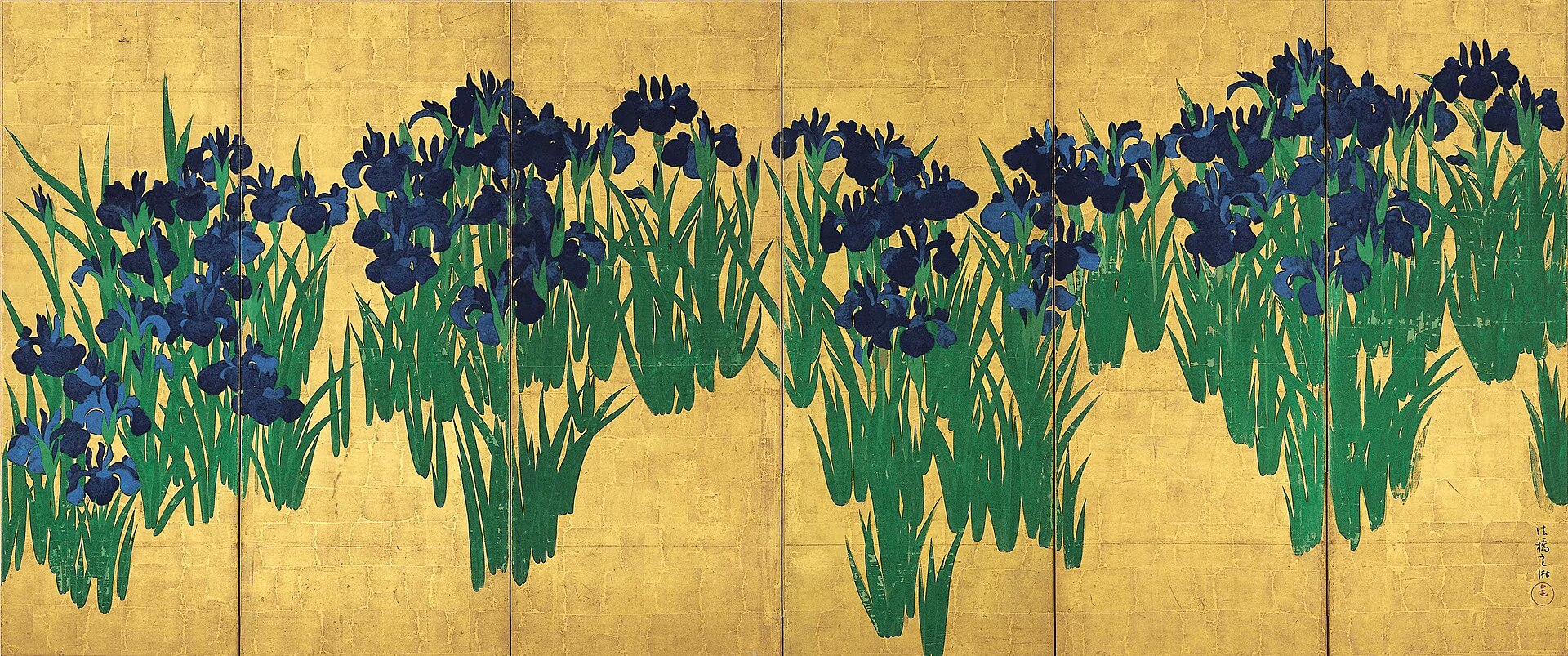
The record in full
Chapter 1What it is
A pair of six-panel folding screens, each 150.9 by 338.8 centimetres, painted in ink and mineral pigment on a paper ground faced with squares of gold leaf.
A pair of six-panel folding screens, each 150.9 by 338.8 centimetres, painted in ink and mineral pigment on a paper ground faced with squares of gold leaf. Set side by side they show nothing but clumps of blue Japanese iris, Iris laevigata, and their green foliage, repeating and varying across the twelve panels against an unbroken field of gold. There is no bridge, no water rendered as water, no figure, no horizon and no sky. The subject is reduced to two elements: a flowering plant and the metal ground it stands on.
The palette is deliberately narrow: ultramarine-toned azurite for the flowers, malachite green for the leaves, and the gold of the ground itself. Nothing else appears. That restriction is not a lack of ambition; it is the ambition. Kyoto's Nezu Museum, which holds the pair, shows it to the public for only about a month each spring, when the garden irises it echoes are themselves in bloom.
Chapter 2How it was made
The gold ground is not a single continuous sheet.
The gold ground is not a single continuous sheet. It is built from individual squares of gold leaf laid across the paper in a grid, a standard technique for large-format Edo screens, and the visible seams between squares are part of why the surface catches and scatters light unevenly rather than reading as a flat mirror. Wikipedia's consolidated account of the screens describes the gold as applied in squares specifically to create this shimmering, water-like reflectiveness.
Some of the iris blooms recur closely enough in outline that more than one source concludes a stencil, or a comparable repeatable pattern, was used to lay out the flower heads before painting, a working method consistent with Korin's documented use of stencils (katagami) elsewhere in his practice, inherited in part from his family's kimono-design business. The leaves and stems, by contrast, are described by specialist commentary as built without outline in the boneless (mokkotsu) manner, the form defined entirely by pooled, mottled washes of ink and pigment blotted wet into a wet ground layer, the tarashikomi technique associated above all with Tawaraya Sotatsu, the founding figure of the school whose name Korin's own art-name preserves (Rin-pa, the school of Korin, takes its last syllable from his). This record treats the tarashikomi description of the leaves as documented by specialist commentary rather than by a museum's own technical examination, since no conservation report or infrared study of the paint layers was located in the sources consulted; a technical study would settle it definitively.
Chapter 3The poem behind the picture
The screens are not an original invention of subject.
The screens are not an original invention of subject. They stage a single, celebrated episode from the tenth-century Japanese classic The Tales of Ise, chapter nine, in which an unnamed traveller, understood by tradition to be the poet and courtier Ariwara no Narihira, journeys east away from the capital and stops at a place called Yatsuhashi, the Eight Bridges, where the water divides into eight channels crossed by a rough plank bridge and irises grow thickly on the banks.
Asked by his companions to compose a poem on the theme of a traveller's feelings, using the five syllables of the word for iris, ka-ki-tsu-ba-ta, as the opening sound of each of the poem's five lines, Narihira produces an acrostic verse of longing for the wife he left in the capital: kara koromo kitsutsu narenishi tsuma shi areba, harubaru kinuru tabi o shi zo omou, roughly, thinking of my wife grown familiar as a well-worn robe, how far I have travelled on this journey. The poem is preserved both in the Tales of Ise itself and in the earlier Kokin Wakashu imperial anthology. It is one of the most quoted passages in the classical Japanese canon, and by the Genroku era, four centuries removed from its composition, the mere sight of irises and a plank bridge together was enough to summon the whole episode, the poem, and its ache of separation, for any educated viewer.
Chapter 4What was left out, and why it matters
This is the point on which the whole object turns, and where a reader has to be careful.
This is the point on which the whole object turns, and where a reader has to be careful. The Nezu screens show irises and, by implication, water. They do not show the bridge. They do not show Narihira, or any traveller, or any human figure at all. A specialist account of Korin's career published by Nippon.com describes this directly as a departure from the literary source, noting that Korin took a fresh approach by showing only the flowers, arranged elaborately, with no human presence, where the story itself is about a person's grief.
Read against the poem, the omission is not a loss of information; it is a wager that the viewer already knows the story so well that the flowers alone will do the work the bridge and the traveller usually do. That reading, that the missing bridge is a deliberate act of compositional abstraction rather than an accident of a lost or cropped panel, is the position taken by Nippon.com's account and is consistent with how Korin is discussed in the wider Rinpa literature; this record presents it as an argued critical position, credited to that source, rather than as a fact recovered from any statement by Korin himself, of which none survives.
Chapter 5Commission: what is documented, and what is not
No commission contract, patron's letter, or dated record of payment for these screens was found in the sources consulted.
No commission contract, patron's letter, or dated record of payment for these screens was found in the sources consulted. The standard secondary account states that the screens were probably made for the Nijo family and then presented to Nishi Honganji, but the word probably is doing real work in that sentence: it is an inference, not a documented transaction.
A closer connection between Korin and the Nijo family is sometimes asserted in circulating accounts, but this record could not independently verify it against the sources consulted: no source directly fetched for this record documents the specific nature of any personal access Korin may have had to the family. What remains is the inference in the standard secondary account above, stated as an inference, and a documented link between any such access and the actual commissioning of this specific pair of screens was not located either way. This record treats the Nijo connection as unverified and flags it as an open question rather than presenting it as settled.
Chapter 6Two hundred years at Nishi Honganji
What is solidly documented is the screens' long institutional home.
What is solidly documented is the screens' long institutional home. They were held by Nishi Honganji, the head temple of the Jodo Shinshu Hongwanji-ha sect of Pure Land Buddhism in Kyoto, for over two hundred years, and were sold by the temple in 1913. Neither the date the screens entered the temple's holdings nor the circumstances of that original transfer, whether gift, bequest, or purchase, is stated in the sources consulted; only the duration of the temple's custody and the year it ended are documented. That two-century span, set against a work made around 1701-1705, places the screens at Nishi Honganji from close to their creation until the early twentieth century, but the record does not close the gap at the front end.
Chapter 7From temple sale to the Nezu collection
The screens' next home is documented at the institutional level and undocumented at the level of the transaction that got them there.
The screens' next home is documented at the institutional level and undocumented at the level of the transaction that got them there. They passed into the collection of Nezu Kaichiro (1860-1940), the businessman, Diet member, and president of the Tobu Railway Company who built one of the twentieth century's most encyclopaedic private collections of Japanese and East Asian art, spanning painting, calligraphy, sculpture, metalwork, ceramics, lacquer, textiles, armor, and archaeological material, reportedly assembled through practice of the tea ceremony and a self-described bold approach to acquisition.
Between the temple's 1913 sale and Nezu's death in 1940, the screens entered his collection at some point; no source consulted gives a specific acquisition date, price, dealer, or intermediary for the Irises screens themselves. Nezu died suddenly in 1940. His son, also named Kaichiro, established a foundation the same year to preserve the collection and opened the Nezu Museum in 1941 at its present site in Minami-Aoyama, Tokyo, where the screens have remained ever since as part of a holding that today runs to more than 7,400 objects, including seven National Treasures.
Chapter 8National Treasure status: the framework and its obligations
The screens are designated a Kokuho, a National Treasure of Japan, in the painting category.
The screens are designated a Kokuho, a National Treasure of Japan, in the painting category. The modern designation system rests on the Law for the Protection of Cultural Properties, drafted in May 1950 and in force from August of that year, administered by the Agency for Cultural Affairs on the advice of the Council for Cultural Affairs. Properties are first designated Important Cultural Properties; a subset judged to have particularly exceptional workmanship or exceptional value to world culture or scholarship is then elevated to National Treasure. The specific year in which the Irises screens received that elevation was not stated in either the Agency for Cultural Affairs' own online catalogue entry or the standard English-language list of National Treasure paintings consulted for this record, and is recorded here as an open question rather than guessed at.
The obligations that attach to the designation are not cosmetic. An owner must notify the Agency for Cultural Affairs if a National Treasure is lost, destroyed, damaged, altered, moved, or if ownership changes hands. Any repair requires a permit, with thirty days' notice to the agency before work begins. Export from Japan is generally prohibited outright. If a National Treasure is ever offered for sale, the state holds the right of first refusal. The Nezu Museum's practice of showing the Irises screens for roughly one month each spring, rather than keeping them on permanent display, sits inside this framework: paper, ink, and mineral pigment are light-sensitive and physically fragile in a way that a lacquer box or a bronze is not, and limited, seasonal display is the conservation strategy that keeps a nearly three-hundred-and-twenty-year-old paper object stable enough to remain a National Treasure at all.
Chapter 9VERSION SAFETY: the other Irises, at the Met
Korin painted this composition more than once, and the two results are frequently confused with each other, in press coverage, in casual reference, and even in some museum-adjacent writing.
Korin painted this composition more than once, and the two results are frequently confused with each other, in press coverage, in casual reference, and even in some museum-adjacent writing. This record is about the Nezu Museum pair described above: no bridge, no figure, dated to roughly 1701-1705, held at Nishi Honganji for over two hundred years before reaching the Nezu collection.
A second, related pair, known as Irises at Yatsuhashi (Yatsuhashi-zu byobu), was painted by Korin later, generally dated to roughly 1709-1716, in the years after his return to Kyoto from Edo. It is larger, each screen measuring 179.1 by 371.5 centimetres against the Nezu pair's 150.9 by 338.8, and it has been held by the Metropolitan Museum of Art in New York since 1953. Unlike the Nezu pair, the Met's screens include an explicit, angular rendering of the plank bridge itself, making the literary reference to the Tales of Ise episode overt rather than implied. The two pairs were shown together for the first time in nearly a century at a joint 2012 exhibition at the Nezu Museum, an event that itself signals how rarely either work travels and how distinct institutions treat them as a matched, comparable set rather than as duplicates.
The distinction that separates them for a reader in a hurry: if there is a bridge in the image, it is the later Met screens, not this record's subject. If the image shows only irises and gold with no bridge and no figure, it is consistent with the Nezu pair, though a specific reproduction should still be checked against a captioned, attributed source before being treated as identified. No image used in this record's gallery was sourced from, or attributed to, the Metropolitan Museum's pair; every file below was independently verified through the Wikimedia Commons API as crediting the Nezu Museum or Nishi Honganji as the depicted work's origin before inclusion.
Chapter 10Cultural reach: the banknote and Van Gogh
The Nezu pair, specifically, not the Met's later screens, is the source of the design on the reverse of the Bank of Japan's five-thousand-yen note, Series E, issued from 1 November 2004, which...
The Nezu pair, specifically, not the Met's later screens, is the source of the design on the reverse of the Bank of Japan's five-thousand-yen note, Series E, issued from 1 November 2004, which carries a portrait of the writer Ichiyo Higuchi on the front. The Japanese-language Wikipedia entry for the work, titled using the same Japanese title as the Nezu screens (Kakitsubata-zu, not the Met pair's separate Japanese title, Yatsuhashi-zu byobu), states plainly that the 2004 note's reverse design uses the Kakitsubata-zu pattern. This record treats that identification as reasonably well supported by the matching Japanese title, while flagging it, like the rest of the Japanese Wikipedia material used here, as a tertiary source that a specialist should verify directly against a Bank of Japan or National Printing Bureau design record before the claim is repeated as settled fact elsewhere. It is exactly the kind of detail, one Irises among two, that search results conflate without distinguishing, which is why the sourcing is stated this explicitly here.
The screens also have a documented, if indirect, afterlife in Western painting. Korin's Irises design was never seen in the original by Vincent van Gogh, who painted his own Irises in Saint-Remy in 1889, but it was reproduced as a woodcut in the Korin Hyakuzu (One Hundred Paintings by Korin), a set of four woodblock-printed volumes produced by the later Rinpa painter Sakai Hoitsu in 1815 to mark the hundredth anniversary of Korin's death and to make his compositions available to a wider audience of artists and patrons for the first time. Van Gogh is understood, via that reproduction, to be one of many nineteenth-century European painters whose interest in japonisme carried Rinpa's flattened, patterned approach to natural subjects into Post-Impressionist painting, though the specific chain from the Korin Hyakuzu print to Van Gogh's own canvas rests on the secondary literature summarized here rather than on a documented statement by Van Gogh naming this print.
Chapter 11The wider Yatsuhashi theme in Korin's work
The Nezu screens are not Korin's only treatment of the Yatsuhashi episode.
The Nezu screens are not Korin's only treatment of the Yatsuhashi episode. A National Treasure lacquer writing box, the Yatsuhashi makie raden suzuribako, attributed to Korin and now held by the Tokyo National Museum, renders the same Tales of Ise scene in gold maki-e lacquer with the bridge itself picked out in strips of lead and its piers in silver, and the irises worked in inlaid mother-of-pearl. Unlike the Nezu screens, this box does show the bridge, in a third medium entirely. The box was exhibited at the 1878 Paris World's Fair and passed into the Tokyo National Museum's holdings the following year, giving it its own, separately documented provenance from either Irises screen pair. Taken together, the two screen pairs and the writing box show an artist returning repeatedly to a single, culturally loaded literary scene across painting and lacquer, making different compositional choices, bridge shown or withheld, figure present or absent, each time. That repetition is itself part of why the two screen pairs are so easily mixed up: they are not casually similar, they are the same artist deliberately reworking the same material.
Chapter 12What remains unresolved
Several gaps in this record are not oversights; they are the honest state of the published evidence.
Several gaps in this record are not oversights; they are the honest state of the published evidence. The date and manner of the screens' entry into Nishi Honganji's holdings, the date, price, and intermediary of Nezu Kaichiro's acquisition after 1913, the year of the National Treasure designation itself, and the firmness of the Nijo family commission claim are all either undocumented in the sources consulted or supported only by inference. A specialist with access to the Nezu Museum's own research publications, the Agency for Cultural Affairs' internal designation records, or Nezu family archival material could likely close some or all of these gaps; this record states them as open rather than filling them with a plausible guess.
The artist
Ogata Korin
Korin was born into money and painted his way out of losing it. The second son of the Karigane-ya, a Kyoto business supplying luxury kimono textiles to court and aristocratic women, he grew up learning No theatre, waka poetry, and calligraphy alongside his younger brother Kenzan, later a celebrated potter. When the family's business patron, the retired empress dowager Tofukumon'in, died, the business declined; Korin, by his own later financial record, spent freely regardless, and in his late thirties turned to painting as a way to support himself. What followed was a career built as much on inherited taste and family connection, to Hon'ami Koetsu, a cultural figure of the previous century to whom the family was related, and to the painter Tawaraya Sotatsu, whose techniques Korin studied and extended, as on formal training; sources consulted describe attempts to identify a specific teacher, sometimes proposed as a Kano-school painter, as inconclusive.
Related works
| Work | Relation | Where it is |
|---|---|---|
| Irises at Yatsuhashi (Yatsuhashi-zu byobu) Ogata Korin | Later pair on the same subject by the same artist; includes the bridge omitted from this record's screens. The central version-safety comparison for this record. Larger than the Nezu pair (179.1 x 371.5 cm per screen against 150.9 x 338.8 cm) and generally dated c. 1709-1716, after Korin's return to Kyoto from Edo. Shown alongside the Nezu pair for the first time in nearly a century at a joint 2012 Nezu Museum exhibition. | Metropolitan Museum of Art, New York, since 1953 |
| Yatsuhashi makie raden suzuribako (writing box with the Eight-Plank Bridge) Attributed to Ogata Korin | Same Tales of Ise Yatsuhashi episode rendered in a third medium, gold maki-e lacquer with mother-of-pearl irises and a bridge picked out in lead and silver strips. National Treasure. Exhibited at the 1878 Paris World's Fair and entrusted to the museum the following year, giving it its own separate, earlier-documented provenance from either screen pair. | Tokyo National Museum |
| Red and White Plum Blossoms Ogata Korin | Korin's other individually designated National Treasure painting, from the final years of his career. Pair of two-panel screens, c. 1712-1716, made in his Shinmachi studio; plum blossoms rendered without outline. | MOA Museum of Art, Atami, Shizuoka |
| Wind God and Thunder God Tawaraya Sotatsu | Foundational Rinpa work by the painter whose tarashikomi technique and gold-ground screen format Korin inherited and developed; Korin painted his own later copy of this same composition. 17th century pair of two-panel screens; the technique lineage behind the Irises screens' leaves runs directly back to this artist. | Kennin-ji, Kyoto |
| Korin Hyakuzu (One Hundred Paintings by Korin) Sakai Hoitsu, after Ogata Korin | 1815 woodblock-printed reproduction volumes through which Korin's compositions, including versions of the Irises theme, reached European artists such as Van Gogh, who never saw the originals. The documented mechanism for this work's indirect influence on Western Post-Impressionist painting. | Multiple institutional collections (e.g. Smithsonian National Museum of Asian Art) |
Open questions
- When, and by what transaction (gift, bequest, or purchase), did the screens enter Nishi Honganji's holdings? Only the duration of temple custody, over two hundred years, and the exit date, 1913, are documented in the sources consulted.
- On what date, at what price, and through which dealer or intermediary did Nezu Kaichiro acquire the screens after the 1913 temple sale? He died in 1940; the acquisition falls somewhere in that 27-year window without a documented date.
- In what year were the screens formally elevated to National Treasure status, and under which designation act (the current 1950 law or an earlier framework)? Neither the Agency for Cultural Affairs' own online record nor the standard English-language National Treasure paintings list consulted states the year.
- Is the standard claim that the screens were made for the Nijo family a documented commission or an unverified inference? No commission record was located, and this record could not independently confirm even the claim of Korin's personal access to the Nijo family that the inference is said to rest on.
- Does any conservation or technical (infrared, pigment-analysis) study of the paint layers exist that would confirm, at the level of physical examination rather than written description, the use of tarashikomi in the leaves and the stencil in the flowers?
- What is the primary source, ideally a Bank of Japan or National Printing Bureau design record, confirming that the 2004 five-thousand-yen note's reverse design is drawn specifically from the Nezu pair rather than a generic or composite rendering of Korin's iris compositions?
Questions about this object
What is Irises (Kakitsubata-zu)?
Irises (Kakitsubata-zu) is a painting, dated c. 1701-1705. Medium: Ink and color (mineral pigments, principally azurite blue and malachite green) on paper, against a ground built from individual squares of gold leaf; pair of six-panel folding screens (byobu).
Who made Irises (Kakitsubata-zu), and is the attribution settled?
The attribution to Ogata Korin is recorded here as accepted. Universally accepted as an autograph work of Ogata Korin's mature period, painted in the years immediately after he was awarded the honorary rank of hokkyo in 1701. No dispute over authorship was found in the sources consulted. No signature or artist's seal on the screens themselves is described in any source consulted; the attribution rests on unbroken institutional record (Nishi Honganji, then the Nezu family) and on connoisseurship, not on a signed inscription. That gap is recorded here rather than assumed away.
Where is Irises (Kakitsubata-zu) now?
Nezu Museum, Tokyo. Inventory number Nezu Museum collection database, item id 10301. Last confirmed 17 August 2026. Held by the Nezu Museum since its 1941 founding by Nezu Kaichiro's son to house the family collection; the screens are documented in the museum's own online catalogue. The exact date and terms on which the elder Nezu Kaichiro (1860-1940) acquired the screens after their 1913 sale by Nishi Honganji were not found in the sources consulted; see provenance and open questions.
What is still unknown about Irises (Kakitsubata-zu)?
When, and by what transaction (gift, bequest, or purchase), did the screens enter Nishi Honganji's holdings? Only the duration of temple custody, over two hundred years, and the exit date, 1913, are documented in the sources consulted.
Sources
- 1Wikipedia, 'Irises screen', consolidating the Nezu and Metropolitan Museum catalogue data, the Ise Monogatari poem text, and the Van Gogh reception note. en.wikipedia.org/wiki/...
- 2Nezu Museum, official collection entry, 'Irises' (Kakitsubata-zu), item id 10301. nezu-muse.or.jp/en/...
- 3Nezu Museum, special exhibition page, 'National Treasure Irises Screens: A Legacy of Poetic Allusion'. nezu-muse.or.jp/en/...
- 4Agency for Cultural Affairs (Japan), Cultural Heritage Online (Bunkazai Online) database, Kakitsubata-zu record. online.bunka.go.jp/heritages/...
- 5Japanese Wikipedia, 'Kakitsubata-zu' (using this work's own Japanese title, distinct from the Metropolitan Museum pair's separate title Yatsuhashi-zu byobu), for the 2004 five-thousand-yen note reverse design and the Nijo Tsunahira access detail. ja.wikipedia.org/wiki/...
- 6Nippon.com, 'Ogata Korin: The Artistic Innovator Famed for His Folding Screens', for the biography, the hokkyo rank, the reading of the Irises screens' omission of the bridge and figure as a deliberate compositional choice, and the tarashikomi/mokkotsu description of the leaves. nippon.com/en/...
- 7Wikipedia, 'Ogata Korin', for the biography, family background, the 1694 pawnbroker letter, and the Edo-period career timeline. en.wikipedia.org/wiki/...
- 8Wikipedia, 'Nezu Kaichiro', for the collector's biography and the 1940-1941 founding of the Nezu Museum by his son. en.wikipedia.org/wiki/...
- 9Wikipedia, 'National Treasure (Japan)', for the Law for the Protection of Cultural Properties (1950), the Agency for Cultural Affairs' designation process, and the export/repair/reporting obligations attached to National Treasure status. en.wikipedia.org/wiki/...
- 10Metropolitan Museum of Art, object record for 'Irises at Yatsuhashi (Eight Bridges)', accession search result 39664, for the later pair's dimensions, dating and 1953 acquisition. metmuseum.org/art/...
- 11Yukari Mochizuki, 'National Treasure "Yatsuhashi Makie Raden Writing Box", Korin Ogata', for the lacquer writing box's materials and its 1878 Paris exposition and 1879 Tokyo National Museum provenance. makie-yukarim.com/yatsuhashi-makie-raden-writing-box-kori...
Last verified · Published
Change log
17 August 2026 - Record created at the house standard: researched narrative, technical evidence, maker dossier, graded provenance chain, prices with hammer and premium separated, related works, open questions and sources.