Every First Photograph Comes With a Qualifier
Niepce, Talbot and two Daguerre plates each carry a 'first'. Each rests on a different qualifier: positive, negative, surviving, with people. What each claim needs to be true.
Records in this piece: View from the Window at Le Gras, Latticed Window at Lacock Abbey, L'Atelier de l'artiste, Boulevard du Temple
On this page 6 sections
ContentsClose
In short
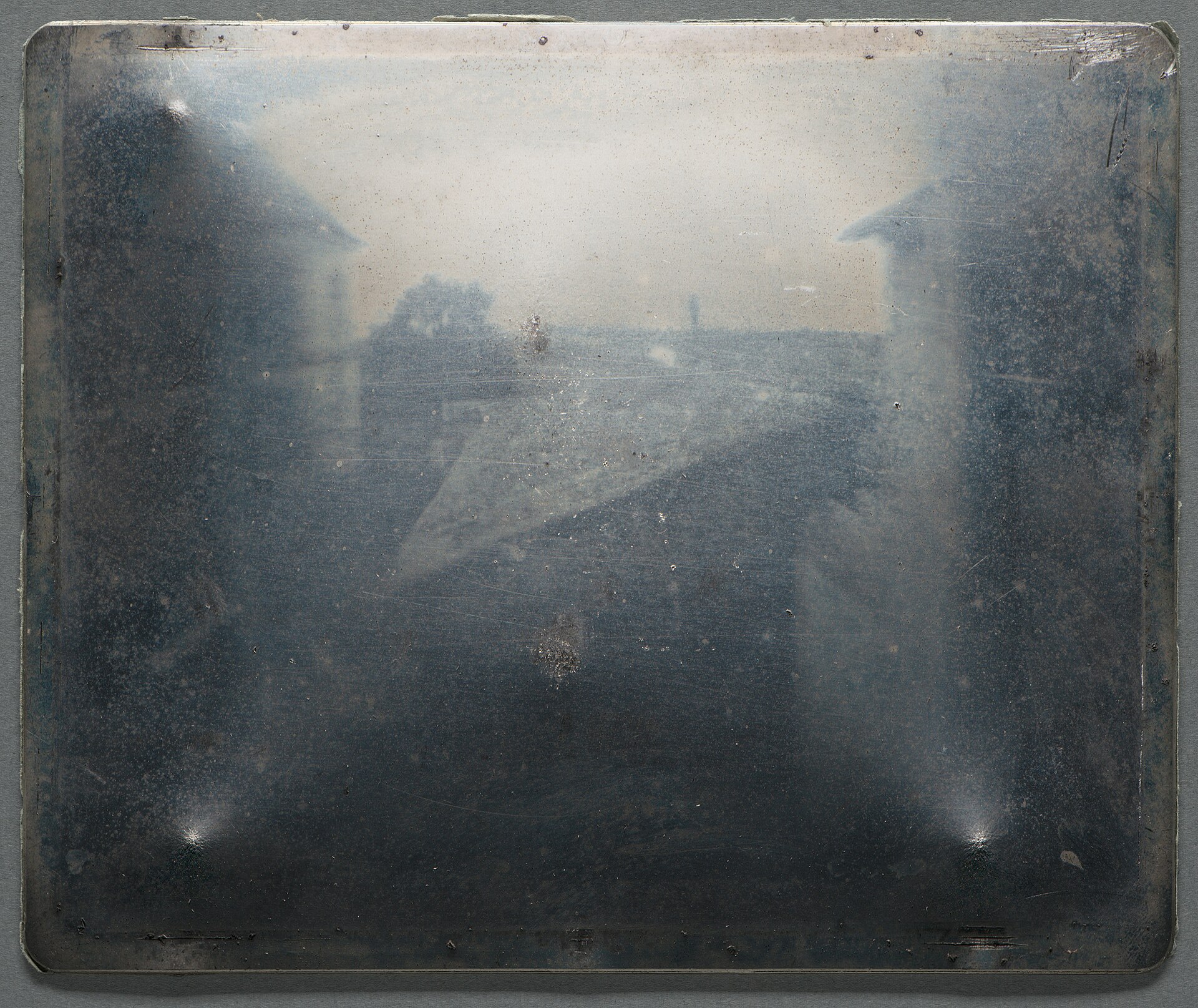
- The Harry Ransom Center's own catalogue page dates the Niepce heliograph to 1827, while the archive's record shows the year is still argued between 1826 and 1827, and that the plate has to be tilted to be read, so nearly every reproduction is a photograph of something else.
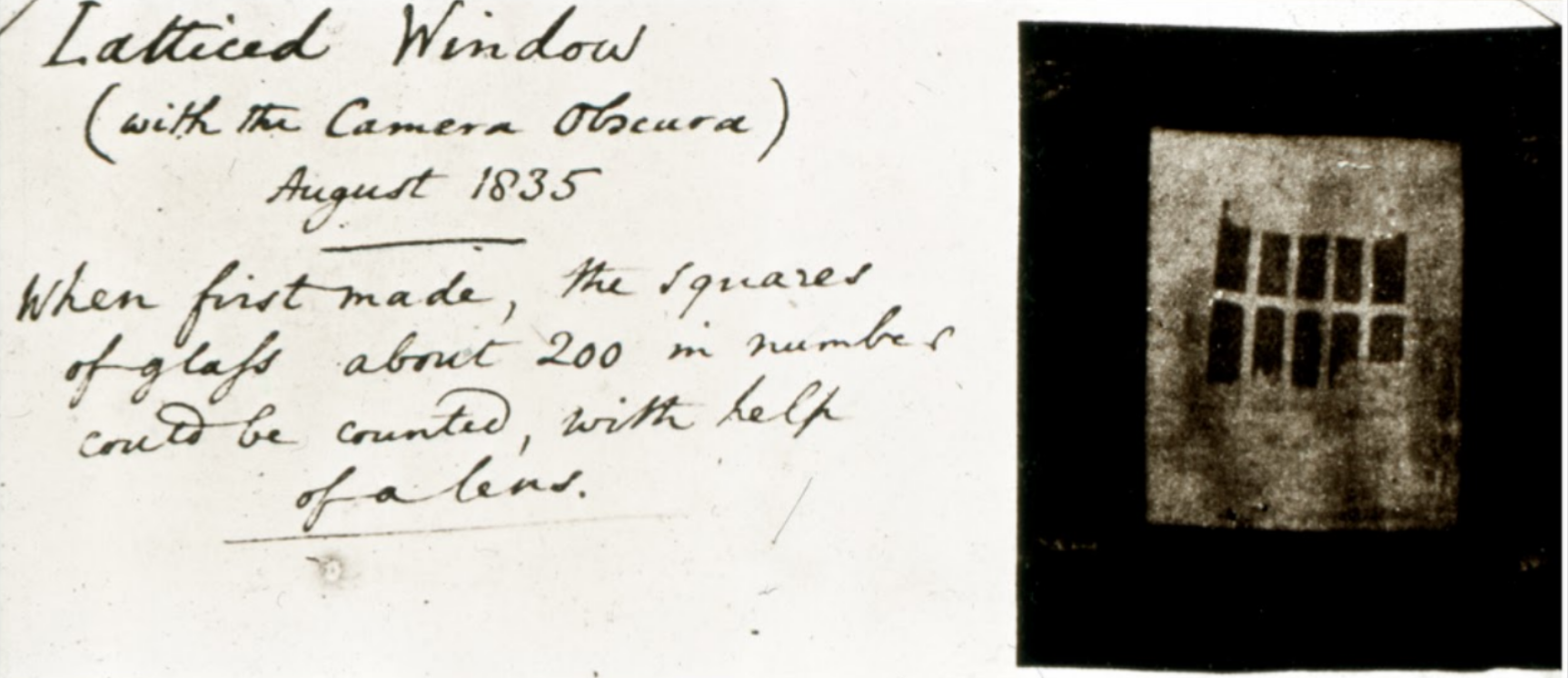
- Talbot's Latticed Window is called the earliest known surviving photographic negative on the strength of one thing: his own handwritten note on the mount giving August 1835.
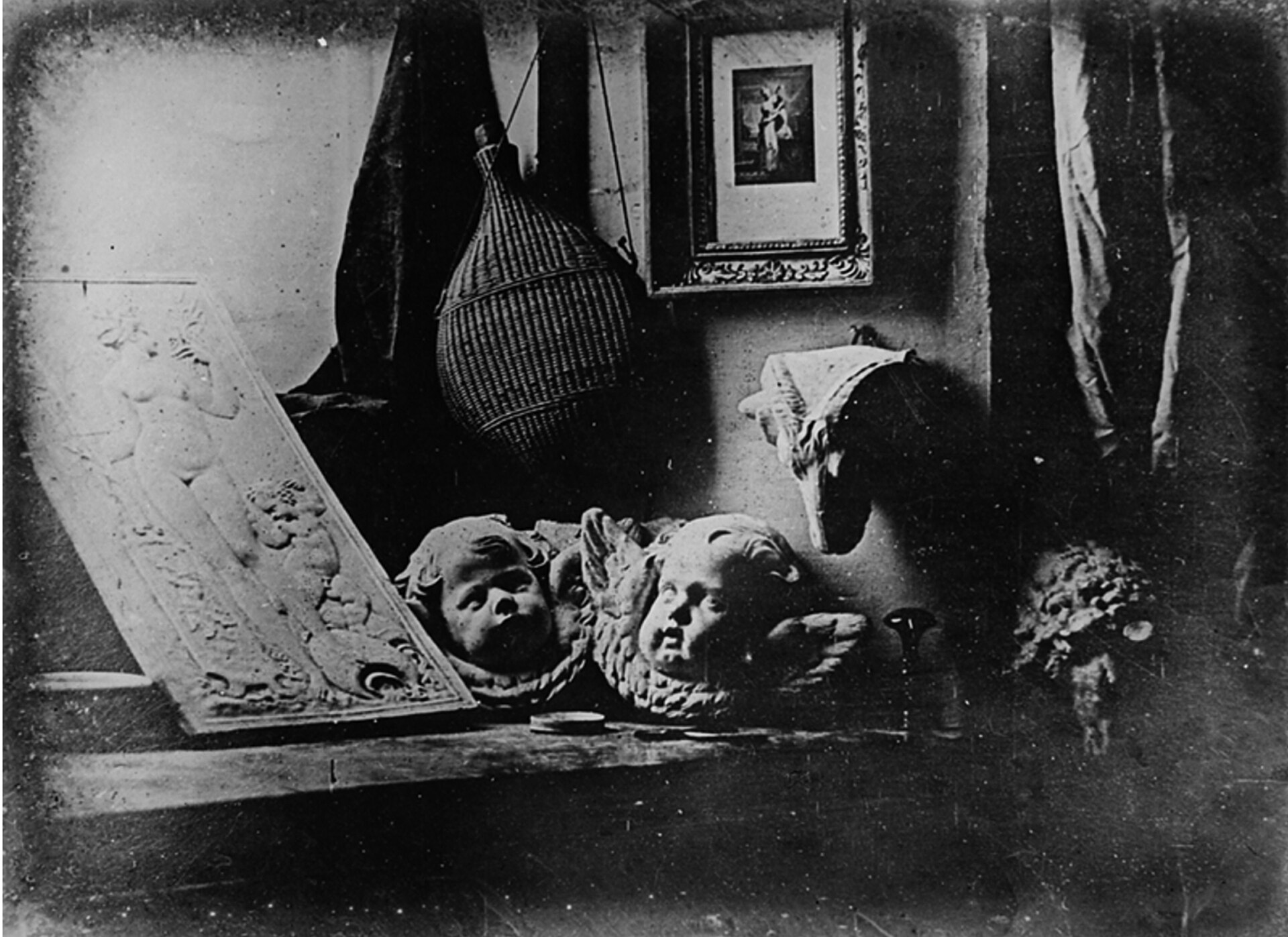
- The 1837 Daguerre still life at the Societe francaise de photographie is often called the earliest surviving daguerreotype, but a second 1837 still life in the same collection, dedicated to Alphonse de Cailleux, is described elsewhere as his oldest.
- The Boulevard du Temple plate that is credited with the first people in a photograph was damaged by a cleaning attempt, the sources disagree by more than a decade on when, and the museum's database describes what it holds as facsimiles.
Four objects hold four different firsts
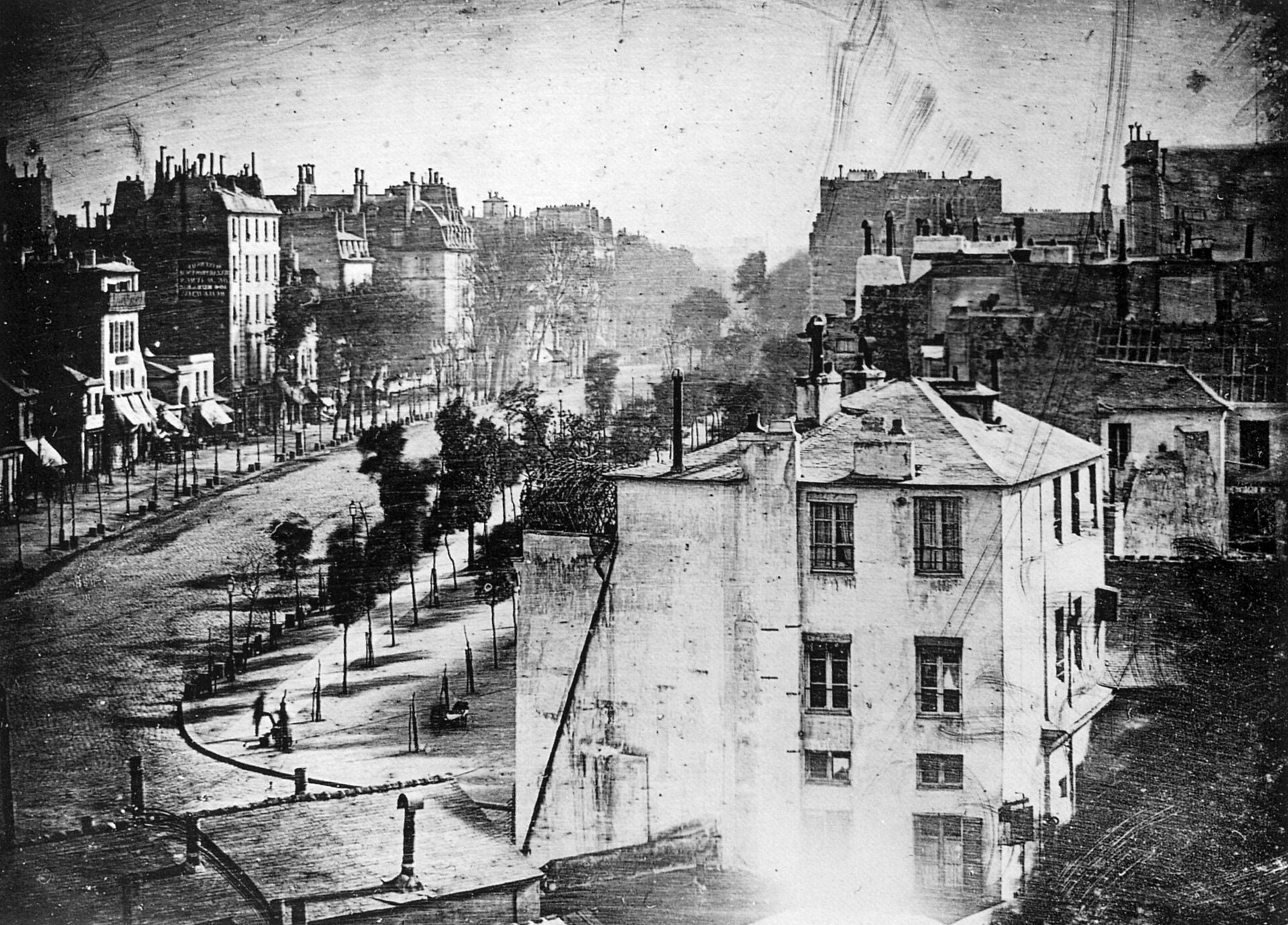
Four objects in this archive are each called the first photograph of something, and each of them is the first only under a qualifier that the headline drops. The Niepce heliograph is the earliest surviving image made in a camera, but it is a positive on metal made with bitumen. Talbot's Latticed Window is the earliest known surviving negative, but it is a paper image the size of a postage stamp. Daguerre's studio still life of 1837 is a candidate for the earliest daguerreotype that survives, and his Boulevard du Temple of 1838 is the plate usually credited with the first people ever fixed on a photographic plate.
The table sets the claim beside the thing that has to be true for it to hold. None of the four claims is false, and none is as simple as the sentence that travels with the picture.
| Object | The claim | The qualifier | Date as catalogued | Holder |
|---|---|---|---|---|
| View from the Window at Le Gras (Niepce) | Earliest surviving camera photograph | A direct positive on pewter, not a print from a negative | 1826 or 1827; the Ransom Center page says 1827 | Harry Ransom Center, Austin |
| Latticed Window, Lacock Abbey (Talbot) | Earliest known surviving photographic negative | Dated by Talbot's own note on the mount | August 1835 | Science Museum Group, National Science and Media Museum |
| L'Atelier de l'artiste (Daguerre) | Often called the earliest surviving daguerreotype | A second 1837 plate in the same collection also carries the claim | 1837 | Societe francaise de photographie, Paris |
| Boulevard du Temple (Daguerre) | Earliest photograph with people in it | The original plate was later damaged; reproductions come from a copy negative | 1838 | Bayerisches Nationalmuseum, Munich |
The Niepce heliograph is the earliest surviving camera image only as a positive on metal
The Niepce heliograph is described by the Harry Ransom Center as made in 1827 on a pewter plate measuring 16.7 by 20.3 centimetres, and the Center bought it in 1963 as part of the Gernsheim Collection. Niepce coated the plate with bitumen of Judea dissolved in oil of lavender, exposed it in a camera at an upper window of his house at Le Gras, and washed away the bitumen that light had not hardened. What is left is a direct positive made of differences in surface texture, which means it reads as a picture only when the plate is held at a raking angle to a light.
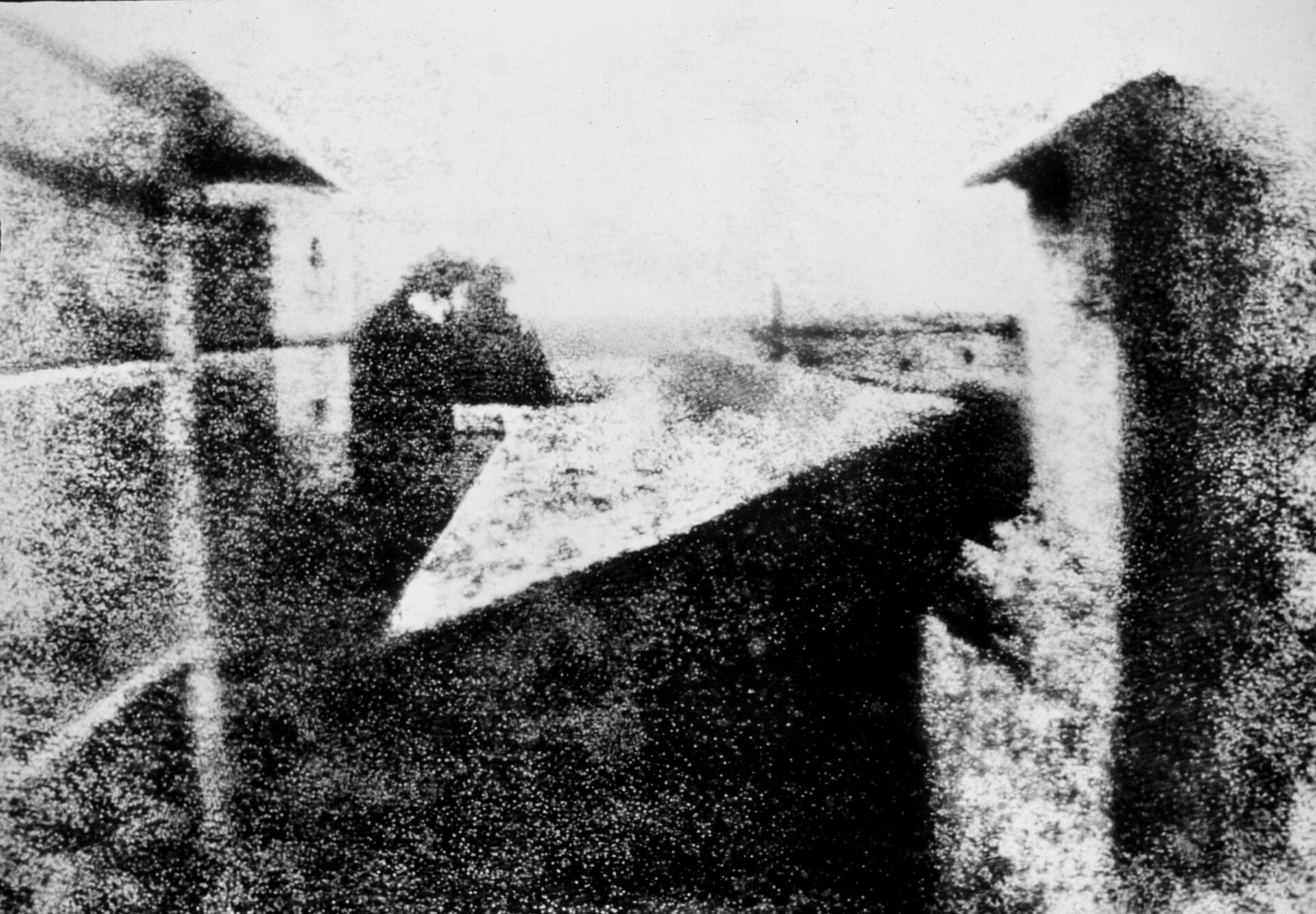
That physical fact decides what most people have actually seen. The widely reproduced image is a hand-retouched copy print made in 1952 by Kodak's London research laboratory at the request of Helmut Gernsheim, who had traced the plate and authenticated it on 14 February 1952. The copy print is the picture in the second plate here, and it shows more than the object does under ordinary light. The year is also open: Gernsheim first dated the plate to 1826 and accepted 1827 in a later edition of his history, and the Ransom Center's own publications have used both. The traditional exposure of about eight hours is argued against by a researcher who rebuilt the process and concluded it ran for days.
Talbot's Latticed Window is the oldest known negative because he wrote the date on it
The Latticed Window at Lacock Abbey is called the earliest known surviving photographic negative by the Science Museum Group, which gives its date as August 1835 and its accession number as 1937-361. The negative itself measures about 35 by 29 millimetres on a mount 69 by 150 millimetres overall, and it is an original sheet of paper that sat in a small wooden camera, not a print. Talbot's note on the mount reads as a test of resolving power: when first made, the squares of glass, about 200 in number, could be counted with the help of a lens.
The date therefore rests on a handwritten line by the man who stood to gain from an early date. In January 1839 Daguerre's process was announced in Paris, and Talbot produced negatives like this one to show he had made permanent camera images three and a half years earlier. The Metropolitan Museum holds a larger negative of the same window that it calls probably 1835, with the date left uncertain. Talbot's fixing method in 1835 was a strong salt solution, since hyposulphite came to him from John Herschel in 1839, so the paper itself is consistent with an early date without proving it.
Daguerre's 1837 still life is a candidate for the earliest daguerreotype, not a settled holder of the title
The still life of plaster casts and studio props held by the Societe francaise de photographie is dated 1837, two years before the daguerreotype process was made public. It is often introduced as the earliest surviving daguerreotype, yet the archive's record finds at least one other 1837 still life in the same collection, dedicated to the Louvre's Alphonse de Cailleux, that tertiary sources call Daguerre's oldest surviving plate. Whether the two are separate objects is itself an open question in the record, though the distinct titles and the Cailleux inscription point to two.
The subject was chosen for the job. Plaster casts under a window hold still for as long as an exposure needs, which is what a demonstration plate for backers had to prove. The date is argued from process as well as paper: a plate made in 1837 would carry the salt fixing Daguerre used then, because Herschel's hypo reached him only in early 1839. The Society was founded in 1854, and nothing documents who owned the plate in the seventeen years between.
The Boulevard du Temple plate is the first with people, and the plate itself was damaged
The Boulevard du Temple daguerreotype of 1838 looks empty because an exposure of several minutes erased everything that moved, and the only figures to survive are a man standing still in a lower corner and, on a later reading, a blurred second figure. Beaumont Newhall described one man having his boots polished in 1937. The critic David Bate, quoted in a 2024 Cambridge University Press collection, reads two: the customer and the bootblack at work. Neither has ever been named.
The plate Daguerre gave to Ludwig I of Bavaria in 1839 reached the Bayerisches Nationalmuseum by transfer in 1868, and every source the archive consulted agrees that a later cleaning attempt damaged it. They disagree on when by more than a decade, giving shortly after the Second World War, 1960, 1970 or 1974, and one academic source says the original was destroyed and only the frame remains. The museum's own database lists the item under R 6312.1-8 as facsimiles in the original passepartout and frame. The image in circulation descends from a copy negative Newhall made in 1936, before the damage.
A first is a claim about a step in the process, and each plate marks a different step
The four objects mark four different steps, which is why they can all be first at once. Niepce fixed a positive in a camera, Talbot made a negative that could in principle be printed again and again, Daguerre made plates sharp enough to persuade backers, and the Boulevard plate showed what a long exposure does to a living street. The qualifier carries the meaning, and the headline that drops it turns four true statements into one disputed one.
For anyone citing one of these pictures, the safe habit is to cite the object and the copy separately. The Niepce picture most people know is the 1952 copy print, and the Boulevard picture descends from a 1936 copy negative of a plate that no longer reads as it did. Talbot's date is his own note. Only the Societe francaise de photographie plate has no copy standing between the reader and the object, and it has the rival claim.
Questions
The Niepce heliograph, View from the Window at Le Gras, is usually named as the earliest surviving photograph made in a camera. The Harry Ransom Center dates it to 1827, and other writers give 1826.
Talbot's Latticed Window, dated August 1835 in his own handwriting, is called the earliest known surviving photographic negative by the Science Museum Group. It measures about 35 by 29 millimetres.
The sources disagree. All agree the plate was damaged by a cleaning attempt, one academic source says it was destroyed, and the Bayerisches Nationalmuseum's database lists facsimiles in the original frame.
Sources
- 1Harry Ransom Center, University of Texas at Austin, 'The Niepce Heliograph' (object page). hrc.utexas.edu/niepce-heliograph
- 2Science Museum Group Collection, 'Windows From Inside South Gallery, Lacock Abbey', object co17291, accession 1937-361. collection.sciencemuseumgroup.org.uk/objects/...
- 3Metropolitan Museum of Art, object record 282004, 'The Oriel Window, South Gallery, Lacock Abbey'. metmuseum.org/art/...
- 4Bayerisches Nationalmuseum, online collection database, Triptychon Boulevard du Temple, inventory R 6312.1-8. bayerisches-nationalmuseum.de/en/...
- 5Gardner and Stewart, eds., Nineteenth-Century Literature in Transition: The 1830s (Cambridge University Press, 2024), excerpt. assets.cambridge.org/97810092/...
- 6Ransom Center Magazine, 'Introducing the Niepce Heliograph', 20 August 2019. sites.utexas.edu/ransomcentermagazine/...
More in Research and Method
The partA Caption Is a Claim: Three Photographs of the Dead
Three photographs of the dead, made in 1858 and 1863, each carried a caption that later evidence cut down.
The Edition Has a Census and the Copy Has a Gap
Counts of surviving Wicked Bibles and first-edition Principias keep rising. The copies in this archive still have no named owner for 239 to 354 years.
No Painting, Print, Map or Photograph Here Needs a Credit Line by Licence, and Twelve of Seventeen Clocks Do
Of 334 lead plates, none of 100 paintings, prints, maps and photographs needs a credit line by licence, against 12 of 17 clocks and instruments.