Boulevard du Temple
Louis Jacques Mande Daguerre · 1838
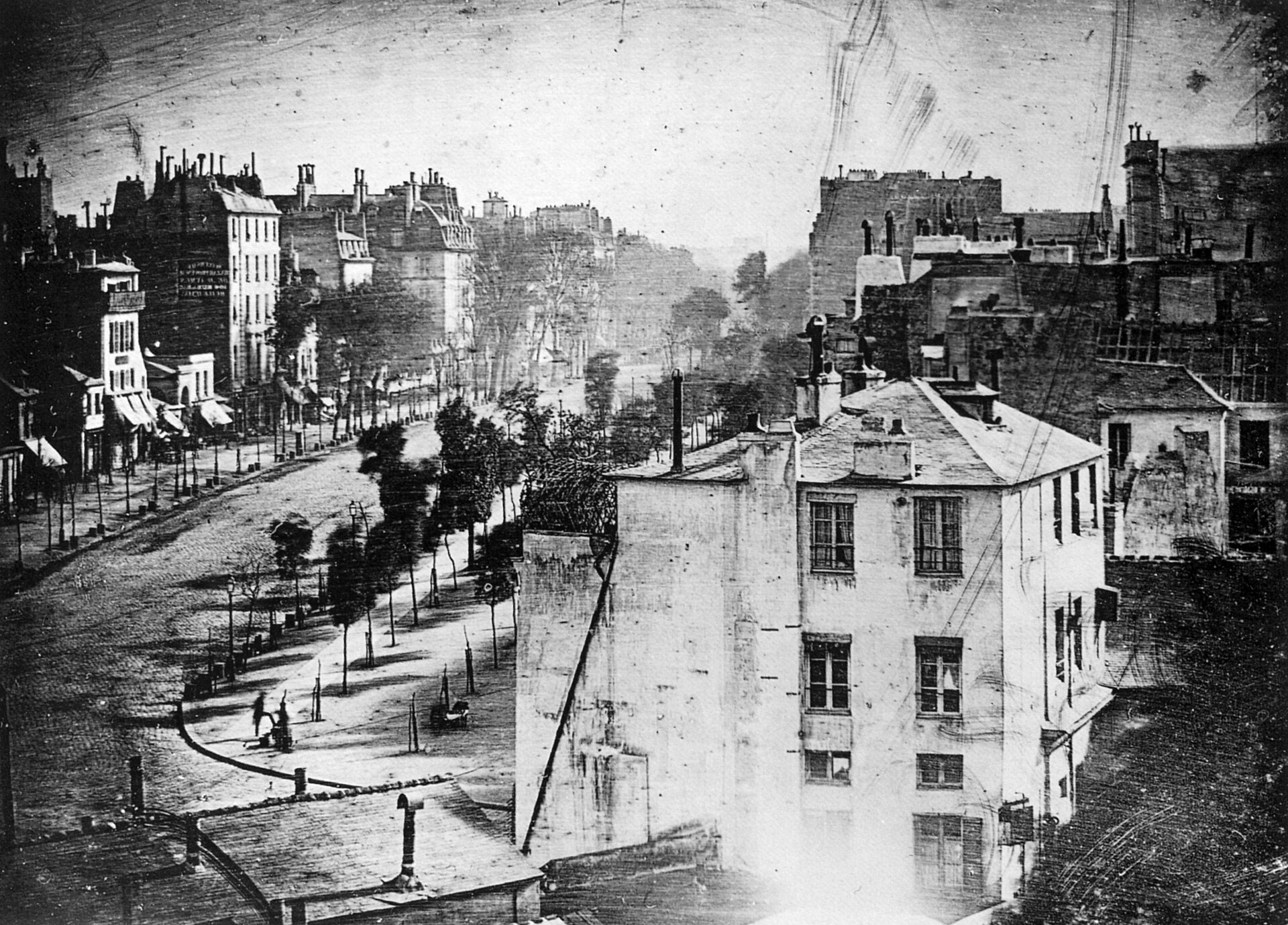
The record subject: a reproduction of Daguerre's 1838 plate, showing the boulevard from an upper window with a stationary figure, or two, visible at bottom left. This is a reproduction descending from Beaumont Newhall's 1936-37 copy negative, not a fresh photograph of the plate as it exists today; see the narrative on the original's disputed condition.
| Artist | Louis Jacques Mande Daguerre |
|---|---|
| Date | 1838 |
| Medium | Daguerreotype (iodized, silver-plated copper plate, developed in mercury vapor and fixed in a salt solution) |
| Dimensions | Approximately 13 x 16 cm, per secondary literature; not confirmed against a primary museum specification sheet in the sources consulted. |
| Where it is now | Bayerisches Nationalmuseum, Munich, Germanylast confirmed |
| Inventory number | R 6312.1-8 |
| Attribution | AcceptedUniversally attributed to Louis Daguerre. Full note |
| Object type | Photograph |
| Period | French, 1838, the first year of the publicly announced daguerreotype process |
| Inscriptions | A dedication inscription from Louis Jacques Mande Daguerre to Ludwig I, King of Bavaria, is recorded on the original passepartout of the presentation set. |
| Owners on record | 5 links4 documented, 1 disputed |
| Sources | 11 cited |
About this record Last verified · 11 sources cited · Change log
On this page 9 sections
ContentsClose
A daguerreotype made from an upper window near Daguerre's own workshop in Paris in 1838, showing a wide boulevard that appears deserted because its exposure of several minutes erased everything that moved through it. In one corner, a shape that held still, a man having his boots polished, and by one later reading a second, blurred figure doing the polishing, are usually credited as the earliest people ever fixed on a photographic plate.
Daguerre gave the plate, with a companion midday view and a studio still life, to Ludwig I of Bavaria in 1839 as a demonstration of his new invention. It reached the Bayerisches Nationalmuseum by transfer in 1868 and remains there, but every source consulted for this record agrees that the original plate was later damaged by a cleaning attempt, and one serious academic source states plainly that it was destroyed, leaving only its frame. The sources disagree by more than a decade on when this happened, and this record has not smoothed that disagreement into a single account.
What most people see when they see this image is not a photograph of the object as it exists today. It is a reproduction of a reproduction, made from a copy negative shot before the damage occurred, of a plate whose two most famous figures have never been named and whose exact damage date is not established in any source this record could verify.
Provenance
Each link is graded. Documented: a cited source supports it. Disputed: the identification is argued but not established. Unknown: no owner for that span, and the gap is not smoothed into a narrative. The grades in the glossary.
- 1838 - 1839Louis Jacques Mande Daguerredocumented
Exposed from a window near Daguerre's own apartment beside his Diorama building on the rue des Marais, Paris, in 1838 (the precise date within the year is itself disputed; see Open Questions). Daguerre retained the plate, along with a companion midday view and a studio still life, as a presentation set.45
- 1839 - 1868Ludwig I, King of Bavariadocumented
Daguerre presented the three plate set, with a dedication inscription in his own name, to Ludwig I of Bavaria. A Cambridge University Press essay collection gives 20 October 1839 as the date the set went on display at the Kunstverein in Munich. The set remained in the Bavarian royal collection for close to three decades.12
- 1868 - presentBayerisches Nationalmuseum, Munichdocumented
The museum's own online collection database records the accession as a transfer ('Ueberlassung') in 1868, under inventory R 6312.1-8. The legal mechanism of the transfer from royal to museum holdings is not specified in the source consulted.1
- Unresolved: the fate of the original plate materialdisputed
Every source consulted agrees the original plate or plates were damaged by a later cleaning or restoration attempt, but the sources disagree by more than a decade on when: shortly after the Second World War, in 1960, in 1970 (on loan to the Munich Stadtmuseum), or in 1974 (at the 'Munich Fotomuseum', per one academic source, which states the original was destroyed and only an empty frame survives). This record grades the event as disputed rather than adopting any single account.234
- 1936 - 1937Beaumont Newhall (copy negative, not ownership of the plate)documented
Newhall photographed the plate for an exhibition and publication project, producing a copy negative before the reported damage occurred. Facsimiles subsequently produced for display, and most photographic reproductions of the image in general circulation, are understood to derive from this copy rather than from a fresh photograph of the plate as it exists today.23
Technical evidence
| Attribution note | Universally attributed to Louis Daguerre. The Bayerisches Nationalmuseum's own accession record for the presentation set carries a dedication in Daguerre's name to Ludwig I, King of Bavaria, on the original passepartout, and no competing attribution appears anywhere in the sources consulted. |
|---|---|
| Process | Daguerreotype: an iodized, silver-plated copper sheet exposed in a camera obscura, developed in mercury vapor, and fixed in a salt (later sodium thiosulfate) solution.5 |
| Support | Silver-plated copper sheet.34 |
| Dimensions | Approximately 13 x 16 cm, per secondary literature. Not confirmed against a primary museum specification sheet in the sources consulted.4 |
| Exposure | Reported variously as four to five minutes, several minutes, or over ten minutes, depending on the source. No primary conservation or optical study settling the figure was found in the sources consulted.234 |
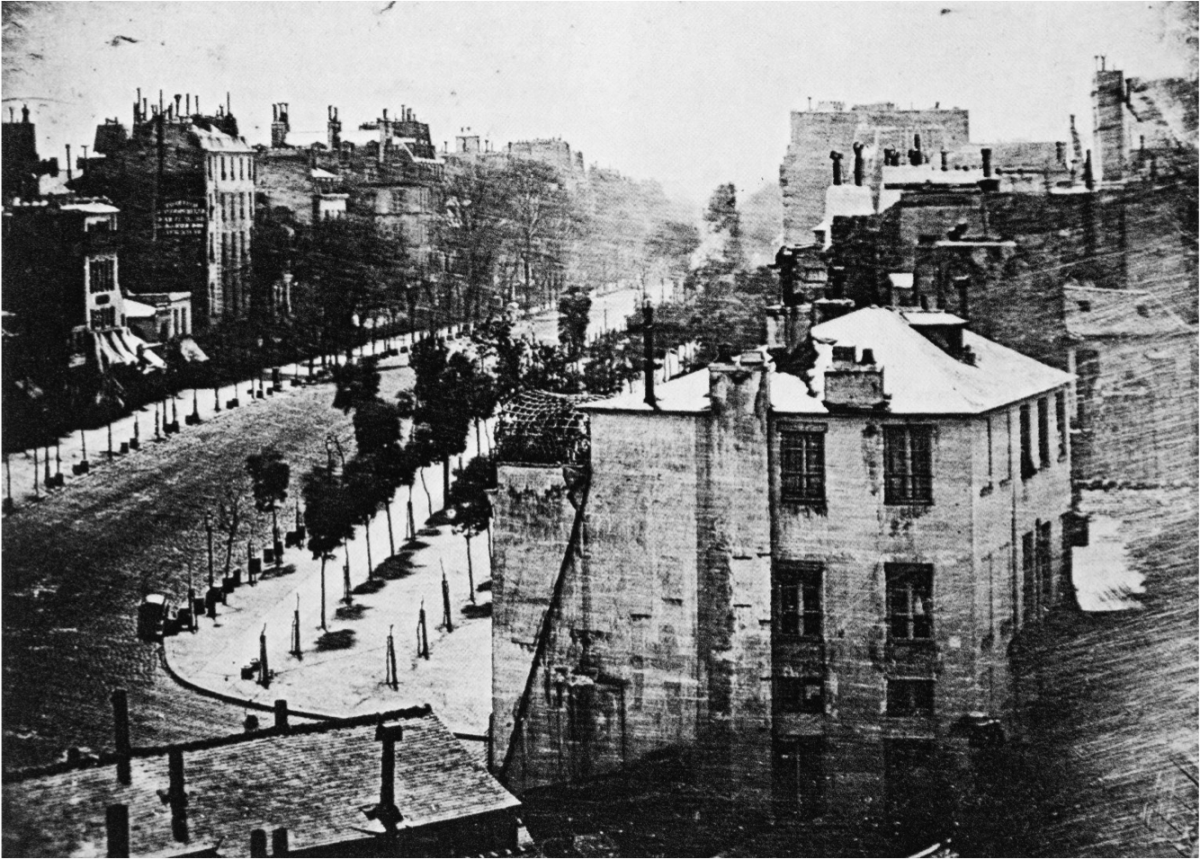
| Orientation | The image as commonly reproduced is understood to be a mirror reversal of the real scene, as produced directly by the camera obscura process without a correcting mirror. A separate, laterally flipped 'unmirrored' reproduction also circulates on Wikimedia Commons.7 |
| Accession and classification | Held by the Bayerisches Nationalmuseum under inventory R 6312.1-8, catalogued by the museum itself as 'Daguerreotypien (Originale) und Daguerreotypien (Faksimiles)'. The accession record spans both original plate material and later facsimiles rather than describing a single unambiguous object.1 |
| Present condition | The plate or plates originally presented to Ludwig I are reported by every source consulted to have been damaged by a later, undated cleaning or restoration attempt, and by one academic source to have been destroyed outright (see Open Questions). What the museum's own database describes at this inventory number today is a set of facsimiles in the original 1839 passepartout and frame.12 |
Images
The record in full
Chapter 1A street that looks empty and is not
At first glance the plate shows a wide Parisian boulevard, lined with plane trees and four and five storey buildings, curving away toward a hazy vanishing point, with no one on it at all.
At first glance the plate shows a wide Parisian boulevard, lined with plane trees and four and five storey buildings, curving away toward a hazy vanishing point, with no one on it at all. That impression is the whole point of the object and the reason it survives in the literature of photography rather than only in a museum store. The Boulevard du Temple, in 1838 one of the busiest streets in Paris, was in fact full of carriages, carts and pedestrians at the moment the plate was exposed. None of them held still long enough to leave a trace.
In the bottom left corner of the frame, at the junction where a paved forecourt meets the tree line, a small dark mark resolves, under magnification, into two figures: a stationary shape and, beside it, a fainter, blurred one bent toward it. Every other person, cart and carriage on the boulevard that morning has vanished into the blank pavement and the smear of half-registered trees. The plate did not fail to record the crowd. It recorded exactly what an exposure of several minutes will show of a moving city: nothing, except whatever refused to move.
Chapter 2How the picture was made
The daguerreotype process that Daguerre had perfected by 1837 exposed a sheet of copper plated with silver and sensitized with iodine vapor, inside a camera obscura, then developed the latent image...
The daguerreotype process that Daguerre had perfected by 1837 exposed a sheet of copper plated with silver and sensitized with iodine vapor, inside a camera obscura, then developed the latent image with mercury vapor and fixed it in a salt bath. The exposure required was long by any later standard, and the sources consulted for this record give figures ranging from four to five minutes up to more than ten, without agreement on which is correct for this specific plate.
The view looks down the boulevard from an upper floor, and the sources agree this was a window near Daguerre's own apartment beside the Diorama building he had built and operated on the rue des Marais, close to the Place du Chateau-d'Eau, an area that today sits near the Place de la Republique. Daguerre did not have to travel to make this picture. He made it by pointing a camera out of his own workplace.
Chapter 3One man, or two
The identity and even the number of human figures in the frame has been read differently by different observers, and this record treats that as a live disagreement rather than a settled fact.
The identity and even the number of human figures in the frame has been read differently by different observers, and this record treats that as a live disagreement rather than a settled fact. Writing in 1937, the photography historian Beaumont Newhall described a single figure: a pedestrian who had stopped to have his boots polished and held still through most of the exposure.
Later commentary complicates this. The critic David Bate, quoted in a 2024 Cambridge University Press essay collection, argues there are two figures, not one: the customer having his boots cleaned, and a second, much fainter figure beside him, the bootblack doing the cleaning, visible only as a blur because he was in continuous motion at his work. Bate reads the pairing as significant in its own right, an exchange of paid labor and, on his account, of class difference, standing at the literal origin point of photography's ability to fix a human being at all.
Neither figure has ever been identified by name in any source consulted for this record. Popular accounts online frequently assert additional details, a child at a window, a horse, a second man reading a newspaper on a bench, with no citation this record could trace to a primary description of the plate. Those claims are omitted here rather than repeated. What can be said is narrower: at one inch from the bottom left corner of the plate, two shapes are visible that were not moving, or not moving fast, during an exposure that erased everything else.
Chapter 4Two views, and a still life, on the same day
The plate usually reproduced as 'Boulevard du Temple' is not the only surviving image from this session.
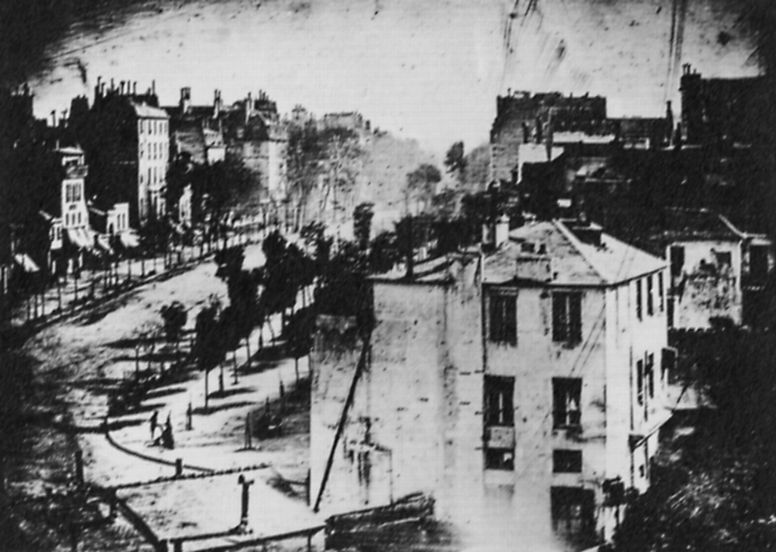
The plate usually reproduced as 'Boulevard du Temple' is not the only surviving image from this session. Daguerre made a second exposure of the same view at midday, from the same window, showing the same buildings and street furniture and no visible figures at all. The two plates are consistently described in the literature as companions made the same day, the morning exposure carrying the figures and the noon exposure serving, in effect, as the control that shows what an empty street actually looks like when nothing distinguishes it.
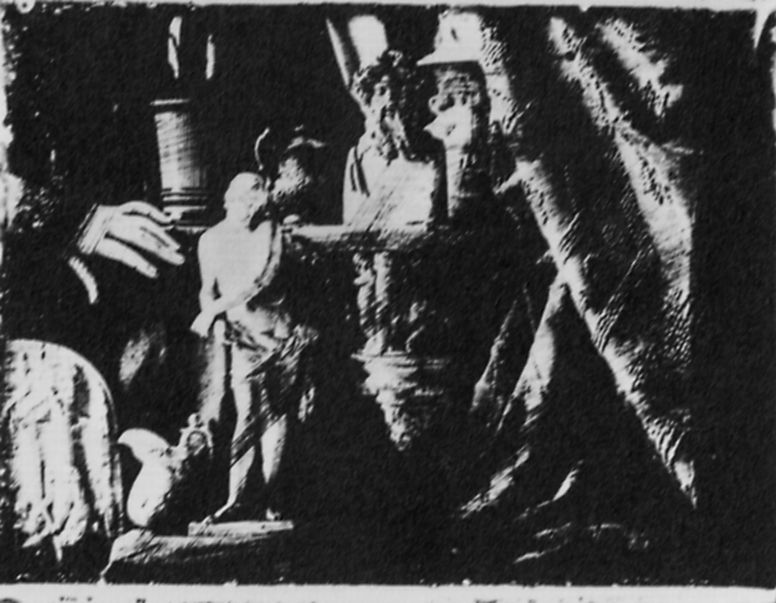
Daguerre mounted this pair with a third image, a studio still life of plaster casts arranged on a draped table, into a three part presentation set. The still life is not a street scene and was evidently included to demonstrate the process on a different kind of subject: a static, controllable arrangement rather than a public thoroughfare exposed to whatever passed through it. Together the three plates read as a demonstration piece built to show a single audience, in one framed object, what the new process could do with architecture, with atmosphere, and with a subject that never moved at all.
Chapter 5A gift for a king
The three plate set was presented to Ludwig I, King of Bavaria, and according to a Cambridge University Press essay collection was on display at the Kunstverein, the arts association in Munich, from...
The three plate set was presented to Ludwig I, King of Bavaria, and according to a Cambridge University Press essay collection was on display at the Kunstverein, the arts association in Munich, from 20 October 1839, two months after Daguerre's process had been publicly announced in Paris. Giving a demonstration set to a reigning monarch, months after making the invention public, reads as a documented strategy rather than a private courtesy: a sitting king's patronage was a fast route to prestige and credibility for an inventor whose process had just been declared free to the world, and Daguerre is known to have pursued comparable recognition and honors from other governments in the same period. The plate's audience, in other words, was chosen for reasons that had nothing to do with the boulevard itself.
The set with the dedication remained in the Bavarian royal collection for close to thirty years before it reached the institution that holds it now. The Bayerisches Nationalmuseum's own online collection record gives the transfer into the museum's holdings as 1868, using the German term 'Ueberlassung', meaning a cession or handover rather than a purchase. The museum's record does not specify the legal mechanism, whether this was a transfer from the royal household to state property, an internal reallocation, or something else, and no other source consulted supplies that detail. What is documented is the date and the fact of a transfer, not its administrative machinery.
Chapter 6A fire that this plate escaped
On 8 March 1839, five months before the daguerreotype process was made public and roughly seven months before the presentation set went on display in Munich, a fire destroyed Daguerre's Diorama...
On 8 March 1839, five months before the daguerreotype process was made public and roughly seven months before the presentation set went on display in Munich, a fire destroyed Daguerre's Diorama building in Paris. English Wikipedia's account, drawing on the standard biographical literature, states that the fire consumed daguerreotype specimens, notebooks and equipment stored on an upper floor of the building. This record has not traced an itemized inventory of what was lost, but the general point is not disputed: a working inventor's early experimental output was concentrated in one building, and that building burned down within a year of this plate's exposure.
The Boulevard du Temple plate survived because it was not in the building when the fire happened, either because it had already been set aside as a presentation piece or because it was elsewhere in Daguerre's possession. Either way, its survival should be read against the backdrop of a documented loss event that plausibly destroyed a great many comparable early plates that will never be catalogued because no description of them survives. Scarcity here is not simply a function of age. It is partly a function of what burned.
Chapter 7What happened to the original plate
Every source consulted agrees that the original plate or plates presented to Ludwig I were damaged by a later cleaning or restoration attempt.
Every source consulted agrees that the original plate or plates presented to Ludwig I were damaged by a later cleaning or restoration attempt. No two sources consulted agree on when.
French Wikipedia's article states the plate was clumsily cleaned in 1960. Several English language accounts, none traced to a primary conservation record, place a damaging restoration in 1970, after the set was lent to the Munich Stadtmuseum. A 2024 Cambridge University Press essay collection states flatly that the original was destroyed during cleaning at the 'Munich Fotomuseum' around 1974, and that only an empty wooden frame with a descriptive label now survives as physical evidence of the original object. Other popular accounts describe an overzealous cleaning attempt shortly after the Second World War, distinct from all three of the dates above.
This record does not resolve the contradiction, because none of the sources consulted resolve it either, and inventing a single account by picking the most repeated version would misrepresent a genuine, documented disagreement as a settled fact. What can be said without qualification is narrower: the plate that toured as a symbol of photography's earliest years in the twentieth century was, by every account, already a copy of something that had been damaged, and by at least one serious academic account, of something that no longer physically exists in its original form at all.
Chapter 8How the world still has the image
The image survived its own object's damage because it had already been copied.
The image survived its own object's damage because it had already been copied. In 1936 or 1937, the American photography historian Beaumont Newhall photographed the plate for an exhibition and publication project, producing a high quality negative before the reported cleaning damage occurred. Multiple sources agree that the daguerreotype facsimiles later produced for display, and by extension most photographic reproductions of this image in circulation since, trace back to Newhall's copy negative rather than to any fresh photograph of the plate as it exists today.
This has a direct consequence for how any reader should treat an image labelled 'Boulevard du Temple' found online or in a printed history of photography: it is very unlikely to be a photograph of the object as it currently exists, and is instead, at some number of generations of remove, a reproduction of a reproduction made before the damage occurred. The high resolution version most widely used online and credited to a 1997 Phaidon Press publication sits within that same chain rather than outside it. This record's lead image is drawn from that chain and is captioned accordingly rather than presented as a fresh photograph of the surviving plate.
Chapter 9Rival claims to the same title
The claim made for this plate is specific and narrower than it is usually stated: not the first photograph, and not even reliably the first photograph with a human trace in it, but among the earliest...
The claim made for this plate is specific and narrower than it is usually stated: not the first photograph, and not even reliably the first photograph with a human trace in it, but among the earliest surviving photographs in which a person can be seen at all, and the earliest to show one incidentally, as a by-product of photographing a place rather than as the deliberate subject of the picture.
The earliest surviving photograph of any kind was made over a decade earlier by Nicephore Niepce, Daguerre's own former partner, using a different process entirely. Niepce's 'View from the Window at Le Gras', made around 1826 or 1827 by exposing a pewter plate coated with bitumen of Judea, shows a rooftop view with no person visible, and is held at the Harry Ransom Center at the University of Texas at Austin. It predates Daguerre's street view by a decade and holds a distinct and better documented claim: earliest surviving photograph outright.
A different, later claim belongs to Robert Cornelius, an amateur chemist in Philadelphia, who made a self-portrait in his family's yard in October or November 1839, months after Daguerre's process was published and roughly a year and a half after the Boulevard du Temple exposure. Cornelius's picture is usually credited as the earliest surviving deliberate photographic portrait, a meaningfully different claim from an incidental figure caught in a street view: Cornelius chose to be photographed and arranged the picture himself, where the man or men on the Boulevard du Temple did not know a camera was pointed at them and were recorded only because a shoeshine took long enough to outlast the exposure.
French Wikipedia's bibliography also references a study, credited to Andre Gunthert and Jacques Roquencourt, examining an alternative dating of 1837 for a different early daguerreotype sometimes called a portrait of a Monsieur Huet. This record has not read that study directly, and notes only that French Wikipedia describes the 1837 dating attached to that separate image as too uncertain to stand, which is itself the correct way to treat a claim of this kind: it is mentioned to show that this field is full of competing early claims, most of which do not hold up, rather than to assert anything about the Huet image's actual content.
Chapter 10What later readers have made of it
Daguerre's own stated purpose for the plate, so far as it can be recovered, was promotional and technical: a demonstration piece built to secure the reputation and patronage that followed a working...
Daguerre's own stated purpose for the plate, so far as it can be recovered, was promotional and technical: a demonstration piece built to secure the reputation and patronage that followed a working inventor around Europe in 1839. Whatever meaning the picture has since acquired was added afterward, by readers looking at a street photograph made for an entirely practical reason.
The strongest example is Bate's reading of the two figures as an unintentional record of a labor transaction, a customer and a tradesman, arguably the first record of a specifically economic human relationship that photography ever produced, whether or not anyone at the time saw it that way. This is a documented interpretation attributed to a named critic, not a claim about what Daguerre intended, and this record treats it as exactly that: a later reading, not an original program. No source consulted attributes any symbolic, religious or esoteric intention to this image at the time it was made, and none should be invented. Its content is a street, a demonstration, and a king who was worth impressing.
The artist
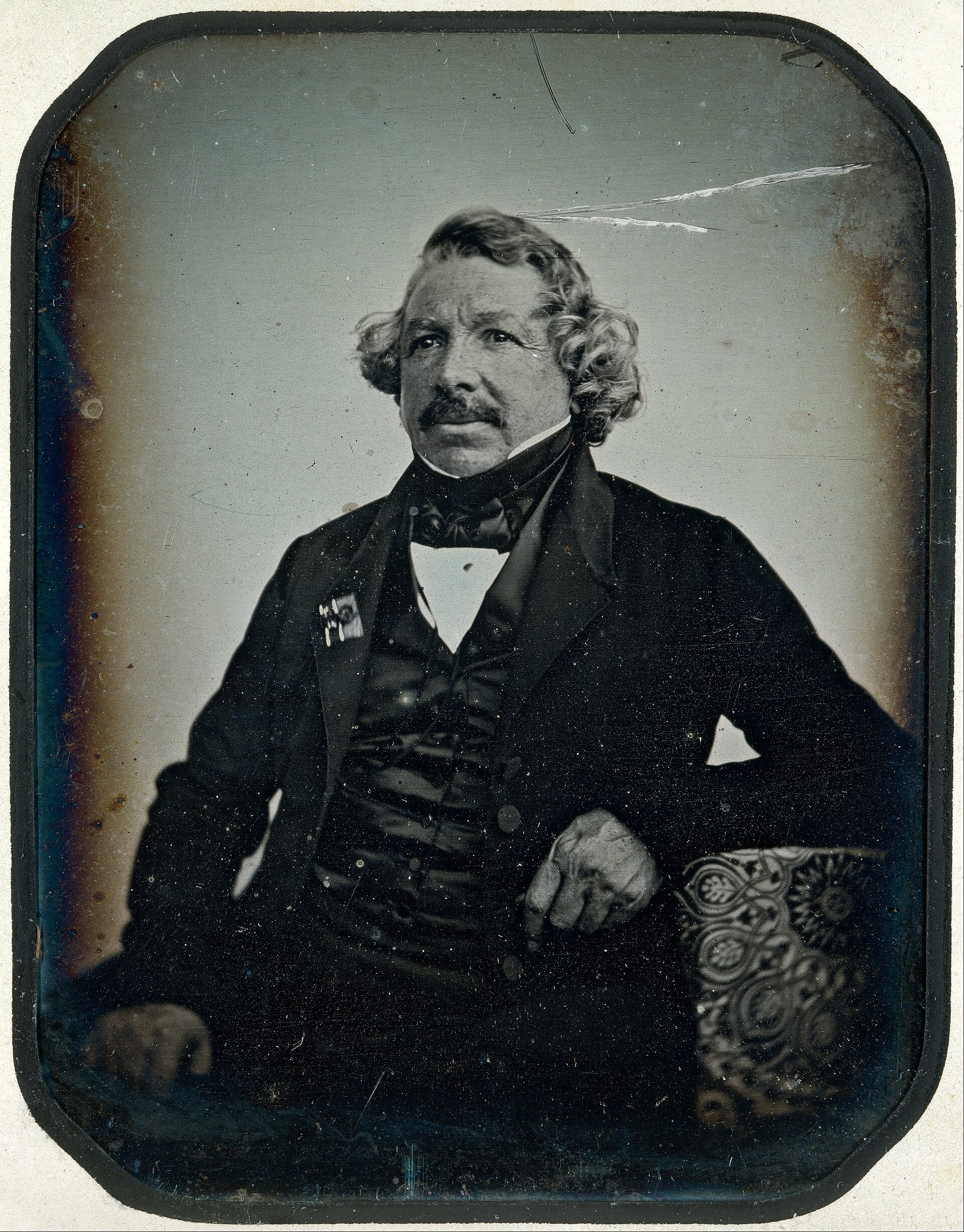
Louis Jacques Mande Daguerre
Daguerre did not begin his working life as a scientist. He trained in architecture, theatrical design and panoramic painting, and built his reputation and his fortune in the theater before he built it in chemistry. The daguerreotype process that carries his name was developed in a decade long partnership with another man, Nicephore Niepce, whose earlier and more fundamental work is frequently underweighted in accounts that lead with Daguerre's name alone. This dossier follows the documented sequence: theater, partnership, invention, fire, announcement, pension, and only then, the plate this record is about.
Related works
| Work | Relation | Where it is |
|---|---|---|
| Boulevard du Temple, at midday Louis Jacques Mande Daguerre | Companion plate, same viewpoint, made the same day Shows the identical street and buildings with no figures visible. Part of the same 1839 presentation set to Ludwig I; the direct comparison that shows what an empty street looks like under the same long exposure. | Bayerisches Nationalmuseum, Munich |
| Still life with plaster casts (Stilleben mit Gipsabguessen) Louis Jacques Mande Daguerre | Third panel of the same 1839 presentation triptych A studio still life of plaster casts on a draped table, not a street view. Shows Daguerre demonstrating the process on a fully static, controllable subject alongside the two street exposures. | Bayerisches Nationalmuseum, Munich |
| View from the Window at Le Gras Nicephore Niepce | Earlier photograph, different process, no person visible Made around 1826-1827 by the heliographic process, using bitumen of Judea on a pewter plate. Generally credited as the earliest surviving photograph of any kind. Establishes that the claim made for the Boulevard du Temple plate is specifically about the earliest surviving photograph with a person in it, not the earliest photograph outright. | Harry Ransom Center, University of Texas at Austin |
| Self-portrait Robert Cornelius | Distinct claim: earliest surviving deliberate photographic portrait Made in Philadelphia in October or November 1839, roughly a year and a half after the Boulevard du Temple exposure and months after Daguerre's process was published. Unlike the incidental figures on the Boulevard du Temple, Cornelius chose to be photographed and arranged the picture himself. | Library of Congress, Washington, D.C. |
Open questions
- What is the precise date of exposure? Most literature places it on a morning between 24 April and 4 May 1838, inferred from shadow length and foliage, but some sources give 1837 instead, and the sources consulted do not resolve the disagreement.
- Are there one or two human figures in the frame? Beaumont Newhall's 1937 account described a single stationary man having his boots polished; a later reading credited to David Bate identifies a second, blurred figure, the bootblack at work. Neither figure has ever been identified by name in any source consulted.
- Does the original plate presented to Ludwig I still physically exist? Every source agrees it was damaged by a later cleaning or restoration attempt, but the sources disagree on the date by more than a decade (accounts place it variously shortly after the Second World War, in 1960, in 1970, and in 1974), and one academic source states the original was destroyed outright, leaving only an empty frame. No conservation report resolving this was found.
- What, precisely, does the Bayerisches Nationalmuseum hold today under inventory R 6312.1-8, and is any of it ever exhibited? The museum's own database describes the item as facsimiles in the original passepartout and frame, without stating where, or whether, any surviving original plate material is separately stored.
- By what legal mechanism did the 1839 royal gift become Bayerisches Nationalmuseum property in 1868? The museum's record supplies only the German term for a transfer or cession and the year, with no further detail in the sources consulted.
Questions about this object
What is Boulevard du Temple?
Boulevard du Temple is a photograph, dated 1838. Medium: Daguerreotype (iodized, silver-plated copper plate, developed in mercury vapor and fixed in a salt solution).
Who made Boulevard du Temple, and is the attribution settled?
The attribution to Louis Jacques Mande Daguerre is recorded here as accepted. Universally attributed to Louis Daguerre. The Bayerisches Nationalmuseum's own accession record for the presentation set carries a dedication in Daguerre's name to Ludwig I, King of Bavaria, on the original passepartout, and no competing attribution appears anywhere in the sources consulted.
Where is Boulevard du Temple now?
Bayerisches Nationalmuseum, Munich, Germany. Inventory number R 6312.1-8. Last confirmed 10 August 2026. The museum's own online collection database lists the accessioned object as 'Daguerreotypien (Originale) und Daguerreotypien (Faksimiles)', with the specific item at this inventory number described as facsimiles in the original 1839 passepartout and frame. Where the museum currently holds any surviving original plate material, and whether it is ever displayed, is not stated on the record consulted.
What is still unknown about Boulevard du Temple?
What is the precise date of exposure? Most literature places it on a morning between 24 April and 4 May 1838, inferred from shadow length and foliage, but some sources give 1837 instead, and the sources consulted do not resolve the disagreement.
Sources
- 1Bayerisches Nationalmuseum, official online collection database, 'Triptychon Boulevard du Temple, Faksimiles im orig. Passepartout u. Rahmen', inventory R 6312.1-8. bayerisches-nationalmuseum.de/en/...
- 2Gardner, John and Stewart, David, eds., Nineteenth-Century Literature in Transition: The 1830s (Cambridge University Press, 2024), Introduction, quoting Beaumont Newhall (1937) and David Bate on the figures, and giving the 20 October 1839 Munich display date and an account of the original's destruction around 1974. assets.cambridge.org/97810092/...
- 3Wikipedia, 'Boulevard du Temple (photograph)'. en.wikipedia.org/wiki/...
- 4Wikipedia (French), 'Boulevard du Temple (Louis Daguerre)'. fr.wikipedia.org/wiki/...
- 5Wikipedia, 'Louis Daguerre'. en.wikipedia.org/wiki/...
- 6Library of Congress, '[Robert Cornelius, self-portrait; believed to be the earliest extant American portrait photo]'. loc.gov/pictures/...
- 7Wikimedia Commons, file description and discussion for File:Boulevard du Temple by Daguerre.jpg and its 'unmirrored' variant, including the featured picture candidacy discussion addressing image orientation. commons.wikimedia.org/wiki/...
- 8Wikimedia Commons, file description and extended metadata for File:Boulevard du Temple, midi, Daguerre.png. commons.wikimedia.org/wiki/...
- 9Zeno.org, via Wikimedia Commons: digitized reproductions of the three panels of the Munich Daguerre presentation triptych. commons.wikimedia.org/wiki/...
- 10AZQuotes, quotation attributed to Louis Daguerre's 1838 prospectus. azquotes.com/quote/...
- 11Wikimedia Commons, file description and extended metadata for File:Jean Baptiste Sabatier-Blot - Louis Jacques Mande Daguerre - Google Art Project.jpg. commons.wikimedia.org/wiki/...


.jpg)

Last verified · Published
Change log
10 August 2026 - Record created at the house standard: researched narrative, technical evidence, maker dossier, graded provenance chain, prices with hammer and premium separated, related works, open questions and sources.