L'Atelier de l'artiste
Louis Jacques Mande Daguerre · 1837
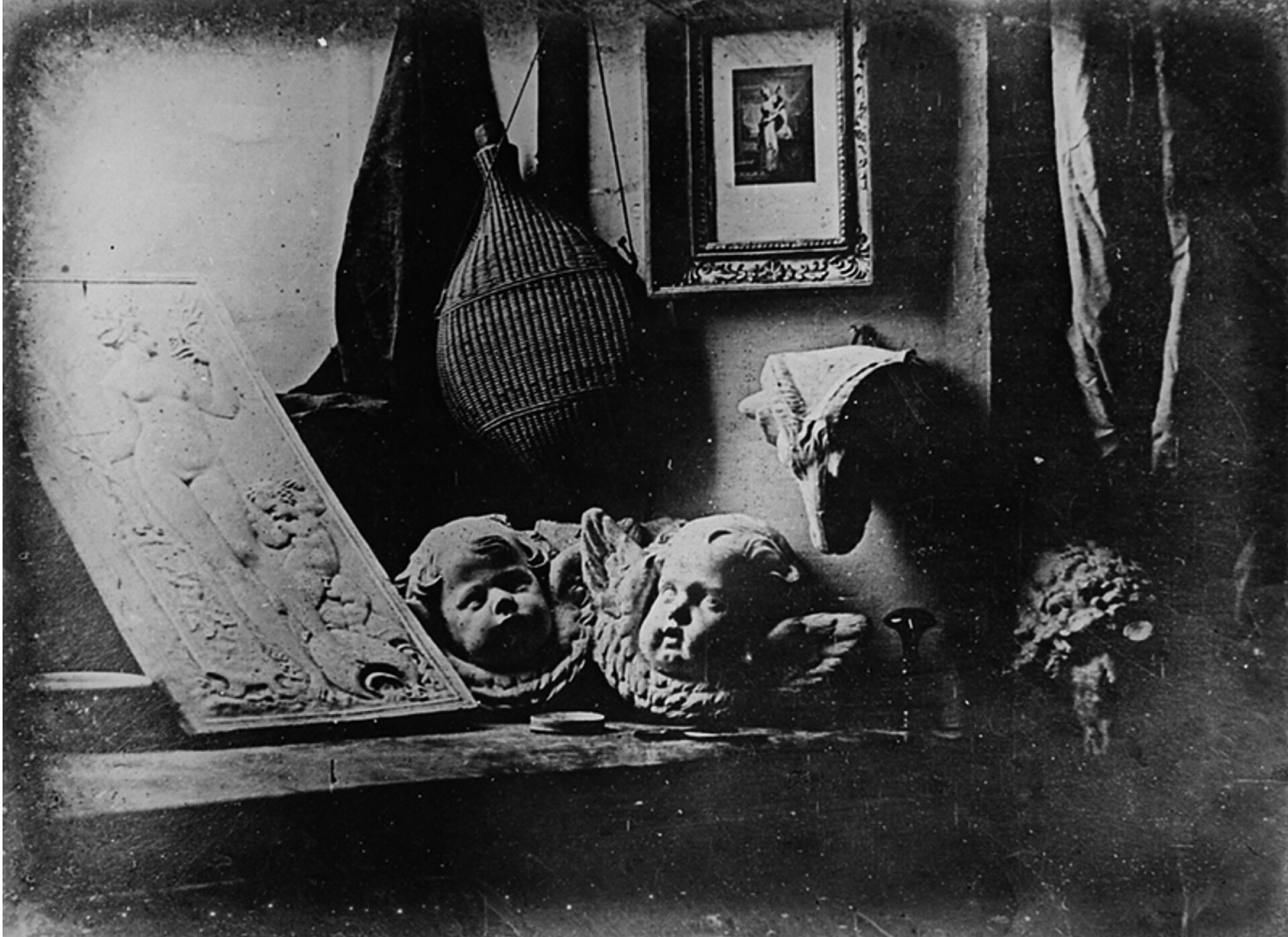
The record subject: a still life of plaster casts and studio props made by Louis Daguerre in 1837, two years before the daguerreotype process was disclosed. Credited by its own file metadata to the Societe francaise de photographie, Paris.
| Artist | Louis Jacques Mande Daguerre |
|---|---|
| Date | 1837 |
| Medium | Daguerreotype: an iodine-sensitized, silver-plated copper plate, exposed in a camera obscura and developed in mercury vapor. On the balance of the documented chronology (see Technical and Open Questions), fixed in a pre-hyposulphite salt solution rather than the sodium thiosulfate ('hypo') fixer Daguerre adopted only after John Herschel's suggestion reached him in early 1839. |
| Dimensions | Not confirmed against a primary Societe francaise de photographie specification sheet in this research pass. A figure of 8 x 9 cm circulates in tertiary sources without institutional citation, and the Wikimedia Commons digitization measures 3,200 x 2,328 pixels with no accompanying physical scale; this record treats the physical dimensions as unresolved rather than repeating an uncited figure. |
| Where it is now | Societe francaise de photographie, Parislast confirmed |
| Inventory number | Not found in the sources consulted. The SFP catalogues its Daguerre holdings in its own print inventories (listed on its website by author), but the specific inventory number for this plate was not accessible in this research pass. |
| Attribution | AcceptedUniversally attributed to Louis Daguerre in every source consulted, and credited to him in the holding institution's own file metadata. Full note |
| Object type | Photograph |
| Period | French, 1837, two years before the daguerreotype process was publicly disclosed |
| Cases | Has a provenance gap |
| Inscriptions | None documented in the sources consulted for this specific plate. This is a meaningful contrast: a related 1837 Daguerre still life also held by the SFP, known as 'Interieur d'un cabinet de curiosites', carries a verso dedication to Alphonse de Cailleux, director of the Musee du Louvre, and a Daguerre plate of 1839 now at Kynzvart Castle carries a dedication to Prince Metternich. No comparable inscription has been found reported for this plate. |
| Owners on record | 3 links2 documented, 1 unknown |
| Sources | 12 cited |
About this record Last verified · 12 sources cited · Change log
On this page 9 sections
ContentsClose
A small still life of plaster casts, drawings and studio props, arranged under a window and exposed onto a silvered copper plate in 1837, two years before Louis Daguerre's process was disclosed to the world. It is held today by the Societe francaise de photographie in Paris and is one of a very small number of demonstration plates Daguerre is known to have made before 1839, when he was still showing the invention privately to potential backers and patrons rather than selling it to the public.
It is often introduced as the earliest surviving daguerreotype. That claim is not the settled, single fact it is usually presented as: at least one other 1837 still life in the SFP's own collection, dedicated to the Louvre's Alphonse de Cailleux, is independently described in the sources as Daguerre's oldest surviving plate. This record covers the specific object carried by the Commons file credited to the SFP and captioned 'L'Atelier de l'artiste', and treats the competing 'oldest' claim as an open question rather than resolving it by assertion.
What can be said without qualification is narrower and still remarkable: whichever of the two 1837 SFP still lifes turns out to hold the stronger claim, both were made and fixed before hyposulphite, before Arago's announcement, before the government pension, and before a single member of the public had been told the process existed.
Provenance
Each link is graded. Documented: a cited source supports it. Disputed: the identification is argued but not established. Unknown: no owner for that span, and the gap is not smoothed into a narrative. The grades in the glossary.
- 1837 -Louis Jacques Mande Daguerredocumented
Made by Daguerre in his own studio in 1837, two years before the daguerreotype process was publicly disclosed, as part of a small, documented practice of producing demonstration plates to show potential backers, scientists and dignitaries. No inscription or dedication is documented for this specific plate.156
- 1837 - 1854 or laterUnknownunknown
No owner, custodian or transaction is documented for the period between the plate's creation and its appearance in the collection of the Societe francaise de photographie, an institution founded only in 1854. This gap of at least seventeen years, and possibly considerably more, is not bridged by any source consulted.
- unknown - presentSociete francaise de photographie, Parisdocumented
The plate is credited to the Societe francaise de photographie in the Wikimedia Commons file's own extended metadata and identified with that institution by every secondary source consulted. The specific date and mechanism of acquisition are not documented in any source found.1
Technical evidence
| Attribution note | Universally attributed to Louis Daguerre in every source consulted, and credited to him in the holding institution's own file metadata. No competing attribution appears anywhere in the sources found. Unlike two comparable 1837-39 demonstration plates discussed in this record (the Cailleux plate and the Metternich-gifted Kynzvart plate), no dedication, signature or inscription is documented for this specific object in the sources consulted; the attribution rests on institutional custody and consistent secondary description rather than on a transcribed inscription on the plate itself. |
|---|---|
| Process | Daguerreotype: an iodine-sensitized, silver-plated copper plate, exposed in a camera obscura and developed with mercury vapor.128 |
| Support | Silvered copper plate (specific gauge and plate-size class not confirmed in the sources consulted).8 |
| Subject and arrangement | A still life of plaster casts of sculpture with studio props and drawing materials, arranged under raking window light inside Daguerre's own studio.18 |
| Fixing method | Inferred to be a pre-hyposulphite fixer, most likely a hot solution saturated with common salt, the method documented for Daguerre's process as it stood in 1837. Sodium thiosulfate ('hypo') fixing was not available to Daguerre until John Herschel's suggestion reached him in early 1839, roughly two years after this plate's stated date. No published technical or conservation analysis of this specific plate confirming its fixative by direct examination was found.34 |
| Orientation | Laterally reversed (mirror image), as produced directly by the daguerreotype process without a correcting mirror, consistent with all unmediated daguerreotypes of the period.1 |
| Dimensions | Not confirmed against a primary institutional specification sheet. A figure of 8 x 9 cm circulates in tertiary sources without citation to the SFP; the Commons digitization measures 3,200 x 2,328 pixels with no stated physical scale. Treated as unresolved rather than repeated as fact.89 |
| Digitization | The public-domain scan in general circulation, and the source of this record's lead image, is credited to the Societe francaise de photographie and hosted on Wikimedia Commons at 3,200 x 2,328 pixels, 2.21 MB.1 |
| Condition and display status | Not documented in the sources consulted. No conservation report, exhibition record, or statement of the plate's present physical condition was found in this research pass. |
Images
The record in full
Chapter 1What it shows
The plate is a still life: plaster casts of sculpture, a scatter of studio props and, by most descriptions, drawing materials, arranged on and around a table inside Daguerre's own workspace.
The plate is a still life: plaster casts of sculpture, a scatter of studio props and, by most descriptions, drawing materials, arranged on and around a table inside Daguerre's own workspace. Light enters from a window at one side, raking across the casts and throwing the kind of hard, directional shadow that a long exposure could hold still and a human sitter could not. Nothing in the frame is alive, and nothing in the frame was ever going to move during the exposure. That is not incidental. It is the entire reason the subject was chosen.
Like every daguerreotype, the image is a direct positive on a mirror-polished plate, and it is laterally reversed: what appears on the plate's left was on the real scene's right. This is a property of the process itself, not a defect of this particular plate, and it applies to every unmediated daguerreotype view, this one included.
Chapter 2Why a still life, and why plaster casts
Daguerre did not choose plaster casts of antique sculpture because they carried a message.
Daguerre did not choose plaster casts of antique sculpture because they carried a message. He chose them because a demonstration plate had one job: to prove, to a viewer who had never seen anything like it, that a lens and a chemically prepared plate could fix fine tonal gradation and sharp detail without a hand at all. A cast under a window delivers exactly that, on demand, for as long as the exposure requires, at zero risk of the subject shifting and blurring the point being made. Studio props, drawings and casts of statuary were also simply what a working artist's studio, and Daguerre's own studio background included years as a scene painter and the operator of the Diorama, a business built entirely on constructing controlled effects of light, would have lying around and already arranged for a painter's use.
No source consulted attributes an iconographic or symbolic program to this arrangement, and none should be invented. The honest reading is the plain one: a technical demonstration, built from whatever static, well-lit material was already at hand in a painter's studio, made to be shown to people who needed convincing that photography worked at all.
Chapter 3How it was made, and why the fixing method matters for dating
By 1837 Daguerre had solved the two problems that had defeated Nicephore Niepce's earlier heliographic process: he found that mercury vapor could develop a latent image exposed on an...
By 1837 Daguerre had solved the two problems that had defeated Nicephore Niepce's earlier heliographic process: he found that mercury vapor could develop a latent image exposed on an iodine-sensitized silver plate in minutes rather than the many hours Niepce's bitumen process required, and he fixed the resulting image in a hot solution saturated with common salt. That salt-fixing method, not the sodium thiosulfate ('hypo') fixer used by every daguerreotype made after 1839, is what a plate genuinely made in 1837 would necessarily carry, because hypo was not yet part of Daguerre's process.
The timeline is precise enough to be useful here. John Herschel discovered in 1819 that sodium thiosulfate dissolves silver halides, but he did not apply that discovery to fixing a photographic image, or communicate it to Daguerre and Henry Fox Talbot, until early 1839, after seeing accounts of Daguerre's and Talbot's work. A plate dated 1837 therefore predates the existence of hypo-fixing by roughly two years. This record has not located a published technical or conservation analysis of this specific plate confirming its fixative by direct examination; the point stands as a documented consequence of the chronology, not as a laboratory finding, and is flagged as such in Open Questions.
Chapter 4A demonstration plate, not a public photograph
In 1837 photography did not exist as a public fact.
In 1837 photography did not exist as a public fact. Daguerre had a working process, no announced invention, no patent yet filed in France, and no income from it. What he had instead was a small number of finished plates that he could put in front of people whose support he needed: scientists who might vouch for the process, officials who might help him secure a state reward, and, later, once he judged the moment right, crowned heads of Europe whose patronage was worth more to a working inventor's reputation than any single sale.
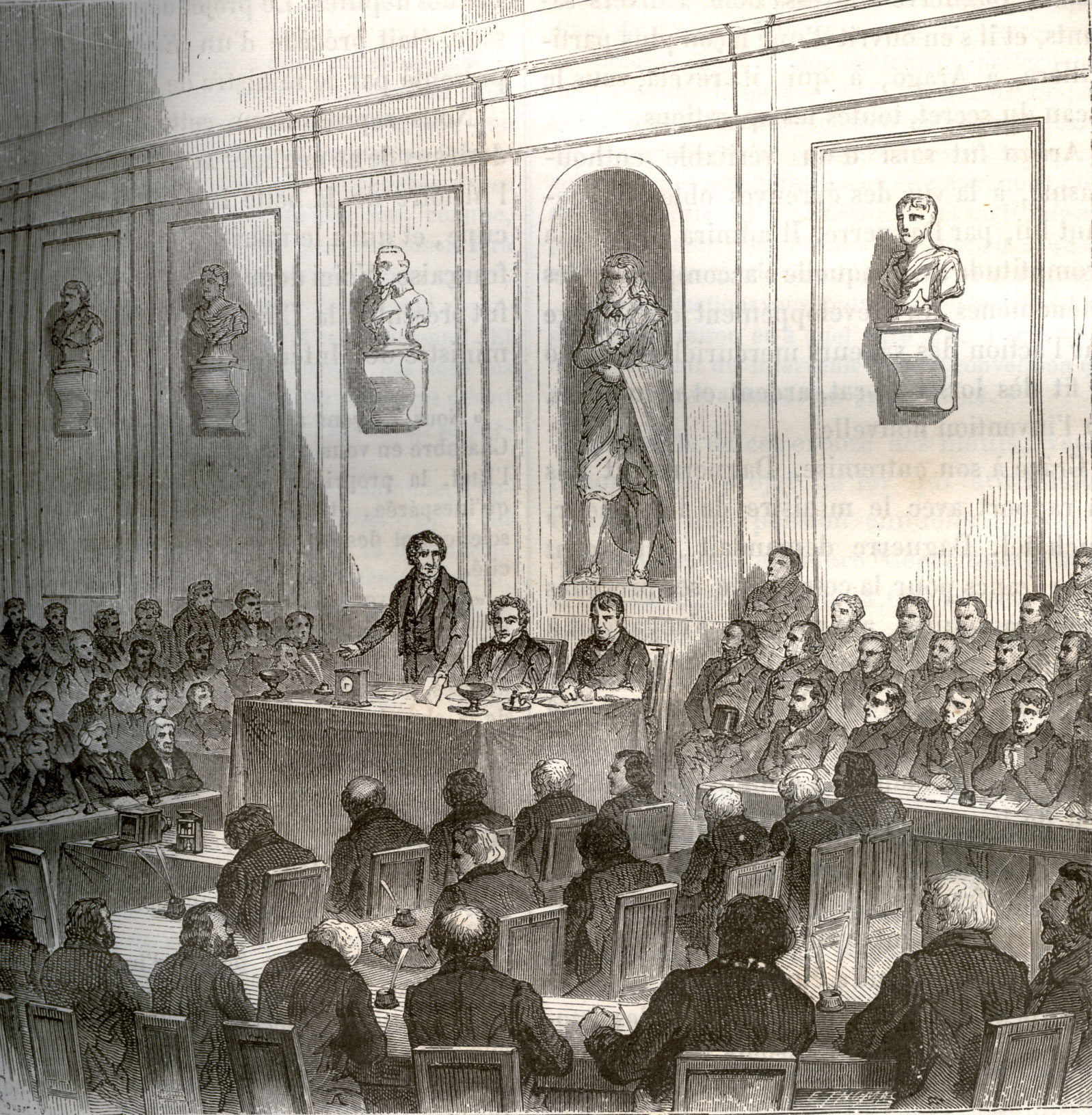
A scholarly account of Daguerre's later demonstration campaign, published in the journal Genesis, records that Daguerre sent daguerreotype plates to a range of political, scientific and artistic figures, and that roughly twenty of these survive, fortunately, in institutions today; the same account describes Francois Arago presenting the process to the Chamber of Deputies in July 1839 with the deliberate rhetorical claim that the process required no drawing skill at all, so that literally anyone could use it as well as Daguerre himself. This plate belongs to the earlier end of that same practice: a demonstration object made before there was a public to demonstrate to.
Chapter 5Other plates from the same practice, at other institutions
This plate is not the only survivor of Daguerre's pre-1839 or 1839 demonstration campaign, and naming the others is the only way to avoid attributing their history to this one.A daguerreotype now at...
This plate is not the only survivor of Daguerre's pre-1839 or 1839 demonstration campaign, and naming the others is the only way to avoid attributing their history to this one.
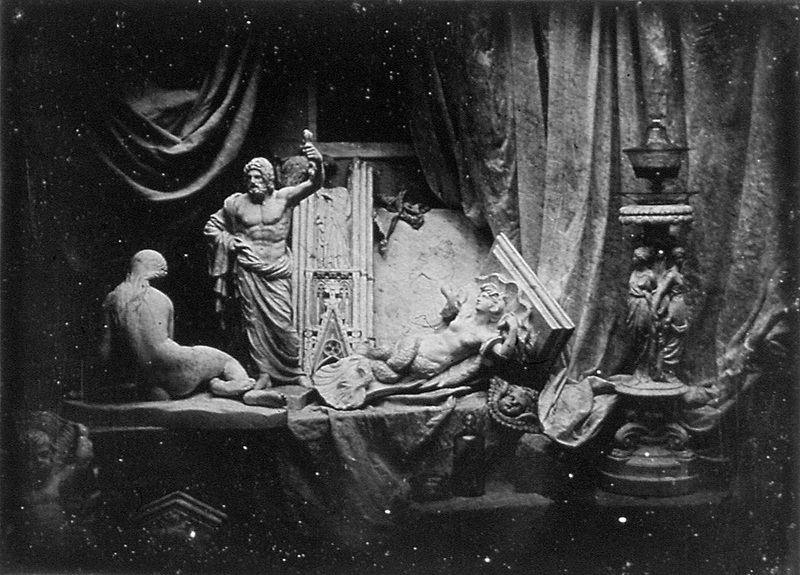
A daguerreotype now at Kynzvart Castle in the Czech Republic (on long-term loan to the National Technical Museum in Prague, and inscribed on the UNESCO Memory of the World Register in 2017) shows a comparable still life of plaster casts, dominated by a statue of Jupiter Tonans. Its own file metadata states it was among the specimens Daguerre presented to the French Chamber of Deputies in July 1839, and that Daguerre subsequently gave it to the Austrian State Chancellor, Prince Klemens von Metternich, with a written dedication, shortly before the process was disclosed on 19 August 1839. That plate is dated to 1839, not 1837, was never in French state or SFP custody, and has no connection to this record's object beyond sharing a genre and a maker.
A second Daguerre still life of plaster casts, also held by the SFP and also dated 1837, is documented under the title 'Interieur d'un cabinet de curiosites'. It carries, per its own reported verso inscription, a dedication to Alphonse de Cailleux, the director of the Musee du Louvre: 'Epreuve ayant servi a constater la decouverte du Daguerreotype offerte a Monsieur de Cailleux par son tres devoue serviteur Daguerre.' Independent sources describe this Cailleux plate, not the plate this record covers, as Daguerre's oldest surviving daguerreotype, and separately record that it remained visible into the 1920s before suffering environmental damage and a non-reversible conservation intervention later in the twentieth century. This record has not been able to confirm, one way or the other, whether the Cailleux plate and this record's plate are in fact two separate objects or a single object described inconsistently across sources; the balance of the evidence, including the distinct titles, the distinct and specifically documented inscription, and the distinct damage history reported only for the Cailleux plate, favors two separate objects, and this record treats them as such while flagging the residual uncertainty in Open Questions.
A third, unrelated still life bearing a similar description exists at the Bayerisches Nationalmuseum in Munich: the third panel of the three-plate presentation set Daguerre gave to Ludwig I of Bavaria, dated 1838 and already the subject of a separate published record on this site, 'Boulevard du Temple' (slug daguerre-boulevard-du-temple). That panel is not reproduced here and this record adds nothing to its history; it is named only so that a reader assembling 'Daguerre plaster cast still lifes' from search results does not fold it into this object's provenance.
A fourth, entirely different maker enters the picture as well: the J. Paul Getty Museum holds a daguerreotype titled 'Still Life With Plaster Casts', made in 1839-42 by Baron Armand-Pierre Seguier, a French amateur associated with Daguerre's own circle of early adopters, not by Daguerre himself. Its near-identical title and closely related subject matter make it an easy plate to confuse with this record's object in a casual search; they are unrelated works by different hands, four years apart in date, held on different continents.
Chapter 6The 1839 disclosure, and where this plate sits relative to it
Everything that made photography public happened two years after this plate was exposed.
Everything that made photography public happened two years after this plate was exposed. On 7 January 1839, Francois Arago, the astronomer, physicist and permanent secretary of the Academie des Sciences, announced Daguerre's invention to a joint session of the Academie des Sciences and the Academie des Beaux-Arts, describing its existence and significance without disclosing the technical process itself. Arago then became the process's principal political advocate, arguing successfully for the French state to acquire the rights from Daguerre and from Isidore Niepce, son and heir of Daguerre's late partner Nicephore Niepce, in exchange for lifetime government pensions: 6,000 francs a year to Daguerre and 4,000 francs a year to Isidore Niepce. On 19 August 1839, the full working process was published and presented to the joint Academies, and the French government declared it a gift 'free to the world.'
A plate dated 1837 therefore predates the first public knowledge that photography existed by roughly two years, and predates the full technical disclosure, the government pension, and the process's free release by the same span. It belongs to the period when the daguerreotype was a private, unannounced capability that its inventor controlled entirely, shown only to the people he chose to show it to.
Chapter 7The 'first successful daguerreotype' claim, examined
Multiple tertiary sources, including museum-education and image-licensing sites, describe this plate outright as 'the earliest known surviving daguerreotype' or 'the first successful daguerreotype.'...
Multiple tertiary sources, including museum-education and image-licensing sites, describe this plate outright as 'the earliest known surviving daguerreotype' or 'the first successful daguerreotype.' That claim is repeated often enough, and confidently enough, that it can look like settled scholarly consensus. It is not, on the evidence this record was able to gather.
Independently, and without reference to this plate, other sources describe the SFP's separate Cailleux-dedicated still life, 'Interieur d'un cabinet de curiosites', as Daguerre's oldest surviving plate. Both claims cannot be straightforwardly true of two different objects at once, and this record has not found a single authoritative source, a peer-reviewed history of photography or a published SFP catalogue, that adjudicates between the two objects and states which one actually holds the earlier or better-attested claim. What the sources agree on is narrower and more defensible: both plates are dated 1837, both were made by Daguerre before the process was disclosed, and both are exceptionally rare survivors of a period from which very little of Daguerre's experimental output survives at all, in part because a fire destroyed Daguerre's Diorama building and the specimens stored in it on 8 March 1839. The popular single-object 'first successful daguerreotype' framing appears to be a simplification of a genuinely contested, two-object situation, not a settled scholarly finding, and this record states that plainly rather than repeating the simplification as fact.
Chapter 8Custody: what is documented, and what is not
The plate's presence in the Societe francaise de photographie's collection today is not in question; it is stated in the file's own credit line and repeated without exception across every secondary...
The plate's presence in the Societe francaise de photographie's collection today is not in question; it is stated in the file's own credit line and repeated without exception across every secondary source consulted. What is missing from every source found is the history that would normally sit in a provenance line: when the SFP acquired the plate, from whom, and by what mechanism, whether purchase, gift, bequest or transfer from another French institution. The SFP was founded in 1854, seventeen years after this plate was made, so the object necessarily passed through at least one earlier owner, documented or not, before reaching the society that holds it now. No record of that owner, or of any owner between 1837 and the SFP's custody, was found in this research pass.
This is a real gap, not a minor one, and this record does not fill it with a guess. A plate this significant to the history of photography ought to have a documented acquisition history somewhere in the SFP's own archives or published catalogues; if a reader or a specialist can supply it, replacing this gap with a documented event is the single most valuable addition this record could receive.
Chapter 9Fragility, condition and the case for caution
Daguerreotypes are direct positives on a thin, chemically active silver surface, not negatives from which further prints can be made, and the image layer is notoriously vulnerable to abrasion...
Daguerreotypes are direct positives on a thin, chemically active silver surface, not negatives from which further prints can be made, and the image layer is notoriously vulnerable to abrasion, tarnish and any contact with the plate surface. The comparable Cailleux plate in the same collection, independently reported to have remained visible into the 1920s before suffering damage and an irreversible conservation intervention later in the twentieth century, is a documented illustration of exactly the kind of loss daguerreotypes of this generation are prone to. No comparable damage or conservation history has been found reported for the specific plate this record covers, and this record does not assume its condition is better or worse than the Cailleux plate's on that basis. What can be said is that any 1837 daguerreotype, whichever one is meant, is old enough, and physically fragile enough, that its exact current condition is worth stating precisely rather than assuming from its continued existence in a collection.
Chapter 10Reproduction and how the image circulates today
The image now in wide circulation, including the file underlying this record, is a digital scan credited to the SFP and released to Wikimedia Commons as public domain, at 3,200 by 2,328 pixels.
The image now in wide circulation, including the file underlying this record, is a digital scan credited to the SFP and released to Wikimedia Commons as public domain, at 3,200 by 2,328 pixels. It appears routinely in general surveys of the history of photography and in undergraduate art-history teaching materials under the English titles 'The Artist's Studio' and 'Still Life in Studio', usually alongside the flat claim, examined above, that it is photography's first successful result. Its wide reuse in teaching contexts is itself part of why the ambiguity with the Cailleux plate matters: a claim repeated in enough textbooks and course pages acquires the texture of settled fact well before anyone checks whether the underlying attribution has actually been resolved.
Chapter 11What is still unresolved
Set against the reference standard this site holds itself to, several questions about this object remain open rather than answered, and are recorded as such below instead of being smoothed over.
Set against the reference standard this site holds itself to, several questions about this object remain open rather than answered, and are recorded as such below instead of being smoothed over. The precise day or month of exposure within 1837 is not established in any source consulted. The plate's physical dimensions are not confirmed against a primary specification. Its fixing method is inferred from the documented chronology of Herschel's 1839 hyposulphite discovery rather than confirmed by direct technical analysis of the plate itself. Its relationship to the Cailleux-dedicated 'Interieur d'un cabinet de curiosites', also at the SFP and also dated 1837, is not conclusively resolved as either the same object under a different title or a genuinely separate one, though the weight of the evidence favors two separate plates. And the entire chain of custody between 1837 and the plate's present home at the SFP, founded in 1854, is undocumented in every source this research pass located.
The artist
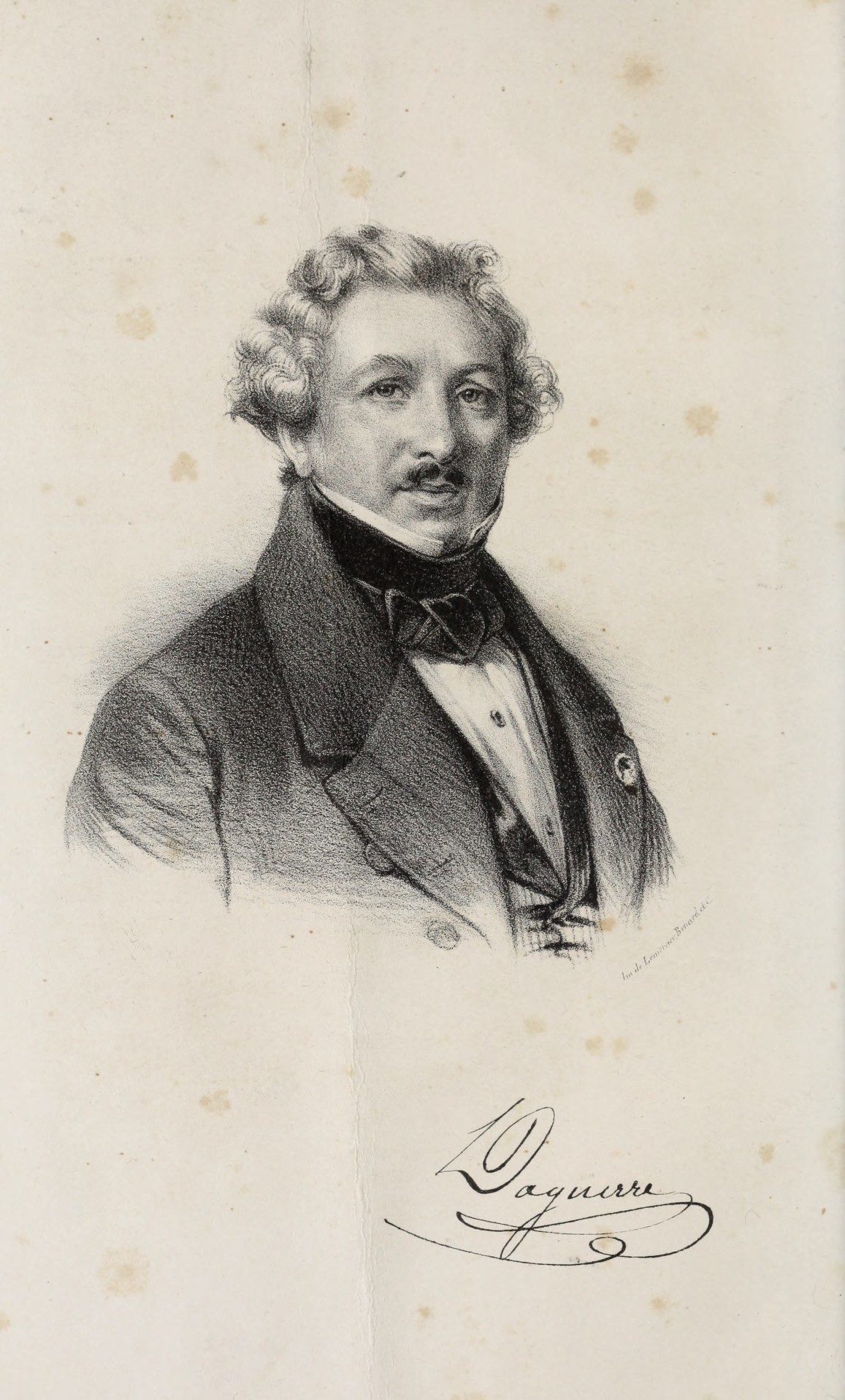
Louis Jacques Mande Daguerre
Daguerre came to photography from the theater, not from science, and the still life this record describes was made by a man who had spent fifteen years building his reputation and his income from controlled, staged effects of light before he ever fixed one permanently on a plate. The plates he made and gave away between 1837 and 1839, this one among them, were not yet public inventions. They were a private man's evidence, shown selectively to the people whose belief in the process he needed before he had anything to sell or announce.
Related works
| Work | Relation | Where it is |
|---|---|---|
| Interieur d'un cabinet de curiosites Louis Jacques Mande Daguerre | A second, separately documented 1837 still life of plaster casts, also held by the Societe francaise de photographie Dedicated on its verso to Alphonse de Cailleux, director of the Musee du Louvre. Independently described in sources as Daguerre's oldest surviving daguerreotype, a claim in direct tension with the popular description of this record's own object as 'the first successful daguerreotype.' Reported damaged by a later conservation intervention after remaining visible into the 1920s. Not conclusively established as a different object from this record's plate, though the balance of evidence favors treating it as one; see Open Questions. | Societe francaise de photographie, Paris |
| Still life with statue of Jupiter Tonans (the Kynzvart Daguerreotype) Louis Jacques Mande Daguerre | A comparable pre-disclosure demonstration still life of plaster casts, made two years later Dated 1839, among the specimens shown to the Chamber of Deputies in July 1839 and then given to Prince Metternich with a written dedication, shortly before the 19 August 1839 public disclosure. Inscribed on the UNESCO Memory of the World Register in 2017. A different plate, made for a different recipient, never in SFP or French state custody. | National Technical Museum, Prague, on long-term loan from Kynzvart Castle |
| Stilleben mit Gipsabguessen, third panel of the Ludwig I presentation triptych Louis Jacques Mande Daguerre | A third, unrelated Daguerre still life of plaster casts, part of an already-published record on this site Dated 1838. The third plate of the three-panel set Daguerre presented to Ludwig I of Bavaria alongside the two 'Boulevard du Temple' views; already covered by this site's separate published record at slug daguerre-boulevard-du-temple. Named here only to prevent a reader folding its history into this object's. | Bayerisches Nationalmuseum, Munich |
| Still Life With Plaster Casts Baron Armand-Pierre Seguier | A closely related subject and near-identical title, by a different maker entirely Made 1839-42 by an amateur associated with Daguerre's early circle, not by Daguerre. Its title and subject matter make it an easy plate to confuse with this record's object in a casual image search. | J. Paul Getty Museum, Los Angeles (accession 2002.41) |
| Boulevard du Temple Louis Jacques Mande Daguerre | Daguerre's better-known 1838 street view, already published on this site A distinct, later object: a street scene, not a studio still life, made from a window near Daguerre's Diorama building and given to Ludwig I of Bavaria in 1839. See this site's record at slug daguerre-boulevard-du-temple; this record does not duplicate its content or its plates. | Bayerisches Nationalmuseum, Munich |
Open questions
- On what day or month within 1837 was the plate actually exposed? No source consulted gives a date more precise than the year.
- Is 'Interieur d'un cabinet de curiosites', the Cailleux-dedicated SFP still life independently described elsewhere as Daguerre's oldest surviving plate, a genuinely separate object from this record's plate, or the same object described inconsistently across sources under two different titles? The distinct titles, the specifically documented Cailleux inscription, and the distinct damage history reported only for that plate favor two separate objects, but this record has not found a source that states this explicitly.
- When, from whom, and by what mechanism did the Societe francaise de photographie acquire this plate? The SFP was founded in 1854, seventeen years after the plate was made, and no source consulted documents any owner between 1837 and the plate's present custody.
- What are the plate's confirmed physical dimensions? Figures circulating online are not traceable to a primary SFP specification in the sources consulted.
- Has any conservation or material analysis of this specific plate been published, confirming its fixing method, its plate gauge, or its current physical condition? None was found in this research pass.
- Does this plate carry any inscription, mark or dedication comparable to the Cailleux plate's verso text or the Kynzvart plate's dedication to Metternich? None is documented in the sources consulted, which is itself worth confirming rather than assuming.
- What exhibition or loan history, if any, does this specific plate have? No exhibition record was found in this research pass.
Questions about this object
What is L'Atelier de l'artiste?
L'Atelier de l'artiste is a photograph, dated 1837. Medium: Daguerreotype: an iodine-sensitized, silver-plated copper plate, exposed in a camera obscura and developed in mercury vapor. On the balance of the documented chronology (see Technical and Open Questions), fixed in a pre-hyposulphite salt solution rather than the sodium thiosulfate ('hypo') fixer Daguerre adopted only after John Herschel's suggestion reached him in early 1839.
Who made L'Atelier de l'artiste, and is the attribution settled?
The attribution to Louis Jacques Mande Daguerre is recorded here as accepted. Universally attributed to Louis Daguerre in every source consulted, and credited to him in the holding institution's own file metadata. No competing attribution appears anywhere in the sources found. Unlike two comparable 1837-39 demonstration plates discussed in this record (the Cailleux plate and the Metternich-gifted Kynzvart plate), no dedication, signature or inscription is documented for this specific object in the sources consulted; the attribution rests on institutional custody and consistent secondary description rather than on a transcribed inscription on the plate itself.
Where is L'Atelier de l'artiste now?
Societe francaise de photographie, Paris. Inventory number Not found in the sources consulted. The SFP catalogues its Daguerre holdings in its own print inventories (listed on its website by author), but the specific inventory number for this plate was not accessible in this research pass.. Last confirmed 10 September 2026. Credited to the 'Societe francaise de photographie' in the file's own extended metadata on Wikimedia Commons, and consistently identified with that institution by every secondary source found. The date and mechanism by which the SFP acquired this specific plate were not found in any source consulted.
What is still unknown about L'Atelier de l'artiste?
On what day or month within 1837 was the plate actually exposed? No source consulted gives a date more precise than the year.
Sources
- 1Wikimedia Commons, File:Daguerreotype Daguerre Atelier 1837.jpg, file page and extended metadata (LicenseShortName 'Public domain', Credit 'Societe francaise de photographie', Artist Louis Daguerre, Date 1837), verified via the Commons API. commons.wikimedia.org/wiki/...
- 2Wikipedia, 'Louis Daguerre'. en.wikipedia.org/wiki/...
- 3Wikipedia (French), 'Louis Daguerre'. fr.wikipedia.org/wiki/...
- 4Wikipedia, 'John Herschel'. en.wikipedia.org/wiki/...
- 5Wikipedia, 'Kynzvart Daguerreotype'. en.wikipedia.org/wiki/...
- 6UNESCO Memory of the World Register, 'The Kynzvart Daguerreotype - the birth of modern visual media', for the 1839 dating and the Metternich gift, and its 2017 inscription. unesco.org/en/...
- 7Journal Genesis (OpenEdition), article discussing Daguerre's practice of sending demonstration daguerreotypes to political, scientific and artistic figures, of which roughly twenty are recorded as surviving, and Francois Arago's July 1839 presentation to the Chamber of Deputies. journals.openedition.org/genesis/...
- 8Laboratoire des premieres fois (Tumblr), quoting the verso inscription of Daguerre's 'Interieur d'un cabinet de curiosites' dedicating the plate to Alphonse de Cailleux, director of the Musee du Louvre. laboratoiredespremieresfois.tumblr.com/post/...
- 9Brewminate, 'Louis Daguerre and the Birth of Commercial Photography in 1837', for Alphonse de Cailleux's role as director of the Louvre and recipient of an 1837 Daguerre demonstration plate, and for the Sabatier-Blot portrait context. brewminate.com/louis-daguerre-and-the-birth-of-commercial...
- 10Photoquotations.com, quotations attributed to Louis Daguerre, including the 1838 description of the process reproducing 'very fine gradation of tones'. photoquotations.com/a/...
- 11The J. Paul Getty Museum, collection record for 'Still Life With Plaster Casts' by Baron Armand-Pierre Seguier, 1839-42, accession 2002.41, consulted to distinguish this unrelated object from the plate covered by this record. getty.edu/art/...
- 12Wikimedia Commons, File:Daguerre kynzvart.jpg, file page and extended metadata, for the Kynzvart plate's own description and July 1839 Chamber of Deputies context. commons.wikimedia.org/wiki/...


Last verified · Published
Change log
10 September 2026 - Record created at the house standard: researched narrative, technical evidence, maker dossier, graded provenance chain, prices with hammer and premium separated, related works, open questions and sources.