Latticed Window at Lacock Abbey
William Henry Fox Talbot · August 1835
Last verified 15 September 2026 · 17 sources cited · Change log
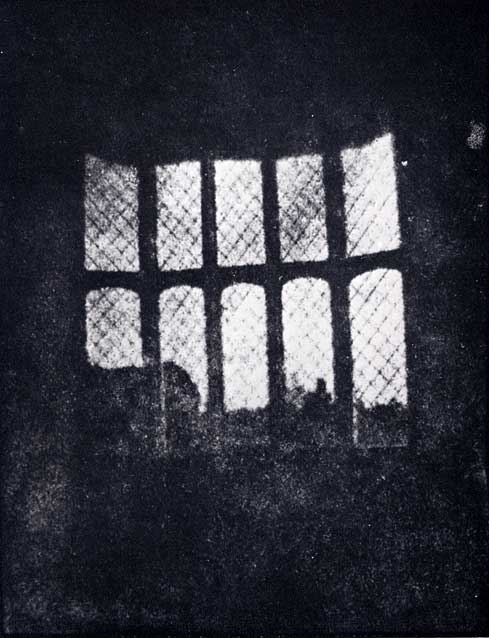
A modern positive image made from Talbot's August 1835 negative, showing the latticed oriel window in the South Gallery of Lacock Abbey as a viewer would expect a photograph to look. The original object is the negative, not this print.
| Artist | William Henry Fox Talbot |
|---|---|
| Date | August 1835 |
| Medium | Photogenic drawing negative: paper sensitized with silver chloride (salted then silver-nitrated) and exposed in a small wooden camera |
| Dimensions | Negative image approximately 35 x 29 mm; overall mount 69 x 150 mm; dark paper surround 58 x 50 mm |
| Where it is now | National Science and Media Museum, Bradford (Science Museum Group), 1937-361last confirmed 15 September 2026 |
| Attribution | acceptedAuthorship is not in dispute. Full note |
| Object type | Photograph |
| Period | British, 19th century, the invention of photography |
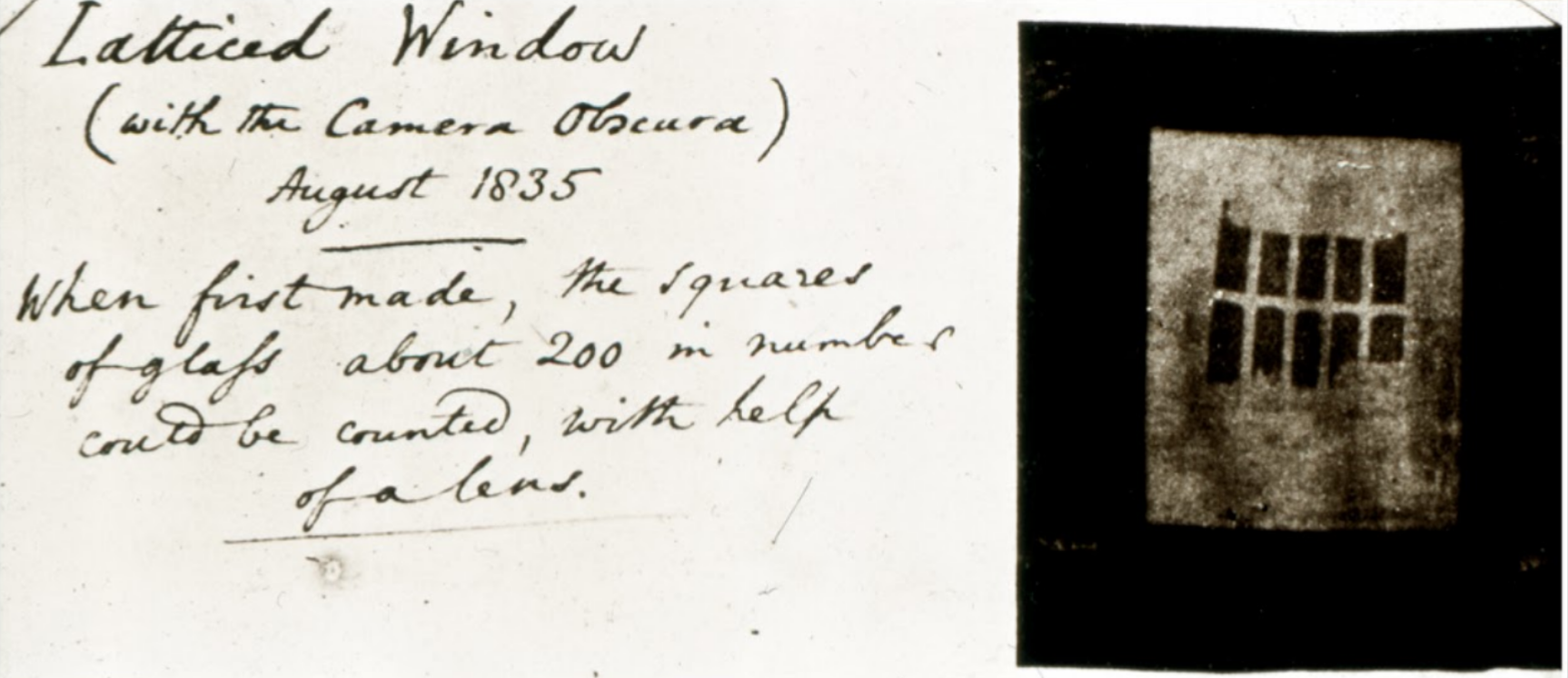
| Inscriptions | In Talbot's hand, on the mount: "Latticed Window (with a Camera Obscura, August 1835). When first made, the squares of glass, about 200 in number, could be counted with the help of a lens." (transcriptions of the exact punctuation vary slightly between published sources; see sources 9 and 11). |
- Where it is now
- National Science and Media Museum, Bradford (Science Museum Group)last confirmed 15 September 2026
- Attribution
- accepted
- Provenance
- 4 links4 documented
- Sources
- 17 cited
- Last verified
- 15 September 2026Change log
On this page 9 sections
A paper negative about the size of a large postage stamp, made by William Henry Fox Talbot inside Lacock Abbey in August 1835. It shows a latticed oriel window in the house's South Gallery, and it is conventionally described as the oldest surviving camera negative in existence. Talbot's own handwritten annotation on the mount, naming the month and year, is the evidence on which that claim and his later priority dispute with Louis Daguerre both rest.
When news reached London in January 1839 that Daguerre had unveiled a rival process in Paris, Talbot produced negatives like this one to prove he had been making permanent camera images almost three and a half years earlier. The two men had solved a genuinely different problem by genuinely different means, working independently and unaware of each other, and the resulting argument over who had 'invented photography' shaped how both processes were patented, licensed and adopted for the next two decades.
The negative has been in the national collection since 1937, is too fragile for permanent display, and is normally shown only as a facsimile alongside one of Talbot's small wooden cameras.
Provenance
Each link is graded. Documented: a cited source supports it. Disputed: the identification is argued but not established. Unknown: no owner for that span, and the gap is not smoothed into a narrative. The grades in the glossary.
- August 1835 - 1877William Henry Fox Talbotdocumented
Made by Talbot at Lacock Abbey in August 1835 and retained there as part of his own working archive until his death in 1877.1313
- 1877 - 1916Charles Henry Talbotdocumented
Lacock Abbey and its contents passed to Talbot's elder son, Charles Henry Talbot, on his father's death.13
- 1916 - 1934/1937Matilda Talbot (nee Gilchrist-Clark)documented
Charles Henry Talbot died unmarried in 1916 and left Lacock Abbey to his niece, who took the name Talbot and organized a centenary exhibition of her grandfather's photographic work in 1934.13
- 1934/1937 - presentScience Museum / Science Museum Group (now National Science and Media Museum, Bradford)documented
Transferred from the Talbot family archive at Lacock to the Science Museum; catalogued 1937 with accession number 1937-361 and credit line 'Matilda Talbot'. Matilda Talbot separately gave Lacock Abbey itself to the National Trust in 1944.113
Technical evidence
| Attribution note | Authorship is not in dispute. The negative carries Talbot's own handwritten annotation naming the subject and the month and year it was made, and it descended through his direct family before entering the national collection. What is genuinely contested is not who made it but what to call it: whether it is truly the earliest surviving camera negative, and how its status should be weighed against Talbot's own later, larger, undated negative of the same window and against Daguerre's and Niepce's entirely different processes in France. |
|---|---|
| Support and medium | Writing paper, salted and sensitized with silver nitrate to form light-sensitive silver chloride; exposed as a negative inside a small wooden camera and fixed with a strong salt solution (Talbot's pre-1839 fixing method, before John Herschel's suggestion of sodium thiosulfate).112 |
| Dimensions | Negative image approximately 35 x 29 mm; dark paper surround 58 x 50 mm; overall mount 69 x 150 mm.1 |
| Camera | One of Talbot's small wooden 'mousetrap' cameras, some as small as two to three inches on a side, fitted with a telescope or microscope lens, several dozen of which he had built and placed around Lacock Abbey in the summer of 1835.312 |
| Exposure | A printing-out exposure with no separate development step; comparable photogenic drawing negatives of the period are reported to require from ten minutes to an hour or more depending on the lens and available light.12 |
| Inscription | Talbot's own handwritten annotation on the mount naming the subject, the month and year (August 1835), and noting that about 200 panes of glass could originally be counted in the image with a lens.911 |
| Accession number | 1937-361, Science Museum Group; credit line 'Matilda Talbot'.1 |
| Comparable object, different negative | A larger (8.5 x 11.6 cm) paper negative of the same window, in the Metropolitan Museum of Art's Rubel Collection (accession 1997.382.1), catalogued only as 'probably 1835' with its precise date acknowledged as uncertain, unlike the annotated Bradford negative described in this record.45 |
| Display status | Held in archive storage as too fragile for permanent exhibition; a facsimile, shown with one of Talbot's mousetrap cameras, substitutes for the original in the museum's galleries.2 |
Images
The record in full
What it is
The object is a single sheet of writing paper, chemically treated and exposed in a small wooden camera, showing a tonally reversed image of a latticed window seen from inside a room. The negative image itself measures roughly 35 by 29 millimetres, mounted on a larger sheet of dark paper 58 by 50 millimetres, itself set onto a support sheet 69 by 150 millimetres overall. It is, in other words, smaller than a modern passport photograph, and the window it depicts is only legible with close inspection or a lens, exactly as Talbot's own annotation describes.
It is not a print. It is the original piece of paper that sat inside the camera during the exposure, chemically altered in the pattern of light and shadow that fell on it. Every positive photograph made from it, then or since, is one step removed from this sheet.
How it was made
Talbot's process, which he called photogenic drawing, started with ordinary writing paper washed in a weak solution of common salt, blotted and dried, then brushed on one side with a strong solution of silver nitrate. The reaction produced a coating of silver chloride in an unusually light-sensitive state. Loaded into a camera and exposed to a bright scene, the coating darkened where light fell on it, building up a visible image during the exposure itself: this was a printing-out process, with no separate chemical development step as later photography would use.
The camera was one of the small wooden boxes, some no larger than a two- or three-inch cube fitted with a lens from a telescope or microscope, that Talbot had built by the dozen and scattered around the grounds of Lacock Abbey that summer. His wife Constance is credited with the nickname that stuck: mousetraps, for the way they sat baited with light around the house and garden. Exposures for this kind of image are reported at anywhere from ten minutes to an hour or more depending on the lens and the available sunlight, and Talbot fixed his earliest negatives with a strong salt solution; the more reliable fixer, sodium thiosulfate, only entered his practice after John Herschel suggested it to him in 1839, four years after this negative was made.
The subject: a window seen from inside
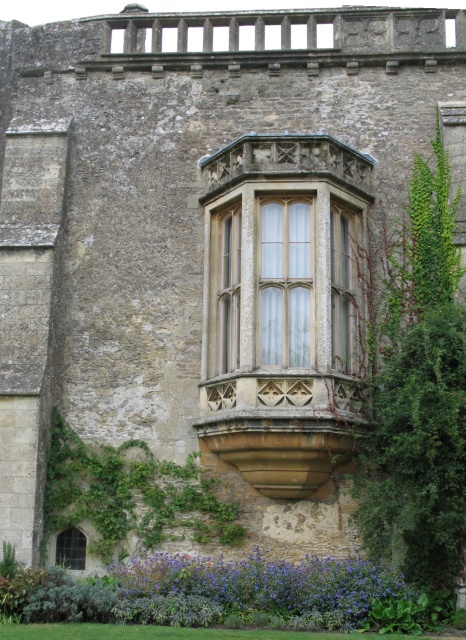
The window itself is a latticed oriel in the South Gallery of Lacock Abbey, Talbot's family home in Wiltshire, and the photograph was taken from inside the room looking out at the leaded panes. It is a domestic, unplanned subject in the most literal sense: Talbot pointed his cameras at whatever was close at hand and stationary long enough to sit through a slow exposure, and a window frame full of small glass squares was, for the same reason a photographer today tests a lens on a brick wall, a natural subject for checking how much detail the new process could resolve.
That is precisely what his own annotation records. He did not caption the image as a work of art or a view of his house; he captioned it as a test of resolving power, noting that when the negative was first made, someone with a lens could count around two hundred individual panes of glass in it. The annotation is evidence of the process's technical performance as much as it is a record of the date.
The annotation and what it actually proves
The wording, given here as transcribed by the museum's own popular accounts, reads: "Latticed Window (with a Camera Obscura, August 1835.) When first made, the squares of glass, about 200 in number, could be counted, with the help of a lens." It is written in Talbot's own hand, in small script, on the back or mount of the negative.
This single sentence is the entire basis for two separate claims made about this object: that it was made in August 1835, and that it is the oldest surviving camera negative anywhere. Both claims rest on Talbot's own retrospective note, not on an independently dated record made at the moment of exposure. That does not make the date wrong. It makes it worth stating plainly what kind of evidence it is: a contemporary or near-contemporary inscription by the maker, on the object itself, which is about as strong as evidence for a 191-year-old unpublished negative gets, but which is still a single-source claim rather than a witnessed or externally corroborated one.
A camera negative, not the first photograph Talbot made
The specific superlative attached to this object needs to be stated precisely, because the popular version of it is often looser than the evidence supports. Talbot's earliest photogenic drawings, made from 1834, were contact prints and photograms: leaves, lace and other flat objects laid directly on sensitized paper and exposed to sunlight, with no camera involved at all. Those experiments predate this negative and are not in competition with it for any title, because they are a different kind of object.
What this negative claims is narrower and more defensible: it is the oldest surviving negative made inside a camera, using a lens to form an image of a three-dimensional scene, that can still be examined today. That distinction, between a photogram made by contact and a negative made by projection through a lens, is the difference between a shadow and a photograph in the modern sense, and it is the reason this object rather than an earlier leaf print carries the claim.
January 1839: the announcement that forced Talbot's hand
Talbot did little further work on his camera process between 1835 and the very end of 1838. That changed abruptly in January 1839. On 7 January, Francois Arago announced to the French Academy of Sciences that Louis Daguerre had achieved a means of fixing images from the camera obscura permanently, but Arago gave no technical details of the process itself, both to protect Daguerre's commercial position and because the French government was then negotiating to buy the invention for the nation. News of the announcement reached English newspapers around 19 January.
Talbot's own account of his reaction survives: he wrote that he found himself "placed in a very unusual dilemma (scarcely to be paralleled in the annals of science)", because he stood to lose credit for years of his own work if Daguerre's undisclosed process turned out to be the same as his, and Daguerre published first in Paris before Talbot could establish his own priority in London. He did not yet know that the two processes were, in fact, fundamentally different.
The Royal Institution and the Royal Society
Talbot moved fast. On 25 January 1839, less than three weeks after Arago's announcement, he exhibited a selection of his photogenic drawings at the Royal Institution in London; his work was presented there partly through Michael Faraday. On 31 January he read a paper to the Royal Society titled "Some Account of the Art of Photogenic Drawing, or the Process by which Natural Objects May Be Made to Delineate Themselves without the Aid of the Artist's Pencil", which he had printed and distributed privately as a pamphlet the following month, the first separate publication on photography.
The paper itself contained no technical instructions for replicating the process. What it did was establish a documented, witnessed date on which Talbot's photogenic drawings, camera negatives among them, were shown to a learned society in London, deliberately built to predate any French claim to have been first. Negatives annotated with 1835 dates, of the kind this object represents, were exactly the evidence that made the claim credible rather than merely asserted.
Two different inventions, one contested word
The dispute that followed is genuinely a dispute, not a manufactured one, but it is worth being precise about what was actually being disputed. Daguerre's process, once its details were finally published later in 1839 after the French government purchased rights to it, produced a single, direct, positive image on a silver-plated copper sheet sensitized with iodine vapor and developed with mercury vapor: sharp, one of a kind, and unreproducible except by rephotographing the plate itself. Talbot's process produced a negative on paper from which any number of positive prints could be made by contact printing, at somewhat lower resolution but with the negative/positive logic that all subsequent film and darkroom photography, and this record's own reproduction of the image, still depends on.
Once Talbot understood that Daguerre's plate process was not the same as his own paper process, the fight over 'who invented photography' stopped being a fight over a single shared technique and became a fight over which act counted as the invention: the first person to fix a camera image permanently, in whatever form, or the first person to devise the reproducible negative that made photography an industry rather than a curiosity. Historians of photography generally treat both claims as independently earned: Talbot and Daguerre worked without knowledge of each other's methods and arrived at different technical answers to a shared problem that had also, a decade earlier and by a third route, briefly occupied Nicephore Niepce in France.
Patents, licensing and why Daguerre won the headline
The two men's business decisions diverged as sharply as their chemistry. The French government granted Daguerre and Niepce's heir annual pensions in exchange for releasing the daguerreotype process to the world free of patent restriction, an arrangement Arago justified publicly as a gift to civilization. Talbot instead patented his improved process, the calotype, in 1841, and pursued licensing fees from other photographers who wanted to use it, reportedly selling only a small number of licenses and prosecuting at least one well-known infringement case in the 1850s.
The commercial result favored Daguerre in the short term: daguerreotypes, sharper and immediately available without a license, dominated portrait photography through the 1840s and into the 1850s, while Talbot's own commercial venture, the Reading Establishment, closed within a few years. The historical result favored Talbot: the daguerreotype was a technological dead end, incapable of duplication, while the negative/positive principle demonstrated by this object became, and remains, the basis of photographic reproduction.
From Lacock Abbey to the national collection
The negative stayed inside the Talbot family's own keeping for exactly a century. William Henry Fox Talbot died at Lacock in 1877 and the house and its contents passed to his elder son, Charles Henry Talbot, who never married and, on his death in 1916, left Lacock Abbey to his niece, Matilda Theresa Gilchrist-Clark, who took the name Talbot in her uncle's honor. Matilda Talbot became the custodian of her grandfather's photographic legacy in a way none of her predecessors had been: she organized a centenary exhibition of his work in 1934, and in the years that followed transferred a large body of Talbot material, this negative among it, from Lacock to the Science Museum in London. The Science Museum Group's own catalogue records this specific negative under accession number 1937-361, credited to Matilda Talbot.
Matilda Talbot went on to give Lacock Abbey itself, along with its grounds and village, to the National Trust in 1944, ensuring the house where the negative was made would remain open to the public even as the negative itself moved to a national scientific collection. The Fox Talbot Museum, opened at Lacock afterward, tells the story of the invention on the site where it happened, while the object itself is kept and shown, when it is shown at all, at what is now the National Science and Media Museum in Bradford.
Condition, fragility and how a negative is displayed
The negative is described by the museum's own staff as too fragile for permanent exhibition. A museum curator with nearly three decades at the institution reported having seen the original only twice in that time. What visitors to the Bradford museum's photography galleries normally see instead is a facsimile of the negative displayed alongside one of Talbot's surviving mousetrap cameras, rather than the object itself.
This creates an unusual situation for an object of this importance: almost every reproduction the public has ever seen of the Latticed Window, including most of the images accompanying this record, is either a modern positive print made from the negative, reversing its tones back to the light and dark values a viewer expects from a photograph, or a photographic facsimile of the negative substituting for public access to the fragile original. Understanding this object means understanding that what is usually shown is one or more removes from the paper Talbot actually loaded into his camera in 1835.
A rival negative of the same window
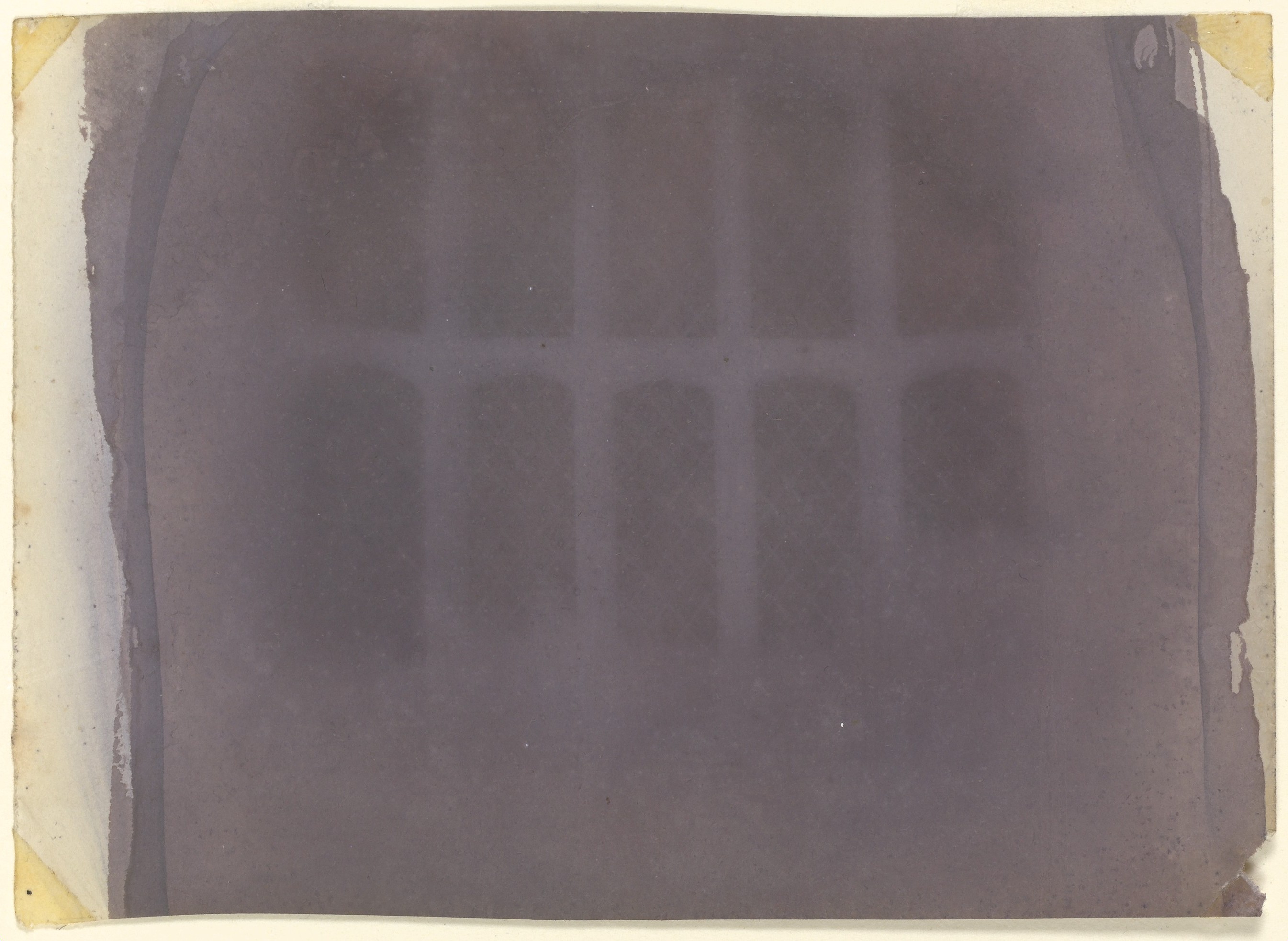
The claim to be the earliest surviving camera negative has to be weighed against an object Talbot himself made later of the same subject. The Metropolitan Museum of Art in New York holds a considerably larger paper negative, also titled The Oriel Window, South Gallery, Lacock Abbey, from the Rubel Collection, accessioned in 1997. Its sheet measures 8.5 by 11.6 centimetres, roughly ten times the area of the Bradford negative, and it shows the same latticed window from a similar vantage point.
Crucially, the Met's own cataloguing calls its negative's date "probably 1835" and Wikimedia Commons' description of the same image states plainly that its date is uncertain, distinguishing it explicitly from "a better-known postage-stamp-size negative showing the same window" that carries Talbot's own August 1835 annotation, meaning the smaller Bradford negative described in this record. The larger negative may be an early Lacock Abbey window study from the same campaign, or it may be a later, undated remake; without an inscription equivalent to the one on this object, its exact date cannot be fixed. The existence of this second, larger, undated negative of the identical subject is itself a caution against treating the superlative attached to the Bradford negative as self-evident: it survives with a precise date because Talbot chose to write one on it, not because it is necessarily unique in age among his surviving camera work.
Naming and the museum's own several names
The object itself carries at least three names in circulation: the popular title 'Latticed Window at Lacock Abbey' or simply 'The Latticed Window', the more literal title used by its own institution's catalogue, 'Windows From Inside South Gallery, Lacock Abbey', and the annotation's own wording, 'Latticed Window (with the Camera Obscura)'. None of these is wrong; they reflect a plain descriptive object that predates any formal title convention for photographs and has simply been called what it shows by whoever was cataloguing it.
Its holding institution has changed name three times without changing custody of the object: it opened to the public as the National Museum of Photography, Film and Television in 1983, was renamed the National Media Museum in 2006, and became the National Science and Media Museum in 2017, throughout remaining part of the Science Museum Group. A reader encountering an older source citing 'the National Media Museum' or 'the National Museum of Photography, Film and Television' as the holder of this negative is reading about the same institution under an earlier name, not a different collection.
The artist
William Henry Fox Talbot
Talbot was not primarily a photographer by trade or training; he was a Cambridge-educated mathematician, sometime Member of Parliament, botanist and Assyriologist who treated the fixing of camera images as one research problem among several he pursued across a long gentleman-scientist's career. That breadth is part of why he came to the problem at all: he began experimenting with light-sensitive paper in 1834 out of frustration at his own inability to draw the views he saw through a camera lucida, a mechanical drawing aid, well enough by hand.
Related works
| Work | Relation | Where it is |
|---|---|---|
| The Oriel Window, South Gallery, Lacock Abbey William Henry Fox Talbot | A larger, undated paper negative of the same window; its date is acknowledged by its holding museum as uncertain, unlike the annotated August 1835 negative described in this record Not the object described in this record; included for direct comparison only. | Metropolitan Museum of Art, New York (The Rubel Collection, 1997.382.1) |
| The Pencil of Nature William Henry Fox Talbot | Talbot's own 1844-46 book, the first commercially published photographically illustrated book, presenting the calotype process he patented after this negative was made Documents Talbot's own account of his process and its applications, written after the priority dispute with Daguerre. | Various collections |
| Boulevard du Temple Louis Daguerre | The rival French process at the center of the January 1839 priority dispute; a direct-positive image on a silvered copper plate, technically unrelated to Talbot's paper negative/positive method Named here only to draw the contrast between the two independently developed processes; no facts from that record are used here. | Recorded elsewhere in this archive |
| View from the Window at Le Gras Nicephore Niepce | An earlier (c. 1826-27) fixed camera image by a third, independent experimenter in France, using yet another process (heliography on a pewter plate) Predates both Talbot's and Daguerre's work; cited only to show that the fixing of a camera image was attempted independently by at least three inventors before any of them knew of the others. | Recorded elsewhere in this archive |
Open questions
- Where exactly was this negative kept between 1835 and its 1937 transfer to the Science Museum? The Talbot family's continuous ownership is documented in outline, but no source consulted for this record details who specifically held or handled the object year to year.
- What is the true date of the Metropolitan Museum's larger negative of the same window? The Met itself calls it 'probably 1835' while acknowledging the date is uncertain; it has never been resolved against the annotated Bradford negative.
- Did other camera negatives from Talbot's 1835 experiments survive uncatalogued or unrecognized, given that dozens of mousetrap cameras were in simultaneous use at Lacock that summer? None has been identified as a rival to this object in the sources consulted.
- Which fixing method was actually used on this specific negative? Talbot's general practice in 1835 was a strong salt solution, since Herschel's hypo suggestion came in 1839, but no source consulted confirms the fixer used on this particular sheet.
- Can the roughly 200 window panes described in Talbot's own annotation still be counted today, or has fading and fragility reduced the negative's resolving detail since 1835? No current condition report was found in the sources consulted.
- How and when precisely did the object move from Lacock Abbey to the Science Museum? A 1934 centenary exhibition and a 1937 accession date are both documented, but the exact circumstances of the transfer itself are not detailed in the sources consulted.
Questions about this object
What is Latticed Window at Lacock Abbey?
Latticed Window at Lacock Abbey is a photograph, dated august 1835. Medium: Photogenic drawing negative: paper sensitized with silver chloride (salted then silver-nitrated) and exposed in a small wooden camera.
Who made Latticed Window at Lacock Abbey, and is the attribution settled?
The attribution to William Henry Fox Talbot is recorded here as accepted. Authorship is not in dispute. The negative carries Talbot's own handwritten annotation naming the subject and the month and year it was made, and it descended through his direct family before entering the national collection. What is genuinely contested is not who made it but what to call it: whether it is truly the earliest surviving camera negative, and how its status should be weighed against Talbot's own later, larger, undated negative of the same window and against Daguerre's and Niepce's entirely different processes in France.
Where is Latticed Window at Lacock Abbey now?
National Science and Media Museum, Bradford (Science Museum Group), 1937-361. Last confirmed 15 September 2026. Descended through Talbot's family at Lacock Abbey to his granddaughter Matilda Talbot, who transferred it to the Science Museum; catalogued 1937 with the credit line 'Matilda Talbot'.
What is still unknown about Latticed Window at Lacock Abbey?
Where exactly was this negative kept between 1835 and its 1937 transfer to the Science Museum? The Talbot family's continuous ownership is documented in outline, but no source consulted for this record details who specifically held or handled the object year to year.
Sources
- 1Science Museum Group Collection, 'Windows From Inside South Gallery, Lacock Abbey' (object co17291, accession 1937-361). collection.sciencemuseumgroup.org.uk/objects/...
- 2National Science and Media Museum blog, 'The world's earliest surviving photographic negative is part of our collection' (curator Colin Harding). blog.scienceandmediamuseum.org.uk/the-birth-of-photograph...
- 3DPReview, 'The Beginning of Photography: The Drama of 1839'. dpreview.com/opinion/...
- 4Metropolitan Museum of Art, object record 282004, '[The Oriel Window, South Gallery, Lacock Abbey]' (accession 1997.382.1, The Rubel Collection). metmuseum.org/art/...
- 5Wikimedia Commons, File:Talbot William, The Oriel Window, South Gallery, Lacock Abbey, 1835 or 1839.jpg (description distinguishing the Met's larger, undated negative from the annotated August 1835 negative). commons.wikimedia.org/wiki/...
- 6JSTOR Daily, 'The Daguerreotype's Famous. Why Not the Calotype?'. daily.jstor.org/the-daguerreotypes-famous-why-not-the-cal...
- 7Cornell University Library, 'Dawn's Early Light' exhibition, 'Daguerre and Talbot'. exhibits.library.cornell.edu/DawnsEarlyLight/...
- 8Science Museum Group Collection, people record, 'William Henry Fox Talbot' (cp37726). collection.sciencemuseumgroup.org.uk/people/...
- 9Talbot Correspondence Project (Bodleian Library), '25 January 1839 - Dame Nature has become his drawing mistress' (quote on Talbot's reaction to Daguerre's announcement; content retrieved via search summary after the site's own bot-protection blocked a direct fetch - flagged for the editor to re-verify against the live page). talbot.bodleian.ox.ac.uk/2016/...
- 10Wikipedia, 'Henry Fox Talbot' (tertiary source, used only for the Assyriology and Society of Biblical Archaeology fact; flagged for replacement with a specialist source on Talbot's cuneiform work). en.wikipedia.org/wiki/...
- 11Edinburgh Photographic History, 'Print made from the oldest negative in existence - The Latticed Window at Lacock Abbey' (annotation transcription). edinphoto.org.uk/1_P/...
- 12Photography Project (UK), 'Henry Fox Talbot: The First Paper Negative' (process and exposure detail). photographyproject.uk/research/...
- 13National Trust, 'History of Lacock Abbey' (provenance from Talbot through Charles Henry Talbot and Matilda Talbot to the National Trust, 1944). nationaltrust.org.uk/visit/...
- 14Wikimedia Commons, File:Latticed window at lacock abbey 1835.jpg (image metadata and licence verification via the Commons API). commons.wikimedia.org/wiki/...
- 15Wikimedia Commons, File:Talbot, latticed window.png (image metadata and licence verification via the Commons API). commons.wikimedia.org/wiki/...
- 16Wikimedia Commons, File:William Henry Fox Talbot (8385714861).jpg (image metadata and licence verification via the Commons API; portrait by Antoine Claudet, c. 1844, from the National Media Museum's Flickr Commons collection). commons.wikimedia.org/wiki/...
- 17Wikipedia, 'National Science and Media Museum' (tertiary source, used only for the sequence of the institution's own name changes in 1983, 2006 and 2017; flagged for replacement with the museum's own institutional history page). en.wikipedia.org/wiki/...


.jpg)
Last verified 15 September 2026 · Published 15 September 2026
Change log
15 September 2026 - Record created at the house standard: researched narrative, technical evidence, maker dossier, graded provenance chain, prices with hammer and premium separated, related works, open questions and sources.