The Luck of Edenhall
Unidentified Mamluk-period glass workshop (Syria or Egypt) · Beaker: circa 1350. Case: circa 1400-1500 (V&A catalogue dating).
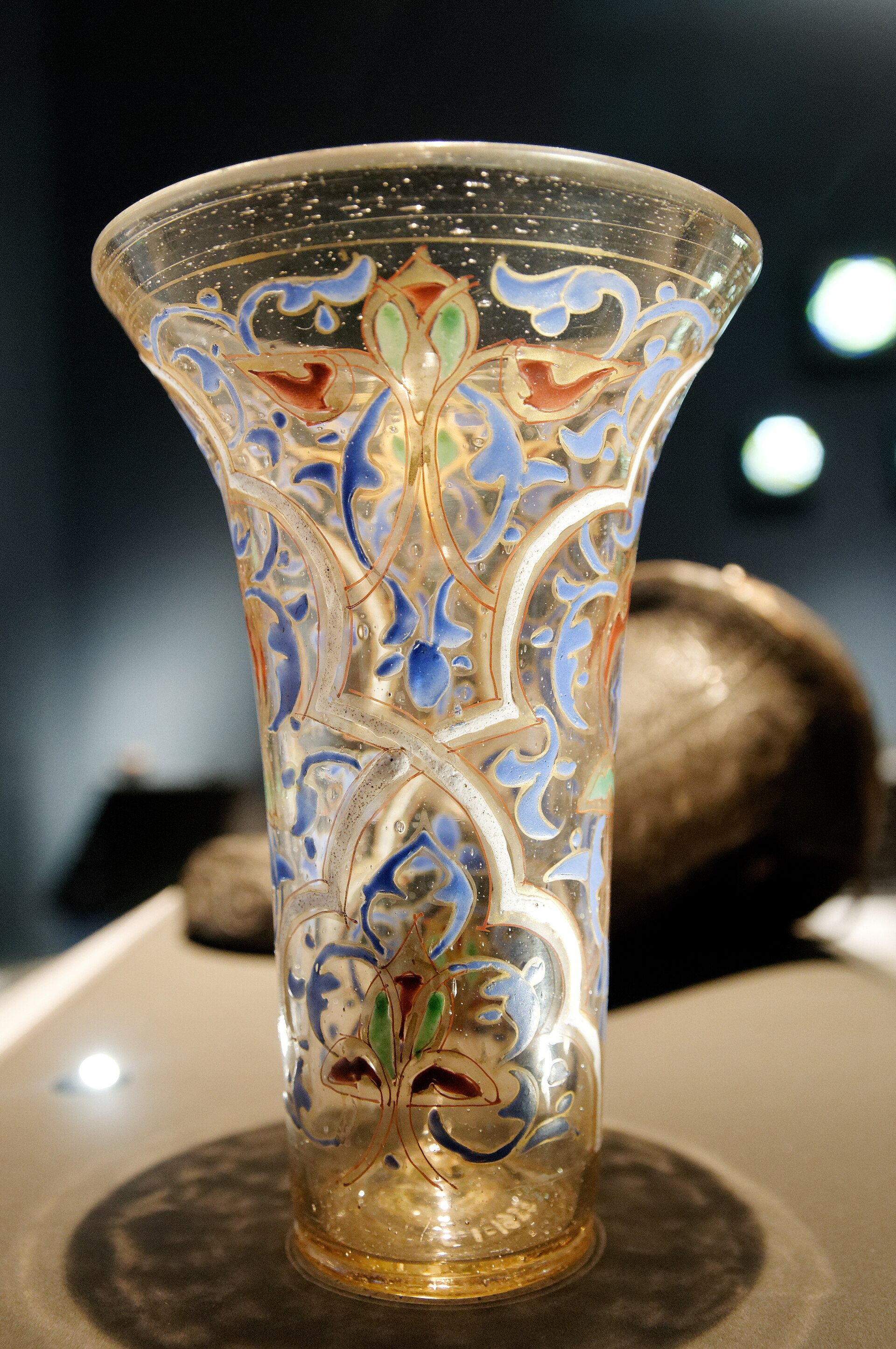
The beaker together with its leather case. Victoria and Albert Museum, London, museum no. C.1 to B-1959.
Photograph by Marie-Lan Nguyen (2012), Victoria and Albert Museum · CC BY 2.5| Artist | Unidentified Mamluk-period glass workshop (Syria or Egypt) |
|---|---|
| Date | Beaker: circa 1350. Case: circa 1400-1500 (V&A catalogue dating). |
| Medium | Beaker: free-blown glass, enamelled and gilt. Case: tooled and gilt leather (cuir bouilli technique) over a rigid form, with a hinged or fitted lid. |
| Dimensions | Beaker: 15.8 cm high, 11.1 cm in diameter at the rim (V&A public-facing article). The V&A's own online collections database separately records the beaker's height as 16 cm; the two V&A-authored figures do not exactly agree and this record has not found either flagged as the corrected one. No published dimensions for the case were found in the sources consulted. |
| Where it is now | Victoria and Albert Museum, London, Medieval and Renaissance Galleries, Room 10alast confirmed |
| Inventory number | C.1 to B-1959 |
| Attribution | DisputedNo maker's name, workshop mark or dedicatory inscription survives on the beaker. Full note |
| Object type | Glass |
| Period | Islamic, Mamluk sultanate (beaker); English or French late medieval (case) |
| Cases | Disputed attribution · Has a provenance gap |
| Inscriptions | None published. Unlike many surviving Mamluk enamelled mosque lamps, which typically carry a titulature band naming the amir or sultan for whom the piece was made, no dedicatory or donor inscription has been recorded for this beaker in any source consulted for this record. The leather case carries the Christogram IHS but no other text. |
| Owners on record | 6 links4 documented, 2 unknown |
| Sources | 20 cited |
About this record Last verified · 20 sources cited · Change log
On this page 9 sections
ContentsClose
A translucent amber glass beaker, enamelled and gilt in blue, green, red and white, made somewhere in Mamluk Syria or Egypt around 1350 and fitted, within a century or so of its manufacture, with a tooled leather carrying case that most likely saved its life. By 1677 it belonged to the Musgrave family of Eden Hall in Cumberland, who called it the Luck of Edenhall and attached to it a superstition that the family's fortune depended on the glass never breaking. The superstition, first fully written down in 1791, was carried across Europe by Ludwig Uhland's German ballad and then by Henry Wadsworth Longfellow's English translation, making an obscure Cumbrian heirloom into a piece of shared literary folklore.
The Musgraves lent the beaker to the Victoria and Albert Museum in 1926, eight years before their own house at Eden Hall was pulled down, and sold it to the museum outright in 1958 for 5,500 pounds, part-funded by the Art Fund and the Pilgrim Trust. It was never sold at public auction; there is no hammer price and no premium to separate, because the transaction was a private purchase negotiated directly with a national museum. Where it was made, exactly how it reached England, and whether its fairy legend has any older root than 18th-century antiquarian invention, remain open questions.
Provenance
Each link is graded. Documented: a cited source supports it. Disputed: the identification is argued but not established. Unknown: no owner for that span, and the gap is not smoothed into a narrative. The grades in the glossary.
- c. 1350 -Manufacture in the Mamluk sultanate (Syria or Egypt)documented
Made as an enamelled and gilt glass beaker in the Mamluk enamelling tradition. The specific city of manufacture (Syria versus Egypt, and within those, which centre) is not established; this record follows the V&A's own formula, 'Syria or Egypt.'1217
- c. 1350 - 1400/1500Unknownunknown
No owner, location or transaction is documented for the period between manufacture and the fitting of the leather case, itself dated only broadly to 1400-1500 by the V&A. How and when the beaker left the Mamluk sultanate and reached Europe is not recorded in any source consulted.12
- 1400/1500 - 1677Unknown, presumed already in England or in transit thereunknown
The leather case was made, on the V&A's dating, sometime in the 15th century, implying the beaker had reached Europe (and probably England) by then, fitted with protective leatherwork of French-or-English (V&A) or specifically Narbonnais (Art Fund) manufacture. No owner is documented for this period, and the beaker's entry into Musgrave family possession specifically is undocumented before 1677.24
- by 1677 - 1926The Musgrave family of Eden Hall, Cumberlanddocumented
First securely documented, and already named 'the Luck of Edenhall,' in the 1677 will of Sir Philip Musgrave, 2nd Baronet (1607-1678), of Hartley Castle and Eden Hall, a Royalist MP and soldier. The family's superstition that its fortune depended on the glass surviving unbroken is attached to the object by at least the later 18th century, when it was written down in print (1791, 1794). The family's country seat, Eden Hall, was itself sold and the family had moved to London by the early 1900s; the house was demolished in 1934, eight years after the glass had already been sent to South Kensington on loan.123131419
- 1926 - 1958The Musgrave family (owner) / Victoria and Albert Museum (custodian on loan)documented
Placed on loan to the Victoria and Albert Museum in 1926, over three decades before its outright sale. Ownership remained with the Musgrave family throughout the loan period.13
- 1958 - presentVictoria and Albert Museum, Londondocumented
Purchased by the museum in 1958 for a total of 5,500 pounds, of which the Art Fund (then the National Art Collections Fund) contributed 1,500 pounds; the museum's own credit line additionally names the Pilgrim Trust and several City of London livery companies as contributors to the remainder. This was a private, negotiated purchase from the family, not a public auction sale: there is no lot number, estimate, hammer price or premium to report. The object was formally registered with the museum number C.1 to B-1959, the accession year in the number reflecting registration in 1959, a year after the purchase itself was agreed and funded.234
Technical evidence
| Attribution note | No maker's name, workshop mark or dedicatory inscription survives on the beaker. Scholars agree it is Near Eastern enamelled and gilt glass of the Mamluk period, made around the middle of the 14th century, but disagree on the specific city of manufacture: Syria (Aleppo or Damascus) and Egypt (Cairo) have all been proposed, on stylistic grounds, by different writers. This record follows the Victoria and Albert Museum's own published formula, 'Syria or Egypt,' rather than adjudicate between the more specific claims. |
|---|---|
| Beaker fabrication | Free-blown, thin-walled glass vessel in translucent, warm amber-tinted glass, without a foot ring or stem.16 |
| Decoration technique | Enamelled in blue, green, red and white, with details outlined in gold leaf/gilding, in bands of interlaced pointed arches and scrolling arabesque and split-palmette vine ornament.12 |
| Dimensions | Beaker: 15.8 cm high, 11.1 cm diameter at the rim, per the V&A's public article. The V&A's own online collections database separately gives the beaker's height as 16 cm; the two figures, both V&A-authored, do not precisely agree.12 |
| Case construction | Stiff, tooled and gilt leather (cuir bouilli) case with a lid, dated 1400-1500. Place of manufacture given as France or England by the V&A's own catalogue, and as the Narbonne region of southern France specifically by the Art Fund's published account; the two do not agree and this record has not adjudicated between them.24 |
| Case iconography | Carries the Christogram IHS (from the Greek letters of the name of Jesus, later glossed in Latin as Iesus Hominum Salvator), possibly intended as a protective device on the case itself.12 |
| Inscriptions on the beaker | None published. No dedicatory or patron inscription survives, unlike the titulature bands typical of dated Mamluk mosque lamps such as the Metropolitan Museum's Mosque Lamp of Amir Qawsun.216 |
| Condition | Described by the V&A as exceptionally fine and pristine for glass of this age; the museum and other sources attribute the survival to the protection of the leather case over most of the object's documented life.12 |
Images
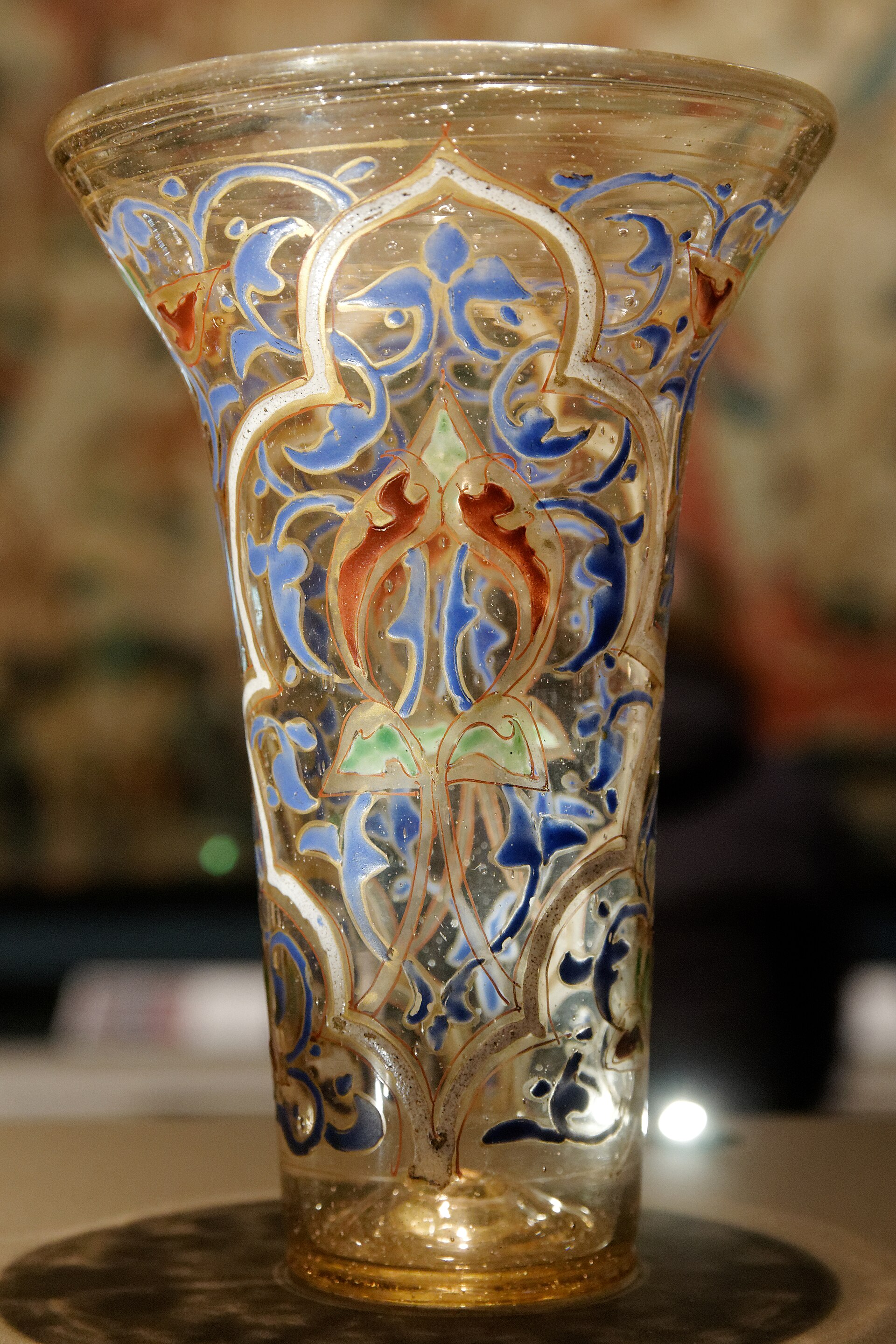
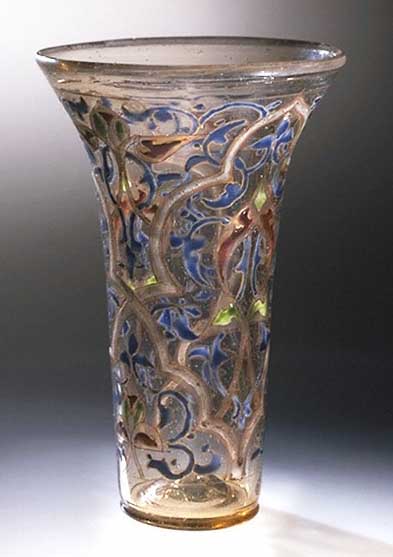
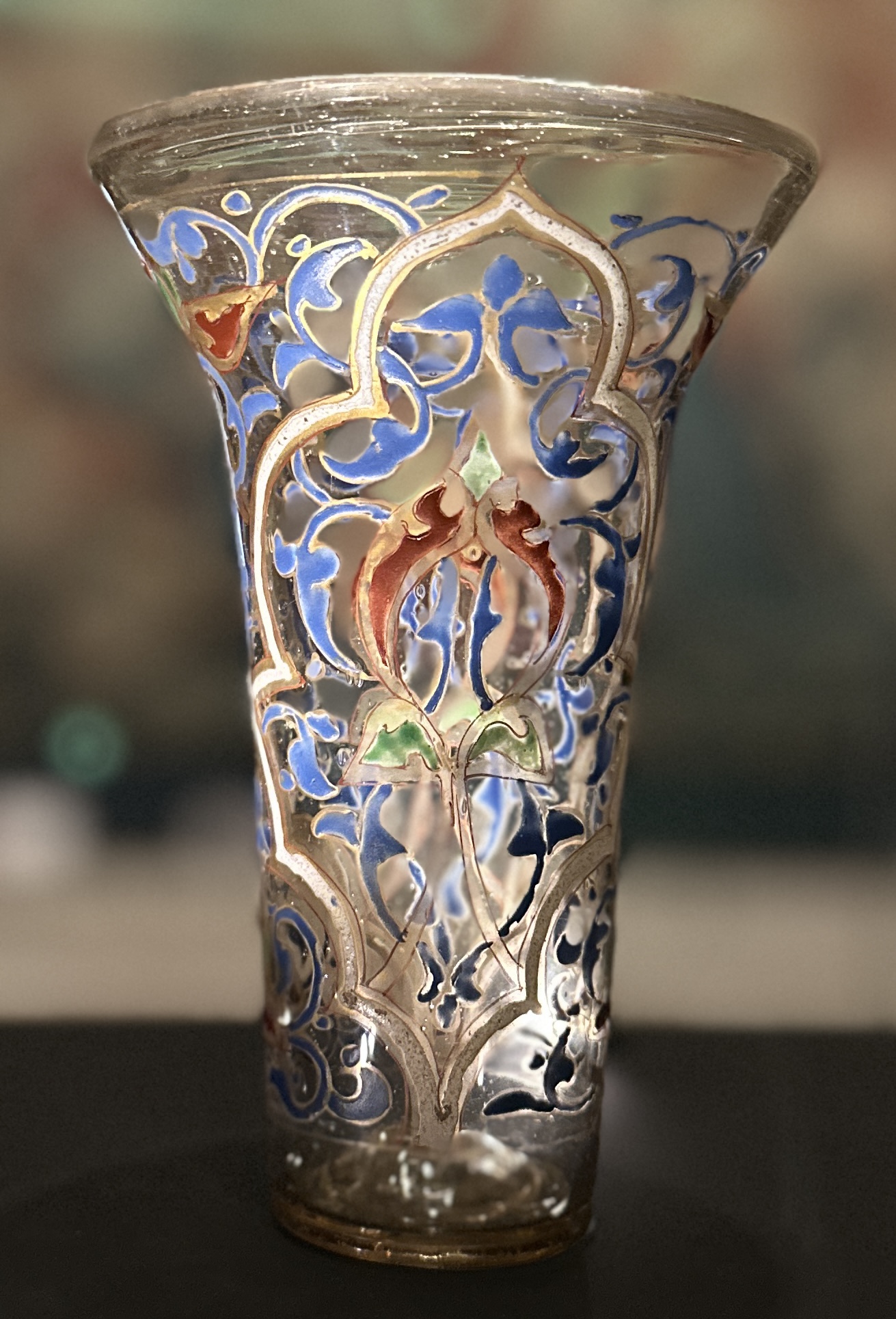
The record in full
Chapter 1What it is
The Luck of Edenhall is a small drinking vessel, a beaker rather than a stemmed goblet, blown in translucent, warm amber-tinted glass and decorated in enamel and gilding: bands of interlaced pointed...
The Luck of Edenhall is a small drinking vessel, a beaker rather than a stemmed goblet, blown in translucent, warm amber-tinted glass and decorated in enamel and gilding: bands of interlaced pointed arches and scrolling arabesque vines, picked out in blue, green, red and white enamel with details outlined in gold. It stands about 15.8 to 16 centimetres tall (the two figures come from two different Victoria and Albert Museum publications) and measures 11.1 centimetres across the rim. It is undecorated on the inside and has no foot ring in the manner of a European goblet; it was made to be held, not set down on a stem.
What makes it exceptional is not the type of object, since enamelled glass beakers and lamps of this general kind survive elsewhere from the same period and region, but its condition. The museum's own catalogue calls it 'an exceptionally fine and pristine example of fourteenth-century luxury Islamic glass,' and that is a considered judgement, not marketing language: glass of this age and thinness rarely survives centuries of ordinary domestic handling without chipping, clouding or loss of enamel, and this piece has done so almost entirely intact. The reason, as the object's own catalogue entry and its later custodians agree, is the leather case described below, which appears to have kept the glass out of daily use for most of its documented life.
Chapter 2How and where it was made
The beaker belongs to a distinct and well-studied tradition: enamelled and gilt glass produced in the Near East under Ayyubid and then Mamluk rule, a technique that develops in the 12th century in...
The beaker belongs to a distinct and well-studied tradition: enamelled and gilt glass produced in the Near East under Ayyubid and then Mamluk rule, a technique that develops in the 12th century in the Syrian region and reaches its height of production and export in the 13th and 14th centuries, under Mamluk patronage centred on Egypt and greater Syria. The best-known products of this tradition are large glass mosque lamps, commissioned by sultans and amirs and inscribed with their names and titles for donation to mosques, madrasas, tombs and other religious foundations in Mamluk Cairo and the Syrian cities; a dated example is the Metropolitan Museum's Mosque Lamp of Amir Qawsun, made around 1329 to 1335 for a named patron and inscribed accordingly. The Luck of Edenhall was made by the same enamelling and gilding process on the same kind of thin blown glass body, but it is a secular drinking vessel rather than a religious lamp, and it carries no inscription naming a patron, which is one reason it cannot be dated or localised as precisely as an inscribed lamp can.
Where within Mamluk territory it was made is genuinely unresolved. The Victoria and Albert Museum, which owns the object and has published on it more than any other institution, gives the origin simply as 'Syria or Egypt' in its own catalogue and public writing, declining to choose between them. Popular and journalistic accounts sometimes narrow this to Aleppo specifically, as the city most associated with the finest enamelled glass workshops of the period, but this record has not found that narrower claim made by the museum itself, and treats it as an unproven, if plausible, refinement rather than an established fact.
Chapter 3How it reached England
Fine enamelled and gilt glass from Mamluk Syria and Egypt was a genuine luxury export commodity in the 13th and 14th centuries, carried into Europe chiefly through Venetian merchants who traded...
Fine enamelled and gilt glass from Mamluk Syria and Egypt was a genuine luxury export commodity in the 13th and 14th centuries, carried into Europe chiefly through Venetian merchants who traded extensively with Mamluk ports; Venetian glassmakers admired the ware closely enough that they began producing their own enamelled imitations of it by the 15th and 16th centuries, a fact that is itself evidence of how prized and how widely seen the Mamluk originals were in Europe. That much is documented general trade history, not something argued specifically about this beaker.
How this particular piece crossed that distance, and when, is not documented at all. An older popular explanation held that it was brought back by a Crusader, but the Victoria and Albert Museum's own current account rejects this on chronological grounds: the beaker was made around 1350, decades after the last Crusader states in the Levant had fallen, so no returning Crusader could have carried it home. The more probable route, on the general evidence of the Mamluk-Venetian luxury trade, is that it passed through Venice or another Italian entrepot as an ordinary article of that commerce and reached England by a further stage of resale or gift that has left no surviving record. This record treats the transmission route as documented in general terms (the Levantine luxury glass trade through Venice existed and is well studied) but treats the specific journey of this specific beaker, including any Crusader involvement, as unknown.
Chapter 4The earliest record of it in England
The earliest firm documentary trace of the object is not from time immemorial, and this record does not treat it as such.
The earliest firm documentary trace of the object is not from time immemorial, and this record does not treat it as such. The beaker is first securely documented, and already carrying the name 'the Luck of Edenhall,' in 1677, in the will of Sir Philip Musgrave, 2nd Baronet, of Hartley Castle, Westmorland, and Eden Hall, Cumberland. Musgrave (1607-1678) was a Royalist politician and soldier who sat in the House of Commons in two spells either side of the Civil War and Interregnum, led the Royalist force that took Carlisle from Parliament in 1648, and was offered, but never took up, a peerage as Baron Musgrave of Hartley Castle. He died on 7 February 1678 and was buried at Edenhall; the will documenting the beaker dates from shortly before his death. That the object already had its distinctive name by 1677 implies the naming, and probably the family's superstition about it, predates the will itself, but no earlier document naming or describing the object has been found in the sources consulted for this record. Everything before 1677, including how long the Musgraves had already owned it and how it first came into the family's hands, is undocumented.
Secondary folklore sources report an early published verse, said to date from 1729 and to begin 'God prosper long from being broke, The Luck of Eden Hall,' connected to an account of a drinking match said to have taken place at Eden Hall around 1721. This record could not independently verify that claim against a primary or scholarly source in the research conducted, and states it here only as a claim reported by secondary sources, not as an established fact; it is flagged for the editor below.
Chapter 5The legend
The superstition attached to the beaker holds that the Musgrave family's fortune, or 'luck,' was bound up with the glass, and that breaking it would end that luck.
The superstition attached to the beaker holds that the Musgrave family's fortune, or 'luck,' was bound up with the glass, and that breaking it would end that luck. The fullest early written version of the story appears in The Gentleman's Magazine in 1791, in an account by the Reverend William Mounsey, who reports a local tradition that a party of fairies had been drinking and making merry around a well near the hall, called St Cuthbert's Well, when they were disturbed by intruders; startled, they fled and left the cup behind, one of them crying as she went, in the version Mounsey records: 'If this cup should break or fall, Farewell the Luck of Edenhall!' Other 18th-century antiquarian sources, including William Hutchinson's History of the County of Cumberland of 1794, give closely related versions of the same tale, and later folklore compilers such as Joseph Ritson (1831) and Thomas Keightley (1833) reprinted and discussed it further, which is itself evidence of how quickly the story travelled once it reached print.
Whether the fairy story has any older oral root than these 18th-century printed accounts, or was substantially the invention of 18th-century antiquarians working backward from an old glass and an already-attached name, cannot be settled from the sources available to this record, and is recorded honestly below as an open question rather than resolved either way. A separate and more skeptical modern reading, reported in secondary sources but not found stated by the Victoria and Albert Museum itself, suggests that the beaker might originally have been used as a chalice, possibly taken from a church, and that the fairy story was a later cover invented to explain an uncomfortable origin; this record treats that reading as speculative and unverified against a primary source, and notes below that a 2010 scholarly article specifically challenges the chalice theory on canon-law grounds, discussed in the section on the case.
Chapter 6Uhland, Longfellow, and the poem's real date
The German poet Ludwig Uhland turned the legend into a ballad, 'Das Gluck von Edenhall,' first published in 1834; it was set to music by Robert Schumann as a choral ballad for male voices, soloists...
The German poet Ludwig Uhland turned the legend into a ballad, 'Das Gluck von Edenhall,' first published in 1834; it was set to music by Robert Schumann as a choral ballad for male voices, soloists, chorus and orchestra in 1853, evidence of how far the story had already travelled within German musical and literary culture within twenty years of Uhland's poem. Uhland's ballad follows the young lord of Eden Hall recklessly drinking from and then shattering the cup at a banquet, bringing immediate ruin on his house; this dramatic ending, in which the glass is actually broken, is Uhland's own literary invention and does not correspond to any claim that the real beaker was ever broken.
Henry Wadsworth Longfellow translated Uhland's ballad into English as 'The Luck of Edenhall,' publishing it in his collection Ballads and Other Poems. This record must correct a date given in its own brief: Longfellow's poem is not from 1858. Ballads and Other Poems was first published in 1841, with an 1842 Cambridge edition (John Owen) in which 'The Luck of Edenhall' appears at pages 48 to 52; Edgar Allan Poe reviewed the collection, including this poem, in 1842. No source consulted for this record supports an 1858 date for Longfellow's translation, and this record uses 1841/1842 instead. Longfellow's version follows Uhland's plot, including the breaking of the glass at the close of the poem, which is worth stating plainly: the literary tradition that most popularised this object internationally ends with an event, the shattering of the cup, that never happened to the real beaker, which survives intact in London today.
The legend outlived its own poems. Anthony Trollope used it as a passing allegory in the opening chapter of his 1864 novel The Small House at Allington, part of his Chronicles of Barsetshire: reflecting on a family's duty to preserve its own estate, his narrator recalls dining at a house 'the whole glory and fortune of which depended on the safety of a glass goblet,' and warns, in terms lifted straight from the Musgrave superstition, that 'if the luck of Edenhall should be shattered, the doom of the family would be sealed.' By 1864, in other words, a specific Cumberland family's private heirloom and its attached superstition had become general literary shorthand, usable by a novelist without further explanation, for the fragility of any old family's fortune.
Chapter 7The case
The beaker survives inside a stiff, tooled and gilt leather case with a lid, made in the cuir bouilli (boiled leather) technique used across late medieval Europe for protecting fragile valuables, and...
The beaker survives inside a stiff, tooled and gilt leather case with a lid, made in the cuir bouilli (boiled leather) technique used across late medieval Europe for protecting fragile valuables, and dated by the Victoria and Albert Museum's catalogue to between 1400 and 1500, meaning it was made within roughly a century of the glass itself and well before the earliest documented Musgrave ownership in 1677. The case carries the Christogram IHS, a monogram derived from the first three letters of the name of Jesus in Greek and later given the Latin gloss Iesus Hominum Salvator (Jesus, Saviour of Mankind); the museum suggests this may have been intended to act as a kind of protective charm on the case itself, independent of whatever meaning attached to the glass inside it.
Where the case was made is disputed between the museum's own two public accounts. The Victoria and Albert Museum's collections catalogue gives the case's place of origin as France or England; the Art Fund's own published account of its 1958 grant states more specifically that the leatherwork probably originated in the Narbonne region of southern France. This record has not been able to adjudicate between a French-or-English attribution and a Narbonne-specific one, and presents both, attributed to their respective sources, rather than choose. What both accounts agree on is the case's importance: it is not merely packaging but very likely the single reason the glass survived, and it is itself a rare and little-studied survival of medieval leatherwork in its own right, worth as much curatorial attention as the beaker it protects.
The clearest scholarly intervention on the object as a whole is a short 2010 article by Glyn Davies, a Victoria and Albert Museum curator, in The Burlington Magazine, titled 'New Light on the Luck of Edenhall.' Its published abstract states that it presents new information on the beaker's use and provenance; secondary reporting on the article describes it as challenging a longstanding assumption that the beaker had at some point been used as a chalice, on the grounds that canon law restricted chalices to precious metal rather than glass. This record could not obtain the full text of the Davies article and so cannot report its argument or evidence in detail; it is recorded here as the single most important specialist source on this object that a future editor should obtain in full, and the chalice question is left open below rather than resolved on the strength of a secondary summary alone.
Chapter 8From Eden Hall to South Kensington
By the early 1900s the Musgrave family had already sold Eden Hall itself and moved their household to London; the house stood empty or in reduced use for some years afterward and was demolished in...
By the early 1900s the Musgrave family had already sold Eden Hall itself and moved their household to London; the house stood empty or in reduced use for some years afterward and was demolished in 1934. The beaker's own move away from Cumberland came before that demolition, not after it: the Musgraves placed it on loan to the Victoria and Albert Museum in 1926, meaning the object had already been removed to South Kensington, and so was not at risk, when the house that gave it its name came down eight years later. The beaker therefore owes its survival to two separate acts of removal from Eden Hall: the leather case that protected it physically from roughly 1400 onward, and the 1926 loan that removed it from the estate before the estate itself was lost.
The loan converted into an outright sale in 1958. The Art Fund's own record of its grant states the total price as 5,500 pounds, toward which the Art Fund itself (then styled the National Art Collections Fund) contributed 1,500 pounds; the Victoria and Albert Museum's catalogue credit line names the Pilgrim Trust and 'several livery companies' of the City of London as additional contributors, which together with the Art Fund's share accounts for the remaining approximately 4,000 pounds, though no source consulted breaks down exactly how much each of the Pilgrim Trust and the individual livery companies gave. The purchase was completed and the object registered with the museum number C.1 to B-1959 in 1959; this record therefore states the acquisition as agreed and funded in 1958 and formally accessioned in 1959, rather than collapsing the two into a single year, since the sources consulted give both years for different stages of the same transaction and do not explicitly reconcile them.
This was, precisely, not an auction sale. There is no lot number, no estimate, no hammer price and no buyer's premium to report, because the Musgrave family sold the beaker directly and privately to the museum that had already held it on loan for over three decades, with charitable and civic bodies making up the purchase price alongside the museum's own funds. Readers looking for an auction result for this object will not find one, because none exists.
What is not documented in any source consulted for this record is which specific member of the Musgrave family conducted the 1958 sale, or the family's own stated reason for selling. A general context is available and is reported as context, not as a specific documented motive for this specific sale: the family had already given up Eden Hall itself decades earlier, and mid-20th-century British death duties are well known to have driven many comparable sales of family heirlooms by landed families in this period. This record does not assert that death duties caused this particular sale, because no source consulted states that directly; it is recorded as a plausible but unconfirmed context, and as an open question below.
Chapter 9Comparable Mamluk glass, and what it shows
The closest comparanda for the Luck of Edenhall are not other secular beakers, which are rare survivals precisely because glass drinking vessels see hard daily use, but the larger corpus of Mamluk...
The closest comparanda for the Luck of Edenhall are not other secular beakers, which are rare survivals precisely because glass drinking vessels see hard daily use, but the larger corpus of Mamluk enamelled mosque lamps, which were made in far greater numbers, for religious donation rather than private use, and which more often carry inscriptions that allow them to be dated and attributed to a specific patron. The Metropolitan Museum's Mosque Lamp of Amir Qawsun, made about 1329 to 1335, and the British Museum's mosque lamp in the Waddesdon Bequest are both securely Mamluk, enamelled and gilt in the same general palette and technique as the Edenhall beaker, and both demonstrate what an inscribed, patron-attributed example of this glass tradition looks like, by contrast with the uninscribed Edenhall piece.
A different kind of comparison is available within the Victoria and Albert Museum's own collection: a colourless enamelled and gilt glass beaker made in Venice (Murano), dated 1519 to 1558 and bearing the arms of the Holy Roman Emperor Charles V, museum number 191-1879. It stands 16.4 centimetres high and 11.2 centimetres in diameter, dimensions strikingly close to those given for the Luck of Edenhall itself. This is not a coincidence of taste but a documented pattern: Venetian glassmakers had, by the 16th century, taken up the Mamluk enamelling tradition and its characteristic vessel proportions closely enough to produce beakers of almost identical size and general form, which is itself evidence of how directly and durably the Near Eastern original shaped European luxury glassmaking for two centuries after pieces like the Edenhall beaker first arrived.
Chapter 10Naming and titles
The object carries different titles depending on which institution or literary tradition is naming it.
The object carries different titles depending on which institution or literary tradition is naming it. The Victoria and Albert Museum's own catalogue title is 'The Luck of Edenhall: Beaker and Case,' treating the glass and its case as a single linked accession under one museum number, C.1 to B-1959. The Art Fund's own published record of its 1958 grant calls it, more generically, 'Goblet ("The Luck of Edenhall"),' using the word goblet loosely for what is more precisely a beaker without a stem or foot. In German literary tradition the object is known through Uhland's ballad title, 'Das Gluck von Edenhall,' and in English literary tradition through Longfellow's translation title, 'The Luck of Edenhall,' which is also the name most commonly used in general and popular writing about the object today. This record uses 'The Luck of Edenhall' as its main title, following both the object's own common name and the title under which Longfellow's poem made it internationally known, while noting the museum's fuller catalogue title in title_alt.
Chapter 11What remains unresolved
Several real gaps in the record deserve to be stated plainly rather than smoothed over.
Several real gaps in the record deserve to be stated plainly rather than smoothed over. The exact city or region of manufacture within Mamluk Syria or Egypt is not settled among the sources consulted, and this record has deliberately not chosen between Aleppo, Damascus and Cairo where the Victoria and Albert Museum's own public position is the more general 'Syria or Egypt.' The date and mechanism by which the beaker crossed from the Near East to Cumberland is entirely undocumented; the Venetian luxury trade explains how such objects generally reached Europe, but nothing in the sources consulted documents this specific beaker's specific journey. Whether the fairy legend recorded in print from 1791 has any older basis, oral or otherwise, or is substantially an 18th-century antiquarian invention built onto an already-old and already-named object, cannot be resolved from the sources available here. And whether the beaker was ever used, at any point in its history, as a chalice, a claim reported as under scholarly challenge in Glyn Davies's 2010 Burlington Magazine article, is a question this record leaves open because the article's full text and argument could not be obtained during research.
The artist
No individual maker is named or identifiable; this dossier covers the Mamluk-period enamelled-glass workshop tradition of Syria and Egypt, the closest equivalent this object has to a named hand.
The Luck of Edenhall carries no signature, workshop mark or dedicatory inscription, and no maker's name has ever been proposed for it in any source consulted for this record. That silence is itself typical of the tradition it belongs to: enamelled and gilt luxury glass made in Mamluk Syria and Egypt in the 13th and 14th centuries survives today mostly as an anonymous corpus, identified and dated not by signature but by comparison with the smaller number of surviving pieces, chiefly mosque lamps, that do carry inscriptions naming a patron. What follows is therefore not a dossier on a person but on a production tradition and how its output, including this beaker, is identified, dated and distinguished from later imitations.
Related works
| Work | Relation | Where it is |
|---|---|---|
| Beaker (Venetian imitation of Mamluk enamelled glass) Venetian (Murano) glassmakers | Later European imitation of the same enamelling tradition and vessel form, of remarkably similar dimensions Dated 1519-1558, bearing the arms of the Holy Roman Emperor Charles V. 16.4 cm high, 11.2 cm in diameter, close to the Edenhall beaker's own dimensions. | Victoria and Albert Museum, London, museum no. 191-1879 |
| Mosque Lamp of Amir Qawsun Unidentified Mamluk workshop, Egypt | Dated, inscribed comparanda for the same enamelling and gilding technique Made circa 1329-1335 for a named amir; unlike the Edenhall beaker, it carries an inscribed titulature band, which is why it can be dated and attributed more precisely. | The Metropolitan Museum of Art, New York |
| Mosque lamp, Waddesdon Bequest Unidentified Mamluk workshop, Egypt or Syria | Comparable enamelled and gilt glass of the same broad period and tradition Enamelled in blue with red and gilding, with an inscription band in Arabic; part of the Waddesdon Bequest. | British Museum, London |
Open questions
- In which city was the beaker actually made? The V&A's own position is 'Syria or Egypt'; more specific claims for Aleppo appear in popular writing but were not found stated by the museum itself.
- By what route and in what year did the beaker reach England? The general Mamluk-Venetian luxury glass trade explains how such objects generally arrived in Europe, but nothing documents this specific beaker's specific journey or date of arrival.
- Does the fairy-well legend, first found fully written down in 1791, have any older basis, oral or otherwise, or was it substantially assembled by 18th-century antiquarians around an already-old, already-named object?
- Was the beaker ever used as a chalice? Secondary reporting describes Glyn Davies's 2010 Burlington Magazine article as challenging this on canon-law grounds, but this record could not obtain the article's full text or evaluate its evidence directly.
- Where exactly was the leather case made? The V&A's own catalogue says France or England; the Art Fund's own published account says the Narbonne region of France specifically. The two accounts were not reconciled in this research.
- Which member of the Musgrave family conducted the 1958 sale, and what was the family's own stated reason for selling? No source consulted names the seller or states a specific motive; death duties are a plausible general context for such sales in this period but are not documented here as the specific cause.
- Is a reported 1729 verse referencing a Duke of Wharton drinking match at Eden Hall in 1721 a genuine early source, and if so what is its correct citation? This record found the claim only in secondary summaries and could not verify it against a primary or scholarly source.
Questions about this object
What is The Luck of Edenhall?
The Luck of Edenhall is a glass, dated beaker: circa 1350. Case: circa 1400-1500 (V&A catalogue dating).. Medium: Beaker: free-blown glass, enamelled and gilt. Case: tooled and gilt leather (cuir bouilli technique) over a rigid form, with a hinged or fitted lid.
Who made The Luck of Edenhall, and is the attribution settled?
The attribution to Unidentified Mamluk-period glass workshop (Syria or Egypt) is recorded here as disputed. No maker's name, workshop mark or dedicatory inscription survives on the beaker. Scholars agree it is Near Eastern enamelled and gilt glass of the Mamluk period, made around the middle of the 14th century, but disagree on the specific city of manufacture: Syria (Aleppo or Damascus) and Egypt (Cairo) have all been proposed, on stylistic grounds, by different writers. This record follows the Victoria and Albert Museum's own published formula, 'Syria or Egypt,' rather than adjudicate between the more specific claims.
Where is The Luck of Edenhall now?
Victoria and Albert Museum, London, Medieval and Renaissance Galleries, Room 10a. Inventory number C.1 to B-1959. Last confirmed 24 August 2026. Purchased in 1958 with assistance from the Art Fund (then the National Art Collections Fund), the Pilgrim Trust, and several City of London livery companies, following 32 years on loan to the museum from the Musgrave family (from 1926). Formally registered with the museum number C.1 to B-1959, the '&B' covering the accompanying leather case as a second, linked object.
What is still unknown about The Luck of Edenhall?
In which city was the beaker actually made? The V&A's own position is 'Syria or Egypt'; more specific claims for Aleppo appear in popular writing but were not found stated by the museum itself.
Sources
- 1Victoria and Albert Museum, 'The Luck of Edenhall: history and legend of a 14th-century glass beaker.' vam.ac.uk/articles/...
- 2Victoria and Albert Museum, online collections catalogue, 'The Luck of Edenhall (beaker and case),' museum no. C.1 to B-1959. collections.vam.ac.uk/item/...
- 3Wikipedia, 'Luck of Edenhall.' source; with the Davies 2010 Burlington Magazine article and the V&A's own curatorial file where they can be obtained in full. en.wikipedia.org/wiki/...
- 4Art Fund, 'Goblet ("The Luck of Edenhall").' Published record of the Art Fund's 1958 grant toward the purchase. artfund.org/our-purpose/...
- 5Glyn Davies, 'New Light on the Luck of Edenhall,' The Burlington Magazine, vol. 152, no. 1282 (January 2010), pp. 4-7. Citation and abstract consulted via Dialnet; the article's full text could not be obtained for this record and is flagged for the editor to source directly. dialnet.unirioja.es/servlet/...
- 6Wikimedia Commons, File:Luck_of_Edenhall_VandA_C.1toB-1959_n02.jpg, extended file metadata (licence, photographer, date). commons.wikimedia.org/wiki/...
- 7Wikimedia Commons, File:Luck_of_Edenhall_VandA_C.1toB-1959.jpg, extended file metadata. commons.wikimedia.org/wiki/...
- 8Wikimedia Commons, File:Luckofedenhall.jpg, extended file metadata. commons.wikimedia.org/wiki/...
- 9Wikimedia Commons, File:Luck_of_Edenhall.jpg, extended file metadata. commons.wikimedia.org/wiki/...
- 10Henry Wadsworth Longfellow, 'The Luck of Edenhall,' in Ballads and Other Poems (3rd ed., Cambridge: John Owen, 1842), pp. 48-52, via Wikisource. en.wikisource.org/wiki/...
- 11German Wikipedia, 'Das Gluck von Edenhall.' source, used only for Uhland's title and 1834 publication date and Schumann's 1853 setting; with a scholarly edition of Uhland. de.wikipedia.org/wiki/...
- 12Louis Werner, 'The Luck of Edenhall,' personal research blog, 22 December 2018. louiswerner.com/new-blog/...
- 13'The Luck of Edenhall (Eden Hall),' folklore source-text compilation citing The Gentleman's Magazine (1791), Hutchinson's History of the County of Cumberland (1794), Ritson's Fairy Tales, Now First Collected (1831) and Keightley's The Fairy Mythology (1833). sites.pitt.edu/~dash/...
- 14Hypnogoria, 'Folklore on Friday: Faery Finds I - The Luck of Edenhall' (2015). Secondary blog citing Rev. William Mounsey's 1791 account and Hutchinson's 1794 History. hypnogoria.blogspot.com/2015/...
- 15Victoria and Albert Museum, online collections catalogue, 'Beaker' (Venetian, Murano, 1519-1558), museum no. 191-1879. collections.vam.ac.uk/item/...
- 16The Metropolitan Museum of Art, collection entry, 'Mosque Lamp of Amir Qawsun,' circa 1329-1335. metmuseum.org/art/...
- 17The Metropolitan Museum of Art, Heilbrunn Timeline of Art History, essay 'Enameled and Gilded Glass from Islamic Lands.' metmuseum.org/essays/...
- 18British Museum, Waddesdon Bequest catalogue entry, mosque lamp. wb.britishmuseum.org/MCN865
- 19History of Parliament Online, 'MUSGRAVE, Sir Philip, 2nd Bt. (1607-78), of Hartley, Westmld. and Edenhall, Cumb.' historyofparliamentonline.org/volume/...
- 20Anthony Trollope, The Small House at Allington (1864), Chapter 1, quoted via Wikisource/Project Gutenberg text. en.wikisource.org/wiki/...


Last verified · Published
Change log
24 August 2026 - Record created at the house standard: researched narrative, technical evidence, maker dossier, graded provenance chain, prices with hammer and premium separated, related works, open questions and sources.