The Gloucester Candlestick
Unrecorded English goldsmith (Canterbury or an itinerant craftsman working in southern England) · 1107-1113 (commissioned)
Last verified 16 September 2026 · 12 sources cited · Change log
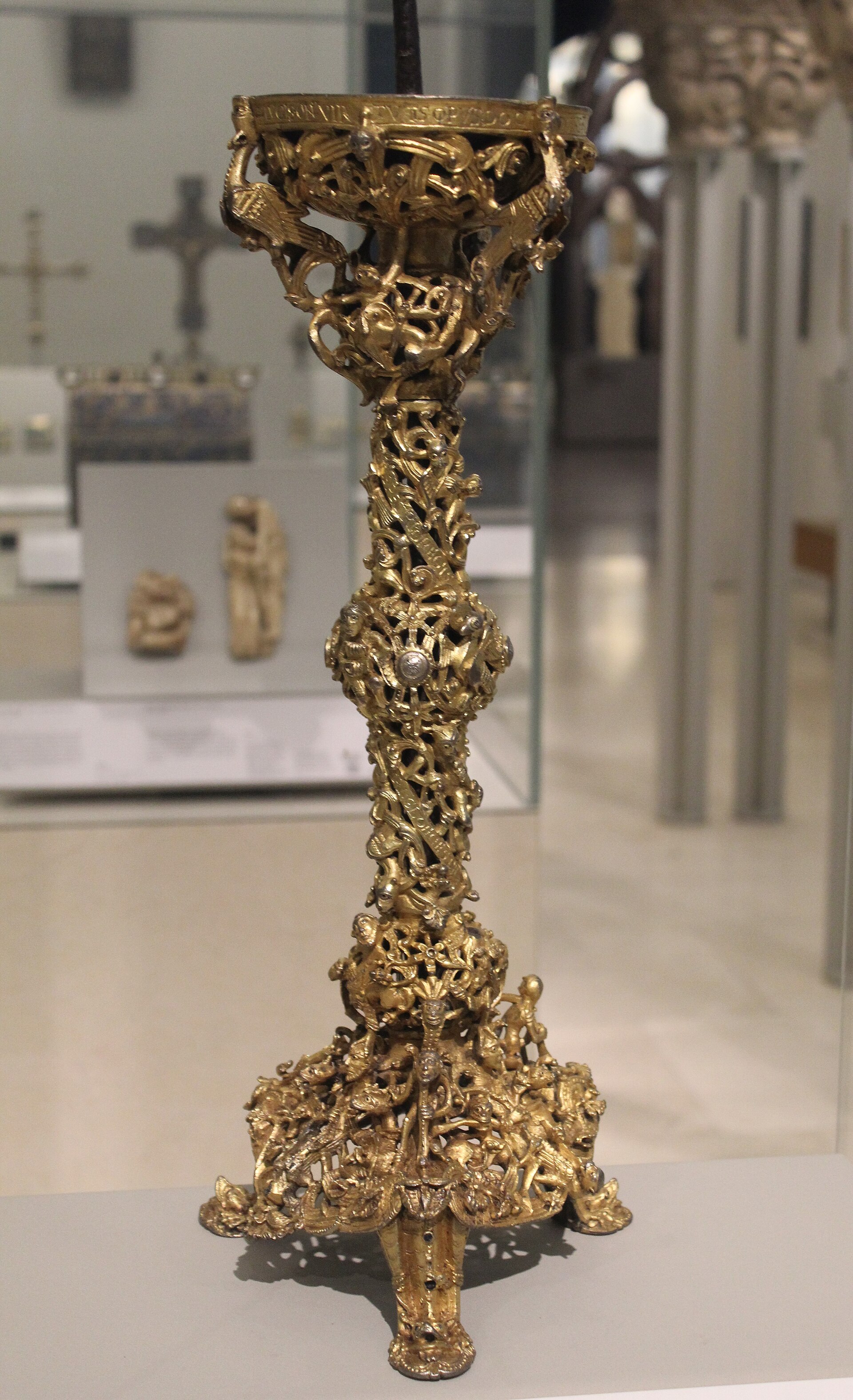
The complete candlestick as displayed at the V&A: triangular dragon-footed base, stem with central Evangelist knop, and grease pan, all cast in gilt copper alloy with openwork figures and foliage.
| Artist | Unrecorded English goldsmith (Canterbury or an itinerant craftsman working in southern England) |
|---|---|
| Date | 1107-1113 (commissioned) |
| Medium | Gilt copper alloy (bronze with an unusually high silver content), cast by the lost-wax (cire-perdue) process in three sections, with niello and glass-bead inlay |
| Dimensions | Height 58 cm, width 20 cm, depth 20 cm; weight 5.76 kg |
| Where it is now | Victoria and Albert Museum, London. On display, Medieval and Renaissance Galleries, Room 8 (The William and Eileen Ruddock Gallery), South Kensington., Museum no. 7649:1 to 3-1861 (three registered parts: base, stem and grease pan)last confirmed 16 September 2026 |
| Attribution | disputedNo maker is named on the object or in any surviving document. Full note |
| Object type | Goldsmith's work |
| Period | English Romanesque, early twelfth century |
| Cases | Disputed attribution · Has a provenance gap |
| Inscriptions | Stem, spiralling downward above and below the central knop: + ABBATIS. PETRI. GREGIS. ET. DEVOTIO. MITIS. + ME. DEDIT. ECCLESIE. SCI. PETRI. GLOECESTRE. ('The devotion of Abbot Peter and his gentle flock gave me to the church of St Peter at Gloucester'). Grease pan, outer rim: LVCIS ON(VS) VIRTVTIS OPVS DOCTRINA REFVLGENS PREDICAT VT VICIO NON TENEBRETVR HOMO, a verse on light and virtue with three published translations (Oman 1958, Harris 1964, Borg 1985). Grease pan, inner rim, slightly later in date: HOC CENOMANNENSIS RES ECCLESIE POCIENSIS THOMAS DITAVIT CVM SOL ANNVM RENOVAVIT ('Thomas of Poche gave this to the church of Le Mans when the sun renewed the year'). |
- Where it is now
- Victoria and Albert Museum, London. On display, Medieval and Renaissance Galleries, Room 8 (The William and Eileen Ruddock Gallery), South Kensington.last confirmed 16 September 2026
- Attribution
- disputed
- Provenance
- 8 links5 documented, 1 disputed, 2 unknown
- Sources
- 12 cited
- Last verified
- 16 September 2026Change log
On this page 10 sections
A gilt bronze altar candlestick, cast in three sections around 1107 to 1113 for Abbot Peter of Gloucester Abbey, and one of the outstanding survivals of English Romanesque metalwork. Its own inscription names the patron; nothing else about its first fifteen years, whether it survived the fire that destroyed the abbey in 1122, or how it crossed to France, is documented. It resurfaces at Le Mans Cathedral, leaves France in about 1788 shortly before the Revolution, passes through a Le Mans private collection and Prince Soltykoff's Paris collection, and is bought by the South Kensington Museum in 1861, where it has stayed since.
Scholars agree it is English work of exceptional quality but disagree on where: Canterbury, a travelling southern English workshop, or, in one minority paper, Gloucester itself. Its closest technical relatives are German, the pair of candlesticks made for Bishop Bernward of Hildesheim, and its closest stylistic register is the Meuse valley tradition typified by Reiner of Huy. The museum's own recent conservation research has found a possible early repair inside the object and an unresolved puzzle in its gilding, evidence that the object is still being actively studied eight centuries after it was made.
Provenance
Each link is graded. Documented: a cited source supports it. Disputed: the identification is argued but not established. Unknown: no owner for that span, and the gap is not smoothed into a narrative. The grades in the glossary.
- 1107 - 1113Abbey of St Peter, Gloucester (Benedictine), under Abbot Peterdocumented
The candlestick's own stem inscription records that it was given to the church of St Peter, Gloucester, by the devotion of Abbot Peter and his community. Peter was elected abbot on 5 August 1107 and died on 17 July 1113, bracketing the date. No independent monastic record of the gift survives; the Historia et Cartularium Monasterii Sancti Petri Gloucestriae describes Peter's abbacy in detail without mentioning the candlestick.18
- 1113 - 1122Abbey of St Peter, Gloucester (presumed)unknown
No document records the candlestick's location or custody in this period. Whether it remained continuously at Gloucester is presumed but not documented.1
- 1122 -Unknownunknown
Gloucester Abbey burned in March 1122. The Historia et Cartularium lists surviving books and mass robes and does not mention the candlestick, either as a survival or as a loss.18
- - c. 1788Cathedral of Le Mans, Francedisputed
By the time of a second grease-pan inscription, judged on stylistic grounds to be somewhat later than the stem inscription but still medieval, the candlestick belonged to Le Mans Cathedral, given by a Thomas of Poche whose identity is not securely established. Neither the date nor the mechanism of the transfer from Gloucester to Le Mans is documented in any source consulted; this record treats the gap as unresolved rather than assigning it a specific route or date.1
- c. 1788 - 1857Monsieur d'Espaulart of Le Mans, private cabinet de curiositesdocumented
The V&A's own object history states the candlestick was removed from Le Mans Cathedral in about 1788 and entered the collection of Monsieur d'Espaulart of Le Mans, where it remained until the 1857 sale of his collection. The circumstances of the 1788 removal itself are not given.1
- 1857 - 1857Sale of the d'Espaulart collectiondocumented
Sold at the Hotel des Ventes, rue Drouot, Paris, on 7 May 1857, as part of the Catalogue de la Precieuse collection d'objets d'art et de Haute curiosite de Monsieur d'Espaulart du Mans. Bought by Prince Pierre Soltykoff for 20,000 francs.1
- 1857 - 1861Prince Pierre Soltykoff, Parisdocumented
Held in Soltykoff's collection, one of the most significant nineteenth-century private collections of medieval and Renaissance decorative art, until the dispersal of the whole collection at auction in Paris in 1861.1
- 1861 - presentSouth Kensington Museum, now the Victoria and Albert Museum, Londondocumented
Acquired in 1861 as part of the museum's purchases at the Soltykoff sale, registered as three parts under 7649:1 to 3-1861. The amount the museum itself paid is not given in any source consulted.1
Prices realised
| Date | Sale | Estimate | Result | Note |
|---|---|---|---|---|
| 7 May 1857 | Hotel des Ventes, rue Drouot, Paris (d'Espaulart sale) | Not recorded in sources consulted | Hammer Not separately recorded With premium Not separately recorded FRF | Sources consulted give a single figure of 20,000 francs, paid by Prince Pierre Soltykoff, without distinguishing a hammer price from any buyer's premium; this record states the figure as given rather than assuming it is a net hammer price. |
| 1861 | Hotel Drouot, Paris (Soltykoff collection sale) | Not recorded in sources consulted | Hammer Not recorded in sources consulted With premium Not recorded in sources consulted Unknown | The South Kensington Museum acquired the candlestick at the 1861 dispersal of the Soltykoff collection, one of at least 26 lots the museum bought at that sale, but no source consulted for this record gives the price the museum paid for this lot specifically. |
Hammer is the price at which the bidding stopped; with premium adds the fee the house charges the buyer on top. Hammer price and buyer's premium in the glossary.
Technical evidence
| Attribution note | No maker is named on the object or in any surviving document. The V&A's own catalogue entry calls the attribution to an English artist 'generally accepted' on the strength of close stylistic parallels with Canterbury manuscript illumination of the late eleventh and early twelfth centuries, a link Alan Borg judged closer than in any other Romanesque metalwork. Anabel Harris used that link to propose Canterbury itself as the place of manufacture. Neil Stratford, cataloguing the piece for the 1984 Hayward Gallery exhibition, contested a Canterbury workshop in favour of a professional craftsman travelling around southern England. A minority paper by Roderick Butler and Christopher Green, published alongside the V&A's own conservators' research in the Journal of the Antique Metalware Society in 2008, argues instead for a Gloucester provenance; this record has seen only its title and has not verified its argument at first hand. An early theory that the object was German, prompted by its close technical kinship to the pair of candlesticks made for Bishop Bernward of Hildesheim, is noted by the V&A as a historical speculation rather than a live position in the current literature. |
|---|---|
| Construction | Three separately cast sections (triangular base with knop, stem with central knop, grease pan with knop beneath), held together by a central metal rod that also forms the candle pricket and may be original.1 |
| Casting process | Modelled in wax and cast by the lost-wax (cire-perdue) process.1 |
| Alloy composition | Copper alloy containing copper, zinc, tin, lead, silver, nickel, iron, antimony and arsenic, analysed by Dr Roger Brownsword of Lanchester Polytechnic. Marian Campbell notes the sections are not identical in composition though all share the same constituents, and that the silver content is unusually high.12 |
| Figural casting | Larger heads among the figures were cast separately from the bodies and slotted in after casting.1 |
| Inlay | Small blue glass beads inlaid as eyes and set into flowers and dragon bodies; chemical analysis of one beast's eye found soda-potash-lime glass, possibly coloured with iron.1 |
| Niello | Silver roundels on the stem knop carry niello decoration in a silver, copper and lead-based compound.1 |
| Gilding | The cast surface was fire-gilded, and the gilding was renewed at some later date; conservators found the gilding worn through to base metal in places and removed a later lacquer coating.12 |
| Internal repair evidence | A length of copper tubing found inside the object on disassembly, tentatively identified by V&A conservators as evidence of an early repair; dating of the tubing by comparison with British Museum reference material was reported as still in progress.2 |
| Dimensions and weight | Height 58 cm, width 20 cm, depth 20 cm, weight 5.76 kg, as measured for the V&A's Medieval and Renaissance Galleries.1 |
Images
The record in full
What it is
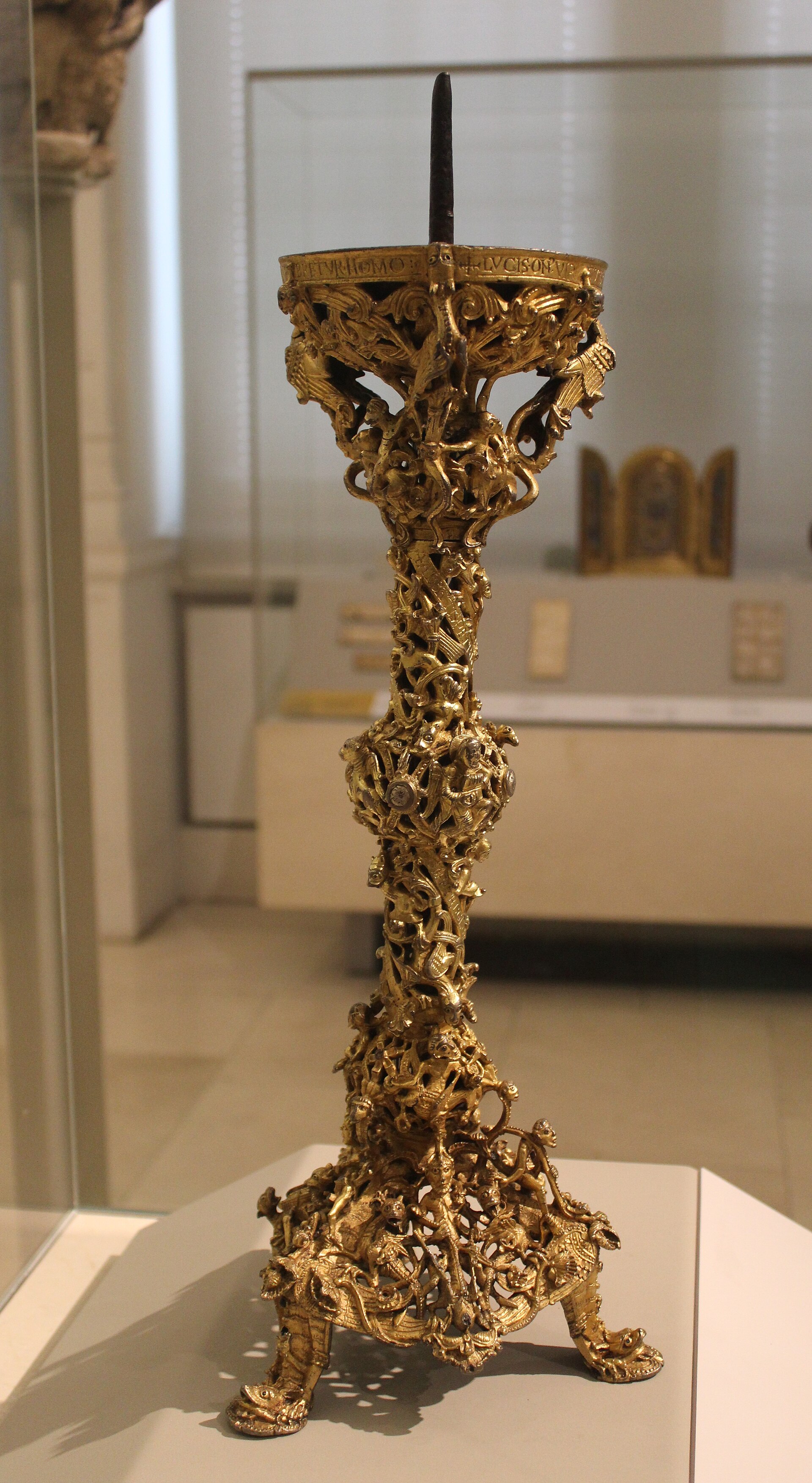
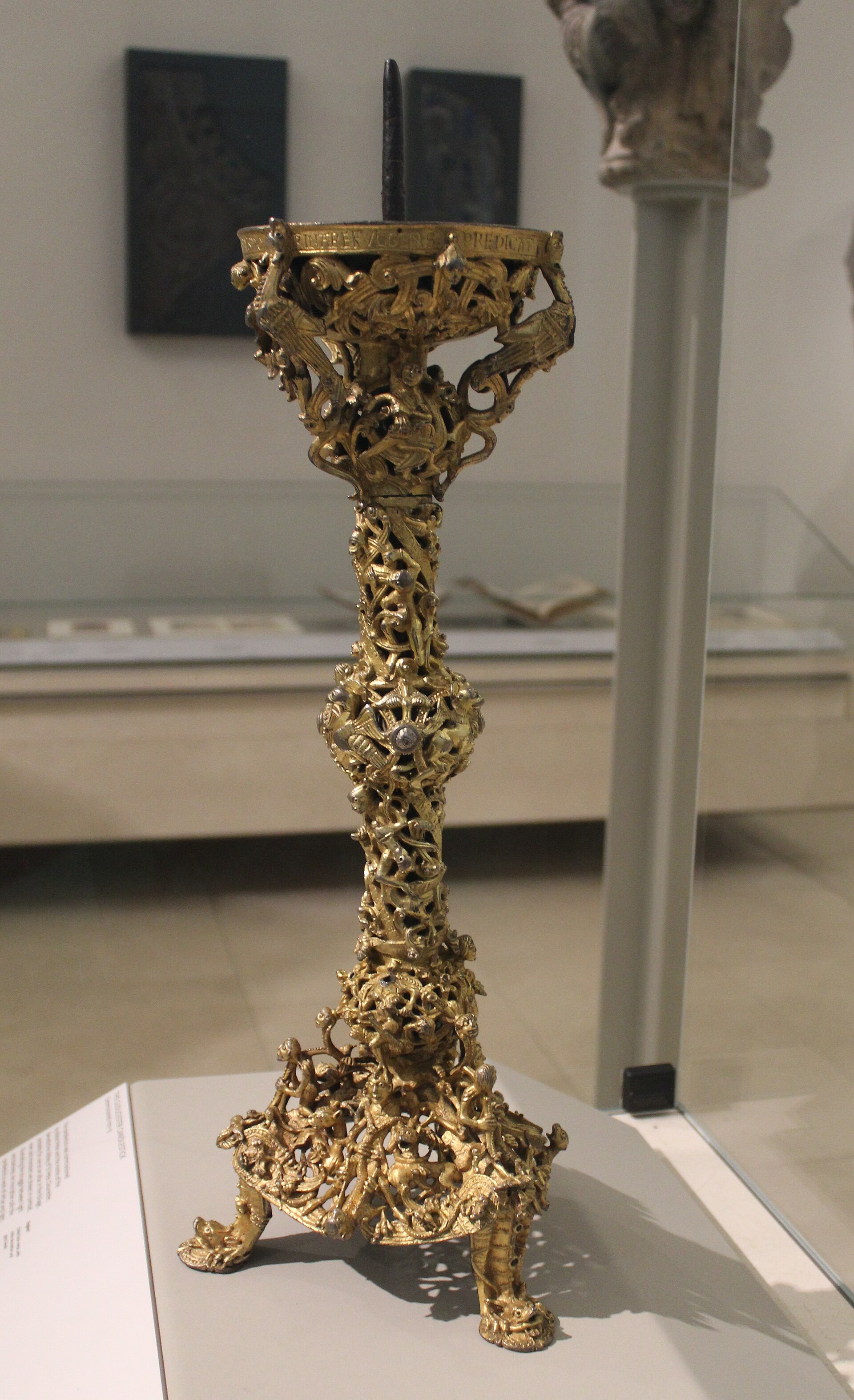
The Gloucester Candlestick is a gilt copper-alloy candlestick just under 58 centimetres tall, cast in three principal sections: a triangular base rising to a knop, a stem with a second, larger knop at its centre, and a grease pan with a third knop beneath it. A central metal rod, which forms the pricket that held the candle, runs through all three parts and holds them together; the V&A's own catalogue entry records that this rod may be original to the object.
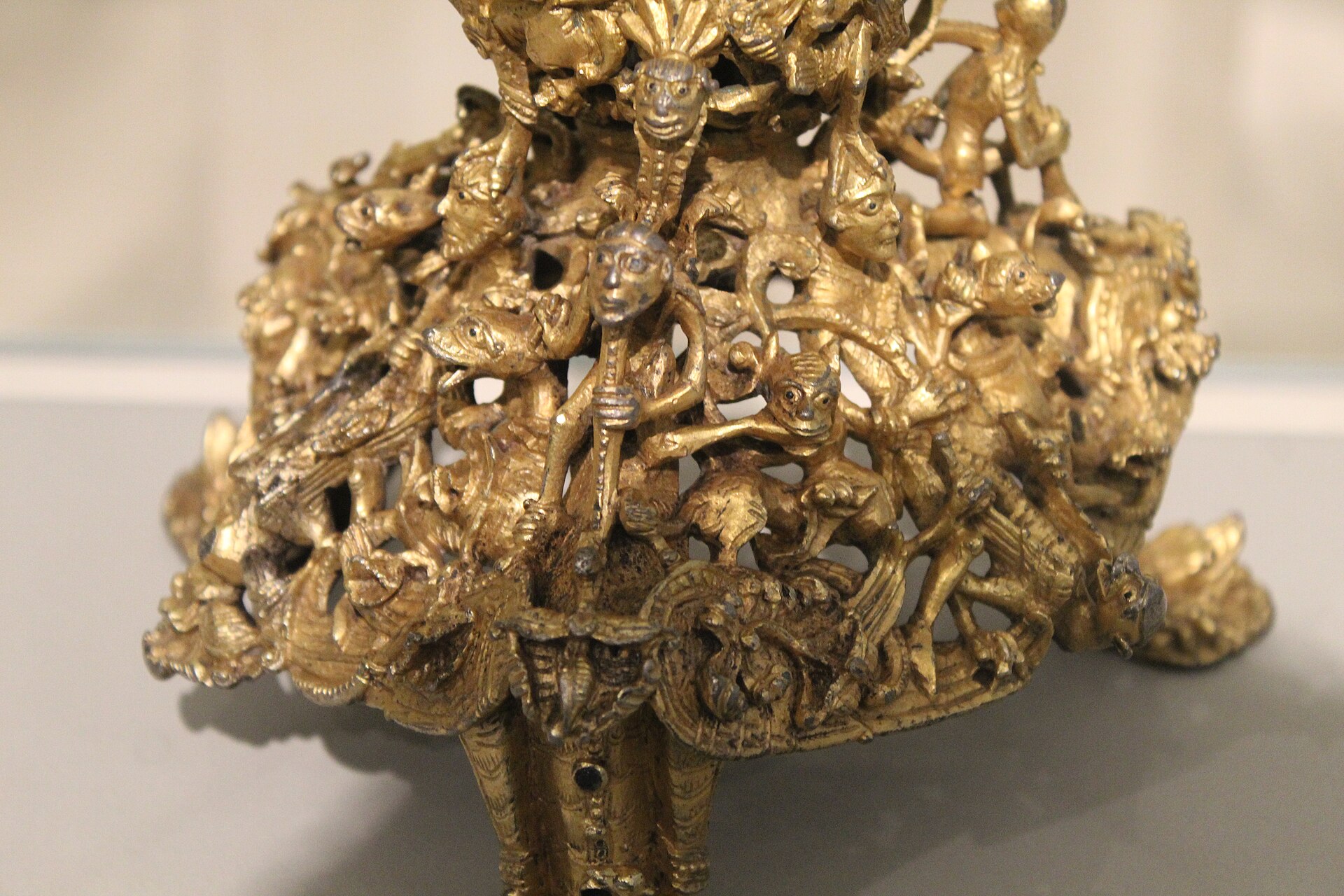
Every surface not required to be plain is worked as openwork: intricately modelled human figures, apes, serpents, dragons and canine-headed winged beasts are intertwined with thick shoots of foliage across the base, stem and pan-support. Three long-eared dragons with spread wings form the feet. Small blue glass beads are inlaid as eyes in some of the figures and set into flowers and dragon bodies. This is not a piece of church plate that happens to be decorated; the decoration is the object, cast in a single continuous programme with the structure that supports the candle.
How it was made
The candlestick was modelled in wax and cast by the lost-wax (cire-perdue) process, in three main sections, then gilded and the gilding renewed at some later point. Analysis of the alloy, carried out by Dr Roger Brownsword of Lanchester Polytechnic, found copper, zinc, tin, lead, silver, nickel, iron, antimony and arsenic; the V&A's metalwork curator Marian Campbell has noted that the different parts do not share exactly the same composition even though all contain the same ingredients, and that the silver content throughout is unusually high for a base-metal casting of this date.
The larger heads among the figures were cast separately from the bodies and slotted in. The silver roundels set into the stem knop carry niello decoration made from a silver, copper and lead-based compound, and analysis of glass from a beast's eye shows a soda-potash-lime glass, possibly coloured with iron. None of this is decoration applied after casting was finished; it is a sequence of separate specialist processes, in metal, niello and glass, brought together in one object.
The inscriptions
Three inscriptions in Latin survive on the object. The most important runs on a thin spiralling band around the stem, above and below the central knop: 'The devotion of Abbot Peter and his gentle flock gave me to the church of St Peter at Gloucester'. Alan Borg has observed that the inscription's slightly unusual Latin word order may have been chosen deliberately, to produce a rhyme.
A second inscription runs around the outer rim of the grease pan and has been translated three different ways by three different scholars: by Charles Oman in his 1958 V&A monograph as a statement that 'the debt of light is the practice of virtue', by Anabel Harris in her 1964 study as 'this upholder of light is the work of virtue', and by Alan Borg in 1985 as 'the burden of light is the work of virtue'. All three agree on the sense, that the object's own brightness preaches against vice, even where they differ on the exact English. A third inscription, on the inner rim of the grease pan and judged slightly later in date than the other two, names the donor to Le Mans Cathedral: 'Thomas of Poche gave this to the church of Le Mans when the sun renewed the year'.
The commission at Gloucester
The only firm evidence for the candlestick's origin is the inscription itself. It names Abbot Peter of the Benedictine abbey of St Peter at Gloucester, now Gloucester Cathedral. Peter had been Prior of the house and succeeded Abbot Serlo, who died in 1104; he was formally elected abbot on 5 August 1107 and died on 17 July 1113, which brackets the candlestick's manufacture to those six years.
The twelfth-century Historia et Cartularium Monasterii Sancti Petri Gloucestriae records that Peter spent eleven years studying scripture, acquired lands for the house, built a stone wall to protect the monastery, and procured many books for it. It does not mention the candlestick at all, which means the object's connection to Peter rests entirely on what it says about itself, not on any independent monastic record of the gift.
At just under 58 centimetres, the V&A's own catalogue judges the candlestick too small to have stood on the ground; it was almost certainly used on an altar or on a stand close to one. Large ceremonial candlesticks are recorded as gifts to English religious houses in exactly this period: Conrad, prior of Christ Church Cathedral Priory from 1108 to 1126, gave his own church a 'bronze candlestick of wondrous size'; Abbingdon Abbey received one from Abbot Faricius between 1100 and 1117; and Abbot Benedict of Peterborough had one made for his abbey between 1177 and 1193. Gloucester's is not an isolated gesture but part of a documented pattern of abbots marking their tenure with exactly this kind of gift.
Whether it was made as one of a pair, as some have proposed by analogy with the Hildesheim candlesticks, remains, in the V&A's own words, a claim that has not been substantiated.
The fire of 1122, and a gap the record cannot close
In March 1122 Gloucester Abbey was destroyed by fire, an event recorded in the Anglo-Saxon Chronicle. The Historia et Cartularium lists what survived: a few books and three mass robes. The candlestick is not among them, and it is not recorded as lost either. This record treats the question of whether the candlestick was inside the abbey during the fire, had already left for France, or survived the fire and left afterward as genuinely open; no source consulted answers it.
Le Mans, and an undocumented crossing
By the time the second grease-pan inscription was added, judged on stylistic grounds to be slightly later than the stem inscription but still medieval, the candlestick belonged to the Cathedral of Le Mans, given by a donor named Thomas of Poche. A. Martin, writing in 1856, proposed that this Thomas was the lord of a manor in the province of Maine, of which Le Mans is the capital, but this is a proposal, not a documented identification, and the V&A's own record does not endorse it as settled.
Nothing in the sources consulted for this record explains how or when an object commissioned for an English Benedictine abbey came to be in French hands. There is no surviving deed of gift, no chronicle account, and no indication of whether it travelled through purchase, a further gift, war, or some other channel entirely. This is one of the two largest gaps in the object's history, and it should be stated as a gap rather than bridged with a plausible-sounding guess.
Le Mans to the French Revolution
What is documented is that the candlestick remained at Le Mans Cathedral until its removal in about 1788, shortly before the Revolution. It then entered the private collection, described as a 'cabinet de curiosites', of Monsieur d'Espaulart of Le Mans, where it stayed for roughly seventy years. The circumstances of its removal from the cathedral in 1788, whether by sale, gift, or some form of pre-revolutionary secularisation of church property, are not given in the sources consulted; only the fact and approximate date of the removal, and the name of the private collector who then held it, are documented.
The 1857 sale and Prince Soltykoff
The d'Espaulart collection was sold at auction at the Hotel des Ventes, rue Drouot, Paris, in May 1857, under the title Catalogue de la Precieuse collection d'objets d'art et de Haute curiosite de Monsieur d'Espaulart du Mans. Prince Pierre Soltykoff bought the candlestick at that sale, on 7 May 1857, for 20,000 francs. The sources consulted give a single figure and do not separate a hammer price from a buyer's premium, so this record states the 20,000-franc figure exactly as recorded, without assuming it is a net hammer price.
Soltykoff assembled one of the most important private collections of medieval and Renaissance decorative art of the nineteenth century. When his own collection was dispersed at auction in Paris in 1861, the sale of 1,109 lots over three weeks was a landmark event in the market for medieval objects, at which the South Kensington Museum, forerunner of the V&A, bought at least 26 lots, including this candlestick.
1861: acquisition by the South Kensington Museum
The candlestick entered the museum's collection in 1861 as part of the Soltykoff purchases, registered under the number it still carries, 7649:1 to 3-1861, the '1 to 3' recording that it was accessioned as three separate parts (base, stem and grease pan). The price the museum itself paid for the candlestick at the 1861 sale, as distinct from the 20,000 francs Soltykoff paid in 1857, is not given in any source consulted for this record and is recorded here as not found rather than estimated.
English, Mosan, or German: the attribution debate
The candlestick's closest technical relative is not English at all. A pair of candlesticks made for Bishop Bernward of Hildesheim before his death in 1022, cast by the same lost-wax process and now in the Hildesheim Cathedral Treasury, share the triangular base and tri-knopped stem of the Gloucester piece closely enough that early scholarship floated a German origin for the Gloucester object outright. The V&A's own catalogue text treats that as a historical speculation, not a live position: fantastic combinations of men, monsters and foliage were, in its words, characteristic of the period generally and not of any one school.
The case for an English maker rests on manuscript comparison rather than metalwork comparison. Borg found that in no other Romanesque metal object does the relationship to manuscript illumination stand out as strongly as it does here, and it was that closeness to Canterbury illumination of the late eleventh and early twelfth centuries that led Harris to propose Canterbury itself as the place of manufacture. Stratford, cataloguing the object for the 1984 Hayward Gallery exhibition English Romanesque Art 1066-1200, accepted the English attribution but rejected a fixed Canterbury workshop, preferring a professional craftsman who travelled around southern England rather than one tied to a single scriptorium.
A further, minority position exists in the literature: Roderick Butler and Christopher Green published a paper in 2008, in the same volume of the Journal of the Antique Metalware Society as the V&A's own conservators' technical study, titled 'The Gloucester Candlestick: A Case for a Gloucester Provenance'. This record has located the paper's title and publication details but has not read the paper itself, and does not know what evidence or argument it advances beyond what its title states; it is recorded here as an open position in the literature, not endorsed or summarised further.
What is not disputed is the object's stylistic proximity to work from the Meuse valley and Lower Rhineland, the leading twelfth-century European centre for figural bronze casting, of which Reiner of Huy's baptismal font of 1107 to 1118 at the church of St Barthelemy in Liege is the best-documented contemporary benchmark. Whether that proximity reflects a shared visual language across the Anglo-Norman and Mosan worlds, direct Mosan training of an English-based caster, or simply the general Romanesque taste for interlaced beast-and-foliage ornament that Borg describes as common to the period, is not resolved in the sources consulted, and no source consulted names a documented Mosan-trained hand as the Gloucester maker specifically.
What the decoration meant
The central knop on the stem carries the symbols of the four Evangelists, a conventional and well-understood sign of the enlightenment carried by the Gospels. The grease-pan inscription makes the candlestick's intended meaning explicit in words: its light preaches against vice. The V&A's own catalogue record proposes that the combat scenes between men and beasts across the base and stem continue that theme, read as a struggle between light and darkness, good and evil, a reading Borg supports by pointing to Bernard of Clairvaux's well-documented distaste for exactly this kind of fantastic Romanesque ornament in a monastic setting, on the view that if a leading churchman of the age thought such imagery worth condemning, contemporaries evidently read moral content into it. Harris takes the opposite position, that the animals need carry no particular moral significance at all. This record states both positions and does not arbitrate between them; the evidence is a matter of how one reads twelfth-century Romanesque ornament in general, not a fact specific to this object.
The wider practice the candlestick belongs to is itself worth stating plainly rather than assuming. Little evidence survives for candles being placed on altars during the first thousand years of Christian worship; the earliest liturgical documents allowing for it, the eleventh-century Cluniac Consuetudinary of Fleury, specify limited use at Christmas, Easter and Pentecost, and the earliest English documentary list of such gifts, made by Henry of Blois to Winchester Cathedral, postdates the Gloucester candlestick. An English ivory box in the V&A's own collection, of the same century, shows a single candlestick standing on an altar dressed for Easter, evidence that such objects were used singly as well as, perhaps, in pairs. The Gloucester Candlestick is therefore very close to the beginning of the altar candle as a standard element of English liturgical furnishing, not a late example of an established custom.
Conservation and recent technical research
The V&A's Metals Conservation department, led by Stephanie Seavers and Catia Viegas Wesolowska, undertook a technical study of the candlestick published as 'The Gloucester Cathedral Candlestick: Ongoing Research' in the Journal of the Antique Metalware Society in 2008. The museum's own account of that research records that the surface gilding is worn in places, revealing the base metal beneath, and that an earlier restoration had applied lacquer to the surface, later removed during the recent conservation campaign.
Disassembly for study found a length of copper tubing inside the object that the conservators suggest may represent an early repair, and small cross-shaped marks at the joints between the three cast sections, evidently made to guide assembly at the time of manufacture. A sculptor working with the conservation team cast a modern replica of one section in a silver-rich alloy matching Brownsword's analysis, and found that the silver made the molten metal flow markedly more easily through the complex mould, and that the finished cast surface came out a silvery yellow color close to gold before any gilding was applied. That finding produced a genuine open question rather than closing one: if the cast metal already looked gold-toned, why was it fire-gilded as well. As of the V&A's own published account, analysis of the copper tubing against British Museum reference data, intended to help date the probable repair, was still in progress.
Reproduction and modern circulation
Gloucester Cathedral has not had physical custody of the candlestick since the eighteenth century, but in 2020 the Gloucestershire engineering firm Renishaw, working with the Cathedral and the V&A, produced a metal replica using additive manufacturing. A 3D laser scan of the original at the V&A captured its openwork geometry, and Renishaw built the copy in aluminium, layer by layer, on a RenAM 500Q multi-laser system, after early trials in titanium were abandoned in favour of aluminium's greater precision at this scale. The replica was installed at Gloucester Cathedral, returning a version of the object to the building it was made for, eight centuries after it left, while the original stayed on display at the V&A.
The artist
Unrecorded English goldsmith, active in the reign of Abbot Peter of Gloucester (1107-1113)
No name survives for the maker of the Gloucester Candlestick, on the object or in any document. What can be said is inferred entirely from the object itself and from comparison with other work of the period: an English Romanesque milieu in which a small number of highly skilled metal casters, working close to the visual language of manuscript illumination, produced ambitious figural bronzework for major religious houses. The candlestick is the strongest surviving evidence for that milieu having existed at all.
Related works
| Work | Relation | Where it is |
|---|---|---|
| Bernward's Candlesticks (pair) Unknown caster, workshop associated with Bishop Bernward of Hildesheim | Closest technical and typological comparandum: earlier candlesticks made by the same lost-wax casting method, sharing the triangular base and multi-knopped stem form. Early scholarship briefly floated a German origin for the Gloucester piece on the strength of this resemblance. Made before Bernward's death in 1022; among the oldest surviving European altar candlesticks and, with the Gloucester piece, one of the two oldest types the V&A's own catalogue identifies for the form. | Dom-Museum Hildesheim, Germany |
| Baptismal font Reiner of Huy | The best-documented named bronze caster of the immediately surrounding period and region; used in the literature as the benchmark for the Mosan figural bronze style against which the Gloucester Candlestick's decoration is compared. Cast 1107-1118, closely contemporary with the Gloucester Candlestick's 1107-1113 commission. | Church of St Barthelemy, Liege, Belgium |
| Candlestick base and plaque (fragment) Unrecorded English metalworker(s) | A related fragmentary English Romanesque candlestick base excavated at Haughmond Abbey, discussed alongside the Gloucester piece by Claude Blair and Marian Campbell in their 2014 study of the Haughmond excavation. Evidence that Gloucester's candlestick was not a unique type of object within English monastic metalwork, even though it is the only substantially complete example of this quality to survive. | Excavated at Haughmond Abbey, Shropshire; published in the 2014 excavation report |
| Ivory box with liturgical scenes Unrecorded English carver | A twelfth-century English ivory in the V&A's own collection depicting a single candlestick standing on an altar dressed for Easter, cited by the V&A as visual evidence for how an object like the Gloucester Candlestick was actually used in the liturgy. Cited in the V&A's own catalogue discussion of the Gloucester Candlestick's liturgical context rather than as a stylistic parallel. | Victoria and Albert Museum, London |
Open questions
- Did the candlestick survive the fire that destroyed Gloucester Abbey in March 1122? The Historia et Cartularium Monasterii Sancti Petri Gloucestriae lists what survived the fire and does not mention it, but does not record it as lost either.
- By what mechanism and in what year did the candlestick pass from Gloucester Abbey to Le Mans Cathedral? No document bridges the gap between the 1107-1113 commission and its documented presence at Le Mans.
- Who was Thomas of Poche, the donor named in the Le Mans inscription? A. Martin's 1856 suggestion that he was a lord of a manor in Maine is a proposal, not a documented identification.
- Under what circumstances was the candlestick removed from Le Mans Cathedral in about 1788, shortly before the French Revolution? The sources consulted record the fact and approximate date of removal but not the mechanism.
- Was the candlestick made as one of a pair, on analogy with the Hildesheim Bernward candlesticks? The V&A's own catalogue states this claim remains unsubstantiated.
- Was the candlestick made in Canterbury, by a traveling craftsman working across southern England, or, as Butler and Green's 2008 paper title claims, near Gloucester itself? The literature is unresolved and this record has not been able to verify the content of the Butler and Green paper.
- If the silver-rich alloy already cast to a gold-like colour, as the V&A conservation team's 2008-2009 replica casting experiment suggested, why was the object fire-gilded as well? The museum's own account records this as an open question raised by its own research.
- What price did the South Kensington Museum pay for the candlestick at the 1861 Soltykoff sale? Soltykoff's own 1857 purchase price of 20,000 francs is documented; the museum's 1861 purchase price is not given in any source consulted.
Questions about this object
What is The Gloucester Candlestick?
The Gloucester Candlestick is a goldsmith's work, dated 1107-1113 (commissioned). Medium: Gilt copper alloy (bronze with an unusually high silver content), cast by the lost-wax (cire-perdue) process in three sections, with niello and glass-bead inlay.
Who made The Gloucester Candlestick, and is the attribution settled?
The attribution to Unrecorded English goldsmith (Canterbury or an itinerant craftsman working in southern England) is recorded here as disputed. No maker is named on the object or in any surviving document. The V&A's own catalogue entry calls the attribution to an English artist 'generally accepted' on the strength of close stylistic parallels with Canterbury manuscript illumination of the late eleventh and early twelfth centuries, a link Alan Borg judged closer than in any other Romanesque metalwork. Anabel Harris used that link to propose Canterbury itself as the place of manufacture. Neil Stratford, cataloguing the piece for the 1984 Hayward Gallery exhibition, contested a Canterbury workshop in favour of a professional craftsman travelling around southern England. A minority paper by Roderick Butler and Christopher Green, published alongside the V&A's own conservators' research in the Journal of the Antique Metalware Society in 2008, argues instead for a Gloucester provenance; this record has seen only its title and has not verified its argument at first hand. An early theory that the object was German, prompted by its close technical kinship to the pair of candlesticks made for Bishop Bernward of Hildesheim, is noted by the V&A as a historical speculation rather than a live position in the current literature.
Where is The Gloucester Candlestick now?
Victoria and Albert Museum, London. On display, Medieval and Renaissance Galleries, Room 8 (The William and Eileen Ruddock Gallery), South Kensington., Museum no. 7649:1 to 3-1861 (three registered parts: base, stem and grease pan). Last confirmed 16 September 2026. V&A Explore the Collections, object record for O114078, consulted directly.
What has The Gloucester Candlestick sold for?
Hammer Not separately recorded; with premium, Not separately recorded. Hotel des Ventes, rue Drouot, Paris (d'Espaulart sale), 1857-05-07.
What is still unknown about The Gloucester Candlestick?
Did the candlestick survive the fire that destroyed Gloucester Abbey in March 1122? The Historia et Cartularium Monasterii Sancti Petri Gloucestriae lists what survived the fire and does not mention it, but does not record it as lost either.
Sources
- 1Victoria and Albert Museum, Explore the Collections, object record for 'The Gloucester Candlestick', museum no. 7649:1 to 3-1861 (object O114078). Primary museum catalogue entry: physical description, both stem and grease-pan inscriptions with translations, object history note, historical context note, and full bibliography. collections.vam.ac.uk/item/...
- 2Victoria and Albert Museum blog, 'A Romanesque Candlestick - Conservation and Research', by the V&A Metals Conservation team (Stephanie Seavers and Catia Viegas Wesolowska). vam.ac.uk/blog/...
- 3Wikipedia, 'Gloucester Candlestick'. Tertiary source, consulted for cross-checking and for its own bibliography; flagged for replacement with direct consultation of the print scholarship it cites. en.wikipedia.org/wiki/...
- 4Oman, Charles Chichele. The Gloucester Candlestick. Victoria and Albert Museum Monograph No. 11. London: HMSO, 1958. Cited via the V&A's own object-record bibliography (source 1) and as the source of one of the three published translations of the grease-pan inscription; the monograph itself was not independently consulted for this record. search.worldcat.org/search
- 5Harris, Anabel. 'A Romanesque Candlestick in London.' Journal of the British Archaeological Association, 3rd series, vol. XXVII, 1964. Cited via the V&A's own object-record bibliography; not independently consulted for this record. tandfonline.com/loi/...
- 6Borg, Alan. 'The Gloucester Candlestick.' Offprinted from Medieval Art and Architecture at Gloucester and Tewkesbury, British Archaeological Association Conference Transactions, 1985. Cited via the V&A's own object-record bibliography; not independently consulted for this record. thebaa.org/publication/...
- 7Cahier, Charles, and Arthur Martin. 'Le Chandelier de Glocester.' Melanges d'Archeologie, vol. IV. Paris, 1856. The earliest scholarly study identified for this object, source of the theory identifying Thomas of Poche as a Maine landholder. Cited via the V&A's own object-record bibliography; not independently consulted for this record. digi.ub.uni-heidelberg.de/diglit/...
- 8Hart, William Henry, ed. Historia et Cartularium Monasterii Sancti Petri Gloucestriae. London: Longman, Green, Longman, Roberts, and Green, 1863-67. Cited via the V&A's own object-record bibliography for the account of Abbot Peter's tenure and the list of items surviving the 1122 fire; the edition itself was not independently consulted for this record. archive.org/details/...
- 9Viegas Wesolowska, Catia, and Stephanie Seavers. 'The Gloucester Cathedral Candlestick: Ongoing Research.' Journal of the Antique Metalware Society, vol. 16, June 2008, pp. 52-59. Cited via the V&A's own object-record bibliography, corroborating source 2; the journal article itself was not independently consulted for this record. antiquemetalware.org.uk/2008/...
- 10Butler, Roderick, and Christopher Green. 'The Gloucester Candlestick: A Case for a Gloucester Provenance.' Journal of the Antique Metalware Society, vol. 16, 2008, pp. 60-61. Located via the V&A's own object-record bibliography; only the title and publication details were verified, the argument of the paper was not read for this record. antiquemetalware.org.uk/2008/...
- 11Zarnecki, George, ed. English Romanesque Art 1066-1200. Exhibition catalogue, Hayward Gallery, London, 5 April - 8 July 1984. Arts Council of Great Britain, 1984, catalogue no. 247, p. 249; the Gloucester Candlestick entry is attributed to Neil Stratford. Cited via the V&A's own object-record bibliography and Wikipedia's bibliography; not independently consulted for this record. archive.org/details/...
- 12TCT Magazine, 'Metal 3D printed replica of 12th century candlestick to go on display at Gloucester Cathedral', on the Renishaw additive-manufacturing replica produced for Gloucester Cathedral from a 3D scan of the V&A original. tctmagazine.com/additive-manufacturing-3d-printing-news/...
Last verified 16 September 2026 · Published 16 September 2026
Change log
16 September 2026 - Record created at the house standard: researched narrative, technical evidence, maker dossier, graded provenance chain, prices with hammer and premium separated, related works, open questions and sources.