The Great Bed of Ware
Unknown English maker, working from continental ornament prints · c. 1590-1600, with later repairs and alterations
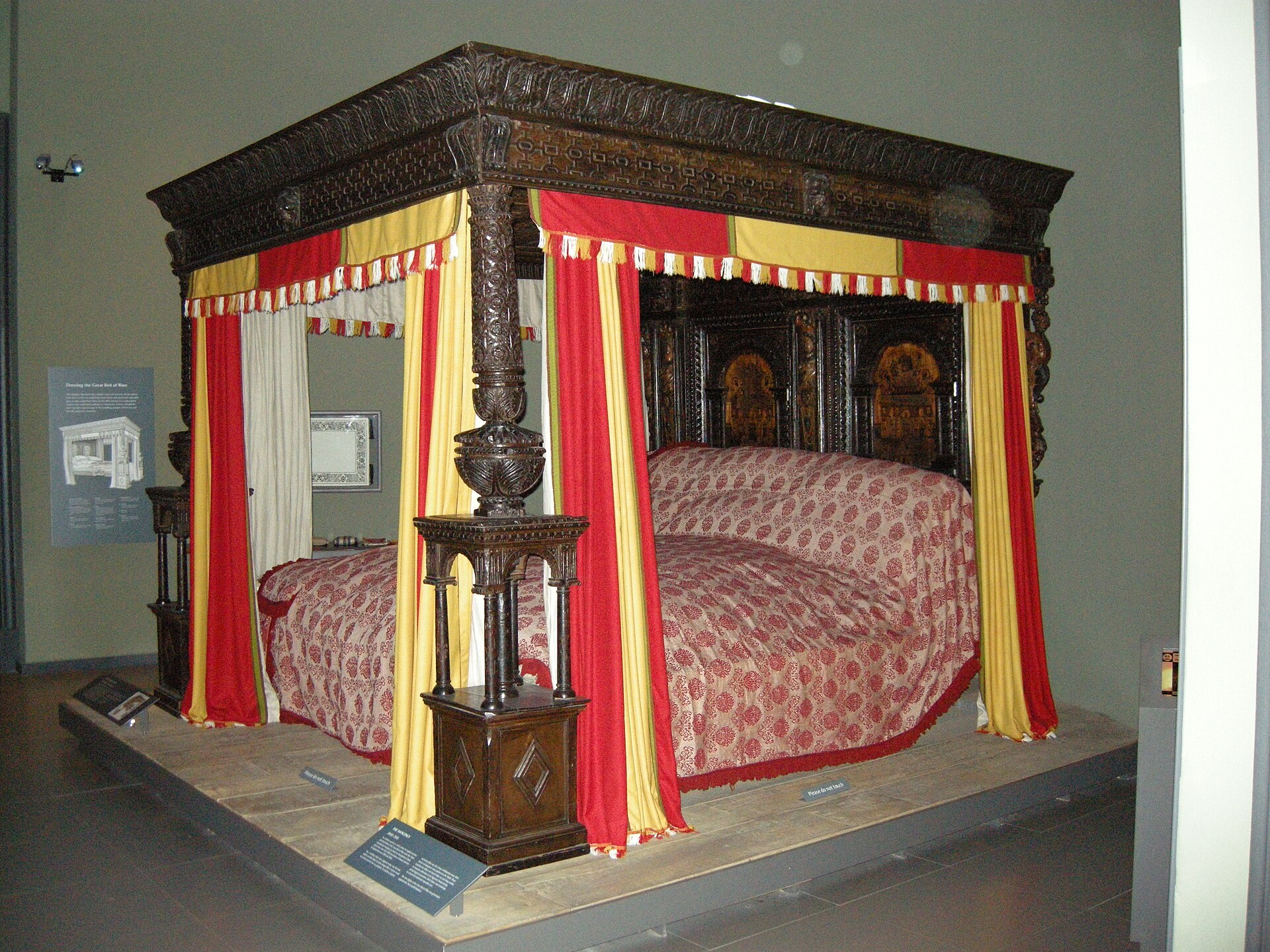
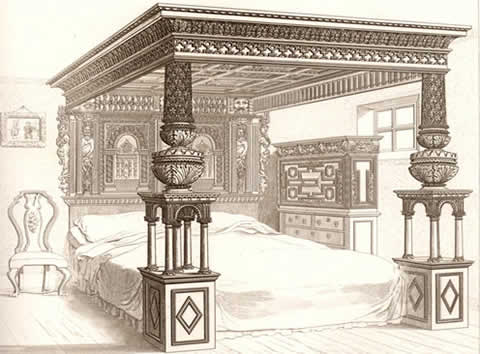
The Great Bed of Ware, oak, carved and originally painted, c. 1590-1600, photographed at the Victoria and Albert Museum during the 2009 Wikipedia Loves Art project, explicitly tagged to museum number W.47-1931 on the file page.
Photograph by veronikab, Wikipedia Loves Art participant, via Wikimedia Commons, CC BY 2.5 · Photograph by Wikipedia Loves Art participant "veronikab"| Artist | Unknown English maker, working from continental ornament prints |
|---|---|
| Date | c. 1590-1600, with later repairs and alterations |
| Medium | Oak, carved and originally painted, with panels of inlaid marquetry |
| Dimensions | 267 x 326 x 338 cm (height x width x depth), per the V&A's own catalogue record. Secondary accounts commonly round this to about 3.38 x 3.26 m, or ten by eleven feet. |
| Where it is now | Victoria and Albert Museum, Londonlast confirmed 23 September 2026 |
| Inventory number | W.47:1 to 28-1931 |
| Attribution | DisputedNo maker is named in any document contemporary with the bed's construction, and none has been securely identified since. Full note |
| Object type | Furniture |
| Period | English, late sixteenth century |
| Cases | Disputed attribution · Has a provenance gap |
| Inscriptions | Extensive carved initials and applied red wax seals left by generations of overnight guests on the bedposts and headboard; a faded painted date of 1463 on the headboard, a century before the bed's actual construction, reflecting a later tradition connecting it to the reign of Edward IV. |
| Owners on record | 9 links7 documented, 1 disputed, 1 unknown |
| Sources | 10 cited |
About this record Last verified 23 September 2026 · 10 sources cited · Change log
On this page 9 sections
ContentsClose
The Great Bed of Ware is a carved oak four-poster bed, about three and a third metres on each horizontal side, made around 1590 to 1600 and now at the Victoria and Albert Museum. No bed of comparable scale from the period is known to survive. It spent more than two hundred and fifty years working as a paying tourist attraction at a sequence of inns in Ware, Hertfordshire, before fifty-seven years in a Hoddesdon pleasure garden and, finally, purchase by the V&A in 1931 for 4,000 pounds, after the same museum had turned it down for nothing in 1865.
Shakespeare named it in Twelfth Night in 1601 and Ben Jonson gave it its lasting name in 1609, both within a couple of decades of its construction, and before anyone recorded who actually built it. The carpenter's name usually attached to it, Jonas Fosbrooke, comes from a nineteenth-century pantomime, not a sixteenth-century record. The surface carries the carved initials and red wax seals of the guests who slept in it across that whole span, which the V&A displays as the object's own history rather than treating as damage to be removed.
What remains genuinely unresolved is who made it, and whether it was ever meant for anyone but paying guests in the first place. The absence of any family crest or mention in a family's own papers argues for the second answer without quite settling the question.
Provenance
Each link is graded. Documented: a cited source supports it. Disputed: the identification is argued but not established. Unknown: no owner for that span, and the gap is not smoothed into a narrative. The grades in the glossary.
- c. 1590 -Unknown maker; first display uncertain between a private household and a Ware inndisputed
The bed's construction date and place, Ware, Hertfordshire, are documented by the V&A. Its original purpose is not: it may have been commissioned privately and moved to an inn soon after, or built for the inn trade from the start. The V&A's own curatorial position now favours the second reading, based on the absence of family heraldry or any reference to the bed in family papers.15
- - 1596The Crown, Ware (earliest tradition)unknown
The V&A's own account places an early, undated period at the Crown before the bed is first documented at the White Hart. No precise dates for this period are given in the sources consulted.1
- 1596 - 1706The White Hart Inn, Waredocumented
First securely dated by the 1596 reference in the travel diary of Prince Ludwig of Anhalt-Kohten, and independently by Shakespeare's 1601 reference and Ben Jonson's 1609 reference, both consistent with the bed being a well-known Ware attraction across this period.134
- 1706 -The George, Waredocumented
Documented by the V&A for 1706. The date it left the George for a second period at the Crown is not given in the sources consulted.1
- - 1765The Crown, Ware (second period)documented
The V&A's account records a return to the Crown before the final move to the Saracen's Head in 1765; exact start date not given.1
- 1765 - 1870The Saracen's Head, Waredocumented
The bed's longest single documented residence at one Ware inn. While here, in 1865, the South Kensington Museum, the V&A's own predecessor, was offered the chance to acquire it and refused, describing it as a coarse and mutilated relic not appropriate as a new acquisition.13
- 1870 - 1927Rye House Hotel, Hoddesdon, Hertfordshiredocumented
Installed in a purpose-built garden display as a pleasure-garden curiosity alongside other assembled antiquities. Remained here longer than at any single Ware inn on record.13
- 1927 - 1931Cannon Brewery Ltd, then Frank Partridge and Sons Ltd, London dealersdocumented
Cannon Brewery acquired the Rye House Hotel in 1927 and did not want the bed. It passed to the dealers Frank Partridge and Sons, of 26 King Street, London, who exhibited it amid concern, recorded in the V&A's own account, that it might be sold abroad, and who agreed to let the V&A have it at cost.1
- 1931 - presentVictoria and Albert Museum, Londondocumented
Purchased for GBP 4,000, of which GBP 2,000 was contributed by the National Art Collections Fund (now the Art Fund). The V&A's own record states the purchase was made principally for the bed's historical and literary significance and to keep it in the country. On permanent display since; moved to the British Galleries, Room 57, in 2001; loaned to Ware Museum April 2012 to April 2013.123
Technical evidence
| Attribution note | No maker is named in any document contemporary with the bed's construction, and none has been securely identified since. The carpenter's name popularly attached to the bed, Jonas Fosbrooke, comes from an early Victorian pantomime, not a sixteenth-century record. A second, separate dispute concerns purpose rather than hand: whether the bed began as a private commission for a wealthy household and was later moved into innkeeping, or was built from the outset as a novelty to draw paying guests to an inn at Ware. The Victoria and Albert Museum now favours the second reading, on the grounds that the bed carries no family heraldry and appears in no family papers. |
|---|---|
| Dimensions | 267 cm high x 326 cm wide x 338 cm deep, per the V&A's own catalogue record. Often rounded in secondary accounts to about 3.38 x 3.26 m, or ten by eleven feet.1 |
| Materials and construction | Oak, carved and originally painted, with panels of inlaid marquetry. Built in at least twenty-eight separable numbered parts, reflected in its own museum number, W.47:1 to 28-1931.1 |
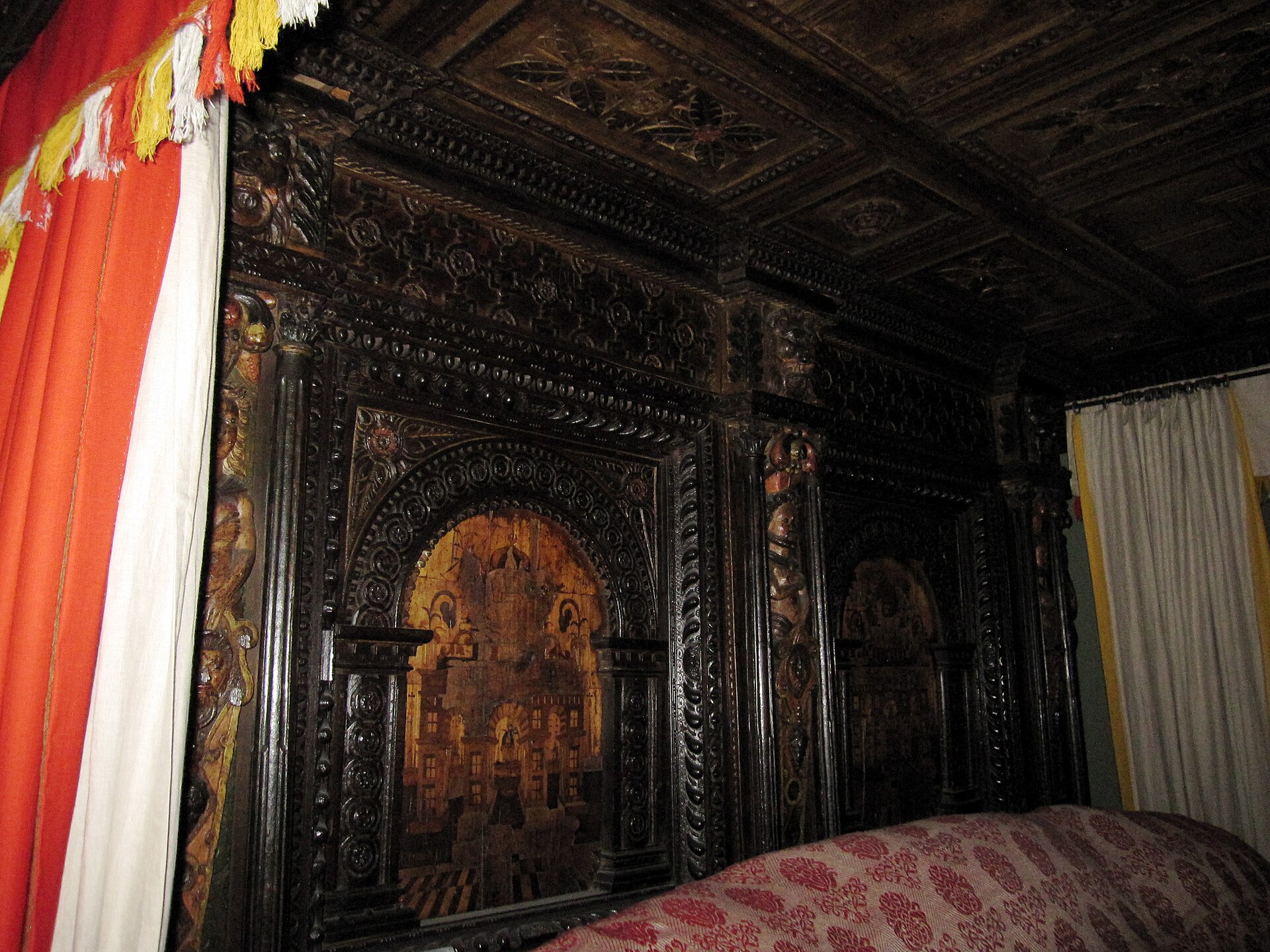
| Headboard iconography | Two arched marquetry panels with architectural perspective scenes and swans, flanked by three carved human figures, two male and one female, carrying baskets of fruit, with satyrs at each outer edge.1 |
| Polychromy | The carved figures retain traces of the bed's original bright paint scheme, now largely lost.1 |
| Design source | The marquetry's architectural perspective panels are in the idiom of ornament engravings published by the Dutch designer Hans Vredeman de Vries (1527-1604). The V&A's catalogue states that no single source print has been matched exactly to the panels.1 |
| Inscribed date | A faded painted date of 1463 appears on the headboard, a century before the bed's actual construction, reflecting a later, unsupported tradition connecting it to the reign of Edward IV.1 |
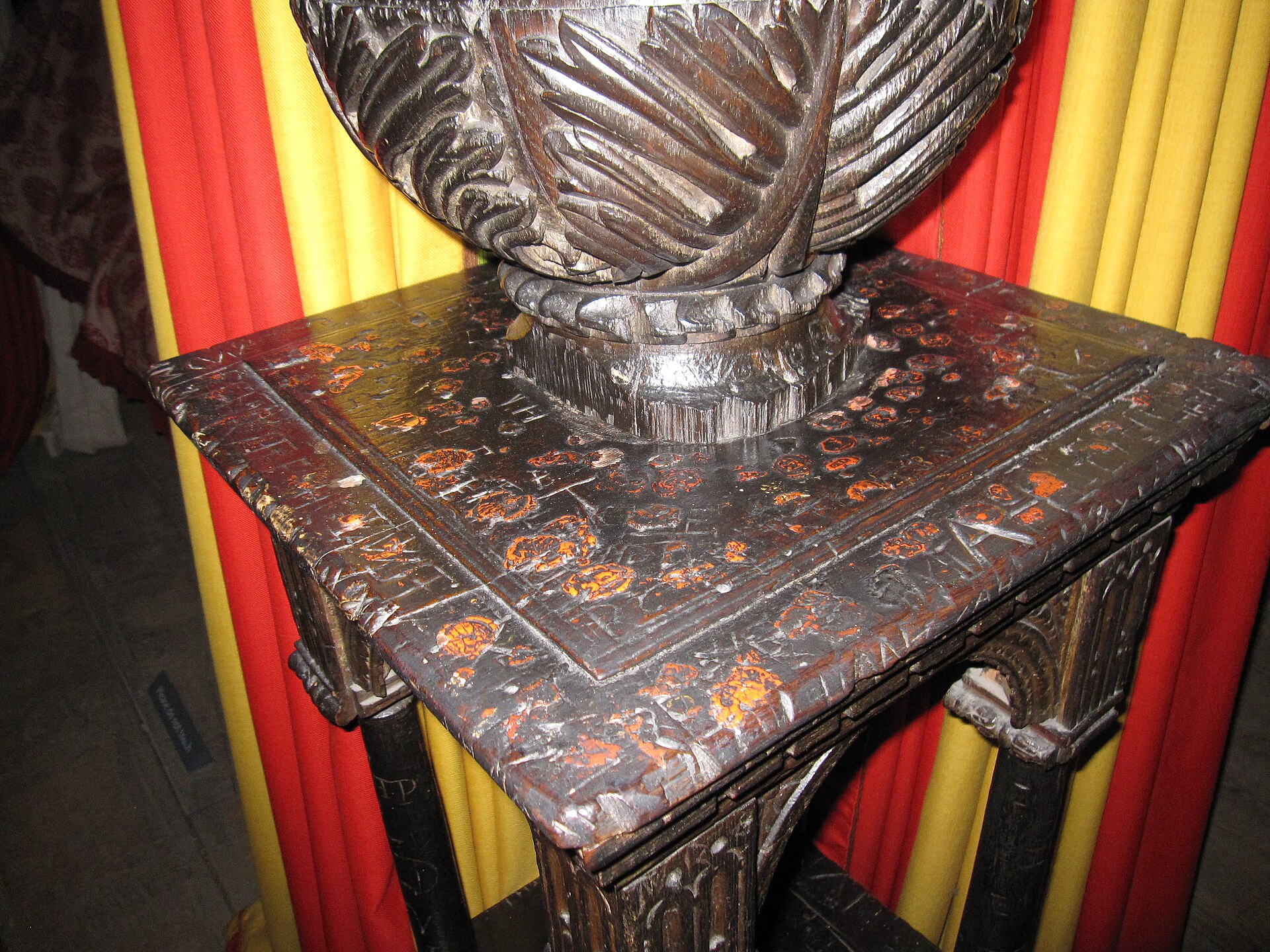
| Surface marks | Extensive carved initials and applied red wax seals left by generations of overnight guests remain visible on the bedposts and headboard, and are treated by the museum as part of the object's history rather than damage.16 |
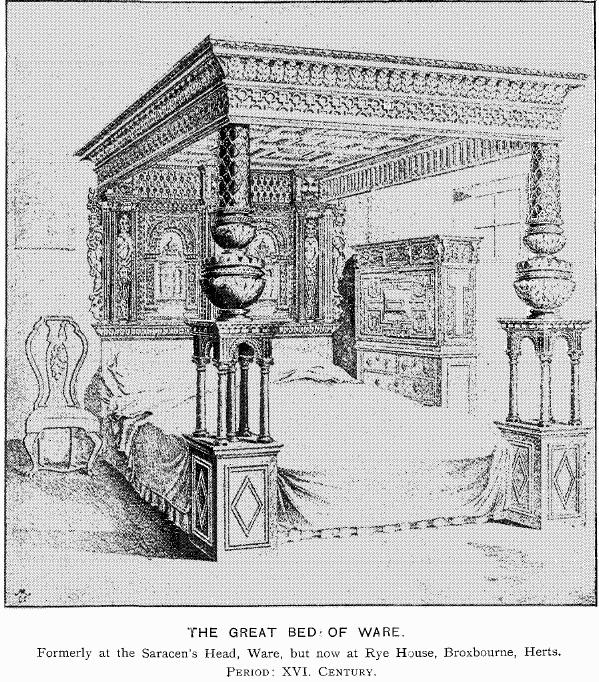
| Hangings | The bed's original textile hangings and canopy fabric do not survive; the fabric shown with it today is a modern reproduction.3 |
Images
The record in full
Chapter 1The largest bed anyone has documented from its period
The Great Bed of Ware is a carved oak four-poster bed measuring 267 cm high, 326 cm wide and 338 cm deep, roughly three and a third metres on each horizontal side.
The Great Bed of Ware is a carved oak four-poster bed measuring 267 cm high, 326 cm wide and 338 cm deep, roughly three and a third metres on each horizontal side. No other bed of comparable scale from the period is known to survive, and no source consulted for this record identifies a rival. It is built in at least twenty-eight separable numbered parts, which is reflected in its own museum number, W.47:1 to 28-1931, a sign that whoever built it expected it to be taken apart and put together again, which is exactly what happened to it for more than three centuries.
The headboard is the most worked surface. Two arched marquetry panels show architectural perspective scenes with swans, flanked by three carved human figures, two male and one female, each carrying a basket of fruit, with a pair of satyrs, part man and part goat, standing guard at the outer edges. The figures still show traces of the bright paint that originally covered them, now largely worn away. Baskets of fruit are a standard Renaissance shorthand for abundance and fertility; satyrs are a standard shorthand for drink and appetite. Nothing about the carving asks to be read as anything other than what it plainly is: an advertisement, worked in oak, for a bed built to be looked at, talked about, and slept in by as many people as would fit.
Chapter 2How it was made, and from whose designs
The marquetry's arched perspective panels derive from ornament engravings published by the Dutch designer Hans Vredeman de Vries (1527-1604), whose pattern books of architectural perspectives...
The marquetry's arched perspective panels derive from ornament engravings published by the Dutch designer Hans Vredeman de Vries (1527-1604), whose pattern books of architectural perspectives, strapwork and grotesque ornament circulated across northern Europe in the late sixteenth century and were used directly by English carvers and joiners of the period. The Victoria and Albert Museum's own catalogue record states plainly that a precise source print has not been identified: the panels are in Vredeman de Vries's idiom, not a traced copy of one surviving sheet.
That distinction matters. It means the bed's headboard is evidence of an English workshop working fluently in an imported continental vocabulary, adapting rather than copying, which is exactly how Vredeman de Vries's own engravings say they were meant to be used: as templates for designers of architectural perspective and inlay work, not as patterns to be reproduced line for line.
Chapter 3A carpenter invented for the stage
The name most often attached to the bed's maker is Jonas Fosbrooke, a Hertfordshire carpenter said to have built it around 1590.
The name most often attached to the bed's maker is Jonas Fosbrooke, a Hertfordshire carpenter said to have built it around 1590. No source consulted for this record can trace that name to any document from the bed's own century. It surfaces instead in an early Victorian pantomime called The Great Bed of Ware, in which Fosbrooke appears as a fictional character, a ghost who haunts the bed and torments those who sleep in it unfaithfully. Sources consulted for this record disagree on the exact year of that pantomime, giving both 1839 and 1849, and on which London theatre staged it; this record does not resolve that disagreement and flags it as open.
What is not in dispute is the direction of travel: a nineteenth-century entertainment supplied a name that later writers then repeated as sixteenth-century fact. Whether a real carpenter named Fosbrooke ever existed at all is genuinely doubted by the sources this record could verify. The honest position is that the bed's maker is not known, and that the popular name for him is a piece of Victorian theatre wearing the costume of history.
Chapter 4Aristocratic commission, or built for the inn trade
A second, separate question is why the bed was made at all.
A second, separate question is why the bed was made at all. For a long time the assumption ran that a bed this large and this richly worked must have started life in a nearby great house, commissioned by a wealthy family and only later moved into an inn. The Victoria and Albert Museum's own curatorial position, attributed to Nick Humphrey, the museum's curator of furniture and woodwork covering this period, now runs the other way: the bed carries no family heraldry, is mentioned in no surviving family papers, and there is no obvious explanation for why a bed made for a private household would have been moved into an inn so soon after it was made. On that reading, the bed was built from the outset as a curiosity, meant to draw paying custom to whichever Ware inn first displayed it, consistent with a documented Tudor practice of putting notable beds, including former royal beds, on show to guests once their original owner no longer needed them.
Both positions are stated here because both have been argued. What this record will not do is present either as settled fact. The absence of heraldry is real and is the strongest single piece of physical evidence either way, and it points toward the inn-built reading; it does not prove it.
Chapter 5The earliest witness: a German prince's travel diary, 1596
The earliest documented reference to the bed identified by the V&A's own catalogue comes from 1596, when a travelling German prince, Ludwig of Anhalt-Kohten, recorded seeing it at the White Hart Inn...
The earliest documented reference to the bed identified by the V&A's own catalogue comes from 1596, when a travelling German prince, Ludwig of Anhalt-Kohten, recorded seeing it at the White Hart Inn in Ware in a verse account of his journey through England. That places a working, famous bed at Ware within six years of its probable construction date, already notable enough for a foreign visitor keeping a travel diary to write it down.
This record does not quote the prince's verse directly, because no source consulted here could be verified against the original text closely enough to reproduce it with confidence. The fact of the 1596 reference itself, however, is stated by the V&A's own catalogue and is treated here as documented.
Chapter 6Shakespeare's joke, and what it required of its audience
By 1601 the bed was famous enough to be used as a punchline without explanation.
By 1601 the bed was famous enough to be used as a punchline without explanation. In Twelfth Night, Act 3, Scene 2, Sir Toby Belch goads Sir Andrew Aguecheek into writing an outrageous challenge letter with the line: "As many lies as will lie in thy sheet of paper, although the sheet were big enough for the bed of Ware in England, set 'em down." The joke depends entirely on the audience already knowing what the bed of Ware was and how large it was. Shakespeare does not explain the reference, which is itself the evidence: a play written for a paying London audience could name the bed the way it might name a well-known street, and expect to be understood.
This is the single most secure fact in the bed's early reputation, because the text of the line can be checked directly against a modern reading edition of the play, and because it requires no further corroboration to prove the bed's fame: the joke only works if the fame was already there.
Chapter 7Ben Jonson gives it its name
The name by which the bed is known today, the Great Bed of Ware, is first attested in Ben Jonson's comedy Epicoene, or The Silent Woman, performed in 1609, which refers to it as the great bed at Ware.
The name by which the bed is known today, the Great Bed of Ware, is first attested in Ben Jonson's comedy Epicoene, or The Silent Woman, performed in 1609, which refers to it as the great bed at Ware. Shakespeare's earlier line calls it simply the bed of Ware; Jonson's slightly later one is the earliest surviving use of the fuller, more formal name that stuck. This record has not been able to verify the exact act, scene and surrounding dialogue of Jonson's line against a scholarly edition of the play, and flags that as a gap for the editor to close, but the fact of the 1609 reference and its wording, the great bed at Ware, is corroborated independently by the V&A's own account and by secondary literary-historical sources.
Taken together, the two references bracket a decade, 1596 to 1609, in which an object built for a provincial inn became famous enough in London to be dropped into two of the period's most performed comedies without a word of introduction.
Chapter 8A paying attraction for more than three hundred years
The bed's working life was spent almost entirely inside Ware's coaching inns, a day's journey north of London on the road to Cambridge and beyond, where travellers routinely stopped overnight.
The bed's working life was spent almost entirely inside Ware's coaching inns, a day's journey north of London on the road to Cambridge and beyond, where travellers routinely stopped overnight. The V&A's own account traces it through five successive locations within the town: an early, undated period at the Crown; the White Hart, where it stood by 1596; the George, documented in 1706; a return to the Crown; and finally the Saracen's Head, where it remained from 1765 until 1870. The exact dates of several of these moves, particularly the earliest ones, are not given in the sources consulted for this record and are treated here as unknown rather than guessed at.
Guests paid, in effect, for the story of having slept in it, or slept near it, or simply seen it. That is the entire commercial logic of the object: a curiosity large enough to be worth a detour, working as free advertising for whichever inn currently held it. It did this job for the better part of three centuries before it ever became a museum piece.
Chapter 9The graffiti: not damage, but the record of every guest
The bed's surface carries carved initials and applied red wax seals left by generations of the guests who stayed in it, still visible on the bedposts and headboard.
The bed's surface carries carved initials and applied red wax seals left by generations of the guests who stayed in it, still visible on the bedposts and headboard. The V&A's own descriptive language treats these marks as part of what the object is, not as damage requiring restoration: they are recorded and displayed alongside the carved decoration rather than removed or concealed.
Read that way, the marks are the most direct surviving evidence of who actually used the bed, across a period for which almost no other visitor record survives. No individual guest's mark has been identified by name in the sources consulted here, and this record does not claim otherwise. What can be said is that the accumulation itself, centuries of ordinary travellers choosing to cut their initials or press a seal into a bed already famous enough to joke about in a London theatre, is itself a form of evidence: proof that ordinary people wanted some permanent trace of having been there.
Chapter 10A borrowed century: the painted date of 1463
Somewhere on the headboard a faded date, 1463, was painted onto the bed at some point after its construction.
Somewhere on the headboard a faded date, 1463, was painted onto the bed at some point after its construction. That date is roughly a century too early for the bed's actual manufacture, and the V&A's own catalogue connects it to a tradition, unsupported by evidence, that the bed had belonged to King Edward IV, whose reign began in 1461. This record treats that tradition as a documented curiosity about the object's own later self-presentation, not as evidence of the bed's real date. It sits alongside the Fosbrooke pantomime as a second example of a later story being physically or textually attached to the bed and then mistaken for its history.
Chapter 11Leaving Ware: a pleasure garden at Rye House, 1870-1927
In 1870 the bed left Ware for the Rye House Hotel at Hoddesdon, a few miles away, where it was installed as an attraction in a purpose-built garden display alongside other assembled antiquities.
In 1870 the bed left Ware for the Rye House Hotel at Hoddesdon, a few miles away, where it was installed as an attraction in a purpose-built garden display alongside other assembled antiquities. It remained there for fifty-seven years, longer than it had spent at any single Ware inn on record, continuing the same basic function it had always had: something large and strange that made a stop worth taking.
In 1865, while the bed was still at the Saracen's Head in Ware, the South Kensington Museum, the V&A's own predecessor institution, was offered the chance to acquire it and declined, describing it as a coarse and mutilated relic in no wise appropriate as a new acquisition. That refusal is worth recording plainly: the museum that would eventually pay four thousand pounds for the bed in 1931 had, sixty-six years earlier, judged it not worth having at any price.
Chapter 12A brewery, a dealer, and a museum that changed its mind
The Rye House Hotel was sold in 1927 to Cannon Brewery, which did not want the bed and moved to dispose of it.
The Rye House Hotel was sold in 1927 to Cannon Brewery, which did not want the bed and moved to dispose of it. It passed to the London dealers Frank Partridge and Sons, of 26 King Street, who exhibited it before sale amid a concern, recorded in the V&A's own account, that it might otherwise be sold abroad. Frank Partridge and Sons agreed to let the V&A have it at cost. The museum bought it in 1931 for 4,000 pounds, with 2,000 pounds of that sum contributed by the National Art Collections Fund, the charity now known as the Art Fund. The V&A's own record states the acquisition was made principally for the bed's historical and literary significance, and to keep it from leaving the country.
No formal export-licensing system existed in Britain in 1931 to force that outcome. The Reviewing Committee on the Export of Works of Art, whose Waverley criteria now govern that kind of decision, was not established until 1952, following a government committee report of that year. In 1931 the only mechanism available was exactly the one used here: a dealer prepared to sell at cost, and a charitable fund prepared to underwrite the difference, acting before a sale abroad could happen rather than blocking one that had already been agreed.
Chapter 13What four thousand pounds meant in 1931
Four thousand pounds in 1931 is worth roughly 354,000 pounds in current terms, using the Office for National Statistics' composite price index.
Four thousand pounds in 1931 is worth roughly 354,000 pounds in current terms, using the Office for National Statistics' composite price index. That single conversion understates what the sum meant to the people actually spending it. A semi-detached house in Edgware, on the edge of London, cost 835 pounds in April 1938, a few years after the sale; a working father's weekly wage in 1939 was around five pounds. Measured against either figure, even allowing for the few years' gap between the bed's purchase and these comparisons, four thousand pounds was not a casual sum. It was, by the museum's own account, four times the entire annual acquisitions budget of the V&A's Furniture Department at the time, spent on a single object that the same museum's predecessor had refused for free sixty-six years before.
Chapter 14At the V&A since 1931
The bed has remained on permanent display at the V&A without interruption since its purchase.
The bed has remained on permanent display at the V&A without interruption since its purchase. It moved into the museum's British Galleries, in Room 57, when those galleries opened in 2001. In April 2012, backed by a Heritage Lottery Fund award, it returned to Ware on a one-year loan to Ware Museum, the first time it had been back in the town since 1870; the loan ended in April 2013 and the bed returned to South Kensington, where it remains.
The artist
Unknown maker; design after Hans Vredeman de Vries
No document from the bed's own century names who built it. What survives instead is a name invented two and a half centuries later for a London stage, a design vocabulary borrowed from a published Dutch print series, and a physical object built to be taken apart and reassembled by someone who evidently expected it to be moved. This dossier covers what can actually be said about the hand behind the bed, rather than repeating the name most commonly attached to it.
Related works
| Work | Relation | Where it is |
|---|---|---|
| Architectural perspective and strapwork engravings Hans Vredeman de Vries | Design source for the headboard's marquetry panels, in idiom rather than exact copy The V&A's own catalogue states no single sheet has been matched exactly to the Ware panels. | Held in print collections including the British Museum and the Rijksmuseum |
| The Great Bed of Ware (pantomime) Unknown London theatre production | Origin of the fictional carpenter Jonas Fosbrooke, later mistaken for sixteenth-century fact The single largest source of misinformation attached to this object's history. | London (theatre and exact year disputed in sources consulted, given as either 1839 or 1849) |
| Poetical account of a journey through England, 1596 Ludwig, Prince of Anhalt-Kohten | Earliest documented literary reference to the bed, predating both Shakespeare and Jonson This record could not verify the exact original wording closely enough to quote it directly. | Not specified in the sources consulted for this record |
| Rye House, Hoddesdon Not applicable (a site, not an artwork) | Location of the bed's display as a pleasure-garden curiosity, 1870-1927 Separately known for the 1683 Rye House Plot, an unrelated seventeenth-century conspiracy against Charles II; the two histories share only the site. | Hoddesdon, Hertfordshire |
Open questions
- Who actually built the bed. No maker is named in any document from the 1590s, and the popular name, Jonas Fosbrooke, is traceable only to a nineteenth-century pantomime.
- Was the bed commissioned privately and later moved into innkeeping, or built for the inn trade from the outset. The absence of heraldry favours the second reading but does not prove it.
- Which specific engraved sheet or sheets by Hans Vredeman de Vries supplied the headboard's arched panel designs. The V&A states that no precise source print has been identified.
- Exactly when the bed moved between the Crown, the White Hart and the George in Ware before 1706. The documented sequence has no precise dates for several of these early moves.
- In which year, and at which London theatre, the pantomime that invented the Fosbrooke legend was first staged. Sources consulted give both 1839 and 1849 without resolving the conflict.
- What the painted date of 1463 on the headboard was meant to establish, and when it was added. It is a century too early for the bed's real construction and is linked only loosely, by tradition, to Edward IV.
- The exact act, scene and surrounding dialogue of Ben Jonson's 1609 reference in Epicoene. This record could confirm the year and the phrase 'the great bed at Ware' but could not verify the precise textual location against a scholarly edition.
Questions about this object
What is The Great Bed of Ware?
The Great Bed of Ware is a furniture, dated c. 1590-1600, with later repairs and alterations. Medium: Oak, carved and originally painted, with panels of inlaid marquetry.
Who made The Great Bed of Ware, and is the attribution settled?
The attribution to Unknown English maker, working from continental ornament prints is recorded here as disputed. No maker is named in any document contemporary with the bed's construction, and none has been securely identified since. The carpenter's name popularly attached to the bed, Jonas Fosbrooke, comes from an early Victorian pantomime, not a sixteenth-century record. A second, separate dispute concerns purpose rather than hand: whether the bed began as a private commission for a wealthy household and was later moved into innkeeping, or was built from the outset as a novelty to draw paying guests to an inn at Ware. The Victoria and Albert Museum now favours the second reading, on the grounds that the bed carries no family heraldry and appears in no family papers.
Where is The Great Bed of Ware now?
Victoria and Albert Museum, London. Inventory number W.47:1 to 28-1931. Last confirmed 23 September 2026. Purchased in 1931 and on permanent display since; moved into the British Galleries, Room 57, when they opened in 2001; loaned to Ware Museum, Hertfordshire, from April 2012 to April 2013.
What is still unknown about The Great Bed of Ware?
Who actually built the bed. No maker is named in any document from the 1590s, and the popular name, Jonas Fosbrooke, is traceable only to a nineteenth-century pantomime.
Sources
- 1Victoria and Albert Museum, Explore the Collections, 'Great Bed of Ware', museum no. W.47:1 to 28-1931, the museum's own catalogue record covering materials, dimensions, iconography, marks and inscriptions, and the acquisition and ownership history to 1931. collections.vam.ac.uk/item/...
- 2Victoria and Albert Museum, 'The Great Bed of Ware' (article), covering the bed's history, fame and use as a paying attraction. vam.ac.uk/articles/...
- 3Wikipedia, 'Great Bed of Ware', consulted for the ownership sequence including Rye House and the 1870 and 1927 transitions, the 1865 South Kensington Museum refusal, the Fosbrooke pantomime, and the Ben Jonson 1609 reference. Tertiary source, flagged for replacement with primary or scholarly citations where the editor can locate them. en.wikipedia.org/wiki/...
- 4Folger Shakespeare Library, Twelfth Night, Act 3, Scene 2, reading text, for the exact wording of Sir Toby Belch's line naming the bed of Ware. folger.edu/explore/...
- 5Cassidy Cash, 'The Great Bed of Ware' (Episode 282), a podcast on Shakespeare-era history featuring discussion attributed to Nick Humphrey, the V&A's curator of furniture and woodwork for this period, on the heraldry evidence and the aristocratic-commission versus inn-built dispute. Secondary source; flagged for verification against the curator's own published writing or the V&A's internal curatorial file. cassidycash.com/the-great-bed-of-ware-ep-282
- 6Ware Museum, 'The Great Bed of Ware', consulted for the bed's history as a tourist attraction and the treatment of its carved graffiti and wax seals. waremuseum.org.uk/explore/...
- 7in2013dollars.com, UK Inflation Calculator, value of 1931 British pounds today, using the Office for National Statistics' composite price index (Consumer Price Index for recent years). in2013dollars.com/uk/...
- 81900s.org.uk, 'House prices and inflation, based on costs from the 1930s and today', for the 1938 Edgware house price and 1939 weekly wage figures used for comparison. 1900s.org.uk/1930s-house.htm
- 9Wikipedia, 'Reviewing Committee on the Export of Works of Art', consulted only to confirm the 1952 establishment date of the Waverley export-licensing system, to show it postdates the 1931 sale. Tertiary source. en.wikipedia.org/wiki/...
- 10Wikimedia Commons API, extmetadata records for the five image files used in this record, consulted directly to verify each file's LicenseShortName, credited artist and date. commons.wikimedia.org/w/...
Last verified 23 September 2026 · Published 23 September 2026
Change log
23 September 2026 - Record created at the house standard: researched narrative, technical evidence, maker dossier, graded provenance chain, prices with hammer and premium separated, related works, open questions and sources.