The Syon Cope
London embroiderers of the opus anglicanum trade, workshop unidentified · c. 1300-1320
Last verified 16 September 2026 · 16 sources cited · Change log
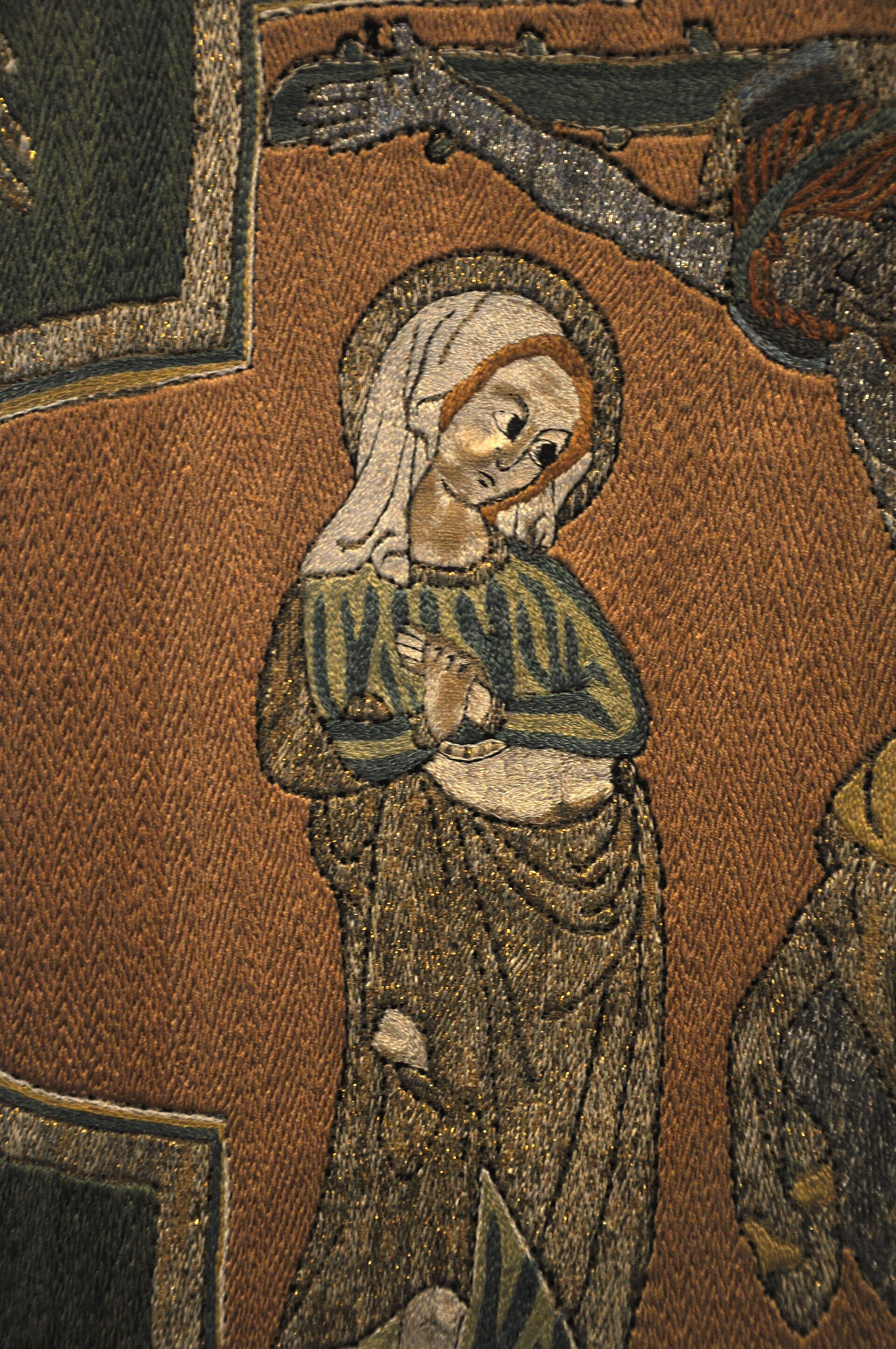
Detail of the embroidered surface showing the split-stitch figure work and underside-couched metal thread. Photographed at the Victoria and Albert Museum, London, the object's current and only confirmed location.
Photograph by Aiwok, via Wikimedia Commons, CC BY-SA 3.0| Artist | London embroiderers of the opus anglicanum trade, workshop unidentified |
|---|---|
| Date | c. 1300-1320 |
| Medium | Linen ground, embroidered with coloured silks, silver-gilt and silver thread, in split stitch, underside couching, laid-and-couched work, cross stitch and plait stitch |
| Dimensions | 150.5 x 305 x 0.5 cm (measured flat) |
| Where it is now | Victoria and Albert Museum, London, on display in the Medieval and Renaissance galleries, Museum number 83-1864last confirmed 16 September 2026 |
| Attribution | unknownNo embroiderer's name, mark or workshop is attached to the cope. Full note |
| Object type | Textile |
| Period | English, early fourteenth century |
| Cases | Has a provenance gap |
| Inscriptions | None now legible. Two kneeling clerics embroidered along the upper edge hold scrolls that are blank or illegible in the surviving embroidery. |
- Where it is now
- Victoria and Albert Museum, London, on display in the Medieval and Renaissance gallerieslast confirmed 16 September 2026
- Attribution
- unknown
- Provenance
- 9 links6 documented, 2 disputed, 1 unknown
- Sources
- 16 cited
- Last verified
- 16 September 2026Change log
On this page 9 sections
An English ecclesiastical vestment embroidered around 1300-1320, entirely covered in split-stitch figures and underside-couched silver-gilt thread on alternating red and green silk, one of the finest survivals of the London luxury embroidery trade known as opus anglicanum. It was made as a chasuble and only later cut down and reassembled into the cope shape it now has, decades before Syon Abbey, the Bridgettine house whose name it carries, was even founded in 1415.
How the vestment reached the Bridgettine nuns is not documented, nor is the exact route it took through their sixteenth-century dissolution, continental exile and eventual return to England, beyond the consistent but hedged claim that it travelled with the community. What is documented is its passage through the Catholic revivalist circle around John Talbot, 16th Earl of Shrewsbury, and his chaplain Dr Daniel Rock, before the South Kensington Museum bought it in 1864 under the museum number, 83-1864, it still carries today.
It remains on display at the V&A, the most complete single-object statement of a trade so admired across thirteenth-century Europe that a pope is recorded asking for more of it by name.
Provenance
Each link is graded. Documented: a cited source supports it. Disputed: the identification is argued but not established. Unknown: no owner for that span, and the gap is not smoothed into a narrative. The grades in the glossary.
- c. 1300 - c. 1320Unknown original patron(s); orphrey heraldry points to gentry families connected to Thetford and Norfolkdocumented
Made as a chasuble, not a cope; the later conversion into cope form is separately documented and is not part of this origin event.23
- Unknowndocumented
Date and agent of the conversion are not given in any source consulted; only the fact of the conversion, and its effect on the surviving design, is documented.2
- - 1539Bridgettine nuns of Syon Abbey, Isleworthdocumented
The community's possession of the cope by the time of the 1539 dissolution is stated consistently across sources. How and when the vestment, made decades before the abbey's 1415 foundation, reached the community is not documented anywhere consulted for this record.123
- 1539 -Bridgettine community in continental exiledisputed
The community's expulsion and continental exile from 1539 is documented. That the cope specifically was hidden and carried into exile with the nuns, rather than separated from them at dissolution, is described in the secondary literature only as probable, not as a documented event.135
- 1594 - 1861Bridgettine community, resident in Lisbon, Portugalunknown
The community's own residence in Lisbon across this period is documented. No source consulted places the cope specifically in Lisbon during this span; its presence with the community there is an assumption of continuity, not a documented fact.5
- - early 19th century (per sources 1 and 2)John Talbot, 16th Earl of Shrewsburydisputed
Two tertiary sources (the 1911 Encyclopaedia Britannica and the V&A's own summary provenance note) state the cope was given by the returning nuns to the Earl of Shrewsbury early in the nineteenth century. This sits awkwardly against the community's own documented return to England only in 1861, nine years after Talbot's death in 1852; the discrepancy is not resolved in any source consulted and is recorded as an open question.124
- Dr Daniel Rockdocumented
Rock was Talbot's domestic chaplain from 1827, resident at Alton Towers until 1840, and later, in 1870, compiled the South Kensington Museum's own descriptive catalogue of its textile collection. The V&A's own provenance note places the cope in his hands after Talbot.2910
- - 1864James Brown, Bishop of Shrewsburydocumented
Brown was the first Roman Catholic Bishop of Shrewsbury, in office 1851-1881, a diocese covering Talbot's own Staffordshire territory. The V&A's own provenance note places the cope in his hands immediately before the museum's purchase.211
- 1864 - presentSouth Kensington Museum, later the Victoria and Albert Museum, Londondocumented
Bought in 1864 under museum number 83-1864, which the object still carries. No source consulted records the price paid or names the immediate vendor with certainty.124
Technical evidence
| Attribution note | No embroiderer's name, mark or workshop is attached to the cope. Opus anglicanum of this quality is consistently associated with professional lay workshops based in London, organised (by the fourteenth century) as a livery trade, working to commission for the church and for export; individual hands are not named in the surviving contracts and accounts, and none can be matched to this object. The attribution to a London workshop rests on the concentration of comparable documented commissions in the capital, not on any mark on the cope itself. |
|---|---|
| Support | Linen ground fabric, entirely covered by embroidery with no plain area left visible, unusual even among comparable opus anglicanum survivals.23 |
| Ground colours | Alternating red (now faded toward brown) and green silk fill the quatrefoil compartments; this is the only known opus anglicanum example with an entirely coloured-silk ground rather than a woven or metal-thread background.12 |
| Metal thread technique | Underside couching: silver-gilt and silver thread (metal wound around a silk core) laid on the surface and pulled through to the back in small loops, producing a shimmer in movement that surface-couched work does not.17 |
| Figure technique | Split stitch throughout the modelled figures, the needle re-piercing the previous stitch at every step to build fine, shaded lines in coloured silk.27 |
| Other stitches | Cross stitch, plait stitch and laid-and-couched work used in secondary areas of the design.2 |
| Dimensions | 150.5 x 305 x 0.5 cm, measured flat.2 |
| Original form and conversion | Made as a chasuble; later cut down and re-assembled into a cope, with new orphrey bands, hood and morse added. The conversion accounts for scenes cut off at the top and bottom edges and for the reduction from an original four rows of quatrefoils to the surviving three.2 |
| Orphrey heraldry | Armorial lozenges on alternating red and green squares around the border, identified with gentry families connected to Thetford and Norfolk, the principal surviving clue to lay patronage of some part of the vestment.3 |
| Dating | c. 1300-1320 in the general literature; the V&A's current online catalogue narrows this to 1310-1320.12 |
Images
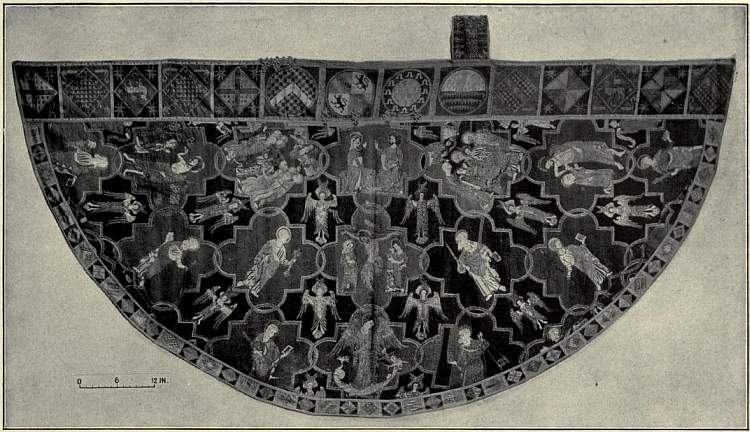
The record in full
A half-circle of figured silk and gold thread
The Syon Cope is a semicircular ecclesiastical vestment, 150.5 centimetres from straight edge to curved hem and 305 centimetres across when opened flat, made to be worn fastened at the chest and to fall in folds over the shoulders and back of a priest or bishop during the most solemn moments of the liturgy. Every visible surface of the linen ground is worked over in embroidery: there is no plain fabric left showing, which is unusual even among the small number of comparable survivals and is one of the things that marks this out as an object of the first rank.
The design is organised in three rows, originally four, of interlaced barbed quatrefoils, the compartments alternating red and green silk grounds (the red has faded toward brown over seven centuries). Each quatrefoil frames a scene or a standing figure; six-winged seraphs, worked in a contrasting technique, fill the spaces between the compartments where the quatrefoils meet. The whole scheme radiates from the centre of the back so that, worn on the body, the principal figures read upright to a viewer standing in front of the wearer, a deliberate solution to a problem every cope designer of the period faced: how to make a flat embroidered semicircle read correctly on a moving, three-dimensional body.
Underside couching, and why it was worth the labour
The gold and silver areas are not woven in but applied by underside couching, the technique that above all others distinguishes true opus anglicanum from continental gold embroidery of the same centuries. A metal thread, silver-gilt wire wound around a silk core, is laid across the surface and a second, near-invisible thread pulls tiny loops of it through to the back of the linen ground at each stitch, rather than simply tacking it down on top. The effect, visible only when the finished cloth catches the light and moves, is a slight give and shimmer in the metal surface that couched-on-top embroidery cannot produce. It is also far slower to work, and slower work on this much surface, essentially the whole of a large semicircular vestment, represents a very large investment of skilled hours before a single scene is even counted.
The figures themselves are modelled in split stitch, the needle piercing back through the thread of the previous stitch at every step to build a fine, almost painterly line capable of shading a face or a fold of drapery in coloured silk. Split stitch and underside couching together are the two technical fingerprints scholars use to identify opus anglicanum among the wider family of medieval European embroidery, and both are present here in a single object at a scale few other survivals can match.
What the scenes show
The central axis of the back carries the cope's three principal subjects: the Coronation of the Virgin at the crown, Christ on the Cross with attendant figures below it, and, at the base, the Archangel Michael, shown with a shield, overcoming Satan. Around these, arranged through the quatrefoils across the shoulders and breast, are further scenes from the life of the Virgin and of Christ, including Christ's appearance to Mary Magdalene after the Resurrection and the doubting Thomas placing his fingers in Christ's wound, interspersed with standing apostles identified by their traditional attributes: Peter, Paul, James, Thomas, Philip, Bartholomew, Andrew and Simon among them. Along the upper edge, where the vestment sat at the wearer's shoulders, the remains of a row of angels holding crowns survive alongside two smaller kneeling clerical figures, hands raised in prayer, carrying scrolls now blank of any legible text.
Those two kneeling figures are the closest thing the cope offers to a self-portrait of its own commission. Nothing on the object names them, and no document has been matched to them; the reasonable inference, that they represent the priest, bishop or house that paid for the vestment, is exactly that, an inference, and this record treats it as such rather than as a settled identification.
A chasuble first, a cope only later
The object now called the Syon Cope did not start out as a cope at all. It was made as a chasuble, the front-and-back garment a priest wears to celebrate Mass, cut on a different pattern from a cope's open semicircle. At some point before it is first recorded, the chasuble was cut down and its embroidered panels re-assembled into the cope shape, with new orphrey bands, a hood and a morse (the clasp or brooch that closes a cope at the chest) added to complete the conversion. This is not a modern conservator's inference; it is stated directly in the V&A's own catalogue record and is the reason the scheme now reads as an awkward fit for a cope's curved hem, with scenes cut off at the top and bottom edges where the original chasuble's shaping did not match the new garment.
The conversion also explains why the cope's most useful clue to an owner, the row of armorial lozenges worked into the orphrey border in alternating red and green squares, may not date to the same moment as the scenes in the main field. Those arms have been identified with families connected to Thetford and to Norfolk more widely, which is the strongest surviving evidence for who originally paid for some part of this vestment. But because the orphrey was assembled at the time of the conversion into a cope rather than necessarily at the time the chasuble was first embroidered, the arms may record a later, separate act of patronage rather than the original commission. No published account resolves which is the case, and this record does not guess.
It cannot have been made for Syon Abbey
The chronology is worth stating plainly, because the cope's popular name obscures it. Syon Abbey was founded at Isleworth, west of London, by Henry V in 1415, as England's only house of the Bridgettine order. The embroidery of this cope is dated by every specialist source consulted to somewhere in the window 1300 to 1320, a date the V&A's own current catalogue narrows further to 1310-1320. That is between eighty and one hundred and fifteen years before Syon Abbey existed as an institution capable of commissioning anything. The vestment therefore cannot, on the dates alone, have been made for the abbey whose name it now carries; it was made for another patron entirely, decades before the Bridgettine community that eventually owned it was founded, and it reached Syon by a route, gift, bequest or purchase, that no source consulted for this record documents.
What the surviving evidence supports is narrower and more honest than the popular name suggests: an early fourteenth-century vestment, associated by its orphrey heraldry with gentry families of the Thetford and Norfolk area, that came by an unrecorded route into the possession of the Bridgettine nuns of Syon Abbey by some point before the abbey's suppression in 1539. Whether it came to them new, second-hand, as a bequest from a lay patron, or already altered into cope form from an earlier religious house, is not established by the literature available for this record, and is recorded here as an open question rather than papered over with a guess.
Dissolution, and a hidden vestment
Syon Abbey was dissolved in 1539 under Henry VIII, part of the general suppression of England's monasteries during the Reformation, and its community of Bridgettine nuns was expelled. What happened to the cope at the moment of dissolution is described in the secondary literature with a consistent hedge: it was, in the V&A's own words and echoed by other sources consulted, probably hidden and taken to the continent by the nuns as they went into exile. That word is doing real work. No inventory, letter or eyewitness account documenting the cope's removal from England in 1539, or naming who carried it, has surfaced in the sources checked for this record. The claim that the vestment travelled with the community rather than being separated from it, sold, or lost at the point of suppression is a plausible inference from the fact that the community is later recorded owning it again, not a documented event in its own right.
Decades of exile on the continent
The Bridgettine community's own movements after 1539 are considerably better documented than the cope's. The nuns spent time in the Low Countries, at Antwerp, Dendermonde, Haamstede, Mechelen and elsewhere, and in France, before a brief restoration in England under Mary I and a second expulsion under Elizabeth I, and eventually secured a settled home in Lisbon, Portugal, arriving there in 1594 after what the community's own later accounts describe as decades of hardship in transit. The community remained in Lisbon, closely associated with the English Catholic exile community there, for more than two and a half centuries.
Whether the cope was among the community's possessions for the whole of that Lisbon period, or reappears in the record only once the nuns are back on English soil, is not something the sources consulted for this record can settle. The continuous ownership by the Bridgettine community, unbroken from before 1539 to the nineteenth century, is asserted by every secondary account that mentions the cope at all, but none of them cites a Lisbon-period inventory, will or correspondence that names the object specifically. This record follows the consensus while flagging that the consensus rests on an assumption of continuity rather than a documented paper trail through the Lisbon years.
Return to England, and a chronology that does not quite close
Here the sources genuinely disagree, or at least do not obviously agree, and this record states the disagreement rather than resolving it. Two independent accounts, the 1911 Encyclopaedia Britannica entry on copes and the V&A's own current collections catalogue, place the cope's return to England and its passage to the Earl of Shrewsbury in the early part of the nineteenth century, well before 1852. The fuller modern histories of Syon Abbey as an institution, by contrast, describe the main Bridgettine community's own documented return from Lisbon to England as a event of 1861, settling first at Spetisbury in Dorset. John Talbot, 16th Earl of Shrewsbury, the collector both tertiary sources name as the recipient of the cope from the nuns, died in 1852, nine years before that documented community return.
The two facts are not strictly contradictory: an individual gift of the cope by the community, or by intermediaries acting for it, could in principle have preceded the main community's own permanent resettlement by decades, and English Catholic exile networks maintained contact with Lisbon throughout this period. But no source consulted for this record explains the mechanism by which an early-nineteenth-century gift to Talbot and a mid-century, 1861, community return can both be true, and this record does not invent one. It is recorded here as an unresolved chronological tension in the published history of the object, worth a specialist's attention rather than a confident narrative.
From Alton Towers to South Kensington
What is well documented is the milieu the cope passed through once it reached England. John Talbot, 16th Earl of Shrewsbury (1791-1852), was the most prominent lay Catholic patron of his generation, financier of new Catholic churches across the English Midlands and the principal patron of the architect Augustus Pugin; he is remembered locally as "Good Earl John." From 1827 his domestic chaplain, resident with him at Alton Towers in Staffordshire until 1840, was Dr Daniel Rock (1799-1871), an antiquarian priest whose scholarly interests ran to precisely this kind of ecclesiastical textile; Rock later spent years cataloguing church vestments, and in 1870 published Textile Fabrics, the descriptive catalogue of the South Kensington Museum's own collection of church vestments, silk stuffs, needlework and tapestries, the same institution that by then owned the Syon Cope.
The V&A's own provenance note for the cope records that it passed, after the Earl of Shrewsbury, through Dr Rock and then through James Brown, the first Roman Catholic Bishop of Shrewsbury (in office 1851-1881, a diocese covering Shropshire and Staffordshire, the Talbot family's own territory), before the South Kensington Museum bought it in 1864 under the museum number it still carries, 83-1864. No source consulted for this record records a purchase price, or names the museum's immediate vendor in 1864 with certainty; the chain as given rests on the museum's own summary provenance note rather than a published, itemised transaction record, and this record flags that gap rather than filling it with an assumed figure.
Work England exported to popes and princes
The Syon Cope is one survival from a trade that was, in its own time, a recognised English export good at the very top of the European luxury market. A Vatican inventory of 1295 lists more than a hundred pieces of English-made ecclesiastical embroidery, more than from any other single country represented in the papal treasury, a scale that makes plain this was not occasional gift-giving but a sustained trade relationship. The English chronicler Matthew Paris, writing in the thirteenth century, records that Pope Innocent IV, having admired the quality of English-made vestments worn by English clergy in Rome, asked that more be obtained from England, and that London merchants who dealt in the embroideries set their own prices for it, a detail that reads as a complaint about English bargaining power in a seller's market as much as an anecdote about papal taste. Opus anglicanum production of this quality declined sharply after the Black Death reached England in 1348, a collapse in skilled labour and patronage from which the trade never fully recovered on the same scale, which is part of why objects made in the preceding half-century, this cope among them, are treated by specialists as the high-water mark of the craft rather than as typical late-medieval output.
The Butler-Bowdon Cope, and what the comparison shows
The closest genuine comparandum to the Syon Cope, and the object against which it is most often measured, is the Butler-Bowdon Cope, also in the V&A, under a separate museum number, T.36-1955. Made roughly a generation later, around 1330-1350, it differs from the Syon Cope in a way that is instructive rather than merely decorative: its embroidery sits on a ground of rich Italian crimson velvet rather than the Syon Cope's entirely silk-embroidered linen, and its figures, scenes from the life of the Virgin with apostles, saints and lion masks, are arranged in Gothic arches following concentric rows that curve with the hem, a more sophisticated solution to the same layout problem the Syon Cope's makers addressed with their radiating quatrefoils. Scholars comparing the two treat the Butler-Bowdon Cope's arrangement as the more resolved design and the Syon Cope's entirely coloured-silk ground, without any woven or velvet backing at all, as unique among the surviving corpus, the only such example known.
The Butler-Bowdon Cope has its own modern market history worth noting for contrast: in 1955, facing a bid to acquire it for the Metropolitan Museum of Art at a price reported as 33,000 pounds, the V&A moved to keep it in Britain and it entered the museum's own collection that year under an export-control style intervention, the same broad mechanism, a public collection matching or blocking an overseas sale, that has kept other opus anglicanum survivals in the country. Two further comparanda extend the picture: the Steeple Aston Cope, made about a decade after the Syon Cope, still owned by the parish church of St Peter and St Paul in Steeple Aston, Oxfordshire, and on loan to the V&A since 1905; and the Chichester-Constable Chasuble, cut down from a larger vestment in the sixteenth century and now in the Metropolitan Museum of Art, New York (accession 27.162.1), acquired in 1927 from the Chichester-Constable family of Burton Constable in Yorkshire, who are recorded owning it by 1894.
On display now
The Syon Cope is on permanent display at the V&A in the Medieval and Renaissance galleries and was a centrepiece of Opus Anglicanum: Masterpieces of English Medieval Embroidery, the exhibition the V&A ran from October 2016 to February 2017, the first exhibition in the United Kingdom devoted specifically to this school of embroidery. The accompanying scholarly catalogue was edited by the V&A textiles curator Clare Browne together with Glyn Davies and M. A. Michael and published by Yale University Press with the museum in 2016, and remains the standard modern reference point for the cope alongside the museum's own online catalogue entry.
The artist
London embroiderers of the opus anglicanum trade, individual hands unrecorded
No maker's name attaches to the Syon Cope, and none is likely ever to. Opus anglicanum of this rank is not folk work; it required a workshop organisation capable of sourcing silver-gilt thread, fine linen and dyed silk in quantity, employing several trained hands on split stitch and underside couching over what must have been months of work on a single large vestment, and negotiating commissions with clergy, monastic houses and lay patrons wealthy enough to pay for it. What can be said, and is said here instead of inventing a name, is what kind of trade produced work like this, where it was based, and why its reputation reached as far as Rome.
Related works
| Work | Relation | Where it is |
|---|---|---|
| Butler-Bowdon Cope London opus anglicanum workshop, unidentified | The closest surviving comparandum: a cope of the same English tradition, made a generation later, on a velvet rather than embroidered-silk ground, with figures arranged to follow the curve of the hem rather than in the Syon Cope's horizontal rows. Entered the V&A in 1955 after the museum acted to keep it in Britain in the face of a reported 33,000-pound bid by the Metropolitan Museum of Art. | Victoria and Albert Museum, London, museum number T.36-1955 |
| Steeple Aston Cope English opus anglicanum workshop, unidentified | Another surviving English cope of the same broad period and technique, made roughly a decade after the Syon Cope. Remains parish property rather than having been sold into a museum collection outright, an unusual survival route for a vestment of this quality. | Church of St Peter and St Paul, Steeple Aston, Oxfordshire; on loan to the Victoria and Albert Museum since 1905 |
| Chichester-Constable Chasuble English opus anglicanum workshop, unidentified | A related English ecclesiastical vestment of the same tradition, cut down from a larger garment in the sixteenth century, comparable evidence for how surviving opus anglicanum pieces were repeatedly altered to later liturgical fashions, as the Syon Cope itself was when converted from a chasuble. Owned by the Chichester-Constable family of Burton Constable, Yorkshire, by 1894; acquired by the Metropolitan Museum in 1927. | Metropolitan Museum of Art, New York, accession 27.162.1 |
Open questions
- How did the cope, made c. 1300-1320 for a patron connected to Thetford and Norfolk, come into the possession of Syon Abbey, which was not founded until 1415? No source consulted documents the gift, bequest or purchase that brought it to the Bridgettine community.
- Does the heraldry on the orphrey date to the original chasuble's commission, or only to the later conversion into a cope, when the orphrey bands were added? The two events may not be contemporary, and no published account resolves which.
- Did the cope travel to the continent with the nuns at the 1539 dissolution, as the secondary literature states with the hedge word 'probably', or was it separated from the community and reunited with them later? No contemporary document recording its removal from England has been identified.
- Is the cope's presence documented at any point during the community's 1594-1861 residence in Lisbon, or does the assumption of unbroken ownership rest entirely on the fact that the nuns are recorded owning it again once back in England?
- How can the cope's return to England and gift to the Earl of Shrewsbury 'early in the nineteenth century' (per the 1911 Encyclopaedia Britannica and the V&A's own summary provenance note) be reconciled with the Bridgettine community's own documented return from Lisbon only in 1861, nine years after Talbot's death in 1852?
- What did the South Kensington Museum pay for the cope in 1864, and from whom precisely was it bought? The museum's own provenance note names Talbot, Rock and Bishop Brown as successive owners but no source consulted gives a transaction price or an immediate named vendor.
- Who were the two kneeling clerical figures embroidered along the upper edge, their scrolls now blank? No documentary identification has been proposed in the literature consulted.
Questions about this object
What is The Syon Cope?
The Syon Cope is a textile, dated c. 1300-1320. Medium: Linen ground, embroidered with coloured silks, silver-gilt and silver thread, in split stitch, underside couching, laid-and-couched work, cross stitch and plait stitch.
Who made The Syon Cope, and is the attribution settled?
The attribution to London embroiderers of the opus anglicanum trade, workshop unidentified is recorded here as unknown. No embroiderer's name, mark or workshop is attached to the cope. Opus anglicanum of this quality is consistently associated with professional lay workshops based in London, organised (by the fourteenth century) as a livery trade, working to commission for the church and for export; individual hands are not named in the surviving contracts and accounts, and none can be matched to this object. The attribution to a London workshop rests on the concentration of comparable documented commissions in the capital, not on any mark on the cope itself.
Where is The Syon Cope now?
Victoria and Albert Museum, London, on display in the Medieval and Renaissance galleries, Museum number 83-1864. Last confirmed 16 September 2026. V&A Collections online catalogue entry, object O93171.
What is still unknown about The Syon Cope?
How did the cope, made c. 1300-1320 for a patron connected to Thetford and Norfolk, come into the possession of Syon Abbey, which was not founded until 1415? No source consulted documents the gift, bequest or purchase that brought it to the Bridgettine community.
Sources
- 1Victoria and Albert Museum, 'The Syon Cope' (museum article). vam.ac.uk/articles/...
- 2V&A Collections, catalogue entry for 'The Syon Cope', object O93171, museum number 83-1864. collections.vam.ac.uk/item/...
- 3Textile Research Centre, Leiden, 'Syon Cope' entry. trc-leiden.nl/trc-needles/...
- 4'Cope', Encyclopaedia Britannica, 11th edition (1911), transcribed on Wikisource. A tertiary, pre-1929 source, flagged for replacement with a modern scholarly catalogue entry where its factual claims are not independently corroborated. en.wikisource.org/wiki/...
- 5Wikipedia, 'Syon Abbey', for the foundation, dissolution, continental exile itinerary and documented 1861 return to England. Flagged for replacement with a scholarly institutional history. en.wikipedia.org/wiki/...
- 6Wikipedia, 'Opus Anglicanum', for the 1295 Vatican inventory, the Matthew Paris/Pope Innocent IV account, and the effect of the Black Death on the trade. Flagged for replacement with a scholarly monograph or the 2016 exhibition catalogue. en.wikipedia.org/wiki/...
- 7Victoria and Albert Museum, 'An A-Z of Opus Anglicanum' (museum article), for underside couching and split stitch technique. vam.ac.uk/articles/...
- 8Wikipedia, 'Butler-Bowdon Cope'. en.wikipedia.org/wiki/...
- 9Wikipedia, 'John Talbot, 16th Earl of Shrewsbury'. en.wikipedia.org/wiki/...
- 10Wikipedia, 'Daniel Rock', for his chaplaincy to the Earl of Shrewsbury and his 1870 catalogue of the South Kensington Museum's textile collection. en.wikipedia.org/wiki/...
- 11Wikipedia, 'James Brown (bishop of Shrewsbury)'. en.wikipedia.org/wiki/...
- 12Victoria and Albert Museum, 'The Butler-Bowdon Cope' (museum article), for the 1955 Metropolitan Museum bid and V&A acquisition. vam.ac.uk/articles/...
- 13Victoria and Albert Museum, 'The Steeple Aston Cope' (museum article), for its parish ownership and loan to the V&A since 1905. vam.ac.uk/articles/...
- 14The Metropolitan Museum of Art, catalogue record for the Chichester-Constable Chasuble, accession 27.162.1. metmuseum.org/art/...
- 15Wikimedia Commons, File:Syon Cope detail.JPG, photograph by Aiwok, CC BY-SA 3.0. commons.wikimedia.org/wiki/...
- 16Wikimedia Commons, File:EB1911 Cope Fig. 2.-THE SYON COPE.jpg, public domain 1911 printed plate. commons.wikimedia.org/wiki/...


Last verified 16 September 2026 · Published 16 September 2026
Change log
16 September 2026 - Record created at the house standard: researched narrative, technical evidence, maker dossier, graded provenance chain, prices with hammer and premium separated, related works, open questions and sources.