Chain of Lovers' Knots, Cheapside Hoard
Unrecorded London goldsmith(s), Cheapside trade · 1590-1620 (this chain, per the V&A); the wider hoard was buried between 1640 and 1666
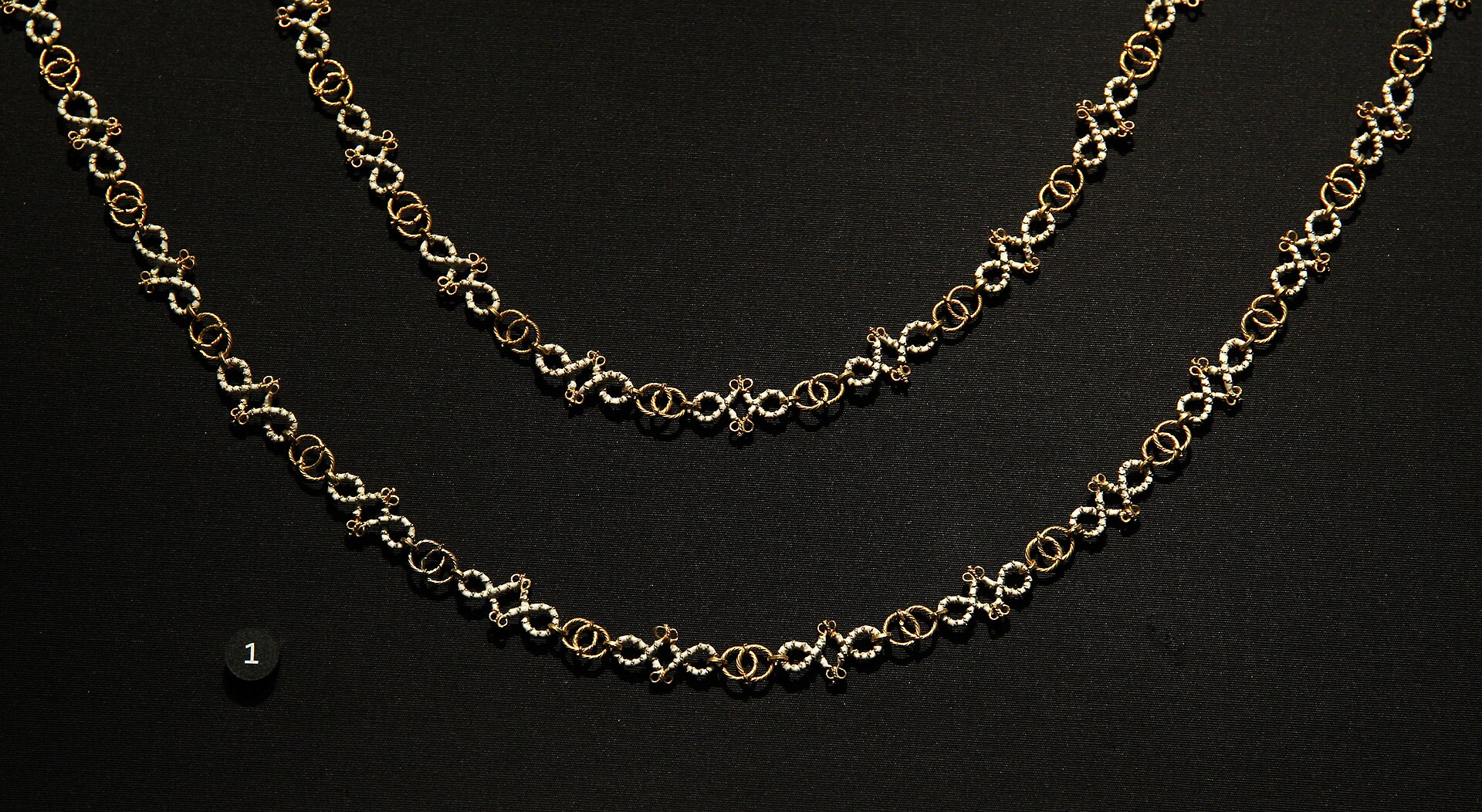
This chain, enamelled gold with interlinking lovers' knots, photographed on display at the Victoria and Albert Museum on 11 April 2019. V&A accession M.1140-1926, dated 1590-1620.
| Workshop | Unrecorded London goldsmith(s), Cheapside trade |
|---|---|
| Date | 1590-1620 (this chain, per the V&A); the wider hoard was buried between 1640 and 1666 |
| Medium | Gold, enamelled white and green, formed into a continuous chain of interlinking lovers' knots |
| Dimensions | 48.5 in (approx. 123 cm) long, 0.8 cm wide, 0.4 cm deep |
| Where it is now | Victoria and Albert Museum, London, Jewellery Gallery (Room 91, the William and Judith Bollinger Gallery). This is one of a small number of Cheapside Hoard pieces held outside the Museum of London: the great majority of the wider hoard, some 500 objects, is held by the Museum of London, renamed the London Museum, which is due to reopen at West Smithfield on 28 November 2026 with the fullest display of the hoard ever assembled; a further group, most published counts giving either 20 or 25 pieces, is held by the British Museum.last confirmed |
| Inventory number | V&A accession M.1140-1926 |
| Attribution | UnknownNo maker's mark or inscription is published for this chain, and no maker is named on any piece in the wider hoard. Full note |
| Object type | Goldsmith's work |
| Period | Elizabethan and Jacobean, c. 1560-1650 |
| Cases | Has a provenance gap |
| Inscriptions | No maker's mark, assay mark or inscription is published for this object in the sources consulted. |
| Owners on record | 6 links4 documented, 2 unknown |
| Sources | 16 cited |
About this record Last verified · 16 sources cited · Change log
On this page 10 sections
ContentsClose
A gold chain of interlinking lovers' knots, enamelled white and green, over a metre long, made in London between about 1590 and 1620. It is one of roughly five hundred pieces of Elizabethan and Jacobean jewellery pulled from a cellar at 30-32 Cheapside on 18 June 1912, when workmen demolishing the building struck through a decayed wooden box with a pickaxe. Most of that hoard is held by the Museum of London; this chain, registered at the Victoria and Albert Museum in 1926, is one of the small number of pieces that left the main body.
The hoard is the largest surviving assemblage of jewellery from this period anywhere, and it is also, in provenance terms, one of the purest problems a collection like this can pose. No owner was ever identified. No inquest was held. The material reached institutions through a pawnbroker who paid navvies in cash and beer for parcels wrapped in handkerchiefs, weeks after the ground had already been disturbed. What can be dated is the burial window, fixed by a chipped intaglio and by fire damage from the Great Fire of London; what cannot be dated, or named, is the person who put the box in the ground and never came back for it.
This chain carries its own smaller version of that same problem. Its motif, a knot that has no visible beginning or end, was the conventional sign of a bond death alone could dissolve. Who wore it, who gave it, and how it came to leave the rest of the hoard and enter the Victoria and Albert Museum fourteen years after the discovery are all undocumented.
Provenance
Each link is graded. Documented: a cited source supports it. Disputed: the identification is argued but not established. Unknown: no owner for that span, and the gap is not smoothed into a narrative. The grades in the glossary.
- c. 1590 - c. 1620Made by an unrecorded London goldsmith or workshopdocumented
Dated by the Victoria and Albert Museum on grounds of style and enamelling technique to 1590-1620. No maker's mark survives.12
- c. 1620 - between 1640 and 1666Unidentified, probably a working jeweller or syndicate in the Cheapside tradeunknown
No owner has ever been identified for the chain or the wider hoard it was found with. Concealed in a wooden box in a cellar under tenement houses at 30-32 Cheapside; the burial window is fixed at its earliest by the Stafford intaglio (Nov 1640) and at its latest by Great Fire damage (Sept 1666) recorded elsewhere in the hoard.135
- 18 June 1912 - 1912Unnamed demolition workmendocumented
Found during demolition of 30-32 Cheapside. No individual finder was named in the surviving record; no plan, inventory or photograph of the deposit in the ground was made.567
- 1912 - 1912George Fabian Lawrence ('Stony Jack'), pawnbroker and antiquities dealer, Inspector of Excavations for the London Museumdocumented
Lawrence bought the material piecemeal from the workmen, paying half-crowns or beer money on the spot. The Museum of London's own records show a cheque of 90 pounds paid to him on 26 June 1912, eight days after the find, and a further 47 pounds in August 1913. No purchase figure specific to any individual piece, including this chain, is published.67
- 1912 - 1926Unrecordedunknown
The route by which this specific chain passed from Lawrence's 1912 purchase to its 1926 registration at the Victoria and Albert Museum, rather than to the London Museum with the bulk of the find, is not documented in the sources consulted.12
- 1926 - presentVictoria and Albert Museum, Londondocumented
Registered under accession M.1140-1926. Held continuously since, currently displayed in the Jewellery Gallery, Room 91. The rest of the wider hoard was divided between the London Museum (the great majority), the British Museum (20 or 25 pieces, sources disagree) and the Guildhall Museum, which merged with the London Museum in 1976 to form the Museum of London.1235
Prices realised
This chain has never been offered at public auction. It passed from the finders to a dealer and from the dealer directly into institutional hands, reaching the Victoria and Albert Museum by 1926. No purchase price, insurance valuation or probate figure for this piece, or for the wider hoard, is published in the sources consulted. Any figure a reader encounters for what the Cheapside Hoard is worth today is an estimate made without a market test.
Technical evidence
| Attribution note | No maker's mark or inscription is published for this chain, and no maker is named on any piece in the wider hoard. It is attributed to the London goldsmithing and jewelling trade of the late sixteenth and early seventeenth centuries on the evidence of its enamelling technique and the find spot: a cellar on the Cheapside frontage that was, within living memory of the burial, the commercial heart of the London jewellery trade. The Victoria and Albert Museum's own catalogue entry and the Museum of London both describe the wider hoard as most probably a working jeweller's stock, while allowing that a collector or receiver of stolen goods cannot be excluded. No name has ever been attached to the workshop that made this chain. |
|---|---|
| Materials and technique | Gold, enamelled white with green, worked as a continuous chain of interlinking lovers' knots.12 |
| Dimensions | Length 48.5 in (approx. 123 cm); width 0.8 cm; depth 0.4 cm.12 |
| Accession and location | V&A M.1140-1926, Metalwork Collection, displayed in the Jewellery Gallery, Room 91 (the William and Judith Bollinger Gallery).12 |
| Date of registration | 1926, fourteen years after the 1912 discovery. No further acquisition detail (purchase, gift, or transfer route) is published in the sources consulted.12 |
| Find context (wider hoard) | A decayed wooden box or casket in a cellar beneath tenement houses at 30-32 Cheapside, at the corner of Friday Street, City of London, struck by workmen's pickaxes on 18 June 1912. No archaeological record of the deposit was made.567 |
| Terminus post quem (wider hoard) | November 1640, from a chipped carnelian intaglio bearing the arms of William Howard, created Viscount Stafford that year.5 |
| Terminus ante quem (wider hoard) | September 1666, from fire damage in the Cheapside excavations attributed to the Great Fire of London; the site was rebuilt in brick afterward.5 |
| Missing pearls (wider hoard) | Calculated from empty settings across the assemblage at on the order of 4,000 pearls, almost all of which decayed in the soil.11 |
| Surviving chains (wider hoard) | Thirty enamelled chains are reported to survive from the hoard, an unusually high survival rate for the type, per the one secondary source that gives this figure (not independently corroborated this session); this chain is one of them.11 |
| Institutional division (wider hoard) | Published figures disagree: 20 or 25 pieces at the British Museum (accessioned 1914) and about 5 at the Victoria and Albert Museum, against the great majority remaining with the Museum of London.3511 |
Images
The record in full
Chapter 1What the chain is
The Victoria and Albert Museum catalogues this object as a chain rather than a necklace, though it is worn around the neck and is commonly described, including on Wikimedia Commons, as a necklace.
The Victoria and Albert Museum catalogues this object as a chain rather than a necklace, though it is worn around the neck and is commonly described, including on Wikimedia Commons, as a necklace. It is gold, enamelled white with touches of green, and formed as a continuous run of interlinking knots, a motif conventionally called a lovers' knot: an interlace pattern with no discernible start or finish. At 48.5 inches, roughly 123 centimetres, it is markedly longer than a single loop around the neck, consistent with the London Museum's account of how such chains were worn in this period, looped in a series down to the waist rather than laid flat against the collar.
It carries the accession number M.1140-1926, was registered at the museum in that year, and is displayed in the Jewellery Gallery, Room 91, the William and Judith Bollinger Gallery. No maker's mark survives on it, which is normal rather than suspicious: English hallmarking in this period applied to wrought plate, not to set or enamelled jewellery, so an unmarked chain is exactly what the regulatory system of the time would produce.
Chapter 2The 1912 discovery
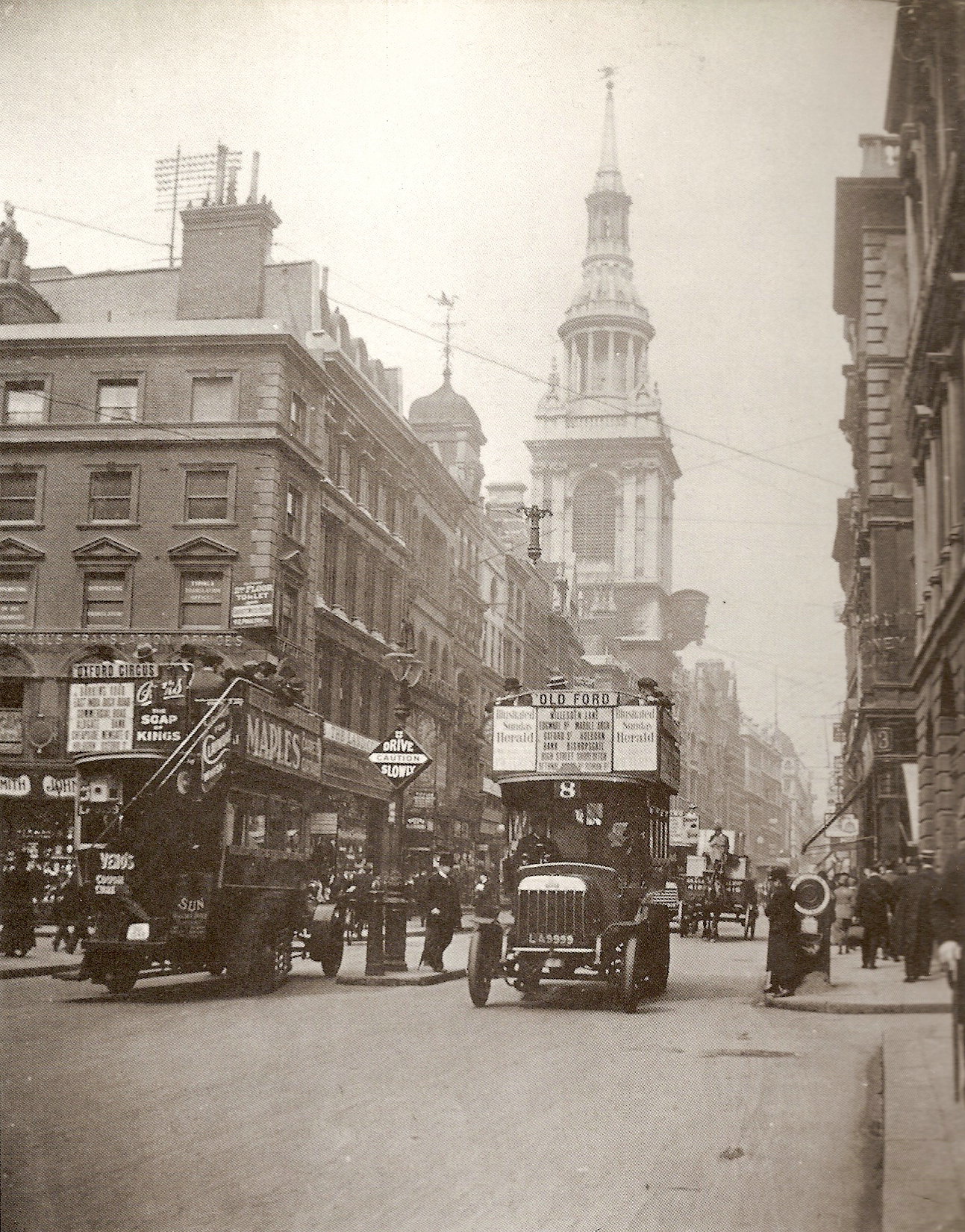
A row of tenement houses numbered 30 to 32 Cheapside, on the corner with Friday Street, a few minutes' walk from St Paul's Cathedral, was being demolished in the summer of 1912.
A row of tenement houses numbered 30 to 32 Cheapside, on the corner with Friday Street, a few minutes' walk from St Paul's Cathedral, was being demolished in the summer of 1912. On 18 June, workmen breaking up the cellar floor with pickaxes struck a decayed wooden box or casket buried beneath it. According to the writer H.V. Morton, who later recorded an account of the find, the navvies at first thought they had struck a toyshop; when the clay-caked mass was washed, it gave up, in his words, 'pearl earrings and pendants and all kinds of crumpled jewellery.'
No archaeologist was present. No plan was drawn and no photograph was taken of the deposit in the ground. What survives as the historical record of the find is not a site report but a set of secondhand accounts, assembled after the fact from the people who bought the pieces off the men who dug them up. The building that stood over the cellar is gone; the site is now under and around One New Change.
Chapter 3Stony Jack, and how a demolition became a collection
George Fabian Lawrence, 1861 to 1939, was a pawnbroker's son from the Barbican who became a self-taught antiquities dealer and the man London building workers called Stony Jack.
George Fabian Lawrence, 1861 to 1939, was a pawnbroker's son from the Barbican who became a self-taught antiquities dealer and the man London building workers called Stony Jack. He kept a shop at 7 West Hill, Wandsworth, that was locked most of the week and open on Saturday afternoons, and his real business was conducted on site: he walked round London's demolition and excavation works at lunchtime, bought the men drinks, kept his pockets full of half-crowns, and paid on the spot for whatever they had found, down to the price of half a pint of beer for something worthless. He had a reputation, unlike a rival dealer nicknamed Old Sixpenny, for honesty, including going back to pay a finder more if a piece turned out to be worth more than he had first offered.
He had been appointed Inspector of Excavations for the London Museum the year of the find. The Cheapside material reached him not as a single hoard handed over at once but as a trickle of parcels and handkerchiefs over the following weeks, from an unknown and unrecorded number of hands. Museum records show a cheque paid to Lawrence for 90 pounds on 26 June 1912, eight days after the find, and a further 47 pounds in August 1913 for unspecified additional purchases. What the museum paid him for the Cheapside material as a whole, and what if anything he paid the individual navvies beyond his standing half-crown rate, is not published in the sources consulted.
The consequence is exact and permanent. What is now called the Cheapside Hoard was reassembled from the pockets of unnamed men, at an unknown number of removes from the ground, with no way of establishing what did not reach Lawrence at all. Sir Mortimer Wheeler, later keeper at the London Museum, wrote of Lawrence's methods that without them 'not a tithe of the objects found during building or dredging operations in the neighbourhood of London during the last forty years would have been saved to knowledge,' while acknowledging the underlying legal problem: the objects, strictly, belonged to the landowner or the Crown, not to the man who dug them up or the dealer who bought them.
Chapter 4Why there was no inquest
In 1912 the law governing a find like this was the common-law doctrine of treasure trove.
In 1912 the law governing a find like this was the common-law doctrine of treasure trove. It turned on the buried owner's intent: gold and silver deliberately hidden with the intention of recovery belonged to the Crown once found, while goods simply lost or abandoned did not. A hoard concealed for safekeeping and never reclaimed is the textbook case, and a coroner's inquest was the mechanism by which the Crown's claim, if any, was established.
No inquest is recorded for the Cheapside find. The Worshipful Company of Goldsmiths, which held the freehold of the site, did not assert a claim. The absence of both is the reason the hoard could be bought piecemeal from workmen and sold on to a museum without any legal process intervening, and it is also the reason no sworn record exists of who found what, or how much of it there originally was. Under the Treasure Act 1996, which replaced the common-law doctrine in England and Wales, a find of this kind would trigger a coroner's inquest, and the finders, the landowner and a valuation would all appear in a public report. In 1912 none of that machinery existed in its modern form, and none of those documents was ever created.
Chapter 5How the hoard was split, and the counts that do not agree
The material did not stay together. The London Museum kept the great majority of it.
The material did not stay together. The London Museum kept the great majority of it. A group went to the British Museum, most sources putting the figure at 20 pieces registered in 1914, though the London Museum's own published account has given a figure of 25. A small number of pieces, this chain among them, went instead to the Victoria and Albert Museum; published figures for that group run to about 5.
Those figures do not reconcile in the sources consulted, and this record carries the disagreement rather than resolving it, because the material was never inventoried as a single body in 1912 and any total is therefore a reconstruction after the fact. The London Museum and the Guildhall Museum, which had also received a portion, merged in 1976 to form the Museum of London, bringing the two largest shares back under one roof for the first time since the split. The chain catalogued here did not follow that path: it was registered at the Victoria and Albert Museum in 1926, fourteen years after the discovery, by which point most of the rest of the hoard had already been with the London Museum for well over a decade. How and by what route this specific chain came to the V&A in 1926, rather than to the London Museum with the bulk of the find, is not documented in the sources consulted.
Chapter 6Dating the burial: a stone that should not have existed yet
The date of manufacture given for this chain, 1590 to 1620, rests on style and technique.
The date of manufacture given for this chain, 1590 to 1620, rests on style and technique. The date of the hoard's burial rests on something more exact: a small, chipped, visually unremarkable carnelian intaglio found among the loose stones, engraved with the heraldic arms of William Howard, who was created Viscount Stafford in November 1640 on his marriage to Mary Stafford. Those arms did not exist before that creation, so the stone cannot have been cut before it, which fixes the earliest possible date the hoard could have gone into the ground.
The latest possible date comes from the site rather than the stones. Fire damage recorded in the Cheapside excavations places the burial no later than the Great Fire of London in September 1666, after which the site was rebuilt in brick. The hoard was therefore concealed within a twenty-six-year window, and everything else asserted about why is inference layered onto those two fixed points.
Chapter 7Whose stock was it: the theories, named and graded
No document names an owner for any part of the hoard, this chain included, and the question of why it was buried and never recovered is unresolved.
No document names an owner for any part of the hoard, this chain included, and the question of why it was buried and never recovered is unresolved. Two positions are in circulation, and neither is proven.
A working jeweller's stock, buried in the political crisis of the 1640s. This is the position taken by both the Victoria and Albert Museum's own catalogue entry for this chain and by the Museum of London's account of the wider hoard: the assemblage is described as most probably a goldsmith's or jeweller's stock in trade, hidden beneath the floorboards, with the Civil War as the likeliest occasion. The site favours it: Cheapside was, until its commercial decline from around 1625, the centre of the London jewellery trade, and the freehold of the houses under which the hoard lay belonged to the Goldsmiths' Company itself, though the properties were let and sublet and the actual tenancy at the time of burial cannot now be traced.
A specific merchant's cargo, arriving from the Indies rather than accumulating locally. The historian Kris Lane, in Colour of Paradise: The Emerald in the Age of Gunpowder Empires (Yale University Press, 2010), proposes an alternative and more specific origin. A Dutch gem merchant, Gerard Polman, brought a shipment of jewels from the East Indies to London in 1631 and died before he could return home; a carpenter's mate, Christopher Adams, is recorded as having taken charge of a box of Polman's jewels and silk and surrendering it to Robert Bertie, 1st Earl of Lindsey, then treasurer of the East India Company. Lindsey went on to litigate with Polman's heirs over the goods before his own death at the Battle of Edgehill in 1642. Lane connects this documented episode to the Cheapside hoard on typological and stylistic grounds, not through a direct paper trail from box to burial, and this record has not been able to verify the connecting argument beyond the secondary summary consulted; it is presented here as an argued position, not a proven chain of ownership for the deposit as a whole.
These two positions are not necessarily exclusive: a jeweller's stock could have included cargo of exactly the kind Lane describes. What can be said with confidence is only that current published scholarship has not settled on a single owner, a single date within the 1640-1666 window, or a single reason, and that this chain, wherever it sat within that stock, carries the same unresolved history as the rest of the hoard.
Chapter 8What the stones in the wider hoard say about London in 1640
Although this chain itself is enamelled gold rather than gem-set, it belongs to an assemblage whose gemstones map the first genuinely global gem trade, and that context is part of what the chain...
Although this chain itself is enamelled gold rather than gem-set, it belongs to an assemblage whose gemstones map the first genuinely global gem trade, and that context is part of what the chain means. The hoard as a whole includes emeralds mined at Muzo in what is now Colombia, extracted under Spanish colonial control by indigenous labourers and enslaved Africans and shipped across the Atlantic and on into Europe from the mid-sixteenth century; diamonds reaching London from India; rubies, sapphires and spinels from Sri Lanka and Burma; turquoise from Persia; and pearls from the Persian Gulf. A single London workshop's stock, buried in a cellar on a street owned by the Goldsmiths' Company, was drawing on Spanish South America, Mughal India, Safavid Persia and the Indian Ocean pearl fisheries simultaneously. The hoard is not evidence that London was merely a large jewellery market by 1640; it is evidence that the market had become a genuinely global one, and that the wealth it displayed on the body was extracted, in the case of the emeralds specifically, at a documented human cost half a world away.
Chapter 9The lovers' knot: what the motif meant
The interlace knot with no visible start or end was a conventional love and betrothal motif in English jewellery of this period, carrying an association, recorded in period sources on the type, of a...
The interlace knot with no visible start or end was a conventional love and betrothal motif in English jewellery of this period, carrying an association, recorded in period sources on the type, of a bond 'which naught but death shall loose.' It sat alongside a wider vocabulary of Elizabethan and Jacobean amatory jewellery: clasped hands, hearts, and the gimmel ring, made of two or three interlocking hoops that could be separated between the betrothed and rejoined at marriage. Posy rings of the same decades, examples of which survive in the Folger Shakespeare Library's collection, carried engraved verses making the same equation explicit: one reads, 'This Ring is round and hath no end, So is my love unto my friend.' The unbroken circle and the unbroken knot were making the identical argument in two different techniques.
What is documented is the convention, not this chain's individual history within it. No inscription, no pair, no named wearer survives for this piece. That it was made to signal an enduring bond is argued from the motif's established meaning in the period; who commissioned it, who wore it, and whether it marked a specific betrothal or marriage is not recorded anywhere in the sources consulted, and this record does not supply an answer where none exists.
Chapter 10The four thousand pearls that are not there
This is a fact about the wider hoard rather than about the chain itself, and it matters for how the whole collection, this piece included, should be read.
This is a fact about the wider hoard rather than about the chain itself, and it matters for how the whole collection, this piece included, should be read. Pearls are organic and, buried in London soil for two and a half centuries, they largely dissolve. From the number of empty settings across the hoard, curators at the Museum of London have calculated that the assemblage originally held on the order of four thousand pearls, the great majority of which rotted away and survive only as absences. What is on display today, gold, enamel and hard gemstone, is therefore the mineral fraction of what was buried: the visual balance a visitor now sees, heavy on emerald and diamond and enamelled gold, is an artefact of differential survival rather than a true picture of the original stock. An enamelled chain like this one, which contains no organic material, is one of the pieces the ground was kindest to.
Chapter 11The 2013 exhibition and the scholarship it produced
The hoard was shown together for the first time in a century at the Museum of London, in an exhibition titled The Cheapside Hoard: London's Lost Jewels, running from 11 October 2013 to 27 April 2014.
The hoard was shown together for the first time in a century at the Museum of London, in an exhibition titled The Cheapside Hoard: London's Lost Jewels, running from 11 October 2013 to 27 April 2014. It reunited the museum's own holdings with pieces on loan from the Victoria and Albert Museum and the British Museum. The senior curator responsible for the exhibition and its accompanying scholarship, Hazel Forsyth, spent years working not only on the objects but on the surviving letters, stock lists, court records and rent books of the period, and published London's Lost Jewels: The Cheapside Hoard alongside the exhibition in 2013. It was this research that identified the Stafford intaglio's dating significance and worked through the missing-pearl calculation; before that identification, the hoard had routinely been dated a generation earlier, to around 1600-1615, on style alone.
Chapter 12What is happening to the hoard now
The Museum of London closed its London Wall site ahead of a move to a new permanent home at West Smithfield, in the former General Market building, which is confirmed to open to the public on 28...
The Museum of London closed its London Wall site ahead of a move to a new permanent home at West Smithfield, in the former General Market building, which is confirmed to open to the public on 28 November 2026, timed to precede the Goldsmiths' Company's own 700th anniversary in 2027. The new site will include a dedicated Goldsmiths' Gallery, combining objects from the Goldsmiths' Company's own collection with what the museum describes as the fullest display of the Cheapside Hoard ever assembled, moving the collection from restricted storage access to a free permanent gallery expected to reach hundreds of thousands of visitors a year. The Goldsmiths' Foundation pledged 10 million pounds toward the museum project in 2017, described at the time as one of the largest single gifts the project received. This chain, held by the Victoria and Albert Museum rather than the Museum of London, is not confirmed in the sources consulted to be part of that new display; its listed location remains the V&A's own Jewellery Gallery.
Chapter 13What is still unresolved
No name has ever been attached to an owner of the hoard, to the workshop that made this chain, or to the person for whom it was made.
No name has ever been attached to an owner of the hoard, to the workshop that made this chain, or to the person for whom it was made. No document explains why this particular chain, of the roughly five hundred objects recovered in 1912, ended up at the Victoria and Albert Museum rather than with the bulk of the find, or what happened to it in the fourteen years between the discovery and its 1926 registration. The Gerard Polman theory identifies a plausible cargo, not a proven one. The published counts of pieces held by the British Museum, 20 against 25 depending on the source, have never been reconciled in print. What is certain is narrower than what is often claimed for this material: a burial window of twenty-six years, a find with no site record, and a chain whose knot pattern argued for a bond that would outlast death, worn by someone whose name did not survive the burial it was found in.
The artist
The London goldsmiths' and jewellers' trade of Cheapside, c. 1560-1650
This record has no individual maker to name, and that absence is a fact about the trade rather than a gap in the research. English goldsmiths and jewellers of this period did not routinely sign or mark set jewellery, hallmarking practice was directed at wrought plate rather than at mounted gemstones and enamelled chains, and the workshop hierarchy meant the men whose names might appear in the Goldsmiths' Company's own books were often not the hands that actually made a given piece. This chain, and the wider hoard it belongs to, is among the largest surviving bodies of that trade's physical output, and not one piece of it can be attached to a name.
Related works
| Work | Relation | Where it is |
|---|---|---|
| The Armada Jewel Attributed to Nicholas Hilliard's workshop | Dating comparandum used by scholars for a costume-dated cameo elsewhere in the wider hoard Gold locket given to Sir Thomas Heneage in 1588, used to help date hoard material stylistically. | Victoria and Albert Museum, London |
| The Colombian emerald verge watch Unrecorded, probably a European movement in an English-mounted case | The single most reproduced object from the wider Cheapside Hoard A hexagonal Colombian emerald crystal hollowed to house a watch mechanism, of about 1600-1610. | Museum of London |
| Gold and enamel salamander hat ornament Unrecorded, London | Another emblematic piece of the wider Cheapside Hoard, set with cabochon Colombian emeralds and table-cut diamonds An outsized replica of this piece has been displayed at the museum for visitor interpretation; it is not the accessioned original. | Museum of London |
| The Fishpool Hoard Unrecorded | English hoard of comparable circumstance: found by workmen on a building site and now dispersed to public collections Found in Nottinghamshire in 1966; 1,237 fifteenth-century gold coins with rings and chains, probably buried in 1463-1464 during the early stage of the Wars of the Roses. | British Museum, London |
| The Staffordshire Hoard Unrecorded, Anglo-Saxon | Contrast case: a comparably large find, but processed under the modern documentary regime the Cheapside find never had Found by a metal detectorist in 2009 and reported and valued under the Treasure Act 1996, generating exactly the documentation (finder, landowner, valuation, inquest) that the 1912 Cheapside find never produced. | Birmingham Museum and Art Gallery and the Potteries Museum, Stoke-on-Trent |
Open questions
- Who owned the hoard, or this chain specifically? No name has ever been documented on any evidentiary basis, and the tenancy of 30-32 Cheapside at the time of burial cannot be reconstructed.
- Why was the hoard buried, and by whom, in the window between 1640 and 1666? The Civil War is the favoured circumstantial reading; Kris Lane's Gerard Polman theory offers a specific but unproven alternative source for at least part of the material.
- How and when did this particular chain leave the main body of the find and reach the Victoria and Albert Museum? It was registered there in 1926, fourteen years after the 1912 discovery, and no acquisition route is published.
- Do the published counts of pieces held by the British Museum (20 or 25, depending on the source) and the Victoria and Albert Museum reconcile? No source consulted resolves the discrepancy.
- Who wore this chain, or for whom was it made? The lovers' knot motif carried a documented betrothal association in the period; nothing ties this particular example to a named person, betrothal or marriage.
- How many objects were taken by workmen at the find spot and never reached George Fabian Lawrence at all? Contemporary accounts describe pocketing at the site, and pieces attributed to the hoard have continued to surface for decades after 1912.
Questions about this object
What is Chain of Lovers' Knots, Cheapside Hoard?
Chain of Lovers' Knots, Cheapside Hoard is a goldsmith's work, dated 1590-1620 (this chain, per the V&A); the wider hoard was buried between 1640 and 1666. Medium: Gold, enamelled white and green, formed into a continuous chain of interlinking lovers' knots.
Who made Chain of Lovers' Knots, Cheapside Hoard, and is the attribution settled?
The attribution to Unrecorded London goldsmith(s), Cheapside trade is recorded here as unknown. No maker's mark or inscription is published for this chain, and no maker is named on any piece in the wider hoard. It is attributed to the London goldsmithing and jewelling trade of the late sixteenth and early seventeenth centuries on the evidence of its enamelling technique and the find spot: a cellar on the Cheapside frontage that was, within living memory of the burial, the commercial heart of the London jewellery trade. The Victoria and Albert Museum's own catalogue entry and the Museum of London both describe the wider hoard as most probably a working jeweller's stock, while allowing that a collector or receiver of stolen goods cannot be excluded. No name has ever been attached to the workshop that made this chain.
Where is Chain of Lovers' Knots, Cheapside Hoard now?
Victoria and Albert Museum, London, Jewellery Gallery (Room 91, the William and Judith Bollinger Gallery). This is one of a small number of Cheapside Hoard pieces held outside the Museum of London: the great majority of the wider hoard, some 500 objects, is held by the Museum of London, renamed the London Museum, which is due to reopen at West Smithfield on 28 November 2026 with the fullest display of the hoard ever assembled; a further group, most published counts giving either 20 or 25 pieces, is held by the British Museum. Inventory number V&A accession M.1140-1926. Last confirmed 17 August 2026. Victoria and Albert Museum collections database and Open API record for object O74076.
What is still unknown about Chain of Lovers' Knots, Cheapside Hoard?
Who owned the hoard, or this chain specifically? No name has ever been documented on any evidentiary basis, and the tenancy of 30-32 Cheapside at the time of burial cannot be reconstructed.
Sources
- 1Victoria and Albert Museum, collections database, 'Cheapside Hoard (chain)', object O74076, accession M.1140-1926. collections.vam.ac.uk/item/...
- 2Victoria and Albert Museum, Open API, museum object record for O74076. api.vam.ac.uk/v2/...
- 3London Museum (formerly Museum of London), 'The Cheapside Hoard', London Stories collections page. londonmuseum.org.uk/collections/...
- 4London Museum, 'Jewels of the Cheapside Hoard', London Stories collections page. londonmuseum.org.uk/collections/...
- 5Wikipedia, 'Cheapside Hoard'. en.wikipedia.org/wiki/...
- 6Mike Dash, 'Stoney Jack and the Cheapside Hoard', A Blast From The Past (blog), 19 August 2013, drawing on Francis Sheppard, Treasury of London's Past (1991) and H.V. Morton, In Search of London (2002). mikedashhistory.com/2013/...
- 7Smithsonian Magazine, 'The Commoner Who Salvaged a King's Ransom' (on George Fabian Lawrence). smithsonianmag.com/history/...
- 8Jerry H. Bentley, review of Kris Lane, Colour of Paradise: The Emerald in the Age of Gunpowder Empires (Yale University Press, 2010), American Historical Review 116, no. 1 (2011). academic.oup.com/ahr/...
- 9The Goldsmiths' Company, 'Goldsmiths' Gallery will bring the Cheapside Hoard to new audiences at London Museum from 28 November'. thegoldsmiths.co.uk/company-news/...
- 10London Museum, press release, 'London Museum in Smithfield will open its doors on 28 November 2026'. londonmuseum.org.uk/about/...
- 11Robert Weldon and Cathleen Jonathan, 'The Museum of London's Extraordinary Cheapside Hoard', Gems and Gemology, Fall 2013, Vol. 49, No. 3. SECONDARY USE: cited via search-indexed excerpts and consistent cross-reference in other sources; the full article could not be directly retrieved this session and should be verified against the original PDF before further reliance. gia.edu/gems-gemology/...
- 12Exhibiting Fashion (University of the Arts London), 'The Cheapside Hoard: London's Lost Jewels', on the 2013-2014 Museum of London exhibition. fashionexhibitionmaking.arts.ac.uk/the-cheapside-hoard-lo...
- 13Folger Shakespeare Library, '"A smale remembrance": Elizabethan Posy Rings', The Collation (blog). folger.edu/blogs/...
- 14Lang Antiques, 'Lover's Knot', Antique Jewelry University. langantiques.com/university/...
- 15Wikimedia Commons, file metadata (/LicenseShortName) for the three images used in this record, verified via the Commons API. commons.wikimedia.org/wiki/...
- 16Wikipedia, 'Staffordshire Hoard' and 'Fishpool Hoard'. en.wikipedia.org/wiki/...

Last verified · Published
Change log
17 August 2026 - Record created at the house standard: researched narrative, technical evidence, maker dossier, graded provenance chain, prices with hammer and premium separated, related works, open questions and sources.