Ewer
Unknown metalworker(s), Khurasan or Herat workshop tradition · ca. 1180-1210
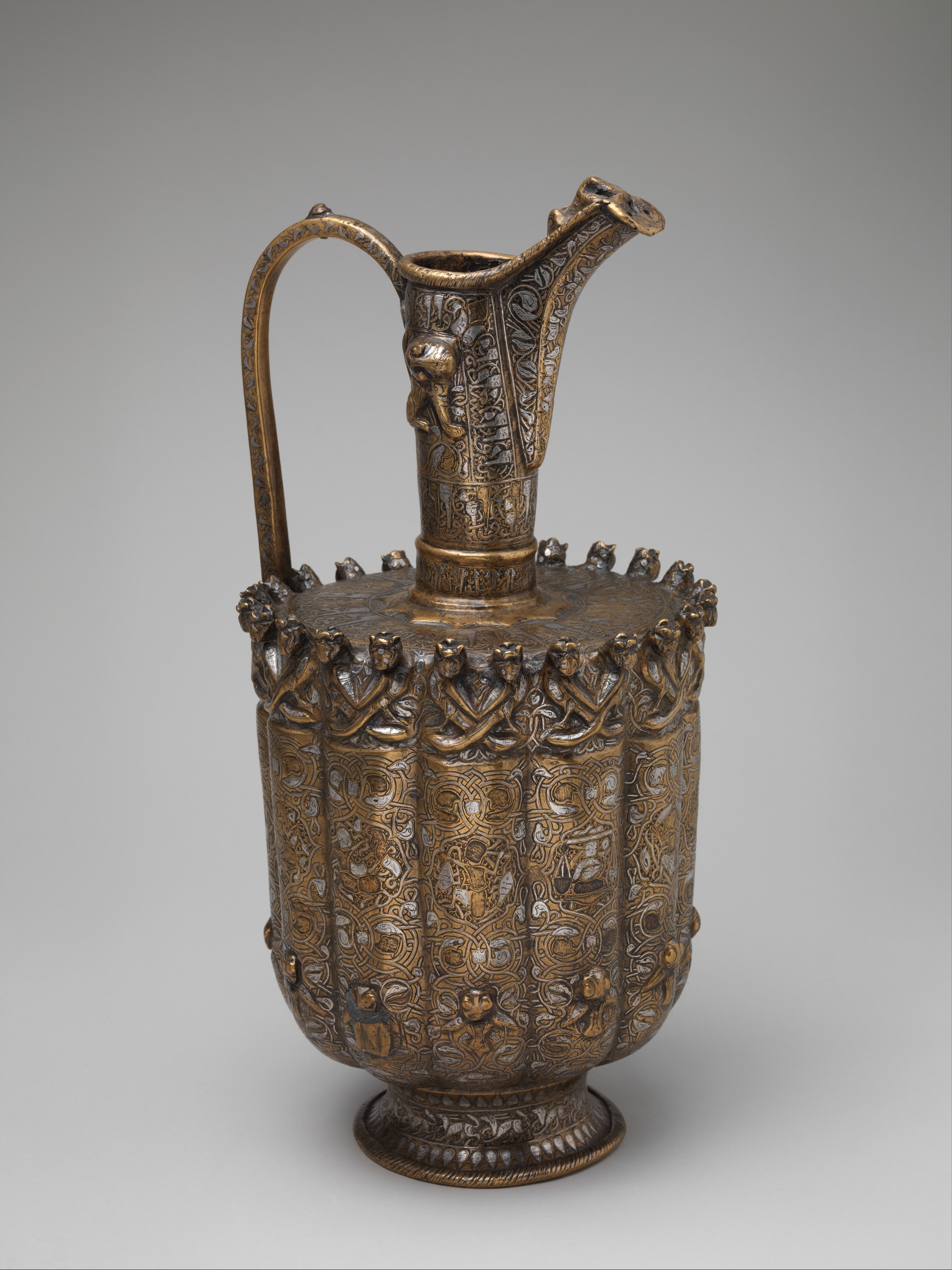
Overall view. Brass, raised and repousse-worked, inlaid with silver and a black compound, ca. 1180-1210, attributed to Khurasan or Herat. Height 40 cm.
| Artist | Unknown metalworker(s), Khurasan or Herat workshop tradition |
|---|---|
| Date | ca. 1180-1210 |
| Medium | Brass; raised and repousse-worked, inlaid with silver and a black compound |
| Dimensions | Height 15 3/4 in. (40 cm); diameter 7 1/2 in. (19.1 cm) |
| Where it is now | Metropolitan Museum of Art, New York, on view at The Met Fifth Avenue, Gallery 453last confirmed |
| Inventory number | 44.15 (Met object ID 450513) |
| Attribution | AcceptedThe Metropolitan Museum attributes the piece to Iran or Afghanistan, Khurasan or Herat, on stylistic grounds: shape, proportions, repousse neck lions and inlay technique link it to a small group of long-necked brass ewers of near-identical size, the best-dated member of which (Georgian National Museum, Tbilisi, 19-2008:32) carries an inscribed date of 577 AH/1181-82 CE. Full note |
| Object type | Islamic metalwork |
| Period | Islamic, Khurasan/Herat, late 12th-early 13th century |
| Cases | Has a provenance gap |
| Inscriptions | Four inscription bands, all benedictory rather than dedicatory or documentary, plus a fifth reading of an owner's name whose security is disputed. On the neck, in naskh script: a blessing translated by the Museum as 'Glory, prosperity, dominion, and perpetual life to its owner.' On the upper neck and shoulder, in so-called 'human-headed' (anthropomorphic) naskh, a longer benedictory formula repeating glory, prosperity, dominion, growth, happiness, health and long life to the owner. On the bottom band, in kufic script, a further blessing of felicitation, dominion and long life. On the handle, a short 'Glory and prosperity.' Abdullah Ghouchani's 2012 reading of the inscription on the underside of the base gives an owner's name, transliterated as Fulad b. Mirak ('Its owner is Fulad b. Mirak'); an earlier reading of the same inscriptions by Yasser al-Tabba in 1978 records the benedictory neck and shoulder bands in slightly different wording and does not report this name. No maker's name, workshop signature, place-name or date appears anywhere on the vessel. |
| Owners on record | 4 links3 documented, 1 unknown |
| Sources | 9 cited |
About this record Last verified · 9 sources cited · Change log
On this page 9 sections
ContentsClose
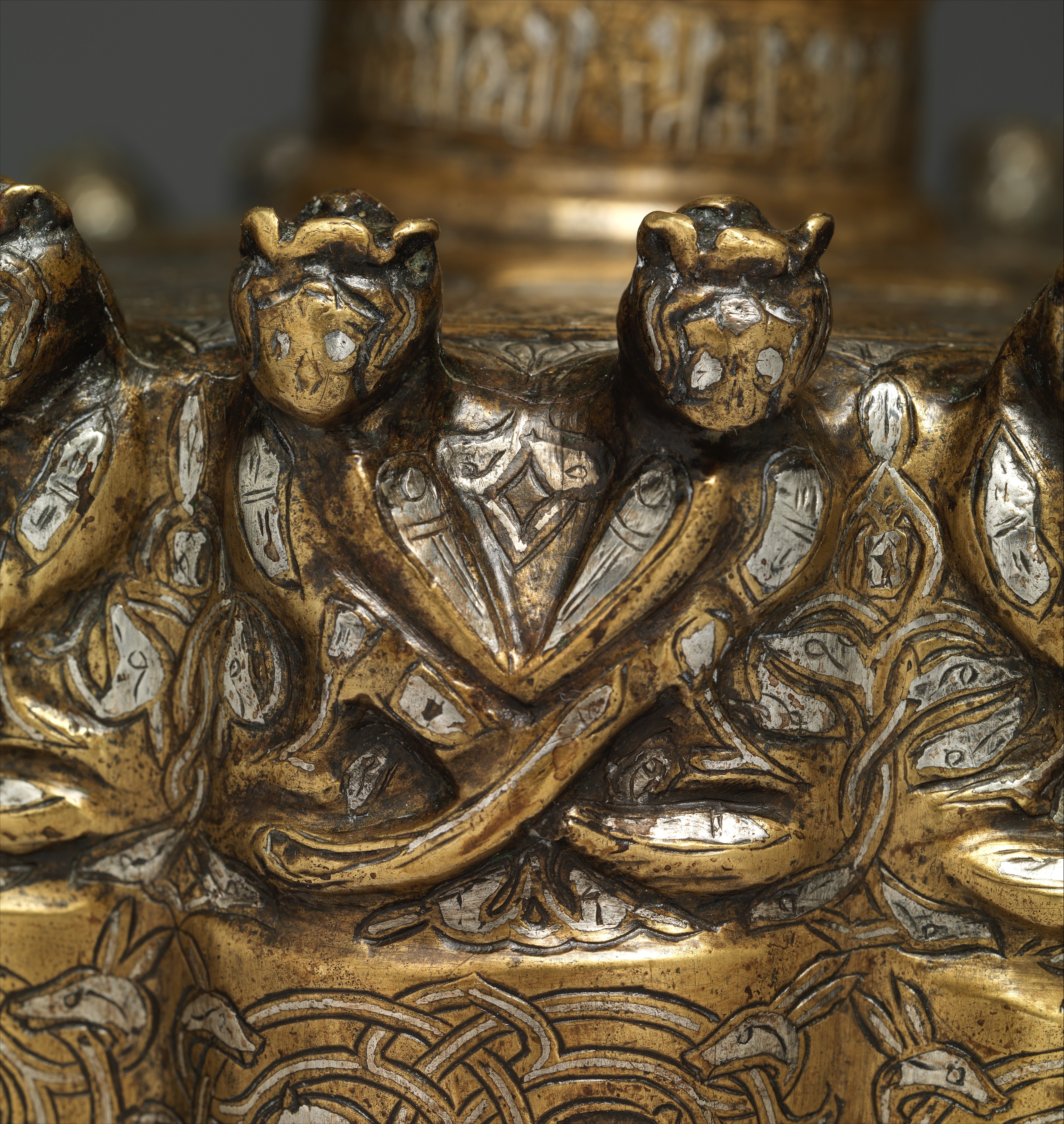
A brass ewer raised from a single sheet, fluted into thirteen panels and inlaid with silver and a black compound, made around 1180-1210 somewhere in Khurasan or at Herat itself, then under Ghurid rather than Seljuq rule. Each flute carries a zodiac sign paired with its ruling planet, and the shoulder bears a pair of crowned, addorsed harpies rare even within its own small comparanda group of similarly shaped long-necked ewers.
It carries no maker's signature, no patron's dedication and no date, only benedictions to an unnamed 'owner' and, on one 2012 reading of the base that an earlier 1978 reading does not corroborate, a possible owner's name: Fulad b. Mirak. It surfaces in the historical record already in the collection of the financier J. Pierpont Morgan, who died in 1913; unlike most of Morgan's Islamic and decorative holdings, which were either given to the Metropolitan in 1917 or sold off by his son for cash, this ewer sat in the estate for another twenty-seven years before the Museum purchased it outright in 1944.
Provenance
Each link is graded. Documented: a cited source supports it. Disputed: the identification is argued but not established. Unknown: no owner for that span, and the gap is not smoothed into a narrative. The grades in the glossary.
- ca. 1180-1210 - by 1913Unknownunknown
No owner, dealer or location is documented between manufacture in Khurasan or at Herat and the ewer's appearance in J. Pierpont Morgan's New York collection by the time of his death in 1913. Whether it left the region during the Mongol invasions of the 1220s, was exported earlier as part of ordinary trade, or left far later via the nineteenth or early twentieth-century art market is not established by any source consulted.12
- by 1913 - 1913J. Pierpont Morgan, New Yorkdocumented
The Metropolitan's own provenance line records the ewer in Morgan's ownership until his death. Morgan died in Rome on 31 March 1913. No source consulted names the dealer, sale or date by which Morgan acquired this specific piece, though he was by then the Metropolitan's most important trustee and donor, having given or bequeathed several thousand objects to the Museum in his lifetime.18
- 1913 - 1944Estate of J. Pierpont Morgandocumented
The Met's provenance line records the ewer as remaining in Morgan's estate from 1913 until its sale to the Museum in 1944, a gap of thirty-one years. This does not match the two paths taken by most of Morgan's collection after his death: about forty percent of it was donated to the Metropolitan by his son J. P. Morgan Jr. in 1917, and much of the remainder was sold by Jack Morgan for liquidity. Why this ewer took neither path, and where it was physically kept for three decades, is not explained in the sources consulted.19
- 1944 - presentMetropolitan Museum of Art, New Yorkdocumented
Purchased by the Metropolitan Museum of Art with the Rogers Fund in 1944, accession number 44.15. First published by the Museum the following year. Currently on permanent view in Gallery 453. The purchase price has not been published in the sources consulted.124
Technical evidence
| Attribution note | The Metropolitan Museum attributes the piece to Iran or Afghanistan, Khurasan or Herat, on stylistic grounds: shape, proportions, repousse neck lions and inlay technique link it to a small group of long-necked brass ewers of near-identical size, the best-dated member of which (Georgian National Museum, Tbilisi, 19-2008:32) carries an inscribed date of 577 AH/1181-82 CE. No findspot, workshop mark or place-name is inscribed on this ewer itself, so the choice between Khurasan generally and Herat specifically is comparanda-based rather than documentary. The Museum's own catalogue entry notes that at the time of manufacture Herat was under Ghurid, not Seljuq, political control, even though the wider group is conventionally discussed as part of a 'Seljuq' decorative tradition and was first published by the Museum in 1945 under the title 'Saljuk Bronzes from Khurasan'. |
|---|---|
| Material | Brass, raised and repousse-worked from sheet metal.12 |
| Inlay | Silver, cut as both sheet and wire, set into chased and undercut recesses against a black compound of unrecorded composition. The Museum's own materials description says only 'a black compound,' not niello; no source consulted gives a chemical analysis of this filler.12 |
| Dimensions | Height 15 3/4 in. (40 cm); diameter 7 1/2 in. (19.1 cm).12 |
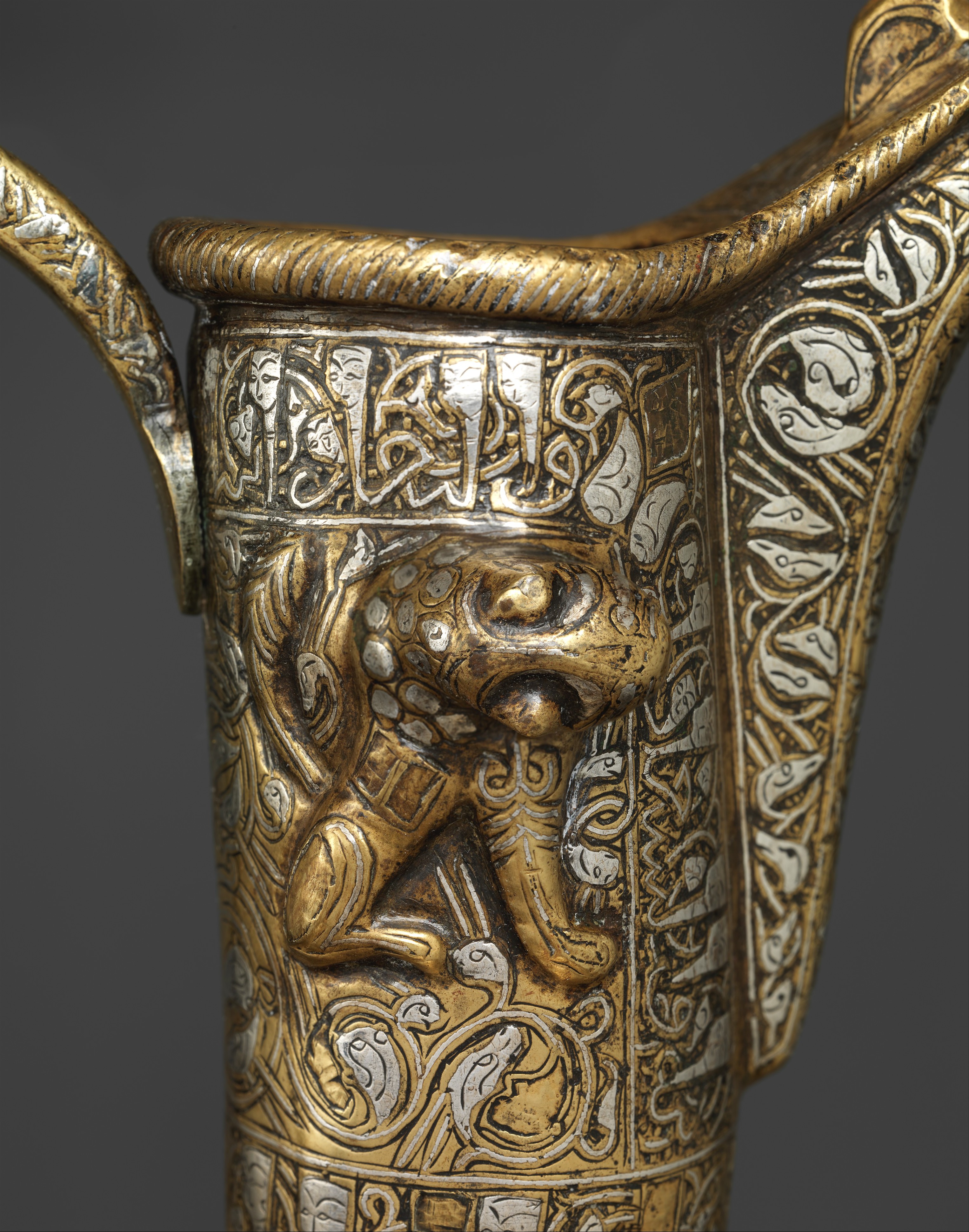
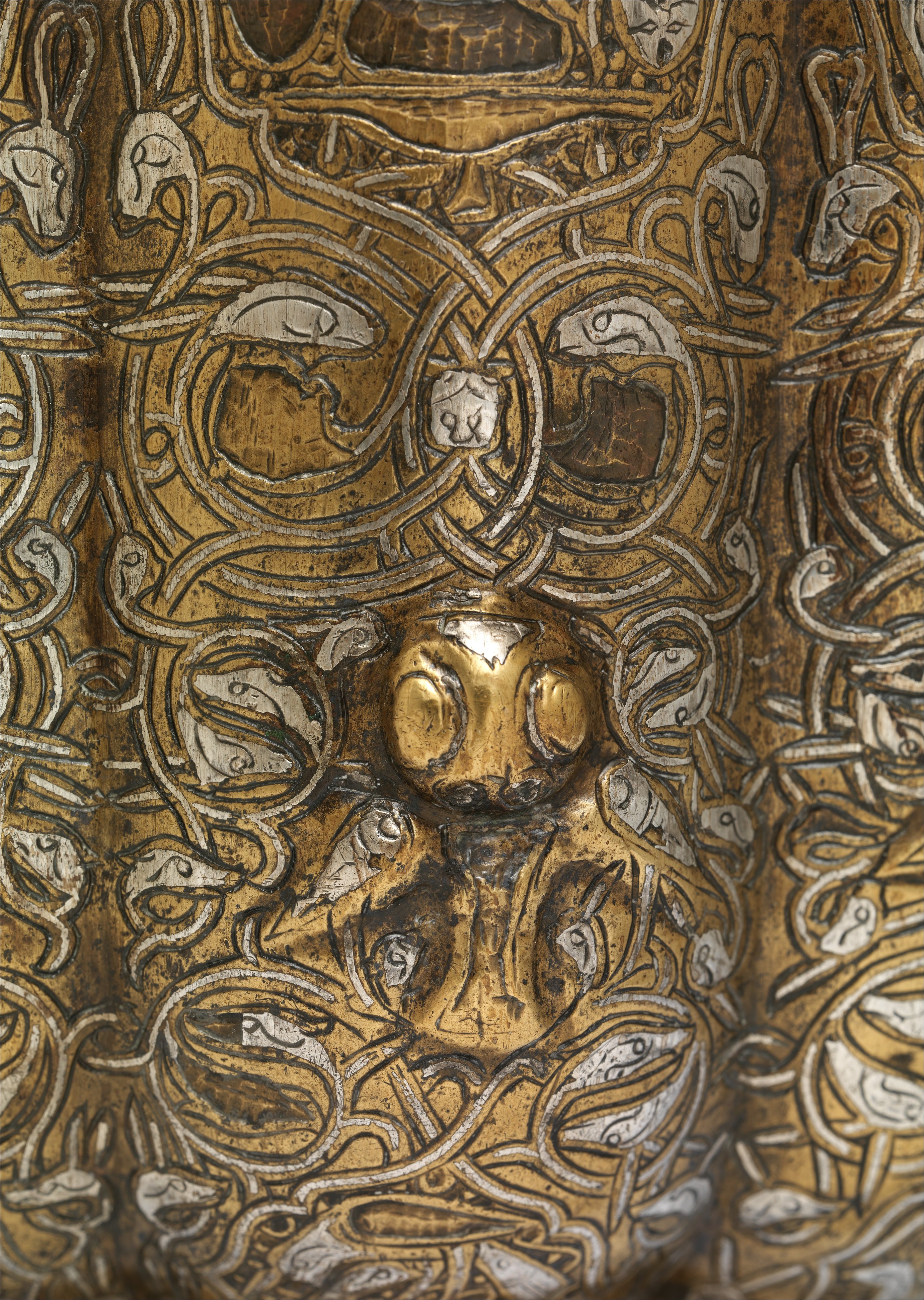
| Construction | Body raised from a single sheet of brass, hammered into thirteen flutes before decoration was added. The confronted harpies and other birds are worked in high-relief repousse; the harpies' heads, which project furthest, are three-dimensional and were formed by hammering from inside the vessel. Neck, handle and foot were made from separate sheets and soldered to the body.13 |
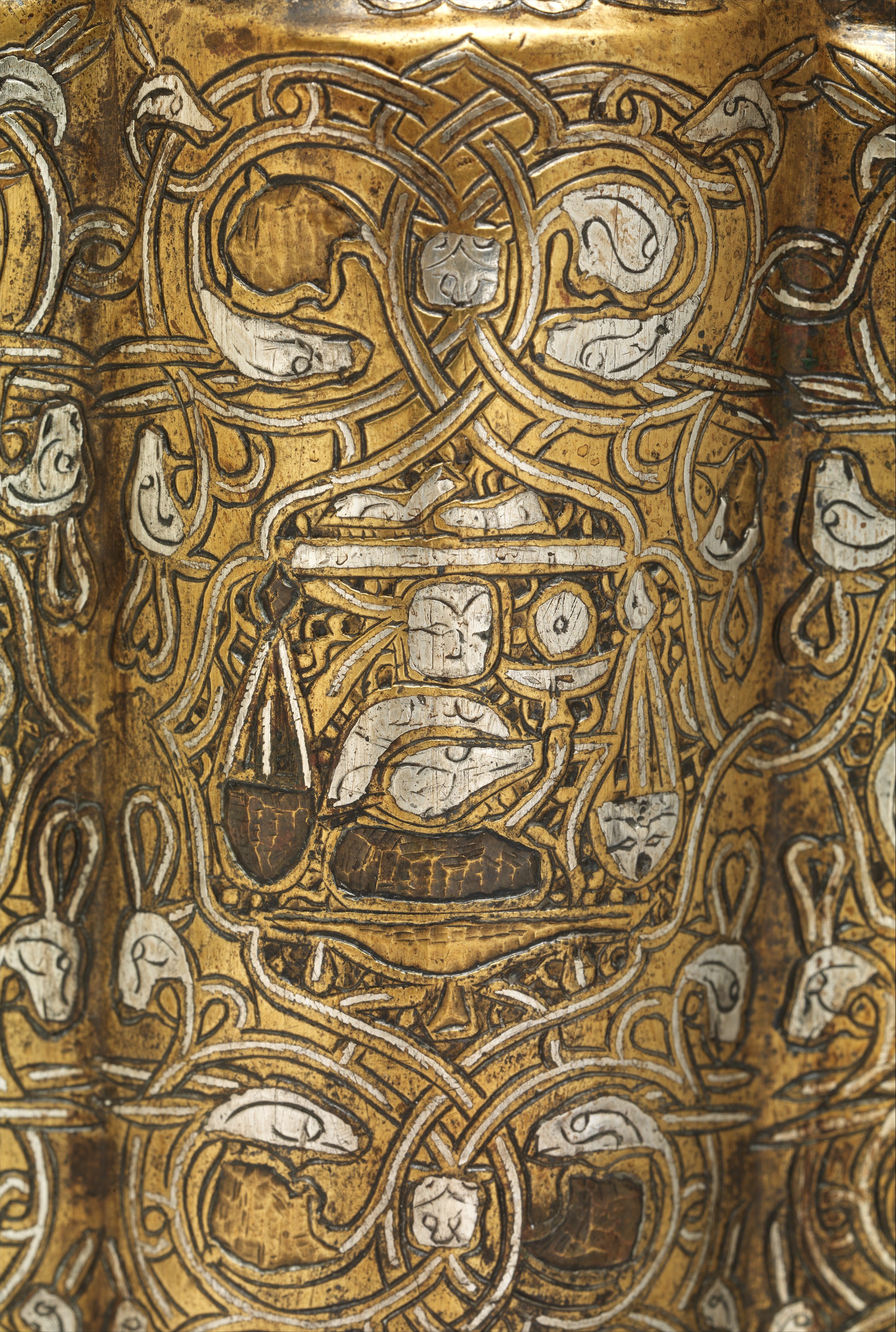
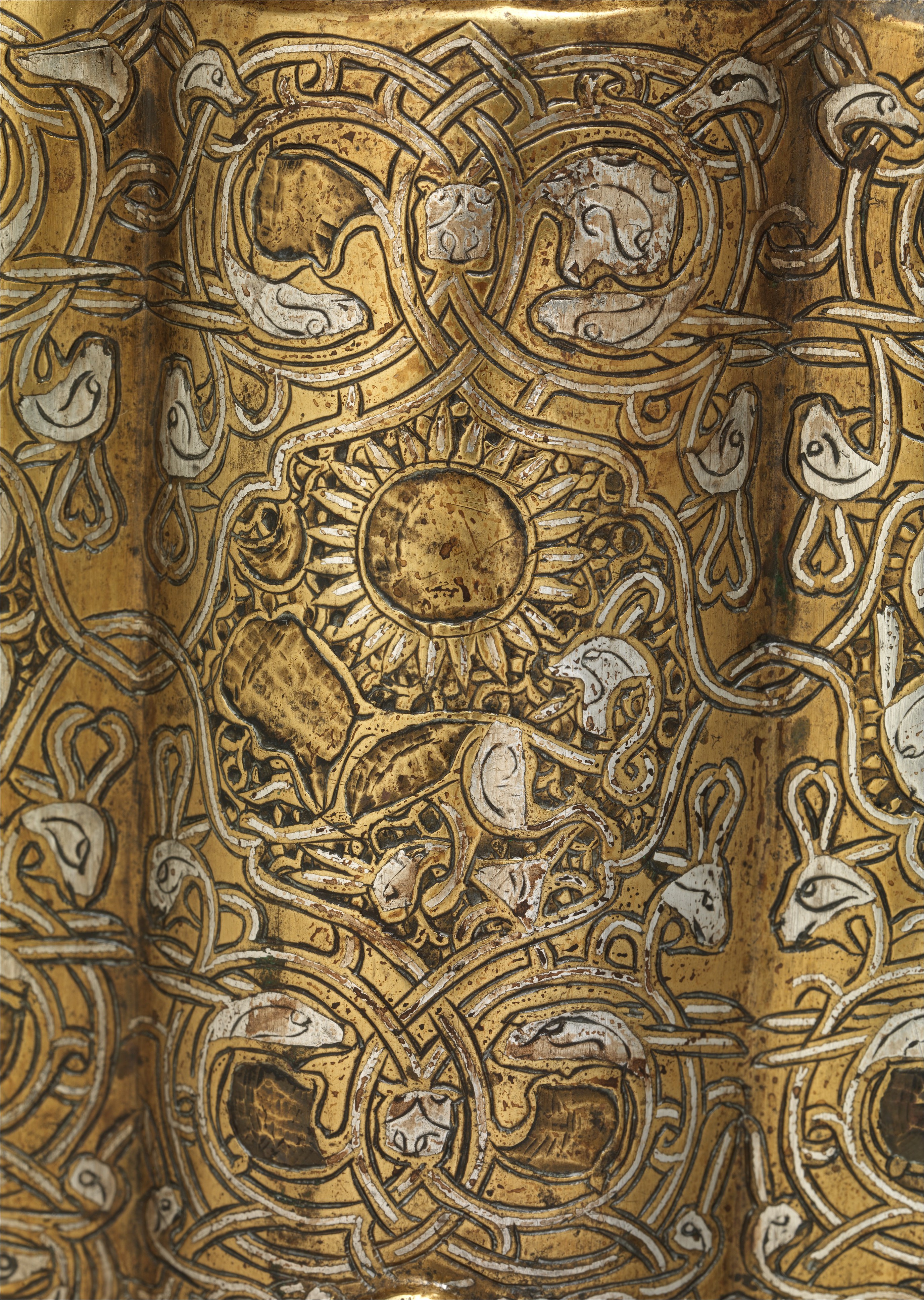
| Decorative programme | Thirteen flutes, twelve carrying a zodiac sign paired with its ruling planet inside a medallion bordered by rabbit-head vine scrolls, the thirteenth reserved for the handle attachment. Crowned, addorsed harpies in high relief on the shoulder; birds at the base of each flute; vegetal scrollwork ending in animal heads (the waqwaq-tree motif) filling remaining fields; inlaid sun-ray bands around the foot. The planet substituted for Virgo's usual ruler Mercury is Saturn, a point flagged as an apparent error by Stefano Carboni's 1997 catalogue entry; zodiac and planetary decoration of this kind was understood to carry talismanic, protective power.1356 |
| Inscriptions | Four benedictory bands (naskh on the neck, anthropomorphic naskh on the upper neck and shoulder, kufic around the base, a short blessing on the handle), plus a disputed reading of an owner's name on the underside of the base. No maker's signature, patron dedication or date.1 |
| Comparanda dimensions | Most published examples of this ewer shape stand 14 7/8 to 15 3/4 in. (38-40 cm) tall, share a neck flanked by repousse lions beside the spout with a third lion atop the spout, a flat shoulder and an outward-curving foot; flute count, width and the amount of silver/copper inlay vary across the group.13 |
Images
The record in full
Chapter 1What it is
A brass ewer, 15 3/4 inches (40 cm) tall, raised from a single sheet of metal and hammered into thirteen broad vertical flutes.
A brass ewer, 15 3/4 inches (40 cm) tall, raised from a single sheet of metal and hammered into thirteen broad vertical flutes. Almost no surface is left plain: silver, cut as both sheet and wire, is inlaid throughout against a black compound packed into the recesses to set it off, and the whole vessel is worked in relief as well as inlay, so that light catches the raised harpies and lions as much as the flat silver fields.
The proportions belong to a small, tightly defined group. Most surviving examples of this exact shape stand between about 14 7/8 and 15 3/4 inches (38-40 cm), share a neck flanked by a repousse lion on either side of the spout with a third lion perched on the spout itself, a flat shoulder, and a foot that curves outward. This ewer sits at the tall end of that range and, within the group, carries unusually dense ornament: most published comparanda are plainer.
Chapter 2How it was made
The body began as one sheet of brass, raised and hammered to form the thirteen flutes before any decoration was added.
The body began as one sheet of brass, raised and hammered to form the thirteen flutes before any decoration was added. The confronted harpies on the shoulder and the birds set at the base of each flute were worked afterward in repousse, in high relief; the harpies' heads, which protrude furthest from the shoulder, are fully three-dimensional and had to be formed by hammering from inside the vessel wall, a harder and more exacting operation than the flatter relief elsewhere on the body.
Every other component, the neck, handle and foot, was made separately from additional sheets of brass and soldered onto the raised body. The zodiac cycle itself was planned before any of this construction began: the metalworker had to hammer exactly thirteen flutes, one for each of the twelve zodiac signs plus one extra reserved for the point where the handle would later be riveted to the body, so that fitting the handle would not cut across any of the medallions. That the maker got this exactly right is a small piece of evidence that the whole decorative programme, not just its individual images, was designed as a single scheme from the start.
The inlay itself followed a documented multi-step process used across this school of metalwork: contours were first traced with a punch to leave a dotted guide line, the surface within them was then chiselled and undercut to key a filling, a black paste of unrecorded composition was pressed into the recess, and silver, cut or drawn to the required shape, was hammered into place and its edges clamped down to hold it.
Chapter 3The zodiac programme
Each of the twelve zodiac flutes carries a medallion showing the sign together with its ruling planet, bordered by twisting vines that end in rabbits' heads.
Each of the twelve zodiac flutes carries a medallion showing the sign together with its ruling planet, bordered by twisting vines that end in rabbits' heads. Reading clockwise from the flute immediately to the left of the handle: Aries the ram, ridden by Mars holding a severed head; Taurus the bull, mounted by Venus playing a lute; a pair of standing figures for Gemini, separated by a head on a stick that ought to represent Mercury but may instead be the pseudo-planet al-Jawzahr; Cancer the crab beneath the moon; Leo the lion, its tail ending in a dragon's head and a full sun disk above its back; a kneeling figure holding what looks like a sheaf of corn for Virgo; Libra's scales, again with Venus and her lute; Scorpio, with Mars standing between two large scorpions and holding a rod; Sagittarius the centaur, turning to shoot at a leonine dragon; Capricorn the goat, ridden by a bearded Saturn; and Aquarius, the water-carrier at his well. Pisces, which should fall between Aquarius and Aries, is hidden behind the lower part of the handle, exactly where the maker's thirteen-flute planning put it out of sight.
One detail has drawn scholarly comment. The ruling planet shown for Virgo is not Mercury, as the astrological convention of the period required, but the bearded, half-naked figure of Saturn, who properly belongs to Capricorn. Stefano Carboni, cataloguing the piece for the Metropolitan's 1997 zodiac exhibition, called this an apparently unusual mistake, noting that such errors are very rare in medieval representations of a system that held real predictive weight for its patrons. Writing nearly two decades later for the 2016 Seljuq catalogue, Sheila Canby raised an alternative reading: because inaccuracies of this kind are so uncommon, Saturn's presence in Virgo might not be an error at all, but a deliberate reference to the horoscope of the ewer's own, otherwise unidentified, owner. Neither reading can be confirmed from the object alone, and this record states both rather than choosing between them.
Chapter 4What the imagery was for
Objects like this one were not decorated with the zodiac for decoration's sake.
Objects like this one were not decorated with the zodiac for decoration's sake. The Metropolitan's own account of astrology in the medieval Islamic world, illustrated with this exact ewer, states plainly that objects carrying astrological decoration were believed to hold talismanic power: they were thought capable of channelling the occult influence of the planets and stars to protect their owner from sickness, bad luck, or defeat. Astrology in this period was widely, if not universally, treated as a serious branch of astronomy, practiced and written on by figures such as Abu Ma'shar al-Balkhi and al-Biruni, even as other theologians and jurists condemned it as incompatible with a universe governed by God alone. A vessel that combined all twelve signs with their planetary lords was not showing off learning; it was assembling as much protective power as the object could hold.
The Metropolitan's own catalogue entry goes further, reading the whole decorative scheme as one interlocking system rather than a set of separate motifs: the power of the lion, the light and strength of the sun, water as the source of life, appropriate to both the fish sign and to the ewer's own function as a water vessel, the good fortune carried by the harpies and birds and by the content of the benedictory inscriptions, and the specifically talismanic meaning of the vine scrollwork that fills every remaining space. On this reading the zodiac cycle is not one image among several but the organizing idea the maker planned the whole object around, with everything else arranged to support it. This is the Metropolitan's own published interpretation, not an inference drawn here; it is the museum's argument to accept or question, not a hidden meaning this record is claiming to have uncovered.
Chapter 5The inscriptions, and what they do not say
Four bands of text run across the vessel, none of them a signature and none of them a date.
Four bands of text run across the vessel, none of them a signature and none of them a date. On the neck, in naskh script, a short blessing: glory, prosperity, dominion and perpetual life to its owner. On the upper neck and shoulder, in the elaborate 'human-headed' anthropomorphic naskh where each letter terminates in a tiny human face, a longer version of the same formula, adding growth, happiness, health and praise. A further blessing in kufic script runs around the base, and a short 'glory and prosperity' is fitted onto the handle. Every one of these is a benediction addressed to an unnamed owner, of a kind found across this entire school of metalwork; none of them names a maker, a patron who commissioned the piece, or a date of manufacture.
The one place an actual name might appear is the underside of the base. Abdullah Ghouchani, publishing a reading in 2012, gives the inscription there as naming an owner: Fulad b. Mirak. An earlier reading of the vessel's inscriptions, published by Yasser al-Tabba in 1978, records the neck, shoulder and base benedictions in slightly different wording and does not report this name. Both readings are cited in the Metropolitan's own Signatures, Inscriptions, and Markings record for the piece, presented side by side rather than reconciled. Whether Fulad b. Mirak is a secure reading of a genuine owner's name, a different construction of the same difficult script, or something al-Tabba's earlier pass simply did not resolve, is not settled by any source consulted here, and this record does not try to settle it either.
What is certain is the contrast with the school's most famous anchor piece. The Bobrinski Bucket, made in Herat in December 1163, is signed twice, once by the caster and once by the metalworker who executed the inlay, and its dedicatory inscription names both a commissioner and a recipient. This ewer, made a generation or two later by the same broad tradition, names no maker at all, and its one possible owner's name is disputed. The two objects sit at opposite ends of what a single benedictory inscription can and cannot tell a modern reader.
Chapter 6Khurasan or Herat: the basis for the attribution
The Metropolitan's own tombstone hedges: 'Attributed to Iran or Afghanistan, Khurasan or Herat.' That hedge is honest rather than vague.
The Metropolitan's own tombstone hedges: 'Attributed to Iran or Afghanistan, Khurasan or Herat.' That hedge is honest rather than vague. Nothing inscribed on the ewer names a city, a province or a workshop, so the attribution rests entirely on comparison with a small number of related vessels, several of which do carry more specific evidence. The best-anchored of these, a faceted ewer now in the Georgian National Museum in Tbilisi, carries an inscribed date corresponding to 1181-82, squarely inside this ewer's own proposed date range, and is treated in the Metropolitan's own catalogue as the diagnostic piece for the whole group. The earlier Bobrinski Bucket, dated by its own inscription to December 1163 and explicitly stating it was made in Herat, anchors the tradition a generation further back.
The Museum's catalogue entry adds a detail that complicates any simple label. At the time this ewer and its siblings were made, Herat was under the control of the Ghurid dynasty, not the Seljuqs, even though the wider decorative tradition these vessels belong to is conventionally discussed, including by the Metropolitan's own curators, as Seljuq metalwork; the Museum's first publication of this very piece, in 1945, was titled 'Saljuk Bronzes from Khurasan.' The Ghurids ruled Herat from roughly 1176 until the dynasty's collapse in the years after 1206; the Khwarazmian Empire that eventually absorbed Ghurid territory did not complete that takeover until around 1215, after the upper end of this ewer's proposed date range. On the political history alone, then, a Ghurid-period Herat is the more defensible reading for an object dated no later than about 1210, whatever stylistic label later scholarship has attached to the wider tradition.
None of this settles Khurasan against Herat specifically. The attribution is, and by the Museum's own account remains, a matter of style and comparanda rather than a documented findspot or workshop signature, and this record treats it that way.
Chapter 7The comparanda group
This ewer is one of a small number of surviving vessels sharing its exact shape and rough size, a group the Metropolitan's own catalogue entry treats as a coherent production run.
This ewer is one of a small number of surviving vessels sharing its exact shape and rough size, a group the Metropolitan's own catalogue entry treats as a coherent production run. What varies between individual pieces, the catalogue notes, is the number, width and shape of the flutes, and, more strikingly, how much of the surface is decorated at all: some members of the group carry plain interlace where this one carries crowned, addorsed harpies and a full zodiac cycle. Rachel Ward, cited in the Museum's own footnotes, reads that variation as either a sign of stylistic development across the group's production or simply a range of taste and budget among the metalworkers' original clients; the sources consulted do not resolve which explanation is correct, and neither does this record.
The amount of precious-metal inlay also varied piece to piece, which the Museum's catalogue reads as a further, more direct marker of relative luxury: more silver and copper meant a more expensive commission, independent of how elaborate the figural programme was. On both counts, size of the decorative programme and density of inlay, this ewer sits toward the more lavish end of its own comparanda group, alongside an even more heavily ornamented example in the British Museum.
Chapter 8After the Mongols: the diaspora, and how far the Mosul connection can be pushed
The Khurasan-Herat inlaid-brass tradition did not end quietly.
The Khurasan-Herat inlaid-brass tradition did not end quietly. The Mongol conquest of Khurasan in the 1220s, including the sack of Herat, is documented to have driven metalworkers out of the region; named modern scholarship on the subject states plainly that they went west, with workshops in Mosul beginning to produce inlaid brasses and bronzes of their own, alongside counterparts working in Syria and Anatolia. Mosul in particular became closely associated with the inlay tradition in the decades that followed, to the point that a later, separately signed and dated example of that Mosul production, an ewer made in 1246-47 by Yunus ibn Yusuf al-Mawsili, is already covered in this archive.
How direct a line runs from this specific ewer, or even from its immediate workshop tradition, to the Mosul school is a harder question than the general narrative of displacement suggests, and the sources consulted here support the general pattern of displacement more firmly than they support any specific chain of transmission. This ewer predates the Mongol invasion by at least a decade on the Metropolitan's own dating, and nothing in the sources consulted ties it, its unnamed maker, or the disputed 'Fulad b. Mirak' to any documented figure who later worked in Mosul. The connection between Khurasan and Mosul metalwork is real and well documented as a regional and chronological pattern; treating this individual object as a proven link in that chain would be overreach this record is not willing to make.
Chapter 9The Morgan years
The ewer's documented history begins abruptly with one of the most consequential collectors in American museum history.
The ewer's documented history begins abruptly with one of the most consequential collectors in American museum history. J. Pierpont Morgan, the financier, was by the early twentieth century the Metropolitan Museum's most important trustee, its president from 1904 until his death, and the donor or bequeather of several thousand objects to its collection across his lifetime. He died in Rome on 31 March 1913, at the age of seventy-five.
No source consulted for this record says when Morgan acquired this particular ewer, from whom, or for how much. He was an active buyer of Islamic and medieval art through the major dealers of his era, and pieces from his collection regularly passed through intermediaries who specialized in bringing material from the Middle East to American and European buyers; but nothing ties this specific object to a named dealer, a specific purchase, or even a decade of acquisition. It is simply present in his New York collection by the time he died.
Chapter 10The estate, and a 31-year gap
Most of what happened to Morgan's vast collection after 1913 followed one of two paths.
Most of what happened to Morgan's vast collection after 1913 followed one of two paths. His son and heir, J. P. Morgan Jr., known as Jack, donated a substantial part of it, estimated at around forty percent, to the Metropolitan in 1917; other portions, described in general accounts as including many of the collection's most valuable individual works, were sold by Jack for cash, driven at least in part by the demands of running the family bank through the First World War.
This ewer took neither path. The Metropolitan's own provenance line records it as remaining in the Morgan estate from 1913 until 1944, when the Museum bought it outright with the Rogers Fund, a general acquisitions endowment rather than a gift credited to the Morgan family. Twenty-seven years separate the 1917 donation from this eventual 1944 purchase. Nothing in the sources consulted explains why this particular object sat unsold and undonated for that long, where it was physically kept during those decades, or what finally prompted its sale to the Museum in 1944. It is a genuine gap in the record, not a smoothed-over one, and it is recorded here as exactly that.
Chapter 11Acquisition and the record since
The Metropolitan Museum of Art purchased the ewer in 1944 using the Rogers Fund, assigning it accession number 44.15.
The Metropolitan Museum of Art purchased the ewer in 1944 using the Rogers Fund, assigning it accession number 44.15. Maurice Dimand, then the Museum's curator of Near Eastern art, included it in the second edition of his Handbook of Muhammadan Art that same year and gave it a fuller treatment the following year in the Museum's own Bulletin, under the title 'Saljuk Bronzes from Khurasan,' the piece's first substantial publication.
It has been exhibited repeatedly since: in the Museum's own 'Masterpieces of Fifty Centuries' survey of 1970-71; in Stefano Carboni's 1997 exhibition 'Following the Stars: Images of the Zodiac in Islamic Art,' built around exactly the kind of astrological imagery this ewer carries; in a 2007-08 display on 'Rumi and the Sufi Tradition'; in a 2009 calligraphy exhibition; and, most recently, as catalogue number 118 in the Metropolitan's major 2016 exhibition 'Court and Cosmos: The Great Age of the Seljuqs,' the show whose catalogue entry supplies most of the interpretive material in this record. It remains on permanent view today in Gallery 453, part of the Museum's Islamic Art galleries.
Chapter 12What is unresolved
Three separate gaps run through this object's history, and none of them is cosmetic.
Three separate gaps run through this object's history, and none of them is cosmetic. The city of manufacture, Khurasan in general or Herat specifically, rests on comparison with other objects rather than on anything inscribed on this one. The reading of the one inscription that might name an owner is contested between two published epigraphers working thirty-four years apart, and the museum that holds the piece has not chosen between them. And the ewer's whereabouts and ownership for the seven centuries between manufacture and its appearance in a New York financier's collection, and for the twenty-seven years between that financier's death and the Museum's eventual purchase, are both simply unknown.
None of these gaps is filled here with a guess. The object's real interest, a fully worked zodiac cycle designed around the constraints of its own construction, an inscription that praises an owner without securely naming one, and a purchase history with a documented hole in the middle of it, does not need padding to be worth the record.
The artist
Unknown metalworker(s) of the Khurasan/Herat brass-inlay tradition
No name survives for whoever made this ewer. That is the ordinary condition of this entire school of metalwork rather than an unusual gap: a handful of related vessels are signed and dated, most, including this one, are not. What can be reconstructed is not a biography but a working method, a shared set of forms, and a documented later history in which the tradition's practitioners were scattered by war and carried their skills elsewhere.
Related works
| Work | Relation | Where it is |
|---|---|---|
| The Bobrinski Bucket Muhammad ibn Abd al-Wahid (caster) and Mas'ud ibn Ahmad (inlayer) | Anchor piece of the same Khurasan/Herat inlaid-brass tradition; signed, dated (Muharram 559 AH/December 1163) and inscribed as made in Herat, unlike this unsigned, undated ewer Already covered in this archive as bobrinski-bucket-hermitage. Cited here only as comparanda; no fact, date or image has been carried over from that record. | State Hermitage Museum, St Petersburg |
| Faceted ewer, dated 577 AH/1181-82 CE Unknown Khurasan/Herat metalworker | The diagnostic dated piece for this ewer's own comparanda group, per the Metropolitan's 2016 catalogue entry Inscribed with Arabic poetry and interlace decoration rather than a figural or zodiac programme; its plainer ornament is read by Rachel Ward as evidence of either stylistic development or differing client budgets within the group. | Georgian National Museum, Simon Janashia Museum of Georgia, Tbilisi (19-2008:32) |
| Ewer with zodiac medallions Unknown Khurasan/Herat metalworker | Comparanda cited directly in the Metropolitan's own catalogue entry for this ewer as an even more ornately decorated example of the same shape and zodiac-medallion scheme Not to be confused with the already-live Blacas Ewer record in this archive, which carries a different British Museum accession number (1866,1229.61). | British Museum, London (1848,0805.2) |
| The Wade Cup with Animated Script Unknown Khurasan metalworker | Comparanda for the wider chronology debate around Khurasan-tradition metalwork after the Mongol invasions Already covered in this archive as wade-cup-cleveland. Cited here only as comparanda. | Cleveland Museum of Art (1944.485) |
| The Vaso Vescovali Unknown Khurasan metalworker, Herat school | Comparanda from the same broad workshop tradition; also unsigned, undated and without a named patron Already covered in this archive as vaso-vescovali. Cited here only as comparanda. | British Museum, London (1950,0725.1) |
| Ewer signed by Yunus ibn Yusuf al-Mawsili Yunus ibn Yusuf al-Mawsili | A later, signed and dated example of the post-Mongol Mosul inlaid-brass tradition that some scholarship connects to the westward displacement of Khurasani metalworkers after the 1220s Already covered in this archive as mosul-ewer-al-mawsili-walters. Cited here only as comparanda; this record does not claim a documented link between this specific ewer and al-Mawsili's later Mosul workshop. | Walters Art Museum, Baltimore (54.456) |
Open questions
- Was this ewer made in Khurasan generally or at Herat specifically? No inscription, findspot or workshop mark settles the question; the attribution rests entirely on comparison with a small number of related, mostly undated vessels.
- Is Abdullah Ghouchani's 2012 reading of an owner's name, Fulad b. Mirak, on the underside of the base correct? Yasser al-Tabba's earlier 1978 reading of the same inscriptions does not report this name, and the Museum's own record presents both readings without resolving them.
- Was the substitution of Saturn for Mercury as the ruling planet of Virgo a mistake by the metalworker, or, as Sheila Canby suggested in 2016, a deliberate reference to the horoscope of the ewer's unidentified original owner?
- Given the object's proposed date range of ca. 1180-1210 spans the last decades of Ghurid control of Herat and the years immediately before the Khwarazmian takeover of the region (completed by about 1215), can the ewer be placed more precisely within that political transition, or tied to one regime rather than the other?
- How and from whom did J. Pierpont Morgan acquire this ewer, and when? No source consulted names a dealer, a sale, or even an approximate decade of acquisition.
- Why did this ewer remain in the Morgan estate for twenty-seven years after his son's 1917 donation of a large portion of the collection to the Metropolitan, when it was neither included in that gift nor sold off with the pieces Jack Morgan liquidated for cash, before finally being purchased by the Museum in 1944?
- What is the actual chemical composition of the black compound used as the inlay ground? The Museum's own materials description avoids the word niello and gives no analysis; whether it matches niello proper or is a different mastic-type filler used elsewhere in this school of metalwork is not established in the sources consulted.
Questions about this object
What is Ewer?
Ewer is an islamic metalwork, dated ca. 1180-1210. Medium: Brass; raised and repousse-worked, inlaid with silver and a black compound.
Who made Ewer, and is the attribution settled?
The attribution to Unknown metalworker(s), Khurasan or Herat workshop tradition is recorded here as accepted. The Metropolitan Museum attributes the piece to Iran or Afghanistan, Khurasan or Herat, on stylistic grounds: shape, proportions, repousse neck lions and inlay technique link it to a small group of long-necked brass ewers of near-identical size, the best-dated member of which (Georgian National Museum, Tbilisi, 19-2008:32) carries an inscribed date of 577 AH/1181-82 CE. No findspot, workshop mark or place-name is inscribed on this ewer itself, so the choice between Khurasan generally and Herat specifically is comparanda-based rather than documentary. The Museum's own catalogue entry notes that at the time of manufacture Herat was under Ghurid, not Seljuq, political control, even though the wider group is conventionally discussed as part of a 'Seljuq' decorative tradition and was first published by the Museum in 1945 under the title 'Saljuk Bronzes from Khurasan'.
Where is Ewer now?
Metropolitan Museum of Art, New York, on view at The Met Fifth Avenue, Gallery 453. Inventory number 44.15 (Met object ID 450513). Last confirmed 6 September 2026. Purchased 1944 with the Rogers Fund from the estate of J. Pierpont Morgan (d. 1913).
What is still unknown about Ewer?
Was this ewer made in Khurasan generally or at Herat specifically? No inscription, findspot or workshop mark settles the question; the attribution rests entirely on comparison with a small number of related, mostly undated vessels.
Sources
- 1Metropolitan Museum of Art, 'Ewer', object 450513, accession 44.15 - Overview, Catalogue Entry, Signatures/Inscriptions/Markings, Provenance, Exhibition History and References tabs. metmuseum.org/art/...
- 2Metropolitan Museum of Art Collection API (Open Access), object record for objectID 450513. collectionapi.metmuseum.org/public/...
- 3Sheila R. Canby, in Sheila R. Canby, Deniz Beyazit, and Martina Rugiadi, Court and Cosmos: The Great Age of the Seljuqs (New York: The Metropolitan Museum of Art, 2016), no. 118, pp. 200-201, figs. 79-81. Catalogue entry text reproduced on the object's own Met page (source 1). metmuseum.org/met-publications/...
- 4Maurice S. Dimand, 'Saljuk Bronzes from Khurasan', The Metropolitan Museum of Art Bulletin, n.s., vol. 4 (November 1945), pp. 87-92. Cited in the object's References tab (source 1); full text not independently retrieved. metmuseum.org/art/...
- 5Stefano Carboni, Following the Stars: Images of the Zodiac in Islamic Art, exh. cat. (New York: The Metropolitan Museum of Art, 1997), no. 9, pp. 24-25. Cited and partly quoted (footnote on the Virgo/Saturn substitution) in the object's Catalogue Entry (source 1); full text not independently retrieved. metmuseum.org/art/...
- 6Metropolitan Museum of Art, 'Astronomy and Astrology in the Medieval Islamic World', Heilbrunn Timeline of Art History. This ewer (object 450513) is used as the illustrative example for the essay's discussion of talismanic zodiac imagery. metmuseum.org/essays/...
- 7AramcoWorld, 'When Metalsmiths Found Their Groove' (2023), on Khurasan/Herat silver-inlay technique, the Bobrinski Bucket, and the post-1220 diaspora of metalworkers to Mosul, Syria and Anatolia. aramcoworld.com/articles/...
- 8Metropolitan Museum of Art, 'The Museum, ca. 1913: Celebrating J. Pierpont Morgan's Legacy', Perspectives, April 10, 2014. metmuseum.org/perspectives/...
- 9Wikipedia, 'J. P. Morgan', for the general account of the 1917 Metropolitan donation (about 40 percent of the collection) and the sale of other portions by J. P. Morgan Jr. en.wikipedia.org/wiki/...
Last verified · Published
Change log
6 September 2026 - Record created at the house standard: researched narrative, technical evidence, maker dossier, graded provenance chain, prices with hammer and premium separated, related works, open questions and sources.