The Bobrinski Bucket
Muhammad ibn Abd al-Wahid (caster) and Mas'ud ibn Ahmad (inlayer) · Muharram 559 AH / December 1163 CE
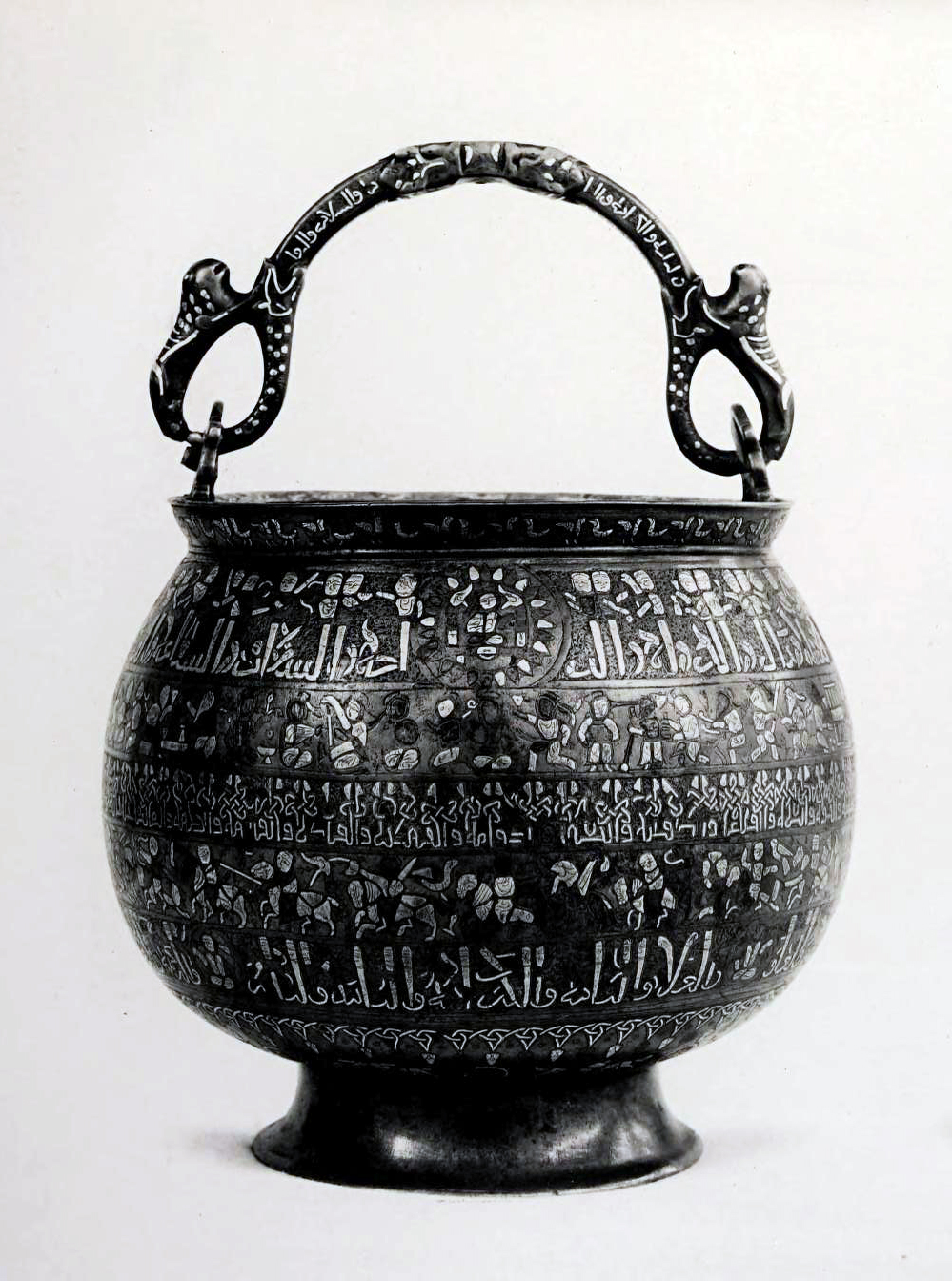
Black-and-white photograph of the Bobrinski Bucket, reproduced as figure 143 in the catalogue of the 1910 Munich exhibition Die Ausstellung von Meisterwerken muhammedanischer Kunst, at a date when the object was still in the Bobrinsky family collection, roughly fifteen years before it entered the Hermitage. This is the only image of the object located under a free licence during this research; the Hermitage's own modern photography of the piece is not freely licensed.
| Artist | Muhammad ibn Abd al-Wahid (caster) and Mas'ud ibn Ahmad (inlayer) |
|---|---|
| Date | Muharram 559 AH / December 1163 CE |
| Medium | Cast bronze (brass alloy), inlaid with silver and copper |
| Dimensions | Height 18.5 cm (7.3 in); no further dimensions were published in the sources consulted |
| Where it is now | State Hermitage Museum, St Petersburg, Russialast confirmed 8 August 2026 |
| Inventory number | IR-2268 (Latin transliteration of the Hermitage's Cyrillic inventory prefix) |
| Attribution | AcceptedBoth craftsmen are named in the bucket's own dedicatory inscription, not assigned by connoisseurship: Muhammad ibn Abd al-Wahid cast the vessel and Mas'ud ibn Ahmad executed the silver and copper inlay. Full note |
| Object type | Islamic metalwork |
| Period | Khurasan under Seljuq rule, mid-twelfth century (Herat workshop tradition) |
| Cases | Has a provenance gap |
| Inscriptions | Three inscriptions in Persian and Arabic across the handle, rim and body. A Kufic date on the top of the handle gives Muharram 559 AH (December 1163 CE). A Persian text on the rim names the caster, Muhammad ibn Abd al-Wahid; the inlayer, Mas'ud ibn Ahmad; the man who ordered the piece, Abd al-Rahman ibn Abdallah al-Rashidi; and the recipient, described as 'the eminent hajji Rukn ad-Din, the glorious of merchants, the Muslims trusted man, an ornament to the hajj and both holy places, Rashid ad-Din Azizi ibn Abu'l-Husayn az-Zanjani, may his fame endure.' Three further bands of Arabic calligraphy on the body (two in anthropomorphic script, one in interlaced geometric Kufic) carry conventional benedictions to the owner rather than further factual content. |
| Owners on record | 5 links3 documented, 2 unknown |
| Sources | 17 cited |
About this record Last verified 8 August 2026 · 17 sources cited · Change log
On this page 9 sections
ContentsClose
A small bronze bucket, cast and inlaid with silver and copper in Herat, in the Khurasan region of present-day Afghanistan, and dated by its own inscription to Muharram 559 AH, December 1163 CE. Three separate inscriptions across its handle, rim and body name the two craftsmen who made it, the man who commissioned it, and the Herat merchant it was made for - a rare and complete run of documentation that makes it one of the earliest firmly dated and signed pieces of Islamic inlaid metalwork, and the fixed point against which an entire undated corpus of twelfth- and thirteenth-century Khurasan bronzes has been classified and dated ever since Richard Ettinghausen's foundational 1943 study.
What the bucket was actually for remains disputed: a bath vessel, a food container, a pilgrimage souvenir, a gift, or, in the interpretation now most widely accepted, a showpiece commissioned to demonstrate a workshop's new repertoire of courtly and astrological imagery. It is named for Count Aleksei Aleksandrovich Bobrinsky, who owned a group of Kufic-inscribed metal objects acquired in Bukhara around 1885; how the bucket itself travelled the roughly 800 kilometres from Herat to Bukhara over the intervening seven centuries is not recorded. It entered the State Hermitage Museum in 1925, transferred from the Soviet successor to the Imperial Archaeological Commission that Bobrinsky had once chaired, while Bobrinsky himself was living in emigration in France.
No free-licence modern photograph of the object was located for this record. The single image available is a black-and-white plate from the catalogue of the landmark 1910 Munich exhibition of Islamic art masterpieces, taken while the bucket was still in the Bobrinsky family's own hands.
Provenance
Each link is graded. Documented: a cited source supports it. Disputed: the identification is argued but not established. Unknown: no owner for that span, and the gap is not smoothed into a narrative. The grades in the glossary.
- 1163 -Rukn ad-Din Rashid ad-Din Azizi ibn Abu'l-Husayn az-Zanjanidocumented
Made in Herat for the merchant Rukn ad-Din az-Zanjani, on the order of Abd al-Rahman ibn Abdallah al-Rashidi, by the caster Muhammad ibn Abd al-Wahid and the inlayer Mas'ud ibn Ahmad. Dated by its own inscription to Muharram 559 AH, December 1163 CE.13
- 1163 - c. 1885Unknownunknown
No owner, findspot or location is documented for roughly seven centuries between the bucket's completion in Herat and its appearance in the Bukhara antiquities trade in the 1880s.1
- c. 1885 - 1917Count Aleksei Aleksandrovich Bobrinskydocumented
Secondary sources place a group of Kufic-inscribed antique metal objects in Bobrinsky's hands as a result of purchases in Bukhara, with the acquisition recorded to 1885. Bobrinsky was chairman of the Imperial Archaeological Commission and had asked the Turkestan governor-general to route regional antiquities to St Petersburg. The specific transaction - dealer, direct find or intermediary - is not documented in the sources consulted.11617
- 1917 - 1925Uncertain (transitional)unknown
Bobrinsky left Russia after the October Revolution and settled in France, where he was active in monarchist emigre politics until his death in Grasse in 1927; he could not have personally delivered the bucket to a Soviet institution in 1925. The move from his private collection into Soviet state hands during this period is consistent with the well-documented nationalization of aristocratic property after 1917, but no source consulted for this record documents the specific act or date of confiscation.16
- 1925 - presentState Hermitage Museum, St Petersburgdocumented
Entered the Hermitage in 1925 by transfer from the State Academy for the History of Material Culture, the Soviet-era successor to the Imperial Archaeological Commission. Ex collection of A. A. Bobrinsky. Inventory number IR-2268.1114
Technical evidence
| Attribution note | Both craftsmen are named in the bucket's own dedicatory inscription, not assigned by connoisseurship: Muhammad ibn Abd al-Wahid cast the vessel and Mas'ud ibn Ahmad executed the silver and copper inlay. This makes the Bobrinski Bucket one of the earliest securely signed and dated pieces of Islamic inlaid metalwork. Scholarship since Ruba Kana'an's 2009 study has specifically debated which of the four men named in the inscription - caster, inlayer, commissioner, or recipient - should be understood as the object's 'artist' in an intellectual sense. |
|---|---|
| Material | Cast bronze (brass alloy) body.16 |
| Dimensions | Height 18.5 cm (7.3 in). No further dimensions were published in the sources consulted.114 |
| Inlay materials | Silver and copper, applied both as wire (for calligraphy) and as sheet (for larger figural fields such as heads and animal bodies).6 |
| Inlay technique | Wire hammered into shallow recessed channels for the script; sheet metal trimmed to a recessed field and hammered down at the edges for larger figural elements, per Rachel Ward's technical account of the method.6 |
| Decorative structure | Handle plus seven horizontal registers on the body, combining three bands of calligraphy (two anthropomorphic, one interlaced Kufic) with four bands of figural and animal imagery.14 |
| Inscriptions | Kufic date on the handle (Muharram 559 AH / December 1163 CE); Persian dedicatory inscription on the rim naming caster, inlayer, commissioner and recipient; three further Arabic calligraphic bands on the body, two in anthropomorphic script, carrying benedictions to the owner.135 |
| Inventory number | IR-2268, State Hermitage Museum, St Petersburg (Latin transliteration of the Cyrillic inventory prefix).1114 |
| Basis of dating | Internal: the object's own inscription, not stylistic estimate. Among the earliest firmly and completely dated pieces of Islamic inlaid metalwork.1210 |
| The suns' twenty-eight rays | The four enthroned suns in the uppermost band each have twenty-eight alternating black and white rays, read variously as coincidence, a reference to the draconic month, or the twenty-eight lunar mansions of Islamic astrology, following a comparative framework developed for a related but separately catalogued Khurasan-associated brass bowl.47 |
| Proposed function | No consensus. Bath vessel, food vessel, hajj-related vessel, gift, and showpiece theories have each been proposed; the showpiece reading is now most widely cited, without having settled the question.18 |
| Nearest dated comparandum | A faceted ewer by Mahmud ibn Muhammad of Herat, dated Sha'ban 577 AH (1181-82), now in the Simon Janashia Museum of Georgia, Tbilisi - the next securely dated piece in the same Herat inlaid-metalwork tradition.15 |
| Photographic record | The only free-licence image identified is a black-and-white photograph published in the catalogue of the 1910 Munich exhibition of Islamic art masterpieces; the Hermitage's own modern photography of the object is not freely licensed.1213 |
Images
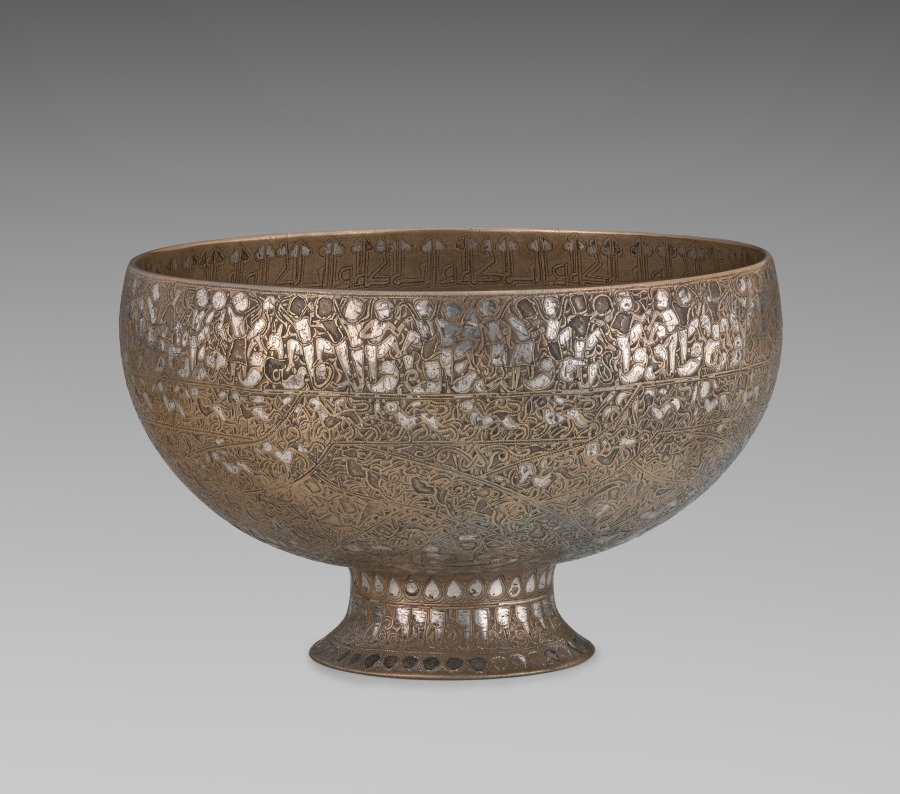
The record in full
Chapter 1A small vessel with an outsized reputation
The Bobrinski Bucket is a cast bronze vessel a mere 18.5 centimetres high, with a rounded body, a heightened waisted foot, a wide rim and a bail handle that swings between two zoomorphic terminals.
The Bobrinski Bucket is a cast bronze vessel a mere 18.5 centimetres high, with a rounded body, a heightened waisted foot, a wide rim and a bail handle that swings between two zoomorphic terminals. Every visible surface, from the handle to the base, carries decoration inlaid in silver and copper wire and sheet: seven horizontal registers of calligraphy and figural imagery packed onto an object small enough to carry in one hand.
Older literature calls it a kettle or a cauldron as often as a bucket - Richard Ettinghausen's foundational 1943 study uses 'kettle' in its own title - and the English name is a convenience rather than a precise functional label, since what the vessel was actually used for is itself one of the longest-running debates about the object.
Chapter 2A dated, signed inscription - rare on its own terms
Almost no medieval Islamic metal object carries both a date and the names of the people who made and commissioned it.
Almost no medieval Islamic metal object carries both a date and the names of the people who made and commissioned it. Most surviving inlaid bronzes and brasses of the period are undated and unsigned, and are placed in time only by comparison with pieces that do carry such information. The Bobrinski Bucket is one of a small number of exceptions.
Across its handle, rim and body it carries three separate inscriptions that together supply a full month-and-year date and four personal names. That internal documentation, not the object's modest size, is the entire basis of its scholarly importance, and it is why this record treats the inscription as the object's defining fact rather than as one feature among several.
Chapter 3What the inscription says
A Kufic inscription on the top of the handle gives the date: the month of Muharram in the year 559 of the Hijra, corresponding to December 1163 CE.A Persian inscription running around the rim names...
A Kufic inscription on the top of the handle gives the date: the month of Muharram in the year 559 of the Hijra, corresponding to December 1163 CE.
A Persian inscription running around the rim names the people involved in making and receiving the vessel. It records that the piece was cast by Muhammad ibn Abd al-Wahid and that its decoration was executed by Mas'ud ibn Ahmad. It further states that the vessel was ordered by Abd al-Rahman ibn Abdallah al-Rashidi, and that it was made for 'the eminent hajji Rukn ad-Din, the glorious of merchants, the Muslims trusted man, an ornament to the hajj and both holy places, Rashid ad-Din Azizi ibn Abu'l-Husayn az-Zanjani, may his fame endure.'
Three further bands of Arabic calligraphy run around the body: two in anthropomorphic script, where the letters carry human heads or torsos, and one in an interlaced geometric Kufic. Their content is conventional - benedictions and well-wishes for the owner, of a kind standard on portable Islamic metalwork of the period - rather than additional documentary information. The historical weight of the object rests entirely on the rim and handle texts.
Chapter 4Four names, one puzzle: who was the artist
The inscription distinguishes the caster's role from the inlayer's with different verbs - Muhammad ibn Abd al-Wahid is credited with having formed or cast the vessel, Mas'ud ibn Ahmad with having...
The inscription distinguishes the caster's role from the inlayer's with different verbs - Muhammad ibn Abd al-Wahid is credited with having formed or cast the vessel, Mas'ud ibn Ahmad with having made or executed its decoration - a division of labour that Ruba Kana'an examined at length in a 2009 article in Islamic Law and Society, 'The de Jure Artist of the Bobrinski Bucket.'
Kana'an's study, drawing on medieval Islamic legal writing on hire and commission, re-examines the relationship between all four men named in the inscription - caster, inlayer, commissioner and recipient - rather than assuming, as earlier scholarship tended to, that the inlayer alone should count as the object's 'artist' in the modern sense. The precise legal relationship she proposes could not be verified beyond her article's abstract and the secondary summaries located during this research; her full argument is flagged here for direct verification against the journal text.
Chapter 5Made for a merchant, not a sultan
The recipient named in the inscription, Rukn ad-Din Rashid ad-Din Azizi ibn Abu'l-Husayn az-Zanjani, was not a ruler but a merchant - described in the text itself as 'the glorious of merchants' and...
The recipient named in the inscription, Rukn ad-Din Rashid ad-Din Azizi ibn Abu'l-Husayn az-Zanjani, was not a ruler but a merchant - described in the text itself as 'the glorious of merchants' and an experienced hajji, with a nisba, az-Zanjani, that ties him to Zanjan in northwestern Iran even though the vessel was made for him in Herat.
That a work of this technical ambition was commissioned for a private merchant rather than a court is treated in the scholarship as significant in itself: it is direct evidence that the market for high-end inlaid Khurasan metalwork in the mid-twelfth century extended well beyond royal and princely patronage into an urban mercantile elite with the means and motive to commission comparable objects.
Chapter 6How it was made
The bucket's calligraphy was created by laying silver and copper wire into shallow recessed channels cut into the cast bronze body, then hammering the wire down until it was firmly seated.
The bucket's calligraphy was created by laying silver and copper wire into shallow recessed channels cut into the cast bronze body, then hammering the wire down until it was firmly seated. Larger areas of inlay, such as human heads or animal bodies, used sheet silver or copper trimmed to a recessed field and hammered into place along its edges, producing a polychrome surface of bronze, silver and copper across the vessel.
Assigning the casting and the decoration to two named individuals reflects a broader pattern in twelfth-century Persian metal workshops, in which a designer's repertoire of ornament could be applied across many different cast objects by other hands, rather than one craftsman executing an object from start to finish.
Chapter 7The iconographic programme, band by band
Reading from the handle down: four lion heads meet at the centre of the handle, with hares and dragons extending toward them on either side.
Reading from the handle down: four lion heads meet at the centre of the handle, with hares and dragons extending toward them on either side. Directly below, running around the rim, pairs of ducks face one another all the way around. The uppermost body band combines anthropomorphic script with four suns of twenty-eight alternating black and white rays, each enclosing an enthroned human figure flanked by two dragon-headed staffs. The second band shows courtly genre scenes - figures drinking, feasting, dancing, playing board games and making music. The third band is Kufic script alone. The fourth shows mounted hunters and fighters, including a group of men battling a dragon. The fifth returns to anthropomorphic script, this time with human heads only, interwoven with dogs, birds, antelope and hares as though moving through a forest. The bottommost band repeats those animals chasing one another among columnar strapwork.
Despite the density of the imagery, the scenes carry no evident narrative sequence or hierarchy. They read instead as a repertoire of generic courtly and hunting motifs associated with ideal kingship - a stock vocabulary of images available to a workshop for use across many different commissions, rather than a story told about this particular object or its owner.
Chapter 8The suns and the astrological question
The twenty-eight-rayed suns in the uppermost band have drawn specific astronomical interest.
The twenty-eight-rayed suns in the uppermost band have drawn specific astronomical interest. Willy Hartner, writing on Islamic astrological iconography, proposed three possible readings of the number twenty-eight: pure coincidence, a reference to the roughly twenty-seven-to-twenty-eight day draconic month used in eclipse calculation, or the twenty-eight lunar mansions (manazil al-qamar) used across Islamic astrology and calendrics.
Hartner's article is formally a study of the Vaso Vescovali, a different and separately catalogued object now in the British Museum, not of the Bobrinski Bucket itself. It is cited here, as later scholarship on the bucket has cited it, only for its comparative framework on astrological motifs in Islamic metalwork of this broad period - not as a claim that the two objects share iconography, patronage or any other fact in common.
Chapter 9What was it for: the functional debate
No single theory of the bucket's original use commands agreement, and this record states that plainly rather than picking a winner.
No single theory of the bucket's original use commands agreement, and this record states that plainly rather than picking a winner. Richard Ettinghausen and Ralph Harari proposed a bath or hammam vessel, on the strength of a resemblance to a water bucket shown in a fifteenth-century bathhouse painting and the practicality of a bail handle in that setting. The historian Nikolay Veselovsky argued it carried food, but the interior lacks the tinning that would have been needed to prevent the bronze from corroding in contact with food or its acids, which counts strongly against that reading. Souren Melikian and Robert Hillenbrand connected it to the hajj, either as a pilgrimage accessory or a marker of the recipient's completed pilgrimage, pointing to the hajj language built into the inscription itself. Others have proposed simply that it was a gift. Ruba Kana'an's interpretation - that it was produced as a showpiece demonstrating a workshop's new repertoire of design and imagery, and presented as a gift rather than put into everyday use - is now the most widely cited reading in current scholarship, without having settled the question outright.
Chapter 10A dated anchor for an entire school
Because the bucket is both dated and located by its own inscription, it has functioned since Ettinghausen's 1943 study as the fixed point against which the wider corpus of undated twelfth- and...
Because the bucket is both dated and located by its own inscription, it has functioned since Ettinghausen's 1943 study as the fixed point against which the wider corpus of undated twelfth- and thirteenth-century Khurasan inlaid bronzes has been organised and dated by style. Where an undated brass basin, ewer or bowl shares its calligraphic conventions, its figural repertoire or its inlay technique with the Bobrinski Bucket, that resemblance becomes the basis for attributing the undated piece to Herat and to a period close to 1163.
A second fixed point followed eighteen years later: a faceted brass ewer made by Mahmud ibn Muhammad of Herat, dated Sha'ban 577 AH (December 1181 to January 1182 CE) and now in the Simon Janashia Museum of Georgia in Tbilisi, sometimes called the Tiflis Ewer. Together the two dated objects bracket a wider group of astrological brass ewers attributed to Herat and datable on stylistic grounds to roughly 1180-1220, examples of which are held today at the Hermitage, the Louvre, the Metropolitan Museum and the British Museum. External testimony corroborates the object's own claim: the late-thirteenth-century Persian geographer Qazvini recorded that Herat was renowned in his own time for its silver-inlaid brass vessels, independently confirming what the dated objects themselves demonstrate. A. S. Melikian-Chirvani's later classificatory studies of Khurasan bronzes continue the dating tradition Ettinghausen's article began.
Other Khurasan-associated inlaid brasses appear throughout this same body of scholarship, including the Wade Cup, now in the Cleveland Museum of Art, and the Vaso Vescovali, now in the British Museum. Both are separately catalogued objects in this archive, each with its own inscription, date and provenance; nothing about either object's facts, images or history is asserted here, and their appearance in this section is limited strictly to their shared place in the comparative literature on Khurasan-school metalwork.
Chapter 11From Herat to Bukhara: seven centuries unaccounted for
Nothing is documented about the bucket's ownership or location between its completion in Herat in 1163 and its appearance in the Central Asian antiquities trade in Bukhara in the 1880s.
Nothing is documented about the bucket's ownership or location between its completion in Herat in 1163 and its appearance in the Central Asian antiquities trade in Bukhara in the 1880s. Herat and Bukhara lie roughly 800 kilometres apart along the historic routes of Khurasan and Transoxiana, but no source located for this record identifies an intermediate owner, a findspot, or the route by which the vessel travelled between the two cities across more than seven hundred years.
Chapter 12Bobrinsky's acquisition
Count Aleksei Aleksandrovich Bobrinsky (1852-1927) was chairman of the Imperial Archaeological Commission for more than thirty years, during which he expanded its funding and staff, led excavations...
Count Aleksei Aleksandrovich Bobrinsky (1852-1927) was chairman of the Imperial Archaeological Commission for more than thirty years, during which he expanded its funding and staff, led excavations of Scythian burial mounds on his own estates near Kerch and Sevastopol, and directed the extraction and publication of the Pereshchepina hoard. In his capacity at the Commission he also took an active interest in antiquities surfacing in Russian Turkestan, asking the Turkestan governor-general to route regional collections to St Petersburg for the Commission's consideration.
Secondary sources place a group of antique metal objects, most bearing Kufic inscriptions, in Bobrinsky's hands as a result of purchases made in Bukhara, with the acquisition recorded to 1885. None of the sources located for this record specify whether the bucket came to him through a dealer, a direct find, or a local intermediary - only that Bobrinsky's ownership of Bukhara-associated Kufic metalwork is attested to that year. The precise transaction is not documented in what could be verified here, and this record does not supply one.
Chapter 13From private collection to state museum
Bobrinsky remained the bucket's owner through the October Revolution of 1917.
Bobrinsky remained the bucket's owner through the October Revolution of 1917. He then left Russia and settled in France, where he campaigned actively for the monarchist cause among the emigre community until his death in Grasse in 1927.
The bucket itself entered the State Hermitage Museum's collection in 1925 - while Bobrinsky was still alive but resident abroad - transferred from the State Academy for the History of Material Culture, the Soviet-era institution that had absorbed the functions of the Imperial Archaeological Commission Bobrinsky once chaired. That sequence is consistent with the wider, well-documented pattern of Soviet nationalization of aristocratic and institutional property after 1917. It is not, on the sources consulted for this record, independently confirmed as a specific act of confiscation of Bobrinsky's personal property, as opposed to the transfer of a collection already associated with the Commission's own institutional holdings. The gap between 1917 and 1925 is recorded here as exactly that - a gap, bracketed by two documented facts, not bridged by an assumption.
Chapter 14One exhibition before the Hermitage years
The earliest documented public appearance of the bucket is the landmark 1910 Munich exhibition Die Ausstellung von Meisterwerken muhammedanischer Kunst (Exhibition of Masterpieces of Muhammadan Art)...
The earliest documented public appearance of the bucket is the landmark 1910 Munich exhibition Die Ausstellung von Meisterwerken muhammedanischer Kunst (Exhibition of Masterpieces of Muhammadan Art), one of the formative international exhibitions in the study of Islamic art. The bucket was reproduced as figure 143 in the accompanying three-volume catalogue, at a date when it was still in the Bobrinsky family's own possession, roughly fifteen years before its transfer to the Hermitage.
That black-and-white catalogue photograph, now credited to the Hermitage by Wikimedia Commons though taken while the object remained in private hands, is the only image of the bucket located under a free licence during this research, and it is the image used in this record.
The artist
Muhammad ibn Abd al-Wahid (caster) and Mas'ud ibn Ahmad (inlayer), working in a Herat metalworking workshop under the patronage of Abd al-Rahman ibn Abdallah al-Rashidi
Two craftsmen's names survive from this commission, which is itself unusual: most twelfth-century Khurasan metalwork is anonymous. Muhammad ibn Abd al-Wahid is credited in the rim inscription with casting the vessel; Mas'ud ibn Ahmad is credited with executing its inlaid decoration. Nothing beyond this single object is documented about either man - no other signed work, no biographical record, no workshop address. What can be said about them rests entirely on the inscription itself and on what scholars have inferred from the wider practice of Persian metal workshops in this period.
Related works
| Work | Relation | Where it is |
|---|---|---|
| Faceted ewer (the 'Tiflis Ewer') Mahmud ibn Muhammad of Herat | The next securely dated piece in the same Herat inlaid-metalwork tradition, eighteen years later Dated Sha'ban 577 AH (December 1181 to January 1182 CE). Together with the Bobrinski Bucket it brackets a wider group of astrological brass ewers attributed to Herat and dated on stylistic grounds to roughly 1180-1220. | Simon Janashia Museum of Georgia, Tbilisi |
| The Wade Cup with Animated Script Unattributed workshop, Khurasan-associated inlaid brass | Discussed in the same scholarly literature on Khurasan-school inlaid metalwork; comparanda only A separately catalogued object in this archive, with its own inscription, date and provenance. No fact, image or attribution belonging to it is used in this record. | Cleveland Museum of Art |
| The Vaso Vescovali Unattributed workshop, Khurasan-associated inlaid brass | Source of the astrological-iconography framework (Hartner) cited comparatively for the bucket's twenty-eight-rayed suns A separately catalogued object in this archive. Hartner's 1973 study is formally about this object, not the Bobrinski Bucket; it is cited here only for its interpretive framework on Islamic astrological motifs, not as shared fact between the two objects. | British Museum, London |
| Astrological brass ewer group, Herat, c. 1180-1220 Various Herat workshops | Wider stylistic group dated by comparison with the Bobrinski Bucket and the Tiflis Ewer Cited in dealer and museum literature as the class of undated objects whose Herat attribution and c. 1180-1220 dating rest on comparison with the two firmly dated anchor pieces. | Examples at the State Hermitage Museum, the Louvre, the Metropolitan Museum of Art and the British Museum |
Open questions
- What were the exact circumstances of Bobrinsky's acquisition of the bucket in Bukhara around 1885 - a dealer purchase, a direct find, or a local intermediary? Not documented in the sources consulted.
- How did the bucket travel the roughly 800 kilometres from Herat to Bukhara between 1163 and the 1880s? No intermediate owner, findspot or route is recorded.
- What specific mechanism moved the bucket from Bobrinsky's collection into the State Academy for the History of Material Culture between 1917 and its 1925 transfer to the Hermitage - formal nationalization of his personal property, or a transfer within an institutional collection already tied to the Commission he had chaired?
- Who was Abd al-Rahman ibn Abdallah al-Rashidi, the man who ordered the bucket, and what was his relationship to the merchant Rukn ad-Din az-Zanjani for whom it was made? Not established beyond the names given in the inscription.
- Does the inlayer Mas'ud ibn Ahmad carry the title 'hajji' (pilgrim) or 'hajib' (chamberlain) in the primary inscription reading? Secondary sources consulted for this record disagree, and the discrepancy could not be resolved without the original publication.
- What was Herat's precise political status in December 1163 - still under Seljuq suzerainty, as the date would suggest, or already shifting toward Ghurid influence? Some non-scholarly sources label the object 'Ghurid,' but the Ghurids did not take Herat itself until 1175, twelve years later; this record treats that label as unconfirmed.
- Has any modern conservation report, condition assessment or scientific and technical imaging study of the bucket been published? None was located in the sources consulted.
- Has the bucket been lent for exhibition at any point since entering the Hermitage in 1925, beyond its documented appearance in the 1910 Munich exhibition while still in Bobrinsky's own collection? No exhibition history after 1925 was located.
Questions about this object
What is The Bobrinski Bucket?
The Bobrinski Bucket is an islamic metalwork, dated muharram 559 AH / December 1163 CE. Medium: Cast bronze (brass alloy), inlaid with silver and copper.
Who made The Bobrinski Bucket, and is the attribution settled?
The attribution to Muhammad ibn Abd al-Wahid (caster) and Mas'ud ibn Ahmad (inlayer) is recorded here as accepted. Both craftsmen are named in the bucket's own dedicatory inscription, not assigned by connoisseurship: Muhammad ibn Abd al-Wahid cast the vessel and Mas'ud ibn Ahmad executed the silver and copper inlay. This makes the Bobrinski Bucket one of the earliest securely signed and dated pieces of Islamic inlaid metalwork. Scholarship since Ruba Kana'an's 2009 study has specifically debated which of the four men named in the inscription - caster, inlayer, commissioner, or recipient - should be understood as the object's 'artist' in an intellectual sense.
Where is The Bobrinski Bucket now?
State Hermitage Museum, St Petersburg, Russia. Inventory number IR-2268 (Latin transliteration of the Hermitage's Cyrillic inventory prefix). Last confirmed 8 August 2026. Entered the Hermitage in 1925 by transfer from the State Academy for the History of Material Culture, the Soviet-era successor to the Imperial Archaeological Commission; ex collection of Count A. A. Bobrinsky.
What is still unknown about The Bobrinski Bucket?
What were the exact circumstances of Bobrinsky's acquisition of the bucket in Bukhara around 1885 - a dealer purchase, a direct find, or a local intermediary? Not documented in the sources consulted.
Sources
- 1Wikipedia, 'Bobrinski Bucket.' Tertiary source consolidating Blair (1998, 2014), Ward (1993), Ettinghausen (1943), Kana'an (2009), Hartner (1973), Flood and Necipoglu (2017), and Bloom and Blair (2009). Flagged for replacement with direct citation of those primary sources. en.wikipedia.org/wiki/...
- 2Ettinghausen, Richard. 'The Bobrinski Kettle: Patron and Style of an Islamic Bronze.' Gazette des Beaux-Arts 24 (1943): 193-208. Full text hosted on Gallica but not directly accessible during this research; cited here as consolidated via Wikipedia and Encyclopaedia Iranica. Flagged for direct verification. gallica.bnf.fr/ark:/...
- 3Kana'an, Ruba. 'The de Jure Artist of the Bobrinski Bucket: Production and Patronage of Metalwork in pre-Mongol Khurasan and Transoxiana.' Islamic Law and Society 16, no. 2 (2009): 175-201. Full text paywalled on JSTOR; cited here via Wikipedia's citation and secondary summaries. Flagged for direct verification. jstor.org/stable/...
- 4Blair, Sheila. Text and Image in Medieval Persian Art. Edinburgh University Press, 2014, pp. 78-83. en.wikipedia.org/wiki/...
- 5Blair, Sheila. Islamic Inscriptions. New York University Press, 1998, pp. 110-121. en.wikipedia.org/wiki/...
- 6Ward, Rachel. Islamic Metalwork. New York: Thames and Hudson, 1993, pp. 72-79. en.wikipedia.org/wiki/...
- 7Hartner, Willy. 'The Vaso Vescovali in the British Museum: A Study on Islamic Astrological Iconography.' Kunst des Orients 9, no. 1/2 (1973): 112-130. jstor.org/stable/...
- 8Bloom, Jonathan M., and Sheila S. Blair. 'Metalwork.' The Grove Encyclopedia of Islamic Art and Architecture. Oxford University Press, 2009. oxfordreference.com/display/...
- 9Flood, Finbarr Barry, and Gulru Necipoglu, eds. A Companion to Islamic Art and Architecture. Hoboken, NJ: John Wiley and Sons, 2017, pp. 464-465. onlinelibrary.wiley.com/doi/...
- 10Encyclopaedia Iranica, 'Metalwork.' Covers the Bobrinski Bucket's role, alongside the Tiflis-area faceted ewer of 577/1181-82, as the two dated anchor pieces for attributing undated Khurasan metalwork to Herat, and cites Qazvini's testimony to Herat's contemporary reputation for inlaid brass. iranicaonline.org/articles/...
- 11Wikidata, Q4935932, 'Bobrinski Bucket.' Records the inventory number IR-2268 and the 1925 transfer to the Hermitage from the State Academy for the History of Material Culture, ex collection A. A. Bobrinsky. wikidata.org/wiki/...
- 12Wikimedia Commons, File:Bobrinsky Bronzekessel.jpg, extmetadata record confirming public domain status and the 1910 Munich publication source. commons.wikimedia.org/wiki/...
- 13Martin, F. R., ed. Die Ausstellung von Meisterwerken muhammedanischer Kunst in Munchen 1910, vol. 3, fig. 143. Original publication of the photograph used as this record's lead image. archive.org/details/...
- 14Kornbluth Photography, 'Bobrinsky Bucket,' scholarly Islamic metalwork photo archive. Confirms inventory number IR-2268, dimensions, and iconographic register descriptions; also the source of the disputed 'Hajib' title for the inlayer, flagged as unresolved against the primary reading. kornbluthphoto.com/BobrinskyBucket.html
- 15Sotheby's, 'A Khurasan silver-inlaid ewer, Herat, 12th century,' lot essay. Source for the Tiflis Ewer comparandum: maker Mahmud ibn Muhammad, dated Sha'ban 577 AH/1181-82, Simon Janashia Museum of Georgia, Tbilisi. sothebys.com/en/...
- 16Wikipedia, 'Aleksei Bobrinsky (historian).' Confirms full name Aleksei Aleksandrovich Bobrinsky (1852-1927), his chairmanship of the Imperial Archaeological Commission, and his emigration to France after 1917. en.wikipedia.org/wiki/...
- 17Document hosted on Neliti, apparent title fragment 'A History of Scientific Archeological Research' concerning Turkestan/Uzbekistan; full author and journal could not be independently confirmed. Cited only for the specific claim that Bobrinsky purchased Kufic-inscribed antique metal objects in Bukhara, with the acquisition recorded to 1885. Flagged for replacement with a verified primary citation. media.neliti.com/media/...

Last verified 8 August 2026 · Published 8 August 2026
Change log
8 August 2026 - Record created at the house standard: researched narrative, technical evidence, maker dossier, graded provenance chain, prices with hammer and premium separated, related works, open questions and sources.