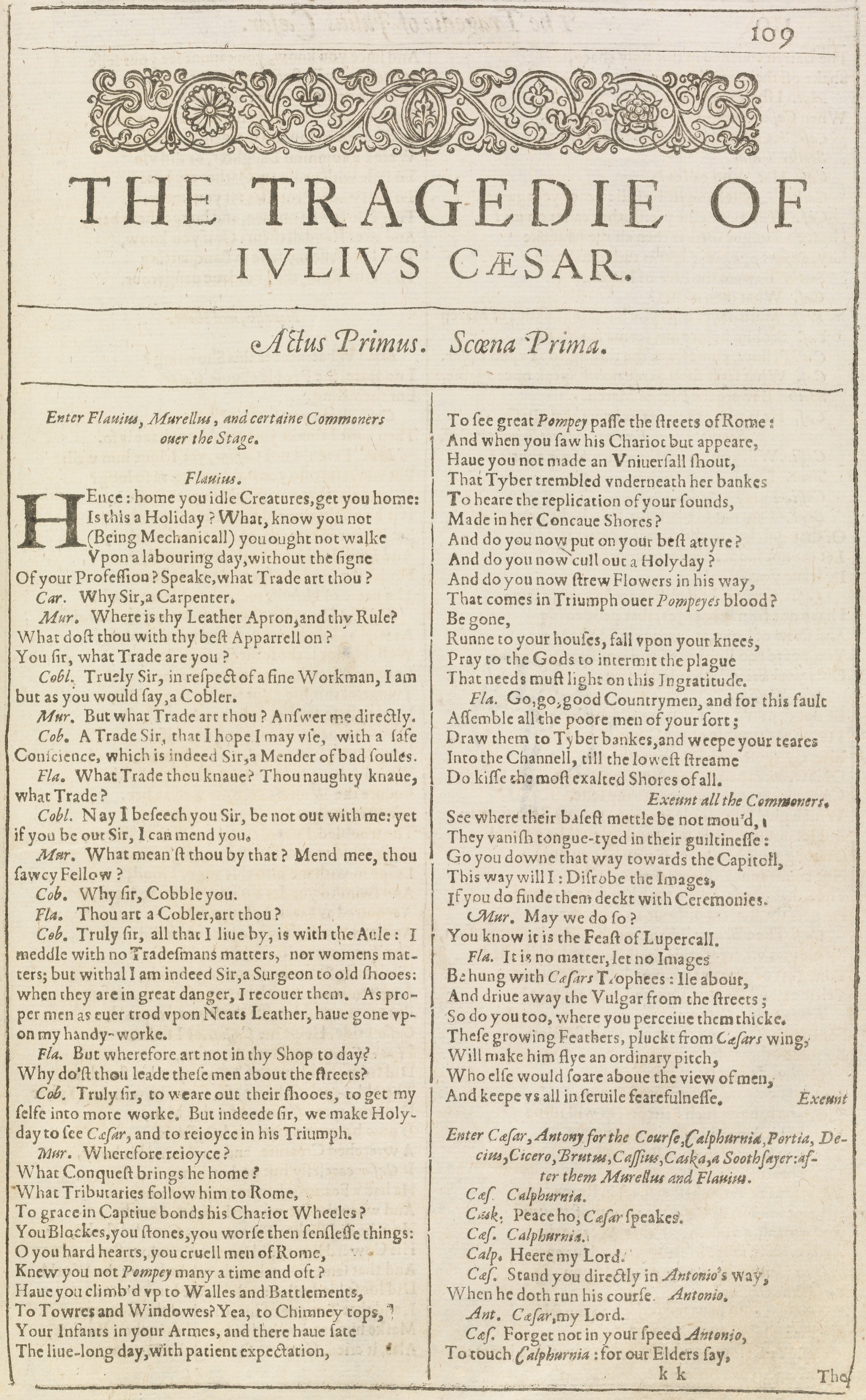
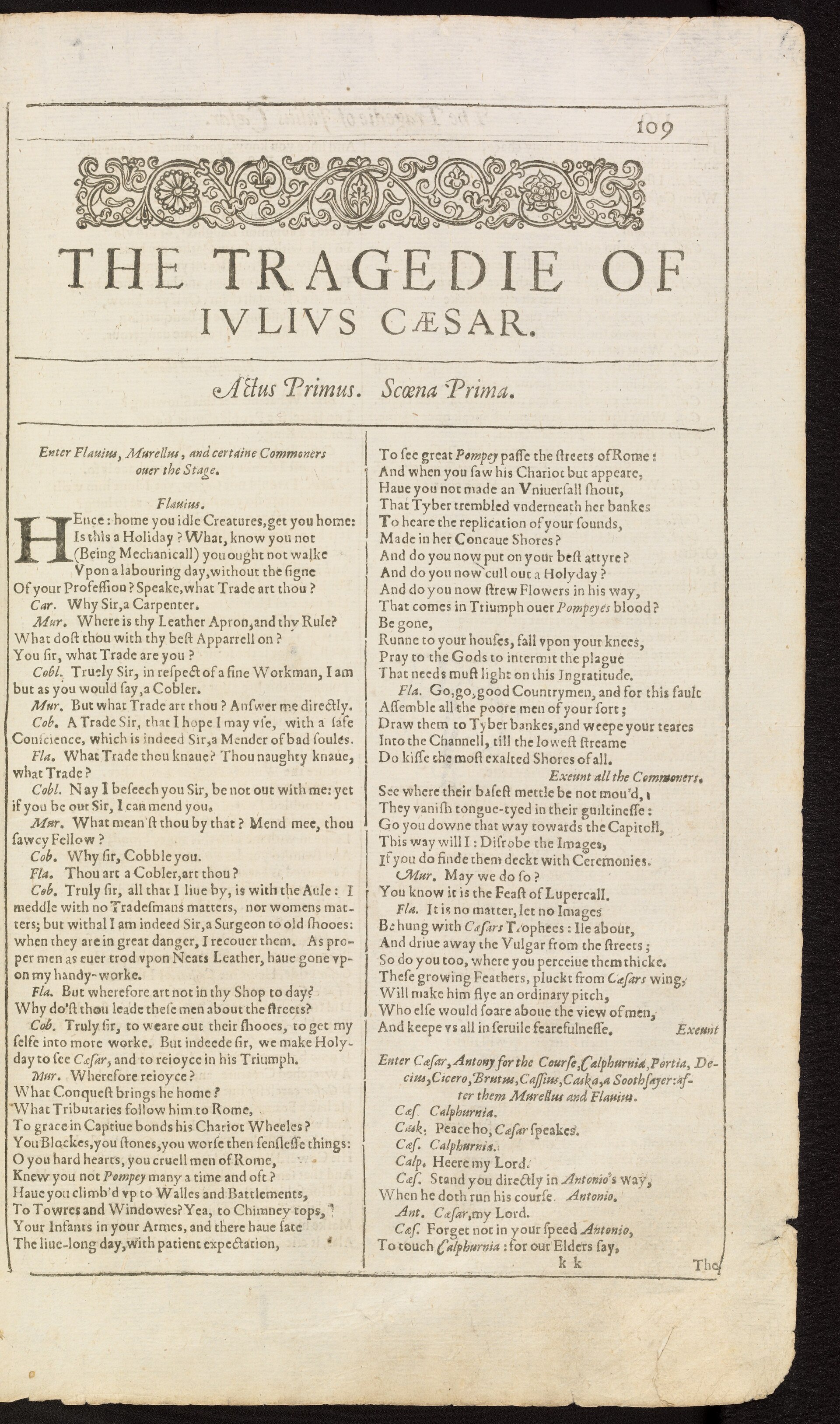
Mr. William Shakespeares Comedies, Histories, & Tragedies (the Bodleian copy)
1623 · Letterpress printing on laid paper
Bodleian Library, University of Oxford
 English · 1564-1616
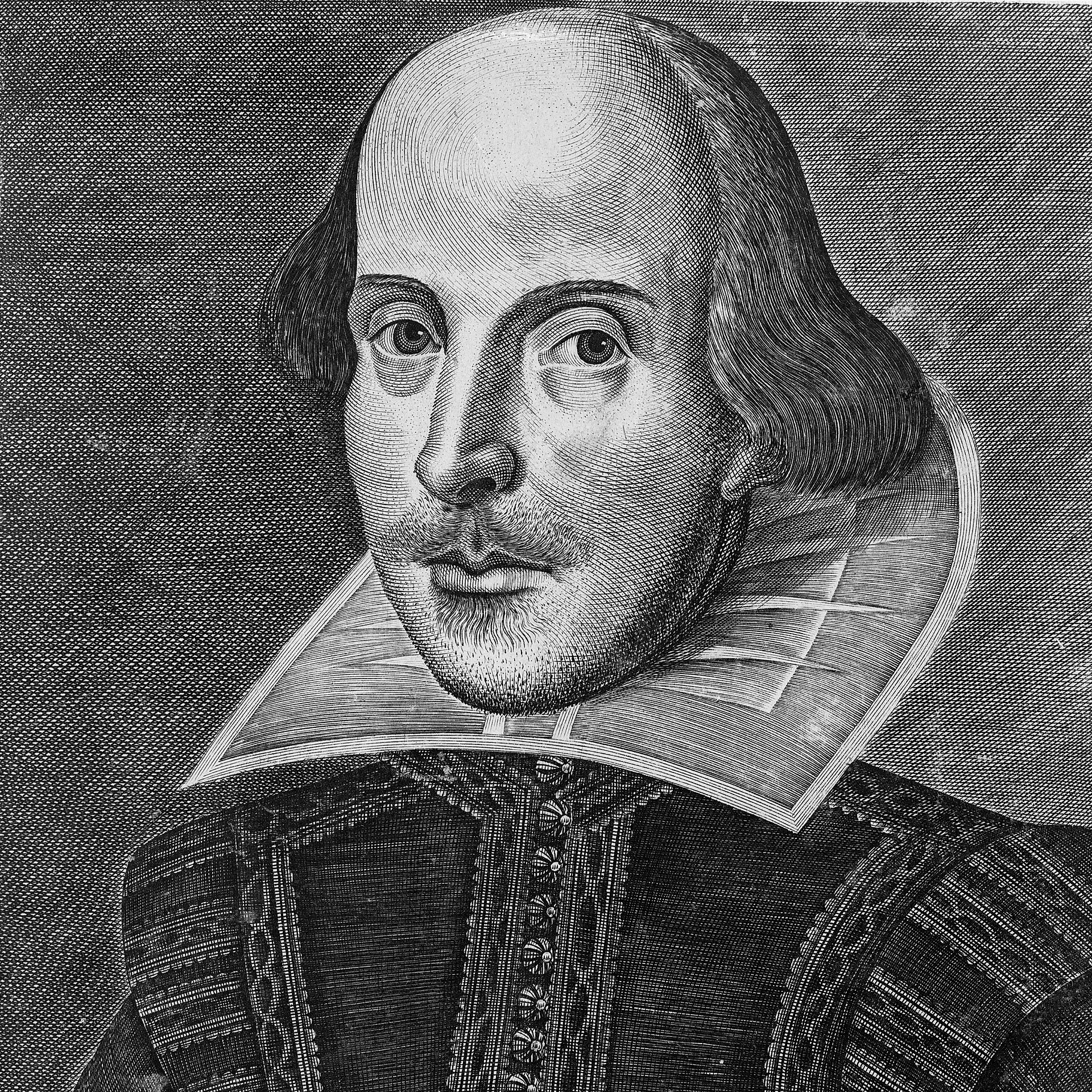
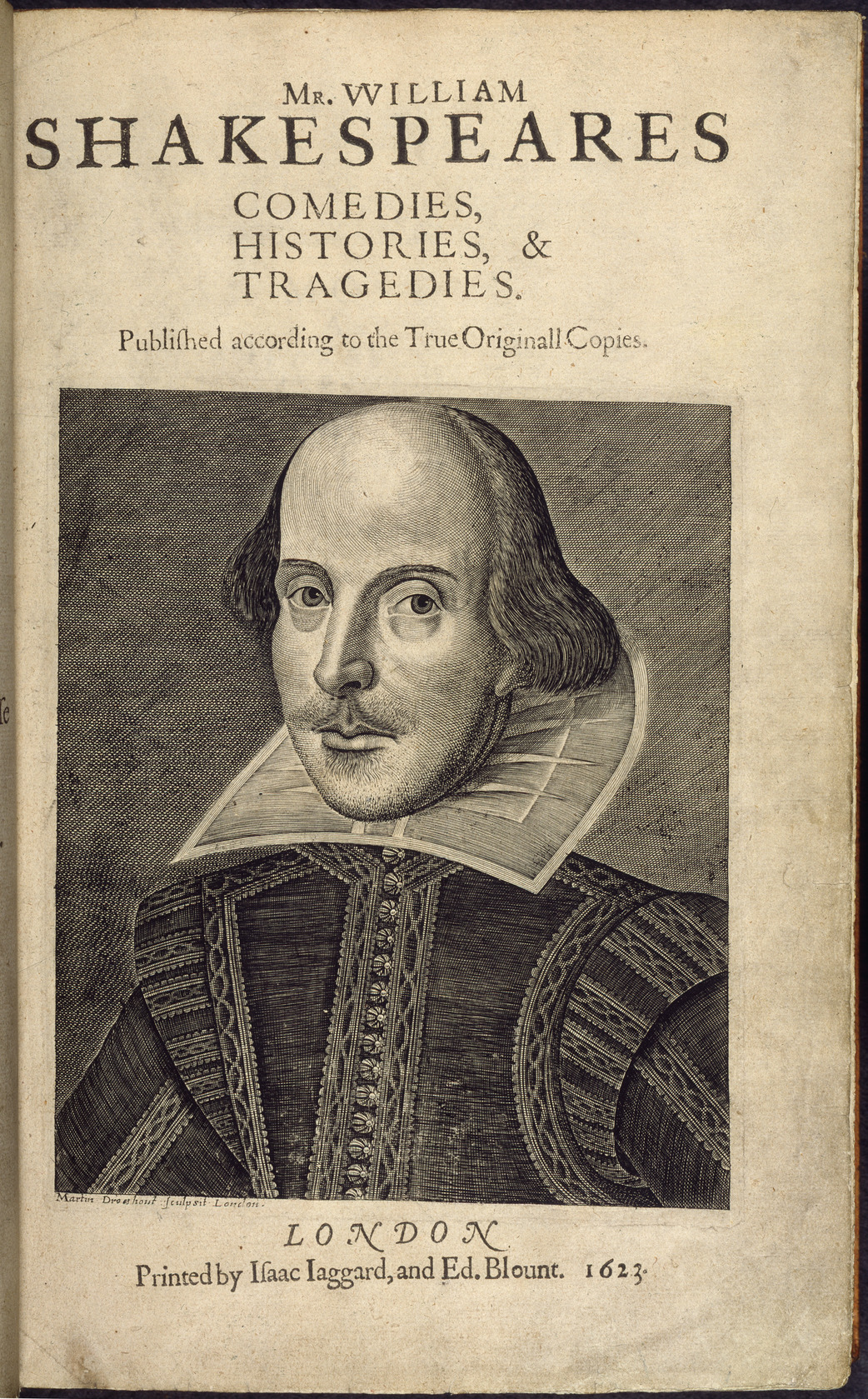
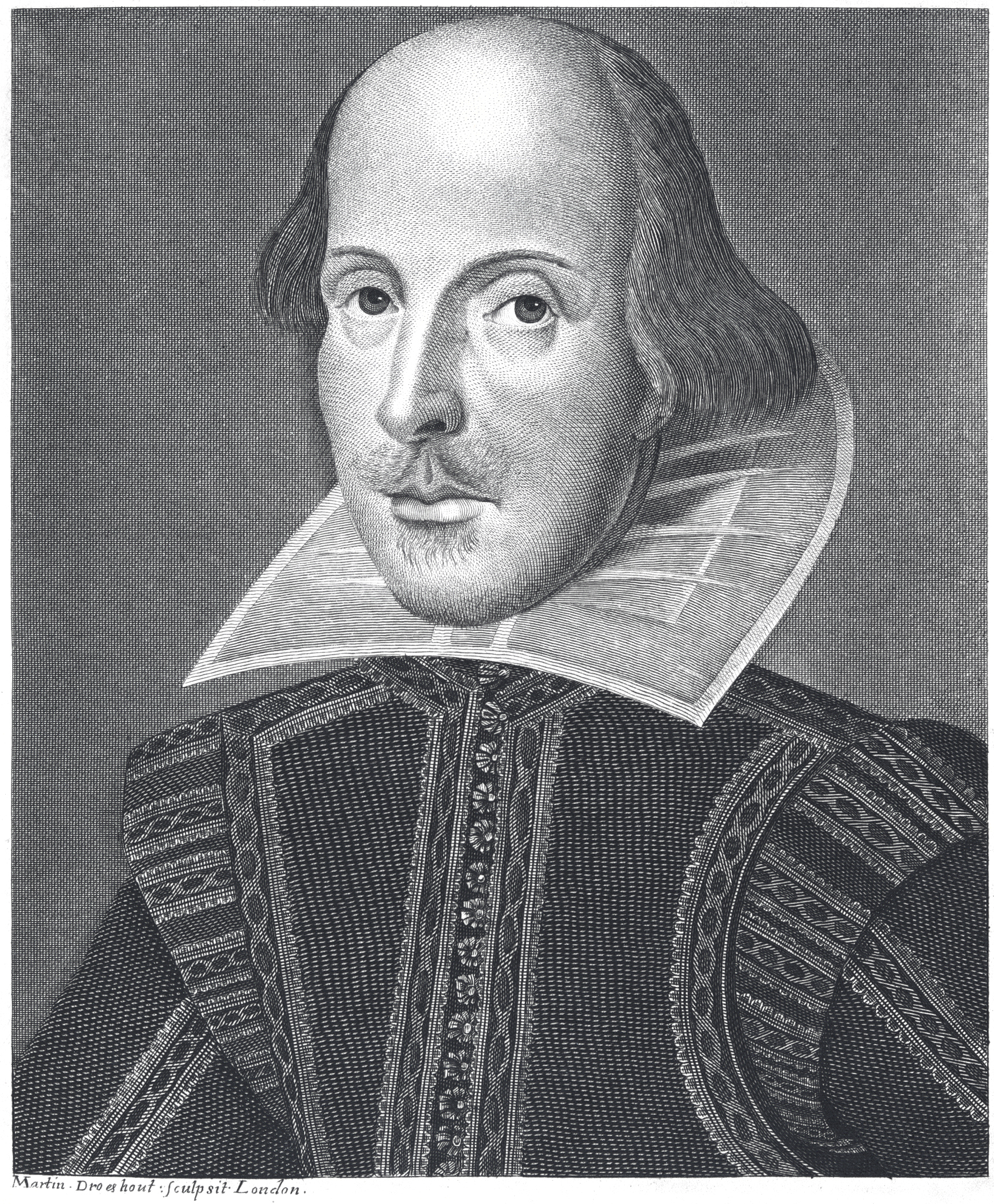
The Droeshout engraving from the title page of the First Folio, in the Bodleian Library's copy, Arch. G c.7. This is the authorised image: commissioned for the volume, printed facing Ben Jonson's short verse to the reader, and endorsed in that verse by a man who had known Shakespeare for twenty years, who wrote that the engraver had a strife with nature to outdo the life and had hit his face. It is one of only two likenesses with any independent claim to authenticity, the other being the funerary monument at Stratford. Its status and its accuracy are separate questions and this caption keeps them apart. Martin Droeshout was in his early twenties in 1623 and no evidence establishes that he ever saw Shakespeare alive; he was working from another image or a description. Which Martin Droeshout made it is itself disputed, Mary Edmond having argued in 1991 for the elder man, the engraver's uncle, with Christiaan Schuckman and June Schlueter's later archival work supporting the younger. The engraving has been criticised since the nineteenth century for its anatomy, most concretely for a doublet that appears to have two left arms, and J. Dover Wilson called it a pudding-faced effigy. It remains the standard against which every other proposed Shakespeare portrait is tested.
Bodleian Library, University of Oxford, via the Bodleian First Folio digital facsimile| Full name | William Shakespeare, of Stratford-upon-Avon |
|---|---|
| Worked as | Playwright, Poet, Actor, Sharer in the Lord Chamberlain's Men and the King's Men |
| Born | Baptised 26 April 1564 · Stratford-upon-Avon, Warwickshire, England |
| Died | 23 April 1616 · Stratford-upon-Avon, Warwickshire, England |
| Nationality | English |
| Movement | The Elizabethan and Jacobean commercial playhouse |
| In this archive | 2 artworks |
| Sources | 30 cited |
| Last verified |
About this page 2 artworks in the archive · Last verified · 30 sources cited
This page is not a life of the poet. It is an account of the object through which almost all of him reaches us: Mr. William Shakespeares Comedies, Histories, & Tragedies, the folio volume printed in London in 1623 and known since as the First Folio. Shakespeare had nothing to do with it. He had been dead seven years when it was registered at Stationers' Hall on 8 November 1623, and he left no instruction that it be made. It exists because two of his fellow actors in the King's Men, John Heminges and Henry Condell, gathered thirty-six plays and put them through a printing house, and because four stationers were willing to carry the cost.
The consequence is the single most important fact about this maker's corpus and the one most often stated without its weight being felt. Eighteen of the thirty-six plays had never been printed in any form. Macbeth, The Tempest, Twelfth Night, Julius Caesar, As You Like It, Antony and Cleopatra, Measure for Measure, The Winter's Tale, Coriolanus, The Comedy of Errors and eight others have no earlier authority of any kind. No manuscript of any Shakespeare play survives in his hand or anyone else's. Remove this one book from the record and roughly half of what is meant by Shakespeare goes with it.
That makes the surviving copies of the First Folio the physical corpus of a writer whose corpus is otherwise textual, and it makes the questions a collector or a curator actually needs answered material rather than literary ones: how many copies survive and who counts them, why no two copies read alike, what a complete copy is and how many there are, how a copy assembled from the leaves of other copies is detected, how a specific copy is proved to be itself after a theft, and what the market pays and for which attributes. Iconotheca holds records on two individual copies, the Durham University copy stolen in 1998 and recovered in 2008, and the Bodleian copy sold by its own library in the 1660s and bought back by subscription in 1906. This page is the ground they both stand on.
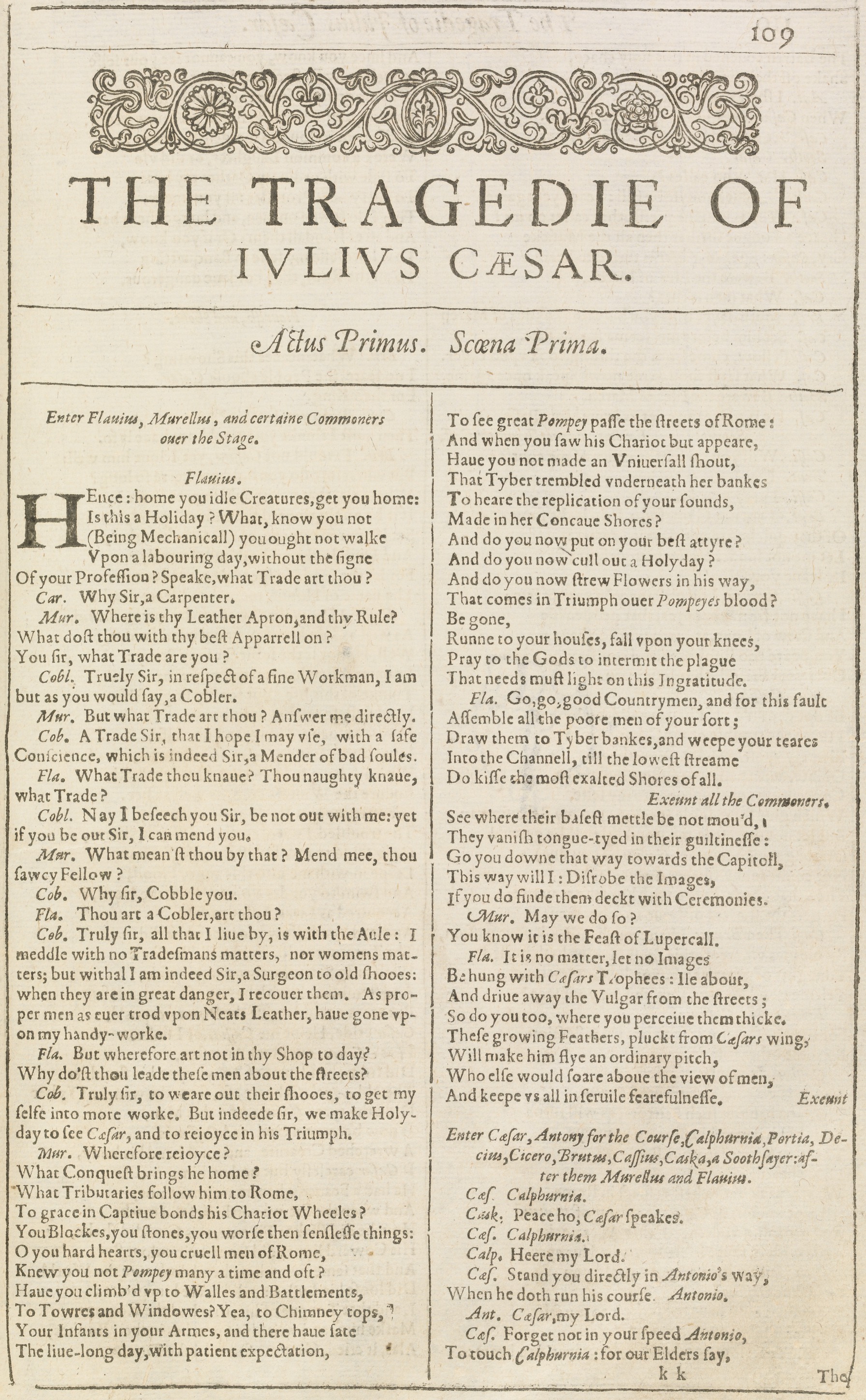
1623 · Letterpress printing on laid paper
Bodleian Library, University of Oxford
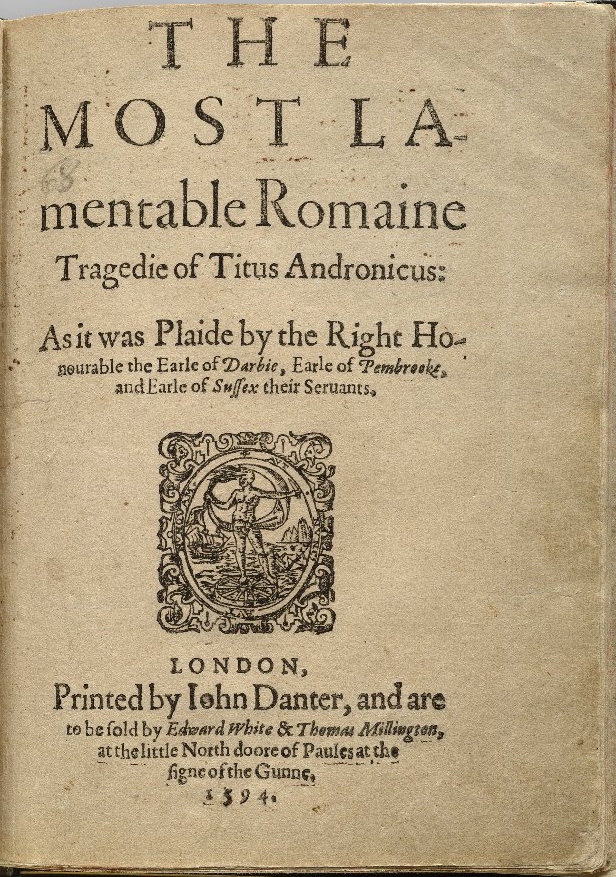
1594 · Letterpress printing on laid paper
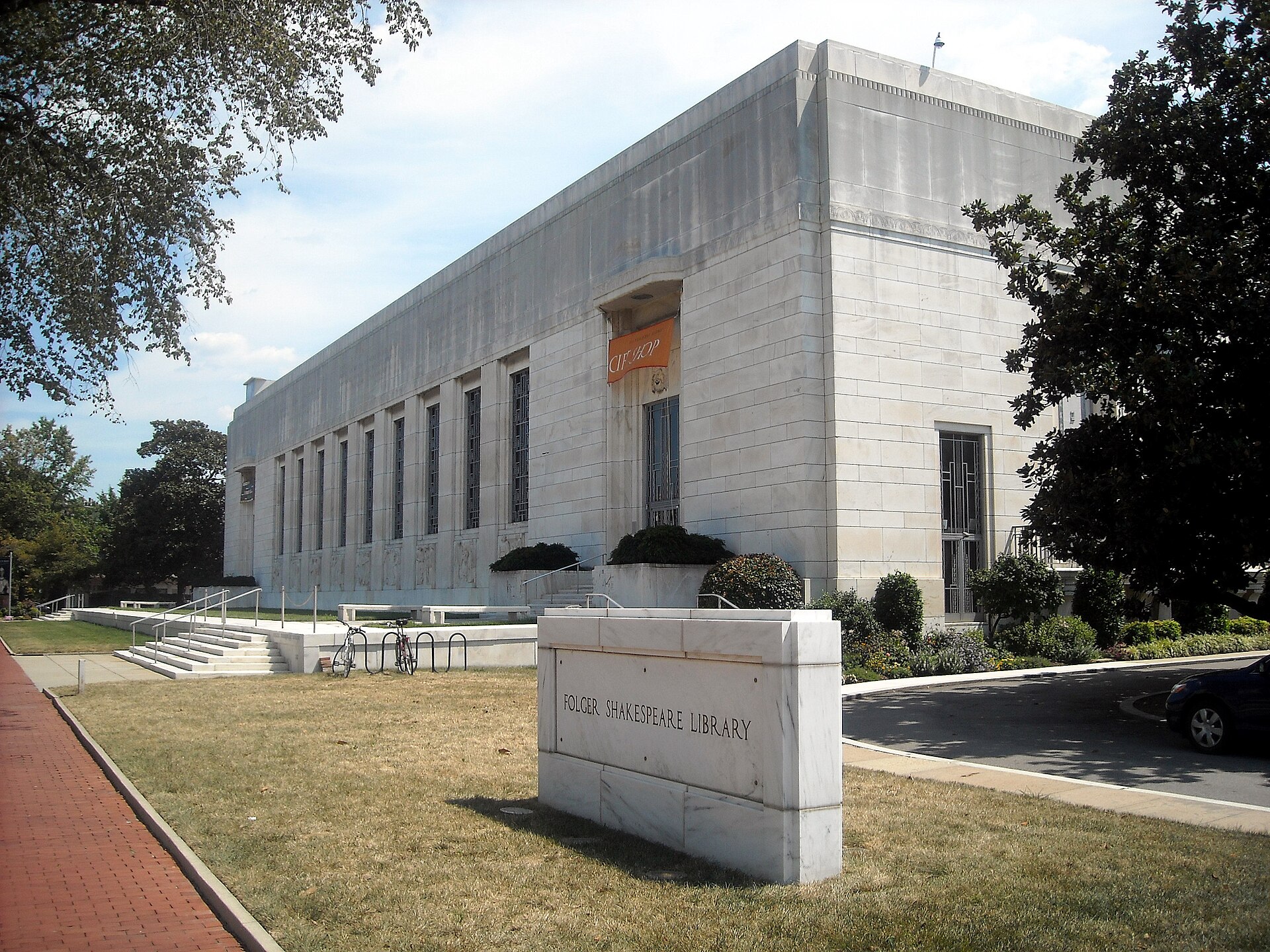
Folger Shakespeare Library, Washington, D.C
Baptised at Stratford-upon-Avon on 26 April; the date of birth is not recorded.4
First Shakespeare quarto printed: Titus Andronicus. Roughly half the plays later collected in the Folio appear in quarto before 1623.4
John Heminges is a founding sharer in the Lord Chamberlain's Men.16
Heminges is a founding shareholder in the Globe; Condell becomes a sharer in the company by 1603 and a Globe shareholder about 1605.16
Heminges and Condell invest in the Blackfriars playhouse, returning them roughly 200 pounds a year.16
Shakespeare dies at Stratford on 23 April. His will leaves 26 shillings and 8 pence each to Richard Burbage, Heminges and Condell for mourning rings.416
Ben Jonson publishes his own Workes in folio, including his stage plays, and is mocked for treating playhouse work as literature.4
William Jaggard and Thomas Pavier issue ten Shakespearean and pseudo-Shakespearean quartos with false dates and imprints, the group later called the False Folio.12
Richard Burbage dies. In the same year the Lord Chamberlain, William Herbert, orders the Stationers' Company to require the King's Men's consent before printing plays from their repertory.10
Printing of the Folio begins, probably in February. The volume is advertised in the Frankfurt Book Fair catalogue for April to October, generally read as advance publicity.4
John Leason, almost certainly the apprentice known to bibliography as Compositor E, is indentured on 4 November, weeks before he begins setting parts of the tragedies.48
William Jaggard, elderly and blind, dies about a month before the book reaches the market; his son Isaac completes the job.4
Entered in the Stationers' Register on 8 November. Printed at the charges of W. Jaggard, Ed. Blount, I. Smithweeke and W. Aspley.4
First recorded purchase: the antiquary Edward Dering buys two copies for 2 pounds on 5 December. Unbound copies sold at 15 shillings, bound at about 1 pound.4525
Second Folio, printed by Thomas Cotes, reusing the Droeshout copperplate.411
Third Folio; the 1664 reissue adds seven plays, of which only Pericles is now accepted as partly Shakespeare's.423
Fourth Folio, the last use of the Droeshout plate, by then heavily re-engraved. The plate then disappears.11
Nicholas Rowe's edition, the first attempt at a clean modern text, worked up from the Fourth Folio.24
First Folios changing hands at an average of about 30 pounds, according to figures in the Christie's catalogue for the 2020 sale.5
On 8 July the British Museum trustees order that any leaf supplied in facsimile by John Harris be signed 'This is by J.H. - A.P.'7
Edward Donner buys the Manchester copy from Bernard Quaritch for 500 pounds and gives it to the university.15
Sidney Lee publishes the first census in December, listing 158 copies in roman numerals as a supplement to the Clarendon Press facsimile of the Chatsworth copy. His 1906 revision lists 172.15
Henry Folger instructs his agent to buy the Vincent copy 'without fail even at ten thousand cash'; he pays Coningsby Sibthorp 10,000 pounds, about 48,730 dollars, on 31 January.13
The Bodleian's own former copy is recognised in January by its Oxford binding and chaining-staple marks; a public subscription buys it back for 3,000 pounds in 1906.28
The Chapin Library copy at Williams College is stolen on 8 February by substitution and returned undamaged on 21 October; four men are convicted.14
Charlton Hinman publishes The Printing and Proof-Reading of the First Folio of Shakespeare, setting out five compositors and the order of composition and presswork.89
Hinman's Norton Facsimile prints an ideal copy assembled page by page from the 29 most satisfactory of the Folger's 80 copies, and introduces Through Line Numbering.2029
The University of Manchester copy, Lee census LXIII, is stolen during the night of 12 to 13 July and has never been recovered.15
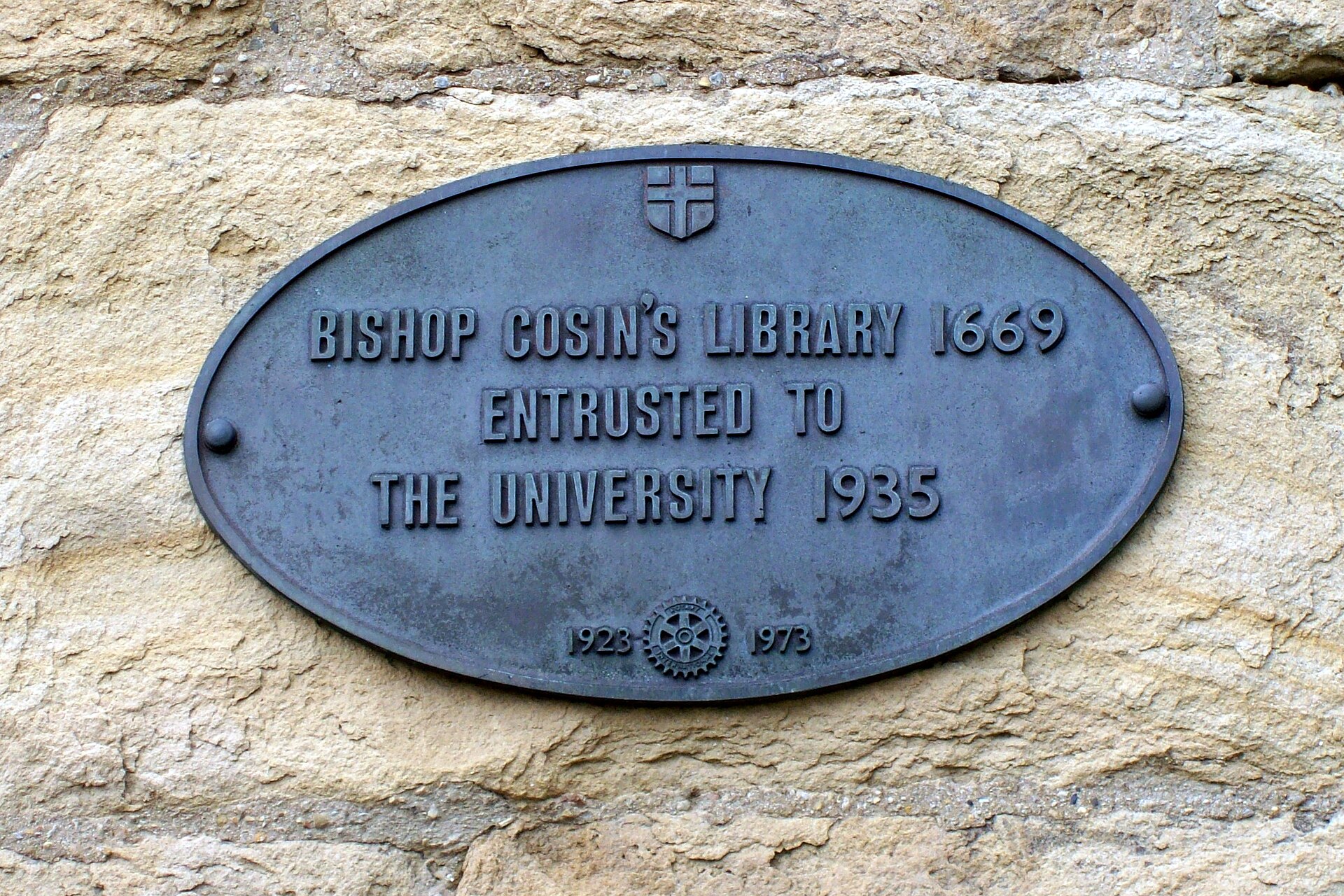
Durham University's copy, West 7, is stolen from Bishop Cosin's Library along with six other items.27
The Berland or Canons Ashby copy makes 6,166,000 dollars at Christie's New York on 9 October, bought by Paul G. Allen.56
Oriel College, Oxford sells its copy privately to Sir Paul Getty, reported at about 3.5 million pounds, brokered by Maggs Brothers.5
Dr Williams's Library sells its copy at Sotheby's London on 13 July: 2.5 million pounds hammer, 2,808,000 pounds with premium.45
The stolen Durham copy is carried into the Folger on 16 June and identified by Anthony James West against his own pre-theft census record.27
Rasmussen and West's Descriptive Catalogue is published, describing 232 copies examined in person over two decades.13
A copy is found in November at Saint-Omer, France, in a collection descending from the English Jesuit college founded there in 1594; it becomes West 233.3
Mount Stuart House on the Isle of Bute is confirmed to hold a previously unknown copy, authenticated by Emma Smith; it becomes West 235.3
Eighteen Folger copies tour all fifty states, Washington DC and Puerto Rico, opening 4 January 2016 and closing 8 January 2017, each displayed open at Hamlet's soliloquy.21
The New Oxford Shakespeare credits Christopher Marlowe as co-author of the three parts of Henry VI and gives co-authors to 17 of 44 plays.22
The Shakespeare Census is created by Adam G. Hooks and Zachary Lesser, tracking copies of all Shakespeare editions to 1700.1
Jason Scott-Warren identifies the annotator of the Free Library of Philadelphia copy as John Milton, from Claire M. L. Bourne's description of the hand.18
The Mills College copy sells at Christie's New York on 14 October: 8.4 million dollars hammer, 9,978,000 dollars with premium, to Stephan Loewentheil. The highest price paid at auction for a work of literature.5
A copy with early Scottish Gordon family provenance sells at Sotheby's New York on 21 July, reported at 2.4 to 2.47 million dollars.2630
Sotheby's London withdraws a complete set of all four folios, estimated at 3.5 to 4.5 million pounds, after the consignor accepts a private offer.25
The First Folio market is defined by a supply that only shrinks. About 235 copies are known, roughly 27 are in private hands, and only five or six of those are complete. Copies move from private ownership into institutions and effectively never come back, so complete copies reach the open market about once a generation. The 2001 Berland copy and the 2020 Mills College copy are the two complete copies sold at auction this century.
Price is driven, in order, by the number of original leaves, the presence and date of the binding, the trimming height, and provenance. Completeness is the dominant variable, and it is technical: a copy is complete only if it retains its own original leaves, which about 56 do. Replacement leaves from another First Folio are a disclosable defect; replacement leaves from a later folio, or in pen facsimile passed as print, are a different matter entirely. The nineteenth-century habit of stripping early calf bindings for bright goatskin and gilt destroyed value as well as evidence, and an original or early binding now carries a large premium. Trimming is measurable and it counts: the Mills copy stood fifteen millimetres shorter than the Allen copy, having been cut close at the head into the upper box rules, and that was one of the reasons cited for it stopping short of ten million dollars.
The long price series, from Christie's own catalogue research, runs from an average of about 30 pounds in the 1790s to about 60 pounds in the first half of the nineteenth century, about 290 pounds in the second, 500 pounds in 1898, 10,000 pounds in 1903, and into the millions from the 1980s. The uplift between 2001 and 2020 was modest in real terms, roughly 6.2 to 10 million dollars over nineteen years, which reflects the fact that no two copies are alike and that each result prices a particular object rather than the edition. The current direction of travel is away from the rostrum: the four-folio set offered by Sotheby's in May 2025 was withdrawn before the sale because the consignor took a private offer.
| Date | Sale | Work | Result | Note |
|---|---|---|---|---|
| 5 December 1623 | Retail, London | Two copies of the First Folio | Hammer GBP 2 for the two copies (retail price; 15 shillings unbound, about 1 pound bound) With premium Not applicable - retail sale, not an auction GBP | The antiquary Edward Dering records buying two copies for 2 pounds the pair. Unbound copies sold at 15 shillings, bound copies at about 1 pound. The earliest recorded transaction in the book. |
| 1898 | Bernard Quaritch, London (private sale) | The Manchester copy, Lee census LXIII | Hammer GBP 500 (private sale price) With premium Not applicable - private sale, not an auction GBP | 500 pounds, paid by Edward Donner, who gave the volume to the University of Manchester in honour of Thomas Ashton. Described at the time as a fine and nearly perfect copy. Stolen in 1972 and never recovered. |
| 31 January 1903 | Private sale via A. B. Railton and Sotheran, London | The Vincent copy, given by William Jaggard to Augustine Vincent in 1623 | Hammer GBP 10,000, about USD 48,730 (private sale price) With premium Not applicable - private sale, not an auction GBP | 10,000 pounds, about 48,730 dollars, paid by Henry Clay Folger to Coningsby Charles Sibthorp of Canwick Hall. Sibthorp had agreed 5,000 pounds in 1899 before the deal collapsed. Folger's instruction on receiving the new price by cipher telegram was to buy without fail even at ten thousand cash. Now Folger First Folio 1. |
| 9 October 2001 | Christie's, New York | The Berland copy, also called the Canons Ashby copy, complete, in early panelled calf of about 1690-1730 | Hammer Reported as 6,166,000 USD With premium Reported as 6,166,000 USD USD | Bought by Paul G. Allen. The Antiques Trade Gazette states the 6.16 million dollar figure as including premium; other accounts report it as a hammer price. This record does not resolve the conflict and flags it. Title leaf and two or possibly three other leaves were supplied from another copy. Passed three times through A. S. W. Rosenbach. |
| 2003 | Private sale brokered by Maggs Brothers | The Oriel College, Oxford copy | Hammer About GBP 3,500,000 (private treaty price) With premium Not applicable - private treaty sale, not an auction GBP | About 3.5 million pounds, paid by Sir Paul Getty shortly before his death. A private treaty sale, so no hammer or premium applies. |
| 13 July 2006 | Sotheby's, London | The Dr Williams's Library copy, complete, in an original seventeenth-century binding | Hammer GBP 2,500,000 With premium GBP 2,808,000 GBP | Bought by Simon Finch Rare Books. The highest price for a printed book at a Sotheby's London auction at the time. The library's director stated the proceeds would secure its finances and its historic collections. |
| 25 May 2016 | Christie's, London | The Shuckburgh copy, previously unrecorded; became West 234 | Hammer GBP 1,870,000 With premium About 2,714,276 USD GBP | Once owned by Sir George Augustus William Shuckburgh-Evelyn, on the market for the first time in more than two centuries. It was subsequently assembled with a Second, Third and Fourth Folio into the complete set offered by Sotheby's in 2025. |
| 14 October 2020 | Christie's, New York, The Exceptional Sale | The Mills College copy, complete and original, bound in blind-stamped russia about 1810, apparently by Thomas Gosden | Hammer USD 8,400,000 With premium USD 9,978,000 USD | Estimate 4 to 6 million dollars. Six minutes of bidding between three telephone bidders; bought by the New York dealer Stephan Loewentheil, his fifth First Folio. The auction record for any work of literature, though the Bay Psalm Book's 14.165 million dollars with premium (12.5 million hammer) in November 2013 remains the record for any printed book. Consigned by Mills College, Oakland, in a budget crisis. First recorded owner John Fuller, landowner and member of parliament, who showed it to Edmond Malone in 1809; Malone's autograph letter attesting to its cleanness was in the lot. Defects cited against it: the Jonson verse leaf inlaid, a few letters of the title and part of the portrait restored, the last leaf re-margined, and the book trimmed 15 mm shorter than the Allen copy. |
Hammer is the price at which the bidding stopped; with premium adds the fee the house charges the buyer on top. Hammer price and buyer's premium in the glossary.
| Institution | City | Holdings | Note |
|---|---|---|---|
| Folger Shakespeare Library | Washington, DC | 82 First Folios, more than a third of all known survivors, plus the Pavier quartos and the largest Shakespeare collection in the world. | Assembled by Henry Clay Folger from 1903. Copy 1 is the Vincent copy, given by William Jaggard to Augustine Vincent in 1623, still carrying a fragment of its original binding with Vincent's blind-stamped badge. Numbering is not chronological: Folger numbered the first 66 by value, condition and completeness. |
| Kodama Memorial Library, Meisei University | Tokyo | Twelve First Folios, the second largest holding in the world. | One copy is annotated in a neat seventeenth-century secretary hand from the first page of The Tempest to the last page of the volume; Akihiro Yamada's 1998 transcript of the marginalia is available in a corrected digital edition. |
| Bodleian Library, University of Oxford | Oxford | The library's original deposit copy, Arch. G c.7, sold in the 1660s and bought back by public subscription in 1906, plus a second copy. | Conserved and digitised in 2012-13; the facsimile is free online under a Creative Commons Attribution licence. Full record on this site: first-folio-bodleian. |
| Durham University Library, Palace Green | Durham | West 7, the Cosin copy, stolen in December 1998 and recovered in 2008 in a deliberately mutilated state. | Redisplayed from April 2025 in the exhibition Shakespeare Recovered, with the rebinding question put to visitors rather than resolved. Full record on this site: durham-first-folio-theft. |
| Free Library of Philadelphia | Philadelphia | A copy given by the Widener family in 1944, annotated by a reader identified in 2019 as John Milton. | The annotator compared the Folio against quartos and supplied what it lacked, including the prologue to Romeo and Juliet. The first vernacular book identified from Milton's library. |
| Biblioteca Universitaria di Padova | Padua | Rari N.S.1, the only First Folio in Italy and the earliest known to have been used as an acting company's promptbook. | Annotated with actors' names, stage directions and cuts. Dated by G. Blakemore Evans in 1960 to between 1625 and 1635, later revised towards 1640 or after. Provenance before about 1840 is undocumented. |
| Bibliotheque d'Agglomeration de Saint-Omer | Saint-Omer | West 233, found in November 2014 after two centuries unrecognised. | The collection descends from the English College founded at Saint-Omer in 1594, a Jesuit school for English Catholic boys with a strong tradition of staging plays. |
| Mount Stuart House | Isle of Bute | West 235, confirmed in 2016 and authenticated by Emma Smith of Oxford. | Formerly owned by the eighteenth-century editor Isaac Reed. The most recent copy added to the census. |
| British Library | London | Multiple copies, one of which supplied the title-page image used on this page. | The British Library's imaging of its copy is released without copyright restriction. |
| John Rylands Library, University of Manchester | Manchester | The Rylands copy. The separate University Library copy, Lee LXIII, was stolen in 1972 and has never been recovered. | The merger of the Rylands and University libraries, completed the week after the theft, is the reason Manchester still has a First Folio at all. |
For most makers in this archive there is an object and, behind the object, a maker's hand: a drawing, a signed contract, a workshop inventory.
For most makers in this archive there is an object and, behind the object, a maker's hand: a drawing, a signed contract, a workshop inventory. For Shakespeare there is almost nothing behind the print. Six signatures on four legal documents, three of them on the will, are the whole of the accepted autograph record, and the six spell the name differently. The only literary manuscript widely argued to be in his hand is three pages of the unpublished play Sir Thomas More, known to bibliographers as Hand D, and that attribution is argued rather than settled.
No autograph manuscript of any play exists. No prompt book used by the King's Men survives with his corrections in it. What the compositors of 1623 were setting from is itself reconstructed: professional scribal transcripts by Ralph Crane for The Tempest, The Two Gentlemen of Verona, The Merry Wives of Windsor, Measure for Measure and The Winter's Tale; authorial working drafts, the so-called foul papers, for The Comedy of Errors, The Taming of the Shrew, Henry V, Timon of Athens and Antony and Cleopatra; playhouse prompt copies for Twelfth Night, Julius Caesar, Macbeth and parts of the Henry VI sequence; and, for a substantial group, earlier printed quartos marked up against a playhouse copy. Every one of those manuscript sources is gone.
So the correct way to describe this corpus is that it is a printing job, and the printing job is the primary document. A textual crux in the Folio is not a scribe's slip on the way to a lost original that a scholar might one day recover. In most cases it is the earliest and only witness, and what can be recovered is the behaviour of the men who set the type.
Shakespeare's will leaves twenty-six shillings and eight pence, one mark, to each of three men described in it as his fellows: Richard Burbage, John Heminges and Henry Condell.
Shakespeare's will leaves twenty-six shillings and eight pence, one mark, to each of three men described in it as his fellows: Richard Burbage, John Heminges and Henry Condell. The money is for mourning rings. It is a small, late insertion in a document otherwise concerned with property and family, and it is the only surviving connection between Shakespeare and the two men who would later put his plays in print.
Stanley Wells has proposed that the three-way bequest amounted to something like an understanding among the three about a collected edition. The proposal is a scholar's inference and this record labels it as one, not as a documented arrangement. What is documented is the shape of the group: Heminges, baptised at Droitwich in 1566, a grocer by trade before the theatre, a founding sharer in the Lord Chamberlain's Men from 1594 and in the Globe from 1599; Condell, baptised at Norwich in 1576, a sharer by 1603 and a Globe shareholder from about 1605; both investors in the Blackfriars playhouse from 1608, which the Shakespeare Birthplace Trust records as returning them roughly two hundred pounds a year. By buying up dead colleagues' shares the two of them came to hold half the Globe between them. They were not sentimental amateurs. They were the company's businessmen.
Burbage died in 1619, and Chris Laoutaris has argued that the public mourning that followed his death is part of the chain of events that produced the Folio, along with the Lord Chamberlain's intervention in the same year restricting the printing of King's Men plays without the company's consent. Whether or not that reconstruction holds, the outcome is not in doubt: the two survivors of the three ring-holders are the men whose names stand at the head of the volume, over a dedication and an address to readers, and the plays are described in that dedication, with the studied modesty of the form, as trifles and as orphans.
The First Folio is routinely called the first printed Shakespeare.
The First Folio is routinely called the first printed Shakespeare. It is not, and the error matters commercially as well as textually. Roughly half the plays had already been printed as separate quartos, cheap single-play pamphlets sold unbound, some of them within a year or two of first performance. A quarto of Titus Andronicus exists from 1594. Quartos of Romeo and Juliet, Richard II, Richard III, Love's Labour's Lost, Henry IV Part 1, A Midsummer Night's Dream, The Merchant of Venice, Much Ado About Nothing, Hamlet, King Lear, Troilus and Cressida, Pericles and Othello all predate 1623.
The relationship between quarto and folio is not one of a corrupt draft superseded by a good text. It varies play by play, and in some cases the quarto carries readings that editors prefer. King Lear exists in two substantially different early versions and modern editions increasingly print both rather than conflating them. Hamlet in the Folio omits lines the second quarto has, and includes lines the quarto does not. The Folio's authority is not that it is always right; it is that for eighteen plays it is all there is, and that for the rest it is an independent witness set from playhouse material rather than a reprint.
There is a further complication in the Folio's own back story, and it involves its printer. In 1619 William Jaggard, working with the publisher Thomas Pavier, issued ten Shakespearean and pseudo-Shakespearean quartos, several carrying false dates and the names of earlier stationers on their title pages because the rights were not clean. Bibliographers call the group the False Folio or the Pavier quartos. That the same shop was then chosen four years later to print the authorised collection has struck scholars as odd ever since; Laoutaris has proposed that the false imprints were themselves the product of an arrangement with the men who would form the First Folio syndicate. The Folio's front matter, in Heminges and Condell's address to readers, positions the new volume explicitly against earlier maimed and deformed copies, which is a commercial claim as much as an editorial one.
The Folio is also not the complete Shakespeare. It omits Pericles, The Two Noble Kinsmen and Edward III, all of which now sit inside the accepted canon in whole or in part, and it omits the poems and the sonnets entirely. Its thirty-six plays are a company's holdings and a syndicate's rights, not a scholar's list.
The physical work was done in the printing house of William Jaggard in the Barbican in London.
The physical work was done in the printing house of William Jaggard in the Barbican in London. By 1623 Jaggard was elderly and blind, and he died about a month before the book reached the market; his son Isaac ran the job. The imprint and colophon name the financial partners: Edward Blount, the Jaggards, William Aspley and John Smethwick, the last two brought in because they held the rights to particular plays, Aspley to Much Ado About Nothing and Henry IV Part 2, Smethwick to Love's Labour's Lost, Romeo and Juliet and Hamlet. They took a share of the venture rather than a fee for their rights.
The clearing of rights was the hard commercial problem, and it is the part of the story least visible in the finished book. The syndicate controlled perhaps eight plays outright. Laoutaris counts as many as twenty-two titles whose rights had to be traced across roughly eight different stationers before the volume could legally be set. That is a two-year negotiation running underneath a two-year printing job, and it explains features of the book that look like errors: Troilus and Cressida was set to follow Romeo and Juliet, printing stopped, and the play was eventually inserted at the head of the tragedies without ever being added to the printed catalogue of contents. Copies exist with the play in, out, and half in. A contemporary reader of the Durham copy wrote the missing title on to the catalogue leaf by hand, which is one of the features that later identified that copy after its theft.
The outlay was substantial. Laoutaris estimates the syndicate's total production cost at around two hundred and fifty pounds. Paper was the largest single component and it was rag paper imported from France, because English papermaking could not supply a job of this size in 1623. The book runs to roughly nine hundred pages, and paper for nine hundred pages times a print run of about seven hundred and fifty copies is the reason a collected playbook had not been attempted before.
Folio was the size of permanence. It was the format of Bibles, of law, of chronicle history and the classics: books to be consulted, shelved and kept.
Folio was the size of permanence. It was the format of Bibles, of law, of chronicle history and the classics: books to be consulted, shelved and kept. Plays were quarto goods, printed to be sold at a playhouse door and discarded. When Ben Jonson issued his own collected Workes in folio in 1616, including his stage plays, he was mocked for the pretension of the thing, and the joke turned precisely on the mismatch between the container and the contents.
Heminges and Condell repeated the claim seven years later on behalf of a dead man, and Jonson himself underwrote it. His commendatory poem stands at the head of the preliminaries, and the two lines that matter for this argument are not the famous one. They are the ones that tell the reader what kind of object he is holding: Shakespeare, Jonson writes, is a Moniment, without a tombe, and art aliue still, while thy Booke doth liue. Leonard Digges, in a second commendatory poem, makes the comparison explicit and physical, setting the book against the funerary monument in the church at Stratford and predicting that time will dissolve thy Stratford Moniment while the reader will view the author still.
This is worth stating plainly rather than decoratively, because it is the object's function and function is meaning. The First Folio was designed and sold as a memorial in book form, competing with a carved memorial that existed and could be visited. The engraved portrait facing Jonson's short verse is part of the same programme: a monument gets an effigy. The volume's third component, the dedication to William Herbert, Earl of Pembroke, then Lord Chamberlain, and his brother Philip Herbert, Earl of Montgomery, supplies the patronage that a monument needs and, not incidentally, names the officer of state whose 1619 order had restricted the printing of the company's plays. Jonson's other line, that he was not of an age, but for all time, is a claim made inside a commercial preface by a rival playwright with a stake in the format's dignity. It is a documented contemporary opinion and this record treats it as one.
The most useful technical fact about the First Folio is that it can be read as evidence of the men who set it.
The most useful technical fact about the First Folio is that it can be read as evidence of the men who set it. They are anonymous. They are also individually identifiable, up to a point, from their habits.
The method begins with Thomas Satchell in 1920, who noticed that in the Folio text of Macbeth thirty-five words are spelt one way in the first half of the play and another way in the second, and proposed two workmen. Edwin Willoughby extended the observation across the volume in 1932 and reduced Satchell's list to six reliable test words: do, go, traitor, here, hereafter and cousin. One man sets doe and deere; another sets do and deare. Because a compositor picking type from a case works faster if he does not think about spelling, his preferences are close to involuntary, and that is what makes them diagnostic.
Charlton Hinman then added a second, physical method. Individual pieces of type acquire distinctive damage, and a damaged sort can be tracked from page to page; if two pages share a battered letter they were set from the same case at about the same time. Working at the Folger Shakespeare Library, Hinman reconstructed the order in which the book was composed and printed and, in The Printing and Proof-Reading of the First Folio of Shakespeare in 1963, set out five compositors, A to E, with their stints. His page totals give B by far the largest share, some four hundred and forty-five pages against A's one hundred and ninety-four, C's one hundred and twenty, D's thirty-five and a half and E's seventy-one and a half.
Compositor E is the discovery that changed how editors read the text. He is almost certainly John Leason, an apprentice whose indenture dates only from 4 November 1622, which is to say that the man setting a substantial run of the tragedies had been in the trade a matter of months. He struggled with manuscript copy, he made many mistakes, and, tellingly, his work was proof-read when his colleagues' generally was not. An editor deciding how much to trust a Folio reading now asks first which compositor set it.
The picture has since been extended and then destabilised. Trevor Howard-Hill added compositor F in 1973 by showing that the A of the comedies and the A of the histories behave differently, and introduced tests of layout habit rather than spelling, notably whether a space is inserted after a comma. Gary Taylor used electronic texts in 1981 to subdivide further, adding H, I and J. Peter Blayney's introduction to the second Norton facsimile gave credence to eight compositors and suggested that behind H there might be two men. Against that, Paul Werstine showed in 1978 and 2001 that the separation of D from F by spelling is unreliable once Ralph Crane's own scribal spellings in the copy are allowed for, and D. F. McKenzie demonstrated in 1984 that a compositor's spacing habits could vary from one day to the next, which undercuts the layout tests at the root. Gabriel Egan's survey of the question concludes that the whole matter rests in limbo until past analyses are reconfirmed by new techniques. Anyone citing a compositor attribution for a specific Folio page should cite whose attribution it is.
Proof-reading in a hand-press shop happened while the press was running.
Proof-reading in a hand-press shop happened while the press was running. A sheet was pulled, someone glanced at it, the forme was corrected, and printing resumed. The already-printed sheets were not thrown away; they were bound into books alongside the corrected ones. The result is that a print run is not a run of identical objects. Around five hundred such stop-press corrections were made during the printing of the First Folio, affecting one hundred and thirty-four of roughly nine hundred pages, and the corrected and uncorrected states are distributed across the surviving copies at random.
Two consequences follow. The first is bibliographical: a First Folio copy has a fingerprint. Its particular combination of corrected and uncorrected states, together with its wormholes, creases, trimming and binding, distinguishes it from every other copy, and that is what makes a stolen copy identifiable and a made-up copy detectable.
The second is editorial. Hinman built a machine to find the variants, the Hinman Collator, devised in the late 1940s: a rig of lights and mirrors that superimposes the images of two copies of the same page so that any difference in alignment or wording appears to move. He used it on fifty-five of the Folger's First Folios. Steven Escar Smith's 2002 survey counted as many as fifty-nine collators built, forty-one of them still surviving, with the last made in 1978; portable optical collators superseded them from the 1960s and digital comparison has superseded those.
Hinman then did something with the results that has shaped every citation of Shakespeare since. His Norton Facsimile of 1968 does not reproduce a copy. It reproduces an ideal copy, each page chosen as the best and most corrected available impression from among the twenty-nine most satisfactory of the eighty First Folios then at the Folger. The book a modern reader calls the First Folio is therefore, in facsimile, a composite that has never existed as a physical object. Hinman also imposed on it the Through Line Numbering that scholarship still uses to cite the Folio text, counting the lines as printed in 1623 rather than by act and scene.
Counting First Folios is an unbroken scholarly project running for well over a century, and the current figures differ from one another for reasons worth understanding before quoting any of...
Counting First Folios is an unbroken scholarly project running for well over a century, and the current figures differ from one another for reasons worth understanding before quoting any of them.
Sidney Lee published the first census in December 1902, as a supplement to the Clarendon Press facsimile taken from the Duke of Devonshire's Chatsworth copy. Lee's forty-five-page list numbered one hundred and fifty-eight copies in roman numerals, and his numbers are still cited: the copy stolen from the University of Manchester in 1972 was Lee LXIII. His revised census of May 1906 carried one hundred and seventy-two.
The modern standard is the two decades of work behind Eric Rasmussen and Anthony James West's The Shakespeare First Folios: A Descriptive Catalogue, published by Palgrave Macmillan in 2012, which located and examined two hundred and thirty-two copies in situ and described the physical condition of each: seventy-four more than Lee's original 1902 count of one hundred and fifty-eight, and sixty more than his revised 1906 count of one hundred and seventy-two. West's numbering is the reference system the trade and the courts now use; the Durham copy is West 7.
Three current figures circulate and they measure different things. The Shakespeare Census, created in 2018 by Adam G. Hooks and Zachary Lesser, lists two hundred and twenty-nine First Folios, arrived at by subtracting from Rasmussen and West's two hundred and thirty-two the seven copies that are currently untraceable and presumed lost, and adding four that have surfaced since. The Folger Shakespeare Library states two hundred and thirty-five known copies, a figure that includes three found after the 2012 catalogue and assigned continuing West numbers: West 233, the Bibliotheque d'Agglomeration de Saint-Omer in France, found in November 2014; West 234, sold at Christie's London on 25 May 2016; and West 235, Mount Stuart House on the Isle of Bute, authenticated in 2016 by Emma Smith of Oxford. The Folio 400 project also gives about two hundred and thirty-five, distributed as one hundred and forty-nine in the United States, two in Canada, fifty-one in the United Kingdom and Ireland, thirteen in Japan, eight in the rest of Europe, and one each in Africa, Australia and New Zealand, with nine or more listed as missing.
The honest statement is therefore: about two hundred and thirty-five copies are known to have existed into the modern record, of which roughly two hundred and twenty-nine can currently be located, out of an estimated print run of about seven hundred and fifty. New copies still appear, at a rate of roughly one a decade. None has been recorded in Russia, Latin America or mainland Asia.
Completeness is the single largest variable in a First Folio's value, and the word does not mean what a non-specialist assumes.
Completeness is the single largest variable in a First Folio's value, and the word does not mean what a non-specialist assumes. Only about fifty-six of the surviving copies are considered complete in the sense that matters, meaning that they retain all their own original leaves. Most copies are missing something, and most of what is missing has been replaced.
The trade term for a defective book perfected with leaves taken from other copies, or with pen or printed facsimiles, is a sophisticated copy. Caroline Duroselle-Melish, writing for the Folger in December 2016, records that by the time Henry and Emily Folger were buying it was almost impossible to find a First Folio that had not been sophisticated in some way. Folger Folio 36 is made up from at least five different copies. Folio 59 carries both a printed facsimile title leaf and manuscript leaves. Folio 62 has a careful manuscript imitation of printed type. Folio 33 has a genuine Droeshout portrait inlaid into a facsimile title page. Henry Folger's own reaction to a made-up copy in 1912 is the most useful sentence in the literature on the subject: he wished the repairs had not been so clever, because their cleverness made him suspect defects an ordinary examiner would not find.
The practice was ordinary and, in the eighteenth and nineteenth centuries, industrial. Booksellers held imperfect copies as stock specifically to break for parts. The nineteenth-century vogue for perfection also destroyed a great deal of evidence in a second way: early calf bindings were routinely discarded and replaced with bright red goatskin and gilt, which means that a handsome Victorian binding on a First Folio is a warning sign rather than a selling point, and an original or early binding is worth a large premium.
Pen facsimile is its own craft. John Harris the younger, 1791 to 1873, worked from 1820 for the British Museum, engaged by Antonio Panizzi to perfect early printed books, and his imitations of early type were so close that on one occasion museum staff who could not find his substitutions had to call Harris himself in to identify them, which he managed only after considerable examination. On 8 July 1843 Panizzi persuaded the trustees to require that any leaf Harris supplied in future be signed with the formula This is by J.H. - A.P. Harris worked on numerous First Folios. His leaves are still turning up.
The line between restoration and fraud is drawn at the edition. Supplying a missing First Folio leaf from another First Folio is a defect to be disclosed; supplying it from a later folio and disguising it is something else. Folger Folio 71 has leaves taken from a Second Folio and counterfeited in manuscript to pass as First Folio text. John Carter's judgement on that practice, quoted by the Folger, is the trade's own: making up with leaves from a copy of a different and usually later edition, that is, faking up, is a bibliographical felony and valid grounds for divorce between buyer and seller.
The same body of description that exposes a made-up copy also identifies a stolen one. Because the census gives every copy a documented physical description, a First Folio can be recognised after theft or mutilation in a way that a painting frequently cannot, and the evidence is exactly the kind of accidental damage a restorer would remove.
The Manchester copy, stolen in 1972, was described in Lee's 1902 census with its binding by Bedford, a facsimile flyleaf, a mounted title and a re-bordered last leaf, and it carried two further peculiarities: the last page of the final section is misnumbered 993 instead of 339, and the Droeshout engraving in that copy shows twelve and a half buttons on the jerkin, one fewer than most copies. That is a description precise enough to convict on, and it is why the University Librarian's report for 1971-72 could describe the volume as in itself completely unsaleable.
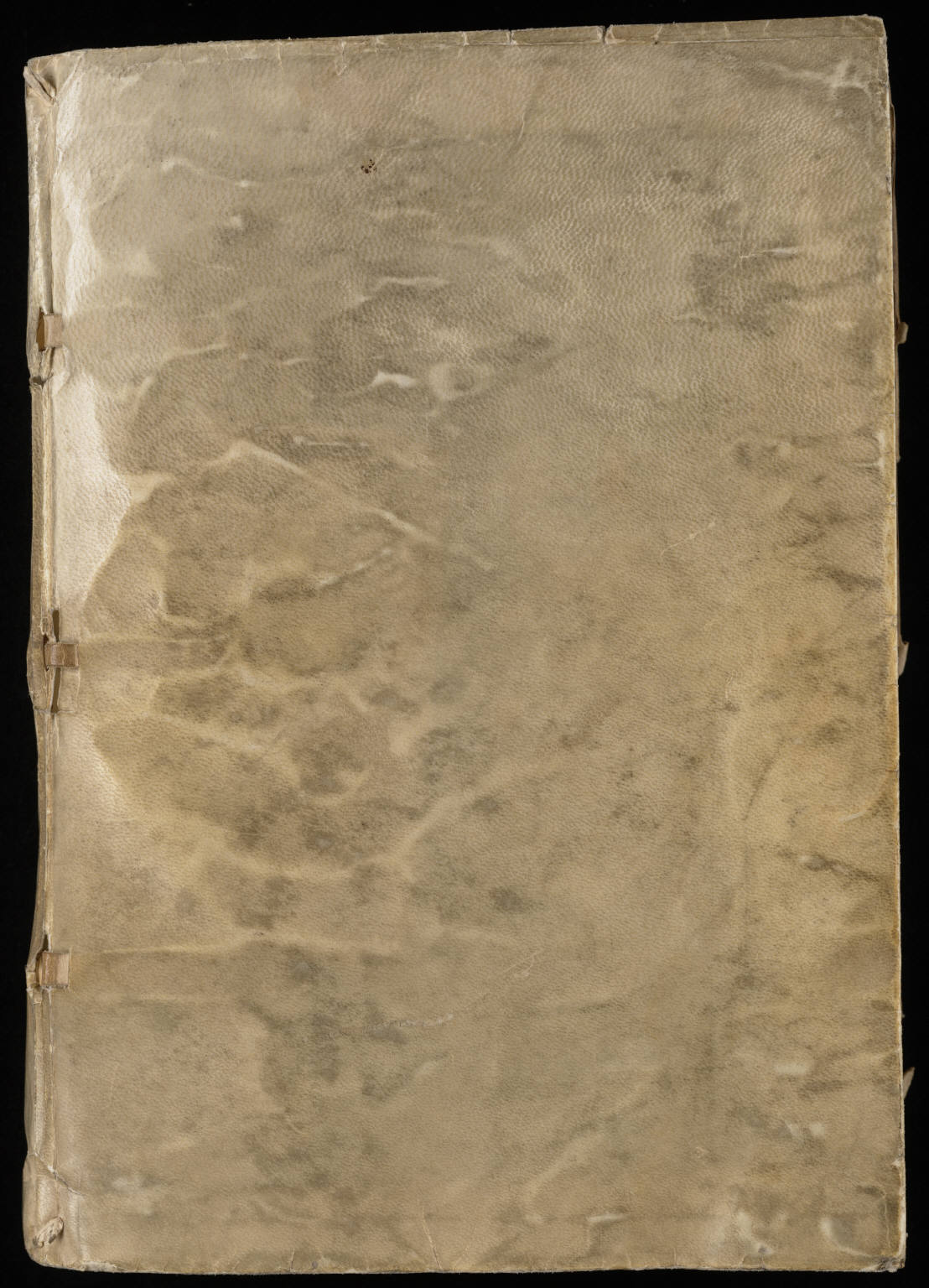
The Bodleian copy was identified in 1905 by a different class of evidence entirely: the tooling of its Oxford binding, attributed by Strickland Gibson to William Wildgoose, a binder the library is documented as having used in the 1620s, together with the physical scar left by a chaining staple. No text was consulted. The book was recognised by its cover and by the mark of the chain that had held it to a shelf.
The most rigorous demonstration on record is the Durham identification. When a mutilated Folio was carried into the Folger in June 2008 with its binding, title page and preliminary leaves cut away specifically to remove identifying marks, Anthony James West set the volume against his own pre-theft examination of Durham's copy using twelve tests of identity, grouped as tests of necessity, borderline tests and tests of sufficiency, and published the exercise in The Library in 2013. The clinching evidence was a contemporary manuscript addition of the title Troilus and Cressida on the printed catalogue leaf, and a pattern of wormholes across thirteen leaves. Every test matched, and the defence conceded the point at Newcastle Crown Court in 2010 without contesting it. Iconotheca's record on that copy carries the case in full.
The general principle is worth stating for anyone buying: in this field the provenance evidence is in the paper, and a copy that has been cleaned, washed, re-margined and rebound has had its identity documents removed along with its defects.
Three First Folios were stolen from institutions in the twentieth century and two of the three came back.The Chapin Library at Williams College in Massachusetts lost its copy on 8 February 1940 to a...
Three First Folios were stolen from institutions in the twentieth century and two of the three came back.
The Chapin Library at Williams College in Massachusetts lost its copy on 8 February 1940 to a planned substitution: a man presenting himself as Professor Sinclair E. Gillingham, using a forged letter of introduction, was given the book to consult and exchanged it for a fake during the session. Four men were convicted under the National Stolen Property Act after one of them confessed while drunk; William John Kwiatkowski, named as the leader, received two years. The volume was returned undamaged on 21 October 1940.
The University of Manchester copy went during the night of 12 to 13 July 1972. The thief is believed to have entered the library with a key and smashed the plate glass top of the exhibition case with considerable violence. Descriptions were circulated to the Antiquarian Booksellers' Association and to libraries in the United States, Germany, France, Belgium and Switzerland, and ports were watched. Nothing was recovered and no arrest has been reported. The copy had been given in 1898 by the Manchester businessman Edward Donner, who bought it from Bernard Quaritch for five hundred pounds; it remains missing more than fifty years on, and its loss is one reason the current census figures carry a category for copies that are known but untraceable.
The Durham University copy was taken from a display cabinet in Bishop Cosin's Library in December 1998, along with two medieval manuscripts and four other printed books, and resurfaced in Washington in 2008. Raymond Scott was acquitted of the theft itself and convicted of handling stolen goods and of removing stolen property from the United Kingdom; he was sentenced to eight years and died in prison in 2012. Nobody has ever been charged with the 1998 break-in. The full account is in this archive's record on that copy and is not repeated here.
Against three institutional thefts sit roughly five hundred copies that simply ceased to exist, by fire, damp, neglect, shipwreck, and by being broken up for leaves to perfect other copies. The Folio survives at a rate of about one copy in three, and the attrition was not dramatic. It was mostly ordinary.
Because a First Folio was an expensive book that people nevertheless used, individual copies preserve seventeenth-century reading and performance in a way no modern edition can.
Because a First Folio was an expensive book that people nevertheless used, individual copies preserve seventeenth-century reading and performance in a way no modern edition can. Emma Smith's Shakespeare's First Folio: Four Centuries of an Iconic Book, published by Oxford University Press in 2016, made this the organising argument of the subject, working from the marks copies carry rather than from the circumstances of production.
The copy in the University Library at Padua, shelfmarked Rari N.S.1 and recorded in the library's holdings since about 1840, is annotated as a working promptbook: characters' and actors' names, often as initials, stage directions for entrances, exits and music, and vertical rules marking cuts, with the cuts consistently favouring dramatic action over poetry. G. Blakemore Evans, who published on it in 1960, dated the theatrical use to between 1625 and 1635; later evidence has pushed the estimate towards 1640 or after. It is the only First Folio in Italy and the earliest known to have been used by an acting company. Its route to Padua is undocumented.
One of the twelve copies in the Kodama Memorial Library at Meisei University in Tokyo, the second largest holding in the world after the Folger, is annotated in a neat seventeenth-century secretary hand from the first page of The Tempest to the last page of the volume. Akihiro Yamada transcribed the whole of it in 1998 and the transcript has since been published digitally alongside the images.
The copy at the Free Library of Philadelphia, given by the Widener family in 1944, is annotated by a reader who compared the Folio text against quartos and supplied what the Folio lacked, including the prologue to Romeo and Juliet. Claire M. L. Bourne dated and described the hand; Jason Scott-Warren of Cambridge, reading her article in September 2019, recognised it as John Milton's, and the identification was supported by comparison with Milton's manuscript drafts and his corrections in other books. Milton changed the form of his letter e after returning from Italy in 1639, which allows some of the annotations to be dated before that year and some after. It was the first vernacular book identified from Milton's library, of which only nine titles had previously been known.
The copy found in November 2014 at Saint-Omer in northern France had sat unrecognised for two centuries in a collection that began as the library of the English College founded there in 1594, a Jesuit institution educating English Catholic boys with a strong tradition of staging plays. Where a copy went, and who read it, is frequently the more interesting half of its history.
The First Folio sold new for fifteen shillings unbound, or about one pound bound in calf.
The First Folio sold new for fifteen shillings unbound, or about one pound bound in calf. What that meant in 1623 is disputed in a way worth recording rather than smoothing: Christie's, quoted by the Antiques Trade Gazette in 2020, put a bound copy at roughly three months' wages for a skilled tradesman; Jean-Christophe Mayer, cited in general reference, puts it at almost two months' wages for an ordinary skilled worker; Chris Laoutaris notes that skilled artisans earned four to five pounds a year, which would make a bound copy something between two and three months' earnings. The first recorded purchase is the antiquary Edward Dering's account-book entry of 5 December 1623 for two copies at two pounds the pair. The edition sold through within about a decade, which for a book at that price was quick, and a Second Folio followed in 1632.
The trajectory afterwards is documented in the Christie's catalogue figures reported by the Antiques Trade Gazette. First Folios changed hands in the 1790s at an average of about thirty pounds; the average rose to about sixty pounds in the first half of the nineteenth century and about two hundred and ninety pounds in the second. Edward Donner paid Quaritch five hundred pounds for the Manchester copy in 1898. In January 1903 Henry Folger, chasing the copy that William Jaggard had given to Augustine Vincent in 1623 and that still carries a fragment of its original binding with Vincent's blind-stamped badge, told his agent A. B. Railton to buy without fail even at ten thousand cash. Ten thousand pounds, roughly forty-eight thousand seven hundred dollars, is what he paid Coningsby Charles Sibthorp, and Emily Folger later called it the keystone of the library.
Modern results are thin because the supply is thin, and the pattern is the opposite of an art market: the pool shrinks permanently as copies enter institutions. Only about twenty-seven copies remain in private hands and only five or six of those are complete. Complete copies reach the open market roughly once a generation. The Berland copy, known as the Canons Ashby copy in an early panelled calf binding of about 1690 to 1730, made 6,166,000 dollars at Christie's New York on 9 October 2001 and went to Paul G. Allen; the Antiques Trade Gazette states that figure as including premium, while other accounts report it as a hammer price, and this record does not resolve the conflict. Oriel College, Oxford, sold its copy privately in a deal brokered by Maggs Brothers, reported at about 3.5 million pounds, to Sir Paul Getty in 2003. Dr Williams's Library sold its copy at Sotheby's London on 13 July 2006 at a hammer price of 2.5 million pounds, 2,808,000 pounds with premium, to Simon Finch Rare Books. The previously unrecorded Shuckburgh copy made 1.87 million pounds hammer, about 2.7 million dollars with premium, at Christie's London on 25 May 2016.
The record is the Mills College copy, sold at Christie's New York on 14 October 2020 in the Exceptional Sale, estimated at four to six million dollars, knocked down after a six-minute contest between three telephone bidders to the New York dealer Stephan Loewentheil at a hammer price of 8.4 million dollars, 9,978,000 dollars with buyer's premium. It is the highest price paid at auction for any work of literature, though not for any printed book: the Bay Psalm Book made a hammer price of 12.5 million dollars at Sotheby's New York in November 2013, 14.165 million dollars with buyer's premium, the figure widely reported at the time as 14.2 million dollars. Mills College, an undergraduate women's college in Oakland founded in 1852, was selling to address a budget crisis; the copy had come to the United States in 1961 when Bernard Quaritch sold it to the Washington investor Allan I. Bluestein, and its first recorded owner was John Fuller, the landowner, member of parliament and patron of Turner, who showed it to Edmond Malone in 1809 and whose lot included Malone's autograph letter attesting to its cleanness.
What moved the price and what held it back are both on the record, which is unusual and useful. The Mills copy was complete and original, bound in blind-stamped russia about 1810, apparently by Thomas Gosden. Against it, the first leaf carrying Jonson's verse was inlaid, a few letters on the title and part of the portrait had been restored, the last leaf was re-margined, and the book stood fifteen millimetres shorter than the Allen copy because it had been trimmed close at the head, often cutting into the upper box rules. Those defects, on a complete copy in a strong market, were enough to keep it under ten million dollars.
Two later data points close the picture. On 21 July 2022 Sotheby's New York sold a copy with early Scottish provenance, acquired by the Gordon family in the early seventeenth century and heavily marked by them with names, doodles and ink spills across more than thirty pages in at least five hands, against an estimate of 1.5 to 2.5 million dollars; the price is reported as 2.4 million dollars by the BBC and 2.47 million dollars elsewhere, and the sources consulted do not separate hammer from premium. And in May 2025 Sotheby's London withdrew a complete set of all four folios, estimated at 3.5 to 4.5 million pounds and assembled in 2016 around the Shuckburgh First Folio, because the consignor accepted a private offer before the sale. The First Folio market's defining feature is that its best material increasingly does not reach the rostrum at all.
The Folio fixed a list of thirty-six plays, and everything since has been argument about the edges of it.
The Folio fixed a list of thirty-six plays, and everything since has been argument about the edges of it. The editorial line runs from Nicholas Rowe's seven-volume edition of 1709-10, which worked from the Fourth Folio and added stage directions and character lists, through Alexander Pope in 1725, Lewis Theobald in 1733, who began serious collation of the quartos, Samuel Johnson in 1765, Edward Capell in 1768, who spent decades collating quartos against the Stationers' Register, and Edmond Malone in 1778, generally reckoned the best of them. Isaac Reed's First Variorum of 1803 ran to twenty-one volumes. The Cambridge Shakespeare of 1863-66 and the Globe edition of 1864 produced the text that most later editions inherited.
The boundary has moved outward since. Pericles and The Two Noble Kinsmen, both absent from the First Folio, are now standard. Edward III entered the mainstream when Yale University Press published it under Shakespeare's name in 1996. Sir Thomas More appears in the second edition of the Complete Oxford Shakespeare in 2005, credited to Shakespeare and others. The seven plays added by the 1664 issue of the Third Folio went the other way: only Pericles survived the sifting, and the rest, The London Prodigal, Thomas Lord Cromwell, A Yorkshire Tragedy and their companions, remain apocryphal.
There is no authentication board for Shakespeare and no committee that certifies an attribution. The de facto authority is whichever scholarly edition a court, a dealer or a university accepts, and the most consequential recent ruling came from Oxford University Press. The New Oxford Shakespeare, published from 2016 under general editors including Gary Taylor and drawing on twenty-three scholars using both conventional textual analysis and computational stylometry, credits co-authors on seventeen of forty-four plays, against eight of thirty-nine in the 1986 Oxford edition, and puts Christopher Marlowe's name alongside Shakespeare's on the title pages of all three parts of Henry VI. Taylor's stated position is that Marlowe's presence in those plays can be verified strongly and clearly enough, and that rivals sometimes collaborate. The dissent was immediate and is on the record: Carol Rutter, professor of Shakespeare and performance studies at Warwick, told the BBC that a publisher's brand mark on an attribution does not settle the issue for most people, and that while she believes Shakespeare collaborated widely she would be very surprised if Marlowe was one of the collaborators. A page that reports the new attribution without the dissent is reporting a press release.
The Folio has been used, more or less continuously since the eighteenth century, as an instrument of cultural authority, and the uses are documentable.Its nineteenth-century transfer to the United...
The Folio has been used, more or less continuously since the eighteenth century, as an instrument of cultural authority, and the uses are documentable.
Its nineteenth-century transfer to the United States is the clearest case. Henry Clay Folger, chairman of Standard Oil, began buying in 1903 and assembled eighty-two copies, more than a third of every surviving example, in a library he built two blocks from the Capitol in Washington. The Bodleian's public subscription of 1906 to buy back its own former copy was mounted explicitly against him. The result is that the largest concentration of the founding document of English literature sits in the American capital, and that the nine largest collections between them hold more than half of everything that survives.
The Folger then spent that capital in kind. In 2016, for the four hundredth anniversary of Shakespeare's death, it sent eighteen of its copies on tour with the Cincinnati Museum Center and the American Library Association, reaching all fifty states, the District of Columbia and Puerto Rico, opening at the Sam Noble Museum in Oklahoma on 4 January 2016 and closing at the Parthenon in Nashville on 8 January 2017, hosted by twenty-three museums, twenty universities, five public libraries, three historical societies and a theatre. Every copy was displayed open at the same page, Hamlet's to be or not to be. The Folger's tour archive keeps the ephemera, down to a parasol from a jazz funeral held for Shakespeare in New Orleans.
That is what a monument is for. Jonson said in 1623 that the book was a monument without a tomb, and the claim, made inside a commercial preface by a man defending an expensive format, has turned out to be an accurate description of the object's function rather than a compliment to its author. The plays were saved by four stationers protecting an investment, a blind printer's son, an apprentice who could not read manuscript, and two actors settling a debt to a dead colleague worth twenty-six shillings and eight pence.
Playwright; Poet; Actor; Sharer in the Lord Chamberlain's Men and the King's Men; Theatre shareholder. 1564-1616.
Born Baptised 26 April 1564; the birth date is not recorded, Stratford-upon-Avon, Warwickshire, England; died 23 April 1616, Stratford-upon-Avon, Warwickshire, England.
Pen facsimile leaves by John Harris the younger (1791-1873). Harris worked for the British Museum from 1820, engaged by Antonio Panizzi to perfect defective early printed books, and supplied hand-drawn imitations of early type so exact that they are hard to distinguish from printing. He worked on numerous First Folios, and his leaves remain in circulation inside copies now held by institutions and private owners.
Folger Shakespeare Library (Washington, DC); Kodama Memorial Library, Meisei University (Tokyo); Bodleian Library, University of Oxford (Oxford); Durham University Library, Palace Green (Durham); Free Library of Philadelphia (Philadelphia); Biblioteca Universitaria di Padova (Padua).
The First Folio market is defined by a supply that only shrinks. About 235 copies are known, roughly 27 are in private hands, and only five or six of those are complete.
Where is the University of Manchester copy, Lee census LXIII, taken during the night of 12 to 13 July 1972? It is described in Lee's 1902 census in enough detail to be unmistakable, including a last page misnumbered 993 for 339 and twelve and a half buttons on the Droeshout jerkin, and it has never surfaced.
Ten objects in this archive were bought, or fought for, by public subscription between 1892 and 2025.
10 min read
Eight records in this archive carry a museum or a state as the seller. The Bodleian sold its First Folio as a duplicate and paid...
11 min read
Twelve records here sit in a museum that carries a collector's name. In none of them is the museum the owner.
11 min read
16 of the 18 manuscripts and printed books in this archive wear a binding a later owner paid for.
10 min read
Last verified
One artwork and its story every Tuesday, with the picture: who owned it, what it made, and what closes soon in the exhibition calendar. No promotion, and nothing we cannot cite.
We send one email to confirm the address and keep nothing else. Every letter carries a one-click unsubscribe. How we handle your data.