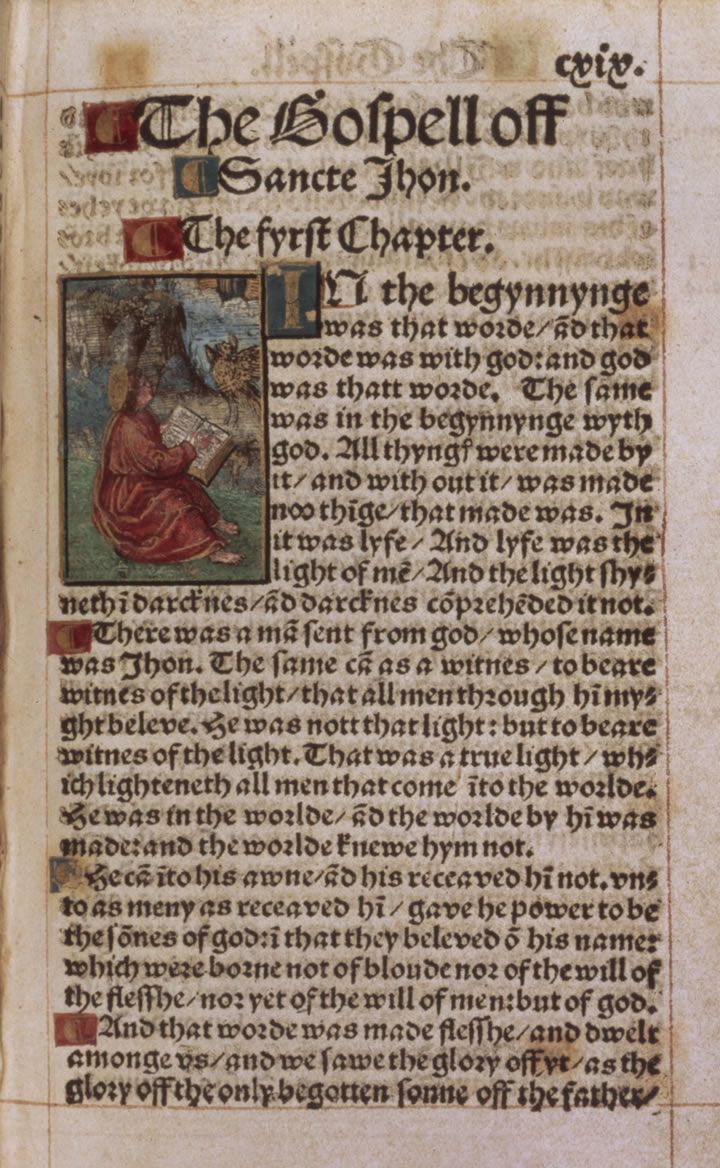
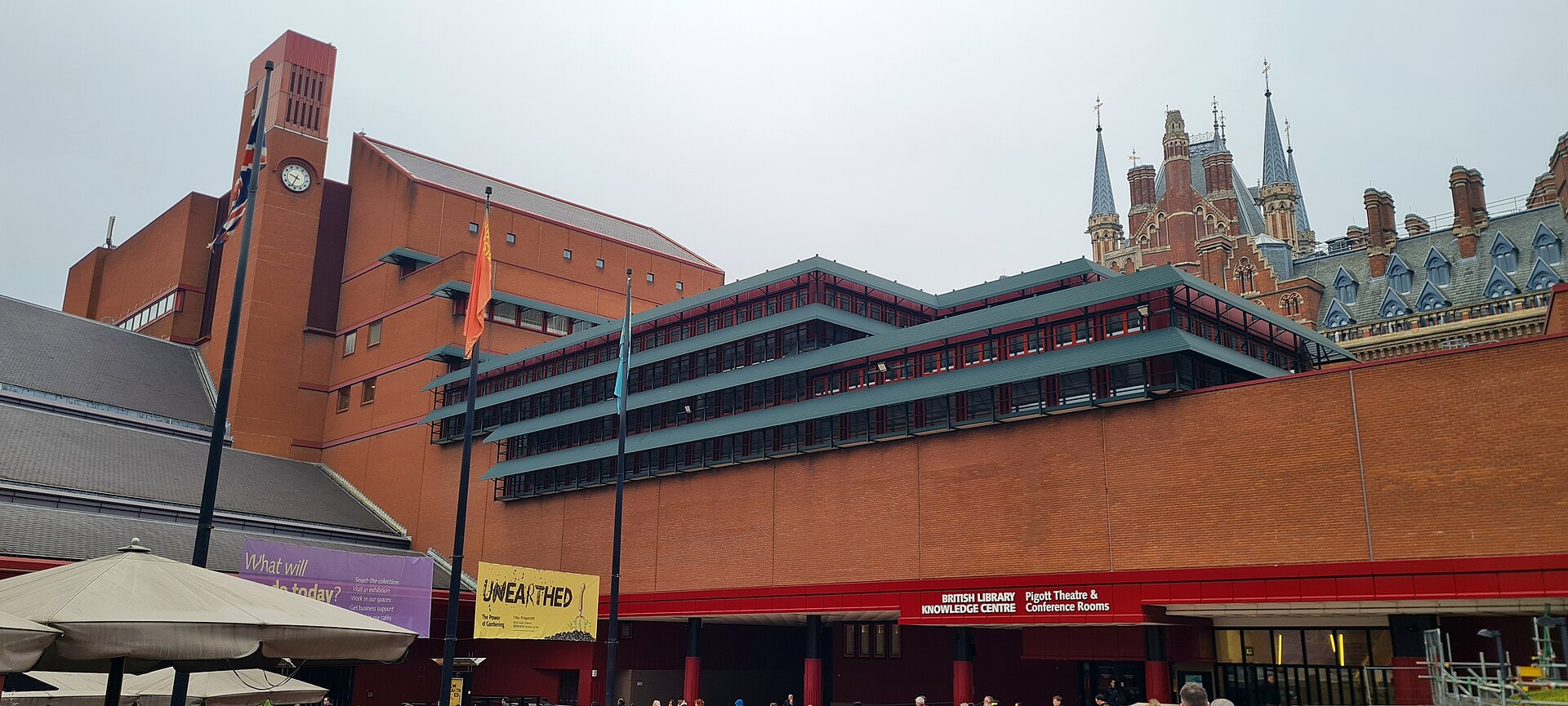
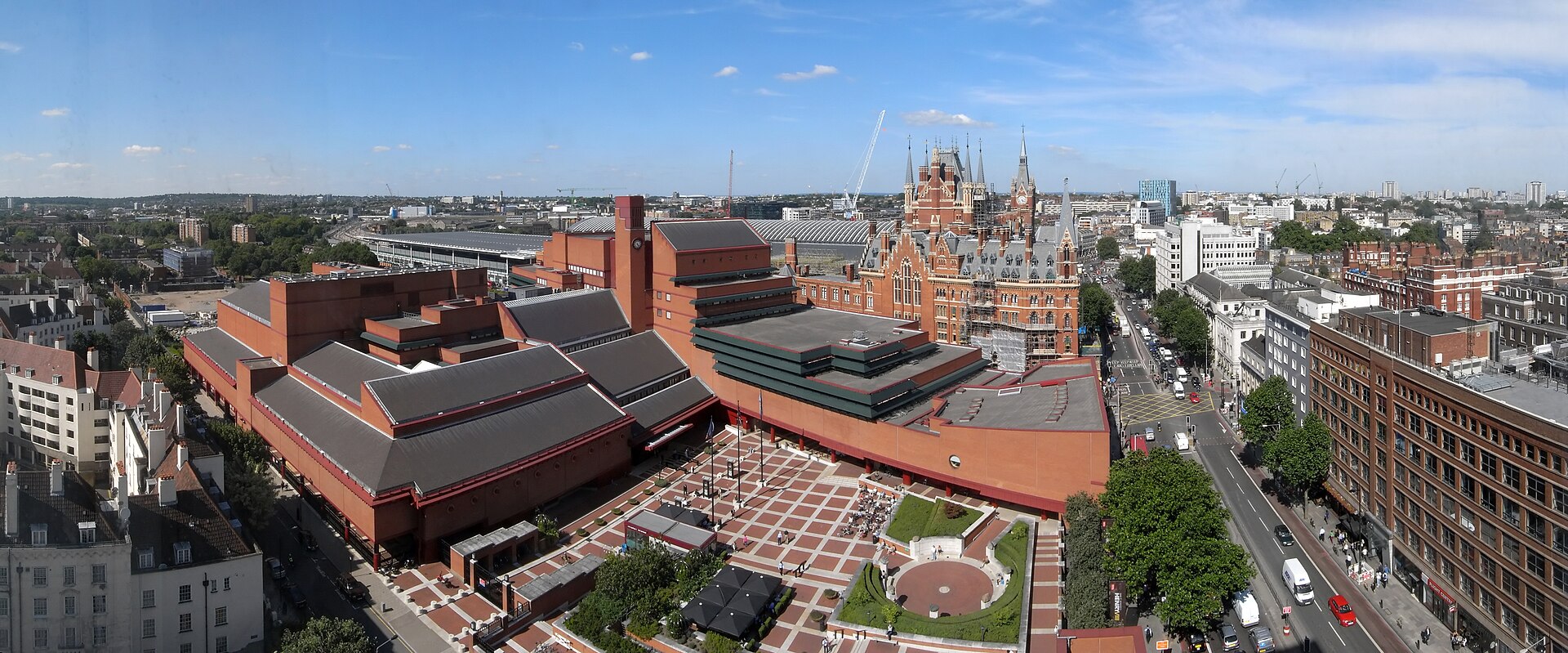
On this page 19 sectionsContentsCloseAn aerial view of Colin St John Wilson's red-brick St Pancras building, its stepped roofline and clock tower in the foreground, with the spires of St Pancras station immediately behind it. Photograph by Patche99z, CC BY-SA 3.0.Photograph by Patche99z · CC BY-SA 3.0
Over 170 million items in almost every language and script, built on legal deposit rather than acquisition: since 1662 in English law, and since 1973 as one of six legal deposit libraries of the UK and Ireland, the Library has been entitled to a copy of everything published in Britain and Ireland, extended to electronic publications from 2013. That scale is why about 70 per cent of the physical collection sits at the Boston Spa site in West Yorkshire rather than in London, and why the London basements run to 24 metres below ground. The strength is breadth rather than a single school or period: manuscripts, printed books, patents, newspapers, maps, sound recordings and now web archives, sitting alongside named treasures such as two of the four surviving 1215 Magna Cartas and a complete vellum Gutenberg Bible.
British Library at a glance
Kind
Library
Founded
1 July 1973, by the British Library Act 1972 (Royal Assent 27 July 1972); the St Pancras building opened to readers in November 1997
City and country
London, United Kingdom
Address
British Library, 96 Euston Road, London NW1 2DB, United Kingdom
What it costs and when it is openConfirmed 30 August 2026
Hours
Monday to Thursday09:30 to 20:00Library building, St Pancras
Friday09:30 to 18:00Library building, St Pancras
Saturday09:30 to 17:00Library building, St Pancras
Sunday11:00 to 17:00Library building, St Pancras
Monday10:00 to 20:00Reading Rooms
Tuesday to Thursday09:30 to 20:00Reading Rooms
Friday to Saturday09:30 to 17:00Reading Rooms; Maps, Manuscripts and Asian and African Studies Reading Rooms close at 17:00 Monday to Saturday, earlier than the others
Monday to Friday09:00 to 16:30Boston Spa, West Yorkshire site: Reading Room
Closed
St Pancras Reading Rooms are closed on Sunday. Boston Spa Reading Room is closed Saturday and Sunday. Maps, Manuscripts and Asian and African Studies Reading Rooms close at 17:00 Monday to Saturday, an hour or more before the other Reading Rooms. The Library's own amended-hours notice, read 7 August 2026, states the St Pancras site will close for essential maintenance on Saturday 26 and Sunday 27 September.
Admission
Permanent collection, Entrance Hall, Members' Room and Treasures GalleryFreeFree, every day the Library is open. A free Reader Pass is needed only to use the Reading Rooms and order collection items, not to visit the public spaces or the Treasures Gallery.
Sound Gallery, Philatelic Gallery, Treasures of the British LibraryFreeAll current on-site galleries and displays are free, open during regular building hours. The paid family exhibition 'Fairy Tales', which ran 27 March-23 August 2026 and was recorded here at the previous confirmation, has since closed; no paid ticketed exhibition is currently running.
American Revolution: 250 Years from the Declaration of IndependenceFreeFree display in the Treasures Gallery, 29 June 2026-17 January 2027.
Free entry: The permanent collection, the Entrance Hall, the Members' Room and the Sir John Ritblat Treasures Gallery are free every day, with no ticket required. Special family and touring exhibitions, such as Fairy Tales, are ticketed separately and are the exception rather than the rule
No booking is needed for the free public spaces or the Treasures Gallery. A free Reader Pass is required to use the Reading Rooms or order collection items, and ticketed exhibitions such as Fairy Tales are booked separately.
Address
British Library, 96 Euston Road, London NW1 2DB, United Kingdom Map
On foot On Euston Road in Camden, between the Euston and King's Cross St Pancras areas of the borough Cycle parking On the upper level of the Piazza, adjacent to Ossulston Street Step-free entrance The Ossulston Street entrance is fully ramped and about 100 metres from the main Euston Road entrance, with Blue Badge parking bays on Ossulston Street
Before you go how long, access, photography, bags, eating, shop
How long to allow
The Library does not publish a suggested visit length for its free spaces. Its own page for the family exhibition Fairy Tales tells visitors that most families take around an hour to explore it.
Access
Manual wheelchairs can be borrowed free of charge subject to availability, though staff cannot assist in using them. Hearing induction loops are installed at Reading Room enquiry desks, the main Information Desk, the Knowledge Centre meeting rooms and the Piggott Theatre. Accessible Reading Rooms are on Floors 1, 2 and 3. The Ossulston Street entrance is fully ramped; the nearest Changing Places toilet is at King's Cross station.
Photography
Not addressed on the Library's own visit page. Unlike many museums, it publishes no general photography policy for its public spaces.
Bags
Luggage larger than 56 by 45 by 25 cm is refused, though this does not apply to pushchairs, foldaway bicycles, umbrellas or walking sticks. E-scooters, e-bicycles, e-unicycles and their batteries are not permitted. Reading Room visitors must leave coats and bags in a cloakroom or locker.
Eating
Upper Ground Floor Cafe, the King's Library Cafe and the Terrace Cafe on the First Floor, and three Origin Coffee outlets (Euston Road, Entrance Hall and Piazza Steps, the last closed over winter), each keeping its own hours.
Shop
Shop and Bookshop in the Entrance Hall, plus an online shop.
Prices and hours change. We take them from the institution's own pages and print the day we read them, and you can check the current position at the source we used. Confirm before you travel.
What is inside
5 spaces, 3 photographed
Photograph by PaliGol · CC BY-SA 4.0
The Piazza
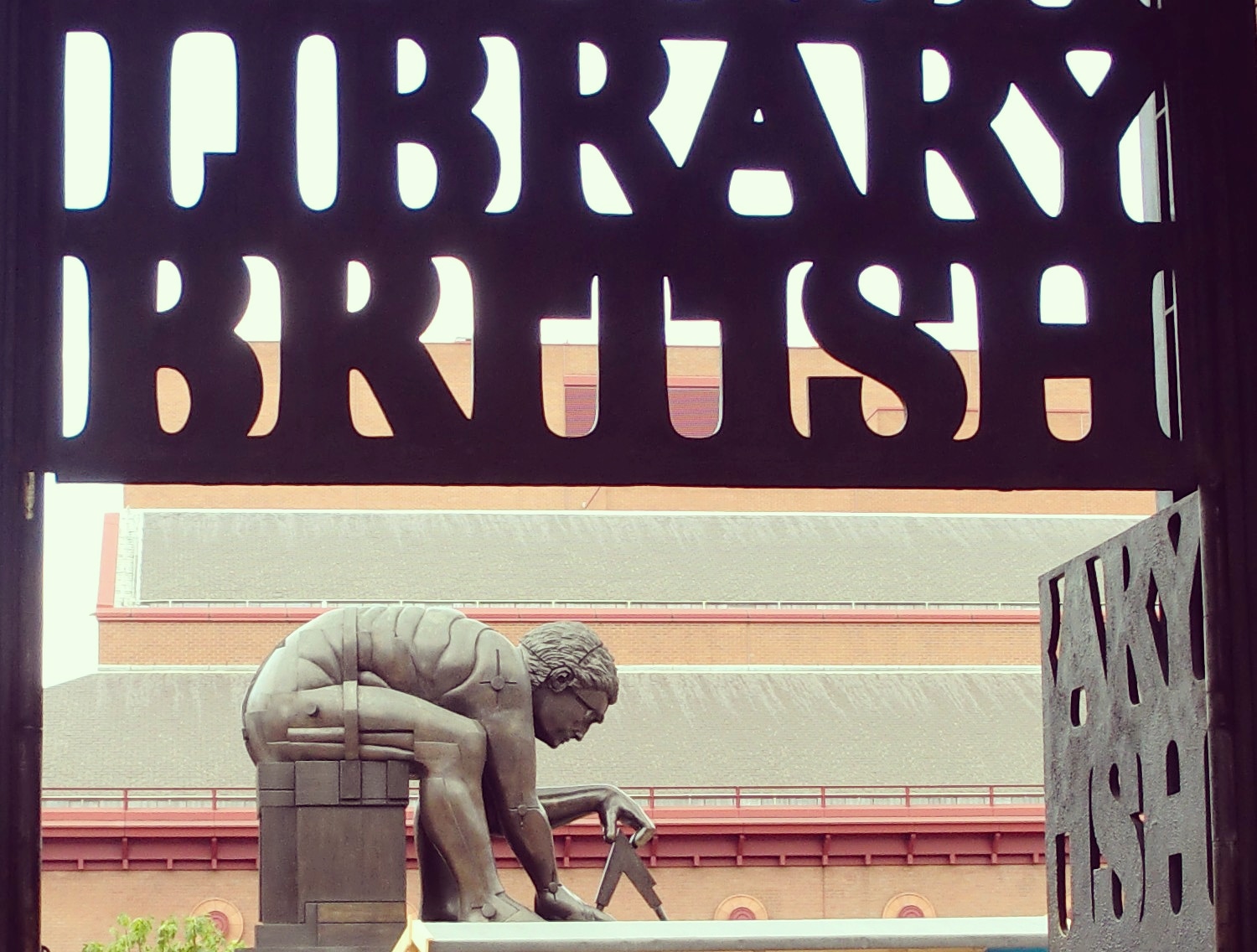
The public square in front of the building, reached past Ossulston Street, holding two works of public sculpture: Eduardo Paolozzi's 1995 bronze Newton, after William Blake's 1795 print of the scientist stooped over a pair of dividers, and Antony Gormley's 2002 installation Planets, eight inscribed stones set into the paving, along with a second Gormley piece called Chair. The Piazza's limestone paving carries visible fossils, and it also holds The Last Word community hub and cycle parking.
Photograph by Txllxt TxllxT · CC BY-SA 4.0
The Entrance Hall
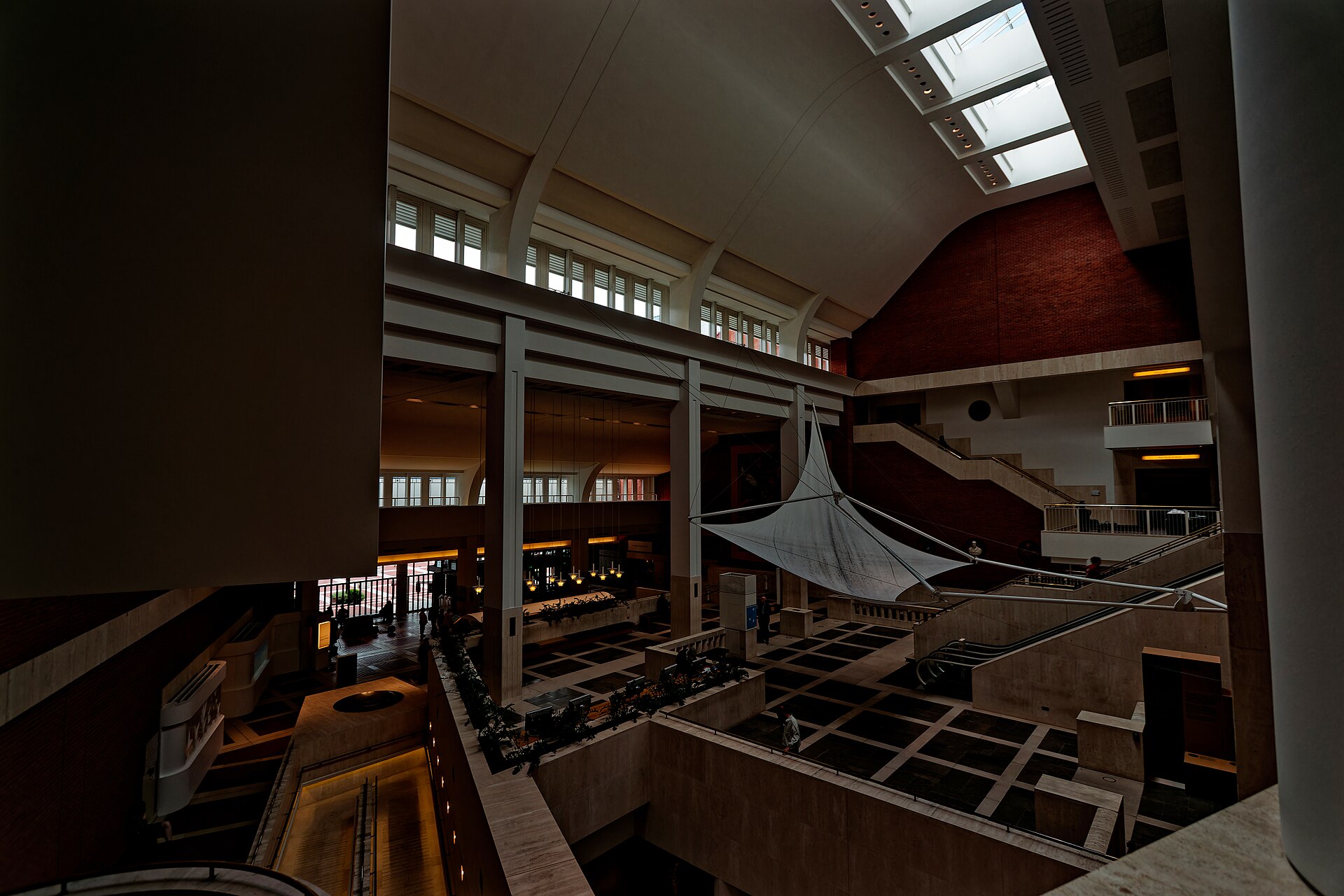
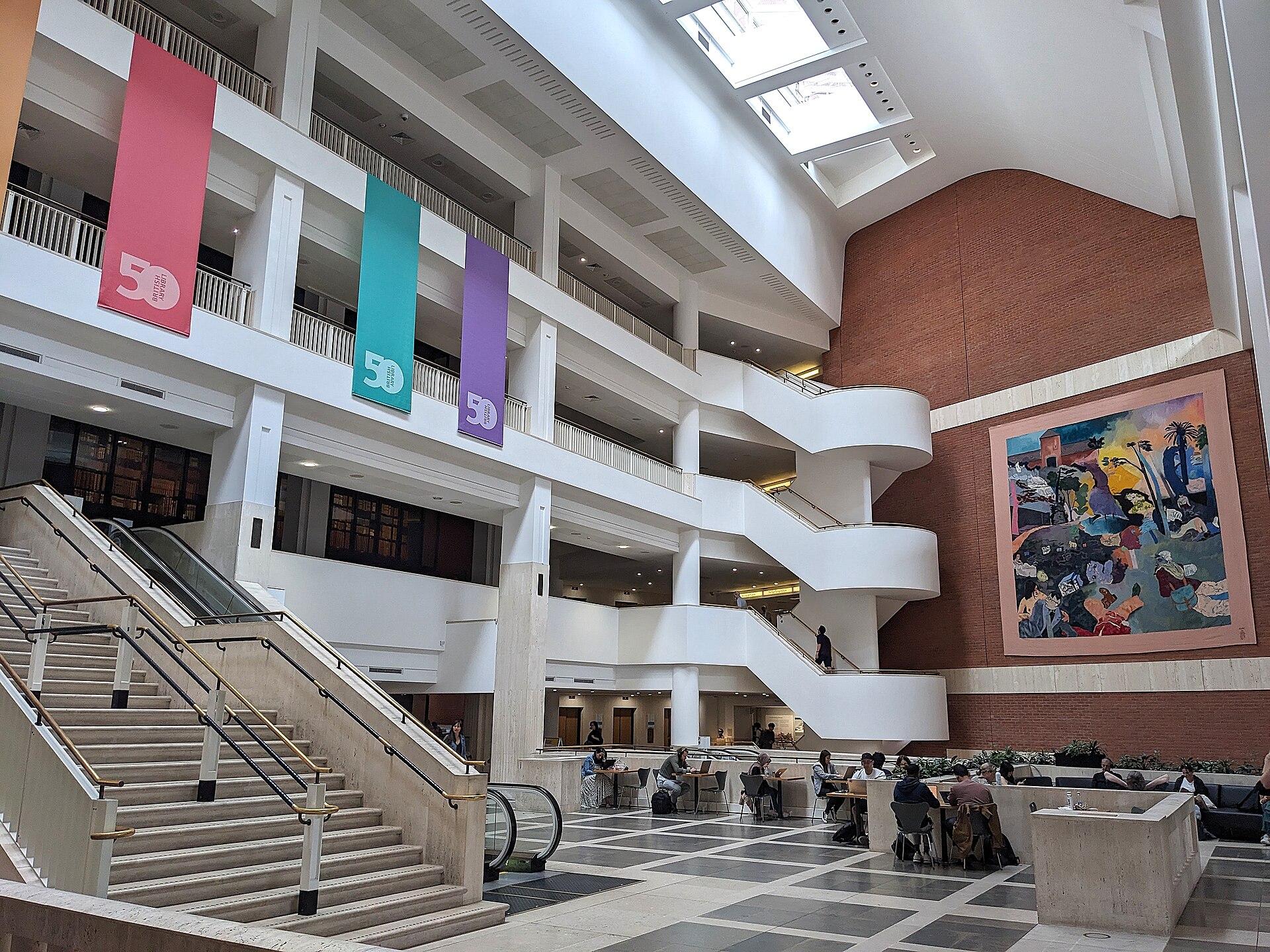
The vaulted foyer inside the main Euston Road entrance, with escalators and staircases rising past the brick chimney breast of the building's interior toward the upper floors. Two empty plinths near the escalators mark where the original ticket turnstiles once stood, from the years when most of the building was open only to Reader Pass holders. The Members' Room and an Origin Coffee kiosk open off this level.
Photograph by Mike Peel · CC BY-SA 4.0
The King's Library Tower and the Reading Rooms
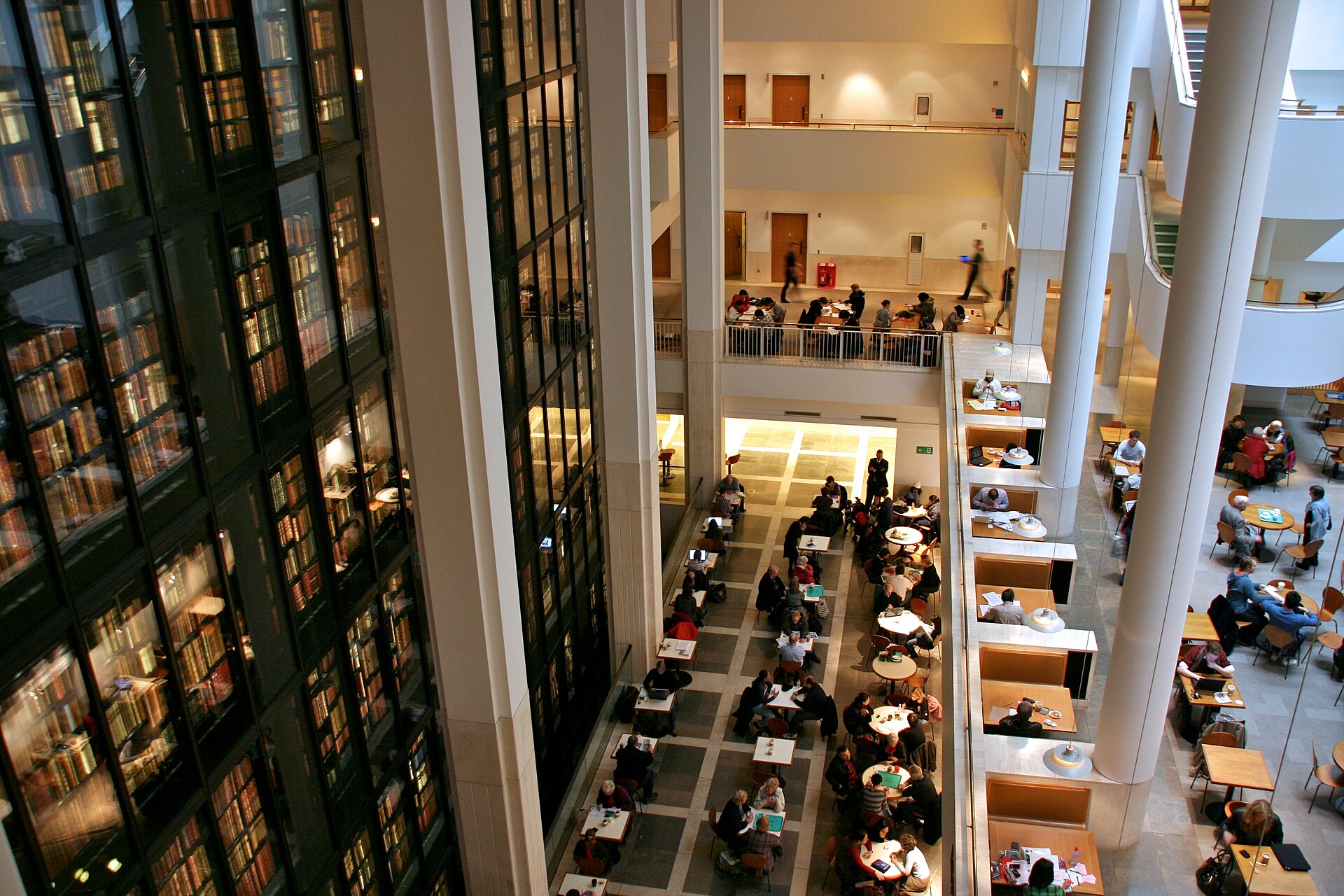
A six-storey glazed tower at the centre of the building, holding the roughly 65,000-volume library George III collected between his accession in 1760 and his death in 1820. His son George IV gave the collection to the nation on condition it be displayed entire and separate from the rest of the Library, a condition the tower still satisfies: it is visible from several floors, with readers working at tables in the surrounding Reading Room in its light.
The Sir John Ritblat Treasures Gallery
The Library's free permanent gallery, named for the property developer Sir John Ritblat, who gave 1 million pounds toward its display cases during construction. It is kept cooler and darker than the rest of the building to protect items that fade or are damaged by light, and holds more than 200 items at any one time, with the exact selection rotating for conservation reasons and occasional loan. Checked live on 7 August 2026, its own current listing named Beowulf, Magna Carta, and works by Shakespeare, Andrea Levy and Monty Python; the Diamond Sutra, held by this archive, was not among them. No free-licence photograph of this gallery as a space was located, so none is shown; the controlled lighting that protects the objects also makes it a difficult room to photograph.
The basements
Five levels of storage beneath the public building, reaching 24 metres below ground, as deep as the Victoria line that runs alongside them. They hold the majority of the London site's physical collection on more than 40 different types of shelving, a salvage recovery area the Library calls a book hospital for assessing damaged items, backup ice-based cooling for the strongrooms, and strongrooms that extinguish fire with the inert gas Inergen rather than water. The basements are not open to visitors and no free-licence photograph of them was located.
What to see first
The King's Library
Assembled by King George III, 1760 to 1820
The Library's own architectural centrepiece: a glazed tower holding the roughly 65,000 volumes George III collected, kept together and on public view under the condition George IV attached when he gave the collection to the nation.6
The Diamond Sutra
China, printed 11 May 868
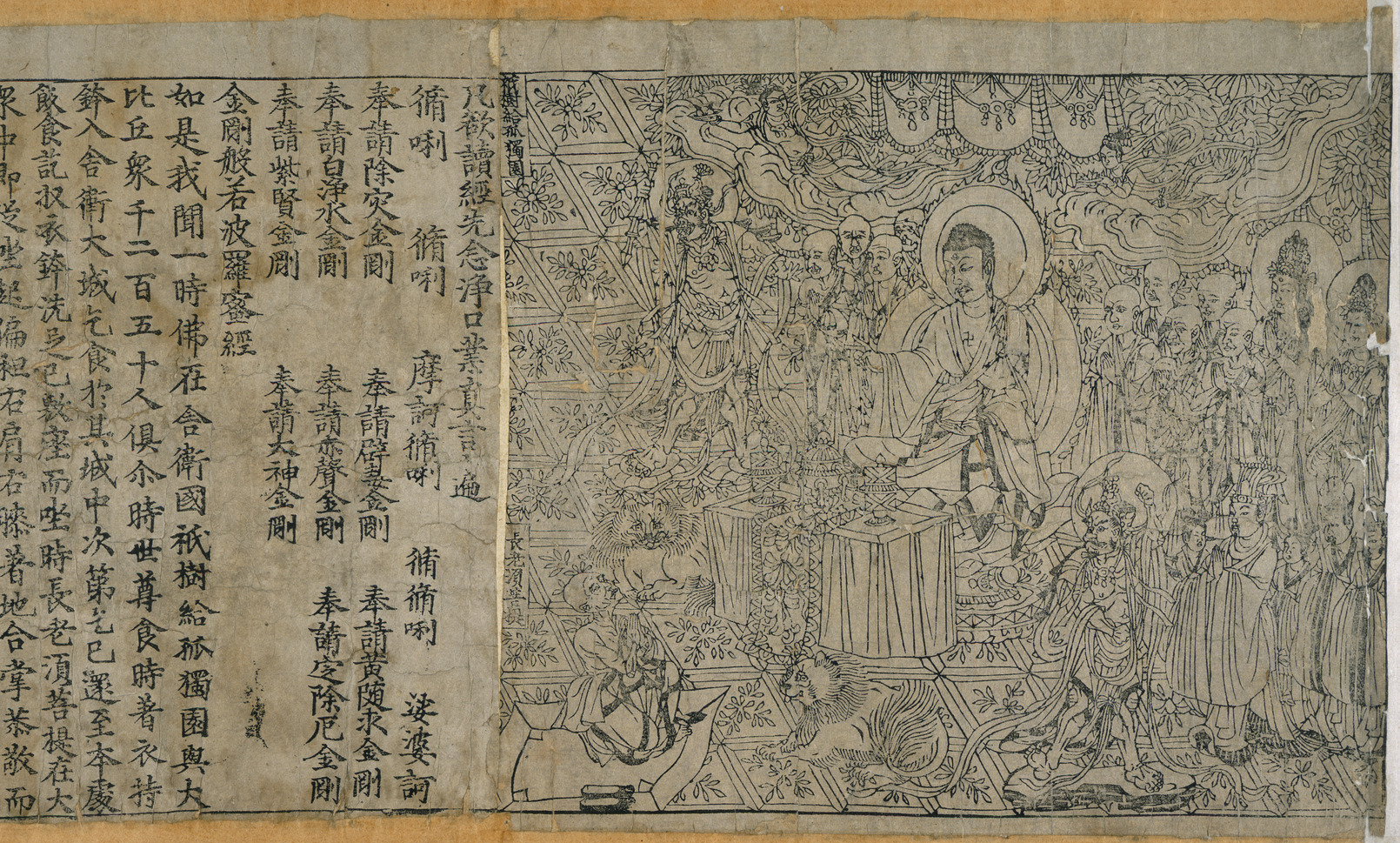
The world's earliest dated printed book, collected at Dunhuang by Aurel Stein in 1907 and now held by this archive's own record. It was shown in the ticketed exhibition A Silk Road Oasis, 27 September 2024 to 23 February 2025, but was not part of the Treasures Gallery's own current listing when checked live on 7 August 2026 - a reader hoping to see it should confirm with the Library before travelling.11
The Library holds two of only four surviving originals from 1215; the other two are at Lincoln and Salisbury Cathedrals. Displayed in the Treasures Gallery's own Magna Carta room.21
The Codex Sinaiticus
Greek Bible, 4th century AD
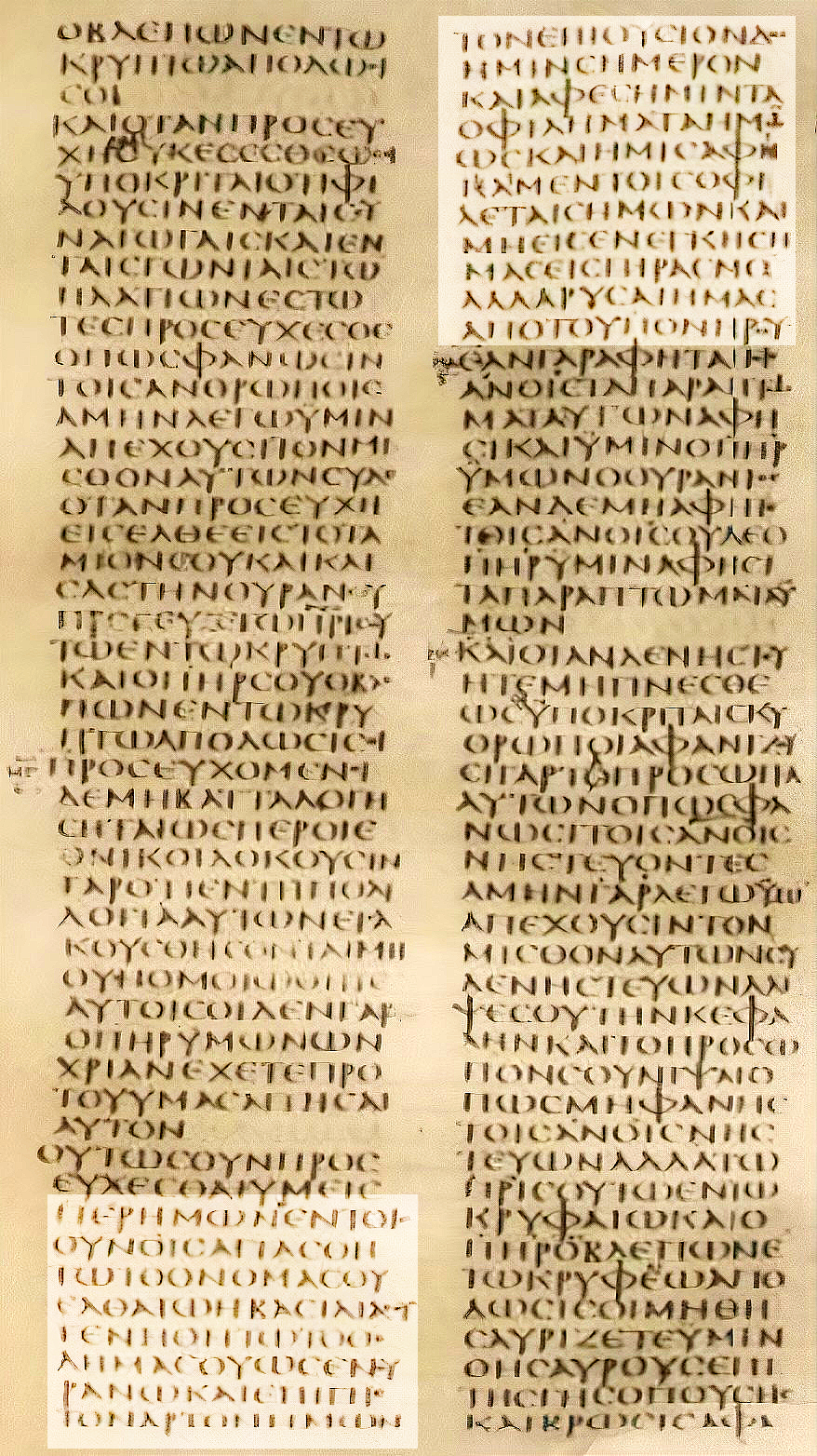
Removed from St Catherine's Monastery on Sinai by Constantin von Tischendorf in 1859 on a promise to return it, then retained, sold by the Soviet government through London booksellers in 1933 and bought by the British Museum for 100,000 pounds. The monastery still disputes the Library's title; a 2005 agreement between the Library, the monastery and two other holding libraries set the ownership question aside to digitise the manuscript jointly rather than resolving it.19
The Beowulf manuscript
England, copied in the decade or so after AD 1000
The sole surviving copy of the Old English epic, known as the Nowell Codex after a 16th-century owner, badly scorched in the 1731 Ashburnham House fire that also damaged much of the Cotton library on which the Library's manuscript collections are founded.23
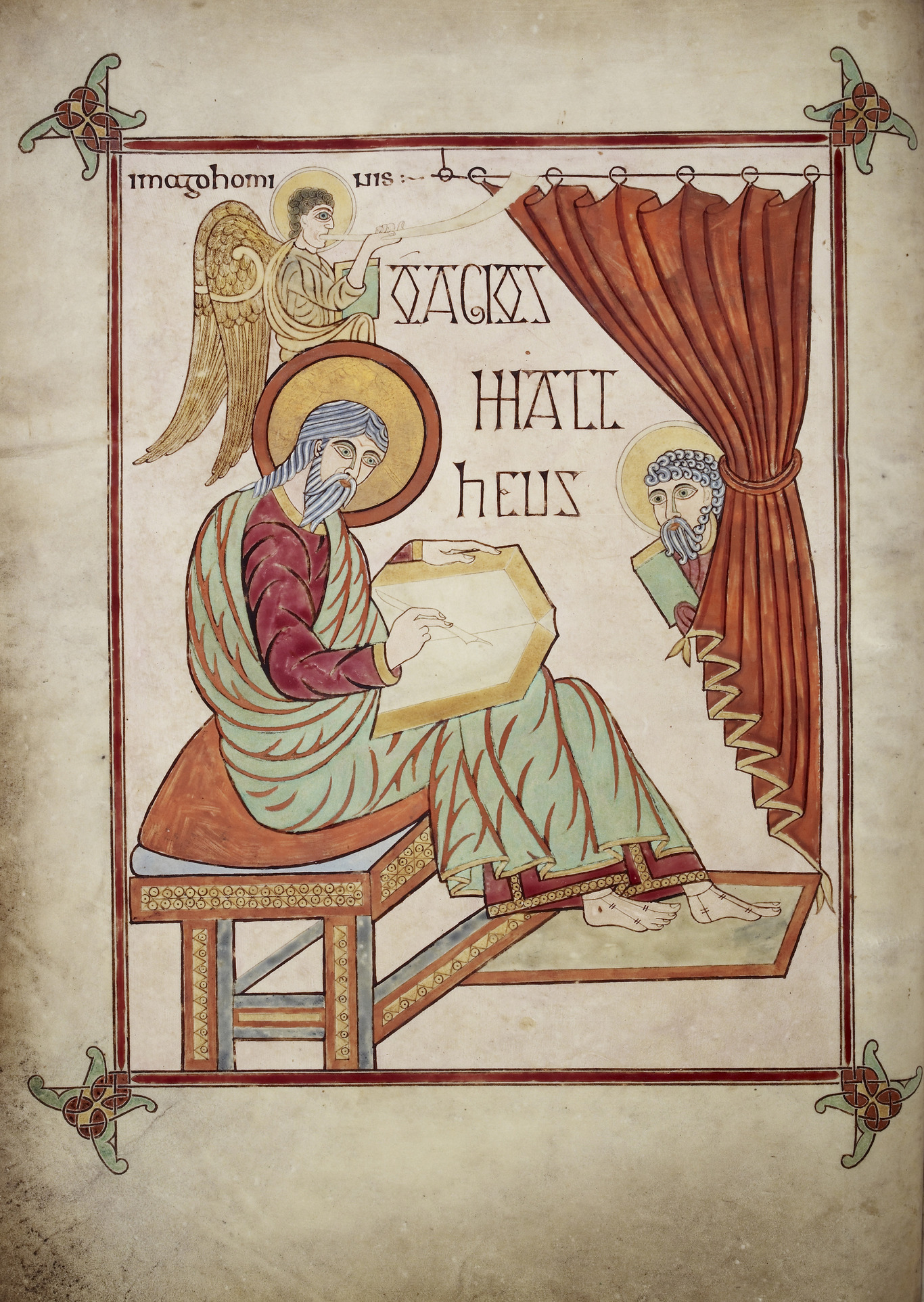
The Lindisfarne Gospels
Northumbria, made around AD 715 to 720
An illuminated Latin gospel book made at the monastery on Lindisfarne, one of the Library's best-known medieval manuscripts and a long-standing fixture of the Treasures Gallery when not on its periodic loan to the North East.22
The Gutenberg Bible
Mainz, Johannes Gutenberg, completed by 1455
The Library holds a complete copy printed on vellum together with a complete copy on paper, a rare pairing among the small number of substantially complete Gutenberg Bibles that survive.24
Newton, after Blake
Eduardo Paolozzi, 1995
A 3.7-metre bronze in the Piazza, adapted from William Blake's 1795 print of the scientist, that Paolozzi built from his own trademark technique of dividing and reassembling the figure at its joints.25
27 Mar to 23 Aug 2026Confirmed 10 Aug 2026 · check before you travel
A national library assembled from someone else's reading room
The British Library did not begin as a building. The British Library Act 1972 created it as a statutory body, the British Library Board, and transferred to it the British Museum's Departments of Printed Books, Manuscripts and Oriental Printed Books, among other collections. The Act received Royal Assent on 27 July 1972, and a commencement order brought it into force on 1 July 1973, the date the new Board formally took over. For the next twenty-four years the new institution had no home of its own: its readers went on using the British Museum's domed Round Reading Room and the museum's building in Bloomsbury, the same room this archive's British Museum record describes under a different institution's name. The Round Reading Room closed on 25 October 1997, stock began moving to the new St Pancras building, and by the end of that year the first of eleven new reading rooms had opened there. The split is a genuine source of confusion even now: the British Museum and the British Library share a founding moment and a former address, but have been two separate institutions, under two separate Acts of Parliament, for more than fifty years.
Thirty years to build
The St Pancras building took longer to complete than the institution had existed by the time it opened. Architect Colin St John Wilson began work on the project in 1962, for a site originally planned in Bloomsbury; public opposition moved it to a disused Midland Railway goods yard next to St Pancras station, and Wilson had to rework his design around the awkward wedge-shaped plot that resulted. Construction itself ran through the 1980s and 1990s. Ten million individually handmade bricks went into the building, in a red that was chosen to answer the Gothic brick of George Gilbert Scott's St Pancras hotel next door. Wilson, a former naval lieutenant, built nautical references into the design throughout, most visibly in a building that reads, from the right angle, like a ship. It became the largest public building constructed in the United Kingdom in the 20th century, and in 2015 it was awarded Grade I listed status, one of the youngest buildings in the country to receive it.
The King's Library in a glass tower
The building's single most legible idea is the tower of books visible from the Entrance Hall and several upper floors: the King's Library, the roughly 65,000-volume collection George III assembled during his reign from 1760 to 1820. His son George IV gave the library to the nation with the explicit condition that it be kept entire and separate from the rest of the collection, a stipulation the glass tower was built to satisfy two centuries later. The tower has an architectural cousin, by design: Yale's Beinecke Rare Book and Manuscript Library uses a comparable glazed-stack idea. Before the King's Library moved to St Pancras it had occupied a room inside the British Museum, the room now called the Enlightenment Gallery; the shelves there today hold books on loan from the House of Commons library, not George III's own volumes, which are now here.
The scroll from Cave 17
Among the manuscripts the Library holds is the Diamond Sutra, a woodblock-printed scroll dated by its own colophon to 11 May 868, the earliest complete printed book to carry a date. It was recovered from a sealed chamber at the Mogao Caves near Dunhuang, in what is now Gansu province in north-west China, part of a cache the archaeologist and Hungarian-British explorer Aurel Stein bought from the caves' self-appointed guardian in 1907 and brought back to the British Museum library, later transferred with it to the British Library in 1973. The circumstances of Stein's acquisition, and of the wider removal of Dunhuang material by several foreign expeditions in the early 20th century, remain a live subject in China, where scholars and officials have periodically pressed for the return of manuscripts taken from the caves. The scroll is not on permanent public view: it appeared in the ticketed exhibition A Silk Road Oasis: Life in Ancient Dunhuang, which ran from 27 September 2024 to 23 February 2025 and closed before this page was researched. Checked against the Treasures Gallery's own current listing on 7 August 2026, the Diamond Sutra was not among the items named as on display; the gallery's own visit page notes that items are taken off display regularly for conservation reasons. A reader travelling to see it in person should confirm its display status with the Library first rather than assume it is out.
Legal deposit and the size of the collection
Legal deposit has existed in English law since 1662: publishers must give a copy of what they publish to the British Library, and to five further institutions if those institutions ask for it - the National Library of Scotland, the National Library of Wales, the Bodleian Libraries at Oxford, Cambridge University Library and the Library of Trinity College Dublin. From 2013 the same obligation was extended to electronic publications, so the Library now also receives web pages, e-books and e-journals as part of its statutory intake. The scale that produces is the reason for most of what is distinctive about the institution: over 170 million items, more than 13.5 million printed books and e-books, over 310,000 manuscript volumes, some 60 million patents and 60 million newspapers, more than 4 million maps, and physical shelving that runs to more than 746 kilometres, roughly the distance from London to Aberdeen. About seventy per cent of that physical collection is kept not in London but at the Boston Spa site in West Yorkshire, on the site of a former wartime munitions factory, with a lorry moving over a thousand items a day between the two sites for readers who request them.
The attack that took the library down for years
On Saturday 28 October 2023 the Library discovered it had been hit by a ransomware attack that compromised the majority of its online systems. The Library's own detailed review, published 8 March 2024, traces the likely point of entry to a terminal server installed in 2020 for remote access by trusted partners, which was not protected by multi-factor authentication; forensic analysis found evidence of an intruder on the network from the night of 25 October, three days before the attack was detected. The gang, identifying themselves as Rhysida, copied and exfiltrated around 600 gigabytes of files, including personal data belonging to library users and staff, then encrypted and destroyed large parts of the server estate to inhibit recovery. The Library refused to pay the ransom the gang demanded, and the stolen data was later published on the dark web. Library premises stayed open throughout, and exhibitions, events and Reading Room access were maintained, but the loss of core systems severely restricted research services for months, and the Library's review found that its own historically complex, legacy-heavy technology estate had made the damage worse than a more modern network would have suffered. An early industry estimate reported in October 2024 put the cost of the initial technical clean-up at 6 to 7 million pounds, with the Library's own actual spend to that date reported at around 1.6 million pounds and the total cost still undetermined.
What is restored, and what still is not, today
Recovery has run in stages rather than all at once. A searchable but read-only version of the main catalogue returned on 15 January 2024. The Library's Rebuild & Renew programme, approved in December 2023, rebuilt its infrastructure from new hardware bought before the attack rather than restoring the old systems, several of which could not be brought back at all because their vendors no longer supported them. A modern, Alma-powered main catalogue and an interim Archives and Manuscripts Catalogue launched together on 15 December 2025, after a two-week suspension of item ordering to make the switch. Access to electronic legal deposit material catalogued before October 2023 - hundreds of thousands of e-books and journal articles - returned on 9 April 2026. E-Theses Online Service metadata, covering more than 650,000 thesis records including 14,000 added since the outage, was restored on 8 July 2026, though the new platform does not itself hold full-text files and instead links out to university repositories. Checked against the Library's own currently-available guide on 7 August 2026, several services remained listed as not available, among them the UK Web Archive, broadcast news content, the Business and Management Portal and several specialist bibliographic databases. Nearly three years after the attack, the Library's own description remains accurate: recovery is under way, but not everything is back.
Strikes, resignations and the cost of recovery
The financial and human cost of the attack outlasted the technical one. Reporting through 2025 recorded multiple senior departures during the recovery period, and in October and November 2025 more than 300 staff belonging to the Public and Commercial Services union struck for two weeks, rejecting a pay offer of 2.4 per cent or 800 pounds, whichever was higher, as inadequate against the cost of living; the union said members were taking second jobs and loans to cover rent and bills. The Library warned during the action that services would be reduced and some reading rooms would close. A further strike followed in December 2025. Commentary that followed, including a piece on the LSE's Impact of Social Sciences blog in December 2025, argued that government support for the Library's recovery had been limited and was unlikely to be the route back to full health, urging investment in shared, open infrastructure across the sector instead. None of this is a reason to discount the institution's holdings or its research value; it is the honest state of an organisation still absorbing the cost of an attack it did not choose and has been open about in public.
What visitors say
We publish no visitor prose and cite no platform average as fact, only as a labelled aggregate. What follows is drawn from the Library's own statements and named reporting. Access to the building, the Reading Rooms and the free Treasures Gallery has continued throughout the period covered here, and the collection is vast by any measure: over 170 million items, of which most sit at the Boston Spa site in Yorkshire rather than London. Set against that, the Library is still working through the consequences of the October 2023 ransomware attack: as of the date this page was researched, several research services remain unavailable or only partly restored nearly three years on, and the financial and staffing strain of recovery produced strike action by hundreds of staff in the second half of 2025.
What is praised, what is criticised
Praised: free entry to the building, the Reading Rooms with a Reader Pass, and the Treasures Gallery, against a collection the Library itself puts at over 170 million items
Praised: the King's Library Tower as the building's centrepiece, visible from several floors and built to a 200-year-old condition that the collection be shown whole
Praised: the family and touring exhibition programme, from Fairy Tales in 2026 to the 2024-25 Silk Road Oasis show that brought Dunhuang material including the Diamond Sutra to London for the first time in years
Praised: the Library's decision to publish its own detailed account of the 2023 cyber-attack rather than a minimal statement, naming what went wrong in its infrastructure as well as what the attackers did
Criticised: research services remain degraded a long time after the attack: as read on the Library's own currently-available guide on 7 August 2026, the UK Web Archive, several specialist catalogues and databases, broadcast news and moving-image content were still listed as not available
Criticised: more than 300 staff, members of the Public and Commercial Services union, struck from 27 October to 9 November 2025 and again in December 2025 over a pay offer they rejected as inadequate, with the union describing staff forced into second jobs and loans to cover housing costs
Criticised: the Codex Sinaiticus, one of the Library's own treasures, carries a live and unresolved ownership dispute with St Catherine's Monastery, which the 2005 digitisation agreement explicitly did not settle
Criticised: named academics told Times Higher Education in November 2024 that Reading Rooms which used to be, in one professor's description, buzzing had gone quiet, and that graduate students were losing funded time to the loss of online catalogues and E-Theses Online Service access
Reported specific researchers hurt by the outage, including a fashion historian reduced to emailing other libraries for material and considering a trip to Edinburgh, a music theatre professor who stopped visiting because of ordering delays, and the Bodleian's own librarian describing graduate students as at their wits' end over thesis deadlines.Times Higher Education, Jack Grove, 21 November 2024 [15]
Reported around 300 PCS members striking from 27 October to 9 November 2025 after rejecting a pay offer of 2.4 per cent or 800 pounds, whichever was higher, and quoted the Library warning of a reduced service and reading room closures during the action.The Art Newspaper, unattributed staff report, 28 October 2025 [17]
Ratings on other platforms
Google: 4.5 from 3,833 ratings, read 7 August 2026 A platform average is a tertiary source: it moves, it is not audited, and we quote no visitor's words.
Questions about British Library
Where is British Library?
British Library, 96 Euston Road, London NW1 2DB, United Kingdom.
How much does it cost to visit?
Permanent collection, Entrance Hall, Members' Room and Treasures Gallery: free; Sound Gallery, Philatelic Gallery, Treasures of the British Library: free; American Revolution: 250 Years from the Declaration of Independence: free. As confirmed 30 August 2026.
When is it open?
Monday to Thursday 09:30-20:00; Friday 09:30-18:00; Saturday 09:30-17:00; Sunday 11:00-17:00; Monday 10:00-20:00; Tuesday to Thursday 09:30-20:00; Friday to Saturday 09:30-17:00; Monday to Friday 09:00-16:30. Closed: St Pancras Reading Rooms are closed on Sunday. Boston Spa Reading Room is closed Saturday and Sunday. As confirmed 30 August 2026.
How do you get there?
On foot: On Euston Road in Camden, between the Euston and King's Cross St Pancras areas of the borough; Cycle parking: On the upper level of the Piazza, adjacent to Ossulston Street; Step-free entrance: The Ossulston Street entrance is fully ramped and about 100 metres from the main Euston Road entrance, with Blue Badge parking bays on Ossulston Street.
What should you see first?
The King's Library (Assembled by King George III, 1760 to 1820); The Diamond Sutra (China, printed 11 May 868); Magna Carta (Sealed at Runnymede, 15 June 1215); The Codex Sinaiticus (Greek Bible, 4th century AD); The Beowulf manuscript (England, copied in the decade or so after AD 1000); The Lindisfarne Gospels (Northumbria, made around AD 715 to 720).
What we could not confirm
The Codex Sinaiticus ownership dispute with St Catherine's Monastery on Sinai remains unresolved; the 2005 agreement covered joint digitisation, not title.
The full financial cost of the 2023 cyber-attack has not been finally stated; an October 2024 estimate of 6 to 7 million pounds for the technical clean-up alone is the most specific public figure located.
Whether every service listed as unavailable on the Library's own currently-available guide as of 7 August 2026 - including the UK Web Archive and several specialist databases - has a published restoration date.
Whether the Diamond Sutra is scheduled for any further public display beyond the closed 2024-25 Silk Road Oasis exhibition; nothing on the Library's own pages, checked live, states one.
Images
2 plates
The Euston Road frontageGround-level view of the building's Knowledge Centre wing and main entrance signage on the Euston Road side. Photograph by Derbrauni, CC BY 4.0.Photograph by Derbrauni · CC BY 4.0
The Entrance Hall atriumLooking across the Entrance Hall from an upper level: the main staircase, escalator and a mural-hung brick wall, with banners marking a Library anniversary hanging from the balustrades. Photograph by Jps3, CC BY-SA 4.0.Photograph by Jps3 · CC BY-SA 4.0
Sources
31
1British Library, Visit the British Library: opening hours for the library building, Reading Rooms, Reader Pass registration and paid exhibitions at St Pancras and Boston Spa; the London address; accessibility, luggage, wheelchair and cloakroom rules; and the live banner noting the Library is still recovering from a cyber-attack. Read in the in-app browser and cross-checked via WebFetch on 7 August 2026. bl.uk/visit
2British Library, Contact us: the customer services phone number 01937 546 060 and email [email protected]. Read in the in-app browser on 7 August 2026. bl.uk/contact-us
3British Library, Eat, drink and shop: named cafes (Upper Ground Floor Cafe, King's Library Cafe, Terrace Cafe), three Origin Coffee outlets, and the Shop and Bookshop, each with its own hours. Read 7 August 2026. bl.uk/visit/eat-drink-shop
4British Library, Legal deposit: the obligation on UK and Irish publishers dating to 1662 in English law, the six legal deposit libraries, and the 2013 extension to electronic publications. Read 7 August 2026. bl.uk/services/legal-deposit
5legislation.gov.uk, British Library Act 1972 c. 54: section 1 establishing the British Library and the British Library Board, section 3 transferring the British Museum's Departments of Printed Books, Manuscripts and Oriental Printed Books, and the commencement order appointing 1 July 1973. Read as raw statutory text on 7 August 2026. legislation.gov.uk/ukpga/1972/54
6British Library, '50 facts about the British Library', Knowledge Matters blog, Elliot Sinclair, 9 July 2023: 10 million handmade bricks, the King's Library Tower and George IV's condition on George III's collection, 746km of shelving, five basement levels reaching 24 metres down, Antony Gormley's Planets and the Piazza fossils, 1.6 million annual visitors, legal deposit intake, and Grade I listing in 2015. Read in the in-app browser on 7 August 2026. bl.uk/stories/blogs/posts/50-facts-about-the-british-library
7British Library, 'Learning Lessons from the Cyber-Attack: British Library cyber incident review', 8 March 2024 (PDF, 18 pages). The attack timeline from 25-28 October 2023, the suspected Terminal Services point of entry and absence of MFA, the 600GB of exfiltrated data, the decision not to pay the ransom, and the Rebuild & Renew programme. Downloaded and text-extracted on 7 August 2026. bl.uk/home/british-library-cyber-incident-review-8-march-2024.pdf
8British Library, 'Restoring our services - November 2025 update', Stories/News. The planned 15 December 2025 relaunch of the main catalogue and an interim Archives and Manuscripts Catalogue, phased e-resources restoration, and the expected early-2026 return of pre-October-2023 electronic legal deposit content and an interim EThOS. Read 7 August 2026. bl.uk/stories/news/restoring-our-services-november-2025-update
9British Library LibGuides, 'What's currently available: Introduction', maintained list of research services available and not available following the 2023 cyber-attack, by content type and in the Reading Rooms. Read live in the in-app browser on 7 August 2026. bl.libguides.com/currently-available
10British Library, 'EThOS records restored', Stories/News, 8 July 2026: restoration of over 650,000 metadata records plus 14,000 added since the outage, and the new platform's reliance on links to university repositories rather than hosting full-text files itself. bl.uk/stories/news/ethos-records-restored
11British Library, Treasures of the British Library, exhibition listing: the Sir John Ritblat Gallery as a free permanent gallery, its current named highlights (Beowulf, Magna Carta, Shakespeare, Andrea Levy, Monty Python at the time of reading), and the notice that items are taken off display regularly for conservation reasons and may be lent elsewhere. Read 7 August 2026. events.bl.uk/exhibitions/treasures-of-the-british-library
12British Library, Fairy Tales exhibition listing: dates 27 March to 23 August 2026, peak price GBP 13.50 and off-peak GBP 11.50, the Universal Credit/Pension Credit GBP 3 off-peak rate, and the age recommendation of 3 to 10. Read in the in-app browser on 7 August 2026. events.bl.uk/exhibitions/fairy-tales
13British Library, press release, 'A Silk Road Oasis opens at the British Library': exhibition dates 27 September 2024 to 23 February 2025, and the Diamond Sutra named as a featured highlight of the show. Read 7 August 2026. bl.uk/about/press/releases/a-silk-road-oasis-opens-at-the-british-library
15Jack Grove, 'How the British Library cyberattack disrupted research', Times Higher Education, 21 November 2024 (updated 25 November 2024): named researchers Liz Tregenza and Nicholas Till and Bodleian librarian Richard Ovenden describing the effect on their work and on graduate students, and the loss of EThOS and online journal access. timeshighereducation.com/depth/how-british-library-cyberattack-disrupted-research
16Simon Bowie, 'Don't rely on government to save the British Library', LSE Impact of Social Sciences blog, 2 December 2025: argument that government support for the Library's recovery has been limited, citing the October-November 2025 strikes, leadership departures, and a call for shared open-source library infrastructure. blogs.lse.ac.uk/impactofsocialsciences/2025/12/02/dont-rely-on-government-to-save-the-british-library/
17The Art Newspaper, 'Hundreds at London's British Library go on strike, as Tate workers consider action', 28 October 2025: around 300 PCS members striking 27 October to 9 November 2025 over a rejected pay offer of 2.4 per cent or GBP 800, and the Library's own warning of reduced service and reading room closures. theartnewspaper.com/2025/10/28/british-library-london-strike-tate-workers-consider-action
18Cyber Daily, 'British Library finally restoring key services a year after cyber attack', 15 October 2024: the GBP 600,000 ransom demand, an initial clean-up cost estimate of GBP 6 to 7 million, and the Library's own reported actual spend to date of around GBP 1.6 million with the total cost still unknown. cyberdaily.au/culture/11239-british-library-finally-restoring-key-services-a-year-after-cyber-attack
19codexsinaiticus.org, official joint project site (British Library, St Catherine's Monastery, Leipzig University Library, National Library of Russia), History page: Tischendorf's 1859 loan receipt and promise to return the manuscript, and the British Museum's 1933 purchase from the Soviet government through Maggs Brothers for GBP 100,000, delivered 26-27 December 1933. Read 7 August 2026. codexsinaiticus.org/en/codex/history.aspx
20The Art Newspaper, 'Sinai monks in historic agreement with British Library over Codex Sinaiticus', 1 April 2005: the four-party agreement of 9 March 2005 to jointly digitise and study the manuscript, and Archbishop Damianos's statement reserving the monastery's claim pending the outcome of research into how the manuscript left Sinai. theartnewspaper.com/2005/04/01/sinai-monks-in-historic-agreement-with-british-library-over-codex-sinaiticus
21Medievalists.net, 'British Library brings all four Magna Carta manuscripts together for the first time in history', October 2014: confirmation that only four original 1215 Magna Carta documents survive, two held by the British Library and one each at Lincoln and Salisbury Cathedrals, sealed at Runnymede on 15 June 1215. medievalists.net/2014/10/british-library-brings-four-magna-carta-manuscripts-together-first-time-history/
22Wikipedia, Lindisfarne Gospels: production around AD 715-720 at the monastery on Lindisfarne, current holding by the British Library as Cotton MS Nero D.IV. Tertiary; read 7 August 2026. en.wikipedia.org/wiki/Lindisfarne_Gospels
23Wikipedia, Beowulf manuscript (Nowell Codex): dating to the decade or so after AD 1000, the 1731 Ashburnham House fire that scorched its edges, and its identity as Cotton MS Vitellius A XV. Tertiary; read 7 August 2026. en.wikipedia.org/wiki/Beowulf_manuscript
24New World Encyclopedia, Gutenberg Bible: the British Library's holding of a complete vellum copy and a complete paper copy among the substantially complete surviving copies. Tertiary; read 7 August 2026. newworldencyclopedia.org/entry/Gutenberg_Bible
25Wikipedia, Newton (Paolozzi): the 1995 bronze by Eduardo Paolozzi, 3.7 metres tall, based on William Blake's 1795 print, installed in the British Library Piazza and Grade I listed in 2015. Tertiary; read 7 August 2026. en.wikipedia.org/wiki/Newton_(Paolozzi)
26Wikidata, British Library (Q23308): machine identity, instance of national library, country United Kingdom, coordinates, and official website bl.uk, used only to fix the entity and cross-checked against the Library's own address. Tertiary. wikidata.org/wiki/Q23308
27Wikimedia Commons API, Category:British Library - Building and its subcategories (Building Interior, King's Library Tower, clock tower, entrance gate). Every plate on this page was licence-checked per file from extmetadata.LicenseShortName and downloaded and inspected by eye before use. Queried 7 August 2026. commons.wikimedia.org/wiki/Category:British_Library_-_Building
28bestinhood.com, '5 Best Libraries in London (2026)': aggregate Google rating for the British Library on Euston Road, 4.5 stars from 3,833 reviews, page states data verified July 2026. Tertiary aggregate, read 7 August 2026. bestinhood.com/london/arts-and-culture/best-libraries-in-london/
29Wikipedia, British Museum Reading Room: confirmation that the 1972 Act separated the British Library in 1973 but that it continued to share the British Museum's Reading Room and building until 1997, when the collection and shelving moved to the new St Pancras site. Tertiary; read 7 August 2026. en.wikipedia.org/wiki/British_Museum_Reading_Room
30British Library, Visit the British Library (re-read 30 August 2026) bl.uk/visit
31British Library, What's On listings (re-read 30 August 2026) events.bl.uk/
Last verified 30 August 2026Open, confirmed 30 August 2026Wikidata Q23308
One artwork and its story every Tuesday, with the picture: who owned it, what it made, and what closes soon in the exhibition calendar. No promotion, and nothing we cannot cite.
We send one email to confirm the address and keep nothing else. Every letter carries a one-click unsubscribe. How we handle your data.
 London, United Kingdom