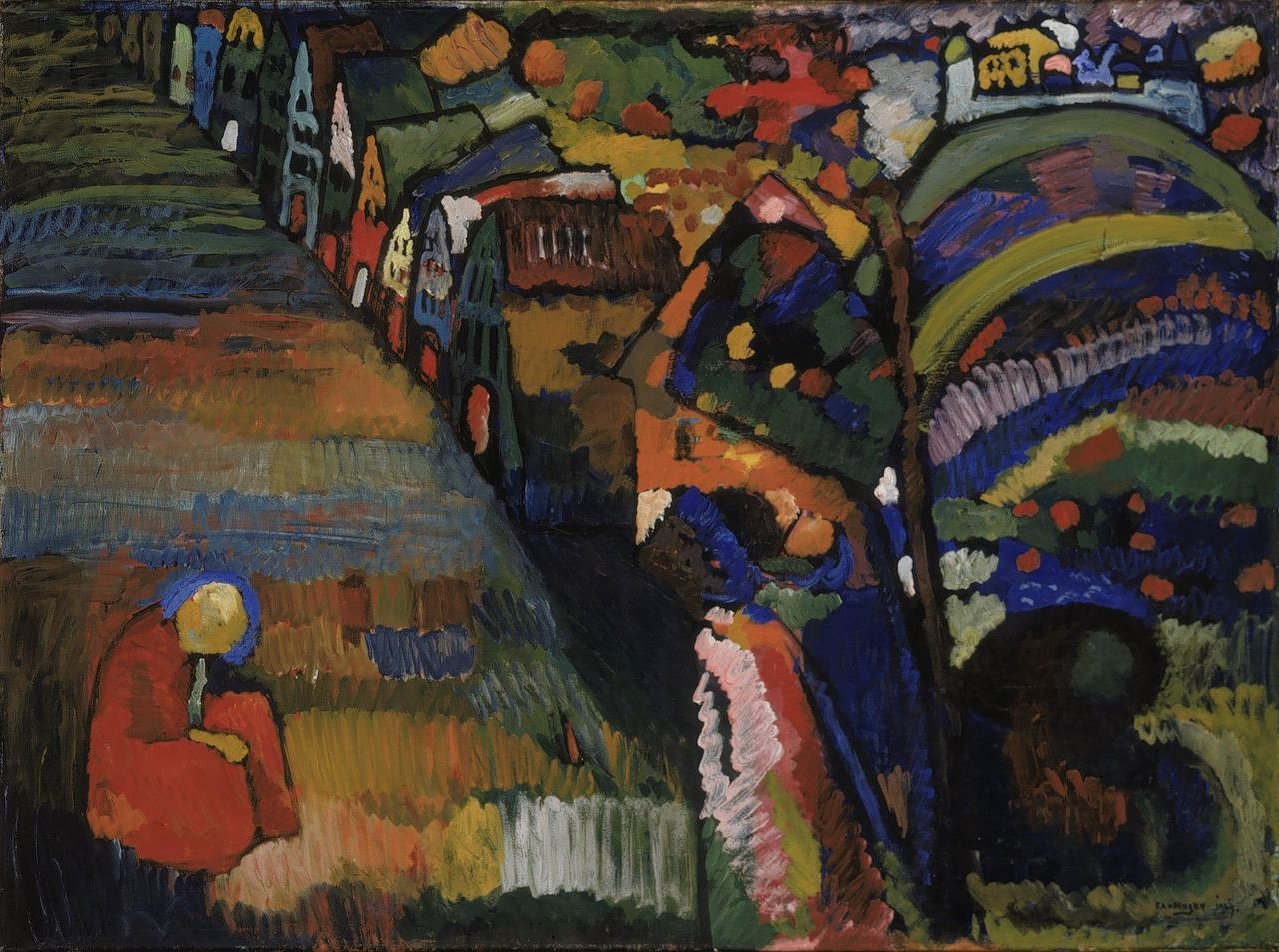
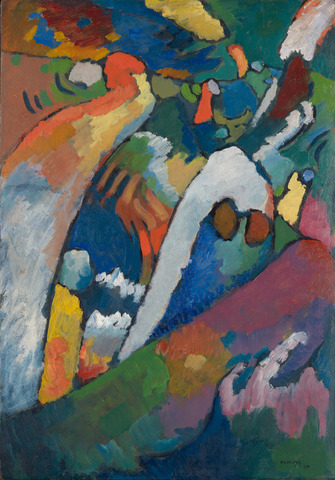
Bild mit Haeusern (Painting with Houses)
1909 · Oil on canvas
 1866-1944
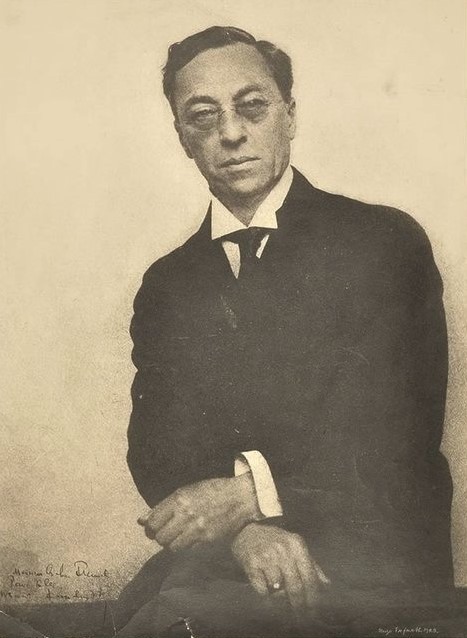
Kandinsky in his first Bauhaus year at Weimar, photographed by Hugo Erfurth in 1923 and dedicated by Kandinsky to Paul Klee. The identification is secure: the print carries Kandinsky's own dedication to a named recipient, not an inferred or disputed attribution.
Hugo Erfurth, 1923| Full name | Wassily Wassilyevich Kandinsky |
|---|---|
| Worked as | Painter, Printmaker, Art theorist, Teacher |
| Born | 16 December 1866 · Moscow, Russian Empire |
| Died | 13 December 1944 · Neuilly-sur-Seine, France |
| Nationality | Russian, later German-resident, French citizen from 1939 |
| Movement | Der Blaue Reiter |
| In this archive | 1 artwork |
| Sources | 26 cited |
| Last verified | 17 September 2026 |
About this page 1 artwork in the archive · Last verified 17 September 2026 · 26 sources cited
Kandinsky trained as a lawyer, gave up a university post in Moscow at thirty to study painting in Munich, and spent the rest of his life doing something almost no major painter has done as thoroughly: writing down, in print, what he thought he was doing and why. That habit is the reason he is taught in philosophy departments as well as art history departments, and it is also the reason his estate has been fought over, forged and re-litigated more than almost any other twentieth-century painter's.
The thing most accounts skip is that the machinery built to manage his reputation after his death has largely stopped working. The society his widow founded to authenticate his paintings dissolved in 2015 and nothing has replaced it. A wholly invented painting bearing his signature was being shopped in Milan for three million euros as recently as 2011. And the single painting in this archive's own corpus, a house-and-tower canvas from his pivotal year of 1909, sits inside a Nazi-era restitution dispute that forced the Netherlands to rewrite its own restitution law after the country's own panel got the answer wrong.
What follows treats his corpus, his authentication history and his market the way this archive treats an object: what is documented, what is argued, what is still open, and who says so.
Born 16 December in Moscow, son of a tea merchant.4
Gives up a law and economics career at thirty and moves to Munich to study painting, citing Monet's Haystacks and a refused professorship at Dorpat.4
Co-founds the Phalanx group in Munich and is elected its president; its painting school opens in 1902.25
Gabriele Muenter enrolls as his student at the Phalanx school; their personal relationship begins.25
Founds and becomes president of the Neue Kuenstlervereinigung Muenchen. Muenter buys the Murnau house. Bild mit Haeusern, the painting in this archive's own corpus, is painted this year.4
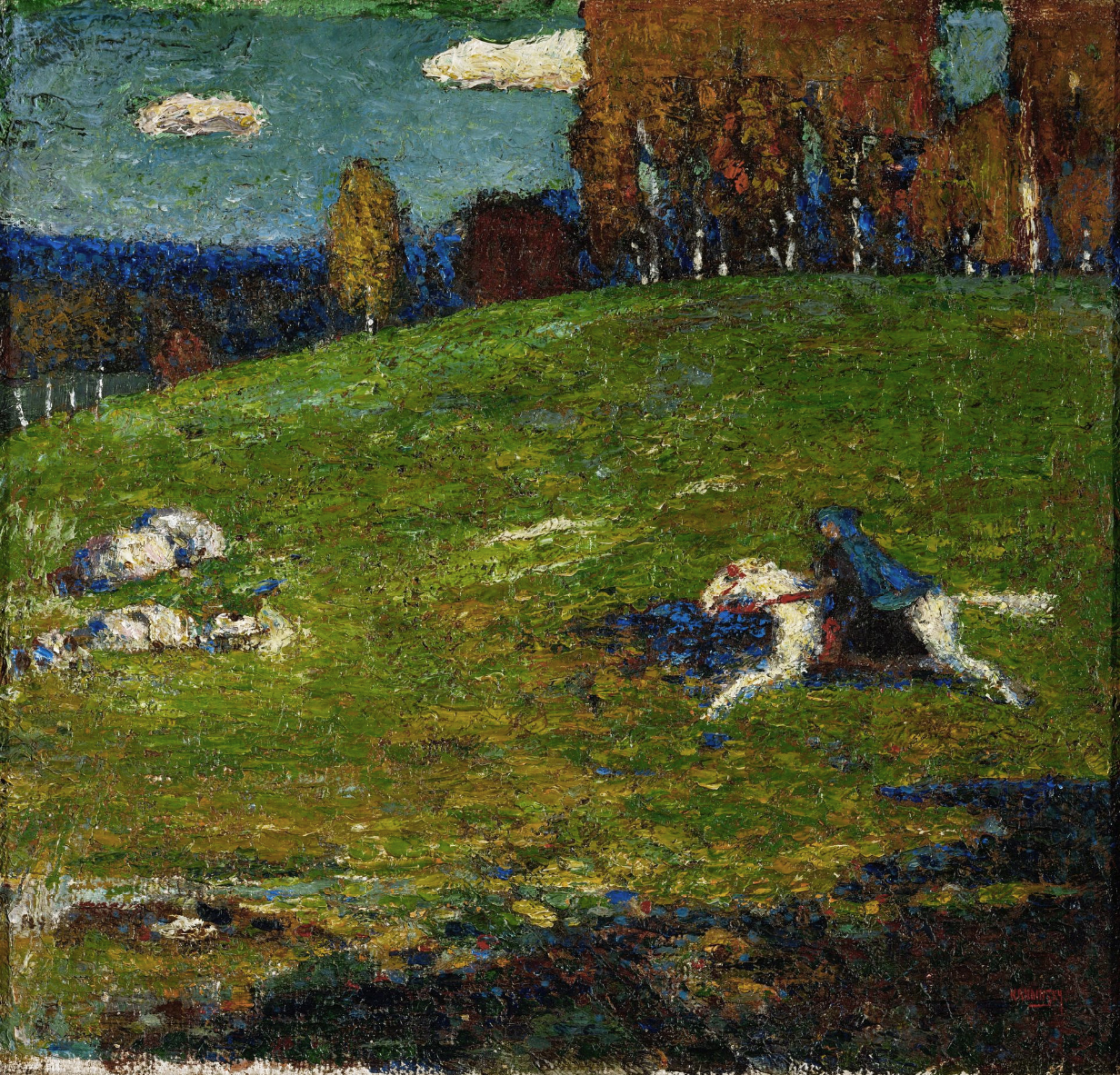
Der Blaue Reiter forms at the end of the year after the Munich association splits. Ueber das Geistige in der Kunst is completed, published dated 1912.4
Returns to Moscow at the outbreak of the First World War; Der Blaue Reiter ends; separates from Muenter in the years that follow.4
Marries Nina Andreevskaya in Moscow on 11 February.5
Works in Soviet cultural administration, founding and directing the Institute of Artistic Culture, Inkhuk, until pushed out by the Constructivist faction.4
Invited by Walter Gropius to the Bauhaus in Weimar; begins teaching in 1922.4
Moves with the Bauhaus to Dessau.4
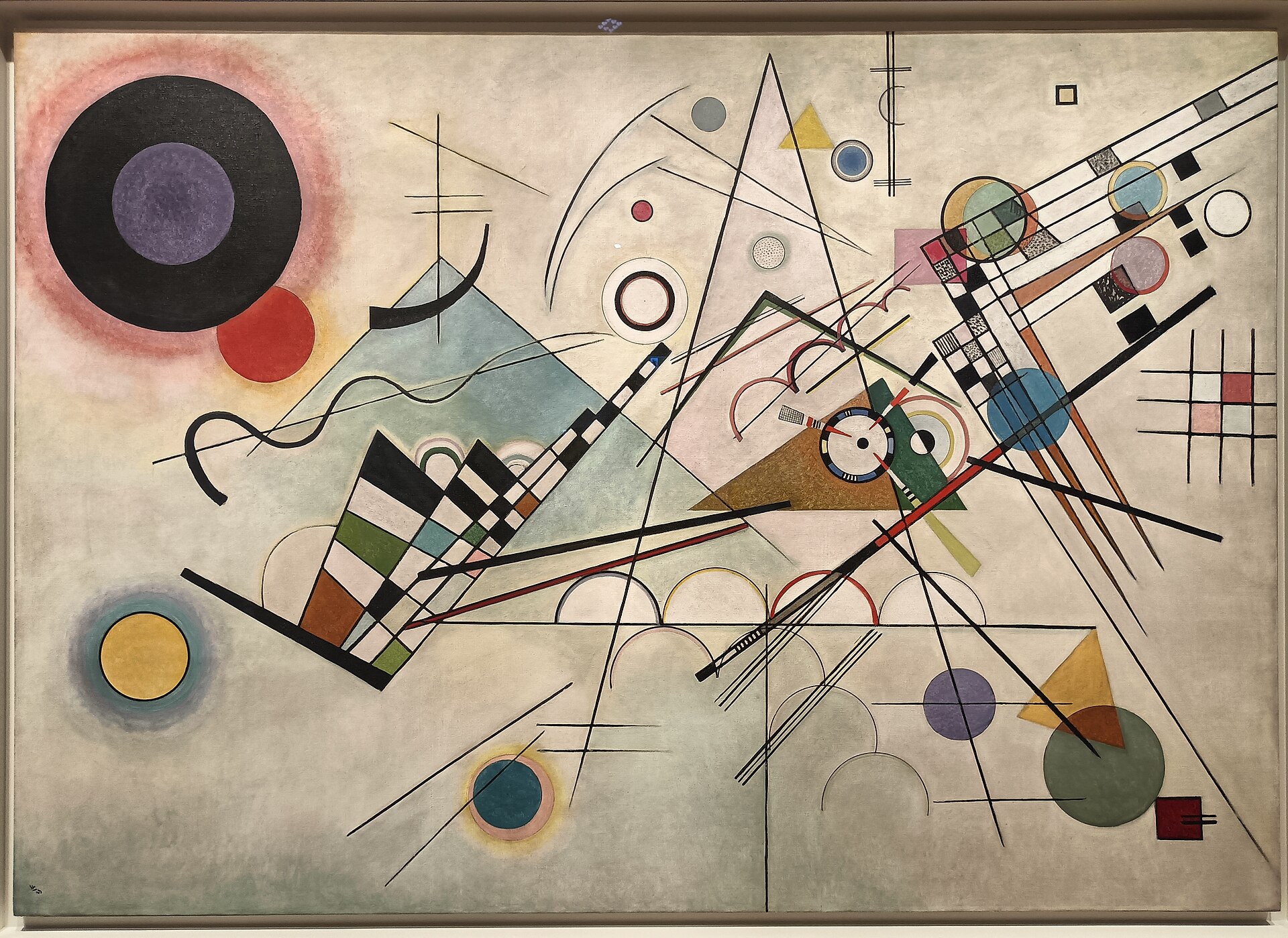
Solomon Guggenheim buys Composition 8 directly from Kandinsky's studio in Dessau, the first of more than 150 Kandinsky works the Guggenheim would acquire.20
The Bauhaus dissolves itself under Nazi pressure in July; Kandinsky moves to Neuilly-sur-Seine, near Paris.4
His work is swept into the Nazi Entartete Kunst campaign; works are confiscated from German public museums.4
Becomes a French citizen.4
Composition I is destroyed in a British air raid on Brunswick, 14 October; Kandinsky dies at Neuilly-sur-Seine on 13 December.4
Roethel is shown the complete Murnau hoard in 1956; Muenter donates the greater part of it to the Stadtische Galerie im Lenbachhaus on her eightieth birthday in 1957.678
Nina Kandinsky creates the Societe Kandinsky at the Centre Pompidou on 6 December, to promote his work and rule on attribution.9
Nina Kandinsky is strangled at her chalet in Gstaad, Switzerland, on 2 September in an unsolved robbery.5
Milan police expose K19, a wholly invented painting bearing Kandinsky's name, offered for roughly three million euros after authentication by Valery Turchin.1112
The Societe Kandinsky dissolves. No successor body takes over its role vetting attributions.9
The Dutch Restitutions Committee issues binding opinion RC 3.141, refusing to return Bild mit Haeusern to the Lewenstein and Klein heirs.1
The Van Abbemuseum restitutes Murnau mit Kirche II to the Stern heirs; Amsterdam returns Bild mit Haeusern to the Lewenstein and Klein heirs.172
Murnau mit Kirche II sells at Sotheby's for GBP 37,196,800, a new auction record for the artist; Bild mit Haeusern resells privately for more than EUR 60 million; the German Advisory Commission recommends restitution of Das bunte Leben.3218
Kandinsky's top prices cluster around paintings with a clean, resolved chain of ownership, and the clearest evidence for that is the pair of pictures restituted from Dutch public museums within a year of each other in 2022 and 2023, which sold within months of their return. Reported totals are usually given as a single premium-inclusive figure; where a source does not separate hammer from premium, this record states the total as reported rather than inventing a hammer.
| Date | Sale | Work | Result | Note |
|---|---|---|---|---|
| 16 November 2016 | Christie's | Rigide et Courbe (1935) | With premium USD 23.3 million (reported total) USD | New York. Bought directly from Kandinsky by Solomon Guggenheim in 1936; had not been on the market since 1964. Hammer not separately published in the sources consulted. |
| 21 June 2017 | Sotheby's | Landscape with Green House (Murnau - Landschaft mit gruenem Haus) (1909) | With premium GBP 21,000,000 (reported total, within estimate) GBP | London, same Impressionist and Modern sale as Bild mit weissen Linien, sold minutes earlier. From the Werner and Gabrielle Merzbacher Collection. A new auction record for the artist at the time, broken again six lots later in the same sale. Hammer not separately published in the source consulted. |
| 21 June 2017 | Sotheby's | Bild mit weissen Linien (1913) | With premium GBP 33,008,750 (reported total) GBP | London. A new auction record for the artist at the time; hammer not separately published in the sources consulted. |
| 1 March 2023 | Sotheby's | Murnau mit Kirche II (1910) | With premium GBP 37,196,800 / reported as USD 44,766,880 GBP | London. Restituted by the Van Abbemuseum, Eindhoven, to the Stern heirs in 2022. The current auction record for the artist. Sources describe the pound figure inconsistently as hammer and as premium-inclusive; this record states the reported total only. |
| 2023 | Private sale | Bild mit Haeusern (1909) | With premium Reported as more than EUR 60 million EUR | Not a public auction. This archive's own corpus record. No hammer, premium split or buyer identity has been published. Proceeds were divided among the Lewenstein heirs, the heirs of Elsa Guidotti and the recovery firm Mondex Corporation. |
| 2026-10-14 (scheduled) | Christie's | Das bunte Leben (1907) | With premium Estimate in excess of USD 30 million USD | London. Restitution recommended by the German Advisory Commission in June 2023 after 50 years on loan to the Lenbachhaus from the Bayerische Landesbank. NOT YET SOLD as of this record; the figure given is a pre-sale estimate, not a result. |
Hammer is the price at which the bidding stopped; with premium adds the fee the house charges the buyer on top. Hammer price and buyer's premium in the glossary.
| Institution | City | Holdings | Note |
|---|---|---|---|
| Centre Pompidou (Musee national d'art moderne) | Paris | The largest single Kandinsky holding, built on Nina Kandinsky's gifts of 1976 and her 1980 bequest of 113 oil paintings and 741 works on paper. | Also holds his papers via the Bibliotheque Kandinsky documentation centre, which despite the name is a general modern-art research library founded in 2002, not Kandinsky's personal archive. |
| Stadtische Galerie im Lenbachhaus | Munich | The world's largest collection of Der Blaue Reiter material, built on Gabriele Muenter's 1957 donation of the works she had hidden in Murnau. | Administered in part through the Gabriele Muenter and Johannes Eichner Foundation, operative since 1966. |
| Solomon R. Guggenheim Museum | New York | More than 150 works, beginning with Solomon Guggenheim's direct studio purchases from Kandinsky from 1929, including Composition 8. | One of the few major Kandinsky holdings built substantially on purchases directly from the artist rather than through dealers or restitution. |
| State Tretyakov Gallery | Moscow | Major early Russian-period works. | The same institution whose in-house authentication department was found in 2006 to have wrongly certified 96 of 212 examined paintings; its certificates for Kandinsky and other Russian avant-garde artists should be treated with that history in mind. |
| State Russian Museum | Saint Petersburg | Includes Saint George (II), 1911, from the Blaue Reiter period. |
Kandinsky was born in Moscow on 16 December 1866, the son of a tea merchant.
Kandinsky was born in Moscow on 16 December 1866, the son of a tea merchant. He studied law and economics, married his cousin Anja Chimiakin, and by his late twenties was lecturing in jurisprudence at the University of Moscow with a career in front of him. In 1896, at thirty, he turned it down. He had been offered a professorship at the University of Dorpat and refused it, enrolling instead at the Munich Academy under Anton Azbe and later Franz von Stuck.
He gave two reasons across his later writing: seeing Monet's Haystacks series on show in Moscow that year, and finding that a painting could hold his attention the way a legal problem never had. The academic career he left was not a fallback; giving it up in his thirties, with a wife and a law degree, is the first fact worth holding onto about a man usually introduced simply as a painter.
In Munich in 1901 Kandinsky co-founded the Phalanx group with Rolf Niczky, Waldemar Hecker and Wilhelm Huesgen, and was elected its president.
In Munich in 1901 Kandinsky co-founded the Phalanx group with Rolf Niczky, Waldemar Hecker and Wilhelm Huesgen, and was elected its president. The group opened a painting school the following year, in Munich's Schwabing district, teaching a curriculum outside the conservative state academy that had barred women outright.
Gabriele Muenter enrolled at the Phalanx school as a student in 1902, with Kandinsky as her teacher. The group folded in 1903 and formally dissolved in 1904, but the personal relationship that began in the classroom lasted until 1914, and it is the reason a large part of Kandinsky's early corpus exists today at all. The imbalance built into that first meeting, teacher and pupil, is worth naming plainly, because the accounts that followed for decades described Muenter mainly as his companion rather than as the painter and, later, the archivist who kept his work alive.
1909 is the year that set most of the rest of his working life in motion, and it is also the year of the one painting by Kandinsky in this archive's own corpus, Bild mit Haeusern.
1909 is the year that set most of the rest of his working life in motion, and it is also the year of the one painting by Kandinsky in this archive's own corpus, Bild mit Haeusern. He founded the Neue Kuenstlervereinigung Muenchen that year and became its president. Muenter bought the house in Murnau, in Upper Bavaria, that the local people called the Russenhaus, and the two of them worked there through the summers that followed. He was drafting the text that became Ueber das Geistige in der Kunst, published in Munich at the end of 1911 and dated 1912 on its title page.
What is documented about his reading that period is specific rather than general. He read and annotated Rudolf Steiner's book Theosophie (1904) and was a regular reader of Steiner's journal Luzifer-Gnosis, copying passages from Steiner's articles on the human aura into his own notebooks. He attended some of Steiner's lectures in Munich and Berlin, introduced through the painter Maria Strakosch-Giesler. Marianne von Werefkin's diaries record that his 1908 study Ariel Scene, from Goethe's Faust, followed a Steiner lecture on the same subject. The scholar Sixten Ringbom, in The Sounding Cosmos (1970), argued from this material that Kandinsky's move toward abstraction was inseparable from this reading, and proposed that Kandinsky also owned and read Annie Besant and C. W. Leadbeater's Thought-Forms (1905); Ringbom's own account calls that specific attribution uncertain, and it should be read as an argued claim, not a documented one. Popular accounts, including the English Wikipedia entry for the painter, state flatly that Kandinsky joined the Theosophical Society in 1909; none of the specialist studies consulted for this record corroborates a registered membership, as against the reading and lecture attendance, which are documented.
The Neue Kuenstlervereinigung Muenchen split at the end of 1911 after a jury rejected a Kandinsky canvas, and Kandinsky and Franz Marc formed a new, looser association around an almanac rather than a...
The Neue Kuenstlervereinigung Muenchen split at the end of 1911 after a jury rejected a Kandinsky canvas, and Kandinsky and Franz Marc formed a new, looser association around an almanac rather than a manifesto. Der Blaue Reiter, named after a motif both painters used independently, brought together Marc, August Macke, Albert Bloch and Muenter, along with contributions from Arnold Schoenberg. One almanac and two group exhibitions appeared before the outbreak of war in 1914 ended the association for good; Marc and Macke were both killed in action.
Kandinsky returned to Moscow in 1914. He and Muenter separated during the following years; they never married, and the split ended a partnership of a little over a decade that had produced most of his pre-abstract corpus and, unknown to either of them at the time, the means by which that corpus would survive the next thirty years.
In Moscow, Kandinsky married Nina Andreevskaya on 11 February 1917; she was in her late teens, he was fifty.
In Moscow, Kandinsky married Nina Andreevskaya on 11 February 1917; she was in her late teens, he was fifty. Their son Vsevolod was born in September 1917 and died of illness in June 1920.
Kandinsky spent the years from 1918 to 1921 inside Soviet cultural administration: the People's Commissariat of Enlightenment, museum reform, and the founding and direction of the Institute of Artistic Culture, Inkhuk. He did not survive the politics of the institution he had built. The younger Constructivist faction rejected his psychological, individual approach to art as bourgeois and pushed him out. In December 1921 he left for Berlin and did not return.
Walter Gropius invited Kandinsky to teach at the Bauhaus in Weimar, and he arrived at the end of 1921, beginning to teach in 1922.
Walter Gropius invited Kandinsky to teach at the Bauhaus in Weimar, and he arrived at the end of 1921, beginning to teach in 1922. He taught the basic design and analytical drawing courses and ran an advanced theory seminar, moving with the school to Dessau in 1925 and to Berlin in 1932. His second theoretical book, Punkt und Linie zu Flaeche, appeared in 1926, extending the earlier book's argument from colour to point, line and plane.
The Bauhaus dissolved itself under Nazi pressure in July 1933 rather than accept the conditions the new regime attempted to impose on it. Kandinsky left Germany for Neuilly-sur-Seine, on the western edge of Paris, and lived there for the rest of his life. He became a French citizen in 1939.
Kandinsky's work was swept into the regime's Entartete Kunst, Degenerate Art, campaign.
Kandinsky's work was swept into the regime's Entartete Kunst, Degenerate Art, campaign. Roughly sixteen thousand works were confiscated from German public museums on Joseph Goebbels' orders from 1937; a selection of about six hundred and fifty, including works by Kandinsky, Picasso, Kirchner and Nolde, was hung deliberately askew in the 1937 Munich exhibition designed to ridicule it, alongside paintings by patients of psychiatric institutions and mocking wall text.
His first three abstract Compositions, numbered I to III, did not survive the war. Composition I was destroyed in a British air raid on Brunswick on 14 October 1944, two months before Kandinsky himself died. No photograph of the destroyed originals in colour is known to survive in the sources consulted for this record; what is reproduced today as Composition I and II are black-and-white photographs and, in one case, a later copy.
Gabriele Muenter kept the Murnau house after the couple separated, and through the 1930s and the war she hid a large collection of Kandinsky's and her own early paintings, drawings, sketchbooks and...
Gabriele Muenter kept the Murnau house after the couple separated, and through the 1930s and the war she hid a large collection of Kandinsky's and her own early paintings, drawings, sketchbooks and reverse-glass paintings in its cellar. German search parties visited the house more than once during the Nazi period and never found the collection.
Hans Konrad Roethel, later the director of the Stadtische Galerie im Lenbachhaus, was first permitted to see the complete hidden collection in 1956. The following year, on her eightieth birthday, Muenter donated the greater part of it to the Lenbachhaus: Wikipedia's consolidated account gives more than eighty oil paintings and about three hundred and thirty watercolours and drawings, while other published accounts of the same gift round the oil paintings up to about ninety and add twenty-nine sketchbooks and twenty-four reverse-glass paintings; the sources consulted do not agree on the exact figures and this record does not resolve the discrepancy. What is not in dispute is the effect: the Lenbachhaus holds the largest collection of Blaue Reiter material in the world because one woman kept several hundred works in a cellar for over a decade, and the Gabriele Muenter and Johannes Eichner Foundation that now administers part of that legacy became operative in 1966, four years after her death.
The picture in this archive's own corpus, Bild mit Haeusern, was not part of that hoard. It had already been sold out of Kandinsky's hands in 1923, years before Muenter began hiding what remained in Murnau, which is why its own survival runs through an entirely separate and considerably darker chain: an Amsterdam sale five months into the German occupation of the Netherlands, not a cellar in Bavaria.
Nina Kandinsky administered her husband's estate for thirty-six years.
Nina Kandinsky administered her husband's estate for thirty-six years. Within three months of his death in 1944 she was consigning work to the Paris dealer Rene Drouin; a large consignment went in the 1940s to the dealer Karl Nierendorf, and after his death in 1947 passed to Leo Castelli, who later wrote that the Kandinskys revived his gallery's finances while dealing with Nina herself was difficult. She placed loans with the San Francisco Museum of Art in 1952 and helped arrange the loan of seven Kandinskys from Soviet museum collections to the Guggenheim's 1963 retrospective, the first Soviet loan to an American museum since the war. She gave fifteen paintings and fifteen watercolours to the Centre Pompidou in 1976, becoming its largest single benefactor to that date, and left the remainder of her holdings to the museum on her death: a further 113 oil paintings and 741 works on paper.
She was also, by her own description, the estate's final word on authenticity, and the record of that role is not flattering. The dealer Richard Feigen recounted identifying a painting as an authentic Kandinsky from across a room, only for Nina to reverse herself the moment she noticed an inscription referring to Gabriele Muenter, declaring the picture not a Kandinsky at all; the implication, as Feigen told it, was that she would not authenticate anything that carried a trace of her predecessor. That anecdote is sourced here only through a secondary account and is flagged for replacement with Feigen's own memoir, Tales from the Art Crypt, which appears to be its origin.
Nina Kandinsky was strangled on 2 September 1980 at her chalet in Gstaad, Switzerland, in what investigators treated as a robbery: about two million dollars in jewellery was taken, including a Cartier necklace bought shortly before, and no painting was touched. Nobody has ever been charged. Fourteen people attended her funeral in Paris.
On 6 December 1979 Nina Kandinsky created the Societe Kandinsky, permanently headquartered at the Centre Pompidou, with a stated mandate to protect and promote her husband's work, oversee publication...
On 6 December 1979 Nina Kandinsky created the Societe Kandinsky, permanently headquartered at the Centre Pompidou, with a stated mandate to protect and promote her husband's work, oversee publication of the catalogue raisonne and act as the body to be consulted on questions of attribution. In practice this made it a functional monopoly: neither Sotheby's nor Christie's would offer a painting or drawing as a Kandinsky unless the Societe had accepted it for the catalogue raisonne, even though the Societe issued no certificates as such.
The Societe Kandinsky was dissolved in 2015. The sources consulted for this record give no stated reason. No successor body has taken over its vetting function, and none of the market-facing sources checked here identifies one. What remains in its place is the printed catalogue raisonne itself, plus a scattered set of private authenticators and dealers offering opinions with no equivalent institutional standing, at a moment when, by the accounts of specialist forgery investigators, fakes attributed to the Russian avant-garde as a group already outnumber the genuine works on the market. A reader checking an attribution today is checking it against a closed catalogue and no live board, which is a materially different position from the one that held for the thirty-six years the Societe operated, and it is not a fact this archive found stated plainly anywhere else.
The scale of the problem predates the Societe's dissolution.
The scale of the problem predates the Societe's dissolution. Moscow's Tretyakov Gallery ran its own in-house expertise department issuing authentication certificates until an internal review found that, of 212 paintings the department had examined, 96 had been wrongly certified as genuine; Russia's ministry of culture barred state institutions from issuing authentication certificates in 2006 as a result, and the Tretyakov's own department was disbanded in 2016, though certificates it had already issued continue to circulate and to be relied on by sellers.
In 2005 the Moscow art historian Valery Turchin, head of Russian art history at Moscow State University and the author of a two-volume study of Kandinsky's technique, published Kandinsky in Russia, reproducing about a dozen previously unrecorded paintings and watercolours from private collections. None of them was accepted into the Societe Kandinsky's catalogue raisonne, and the book provoked open criticism from the Societe. One of the works Turchin had vouched for in print, a canvas known as K19 and dated 1919, was offered for sale in Milan for roughly three million euros; Milan police established that it had in fact been commissioned in 2008 from an Israeli artist of Russian origin, painted in Kandinsky's manner rather than copied from any existing work, and had already passed through a Moscow museum showing and a German gallery undetected before the sale collapsed. Turchin had written in an exhibition catalogue that the picture carried unmistakable references to the apocalypse and the Last Judgement; Paris-based experts needed three months to establish that it was invented outright. The case was reported in February 2011 and led to six arrests; the sources consulted here do not record a subsequent criminal conviction.
The pattern continues. In 2022 The Art Newspaper reported a painting titled Murnau. House on the Hill, dated to 1909 and carrying Tretyakov certificates despite the 2006 finding against that department, being offered through a Russian site named Art For Victory to raise money for the war in Ukraine; it does not appear in the Kandinsky catalogue raisonne.
Kandinsky wrote about his own materials with unusual precision.
Kandinsky wrote about his own materials with unusual precision. Letters he sent in 1900 to a correspondence student, Andrei Pappe in Odessa, and preserved by chance, instruct the beginner to prime a canvas first with joiner's glue and then a chalk ground, to lay out pigments on the palette in a fixed order, to apply pure colour without long mixing, and to seek contrast rather than relying on white for light: white, he wrote, kills light rather than making it. The Moscow scholar Valery Turchin, working from these letters and from the paintings themselves, traces a shift from the tempera and gouache Kandinsky favoured before 1907, often on dark or blackened cardboard for a Symbolist effect of the image emerging from darkness, to the oils on pale-primed, fine-woven canvas that dominate from 1909, sometimes applied thickly with a palette knife and sometimes, after 1912, in thin, watercolour-like washes.
Later technical study has extended this picture with instrumental analysis. A 2013 investigation published in the Journal of the American Institute for Conservation examined five paintings from after 1930 on which Kandinsky had himself noted huile plus rip, oil plus Ripolin, an industrial enamel paint; researchers compared the actual paint layers against reference enamels and against paint tubes that survive from Kandinsky's own studio. Separate technical study of his reverse-glass paintings of 1911 to 1914 has documented a zinc-white ground beneath thin colour washes, a fragile combination that is a large part of why so few of them survive intact.
Three early Kandinskys sold at the same October 1940 Amsterdam auction, or restituted from public German and Dutch collections in the last few years, now form the clearest run of comparable market...
Three early Kandinskys sold at the same October 1940 Amsterdam auction, or restituted from public German and Dutch collections in the last few years, now form the clearest run of comparable market evidence available for the artist. Das bunte Leben, lot 204 at the Frederik Muller sale of 9 October 1940 from the same Lewenstein estate as this archive's own corpus painting, was bought that day by the collector Salomon Slijper, later passed to the Bayerische Landesbank and hung on loan at the Lenbachhaus for decades; the German Advisory Commission on Nazi-looted property recommended its restitution to the Lewenstein heirs in June 2023, and it is scheduled to come to auction at Christie's in London in October 2026 with a pre-sale estimate in excess of thirty million US dollars. As of this record it has not yet sold, and no hammer price exists to report.
Murnau mit Kirche II, restituted by the Van Abbemuseum in Eindhoven in 2022 to the heirs of Johanna and Siegbert Stern, sold at Sotheby's in London on 1 March 2023 for a total of GBP 37,196,800, reported elsewhere as USD 44,766,880: the current auction record for the artist, breaking the record set less than six years earlier. That record was broken twice in one evening. An earlier record of USD 23.3 million had been set by Rigide et Courbe at Christie's New York on 16 November 2016, a painting Solomon Guggenheim had bought directly from Kandinsky in 1936 and which had not been back on the market since 1964. At Sotheby's London on 21 June 2017, a second 1909 picture from the Fauvist Murnau period, Landscape with Green House (Murnau - Landschaft mit gruenem Haus), sold within estimate for GBP 21 million (USD 26 million) and broke the 2016 record first; six lots later in the same sale, Bild mit weissen Linien of 1913 broke it again, selling for GBP 33,008,750. None of the published reports of the 2016, 2017 or 2023 sales separates a hammer figure from the price with premium; this record states the totals as reported rather than asserting a hammer that is not published.
Set against those figures, this archive's own painting, Bild mit Haeusern, sold privately in 2023 for a reported figure of more than sixty million euros, which would be the highest price so far associated with the artist if the figure is accurate, though it was a private sale with no published hammer, premium or buyer identity. Solomon Guggenheim's other major purchase, Composition 8, came directly from Kandinsky's studio in Dessau in the spring of 1929, the first of more than one hundred and fifty Kandinsky works eventually acquired by the Guggenheim: a reminder that a meaningful share of the artist's highest-value corpus reached its present institutions through direct purchase from the artist rather than through any auction at all.
Painter; Printmaker; Art theorist; Teacher. 1866-1944.
Born 16 December 1866, Moscow, Russian Empire; died 13 December 1944, Neuilly-sur-Seine, France.
K19, 2008-2011. A painting dated 1919 and offered in Milan for roughly three million euros, authenticated in print by the Moscow scholar Valery Turchin, who wrote that it carried unmistakable references to the apocalypse and the Last Judgement.
Centre Pompidou (Musee national d'art moderne) (Paris); Stadtische Galerie im Lenbachhaus (Munich); Solomon R. Guggenheim Museum (New York); State Tretyakov Gallery (Moscow); State Russian Museum (Saint Petersburg).
Kandinsky's top prices cluster around paintings with a clean, resolved chain of ownership, and the clearest evidence for that is the pair of pictures restituted from Dutch public museums within a year of each other in 2022 and 2023, which sold within months of their return. Reported totals are usually given as a single premium-inclusive figure; where a source does not separate hammer from premium, this record states the total as reported rather than inventing a hammer.
Did Kandinsky hold registered membership in the Theosophical Society, as Wikipedia and other popular accounts state for 1909, or is this a conflation with his documented reading of Steiner and attendance at Steiner's lectures? The specialist studies consulted document the latter but not a membership record.
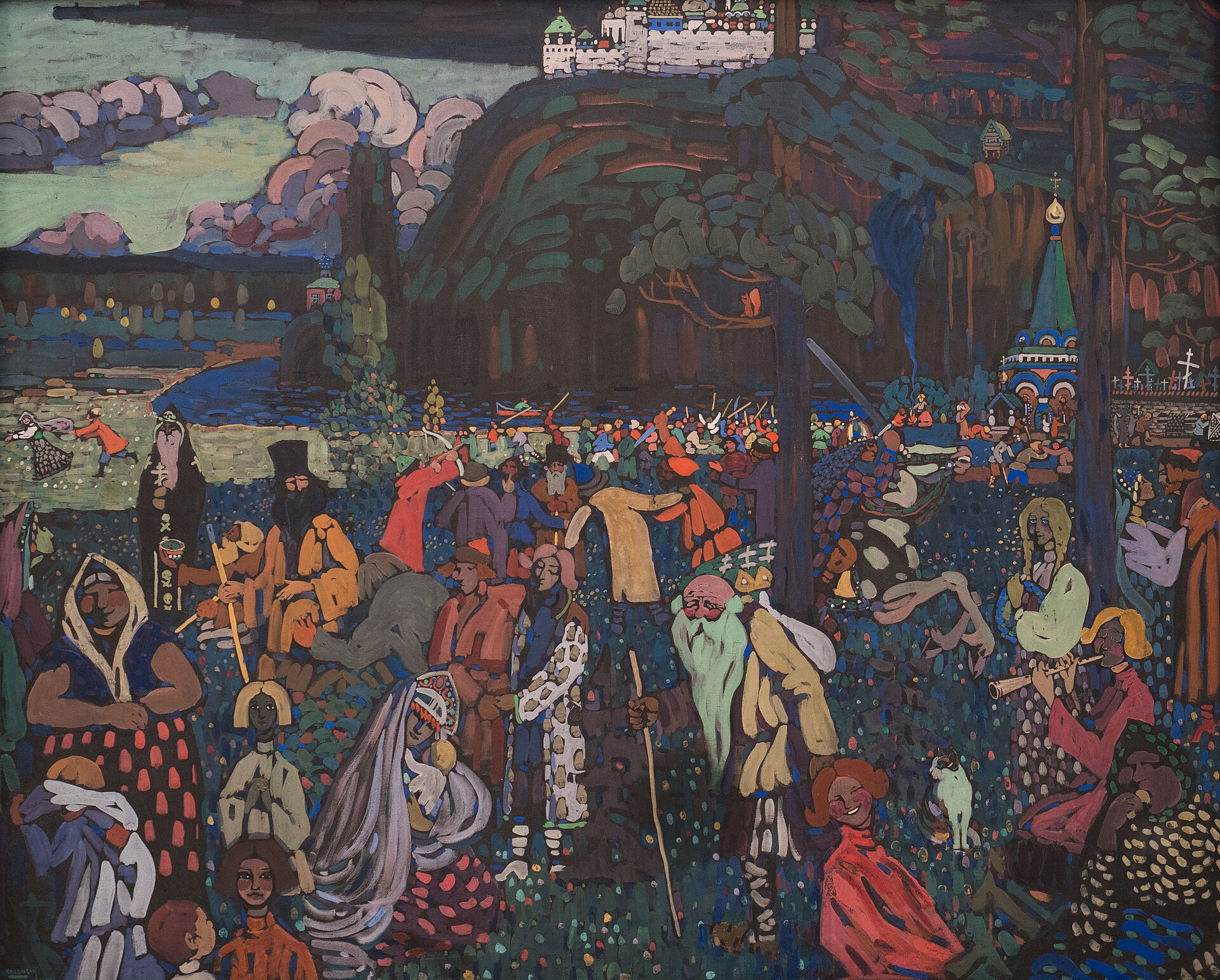 Shown: Bild mit Haeusern (Painting with Houses), Wassily Kandinsky
On 3 April 2026 a New York court decided a Nazi-era laches defence on the facts.
8 min read
An accession number dates a museum's custody, not the object. Five institutions in this archive use five incompatible formats...
9 min read
Across the disputed objects in this archive, the instrument that delivered one to its claimant was almost never a judgment.
9 min read
A restitution is itself an undocumented transfer. This archive holds an object delivered to a family that had never owned it, a...
12 min read
Location is the fastest-decaying line on any object record. Of 223 records published here, 84 know where the object is only...
11 min read
Last verified 17 September 2026
One artwork and its story every Tuesday, with the picture: who owned it, what it made, and what closes soon in the exhibition calendar. No promotion, and nothing we cannot cite.
We send one email to confirm the address and keep nothing else. Every letter carries a one-click unsubscribe. How we handle your data.
