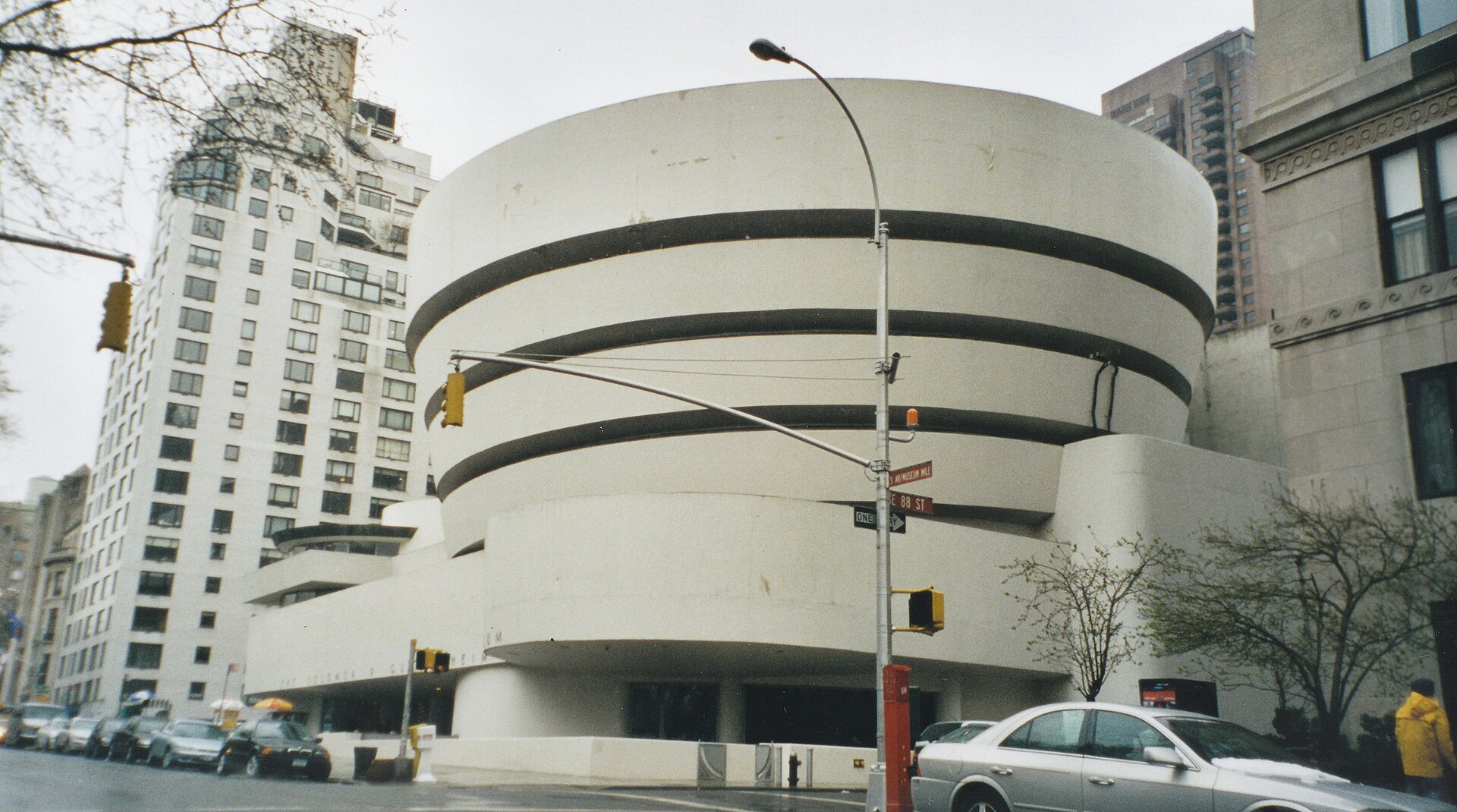
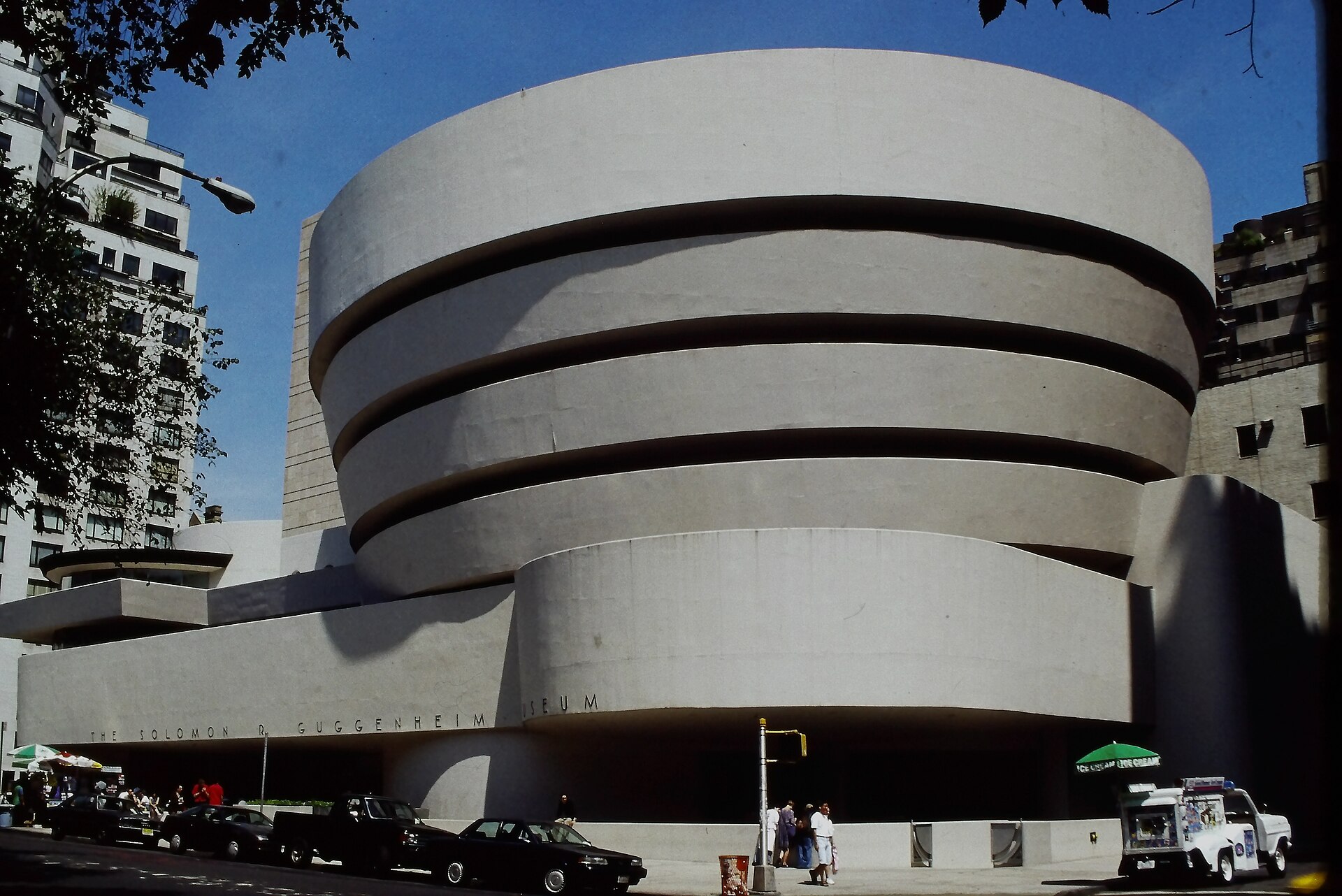
The spiral exterior of Frank Lloyd Wright's building on Fifth Avenue at 88th Street, across from Central Park.
Gunnar Klack, CC BY-SA 4.0Solomon R. Guggenheim Museum
Museum · Founded 1937
Open, admission and hours confirmed 21 August 2026 · 21 sources
On this page 18 sections
ContentsClose
The Guggenheim's real strength is depth in two narrow, well-chosen bands rather than breadth across the whole of modern art. The first is Vasily Kandinsky, whose work the museum can follow from his pre-First World War Munich years through the Bauhaus and into his final period near Paris, a run built on Solomon Guggenheim's own direct purchases from the artist starting in the late 1920s. The second is the postwar American and European art bought in bulk from Giuseppe and Giovanna Panza di Biumo between 1990 and 1992 - Flavin, Judd, Morris, Nauman, Weiner and Irwin among more than 350 works - which gave a museum built for European abstraction a serious postwar wing almost overnight. The Thannhauser gift supplies most of what a visitor expecting Impressionist and Post-Impressionist painting will actually find. What the museum does not offer is comprehensive survey coverage of any period: with roughly 8,000 works and only a fraction on view at a time, it is a collection of concentrations rather than a chronological walk through modern art.
| Kind | Museum |
|---|---|
| Founded | 1937 |
| City and country |  New York, United States New York, United States |
| Address | 1071 Fifth Avenue, New York, NY 10128, United States |
| Website | guggenheim.org |
| Status | Open, confirmed |
| Record last verified |
Visiting
- Hours
- Every day10:30 to 17:30Members-only hours on select Mondays, 6:00-8:00 pm. The museum store is open 10:30 am to 6:00 pm and Cafe Rebay 10:30 am to 4:00 pm.
- Closed
- No regular weekly closing day. One-off exceptions on the museum's own current calendar: early close at 3:00 pm on September 22, November 9 and November 14, 2026, and a full closure on Tuesday, November 10, 2026..
- Admission
- General AdmissionUSD 16Temporary reduced rate, in effect August 3 to September 17, 2026, while the rotunda ramp is closed for exhibition installation. Check the museum's own visit page for the rate that applies after that date.
- Students and Seniors 65+ (with ID)USD 12
- Visitors with DisabilitiesUSD 12One carepartner admitted free per visitor
- Children under 12FreeFree
- MembersFreeFree
- Tickets
- guggenheim.org/visit The museum's own ticket page.
- Do I need to book?
- Not required. Advance tickets are recommended for faster entry; walk-in tickets are sold at the Admissions desk. All visitors pass through a weapons detection system on arrival, which can add a short wait even for ticket and member entry.
- Address
- 1071 Fifth Avenue, New York, NY 10128, United States MapSubway 4, 5, 6 and Q trains
Bus M1, M2, M3 or M4 on Madison or Fifth Avenue - Website
- guggenheim.org
- Telephone
- +1 212 423 3500
- [email protected]
Before you go how long, access, photography, bags, eating, shop
- How long to allow
- Most first-time visitors budget one and a half to two hours. There is no time limit once inside, and the rotunda's ramp is itself a continuous quarter-mile climb rising ninety-two feet to the skylit dome.
- Access
- The museum publishes a dedicated accessibility page and runs a separate phone line for visitors with disabilities; a carepartner is admitted free alongside a disability ticket.
- Photography
- Flash-off still photography for personal, non-commercial use is permitted throughout unless a specific gallery says otherwise. Tripods and camera extension poles are not allowed.
- Bags
- Free coat check on the ground floor. Backpacks, long umbrellas, musical instruments and packages must be checked if they are smaller than 22 by 14 by 9 inches; anything larger cannot be brought in or checked at all.
- Eating
- Cafe Rebay, named for the museum's first director, serves coffee, pastries and light food daily from 10:30 am to 4:00 pm, with views toward Central Park. Outside food and drink are not permitted, other than personal water bottles.
- Shop
- A museum store on the ground floor sells books and art- and architecture-themed goods; members receive a 10 percent discount.
Prices and hours change. We take them from the institution's own pages and print the day we read them, and you can check the current position at the source we used. Confirm before you travel.
What is inside
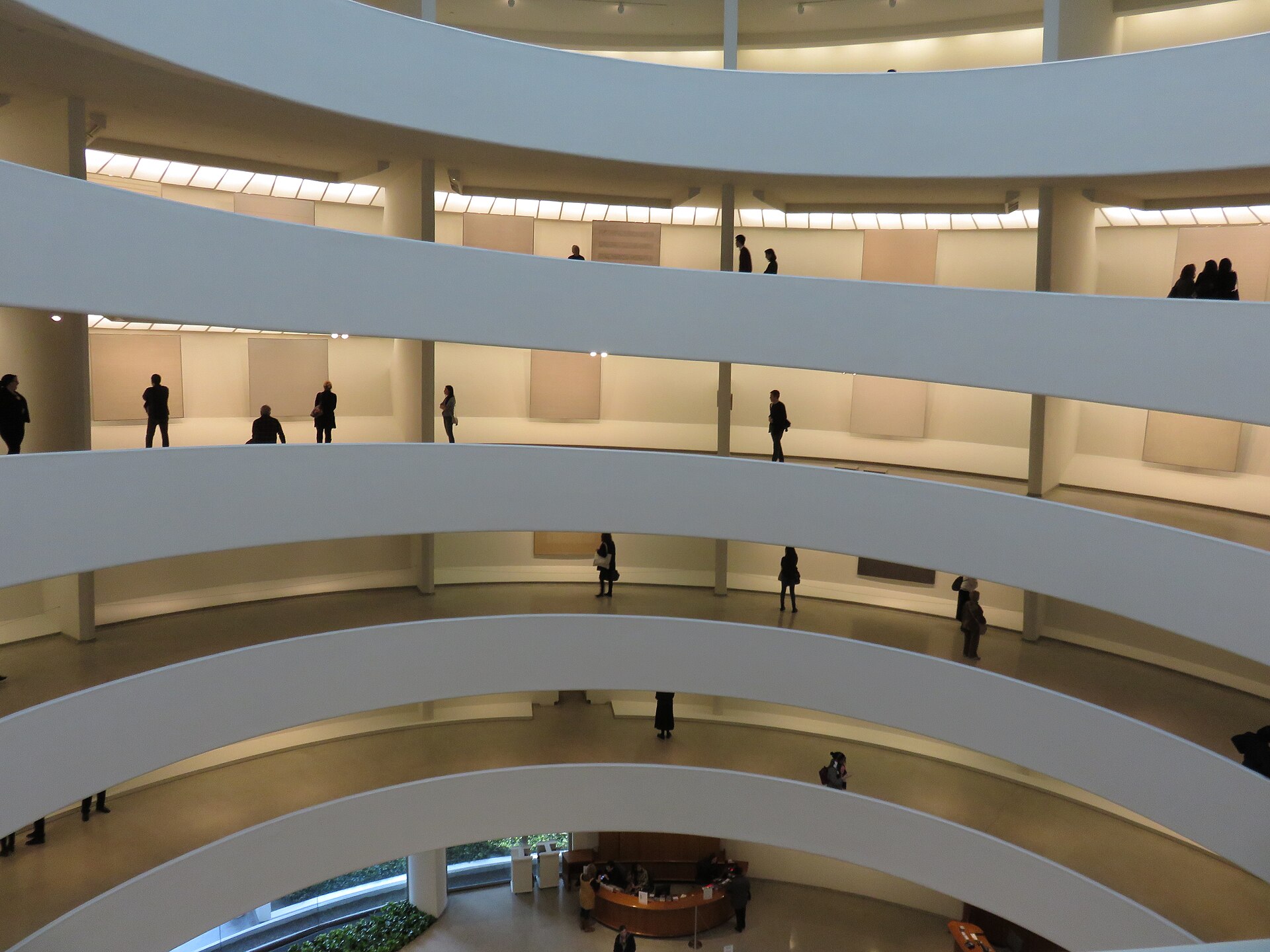
Photograph by Antony-22 · CC BY-SA 4.0 Rotunda and the spiral ramp
Frank Lloyd Wright's six-story helical ramp, the museum's original and largest exhibition space, used for its biggest temporary and thematic shows. Through September 18, 2026 the ramp itself is closed to the public for the installation of a Taryn Simon exhibition, though the rest of the museum keeps its normal hours.
Thannhauser Collection galleries
Ground-level rooms holding the Impressionist, Post-Impressionist and early modern French paintings given by Justin Thannhauser and later his widow Hilde, including the Picasso, van Gogh and Chagall paintings described in this page's highlights. Shown on a long-term, ongoing basis rather than rotated with the temporary programme.
Tower Galleries
The 1992 annex designed by Gwathmey Siegel and Associates, which doubled the museum's exhibition space when it opened. Used for contemporary and special exhibitions, including material drawn from the postwar American and Panza holdings.
Gail May Engelberg Center for Arts Education
The museum's education wing, used for school, family, teen and youth programmes. It opened as the Sackler Center for Arts Education and was renamed in 2022 after the museum dropped the Sackler name.
What to see first
Composition 8 (1923)
Vasily KandinskyA geometric abstraction from Kandinsky's Bauhaus years, held as part of the founding non-objective collection Solomon Guggenheim began assembling through direct purchases from the artist in the late 1920s, before the Foundation itself existed.6
Paris Through the Window (1913)
Marc ChagallPainted in Chagall's first Paris years, before the outbreak of the First World War sent him back to Russia; one of two major Chagalls from that period the museum holds.7
I and the Village (1911)
Marc ChagallThe other of the two, painted in the same Paris years, and among the most reproduced works from the museum's early twentieth century holdings.7
Woman with Yellow Hair (1931)
Pablo PicassoEntered the collection through the 1963 gift of Justin Thannhauser, the dealer's son who preserved his father's Munich gallery stock through the Nazi years and settled it in New York.8
Landscape with Snow (February 1888)
Vincent van GoghThe painting the White House asked to borrow for the presidential residence in September 2017. The museum declined, citing the work's fragility and travel restrictions, and offered Maurizio Cattelan's gold toilet instead - a refusal later complicated by loans of the same picture to four European exhibitions between 2018 and 2023.19
Bird in Space
Constantin BrancusiOne of Brancusi's most reduced sculptural forms, from an artist whose 1955 retrospective at the Guggenheim, his first in the United States, helped establish his reputation there.9
America (2016)
Maurizio CattelanAn 18-karat gold, fully plumbed working toilet that an estimated 100,000 visitors used during its year on view from September 2016. Later stolen from a loan exhibition at Blenheim Palace in England in September 2019 and never recovered.18
Comedian (2019)
Maurizio CattelanCattelan's duct-taped banana, one of an edition of three. A second edition sold at auction for 6.2 million dollars in 2024, but the Guggenheim's copy came to the museum as a donation and is not for sale.19
The Panza Collection
Various, including Dan Flavin, Donald Judd, Robert Morris, Bruce Nauman, Lawrence Weiner and Robert IrwinMore than 350 works of Minimal, Post-Minimal and Conceptual art bought from Giuseppe and Giovanna Panza di Biumo between 1990 and 1992, funded in part by a deaccessioning sale that remains one of the more contested in American museum history.5
Exhibitions on now
Past exhibitions here
A museum commissioned to be unlike any other
In June 1943 Hilla Rebay, the artist and adviser who had introduced the mining heir Solomon R. Guggenheim to European abstraction more than a decade earlier, wrote to Frank Lloyd Wright and asked him to design a home for Guggenheim's collection of non-objective art. Guggenheim's one instruction was that the building should look like nothing else in the world. Wright had no love for the site: writing in 1949, he said he could think of several more desirable places to build a great museum, but that New York would have to do. He settled on Fifth Avenue between 88th and 89th Streets for one reason above the rest, its proximity to Central Park, the closest the city came to open ground and light. The contract dated to 1943; the building did not open until October 21, 1959, sixteen years and 749 recorded drawings later, six months after Wright's own death that April.
What Wright built was meant to work as an instrument rather than a container: a continuous, gently rising ramp winding a quarter of a mile and ninety-two feet up to a skylit dome, so a visitor could ride an elevator to the top and walk back down through the collection along one unbroken path rather than through a sequence of separate rooms. Wright described the goal as creating the best possible setting for showing paintings or listening to music, and local resistance to the design had already stalled construction for years before Guggenheim's death in 1949.
A building that fought its critics before it won them over
Twenty-one painters signed a letter of protest against the design before it opened, arguing that the ramp's inward-sloping walls and curved bays made it impossible to hang paintings properly. Wright dismissed the signatories in a letter of his own that December and pressed on. When the museum opened, the New York Times critic John Canaday used his opening-day review to argue the spiral had been built with more regard for effect than for showing pictures, and that the building and the paintings hung in it worked against each other. Other critics disagreed just as strongly: the Herald Tribune's Emily Genauer called it the most beautiful building in America even while noting it had already been mocked as a corkscrew, a washing machine and a marshmallow, and the Times Magazine's architecture writer likened it to an inverted cupcake and a giant Jello mold in the same breath as praising it. Six decades on, the criticism has faded and the praise has not: the building is one of eight Frank Lloyd Wright structures in the United States inscribed together on the UNESCO World Heritage List in 2019, and it is routinely named among the most significant buildings of the twentieth century regardless of what happens to be on view inside it.
The non-objective collection Guggenheim and Rebay built
The building's first purpose was to house a specific idea: non-objective art, the term Rebay and Guggenheim used for abstraction that referred to nothing in the visible world. Guggenheim had begun buying paintings by Vasily Kandinsky directly in the late 1920s, years before the Foundation existed, and a predecessor institution, the Museum of Non-Objective Painting, had already opened on East 54th Street in 1939 to show that collection before Wright's building was even commissioned. Kandinsky had set out the theory behind his own paintings in a 1911 treatise arguing that color and form could carry meaning without depicting anything at all, and the museum's collection is still organized around that argument: paintings such as Composition 8 from 1923 and Several Circles from 1926 sit alongside dozens of other Kandinsky canvases and watercolors tracing the idea from his Munich years through the Bauhaus to his final period in France. The Foundation that formalized this collection was established in 1937, and it is that year, not 1959, the institution itself dates its own founding to.
The Thannhauser gift
Much of what the Guggenheim shows from outside the non-objective tradition arrived as a single gift. Heinrich Thannhauser had run the Moderne Galerie in Munich, the gallery where Kandinsky's own circle first exhibited before the First World War; his son Justin Thannhauser fled Germany for New York and, through a 1963 gift and later bequests from his widow Hilde, gave the museum the core of what is now called the Thannhauser Collection. It is the reason a museum built for abstraction also owns Impressionist and Post-Impressionist paintings: Pablo Picasso's Woman with Yellow Hair from 1931, Vincent van Gogh's Landscape with Snow from February 1888, and Marc Chagall's Paris Through the Window and I and the Village, both painted in the Paris years just before 1914. These rooms are the part of the museum most likely to be on a visitor's list even if they came for the building alone.
Selling to buy: the deaccessioning that paid for postwar American art
In May 1990, under director Thomas Krens, the Guggenheim sold three works from its own founding collection at Sotheby's in New York - a Kandinsky, a Chagall and a Modigliani - for a combined 47 million dollars. The sale helped fund the Foundation's purchase, between 1990 and 1992, of more than 350 works from the collectors Giuseppe and Giovanna Panza di Biumo: one of the most complete surviving collections of Minimal, Post-Minimal and Conceptual art from the 1960s and 1970s, with major holdings of Dan Flavin, Donald Judd, Robert Morris, Bruce Nauman, Lawrence Weiner and Robert Irwin. The deaccessioning was not received quietly; the artist Donald Judd wrote publicly against it that same year, and the sale is still cited as one of the more contested American examples of a museum trading its own collection to buy another one. Whatever the argument over the method, the Panza acquisition gives the Guggenheim's twentieth century holdings a second center of gravity alongside the Kandinsky and Thannhauser material, and the museum spent much of the 2010s on a dedicated research project, concluded in 2021, cataloguing the fabrication and ownership history of more than 140 of those Panza works.
A tower, a network, and a name that came off the wall
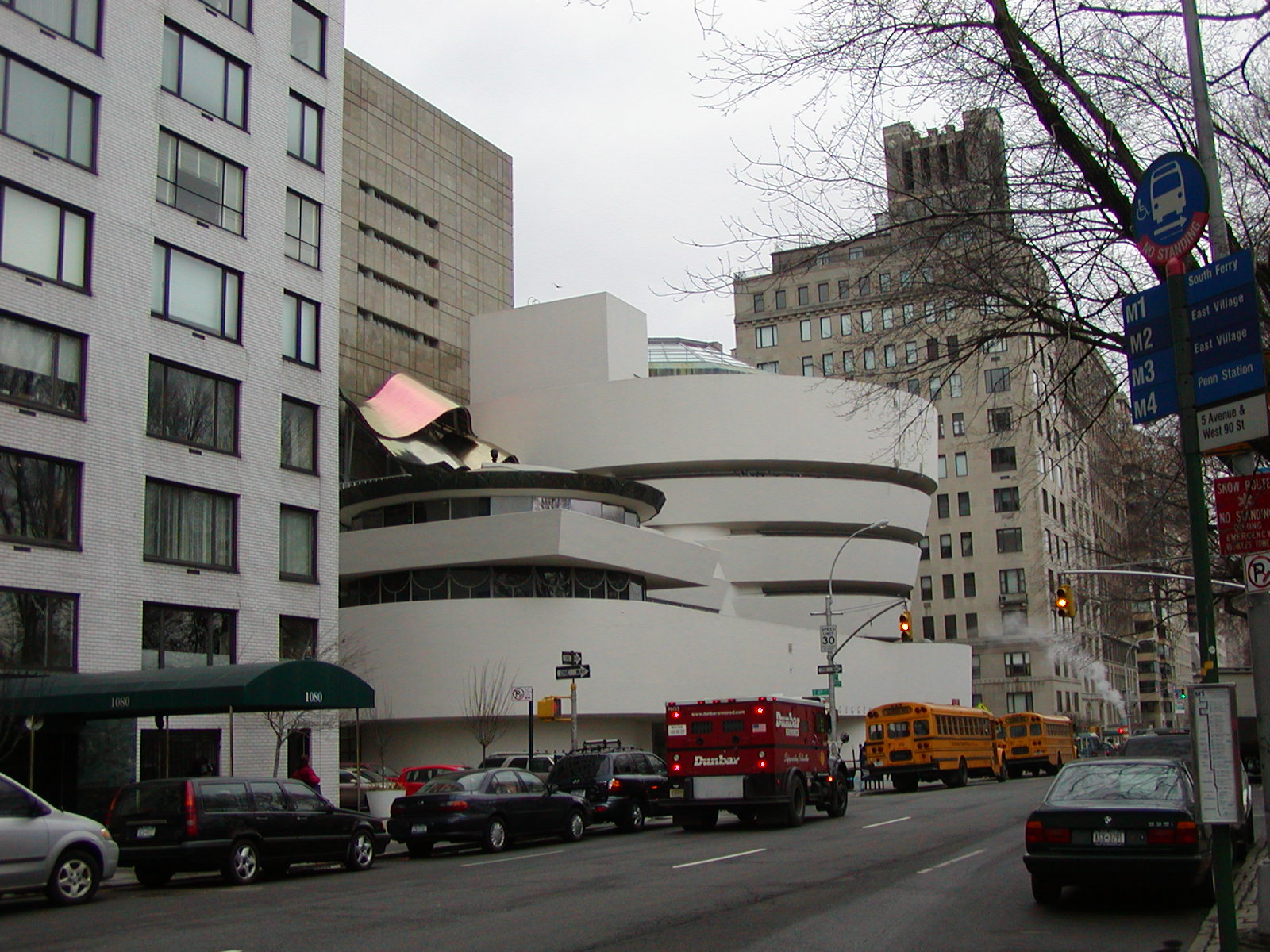
The museum doubled its own exhibition space in 1992 with a ten-story limestone annex designed by Gwathmey Siegel and Associates, built alongside a broader renovation of the original rotunda. By then the Guggenheim name had already begun to travel: the Foundation now operates what it calls a constellation of museums that includes the Peggy Guggenheim Collection in Venice, a separate institution built around Solomon's niece's own collection; the Guggenheim Museum Bilbao, which opened in 1997; and a Guggenheim Abu Dhabi still under development. Each is a distinct institution with its own director and its own collection, and none of them is the subject of this page. Nearer home, the museum's education wing, opened as the Sackler Center for Arts Education, dropped the Sackler name in 2022, part of a wider pattern of museums distancing themselves from a family whose fortune came from the marketing of opioids; the space is now the Gail May Engelberg Center for Arts Education.
What the museum has not resolved
In 2019 the Guggenheim gave Chaedria LaBouvier the job of organizing Basquiat's Defacement: The Untold Story, making her the first Black curator to lead a show there. She subsequently accused the museum's longtime chief curator, Nancy Spector, and its leadership of racist treatment, including being excluded from a public panel about the exhibition she herself had curated. Twenty-two of the twenty-three members of the museum's curatorial department signed a letter that summer describing a work environment that enabled racism and other discrimination. The Guggenheim hired the law firm Kramer Levin to investigate; in October 2020 the museum announced the inquiry, which reviewed more than 15,000 documents, had found no evidence LaBouvier was treated adversely because of her race, and that Spector, after 34 years at the museum, was leaving anyway. LaBouvier said she had never been interviewed for the investigation and had been warned by a board member in 2019 not to go up against the Guggenheim; the museum said its investigators had tried to reach her. Separately, in 2019, roughly 140 of the museum's maintenance and installation staff unionized, the first time Guggenheim employees had organized in this way.
The toilet the White House could not have
Maurizio Cattelan's America, a fully functioning 18-karat gold toilet, was installed as a working restroom for visitors from September 2016, and in its year on view an estimated 100,000 people used it. On its last day in New York, September 15, 2017, Nancy Spector, still the museum's chief curator, wrote to the White House's curatorial office, which days earlier had asked to borrow van Gogh's Landscape with Snow for the President's residence. She declined, citing the painting's fragility and its restrictions on travel, and offered America instead. The White House did not take her up on it, and records later showed the same van Gogh went on loan to four European exhibitions between 2018 and 2023. The toilet went to a real exhibition two years later, at Blenheim Palace in Oxfordshire, where thieves stole it within minutes on the morning of September 14, 2019; it has never been recovered and is widely presumed melted down for its scrap gold value, worth close to 9 million dollars at 103 kilograms. A related work, an edition of Cattelan's taped-banana sculpture Comedian, was later donated to the Guggenheim outright, so the museum that lost one Cattelan sculpture to theft still owns another.
What visitors say
Visitors consistently say the building itself, more than any single work inside it, is the reason to come: the continuous spiral ramp and the light falling through the dome are what people describe first, and the architecture is treated as inseparable from the collection rather than a container for it. Complaints cluster around cost weighed against how quickly the single building can be seen, and around how small a share of the roughly 8,000-work collection is on view against expectations set by the Guggenheim name.
What is praised, what is criticised
- Praised: The Frank Lloyd Wright building itself - the continuous ramp, the dome light and the way the architecture frames every gallery visit
- Praised: The compact scale, which most visitors clear in under two hours, unlike the much larger encyclopedic museums nearby
- Criticised: General admission has risen with successive price increases, and some visitors say it is steep for a single building that does not take long to see
- Criticised: Only a small fraction of the roughly 8,000-work collection is on view at any time, and visitors expecting a survey of modern art on the scale of the city's larger museums report disappointment
- Criticised: The sloped, curving walls that made Wright's design controversial when it opened in 1959 still divide opinion; some visitors find them disorienting for looking closely at conventionally framed paintings
Ratings on other platforms
Tripadvisor: 3.7 from 5,609 ratings, read 21 August 2026
A platform average is a tertiary source: it moves, it is not audited, and we quote no visitor's words.
Questions about Solomon R. Guggenheim Museum
Where is Solomon R. Guggenheim Museum?
1071 Fifth Avenue, New York, NY 10128, United States.
How much does it cost to visit?
General Admission: USD 16; Students and Seniors 65+ (with ID): USD 12; Visitors with Disabilities: USD 12; Children under 12: free; Members: free. As confirmed 21 August 2026.
When is it open?
Every day 10:30-17:30. Closed: No regular weekly closing day. One-off exceptions on the museum's own current calendar: early close at 3:00 pm on September 22, November 9 and November 14, 2026, and a full closure on Tuesday, November 10, 2026. As confirmed 21 August 2026.
How do you get there?
Subway: 4, 5, 6 and Q trains; Bus: M1, M2, M3 or M4 on Madison or Fifth Avenue.
What should you see first?
Composition 8 (1923) (Vasily Kandinsky); Paris Through the Window (1913) (Marc Chagall); I and the Village (1911) (Marc Chagall); Woman with Yellow Hair (1931) (Pablo Picasso); Landscape with Snow (February 1888) (Vincent van Gogh); Bird in Space (Constantin Brancusi).
What we could not confirm
- Why the museum told the White House in September 2017 that Landscape with Snow could not travel, then lent the same painting to four European exhibitions between 2018 and 2023.
- Whether the Kramer Levin investigation into Chaedria LaBouvier's allegations against Nancy Spector and museum leadership has ever been published in full; the Guggenheim has said only that it found no evidence of race-based adverse treatment.
- Where Maurizio Cattelan's stolen America sculpture is now, or whether it survives in recognizable form.
Images
Sources
- 1Solomon R. Guggenheim Museum, Plan Your Visit (hours and admission), guggenheim.org, read 21 August 2026. guggenheim.org/visit
- 2Solomon R. Guggenheim Museum, Contact Us, guggenheim.org, read 21 August 2026. guggenheim.org/contact-us
- 3Solomon R. Guggenheim Museum, Visitor Policies and FAQ, guggenheim.org, read 21 August 2026. guggenheim.org/plan-your-visit/visiting-faq
- 4The Solomon R. Guggenheim Foundation Announces the Appointment of Dr. Melissa Chiu as Director of the Solomon R. Guggenheim Museum in New York, press release, guggenheim.org, 9 April 2026. guggenheim.org/press-release/the-solomon-r-guggenheim-foundation-announces-the-appointment-of-dr-melissa-chiu
- 5The Panza Collection Initiative, guggenheim.org, read 21 August 2026. guggenheim.org/conservation/the-panza-collection-initiative
- 6Vasily Kandinsky, Collection Online, guggenheim.org, read 21 August 2026. guggenheim.org/artwork/artist/vasily-kandinsky
- 7Marc Chagall, Collection Online, guggenheim.org, read 21 August 2026. guggenheim.org/artwork/artist/marc-chagall
- 8Pablo Picasso, Collection Online, guggenheim.org, read 21 August 2026. guggenheim.org/artwork/artist/pablo-picasso
- 9Constantin Brancusi, Collection Online, guggenheim.org, read 21 August 2026. guggenheim.org/artwork/artist/constantin-brancusi
- 10Vincent van Gogh, Collection Online, guggenheim.org, read 21 August 2026. guggenheim.org/artwork/artist/vincent-van-gogh
- 11The Architecture of the Solomon R. Guggenheim Museum, teaching materials, guggenheim.org, read 21 August 2026. guggenheim.org/teaching-materials/the-architecture-of-the-solomon-r-guggenheim-museum
- 12Solomon R. Guggenheim Museum, Wikipedia, read 21 August 2026. en.wikipedia.org/wiki/Solomon_R._Guggenheim_Museum
- 13Wikidata Q201469, Solomon R. Guggenheim Museum, read 21 August 2026. wikidata.org/wiki/Q201469
- 14Concerning the Solomon R. Guggenheim Museum, Frank Lloyd Wright Foundation, read 21 August 2026. franklloydwright.org/concerning-the-solomon-r-guggenheim-museum/
- 15Wright-Designed Guggenheim Museum Opens, Research Starters, EBSCO, read 21 August 2026. ebsco.com/research-starters/history/wright-designed-guggenheim-museum-opens
- 16The Guggenheim: Critical Response, PBS American Experience companion to Frank Lloyd Wright, read 21 August 2026. pbs.org/kenburns/frank-lloyd-wright/guggenheim-critics
- 17Eileen Kinsella, Veteran Guggenheim Curator Nancy Spector Has Been Cleared of Racial Bias Allegations - But She's Leaving the Museum Anyway, Artnet News, 8 October 2020. news.artnet.com/art-world/guggenheim-nancy-spector-out-investigation-ends-1914195
- 18Javier Pes, Three More People Are Arrested in Connection With the Theft of Maurizio Cattelan's Solid Gold Toilet From an English Palace, Artnet News, 23 October 2019. news.artnet.com/art-world/arrests-reward-cattelan-toilet-1686652
- 19Martin Bailey, What Links Van Gogh, Trump, a Golden Toilet and Cattelan's 6.2m Dollar Banana, The Art Newspaper, 13 December 2024. theartnewspaper.com/2024/12/13/what-links-van-gogh-trump-a-golden-toilet-and-cattelans-62m-banana
- 20Solomon R. Guggenheim Museum, Tripadvisor listing and reviews, read 21 August 2026. tripadvisor.com/Attraction_Review-g60763-d108687-Reviews-Solomon_R_Guggenheim_Museum-New_York_City_New_York.html
- 21Wikimedia Commons, Category Exterior of the Solomon R. Guggenheim Museum and associated file pages, licence and author metadata read 21 August 2026. commons.wikimedia.org/wiki/Category:Exterior_of_the_Solomon_R._Guggenheim_Museum