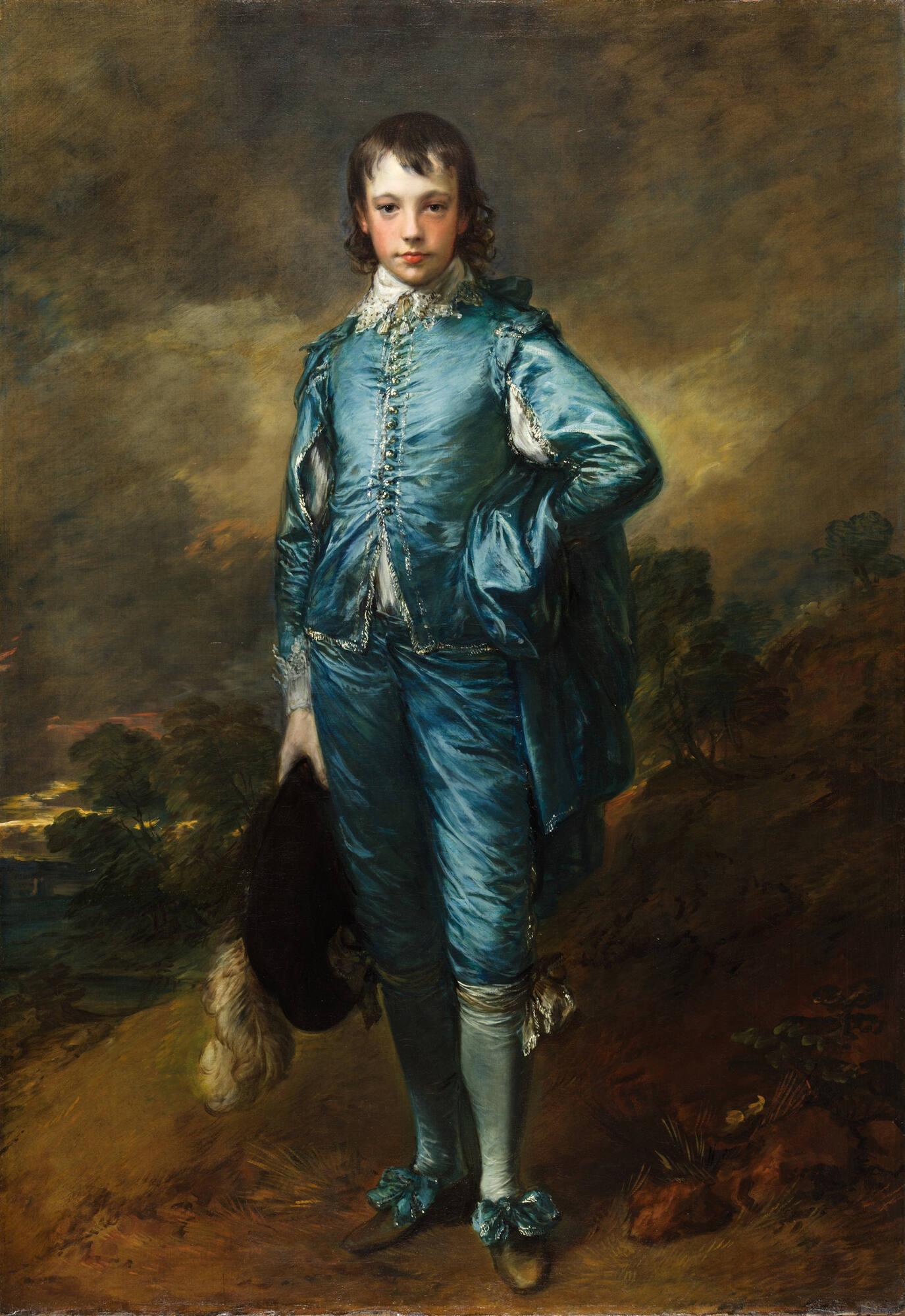
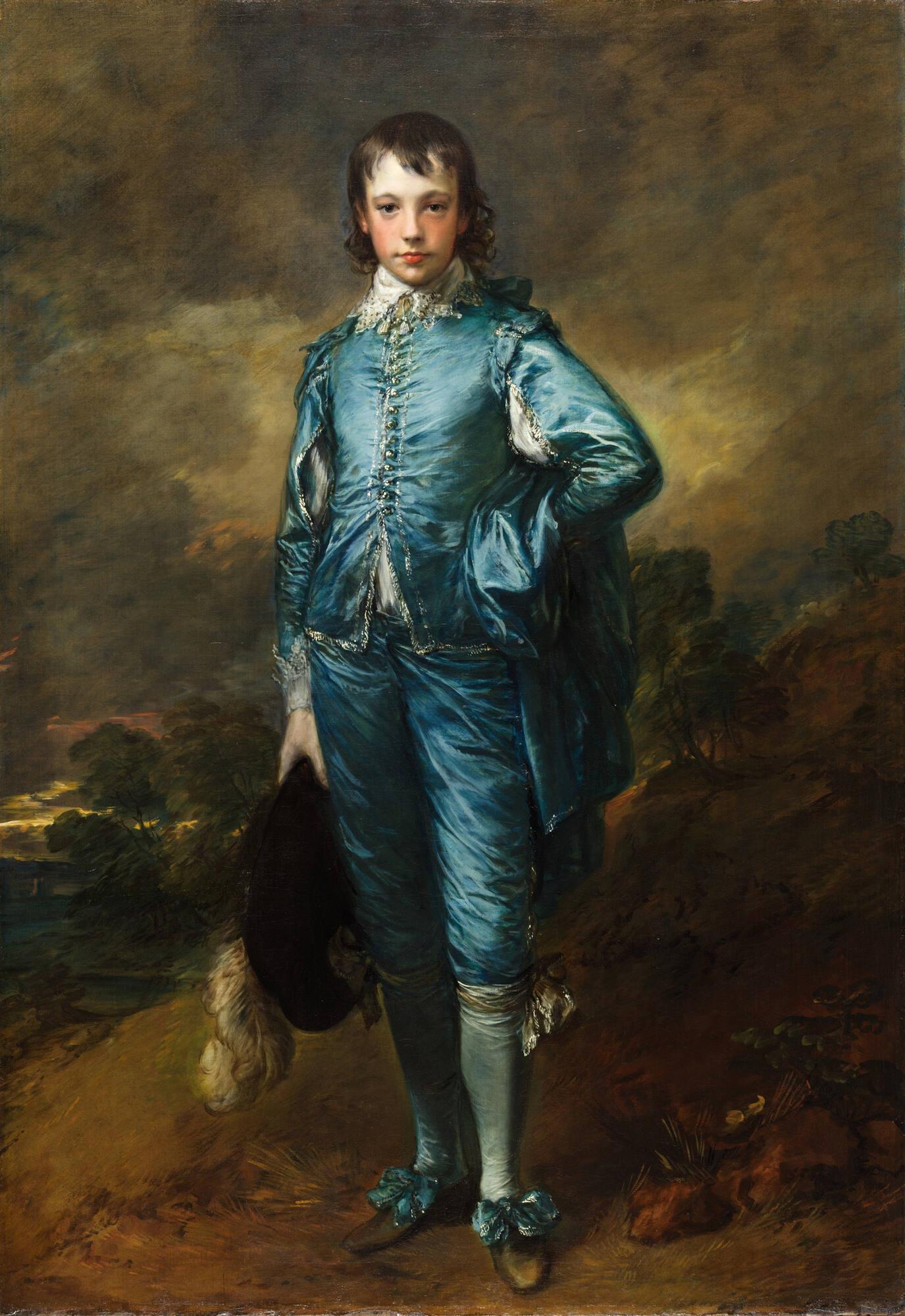
The Blue Boy
c. 1770 · Oil on canvas
The Huntington Library
 English · 1727-1788
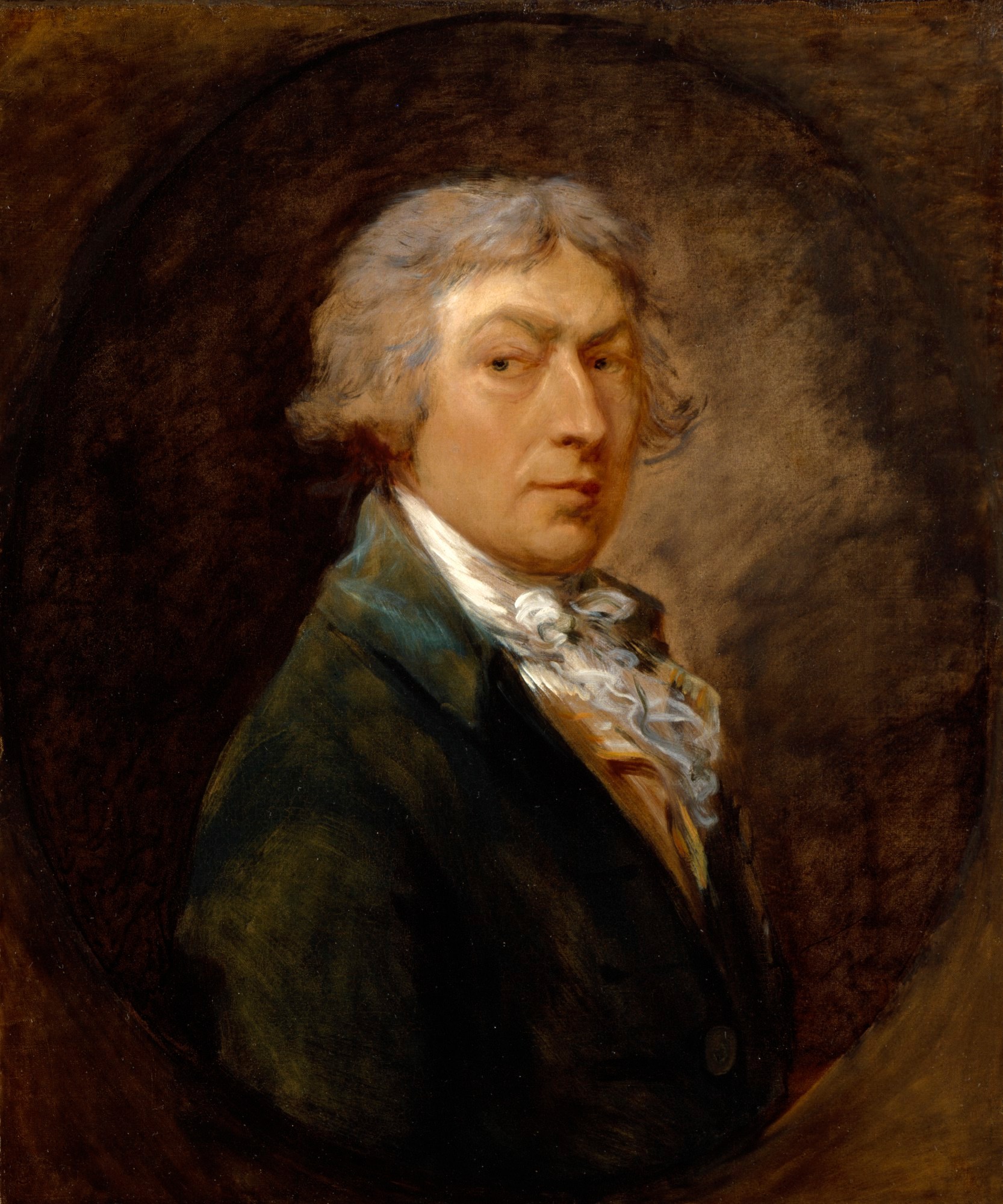
Self-portrait, oil on canvas in a painted oval, dated 1787 on the Commons record, Royal Academy of Arts, London (03/1395). The Courtauld Gallery calls it his most famous self-portrait, and the sitter is not in dispute.
Royal Academy of Arts, London| Worked as | Painter, Draughtsman, Printmaker |
|---|---|
| Born | Baptised 14 May 1727 (birth date not recorded) · Sudbury, Suffolk |
| Died | 2 August 1788 · Schomberg House, Pall Mall, London |
| Nationality | English |
| Movement | British portraiture and landscape, eighteenth century |
| In this archive | 1 artwork |
| Sources | 25 cited |
| Last verified |
About this page 1 artwork in the archive · Last verified · 25 sources cited
Thomas Gainsborough was the most successful English portrait painter outside Sir Joshua Reynolds's orbit and, by his own account, a landscape painter who was tired of faces. He wrote to a friend that he was sick of portraits and wished to take his viol-da-gamba and walk off to some sweet village to paint landskips. The people who walked through his studio after he died, at his widow's exhibition of 1789, ranked him the same way: as a painter of pastoral and landscape subjects who had practised portraiture to make a living. The modern order is the reverse: the public knows him for portraits such as The Blue Boy and Mr and Mrs Andrews, although his auction record belongs to a landscape.
There is no single number for his work and no body that rules on it. The portraits, fancy pictures and copies run to roughly 1,100 paintings in Hugh Belsey's two-volume catalogue of 2019, which added nearly 200 new attributions. The landscapes sit in John Hayes's catalogue of 1982 and the drawings, over 1,100 by one count, in the Hayes and Belsey catalogue. Attribution is a matter of one living specialist's eye, tested against a nephew, Gainsborough Dupont, who was trained to paint like him and finished some of his canvases.
The fact a reader is least likely to know is how fast the imitation started. Within months of his death a London newspaper was warning that an impostor at Bath had been turning out pictures and drawings in his manner, and his widow staged the sale of his studio in his own rooms, in the newspapers' phrase, so that a buyer could be sure of a genuine work. Twenty-five landscape drawings that sat in the Royal Collection under the name of Sir Edwin Landseer were identified as his only in 2017, which tells you the error can run the other way too.
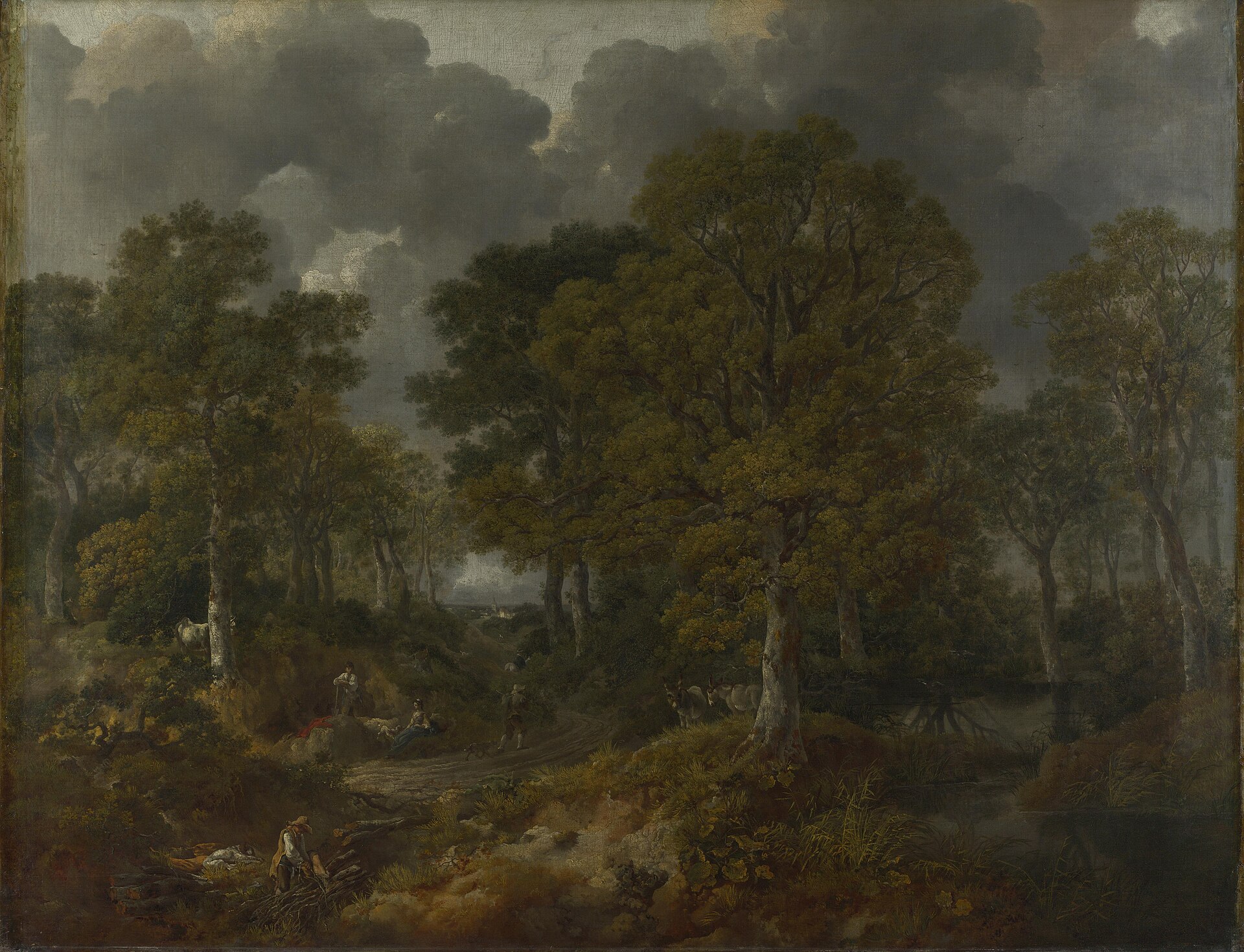
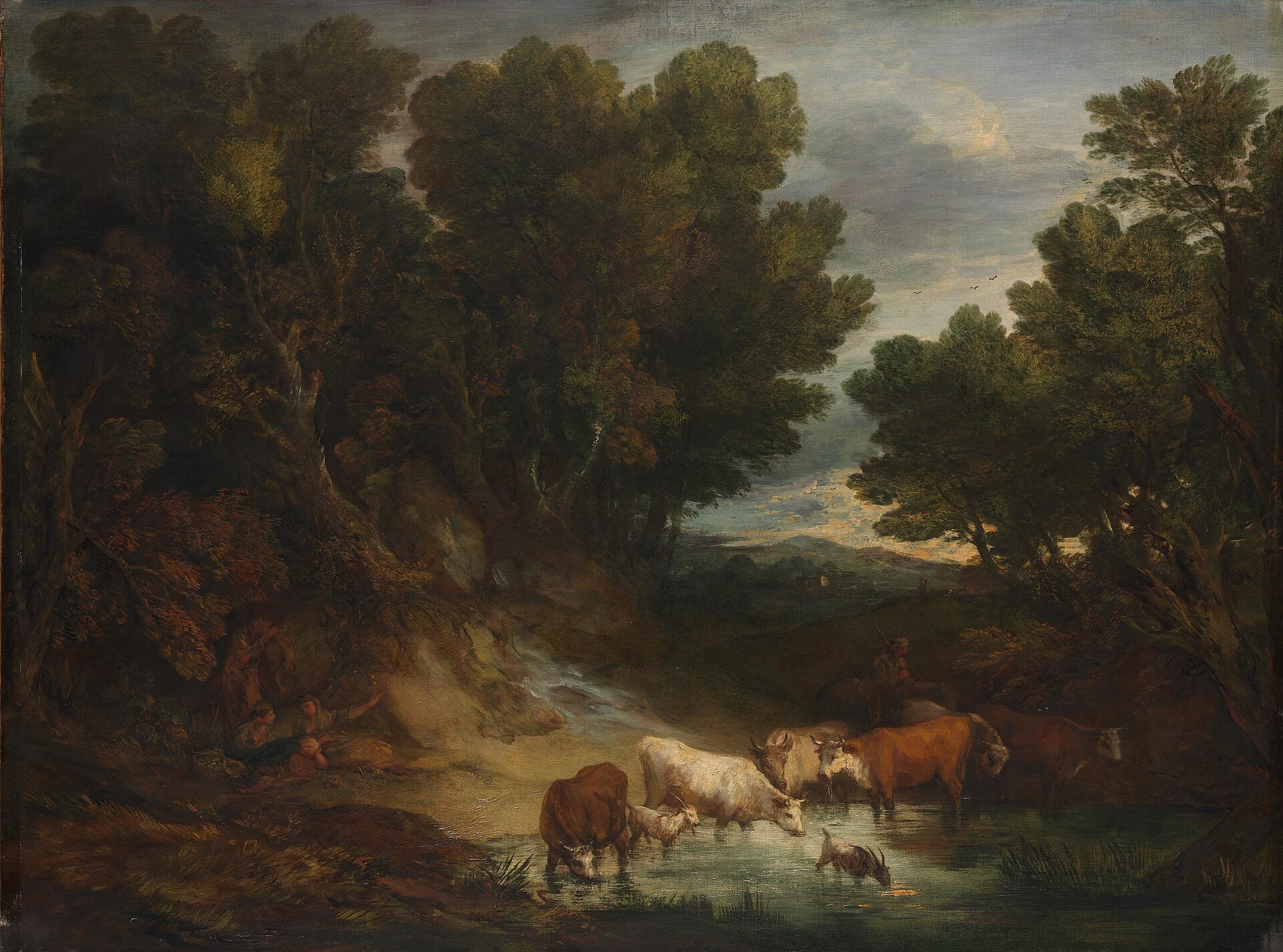
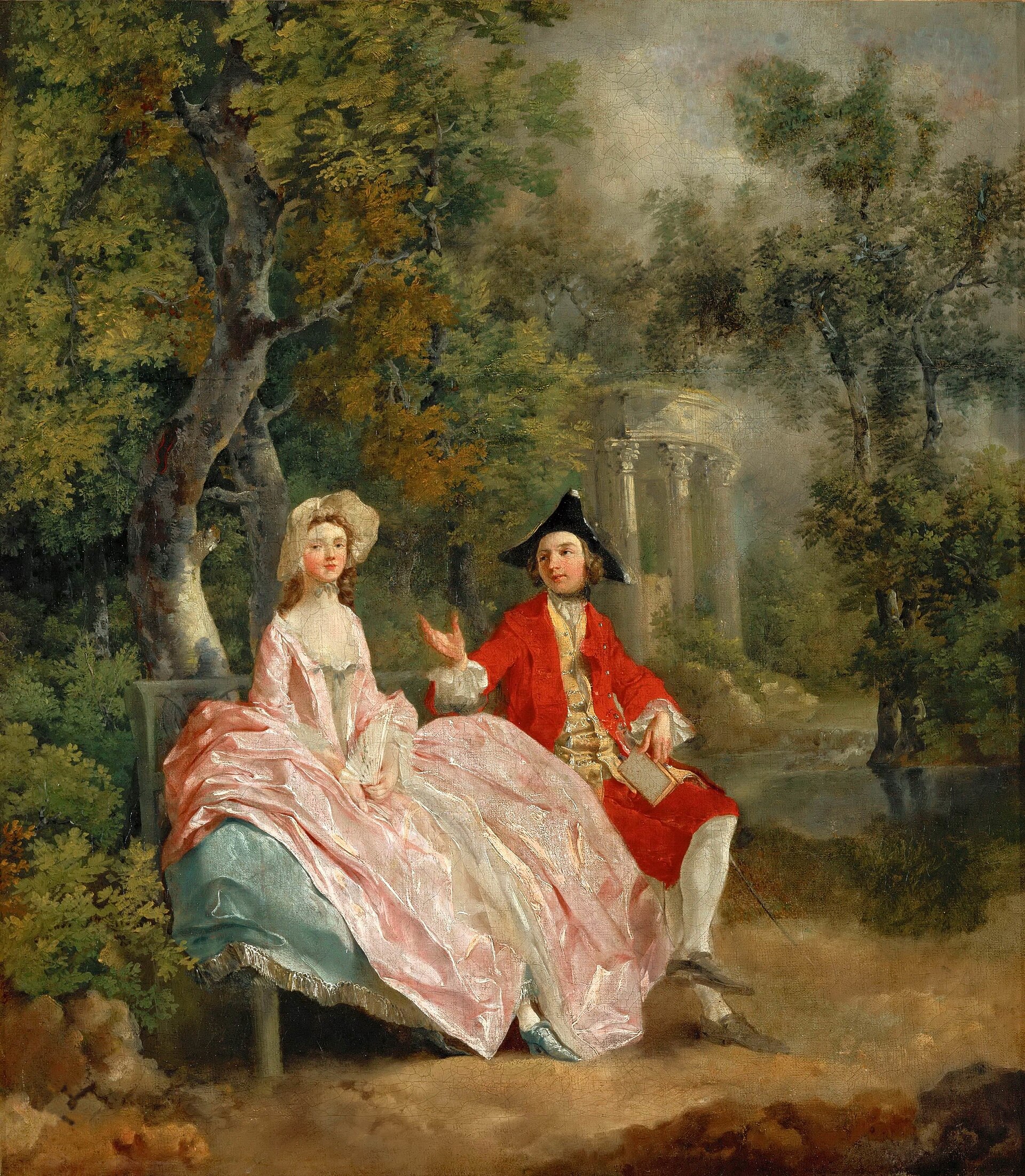
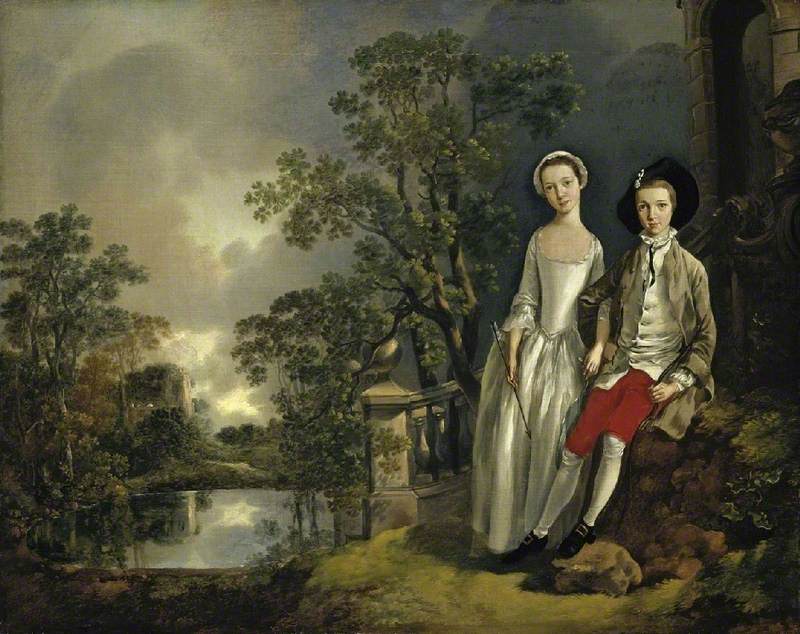
Baptised in May at the Independent Meeting House, Friars Street, Sudbury; the day of birth is not recorded.4
Sent to London at thirteen; Gainsborough's House says he studied under Hubert Gravelot and Francis Hayman, but Whitley found the evidence for Hayman slight, resting on a note by Edward Edwards twenty years after the death; the National Gallery's catalogue says he left school about 1742.196
Paints Mr and Mrs Andrews, probably after Robert Andrews took sole possession of Auberies in 1750.67
Opens an account at Hoare's bank, which will mostly record an annuity of 200 pounds a year.4
Invited to be one of the inaugural members of the Royal Academy; paints Ignatius Sancho in the same year.1817
Apprentices his nephew Gainsborough Dupont on 12 January.4
Henry Hoare pays 80 guineas for Going to Market, Early Morning on 6 July; Gainsborough boycotts the Academy exhibitions from this year to 1776.818
Withdraws all his pictures from the Academy in April after a quarrel over the hanging of the Three Eldest Princesses and shows privately at Schomberg House.184
Raises his price for a whole-length to a maximum of 160 guineas.4
Dies at Schomberg House at 2 a.m. on 2 August; Reynolds delivers his Fourteenth Discourse on 10 December.45
Widow's exhibition and sale at Schomberg House, 30 March to 31 May; afterwards Henry Bate warns in the Morning Herald of imitations, two of which are offered at Greenwood's sale of 11 June.4
Christie's sale of unfinished portraits and studio contents after Dupont's death; three portraits sell for thirteen shillings.412
The Woodman is destroyed in the fire at Exton Park on 23 May.4
Portrait of the Duchess of Devonshire sells at Christie's and is stolen from Agnew's gallery weeks later; returned in 1901.415
The Blue Boy sold by the Duke of Westminster through Duveen to Henry Huntington for 728,000 dollars; displayed at the National Gallery before it left in 1922.13
Mr and Mrs Andrews, largely unknown until then, is lent to the Gainsborough bicentenary exhibition at Ipswich.6
Ellis Waterhouse publishes the standard catalogue of the portraits and related pictures.166
The National Gallery acquires Mr and Mrs Andrews through Agnew's after the Sotheby's sale of 23 March.6
John Hayes publishes The Landscape Paintings of Thomas Gainsborough in two volumes.8
Portrait of Miss Read, later Mrs William Villebois, sells at Christie's London on 5 July for a reported 6.5 million pounds, then a record for the artist.2416
Royal Collection identifies 25 Windsor landscape drawings as Gainsborough's, not Landseer's; Hugh Belsey proposes a list of rejected attributions.32
Belsey's catalogue of about 1,100 portraits, fancy pictures and copies appears; Going to Market, Early Morning makes 7.961 million pounds with premium at Sotheby's on 3 July.110
Export bar placed on Going to Market on 23 December 2019, with a licence decision deferred to 22 March 2020 and extendable to 22 September 2020.9
Kimbell Art Museum announces its acquisition of Going to Market, Early Morning.11
The auction record for Gainsborough stands at 7.961 million pounds with premium for the landscape Going to Market, Early Morning, sold at Sotheby's London on 3 July 2019 after a 7 million pound hammer, above the roughly 6.5 million pounds reported for the portrait of Miss Read, later Mrs William Villebois, at Christie's London in July 2011, a figure whose hammer or premium basis was not established. The 2019 picture had an unbroken provenance from the artist's banker and an original receipt, which the export committee also cited. The price history is older than the modern record: the Stolen Duchess made a record for a painting at Christie's in 1876 by Wikipedia's account, and the Blue Boy was sold privately in 1921 for 728,000 dollars. Comparable cohorts are not tabulated here: the full run of Gainsborough auction results was not obtained from a price database.
| Date | Sale | Work | Result | Note |
|---|---|---|---|---|
| 1876 | Christie's, London (Wynn Ellis sale) | Portrait of Georgiana, Duchess of Devonshire | Hammer 10,605 pounds per Whitley; 10,000 guineas per Wikipedia With premium Not stated GBP | Bought by Agnew's; stolen three weeks later and returned in 1901. The two reported figures differ and are not reconciled here. |
| 2 June 1883 | Christie's, London (Stourhead Heirlooms sale, lot 16) | Going to Market, Early Morning | Hammer 2,700 guineas With premium Not stated; period sale GBP (guineas) | Top lot of the sale; bought by Martin for Thomas Holloway. |
| 3 July 2019 | Sotheby's, London (Old Masters Evening Sale, lot 22) | Going to Market, Early Morning | Hammer 7,000,000 With premium 7,961,000 with premium GBP | Estimate 7 to 9 million pounds. Bought by a guarantor bidding by paddle; reported as a new record for the artist. An export bar followed on 23 December 2019 at a recommended price of 7,961,000 pounds plus 234,200 pounds VAT; the Kimbell acquired it in 2023. |
Hammer is the price at which the bidding stopped; with premium adds the fee the house charges the buyer on top. Hammer price and buyer's premium in the glossary.
| Institution | City | Holdings | Note |
|---|---|---|---|
| Gainsborough's House | Sudbury | Charity Relieving Distress (1784), recorded on display there in 2015. | Other holdings (a Cobbold portrait, a loaned self-portrait) are unverified and omitted; check the museum's current displays. |
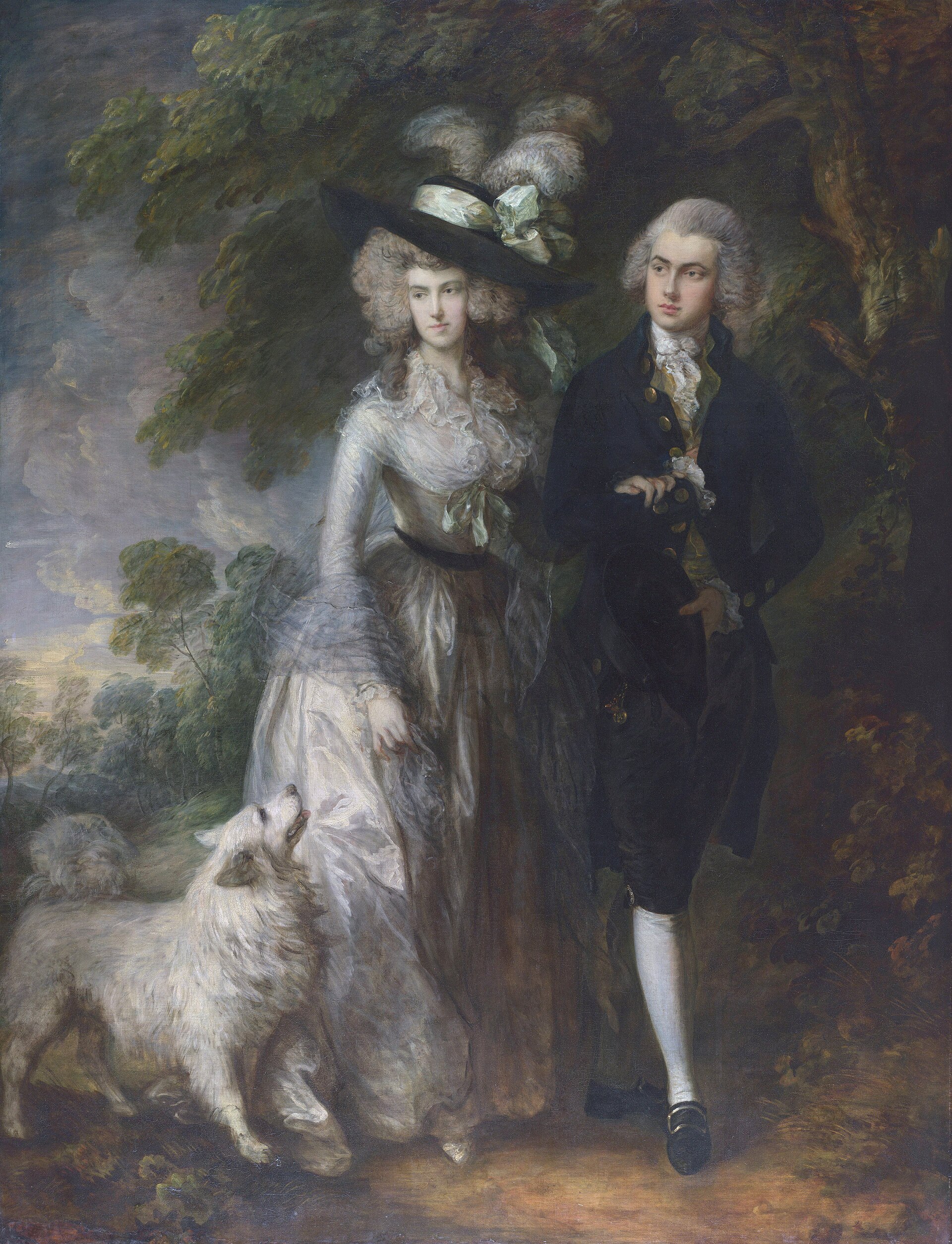
| The National Gallery | London | Mr and Mrs Andrews (NG6301), Cornard Wood (NG925), The Watering Place (NG109), Mr and Mrs William Hallett (The Morning Walk). | The online catalogue listed Mr and Mrs Andrews as not on display on 9 November 2026. |
| The Huntington | San Marino, California | The Blue Boy (accession 21.1). | On view in San Marino since 1928, with a visit to the National Gallery in 2022. |
| Kimbell Art Museum | Fort Worth | Going to Market, Early Morning, acquired 2023. | |
| The Courtauld Gallery | London | Portrait of Thomas Gainsborough completed by Dupont; the Witt bequest of drawings (1952); an imaginary landscape accepted by Belsey in 2014. | |
| Royal Collection | Windsor | The album of 25 early landscape drawings identified in 2017. | Previously labelled Landseer. |
| Musee du Louvre | Paris | Conversation in a Park (RF 1952-16), given by Pierre Bordeaux-Groult in 1952. | |
| The Fitzwilliam Museum | Cambridge | Heneage Lloyd and His Sister, Lucy. | |
| Royal Academy of Arts | London | His 1787 self-portrait, and the letter Reynolds endorsed as written by Gainsborough when dying. | |
| The Frick Collection; Kenwood House; Floors Castle | New York; London; Kelso | Mrs Charles Hatchett; Miss Brummell; the portrait of Captain Roberts. | The three pictures Belsey proposed in 2017 to list as rejected (Floors Castle per the Apollo report only). |
The sentence everyone quotes is genuine.
The sentence everyone quotes is genuine. In a letter to his friend Jackson, printed by W. T. Whitley in 1915, Gainsborough wrote: "I'm sick of Portraits and wish very much to take my viol-da-gamba and walk off to some sweet village, where I can paint landskips and enjoy the fag-end of life in quietness and ease." He went on to complain about fine ladies and their tea-drinkings, and about being confined in harness while others rode in the waggon.
The same inversion shows in the notices of the exhibition his widow held in 1789. Whitley, reading the newspapers, found that Gainsborough was regarded as he had chosen to regard himself, a painter of pastoral and landscape subjects who practised portraiture for a living, and that his portraits were rarely mentioned while the Boy at a Cottage Fire and the Boy with a Cat were praised in extravagant terms. One critic wrote that the cat alone was a better warrant for immortality than groups of Academicians. The pictures of the boy and the girl at the fire and the boy with the cat did not sell; the landscapes sold fairly well.
Gainsborough was baptised in May 1727 at the Independent Meeting House in Friars Street, Sudbury.
Gainsborough was baptised in May 1727 at the Independent Meeting House in Friars Street, Sudbury. Whitley, working from the surviving records of the chapel, found that most of the family were Dissenters with an intimate connection to it. The exact day of birth isn't recorded; the 14 May usually given is a baptism date reported in secondary reference works. At thirteen he was sent to London, where Gainsborough's House says he studied under the French designer Hubert Gravelot and then the painter Francis Hayman. Whitley disputes the Hayman part: he found the evidence extremely slight, limited to a note in Edward Edwards's Anecdotes of Painting, published twenty years after the death, and no mention of Hayman in the sketches by Thicknesse, Bate or Pasquin, who all knew Gainsborough.
The documented intellectual life is music rather than doctrine. He owned a viol-da-gamba and told Jackson he was learning the nature of modulation and flats and sharps, adding that there was never a poor devil so fond of harmony with so little knowledge of it. No lodge membership, confessor, treatise or reading list is recorded in the sources consulted for this page, and Whitley says his widow kept his library "such as it was". The pictures don't need a hidden programme to be read: their subjects are land, marriage, rank and rural charity, treated in the idiom of his day.
His last recorded remark is a small case study in how a story improves. Whitley gives the version attributed to Jackson, "We are all going to Heaven, and Vandyke is of the party", and notes that Allan Cunningham later set the line in a scene with Reynolds at the bedside. Whitley saw no reason to believe Reynolds was present at the death. Reynolds himself, in his Fourteenth Discourse, says he was invited to a last interview some days before. Gainsborough had also left a written charge that no plaster cast, model or likeness of him be taken after his death.
Gainsborough's own letters and the account books quoted by Whitley give a ladder.
Gainsborough's own letters and the account books quoted by Whitley give a ladder. In a letter to the actor David Garrick, endorsed in Garrick's hand 1768, he called sixty guineas his portrait price, and the second Earl of Dartmouth paid sixty guineas for a portrait of his countess. By 1776 a whole-length cost a hundred guineas; the Society of Arts paid that without argument for a portrait of Lord Folkestone, a copy of a Hudson to which he added a pair of legs and a sky. In February 1787 the Haberdashers' Company accepted his figure of 120 guineas for a whole-length of its clerk Jerome Knapp, just before he raised his price to a maximum of 160 guineas. The Company's accounts record 126 pounds paid for the picture and 16 pounds 12 shillings and 2 pence for its frame.
Landscapes were priced on a different scale. Henry Hoare, his banker, paid 80 guineas for Going to Market, Early Morning on 6 July 1773. Sir Peter Burrell paid 350 guineas for The Market Cart. The publisher John Boydell paid 75 guineas for the early Cornard Wood at an auction in the spring of 1788. A list in the Duke of Rutland's hand put three Gainsborough landscapes at 220 pounds together. Gainsborough opened his account with Hoare's bank in 1762, and Whitley found that it dealt almost entirely with an annuity of 200 pounds a year, which suggests that most of his receipts and payments were in cash. No modern equivalent is given here: a conversion needs a named method (retail prices, average earnings or share of output) and none was sourced.
No picture shows how a Gainsborough price is built better than this landscape of about 1773, oil on canvas, 121.8 by 147.2 centimetres.
No picture shows how a Gainsborough price is built better than this landscape of about 1773, oil on canvas, 121.8 by 147.2 centimetres. Hoare's bank still holds the original receipt, according to The Art Newspaper, and Sotheby's records the price as 80 guineas on 6 July 1773. It hung in the Picture Gallery at Stourhead and was admired by visitors; Mrs Lybbe Powys saw it there in August 1776. It was the top lot of the Stourhead Heirlooms sale at Christie's on 2 June 1883, at 2,700 guineas, bought by Martin for Thomas Holloway's Royal Holloway College. Rembrandt's Landscape with the Rest on the Flight into Egypt and Poussin's Rape of the Sabine Women each made 490 guineas in the same sale.
Its titles migrated. A Stourhead catalogue of 1808 lists it as Peasants and Colliers; an inventory of 1838 calls it Peasants and Colliers riding to Market at dawn of day. Ellis Waterhouse numbered it 911 in his 1958 catalogue and John Hayes 107 in his landscape catalogue of 1982, the two numbers a researcher needs to find it in the literature. The college sold it privately in 1993, and the private collection that bought it then put it up at Sotheby's London on 3 July 2019 at an estimate of 7 to 9 million pounds. It sold at 7 million pounds hammer, 7.961 million with premium, to a paddle number The Art Newspaper identified as the same guarantor who bought other lots in the sale, and was reported as a record for the artist.
The export system then did what it is for. On 23 December 2019 the Arts Minister placed a bar on it on the advice of the Reviewing Committee on the Export of Works of Art, which found it of outstanding aesthetic importance and significant for the study of Gainsborough's relationships with his patrons and with landscape art. The recommended price was 7,961,000 pounds plus 234,200 pounds VAT, and a decision on the licence was deferred to 22 March 2020, extendable to 22 September 2020. The committee member Christopher Baker said the picture displays Gainsborough's knowledge of seventeenth-century European art. In the picture a group on horseback passes a destitute mother with a baby, which the press release itself remarks on. The Kimbell Art Museum in Fort Worth announced its acquisition in September 2023 through the dealers Simon Dickinson. How the picture passed from the 2020 bar to the Kimbell isn't recorded in the sources consulted.
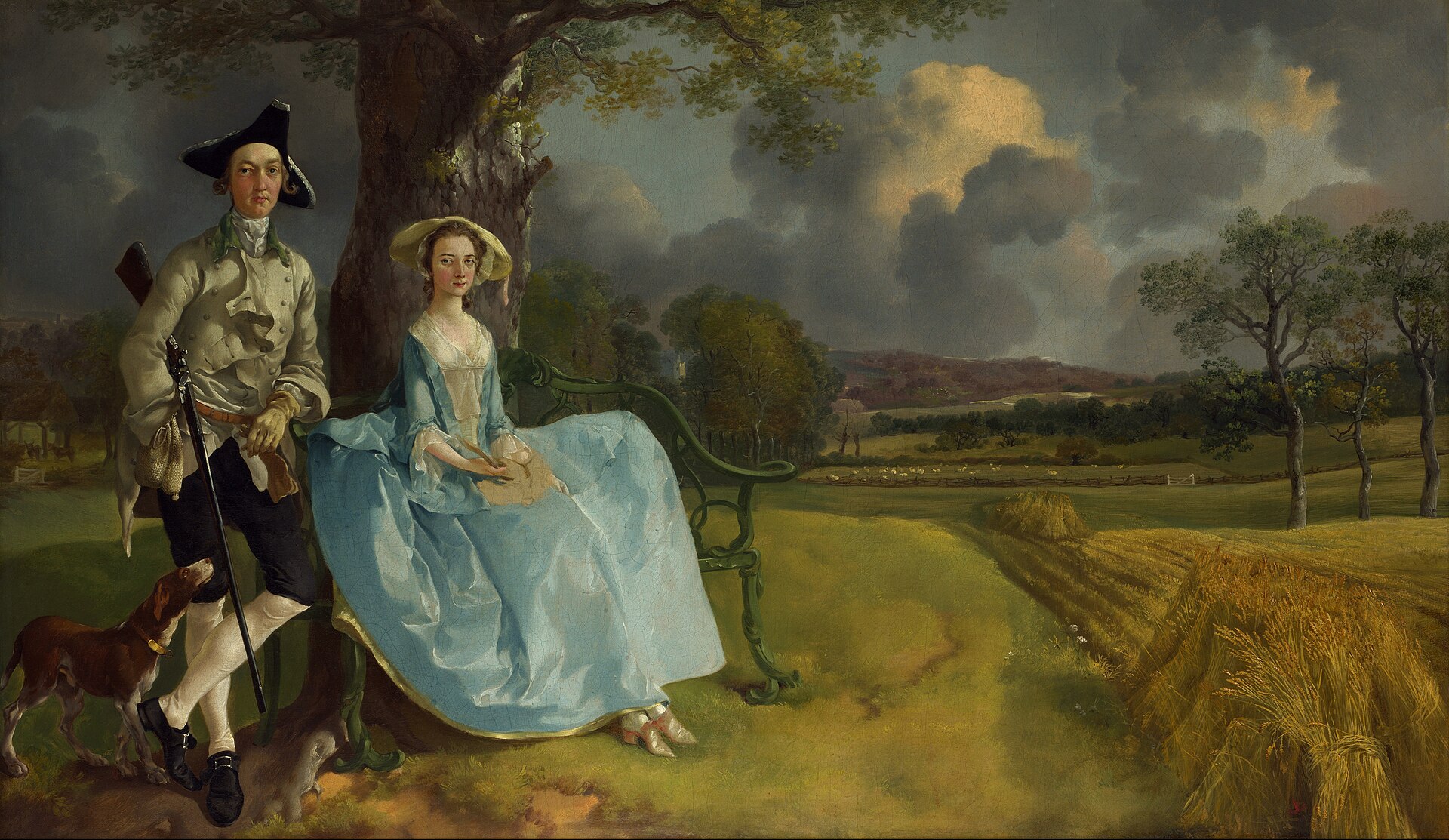
The picture the public knows best is an early one, oil on canvas, 69.8 by 119.4 centimetres, dated about 1750 and catalogued by the National Gallery as NG6301.
The picture the public knows best is an early one, oil on canvas, 69.8 by 119.4 centimetres, dated about 1750 and catalogued by the National Gallery as NG6301. Robert Andrews and Frances Carter married at All Saints, Sudbury, on 10 November 1748. The Gallery's catalogue by Judy Egerton argues that it isn't a marriage portrait: Gainsborough was probably still in London at the wedding, the couple aren't formally dressed, and the picture may commemorate the consolidation of the Auberies estate when Robert came into sole possession in 1750. The Gallery calls it a triple portrait of the husband, the wife and the land; Egerton's catalogue says it might equally be called a triple portrait of Robert Andrews, his wife and his property. The view looks east over the Stour valley and, according to the Gallery, is depicted with more accuracy than any other Gainsborough landscape. By 1750 Andrews owned nearly 3,000 acres.
The patch of unpainted canvas in Mrs Andrews's lap is the one genuinely open question in it. Some think Gainsborough meant a shot cock pheasant. Others think it was reserved for a child, and Egerton, noting that a sportsman wouldn't dump a bird in a lady's lap, favours that; the couple's first, Frances Louisa, wasn't born until 1751, and they had nine in all. The Gallery's own text says plainly that we will probably never know why that part was not completed.
It was bought by the National Gallery in 1960 after a Sotheby's sale on 23 March of that year, at which Agnew's bought it from the sitters' great-great-great-grandson. The funding came from a Special Grant from the Exchequer, the Pilgrim Trust, the National Art Collections Fund, Associated Television Ltd and Mr and Mrs W. W. Spooner. The price isn't stated in the Gallery's pages and no second source for a figure was opened for this record. For two centuries it passed down in the family and was largely unknown until George Andrews lent it to the Gainsborough bicentenary exhibition at Ipswich in 1927.
The best technical description of Gainsborough's handling was given by his rival, in the Fourteenth Discourse delivered to the Academy students on 10 December 1788, four months after his death.
The best technical description of Gainsborough's handling was given by his rival, in the Fourteenth Discourse delivered to the Academy students on 10 December 1788, four months after his death. Reynolds said that the odd scratches and marks visible in his pictures on close examination, which appear to experienced painters the effect of accident, produce "this chaos, this uncouth and shapeless appearance, by a kind of magic, at a certain distance assumes form". He added that Gainsborough eagerly wanted his pictures seen both near and far at the exhibition, and that his portraits were often little more, in finish, than a dead-colour, the first painting that other artists then lose by over-working.
Reynolds also gave the connoisseur's test and the reason it matters here: a lightness of effect produced by colour and one produced by facility of handling are generally united, a copy may keep one but hardly the other, and so painters know that it is principally by this air of facility or its absence that originals are distinguished from copies. He also records that Gainsborough formed all parts of a picture together rather than feature by feature, painted by candle-light, brought stumps, weeds and animals into the painting-room to draw from the object, and made a model landscape on a table out of broken stones, dried herbs and pieces of looking-glass. The later tale of broccoli for trees appears in a 1996 exhibition review as gossip and is not in Reynolds.
The laboratory evidence is thin and early. Egerton's technical notes on Mr and Mrs Andrews record a light greyish cream ground of lead white and chalk, the same as in the portrait of Dr Ralph Schomberg (NG684). The greyest areas of sky contain no blue pigment at all, only wood charcoal with white, a mixture with a bluish cast that she says is fairly common in Dutch seventeenth-century landscape. Prussian blue appears in the bluer sky and in Mrs Andrews's dress, and the greens are what Egerton calls Gainsborough's usual complicated mixture of Prussian blue, yellow lake, earth pigments, Naples yellow, white and black. The pale to mid yellow of the cornfield is Naples yellow with white. The Huntington's senior paintings conservator Christina O'Connell, quoted by The Art Newspaper in 2021 on the Blue Boy, reports areas where individual pigment particles are visible, which she took to mean he sometimes used more coarsely ground pigment, so that a dab of paint highlights the eye up close and blends at a distance.
Gainsborough ran no large studio. His assistant and heir was his nephew Gainsborough Dupont, son of his sister Sarah.
Gainsborough ran no large studio. His assistant and heir was his nephew Gainsborough Dupont, son of his sister Sarah. Whitley, from Dupont's indentures, records that he was apprenticed to his uncle on 12 January 1772 to learn the art or mystery of a painter, and that he was admitted to the Royal Academy schools in 1775 on the same day as John Hoppner, which Whitley found strange when Gainsborough was on the worst of terms with the Academy. Dupont's dates are 1754 to 1797. He tended his uncle's pictures after the fact, too: when The Woodman was damaged on its way to Lord Gainsborough's seat in 1789, it was Dupont who repaired it.
The division of hands is the live problem. The Courtauld's portrait of Gainsborough, of the late 1760s, was unfinished at the painter's death and was completed by Dupont, who altered the wig and added a jacket copied from the self-portrait now at the Royal Academy. In March 2012 Hugh Belsey told a Furman University audience that its Portrait of Lady Impey, doubted since 2010 as possibly Dupont's, was by Gainsborough himself but, in his words, a mess. In 2017 he questioned the Kenwood House portrait Miss Brummell of the early 1780s: it was, he said, just not Gainsborough's style and too messy, and he thought it likely to be Dupont's. His other candidates for the rejected list were the Frick Collection's Mrs Charles Hatchett, a portrait of Captain Roberts at Floors Castle and a picture in the Royal Albert Memorial Museum in Exeter. Those were the proposals as reported before the catalogue appeared; whether each stood in the printed volumes wasn't checked for this page.
The Blue Boy's sitter has drawn the same name. Jonathan Buttall, the son of a hardware merchant, was long said to be the boy because of his early ownership of the picture; as reported by Wikipedia, which is a tertiary source and should be replaced by the original publication, Susan Sloman argued in 2013 that the likelier sitter is Dupont. Nobody has proved either.
No authentication board for Gainsborough turned up in any source opened for this page.
No authentication board for Gainsborough turned up in any source opened for this page. What exists is a sequence of catalogues and one living arbiter. Ellis Waterhouse's Gainsborough of 1958 is the standard catalogue of the portraits and related pictures; he numbered the Andrews picture 18 and the Stourhead landscape 911, which shows his scheme ran portraits first and landscapes after. John Hayes catalogued the drawings in 1970 and the landscape paintings in 1982, the latter in two volumes. Hugh Belsey's Thomas Gainsborough: The Portraits, Fancy Pictures and Copies after Old Masters, published in 2019 by Yale University Press with the Paul Mellon Centre, runs to two volumes and about 1,100 paintings, nearly 200 of them newly attributed, with a biography of each sitter, provenance and exhibition history.
So the accepted body of work has three components and no total: roughly 1,100 portraits, fancy pictures and copies in Belsey, the landscapes in Hayes and over 1,100 drawings in the Hayes and Belsey catalogue, according to Apollo. A reader who wants the number for the whole career must add three catalogues compiled over six decades. In practice the final word is Belsey's. He is a senior research fellow of the Paul Mellon Centre and was formerly at Gainsborough's House in Sudbury, where the sources call him curator and director, and when the BBC programme Fake or Fortune? found two unattributed pictures in 2014, an imaginary landscape at the Courtauld and a portrait of Joseph Gape in storage at St Albans, both were accepted by him for the then forthcoming catalogue. The Courtauld picture turned out to be a drawing partly worked up in colour by Gainsborough and finished off by another hand, most noticeably in the central part of the sky.
Reattribution runs in both directions. The Royal Collection announced on 11 July 2017 that 25 landscape drawings in an album at Windsor Castle, labelled Landseer since Queen Victoria paid his executors 250 pounds in April 1874 for two volumes of sketches, are by Gainsborough. The evidence included eighteenth-century paper, one sheet watermarked 1748 and one sheet that the former British Museum curator Lindsay Stainton recognised as a squared-up study for Cornard Wood. In 1996 the Courtauld showed most of the Gainsborough drawings left by Sir Robert Witt in 1952, and a reviewer reported that many bought as genuine were now labelled fakes or re-attributions.
Imitation began within months of the death.
Imitation began within months of the death. Whitley prints the warnings of Henry Bate in the Morning Herald. Two or three months after the death Bate cautioned the public against drawings that purported to come from his hand, and after the studio exhibition closed he wrote that scarcely a sale had occurred in which some wretched imitations had not been introduced. He named no one but described an execrable impostor of the brush who resided at Bath and was said to have been labouring for months at pictures and drawings in the master's style, with two others in different parts of the kingdom. Two such pictures were sent to the auctioneer Greenwood for the sale of 11 June 1789, in a sale of the property of a Man of Fashion, and Bate said that Greenwood's eye and integrity would not let them pass as genuine.
The widow's strategy was set against exactly this. The newspapers of 1789, Whitley says, make clear that Margaret Gainsborough showed her husband's pictures in the rooms in which they were painted, and refused to sell any before the doors opened, to checkmate the forgers. A newspaper writer said a buyer could select with confidence that no vile copy could in future surprise him.
Drawings were attacked in a second way. The 1996 review observes that an eighteenth-century fake is harder to spot than a modern one because the forger is in tune with the artist and his period, and that opportunists bought large sheets of his drawings and cut them up to sell the pieces separately. One sheet in the Courtauld, Study of Beggar Children, carries the real Gainsborough alongside someone else's attempt to recreate what had been sliced off, notably the top of a girl's head from the eyebrows up. The reviewer's test was fluency: the chalk flies in his hand while the other hand is miserably indecisive and flabby.
Gainsborough was invited to be one of the inaugural members of the Royal Academy in 1768, and his relationship with it and with Reynolds was distant and conflicted.
Gainsborough was invited to be one of the inaugural members of the Royal Academy in 1768, and his relationship with it and with Reynolds was distant and conflicted. From 1773 to 1776 he boycotted its exhibitions, complaining of how his pictures were hung. In April 1784, after another quarrel with the hanging committee ostensibly over the placement of his royal portraits, the group of George III's three eldest daughters among them, he withdrew everything he had sent and never exhibited there again. For the next three years he showed his work privately in his painting room at Schomberg House. Gainsborough's House says he exhibited just over a hundred pictures at the Academy in total.
Georgina Cole argued in British Art Studies in 2015 that Charity Relieving Distress, painted in the year of the secession and shown at Schomberg House three months after the break, is a pictorial attempt to reconcile his approach with Reynolds's through the figure of charity. That is a scholar's interpretation, offered as such, and not a statement of the painter's intention. Where the record is firm is the endgame. British Art Studies adds that in late 1787 he began to rebuild the relationship and that evidence suggests he would have reached full reconciliation had he not died suddenly. Whitley says a pathetic letter endorsed by Reynolds as from Gainsborough when dying is now in the Royal Academy's possession. Reynolds, in the discourse of December 1788, described him as one of the greatest ornaments of the Academy while setting out his defects as instruction for the students, chiefly his want of precision and finishing.
Margaret Gainsborough and Dupont arranged the unsold paintings and drawings at Schomberg House in the winter of 1788-9, hung among them the Old Masters he had collected, and opened the exhibition on...
Margaret Gainsborough and Dupont arranged the unsold paintings and drawings at Schomberg House in the winter of 1788-9, hung among them the Old Masters he had collected, and opened the exhibition on 30 March 1789 at half a crown, cut to a shilling at the end of April. Dupont was in attendance to sell by private contract. The collection included about forty landscapes priced from 10 to 500 guineas and 148 drawings priced from 2 to 10 guineas each. Bate wrote that Gainsborough could never be prevailed upon in his lifetime to part with a drawing for money; he gave four of a set of twelve to the Queen, and she bought six more at the exhibition. Seven hundred people paid on the last day, 31 May. The larger part of the pictures, at catalogue prices of between seven and eight thousand pounds, remained unsold, and most of the unsold works were reserved for a Christie's sale at the house three years later.
Pictures went in strange directions. The Woodman, his own favourite, was bought on the first day by the Earl of Gainsborough for 500 guineas after the King failed to take it. It was damaged in transit to Exton Park and was destroyed with other Gainsboroughs when that wing burned on 23 May 1810; the owner lost 20,000 pounds, a quarter insured. The Murillo that Gainsborough had paid the dealer Desenfans 500 guineas for sold in the exhibition for 300. His copies after Van Dyck were priced at 100 and 150 guineas, while his Old Masters, of dubious authenticity in Whitley's view, were priced mostly between 2 and 40 guineas.
The prices at the sale of unfinished work in 1797 were very low. After Dupont's death, a Christie's sale of Gainsborough's unfinished portraits and studio contents saw a kit-cat of the Duchess of Gloucester go for 2 pounds 10 shillings, a head of Lady Clarges for five shillings and three portraits in one lot for thirteen shillings, bought by the wine merchant and self-styled connoisseur Caleb Whitefoord. The unfinished whole-length The Housemaid made four and a half guineas. Seven easels, colour stands, canvases, paints and fifty-three dozen brushes from Dupont's studio, some of which Whitley thought must have been Gainsborough's, brought less than five pounds together. Mrs Gainsborough died in December 1798 and was buried at Kew, retaining to the end his sketch-books, engravings and library. A dispersal of studio contents in 1799-1801 sent his drawings to artists and connoisseurs; Constable owned twelve.
His record prices belong to the Victorian saleroom.
His record prices belong to the Victorian saleroom. Wikipedia, a tertiary source to be replaced with Rothschild-collection scholarship, says Lionel de Rothschild began buying his portraits in the 1850s and the family's collecting drove prices up. In 1876 the portrait of Georgiana, Duchess of Devonshire, bought by Wynn Ellis for about sixty guineas, sold at Christie's for 10,605 pounds as Whitley has it, or 10,000 guineas as Wikipedia has it; Agnew's bought it and it was stolen from their Bond Street gallery weeks later. Wikipedia says the thief, Adam Worth, kept it for twenty-five years and returned it through Pinkerton's in March 1901 for 25,000 dollars; Whitley says it was then sold to J. Pierpont Morgan. The picture, which had been cut down by an earlier owner, stayed in the Morgan family until 1994.
In 1921 The Blue Boy went from the Duke of Westminster through Joseph Duveen to Henry Huntington for the then record price of 728,000 dollars. It had first appeared at the Royal Academy in 1770 as A Portrait of a Young Gentleman and was being called the Blue Boy by 1798. Before it left Britain a report in The New York Times of 1922, quoted by The Art Newspaper, said 90,000 people seized a last opportunity to see it at the National Gallery, and a pencilled note on a stretcher read Au revoir. A durable story says Gainsborough painted it to refute Reynolds's rule that masses of light should be warm. The rule is in Reynolds's Eighth Discourse of 10 December 1778; the picture is dated about 1770, eight years earlier; and the tale was first told, Wikipedia says, in 1821 by the printmaker John Young.
Export history is part of the record, and it's easy to get wrong. When a Member of Parliament asked in August 1972 whether the Government would refuse an export licence for The Gravenor Family, the answer in the Commons was that no application had been made. The export system is triggered by an application, not by a sale. In 2019 the Going to Market buyer did apply, and the bar followed; see above.
The National Gallery's page on Gainsborough says the artist is the subject of ongoing research and that it began by examining relationships to the enslavement of people.
The National Gallery's page on Gainsborough says the artist is the subject of ongoing research and that it began by examining relationships to the enslavement of people. It records that The Byam Family, of about 1762-66 and on loan to the Holburne Museum in Bath, depicts a family whose wealth came from an Antigua sugar plantation worked by 132 enslaved people in 1763. It records that the Baillie Family of about 1784 is in Tate, and that in 1768 Gainsborough painted Ignatius Sancho, then employed as a valet to the Duke of Montagu, in a gold-trimmed waistcoat rather than livery, a portrait now in the National Gallery of Canada that the Duke and Duchess probably paid for and presented to him.
Painter; Draughtsman; Printmaker. 1727-1788.
Born Baptised 14 May 1727 (birth date not recorded), Sudbury, Suffolk; died 2 August 1788, Schomberg House, Pall Mall, London.
Posthumous imitators, 1788-1789. Henry Bate warned in the Morning Herald within months of the death against drawings purporting to be Gainsborough's, and after the studio exhibition closed named no one but described an impostor of the brush at Bath working for months on pictures and drawings in the master's style, with two others elsewhere. Two such pictures reached the auctioneer Greenwood for the sale of 11 June 1789.
Gainsborough's House (Sudbury); The National Gallery (London); The Huntington (San Marino, California); Kimbell Art Museum (Fort Worth); The Courtauld Gallery (London); Royal Collection (Windsor).
The auction record for Gainsborough stands at 7.961 million pounds with premium for the landscape Going to Market, Early Morning, sold at Sotheby's London on 3 July 2019 after a 7 million pound hammer, above the roughly 6.5 million pounds reported for the portrait of Miss Read, later Mrs William Villebois, at Christie's London in July 2011, a figure whose hammer or premium basis was not established. The 2019 picture had an unbroken provenance from the artist's banker and an original receipt, which the export committee also cited.
Which of Belsey's proposed rejections (Miss Brummell at Kenwood, the Frick's Mrs Charles Hatchett, Captain Roberts at Floors Castle and the Exeter picture) stand in the printed 2019 catalogue, and have the owning museums changed their labels?
Last verified
One artwork and its story every Tuesday, with the picture: who owned it, what it made, and what closes soon in the exhibition calendar. No promotion, and nothing we cannot cite.
We send one email to confirm the address and keep nothing else. Every letter carries a one-click unsubscribe. How we handle your data.