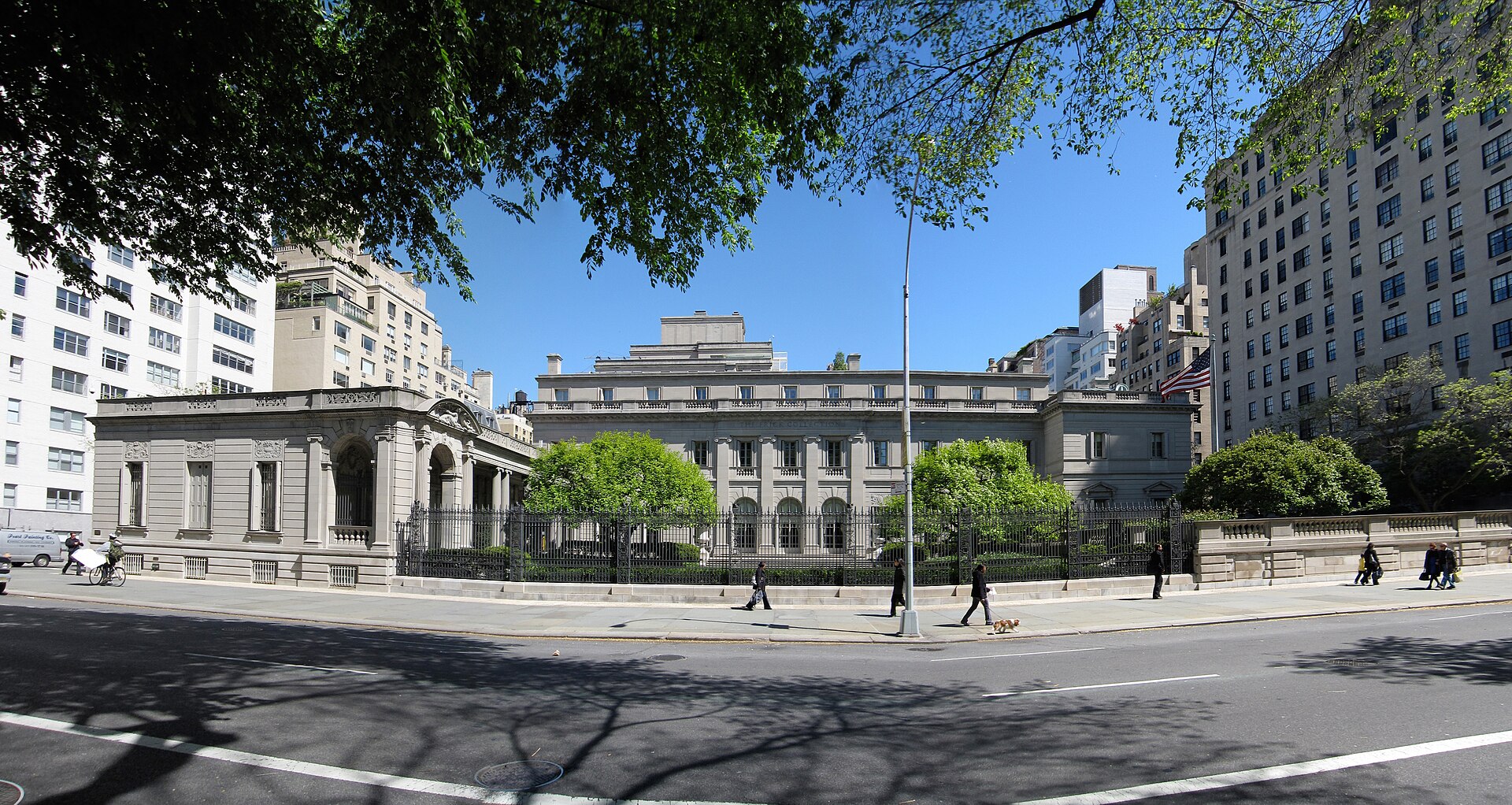
The Fifth Avenue front of the house that holds the Frick Collection, with the 70th Street wing at left.
Gryffindor, CC BY-SA 3.0The Frick Collection
Museum · Founded 1935
Open, admission and hours confirmed 17 November 2026 · 13 sources
On this page 14 sections
ContentsClose
Old master painting is the core: Vermeer, Rembrandt, Holbein, Bellini, Titian, El Greco, Goya, Turner and Fragonard are all listed by the museum among its featured artists [1][12]. The depth beyond painting is unusual for a house museum: French furniture and Sevres porcelain, Limoges enamels, bronzes, European timepieces and the Scher medals [5][11].
| Kind | Museum |
|---|---|
| Founded | 1935 |
| City and country |  New York City, United States |
| Address | 1 East 70th Street, New York, NY 10021, United States |
| Website | frick.org |
| Status | Open, confirmed |
| Record last verified |
Visiting
- Hours
- Mon, Wed-Sun10:30 to 17:30Last entry 30 minutes before closing
- Fri (First Fridays)17:30 to 21:00Free evening, first Friday of the month except January and September
- Closed
- Tuesday.
- Admission
- AdultUSD 30Timed tickets recommended; includes current special exhibitions
- Senior (65+)USD 22
- Visitor with disabilityUSD 22
- Student with IDUSD 17
- Youth 10 to 18FreeFree
- MemberFreeFree, no reservation needed
Free entry: Wednesday 1:30 to 5:30 pm pay-what-you-wish, minimum 5 USD if reserved online. Louis Vuitton First Fridays evening, first Friday of the month except January and September. Children under 10 are not admitted- Tickets
- frick.org/visit The museum's own ticket page.
- Do I need to book?
- No, but timed tickets are recommended
- Address
- 1 East 70th Street, New York, NY 10021, United States MapSubway 6 train to 68th Street and Lexington Avenue; Q train to 72nd Street and Second Avenue then the M72 crosstown bus; N, R or W train to 59th Street and Fifth Avenue
Bus M1, M2, M3 and M4 to Madison Avenue and 69th Street northbound or Fifth Avenue and 69th Street southbound; M72 crosstown to Fifth Avenue and 69th Street - Website
- frick.org
- Telephone
- 212-288-0700
- [email protected]
Before you go how long, access, photography, bags, eating, shop
- How long to allow
- About two hours for the house and exhibition galleries (our estimate)
- Access
- The museum has an Access-A-Ride stop at the south corner of East 70th Street and Fifth Avenue, and its 2025 project added accessible lifts to the second floor.
- Photography
- Not permitted in the galleries; permitted in the Garden Court and other public spaces.
- Bags
- Bags inspected at entry; backpacks within size limits must be checked or worn on the front; free coat check on Floor C.
- Eating
- Westmoreland on Floor 2 (reservations required, no museum ticket needed) and a coffee bar on Floor SC1.
- Shop
- Museum Shop, open without a museum ticket.
Prices and hours change. We take them from the institution's own pages and print the day we read them, and you can check the current position at the source we used. Confirm before you travel.
What is inside
Living Hall and the ground-floor galleries
The central oak-panelled hall of the house, where the Holbein portraits of Thomas More and Thomas Cromwell face each other across the fireplace, with the West Gallery and its skylight beyond [5][11].
Garden Court and Oval Room
Spaces added by John Russell Pope for the 1935 opening: a glass-roofed colonnade with a marble fountain and an oval room decorated with five woods [3][5].
Photograph by Bmzuckerman · CC BY 4.0 Reception Hall and the new galleries
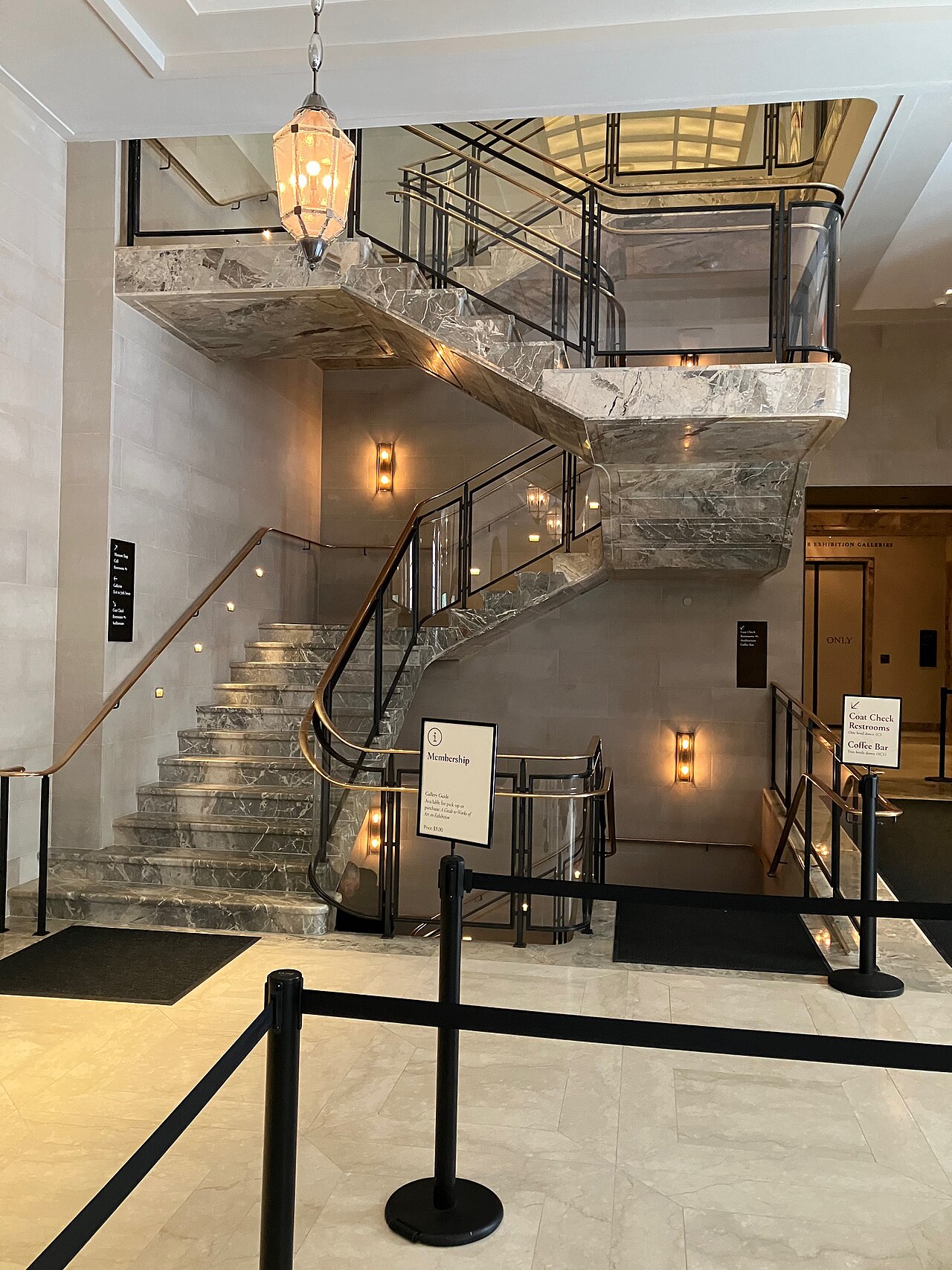
The 1977 reception hall, raised and enlarged in the 2025 project, now with a marble stair, the shop and a cafe overlooking the garden, plus the Lauder exhibition galleries and the 218-seat Schwarzman Auditorium under the garden [7][9].
Second floor
Opened to the public in 2025 for the first time: smaller paintings, sculpture and decorative arts, a breakfast room, clocks and watches, an Impressionist room and the Boucher Room back in its original place [7][8].
Photograph by Bmzuckerman · CC BY 4.0 70th Street Garden and Portico Gallery
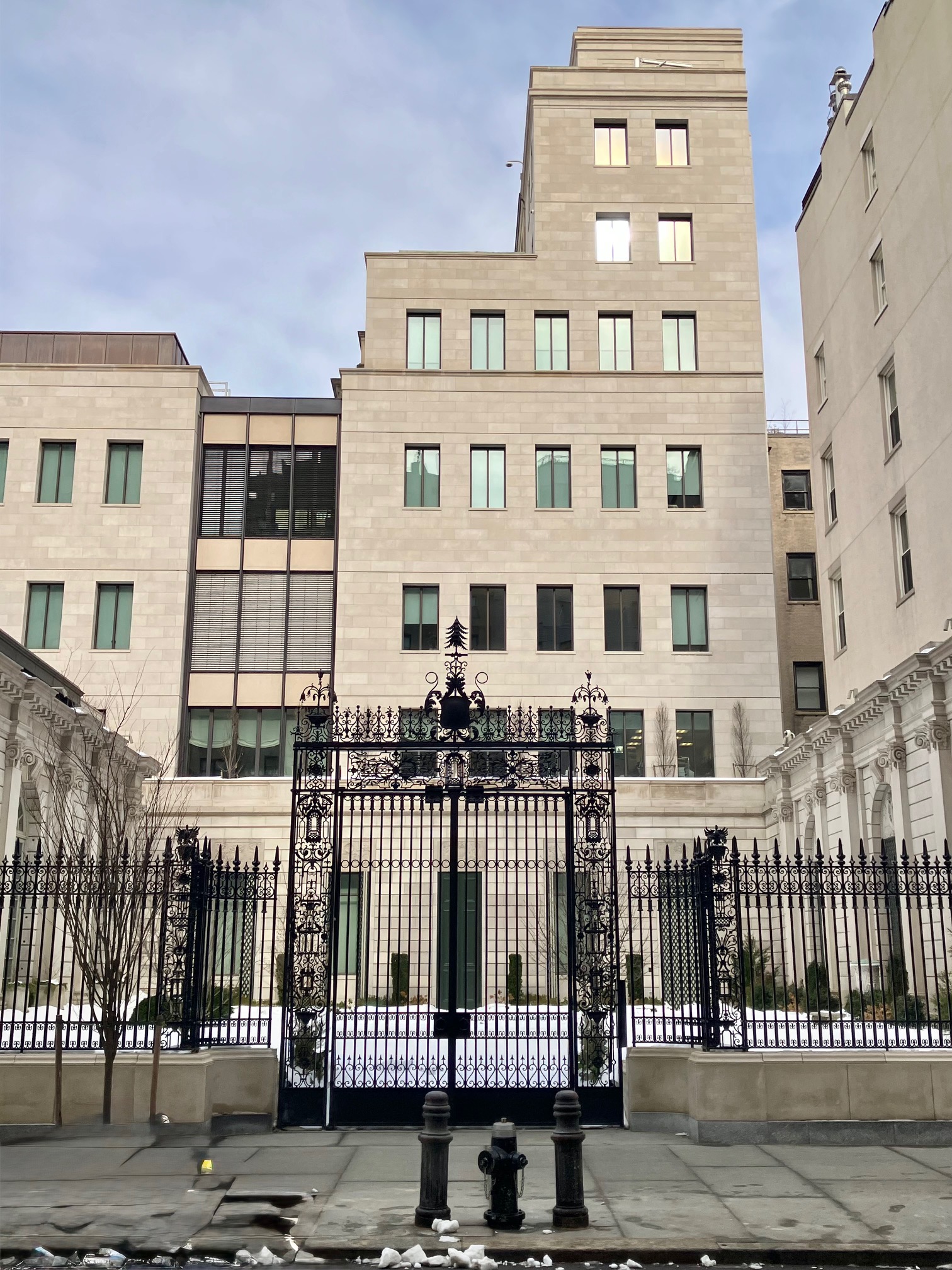
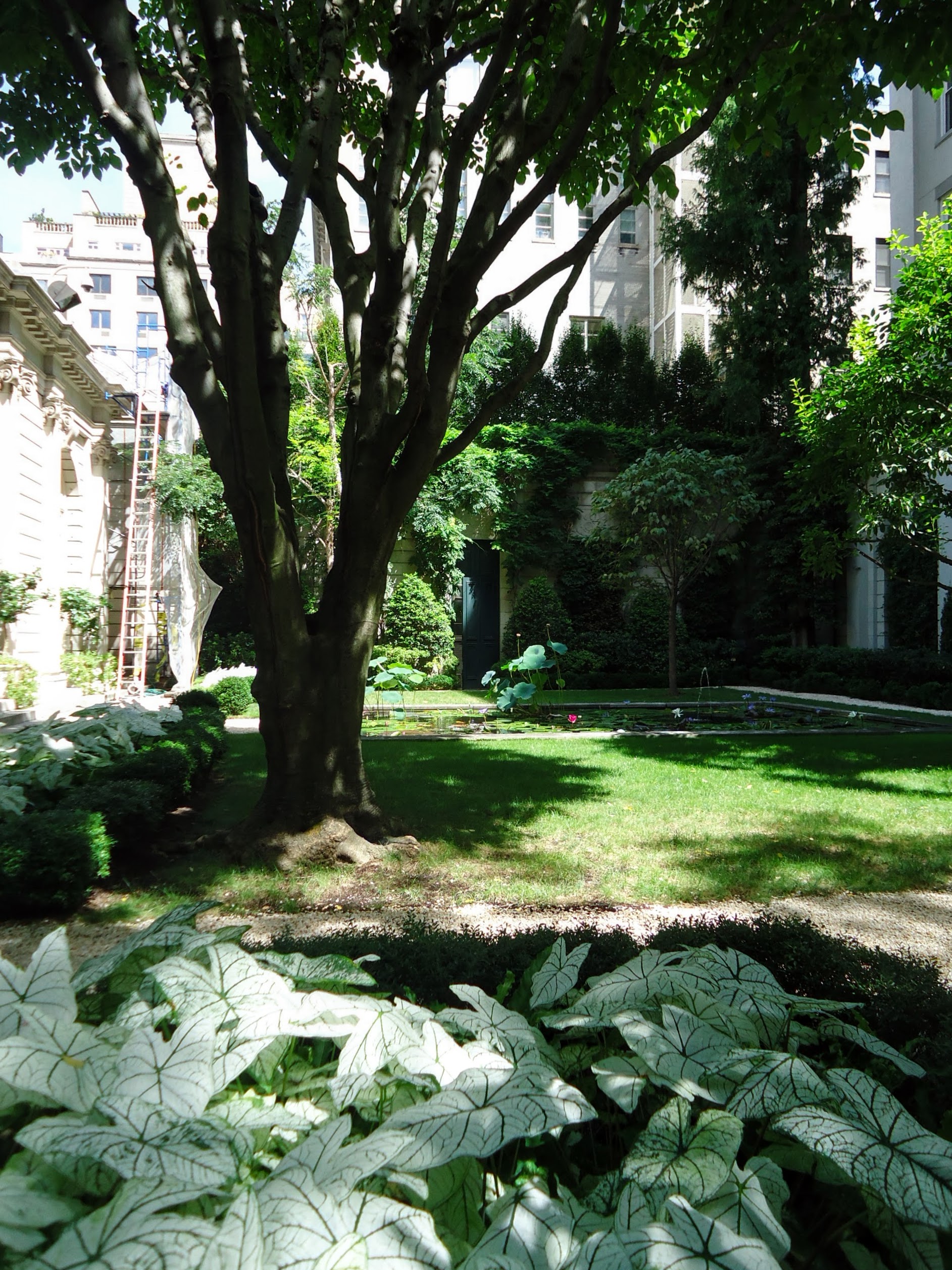
The Russell Page garden of 1977, restored in 2025 and visible from several new vantage points, and the former portico enclosed in 2011 for sculpture and decorative arts [3][7].
What to see first
Mistress and Maid
Johannes VermeerOne of the museum's three Vermeers and the last work Henry Clay Frick bought, in 1919, the year he died; a joint study with the Metropolitan found the background curtain painted over an abandoned sketch.11
The Polish Rider
Rembrandt van RijnListed by the museum among the permanent collection highlights, dated about 1655.12
Sir Thomas More and Thomas Cromwell
Hans Holbein the YoungerThe two portraits face each other across the Living Hall fireplace, where Frick hung them.11
St. Francis in the Desert
Giovanni BelliniAbout 1475 to 1480, oil on panel; the museum notes that the film-maker Wim Wenders was moved by it on seeing it in 2018.11
The Progress of Love
Jean-Honore FragonardPanels rejected by Madame du Barry that spent about a century in Grasse; now the centre of the Fragonard Room.11
The Bullfight
Edouard ManetOnce one painting with Dead Toreador, now in Washington, until Manet cut it apart; shown upstairs in the Impressionist room.11
Lodovico Capponi
Agnolo BronzinoListed as a permanent collection highlight; Wes Anderson has said it partly inspired a painting in The Grand Budapest Hotel.12
Portrait medals of the Scher Collection
Various, 15th century onwardAbout 450 medals, the largest gift in the museum's history, now shown upstairs.11
Exhibitions on now
A Gilded Age house built to hold paintings
The Frick Collection occupies the house that Henry Clay Frick commissioned in 1913 from Carrere and Hastings. The architect in charge was Thomas Hastings, and the museum's own account gives the building as his work of 1913 to 1914 [3]. It is a limestone Beaux-Arts mansion on Fifth Avenue at East 70th Street, three storeys in an L shape, set back behind a garden, with a long gallery wing running along 71st Street [5]. Frick died in 1919 and left the house, the collection and an endowment in trust with a will that asked for a place devoted to the study of the fine arts [2]. The mansion was not opened as it stood. After Adelaide Frick died in 1931 the trustees engaged John Russell Pope, who added the Oval Room, the East Gallery, the Garden Court and a lecture hall and music room, and the museum opened to the public on 16 December 1935 [2][3][4]. The Garden Court sits where the carriage drive used to be [11]. Admission was free until 1976 [4]. That layering is the thing to understand before you go. What looks like a private house is a house plus a museum conversion plus later additions: a 1977 reception hall and a garden on 70th Street designed by Russell Page [2][3], and in December 2011 the old portico enclosed as the Portico Gallery for sculpture and decorative arts [3]. The building has been a New York City landmark since 1973 and a National Historic Landmark since 2008 [5].
Frick Madison and the 2025 reopening
From 18 March 2021 to 3 March 2024 the collection was shown at Frick Madison, the Marcel Breuer building at 945 Madison Avenue that had been the Whitney Museum, while the Fifth Avenue house was rebuilt around it [2]. That chapter is closed. The Frick reopened in its own house on 17 April 2025 [2][7]. This page is about the house at 1 East 70th Street and nowhere else. The project was announced in April 2018 with a design by Annabelle Selldorf and approved by the Landmarks Preservation Commission that June [4]. It went through a long and contested review, earlier garden-demolition plans having drawn opposition from residents and preservationists [4][9]. Executive architects were Beyer Blinder Belle [9]. The museum's release puts the cost at 220 million dollars and calls it the most comprehensive upgrade since 1935 [7]. Other outlets have printed higher totals that include the Madison years, so treat any single figure with care [4]. What the visitor gets: restored first-floor galleries with masterworks rehung, new exhibition galleries on the first floor named for Ronald S. Lauder, the first dedicated education rooms, a 218-seat auditorium under the garden, and a new suite of second-floor galleries in the original mansion that the public had never entered [7]. A new staircase and accessible lifts make the second floor reachable, and the 1977 reception hall was raised and enlarged to make room for a shop and a cafe above the garden [9].
What is inside: from the Living Hall to the second floor
The galleries are the rooms of the house. The Living Hall has the two Holbein portraits, Sir Thomas More and Thomas Cromwell, hanging on opposite sides of the fireplace [11]. The West Gallery runs most of the length of the gallery wing under a long skylight [5]. The Fragonard Room holds the large Progress of Love panels with French furniture and Sevres porcelain [5], and the Garden Court is a glass-roofed colonnade with a marble fountain [5]. The 2025 reopening added a route upstairs. A critic in Apollo describes it as taking in a breakfast room with Barbizon pictures, a room of clocks and watches, an Impressionist room that includes Manet's The Bullfight, and a hall with a Twachtman ceiling, then ending at the Boucher Room, now back in its original position [8]. The Boucher Room began life as Adelaide Frick's boudoir [11]. Upstairs also holds part of the Scher collection of portrait medals, about 450 pieces and the museum's largest single gift [8][11]. The collection is small and dense. It numbers about 1,800 works as of 2025 [4], and the museum calls its timepieces one of the most important groups in the United States [11]. The highlights below are the ones the museum itself lists in its permanent collection image sheet [12].
Planning a visit: tickets, rules and the house manners
Timed tickets are recommended, and the museum says last tickets go an hour before closing [1]. Only children aged 10 and over are admitted, which the museum explains as a protection for works shown largely without stanchions or vitrines [1]. Photography is not allowed in the galleries; the Garden Court and public spaces are fine [1]. Bags are inspected at the door, and a free coat check on Floor C is offered [1]. A pay-what-you-wish Wednesday afternoon exists, from 1:30 to 5:30 pm, with a minimum contribution of 5 dollars if you reserve online; walk-up tickets that day are offered on site but not guaranteed [1]. On the first Friday evening of most months there is a free Louis Vuitton First Fridays evening [1]. A coffee bar sits on Floor SC1 and the full-service cafe Westmoreland is on Floor 2 with reservations required, no museum ticket needed [1][4]. Allow two hours for the house and the exhibition galleries. That is our estimate, not the museum's. Most pictures carry only a small plaque with artist and title; the museum explains that it keeps the domestic atmosphere and offers a free mobile guide through Bloomberg Connects instead [1].
The man behind the house, and what the page should not leave out
A museum made from a house is a party to the history of the person who built it. Henry Clay Frick chaired Carnegie Steel during the 1892 lockout at Homestead, where he had a barbed-wire fence built around the works and where a clash with Pinkerton detectives on 5 and 6 July left ten men dead, nine of them workers [6]. He was shot and stabbed by Alexander Berkman on 23 July 1892 and survived [6][11]. Separately, he was a founder of the South Fork Fishing and Hunting Club, whose dam failed in the Johnstown Flood of 31 May 1889, which killed 2,208 people [6]. These are matters of record; the museum's own history page does not dwell on them [2]. The money came from that world, and the collection reads as a rich man's taste: portraits, landscapes and French rococo rather than violent or erotic subjects, which the museum says Frick preferred [11]. Helen Clay Frick largely guided the early Italian acquisitions, including Cimabue, Duccio and Piero della Francesca [11]. The institution's own conduct has had its critics too. A 2014 plan for an annex that would have demolished the Russell Page garden met resistance from neighbours and preservationists and was withdrawn in 2015 [4]. Reviewers of the finished work have been mostly admiring, though Apollo notes that much of the spending is invisible, in climate control and lighting, and doubts that the added rooms alone justified a leading architect [8].
What visitors say
Critics and visitors rate the Frick highly for the intimacy of seeing great paintings in a restored mansion rather than a large museum. The recurring complaints are practical: a crowded door on busy days, timed tickets that sell out, a firm rule against photographs in the galleries, no children under 10, and thin wall labels that push you to the guide.
What is praised, what is criticised
- Praised: The faithful restoration of the house, including woven fabrics recreated from original swatches and the restored garden [8]
- Praised: The sense of close looking in domestic rooms, and a collection called opulent but tasteful [10]
- Praised: The new second-floor rooms and the underground music room, whose acoustics Apollo singles out [8]
- Criticised: Queues at the 70th Street entrance a week after reopening, with the museum saying timed slots sell out about a week ahead [10]
- Criticised: Wall labels with little detail, so visitors need the printed or mobile guide [10]
- Criticised: Much of the 220 million dollar spend is invisible and a leading architect for the added rooms may not have been needed [8]
- Criticised: Children under 10 are not admitted, and no photography in the galleries [1]
Questions about The Frick Collection
Where is The Frick Collection?
1 East 70th Street, New York, NY 10021, United States.
How much does it cost to visit?
Adult: USD 30; Senior (65+): USD 22; Visitor with disability: USD 22; Student with ID: USD 17; Youth 10 to 18: free. As confirmed 17 November 2026.
When is it open?
Mon, Wed-Sun 10:30-17:30; Fri (First Fridays) 17:30-21:00. Closed: Tuesday. As confirmed 17 November 2026.
How do you get there?
Subway: 6 train to 68th Street and Lexington Avenue; Q train to 72nd Street and Second Avenue then the M72 crosstown bus; N, R or W train to 59th Street and Fifth Avenue; Bus: M1, M2, M3 and M4 to Madison Avenue and 69th Street northbound or Fifth Avenue and 69th Street southbound; M72 crosstown to Fifth Avenue and 69th Street.
What should you see first?
Mistress and Maid (Johannes Vermeer); The Polish Rider (Rembrandt van Rijn); Sir Thomas More and Thomas Cromwell (Hans Holbein the Younger); St. Francis in the Desert (Giovanni Bellini); The Progress of Love (Jean-Honore Fragonard); The Bullfight (Edouard Manet).
What we could not confirm
- Which wall labels and which rooms are on view on a given day; the museum's rehang is recent.
- The reported cost of the project differs by outlet (220 million dollars in the museum's release; higher in others that include the Madison years).
- The museum's visit page still carries an old banner about a February opening time, so check the live page before travelling.
Images
Sources
- 1The Frick Collection, Visit (hours, admission, FAQ, getting here, contact) frick.org/visit
- 2The Frick Collection, History frick.org/about/history
- 3The Frick Collection, Buildings frick.org/about/buildings
- 4Wikipedia, Frick Collection () en.wikipedia.org/wiki/Frick_Collection
- 5Wikipedia, Henry Clay Frick House () en.wikipedia.org/wiki/Henry_Clay_Frick_House
- 6Wikipedia, Henry Clay Frick () en.wikipedia.org/wiki/Henry_Clay_Frick
- 7The Frick Collection, press release: Frick Reopens to the Public frick.org/press/frick-reopens-to-public
- 8Edward Behrens, Apollo, 17 April 2025 apollo-magazine.com/?p=1023491
- 9Stephanie Murg, Wallpaper*, 31 March 2025 wallpaper.com/architecture/the-frick-collection-selldorf-architects-usa
- 10Maria Sciullo, Pittsburgh Magazine, 14 May 2025 pittsburghmagazine.com/frick-collection-new-york-city-renovation/
- 11The Frick Collection, 85 Frick Facts for 85 Years frick.org/blogs/frick_collection/85_frick_facts
- 12The Frick Collection, Permanent Collection Highlights image sheet, October 2024 frick.org/sites/default/files/pdf/press/frick-image-sheet-permanent-collection-highlights-october-2024.pdf
- 13Wikimedia Commons file pages for the plates (licences read per file) commons.wikimedia.org/wiki/File:Henry_C_Frick_House_panoramic.jpg
