Royal Academy of Arts
Museum · Founded 1768
Open, admission and hours confirmed 18 September 2026 · 15 sources
On this page 13 sections
ContentsClose
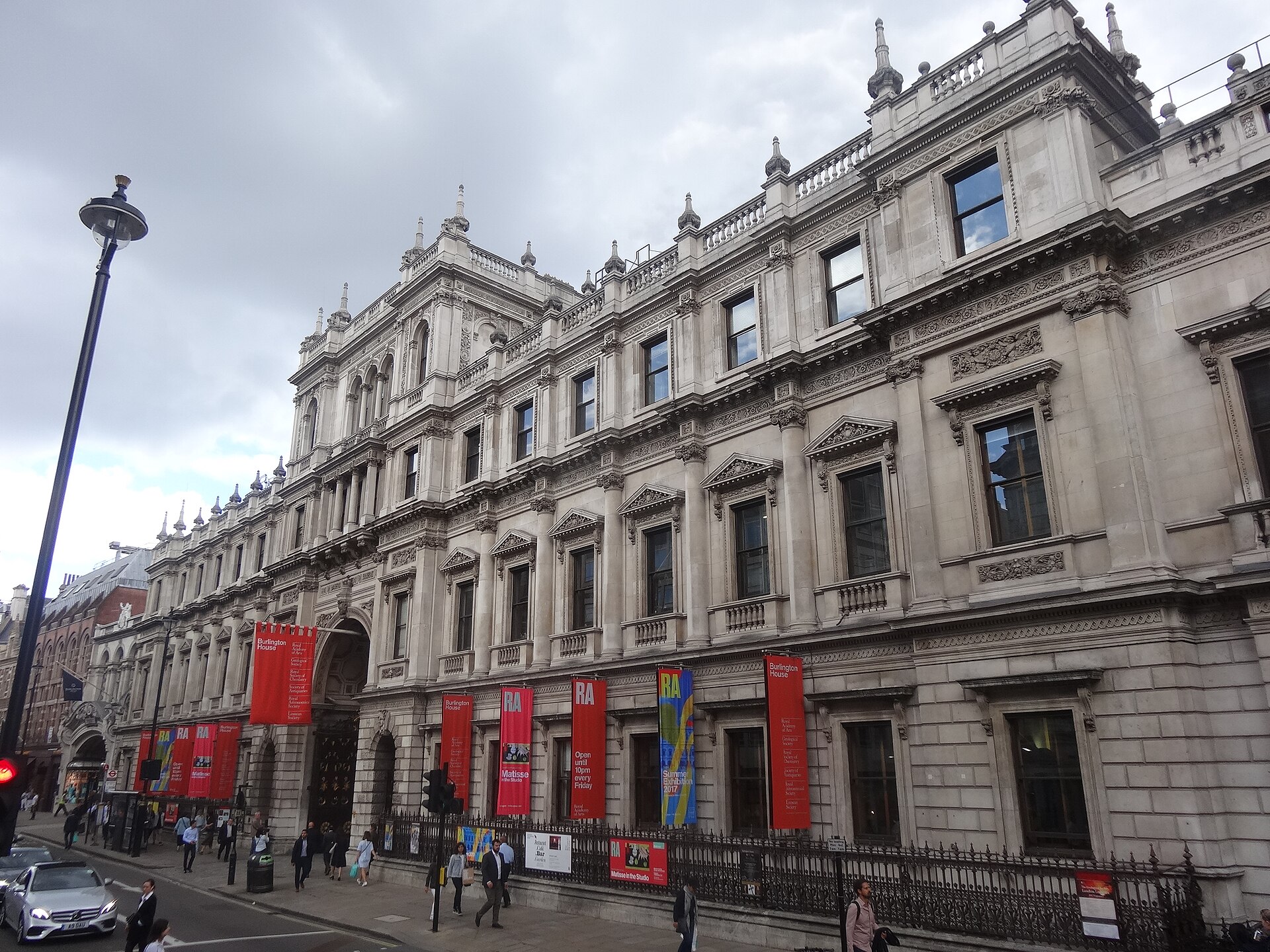
The Royal Academy's holdings are shaped by how the institution has always fed them: not by state purchase or bequest alone, but by the Diploma Works every Royal Academician has been required to give on election since 1768, an unbroken run of paintings, sculpture and architectural drawings that amounts to a self-portrait of British art from Reynolds and Gainsborough to Hockney, Paolozzi and Shonibare. Around that core sit a Teaching Collection built to train the Royal Academy Schools' own students, an important collection of portraits of Members, one of Britain's oldest fine art libraries and an archive documenting the institution's own activities since 1760. Set against this largely British, largely post-1768 material, the Academy holds one major work of Continental Renaissance sculpture, Michelangelo's Taddei Tondo, the only marble by Michelangelo in a UK collection, which arrived by private bequest rather than through the Diploma system.
| Kind | Museum |
|---|---|
| Founded | 1768 |
| City and country |  London, United Kingdom London, United Kingdom |
| Address | Burlington House, Piccadilly, London W1J 0BD, United Kingdom |
| Website | royalacademy.org.uk |
| Status | Open, confirmed 18 September 2026 |
| Record last verified | 18 September 2026 |
Visiting
- Hours
- Tuesday-Sunday10:00 to 18:00Last entry to the galleries is half an hour before closing
- Friday10:00 to 21:00Late opening; the RA calls this Friday Nights at the RA
- Closed
- Monday.
- Admission
- Adult, current exhibition (Richard Dadd: Beyond Bedlam)GBP 15The RA sets no single general admission fee. Each temporary exhibition is ticketed separately; this is the price of the exhibition on view at the time of research.
- 16 to 25 (25 & Under scheme)GBP 7.50Half the adult exhibition price after free sign-up to the 25 & Under scheme. Valid photo ID required on arrival.
- Under 16FreeFree to all exhibitions. Must be accompanied by a fee-paying adult.
- Disabled visitorFreePays the concessionary exhibition rate; one companion or carer enters free.
Free entry: Every day: the Main Galleries collection displays and the John Madejski Fine Rooms are free, no ticket or booking required- Tickets
- royalacademy.org.uk/exhibition/richard-dadd The museum's own ticket page.
- Do I need to book?
- Not required for the free Main Galleries collection displays or the John Madejski Fine Rooms; timed online booking is encouraged for ticketed loan exhibitions
- Address
- Burlington House, Piccadilly, London W1J 0BD, United Kingdom MapUnderground Piccadilly Circus and Green Park, both a short walk from the Burlington House entrance on Piccadilly
- Website
- royalacademy.org.uk
- Telephone
- +44 20 7300 8000
- [email protected]
Before you go how long, access, photography, bags, eating, shop
- How long to allow
- About an hour for the free Fine Rooms alone; a half day where a ticketed exhibition in the Sackler Wing is added
- Access
- Step-free access throughout the building; manual wheelchairs and one rollator walker can be borrowed or booked in advance; disabled visitors pay the concessionary exhibition rate with a free companion ticket; accessible toilets and a doorbell-operated ramped entrance are provided at the Burlington House door
- Photography
- Photography is allowed throughout unless a sign says otherwise; drones are strictly prohibited
- Bags
- Self-service lockers and a small cloakroom are provided; backpacks, suitcases and large bags cannot be brought into the galleries or stored anywhere else in the building
- Eating
- The RA Cafe at Burlington House serves hot and cold drinks and light meals. In the Keeper's House, the Sir Hugh Casson Room, the Shenkman Bar and Dining Room and the Academicians' Room serve food and drink. The Jose Pizarro restaurant and the Poster Bar in Burlington Gardens are closed until 2027 during the Collection Gallery expansion.
- Shop
- An RA Shop sells books, prints and exhibition-themed goods; a free selling display of contemporary work, Flowers for you, runs alongside it in the galleries
Prices and hours change. We take them from the institution's own pages and print the day we read them, and you can check the current position at the source we used. Confirm before you travel.
What is inside
Main Galleries and The Jillian and Arthur M. Sackler Wing of Galleries
The Academy's principal loan-exhibition spaces, entered from the Burlington House Piccadilly entrance and ticketed separately for each show. The Sackler Wing, designed by Norman Foster and Spencer de Grey and opened in 1991, replaced the Victorian Diploma Galleries with a glass staircase and top-lit atrium. The exhibition on view at the time of research was Richard Dadd: Beyond Bedlam, 25 July to 25 October 2026.
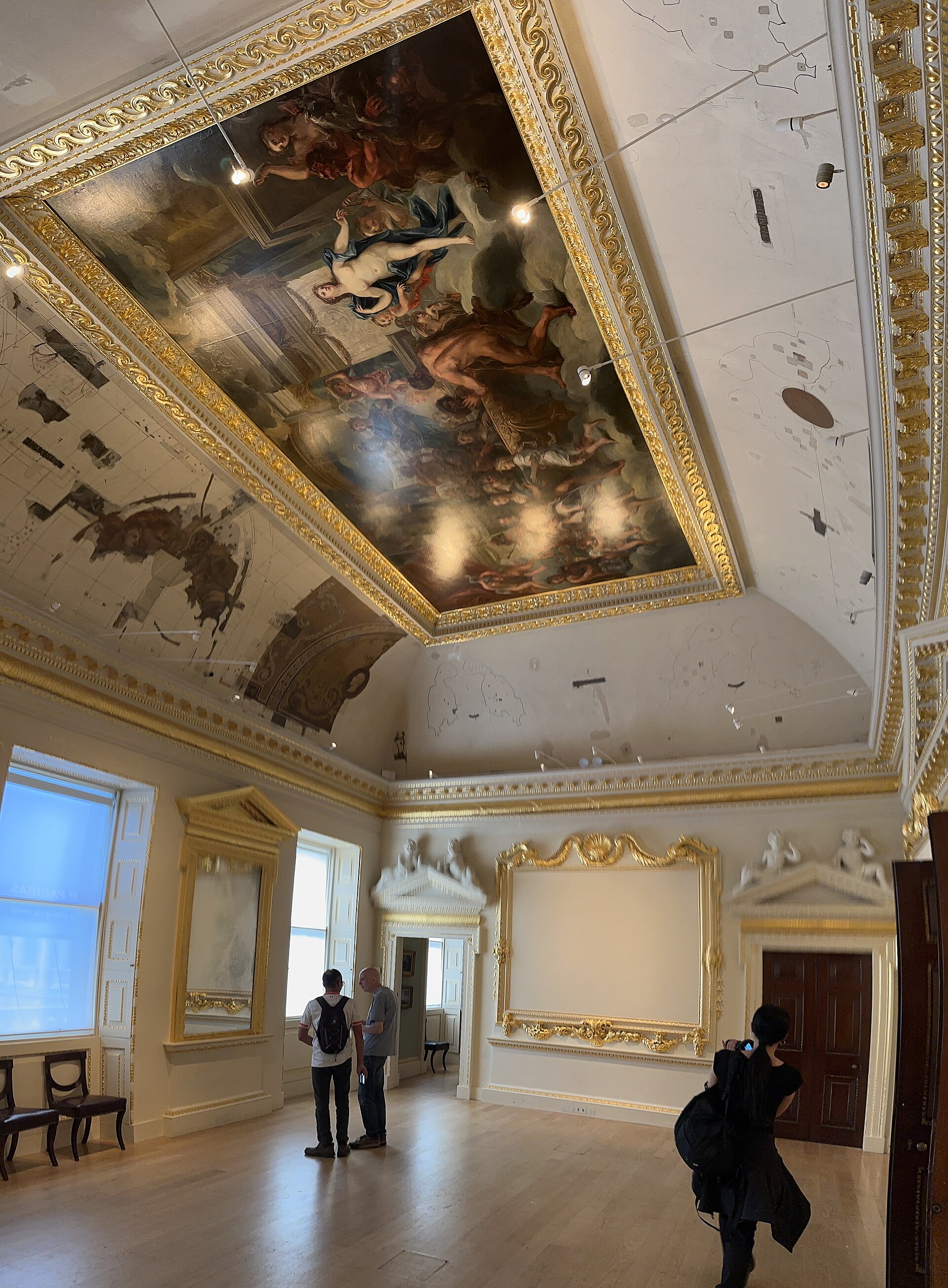
Photograph by Matt Brown · CC BY 2.0 The John Madejski Fine Rooms
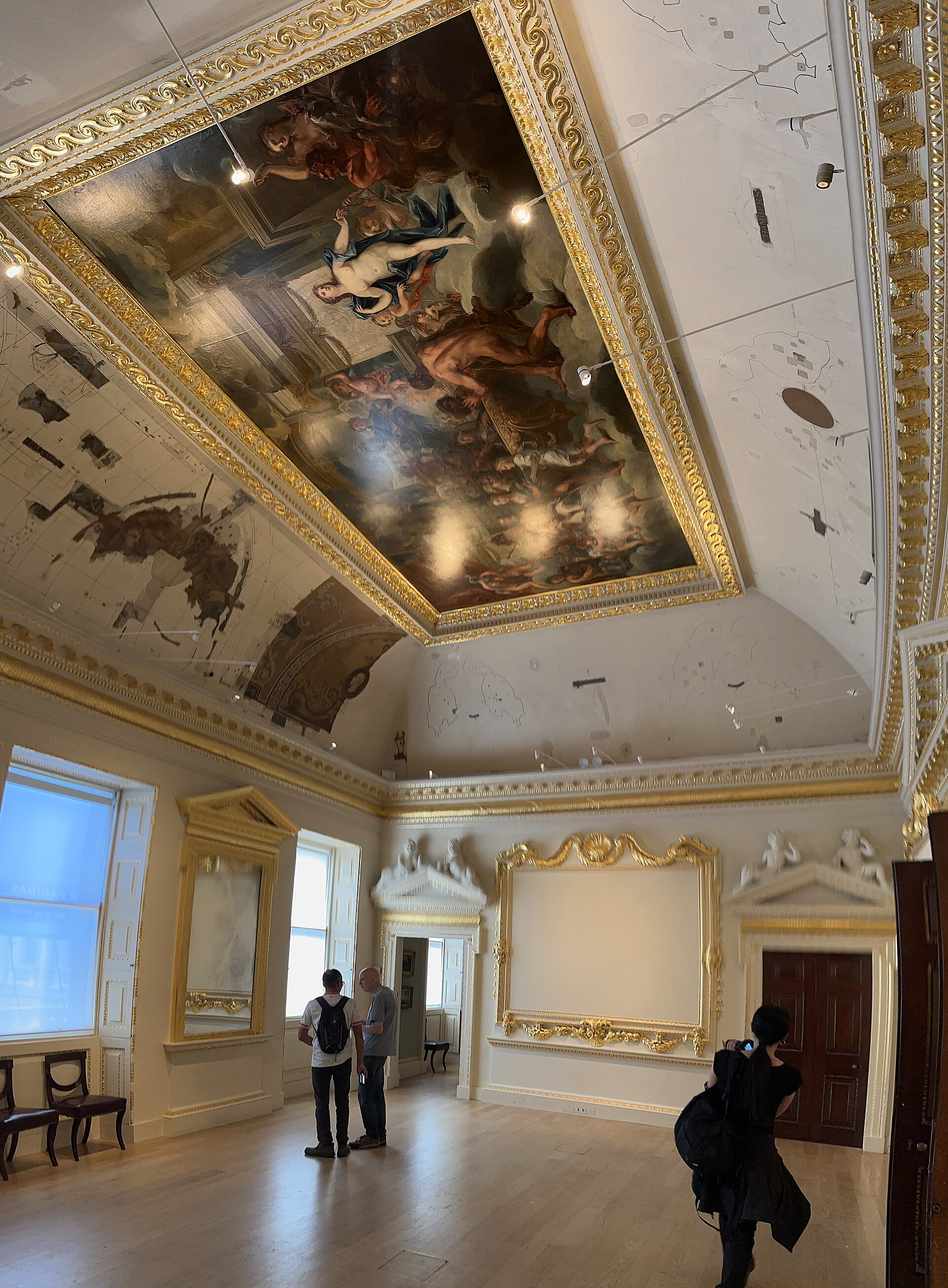
The Academy's working rooms above the Burlington House entrance, decorated to a scheme begun around 1710 for Lady Juliana, Dowager Countess of Burlington, and still used for RA business, including the General Assembly Room where Royal Academicians meet. Free and open to the public from 16 December 2025 to early 2027 while the main Collection Gallery is closed, showing works from the RA Collection by Thomas Gainsborough, Laura Knight, L.S. Lowry, Mary Moser, Frank Cadogan Cowper, David Hockney, Nigel Hall, Olwyn Bowey and Diana Armfield among others.
RA Collection Gallery, 6 Burlington Gardens
The Academy's dedicated free galleries for its own permanent collection, in a listed building acquired in 2001 and joined to Burlington House in the 2018 RA250 project. Closed to the public from 27 October 2026 while the Collection Gallery is expanded; due to reopen in early 2027. Visitors attending events in the Clore or Benjamin West Lecture Theatre can still reach Burlington Gardens on their event ticket.
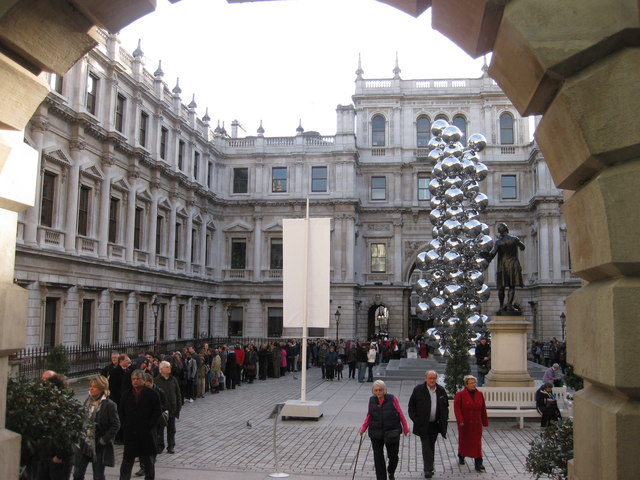
Photograph by Rib · CC BY-SA 2.0 Annenberg Courtyard
The entrance forecourt off Piccadilly, arrived at through the archway from the street, where the Academy has long staged a changing programme of outdoor sculpture commissions by contemporary artists alongside Alfred Drury's statue of the first president, Sir Joshua Reynolds, palette in hand.
Royal Academy Schools
Britain's oldest art school, founded alongside the Academy in 1768 and still training postgraduate students inside Burlington House on a fully-funded course; not generally open to the public outside the annual Premiums Show and degree shows.
What to see first
The Taddei Tondo
Michelangelo BuonarrotiA marble relief of the Virgin and Child with the infant Saint John, carved around 1504-05 and left unfinished when Michelangelo left Florence for Rome. It is the only marble sculpture by Michelangelo in a UK collection. Bought to London in 1822 by Sir George Beaumont, it entered the RA Collection on the death of Lady Margaret Beaumont in 1829; within a week the newly elected Academician John Constable called it one of the most beautiful works of art in existence.10
Sketch of Michelangelo's Taddei Tondo
John Constable RAA pen-and-brown-ink drawing made in 1830, the same year the Tondo itself entered the Collection, recording the reaction of a British Academician meeting a Renaissance masterpiece for the first time inside Burlington House.10
16th-century copy of Leonardo da Vinci's Last Supper
Unknown artist after LeonardoAn almost full-size copy of Leonardo's Milan mural, part of the Teaching Collection assembled from the Academy's foundation to give RA Schools students direct access to Old Master composition without travelling to Italy.9
RA Diploma Work
J.M.W. Turner RAOne of the Diploma Works given to the Academy by artists on their election as full Members, a tradition running unbroken from the 18th century to today and forming, across hundreds of works, a self-portrait of British art painted by its own practitioners.9
A Mermaid
John William Waterhouse RAWaterhouse's own Diploma Work, and named by the Academy's own account of its holdings as one of the best-known paintings in the Collection.9
Self-portraits
Sir Joshua Reynolds PRA and Thomas Gainsborough RAThe Academy's collection of Members' portraits includes self-portraits by its first President and by Gainsborough, part of a visual record of the founding generation of 1768 alongside portraits of Constable, Millais and other Academicians.9
RA Diploma Work
Yinka Shonibare RAGiven to the Academy on Shonibare's election as a Royal Academician, one of a small group of Diploma sculptures by artists working today, alongside John Flaxman, John Gibson, Eduardo Paolozzi and Elisabeth Frink. Confirmed as a holding on the Academy's own collections page, distinct from Shonibare's separate history of showing work at the RA's temporary exhibitions.9
Burlington House and what it was built to hold
The Royal Academy of Arts occupies Burlington House, a palazzo on Piccadilly that began as a townhouse for the Earls of Burlington in the second half of the seventeenth century and was remodelled into its present Palladian form for the 3rd Earl in the 1710s and 1720s. The government bought the house and its garden in 1854, and over the following two decades it was reworked again, with new ranges added around a courtyard to hold a cluster of learned societies. The Royal Academy was not the house's first tenant: it had rented rooms in Pall Mall from its founding, then a purpose-built gallery at Old Somerset House designed by its own first Treasurer, Sir William Chambers, then premises shared with the newly founded National Gallery in Trafalgar Square. Space at Trafalgar Square ran short, and in 1867 the Academy moved into Burlington House, where it remains. Its President at the time, Francis Grant, negotiated an annual rent of one pound for nine hundred and ninety-nine years, a lease that still runs.
The building has been added to twice in ways that shape a visit today. In 1991 the Academy opened the Sackler Wing of Galleries, designed by the Royal Academicians Norman Foster and Spencer de Grey, replacing the Victorian Diploma Galleries with a glass staircase and a light-filled atrium that Foster has said helped set the template for later projects such as the Great Court at the British Museum. In 2001 the Academy bought 6 Burlington Gardens, a listed building on the block behind Burlington House, and from 2008 worked with David Chipperfield Architects on a decade-long masterplan, RA250, to join the two buildings for the first time and open new space for art, architecture, lectures and debate. The joined campus opened on 19 May 2018, months ahead of the Academy's 250th anniversary. That project is not finished: the Collection Gallery inside 6 Burlington Gardens closed to the public again from 27 October 2026 for a further expansion, with a return expected in early 2027, while the historic Burlington House side keeps its usual hours throughout.
A company of artists, self-funded and self-governing
The Royal Academy is not a branch of the state and not, despite the similarity of name, the same institution as the Royal Academy of Music or the Royal Academy of Engineering, nor the Royal Society, a separate scientific body that shares the Burlington House courtyard as a fellow society but keeps no art collection. It was founded on 10 December 1768, when a petition of thirty-six painters, sculptors and architects led by Chambers asked George III for permission to establish a society for promoting the arts of design, with an annual public exhibition and a school attached. The King agreed the same winter. At the first General Assembly four days later, Sir Joshua Reynolds was elected President, George Michael Moser became the first Keeper, responsible for the Schools, and Francis Milner Newton was appointed Secretary. The Academy has run itself this way ever since: an independent, self-governing body of practising artists and architects, the Royal Academicians, who elect their own new Members, teach in their own free art school, and fund the institution chiefly through ticket sales, membership and its shop rather than a government grant of the kind that supports the National Gallery a few streets away.
The thirty-six founders included two women, Mary Moser and the Swiss-born Angelica Kauffman, but the Academy's record on admitting more is a chequered one. In 1879 its Council concluded, reading the 1768 Instrument of Foundation again, that nothing in it in fact barred women, and passed a resolution making them eligible, though on restricted terms; even so, no further woman was elected a full Academician until Laura Knight in 1936, a gap of a hundred and sixty-eight years. In 1913 suffragettes turned the galleries themselves into a stage for protest: one slashed John Singer Sargent's portrait of the novelist Henry James, another attacked a painting by George Clausen, and a third tried to start a fire in the toilets.
Inside Burlington House: what is on view now
A visitor entering from Piccadilly reaches the Main Galleries and the Sackler Wing, where the Academy's ticketed loan exhibitions run; at the time of this research the show on view was Richard Dadd: Beyond Bedlam, bringing together more than a hundred works by the Victorian fairy painter across the Sackler Wing's rooms. Free to everyone and reached from the same entrance are the John Madejski Fine Rooms, the Academy's own working rooms above the entrance hall, decorated to a scheme laid out around 1710 for Lady Juliana, Dowager Countess of Burlington, and still used for Academy business: the General Assembly Room, where Royal Academicians meet, was once the house's banqueting room. From December 2025 the Fine Rooms are standing in as the public collection display while the purpose-built Collection Gallery in 6 Burlington Gardens undergoes a further expansion and stays closed until early 2027.
Outside the galleries proper, the Annenberg Courtyard forms the Academy's forecourt off Piccadilly, arrived at through an archway, and has for years carried a changing programme of large outdoor sculpture commissions alongside Alfred Drury's statue of Reynolds. Upstairs and largely out of public view, the Royal Academy Schools continue to train postgraduate art students for free inside the same building where they have taught, without interruption, since 1768, making them Britain's oldest art school.
The Summer Exhibition and the Diploma Collection
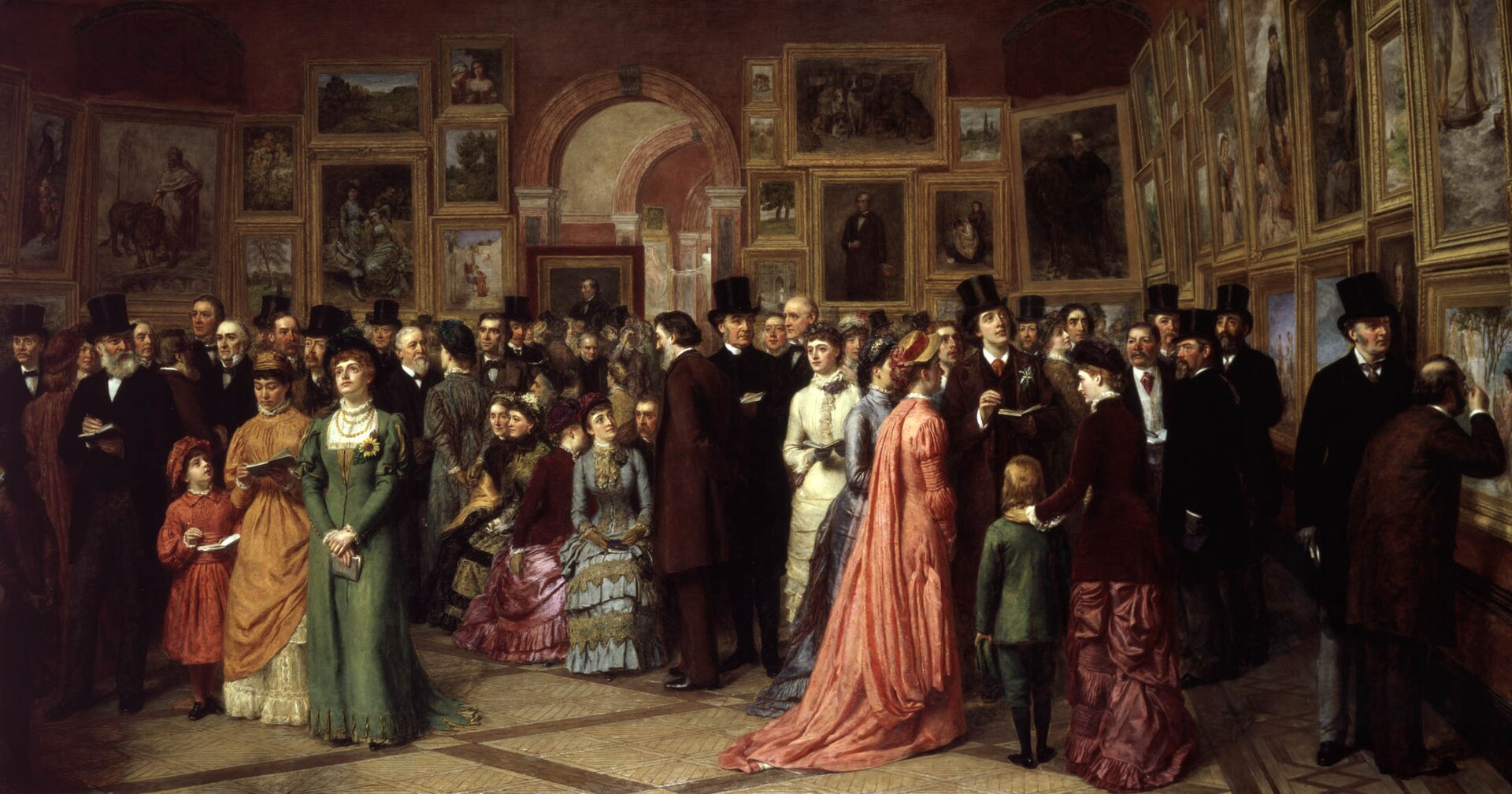
Two things distinguish the Academy's own collection from an ordinary museum's. The first is the Summer Exhibition, held every year without a break, including through both World Wars, since 1769, and the world's oldest open-submission art exhibition: anyone can enter a work, a rotating committee of Academicians selects and hangs the show over an eight-day hang, and the Academy takes a thirty-five per cent commission on anything sold, with the proceeds going to the RA Schools. Around two-thirds of exhibited works are typically by artists who are not Academicians at all, hung alongside Members and Honorary Academicians such as David Hockney, Tracey Emin and Ed Ruscha in recent years. It ends each year on Sanctioning Day, after which no changes can be made, and Non-Member's Varnishing Day, when a procession of artists led by a steel band still makes its way down Piccadilly.
The second is the Diploma Collection: every artist and architect elected a Royal Academician since 1768 has presented one work on election, an unbroken run that has produced paintings by Turner, John Constable, John Everett Millais, John Singer Sargent, Stanley Spencer and David Hockney; sculpture by John Flaxman, John Gibson, Eduardo Paolozzi, Elisabeth Frink and Yinka Shonibare; and architectural drawings by John Soane, Edwin Lutyens, Zaha Hadid and David Adjaye. Set against this largely British record is the Academy's one major work of Continental Renaissance sculpture, Michelangelo's marble Taddei Tondo, bought to England in 1822 and given to the Academy in 1829, the only marble carved by Michelangelo held anywhere in the United Kingdom. A near full-size sixteenth-century copy of Leonardo's Last Supper, made for teaching rather than display, sits in the same Teaching Collection that also holds George Stubbs's anatomical studies and casts from the antique.
Controversy and reception
The Academy's own exhibition history has produced real controversy more than once. Its 1930 Italian Art show, which brought Botticelli's Birth of Venus, Raphael's La Donna Velata and Donatello's David to Burlington House, was visited by Mussolini and used to further the cause of Fascism in Britain, a use the Academy did not control but that historians still cite against the show. In September 1997, Sensation, drawn from Charles Saatchi's collection, opened to a media storm over deliberately shocking exhibits, most notoriously Marcus Harvey's portrait of the child murderer Myra Hindley built from a child's handprint stencil; several Academicians resigned over the show, though most later returned, and more than three hundred thousand visitors came to see it, several of the artists involved going on to become Academicians themselves.
Current visitor opinion, read on Tripadvisor on 18 September 2026 from 2,273 ratings averaging 4.3 out of 5, consistently praises the free Fine Rooms, the Annenberg Courtyard and the range of the loan programme, and just as consistently divides over the Summer Exhibition, which some visitors call a uniquely democratic exhibition and others call inconsistent in quality and overpriced; specific and recent complaints cover reflective glazing that obscures paintings in the Fine Rooms and lapses in cafe hygiene and service, alongside at least one detailed account of staff going well beyond what was asked of them during a medical emergency on site. Critical reception of individual shows runs from warm to sharply divided: reviewing the 2026 Rose Wylie retrospective for theartsdesk, Sarah Kent gave the show five stars and called Wylie's paintings a blast of fresh air, while noting in the same review that the Academy's own curators had tried to tame her rebellious spirit by making her paradoxical images seem sensible, a mild but real institutional criticism embedded inside an otherwise enthusiastic notice.
What visitors say
Visitors consistently rate the free permanent displays, the historic interiors and the Annenberg Courtyard as the best reasons to visit even without buying a ticket, and describe staff as helpful, including in a serious account of a medical emergency handled with care. Opinion splits hardest over the annual open-submission Summer Exhibition, which some find a democratic celebration of working artists and others find inconsistent in quality and overpriced for what is on the walls. A recurring practical complaint is glare from glazing over paintings in the John Madejski Fine Rooms, and there are isolated but sharp complaints about cafe service and hygiene.
What is praised, what is criticised
- Praised: The free John Madejski Fine Rooms and the grandeur of the Burlington House interiors, repeatedly named as worth the visit on their own
- Praised: The range and ambition of the loan exhibition programme, from Old Masters to living Royal Academicians
- Praised: The Annenberg Courtyard as a place to sit before or after a show
- Praised: Staff helpfulness, including one visitor's account of the Academy's response to a medical emergency on site
- Criticised: Inconsistent quality and high prices among works for sale at the open-submission Summer Exhibition
- Criticised: Reflective glazing over paintings in the John Madejski Fine Rooms that some visitors say makes them hard to see
- Criticised: Service and, on at least one visit, food hygiene lapses in the on-site cafes
Ratings on other platforms
Tripadvisor: 4.3 from 2,273 ratings, read 18 September 2026
A platform average is a tertiary source: it moves, it is not audited, and we quote no visitor's words.
Questions about Royal Academy of Arts
Where is Royal Academy of Arts?
Burlington House, Piccadilly, London W1J 0BD, United Kingdom.
How much does it cost to visit?
Adult, current exhibition (Richard Dadd: Beyond Bedlam): GBP 15; 16 to 25 (25 & Under scheme): GBP 7.5; Under 16: free; Disabled visitor: free. As confirmed 18 September 2026.
When is it open?
Tuesday-Sunday 10:00-18:00; Friday 10:00-21:00. Closed: Monday. As confirmed 18 September 2026.
How do you get there?
Underground: Piccadilly Circus and Green Park, both a short walk from the Burlington House entrance on Piccadilly.
What should you see first?
The Taddei Tondo (Michelangelo Buonarroti); Sketch of Michelangelo's Taddei Tondo (John Constable RA); 16th-century copy of Leonardo da Vinci's Last Supper (Unknown artist after Leonardo); RA Diploma Work (J.M.W. Turner RA); A Mermaid (John William Waterhouse RA); Self-portraits (Sir Joshua Reynolds PRA and Thomas Gainsborough RA).
What we could not confirm
- The Collection Gallery in 6 Burlington Gardens is closed for expansion from 27 October 2026 with a stated return in early 2027; the RA's own site does not yet give the final scope of the reopened display.
- The RA sets exhibition ticket prices per show rather than a single admission fee; the GBP 15 adult price recorded here is for Richard Dadd: Beyond Bedlam and will change with the next exhibition.
Images
Sources
- 1Royal Academy of Arts, home page, accessed 18 September 2026 royalacademy.org.uk/
- 2Royal Academy of Arts, Opening times royalacademy.org.uk/page/opening-times
- 3Royal Academy of Arts, Plan your visit royalacademy.org.uk/plan-your-visit
- 4Royal Academy of Arts, Access and facilities royalacademy.org.uk/access-at-the-ra
- 5Royal Academy of Arts, Contact us royalacademy.org.uk/page/contact-us
- 6Royal Academy of Arts, Richard Dadd: Beyond Bedlam, exhibition page royalacademy.org.uk/exhibition/richard-dadd
- 7Royal Academy of Arts, 25 & Under royalacademy.org.uk/page/25-and-under
- 8Royal Academy of Arts, The John Madejski Fine Rooms, display page royalacademy.org.uk/exhibition/fine-rooms-open
- 9Royal Academy of Arts, Collection and research royalacademy.org.uk/page/collections-and-research
- 10RA Collections team, 'How to read it: Michelangelo's Taddei Tondo', Royal Academy of Arts, 1 April 2017 royalacademy.org.uk/article/how-to-read-it-michelangelo-taddei-tondo
- 11Royal Academy of Arts, About the Summer Exhibition royalacademy.org.uk/summer-exhibition
- 12Royal Academy of Arts, A brief history of the RA royalacademy.org.uk/page/a-brief-history-of-the-ra
- 13Tripadvisor, Royal Academy of Arts, London, reviews and rating, read 18 September 2026 tripadvisor.com/Attraction_Review-g186338-d188864-Reviews-Royal_Academy_of_Arts-London_England.html
- 14Sarah Kent, 'Rose Wylie, Royal Academy review - a gleeful celebration of sight', theartsdesk, 26 February 2026 theartsdesk.com/visual-arts/rose-wylie-royal-academy-review-gleeful-celebration-sight
- 15Wikidata, Royal Academy of Arts (Q270920), accessed 18 September 2026, tertiary for identity and coordinates only wikidata.org/wiki/Q270920