The Blue Boy
Thomas Gainsborough · c. 1770
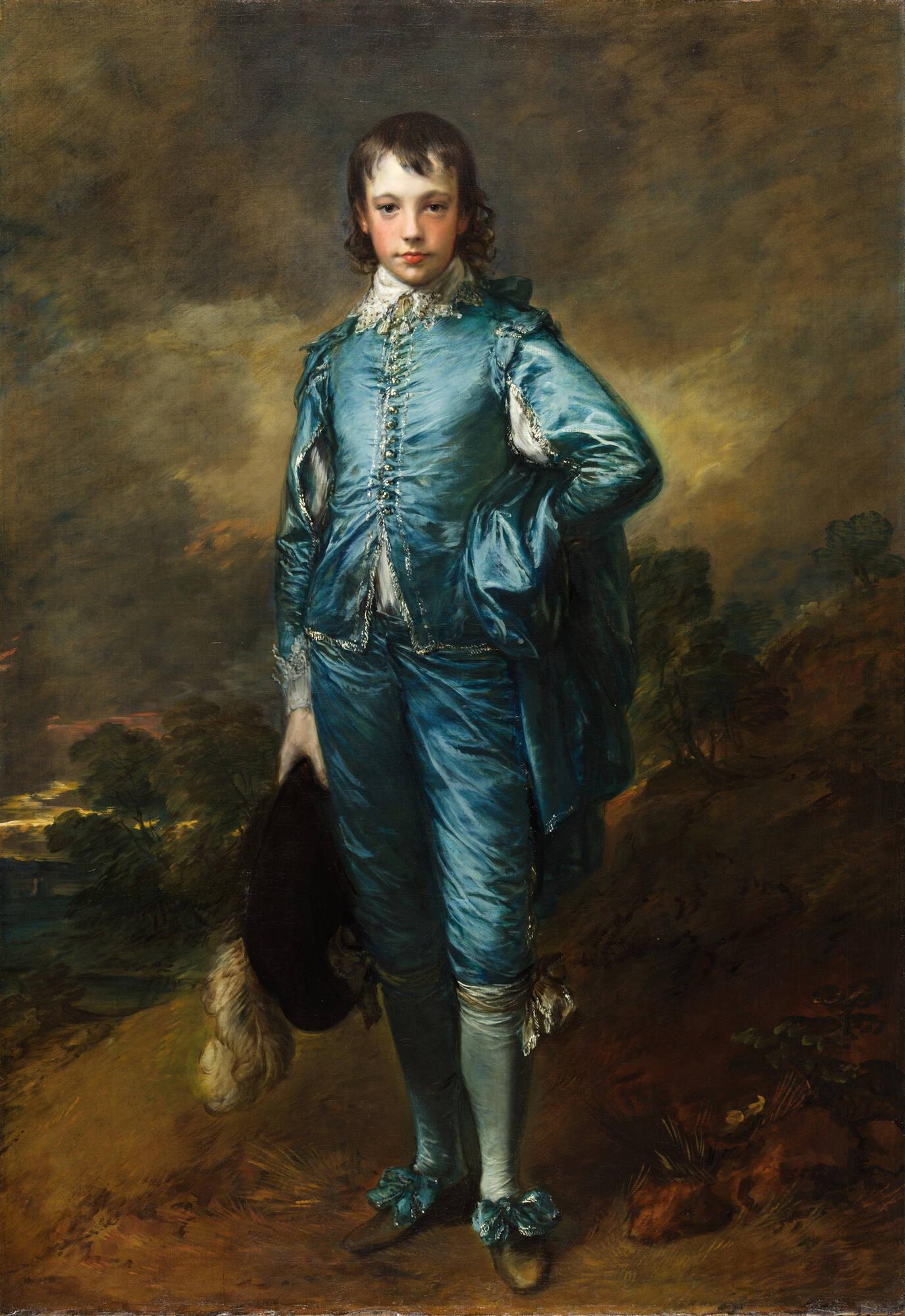
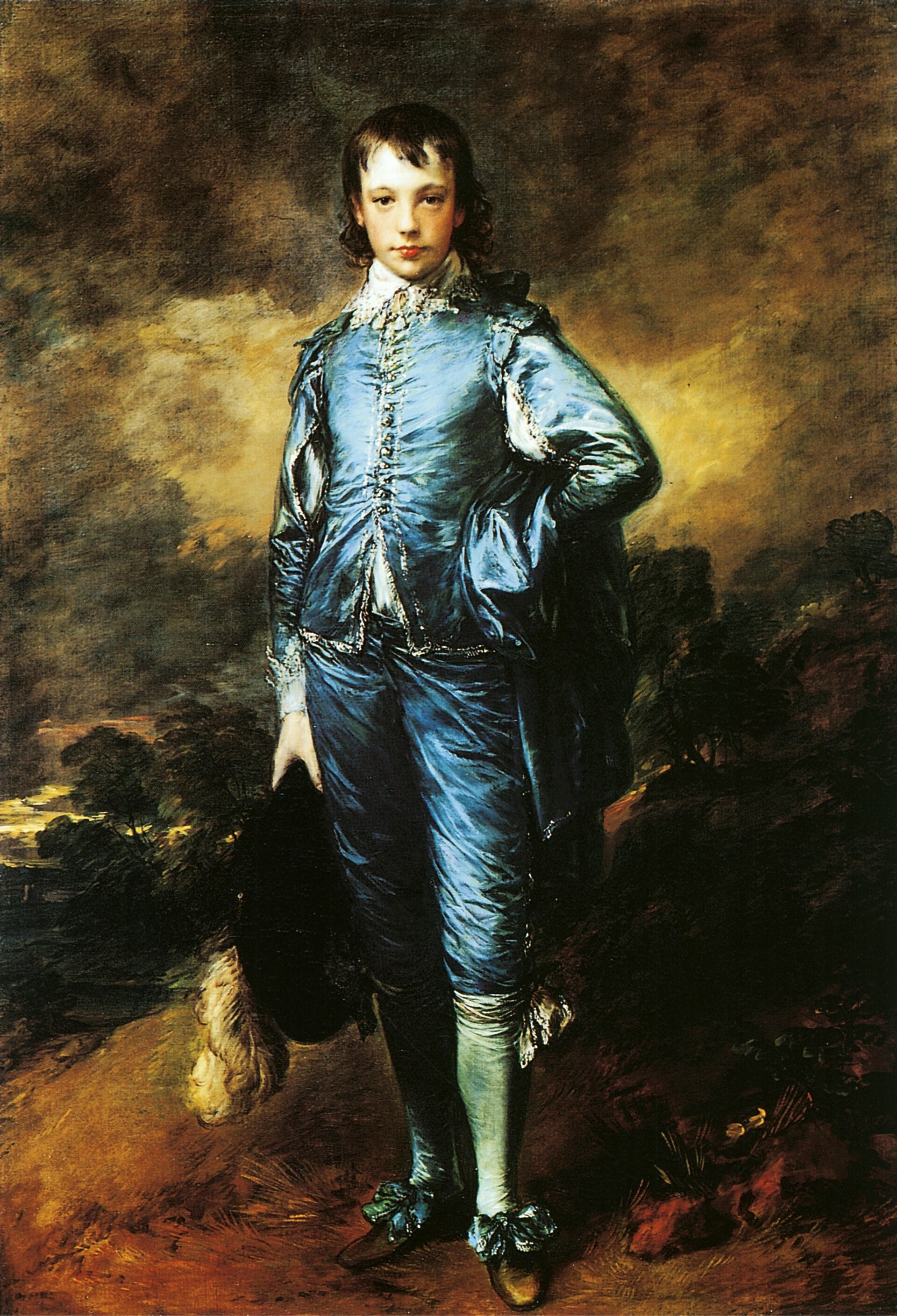
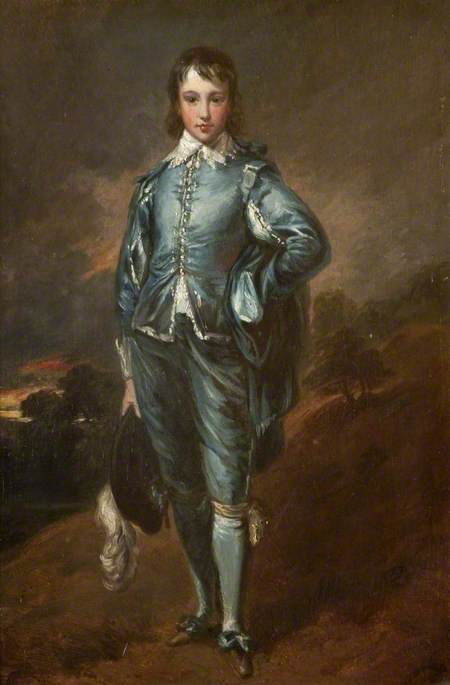
The whole picture, oil on canvas, 179.4 x 123.8 cm, The Huntington, object number 21.1. This is the Huntington's own object image, uploaded to Commons on 24 February 2023 from its eMuseum page, and the colour reads cleaner and cooler than the older web copy below; the Commons record does not say when the photograph was taken.
| Artist | Thomas Gainsborough |
|---|---|
| Date | c. 1770 |
| Medium | Oil on canvas |
| Dimensions | 70 5/8 x 48 3/4 x 1 in (179.4 x 123.8 x 2.5 cm); frame 85 x 63 x 6 in (215.9 x 160 x 15.2 cm) |
| Where it is now | The Huntington Library, Art Museum and Botanical Gardens, San Marino, California (Thornton Portrait Gallery)last confirmed |
| Inventory number | 21.1 |
| Attribution | AcceptedAccepted as Gainsborough's in every source consulted. Full note |
| Object type | Painting |
| Period | English, eighteenth century |
| Inscriptions | None recorded on the front. A pencil inscription 'Au revoir, CH' on a stretcher bar at the back was written by Sir Charles Holmes, director of the National Gallery, in January 1922. |
| Owners on record | 11 links9 documented, 2 disputed |
| Sources | 52 cited |
About this record Last verified · 52 sources cited · Change log
On this page 11 sections
ContentsClose
Gainsborough's full-length boy in blue satin, shown, the Huntington says, at the Royal Academy in 1770 as A Portrait of a Young Gentleman, is in the Huntington at San Marino, California, under object number 21.1. It was painted on a canvas that already carried the start of a portrait of a man, with a dog that Gainsborough later painted out. No document names the sitter: Jonathan Buttall, the son of a Soho ironmonger, was the traditional answer from 1808, and the Huntington's own 2021 release treats that as disproven while a nephew, Gainsborough Dupont, is proposed but unconfirmed.
The earliest printing of the story that Gainsborough painted it to defy Sir Joshua Reynolds that this record found is in 1820 or 1821, more than forty years after the Discourse of 10 December 1778 that supposedly provoked it. The picture came by way of Hoppner to the Earls Grosvenor, and in October 1921 the Duke of Westminster's pictures went through Christie's to Joseph Duveen, who cleaned it, showed it at the National Gallery for three weeks to about 90,000 visitors with Sir Charles Holmes's pencilled Au revoir CH on the stretcher, and sold it to Henry and Arabella Huntington. The price depends on the source: 620,000, 640,000 or 728,000 dollars.
The Huntington treated it from 2017 and in public from September 2018, and lent it to the National Gallery for the first time in 2022. It is on view again in the Thornton Portrait Gallery. A second canvas of the same subject, the Hawley picture, was argued in 1898 to be the original; this record concerns the Huntington picture only.
Provenance
Each link is graded. Documented: a cited source supports it. Disputed: the identification is argued but not established. Unknown: no owner for that span, and the gap is not smoothed into a narrative. The grades in the glossary.
- c. 1770 - 1770Thomas Gainsboroughdocumented
Dated 1770 or c. 1770 by the Huntington and the National Gallery. Gainsborough lived in Bath from 1759 until 1774; the place of execution is not recorded in the sources consulted. Painted on a canvas that already carried an abandoned portrait of a man, with a dog later painted out. Not commissioned, according to the Huntington co-curator Melinda McCurdy.3451348
- 1770 - 1770Royal Academy exhibition, Londondocumented
The Huntington says it first appeared in public at the Royal Academy in 1770 as A Portrait of a Young Gentleman. Gower in 1903 wrote only that it was supposed to have been exhibited there. The Academy catalogue was not seen.1722
- before 1796 (date of acquisition unrecorded) - 1796Jonathan Buttall (1752-1805), Greek Street, Sohodocumented
Edwards (1808) says the picture was the portrait of Master Buttall, whose father was a considerable ironmonger in Greek Street; Young (1820 or 1821) says it was bought at Mr. Buttall's sale; the Huntington calls Buttall the first owner. Ownership by Buttall is attested by those statements; how and when Buttall obtained it, and whether he sat for it, is unrecorded, and no source dates his acquisition. Wikipedia, relying on Hedquist, says he filed for bankruptcy in 1796. The American Art News of 22 October 1921 says, without a source, that young Buttall had it until about 1796 and that it then passed to George, Prince of Wales.719222349
- c. 1796 - 1802Mr. Nesbit (Nesbitt); Wikipedia identifies him as the politician John Nesbittdisputed
Young: purchased at Mr. Buttall's sale by Mr. Nesbit. The Grosvenor House catalogue of 1876 says instead that at Mr. Buthall's death the picture was sold to Mr. Nesbit. Fuller prints a Nesbitt sale of 25 May 1802 in his own different account. No sale document seen; this link rests on catalogue statements, and the American Art News of 22 October 1921 adds, without a source, that the Prince of Wales owned it between Buttall and Nesbitt and that Nesbitt, a boon companion of the Prince, bought it for 300 pounds.192021253749
- 1802 - c. 1809John Hoppner, painterdisputed
Edwards wrote in a book published in 1808 that it was then in Hoppner's possession; Young says Hoppner disposed of it to Earl Grosvenor. Hoppner's son wrote on 7 June 1872 that he remembered a Blue Boy in his father's house in Charles Street, St James's, and believed it was held in custody for the Prince of Wales. Fuller used the letter to argue that the picture Hoppner held was a different Blue Boy.19212223
- before 1814 (probably about 1809) - 1921The Earls Grosvenor, Marquesses and Dukes of Westminster, Grosvenor House, Park Lane, Londondocumented
Young, 1820 or 1821, No. 16; the Grosvenor House catalogues of 1876 and 1880, No. 77. Lent in 1814 to the British Institution as Portrait of a Youth and in 1857 to Manchester as The Blue Boy (Master Buttall), No. 156; Wikipedia adds the 1862, 1870, 1885 and 1896 loans. Ownership by Earl Grosvenor is attested by the 1814 British Institution entry and Young's catalogue; the date about 1809 is probable and comes from Wikipedia's summary of Hedquist, and no purchase price is recorded. Fuller notes the first Earl died in August 1802, so the buyer was probably the second Earl. The American Art News said in October 1921 that it had been sent to the National Gallery in war time for safe keeping.1920212549
- October 1921 - November 1921Duveen Brothers (Sir Joseph Duveen), London and New Yorkdocumented
Reported by the American Art News of 22 October 1921 (the only source for Christie's role) as sold by Christie's for the Duke of Westminster to Duveen, together with Reynolds's Mrs Siddons as the Tragic Muse, for about 170,000 pounds (about 640,000 dollars) for the Gainsborough and 200,000 pounds for both. A London paper of 20 October put the Blue Boy at 157,500 pounds (150,000 guineas). Behrman says the same deal included Gainsborough's Cottage Door. The sale was private; no auction occurred. The documented price is in dispute between the sources.253741
- October to November 1921 - 1922Henry E. Huntington (1850-1927) and Arabella Huntington (1851-1924), San Marino and New Yorkdocumented
The American Art News named Huntington as the buyer on 29 October 1921; the Los Angeles Times reported the purchase on 14 November. The price is given as 640,000 dollars (American Art News, 1921), 620,000 dollars (Behrman) and 728,000 or 728,800 dollars (the Huntington and The Art Newspaper), or roughly 725,000 (Hess, 2013). The Huntington says Henry and Arabella purchased it from Duveen, who had acquired it from the Duke.1315264142
- January 1922 - 25 January 1922Exhibited by Duveen at the National Gallery, London, for three weeksdocumented
Cleaned first at Duveen's order. 90,000 visitors; paid admissions about 1,000 pounds per the American Art News; Charles Holmes's pencil note Au revoir CH on a stretcher bar.473031
- 6 February 1922 - 16 March 1922Duveen Galleries, New Yorkdocumented
Arrived in New York on the French liner La Savoie on 6 February 1922 in the charge of Mr Todd of Duveen's London galleries; shown from 23 February for the benefit of the Fifth Avenue Hospital, admission 2 dollars; extended to 15 March; sent to San Marino on 16 March.32333435
- March 1922 - presentHenry E. and Arabella Huntington, then The Huntington Library, Art Museum and Botanical Gardens, San Marino, Californiadocumented
Arrived at San Marino, guarded and accompanied by Duveen, per the American Art News of 25 March 1922. The Huntington opened to the public in 1928 and the Blue Boy has been a visitor favourite since. Loaned once, to the National Gallery, London, from 25 January 2022. The date of any formal transfer from the founders to the institution was not found; the Huntington's catalogue states object number 21.1.1271136
Technical evidence
| Attribution note | Accepted as Gainsborough's in every source consulted. The American Art News wrote in November 1921 that the Westminster picture had never been questioned as his, in contrast to the rival Hawley or Fuller canvas. The sitter, not the painter, is the open question. Gainsborough did not sign or date his pictures (Fuller, 1898). |
|---|---|
| Support | Oil on canvas, lined. A repaired tear shows in the X-ray at the lower left. The canvas had been used before: a portrait of a man was begun on it and abandoned, and a 1939 X-ray of the upper part was read as showing a canvas that had been cut down. Before the 2018-20 treatment the adhesive that bound the canvas to its lining was failing.4510 |
| Dimensions (the Huntington) | 70 5/8 x 48 3/4 x 1 in (179.4 x 123.8 x 2.5 cm); frame 85 x 63 x 6 in (215.9 x 160 x 15.2 cm).2 |
| Dimensions in earlier catalogues | Young's Grosvenor House catalogue (1820 or 1821): 5 ft 10 in high, 4 ft wide. Fuller (1898): the Grosvenor House picture 70 x 48 in. Wikipedia (tertiary): 177.8 x 112.1 cm, which does not match the Huntington's own width of 123.8 cm.192149 |
| Ground | A double ground of lead white and chalk with some yellow ochre and a few black particles, forming an off-white preparation (cross-section; SEM-EDS imaging by Dr Gregory D. Smith, Indianapolis Museum of Art at Newfields).4 |
| Abandoned first portrait | Infrared reflectography shows a man's face and the outlines of his shoulders, painted with lead white and vermilion flesh tones covered by a grey layer, then covered with dark paint. The X-ray shows a man's face; where the background has worn thin, the Huntington's visible-light detail shows an abandoned portrait of a man in a thick white neckcloth. The Huntington reads the early abandonment as the reason the canvas was reused.45 |
| The dog | X-ray of 1994 (survey begun February 1994, reported by the Los Angeles Times on 25 June 1995) shows a dog, probably an English water spaniel, painted and covered. The Huntington's infrared images show it disguised with foliage; the Los Angeles Times and ARTnews describe a pile of painted rocks.41014 |
| X-radiography | Upper half of the picture X-rayed in 1939; a Getty-funded survey of the Huntington's British pictures in 1994-95; digital X-radiography in the 2017-20 project. It shows layered brushstrokes in the costume, the support structure and condition, the repaired tear and the abandoned portrait.410 |
| Ultraviolet | Overpaint from past restorations absorbs ultraviolet light while the varnish fluoresces. At the far left edge the Huntington's page shows overpaint that had discoloured.4 |
| Paint handling | Under a surgical microscope the conservator saw individual pigment particles, which she read as coarser grinds used for their light-reflecting behaviour, and a highlight in the eye made from a single small dab of paint. Gainsborough painted the background very thinly in places, which later cleanings abraded; uneven earlier cleanings are visible.6 |
| Condition before treatment | Brittle edges, paint lifting and flaking, hazy and discoloured layers of varnish and old inpainting; the most recent earlier treatments had mainly added new varnish.56 |
| Treatment history | Cleaned and varnished at Duveen's order before the National Gallery showing in January 1922, over the objections of some British experts. Reframed in 1938 in a cut-down Carlo Maratta type frame. ARTnews (2022) says it had been restored six times in the century before 2018. Treated by Christina O'Connell from 2017, with the in-gallery phase beginning 22 September 2018.58143034 |
| Frame | Current: an eighteenth-century English rococo frame chosen in 2013 and fitted from late that year, replacing the cut-down frame of 1938. The frame it arrived in at San Marino was probably the one it wore at Grosvenor House.816 |
| Reverse | Pencil inscription 'Au revoir, CH' on a stretcher bar, written by Sir Charles Holmes, director of the National Gallery, before the picture left in January 1922.47 |
| Signature | None recorded on the front. Fuller (1898) says Gainsborough never signed or dated his pictures.21 |
| Pigments | The Huntington used X-ray fluorescence but its pages consulted do not publish a pigment table. ARTnews (2022) says Prussian blue; that is a press statement not found on the Huntington's pages.514 |
Images
The record in full
Chapter 1A boy in clothes that were a century and a half out of date
The Blue Boy is a full-length portrait in oil on canvas, 70 5/8 by 48 3/4 inches (179.4 by 123.8 cm) without its frame, in the Huntington Library, Art Museum and Botanical Gardens at San Marino...
The Blue Boy is a full-length portrait in oil on canvas, 70 5/8 by 48 3/4 inches (179.4 by 123.8 cm) without its frame, in the Huntington Library, Art Museum and Botanical Gardens at San Marino, California, under object number 21.1. The Huntington's online catalogue lists it as on view, and its own pages place it in the Thornton Portrait Gallery of the Huntington Art Gallery, the former house of Henry and Arabella Huntington. (sources 1 and 2)
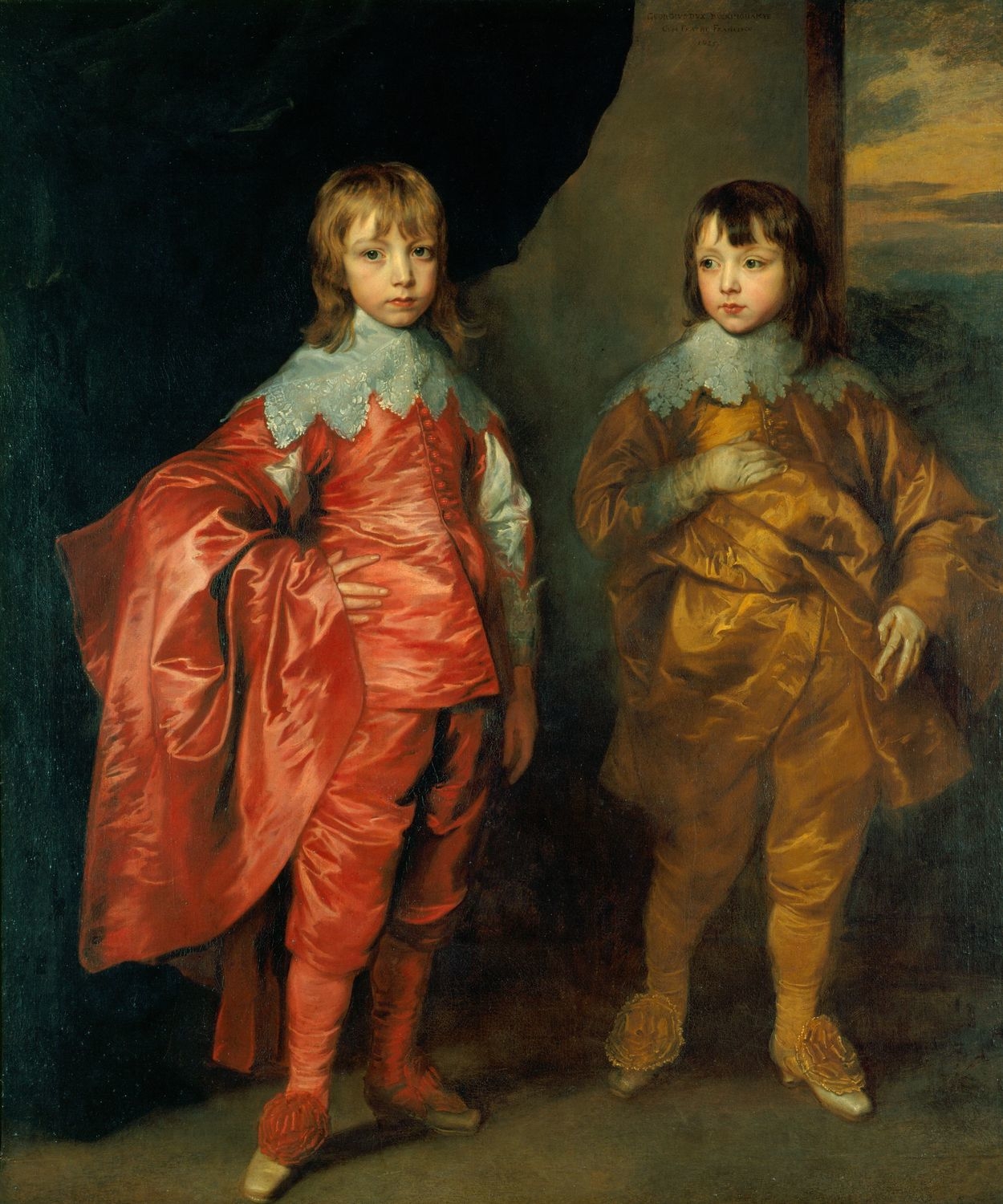
It shows a youth standing on a rising, wooded slope under a stormy sky. He wears a slashed doublet and knee breeches of blue satin, a short cloak, a lace collar and silk stockings tied with bows at the knee, and he holds a plumed hat in his lowered right hand. The costume is not the dress of 1770. It is seventeenth-century dress of Anthony van Dyck's day, which the Huntington calls a masquerade costume of Gainsborough's own time, one that paid tribute to the artist he admired above all others. (source 3) The Royal Collection's catalogue entry for Van Dyck's double portrait of the Villiers brothers says the composition was much admired in the eighteenth century and that its influence can be seen on the child portraiture of Reynolds, Gainsborough and Zoffany. (source 45)
Gainsborough showed it, the Huntington says, at the Royal Academy in 1770 under the title A Portrait of a Young Gentleman. By 1798, the Huntington says, it was being called The Blue Boy, and the name stuck. (sources 1 and 7) That title migration matters for anyone checking a catalogue. The picture has been listed as a portrait of a youth, as Master Buttall, as the Boy in Blue and as The Blue Boy, and a second, different canvas with the same nickname circulated for most of the nineteenth century (see the section on the other Blue Boy below). (sources 19 and 21)
The frame in the Huntington's catalogue measures 85 by 63 by 6 inches. Until 2013 the picture sat in a frame that the Huntington's curator had cut down from a spare in 1938; the present frame is an eighteenth-century English rococo example chosen in 2013. (sources 2 and 8)
Chapter 2Nobody has proved who he was
For most of its history the boy has had a name.
For most of its history the boy has had a name. Edward Edwards, in the anecdotes of painters published in 1808, listed among Gainsborough's works a whole-length portrait of a young gentleman in a Vandyck dress that had obtained the title of the Blue Boy from the colour of its satin, and added in a footnote that it was the portrait of a Master Buttall, whose father was then a very considerable ironmonger in Greek Street, Soho. (source 23) That footnote is the earliest identification this record has found in print. John Young's catalogue of the Grosvenor House pictures, dated 1820 on one Internet Archive copy and 1821 on another, repeats it under the entry Portrait of Master Buttall, better known under the name of the Blue Boy. (source 19)
The name did not travel with the picture at first. William H. Fuller, writing in 1898 in defence of the other Blue Boy, noted from a transcript of the British Institution catalogue that the Grosvenor picture was shown there in 1814 only as Portrait of a Youth, lent by Earl Grosvenor, and that the double title The Blue Boy (Master Buttall) first appeared in public at the Manchester Art Treasures exhibition of 1857. (source 21) Fuller also reported a genealogical objection from J. Sewell in Notes and Queries of 14 June 1873: that research had found two Jonathan Buttalls, father and son, and no child born to either between 1727 and 1796. Fuller's own conclusion was only that the boy had gone down to posterity without an authenticated name. (source 21) Fuller was arguing for a rival picture, so his scepticism has a motive, and Sewell had owned that rival picture and put it on the market in 1870, so he had one too; but the record Fuller reproduces can be checked against the same journals.
Modern holders of the picture have moved in steps. The Huntington's Project Blue Boy history page says the picture was long believed to be a portrait of its first owner, Jonathan Buttall, a friend of the Gainsborough family, that the artist had exhibited it simply as a portrait of a young gentleman, and that one scholar had suggested the sitter was the artist's nephew Gainsborough Dupont, who lived with his uncle from an early age and later served as his apprentice and studio assistant. (source 3) The Burlington Magazine's contents page for April 2013 summarises Susan Sloman's article, Gainsborough's Blue Boy, as saying the boy is there identified as Gainsborough Dupont. (source 17) The article itself is behind a subscription and was not read for this record.
By 29 June 2021 the Huntington's press release for the National Gallery loan was firmer. It described Jonathan Buttall (1752-1805) as the first owner, once thought to have been the sitter, and said that recent research has disproven this identification while the subject remains unconfirmed. (source 7) The National Gallery's exhibition page of 2022 says that the identity of the boy in blue is uncertain. (source 11) ARTnews reported on 4 February 2022 that many historians posit Buttall, that others believe there was no sitter and that the picture is a character study of an aristocratic type, and that a more recent theory favours Dupont. (source 14) The Huntington adds that no portraits of Jonathan Buttall are known to exist, so there is no face to compare. (source 3)
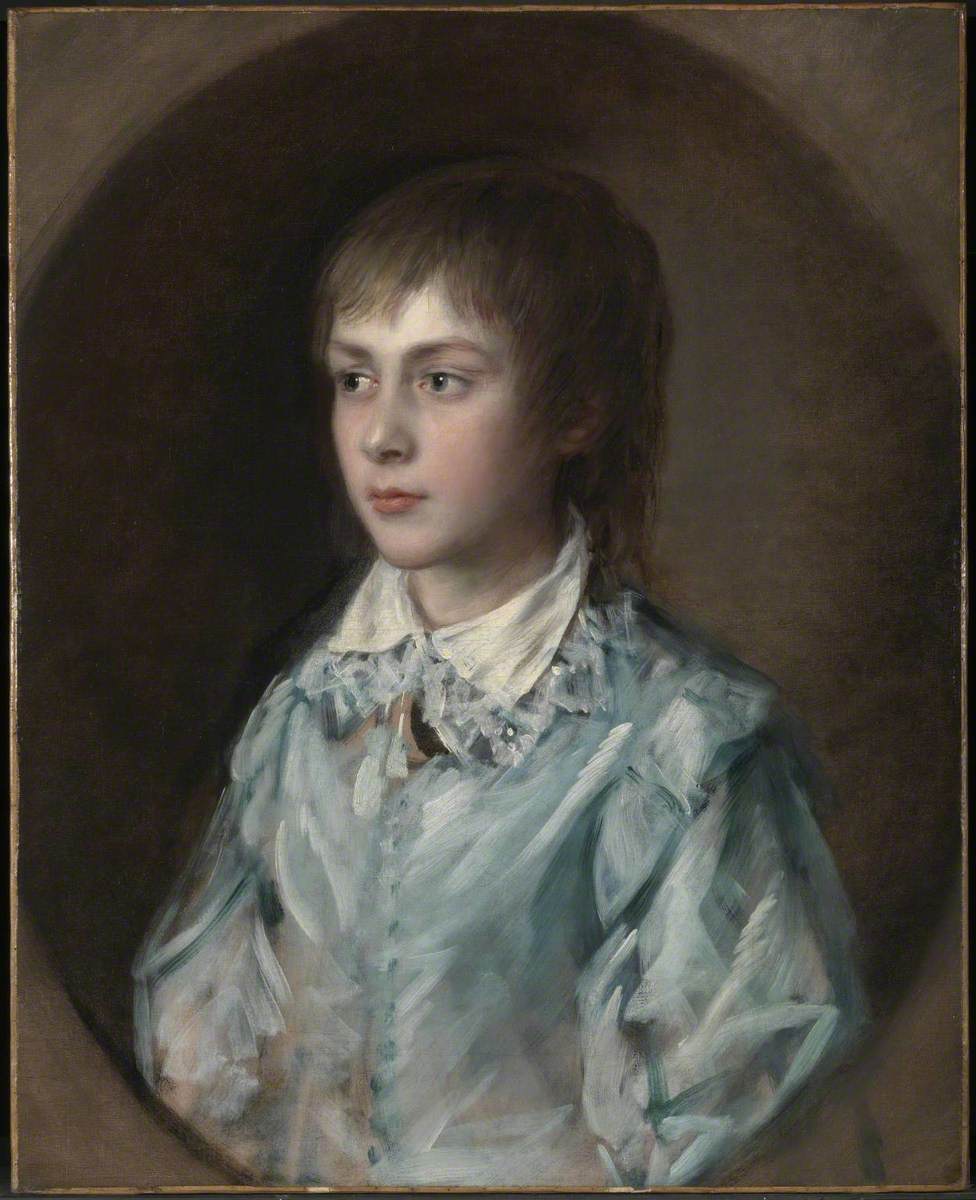
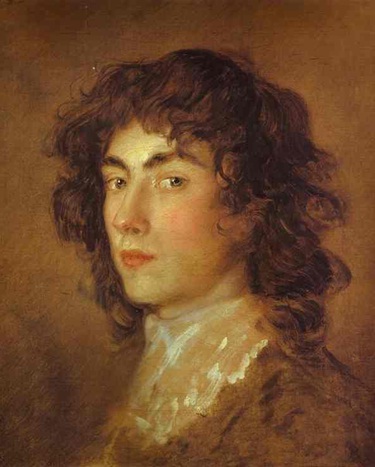
On the numbers, Buttall was born in 1752 according to the Huntington, which makes him seventeen or eighteen in 1770. (source 7) Dupont was born on 20 December 1754 and was apprenticed to his uncle in 1772, according to Wikipedia's summary of the National Gallery of Art's catalogue, which would make him fifteen or sixteen in 1770. (source 50) Neither age settles anything. The Huntington's history page shows another nephew, Edward Richard Gardiner (Tate, c.1760-8), in a pale-blue costume, and a portrait of Dupont of about 1773 (Waddesdon, on loan) in what appears to be a very similar blue Van Dyck suit, and it reads the blue as a studio costume rather than any one sitter's clothes. Tate also holds a portrait of Dupont dated c.1770-5, on long loan to Gainsborough's House. (sources 3, 46 and 47)
Chapter 3A used canvas: the portrait of a man underneath and the dog that was painted out
The Blue Boy was painted on a canvas that had already been started.
The Blue Boy was painted on a canvas that had already been started. The Huntington's associate curator Melinda McCurdy is quoted on the exhibition page for Project Blue Boy as saying that earlier X-rays had shown the picture was painted on a used canvas on which the artist had begun the portrait of a man. (source 5) One of those earlier X-rays dates from 1939, according to the Los Angeles Times of 25 June 1995: an X-ray of the top part of the picture, made to see what lay under a mysterious ridge of paint, showed that the boy had been painted over an incomplete likeness of an older man on a canvas that had been cut down. (source 10)
The 2017-18 examination added detail. In the Huntington's conservation pages, written by the conservator Christina O'Connell, infrared reflectography shows that Gainsborough covered the earlier portrait with dark paint, that only the face and the outlines of the shoulders had been painted, and that he therefore abandoned it at an early stage. Cross-sections show a double ground of lead white and chalk with some yellow ochre and a few black particles, forming an off-white preparation, and flesh tones of lead white and vermilion that were then covered with grey. The X-ray shows a man's face, and where the background has worn thin the abandoned portrait of a man in a thick white neckcloth shows in ordinary light. (source 4)
The dog is the other discovery. The Los Angeles Times reported in June 1995 that a survey financed by the Getty Grant Program, begun in February 1994, had found by X-ray that Jonathan Buttall, as the paper called the sitter, was originally painted with a dog, probably an English water spaniel, later covered with a pile of painted rocks. (source 10) The Huntington's own pages say the infrared images show the dog disguised with foliage, while the X-ray shows the dog that Gainsborough painted and then decided against. (source 4) The two accounts differ on what replaced it, rocks or foliage, and the conservation report that would decide it is not among the pages consulted.
The 1995 article quotes the Huntington curator Shelley Bennett, who said she did not know why the dog went and offered two guesses: that it was so cute it undercut the aristocratic conceits of the painting, or that all the fluff fought with the boy's hat. (source 10) That is a curator's speculation in 1995, not evidence. The 2017-18 X-rays also showed a repaired tear in the lower left, and the Huntington records that the adhesive holding the canvas to its lining was failing before the recent treatment. (sources 4 and 5)
A 1922 press report adds a third alteration that the Huntington's pages do not mention. A London correspondent writing on 10 January 1922 about the picture newly cleaned for the National Gallery said that the pentimenti it revealed included the hat, which had originally been on the boy's head and now hangs from his right hand, with both hat and feather changed in position and size. (source 38) This is a critic's reading of the cleaned surface, not a technical finding, and no later source consulted repeats it.
Chapter 4Van Dyck dress, and what the picture was for
According to the Huntington's co-curator Melinda McCurdy, the Blue Boy was not commissioned.
According to the Huntington's co-curator Melinda McCurdy, the Blue Boy was not commissioned. She told ArtFix Daily, as the BBC quoted her on 29 June 2021, that Gainsborough produced it for the express purpose of showing off his prowess at the Royal Academy exhibition of 1770, where it would hang beside the work of his rivals. (source 13) The Huntington's exhibition page calls it Gainsborough's first attempt at full-length Van Dyck dress. (source 5) The function, on this account, was advertisement: a showpiece for a painter who wanted wider patronage, not a picture made for a family wall.
The intellectual programme is a matter of costume and rivalry, and it should be graded plainly. That the boy wears Van Dyck dress is plain from the canvas, and the Huntington and the National Gallery both read it as homage. One report of Gainsborough's reverence for Van Dyck is a deathbed remark: Ronald Sutherland Gower's 1903 biography gives the dying painter's words to Reynolds as 'We are all going to Heaven, and Vandyke is of the company', and says the remark has come down to us; the passages consulted print it without a citation, though a footnote marker follows it in the scan. (source 22) The Huntington reports, with the word reportedly, that the painter Francis Hayman exclaimed on seeing the picture, 'It is as fine as a Van Dyck!' (source 3)
Where the picture departs from convention is the blue. The Huntington notes that Gainsborough usually painted his sitters in contemporary clothes, unlike Reynolds, who liked references to classical or Renaissance art, and that the blue suit appears in several portraits of the painter's nephews, so that by dressing the boy as in Van Dyck's day Gainsborough was not breaking his own rule of avoiding the dress of the past. (source 3) Deborah Cherry and Jennifer Harris wrote on Gainsborough and Van Dyck in Art History in September 1982, an article known here only from Wikipedia's citation. (source 49)
Nothing found in this research shows a hidden doctrine, a patron's instruction, a book Gainsborough owned on colour or a lodge or society that bears on the picture. No contract is known, McCurdy says there was no commission, and no inventory consulted ties the picture to any text. That absence is a finding. What the sources support is ordinary eighteenth-century portrait practice: a painter measuring himself against Van Dyck, in a costume the Huntington calls a masquerade dress of Gainsborough's own time.
Chapter 5The Reynolds story, in the order it appeared
The popular account says Gainsborough painted a blue picture to refute a rule laid down by Sir Joshua Reynolds, that blue must not dominate.
The popular account says Gainsborough painted a blue picture to refute a rule laid down by Sir Joshua Reynolds, that blue must not dominate. The documents give the text of the rule, its date and the stages by which the story attached itself to this canvas.
Reynolds delivered his Eighth Discourse to the Royal Academy students at the distribution of prizes on 10 December 1778. In the printed text, in the 1842 edition edited by John Burnet, he writes that it ought in his opinion to be indispensably observed that the masses of light in a picture be always of a warm mellow colour, yellow, red or a yellowish white, and that blue, grey or green colours be kept almost entirely out of these masses and used only to support and set off the warm colours. He adds that if the conduct is reversed and the light is cold with warm colours around it, it will be out of the power of art, even in the hands of Rubens or Titian, to make a picture splendid and harmonious. (sources 18 and 22) The rule is about the masses of light in a composition, not a ban on blue clothes. The date is eight years after the picture was exhibited, if it is the 1770 Royal Academy picture, as the Huntington says. Fulcher (1856) and Gower (1903) both put it in 1779; the 1770 dating rests on identifying it with the Academy's no. 85, a portrait of a young gentleman, which Fuller (1898) argued from Mary Moser's letter praising a portrait in a Vandyke habit. (sources 21 and 22)
The first printed link between the rule and the picture that this research found is John Young's Grosvenor House catalogue of 1820 or 1821. Young wrote that the picture was painted in consequence of a dispute between Gainsborough, Sir Joshua Reynolds and several other artists, Gainsborough having asserted that the predominant colour in a picture ought to be blue, and that it was considered he had proved his assertion. (source 19) Young did not cite a source. Fuller, in 1898, first says he can find no account of it in Fulcher's life of Gainsborough or in Leslie and Taylor's life of Reynolds, then prints Fulcher's 1856 Life, which does tell it, dates the picture to early 1779 and says Gainsborough clothed the boy in blue to refute Reynolds. (source 21) Mrs. Jameson's 1844 account of the Grosvenor Gallery repeated Young's wording, which Fuller described as copied word for word. (source 21) The Manchester catalogue of 1857 carried the tale as a caption: painted to disprove the opinion of Sir Joshua Reynolds that the predominance of blue is incompatible with a good effect of colour. (source 21) The Grosvenor House catalogues of 1876 and 1880 repeat it again. (source 20)
One more step is documented. In the 1842 Burnet edition of the Discourses, a footnote to the Eighth Discourse prints a letter to Burnet from the late Sir Thomas Lawrence, in which Lawrence says that, masterly as the execution is, he always feels that the Blue Boy of Gainsborough is a difficulty boldly combated, not conquered. (source 18) Lawrence's remark shows the picture was being weighed against Reynolds's rule by a leading portraitist before 1842, and that he took Reynolds's side on the colour question.
The chronology was already being corrected in 1898 and in 1922. Fuller pointed out that the Eighth Discourse dates from 1778, and speculated that Reynolds, not Gainsborough, may have had a famous picture in mind when he gave it. (source 21) The American Art News, describing the cleaned picture in New York on 25 February 1922, said that it is now known the picture was painted long before Reynolds uttered his warning. (source 34) The Huntington's 2021 press release does not repeat the story, and the National Gallery's 2022 page calls the picture Gainsborough's eloquent response to Van Dyck, without mentioning Reynolds. (sources 7 and 11) Wikipedia, citing Valerie Hedquist's 2020 book, states that the erroneous account propelled the painting to international fame; that is a tertiary summary of a book not read here. (source 49)
Gower, writing in 1903, offered an aesthetic point rather than a date: in the Blue Boy the artist put a mass of deep rich brown behind the figure, which harmonises with the blue costume, so that the blue light sits against a warm ground. (source 22) That reading, a painter's observation of how the picture works, is the nearest thing in the sources to a reconciliation of the canvas with the rule.
Chapter 6The chain of owners to 1921, with its dispute
The standard chain, from the Huntington and from Young's catalogue, is short.
The standard chain, from the Huntington and from Young's catalogue, is short. The picture belonged to Jonathan Buttall, who the Huntington says was its first owner. (source 7) Young's catalogue (the 1821 copy read) says it was purchased at Mr. Buttall's sale by Mr. Nesbit, afterwards became the property of Mr. Hoppner, who disposed of it to Earl Grosvenor. (source 19) The later Grosvenor House catalogue of 1876 puts it differently: at Mr. Buthall's death the picture was sold to Mr. Nesbit, then belonged to Hoppner the painter until he sold it to the first Earl Grosvenor. (source 20) The two catalogues disagree on whether the sale was Buttall's or followed his death.
Wikipedia, relying on Hedquist, gives dates: Buttall's bankruptcy in 1796, John Nesbitt the politician from 1796, Hoppner in 1802 and the Earl Grosvenor collection about 1809. (source 49) Gower in 1903 likewise says Buttall's pictures were sold in 1796. (source 22) Edwards, who died in December 1806 according to Fuller, wrote in anecdotes published in 1808 that the picture was then in the possession of the painter John Hoppner. (sources 21 and 23) The 1876 and 1880 catalogues say the first Earl, but Fuller notes that the first Earl died on 5 August 1802, and Edwards still had the picture with Hoppner in a book published in 1808, so the buyer was probably Robert, the second Earl (later first Marquess), to whom Young dedicated his catalogue. (sources 19, 20 and 21) The only price found for an earlier transfer is the American Art News's statement in 1921, without a source, that Nesbitt bought it for 300 pounds; the same item puts the Prince of Wales in the chain between Buttall and Nesbitt, and the King Country Chronicle's report of the same year likewise has it pass to the Prince after the Royal Academy. (sources 25 and 37)
The chain is not without a competitor. Gower noted that there was little doubt the Grosvenor House picture was the original, but that replicas exist, and that it was supposed at one time to have been in Hoppner's hands in trust for the Prince of Wales, on the strength of a letter by Hoppner's son. (source 22) Fuller printed that letter in 1898. Richard Belgrave Hoppner wrote on 7 June 1872 that he remembered a Blue Boy in his father's house in Charles Street, St James's, and believed it was in his father's custody for the Prince of Wales, and that he did not know what became of it. (source 21) On that basis Fuller argued that a different Blue Boy, which had been Nesbitt's, came back to Nesbitt at Heston in 1815 and passed by auction to William Hall, then to a Mr Dawson and to J. Sewell, who put it with the dealers Hogarth in 1870; Hogarth sold it to Sir Joseph Hawley, after whom it went to his brother Sir Henry, then to the dealer Martin Colnaghi and to its owner when Fuller wrote. (source 21)
This record therefore grades the Hoppner-to-Grosvenor link as disputed, and the earlier links as documented by catalogue statements rather than by sale records. Nobody in the sources consulted produced the Buttall sale catalogue or a Nesbitt receipt. Fuller was an advocate for the rival picture, and the Huntington follows Young's chain. The chain from Grosvenor House to the Huntington is documented without gaps.
Chapter 7The other Blue Boy and the copies
This record concerns the Huntington picture, accession 21.1.
This record concerns the Huntington picture, accession 21.1. The Blue Boy has long had a rival. The Dictionary of National Biography entry on Gainsborough by Cosmo Monkhouse says Gainsborough probably painted more than one Blue Boy, as Fuller quoted in 1898. (source 21) The rival canvas that Fuller defended was shown as from the collection of Sir Joseph Hawley, as a little larger than the Grosvenor House picture, about 71 by 50 inches in sight size against 70 by 48. (source 21) In 1870 the dealers Hogarth had to explain in Notes and Queries that the picture they were exhibiting at 96 Mount Street was not the one from Grosvenor House. (source 21)
The American Art News of 12 November 1921 was still discussing it. Under the heading Those Two Blue Boys it said that two Blue Boys, both alleged to be by Gainsborough, would soon be in the United States: the Fuller-Hearn picture, which had been there many years and had been controversial, some saying it was a copy Hoppner made for a patron, and the more famous example Duveen had acquired from the Duke of Westminster, which had never been questioned as Gainsborough's. (source 27) The Fuller picture's present location and status are not established in the sources consulted here.
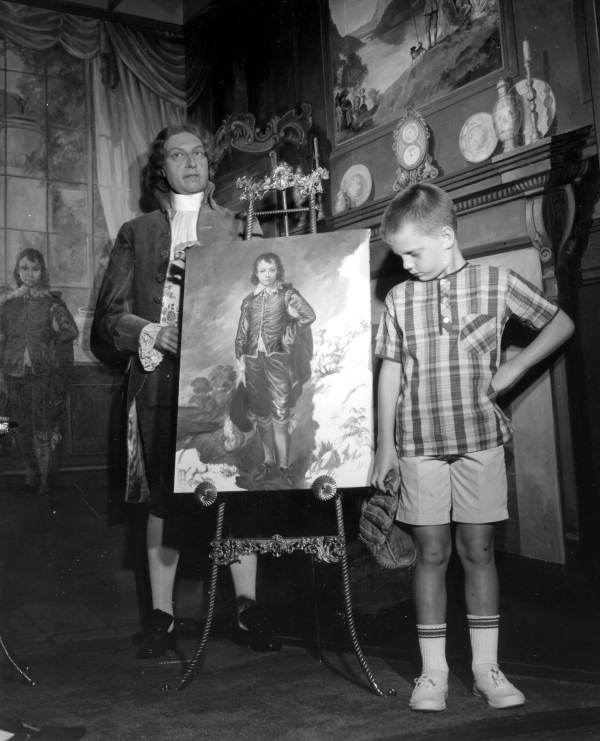
The Huntington picture has been copied, reproduced and imitated since the nineteenth century. Wikimedia Commons carries images of an oil copy at Pollok House in Glasgow, credited to Art UK as after Gainsborough, probably after 1770, and a 1965 photograph of a boy beside a Blue Boy reproduction in a Florida wax museum. These are included in this record's plates only as marked non-matches. When a Blue Boy appears in a sale, a house or a shop, the first question is which of these it is.
Chapter 8The sale of 1921: who sold, who bought, and what they paid
By 15 October 1921 the sale had been reported and denied in the same breath.
By 15 October 1921 the sale had been reported and denied in the same breath. The American Art News of 15 October carried a London item saying that a report that the Duke of Westminster had sold Gainsborough's Blue Boy and Reynolds's Mrs Siddons as the Tragic Muse to an unnamed American had been formally denied, but that the Manchester Guardian feared it was only premature. The paper added that British authorities could do nothing to prevent a transaction, and that even with a slump in prices the two pictures would be worth 100,000 pounds, a sum there was hardly a chance of raising from either the treasury or the public. (source 24) No export licence or application appears in any report consulted, and in 1922 Sir Robert Witt, presiding at the annual meeting of the National Art-Collection Fund, named prohibition of export and a central compensation fund as the remedies still to be weighed. (source 40)
A week later the American Art News reported that Christie's had sold the Gainsborough to Duveen for the Duke of Westminster for a price approximating 170,000 pounds, or about 640,000 dollars at the current rate, and that the Reynolds had gone in the same transaction, the total for the two being 200,000 pounds, accepted after the Duveens' original offer for the Gainsborough alone had been refused. (source 25) A London paper dated 20 October and reprinted in New Zealand put the split at 157,500 pounds for the Blue Boy, which is exactly 150,000 guineas, and 42,500 pounds for the Tragic Muse. (source 37) The two reports do not agree, and neither shows a receipt. The American Art News reported it as sold through Christie's, a private sale; it has not been sold at auction in anything this research found.
Sir Joseph Duveen was quoted as saying that about twenty years earlier his father had offered 50,000 pounds for the picture and that ten years earlier he himself had offered 100,000. (source 37) The New Zealand paper also reported that Duveen said he intended to exhibit the pictures in London for three weeks and in Paris for three weeks, and that he hoped to sell them in England. (source 37) S. N. Behrman's 1952 biography Duveen, in the London edition of 1953, tells the origin as a story Duveen liked to repeat. On a liner to Europe in the summer of 1921 Duveen dined with the Huntingtons in a suite hung with copies of Gainsborough, one of them a reproduction of the Blue Boy; Henry Huntington asked who the boy was and what the original would cost; Duveen said it could probably not be had at any price and then named about 600,000 dollars. (source 41) Behrman is a literary biographer retelling Duveen's own account, no corroboration of the dinner was found in the sources consulted, and he has Duveen delivering the picture to the Huntingtons in Paris, whereas the 1921 and 1922 press have it going first to the National Gallery in London.
The Duke's reasons are given by newspapers, not by the Duke. The American Art News of 22 October 1921 said the sale was believed to be a result of the tremendous rate of taxation in England, amounting to 60 per cent of income for those of the Duke's wealth. (source 25) A Los Angeles Times caption of November 1921, held in the UCLA photographic archive, said all England was lamenting the taxation system that compelled the Duke, conceded to be England's richest peer, to part with such an art treasure. (source 42) Behrman has Duveen's operatives telling him that the Duke would prefer a lump of American cash to the delight of owning two or three extra masterpieces. (source 41) These are the assertions of a trade paper, a daily newspaper and a biographer, made in 1921 or 1952; none is an account from the Westminster estate. The estate's own papers and the Duveen Brothers archive at the Getty Research Institute were not consulted.
Huntington's identity as the buyer was inferred in print within a week. The American Art News of 29 October 1921 said he was the collector for whom Duveen Brothers had purchased the picture, and that he had returned to New York the previous Friday. (source 26) The Los Angeles Times reported the purchase on 14 November 1921, under a headline giving the Duveens' price as 170,000 pounds; Calisphere prints the year as 1931, evidently a slip. (source 42) The price he paid depends on whom you read: 640,000 dollars in the American Art News of October and November 1921; 620,000 dollars in Behrman; and 728,000 dollars on the Huntington's own page and in the Art Newspaper in 2021, with 728,800 dollars on the Huntington's history page, which words it as what newspapers reported, and roughly 725,000 dollars in the Huntington curator Catherine Hess's Verso post of 24 October 2013. (sources 1, 3, 8, 15, 25, 27 and 41) The 1921 trade paper's own total of 1,390,000 dollars for the Blue Boy and two Widener Rembrandts rested on the lower figure. (source 26) The 88,000 dollars between 640,000 and 728,000 may be Duveen's costs, the cleaning and exhibitions or a later reckoning; no source consulted explains it. Contemporary reports were also careless: a New Zealand paragraph of 19 January 1922 gave Duveen's price for the Blue Boy and the Tragic Muse as 990,000 pounds, an evident error, perhaps in the OCR of the Papers Past text, for the 200,000 reported elsewhere (source 39).
The Duke of Westminster in these dealings is Hugh Grosvenor, 2nd Duke of Westminster, in the Huntington's own wording; the trade press says only the Duke. (source 8) The Huntington's wording is that Henry and Arabella Huntington bought the painting in 1921, from Duveen, who had acquired it from the Duke. (source 3)
Chapter 9Cleaned for the public: the National Gallery in January 1922
Duveen did not ship the picture directly.
Duveen did not ship the picture directly. According to the American Art News of 12 November 1921 he declared that a hundred years of varnish had turned the Blue Boy virtually a Green Boy, and that the varnish would be removed in London after it left the National Gallery. (source 27) A report in the same paper on 7 January 1922 said Duveen had ordered the removal of the varnish, and that it had been rumoured he was asked not to attempt it and replied that if the British public objected it need not be shown in England. (source 30) On 25 February 1922, reviewing the New York showing, the paper said most British experts had opposed Duveen on the cleaning but that he had fought and won. (source 34) The Hawera and Normanby Star, printing a London letter dated 10 January 1922, said critics were not altogether pleased, quoting one who thought at first sight that the picture had been over-cleaned: the figure now asserted itself, seemed to come out in front of the frame, and the illusion of height had gone. (source 38)
The picture went on public view at the National Gallery on a Monday in early January 1922. The American Art News of 7 January described immense crowds, throngs so great that at one time it seemed the gallery would be stormed, and visitors approaching the picture with an air of reverence, the men lifting their hats. (source 30) Charles Holmes, then director of the National Gallery, wrote on a stretcher bar at the back, in pencil, 'Au revoir. CH.' The Huntington's release of 2021 quotes a 1922 New York Times report that the picture was leaving England forever and 90,000 persons seized a last opportunity to see it, adding that the wish was one which neither Holmes nor any other Englishman expected to see fulfilled. (source 7) The American Art News of 28 January 1922 gave the same figure of 90,000 over three weeks and said paid admissions came to about 1,000 pounds. (source 31) The Huntington's conservation pages photograph the inscription. (source 4)
It had been at the National Gallery before: the American Art News said in October 1921 that it was in the gallery, where it had been sent in war time for safe keeping. (source 25) That is a press report, not a Gallery record.
The Huntington's release says the 2022 opening date marked exactly a century since the picture last hung on the Gallery's walls, 25 January 1922. (source 7) The American Art News of 28 January said it travelled in a specially constructed case with a six-inch space between the face of the picture and the lid and an outer case for double protection, with the steamer's name not announced, and recalled the 1876 theft of the Duchess of Devonshire. (source 31) On 11 February the paper reported its arrival in New York on 6 February on the French liner La Savoie, in the charge of Mr Todd of Duveen Brothers' London galleries. (source 32)
In New York it was shown at Duveen's galleries, for a fee of 2 dollars on most days, for the benefit of the Fifth Avenue Hospital, from 23 February. (source 33) The paper said on 25 February that visitors were flocking to see it. (source 34) It reported on 11 March that the show was extended to 15 March, with the picture to go to Huntington's home near Pasadena on 16 March. (source 35) The American Art News of 25 March 1922 reported that it had arrived at San Marino, guarded night and day on its journey west and accompanied by Duveen, in the case made for its passage from the National Gallery. (source 36) The release adds that the picture has been a visitor favourite since the Huntington opened to the public in 1928. (source 7)
Chapter 10What the money meant
The sums need a frame. In 1921 the average annual salary or wage of full-time non-governmental, non-agricultural workers in the United States was 1,378 dollars, according to the Bureau of Labor...
The sums need a frame. In 1921 the average annual salary or wage of full-time non-governmental, non-agricultural workers in the United States was 1,378 dollars, according to the Bureau of Labor Statistics figures that the University of Missouri's library guide cites from its Bulletin 852. (source 44) At that rate 728,000 dollars equals about 528 years of such pay, and 640,000 dollars about 464 years. The method compares one reported price with one national average; it says nothing about what the sum meant to a man of Huntington's wealth.
Prices can also be restated with the consumer price index. The Federal Reserve Bank of Minneapolis's table of the US CPI gives annual averages of 17.9 for 1921 and 321.9 for 2025, a factor of about 18.0. (source 43) Applied to 728,000 dollars that is roughly 13.1 million dollars in 2025 money, and roughly 11.5 million for the 640,000 dollar figure. The method measures consumer prices and says nothing about the market for art. ARTnews wrote in February 2022 that 728,000 dollars was over 10 million dollars in today's money, without naming its method. (source 14)
Among paintings, the 1921 price was a record. The American Art News said the Gainsborough brought the highest price yet recorded for a painting, more than three times what the Duveens had paid in 1919 for Romney's Beckford Children at the Duke of Hamilton's sale, itself a record for an English painting, and that the Widener Rembrandt The Mill had been reported at 500,000 dollars. (source 25) The London paper reprinted in New Zealand named 100,000 pounds for The Mill, 80,000 for a Velazquez, 75,000 for a Titian and 72,000 for Holbein's Duchess of Milan as the earlier benchmarks. (source 37) Joseph Widener paid a reported 750,000 dollars for two Yussupov Rembrandts in the same weeks as Huntington paid 640,000 for the Gainsborough, according to the American Art News. (source 26)
The Tragic Muse gives a second data point. The same weekly said it had been put up at Christie's about eighteen months earlier, that the Louvre had offered 36,000 pounds and then withdrawn from the bidding, and that the Duke had bought it in; the day after Duveen's purchase it was offered to the Louvre for 40,000 pounds. (source 25) So in about April 1920 the Reynolds did not sell at the level the bidding reached, and it left the Duke's hands about eighteen months later as part of the 200,000 pound deal, with the Louvre then asked 40,000 pounds for it. The Blue Boy has no comparable sale record, because it was never offered at auction in anything found here.
Huntington's own view of the price survives in Behrman's account. A friend was said to have been shocked that a sensible man would pay 620,000 dollars for one picture; Huntington answered that he had bought pictures for five hundred, five thousand and a hundred and fifty thousand, and that the one he paid six-twenty for was the greatest in the world. (source 41) The same biography reports Duveen's 1921 deal as covering the Blue Boy, the Tragic Muse and Gainsborough's Cottage Door for a total only slightly more than the 600,000 dollars he had named for the Blue Boy alone. (source 41) That total is not confirmed by the newspapers, which put the two-picture price at 200,000 pounds, and it is not used as a price in the chain.
Chapter 11Frames, prints and the making of a famous image
The picture's frames are documented unusually well.
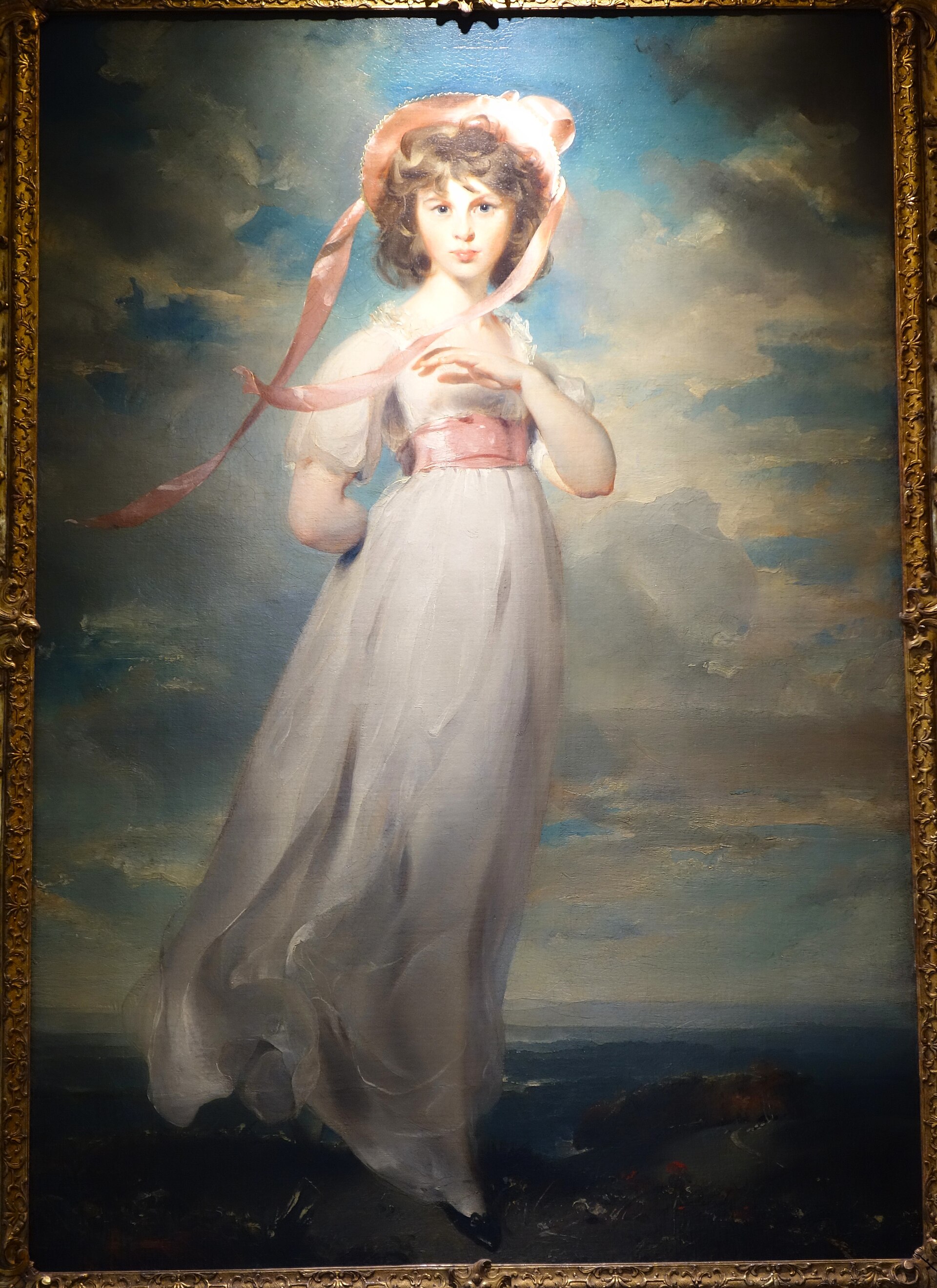
The picture's frames are documented unusually well. According to the Huntington's chief curator of European art, Catherine Hess, writing on 24 October 2013, the frame it arrived in at San Marino was probably the one it wore at Grosvenor House; in 1938 the curator Maurice Block, answering complaints about a bulky nineteenth-century frame, noted in a memo of 6 May that an old frame had been cut down to hold it. (source 8) That replacement was probably an extra supplied by Duveen, of the Carlo Maratta type used in England from about 1750. In 2013 the Huntington consulted Michael Gregory of Arnold Wiggins and Sons in London, chose an eighteenth-century English rococo frame to complement the one on Lawrence's Pinkie, and planned the change for late November, paid for by Jim and Joan Caillouette. (source 8) The Atlantic wrote in 2017 that O'Connell's first big project on arriving at the Huntington was moving the picture from an ornate, early twentieth-century frame to a more historically appropriate eighteenth-century one. (source 16)
The picture circulated as an image long before it crossed the Atlantic. Young's catalogue of 1820 was published with etchings from the whole Grosvenor collection. (source 19) The Grosvenor family allowed visitors into their London house to see it and lent it often, to Manchester in 1857, the 1862 International Exhibition, the South Kensington Museum in 1870, the Grosvenor Gallery in 1885 and the Royal Academy in 1896, according to Wikipedia's summary of Hedquist, which is a tertiary source whose dates are not independently checked here. (source 49)
The 1921 sale gave the image a second wave. In December 1921 the trade press announced a colour mezzotint of the Blue Boy by Sydney E. Wilson for Vicars Brothers, to be ready by April, and an advertisement announced an edition limited to 425 proof impressions, signed by the engraver and stamped by the F.A.T.G., at 8 pounds 8 shillings each, size 15 by 10 inches. (sources 28 and 29) The Huntington says Duveen engineered exhibitions at the National Gallery and at his New York showroom, and that the composer Cole Porter wrote Blue Boy Blues to mourn the departure. (source 3) ARTnews quotes a line of the song, From gilded galleries in Park Lane to the Wild West across the winter sea. (source 14) The Huntington's 2021 release adds that F. W. Murnau's 1919 film Der Knabe in Blau, now lost, was about the painting, citing the fashion historian Kimberly Chrisman-Campbell in The Atlantic. (source 7)
Later readings belong in a separate list, as what later viewers made of the picture. The Huntington's release records that the artist Robert Rauschenberg credited the Blue Boy with inspiring him to become a painter after a wartime visit, again via Chrisman-Campbell. (source 7) Dan Vo, writing for the National Gallery in February 2022, discusses the picture as an icon of queer culture, citing Professor Jeanette Hoorn on the youth's dress and eighteenth-century anxieties about effeminacy, Professor Valerie Hedquist on the placement of his arm, the physician Magnus Hirschfeld's 1914 catalogue and the 1974 launch of the gay magazine Blueboy. (source 12) These are readings by named writers from 1914 and later; they are not claims about what Gainsborough intended. In October 2021 the Huntington hung Kehinde Wiley's newly commissioned A Portrait of a Young Gentleman, oil on linen, 179.1 by 124.8 cm, opposite the picture, using the title Gainsborough first gave his. (source 9) Wiley said, in a Huntington statement, that he first saw Gainsborough and Reynolds at the Huntington as a boy and later thought about desire, objectification and fantasy in portraiture and, of course, colonialism. (source 9)
Chapter 12Project Blue Boy, 2017 to 2020
By 2018 the picture needed work. The Huntington's Frontiers magazine said on 1 April 2018 that its edges were brittle and that in places paint was lifting and flaking; earlier treatments had been...
By 2018 the picture needed work. The Huntington's Frontiers magazine said on 1 April 2018 that its edges were brittle and that in places paint was lifting and flaking; earlier treatments had been touch-ups, and until roughly four years earlier the Huntington had had no full-time paintings conservator. (source 6) ARTnews wrote in 2022 that the picture had been restored six times in the last century, mostly quickly to cut its time away from the public. (source 14) The Huntington's project page quotes O'Connell saying that the most recent treatments had mainly added new varnish layers as temporary solutions, so that the original colours appeared hazy and dull. (source 5)
The treatment was announced as a two-year technical examination funded by a Bank of America Art Conservation Project grant, with additional support from the Getty Foundation, Friends of Heritage Preservation and Haag-Streit USA. (sources 5 and 6) It began in fall 2017 with preliminary analysis in the conservator's laboratory. (source 6) The in-gallery phase ran from 22 September 2018: examination and stabilisation of paint, surface cleaning and removal of non-original varnish and overpaint until 18 February 2019; four months off view for structural work and new varnish; the painting back on view from 19 June to 30 September for inpainting; then off view again from 1 October 2019 for the final inpainting, varnish, a technical study, supportive backing and framing adjustments. The schedule gives 26 March as the date it would go back on view. (source 5) The history page gives the whole project as September 2018 to March 2020. (source 3)
Equipment and methods are recorded. O'Connell used a Haag-Streit Hi-R NEO 900 surgical microscope, six feet tall with a movable arm and magnification up to 25 times, on loan from Haag-Streit USA and arranged through the ear surgeon John House; the Huntington says digital X-radiography, infrared reflectography, ultraviolet fluorescence and X-ray fluorescence were used. (sources 5 and 6) In the April 2018 interview O'Connell said she could see pigment particles in places, which meant Gainsborough was sometimes using more coarsely ground particles that reflect light differently, and that the highlight in the boy's eye is a little dab of paint that blends together from a distance. (source 6) SEM-EDS imaging of cross-sections was supplied by Dr Gregory D. Smith of the Indianapolis Museum of Art at Newfields. (source 4)
The Huntington does not publish a pigment table in the pages consulted. ARTnews wrote in 2022 that Gainsborough foregrounded Prussian blue and green for a cool wash; that is a press claim not found on the Huntington's pages and not verified here. (source 14) What the imaging showed, in the Huntington's words, was the layering of the costume brushwork in X-ray, the structure of the support, the repaired tear and the abandoned portrait. (source 4)
Chapter 13Back to London in 2022, and where it hangs now
The Huntington lent the picture to the National Gallery in London for the first time in 2022.
The Huntington lent the picture to the National Gallery in London for the first time in 2022. In its news release of 29 June 2021 the Huntington said the free exhibition would run from 25 January to 3 May 2022 and opened on the centenary, and its president, Karen R. Lawrence, said the museum imagined this to be the one and only time the painting would travel. (source 7) The Art Newspaper gave the same end date on 30 June 2021. (source 15) The National Gallery's own exhibition page, as it stands in 2026, gives the run as 25 January to 15 May 2022, in Room 46, and describes it as the first time the painting had been loaned by the Huntington. (source 11) The BBC's report of 29 June 2021 also says 15 May. (source 13) The two institutions differ by twelve days, and the host's later page is probably the better guide to what happened, but no notice of an extension was found.
The National Gallery hung the picture with Van Dyck portraits of boys and young men in similarly elaborate outfits, according to Dan Vo, and published a catalogue, Gainsborough's Blue Boy: The Return of a British Icon, edited by Christine Riding, Susanna Avery-Quash, Melinda McCurdy, Jacqueline Riding and Imogen Tedbury (National Gallery Company, 2022). (source 12) ARTnews quoted an unnamed institution's statement on 4 February 2022, probably the Huntington's, that the portrait was unlikely ever to be lent again. (source 14) Its page quotes two reviews, from the Daily Telegraph and the Evening Standard. (source 11) ARTnews and the Huntington both note Wiley's companion painting at the Huntington. (sources 9 and 14)
The Huntington says the painting returned home to the Thornton Portrait Gallery. (source 1) Its online catalogue, consulted on 8 October 2026, lists it as on view. (source 2) The Huntington's Wiley exhibition page records that A Portrait of a Young Gentleman was off view from 4 to 13 January 2022 and back from 14 January in the same gallery. (source 9)
Chapter 14What is still unresolved
The sitter is the largest open question: the Huntington's own 2021 statement treats the Buttall identification as disproven and the Dupont suggestion as unconfirmed.
The sitter is the largest open question: the Huntington's own 2021 statement treats the Buttall identification as disproven and the Dupont suggestion as unconfirmed. The basis for that statement lies in research this record did not read, notably Sloman's 2013 article and Hedquist's book. (sources 7, 17 and 49) The identity of the abandoned older man beneath the boy has never been proposed in the sources consulted. The reason for the dog's removal is a curator's guess. The price paid by Huntington is quoted in five ways. Who owned what between Buttall and Grosvenor House rests on two catalogues and a dispute that Fuller made in 1898, and the whereabouts of the other Blue Boy are unrecorded here. The documents that would settle most of these, the Duveen Brothers papers at the Getty, the Christie's sale records for 1921 and the Huntington's 2018-20 conservation report, were not consulted for this record.
The artist
Thomas Gainsborough
Gainsborough is usually set against Reynolds, and most of what is said about the Blue Boy takes that rivalry as its frame. The record is more modest. He was a Suffolk-born portraitist who wanted landscape, trained in London, built a practice at Ipswich and Bath, and settled in London in 1774, a founding member of the Royal Academy who fell out with it over how his pictures were hung. The Blue Boy sits at the moment when he showed what he could do against the dead Van Dyck and the living Reynolds.
Exhibited
- 1770Royal Academy exhibition, A Portrait of a Young Gentleman (Huntington's identification)Royal Academy, London
- 1814Shown as Portrait of a Youth, lent by Earl Grosvenor (Fuller's transcript)British Institution, London
- 1857Art Treasures of the United Kingdom, Saloon D, No. 156, The Blue Boy (Master Buttall)Manchester
- 1862, 1870 (twice), 1885, 1896International Exhibition; Royal Academy and South Kensington Museum (both 1870); Grosvenor Gallery; Royal Academy (from Wikipedia's summary of Hedquist; not independently checked)London
- January 1922Three-week public display ahead of departure, under DuveenThe National Gallery, London
- February to March 1922For the benefit of the Fifth Avenue Hospital, 23 February to 15 MarchDuveen Galleries, New York
- 2018-2020Project Blue Boy, in-gallery conservation phases from 22 September 2018The Huntington, San Marino
- 2022Gainsborough's Blue Boy, 25 January to 15 May (the Huntington's release says 3 May)The National Gallery, London, Room 46
Literature
- Susan Sloman, 'Gainsborough's Blue boy', The Burlington Magazine, vol. 155 (April 2013), pp. 231-237 (pages from Wikipedia's citation); summary on the Burlington's contents page seen, article not seen.
- Valerie Hedquist, Class, Gender, and Sexuality in Thomas Gainsborough's Blue Boy (Routledge, 2019 or 2020; sources differ); cited by Wikipedia and the National Gallery, not seen.
- Christine Riding, Susanna Avery-Quash, Melinda McCurdy, Jacqueline Riding and Imogen Tedbury (eds), Gainsborough's Blue Boy: The Return of a British Icon (National Gallery Company, 2022), as listed by the National Gallery; not seen.
- Robyn Asleson and Shelley M. Bennett, British Paintings at the Huntington (2001); Shelley M. Bennett, The Art of Wealth: The Huntingtons in the Gilded Age (2013); Catherine Hess and Melinda McCurdy, Blue Boy & Co.: European Art at the Huntington (2015), as listed by the Huntington; not seen.
- Deborah Cherry and Jennifer Harris, 'Eighteenth-Century Portraiture and the Seventeenth-Century Past: Gainsborough and Van Dyck', Art History, vol. 5, no. 3 (September 1982), pp. 287-309, as cited by Wikipedia; not seen.
- Ellis Waterhouse, Gainsborough (1958; 1966 edition), as listed on the Internet Archive; not opened.
- S. N. Behrman, Duveen (Random House, 1952; Hamish Hamilton, 1953), chapter 'The Blue Boy and Two Lavinias'; London edition read.
- Meryle Secrest, Duveen: A Life in Art (2004); not seen.
- William H. Fuller, Gainsborough's Blue Boy: A Monograph (New York, 1898); read.
- John Young, A Catalogue of the Pictures at Grosvenor House (1820 or 1821); read.
- Edward Edwards, Anecdotes of Painters (1808); read.
- Ronald Sutherland Gower, Thomas Gainsborough (1903); read.
- John Hayes, British Paintings of the Sixteenth through Nineteenth Centuries (National Gallery of Art, Washington, 1992), pp. 63-64, as cited by Wikipedia for Gainsborough Dupont; not seen.
Related works
| Work | Relation | Where it is |
|---|---|---|
| George Villiers, 2nd Duke of Buckingham, and Lord Francis Villiers Anthony van Dyck | The Van Dyck double portrait of two boys in costly dress that Wikipedia, citing Cherry and Harris (1982), names as the closest in kind to the Blue Boy; the Royal Collection says the composition was much admired in the eighteenth century. Inscribed 1635, oil on canvas, 137.2 x 127.7 cm. The Cherry and Harris article was not read in the original. | Royal Collection, Queen's Gallery, Windsor Castle (RCIN 404401) |
| Lord John Stuart and his Brother, Lord Bernard Stuart Anthony van Dyck | Van Dyck portrait of two young men in elaborate dress, shown with the Blue Boy at the National Gallery in 2022. Dated about 1638 on the Gallery's page. | The National Gallery, London (as shown in the 2022 display; accession number not given on the page consulted) |
| Edward Richard Gardiner Thomas Gainsborough | Portrait of a nephew in a pale-blue costume that the Huntington cites as a forerunner of the Blue Boy's suit. c.1760-8. | Tate, T00727 |
| Gainsborough Dupont Thomas Gainsborough | Portraits of the nephew and assistant whom Sloman (2013) identified as the Blue Boy's sitter; the Huntington shows a portrait of about 1773 in what appears to be a very similar blue suit. The sitter question is unresolved; see the open questions. | Tate, on long loan to Gainsborough's House, Sudbury (c.1770-5); a further portrait at Waddesdon, on loan (about 1773), shown on the Huntington's page |
| Sarah Goodin Barrett Moulton: Pinkie Thomas Lawrence | The Huntington's companion icon, a different picture, dated 1794 in the Huntington's catalogue; Behrman places Duveen's purchase of it in 1926, and X-rays of both pictures were announced in 1995. Not by Gainsborough. It must not be confused with the Blue Boy in sales or loans. | The Huntington, 27.61 |
| Sarah Siddons as the Tragic Muse Joshua Reynolds | Sold by the Duke of Westminster to Duveen in the same transaction as the Blue Boy in October 1921, per the 1921 press and Behrman; the Los Angeles Times of 1995 lists it among the Huntington's four icons. A near-identical replica is at Dulwich. The American Art News reported in October 1921 that this one would go to the Louvre; the later record shows otherwise. | The Huntington (accession number not checked) |
| Cottage Door Thomas Gainsborough | Behrman says Duveen bought it from the Duke with the Blue Boy and the Tragic Muse in 1921. The Huntington's online catalogue lists the Cottage Door under 22.3; the 1921 purchase is Behrman's statement and was not confirmed in press reports. | The Huntington, 22.3 (c. 1780) |
| The Hawley / Colnaghi 'Blue Boy' Attributed to Gainsborough by its advocates; others call it a copy | A second canvas of the same subject, defended by Fuller in 1898 as the original and described by the American Art News in 1921 as controversial. A different picture. Any plate or record of a Blue Boy from the Hawley or Fuller line is not this record's subject. | Unlocated in the sources consulted |
| The Blue Boy (after Gainsborough) After Thomas Gainsborough | An oil copy, credited by Art UK as probably after 1770. A copy, not the Huntington picture. | Pollok House, Glasgow (PC.117) |
| A Portrait of a Young Gentleman Kehinde Wiley | Companion painting commissioned by the Huntington and hung opposite the Blue Boy from 2 October 2021, using Gainsborough's own exhibition title. Oil on linen, 179.1 x 124.8 cm. | The Huntington |
| Der Knabe in Blau F. W. Murnau (film) | A silent film of 1919 about the painting, now lost, per the Huntington's release. Via Kimberly Chrisman-Campbell in The Atlantic, as quoted by the Huntington. | Lost |
| The Blue Boy, colour mezzotint Sydney E. Wilson, for Vicars Brothers | A reproduction print announced in December 1921, edition of 425 signed proofs, 15 x 10 in. Announced for April 1922. | Edition not traced |
Open questions
- Who is the boy? The Huntington's 2021 release says recent research has disproven the Jonathan Buttall identification and that the sitter remains unconfirmed; Susan Sloman's Burlington Magazine article of April 2013 identifies Gainsborough Dupont. What the 'recent research' is, and whether it rests on the same evidence as Sloman, was not established because neither could be read.
- Who was the older man whose abandoned portrait lies under the boy, when was he begun, and was he a sitter or a study? The Huntington's pages describe only a face in a thick white neckcloth, begun on a canvas that was later reused.
- Why did Gainsborough paint out the dog? The Huntington curator's 1995 guesses (too cute, or too much fluff beside the hat) are guesses. Whether the dog was covered with rocks or foliage is stated differently by the Los Angeles Times and the Huntington's infrared captions.
- What exactly did the Huntington pay? 620,000, 640,000, roughly 725,000, 728,000 and 728,800 dollars all appear in sources. No Duveen invoice or Huntington ledger has been seen, and the 88,000 dollar gap between the 1921 trade paper and the Huntington's own figure is unexplained.
- What happened to the Hawley or Fuller Blue Boy, and was it the picture Nesbitt owned? Fuller argued in 1898 that the Grosvenor picture was a different canvas from the one in Nesbitt's possession; the Huntington follows Young. The Fuller picture's present whereabouts are not recorded here.
- When did Hoppner pass the picture to Earl Grosvenor, and for what? The catalogues give no date or price; the Wikipedia summary of Hedquist says about 1809.
- Is this picture the Royal Academy's 1770 Portrait of a Young Gentleman? The Huntington says so; Gower in 1903 wrote only that it was supposed to have been exhibited there. The RA catalogue entry itself was not seen.
- What pigments are in the blue? The Huntington used X-ray fluorescence in 2018-20 but its pages consulted do not publish results; ARTnews's mention of Prussian blue is unverified.
- What did the Westminster estate receive and why did it sell? Newspapers in 1921 say taxation; Behrman says need for cash. The Westminster estate records, Christie's 1921 records and the Duveen Brothers papers at the Getty Research Institute have not been read for this record.
Questions about this object
What is The Blue Boy?
The Blue Boy is a painting, dated c. 1770. Medium: Oil on canvas.
Who made The Blue Boy, and is the attribution settled?
The attribution to Thomas Gainsborough is recorded here as accepted. Accepted as Gainsborough's in every source consulted. The American Art News wrote in November 1921 that the Westminster picture had never been questioned as his, in contrast to the rival Hawley or Fuller canvas. The sitter, not the painter, is the open question. Gainsborough did not sign or date his pictures (Fuller, 1898).
Where is The Blue Boy now?
The Huntington Library, Art Museum and Botanical Gardens, San Marino, California (Thornton Portrait Gallery). Inventory number 21.1. Last confirmed 8 October 2026. Bought in 1921 by Henry E. and Arabella Huntington from Duveen Brothers and shipped to San Marino in March 1922; the Huntington's online catalogue lists it as on view (checked 2026-10-08).
What is still unknown about The Blue Boy?
Who is the boy? The Huntington's 2021 release says recent research has disproven the Jonathan Buttall identification and that the sitter remains unconfirmed; Susan Sloman's Burlington Magazine article of April 2013 identifies Gainsborough Dupont. What the 'recent research' is, and whether it rests on the same evidence as Sloman, was not established because neither could be read.
Sources
- 1The Huntington, The Blue Boy (collection page): dates, the 2017 and 2018 conservation, the 2022 loan, the Wiley painting. huntington.org/art-museum/...
- 2The Huntington online catalogue (eMuseum), The Blue Boy, object number 21.1: medium, dimensions in inches and centimetres, frame dimensions, status On view, IIIF and PDF links; consulted 2026-10-08. emuseum.huntington.org/objects/...
- 3The Huntington, Project Blue Boy: History (text by Melinda McCurdy): Van Dyck, the blue costume, the sitter, 1921 purchase, Duveen's exhibitions, further reading. huntington.org/art-museum/...
- 4The Huntington, Project Blue Boy: Conservation (text and photographs by Christina O'Connell): visible light, cross-section, ultraviolet, infrared reflectography and X-radiography findings; the 'Au revoir, CH' inscription. huntington.org/art-museum/...
- 5The Huntington, Project Blue Boy (exhibition page, 22 Sept 2018 to 30 Sept 2019): treatment schedule, equipment, funders, McCurdy and O'Connell quotations. huntington.org/exhibitions/...
- 6Usha Lee McFarling, 'Examining The Blue Boy', Huntington Frontiers, 1 April 2018: interview with Christina O'Connell and John House; condition, microscope, plan of treatment. huntington.org/watch-read-listen/...
- 7The Huntington, news release 'Huntington to Lend Its Iconic Blue Boy to the National Gallery, London', 29 June 2021: dates, quotations from Karen R. Lawrence and Gabriele Finaldi, the 1922 New York Times 'Au revoir' passage, Buttall 'disproven', Murnau film, Rauschenberg. huntington.org/watch-read-listen/...
- 8Catherine Hess, 'How Do You Frame a Masterpiece?', Huntington Verso, 24 October 2013: 1938 frame memo, Duveen frame, 2013 reframing. huntington.org/watch-read-listen/...
- 9The Huntington, Kehinde Wiley, 'A Portrait of a Young Gentleman' (exhibition page): dimensions, 2 Oct 2021 debut, Wiley quotation. huntington.org/exhibitions/...
- 10Suzanne Muchnic, 'Exorcising the Ghosts of Art', Los Angeles Times, 25 June 1995: the 1994-95 Getty-funded survey, the dog, the 1939 X-ray of the older man, Shelley Bennett quotations. latimes.com/archives/...
- 11The National Gallery, London, 'Gainsborough's Blue Boy' (past exhibition, 25 January to 15 May 2022, Room 46). nationalgallery.org.uk/exhibitions/...
- 12Dan Vo, 'Gainsborough's Blue Boy', National Gallery Picture of the month, February 2022: Van Dyck pairings, reception readings, catalogue citation. nationalgallery.org.uk/paintings/...
- 13BBC News, 'Thomas Gainsborough's Blue Boy to return to the UK after 100 years', 29 June 2021: Finaldi and Lawrence quotations, 25 January to 15 May 2022, McCurdy quotation, 'Au revoir'. bbc.com/news/...
- 14Tessa Solomon, 'Why Thomas Gainsborough's Iconic Blue Boy Was Once the Most Famous Painting in the World', ARTnews, 4 February 2022 (press feature, secondary). artnews.com/feature/...
- 15Gareth Harris, 'Gainsborough showstopper The Blue Boy comes home to the UK after 100 years', The Art Newspaper, 30 June 2021. theartnewspaper.com/2021/...
- 16Kimberly Chrisman-Campbell, 'Saving One of Western Art's Most Iconic Paintings', The Atlantic, 22 September 2017 (only the opening text was readable; the rest is behind a subscription). theatlantic.com/entertainment/...
- 17The Burlington Magazine, April 2013 (vol. 155, no. 1321), contents page with the summary of Susan Sloman, 'Gainsborough's Blue boy'; the article itself is behind a subscription and was not read. burlington.org.uk/archive/...
- 18The Discourses of Sir Joshua Reynolds, ed. John Burnet (London: J. Carpenter, 1842): the Eighth Discourse (10 December 1778), Burnet's note quoting a letter of Sir Thomas Lawrence on the Blue Boy, the Fourteenth Discourse on Gainsborough. Internet Archive scan, read in full text. archive.org/details/...
- 19John Young, A Catalogue of the Pictures at Grosvenor House, London, with etchings (London: J. Dowding, 1821 per this record; another Internet Archive copy is dated 1820), No. 16, 'Portrait of Master Buttall, better known under the name of the Blue Boy'. archive.org/details/...
- 20Catalogue of the Collection of Pictures at Grosvenor House (London: S. Goldbourn, 1876), No. 77; the 1880 edition (archive.org id catalogueofcolle00west) carries the same entry. archive.org/details/...
- 21William H. Fuller, Gainsborough's Blue Boy: A Monograph (New York, 1898): a partisan argument for the Hawley picture; transcripts of the 1814 and 1857 catalogues, the Hoppner letter of 1872, Notes and Queries extracts, Reynolds's Eighth Discourse. archive.org/details/...
- 22Ronald Sutherland Gower, Thomas Gainsborough (London: G. Bell and Sons, 1903), pp. 77-79 and deathbed passage; read in the Internet Archive full text. archive.org/details/...
- 23Edward Edwards, Anecdotes of Painters who have resided or been born in England (London, 1808), the Gainsborough chapter and footnote naming Master Buttall. archive.org/details/...
- 24American Art News, vol. 20, no. 1, 15 October 1921: 'British Fear Blue Boy Will Be Sold'. archive.org/details/...
- 25American Art News, vol. 20, no. 2, 22 October 1921: ''Blue Boy's' Price Is World's Record' (Christie's, Duveen, 170,000 pounds, taxation). archive.org/details/...
- 26American Art News, vol. 20, no. 3, 29 October 1921: ''Blue Boy' Goes to H. E. Huntington'; editorial 'Three Great Paintings'. archive.org/details/...
- 27American Art News, vol. 20, no. 5, 12 November 1921: ''Blue Boy' to Lose 'Green Boy' Look'; 'Those Two Blue Boys'. archive.org/details/...
- 28American Art News, vol. 20, no. 9, 10 December 1921: note of Sydney E. Wilson's mezzotint of the Blue Boy. archive.org/details/...
- 29American Art News, vol. 20, no. 11, 24 December 1921: advertisement for the Wilson colour mezzotint, edition of 425. archive.org/details/...
- 30American Art News, vol. 20, no. 13, 7 January 1922: 'London Has Last Look at Blue Boy'. archive.org/details/...
- 31American Art News, vol. 20, no. 16, 28 January 1922: 'Guard Blue Boy's Journey to America'. archive.org/details/...
- 32American Art News, vol. 20, no. 18, 11 February 1922: 'Blue Boy Will Be Shown Next Week' (arrival on La Savoie, 6 February). archive.org/details/...
- 33American Art News, vol. 20, no. 19, 18 February 1922: admission for the Duveen Galleries showing. archive.org/details/...
- 34American Art News, vol. 20, no. 20, 25 February 1922: ''Blue Boy' Seen in Its Original Glory'; editorial 'The Blue Boy'. archive.org/details/...
- 35American Art News, vol. 20, no. 22, 11 March 1922: 'Blue Boy' exhibition extended to 15 March. archive.org/details/...
- 36American Art News, vol. 20, no. 24, 25 March 1922: ''Blue Boy' Arrives at Huntington Home'. archive.org/details/...
- 37'Sale of Old Masters. Record Prices', King Country Chronicle (New Zealand), 15 December 1921, reprinting a London paper of 20 October 1921. Papers Past, read through the browser. paperspast.natlib.govt.nz/newspapers/...
- 38'The Blue Boy', Hawera and Normanby Star (New Zealand), 15 March 1922, London letter dated 10 January 1922. Papers Past. paperspast.natlib.govt.nz/newspapers/...
- 39Untitled paragraph, The Dominion (New Zealand), 19 January 1922: Huntington as owner; garbled price. Papers Past. paperspast.natlib.govt.nz/newspapers/...
- 40'Art Treasures', Southland Times (New Zealand), 15 August 1922: Sir Robert Witt at the National Art-Collection Fund; earlier record prices; its own Blue Boy price line is illegible in the OCR. Papers Past. paperspast.natlib.govt.nz/newspapers/...
- 41S. N. Behrman, Duveen (London: Hamish Hamilton, 1953; first published 1952), chapter 'The Blue Boy and Two Lavinias': the Aquitania anecdote, the 1921 purchase, Huntington's remark. Internet Archive scan, read in full text; a biographer's retelling of Duveen's own account. archive.org/details/...
- 42UCLA Library Special Collections, Los Angeles Times Photographic Archives, 'Famed Blue Boy painting by Thomas Gainsborough, Los Angeles, 1921' (Calisphere), with caption text on taxation and the headline of the Los Angeles Times article of 14 November (printed there with the year 1931, evidently a slip). calisphere.org/item/...
- 43Federal Reserve Bank of Minneapolis, 'Consumer Price Index, 1913-': annual average CPI(-U) 17.9 (1921), 321.9 (2025), 334.4 (2026 estimate); consulted 2026-10-08. minneapolisfed.org/about-us/...
- 44University of Missouri Libraries, Prices and Wages by Decade: 1920-1929, citing U.S. BLS Bulletin 852, pp. 22-23 (average annual salary-wage of full-time workers, 1921: 1,378 dollars). libraryguides.missouri.edu/pricesandwages/...
- 45Royal Collection Trust, Anthony van Dyck, George Villiers, 2nd Duke of Buckingham, and Lord Francis Villiers, inscribed 1635, RCIN 404401. rct.uk/collection/...
- 46Tate, Thomas Gainsborough, 'Gainsborough Dupont', c.1770-5 (on long loan to Gainsborough's House, Sudbury). tate.org.uk/art/...
- 47Tate, Thomas Gainsborough, 'Edward Richard Gardiner', c.1760-8, T00727. tate.org.uk/art/...
- 48The National Gallery, London, Thomas Gainsborough (1727-1788), artist page: biography and bibliography (Belsey in the Oxford DNB; Rosenthal in Grove Art). nationalgallery.org.uk/artists/...
- 49Wikipedia, 'The Blue Boy' (wikitext read); a source, used for Hedquist's dates and exhibition list and with Hedquist, Class, Gender, and Sexuality in Thomas Gainsborough's Blue Boy (Routledge, 2019 or 2020) and Sloman (2013). en.wikipedia.org/wiki/...
- 50Wikipedia, 'Gainsborough Dupont' (wikitext read); a source citing Hayes (1992) and the National Gallery of Art; . en.wikipedia.org/wiki/...
- 51Wikimedia Commons, File:Thomas Gainsborough - The Blue Boy (c. 1770).jpg: Artwork template naming the Huntington (accession 21.1, 179.4 x 123.8 cm) and its eMuseum page as source; uploaded 24 February 2023; licence PD-Art (PD-old-auto-expired, creator died 1788). commons.wikimedia.org/wiki/...
- 52Wikimedia Commons, File:Thomas Gainsborough (1727-1788) (after) - The Blue Boy - PC.117 - Pollok House.jpg: credited to Art UK as an oil copy after Gainsborough, probably after 1770. commons.wikimedia.org/wiki/...
.jpg)
_(after)_-_The_Blue_Boy_-_PC.117_-_Pollok_House.jpg)
Last verified · Published
Change log
8 October 2026 - Record created at the house standard: researched narrative, technical evidence, maker dossier, graded provenance chain, prices with hammer and premium separated, related works, open questions and sources.