Rachel Ruysch
 Dutch · 1664-1750
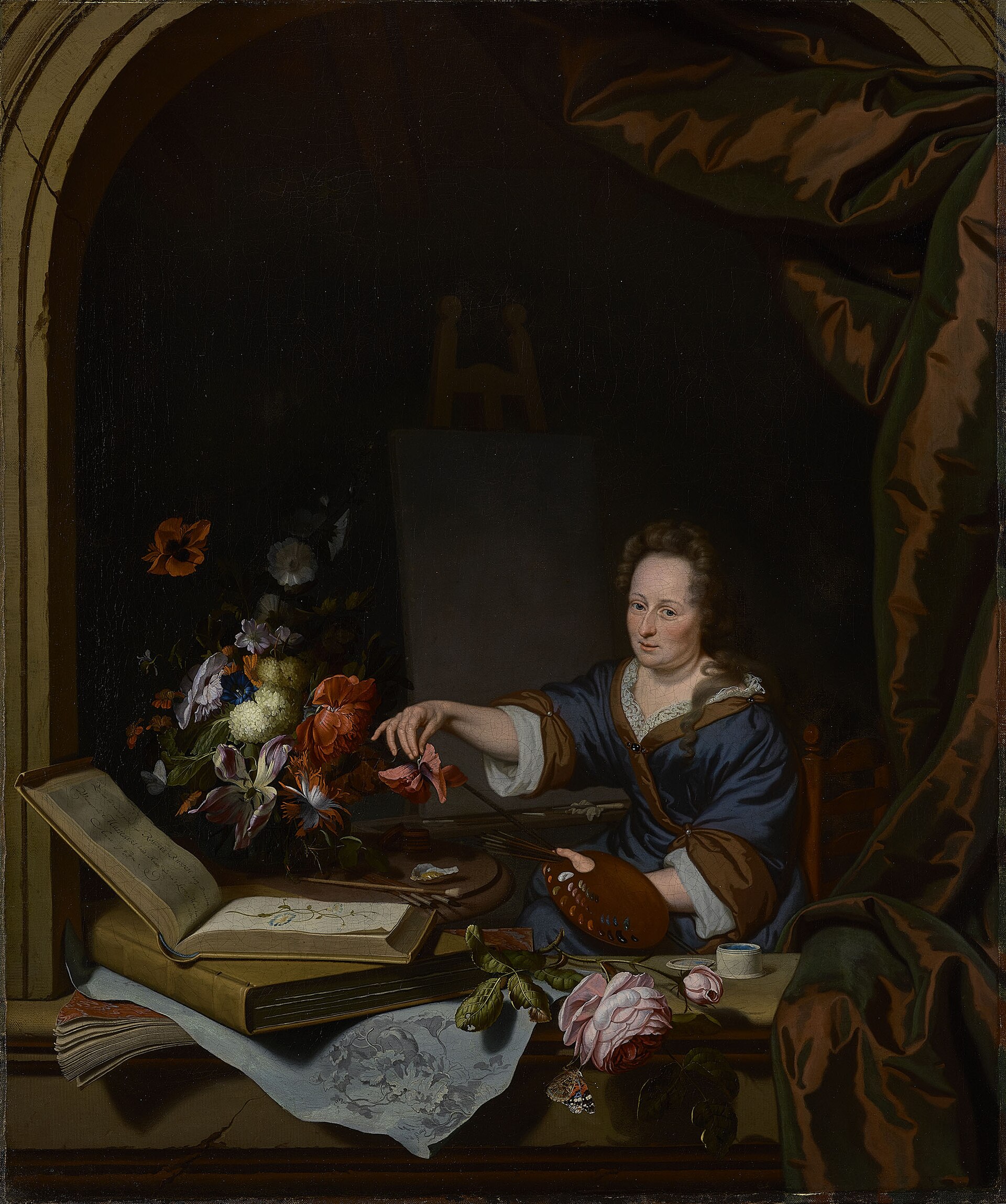
Rachel Ruysch at her easel in the 1692 dual portrait, Metropolitan Museum of Art, accession 2023.91. The Met catalogues the sitter as Ruysch, and the curator Adam Eaker reads the inscription in the open book as describing how Van Musscher painted her from life. The figure is by Michiel van Musscher and the still-life elements are by Ruysch. A contemporary portrait, not a self-portrait.
Metropolitan Museum of Art, New York (public domain)| Full name | Rachel Ruysch (Rachel Pool-Ruysch after her marriage) |
|---|---|
| Worked as | Painter, Flower and still-life painter, Court painter to Johann Wilhelm, Elector Palatine |
| Born | Baptised 3 June 1664 · The Hague |
| Died | 12 October 1750 · Amsterdam |
| Nationality | Dutch |
| Movement | Dutch Golden Age still life |
| Sources | 20 cited |
| Last verified |
About this page Last verified · 20 sources cited
On this page 13 sections
ContentsClose
Rachel Ruysch painted flowers for about seven decades and sold them to a Leiden cloth merchant, a Tuscan grand duke and the Elector Palatine. She was one of the most successful painters of her day, and she is still catalogued like a minor one. The last monograph with a numbered catalogue of her work appeared in 1956, and the standard study of her early development is an unpublished 1998 Pittsburgh dissertation.
The number most readers want does not exist in any form a specialist would sign. A 2025 review of the first large survey puts her surviving pictures at over 150. The survey itself showed 57 of them. A numbered catalogue of 1956 runs to at least 171 entries, and Wikipedia repeats a figure above 250 for works documented or attributed. Those three counts may measure different things, and nobody has published a reconciliation.
What a reader probably doesn't know is how much of her biography is arithmetic that her own patrons disagree about. A Leiden merchant's family inventories say he paid 1,300 guilders for the pendant pair of 1710. The German traveller who watched the pair waiting for delivery wrote that the price was 1,500. Her lottery win of December 1722 is 75,000 guilders in a Dutch biographical dictionary and 60,000 in a 2023 museum article. The page below keeps each figure and names who gives it.
Images
Chronology
- 1664
Baptised in The Hague on 3 June, eldest child of Frederik Ruysch and Maria Post; the family moved to Amsterdam while she was a baby.1
- 1679-1683
Apprenticed to the still-life painter Willem van Aelst in Amsterdam, according to Sotheby's.3
- c. 1685
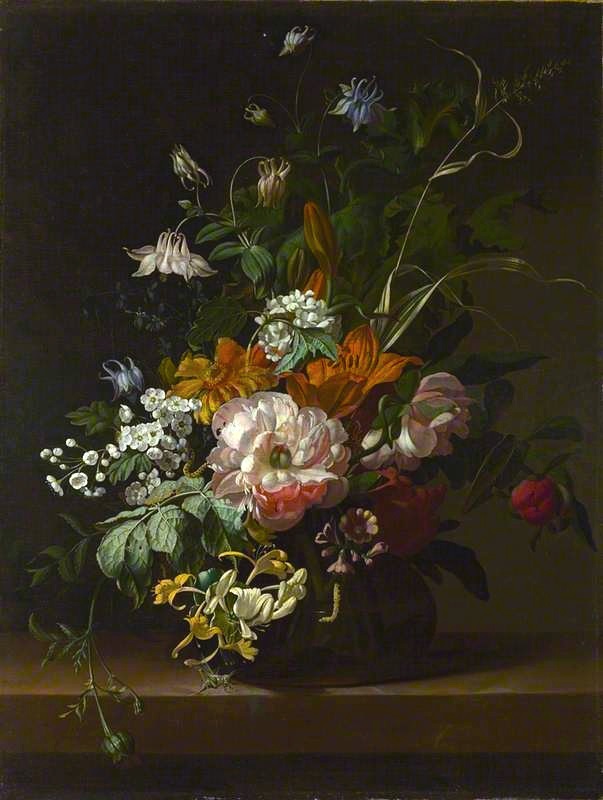
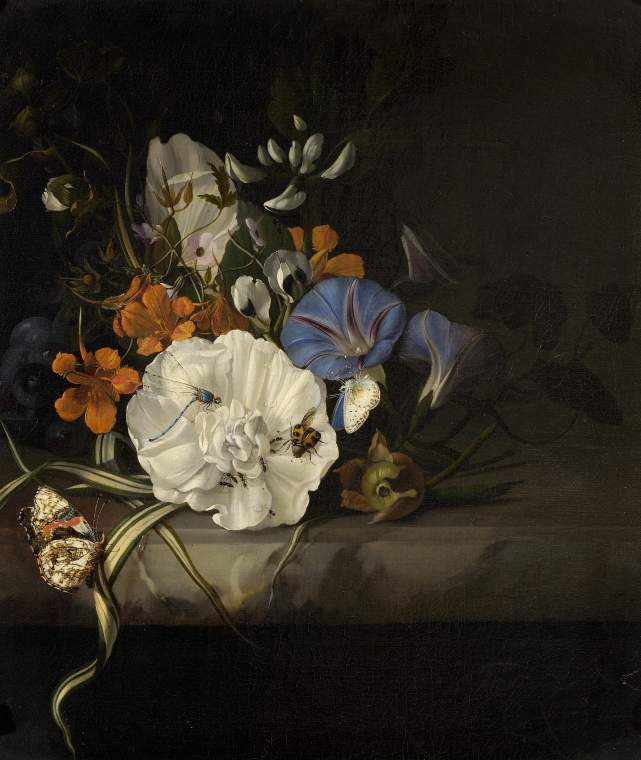
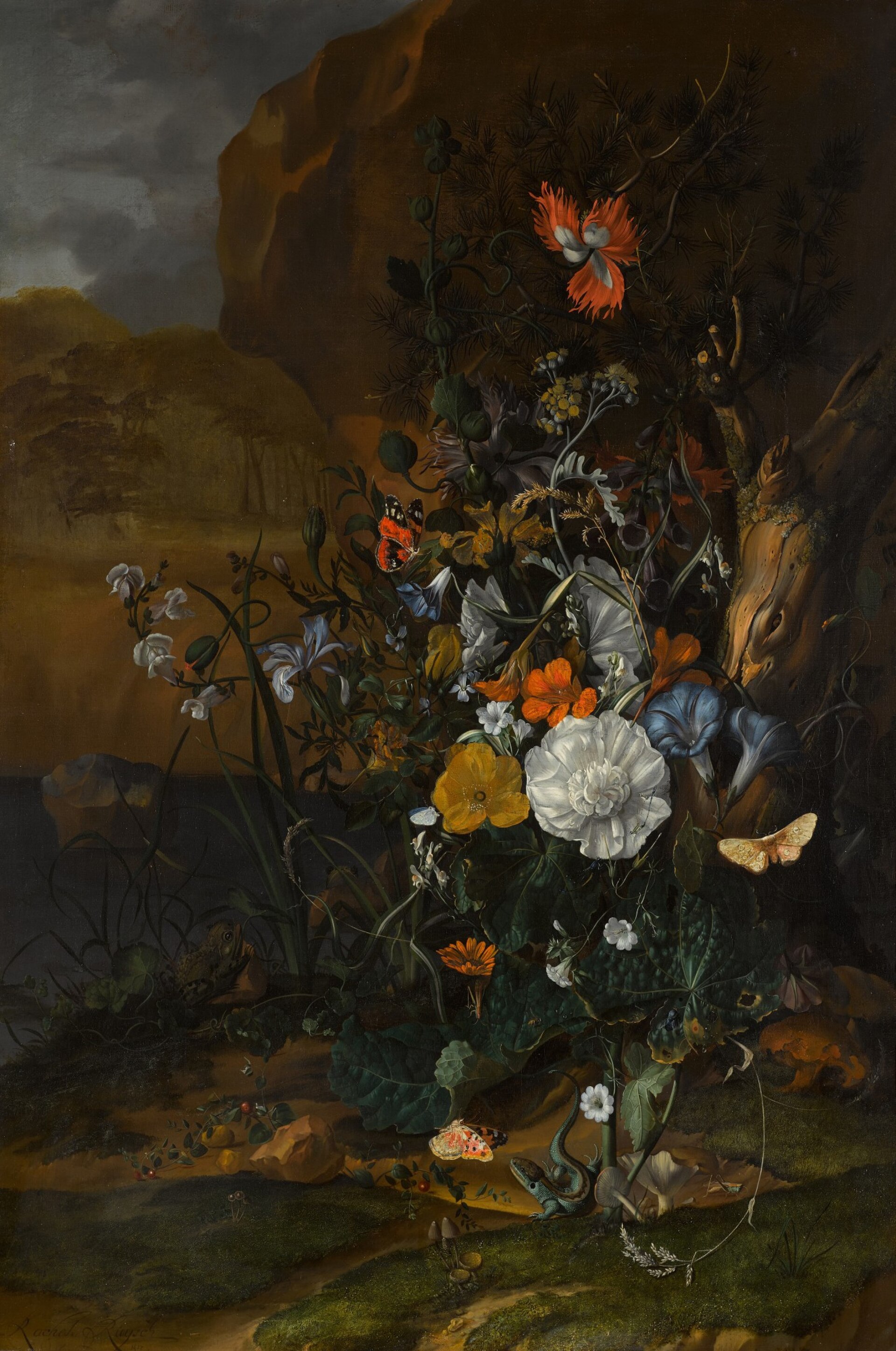
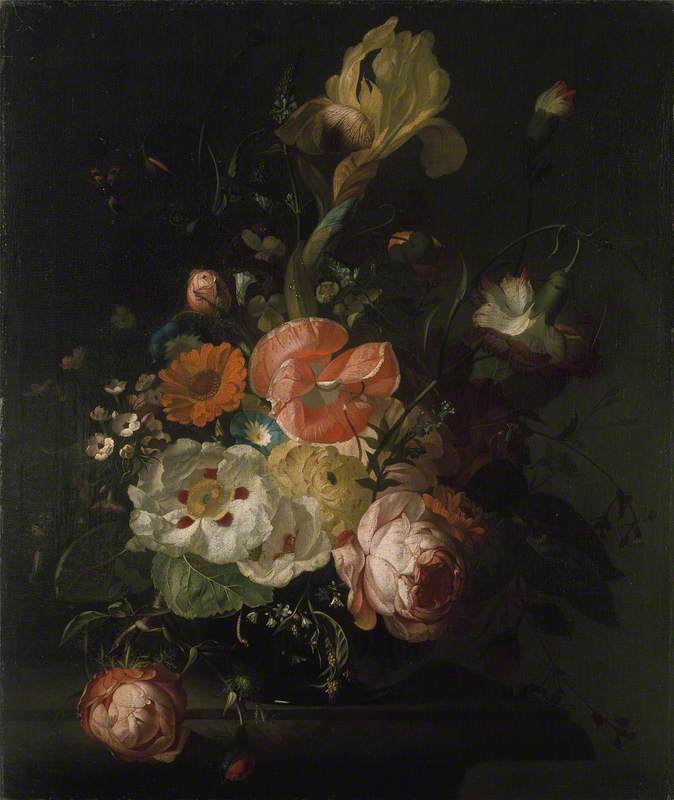
Flowers in a Vase, now National Gallery London NG6425, dated by that museum to about 1685; the Boymans museum in Rotterdam holds a tree-stump flower piece the dictionary dates 1685.181
- 1692
Michiel van Musscher and Ruysch paint the dual portrait of her at her easel, bought by the Metropolitan Museum in 2023.1011
- 1693
Marries the portrait painter Jurriaan Pool in Amsterdam on 12 August.1
- 1695
Johann Wilhelm, Elector Palatine, visits Frederik Ruysch's museum in the summer.1
- 1699
Asked to join the Hague painters' confraternity Pictura as its first woman, according to the Dutch dictionary; the National Gallery of Ireland gives 1701.114
- 1700
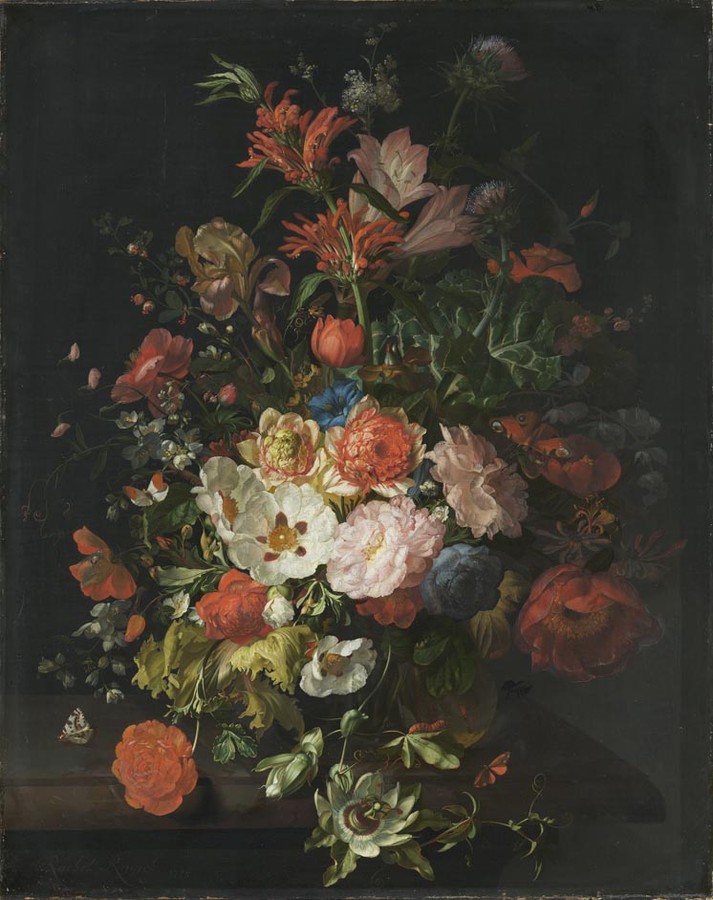
Signs and dates the Mauritshuis Vase with Flowers, inventory 151.13
- 1708
Offered the post of court painter to the Elector, with exemption from living at court and a stipend in return for one picture a year.1
- 1709
Pair of fruit and flower pieces painted for the Elector, now in Munich, according to Sotheby's.3
- 1710
Paints the pendant pair of flowers and fruit for Pieter de la Court van der Voort of Leiden; first of two trips to Dusseldorf.3
- 1711
On 14 March von Uffenbach sees two pictures awaiting delivery in her house and records her saying she cannot paint much more than two a year.3
- 1716
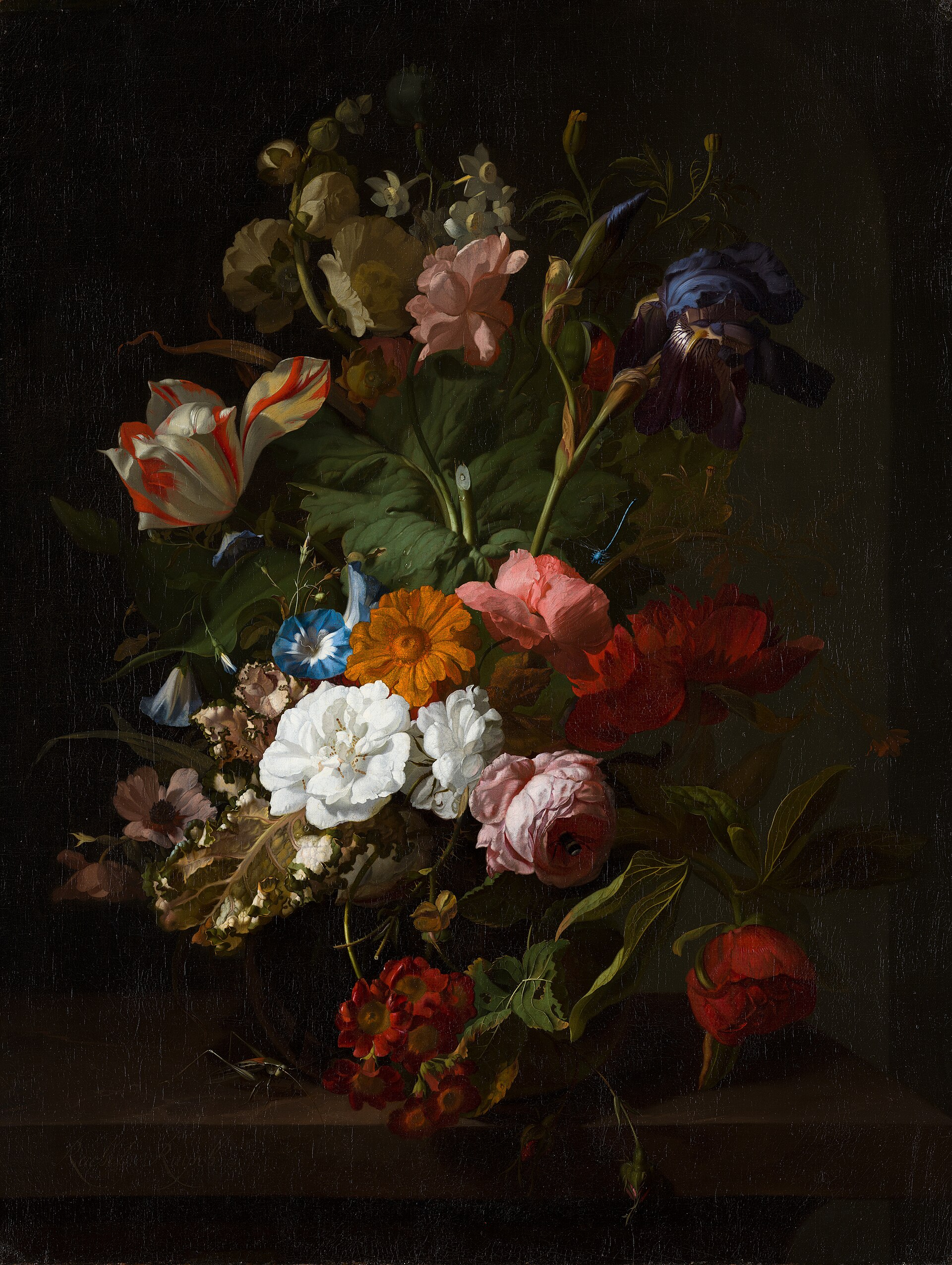
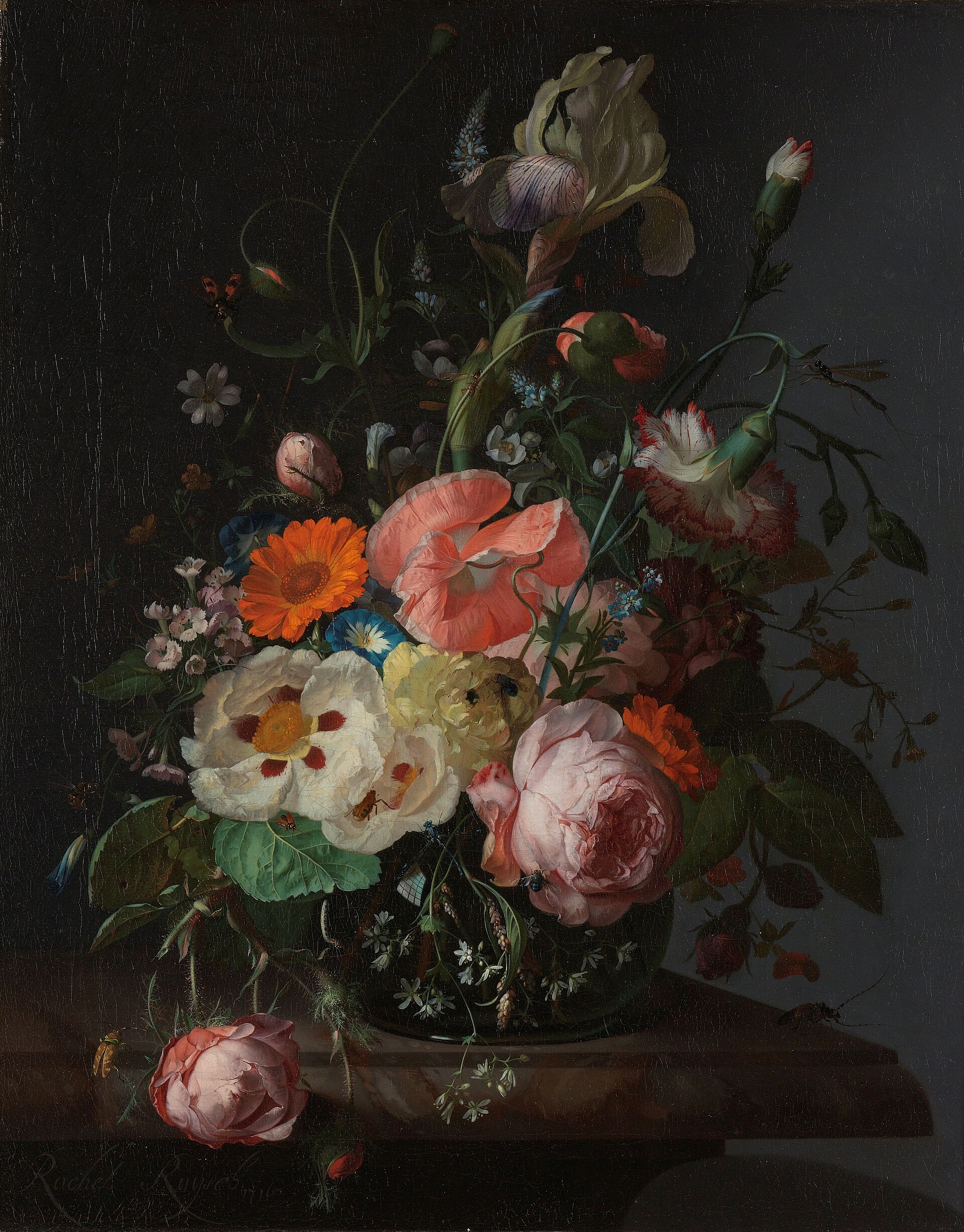
Signs the Rijksmuseum flower piece SK-A-2338; Jurriaan Pool's family portrait is packed when the Elector dies.121
- 1722
In December wins the first prize of the States of Holland lottery, 75,000 guilders by the Dutch dictionary and 60,000 by the National Gallery of Ireland.114
- 1734
The couple agree to let their eldest son sell his mother's paintings.1
- 1745
Pool dies in October; a flower piece dated 1745 is inscribed with her age, 81.14
- 1748
Johan van Gool visits her at 84 and finds most of her pictures have gone abroad.1
- 1750
Receives a collection of poems in her honour and dies on 12 October in Amsterdam.1
- 1766
The 1710 flower piece is sold at the Leiden De la Court van der Voort-Backer sale, lot 103, for 1,015 guilders.3
- 1908
Rijksmuseum purchase of SK-A-2338 recorded.12
- 1956
M.H. Grant publishes Rachel Ruysch, 1664-1750, the last numbered catalogue.23
- 1998
Marianne Berardi's Pittsburgh dissertation on her early development; still unpublished.2
- 2013
- 2023
The Met buys the 1692 dual portrait; the National Gallery of Ireland and the Museum of Fine Arts Boston each buy a late flower piece.1014
- 2024-25
Rachel Ruysch: Nature into Art opens at the Alte Pinakothek, Munich with 57 of her paintings (Art Newspaper), then travels to Toledo and Boston.29
The market
Her results are sparse enough to read one by one. The record in pounds is the 1710 flower piece at Sotheby's London on 3 July 2013, lot 29: GBP 1,650,500 in the aggregator Art.Salon, GBP 1,400,000 in Sotheby's own 2019 catalogue note. The two differ by exactly the arithmetic of a 25 per cent premium on the first GBP 50,000, 20 per cent to GBP 1 million and 12 per cent above, which suggests that GBP 1,400,000 is the hammer and GBP 1,650,500 the total. That is this page's inference. It has not checked Sotheby's 2013 conditions of business and it is not a published statement.
In dollars two results compete. A monumental 1700 canvas, 44 by 35 inches, sold for USD 2.4 million with premium at Butterscotch Auction Gallery on 12 February 2012, reported by Antiques and the Arts Weekly as a record at the time. A 1698 canvas of 48.3 by 40 cm sold for USD 2,198,000 at Sotheby's New York on 28 January 2021, per the same Art.Salon aggregator, against an estimate of USD 1 to 1.5 million. No dollar conversion of the 2013 sterling result is attempted here, so the dollar and sterling records are not ranked against each other.
The older prices matter for the cohort. A flower piece sold at the Leiden sale of 1766 for 1,015 guilders; a pendant pair made 200 guineas in London in 1912; a 1698 flower piece sold in Amsterdam in 1783 for 200 guilders. The same painter's pictures cost 650 guilders each in about 1710.
| Date | Sale | Work | Result | Note |
|---|---|---|---|---|
| 3 July 2013 | Sotheby's, London (Old Master and British Paintings evening sale, lot 29) | Still life of roses, tulips, a sunflower and other flowers in a glass vase with a bee, butterfly and other insects upon a marble ledge, signed and dated 1710, canvas 88.9 by 71.1 cm | Hammer GBP 1,400,000 (Sotheby's 2019 note; hammer status inferred, not stated) With premium GBP 1,650,500 (Art.Salon, an aggregator) GBP | Estimate GBP 1,000,000 to 1,500,000. Commissioned by Pieter de la Court van der Voort for 650 guilders with its pendant; unseen at auction since 1912. The Art Newspaper reports a 1710 glass-vase picture, now at the National Gallery, London and on loan from the Capstick collection, reunited with its pendant fruit piece in the 2024-25 exhibition. That it is this canvas is an inference from title, date and pendant. |
| 28 January 2021 | Sotheby's, New York (Master Paintings and Sculpture Part I, lot 32) | Still life with flowers in a vase on a ledge with a dragonfly, caterpillar and butterfly, signed and dated 1698, canvas 48.3 by 40 cm | Hammer not available With premium USD 2,198,000 (Art.Salon) USD | Estimate USD 1,000,000 to 1,500,000; Sotheby's own results page requires a login. Provenance includes the Amsterdam sale of Pieter Locquet in 1783, lot 312, for 200 guilders. |
| 12 February 2012 | Butterscotch Auction Gallery (estate auction, New York) | Monumental still life signed and dated 1700, 44 by 35 inches | Hammer not reported With premium USD 2,400,000 (the report says prices include the buyer's premium) USD | Reported at the time as a new world record for the artist; provenance traced to the 1857 Alton Towers sale. |
| 8-9 September 1766 | Luchtmans, Leiden (sale of Catherina de la Court van der Voort-Backer, lot 103) | The 1710 flower piece (single canvas) | Hammer 1,015 guilders (to de Winter) Dutch guilders | The family inventory gives 650 guilders for the commission around 1710. |
| 10 February 1912 | Christie's, London (Lesser Lesser sale, lot 95) | The 1710 flower piece with its pendant fruit piece | Hammer 200 guineas for the pair (to Shepherd) Pounds sterling, in guineas (1 guinea = 21 shillings) | Sotheby's says separately that the pendant fruit piece was bought at this sale by the 4th Marquess of Bute, while the flower piece's own provenance lists Shepherd; the catalogue note doesn't reconcile the two. |
Hammer is the price at which the bidding stopped; with premium adds the fee the house charges the buyer on top. Hammer price and buyer's premium in the glossary.
Where to see the work
| Institution | City | Holdings | Note |
|---|---|---|---|
| Mauritshuis | The Hague | Vase with Flowers, signed and dated 1700, canvas, inventory 151. | The ground layers of this picture are published in the 2025 JHNA study. |
| Rijksmuseum | Amsterdam | Still Life with Flowers on a Marble Tabletop, signed and dated 1716, SK-A-2338; also SK-A-354, dated between 1690 and 1720 in the museum's record. | Purchase of SK-A-2338 recorded for 1908 with the support of the Vereniging Rembrandt. |
| Alte Pinakothek | Munich | The Palatine pictures from Johann Wilhelm's collection, including the 1709 pair and a Bouquet of Flowers dated 1715. | Co-organised the 2024-25 survey. |
| Galleria Palatina, Palazzo Pitti | Florence | The 1716 pair of a flower piece and a fruit piece, cited in Sotheby's 2013 note as Grant cat. nos. 167 and 171. | Her work was especially prized in Florence according to Sotheby's. The pair of small square panels she was painting in 1711 was intended as the Elector's gift to his father-in-law Cosimo de' Medici, and Sotheby's says it is still in the Pitti; the 1716 pair listed here is a separate pair whose patron this page has not found. |
| National Gallery | London | Flowers in a Vase, about 1685, NG6425, bequeathed by Alan Evans in 1974; a 1710 loan reported by the Art Newspaper. | Room 28 at the time of the museum's page. |
| Fitzwilliam Museum | Cambridge | Spray of flowers with insects and butterflies on a marble slab, 1690s, PD.38-1975. | |
| Metropolitan Museum of Art | New York | The 1692 dual portrait of Ruysch by Michiel van Musscher with her flower still life, accession 2023.91. | The museum's first Ruysch; an earlier picture of 1871 proved a copy. |
| National Gallery of Ireland | Dublin | Vase of Flowers with an Ear of Corn, signed and dated 1742, NGI.2023.20, purchased 2023. | |
| Museum of Fine Arts | Boston | A Still Life of Flowers in a Glass Vase on a Marble Table before a Niche, 1742, oil on panel, 2023.336. | Bought in 2023; co-organised the 2024-25 survey. |
Forgeries and misattributions
- Copies and doubtful attributions rather than documented forgeries.
- The Ashmolean's panel of 1716, catalogued as after Ruysch (RKD 193054), repeats the Rijksmuseum canvas SK-A-2338 in composition. The Met's first Ruysch, bought in 1871, was later found to be a copy (Hyperallergic). In September 2025 the ARCA blog compared a Buenos Aires still life named for Ruysch with a wartime loss that Dutch records list as by Abraham Mignon and reached no finding. Wikipedia names Catharina Backer as a copyist of her work. By comparison of composition and support in museum catalogues and, in the Buenos Aires case, by matching images and measurements in archives. No technical test reported in any source seen here separates Ruysch from her sister Anna or from followers.161017
The essay
Chapter 1Over 150 pictures survive, and the last published numbered catalogue is from 1956
Elizabeth Honig's review of the 2024-25 exhibition catalogue says the book illustrates or mentions about half of the over 150 works by Ruysch that survive.
Elizabeth Honig's review of the 2024-25 exhibition catalogue says the book illustrates or mentions about half of the over 150 works by Ruysch that survive. She adds that there had been no monograph on the painter for almost seventy years, and that the dissertation on her early work has never been published. Her footnote names the two works she means: Maurice H. Grant, Rachel Ruysch, 1664-1750 (Leigh-on-Sea, 1956) and Marianne Berardi's 1998 Pittsburgh thesis Science into Art. The Dutch women's dictionary, in its list of works, simply sends the reader to Berardi.
The exhibition at the Alte Pinakothek in Munich, the Toledo Museum of Art and the Museum of Fine Arts, Boston, showed 57 paintings by Ruysch. The Art Newspaper's reviewer calls that over a third of her surviving work, which fits the 150-odd figure. Wikipedia gives a different count, more than 250 documented or attributed, without saying what separates the two numbers. The likeliest reading is that 150 counts pictures that exist and that the larger figure adds works known only from inventories and sale records, but no source says so and this page doesn't claim it.
Grant's catalogue numbers are cited by auction houses to this day, and the citations show its limits. When Sotheby's sold the 1710 flower piece in 2013 its catalogue entry recorded that Grant had confused the provenance of two of his own entries, and that Hofstede de Groot's 1928 Verzeichnis had listed the picture under the wrong entry as well. The painting's modern identification with a pair recorded in a Leiden inventory was confirmed for Sotheby's by Berardi.
Chapter 2She learned in her father's museum and from the best flower painter in Amsterdam
The Dutch women's dictionary, written by Luuc Kooijmans, sets the scene.
The Dutch women's dictionary, written by Luuc Kooijmans, sets the scene. Her father Frederik Ruysch was professor of anatomy and botany in Amsterdam and kept a famous collection of preparations, insects and plants. Her mother Maria Post was the daughter of the architect Pieter Post. By fourteen she was painting animals and plants so well that her parents let her study with a painter, which the dictionary calls unusual for a girl. Otto Marseus van Schrieck, who had made the dark-corner genre of snakes, toads and insects fashionable in Amsterdam, was dead by then. She went instead to Willem van Aelst, whom the dictionary calls the best still-life painter in Amsterdam and a friend of her parents. Sotheby's gives the apprenticeship as 1679 to 1683.
The dictionary describes her early method in practical terms. She laid out the main lines of a composition and waited for the paint to dry, then added insects, grass blades and tiny flowers with a very fine brush. She used small sponges dipped in paint to build the texture of moss, and sometimes real moss to make imprints, as Marseus and Van Aelst had done. She combined plants and animals that never meet in nature, and she worked from models in her father's collection rather than from the open field. The dictionary adds that Frederik Ruysch could preserve flowers so that they kept the look of bloom, which let her compose bouquets of species that flower in different seasons. That last claim is the dictionary's and rests on no technical study that this page has found.
The National Gallery in London makes the same point about out-of-season bouquets from the other side. It says painters of the period stored detailed sketches made when each flower was in bloom and assembled them later, and then admits that why they did so is less clear. Its own offered reasons are a gradual tradition, a taste for varied shapes and colours, or a picture of the whole richness of two seasons passing.
Chapter 3Nature as a science, argued by the curators and not claimed for the painter
The catalogue of the 2024-25 exhibition places her in the scientific life of Amsterdam.
The catalogue of the 2024-25 exhibition places her in the scientific life of Amsterdam. Honig reports that Anna Knaap argued her production belongs inside the horticultural networks of the day, where women played real roles and new plants kept arriving from the Dutch colonies. Knaap's chosen example is a still life with cactus in a blue vase, one of several pictures that include only imported plants. The Leiden botanical garden, Honig notes citing Knaap, held 1,100 species in 1600, 3,000 in 1685 and 7,000 in 1740. Honig adds that Pieter de la Court in Leiden, a figure in horticulture, commissioned pictures from Ruysch.
Two other essays in the same book, as Honig describes them, are arguments by named scholars and should be read that way. Bert van de Roemer compares the kind of immortality Frederik Ruysch's preservation techniques gave anatomical and botanical specimens with the eternal blooms of Rachel's pictures. The biologist Charles Davis inventoried the species in sixteen of her paintings and found the highest plant diversity in the middle of her career, with one picture from late in that period holding 36 species. These are modern readings. No letter, inventory or contract that this page has seen records Ruysch stating what her flower pictures meant.
Critics also differ on whether the flowers carry a memento mori. The Art Newspaper quotes Andreas Kilb in the Frankfurter Allgemeine saying her flowers are not a memento mori, though death shares the stage with the beauty. The same review's own author wonders whether the work is merely decorative. The National Gallery's page offers the Protestant view that the study of nature was a gift from God and says no more. Honig reads her as appreciated and collected in part for her response to the new botany; no source records the maker's own account.
Chapter 4Dusseldorf was a pension with one picture a year attached
The Dutch women's dictionary gives the terms.
The Dutch women's dictionary gives the terms. Johann Wilhelm, Elector Palatine, visited Frederik Ruysch's museum in the summer of 1695 and undoubtedly saw Rachel's work. In 1708 she was offered the post of court painter. With a large family she was reluctant to move to Dusseldorf, and she was exempted from the residence obligation, as the dictionary notes Adriaan van der Werff and Jan Weenix also were. She received an annual stipend, for which she had to make only one painting a year for the collection of the Elector and his wife. She travelled to Dusseldorf a couple of times to deliver pictures.
The dictionary gives the personal detail. Her last child, a boy, was born when she was 47 and she named him Jan Willem after her patron, who with his wife agreed to be godparent. On a visit to show the child she was given a dressing table with a 28-piece silver toilet set and six silver sconces, and the boy received a costly medallion on a red ribbon. Jurriaan Pool was commissioned to paint her portrait and turned it into a family picture with the medallion. It was complete in 1716 and packed for shipment when news came that the Elector had died.
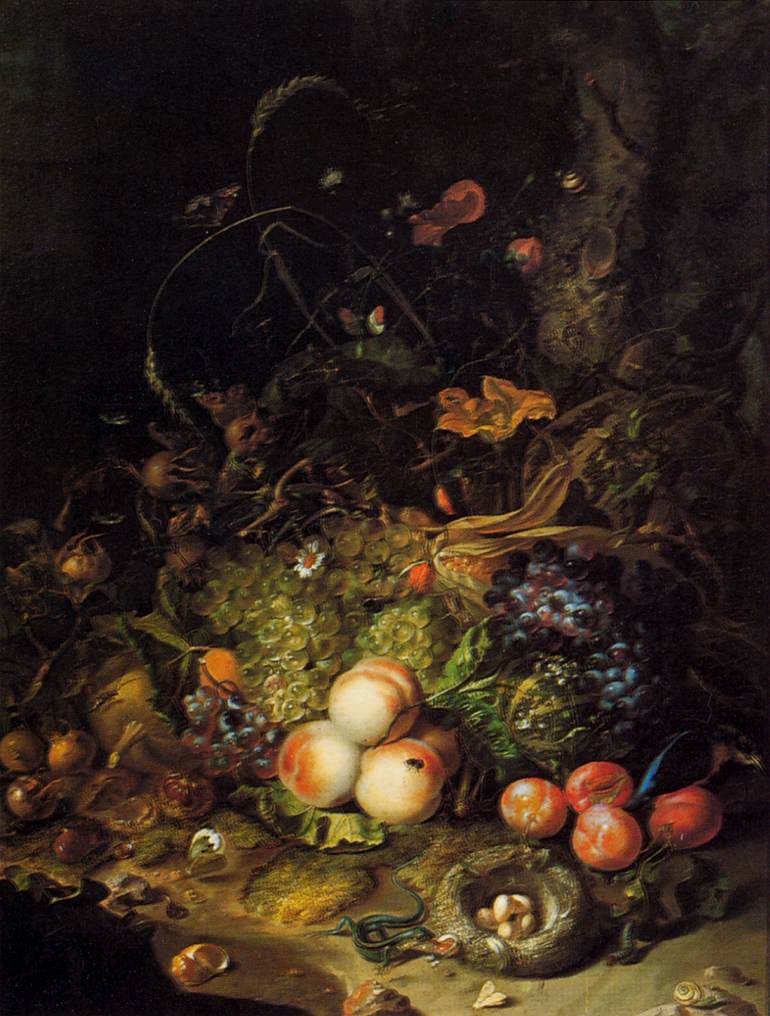
The Art Newspaper says the Elector's collection formed a pillar of the Alte Pinakothek's holdings. It reports a 1714 flower and fruit picture, four feet wide and now in Augsburg, that once decorated Johann Wilhelm's bedchamber, and Honig says the Elector kept several of her paintings in that room. Sotheby's names a pair painted for him in 1709, now in Munich. A second court sat behind the first. The dictionary says she was painting two small square panels for Cosimo de' Medici, the Elector's father-in-law, in 1711. Sotheby's says the pair on panel is still in the Palazzo Pitti in Florence and that a pair she painted in 1716 hangs there too.
Chapter 5What a pair cost: 1,300 guilders or 1,500, depending on who is asked
On 14 March 1711 the German traveller Zacharias Conrad von Uffenbach called on the Pools in Amsterdam.
On 14 March 1711 the German traveller Zacharias Conrad von Uffenbach called on the Pools in Amsterdam. Sotheby's 2013 catalogue prints a translation of what he wrote afterwards. He saw two pictures waiting for a Mr de la Court in Leiden, one of flowers and one of fruit, and records that the buyer paid her 1,500 guilders. He also records her saying she can't paint much more than two paintings in a year, and that she delivers one every year to the Elector Palatine, from whom she receives a pension.
The buyer was Pieter de la Court van der Voort, a cloth merchant who settled in Leiden in 1686 and amassed an art collection. His own inventory of 1731, quoted in the same catalogue, describes a flower piece and its pendant fruit piece painted for him, kept in his house and still awaiting further looking over and improvement, at 650 guilders each; Sotheby's reads this as Ruysch visiting him in Leiden to touch them up. His son Allard's inventory of December 1749 gives 650 guilders each or 1,300 for the two. Sotheby's sets the traveller's 1,500 against the family's 1,300 and prefers the family inventories. No source explains the difference, and this page does not. The Dutch women's dictionary prints Uffenbach's figure without the family's.
The same picture's later prices show how the numbers moved. It was sold at the Leiden sale of the widow Catherina de la Court van der Voort-Backer on 8-9 September 1766, lot 103, for 1,015 guilders to the dealer de Winter, perhaps acting for the Leipzig collector Gottfried Winckler. It then reappeared in the London sale of Lesser Lesser at Christie's on 10 February 1912, lot 95, with its pendant, for 200 guineas to Shepherd. It sold again at Sotheby's London on 3 July 2013 (see the market section).
Chapter 6The dark ground and the signature with her age
A 2025 article in the Journal of Historians of Netherlandish Art by the Mauritshuis conservators Marya Albrecht and Sabrina Meloni reports on the grounds of eighty-three still lifes in that museum...
A 2025 article in the Journal of Historians of Netherlandish Art by the Mauritshuis conservators Marya Albrecht and Sabrina Meloni reports on the grounds of eighty-three still lifes in that museum, studied by microscopy, infrared reflectography, X-radiography, X-ray fluorescence and cross-sections. Its table lists Ruysch's Vase with Flowers, signed "Rachel Ruysch F: 1700", on canvas, 79.5 by 60.2 cm, inventory 151, with a double ground. Both layers are dark brown, built from earth pigments, chalk and lead white, and the upper layer holds more and finer particles of lead white than the lower one. The article's wider finding is that several painters used a remarkably dark upper ground and left it uncovered in places as a backdrop, though a dark gray upper ground under the whole picture appears in only three of the eighty-three.
The study finds ten canvases with a gray layer over a red one, all from the northern Netherlands between about 1650 and 1680, and reads it as evidence of local preference. Ruysch's 1700 picture isn't one of them. The article discusses her only in its table, so it draws no conclusion about where or from whom she bought her canvas.
She signed and dated, and late in life she added her age. Sotheby's offered in 2019 a flower piece inscribed "R Ruysch 1745 81 Jaren" and noted that the age suggests pride in still producing such quality after eighty. The Museum of Fine Arts, Boston bought a small panel of 1742 inscribed with her name, the date and the age of 79, according to the National Gallery of Ireland's curator Lizzie Marx.
Chapter 7Her sister, her husband and the other hands
Anna Ruysch, her younger sister (baptised December 1666), trained in the same circle.
Anna Ruysch, her younger sister (baptised December 1666), trained in the same circle. Honig reports that Robert Schindler's catalogue essay shows numerous works by Anna's hand and suggests she might have collaborated on some of Rachel's larger and more demanding works, against the usual view of Anna as a fairly amateur imitator. The Art Newspaper's reviewer calls her a mysterious-sounding sister who painted floral still lifes nearly indistinguishable from Rachel's. Wikipedia, citing the same Dutch dictionary, says fewer than ten pictures are attributed to Anna with certainty because she rarely signed, and records her sales at 50,900 pounds in 2007 and 201,600 and 327,000 pounds in 2022. That is a tertiary summary of dealers' and auction-house claims.
Honig adds a second doubt, from the inventory side: Bernd Ebert questions whether all the Ruysch pictures listed in princely inventories were really by her. The 1692 portrait now in the Metropolitan Museum shows another kind of shared hand. Michiel van Musscher painted the sitter at her easel and Ruysch painted the flowers and other still-life elements around her. The Met's curator Adam Eaker, quoted in Hyperallergic, says collaborations of this sort were a game in which connoisseurs showed they could tell the hands apart. A third contributor remains unnamed: the open book in the foreground is signed "De Vree".
Her husband Jurriaan Pool is the other documented painter in the house. The dictionary says he claimed his wife's brushwork surpassed that of all masters past and present, and that he painted the family picture of 1716. Whether he or anyone else ever touched her flower pieces is unrecorded in anything this page has seen.
Chapter 8Copies, misattributions and a portrait painted over a flower piece
Ruysch was copied during her lifetime or soon after, and the copies are catalogued in public collections.
Ruysch was copied during her lifetime or soon after, and the copies are catalogued in public collections. The Ashmolean in Oxford holds a panel of 1716 listed as after Ruysch, recorded at the Netherlands Institute for Art History as number 193054. It repeats the Rijksmuseum's signed canvas of the same year in composition. Wikipedia names Catharina Backer, daughter-in-law of Pieter de la Court van der Voort, as a well-documented copyist and says she owned two of Ruysch's large paired canvases. That comes from a tertiary summary of a Dutch dictionary entry that this page hasn't traced to its primary source.
The Metropolitan Museum's first Ruysch, acquired in 1871, was later found to be a copy, according to Hyperallergic's report. In 2023 the Met bought the 1692 portrait, which Hyperallergic calls its first painting by her. The 2024-25 catalogue includes an essay by Josephina de Fouw, Nouchka de Keyser and Jorinde Koenen reporting that a portrait of a nineteenth-century collector was painted over a work by Ruysch that he owned, as Honig describes it.
A wartime question is unresolved. In September 2025 the research group ARCA published an inquiry on its blog. By overlaying photographs of a still life that the Museo Nacional de Arte Decorativo in Buenos Aires attributes to Ruysch on the Dutch record photograph of a wartime loss listed as by Abraham Mignon, ARCA says it suspects they are the same painting under different attributions. It notes that the recorded widths differ, and that attributions are seldom definitive and may be reassessed. No museum, registry or court has ruled, and this page does not. The earliest images of the Buenos Aires picture that ARCA found date to 2007 and the museum's donation date is given as 1960, 1962 or 1964 in different sources.
Chapter 9A lottery, three sons and the sale of the studio
The dictionary says Ruysch and Pool won 200 guilders in the lotteries of the States of Holland in 1713.
The dictionary says Ruysch and Pool won 200 guilders in the lotteries of the States of Holland in 1713. In December 1722 they and their son George bought a lot for ten guilders and won the first prize of 75,000 guilders. Honig, summarising Schindler, also gives 75,000 guilders in 1723. The National Gallery of Ireland's article gives the same event as 60,000 guilders. The year also differs: December 1722 in the dictionary and the National Gallery of Ireland's article, 1723 in Honig and the Art Newspaper. The dictionary lists notarial acts from 1723 in the Amsterdam archive, which are where the question could be settled.
George died three years later at 25, and by the dictionary's count the couple had lost two adult sons in a few years, one of them Abraham, who died in Guinea in the service of the West India Company in 1720. In 1734 they agreed to let their eldest son Frederik sell his mother's paintings. In 1743 she wrote of her second son Isaac's behaviour with the deepest sadness, and in 1749 she said the friendship between her and all her children was restored. The Art Newspaper says she all but gave up painting for over a decade after the win, which sits oddly beside dated pictures of 1741, 1742 and 1745.
The dictionary also records that the biographer Johan van Gool met her in 1748 at 84 and found that most of her paintings had been sent abroad. She showed him a picture begun the year before. In 1750 she was given a collection of verses written about her work, which the dictionary calls a unique gesture for a Dutch artist. She died on 12 October that year. The dictionary cites Abraham Bredius's Kunstler-Inventare 4, pages 1203-1209, among its archival sources. This page has not opened that volume and gives no inventory contents.
Chapter 10How the reputation moved: poems, near-silence and the 2024 survey
Sotheby's says eleven contemporary poets paid tribute to her and that van Gool wrote her biography in the Nieuw Schouburg of 1750.
Sotheby's says eleven contemporary poets paid tribute to her and that van Gool wrote her biography in the Nieuw Schouburg of 1750. Honig adds that the poems were published in her lifetime, possibly with a nudge from her son Frederik, and that many of the poets were up-and-coming women writers. Honig says her works were collected and admired by the urban and courtly elites of Europe.
Then the record thins. Honig says every historian of Dutch art knows the name and few know much about her, and she calls the scholarly neglect a stark contrast with her lifetime esteem. The Art Newspaper's reviewer calls her a footnote and a major painter of what amounts to a minor sub-genre. The Met bought its portrait in 2023 and the National Gallery of Ireland bought a flower piece signed and dated 1742 in the same year. Boston bought a 1742 panel the same year.
Nobody has replaced Grant's catalogue. Honig calls the 2024-25 book a key text on Ruysch for a long time, and she treats it as an independent book rather than a catalogue of the exhibition alone. It is not described as a catalogue of all her works.
What is documented
Technique
The surviving work
- What is accepted
- Over 150 surviving paintings, per Elizabeth Honig's 2025 review of the 2024-25 exhibition catalogue by Schindler, Ebert, Knaap and others; 57 of them were shown. This page found no published figure of 'accepted' works from any authority and no complete list since Grant (1956) or Berardi (1998).
- What is contested
- Wikipedia reports more than 250 documented or attributed; that count is not in a source this page opened. Bernd Ebert doubts that all Ruysch pictures in princely inventories were really by her (Honig). Robert Schindler suggests her sister Anna may have collaborated on larger works (Honig). Grant's 1956 catalogue and Hofstede de Groot's 1928 Verzeichnis both mislocated provenance for the 1710 flower piece, per Sotheby's 2013 note.
- Who rules on attribution
- No standing authentication board or committee was found. In practice the 2024-25 curators (Schindler, Ebert, Knaap) and Marianne Berardi are the authorities auction houses cite. Honig's review is the best published account of who holds what.
Catalogue raisonne
- Maurice H. Grant, Rachel Ruysch, 1664-1750 (Leigh-on-Sea: F. Lewis, 1956). The last monograph with numbered entries before the 2024-25 book; cited by auction houses by catalogue number, with entries at least to 171. Sotheby's 2013 shows it confusing the provenance of cat. nos. 45 and 46 with the 1912 Lesser Lesser sale.23
- C. Hofstede de Groot, Verzeichnis der Werke... (Stuttgart, 1928), vol. 10. Early comprehensive Dutch catalogue; Sotheby's records that it lists the 1710 flower piece under the wrong provenance, cat. no. 70.3
- Marianne Berardi, Science into Art: Rachel Ruysch's Early Development as a Still-Life Painter (Ph.D. diss., University of Pittsburgh, 1998). Unpublished; the Dutch women's dictionary sends readers to it for a list of works. Berardi helped Sotheby's identify the 1710 flower piece with the Leiden De la Court pair.123
- Robert Schindler, Bernd Ebert and Anna C. Knaap and others, Rachel Ruysch: Nature into Art (exhibition catalogue, Munich, Toledo, Boston, 2024-25). Ten essays; Honig reports that it illustrates or mentions about half the surviving works and treats it as an independent book. It is not described as a catalogue of all her works.2
Questions about Rachel Ruysch
Who was Rachel Ruysch?
Painter; Flower and still-life painter; Court painter to Johann Wilhelm, Elector Palatine. 1664-1750.
When did Rachel Ruysch live?
Born Baptised 3 June 1664, The Hague; died 12 October 1750, Amsterdam.
How are fakes and misattributions of Rachel Ruysch detected?
Copies and doubtful attributions rather than documented forgeries. The Ashmolean's panel of 1716, catalogued as after Ruysch (RKD 193054), repeats the Rijksmuseum canvas SK-A-2338 in composition. The Met's first Ruysch, bought in 1871, was later found to be a copy (Hyperallergic).
Where can you see work by Rachel Ruysch?
Mauritshuis (The Hague); Rijksmuseum (Amsterdam); Alte Pinakothek (Munich); Galleria Palatina, Palazzo Pitti (Florence); National Gallery (London); Fitzwilliam Museum (Cambridge).
What does the market for Rachel Ruysch look like?
Her results are sparse enough to read one by one. The record in pounds is the 1710 flower piece at Sotheby's London on 3 July 2013, lot 29: GBP 1,650,500 in the aggregator Art.Salon, GBP 1,400,000 in Sotheby's own 2019 catalogue note.
What is still unresolved about Rachel Ruysch?
How many surviving paintings are by Rachel Ruysch herself? Over 150 survive according to Honig's 2025 review, Wikipedia gives over 250 documented or attributed, and no one has published a complete numbered catalogue since Grant (1956).
Open questions
- How many surviving paintings are by Rachel Ruysch herself? Over 150 survive according to Honig's 2025 review, Wikipedia gives over 250 documented or attributed, and no one has published a complete numbered catalogue since Grant (1956).
- Where does Rachel end and Anna Ruysch begin? Schindler suggests Anna may have collaborated on Rachel's larger works, fewer than ten pictures are securely Anna's, and no pigment or technical study found separates the two.
- What did Pieter de la Court van der Voort actually pay for the 1710 pair: 1,300 guilders by the family inventories or 1,500 by von Uffenbach's report?
- Was the lottery prize of December 1722 75,000 guilders or 60,000? The Amsterdam notarial acts of 1723 that the dictionary cites could settle it.
- When did she join the Hague Pictura: 1699 by the Dutch women's dictionary or 1701 by the National Gallery of Ireland's article?
- Did she have ten children or eleven? The dictionary and the Art Newspaper say ten; Honig's summary of Schindler says eleven.
- What is the one drawing securely given to her: a drawing of a Surinam toad, identified as hers by Schindler (Honig), and how does it relate to the hand-coloured engraving of the same animal that the Art Newspaper says inspired her 1690 forest-floor picture? And what is the blue sheet visible beneath the books in the Met's 1692 portrait?
- Is the Buenos Aires still life named for Ruysch the picture that Dutch records list as a lost Abraham Mignon? ARCA suspects so from overlaid photographs, notes a width discrepancy, and no museum, registry or court has ruled.
- Who was the third hand, "De Vree", who signed the open book in the 1692 Met portrait?
- Is the 1710 glass-vase picture on loan at the National Gallery, London, in 2025 the canvas Sotheby's sold in 2013 (this page's inference from title, date and pendant), and where is its pendant fruit piece's provenance after 1996?
Sources
- 1Luuc Kooijmans, 'Ruysch, Rachel', Digitaal Vrouwenlexicon van Nederland (Online Dictionary of Dutch Women), Huygens ING; English version, last updated 13 January 2014. Opened and read in full. resources.huygens.knaw.nl/vrouwenlexicon/...
- 2Elizabeth Honig, review of Rachel Ruysch: Nature into Art (Robert Schindler, Bernd Ebert, Anna C. Knaap and others, 2024), Historians of Netherlandish Art Reviews. Opened and read in full. hnanews.org/hnar/...
- 3Sotheby's London, Old Master and British Paintings evening sale, 3 July 2013, lot 29, lot page with provenance, literature, translated Uffenbach passage, Berardi note and condition report. Opened and read in full. sothebys.com/en/...
- 4Sotheby's London, Old Master Day sale, July 2019, lot 146, catalogue note recording the 2013 result of GBP 1,400,000 and the 1745 inscription of age 81. sothebys.com/en/...
- 5Art.Salon, auction result page for Sotheby's London 3 July 2013, lot 29: GBP 1,650,500 realised (aggregator, ; replace with Sotheby's own results page, which requires a login). art.salon/artwork/...
- 6Sotheby's New York, Master Paintings and Sculpture Part I, 28 January 2021, lot 32, lot page with description and provenance (results behind a login). sothebys.com/buy/...
- 7Art.Salon, auction result page for Sotheby's New York 28 January 2021, lot 32: USD 2,198,000 realised (aggregator, ). art.salon/artwork/...
- 8'Rachel Ruysch Still Life Sets Artist Record At Butterscotch', Antiques and the Arts Weekly, 13 March 2012. antiquesandthearts.com/rachel-ruysch-still-life-sets-arti...
- 9J.S. Marcus, 'Rachel Ruysch: Nature into Art at the Alte Pinakothek', The Art Newspaper, 6 February 2025. Opened and read in full. theartnewspaper.com/2025/...
- 10'Dual Portrait of Old Master Rachel Ruysch Holds a Trove of Secrets', Hyperallergic, on the Metropolitan Museum's acquisition; includes statements of curator Adam Eaker. hyperallergic.com/dual-portrait-of-old-master-rachel-ruys...
- 11Metropolitan Museum of Art, Open Access collection API record for object 875634: Rachel Ruysch (1664-1750), 1692, oil on canvas, 76.2 by 63.5 cm, accession 2023.91, public domain. collectionapi.metmuseum.org/public/...
- 12Rijksmuseum, object page SK-A-2338, Still Life with Flowers on a Marble Tabletop, 1716 (signature, dimensions, acquisition, credit line). rijksmuseum.nl/en/...
- 13Marya Albrecht and Sabrina Meloni, 'Laying the Ground in Still Lifes: Efficient Practices, Visual Effects, and Local Preferences Found in the Collection of the Mauritshuis', Journal of Historians of Netherlandish Art 17:2 (2025), DOI 10.5092/jhna.2025.17.2.6. Table 1 lists Ruysch's Vase with Flowers, inventory 151. jhna.org/articles/...
- 14Lizzie Marx, 'A New Acquisition for the National Gallery of Ireland', Art Herstory, on Ruysch's Vase of Flowers with an Ear of Corn, NGI.2023.20 (also the 2022 lottery figure of 60,000 guilders and the 1742 Boston panel). artherstory.net
- 15Wikipedia, 'Rachel Ruysch' (; used only where flagged; replace with primary sources). en.wikipedia.org/wiki/...
- 16Wikipedia, 'Still Life with Flowers on a Marble Slab' (; the statements on a copy at the Ashmolean and on Catharina Backer as a copyist are not traced to a primary source here). en.wikipedia.org/wiki/...
- 17ARCA, 'A Still Life in Buenos Aires: Misattribution, Mystery, and Nazi-Era Shadows', ARCAblog, September 2025 (an inquiry, not a finding). art-crime.blogspot.com/2025/...
- 18National Gallery, London, NG6425, Flowers in a Vase, about 1685: overview, in-depth essay and details. nationalgallery.org.uk/paintings/...
- 19Wikipedia, 'Anna Ruysch' (; relies on Kooijmans's dictionary entry and auction pages; primary sources). en.wikipedia.org/wiki/...
- 20Wikimedia Commons, Category: Paintings by Rachel Ruysch, file pages for the plates (licence lines and holding institutions read from each file's wikitext). commons.wikimedia.org/wiki/...
Last verified