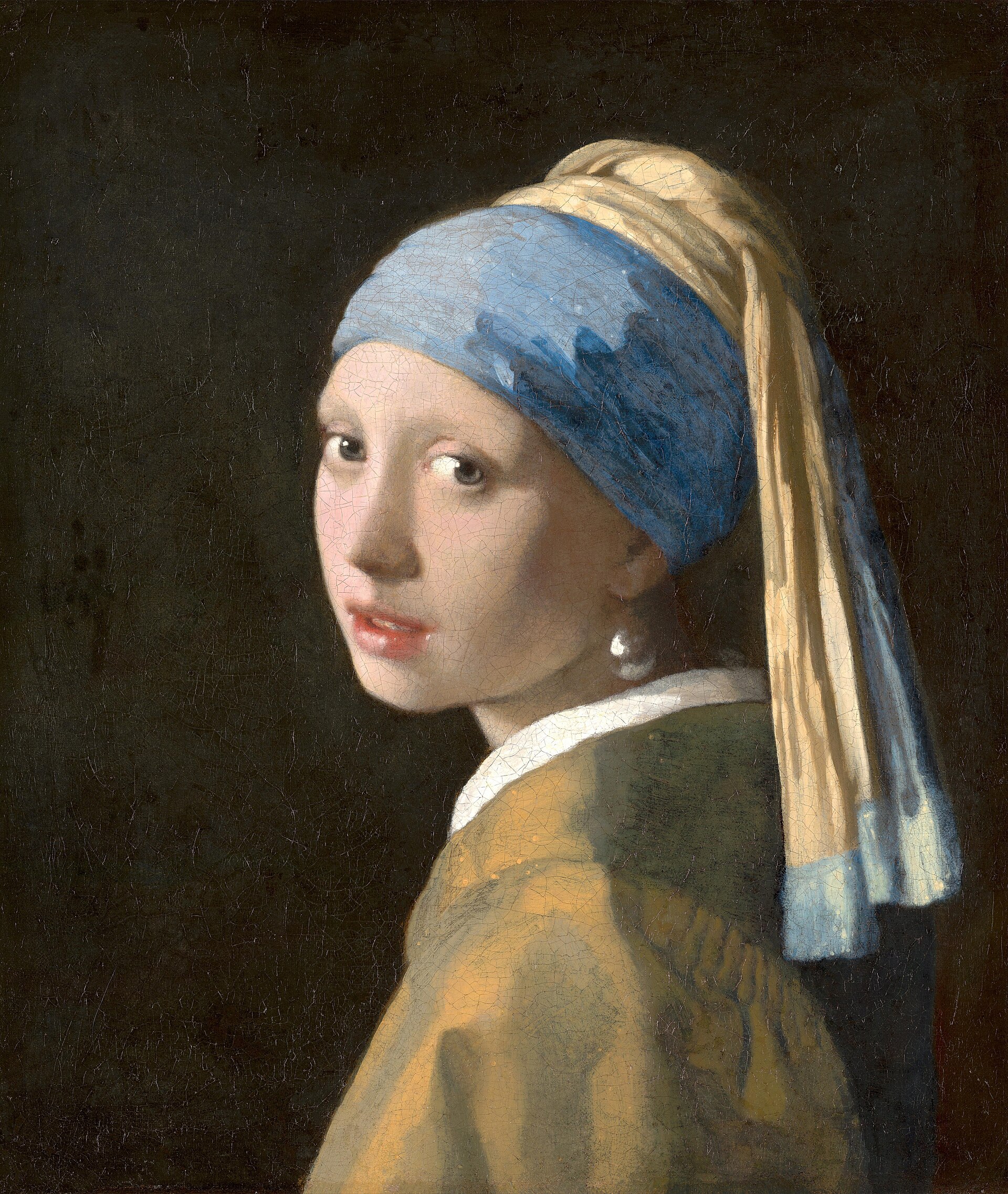
Girl with a Pearl Earring
c. 1665 · Oil on canvas
Mauritshuis
Museum · Koninklijk Kabinet van Schilderijen Mauritshuis · Founded 1822
Closure confirmed 4 September 2026 · 7 sources
Mauritshuis is currently closed, on the evidence sourced below.
Expected to reopen: closed to the public for maintenance work from Monday 24 August through Sunday 20 September 2026 · stated as a confirmed date
Closure confirmed 4 September 2026 from the institution's own page. We re-check this page on a schedule and will update it, from the institution's own announcement, the moment it reopens.
About 250 paintings, almost all Dutch and Flemish and almost all seventeenth-century, in a house built in the same century. Eleven Rembrandts make one of the largest holdings of his work anywhere; three Vermeers, two of them hung in the same room, make this the place to see the painter rather than a painting. The collection is not encyclopaedic and does not try to be: it was assembled as a stadholder's cabinet, and it still reads like one. Vermeer's Girl with a Pearl Earring, almost certainly the single most famous object this museum holds, is researched as its own record in this archive; what follows here is about the building and the collection around it, not a repeat of that record.
| Local name | Koninklijk Kabinet van Schilderijen Mauritshuis |
|---|---|
| Kind | Museum |
| Founded | 1822 as a museum; the house was completed in 1641 |
| City and country |  The Hague, Netherlands The Hague, Netherlands |
| Address | Plein 29, 2501 CM The Hague, Netherlands |
| Website | mauritshuis.nl/en |
| Status | Closed temporarily, confirmed 4 September 2026 |
| Record last verified | 8 August 2026 |
The museum is closed (see above). These are the figures published before the closure, kept here for a visitor planning ahead rather than presented as bookable today, and you can check the current position at the source we used. We will re-confirm them once it reopens.
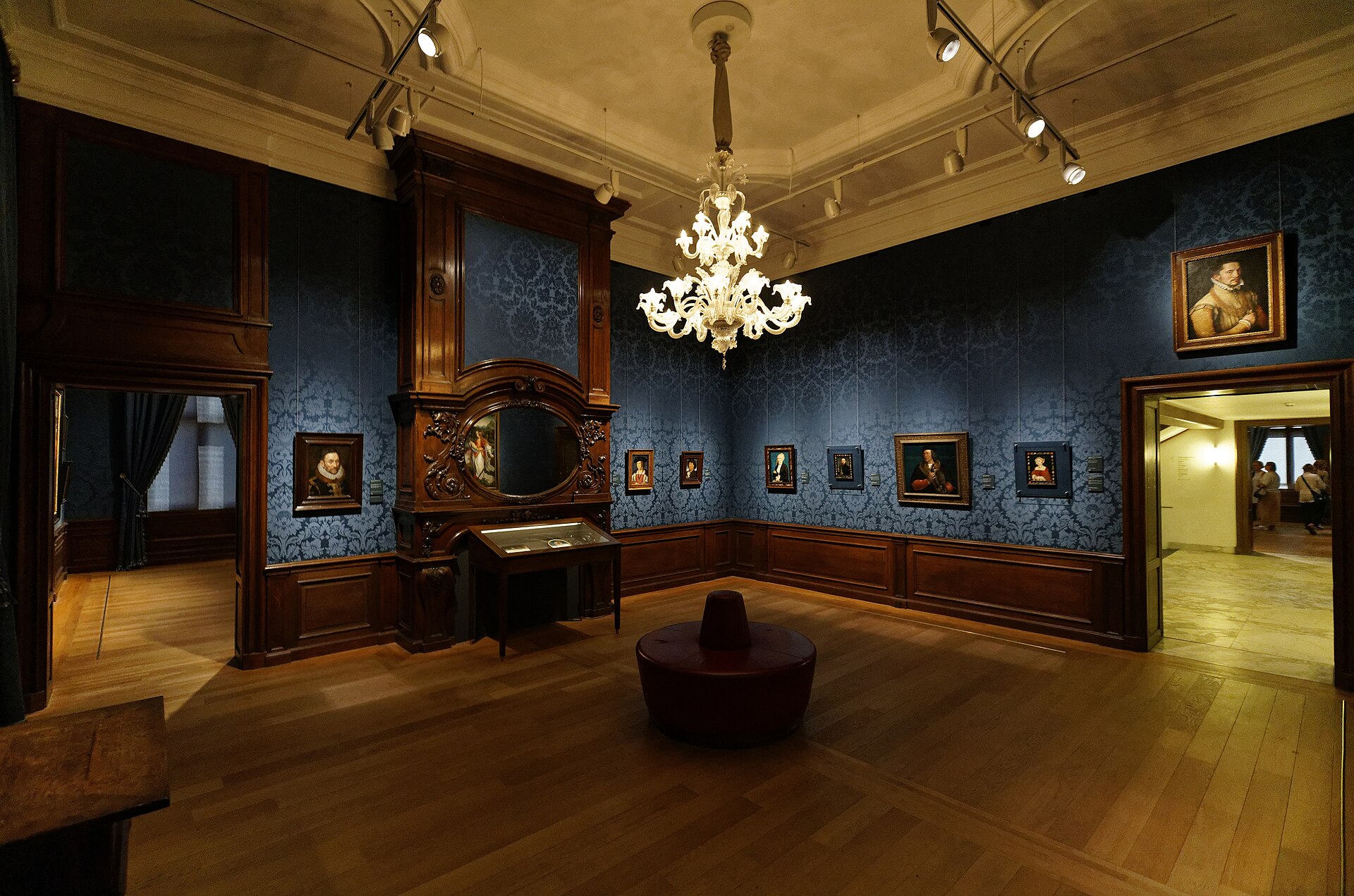
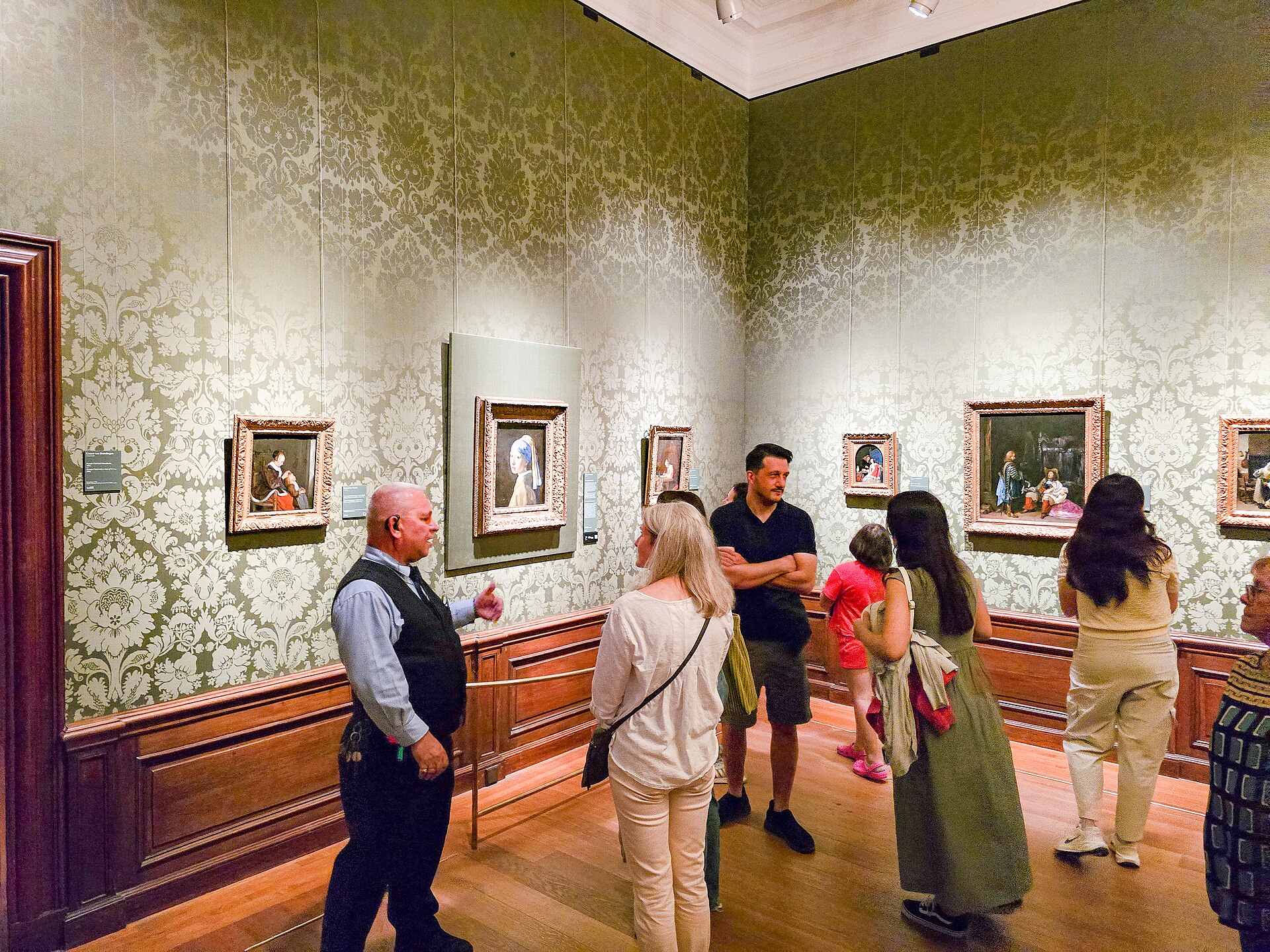
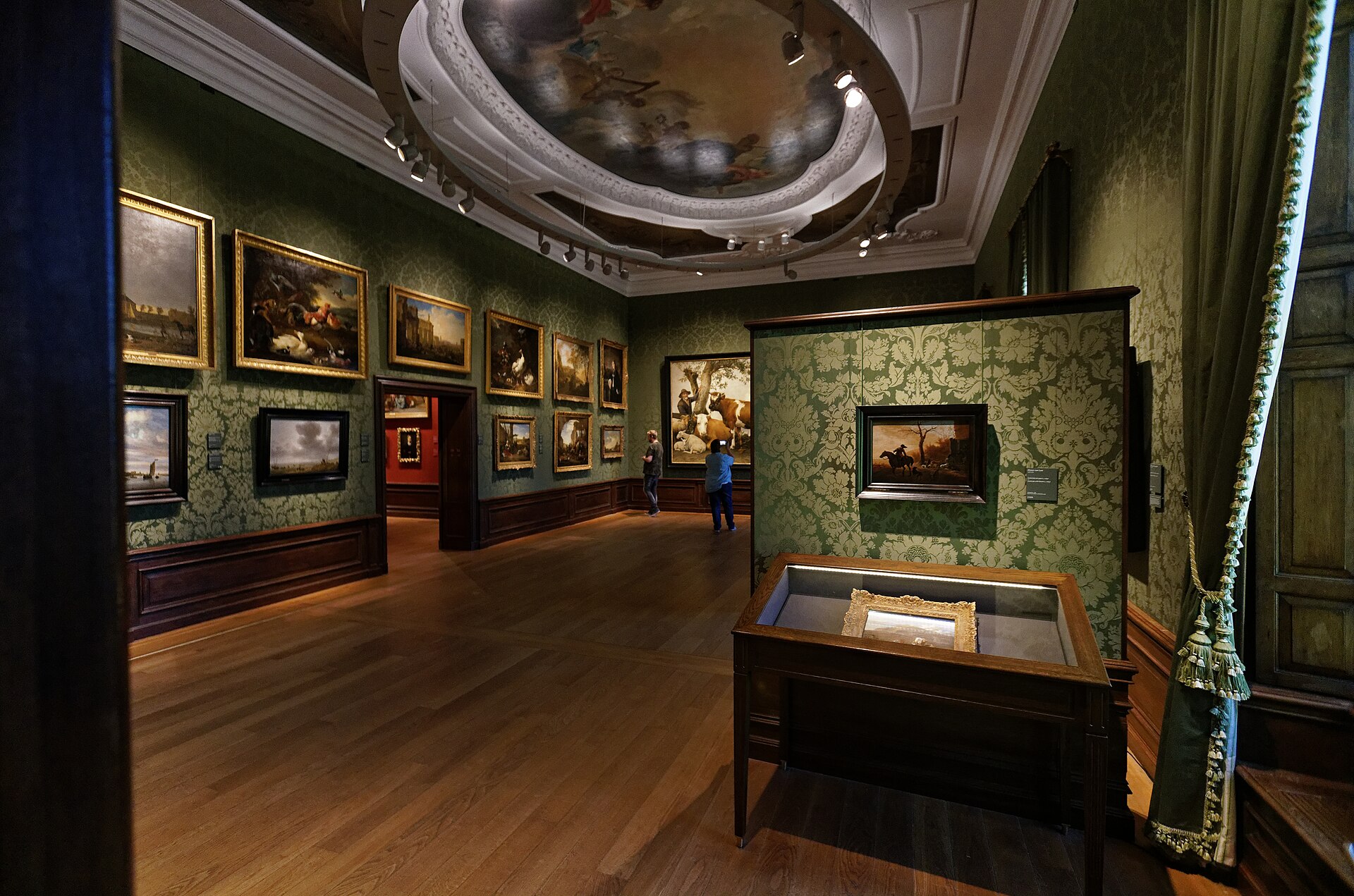
The historic city palace on the Plein holds the permanent collection across two floors of panelled rooms with silk wall coverings, painted ceilings and chandeliers. The museum makes the point that no other building in the Netherlands carries so many important paintings per square metre, and the rooms are domestic in scale rather than institutional.
On the ground floor, the room refitted after the 1704 fire with gilded Louis XIV decoration and large allegorical paintings by the Venetian artist Giovanni Antonio Pellegrini, built into the chimney breasts and the ceiling. It is a survival of the rebuilding rather than of the original house.
Connected to the old building by an underground foyer since the 2012 to 2014 works, the corner building of Societeit De Witte holds the temporary exhibition rooms, the museum offices, the library, the brasserie and the Art Workshop. Three exhibitions a year are staged here.
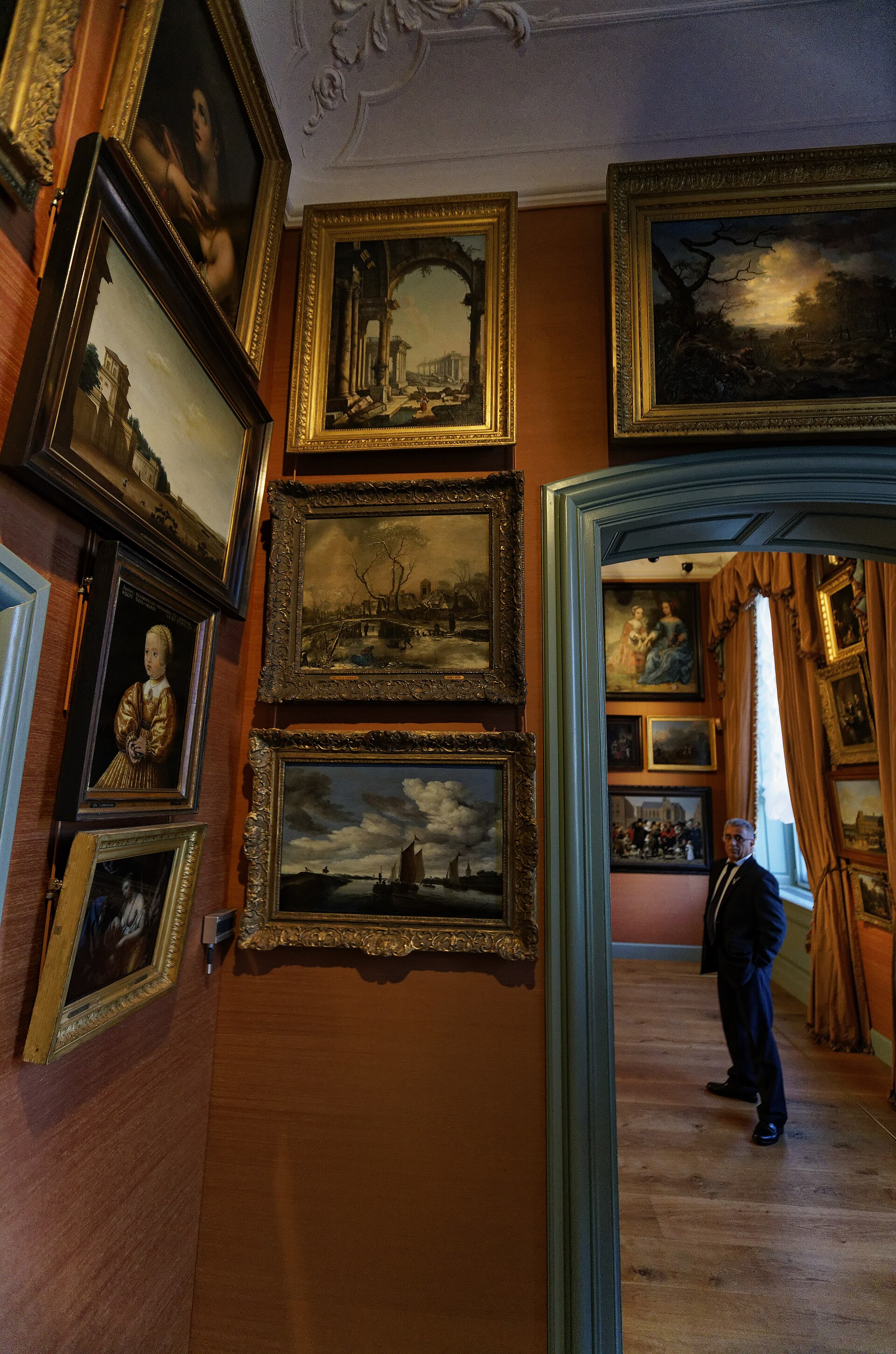
A five-minute walk away at Buitenhof 33, sharing its entrance with the Gevangenpoort. It is the oldest museum in the Netherlands and hangs more than 150 old masters in the dense, floor-to-ceiling manner of an eighteenth-century picture cabinet. It is part of the Mauritshuis and is covered by the combined ticket.
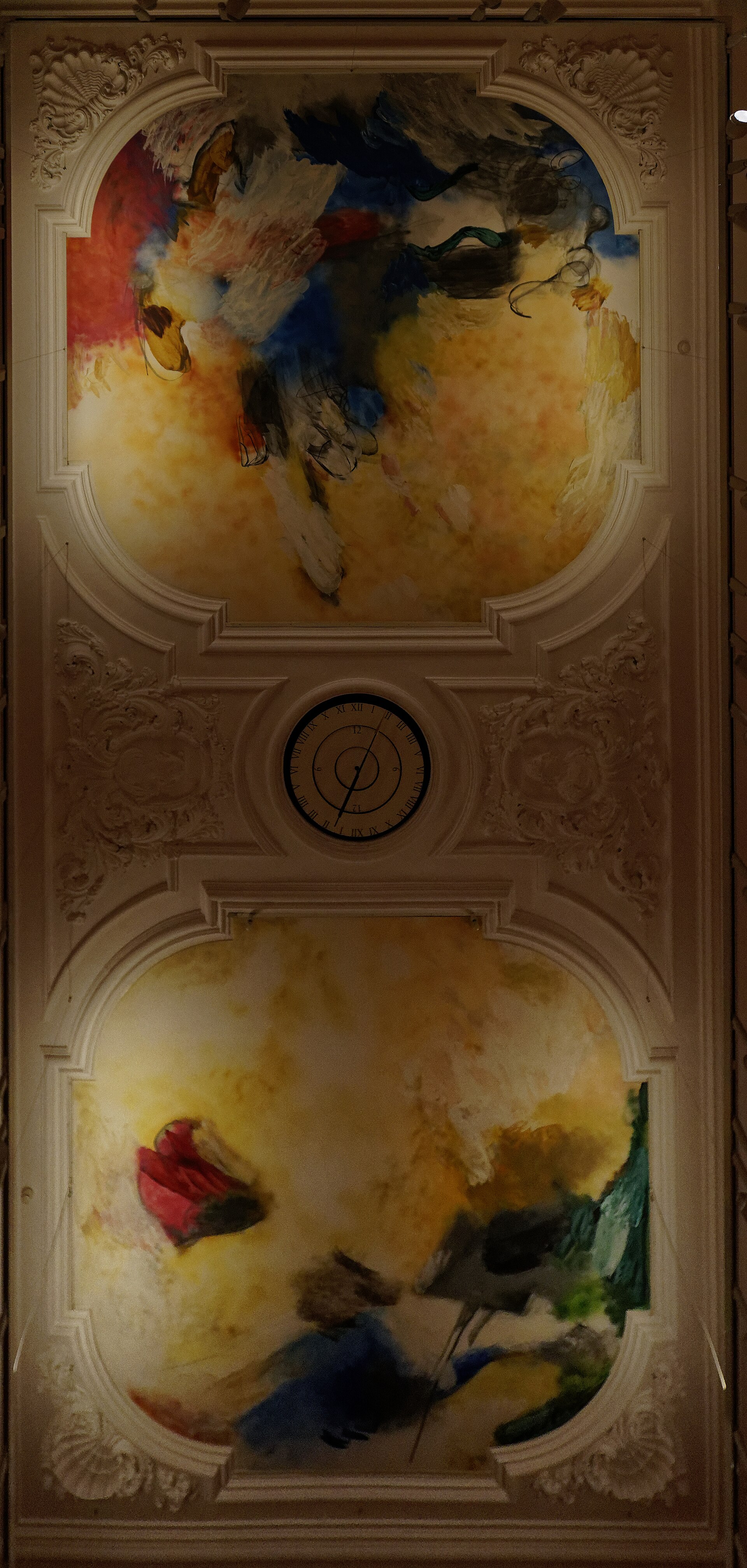
The most recent painting in the building is on the ceiling here: Ger Lataster's Icarus Atlanticus of 1987, three centuries newer than almost everything else under this roof.
The single object most visitors come for, and the reason to buy a timed ticket rather than arrive and hope. It hangs with two other Vermeers rather than in isolation. Already researched in this archive as its own record.2
Full record in this archiveHung in the same room as the Girl, with Diana and Her Nymphs: three Vermeers within a few paces, which almost nowhere else can offer.2
One of eleven Rembrandts in the building, which is one of the largest holdings of his work anywhere, and the picture most visitors know after the Vermeer.2
The museum records this as his final self-portrait, hanging a few rooms from the group portrait of 1632: the two ends of one career under one roof.2
A small panel dated to 1654, and the painting the museum built its own 2026 exhibition on birds around.2
Life-size, and one of the pictures the museum lists among its own highlights. It belongs to the collection assembled by stadholder William V, the collection French troops took to Paris in 1795 and returned in 1815.2
The museum names this study among its own highlights and addresses the colonial history the building is implicated in, rather than leaving either to a footnote.2
Painted in Dutch Brazil by an artist Johan Maurits took with him, and one of the few objects here that came out of the colony that paid for the house.3
By the painter whose Brazilian views this archive holds a record of, made on the expedition Johan Maurits led. It ties the building's money to the pictures on its walls.3
One of the very few women painters of the period with a documented body of work, and the museum lists her among its own highlights rather than in a footnote.2
The oldest painting in the building, two centuries earlier than the collection's centre of gravity.2
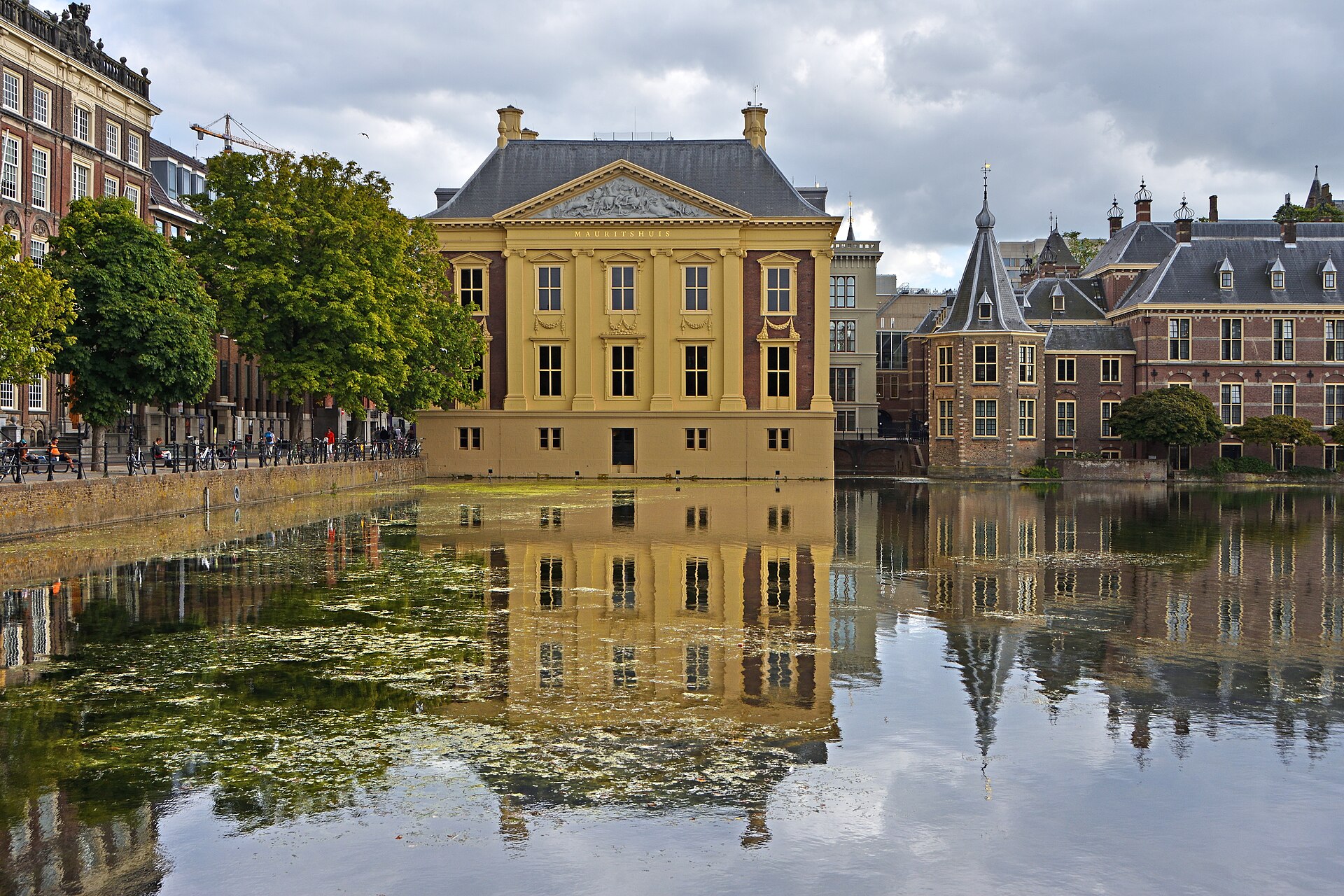
The Mauritshuis was not built as a museum. It was built as a private residence for Count Johan Maurits of Nassau-Siegen, completed in 1641, on the best site in The Hague: free-standing on the Plein, with the Hofvijver on one side and the Binnenhof on the other, so that all four stone facades could be seen at once. Johan Maurits was not there to watch it go up. For most of the construction he was in South America, serving as governor-general of the Dutch colony in Brazil on behalf of the West India Company, and he moved in only on his return in 1644. Three years later he left for Germany as stadholder of Cleves, and after that used the house only when he passed through the city. For long stretches of the seventeenth century it lodged important guests of the States General rather than its owner.
The design is by Jacob van Campen, with Pieter Post finishing the interiors, and it is one of the first buildings in the Netherlands in the style now called Dutch classicism: columns, capitals, cornices and a tympanum, arranged with a symmetry the free-standing site was chosen to display. Van Campen went on to build the new town hall in Amsterdam, today the Royal Palace on the Dam, in the same idiom. What the Mauritshuis cost is not known. The mortgage on it alone stood at 160,000 guilders in the 1660s, against the roughly 250 guilders a skilled craftsman earned in a year: the debt on the house was 640 times a craftsman's annual wage.
The building had a nickname in its own century, and it was not affectionate. Contemporaries called it the Sugar Palace, a reference to where Johan Maurits's money came from. He had earned large sums for the West India Company in Brazil through the trade in sugar and the trade in people; enslaved African men and women grew and processed the cane. During his governorship, from 1636 to 1644, 24,000 people were transported from Africa to the Dutch colony. In 2020 research established that he had also traded privately, out of the Company's sight and against its rules, and that this illicit business included trading in enslaved people.
The interior he furnished reflected where the money was made. There was a great deal of tropical hardwood, and the walls carried murals of Brazilian landscapes. The large room on the upper floor held what he had brought back: headdresses, gemstones, feathers, shells, spears, stuffed animals, and probably paintings of Brazilian landscapes, plants and animals by Albert Eckhout and Frans Post, both of whom had travelled with him. Two of those pictures still hang in the building, Eckhout's study of two Brazilian tortoises of about 1640 and Frans Post's view of Itamaraca Island of 1637. After the Portuguese retook the colony in 1654, Johan Maurits gave other Eckhout paintings to Frederick III of Denmark, and they are in Denmark still.
The museum publishes all of this on its own pages and addresses it in the galleries, which is worth stating plainly: the institution names the source of its founder's fortune rather than leaving the reading to others. For this archive the connection is direct. Frans Post's Brazilian views are the subject of a record here, and the expedition that produced them is the same expedition that paid for the house those pictures now hang in.
Shortly before Christmas 1704 the house burned. The cause recorded is the negligence of a drunken clerk; the fire was hard to fight because the Hofvijver had frozen, and when it was over only the blackened outer walls were standing. The owners rebuilt, in fits and starts, between 1708 and 1718, and they rebuilt to the taste of their own moment rather than restoring what had been lost. That is why the most sumptuous room in the building is early eighteenth-century and not seventeenth: the Golden Room on the ground floor, gilded in the Louis XIV manner, with large allegorical paintings by Giovanni Antonio Pellegrini, a Venetian who happened to be passing through The Hague, built into the chimney breasts and the ceiling.
A visitor who reads the building as a single seventeenth-century object is therefore reading it wrong. The shell is Van Campen's. Most of what is inside it is a reconstruction of the decade after the fire, and the collection arrived a century after that.
The core of the collection was assembled by stadholder William V. In 1795 French troops took it to Paris as spoils of war, and it came back to The Hague only in 1815. Those recovered pictures became the Royal Picture Gallery that King William I established in 1816, housed at first in William V's own former gallery on the Buitenhof, the building that is now the Prince William V Gallery. That space was quickly too small for a growing collection. The Dutch state bought the Mauritshuis on 13 May 1820 with the intention of putting collections in it, and by royal decree the paintings moved in: since 1822 the building has been a museum, formally the Royal Cabinet of Paintings. It marked its bicentenary in 2022.
The provenance of the collection is therefore itself a case of the kind this archive records. Paintings seized as war booty, held abroad for twenty years, returned, and rehoused in a palace bought by the state from private owners - the chain is documented at every link, and it is the reason a picture like Potter's Bull carries a Paris interval in its history.
The museum was extensively renovated and expanded between 2012 and 2014. The seventeenth-century house was connected by an underground foyer to the corner building of Societeit De Witte at Plein 26, which now holds the temporary exhibition rooms, the offices, the library, the brasserie and the Art Workshop. The effect is that the historic building was left to be a historic building: the plant, the shops and the temporary shows are next door and below ground.
What the museum does with its ticketing is worth recording, because it is unusual. Everyone under 19 enters free, every day, unconditionally. From 1 January 2026 the museum ran a pilot offering entry for four euros after four in the afternoon, seven days a week, to visitors of 19 and over resident in the Netherlands, sold only at the desk and never online, with groups capped at four - the first daily late-afternoon rate that low at any Dutch museum. Its general director, Martine Gosselink, put the case in terms of the standard price being a threshold that does not match the museum's ambition that everyone should feel at home in it. The pilot was announced as running for six months and then being evaluated, and we have not re-confirmed its status since; the standard adult ticket remains 21 euros. The museum closed 2025 on roughly 520,000 visitors including the Prince William V Gallery, five per cent up on 2024 and the highest figure in its history.
We publish no visitor prose and cite no platform average, so what follows is drawn from the museum's own statements and its published figures. It draws around 520,000 visits a year to about 250 paintings, and reckons ninety minutes enough to meet its principal painters. It tells prospective visitors to book a time slot because entry is not otherwise guaranteed, which is the clearest public admission of the pressure around the Girl with a Pearl Earring. It takes no cash anywhere in the building, and in 2026 it piloted a four-euro late ticket on the argument that its standard price is a threshold.
Plein 29, 2501 CM The Hague, Netherlands.
Adult: EUR 21; Under 19: free; Student: EUR 13.5; CJP: EUR 13; Group, from 15 adults: EUR 18.5. As confirmed 4 September 2026.
Monday 13:00-18:00; Tuesday to Sunday 10:00-18:00; Tuesday to Sunday 12:00-17:00. Closed: The Prince William V Gallery is closed on Mondays. Special hours apply on public holidays; the museum publishes them separately. As confirmed 4 September 2026.
Rail: The Hague Central Station, a ten-minute walk; Car: Parking within 100 metres of the entrance; On foot: On the Plein, next to the Binnenhof and the Hofvijver; the Prince William V Gallery is five minutes away on the far side of the Binnenhof.
Girl with a Pearl Earring (Johannes Vermeer, c. 1665); View of Delft (Johannes Vermeer, c. 1660-1661); The Anatomy Lesson of Dr Nicolaes Tulp (Rembrandt van Rijn, 1632); Self-portrait (Rembrandt van Rijn, 1669); The Goldfinch (Carel Fabritius, 1654); The Bull (Paulus Potter, 1647).
1 record in this archive names Mauritshuis as the current location.
One artwork and its story every Tuesday, with the picture: who owned it, what it made, and what closes soon in the exhibition calendar. No promotion, and nothing we cannot cite.
We send one email to confirm the address and keep nothing else. Every letter carries a one-click unsubscribe. How we handle your data.