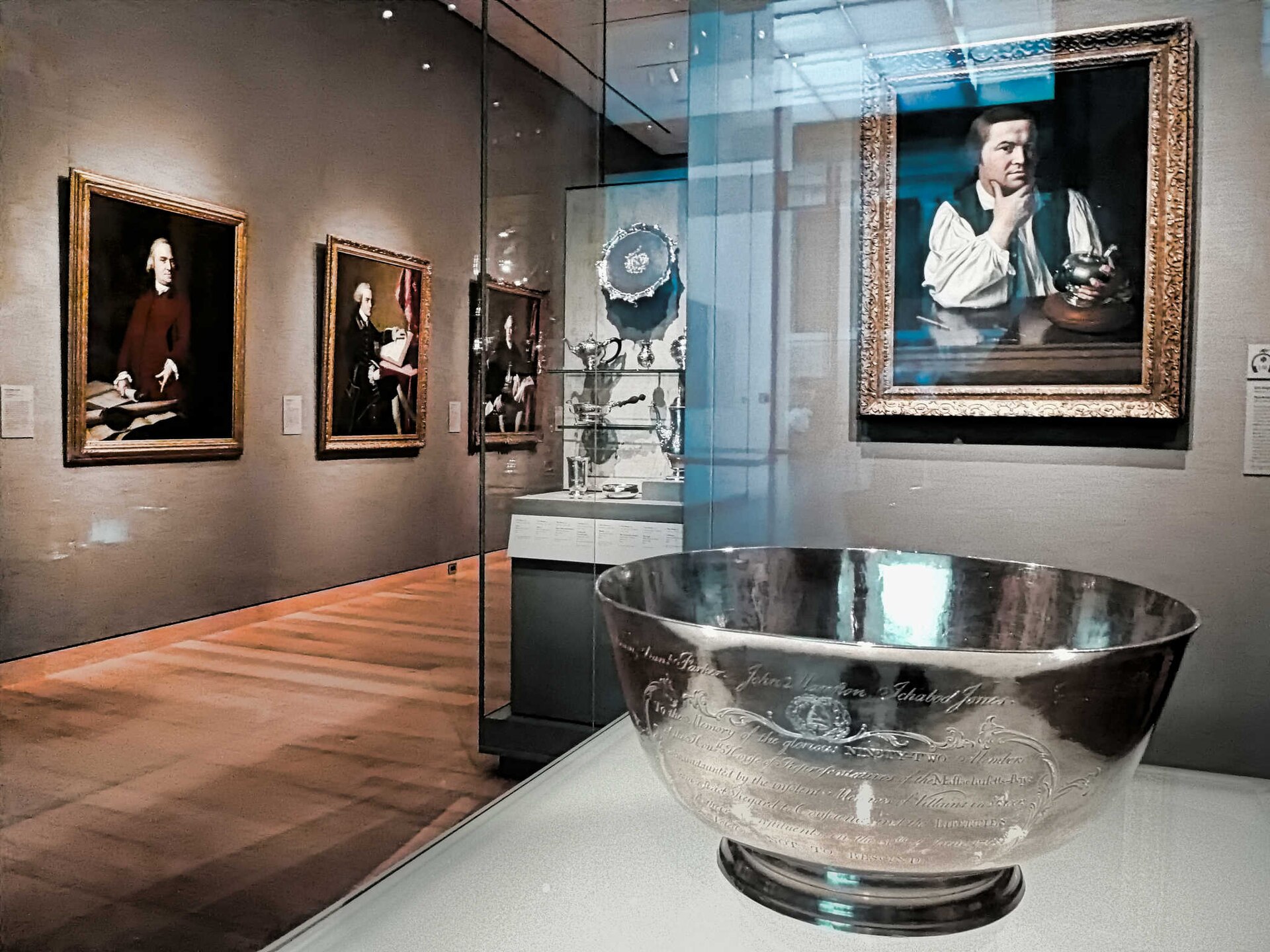
The Sons of Liberty Bowl
1768, finished within five weeks of 30 June · Silver
Museum of Fine Arts, Boston, accession 49.45
 1734-1818
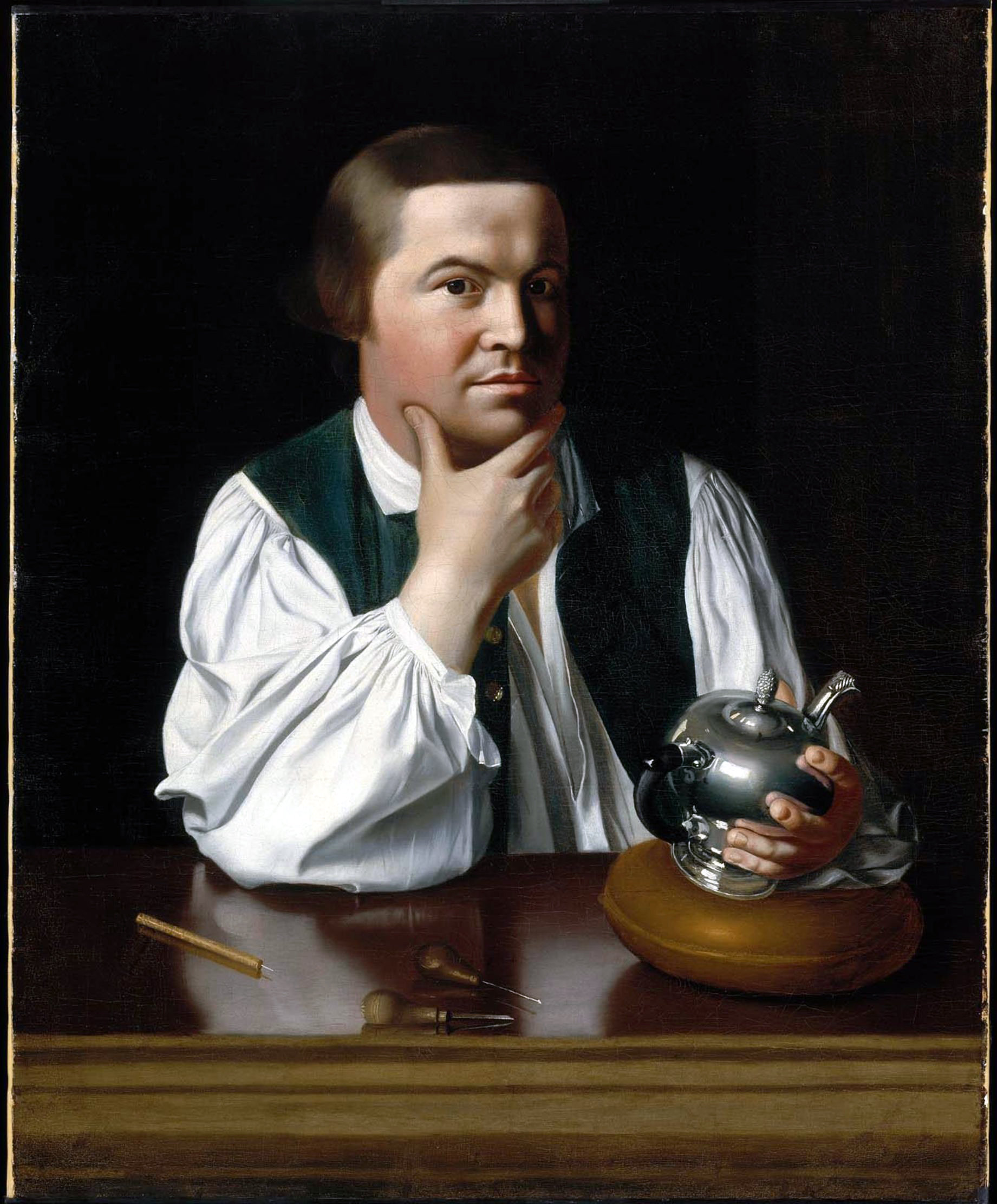
John Singleton Copley, Paul Revere, oil on canvas, Museum of Fine Arts, Boston, accession 30.781. The identification is secure: the picture descended in the Revere family and was given to the museum in 1930 by three of the silversmith's descendants. It was dated to about 1770 for generations until conservators cleaning it in 1995 found Copley's initials and the date 1768 inscribed in miniature at the lower right, which makes it contemporary with the Sons of Liberty Bowl. He is shown in working shirtsleeves at his bench, holding an unfinished pear-shaped teapot on a sand-filled leather pad, with engraving burins laid out in front of him: a tradesman painted at his trade, at a moment when men of his class were normally painted as gentlemen.
Museum of Fine Arts, Boston| Full name | Paul Revere II, silversmith, goldsmith, engraver, bell and cannon founder and copper manufacturer, of Boston |
|---|---|
| Worked as | Silversmith, Goldsmith, Copperplate engraver, Bell and cannon founder |
| Born | 21 December 1734 Old Style, 1 January 1735 New Style · Boston, Massachusetts Bay |
| Died | 10 May 1818 · Charter Street, Boston |
| Nationality | American, born a British colonial subject |
| Movement | American colonial and Federal silver, Boston |
| In this archive | 1 artwork |
| Sources | 32 cited |
| Last verified | 17 September 2026 |
About this page 1 artwork in the archive · Last verified 17 September 2026 · 32 sources cited
Paul Revere II ran a working silver shop in Boston for roughly fifty years, kept books while he did it, and then spent his last two decades turning himself from an artisan into a manufacturer of bells, bolts and rolled copper. The books survive. That single fact is why this maker can be written about differently from almost any other silversmith of his century: the daybooks in the Massachusetts Historical Society record what the shop made, for whom, and what it charged, and they are digitised. A collector holding a marked Revere spoon is holding an object whose commercial context is documented rather than inferred.
The thing most readers do not know is that his fame is younger than his silver by a century. He died in 1818 and was remembered, in the words of the curators of the 2019 exhibition that reassembled his output, mainly as a successful regional businessman. Henry Wadsworth Longfellow made him a national figure in a poem finished in October 1860 and published in January 1861, written for a country about to go to war and in need of a hero. Everything the market now pays for the name was set in motion by that poem, not by the shop.
The second thing worth knowing before reading any Revere attribution is that the mark is the shop's, not the hand's. Authentic silver from his premises, whether he raised it himself or an apprentice or journeyman did, almost always carries one of his punches. Marked Revere means made at Revere's, and no more than that. The corpus is large, the documentation is unusually good, and the attribution question is therefore not whether a piece is Revere's but which of several men in one room actually made it. Nobody can answer that from the object.
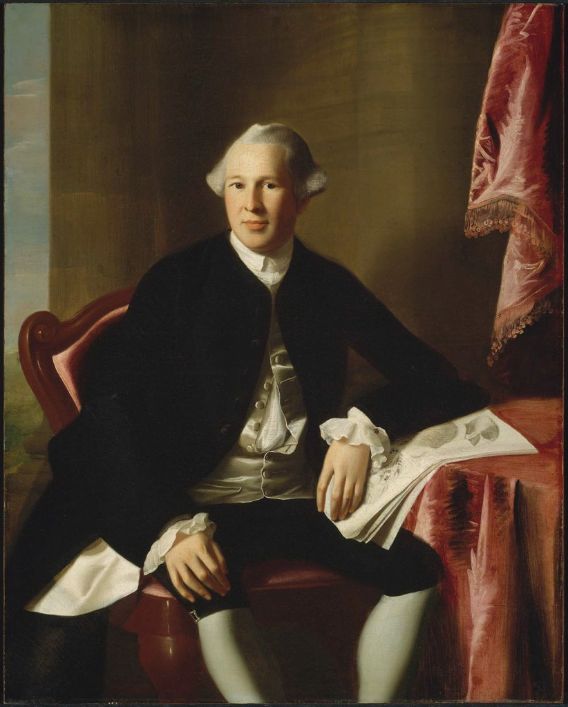
Apollos Rivoire born at Riocaud in Guyenne, France, into a Huguenot family, on 30 November.27
Rivoire leaves France on 21 November for his uncle Simon's house on Guernsey, and reaches Boston at about thirteen.27
John Coney dies; Rivoire buys out the remainder of his own apprenticeship from the estate for roughly forty pounds, recorded as thirty pounds for the indenture plus a further ten.27
Rivoire, by now calling himself Paul Revere, marries Deborah Hitchbourn on 19 June.27
Paul Revere II born in Boston on 21 December Old Style, 1 January 1735 New Style, and baptised at the New Brick Congregational Church on 22 December.528
Leaves classroom schooling at thirteen and is apprenticed to his father.528
Apollos Rivoire dies on 22 July. Paul is nineteen, too young to be the legal proprietor; his mother heads the business and he works the bench, using his father's punch unchanged.327
Commissioned second lieutenant of provincial artillery in February and serves on the Crown Point expedition in upstate New York.52428
Marries Sarah Orne on 4 August. They have eight children.28
Initiated into St Andrew's Lodge on 4 September, aged twenty-five.824
Raised in St Andrew's Lodge on 27 January. The first surviving shop wastebook opens on 3 January.1024
Advertises dentistry in the Boston Gazette. Makes the Sons of Liberty Bowl for fifteen subscribers within five weeks of the vote of 30 June, and sits for Copley.17
Publishes The Bloody Massacre on 26 March, taken from Henry Pelham's design; Pelham writes on 29 March accusing him of plundering him on the highway. Elected Master of St Andrew's Lodge on 30 November.92324
Makes a forty-five-piece service for Dr William Paine and Lois Orne, charging thirty-four pounds for labour above materials. Marries Rachel Walker on 10 October after Sarah's death.21528
Rides on the night of 18 April and is taken by a patrol at Lincoln. Wastebook entries stop on 2 April. In November the provincial congress sends him to Philadelphia to study the only powder mill in the colonies.1028
Commands the artillery on the Penobscot expedition, which sails 25 July and fails. Placed under house arrest on 6 September; an inquiry of 16 November finds him culpable.2829
Court-martialled at his own repeated request on 19 February and acquitted on both charges with equal honour as the other officers in the same expedition.29
The second wastebook opens on 2 August. Moses Michael Hays commissions the first of about twenty-five pieces.101730
Builds a foundry on Lynn and Foster Streets in the North End, making firebacks, window weights, cannon, bolts and spikes.6
Casts his first bell, 912 pounds, for the New Brick or Second Church of Boston. Makes an eighteen-piece service for John and Mehitable Templeman and the pair of wine cups for the Hays family.111517
Elected Grand Master of the Grand Lodge of Massachusetts on 12 December; twenty-three lodges are chartered during his term.824
Completes his first navy contract in October, fifteen tons of bolts. Lays the cornerstone of the Massachusetts State House.2426
The second wastebook closes on 7 August. Steps down as Grand Master on 27 December. The foundry casts a bell for the frigate Constitution.101124
Has supplied more than 8,000 pounds of bolts, spikes and staples to Constitution alone. Writes to Navy Secretary Benjamin Stoddert for backing to roll copper and is declined. Jeremy Belknap prints his account of the ride under the date 1 January.1226
Makes the small gold urn holding the lock of Washington's hair presented by Martha Washington to the Grand Lodge on 27 January. Writes that he has made the most improvements in that branch of metallurgy of any man in the state.625
Builds the copper rolling mill on the Neponset river at Canton at the age of sixty-five, the first commercial copper rolling in North America. The foundry casts its forty-eighth church bell.611
Supplies the copper covering for the dome of the new Massachusetts State House.56
Supplies rolled copper sheathing for the re-coppering of USS Constitution in her first major refit.526
Begins supplying boiler sheet to Robert Fulton's steamboats; has put 25,000 dollars of improvements into the Canton mill.6
Ends his active involvement in the bell and copper business, which continues under his sons.11
Dies at his house in Charter Street, Boston, on 10 May, aged eighty-three, and is buried in the Granary Burying Ground.528
Longfellow finishes Paul Revere's Ride on 13 October; it appears in the Boston Transcript in December and in the Atlantic Monthly for January 1861.24
The Sons of Liberty Bowl is bought for the Museum of Fine Arts, Boston by public subscription against an asking price of 56,000 dollars, and accessioned 49.45.1
Carlson and Fennimore publish the Winterthur findings on the Lenssen collection: seventy-five per cent fake, with Revere marks struck between 1930 and 1950.13
Conservators cleaning Copley's portrait of Revere at the Museum of Fine Arts find the artist's initials and the date 1768 at the lower right, moving the picture two years earlier.1
A pair of 1792 wine cups makes 752,500 dollars with premium at Sotheby's New York on 23 January, the auction record for Revere silver.1718
The Sons of Liberty Bowl is shown in the reinstalled Art of the Americas galleries at the Museum of Fine Arts beside an 1857 storage jar by David Drake, an enslaved South Carolina potter who also inscribed his work.32
The market for Revere silver is distorted by a poem, and the distortion is measurable rather than rhetorical. The shop was one of the most productive in colonial Boston and its commonest product was the teaspoon. An eighteenth-century Boston tablespoon by a maker with no national fame is a modest object. On Antiques Roadshow in 2019 Sam Cowan of Freeman's put a Revere tablespoon of about 1780 at 7,000 to 10,000 dollars at auction, and on 1 June 2021 a Revere table spoon monogrammed for Hepzibah Hall Fitch made 32,500 dollars including premium at Heritage, reported as the highest price ever paid at auction for an American spoon. That is what six letters in a rectangle are worth.
The record is 752,500 dollars including buyer's premium, for a pair of wine cups of 1792 made for Moses Michael Hays and Rachel Myers Hays, sold as lot 122 at Sotheby's New York on 23 January 2011 against an estimate of 100,000 to 200,000. No separate hammer figure has been published for that lot and a reader should not assume the premium-inclusive number is the hammer. Below it the pattern is consistent: 233,000 dollars for a drum-form teapot made for the same client in 1783, at Christie's New York on 22 January 2015; 129,875 dollars with premium for a pitcher engraved for Benjamin Russell, at Weiss Auctions on 18 January 2023; 39,975 dollars for a porringer at Skinner in 2016, a price the trade press attributes to family history combined with the fame of the maker.
The same effect runs through the prints and there it can be measured against a control, because the Boston Massacre plate exists in two versions by two men. Revere's, printed in about two hundred impressions with at least twenty-five known, trades between roughly 150,000 and over 200,000 dollars. Henry Pelham's original design, from which Revere took his, survives in two known copies and carries an auction estimate of 50,000 to 70,000. The rarer object, by the artist who actually designed it, is worth a third of the copy.
Three things follow for a buyer. Documented ownership pays, because the daybooks make provenance checkable here in a way it is not for most colonial silver. Form matters less than name, which is unusual and means this market is less rational than most specialist markets. And the fake rate is high enough that instrumental analysis of the metal, not inspection of the mark, is the test to apply before bidding.
One object is outside all of this and always has been. The Sons of Liberty Bowl of 1768 has never been sold at auction. It passed by inheritance and private transfer until 1949 and has been publicly owned since. The only money figure ever attached to it is the asking price of 56,000 dollars put to the Museum of Fine Arts in 1949, which is not a hammer, not a premium and not a recorded price paid; the sum actually raised by subscription and drawn from the Francis Bartlett Fund has not been published. Everything offered in the salerooms under that title is a reproduction. The gold urn Revere made for the Grand Lodge in 1800 has likewise never been to market and, kept in a vault and carried in procession every three years, never will be.
| Date | Sale | Work | Result | Note |
|---|---|---|---|---|
| 23 January 2011 | Sotheby's, New York | An Important Pair of American Silver Wine Cups, Paul Revere Jr, Boston, 1792, each 5 3/8 in., engraved MRH for Moses Michael Hays and Rachel Myers Hays, marked REVERE near the upper rim; lot 122, Property from the Hascoe Family Collection, sale N08724 | Hammer Not published With premium 752,500 USD | The auction record for Revere silver. Estimate 100,000 to 200,000 dollars. Antiques and The Arts Weekly reports the figure and states that prices include buyer's premium; no hammer has been published separately and the two must not be conflated. Provenance descends from the Hays family through Judith Hays Myers, Samuel Hays Myers, Caroline Myers Cohen and the Bortman-Larus Americana Collection to Harold Sack. The Hascoe sale totalled 5.4 million dollars within an Americana week of 14.4 million. |
| 18 January 2023 | Weiss Auctions | Silver pitcher, 6 1/2 in., 17.35 troy ounces, engraved with the initials of Benjamin Russell, founder of the Columbian Centinel | Hammer Not published With premium 129,875 USD | Reported as a world record for a Revere pitcher, with the figure stated to include buyer's premium. Revere and Russell were both involved in founding the Massachusetts Charitable Mechanic Association, which is the provenance argument behind the price. |
| 1 June 2021 | Heritage Auctions | Silver table spoon, Boston, circa 1790, monogrammed HH for Hepzibah Hall Fitch | Hammer Not published With premium 32,500 USD | Reported as the highest price paid at auction for an American spoon, with the figure stated to include buyer's premium. The Revere pieces in that sale totalled 336,250 dollars, described as the largest number of his pieces ever sold in a single auction. Set against the 7,000 to 10,000 dollar auction valuation given to a comparable Revere tablespoon on Antiques Roadshow in 2019, it is the clearest single measure of the fame premium. |
| 2016 | Skinner | Silver porringer | Hammer Not published With premium 39,975 USD | The reporting attributes the price to the family history plus the fame of Revere, the piece having been matched to another porringer in a Massachusetts museum with documented Pearce family provenance. Exact sale date not given in the source read. |
| Various | The Bloody Massacre Perpetrated in King Street, engraving, 1770 | Hammer Not published With premium 150,000 to over 200,000 USD | About two hundred impressions printed, at least twenty-five known. Given as a trading range on Antiques Roadshow rather than as a single result. Henry Pelham's original design, of which two copies are known, was appraised in the same segment at 50,000 to 70,000 dollars. | |
| Various | Silver table spoon, Boston, comparable ordinary example of about 1780 | Hammer Not published With premium 7,000 to 10,000 USD | Not a result but a valuation, given on Antiques Roadshow in 2019 by Sam Cowan of Freeman's, Denver, as the auction range for an unremarkable Revere tablespoon. It is included as the control against which the 32,500 dollar record spoon of 2021 should be read. |
Hammer is the price at which the bidding stopped; with premium adds the fee the house charges the buyer on top. Hammer price and buyer's premium in the glossary.
| Institution | City | Holdings | Note |
|---|---|---|---|
| Museum of Fine Arts, Boston | Boston | The Sons of Liberty Bowl, accession 49.45; Copley's portrait of Revere, accession 30.781, and his portrait of Rachel Walker Revere; a large body of Revere silver reported by the dealership M.S. Rau as more than ninety pieces of hollowware, a tertiary figure that should be replaced with the museum's own. | The reference collection, and the museum that produced the Buhler catalogues. As of June 2026 the bowl stands in the Lynch Gallery, gallery 132, in the reinstalled Art of the Americas galleries, shown beside an 1857 storage jar by David Drake, an enslaved South Carolina potter who also inscribed his work; the museum plays audio of both objects' inscriptions. |
| Paul Revere House | Boston | The house itself, in North Square, together with Revere silver, the partial denture attributed to him and acquired in 2016, and the interpretive programme built on the family papers. | Operated by the Paul Revere Memorial Association, which paid for the digitisation of the daybooks. The most careful public source on what is and is not documented about him. |
| Massachusetts Historical Society | Boston | The Revere Family Papers, 1746-1964, collection fa0017, including both surviving wastebooks and the letter to Jeremy Belknap describing the ride. | The documentary base for everything on this page. The wastebooks are digitised and free to read; a student can check a Revere attribution against the shop's own record without leaving a desk. |
| American Antiquarian Society | Worcester, Massachusetts | Revere engravings, including A Warm Place - Hell, and the material assembled for the Beyond Midnight exhibition of 2019 to 2020. | Publisher of Brigham's catalogue of the engravings. The Beyond Midnight exhibition toured to the New-York Historical Society, the Worcester Art Museum, the Concord Museum and Crystal Bridges. |
| Metropolitan Museum of Art | New York | Revere silver and the impression of The Bloody Massacre reproduced widely from its collection. | Exact holdings not counted for this record. |
| Winterthur Museum, Garden and Library | Winterthur, Delaware | The Lenssen collection, three-quarters of it forged, including objects struck with false Revere marks between 1930 and 1950; the analytical reports behind the Treasures on Trial exhibition. | The place to see what a fake Revere looks like, which is a rarer and more useful sight than another genuine spoon. |
| National Gallery of Art | Washington | Paul Revere, Masonic Certificate, 1773, accession 58937, released CC0. | Evidence for the lodge work, and freely reproducible. |
| Grand Lodge of Masons in Massachusetts | Boston | The gold urn of 1800 containing a lock of George Washington's hair, and a charge for the installation of lodge officers in Revere's own handwriting. | The urn leaves the vault when a Grand Master is first installed. Access is not a normal museum arrangement and should be enquired about in advance. |
| King's Chapel | Boston | A Revere bell, still rung. | Of more than nine hundred bells cast by the foundry between 1792 and 1843, 146 are known to survive and only twenty-seven date from Revere's own period of direct involvement. |
| USS Constitution and the USS Constitution Museum | Charlestown, Boston | The ship, whose bolts, spikes and fittings came from Revere's foundry from 1795 and whose 1803 re-coppering used sheet from his Canton mill. | The largest surviving object his workshops contributed to, and still afloat. |
The standard account is a horse. It gets three things wrong at once.
The standard account is a horse. It gets three things wrong at once. It puts a night in April 1775 at the centre of a working life that ran from about 1748 to about 1811; it treats the silver as a charming sideline to the politics, when the politics were intermittent and the silver was the trade; and it silently backdates his celebrity by a hundred years.
Revere was one of at least three riders that night, and the one who did not reach Concord. He was intercepted by a British patrol in Lincoln, questioned and released in Lexington without his horse. Samuel Prescott got through. Revere wrote three accounts of it himself, one deposition for the Massachusetts Provincial Congress within weeks of the event, a revised deposition, and a much fuller letter to Jeremy Belknap of the Massachusetts Historical Society which Belknap dated 1 January 1798 when he printed it. Those three documents are the evidentiary base for the ride, they are held in Boston, and they do not say what the poem says.
What the poem did was create a demand. The curators of Beyond Midnight, the American Antiquarian Society exhibition that toured from 2019, put the pre-poem position flatly: after his death in 1818 he was remembered mainly as a successful regional businessman. A man remembered as a regional businessman does not have his teaspoons chased across salerooms. A man in a poem every American schoolchild learns does. The whole of the price premium discussed further down this page rests on the difference.
The Library of Congress made a parallel correction in March 2026 on the other half of his output. Introducing the Revere engravings in its Rare Book and Special Collections Division, it noted that Revere was more craftsman than artist, and that his engravings were almost always copied or adapted from other artists' drawings, which was not unusual for engravers of the period. That is the right frame for the Pelham affair described below, and it is not the frame the popular accounts use.
The shop was inherited, and so was the mark.
The shop was inherited, and so was the mark. Revere's father was Apollos Rivoire, born 30 November 1702 at Riocaud in Guyenne, into a Huguenot family. He left France on 21 November 1715 for the house of his uncle Simon on Guernsey, and was in Boston at about thirteen. Around 1720 he was apprenticed to John Coney, the outstanding Boston goldsmith of the generation before, and when Coney died in 1722 the indenture became an asset of the estate.
That is where the record turns unusually specific. Coney's estate papers record Paul Rivoire's time, about three and a half years as per indenture, valued at thirty pounds, and then a second entry: cash received for Paul Rivoire's time, more than it was prized at, ten pounds. Rivoire bought his own remaining apprenticeship out of the dead man's estate for roughly forty pounds. He was in business on his own account by 1723 and married Deborah Hitchbourn on 19 June 1729. By then he had anglicised the name, which appears variously as Reverie and Revear in the family records before it settled as Revere.
Paul the son finished his classroom schooling at thirteen and was apprenticed to his father. When Apollos died on 22 July 1754 the boy was nineteen, too young under Massachusetts practice to be the legal proprietor of the business, so his mother became its head and he ran the bench. His earliest maker's punch was his father's, used unchanged, and the evidence indicates that father and son shared patterns for casting handles and other applied parts.
Two consequences follow for anyone reading a Revere object. First, an early mark is not by itself proof of which Revere struck it, because the earliest punch was Apollos's. Second, a cast handle on an early piece may come from a pattern older than the maker, which removes one of the diagnostics a connoisseur would ordinarily reach for. The house of Revere begins as a continuation, not a foundation.
Two daybooks survive and both are digitised, the digitisation paid for by the Paul Revere Memorial Association.
Two daybooks survive and both are digitised, the digitisation paid for by the Paul Revere Memorial Association. Volume one is a wastebook and memoranda for Boston running 3 January 1761 to 10 October 1783, continuous apart from a gap between 2 April 1775 and 18 December 1778 when Revere was carrying despatches and serving as an artillery officer. Volume two runs 2 August 1783 to 7 August 1797. A commission entry in them normally gives three things: the cost of the metal, the workmanship, and the engraving.
Across those books the Paul Revere House counts over 5,000 silver objects and almost 24,000 prints. Deborah Federhen's analysis, as used by Jeannine Falino, breaks the shop's small wares down into 2,479 pieces of flatware, 1,074 personal items such as buckles and buttons, 1,044 harness fittings and 195 miscellaneous, which sums to about 4,792 - a figure for small wares alone, excluding hollowware. Add Federhen's own 565 pieces of hollowware and her total comes to about 5,357, which sits close to the Paul Revere House's own count of over 5,000. The two institutions' figures therefore agree more than a bare comparison of 4,792 against over 5,000 would suggest; the honest residual uncertainty is the exact date range and category definitions each used, and that the true figure is higher again because the daybooks are not a complete record of everything the shop made.
The breakdown is the useful part, because it destroys the image of a luxury atelier. The Paul Revere House gives the same shape from its own count: 2,479 flatware, 400 buckles, 89 canns, 64 teapots, 60 creamers, 50 sugar tongs, 30 porringers, 30 ladles. Federhen counted twenty-three standard porringers and seven child's porringers between 1762 and 1787, which is the same thirty from the other direction.
Falino's summary of the business model is the sentence to keep: Revere's true success lay in selling a high volume of low-end goods over a period of thirty years. The ratio of flatware bought to hollowware bought runs at close to five to one. For every teapot there are five spoons, and the spoons are where the money came from.
Over ninety distinct forms are recorded. Alongside the tea equipage and the tankards there are salts, casters, trays, coffee pots, sugar bowls, gold jewellery, buttons, harness fittings, brass gunner's calipers, surgical instruments and a sword hilt, and among the pre-Revolutionary oddities a chain for a pet squirrel, an ostrich egg snuffbox and a child's whistle. The books also record 414 repairs: mending, cleaning and polishing. A silversmith in colonial Boston was as much a maintenance business as a manufacturing one.
This is the question a specialist asks and a catalogue entry usually avoids.
This is the question a specialist asks and a catalogue entry usually avoids. Revere worked alongside apprentices, journeymen, other shop workers and family members from the 1760s through to 1811. Authentic silver from the premises, whoever at the bench actually made it, almost always bears one of his punches. There is therefore no mark that distinguishes an object Revere raised with his own hands from one a journeyman raised for him, and no committee anywhere that claims to make that distinction from the object.
Some of the names are recoverable. Joseph Callender, later a well-known Boston engraver, took his journeymanship in Revere's shop and afterwards cut dies for commemorative medals on which Revere's own daybook records the merchant Joseph Barrell paying five shillings for repairing the edges of ten copper medals and fifteen shillings for making six silver blanks. Isaac Greenwood, a local instrument maker, ivory turner and dentist, was not an employee but a supplier and subcontractor: Revere went to him for turtle shell buttons and for teapot handles and knobs, and Greenwood turned some of Revere's vessels on the lathe, presumably to true them. Paul Revere III appears to have revitalised the shop in the years his father was attending to the foundry and the mill, and by the 1790s was running the daily work.
The technique itself pushes labour away from the master. Wolverton and Hewes note that Revere's shop used sheet silver, cut to shape and seamed, for many forms, rather than the more costly and labour-intensive process of raising hollowware from a single sheet. Seaming is division-of-labour work. A shop organised around it is organised to be run by more than one pair of hands.
By the time of the cannon foundry the transition is explicit in the accounts. Revere kept track of wages and living expenses for his employees, including for an entry reading Henry, a black man. The American Antiquarian Society reads those accounts as marking his move from an apprentice system to wage labour, and the reading is right: the man who inherited his father's punch ended by paying a payroll.
The practical conclusion for a buyer is narrow and worth stating. A marked Revere object is a documented product of a known Boston shop. It is not, and cannot be shown to be, the personal work of the man in the Copley portrait. Any catalogue description that implies otherwise is asserting something no evidence supports.
Falino's study of the daybooks is the closest thing that exists to a sociology of an eighteenth-century American silver shop.
Falino's study of the daybooks is the closest thing that exists to a sociology of an eighteenth-century American silver shop. Revere recorded 588 customers in the two volumes. Adding owners identified from surviving objects brings the known patronage to 757 individuals, with purchases dated between 1754 and 1806. Of the 361 customers who can be identified by occupation, roughly 53 per cent were artisans and roughly 46 per cent were merchants and professional men.
That balance is the finding. The received image of a silversmith serving a merchant elite is wrong for this shop: the artisans are the larger half, and they were buying buckles, buttons, rings and above all spoons. The elite customers show up disproportionately in the repair ledger, sending in plated candlesticks, a tea urn twice, a cruet twice and a fan for mending. Owning imported plate creates a stream of small work for a local smith, and that stream is a large part of what the daybooks are.
At the top of the range there are two documented services. In 1773 Revere made a forty-five-piece service for Dr William Paine and Lois Orne, and received thirty-four pounds for his labour above the cost of materials, which Falino calls a considerable sum even for a service of that size. In 1792 he made an eighteen-piece service for John and Mehitable Templeman. Those two commissions bracket his career either side of the war.
What thirty-four pounds meant to a Boston household in 1773 is a question this record leaves open rather than answers with a modern conversion. The methods for such conversions differ by an order of magnitude depending on whether they index to a wage, a commodity basket or a share of output, and no period wage series for Boston silversmiths was located for this page. The figure is given as it appears in the books, in the money of the day, which is the only form in which it is evidence.
One number cuts against the political reading of his business. Falino finds that only 76 men, 22 per cent of the 339 Sons of Liberty, used Revere for silversmithing work of any size. He was deeply embedded in the movement and the movement did not, on the whole, buy his silver. Politics brought him committee seats, not orders.
To read a colonial American silver corpus correctly you have to understand what the objects were for, and the answer is only partly display.
To read a colonial American silver corpus correctly you have to understand what the objects were for, and the answer is only partly display. There was no stable banking system in the colonies. A household with surplus coin took it to a silversmith, who melted it and returned it as spoons, a cann, a tankard. The plate was the savings account: portable, recognisable, and convertible back into money at close to metal value whenever the family needed it to be.
Two things follow. The first is that engraved initials and cyphers on colonial silver are not merely decorative. Marked plate is identifiable plate, which matters when the household wealth is sitting on a sideboard in a town with no police force. Revere charged extra for engraving inscriptions, monograms and family crests, and the charge appears as a separate line in the daybooks precisely because it was a separate service bought for a reason.
The second is that the survival of any given piece is contingent in a way that painting survival is not. Silver that goes out of fashion, or whose owner needs cash, goes back in the crucible. Colonists arriving from Europe routinely had their old plate melted and remade in the current style from the same metal. That is why a shop that documented more than 4,800 objects cannot be matched piece for piece against what exists today, and why nobody has published a number for how much Revere silver survives. The corpus is not a set of objects that were lost; it is a set of objects that were spent.
The habit reaches into the most famous single object from the shop. The Sons of Liberty Bowl of 1768 was made from forty-five ounces of silver and made to hold forty-five gills, both figures chosen for the number rather than for what happened to be on the bench. It weighs 43 troy ounces and 16 and a half pennyweight today. Roughly an ounce and a quarter of it has gone to finishing and to two and a half centuries of polishing. Silver is a material that is continuously, slightly, consumed by being cared for.
Most of Revere's silver has nothing political about it.
Most of Revere's silver has nothing political about it. One object does, and it is the reason this archive holds a record on him at all.
On 30 June 1768 the Massachusetts House of Representatives voted ninety-two to seventeen against rescinding the Circular Letter it had sent to the other colonial legislatures in February. Within five weeks Revere had finished a punch bowl for fifteen members of the Sons of Liberty, engraved with a dedication to the memory of the glorious ninety-two, with a liberty cap, with flags lettered Magna Charta and Bill of Rights, and with the words No 45 Wilkes and Liberty over a torn page labelled Generall Warrants. The names of the fifteen subscribers run round the rim as a round robin, the device that lets a group sign a document without producing a ringleader.
The bowl is not in the daybooks. Volume one covers 1768 continuously. Jonathan Fairbanks reads the absence as deliberate concealment, on the ground that business papers could be seized and the object was, on a bad day, treasonable. The Massachusetts Historical Society supplies the qualification that has to sit beside that reading: in the early years Revere kept inconsistent daily records in the wastebooks before transferring entries into ledgers. Either way the consequence is the same and it is the sort of thing this archive exists to state plainly. There is no entry, therefore no recorded charge, therefore any figure quoted as what the fifteen paid him is an invention.
The same year produced the portrait. John Singleton Copley painted Revere at his bench, in shirtsleeves, one hand on his chin and the other holding an unfinished pear-shaped teapot on a sand-filled pad, with engraving burins laid out in front of him. The picture was dated to about 1770 for generations. In 1995, cleaning it for a Copley exhibition, the Museum of Fine Arts conservators Jim Wright and Jean Woodward found Copley's initials and the date 1768 inscribed in miniature at the lower right edge. The redating turns the portrait into a contemporary document of the same twelve months as the bowl, painted by a man who married into a Loyalist family the following year and never saw Revere again after the war.
It is also, for a silversmith, an unusual picture: a tradesman painted at work, in working dress, with his tools shown accurately, at a moment when portraiture of that class in the colonies overwhelmingly showed men as gentlemen. The teapot he holds is a Tory object in a town boycotting tea, and the plain linen he wears belongs to the homespun campaign of the same year. Fairbanks reads the composition as a man balanced between the two, and the reading is hard to improve on.
The burin that cuts a monogram into a tankard cuts a line into a copperplate.
The burin that cuts a monogram into a tankard cuts a line into a copperplate. Revere ran a small handpress in the silver shop and produced, across the surviving daybooks, close to 24,000 prints: paper currency for Massachusetts, trade cards, bookplates, magazine plates, political cartoons and broadsides. Clarence S. Brigham catalogued the output in Paul Revere's Engravings, published by the American Antiquarian Society in 1954 and revised in 1969, which remains the standard reference.
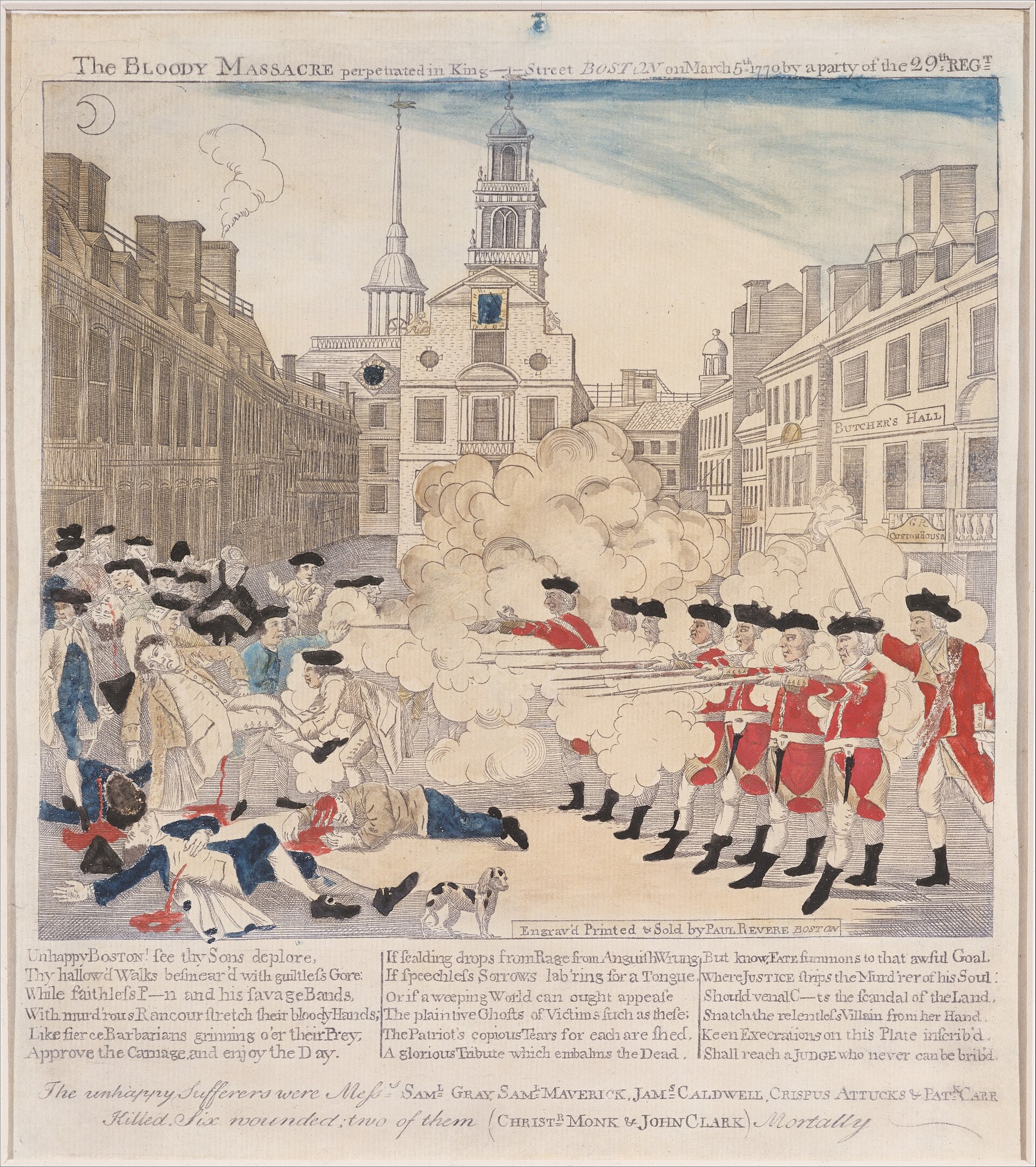
The famous plate is The Bloody Massacre Perpetrated in King Street, produced within three weeks of the killings of 5 March 1770 and advertised for sale on 26 March. It shows an orderly line of soldiers firing on command into a crowd, which is not what the subsequent trials established, and it worked: it circulated as a standalone broadside and as a frontispiece to A Short Narrative of the Horrid Massacre in Boston, and it did more than any text to fix the colonial reading of the event.
It was also taken from Henry Pelham's design. Pelham, Copley's half-brother, had made a drawing titled The Fruits of Arbitrary Power and had shown it to Revere in confidence. On 29 March 1770 he wrote to Revere in terms that survive and that no amount of patriotic framing softens. Pelham told him that when he heard Revere was cutting a plate of the late murder he thought it impossible, as he knew Revere was not capable of doing it unless he copied it from Pelham's, and that he had thought he had entrusted it to a person who had more regard to the dictates of honour and justice. He then set out the injury: after the trouble and expense of making a design and paying for paper and printing, he found himself deprived not only of any proposed advantage but even of the expense he had been at, as truly as if Revere had plundered him on the highway.
Two qualifications belong here, and both are institutional rather than partisan. The Library of Congress, writing in March 2026, states as a general matter that Revere's engravings were almost always copied or adapted from other artists' drawings and that this was not unusual for engravers of the era. And the Paul Revere House records that whatever passed between the two men was got over: four years later they were in a business arrangement together. Pelham's grievance was real, the practice was ordinary, and both statements are true at once.
The market has settled the argument in the least edifying way available. Revere's print was made in an edition of about two hundred, of which at least twenty-five are known, and copies have sold in the range of 150,000 to over 200,000 US dollars. Pelham's version, the original design, survives in two known copies and was appraised on Antiques Roadshow at 50,000 to 70,000 dollars. Rarity lost to fame by a factor of three.
Revere advertised dentistry in the Boston Gazette in 1768 and again in 1770, and his 1774 account book carries an entry for cleaning teeth.
Revere advertised dentistry in the Boston Gazette in 1768 and again in 1770, and his 1774 account book carries an entry for cleaning teeth. The 1770 advertisement claims he has fixt some hundreds of teeth. What he did was wire artificial teeth of ivory or animal material into a customer's mouth and clean what was already there. He did not extract and he did not transplant. It is small precision metalwork performed in an inconvenient place, which is exactly what a silversmith's training equips a man to do.
The Paul Revere House acquired a partial denture in 2016 that is attributed to him, and is careful about it: the museum states that it cannot prove Paul Revere actually made this denture. That is the right posture and this record follows it.
Then there is the story that appears in every popular account, and it needs handling carefully because it has been formally corrected by the institution best placed to know. Joseph Warren was killed at Bunker Hill on 17 June 1775 and buried in a shallow unmarked grave. After the British evacuation of Boston in March 1776 the body was exhumed and identified. The familiar version is that Revere recognised the wire he had used to fasten Warren's false teeth, and that this is the first forensic dental identification in American history.
The Paul Revere House now carries an erratum on its own dentistry page stating that the museum believes there is evidence that Warren was identified on the basis of his dental work, but that there is insufficient evidence to state definitively that Revere played a role in the identification. The museum also notes that it holds no definitive record of Revere having done dental work for Warren at all, and that it is not aware of any mention of Revere identifying Warren's dental work before General William H. Sumner's Reminiscences of Gen. Warren and Bunker Hill, published in 1858.
An 1858 first appearance for a 1776 event, in the decade that also produced the poem, is the kind of coincidence a provenance record is obliged to notice. The identification by dental work stands. The identifier does not.
Between 1775 and 1780 the silver shop was effectively shut.
Between 1775 and 1780 the silver shop was effectively shut. The daybook gap between 2 April 1775 and 18 December 1778 is the trade going dark, and what filled it was war work and public office.
On the night of 18 April 1775 Warren sent Revere to Lexington to warn John Hancock and Samuel Adams. He arranged the lantern signal at the Old North Church, crossed the river, borrowed a horse, reached Lexington, met William Dawes, and rode on towards Concord with Dawes and Samuel Prescott. A patrol took the three in Lincoln. Prescott and Dawes got away; Revere was taken back to Lexington, questioned and released on foot. His own three accounts of the night are the primary record and they include the Green Dragon passage, in which he describes a club of Boston mechanics watching the movements of the British troops and swearing on the Bible at every meeting not to disclose their transactions except to Hancock, Adams and Doctors Warren and Church. That passage is quoted here from the abridgment printed in the Grand Lodge Proceedings; the manuscript itself is at the Massachusetts Historical Society and was not read for this record.
In November 1775 the provincial congress sent him to Philadelphia to study the only powder mill in the colonies, and he used what he learned to set up a powder mill at Stoughton, now Canton, the town in which he would later build the copper works. When the British broke the trunnions off the cannon at Castle William on leaving Boston, Washington had Revere make the guns serviceable again, which he did with a newly contrived carriage.
Then Penobscot. The expedition sailed on 25 July 1779 to dislodge a British force from the Maine coast and became the worst American naval defeat before Pearl Harbor. Revere commanded the field artillery. On 6 September 1779 he was placed under house arrest. Brigadier General Peleg Wadsworth charged him with disputing orders over an ordnance brig, and Major William Todd reported a refusal of General Solomon Lovell's order to retrieve cannon; a further charge concerned leaving the Penobscot river without particular orders. An inquiry on 16 November 1779 found him culpable.
He then petitioned six times over two and a half years for a court martial, which is the behaviour of a man who believes he can win it. He got one on 19 February 1782. Thirteen officers, twelve captains and a general, found the charges had little foundation, dropped both, and directed that Paul Revere be acquitted with equal honour as the other officers in the same expedition, on the ground that the army had been in such confusion during the retreat that regular orders could not be given.
The relevance to the objects is direct. Two and a half years of contested reputation sit between the pre-war shop and the post-war one, and when he resumed, the business he resumed was not the business he had left.
The post-war output dwarfs the pre-war output.
The post-war output dwarfs the pre-war output. The Paul Revere House puts the split at 1,145 objects before the Revolution against 4,210 after it. Falino, following Federhen, gives Revere 175 against Benjamin Burt's 185 for the pre-Revolutionary period, with Burt ahead in every traditional form: forty canns to Revere's ten, thirty-two porringers to twenty-seven, twenty-six tankards to sixteen, thirteen teapots to four. Those two sets of numbers are plainly counting different things, hollowware in the one case and total objects in the other, and this record does not attempt to reconcile them. What both show is the same reversal after the war: Revere retooled for the new fashion in tea equipage and made thirty-eight teapots in a period when Burt and Zachariah Brigden between them managed five.
He also stopped confining himself to silver. He opened a hardware and home goods store, then in 1787 built a foundry on Lynn and Foster Streets in the North End, at first making firebacks and window weights, then cannon, then bolts, spikes and fittings for shipbuilding, then bells.
The first bell came in 1792, 912 pounds, for the New Brick or Second Church of Boston, and it was not entirely successful. He learned. By 1801 the foundry had cast its forty-eighth church bell, an 876-pound bell for the Westborough meeting house, and its seventy-first bell counting ship and academic bells. The standard inscription was THE LIVING TO THE CHURCH I CALL AND TO THE GRAVE I SUMMON ALL. He cast a bell for the frigate Constitution in 1797. Revere's own active involvement ended in 1811; the family firm continued under his sons Joseph Warren Revere and Paul Revere junior and their successors. Between 1792 and 1843 the foundry cast more than nine hundred bells, of which 146 are known to survive, and only twenty-seven are known from the years of Revere's own direct involvement. One of them still rings at King's Chapel in Boston.
The last venture is the one that outlived him by a century and a half. Revere's first navy contract was completed in October 1795 for fifteen tons of bolts, and by 1798 he had supplied more than 8,000 pounds of bolts, spikes and staples to Constitution alone. What he could not do was roll copper sheet; nobody in America could, and the frigate's original sheathing was British. He wrote to Secretary of the Navy Benjamin Stoddert in 1798 asking for government backing and was declined. He got the backing later, and in 1800 to 1801, at the age of sixty-five, he built a rolling mill on the Neponset river at Canton and became the first American to roll copper sheet commercially. Sheathing Constitution's hull needed roughly 12,000 feet of rolled sheet, and Revere's mill supplied the replacement copper in her refit of 1802 to 1803. He wrote in 1800 that he had made the most improvements in that branch of metallurgy of any man in the state.
The mill also covered the dome of the new Massachusetts State House in 1802 and from 1807 supplied boiler sheet to Robert Fulton's steamboats, and by 1807 Revere had put 25,000 dollars of improvements into it. Joseph Warren Revere ran it until his death in 1868. The assets of Paul Revere and Son were bought in 1801 by a predecessor of the Taunton-New Bedford Copper Company, which was one of six firms merged in 1928 into Revere Copper and Brass of Rome, New York; the cookware sold as Revere Ware from 1938 carries his name for that reason. The last item is a naming fact rather than a manufacturing one, and it is recorded here because it is the mechanism by which his name became a consumer trademark, which in turn feeds back into the price of his silver.
Revere's Masonic record is one of the best-documented parts of his life, because lodges keep minutes.
Revere's Masonic record is one of the best-documented parts of his life, because lodges keep minutes. He was initiated in St Andrew's Lodge on 4 September 1760 at the age of twenty-five, and raised on 27 January 1761. St Andrew's held a charter of 1756 from the Grand Lodge of Scotland and represented Ancient rather than Modern Masonry, a distinction that mattered in Boston because the Ancient lodges drew on tradesmen and the Modern ones on the Crown establishment.
He was elected Senior Warden in November 1764 and Master on 30 November 1770. The Paul Revere House records that he attended 169 of 185 lodge meetings between 1761 and 1771 and that in the thirty-five years from 1762 to 1797 there were only four in which he held no Masonic office. He served nine terms as Master across St Andrew's and the later Rising States Lodge, was Junior Grand Warden in 1777, 1778 and 1779, Senior Grand Warden from 1780 to 1783, Deputy Grand Master in 1784, 1790 and 1791, and Grand Master of the Grand Lodge of Massachusetts from 12 December 1794 to 27 December 1797. Twenty-three lodges received charters during his term. He laid the cornerstone of the Massachusetts State House in 1795. A charge in his own handwriting, delivered when he installed the officers of a lodge, is preserved in the Grand Lodge archives.
Sources differ on how to date the Grand Mastership. Wikipedia gives 1795 to 1797 and some Masonic accounts give the term as the calendar years 1795, 1796 and 1797, while the Grand Lodge Proceedings of 1916 give the precise span 12 December 1794 to 27 December 1797. Both are describing the same three years counted from different points; this record uses the precise dates and notes the discrepancy rather than choosing silently.
The membership is not a curiosity. The first Grand Master of the Massachusetts Grand Lodge, constituted in 1769, was Joseph Warren, who wrote in the Boston Gazette as A True Patriot and is the probable author of the dedication on the Sons of Liberty Bowl. Revere belonged also to the Loyal Nine, the North Caucus, the Long Room Club and the Boston Committee of Correspondence, and Fairbanks notes that only Warren belonged to as many. The Boston resistance ran on overlapping fraternal memberships, and Revere sat in most of them at once. That is the practical reason he was the man sent with the despatches.
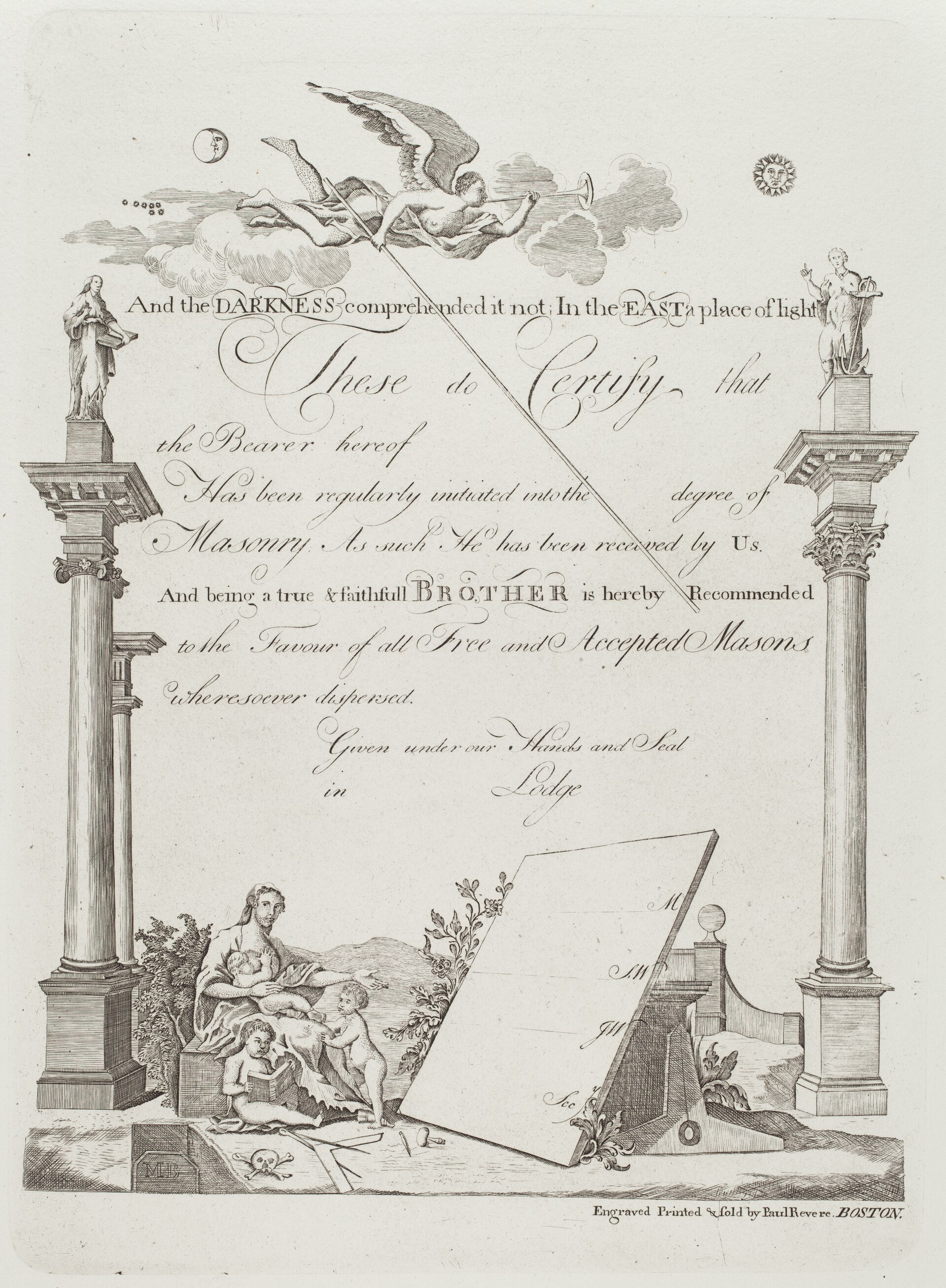
The lodges also gave him work. He designed and engraved Masonic membership certificates and lodge notices, some of which he signed himself as Master; a summons for the Lodge of St Andrew of 1768 is engraved and signed by him, and a certificate of 1773 is in the National Gallery of Art in Washington. Moses Michael Hays, the merchant who founded the Massachusetts Bank in 1784 and who was Revere's only known Jewish patron, was a fellow Mason and commissioned about twenty-five pieces of silver from him between 1783 and 1792. Two of those pieces now hold the auction record for his work.
The last Masonic object is the strangest and it is still in use. In January 1800 the Grand Lodge asked Martha Washington for a lock of her husband's hair. She sent it, and it was placed in a small gold urn, three and seven-eighths inches high, made by Revere. The inscription reads that this urn encloses a lock of hair of the immortal Washington, presented 27 January 1800 to the Massachusetts Grand Lodge by his amiable widow. It is kept in the Grand Lodge vault and carried in procession when a Grand Master is first installed. It is, so far as this record can establish, the only object Revere made that has never once entered the market and never will.
Revere marks are among the most faked in American silver, and the reason is arithmetic: a punch is a small piece of steel, the premium attaching to six letters is enormous, and until the 1970s there...
Revere marks are among the most faked in American silver, and the reason is arithmetic: a punch is a small piece of steel, the premium attaching to six letters is enormous, and until the 1970s there was no routine analytical method for testing the metal underneath.
The documented case is the Lenssen collection at Winterthur, and it is documented to a standard that makes most forgery stories look like gossip. Arthur Lenssen, a New York businessman who lived from 1874 to 1968, began collecting antique American silver in 1930. Between 1934 and about 1950 he bought nearly 280 objects from two Philadelphia dealers, Samuel Harris and Albert Morley. His first purchase from Harris, in 1934, was a genuine antique tablespoon by Samuel Vernon, for twenty dollars. That is how these things start.
Winterthur's Janice H. Carlson, senior scientist, and Donald L. Fennimore junior, senior metals curator, spent about three years examining over a thousand pieces. Seventy-five per cent of the Lenssen collection proved to be fake, and ninety per cent of the fakes had come from Harris and Morley, who were working with a skilful silversmith, an engraver and a die maker. Among the objects carrying illegitimate Revere marks struck between 1930 and 1950 were porringers, spoons, beakers, a shoe buckle and a candle snuffer. The findings were published by Carlson and Fennimore as The Fakes in the Indicator, the magazine of the Stevens Alumni Association, in the winter of 1983, with an unpublished analytical report of 22 April 1983 behind it.
The method is the part worth knowing, because it still works. Winterthur used energy dispersive X-ray fluorescence spectroscopy, developed there in the 1970s, to read the elemental composition of the metal. Silver refined before about 1850 carries trace gold and lead. Silver refined after that does not. A mark can be copied; the trace element signature of eighteenth-century refining cannot be, short of using period metal, and the fakes made from old silver were then caught on the mark instead, by the uniformity of small details that a period punch does not have.
The connoisseurship end has its own tells and the Paul Revere House publishes them. Revere did not mark work with his signature, with other numbers or letters, or with a picture of a horse and rider, or with a patriot's head. Anything bearing a galloping rider is a souvenir, a reproduction or a fraud, and the reason such objects exist at all is the poem. The genuine punches are the surname REVERE in a rectangle, used on larger pieces, the rectangle measuring roughly seven sixteenths of an inch wide and between one sixteenth and three sixteenths high, and the initials PR in italic or block letters for small work such as teaspoons.
Two facts govern the price of Revere silver, and they pull in opposite directions.
Two facts govern the price of Revere silver, and they pull in opposite directions. The output was large, dominated by flatware, and well documented, which should make it cheap. The name is one of about a dozen in American history that a non-collector recognises, which makes it expensive. The second wins by a wide margin, and the size of the win is the genuinely interesting number.
The record stands at 752,500 US dollars, including buyer's premium, for a pair of silver wine cups made in 1792 and engraved MRH for Moses Michael Hays and Rachel Myers Hays. They were lot 122 in the Hascoe family collection sale at Sotheby's New York on 23 January 2011, estimated at 100,000 to 200,000 dollars. The published figure is the premium-inclusive one; Sotheby's has not published a separate hammer, and a reader should not assume the two are the same. The Hascoe sale made 5.4 million dollars that day within an Americana week that totalled 14.4 million.
Below that the shape is consistent. A drum-form teapot made for the same Moses Michael Hays in 1783 made 233,000 dollars at Christie's New York on 22 January 2015, in a market where only six drum-form Revere teapots are known and four of them are in permanent collections. A silver pitcher of six and a half inches and 17.35 troy ounces, engraved for Benjamin Russell of the Columbian Centinel, made 129,875 dollars including premium at Weiss Auctions on 18 January 2023, reported as a record for a Revere pitcher. A porringer made 39,975 dollars at Skinner in 2016, a price the reporting attributes to the family history together with the fame of Revere. And a single table spoon of about 1790, monogrammed HH for Hepzibah Hall Fitch, made 32,500 dollars including premium at Heritage on 1 June 2021 and was reported as the highest price paid at auction for an American spoon; the group of Revere pieces in that sale totalled 336,250 dollars.
The spoon is the diagnostic result. Revere's shop made 2,479 pieces of flatware. Flatware is the commonest and least individual thing a silversmith produces, and an eighteenth-century Boston tablespoon by a maker without a poem is an object worth a few hundred dollars. On Antiques Roadshow in 2019 Sam Cowan of Freeman's valued a Revere tablespoon of about 1780 at 7,000 to 10,000 dollars at auction, which is the ordinary trading level, and the record spoon made more than three times that. The premium is not a refinement of the price. It is the price.
The same distortion runs through the prints, where it is measurable against a control. Revere's Bloody Massacre, printed in about two hundred impressions with at least twenty-five known, trades between roughly 150,000 and over 200,000 dollars. Pelham's original design, from which Revere took it, survives in two known copies and carries an auction estimate of 50,000 to 70,000. The scarcer object, and the one with the better claim to authorship, is worth a third of the copy. Nothing in connoisseurship explains that. A poem does.
For anyone actually bidding, three practical points follow. Documented ownership adds a great deal, because the daybooks make it checkable in a way it is not for most colonial silver. The form matters less than the name, which is unusual and means the market is less rational than a specialist market normally is. And the fake rate is high enough that metal analysis, not the mark, is the test that should be applied before the paddle goes up.
Silversmith; Goldsmith; Copperplate engraver; Bell and cannon founder; Copper manufacturer; Dentist. 1734-1818.
Born 21 December 1734 Old Style, 1 January 1735 New Style; baptised 22 December 1734, Boston, Massachusetts Bay; died 10 May 1818, Charter Street, Boston; buried in the Granary Burying Ground.
The Lenssen collection, Winterthur. Arthur Lenssen, a New York businessman who lived from 1874 to 1968, began collecting American silver in 1930 and between 1934 and about 1950 bought nearly 280 objects from two Philadelphia dealers, Samuel Harris and Albert Morley. His first purchase from Harris, in 1934, was a genuine Samuel Vernon tablespoon for twenty dollars.
Museum of Fine Arts, Boston (Boston); Paul Revere House (Boston); Massachusetts Historical Society (Boston); American Antiquarian Society (Worcester, Massachusetts); Metropolitan Museum of Art (New York); Winterthur Museum, Garden and Library (Winterthur, Delaware).
The market for Revere silver is distorted by a poem, and the distortion is measurable rather than rhetorical. The shop was one of the most productive in colonial Boston and its commonest product was the teaspoon.
How many pieces of Revere silver actually survive? No published census was located.
Two Roman silver vessels in the British Museum carry their own weights punched into the base.
12 min read
Ten objects in this archive were bought, or fought for, by public subscription between 1892 and 2025.
10 min read
A maker's bill, workbook or memoir is the only provenance document that fixes date, cost and first owner at once.
10 min read
Last verified 17 September 2026
One artwork and its story every Tuesday, with the picture: who owned it, what it made, and what closes soon in the exhibition calendar. No promotion, and nothing we cannot cite.
We send one email to confirm the address and keep nothing else. Every letter carries a one-click unsubscribe. How we handle your data.