The Sons of Liberty Bowl
Paul Revere II · 1768, finished within five weeks of 30 June
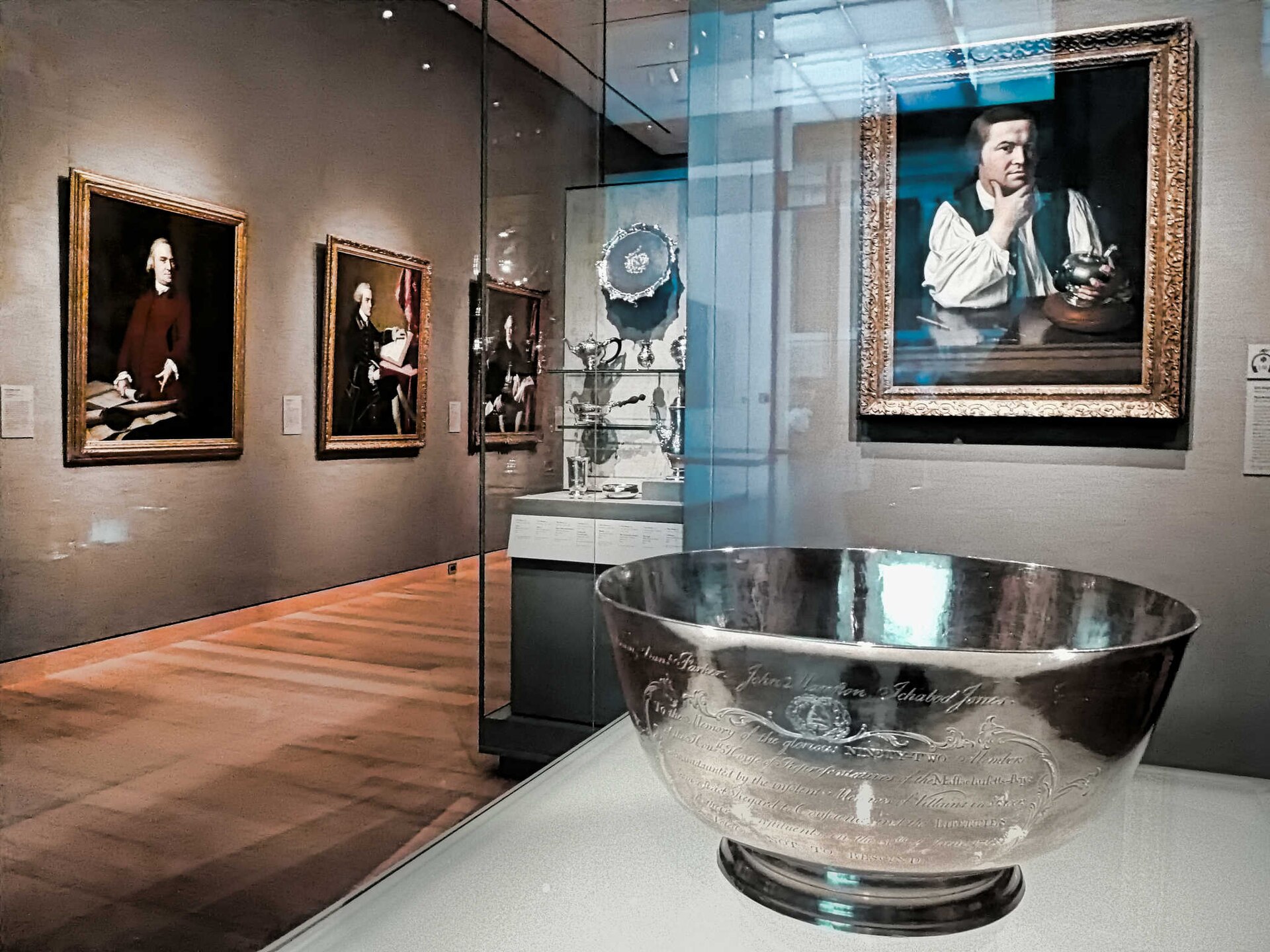
The bowl itself, on permanent display in the Arts of the Americas wing at the Museum of Fine Arts, Boston, accession 49.45. The engraving is legible around the body: the names of the fifteen subscribers along the rim, and beneath them the dedication to the memory of the glorious ninety-two members of the House of Representatives who voted not to rescind the Circular Letter. Copley's portraits of Revere, Samuel Adams, Hancock and Joseph Warren hang on the wall behind it, which is why this one photograph carries half the record.
Museum of Fine Arts, Boston, accession 49.45; photograph by BostonHistoryGuy, CC BY-SA 3.0 via Wikimedia Commons| Artist | Paul Revere II |
|---|---|
| Date | 1768, finished within five weeks of 30 June |
| Medium | Silver, hammered and engraved |
| Dimensions | Height 5 1/2 in. (about 14 cm); diameter at the lip 11 in. (about 27.9 cm); diameter at the base 5 13/16 in. (about 14.8 cm) |
| Where it is now | Museum of Fine Arts, Boston, accession 49.45last confirmed 3 August 2026 |
| Attribution | AcceptedGiven to Paul Revere II and never seriously contested. Full note |
| Object type | Silver |
| Period | American colonial, eighteenth century |
| Owners on record | 5 links5 documented |
| Sources | 8 cited |
About this record Last verified 18 August 2026 · 8 sources cited · Change log
On this page 12 sections
ContentsClose
A silver punch bowl made in Boston in the summer of 1768 for fifteen members of the Sons of Liberty, to honour the ninety-two members of the Massachusetts House of Representatives who refused a royal order to rescind the Circular Letter. It was made from forty-five ounces of silver and holds forty-five gills, and both numbers are political: forty-five is John Wilkes's North Briton No. 45, and ninety-two is the vote of 30 June 1768.
Revere finished it within five weeks of that vote and it appears nowhere in his shop records, although the wastebook covering 1768 survives and runs continuously through the year. The dedication engraved on it is probably not his words but Dr Joseph Warren's, an identification made through a Boston merchant's habit of writing the real authors on his newspapers.
It descended in the family of one of the fifteen, left that family in 1902, and was bought for the Museum of Fine Arts in 1949 by public subscription, schoolchildren included, after the museum found it could not meet an asking price of 56,000 dollars.
Provenance
Each link is graded. Documented: a cited source supports it. Disputed: the identification is argued but not established. Unknown: no owner for that span, and the gap is not smoothed into a narrative. The grades in the glossary.
- 1768 -Fifteen members of the Sons of Liberty, jointlydocumented
Commissioned from Paul Revere by fifteen men whose names are engraved round the rim as a round robin. Kept at Nathaniel Barber's insurance office in the North End and used at the Bunch of Grapes and Green Dragon taverns.12
- - 1832William Mackay, Boston, and his heirsdocumented
Stevens states that William Mackay, one of the fifteen, bought the right of ownership from the other Sons of Liberty, and that the bowl passed thereafter to his descendants. The date on which he bought the others out is not given in the sources read, so the start of this link is left open rather than guessed.2
- 1832 - 1902William Mackay of New York City, then Robert C. Mackay of Bostondocumented
Fairbanks records that in 1832 the bowl became the property of William Mackay of New York City and passed subsequently to his brother, Robert C. Mackay of Boston. Within this period Stevens records two fixed points: in 1874 the Rev Dr George E. Ellis took the bowl to the Massachusetts Historical Society, where the occasion was minuted, after which it was returned to the family; and in January 1895 the owner was a direct descendant of William Mackay working as a clerk at the New England Mutual Life Insurance Company in Milk Street, Boston.12
- 1902 - 1949Marian Lincoln Perry, Providence, Rhode Island, and her familydocumented
Robert C. Mackay passed the bowl in 1902 to Marian Lincoln Perry of Providence, who was herself a descendant of one of the fifteen original associates. The bowl therefore moved from the descendants of one subscriber to the descendants of another rather than leaving the founding families. Re-verified 2026-08-18: the museum's own published account identifies her specifically as the great-great-granddaughter of John Marston, one of the fifteen. Perry died in 1935; her son Marsden J. Perry inherited the bowl (the museum's own collections record dates the inheritance to 1938) and, working with the Boston dealer Israel Sack, offered it to the Museum of Fine Arts on the grounds that 'the bowl should belong to the city that gave it birth.' This record previously named the 1949 donor as 'Mrs J. Marsden Perry'; that has been corrected here to follow the museum's own current collections record, which names a male heir, not a widow.157
- 1949 - presentMuseum of Fine Arts, Bostondocumented
Accession 49.45, credit line gift by subscription and the Francis Bartlett Fund. Prominent Bostonians organised the Revere Sons of Liberty Bowl Fund; the superintendent's office circulated an invitation to Boston schoolchildren on 30 November 1948 with a collection day of 7 December 1948, and their contributions were part of the sum raised. A committee under Mark Bortman raised the balance after the museum found it could not meet the asking price of 56,000 dollars. On 15 February 1949 Governor Paul A. Dever transmitted the bowl from Bortman to Edward Jackson Holmes, the museum's president. First displayed in the upper rotunda with portraits of colonial notables. Re-verified 2026-08-18: as of June 2026 the bowl is no longer in that rotunda placement - it now stands in the Carolyn A. and Peter S. Lynch Gallery (Gallery 132), moved there as the centrepiece of the museum's reinstalled Art of the Americas galleries, its first such reinstallation since 2010. Since 20 June 2026 it has been shown beside an 1857 stoneware storage jar by David Drake, an enslaved South Carolina potter who also inscribed his work; the museum plays audio of both objects' inscriptions for visitors, deliberately setting Revere's Revolutionary-era protest against Drake's testimony as an enslaved maker.158
Prices realised
This bowl has NEVER been sold at auction. It passed by inheritance and private transfer until 1949 and has been publicly owned since. Everything offered in the salerooms under the title Sons of Liberty Bowl is a reproduction. The only money figure attached to the object is the 1949 ASKING PRICE of 56,000 US dollars, which is not a hammer, not a premium, not an estimate and not a recorded price paid; the price actually paid has not been found.
Technical evidence
| Attribution note | Given to Paul Revere II and never seriously contested. Benjamin Franklin Stevens, writing in 1895 with the bowl in front of him, records that the name of Revere is stamped on the underside. The attribution does not rest on the shop records, because the bowl is not in them: the wastebook covering 1768 survives, is digitised and is continuous through that year. |
|---|---|
| Height | 5 1/2 in., about 14 cm.1 |
| Diameter at the lip | 11 in., about 27.9 cm.1 |
| Diameter at the base | 5 13/16 in., about 14.8 cm.1 |
| Present weight | 43 troy ounces, 16 1/2 pennyweight. NOT 45 ounces: that is the weight of metal it was made from, and the difference is loss to finishing and to two centuries of polishing.1 |
| Capacity | Forty-five gills of rum punch, chosen to match No. 45 of Wilkes's North Briton.1 |
| Metal used | Forty-five ounces of silver, again for the number.1 |
| Form | A shallow S profile rising to a slightly flared lip, on a splayed foot with convex and concave mouldings. The model is a Delft punch bowl, itself derived from imported East Asian porcelain.1 |
| Raised or seamed | NOT ESTABLISHED. Fairbanks describes hundreds of hours of hammering on a polished anvil and stakes but does not say whether the body is raised from one sheet or seamed. This record does not assert it.1 |
| Surface | Repeated polishing has exposed fire scale, the sub-surface oxide left by annealing, giving the silver a slightly cloudy cast that reads as tarnish and is not.1 |
| Maker's mark | Stevens, writing in 1895 with the bowl in front of him, states that the name of Revere is stamped on the underside. WHICH of Revere's punches it is, in what form, and its exact position are not established from any source read for this record.2 |
| Engraved dedication | To the Memory of the glorious NINETY-TWO: Members of the Honbl House of Representatives of the Massachusetts-Bay, who, undaunted by the insolent Menaces of Villains in Power, from a Strict Regard to Conscience, and the LIBERTIES of their Constituents, on the 30th of June 1768, Voted NOT TO RESCIND.1 |
| Engraved devices | A liberty cap over a cartouche; two flags lettered Magna Charta and Bill of Rights; No 45. Wilkes and Liberty over a torn page labelled Generall Warrants.1 |
| Names on the rim | Fifteen, engraved as a round robin so that no name stands first. Caleb Hopkins, Nathaniel Barber, John White, William Mackay, Daniel Malcolm, Benjamin Goodwin, John Welsh, Fortescue Vernon, Daniel Parker, John Marston, Ichabod Jones, John Homer, William Bowes, Peter Boyer, Benjamin Cobb.12 |
| Absence from the shop books | The bowl is in neither wastebook and in no part of the Revere family papers, although volume 1 covers 3 January 1761 to 10 October 1783 continuously apart from a break in 1775-1778.13 |
Images
The record in full
Chapter 1The vote the bowl is about
On 11 February 1768 the Massachusetts House of Representatives sent a document to the legislatures of the other colonies, since known as the Circular Letter, arguing against the Acts of Parliament...
On 11 February 1768 the Massachusetts House of Representatives sent a document to the legislatures of the other colonies, since known as the Circular Letter, arguing against the Acts of Parliament that taxed the colonies. By early summer Governor Francis Bernard had been instructed to require the House to rescind it, and to dissolve the General Court if it refused.
The House voted on 30 June 1768. Ninety-two voted not to rescind and seventeen voted with the governor. The ninety-two became a slogan within days. The seventeen became the Rescinders, and Revere published an engraving, A Warm Place - Hell, in which a devil drives seventeen men into the burning jaws of a monster while a demon overhead cries 'push on Tim' at Timothy Ruggles, one of the active Loyalists.
The bowl was finished within five weeks of the vote. That is the thing to hold on to: it is not a commemorative piece made at a safe distance, it is a piece of political publishing made while the quarrel was live and while the governor was treating the vote as insubordination.
Chapter 2Forty-five, and why the number is in the metal
The bowl was made from forty-five ounces of silver and made to hold forty-five gills of rum punch.
The bowl was made from forty-five ounces of silver and made to hold forty-five gills of rum punch. Neither figure is an accident of what was in the shop.
In issue 45 of The North Briton the English radical John Wilkes attacked the ministry and the peace of 1763. He was arrested, his house was searched without a specific warrant, his papers were seized, and he beat the charge by proving the search illegal. General warrants and the number forty-five became shorthand across the English-speaking world for the argument that a subject has rights a government cannot search its way past.
Boston took the point literally. On 23 June 1768, a week before the vote, the Sons and Daughters of Liberty met at Roxbury, drove in a train of carriages past the governor's house and drank forty-five toasts. The first were to the King, the Queen and the royal family, in the traditional order; the fifth was to a perpetual union of Great Britain and her colonies on the immutable principles of justice and equity, which is not the language of men who have decided on independence. Thomas Hutchinson, writing to Thomas Pownall that same month, reported that Nathaniel Barber, who kept the insurance office where the bowl would live, had christened one of his children John Wilkes and had the figure 45 marked on the child's breast.
So the bowl is one object inside a whole vocabulary of forty-fives, and it is the only one of them that still exists.
Chapter 3What is engraved on it
One side carries a cartouche topped by a liberty cap and flanked by two flags, one lettered Magna Charta and the other Bill of Rights.
One side carries a cartouche topped by a liberty cap and flanked by two flags, one lettered Magna Charta and the other Bill of Rights. At its centre, over a torn page labelled Generall Warrants, is 'No 45. Wilkes and Liberty'.
The other side carries the dedication: 'To the Memory of the glorious NINETY-TWO: Members of the Honbl House of Representatives of the Massachusetts-Bay, who, undaunted by the insolent Menaces of Villains in Power, from a Strict Regard to Conscience, and the LIBERTIES of their Constituents, on the 30th of June 1768, Voted NOT TO RESCIND.'
Round the rim are the names of the fifteen men who paid for it, engraved as a round robin so that no name stands first: Caleb Hopkins, Nathaniel Barber, John White, William Mackay, Daniel Malcolm, Benjamin Goodwin, John Welsh, Fortescue Vernon, Daniel Parker, John Marston, Ichabod Jones, John Homer, William Bowes, Peter Boyer, Benjamin Cobb. A round robin is a device for signing a petition without identifying a ringleader. On a treasonable object in 1768 that is not a decorative choice.
Chapter 4Who wrote the words, and how that was worked out
The dedication is not Revere's composition.
The dedication is not Revere's composition. Jonathan Fairbanks noticed that its style, and its emphatic capitalisation of key words, match a series of pieces published in the Boston Gazette under the pseudonym A True Patriot, one of them on 29 February 1768.
Identifying the pseudonym was possible because of one man's filing habit. Harbottle Dorr, a Son of Liberty who sold grindstones in Union Street, kept the newspapers and wrote on each one who had actually written the anonymous articles. Anne E. Bentley, curator at the Massachusetts Historical Society, directed Fairbanks to the Dorr papers. A True Patriot was Dr Joseph Warren, who was killed at Bunker Hill in 1775.
Fairbanks is careful and this record follows him: he writes that the lines still resist completely reliable attribution. The resemblance is a strong argument, not a signature. What is established is that the question can be answered at all, and that the route to answering it is a marked-up newspaper file kept by a man who was in the room.
Chapter 5The bowl is not in the shop books, and the shop books survive
Revere kept wastebooks. The Massachusetts Historical Society holds them and has digitised them, the digitisation paid for by the Paul Revere Memorial Association.
Revere kept wastebooks. The Massachusetts Historical Society holds them and has digitised them, the digitisation paid for by the Paul Revere Memorial Association. Volume 1 is a wastebook and memoranda for Boston running 3 January 1761 to 10 October 1783. Volume 2 runs 2 August 1783 to 7 August 1797.
So 1768 is covered. The society records only one break in volume 1, between 2 April 1775 and 18 December 1778, a period when Revere was working as a courier and serving as an artillery officer in the Massachusetts militia. Nothing is missing around 1768.
The society also describes what a commission entry in that volume normally contains: the cost of the metal, the workmanship and the engraving. That is precisely the entry the Sons of Liberty Bowl would have generated, itemised in the three ways that would have priced it.
There is no such entry. The bowl appears nowhere in the wastebooks and nowhere in the Revere family papers. Fairbanks reads the absence as deliberate, on the ground that business papers could be seized and that an object engraved with Wilkes slogans and a public tribute to men who had defied a royal order was, on a bad day, treasonable.
One qualification belongs here, and the source that supplies the daybooks also supplies it. The society states that in the early years of his business Revere kept inconsistent daily records in the wastebooks before transferring entries into ledgers. Inconsistent record-keeping is an innocent explanation for a missing entry, and it has to be weighed against the argument from concealment rather than ignored. What is certain either way is the consequence: there is no ledger entry, therefore no recorded charge, and any figure quoted as what the fifteen paid Revere would be an invention.
Chapter 6How it was made, and what the surface is doing now
The form was almost certainly taken from the Delft punch bowls that colonial households knew, which themselves copy Chinese export porcelain.
The form was almost certainly taken from the Delft punch bowls that colonial households knew, which themselves copy Chinese export porcelain. The profile is a shallow S rising to a slightly flared lip; the foot is splayed and shaped with convex and concave mouldings.
Fairbanks describes the labour rather than the technique: forming a bowl of this size would have taken hundreds of hours of hammering on a polished anvil and stakes before any engraving began, and doing it in five weeks was a feat. No source consulted for this record states whether the body is raised from a single sheet or seamed, and this record does not assert it.
The present weight is 43 troy ounces and 16 1/2 pennyweight, against the forty-five ounces of metal it was made from. The difference is metal lost to finishing and, over two centuries, to polishing. Polishing has also cut through to the fire scale, the oxide left below the surface by repeated annealing, so the bowl reads slightly cloudy and looks as though it wants cleaning. It does not. Cleaning it further would remove more of it, and the cloudiness is the record of how often it has been cleaned already.
Chapter 7Where it lived, and who the fifteen were
It was kept at Nathaniel Barber's insurance office in the North End and carried out for the meetings of the group at the Bunch of Grapes Tavern and the Green Dragon Tavern.The fifteen were not the...
It was kept at Nathaniel Barber's insurance office in the North End and carried out for the meetings of the group at the Bunch of Grapes Tavern and the Green Dragon Tavern.
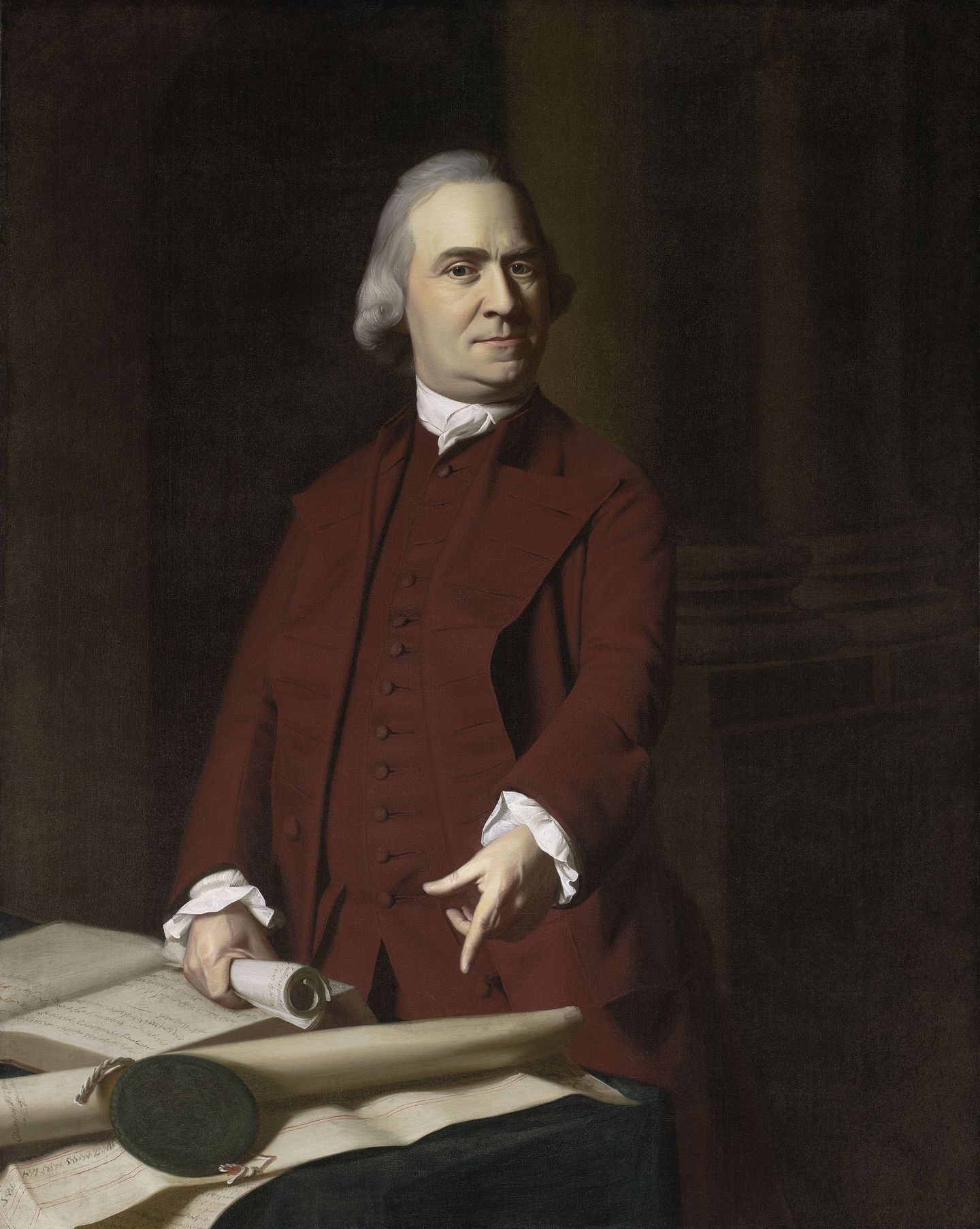
The fifteen were not the leadership of the colony. Fairbanks describes them as merchants of the middling sort: small traders, tradesmen, tavernkeepers, a mariner, a distiller, a woodcarver, most with their livelihoods tied to the wharves and the marketplace, and most of them later on London's list of enemies. Samuel Adams and Joseph Warren belonged to the movement but are not on the bowl. That is the object's argument about itself, and it is why the round robin matters.
One of the fifteen can stand for the rest. Daniel Malcolm was a merchant whose wine was assumed to be smuggled; when customs officers came for his goods they were kept out of the warehouse for want of a warrant, and by the time they had one the wine was gone. He died on 23 October 1769. His gravestone on Copp's Hill was cut by John Homer, another of the fifteen, and calls him a true Son of Liberty and an enemy of oppression; it records that he lies in a vault ten feet deep, and it is pocked with what appears to be musket damage.
Stevens, writing in 1895, checked the fifteen against the first Boston Directory of 1789 and found six of them still listed: William Mackay, gentleman, of Fish Street; Benjamin Cobb, distiller, Long Wharf; John Homer, stonecutter, Fish Street; John Welsh, ironmonger, Union Street; John White, of Scarlet's Wharf; and Peter Boyer, town treasurer, Sudbury Street. The other nine were dead. That single check is the best surviving measure of who these men actually were.
Chapter 8One family bought out the other fourteen
The bowl began as joint property. Stevens states that William Mackay, one of the fifteen and a merchant, bought the right of ownership from the other Sons of Liberty, and that the bowl thereafter...
The bowl began as joint property. Stevens states that William Mackay, one of the fifteen and a merchant, bought the right of ownership from the other Sons of Liberty, and that the bowl thereafter belonged to his descendants. Writing in January 1895, Stevens added that it would always continue in the possession of the oldest male descendant. That prediction failed within seven years.
Fairbanks gives the descent: in 1832 the bowl became the property of William Mackay of New York City, and it passed subsequently to his brother, Robert C. Mackay of Boston. In 1902 Robert C. Mackay passed it to Marian Lincoln Perry of Providence, Rhode Island, who was herself a descendant of one of the fifteen original associates.
That last point is worth stating plainly, because it is easy to read the 1902 transfer as the moment the object left the founding families. It did not. It moved from the descendants of one subscriber to the descendants of another. Which of the fifteen Marian Lincoln Perry descended from is not stated in the sources read for this record, and this record does not guess.
Chapter 9Shown once in 1874, then found by accident in 1895
In 1874 the bowl was taken to the rooms of the Massachusetts Historical Society by the Rev Dr George E.
In 1874 the bowl was taken to the rooms of the Massachusetts Historical Society by the Rev Dr George E. Ellis, and Stevens records that the proceedings of that occasion were minuted in the society's archives. It was then returned to the Mackay family. That is the only public showing before 1949 that any source read for this record mentions.
How it surfaced again in 1895 is the kind of thing that normally never gets written down. John Marston of Philadelphia, a great-grandson of the John Marston on the rim, wrote to Benjamin Franklin Stevens asking him to find out whether a Revere punch bowl carrying his ancestor's name still existed somewhere near Boston.
Stevens read the letter aloud in the office of the New England Mutual Life Insurance Company in Milk Street. A clerk stepped forward and said that the owner of the bowl was a direct descendant of William Mackay and was a clerk in that same office. The bowl arrived the same day.
Stevens then had it photographed, specially for his pamphlet, by A. H. Folsom of 48 Alleghany Street, Roxbury. That 1895 campaign is the earliest photography of the object named in any source read here, and those plates are long out of copyright, which makes their absence from any free-licence collection the single most frustrating fact in this record's image note.
Chapter 101949: the museum could not afford it and asked the city
In 1949 Mrs J. Marsden Perry offered the bowl to the Museum of Fine Arts.
In 1949 Mrs J. Marsden Perry offered the bowl to the Museum of Fine Arts. The asking price was 56,000 dollars and the museum did not have it.
The museum authorised a fundraising committee under Mark Bortman to solicit subscriptions. Donors included schoolchildren. On 15 February 1949 Governor Paul A. Dever transmitted the bowl from Bortman to Edward Jackson Holmes, the museum's president. The credit line records the mechanism exactly: gift by subscription and the Francis Bartlett Fund. It was accessioned 49.45.
Two figures have to be kept apart. 56,000 dollars is the ASKING PRICE recorded by Fairbanks. The sum actually paid is not stated in any source read for this record, and neither is the split between money raised by subscription and money drawn from the Bartlett endowment. No price paid is printed here, because none has been found.
Mark Bortman is worth following past 1949. The Massachusetts Historical Society records that the Paul J. Revere papers came to it as his gift in 1967. The man who raised the money to keep the bowl in Boston spent the following two decades placing Revere material in public collections.
The museum put the bowl in the upper rotunda with portraits of colonial notables, and it has been on view ever since, moving around the building as displays have changed.
Chapter 11The portrait that turned out to be the same year
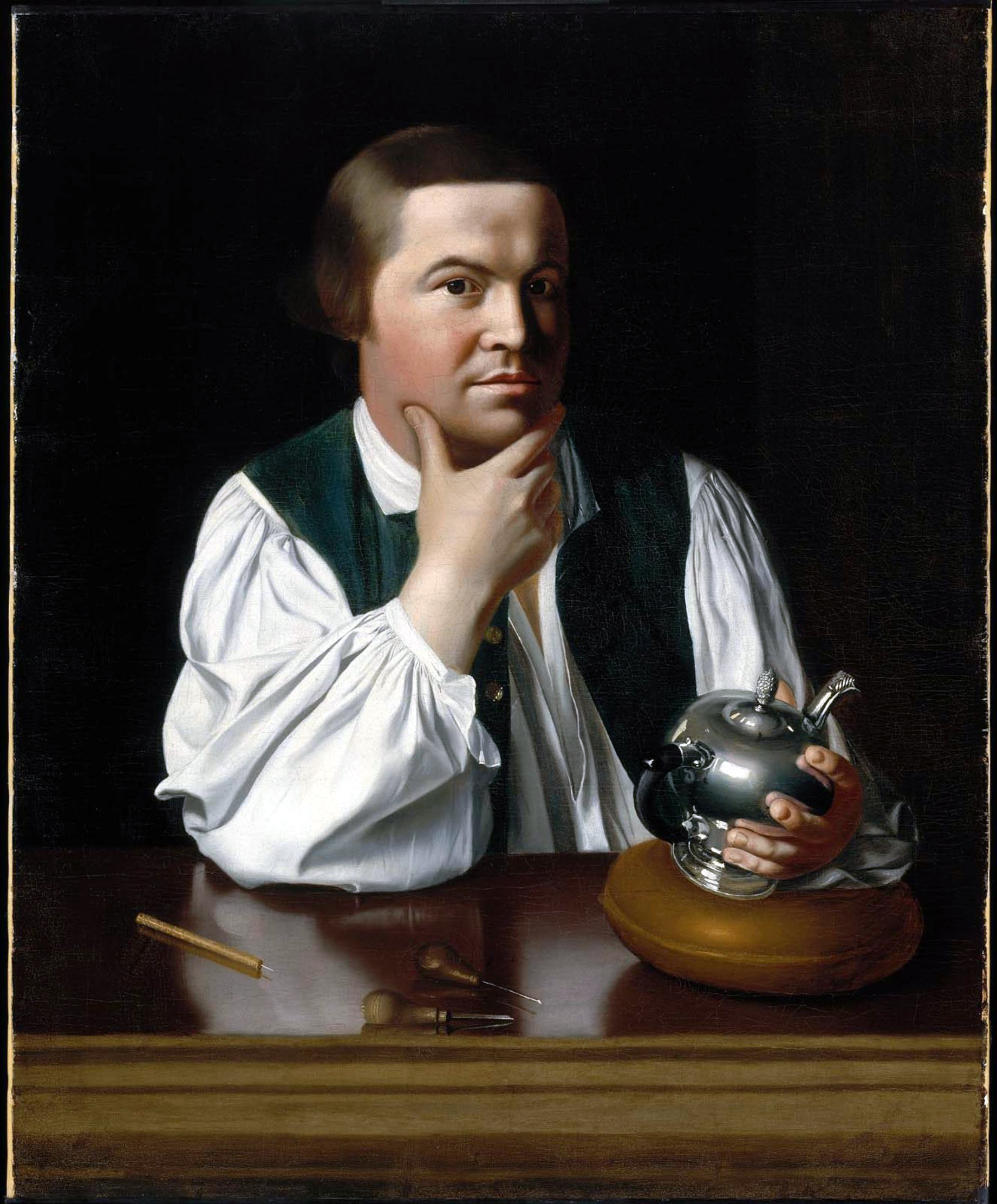
The Museum of Fine Arts also owns John Singleton Copley's portrait of Paul Revere, accession 30.781, given in 1930 by three of the silversmith's descendants.
The Museum of Fine Arts also owns John Singleton Copley's portrait of Paul Revere, accession 30.781, given in 1930 by three of the silversmith's descendants. For generations it was dated to about 1770.
In 1995, preparing a Copley exhibition, Jim Wright, head of paintings conservation, and Jean Woodward, associate paintings conservator, cleaned the picture and found Copley's initials and the date 1768 inscribed in miniature at the lower right edge.
A redating of two years changes what the picture is. Painted in 1768 it is contemporary with the bowl, made by two friends in the same town in the year that town turned, and the objects in it stop being studio props. Revere holds a pear-shaped teapot, which in 1768 is a Tory object in a town boycotting tea, and wears a conspicuous white linen shirt in the year the Boston Gazette reported some sixty young women of Roxbury spinning over a hundred score of linen yarn in a single morning to prove the colonies could clothe themselves. Fairbanks reads the composition as a man balanced between the two.
Copley married into a Loyalist family the following year. The two men were separated by the war and never met again.
Chapter 12What this object is usually asked to carry
The bowl is routinely described as one of the most important objects in American history, ranked with the Declaration of Independence and the Constitution.
The bowl is routinely described as one of the most important objects in American history, ranked with the Declaration of Independence and the Constitution. That claim is repeated widely and no source read for this record attributes it to a named author in a citable place, so this record does not print it as a judgement of its own.
What can be said precisely is narrower and stronger. It is an object made by a named craftsman, for fifteen named men, about a dated vote, in a town under military occupation within three months, and it carries the argument on its own surface in words that were probably written by a man who was killed seven years later. It was never sold at auction. It has been publicly owned since 1949 and publicly displayed ever since.
Everything offered in the salerooms under the title Sons of Liberty Bowl is a reproduction. There is one of these.
The artist
Paul Revere II, silversmith, engraver, bell and copper founder, of Boston
The difficulty in writing about Revere is that the poem got there first. What matters for this object is narrower and much better documented: he ran a working silver shop that kept books, he engraved for the political press, and in 1768 he was a tradesman and not yet the figure of the ride. This bowl sits exactly on the join between those two trades, because it is a raised silver vessel made in order to be read.
Exhibited
- 1874Shown to the Massachusetts Historical Society by the Rev Dr George E. Ellis; the occasion minuted in the society's archivesMassachusetts Historical Society, Boston
- 1949Displayed on acquisition in the upper rotunda with portraits of colonial notablesMuseum of Fine Arts, Boston
- 1975Paul Revere's Boston, 1735-1818Museum of Fine Arts, Boston
Literature
- Benjamin Franklin Stevens, 'The silver punch bowl made by Paul Revere...', Boston, Nathan Sawyer and Son, 1895, reprinted from the Boston Sunday Herald of 20 January 1895. The earliest sustained account of the object located for this record. Names the fifteen, transcribes the inscriptions, checks the fifteen against the 1789 Boston Directory, records the 1874 visit to the Massachusetts Historical Society and the 1895 rediscovery, and commissions the first photography of the bowl.
- Clarence S. Brigham, 'Paul Revere's Engravings', revised edition, New York, Atheneum, 1969. The standard catalogue of the prints. A Warm Place - Hell at pages 43-49 and the landing print at 79-85, per Fairbanks. NOT CONSULTED DIRECTLY.
- Jonathan L. Fairbanks and Wendy Cooper, 'Paul Revere's Boston, 1735-1818', Museum of Fine Arts, Boston, 1975. Exhibition catalogue. NOT CONSULTED DIRECTLY.
- Jonathan L. Fairbanks, 'Paul Revere's Sons of Liberty Bowl', Colonial Society of Massachusetts. The fullest published account read for this record. Establishes the Joseph Warren authorship argument and the 1995 redating of the Copley portrait, and prints the accession number and credit line.
- Gerald W. R. Ward, 'Paul Revere: Sons of Liberty Bowl', Museum of Fine Arts, Boston. The museum's own monograph on the object. NOT CONSULTED. It is the first place to go for the maker's mark, the gauge and any scratch weight, all of which this record records as unestablished.
- Kathryn C. Buhler, 'American Silver 1655-1825 in the Museum of Fine Arts, Boston', 1972. NOT CONSULTED. The standard catalogue of the museum's American silver and the expected source for the mark.
Related works
| Work | Relation | Where it is |
|---|---|---|
| Paul Revere John Singleton Copley | Painted in the same town in the same year, and now hung with the bowl Oil on canvas, 35 1/8 by 28 1/2 in. Given by Joseph W., William B. and Edward H. R. Revere in 1930. Redated from about 1770 to 1768 in 1995, when conservators found Copley's initials and the date at the lower right. | Museum of Fine Arts, Boston, 30.781 |
| A Warm Place - Hell Paul Revere | Revere's other answer, in another medium, to the same vote Engraving, 3 3/8 by 4 15/16 in., 1768. A devil drives the seventeen Rescinders into the jaws of Hell while a demon overhead cries 'push on Tim' at Timothy Ruggles. | American Antiquarian Society |
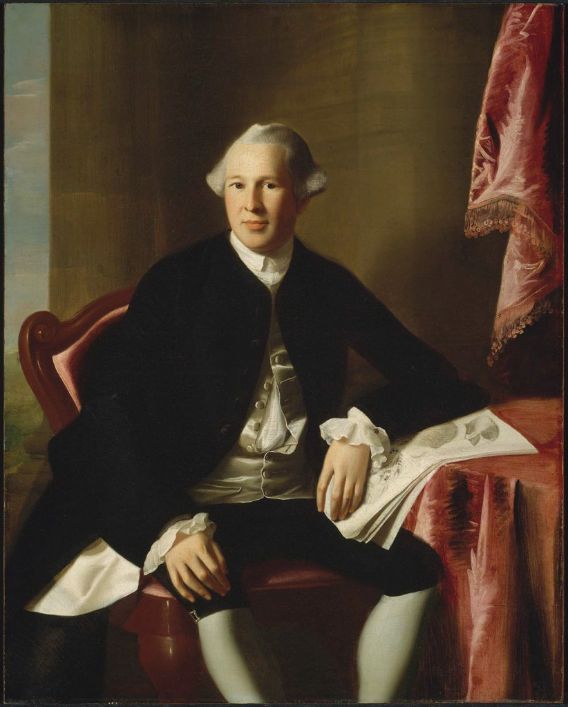
| Dr Joseph Warren John Singleton Copley | Portrait of the probable author of the bowl's dedication Oil on canvas, about 1772-74, 50 by 39 3/4 in. Gift of Buckminster Brown MD through Church M. Matthews Jr, Trustee. Fairbanks notes that Copley posed Warren much as Hogarth had posed Wilkes, to opposite effect. | Museum of Fine Arts, Boston, 95.1366 |
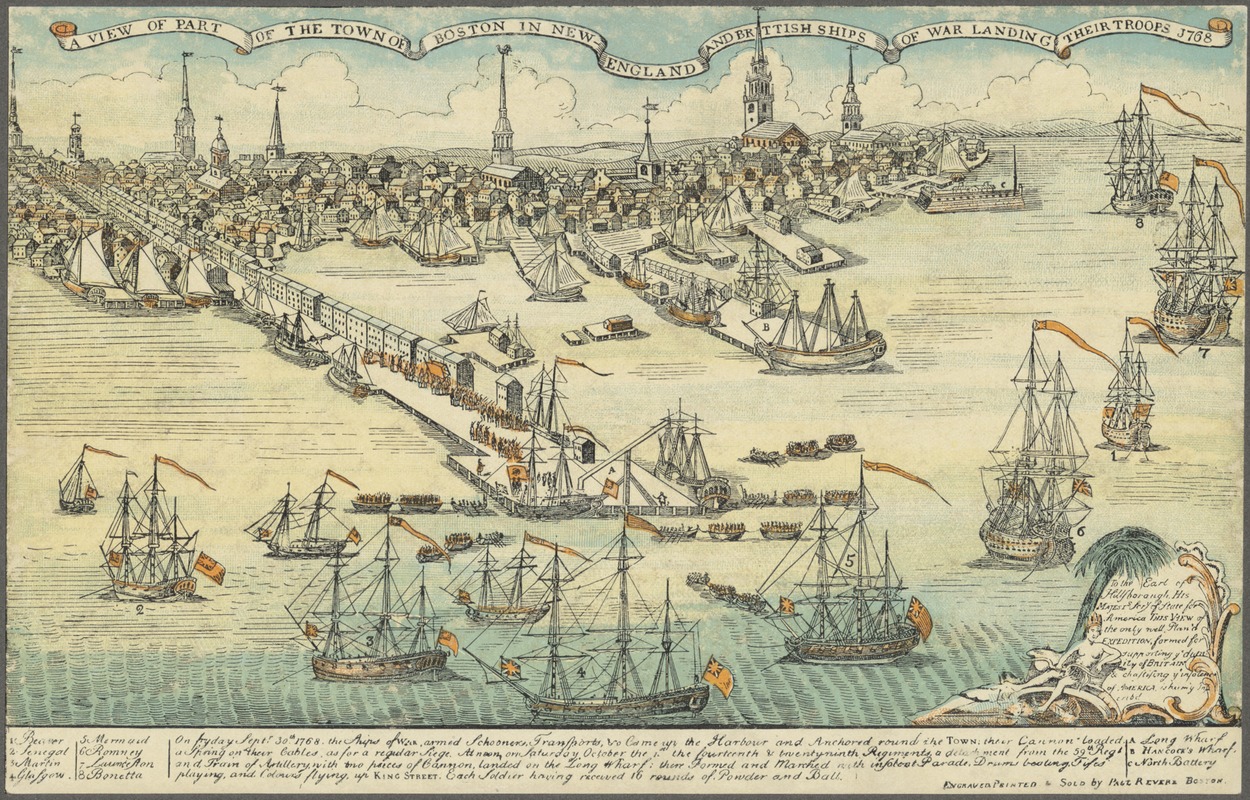
| The town of Boston in New-England and Brittish ships of war landing their troops Paul Revere | The occupation that followed the vote, from the same hand Engraving, 7 5/8 by 12 in. It shows the landing at the Long Wharf on 1 October 1768; Fairbanks dates the print itself 1770, which is a trap for anyone captioning it by its subject year. | Boston Athenaeum, A/B64B6/Hil.1770x |
| John Wilkes William Hogarth | The image behind the number 45 Engraving, London, 1763. Hogarth's deliberately unflattering portrait of the man whose No. 45 gave this bowl its arithmetic. | Private collection |
Open questions
- What did the fifteen pay Revere? There is no entry in the wastebooks, and the volume covering 1768 is continuous through that year. No figure exists to find.
- Is the absence from the wastebooks concealment or untidiness? Fairbanks argues concealment. The Massachusetts Historical Society describes Revere's early daily record-keeping as inconsistent. Both readings are on the table and this record does not arbitrate.
- What did the Museum of Fine Arts actually pay in 1949? The asking price of 56,000 dollars is recorded; the sum paid, and the split between subscription income and the Francis Bartlett Fund, are not.
- Which of Revere's punches is struck on the underside, and exactly where? Stevens says only that the name is stamped there.
- Is the body raised from a single sheet or seamed? No source read for this record states it.
- Who first ranked this bowl with the Declaration of Independence and the Constitution? The comparison is repeated everywhere and attributed to nobody in the sources read.
- Was the bowl exhibited publicly between 1874 and 1949? Only the 1874 visit to the Massachusetts Historical Society is recorded in the sources read.
Questions about this object
What is The Sons of Liberty Bowl?
The Sons of Liberty Bowl is a silver, dated 1768, finished within five weeks of 30 June. Medium: Silver, hammered and engraved.
Who made The Sons of Liberty Bowl, and is the attribution settled?
The attribution to Paul Revere II is recorded here as accepted. Given to Paul Revere II and never seriously contested. Benjamin Franklin Stevens, writing in 1895 with the bowl in front of him, records that the name of Revere is stamped on the underside. The attribution does not rest on the shop records, because the bowl is not in them: the wastebook covering 1768 survives, is digitised and is continuous through that year.
Where is The Sons of Liberty Bowl now?
Museum of Fine Arts, Boston, accession 49.45. Last confirmed 3 August 2026. Acquired 1949 by public subscription with the Francis Bartlett Fund; on view continuously since.
What is still unknown about The Sons of Liberty Bowl?
What did the fifteen pay Revere? There is no entry in the wastebooks, and the volume covering 1768 is continuous through that year. No figure exists to find.
Sources
- 1Jonathan L. Fairbanks, 'Paul Revere's Sons of Liberty Bowl', Colonial Society of Massachusetts. Read in full. Source for the dimensions and present weight, the forty-five ounces and forty-five gills, the five-week production, the absence from the daybooks, the transcription of both inscriptions, the identification of Joseph Warren as 'A True Patriot' through the Harbottle Dorr papers, the Wilkes material, the accession number and credit line, the 1995 discovery of Copley's date on the Revere portrait, and the 1949 subscription campaign. colonialsociety.org/node/...
- 2Benjamin Franklin Stevens, 'The silver punch bowl made by Paul Revere to commemorate a vote of the honorable House of Representatives of the Massachusetts Bay in 1768', Boston, Nathan Sawyer and Son, 1895, reprinted from the Boston Sunday Herald of 20 January 1895; cover title 'A chapter of provincial history'. Read in full from the Library of Congress copy. A PERIOD SOURCE, not modern scholarship: source for the names of the fifteen, the transcription of the inscriptions as read in 1895, the statement that William Mackay bought out the other fourteen, the 1874 visit to the Massachusetts Historical Society, the 1895 rediscovery, the maker's mark on the underside, and the Folsom photographic campaign. archive.org/details/...
- 3Massachusetts Historical Society, collection guide to the Revere Family Papers, 1746-1964, fa0017. Read directly. Source for Wastebook and memoranda, Boston, 3 January 1761 to 10 October 1783; for Wastebook, Boston, 2 August 1783 to 7 August 1797; for the absence of entries between 2 April 1775 and 18 December 1778 and the reason given for it; for the statement that Revere kept inconsistent daily records in wastebooks in his early years; for the content of a commission entry; and for Mark Bortman's 1967 gift of the Paul J. Revere papers. masshist.org/collection-guides/...
- 4Paul Revere House, 'Revere's Silver Shop'. Read directly. Source for the statement that Revere's earliest maker's mark was the same as his father's and that father and son shared casting patterns, for the death of his father in 1754, for the shop records beginning in 1761, for over 1,000 personal items and 414 repairs, and for the extra charge made for engraving inscriptions, monograms and crests. paulreverehouse.org/reveres-silver-shop
- 5Museum of Fine Arts, Boston, collection record for the Sons of Liberty Bowl, accession 49.45. NOT READ: the public record sits behind a JavaScript robot check and returned a verification page to every fetch attempted. The accession number and the credit line used here are printed in source 1. collections.mfa.org/objects/...
- 6Clarence S. Brigham, 'Paul Revere's Engravings', revised edition, New York, Atheneum, 1969, cited by Fairbanks at pages 43-49 for A Warm Place - Hell and 79-85 for the landing print. NOT CONSULTED DIRECTLY. colonialsociety.org/node/...
- 7Paul Revere's Sons of Liberty Bowl, Museum of Fine Arts, Boston mfa.org/article/...
- 8Museum first: MFA Boston pairs prized vessels by Paul Revere and enslaved artist David Drake, The Art Newspaper theartnewspaper.com/2026/...
Last verified 18 August 2026 · Published 4 August 2026
Change log
2 August 2026 - Record deepened to the house standard: narrative sections, technical evidence, artist dossier, related works and open questions added; provenance chain and auction results replaced with the researched versions; sources rebuilt.
4 August 2026 - Withheld from publication. This archive lists an object only when a photograph OF THAT OBJECT can be reproduced under a free licence. No such photograph has been found for this one, so the record is held rather than published beside pictures of other things. It will be released if a free reproduction appears.
4 August 2026 - Record created at the house standard: researched narrative, technical evidence, maker dossier, graded provenance chain, prices with hammer and premium separated, related works, open questions and sources.
18 August 2026 - Re-verified (record-desk moat pass). Current display location confirmed and updated: moved June 2026 to the Lynch Gallery (132) as part of the MFA's first Art of the Americas reinstallation since 2010, now shown beside David Drake's 1857 storage jar - a first for the museum, sourced to The Art Newspaper. A newly found MFA-published account of the bowl answers a previously open question (Marian Lincoln Perry's descent: great-great-granddaughter of Sons of Liberty member John Marston) and adds Israel Sack's role and the schoolchildren's subscription drive. Corrected the 1949 donor's name from 'Mrs J. Marsden Perry' to 'Marsden J. Perry' (male heir, not a widow) to match the museum's own current collections record. Source URLs re-checked and resolve.