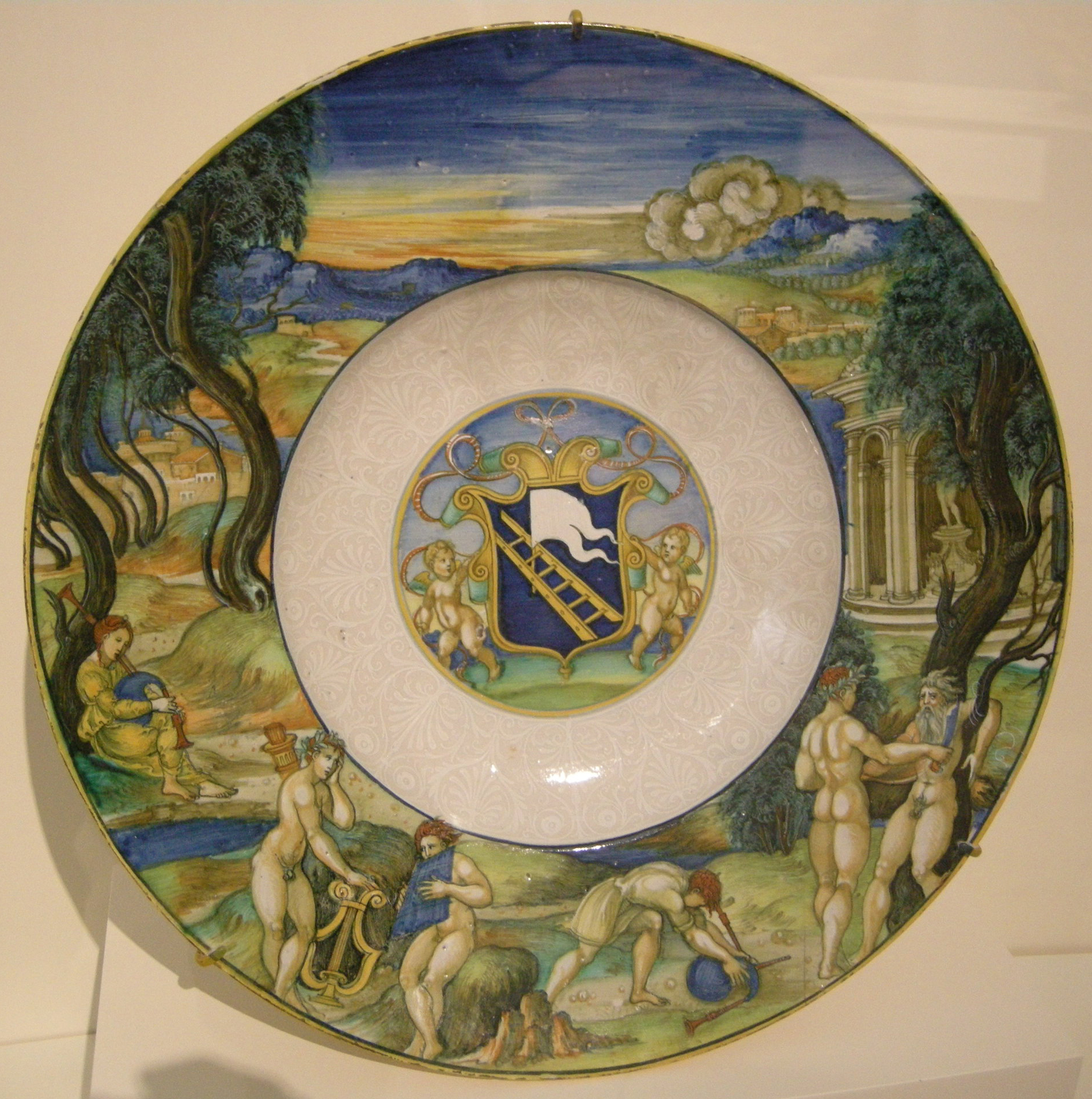
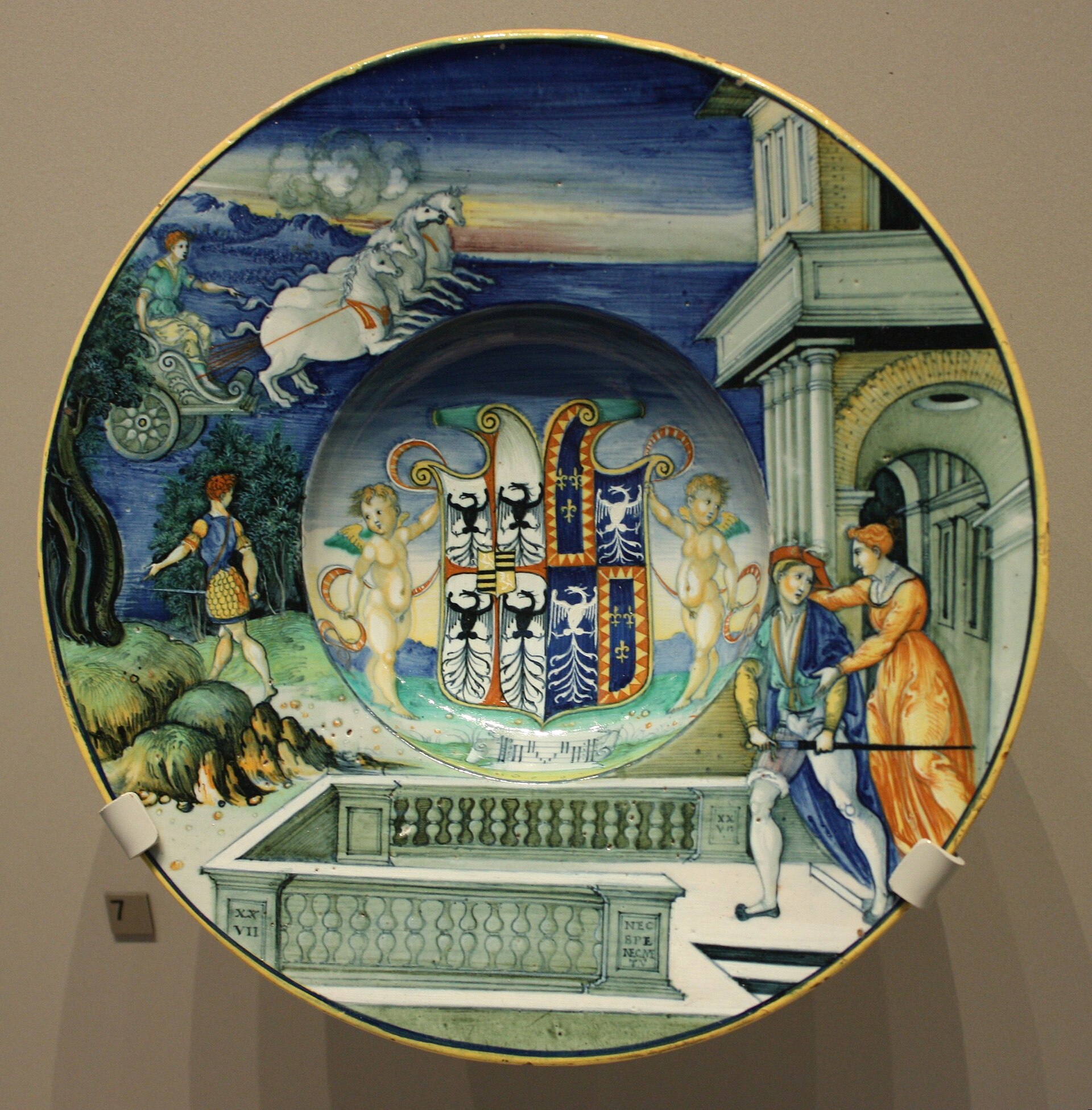
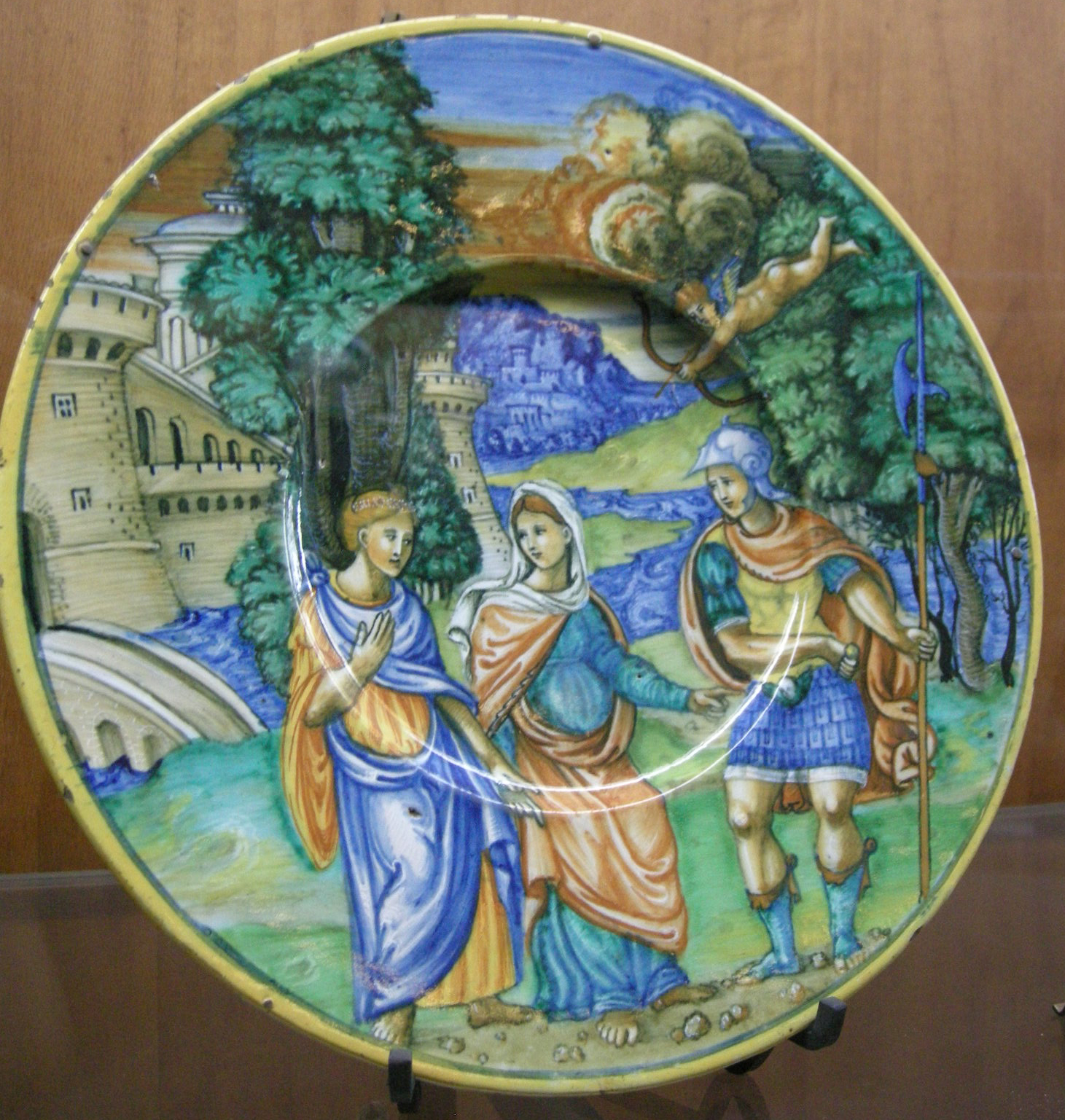
Armorial Dish with the Flaying of Marsyas
mid-1520s · Tin-glazed earthenware
J. Paul Getty Museum, Los Angeles
 Italian · 1480-1537
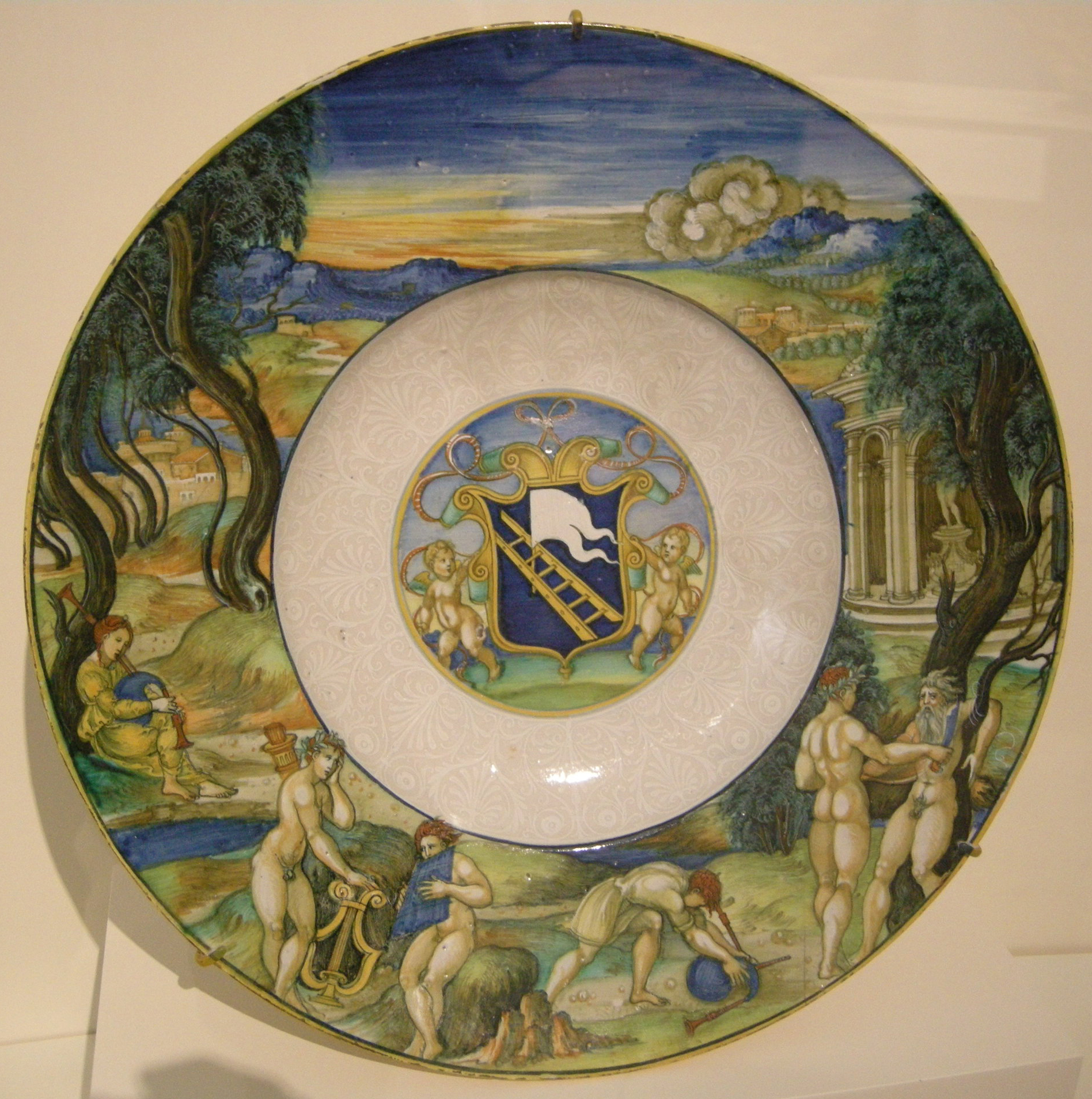
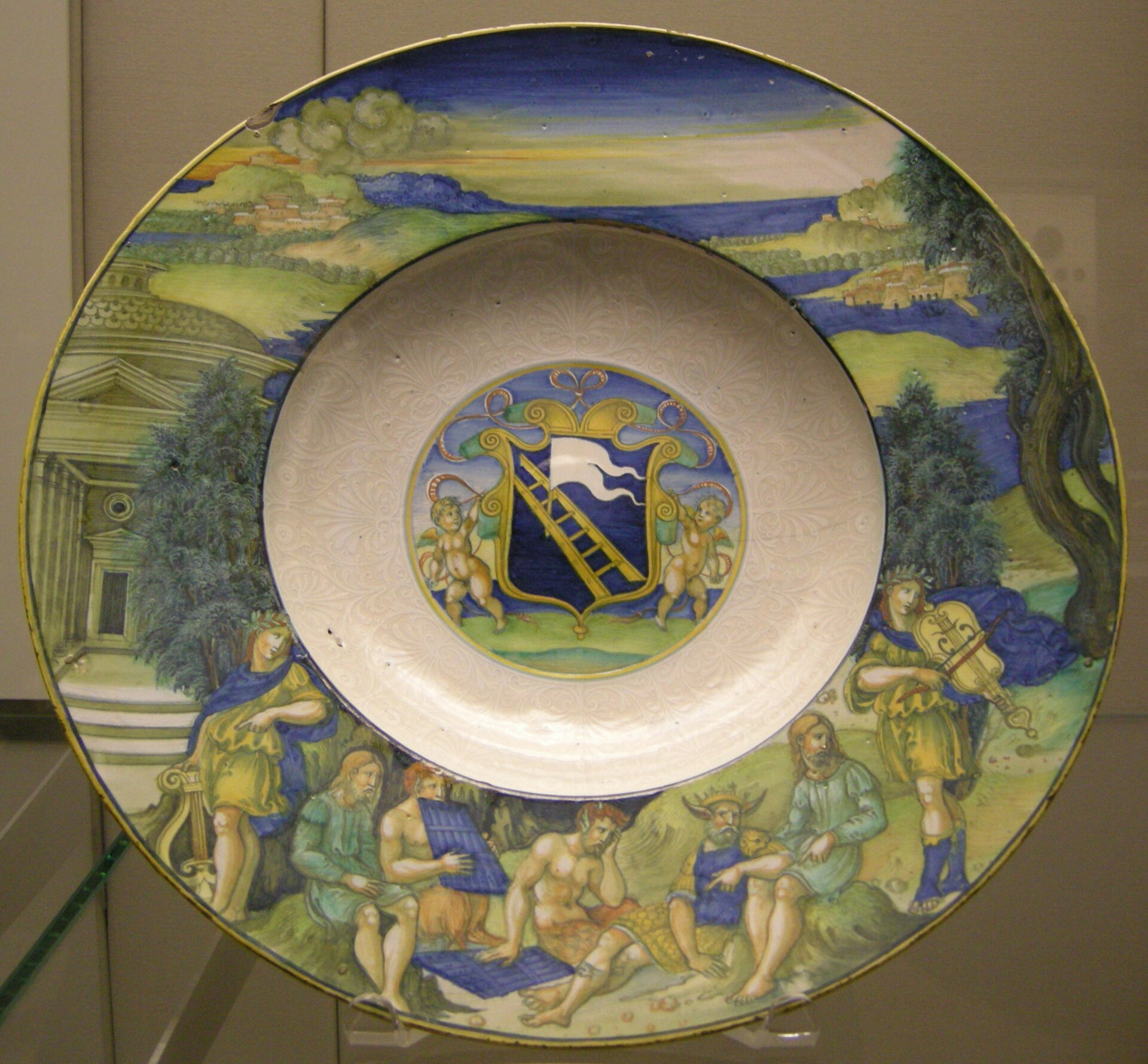
Armorial Dish with the Flaying of Marsyas The Getty's own dish, the companion object record to this maker page. Calini service, mid-1520s. Unqualified attribution by the J. Paul Getty Museum. No verified portrait. No securely identified likeness of this maker is known under a free licence. We do not publish a face we cannot verify.
Photograph by Sailko, via Wikimedia Commons, CC BY-SA 3.0. Object: J. Paul Getty Museum, Los Angeles.| Full name | Nicola di Gabriele Sbraghe (also given as Sbraga), known by his working name Nicola da Urbino |
|---|---|
| Worked as | Maiolica painter, Workshop owner |
| Born | about 1480 · Urbino, presumed but not documented. |
| Died | end of 1537 or January 1538 · Urbino. There is no evidence he ever worked anywhere else |
| Nationality | Italian |
| Movement | Istoriato maiolica, Urbino, Italian Renaissance |
| In this archive | 1 artwork |
| Sources | 21 cited |
| Last verified |
About this page 1 artwork in the archive · Last verified · 21 sources cited
Nicola da Urbino is, with Francesco Xanto Avelli, one of the two painters who defined istoriato maiolica, the Renaissance fashion for covering an entire dinner plate with a single painted narrative scene, in Urbino in the 1520s. He is now called the finest painter to work in the medium. He signed almost nothing.
For roughly a century, from around the 1880s until 1986, the name attached to his best work was not his own. Scholars called him Nicola Pellipario, a person built out of a misread document, and it took archival research published in 1985 to take that invented name away and give the workshop back its real owner: Nicola di Gabriele Sbraghe, recorded as a master with his own shop in Urbino from 1520. Even his correct name did not stop the argument. His documented working companion, Francesco Xanto Avelli, worked beside him through the very years his best-known plates were painted and did not sign and date a single one of his own before 1530, which means that almost everything unsigned from this decade in Urbino, this artist's whole reputation included, still rests on the connoisseurship of a handful of specialists rather than on a document.
The single fact a reader is least likely to find elsewhere is this: when the most celebrated maiolica service in existence, the credenza Eleonora Gonzaga gave her mother Isabella d'Este in 1524, is mentioned in the one surviving letter that documents it, the painter's name does not appear in it at all.
Born, place not documented; presumed connected to Urbino from his later working name.25
First documented in the Urbino archives as master and owner of his own workshop.23
Francesco Xanto Avelli arrives in Urbino and begins working in close proximity to Nicola.67
Eleonora Gonzaga, Duchess of Urbino, delivers a maiolica credenza to her mother Isabella d'Este, documented in Eleonora's own surviving letter, which does not name the painter.3
The Calini family of Brescia commission an armorial dinner service, of which eleven pieces (plus one further disputed piece) are known today.114
A group of skilled Urbino craftsmen, including Xanto, attempt to organize for higher pay; Nicola is named by Mallet as one of the master-potters who resisted the claim.47
The Caesar Travels to Egypt composition and related plates are painted, dated by their dependence on a woodcut first printed that year in Venice.3
Bernard Rackham's Victoria and Albert Museum catalogue of Italian maiolica tentatively attributes further pieces to Nicola, including one Wilson later reassigns to an assistant.3
John Mallet redates the Isabella d'Este service to around 1525 on stylistic grounds alone, ahead of any archival confirmation.3
Franco Negroni publishes the article proving Nicola Pellipario never existed and identifying the real Nicola di Gabriele Sbraghe.53
J.V.G. Mallet publishes his catalogue study separating Nicola's corpus from Xanto's in the journal Faenza.3
An armorial dish attributed to Nicola sells at Christie's, Paris, for a reported price of about EUR 1.2 million, at the time a record for maiolica.1819
An unrecorded armorial dish attributed to Nicola, found in a drawer in a Scottish country house, sells at Lyon and Turnbull for a new maiolica auction record.151617
Prices for maiolica attributed to Nicola da Urbino are shaped by the same attribution uncertainty this page describes throughout. Market commentary notes that work confidently given to his younger contemporary Francesco Xanto Avelli, who signed and dated most of his mature output, can command a premium precisely because a buyer knows what they are getting; an unsigned dish given to Nicola is always, to some degree, a purchase of connoisseurship rather than of a documented fact.
Even so, the two highest prices ever recorded at auction for a piece of Italian Renaissance maiolica of any attribution have both gone to work attributed to Nicola da Urbino, and both were early, previously unrecorded dishes that surfaced from private houses rather than from known collections.
| Date | Sale | Work | Result | Note |
|---|---|---|---|---|
| 2009 | Christie's, Paris | Armorial dish, c. 1525, attributed to Nicola da Urbino | Hammer not published separately in the sources consulted With premium reported at approximately EUR 1.2 million, inclusive of buyer's premium EUR | Reported in later market coverage as the auction record for maiolica prior to 2021. This record could not locate the original Christie's sale catalogue; the figure is as reported secondhand by Apollo Magazine and by Barnebys, and is not independently confirmed. |
| 6 October 2021 | Lyon and Turnbull, Edinburgh | Unrecorded armorial istoriato dish, Samson and Delilah, attributed to Nicola da Urbino, c. 1520-23 | Hammer GBP 1,040,000 With premium GBP 223,000 (total with premium GBP 1,263,000) GBP | Estimate GBP 80,000-120,000. Found unrecorded in a drawer at Lowood House near Melrose, in the Scottish Borders, during preparation of a house-contents sale; descended through the family of the Glasgow merchant James Ewing, who acquired Italian works of art on an 1844-45 trip. A new world-record price for maiolica at auction. Hammer and premium taken from Lyon and Turnbull's own sale record; the total of GBP 1,263,000 matches the French Porcelain Society's figure. A widely repeated press figure of GBP 1,236,000 (The History Blog) is an inaccurate secondhand report of the total, not a rival hammer price. |
| 2023 | Private dealer stand, TEFAF Maastricht (Justin Raccanello) | Armorial dish, c. 1520, Europa and the Bull, arms of the Calini family, attributed to Nicola da Urbino | Hammer not applicable, this was an asking price, not a completed sale With premium EUR 1.5 million asking price reported EUR | Whether this dish is a twelfth survivor of the same Calini service otherwise recorded at eleven pieces, or one of those eleven under a description this record has not been able to match, is left open. |
Hammer is the price at which the bidding stopped; with premium adds the fee the house charges the buyer on top. Hammer price and buyer's premium in the glossary.
| Institution | City | Holdings | Note |
|---|---|---|---|
| J. Paul Getty Museum | Los Angeles | One dish, Calini service (Flaying of Marsyas) | Accession 84.DE.117, purchased 1984. |
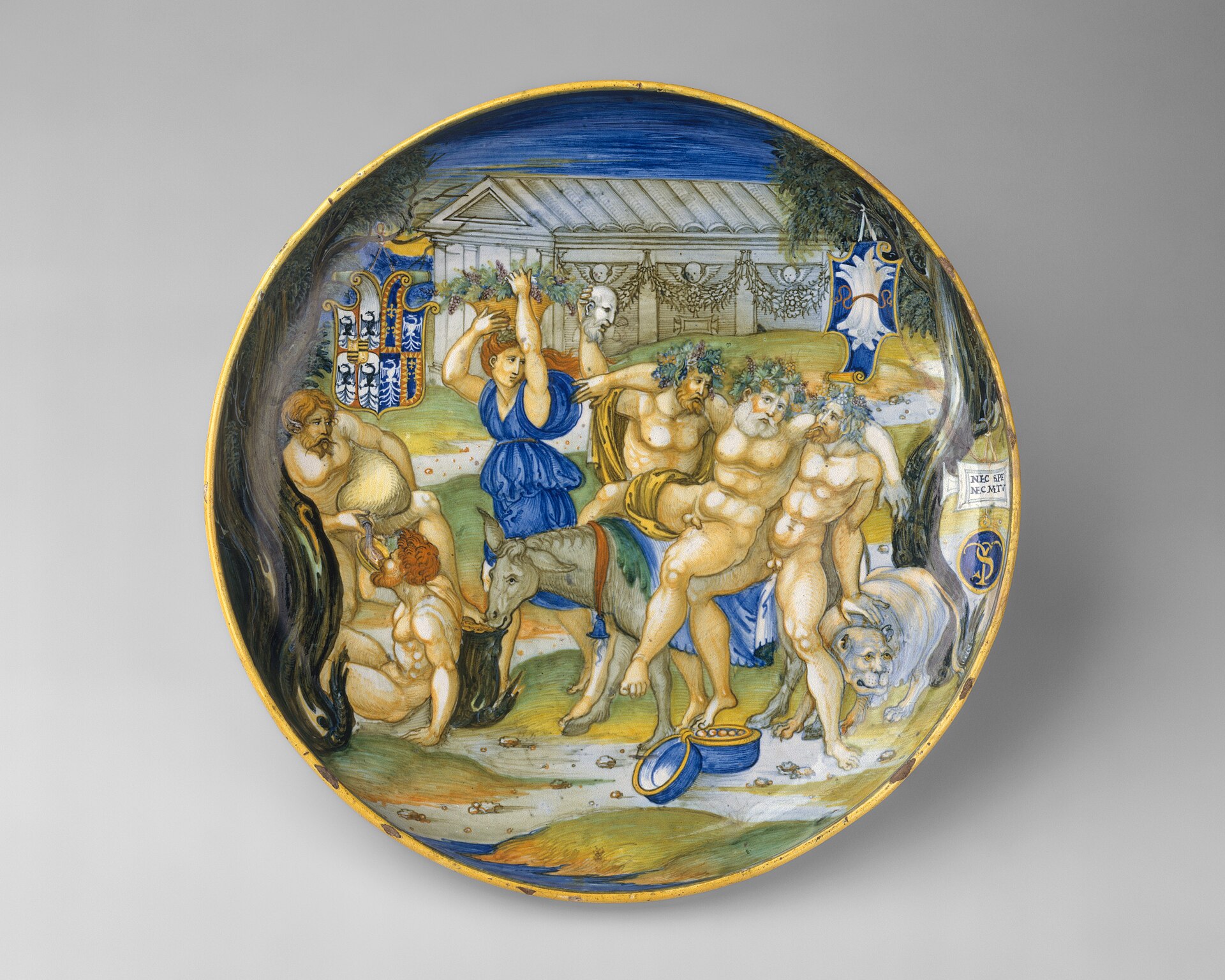
| Metropolitan Museum of Art | New York | At least four attributed works: three pieces from the 1524 Isabella d'Este/Eleonora Gonzaga service in the Robert Lehman Collection (Silenus, King Midas, and related armorial plates), plus a large dish showing Pope Leo X presenting Federico Gonzaga his baton, and a Calini-service plate (Paris killing Achilles). | The Lehman pieces entered the collection in 1975; the Calini plate in 1884. |
| Victoria and Albert Museum | London | At least two attributed pieces, including a plate with Hippolytus and Phaedra from the Isabella d'Este service and a studio-replica version of Caesar Travels to Egypt. | The Hippolytus and Phaedra plate is object O119834. |
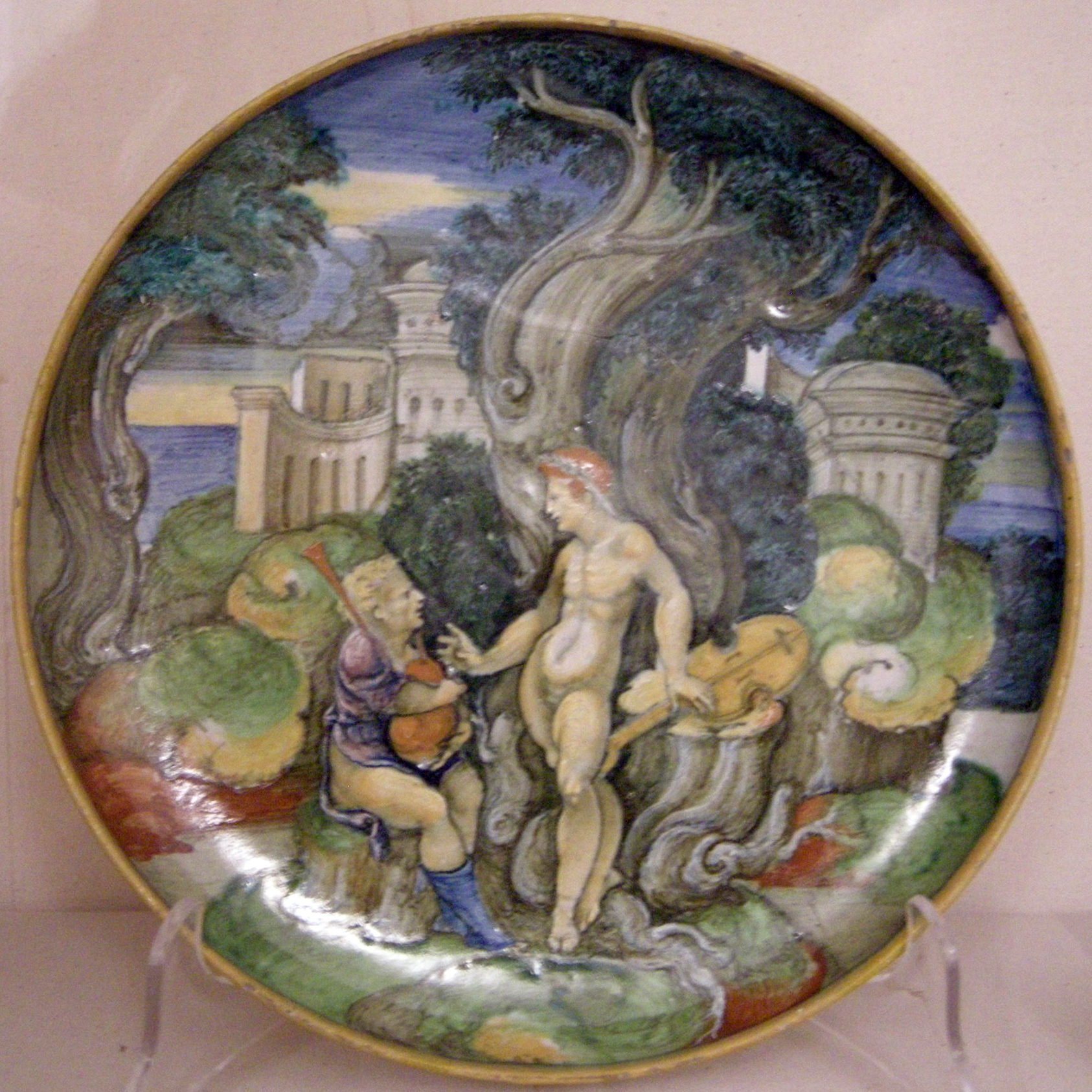
| British Museum | London | Multiple pieces including a Calini-service dish (Pan and Apollo), a plate with the arms and imprese of Isabella d'Este dated 1524, and a disputed signed plate (Nicola da .V.). | Catalogued in Thornton and Wilson, Italian Renaissance Ceramics: A Catalogue of the British Museum Collection (2009). |
| Fitzwilliam Museum | Cambridge | One dish from the Isabella d'Este service, showing Peleus and Thetis. | Accession EC.30-1938; provenance through the Rothschild family and the dealer Charles Damiron before purchase in 1938. |
| Museo Correr | Venice | Seventeen pieces of an earlier, related service, plus a late plate (Caesar Leaves Rome). | Wilson calls the earlier service's pastoral treatment of Ovid unequalled. |
| Kunstgewerbemuseum | Berlin | Pieces from a Gonzaga service depicting the foundation myth of Mantua and the Rape of Europa. | |
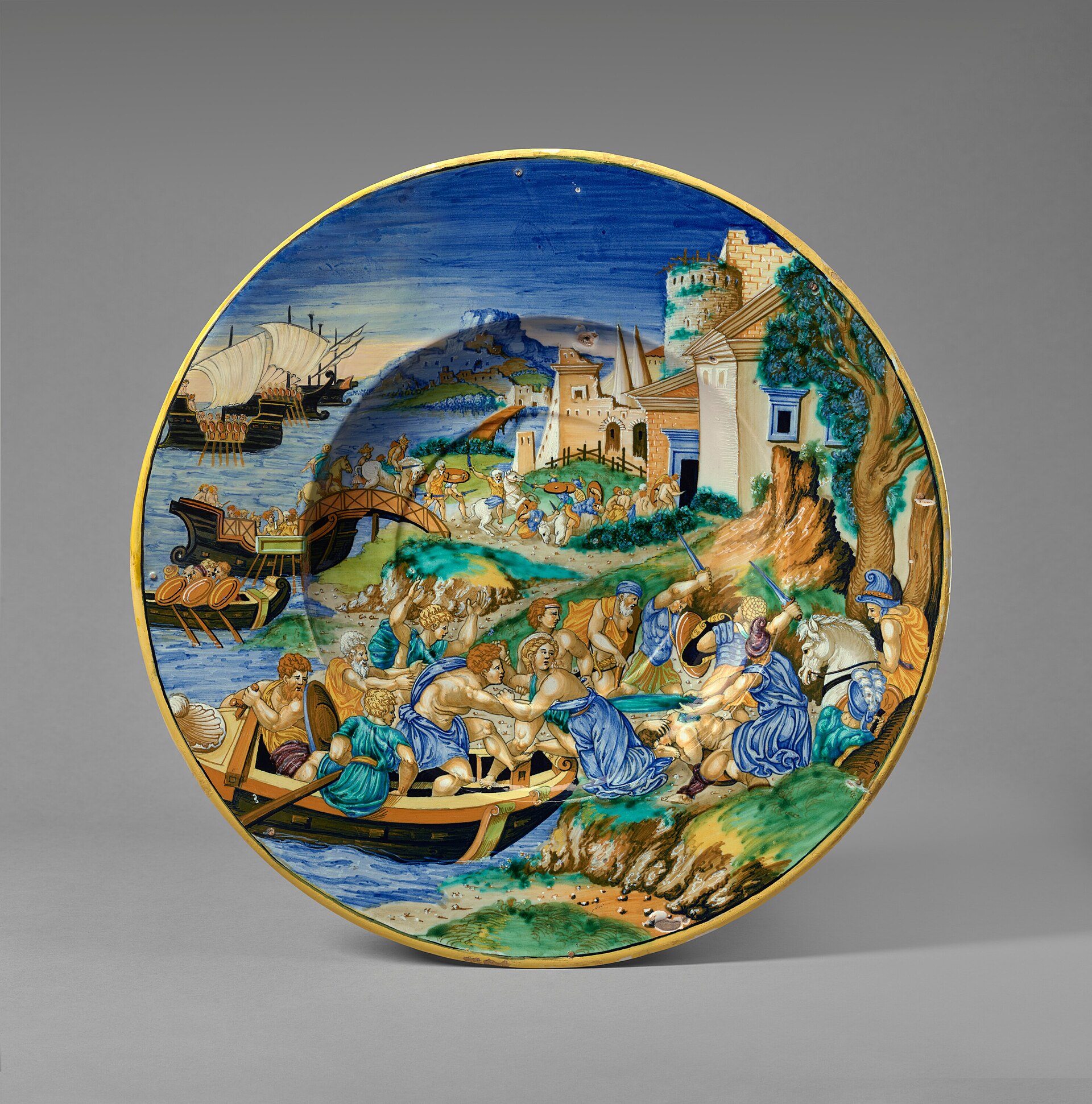
| Musee national de la Renaissance, Chateau d'Ecouen | Ecouen | One Calini-service dish, the Sacrifice of Iphigenia. | |
| National Museums Scotland | Edinburgh | Five Calini-service pieces, the largest single surviving group from that service. | |
| Detroit Institute of Arts | Detroit | One disputed plate, Hercules and Omphale, argued by Wilson to be a partial collaboration and rejected in full by Mallet. | Gift of Mr and Mrs R. Brodie. |
| Fondation Bemberg | Toulouse | One plate, Caesar Travels to Egypt, considered by Wilson an autograph late work. | |
| Castello Sforzesco | Milan | Several attributed and circle-of pieces spanning a range of attribution confidence, including Aeneas at the House of Evander (unqualified attribution), Apollo and Daphne (attr.), and Dido and Aeneas (circle of). | A useful single collection for seeing the attribution-confidence gradient in one place. |
Pieces inscribed only Nicola da Urbino, a working name tied to a city rather than to a family, accumulated for decades around a reconstructed personality that early twentieth century scholarship...
Pieces inscribed only Nicola da Urbino, a working name tied to a city rather than to a family, accumulated for decades around a reconstructed personality that early twentieth century scholarship called Nicola Pellipario, built on a documentary connection to an unrelated family of that surname. It held as settled fact in the literature for most of a century.
In 1985 the Italian scholar Franco Negroni published an article in the Urbino journal Notizie da Palazzo Albani whose title translates as Nicolo Pellipario: Phantom Ceramicist, demonstrating that the Pellipario identity did not survive contact with the Urbino archives. The painter actually recorded running his own workshop in the city from 1520, called maestro in the documents, was Nicola di Gabriele Sbraghe, also given as Sbraga. Every museum label carrying the name Nicola da Urbino, including every one cited on this page, is downstream of that 1985 correction. Some tertiary accounts still give the correction a different year; the exact citation, checked directly against a scholarly bibliography rather than repeated from a museum label, is Notizie da Palazzo Albani 14, no. 1 (1985), pp. 13-20.
Set beside the size of his reputation, what is actually documented about Nicola di Gabriele Sbraghe as a person is thin.
Set beside the size of his reputation, what is actually documented about Nicola di Gabriele Sbraghe as a person is thin. He is recorded as a master and workshop owner in Urbino from 1520. He died at the end of 1537 or in January 1538, a dating given consistently across the institutions that hold his work. There is no evidence he ever worked in any other city.
No birth record, no record of his training, and no family document beyond his own name have been located in the sources consulted for this record. The name Nicola da Urbino tells a reader where he worked, not where he was born, and the gap between the two is exactly the kind of thing later cataloguers filled in with confidence the documents do not support.
Francesco Xanto Avelli da Rovigo, a painter and poet, arrived in Urbino around 1521 or 1522 and worked in close proximity to Nicola through exactly the years this record's companion object, the...
Francesco Xanto Avelli da Rovigo, a painter and poet, arrived in Urbino around 1521 or 1522 and worked in close proximity to Nicola through exactly the years this record's companion object, the Getty's Calini dish, was painted. Xanto did not sign and date a work before 1530. For a decade the two men's unsigned or ambiguously marked output overlaps in a way that has never been fully untangled.
The clearest documented fact about their relationship is not stylistic. In 1530 a group of skilled Urbino craftsmen, Xanto among them, attempted to organize to demand higher pay, in what one modern account calls a kind of trade union action; the episode survives in a notarial document. J.V.G. Mallet's own account of the affair states plainly that Nicola, by then head of an established bottega, was one of the master-potters who combined to resist the wage claim. The National Gallery of Art's biography of Xanto, working from the same episode without naming Nicola specifically, adds the argued half of the story: after 1530 Xanto's signing practice became unusually and unprecedentedly consistent, and modern scholars have suggested, without documentary proof, that this may connect to his having been blacklisted by the leading workshop owners after the dispute. If that argument holds, then the two painters' opposite relationships to their own names, Xanto's insistence on signing everything and Nicola's near total silence, may be read partly as an economic scar left by a labour dispute rather than as a difference of temperament alone. That reading is argued, not documented, and this record treats it that way.
Only five works are known to carry Nicola's own signature or monogram.
Only five works are known to carry Nicola's own signature or monogram. One of them, a plate showing the Discovery of the Cup in Benjamin's Sack, now in the Museo Diocesano at Reggio Emilia, carries on its reverse the words Io niChola pinsitt, I Nicola painted this, in the first person, proof that the monogram was used by the painter and not only as a workshop mark. Everything else attributed to him is a matter of expert judgment applied to an unsigned surface.
The standard modern attempt to sort his output from Xanto's is J.V.G. Mallet's 2007 study, Nicola da Urbino and Francesco Xanto Avelli, published in the journal Faenza. Secondary accounts of that study describe an appendix cataloguing around 128 dishes given to Nicola either as painter or as the source of the design; this record has not been able to obtain Mallet's original text to confirm that figure directly; it is reported here, not asserted as independently verified. What is independently documented, in Timothy Wilson's own words, is that during his working lifetime as a specialist so many old attributions have crumbled: scholars have since removed from Nicola's accepted oeuvre almost all pieces painted with grotesques, pieces with heads of beautiful women, and a series of dishes with blue strapwork, some of which have been reassigned to a separate hand now catalogued only by the name of convenience the Milan Marsyas Painter.
The corpus is not settled even now. Wilson and Mallet, who Wilson describes as friends and correspondents in disagreement for over thirty five years, continue to publish opposing views on specific plates. A British Museum plate inscribed Nicola da .V. on the back is, in Mallet's view, largely or wholly painted by an assistant despite the apparent signature; Wilson believes it wholly or mainly by Nicola's own hand. On a Detroit Institute of Arts plate showing Hercules and Omphale, Wilson accepts a Cupid in the clouds as autograph and the rest as collaborative; Mallet, in a letter to Wilson dated 28 March 2015, states that he declines to accept any part of the plate into Nicola's oeuvre at all. Neither scholar has published a final list, and none is expected.
A maiolica workshop of this size and reputation did not produce every marked object by the master's own hand, and Wilson is explicit that Nicola's inscriptions, where they exist, are not proof he...
A maiolica workshop of this size and reputation did not produce every marked object by the master's own hand, and Wilson is explicit that Nicola's inscriptions, where they exist, are not proof he painted a given piece himself; a workshop owner could pass a design to an assistant and still mark the result as his own.
The clearest documented case concerns a composition called Caesar Travels to Egypt, taken from a woodcut in an Italian edition of the ancient historian Dio Cassius printed in Venice in 1533, which fixes the earliest possible date for any version of it. Wilson accepts the version now in the Fondation Bemberg in Toulouse as Nicola's own autograph work, inscribed by him. A near identical version in the Victoria and Albert Museum, in Wilson's judgment, is a studio replica, painted by an assistant, possibly the young Sforza di Marcantonio, a painter from Castel Durante who later moved to Pesaro, working either from a drawing or from the Bemberg plate itself, and then inscribed by Nicola in his capacity as workshop boss rather than as its painter. Bernard Rackham's 1940 catalogue of the Victoria and Albert Museum's maiolica had already flagged the same plate as only a tentative attribution. Because the underlying print dates the group to 1533 or later, both plates belong to the last four or five years of Nicola's life, when he was already the establishment figure who had helped block Xanto's pay claim three years earlier.
Nicola's most celebrated documented commission is a service of maiolica now generally called the Isabella d'Este service, and what is actually on record about it is more specific, and more modest...
Nicola's most celebrated documented commission is a service of maiolica now generally called the Isabella d'Este service, and what is actually on record about it is more specific, and more modest, than its later fame suggests. In the autumn of 1524 Eleonora Gonzaga, Duchess of Urbino, wrote to her mother Isabella d'Este, Marchioness of Mantua, that she had had made a credenza of clay vessels so that the masters of this country might get some name for working well, adding that if it pleased her mother she would be glad, and that she should use it at Porto as a thing suited to the countryside. The letter, held in the Mantuan archives and published by Mariarosa Palvarini Gobio Casali, does not name the painter at all.
Twenty four pieces of the service are known to survive, now divided among institutions including the Metropolitan Museum, the British Museum, the Victoria and Albert Museum and the Fitzwilliam Museum in Cambridge. For most of the twentieth century the service was dated, on no strong grounds, to around 1519. In 1981 John Mallet re-examined the surviving pieces on purely stylistic terms and proposed a date of around 1525; soon afterward Eleonora's letter was published for the first time from the archives, dating actual delivery to November 1524, a rare case of a connoisseur's stylistic hypothesis being confirmed almost exactly by an independent archival discovery. Eleonora expected her mother to use the plates off duty, at her country villa at Porto Mantovano, rather than at court in Mantua, where decorum required silver or gold; a maiolica service, however fine, was understood by its own patron as a cosa da villa, a thing for the countryside, not as princely plate. Wilson reads Eleonora's silence about the painter's name as ordinary for the period: a talented maiolica painter, however skilled, had in her mind the status of an artisan rather than an artist with a public name of his own, at exactly the same date that painters on panel were beginning to enjoy a very different kind of fame.
An earlier and closely related service, its atmosphere Wilson calls unequalled for its lyrical, pastoral treatment of stories from Ovid's Metamorphoses, survives in seventeen pieces at the Museo Correr in Venice.
The Getty's own armorial dish attributed to Nicola, painted for the Calini family of Brescia and showing the flaying of Marsyas, belongs to a second and different tier of eleven known survivors, a...
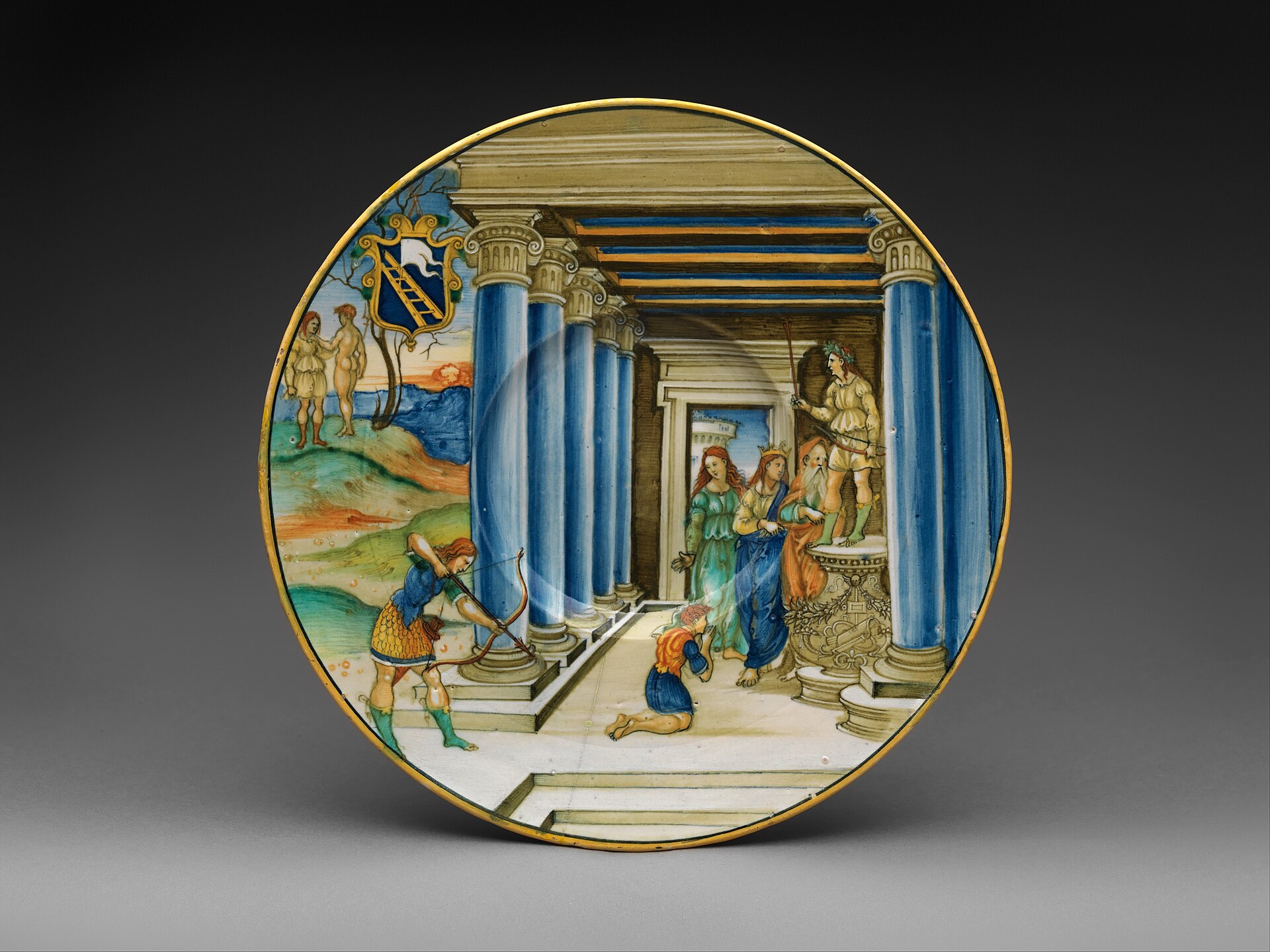
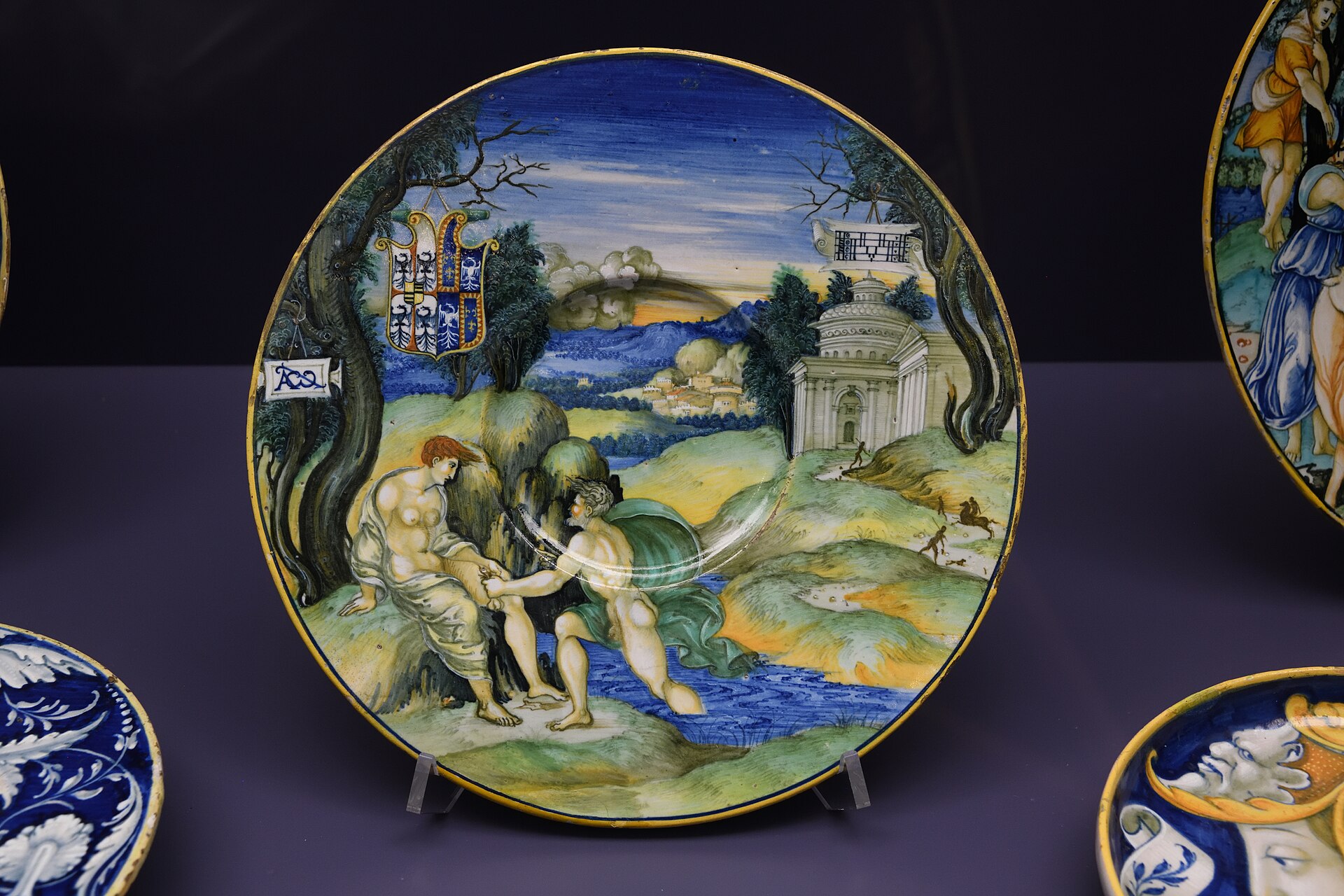
The Getty's own armorial dish attributed to Nicola, painted for the Calini family of Brescia and showing the flaying of Marsyas, belongs to a second and different tier of eleven known survivors, a dinner service made for a family of jurists rather than for a ruling house, now scattered across institutions in five countries: the Metropolitan Museum, the British Museum, the Musee national de la Renaissance at the Chateau d'Ecouen, and National Museums Scotland, which holds five pieces, the largest single surviving group. That a wealthy professional Brescian family could commission the same quality of istoriato ware, from the same workshop, that a Marchioness of Mantua was buying is itself evidence of how far the market for painted narrative tableware had spread beyond the courts by the 1520s.
A dish attributed to Nicola showing Europa and the bull, also bearing Calini arms, was offered at TEFAF Maastricht by the dealer Justin Raccanello with an asking price of about 1.5 million euros, reported in 2023. Whether this piece should be counted as a twelfth survivor of the same eleven-piece service already on record, or was always counted among those eleven under a description this record has not matched, is left open rather than resolved by assumption.
A period price means little without a comparison from the same market and the same years.
A period price means little without a comparison from the same market and the same years. In 1530 the agent of Federico Gonzaga, Duke of Mantua, could buy nearly a hundred pieces of Urbino istoriato maiolica for 25 scudi. In 1525-26 a silver-gilt salt designed by the artist Giulio Romano for the same duke cost 31 ducats in materials plus 20 ducats for the goldsmith's labour, not counting Giulio Romano's own fee. A ducat and a scudo were close enough in value that a single elaborate silver-gilt salt, made by a named and prestigious artist, cost roughly as much as two hundred good pieces of the painted earthenware a duchess called a thing for the countryside. Istoriato maiolica was a real outlay for the family that ordered a service, and it was still, in the same court, at the same moment, a small fraction of the cost of a comparable object in precious metal.
Two different kinds of gap run through everything known about this painter, and they should not be mistaken for each other.
Two different kinds of gap run through everything known about this painter, and they should not be mistaken for each other. The first is biographical: no birth record, no training record, and no owner is documented for most individual objects between their creation in the 1520s or 1530s and their appearance in a modern collection, a gap that runs to centuries on more than one of the pieces named on this page. The second is methodological: the corpus itself, even after the 1985 correction gave the painter back his real name, remains an argument conducted in print by a small number of specialists who still disagree, as recently as 2015 and 2019, about which unsigned plates belong in it at all.
Neither gap is a failure of research. They are what is left when a painter who ran a substantial and celebrated workshop chose, or was expected by the conventions of his trade, to sign almost nothing he made. The 1985 correction proved that even a name can be recovered from the archive when someone looks hard enough. It did not, and could not, settle which hand actually held the brush on any given unsigned plate, and nobody now working on Nicola da Urbino claims that it did.
Maiolica painter; Workshop owner. about 1480 - 1537/1538.
Born about 1480, Urbino, presumed but not documented. No birth record survives; the working name Nicola da Urbino ties him to the city where he ran a workshop from 1520, not to a confirmed birthplace; died end of 1537 or January 1538, Urbino. There is no evidence he ever worked anywhere else.
J. Paul Getty Museum (Los Angeles); Metropolitan Museum of Art (New York); Victoria and Albert Museum (London); British Museum (London); Fitzwilliam Museum (Cambridge); Museo Correr (Venice).
Prices for maiolica attributed to Nicola da Urbino are shaped by the same attribution uncertainty this page describes throughout. Market commentary notes that work confidently given to his younger contemporary Francesco Xanto Avelli, who signed and dated most of his mature output, can command a premium precisely because a buyer knows what they are getting; an unsigned dish given to Nicola is always, to some degree, a purchase of connoisseurship rather than of a documented fact.Even so, the two highest prices ever recorded at auction for a piece of Italian Renaissance maiolica of any attribution have both gone to work attributed to Nicola da Urbino, and both were early, previously unrecorded dishes that surfaced from private houses rather than from known collections.
What is the currently accepted number of works in Nicola's corpus, and how does it compare with Mallet's 2007 count? This record could not obtain Mallet's original Faenza article to verify the widely repeated figure of about 128 dishes.
Last verified
One artwork and its story every Tuesday, with the picture: who owned it, what it made, and what closes soon in the exhibition calendar. No promotion, and nothing we cannot cite.
We send one email to confirm the address and keep nothing else. Every letter carries a one-click unsubscribe. How we handle your data.