Armorial Dish with the Flaying of Marsyas
Nicola di Gabriele Sbraghe (or Sbraga), known as Nicola da Urbino · mid-1520s
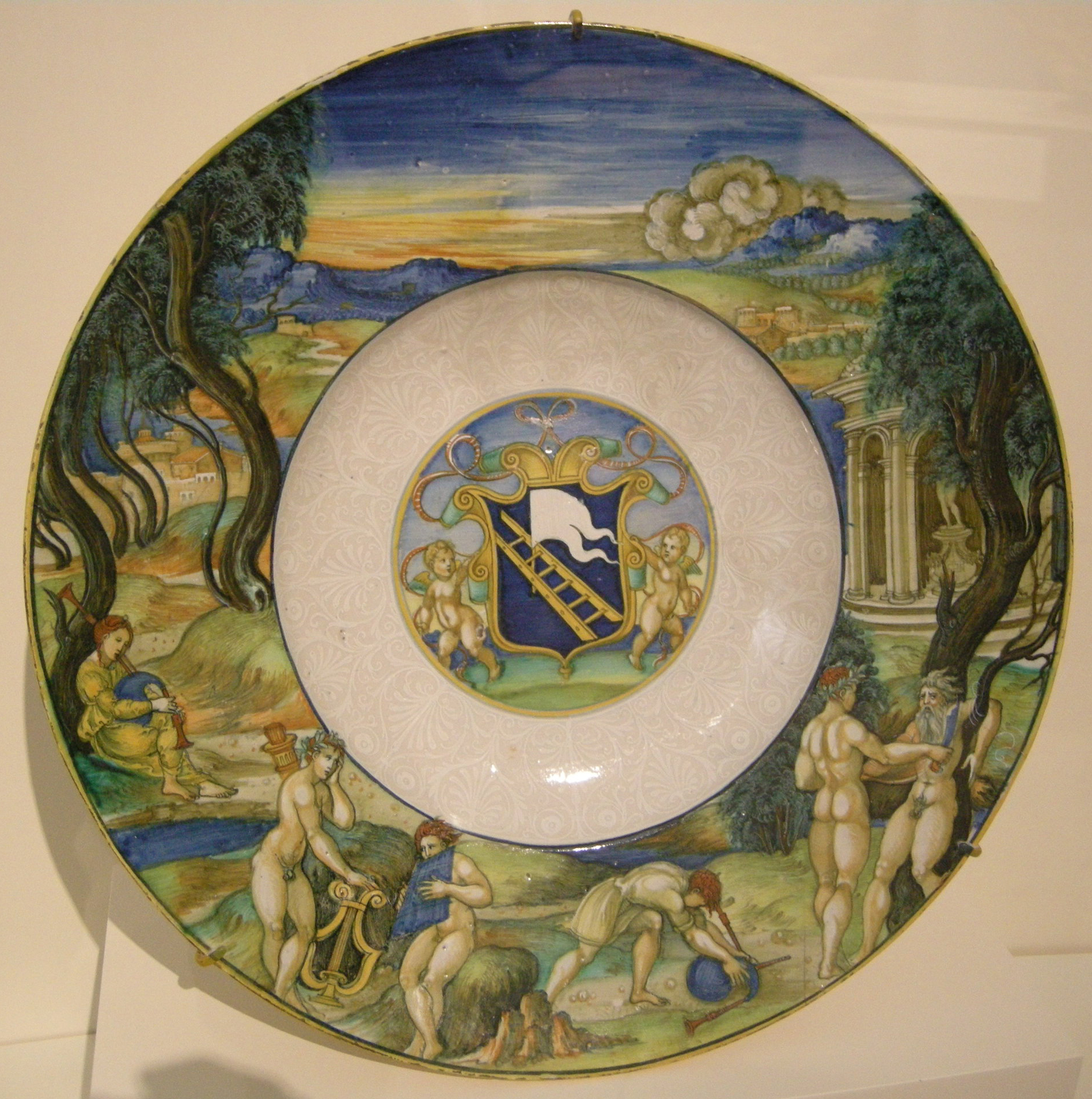
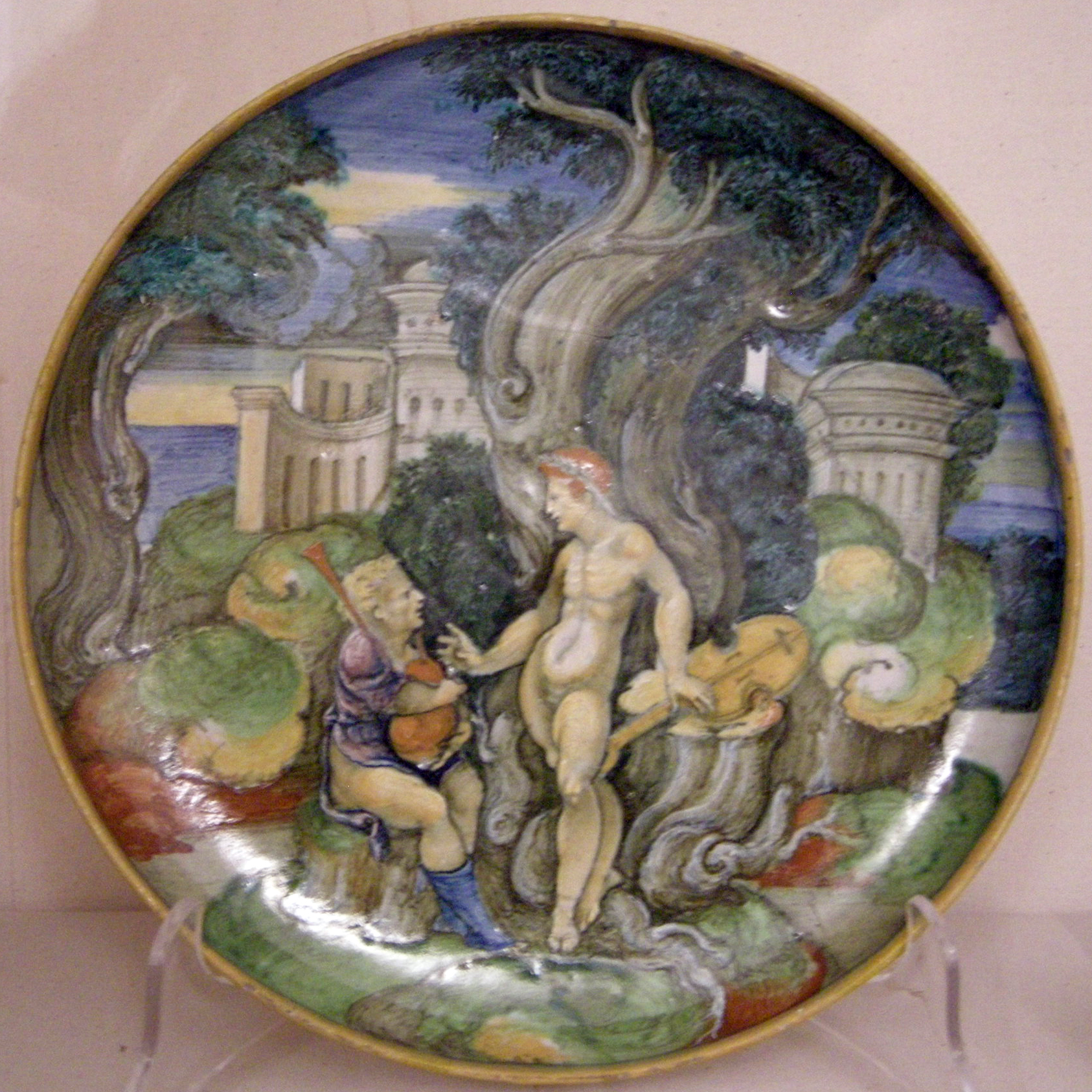
The record subject, photographed at the Getty Center. Tin-glazed earthenware, mid-1520s, Urbino. Getty accession 84.DE.117.
Photograph by Sailko, via Wikimedia Commons, CC BY-SA 3.0. Object: J. Paul Getty Museum, Los Angeles.| Artist | Nicola di Gabriele Sbraghe (or Sbraga), known as Nicola da Urbino |
|---|---|
| Date | mid-1520s |
| Medium | Tin-glazed earthenware (maiolica), istoriato-painted with bianco sopra bianco (white-on-white) border decoration |
| Dimensions | 5.7 x 41.4 cm (2 1/4 x 16 5/16 in.) |
| Where it is now | J. Paul Getty Museum, Los Angeleslast confirmed |
| Inventory number | 84.DE.117 |
| Attribution | AcceptedThe J. Full note |
| Object type | Ceramic |
| Period | Italian Renaissance, Urbino, 1520s |
| Cases | Has a provenance gap |
| Inscriptions | None. No signature, monogram, date, or verse appears on the dish or its reverse. |
| Owners on record | 4 links3 documented, 1 unknown |
| Sources | 13 cited |
About this record Last verified · 13 sources cited · Change log
On this page 9 sections
ContentsClose
A shallow armorial dish painted in Urbino in the mid-1520s with the arms of the Calini family of Brescia and, around the rim, the flaying of the satyr Marsyas from Ovid's Metamorphoses. It is one of eleven known survivors of a dinner service made for a family of jurists rather than princes, now scattered across five countries. It is catalogued to Nicola da Urbino, one of the two painters who defined istoriato maiolica in the 1520s, but the man himself signed almost nothing and was not correctly identified by name until 1986.
The dish's real subject, for a record like this one, is not only Marsyas. It is what it takes to attribute an unsigned object made in a workshop town where two of the greatest painters of the age, Nicola da Urbino and Francesco Xanto Avelli, were working side by side in the very years this plate was painted, one of them leaving almost no trace of his hand in writing and the other not yet signing his own work at all.
Provenance
Each link is graded. Documented: a cited source supports it. Disputed: the identification is argued but not established. Unknown: no owner for that span, and the gap is not smoothed into a narrative. The grades in the glossary.
- mid-1520s -The Calini family of Bresciadocumented
The dish bears the arms of the Calini, a family of jurists from Brescia, at its center, and belongs to a dinner service made for them in Urbino. The Musee national de la Renaissance, which holds a companion piece from the same service, proposes the commission may have marked the birth of Muzio Calini, son of Luigi Calini, in 1525; this occasion is offered by the museum as a possibility, not a documented fact, and no contract or family record confirming it has been located in the sources consulted.12715
- mid-1520s - by 1984Unknownunknown
No owner is documented between the Calini commission and the dish's appearance with a London dealer in 1984, a gap of roughly four and a half centuries. A companion piece from the same service, now at the Metropolitan Museum of Art, was already in a New York collection by 1884, which shows the service was broken up and in the trade at least a century before this piece surfaces in the record; nothing found ties the two histories together.8
- by 1984 - 1984Rainer Zietz Limited, Londondocumented
Sold to the J. Paul Getty Museum in 1984 by the London dealer Rainer Zietz Limited, a firm dealing in European sculpture, ceramics, glass and silver. This sale supplied a substantial part of the Museum's founding group of Italian maiolica, published in 1988 and again, expanded, in 2002 as the Museum's standing catalogue of the collection. The price paid has not been published in the sources consulted.1210
- 1984 - presentJ. Paul Getty Museum, Los Angelesdocumented
Accessioned as 84.DE.117. As of the most recent archived description of the object consulted for this record, the dish was on view at the Getty Center, Museum North Pavilion, Gallery N101; current display status was not independently reverified at time of writing.12
Technical evidence
| Attribution note | The J. Paul Getty Museum attributes this dish to Nicola da Urbino without qualification. The attribution rests entirely on connoisseurship: Nicola signed almost nothing, and the name under which he is catalogued was itself unknown until the 1980s. For roughly a century he was called Nicola Pellipario, a person shown in 1986 never to have existed. His documented working companion in Urbino through the exact years this dish was painted, Francesco Xanto Avelli da Rovigo, worked in a closely related manner and left no securely signed and dated work before 1530, which is the reason the wider corpus of unsigned mid-1520s Urbino istoriato ware, this piece included, remains a matter of expert judgment rather than record. |
|---|---|
| Body and glaze | Tin-glazed earthenware (maiolica), made in Urbino. The opaque white ground is produced by a lead glaze fired with added tin oxide, an imported and costly material.19 |
| Dimensions | 5.7 x 41.4 cm (2 1/4 x 16 5/16 in.), overall.1 |
| Decorative technique | Istoriato narrative painting on the wide rim, with a band of bianco sopra bianco (opaque white ornament raised on the white ground) separating the rim scene from the central armorial shield.12 |
| Iconographic source | Figures adapted from woodcuts in an illustrated Italian-language edition of Ovid's Metamorphoses (Bonsignori's translation), first printed in Venice in 1497 and reprinted into the early sixteenth century; a copy of a related 1501 printing is held by the Metropolitan Museum of Art.128 |
| Heraldry | Arms of the Calini family of Brescia at center: a blue field crossed by a gold ladder with a small forked white pennant between two rungs, supported by putti.12 |
| Inscriptions | None present. This absence is itself diagnostic: Nicola da Urbino is not known to have signed or dated his work, unlike his younger contemporary Francesco Xanto Avelli, whose pieces from 1530 onward routinely carry a signature, place, date and verse.156 |
| Painting process | Pigments were applied directly onto the dry, unfired tin glaze, a surface that absorbed color immediately and allowed little correction, requiring the painter to work fluently and without extensive revision.9 |
Images
The record in full
Chapter 1What it is
A shallow dish of tin-glazed earthenware, 41.4 centimetres across and only 5.7 centimetres deep, made to sit on a table rather than hang on a wall.
A shallow dish of tin-glazed earthenware, 41.4 centimetres across and only 5.7 centimetres deep, made to sit on a table rather than hang on a wall. At its center is a painted shield bearing the arms of the Calini family of Brescia: a blue field crossed by a gold ladder with a small forked white pennant threaded between two of its rungs, held by putti. Around that shield runs a narrow band of bianco sopra bianco, opaque white ornament raised on the white tin glaze itself, a refinement particular to the best Urbino ware of this period and easy to miss in photographs taken at any distance. The wide outer rim carries the istoriato scene proper: a continuous narrative band showing four moments from a single myth, read left to right around the circumference of the plate.
Nothing about the object announces a maker's name. There is no signature, no monogram, no painted date, no verse on the reverse of the kind that later Urbino painters, Francesco Xanto Avelli above all, made routine. Everything known about who painted it, and when, is inferred from the painting itself, from its place in a larger service, and from what has been reconstructed about the workshop that produced it.
Chapter 2The myth on the rim
The scenes come from Ovid's Metamorphoses, Book VI: the contest of skill and hubris between the satyr Marsyas and the god Apollo.
The scenes come from Ovid's Metamorphoses, Book VI: the contest of skill and hubris between the satyr Marsyas and the god Apollo. On the far left Athena is shown playing the pipes she invented and then discarded, having noticed in a reflection how the instrument distorted her face. Marsyas finds the discarded pipes and takes up the skill Athena renounced. He is then shown in a musical contest with Apollo, playing before the god on the pipes against Apollo's lyre. On the far right comes the consequence: a triumphant Apollo, having won, ties the satyr to a tree and flays him alive as punishment for daring to challenge a god. Ovid gives Marsyas a single line of protest as the knife does its work, asking why he is being torn from himself; nothing on the dish quotes it, but the painter has chosen to show the moment of punishment rather than stopping at the contest itself, and the sequence only makes sense as a warning against exactly the kind of overreach Marsyas is guilty of.
The figures are not invented from life. They are adapted from woodcuts in an illustrated edition of Bonsignori's Italian translation of the Metamorphoses, printed in Venice at the end of the fifteenth century and reprinted into the first years of the sixteenth, a book that supplied compositions to istoriato painters across Urbino, Castel Durante and Faenza for a generation. Painters working from the same printed source repeatedly is one of the reasons attribution in this field is so difficult: two dishes with visibly related compositions can be the work of two different hands who simply opened the same book.
The subject itself was a common choice for a dining service and not an idiosyncratic one. A myth about the punishment of pride, told across the rim of a dish that would have been set before guests at table, carried an unmissable moral for anyone eating from it: know your place, and do not compete with your betters. Nothing in the sources consulted suggests the Calini chose the subject for any more specific or private reason than that ordinary and very legible moral function, which a family of jurists, professionally in the business of judgment and rank, had every reason to want repeated at their own table.
Chapter 3How istoriato ware was made
A maiolica workshop of this period employed roughly eight people under a master potter, each with a distinct task: digging and refining clay, throwing or moulding the body, mixing and firing the...
A maiolica workshop of this period employed roughly eight people under a master potter, each with a distinct task: digging and refining clay, throwing or moulding the body, mixing and firing the kiln, preparing the tin glaze, and painting. Tin oxide, the ingredient that gave the ware its opaque white ground, was an imported and genuinely expensive material, which is part of why maiolica cost more than ordinary pottery and why an armorial commission was a substantial outlay for the family that ordered it, not a routine purchase.
Painting was done directly onto the dry, unfired tin glaze, a surface that absorbed pigment immediately and forgave almost no correction; a painter had to commit to a line the first time he laid it down. This is worth stating plainly because it bears directly on attribution: the confident, fluent draughtsmanship visible in finished istoriato ware is not a stylistic flourish that can be faked by a slow or careful hand working from a model. It required real facility, which is one of the reasons connoisseurs treat this Urbino production of the 1520s, unsigned as almost all of it is, as the work of a small number of identifiable, highly skilled individuals rather than an anonymous trade output.
Chapter 4A painter without a name
The single strangest fact about the artist this dish is attributed to is that his real name was not known for roughly four hundred and fifty years.
The single strangest fact about the artist this dish is attributed to is that his real name was not known for roughly four hundred and fifty years. Pieces inscribed simply Nicola da Urbino, a working name tied to a place rather than a family, had accumulated around a reconstructed personality that early twentieth-century scholarship called Nicola Pellipario, a name built on a documentary connection to an unrelated family of that surname. It was treated as settled fact in the literature for decades.
In 1986 the Italian scholar Franco Negroni published an article whose title translates as Nicolo Pellipario: Phantom Ceramicist, demonstrating that the Pellipario identity did not hold up against the Urbino archives. The painter actually recorded as running his own workshop in Urbino from 1520, called maestro in the documents, was Nicola di Gabriele Sbraghe, also given as Sbraga. The Getty's own collection database states the position plainly: until the 1980s, when he was identified in the Urbino archives as Nicola di Gabriele Sbraghe, the identity of the man who signed his works Nicola da Urbino remained unknown. Every label on every museum wall bearing his name, including the one attached to this dish, is downstream of that 1986 correction.
What survives about him beyond the name is thin. He is called maestro and workshop owner in the Urbino records from 1520; he died at the end of 1537 or in January 1538. Almost nothing else of his personal life, his training, or his family is documented. The entire modern reputation of Nicola da Urbino, sometimes called the Raphael of maiolica painting for the sophistication and restraint of his figure drawing, rests on a corpus assembled by connoisseurship around a name that scholarship spent most of the twentieth century getting wrong.
Chapter 5The problem of the unsigned hand
Nicola da Urbino was not working alone in Urbino in the 1520s.
Nicola da Urbino was not working alone in Urbino in the 1520s. Francesco Xanto Avelli da Rovigo, a painter and poet who arrived in the city around 1521 or 1522, worked in close proximity to him through exactly the years this dish was painted, drawing on the same printed sources and, for part of the decade, using the pipes of Xanto's own initials as F.R. rather than his full name. Xanto is not known to have signed and dated a work before 1530; the weight of scholarly opinion nonetheless attributes unsigned work back to around 1524 to his hand, without unanimous agreement on which unsigned pieces those are.
The standard modern attempt to sort the two painters' output is J.V.G. Mallet's 2007 study Nicola da Urbino and Francesco Xanto Avelli, published in the journal Faenza, which catalogues roughly 128 dishes given to Nicola either as painter or as the source of the design. Later work in Nicola's accepted corpus, from about 1528 onward, shows warmer flesh tones than the cooler, more blue-dominated palette of his earlier 1520s pieces, a stylistic marker scholars use to help separate hands and periods within an unsigned production. This dish, dated only to the mid-1520s, falls before that later shift and inside the very years when Nicola and Xanto's work is hardest to tell apart.
Two things should be said plainly and separately here, because conflating them would be exactly the kind of error this record exists to avoid. First, the general difficulty of distinguishing Nicola's early hand from Xanto's is real, published, and named: it is the subject of Mallet's monograph and is acknowledged across the museum and dealer literature on Urbino maiolica of this decade. Second, no source located for this record singles out this specific dish, or the Calini service it belongs to, for an individual reattribution dispute between the two painters, or for a formal workshop qualification such as circle of or attributed to; the Getty catalogues it to Nicola da Urbino without a hedge. The honest position is that the dish sits inside a genuinely and publicly contested zone of connoisseurship without itself being a documented flashpoint in that argument, and a future cataloguer with access to Mallet's full 2007 appendix, which was not obtainable for this record, may be able to say more.
Chapter 6Nicola's other clients
Whoever he was, the painter given this name worked for the most prominent collectors of his generation.
Whoever he was, the painter given this name worked for the most prominent collectors of his generation. Around 1524 he supplied a maiolica service bearing the joint arms of Isabella d'Este, Marchioness of Mantua, and her late husband Francesco II Gonzaga; a plate from it is in the Victoria and Albert Museum, London. He later painted for her son Federico II Gonzaga, first Duke of Mantua: the Metropolitan Museum holds a large dish from around 1521 showing Pope Leo X presenting Federico with the baton of Captain General of the Church, and the Kunstgewerbemuseum in Berlin holds further pieces from a Gonzaga service depicting the foundation myth of Mantua and the rape of Europa.
Set against that princely clientele, the Calini commission represents a different, and historically more interesting, tier of patron. The Calini were jurists, not rulers; a wealthy professional Brescian family buying the same quality of istoriato ware, from the same painter, that a Marchioness of Mantua was buying, is itself a small piece of social history about how far up the market for painted narrative tableware had spread by the 1520s.
Chapter 7The Calini service and its dispersal
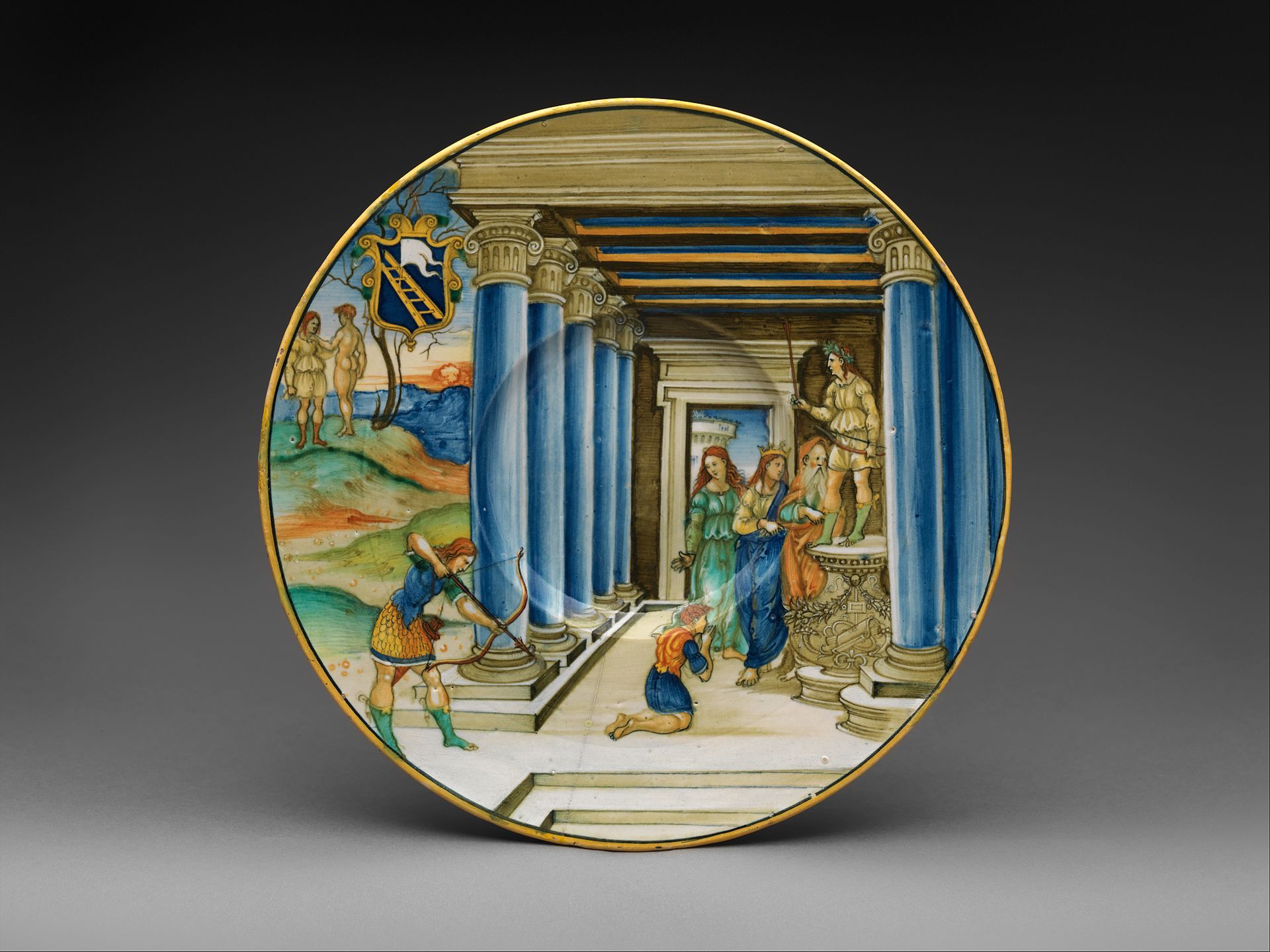
Eleven pieces of the Calini service are known today, according to the Musee national de la Renaissance at the Chateau d'Ecouen, which holds one of them: a dish showing the sacrifice of Iphigenia.
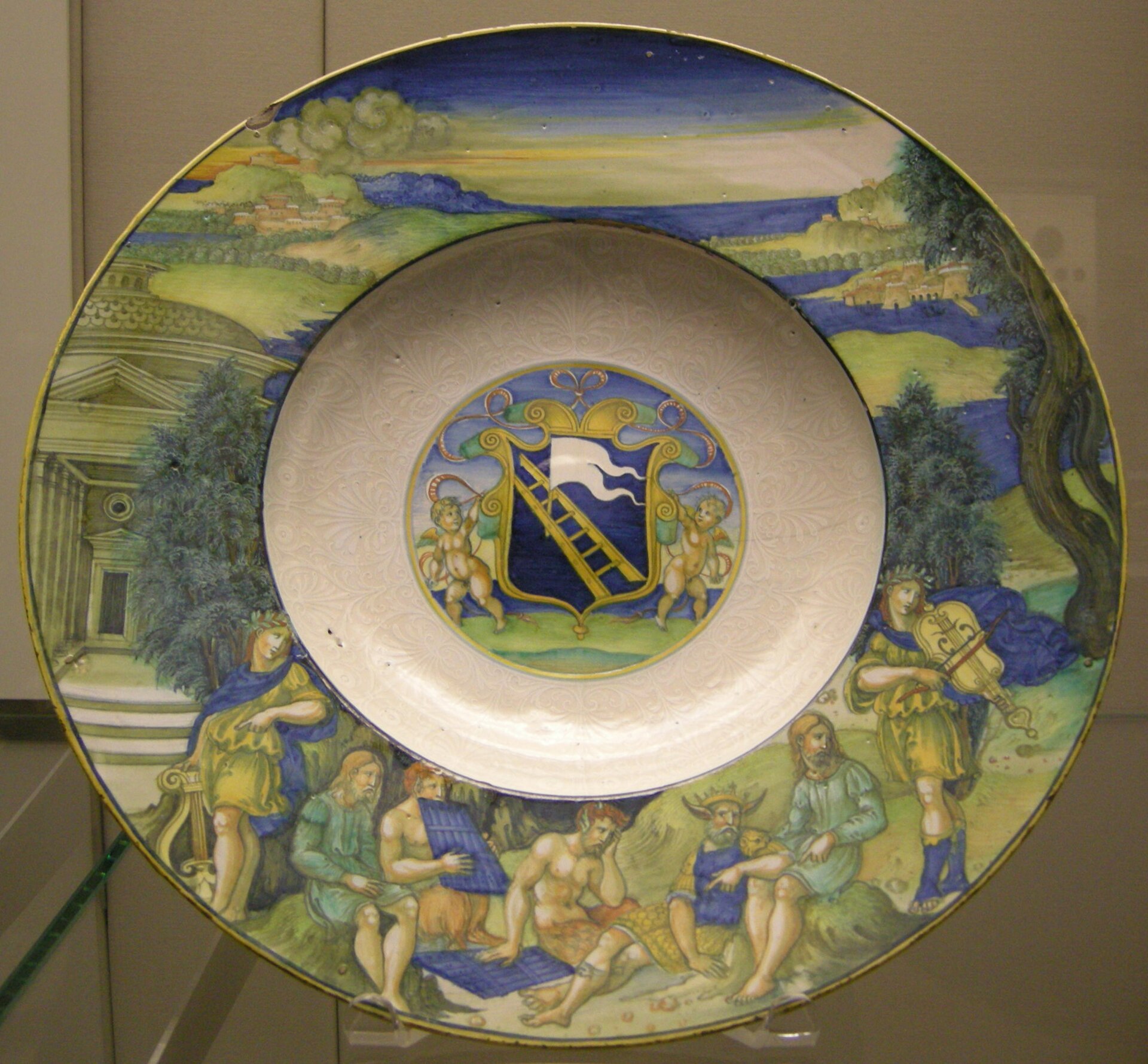
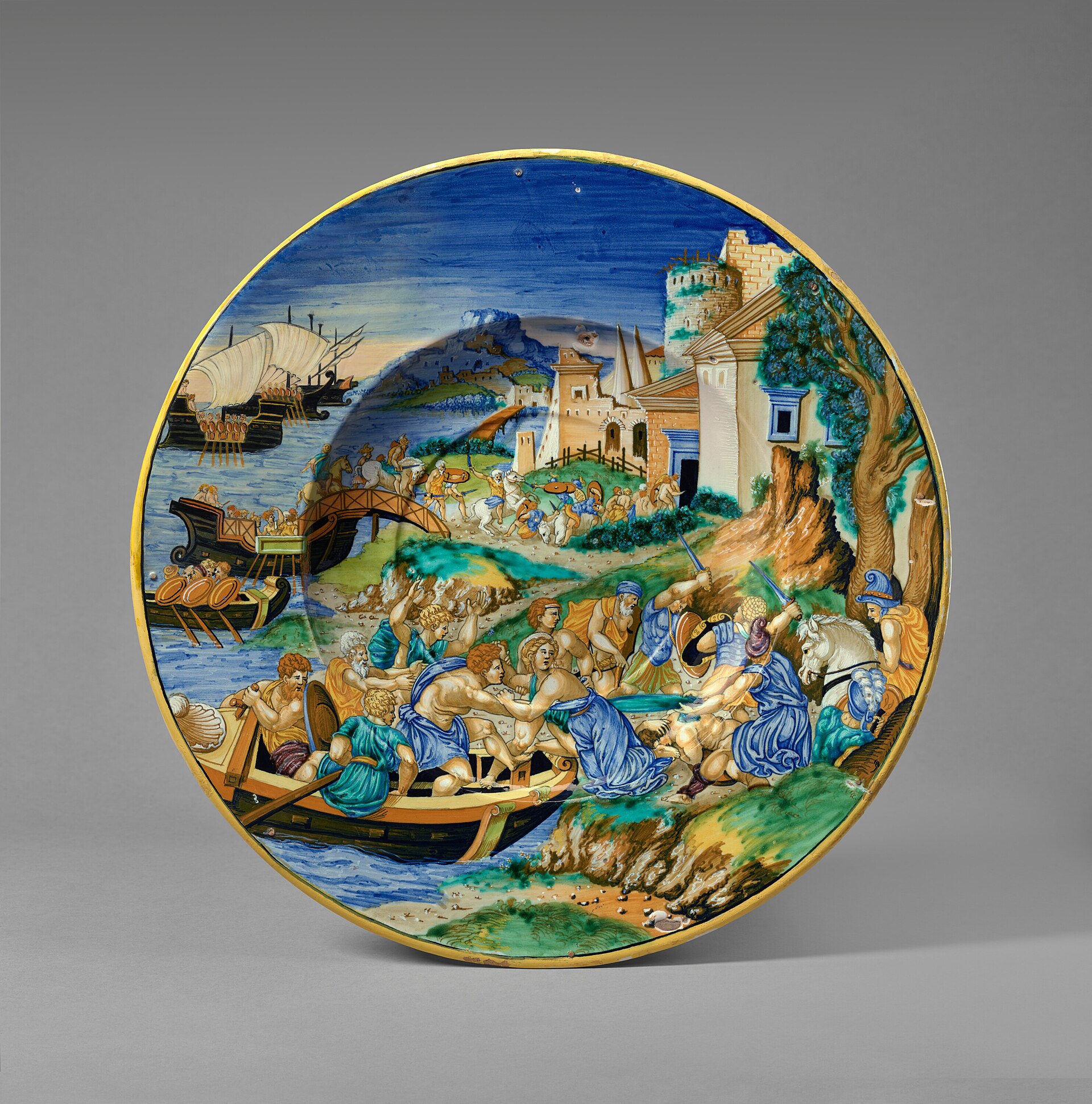
Eleven pieces of the Calini service are known today, according to the Musee national de la Renaissance at the Chateau d'Ecouen, which holds one of them: a dish showing the sacrifice of Iphigenia. Five more are in National Museums Scotland, forming the largest single surviving group, including scenes of Perseus and Andromeda, Saint George and the Dragon, and the punishment of Phalaris. The British Museum holds a dish from the same service showing the musical contest of Pan and Apollo, a different scene from the one on the Getty's dish though drawn from the same broad vein of Ovidian subject matter. The Metropolitan Museum's example, showing Paris killing Achilles, entered that museum's collection in 1884, decades before Nicola da Urbino's correct name was even known and long before the Getty entered the market for maiolica at all, which shows the service was already broken apart and circulating in the trade in the nineteenth century.
No source consulted for this record accounts for how or when the service was first dispersed, or what happened to any of the remaining pieces of what would originally have been a much larger set; a full dinner service of this class regularly ran to several dozen individual pieces, of which eleven survivors, however geographically scattered, still represent only a fraction.
Chapter 8What is still unresolved
Two different kinds of gap sit inside this record, and they should not be mistaken for one another.
Two different kinds of gap sit inside this record, and they should not be mistaken for one another. The first is a plain provenance gap: nobody has published where this dish was for roughly four and a half centuries between the Calini household and its appearance with a London dealer in 1984. The second is a methodological gap: the attribution to Nicola da Urbino, though stated without qualification by the Getty, rests on a body of connoisseurship that its own leading scholar has spent decades refining and that remains, by the nature of unsigned workshop production, an argument rather than a settled fact for pieces of exactly this date. Neither gap has been closed by anything found in the course of researching this record, and neither should be quietly smoothed over in the writing of it.
The artist
Nicola di Gabriele Sbraghe (also given as Sbraga), known as Nicola da Urbino
For most of the twentieth century, museums and scholars called this painter by a name that belonged to nobody. He signed almost nothing, and the identity built up around his workshop name, Nicola da Urbino, was for decades attached to an invented person, Nicola Pellipario, until archival research in the 1980s took the invented name away and gave the workshop back its real owner: Nicola di Gabriele Sbraghe, recorded running his own shop in Urbino from 1520. Everything said about him, including the attribution of this dish, follows from that correction.
Related works
| Work | Relation | Where it is |
|---|---|---|
| Plate with Paris Killing Achilles and arms of the Calini family Nicola da Urbino (Nicolo da Gabriele Sbraghe) | Sibling dish from the same Calini service A different scene from the same original dinner service. Entered the Met's collection in 1884, showing the service was already dispersed in the trade in the nineteenth century. | Metropolitan Museum of Art, New York (84.3.2) |
| Dish with the Contest of Pan and Apollo, arms of the Calini family Nicola da Urbino | Sibling dish from the same Calini service A different musical-contest myth from the same service; not the Marsyas subject shown on the Getty dish, though thematically related. | British Museum, London |
| Dish with the Sacrifice of Iphigenia, arms of the Calini family Nicola da Urbino | Sibling dish from the same Calini service One of five pieces cited by this museum among the eleven Calini pieces currently known. | Musee national de la Renaissance, Chateau d'Ecouen |
| Plate with the Abduction of Helen Francesco Xanto Avelli | Not from the Calini service. A securely signed and dated 1534 work by the painter whose early unsigned output is hardest to separate from Nicola da Urbino's Included here as the documented comparandum for the attribution problem discussed in this record, not as a related object in the Calini service. | J. Paul Getty Museum, Los Angeles (84.DE.118) |
| Armorial plate with Apollo and Marsyas Nicola da Urbino | A separate, later treatment of the same myth by the same attributed hand, about 1530-34 Confirms Nicola's workshop returned to the Marsyas subject more than once. This is a different object from the Getty dish, made roughly five to ten years later. | Musei Civici, Pesaro |
Open questions
- Where was the dish between its creation in the mid-1520s and its appearance with a London dealer in 1984? No owner is documented for roughly four and a half centuries.
- Was this specific dish painted by Nicola da Urbino himself, or by an assistant in the workshop he is recorded as owning from 1520? The Getty's attribution carries no such qualification, but no piece-by-piece published discussion of the Calini service against Mallet's 2007 attribution criteria was located for this record.
- Did the Calini commission genuinely mark the 1525 birth of Muzio Calini, as the Musee national de la Renaissance proposes, or was it ordered for some other family occasion? The museum itself frames this as a possibility, not a documented fact.
- How many pieces of the original Calini service remain unidentified? A dinner service of this class typically ran to several dozen pieces; eleven known survivors, however widely admired, are very unlikely to be the complete set.
- What price did the Getty pay Rainer Zietz Limited in 1984? This figure has not been published in the sources consulted.
- When and through whose hands did the service first break apart? The Metropolitan Museum's piece was already in New York by 1884, which places the dispersal in the nineteenth century at the latest, but no source found identifies who broke the service up or when.
- The exact publication year of Negroni's Nicolo Pellipario: Ceramista fantasma is given inconsistently across sources (Wikipedia cites 1985; a WorldCat-style search independently found the journal issue Notizie da Palazzo Albani 14 dated 1986) and the original article itself could not be fetched to resolve it; likewise Mallet's 2007 Faenza catalogue of roughly 128 Nicola da Urbino dishes is widely cited in secondary literature but could not be independently verified against the original journal text, so the specific dish-count figure has been left out of this record rather than asserted on secondary authority alone.
Questions about this object
What is Armorial Dish with the Flaying of Marsyas?
Armorial Dish with the Flaying of Marsyas is a ceramic, dated mid-1520s. Medium: Tin-glazed earthenware (maiolica), istoriato-painted with bianco sopra bianco (white-on-white) border decoration.
Who made Armorial Dish with the Flaying of Marsyas, and is the attribution settled?
The attribution to Nicola di Gabriele Sbraghe (or Sbraga), known as Nicola da Urbino is recorded here as accepted. The J. Paul Getty Museum attributes this dish to Nicola da Urbino without qualification. The attribution rests entirely on connoisseurship: Nicola signed almost nothing, and the name under which he is catalogued was itself unknown until the 1980s. For roughly a century he was called Nicola Pellipario, a person shown in 1986 never to have existed. His documented working companion in Urbino through the exact years this dish was painted, Francesco Xanto Avelli da Rovigo, worked in a closely related manner and left no securely signed and dated work before 1530, which is the reason the wider corpus of unsigned mid-1520s Urbino istoriato ware, this piece included, remains a matter of expert judgment rather than record.
Where is Armorial Dish with the Flaying of Marsyas now?
J. Paul Getty Museum, Los Angeles. Inventory number 84.DE.117. Last confirmed 11 August 2026. Purchased 1984 from the London dealer Rainer Zietz Limited, as part of the founding group of Italian maiolica that established the Museum's ceramics collection.
What is still unknown about Armorial Dish with the Flaying of Marsyas?
Where was the dish between its creation in the mid-1520s and its appearance with a London dealer in 1984? No owner is documented for roughly four and a half centuries.
Sources
- 1J. Paul Getty Museum, 'Armorial Dish with the Flaying of Marsyas,' Museum Collection Online, object 84.DE.117. getty.edu/art/...
- 2J. Paul Getty Museum, 'Armorial Dish with the Flaying of Marsyas,' archived object page with full curatorial description, via Wayback Machine. web.archive.org/web/...
- 3J. Paul Getty Museum, artist biography for Nicola di Gabriele Sbraghe (or Sbraga), known as Nicola da Urbino, archived via Wayback Machine. web.archive.org/web/...
- 4J. Paul Getty Museum, 'Plate with the Abduction of Helen,' Museum Collection Online, object 84.DE.118. getty.edu/art/...
- 5Wikipedia, 'Nicola da Urbino.' source, consolidating the Pellipario/Negroni correction and the Isabella d'Este service; with Negroni 1986 and Mallet 2007 directly. en.wikipedia.org/wiki/...
- 6Wikipedia, 'Francesco Xanto Avelli.' source, for his arrival in Urbino, his signing practice, and the dating of his earliest unsigned work; with Mallet 2007. en.wikipedia.org/wiki/...
- 7Musee national de la Renaissance, Chateau d'Ecouen, 'Arts du feu' collection page, entry for the Calini service dish with the Sacrifice of Iphigenia. musee-renaissance.fr/arts-du-feu-61
- 8Metropolitan Museum of Art, 'Plate with Paris Killing Achilles and arms of the Calini family,' object 84.3.2. metmuseum.org/art/...
- 9Jessie McNab, 'Maiolica in the Renaissance,' Heilbrunn Timeline of Art History, Metropolitan Museum of Art, October 2002. metmuseum.org/essays/...
- 10British Antique Dealers' Association, dealer profile for Rainer Zietz Ltd. bada.org/dealer/...
- 11Wikimedia Commons, file and licence metadata for the lead photograph of the Getty dish (photographer Sailko). commons.wikimedia.org/wiki/...
- 12Wikimedia Commons, Category: Maiolica in the Getty Center. commons.wikimedia.org/wiki/...
- 15Wikipedia, 'Muzio Calini,' for confirmation of his 1525 birth in Brescia. en.wikipedia.org/wiki/...

Last verified · Published
Change log
11 August 2026 - Record created at the house standard: researched narrative, technical evidence, maker dossier, graded provenance chain, prices with hammer and premium separated, related works, open questions and sources.