Michelangelo Buonarroti
 Florentine · 1475-1564
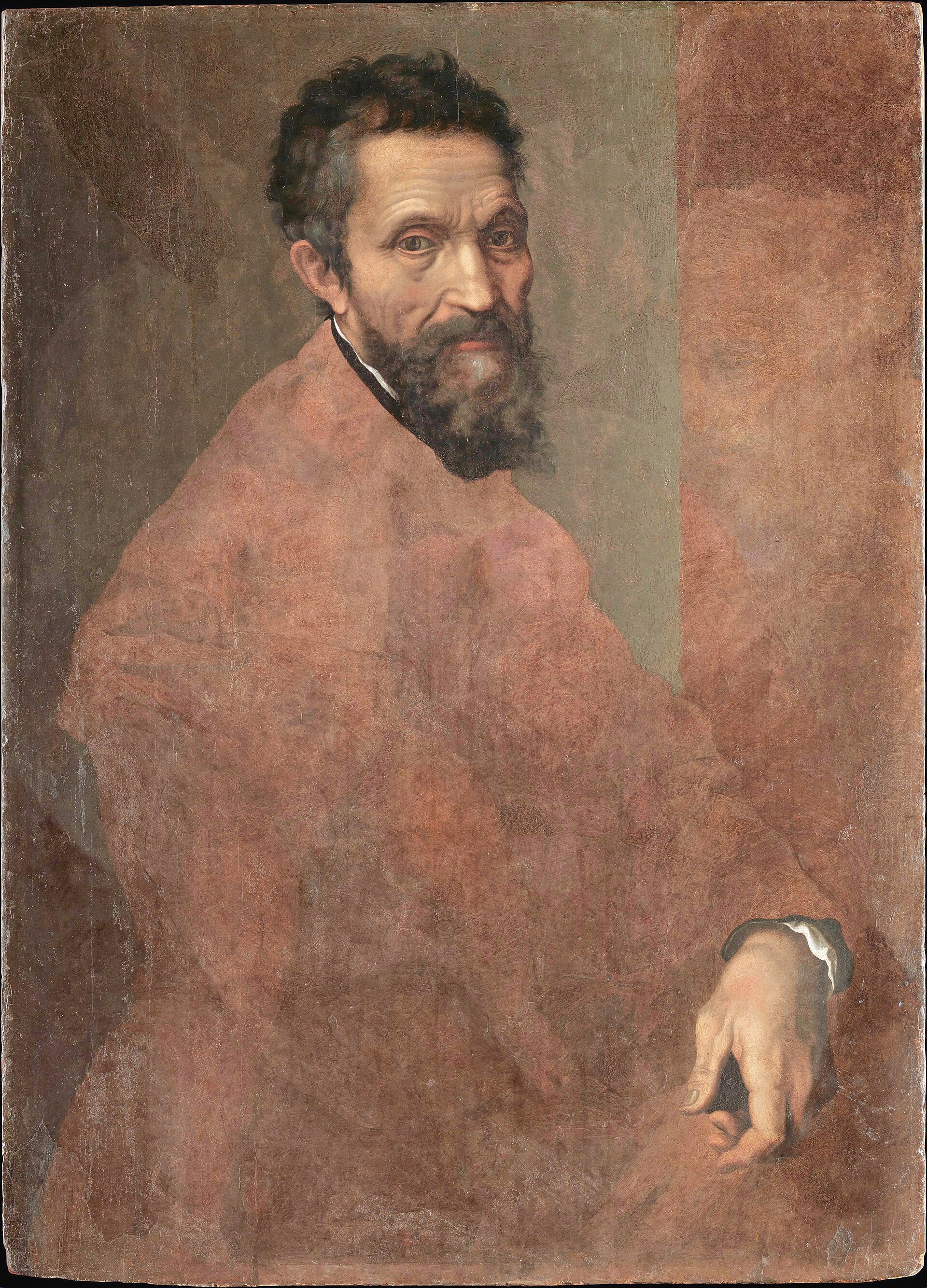
Unfinished portrait of Michelangelo, oil on wood, attributed to Daniele da Volterra, a younger friend of Michelangelo who later modelled a bronze bust of him from a death mask. An inventory of Volterra's studio taken after his own death lists a portrait of Michelangelo on panel, generally identified with this picture. The identification of the sitter as Michelangelo is not in question; the attribution of the painting itself to Volterra's own hand is given as probable, not certain, which is consistent with the panel's unfinished state.
Metropolitan Museum of Art, New York, gift of Clarence Dillon, 1977 (accession 1977.384.1)| Full name | Michelangelo di Lodovico Buonarroti Simoni |
|---|---|
| Worked as | Sculptor, Painter, Architect, Poet |
| Born | 6 March 1475 · Caprese, Republic of Florence (now Caprese Michelangelo... |
| Died | 18 February 1564 · Rome, aged 88 |
| Nationality | Florentine |
| Movement | High Renaissance |
| Sources | 22 cited |
| Last verified |
About this page Last verified · 22 sources cited
On this page 13 sections
ContentsClose
Michelangelo is the artist whose fame makes him hardest to see clearly. The name carries the David, the Sistine ceiling and the Pieta so completely that it is easy to forget how much of his actual output is contested, lost, or both. He is recorded as having burned a large part of his own working papers shortly before he died specifically so later students could not reconstruct his method, which means the drawings that survive - somewhere around six hundred sheets, out of a working life of some seventy-seven years - are the deliberately curated remnant of a much larger and now unrecoverable body of paper. Whether any given sheet is genuinely his hand is argued case by case in the literature to this day, most recently and most expensively in February 2026, when a small red-chalk study surfaced from a family collection, was examined for six months by a single specialist, and sold at auction for far more than anyone expected.
The standard account also gets the beginning wrong. Michelangelo and his first biographer, writing at Michelangelo's own dictation, insisted he was self-taught; the surviving apprenticeship contract with Domenico Ghirlandaio says otherwise. He was, before he was a sculptor of unrepeatable authority, a forger: a Sleeping Cupid he carved as a young man was artificially aged and sold to a cardinal as a Roman antique, and it was that fraud, not a commission, that got him to Rome. Michelangelo's marble corpus is small enough to argue about sculpture by sculpture; his drawings corpus is large enough, and contested enough, to have generated an entire scholarly literature on how to tell his hand from his students'; and the market for both remains active and largely undocumented at the level that matters, which is who is bidding and why.
This page treats the fame as the least interesting fact about him. What is interesting is what can actually be checked: the contracts, the burned papers, the forged antique, the cleaned ceiling that specialists still argue about, and the drawing that a Christie's expert spent half a year proving was real.
Images
Chronology
- 1475
Born 6 March in Caprese, in the territory of Florence, son of Lodovico di Leonardo Buonarroti Simoni.3
- 1488
Apprenticeship contract signed 1 April, placing the thirteen-year-old Michelangelo with Domenico and David Ghirlandaio for three years; the document survives and contradicts his later claim to have been self-taught.3
- 1490-1492
Lives in the household of Lorenzo de' Medici, studies sculpture under Bertoldo di Giovanni in the Medici garden, and by his own account dines regularly with Marsilio Ficino, Angelo Poliziano and Pico della Mirandola.3
- 1496
Carves the Sleeping Cupid, artificially aged and sold via the dealer Baldassare del Milanese to Cardinal Raffaele Riario in Rome as a genuine antique; the deception is discovered but Riario becomes his first Roman patron.4
- 1497
Completes the Bacchus in Rome.3
- 1498
Contracted on 27 August by Cardinal Jean Bilheres de Lagraulas to carve the Pieta for 450 ducats, to be finished within a year.3
- 1501-1504
Carves the David in Florence from a marble block that had stood roughed-out and neglected for decades.3
- 1504-1505
Designs the Battle of Cascina cartoon for the Palazzo Vecchio, alongside Leonardo da Vinci's commission for the Battle of Anghiari in the same hall; neither fresco is ever painted onto the wall.5
- 1508-1512
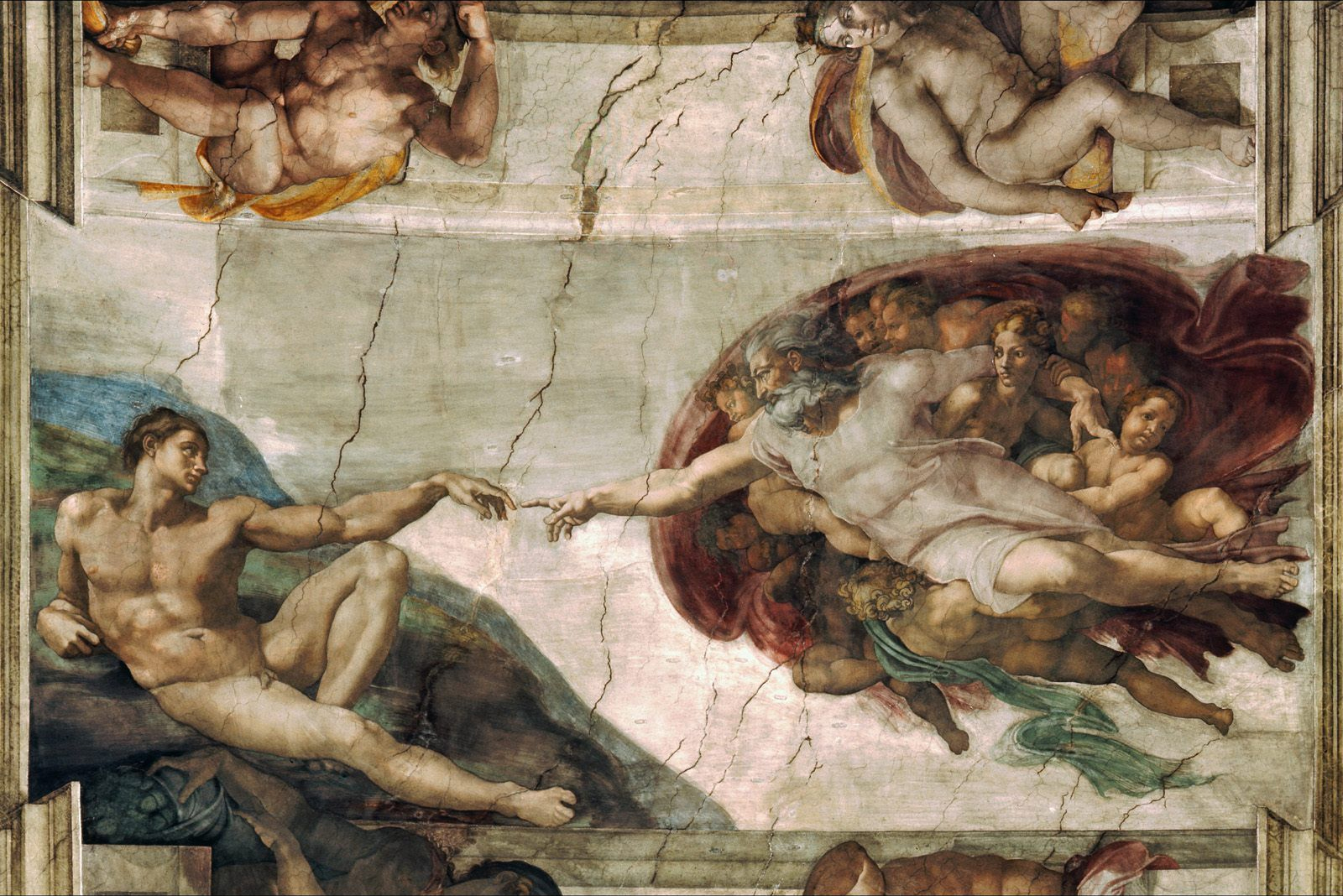
Paints the Sistine Chapel ceiling for Pope Julius II, expanding the commission from a planned twelve apostles to the Genesis cycle, for a documented total of roughly 3,000 ducats.3
- 1512
The Battle of Cascina cartoon is destroyed or cut apart, by Vasari's account by admirers while its keeper was ill; other sources in the literature name Baccio Bandinelli specifically, acting after the Medici restoration.5
- 1532
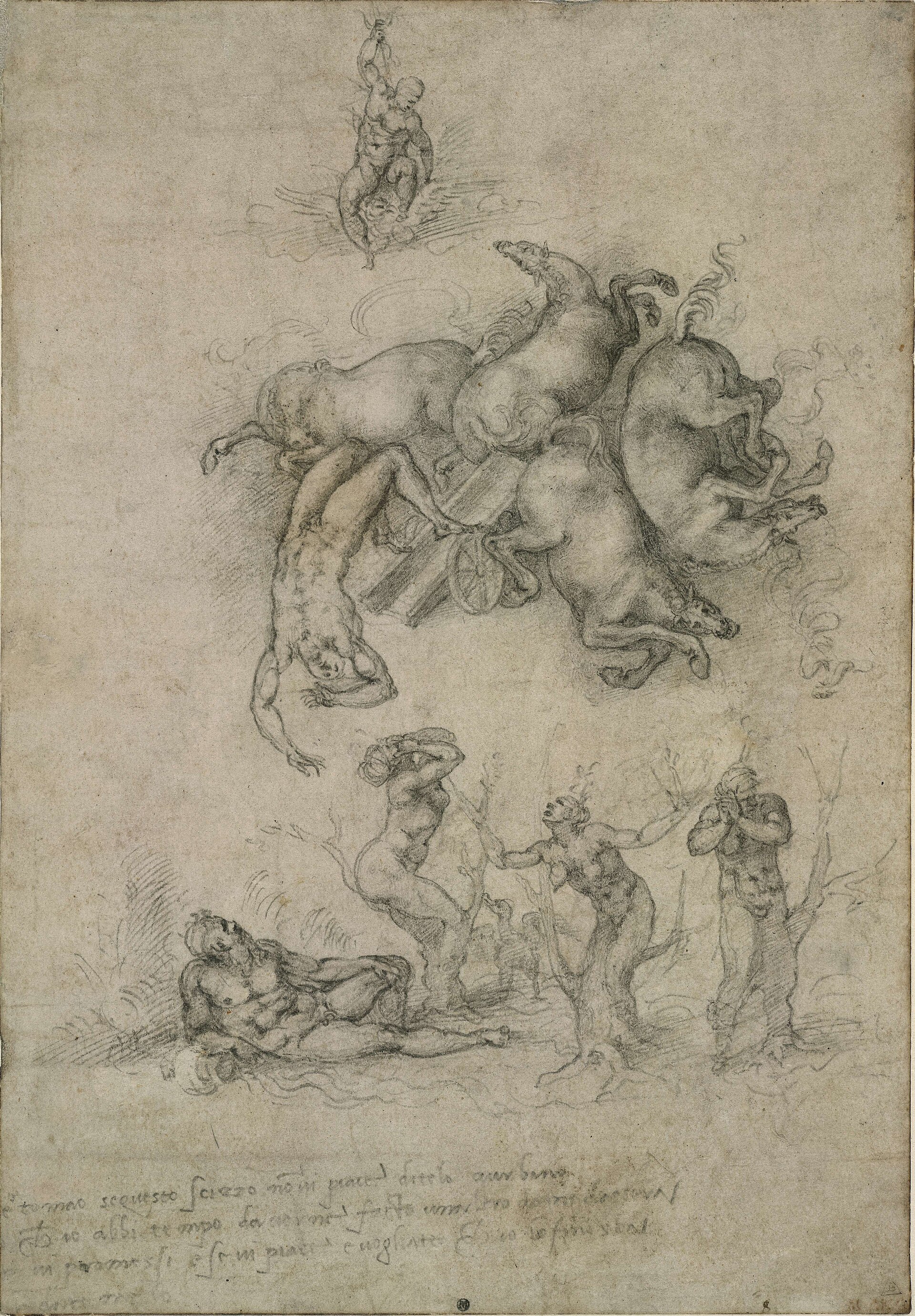
Meets Tommaso dei Cavalieri in Rome and begins the presentation drawings and poems addressed to him, including the Fall of Phaeton.3
- 1534-1541
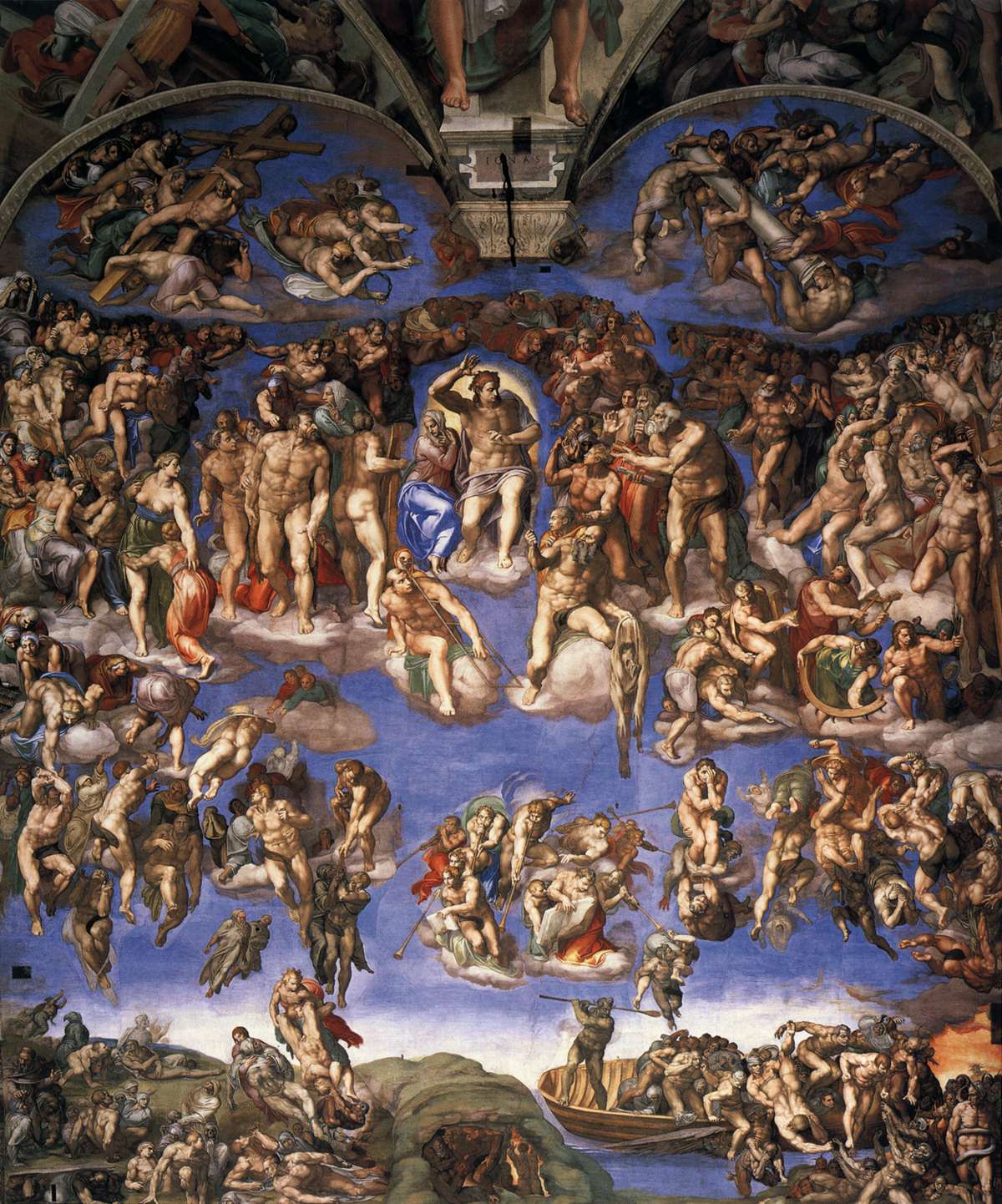
Paints the Last Judgment on the Sistine Chapel altar wall.3
- 1538 onward
Documented friendship and exchange of letters, poems and gift drawings with Vittoria Colonna, continuing until her death in 1547.3
- 1564
Dies in Rome on 18 February without a formal will; his body is secretly transported to Florence inside a bale of merchandise and buried in Santa Croce.3
- 1623
Michelangelo's grand-nephew, Michelangelo Buonarroti the Younger, publishes the first edition of the poems, changing the gender of the pronouns in the Cavalieri sonnets from male to female.3
- 1878
John Addington Symonds publishes an English translation restoring the original male pronouns, 255 years after the bowdlerized first edition.3
- 1975-1980
Charles de Tolnay publishes the four-volume Corpus dei disegni di Michelangelo, the standard inclusive catalogue of the drawings.20
- 1980-1994
The Vatican Museums' own conservation staff, led by Gianluigi Colalucci, clean the Sistine ceiling and Last Judgment, provoking the still-unresolved Beck controversy over whether original a secco shadow glazes were removed.1819
- 1991
Alexander Perrig publishes Michelangelo's Drawings: The Science of Attribution, the most skeptical modern reduction of the accepted corpus.20
- 1996-1997
Kathleen Weil-Garris Brandt attributes the small marble Young Archer to the teenage Michelangelo, a contested but influential rediscovery.3
- 2005
Hugo Chapman publishes Michelangelo Drawings: Closer to the Master, a joint catalogue with the Ashmolean and Teylers museums, the current closest thing to a shared curatorial position on the drawings.21
- 2015-2018
Paul Joannides and Victoria Avery argue that the Rothschild Bronzes at the Fitzwilliam Museum are early bronzes by Michelangelo; the attribution is contested by named scholars including Nicholas Penny.7
- 2022
Christie's Paris sells a previously unrecorded Michelangelo drawing for a hammer price of EUR 20,000,000 (EUR 23,162,000 with premium), authenticated by Paul Joannides.15
- 2026
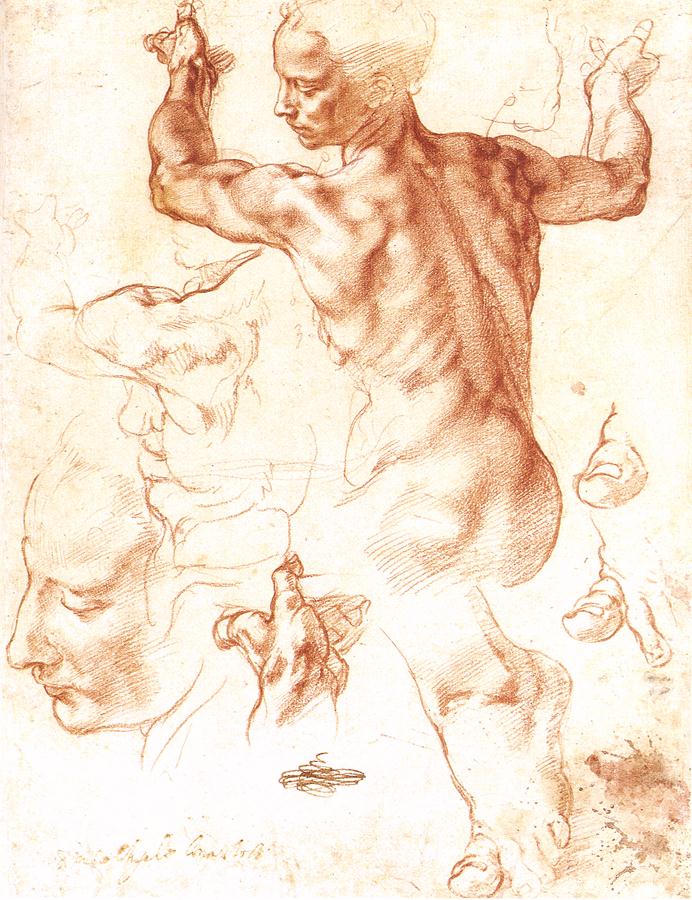
Christie's New York sells a newly identified red chalk study for the Libyan Sibyl's foot for a hammer price of USD 23,100,000 (USD 27,200,000 with premium), the current auction record for the artist.111213
The market
Finished Michelangelo paintings and marbles essentially never come to market; almost everything that survives has been in institutional or ecclesiastical hands for centuries. The active market is entirely in works on paper, and it is thin and sporadic, driven overwhelmingly by rediscoveries of sheets unknown to scholarship rather than by known works changing hands. When a genuinely new sheet surfaces with a persuasive attribution behind it, the result can run to tens of millions; a documented but visually unremarkable study, without the drama of rediscovery, sells for a small fraction of that.
| Date | Sale | Work | Result | Note |
|---|---|---|---|---|
| 18 May 2022 | Christie's | A nude man (after Masaccio) and two figures behind him | Hammer EUR 20,000,000 With premium EUR 23,162,000 EUR | Pen and two shades of brown ink with wash, 330 x 200 mm. Rediscovered sheet from the 18th-century Turin collection of Commendatore Modesto Genovosio, unpublished before 2022; authenticated by Paul Joannides of Cambridge University. Estimated at around EUR 30,000,000; the result, though a record at the time, fell short of that expectation. |
| 5 February 2026 | Christie's | Study for a foot of the Libyan Sibyl (recto); study of a leg with knee bent (verso) | Hammer USD 23,100,000 With premium USD 27,200,000 USD | Red chalk, 135 x 115 mm, c. 1510-1512. Previously unrecorded and unpublished, from a European family collection traced to the 18th-century Swiss diplomat Armand Louis de Mestral de Saint-Saphorin. Identified by Christie's specialist Giada Damen after roughly six months of technical and comparative study, principally against the Metropolitan Museum of Art's Studies for the Libyan Sibyl. Sold against an estimate of USD 1,500,000-2,000,000, about 20 times the low estimate, after some 45 minutes of bidding; the current auction record for the artist. |
| 9 July 2003 | Sotheby's | Study of a Left Thigh and Knee, with a separate study of a Right Knee | With premium GBP 296,800 GBP | Included for scale. Hammer price not separately published in the source consulted; the premium figure is a representative mid-market result for an accepted Michelangelo figure study, well below either record sheet above, and shows how much a dramatic rediscovery and an exceptional subject add to price beyond a secure attribution alone. |
Hammer is the price at which the bidding stopped; with premium adds the fee the house charges the buyer on top. Hammer price and buyer's premium in the glossary.
Where to see the work
| Institution | City | Holdings | Note |
|---|---|---|---|
| Vatican Museums / Sistine Chapel | Vatican City | The ceiling (1508-12) and the Last Judgment (1534-41), in place. | The only location where the two fresco cycles can be seen as executed, rather than in reproduction. |
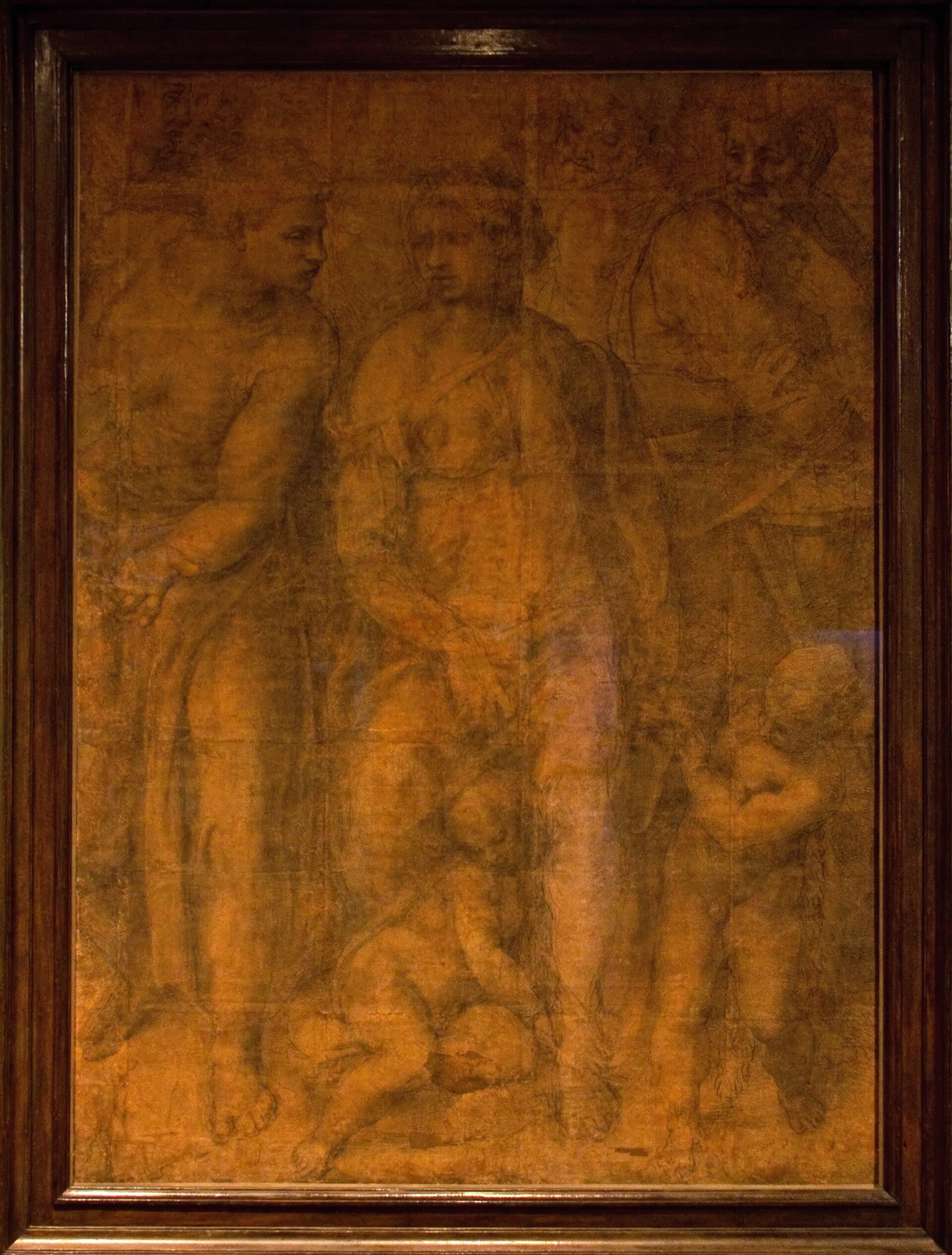
| British Museum | London | One of the largest holdings of Michelangelo drawings outside Italy, including the Epifania cartoon and the Fall of Phaeton presentation drawing. | |
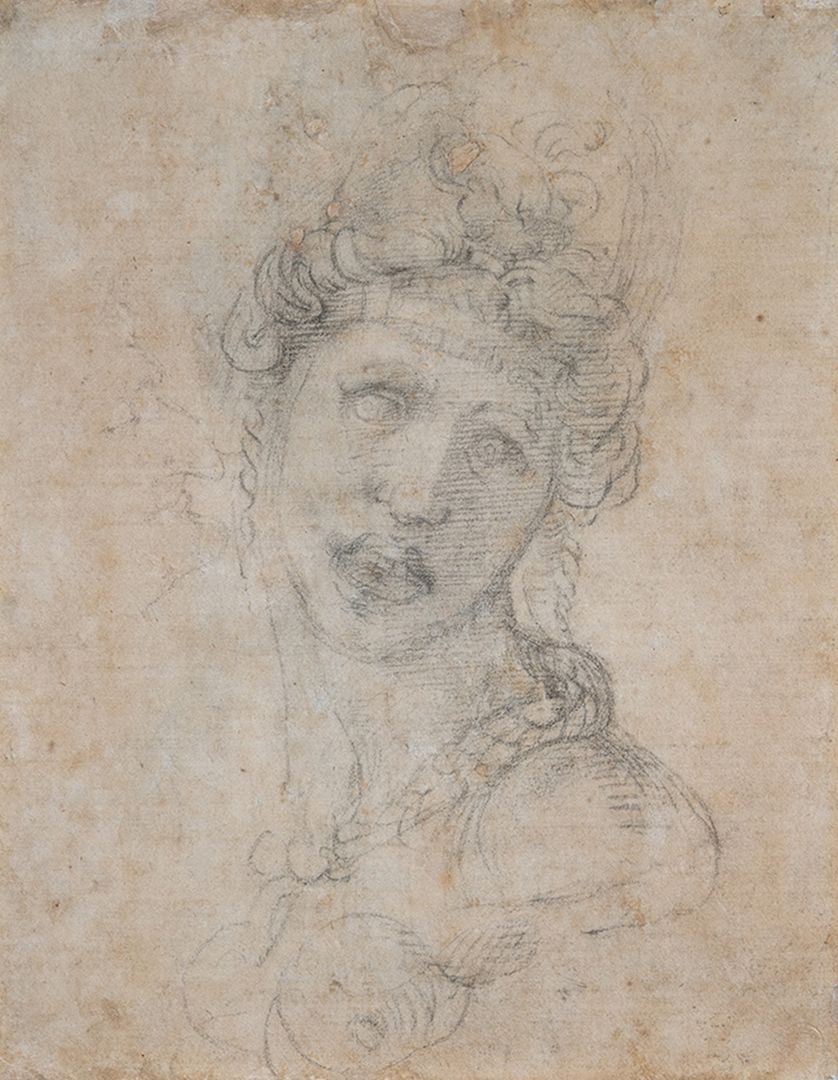
| Casa Buonarroti | Florence | The house Michelangelo left to his nephew Leonardo, now a museum of drawings, sculpture and family material, including the Cleopatra sketch. | |
| Galleria dell'Accademia | Florence | The David and the four unfinished Slaves (Prisoners) made for Julius II's tomb. | |
| Museo Nazionale del Bargello | Florence | Early sculpture including the Bacchus and the Brutus. | |
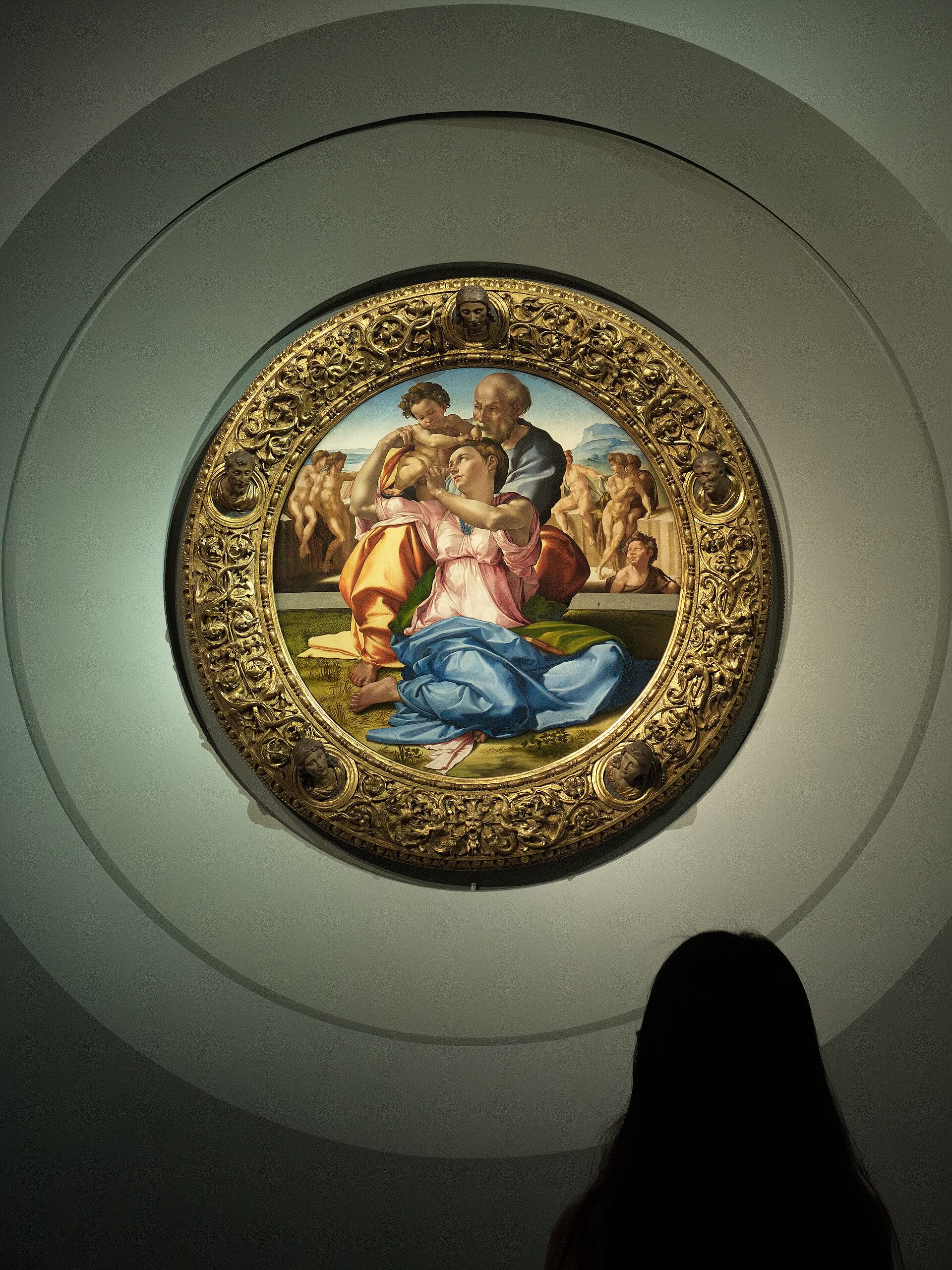
| Uffizi Gallery | Florence | The Doni Tondo, his only universally accepted finished panel painting. | |
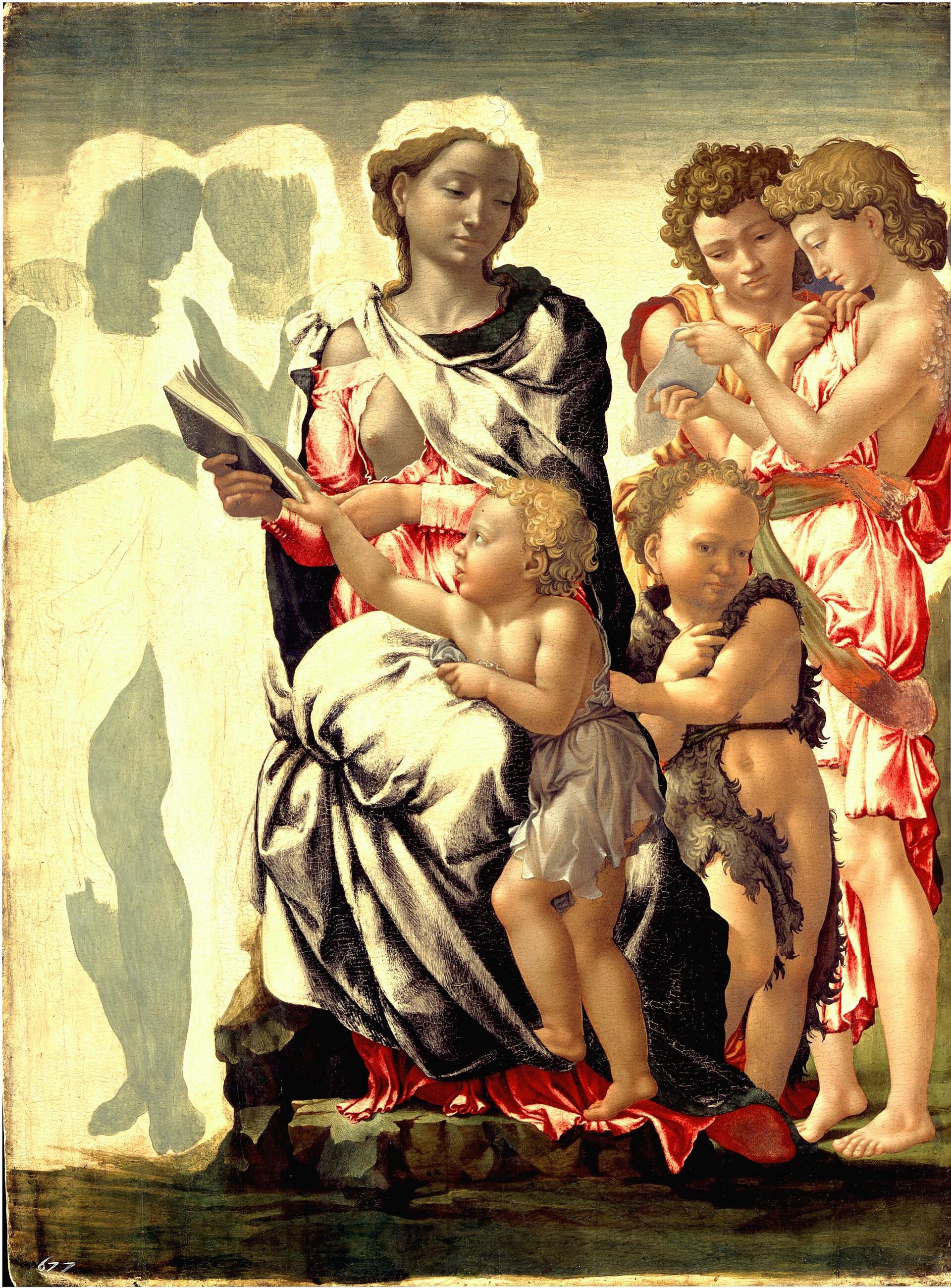
| National Gallery | London | The Manchester Madonna and the Entombment, both unfinished early panels of contested completeness of attribution. | |
| Metropolitan Museum of Art | New York | Drawings including Studies for the Libyan Sibyl, and the unfinished portrait attributed to Daniele da Volterra. | |
| Teylers Museum | Haarlem | A major eighteenth-century-formed holding of Michelangelo drawings. | |
| Fitzwilliam Museum | Cambridge | The contested Rothschild Bronzes. | Attribution to Michelangelo argued by Paul Joannides and Victoria Avery, disputed by other named scholars; see corpus notes above. |
Forgeries and misattributions
- The Sleeping Cupid, c. 1496
- Michelangelo, in his early twenties, carved a marble sleeping Cupid in Florence. It was artificially aged to resemble a genuine Roman antique and sold in Rome, through the dealer Baldassare del Milanese, to Cardinal Raffaele Riario. Vasari records that del Milanese arranged for Michelangelo to be paid 30 crowns for the carving and sold the piece on to the cardinal for 200 ducats. This is the rare case on this site of the maker being the forger rather than the victim of one: Michelangelo made the fake, and was not the one defrauded by it. The Cupid later passed as a diplomatic gift from Cesare Borgia to Isabella d'Este, entered the Gonzaga collection at Mantua, and was later acquired into the English royal collection under Charles I; it was most likely destroyed in the 1698 fire at the Palace of Whitehall. Cardinal Riario grew suspicious of the piece's evident freshness, had it examined by others, and confirmed it was a modern carving rather than an antique; he demanded a refund from the dealer. Michelangelo's own role only became fully clear to Riario once the size of del Milanese's markup came out.422
The essay
Chapter 1The self-taught myth, and the contract that disproves it
Ascanio Condivi's 1553 biography of Michelangelo, written at a point when Michelangelo was dissatisfied with Giorgio Vasari's earlier account and encouraged a rival version, states plainly that...
Ascanio Condivi's 1553 biography of Michelangelo, written at a point when Michelangelo was dissatisfied with Giorgio Vasari's earlier account and encouraged a rival version, states plainly that Michelangelo owed nothing to any teacher. Modern scholarship treats the Condivi text as close to Michelangelo's own dictated testimony rather than as independent biography, which makes the claim a piece of self-fashioning rather than an error of Condivi's.
It is contradicted by a document that survives: a contract dated 1 April 1488, filed by Michelangelo's father Lodovico, placing his thirteen-year-old son with the painters Domenico and David Ghirlandaio for three years to learn the trade of painting. The arrangement was unusual in one respect - the Ghirlandaio workshop agreed to pay the boy a wage across the three years, rather than the family paying for his training, which was not the normal direction of money in a Florentine apprenticeship. Michelangelo later left the Ghirlandaio workshop early to study sculpture in the Medici gardens, which is likely part of why the connection was played down in his own later account of himself.
Chapter 2The Medici household and a philosophy he lived inside
Between about 1490 and 1492 Michelangelo lived in the Palazzo Medici as a favoured presence in the household of Lorenzo de' Medici, studying sculpture under Bertoldo di Giovanni in the Medici...
Between about 1490 and 1492 Michelangelo lived in the Palazzo Medici as a favoured presence in the household of Lorenzo de' Medici, studying sculpture under Bertoldo di Giovanni in the Medici sculpture garden and, by his own later account and Condivi's, dining at Lorenzo's table alongside Marsilio Ficino, Angelo Poliziano and Giovanni Pico della Mirandola. This is documented as lived exposure, not inference from the pictures: Michelangelo's own early biographers, working from what he told them, place him inside this specific circle at this specific address for roughly two years.
What Michelangelo drew from Ficino's Neoplatonism as an artistic programme, as against what he simply absorbed as the intellectual air of the household, is a separate and much less settled question, addressed later on this page in connection with the unfinished Slaves. The household years themselves - the fact of his presence, the specific names at the table, Poliziano's suggestion of the classical subject for the young Michelangelo's Battle of the Centaurs relief - are documented; the depth and direction of philosophical influence on any single later work is argued, and should not be treated as the same kind of claim.
Chapter 3The forger who became Rome's rising sculptor
In 1496, in his early twenties and working in Florence, Michelangelo carved a marble Sleeping Cupid.
In 1496, in his early twenties and working in Florence, Michelangelo carved a marble Sleeping Cupid. The piece was artificially aged to pass as a genuine antique and sold in Rome, through the dealer Baldassare del Milanese, to Cardinal Raffaele Riario as a newly discovered Roman original. Vasari records that del Milanese arranged for Michelangelo to be paid thirty crowns for the carving, while the cardinal paid two hundred ducats for it as a supposed antique.
Riario grew suspicious of the piece's condition, had it examined, and confirmed it was modern work; he demanded his money back from the dealer. When Michelangelo learned how large the dealer's margin had actually been, he asked for the Cupid back so he could sell it again himself on his own account; del Milanese refused, saying he would rather break it into a hundred pieces than return property he had bought outright. Riario, rather than pursuing the young sculptor who had duped him, was impressed enough by the carving to bring him to Rome as his guest, which opened the years that produced the Bacchus and the Pieta.
The Cupid itself kept moving. It passed as a diplomatic gift from Cesare Borgia to Isabella d'Este, entered the Gonzaga collection in Mantua, and was later acquired into the English royal collection under Charles I. It was most likely destroyed in the 1698 fire at the Palace of Whitehall in London - a forgery that outlived the fraud it was made for by two centuries before it burned along with a great deal of genuine royal property.
Chapter 4The only work he ever signed
Michelangelo was contracted on 27 August 1498 by the French cardinal Jean Bilheres de Lagraulas to carve a Pieta for the cardinal's own funerary chapel in Old St Peter's, for 450 papal ducats, to be...
Michelangelo was contracted on 27 August 1498 by the French cardinal Jean Bilheres de Lagraulas to carve a Pieta for the cardinal's own funerary chapel in Old St Peter's, for 450 papal ducats, to be finished within a year. He took closer to two, and the cardinal had died before the statue was in place.
The Pieta is the only sculpture Michelangelo ever signed. According to Vasari, he did it after overhearing visitors in Rome attribute the new statue to a different, lesser-known sculptor; he is said to have returned at night and cut his name into the sash running across the Virgin's chest: Michelangelo Buonarroti, the Florentine, made this. Some later historians doubt the overheard-conversation story specifically and think the signature may always have been planned, but the fact of the signature, its placement, and its uniqueness in his output are not in dispute. Every other sculpture, painting and drawing that carries his name today carries it by argument, not by his own hand writing it there.
Chapter 5A cartoon a generation of painters studied, then lost
In 1504 the Florentine Republic commissioned Michelangelo to design a monumental battle fresco, the Battle of Cascina, for the Salone dei Cinquecento in the Palazzo Vecchio - the same hall in which...
In 1504 the Florentine Republic commissioned Michelangelo to design a monumental battle fresco, the Battle of Cascina, for the Salone dei Cinquecento in the Palazzo Vecchio - the same hall in which Leonardo da Vinci had already been commissioned to paint the Battle of Anghiari. Michelangelo completed at least the full-scale cartoon by February 1505, a design of soldiers scrambling from a river ambush that other artists, by every account, studied intensively; neither fresco was ever painted onto the wall, because Michelangelo was summoned to Rome by Pope Julius II before he could begin.
The cartoon did not survive. Vasari's account has it deliberately cut into pieces by admiring artists while its custodian was ill, with fragments then scattered across Italy and the last ones he had heard of turning up in Mantua; other sources in the literature name the sculptor Baccio Bandinelli specifically as responsible, acting after the Medici restoration of 1512 to destroy an image with republican associations. The two accounts are not fully reconcilable and this page does not resolve them. What survives is a full-scale grisaille copy attributed to Michelangelo's pupil Aristotile da Sangallo, now at Holkham Hall in Norfolk, plus a scatter of Michelangelo's own preparatory drawings and prints of fragments by Marcantonio Raimondi - a documented, world-class competition between the two greatest artists of the age that neither man's actual mural work survives to let us judge directly.
Chapter 6Twelve apostles was not enough
Julius II's original commission for the Sistine Chapel ceiling, agreed around 1508, called for a comparatively modest scheme: the twelve apostles on the twelve triangular spandrels, with an...
Julius II's original commission for the Sistine Chapel ceiling, agreed around 1508, called for a comparatively modest scheme: the twelve apostles on the twelve triangular spandrels, with an ornamental field between them. Michelangelo, by his own later account confirmed in both Condivi's and Vasari's biographies, told the pope the plan was a poor thing and was given what amounts to a free hand to design something larger. The result was the Genesis cycle actually on the ceiling today - the Creation, the Fall, the Flood, and the ancestors of Christ - a theological expansion whose exact intellectual authorship is not fully settled: Michelangelo is credited with the design and its execution, but the degree to which he worked out the detailed scriptural programme alone, as against in consultation with theologians at the papal court, is argued rather than documented in the surviving record.
Work ran from May 1508 to October 1512. Michelangelo's own payment memorandum records five hundred papal chamber ducats received on account at the outset; across the whole commission the documented total comes to roughly three thousand ducats, against 450 ducats for the entire Pieta a decade earlier. Payment was neither smooth nor prompt - Michelangelo is recorded halting work more than once over disputes with the papal treasury - which is a useful corrective to any picture of an untroubled patron-genius relationship.
Chapter 7How the ceiling was actually painted
The ceiling is buon fresco: pigment applied to a freshly laid, still-wet patch of plaster so that the colour binds chemically into the wall as it dries, rather than sitting on top of a dry surface.
The ceiling is buon fresco: pigment applied to a freshly laid, still-wet patch of plaster so that the colour binds chemically into the wall as it dries, rather than sitting on top of a dry surface. Each day's patch is a giornata, and the faint seams between adjoining giornate, still visible on close inspection, are a day-by-day record of how much ground Michelangelo could cover as the project went on. Early giornate are small; by the end, when he was painting the Separation of Light from Darkness near the altar wall, he completed the entire scene in a single day's plaster - direct physical evidence, independent of any biographer's claim, that he had become dramatically faster and more confident over the four years of the commission.
The technique carries a documented consequence for physical comfort that Michelangelo himself complained about in a sonnet sent to his friend Giovanni da Pistoia in 1509, describing paint dribbling onto his face and a swelling in his throat from the posture - not, contrary to a persistent modern image, working flat on his back, but standing and craning upward on a raised platform of his own scaffolding design.
Chapter 8What the cleaning uncovered, and the argument it did not settle
The Vatican's own conservation staff, led by Gianluigi Colalucci, cleaned the ceiling and the Last Judgment between 1980 and 1994, removing five centuries of candle soot, animal-fat and vegetable-oil...
The Vatican's own conservation staff, led by Gianluigi Colalucci, cleaned the ceiling and the Last Judgment between 1980 and 1994, removing five centuries of candle soot, animal-fat and vegetable-oil residues from earlier restorations, and old varnish layers. The result was a far brighter, more saturated palette than anyone alive had seen on the ceiling, and it produced one of the loudest conservation controversies of the twentieth century.
The art historian James Beck, joined by other scholars including Alessandro Conti and, initially, Charles Hope, argued that the cleaning had removed not only grime but shadow glazes Michelangelo himself had brushed on afterward, a secco, over the dried fresco, to deepen modelling and unify tone - a technique for which there is independent documentary evidence, including Michelangelo's own recorded purchase of a lake pigment that can only be applied a secco. Beck called the result an artistic Chernobyl and petitioned the Vatican, alongside other artists and scholars, to halt the work; Charles Hope later reversed his qualified early defence of the cleaning and described the finished ceiling's colour as gaudy rather than restored. The Vatican team's position, then and since, is that the great majority of what was removed was later restorers' additions rather than anything of Michelangelo's, supported by finding soot trapped beneath glue layers - meaning the glue postdated the soot rather than the reverse - and by a small fragment of ceiling that had been protected from air and showed no a secco layer to strip. The Vatican's account is now the majority scholarly position; it has not, on every specific point Beck raised, been closed by new technical analysis, and this page treats it as the current consensus rather than as a settled fact beyond argument.
Chapter 9Bodies that seem to want to climb out of the stone
Michelangelo left four large marble figures for Julius II's tomb - now known as the Slaves or Prisoners, in the Galleria dell'Accademia in Florence - deliberately or circumstantially unfinished, with...
Michelangelo left four large marble figures for Julius II's tomb - now known as the Slaves or Prisoners, in the Galleria dell'Accademia in Florence - deliberately or circumstantially unfinished, with limbs and torsos still partly locked inside the block. The unfinished state, non-finito, recurs across his sculpture generally and has been read since the twentieth century as more than an accident of an interrupted commission.
Erwin Panofsky, developing an idea first suggested by Oscar Ollendorff and later extended by Charles de Tolnay, argued that the Slaves can be read as a Neoplatonic allegory of the soul struggling against the matter that imprisons it - a reading consistent with Ficino's own Neoplatonic writing, which held that the immortal soul is inherently miserable while bound to the body. This is an argued reading, not a documented statement of intention: no letter or contract from Michelangelo explains the Slaves in these terms, and other scholars have questioned whether applying this specific iconological framework to unfinished marbles, whose incompleteness may simply reflect a changed commission, is safe. The honest position is that Michelangelo's years inside Ficino's circle make a Neoplatonic reading plausible and that Panofsky's argument is taken seriously in the literature, while the leap from plausible influence to certain intention in any one block of marble is exactly that: a leap, made by named scholars, and disputed by others.
Chapter 10What he burned, and what that leaves us counting
Vasari records that shortly before his death Michelangelo burned a large number of his own drawings, sketches and cartoons, so that no one could see the labour behind his finished work or judge him...
Vasari records that shortly before his death Michelangelo burned a large number of his own drawings, sketches and cartoons, so that no one could see the labour behind his finished work or judge him by his failed attempts. What survives from a working life of roughly seventy-seven years is generally put at around six hundred sheets - a number used across the major holding institutions - which makes the corpus small enough to be individually contested and large enough that no single scholar has ever examined every sheet against every other in one sitting.
The count itself has been revised considerably over the past century, and named scholars disagree sharply on method and result rather than converging on one figure. Charles de Tolnay's four-volume Corpus dei disegni di Michelangelo (1975-80) reproduces some 633 sheets and took an inclusive position; it remains the standard point of reference for locating a given sheet, even where individual attributions in it are no longer accepted. Alexander Perrig's Michelangelo's Drawings: The Science of Attribution (1991) took the most skeptical position in the modern literature, proposing objective criteria for authenticity and reassigning a significant share of the traditional corpus to four artists in Michelangelo's circle - a position other specialists have since described as isolated and accepted by no serious student of Michelangelo's draughtsmanship. Michael Hirst's Michelangelo and His Drawings (1988) sits closer to the centre of the range and is widely regarded as the most measured single-author account. Hugo Chapman's Michelangelo Drawings: Closer to the Master (2005), produced jointly by the British Museum, the Ashmolean Museum and the Teylers Museum, represents the closest thing to a current shared curatorial position among the three largest non-Italian holdings, and is the source for the approximately six hundred figure used on this page.
Chapter 11How a new Michelangelo gets made now
There is no closed authenticating board for Michelangelo, and there has never been one.
There is no closed authenticating board for Michelangelo, and there has never been one. A new attribution is argued in print, in an exhibition catalogue, or increasingly in a saleroom research report, by a named specialist working from connoisseurship, comparison of hand and materials, and provenance; it stands only for as long as other specialists find the argument persuasive, and it can be reopened at any point by a better argument or a new document.
Three recent cases show the range. In 1996-97 the New York University scholar Kathleen Weil-Garris Brandt attributed a small marble known as the Young Archer, then standing largely unremarked in a French government building on Fifth Avenue, to the teenage Michelangelo; the attribution convinced enough of the field that the piece is now on long-term loan to the Metropolitan Museum of Art from the French state, though it has never been universally accepted. In 2015 the Cambridge scholar Paul Joannides connected two bronze statuettes of youths on panthers, known since the nineteenth century as the Rothschild Bronzes and demoted through most of the twentieth to a series of other names, to a drawing by a Michelangelo pupil in the Musee Fabre in Montpellier, supported by neutron-based dating consistent with the right period; Joannides and Victoria Avery published the full case in 2018. Named scholars, including Nicholas Penny writing in The Burlington Magazine, have argued in response that the bronzes read as a pastiche or belong instead to a different sculptor, with one 2020 proposal naming Francesco da Sangallo. And in 2022 and again in 2026, individual drawings previously unknown to scholarship were authenticated and sold at auction within years of surfacing - the subject of its own section below. In every one of these cases, attribution was made by a person with a name, published for other people with names to test, and none of them was final in the way a laboratory certificate is final.
Chapter 12What a Michelangelo actually costs
Finished panel paintings and marbles by Michelangelo essentially never reach the market; almost everything that survives has been in an institutional or church collection for centuries.
Finished panel paintings and marbles by Michelangelo essentially never reach the market; almost everything that survives has been in an institutional or church collection for centuries. The active market is in drawings, and it is thin, sporadic and driven almost entirely by rediscoveries rather than by known works changing hands.
Two sales define the current top of that market, both for sheets unknown to scholarship until shortly before they sold. On 18 May 2022, Christie's Paris sold a pen and ink sheet combining a copy after Masaccio with two added figures by Michelangelo's own hand, authenticated by Paul Joannides and consigned from an eighteenth-century Turin collection, for a hammer price of 20 million euros and 23,162,000 euros with premium, against a pre-sale estimate of around 30 million - a record at the time, though one that fell short of expectations. On 5 February 2026, Christie's New York sold a palm-sized red chalk study for the right foot of the Libyan Sibyl on the Sistine ceiling, from a European family collection traceable to the eighteenth-century diplomat Armand Louis de Mestral de Saint-Saphorin and unpublished until its consignment, for a hammer price of 23.1 million dollars and 27.2 million dollars with premium - about twenty times its 1.5 to 2 million dollar estimate, after roughly forty-five minutes of bidding, and the current auction record for the artist. By contrast, a documented but more ordinary figure study, without the drama of rediscovery, made only 296,800 pounds including premium at Sotheby's London in July 2003 - a reminder that a Michelangelo attribution alone does not set the price; scarcity, freshness to the market and the strength of the individual argument for the hand do.
Chapter 13Poems he did not mean for us to read as written
Michelangelo wrote roughly three hundred poems across his life, about thirty of them addressed in unambiguous terms of love to the young Roman nobleman Tommaso dei Cavalieri, whom he met in 1532 and...
Michelangelo wrote roughly three hundred poems across his life, about thirty of them addressed in unambiguous terms of love to the young Roman nobleman Tommaso dei Cavalieri, whom he met in 1532 and for whom he also made a series of presentation drawings, including the Fall of Phaeton and a Rape of Ganymede, as gifts rather than commissions. He formed a second, differently registered but equally documented friendship in the 1530s and 1540s with the noblewoman and religious reformer Vittoria Colonna, exchanging letters and poems with her and making her several drawings, among them a Pieta, as personal gifts; Colonna is recorded sending him more than a hundred of her own sonnets copied onto parchment.
The poems were not published in Michelangelo's lifetime. When his grand-nephew, also named Michelangelo Buonarroti, brought out the first edition in 1623, he changed the grammatical gender of the pronouns in the Cavalieri poems from male to female, producing a body of ordinary heterosexual love poetry that bore no resemblance to what Michelangelo had actually written. That edited version stood as the only printed text for two hundred and fifty-five years, until the English critic John Addington Symonds restored the original male pronouns in his 1878 translation - meaning that for most of the time these poems have existed in print, readers were reading a text edited specifically to remove what its subject had actually said.
Chapter 14The body that left Rome inside a bale of merchandise
Michelangelo left no formal will. His recorded last wishes, given verbally, were terse: his soul to God, his body to the earth, his possessions to his nearest relatives, with an instruction to...
Michelangelo left no formal will. His recorded last wishes, given verbally, were terse: his soul to God, his body to the earth, his possessions to his nearest relatives, with an instruction to meditate on the sufferings of Christ. His nephew Leonardo Buonarroti, his sole male heir, travelled to Rome after his death to settle the estate and inherited the family property in Florence that is now the Casa Buonarroti museum.
Michelangelo had wanted to be buried in Florence, the city he had left decades earlier under the Medici and returned to only in memory. Rome, where he died and where he was already interred at the church of Santi Apostoli, was reluctant to give him up. According to Vasari, Leonardo had the body removed secretly and transported to Florence disguised as ordinary merchandise inside a bale, avoiding the public attention a state funeral in Rome would have drawn. It arrived in Florence on 10 March 1564 and was buried in Santa Croce beneath a tomb designed by Vasari - a smuggling operation conducted on behalf of a man whose actual estate amounted to a house, some land, and whatever drawings he had not already burned.
What is documented
Technique
The surviving work
- What is accepted
- Approximately 600 sheets of drawings are currently treated as autograph, the figure used by the British Museum, the Ashmolean Museum and the Teylers Museum in Hugo Chapman's 2005 joint catalogue, Michelangelo Drawings: Closer to the Master. On sculpture, only a small number of marbles are universally accepted as entirely by Michelangelo's own hand, principally the Pieta, the David, the Bacchus and the Moses; several others, including the Manchester Madonna panel and the disputed Rothschild bronzes, are accepted by some specialists and rejected or qualified by others.
- What is contested
- The number of drawings attributed to Michelangelo has swung considerably over the past century, depending on the connoisseur and the method, without settling into one agreed figure. Charles de Tolnay's four-volume Corpus dei disegni di Michelangelo (1975-80) reproduces some 633 sheets and took an inclusive position. Alexander Perrig's Michelangelo's Drawings: The Science of Attribution (1991) took the most skeptical position in the modern literature, proposing objective attribution criteria and reassigning a substantial share of the traditional corpus to four artists in Michelangelo's circle - a position other specialists have since described as isolated and accepted by no serious student of Michelangelo's draughtsmanship. Michael Hirst's Michelangelo and His Drawings (1988) sits closer to the centre of that range. No single figure commands unanimous agreement; the approximately 600 used on this page is the current working figure at the three largest non-Italian holding institutions, not a closed count.
- Who rules on attribution
- No closed authenticating board exists, and none ever has. A new attribution is argued in print, in a museum catalogue, or in a saleroom research report by a named specialist, through comparison of hand, materials and provenance against the accepted corpus, and it stands only as long as other specialists in the field find the argument persuasive. Independent scholars such as Paul Joannides, museum curators, and increasingly in-house auction house specialists such as Christie's Giada Damen have each produced accepted new attributions in the last decade by this route; none of their conclusions carries formal, final authority, and each has been or could be reopened by a stronger counter-argument.
Catalogue raisonne
- Charles de Tolnay, Corpus dei disegni di Michelangelo, 4 vols (Novara: Istituto Geografico De Agostini, 1975-80) The most complete illustrated catalogue and still the standard point of reference for locating a given sheet, though a substantial number of its individual attributions are no longer accepted by specialists.20
- Hugo Chapman, Michelangelo Drawings: Closer to the Master (London: British Museum Press, 2005) Produced jointly with the Ashmolean Museum and the Teylers Museum, drawing on all three collections; the closest current approximation to a shared curatorial position among the largest non-Italian holdings.21
- Alexander Perrig, Michelangelo's Drawings: The Science of Attribution (New Haven and London: Yale University Press, 1991) The most skeptical modern catalogue; rejects a large share of the traditionally accepted corpus and reassigns sheets to named associates. Treated in the literature as an important corrective rather than as the new consensus.20
Questions about Michelangelo Buonarroti
Who was Michelangelo Buonarroti?
Sculptor; Painter; Architect; Poet. 1475-1564.
When did Michelangelo Buonarroti live?
Born 6 March 1475, Caprese, Republic of Florence (now Caprese Michelangelo, near Arezzo); died 18 February 1564, Rome, aged 88.
How are fakes and misattributions of Michelangelo Buonarroti detected?
The Sleeping Cupid, c. 1496. Michelangelo, in his early twenties, carved a marble sleeping Cupid in Florence. It was artificially aged to resemble a genuine Roman antique and sold in Rome, through the dealer Baldassare del Milanese, to Cardinal Raffaele Riario.
Where can you see work by Michelangelo Buonarroti?
Vatican Museums / Sistine Chapel (Vatican City); British Museum (London); Casa Buonarroti (Florence); Galleria dell'Accademia (Florence); Museo Nazionale del Bargello (Florence); Uffizi Gallery (Florence).
What does the market for Michelangelo Buonarroti look like?
Finished Michelangelo paintings and marbles essentially never come to market; almost everything that survives has been in institutional or ecclesiastical hands for centuries. The active market is entirely in works on paper, and it is thin and sporadic, driven overwhelmingly by rediscoveries of sheets unknown to scholarship rather than by known works changing hands.
What is still unresolved about Michelangelo Buonarroti?
How much of the Sistine ceiling's detailed theological programme Michelangelo devised alone, as against in consultation with named or unnamed theologians at the papal court. Condivi and Vasari agree only that he expanded a simpler scheme; the authorship of the final scriptural sequence in detail is argued, not documented.
Open questions
- How much of the Sistine ceiling's detailed theological programme Michelangelo devised alone, as against in consultation with named or unnamed theologians at the papal court. Condivi and Vasari agree only that he expanded a simpler scheme; the authorship of the final scriptural sequence in detail is argued, not documented.
- Whether the 1980-1994 Vatican cleaning removed later grime alone or also removed a secco shadow glazes Michelangelo applied himself. The Vatican restoration team's account is the current majority view; James Beck's specific technical objections were never individually closed out by new analysis.
- Whether the Manchester Madonna and other early unfinished panels are entirely autograph or partly executed by a workshop hand from Michelangelo's Ghirlandaio training. The National Gallery now catalogues the panel without qualification; the doubts that produced a notional separate 'Master of the Manchester Madonna' in the older literature have not been individually refuted, only outweighed by more recent opinion.
- Whether the Rothschild Bronzes at the Fitzwilliam Museum are by Michelangelo at all. The case for his authorship rests on a copy drawing of a lost original and on scientific dating that narrows the period without naming the hand; named scholars including Nicholas Penny have argued for a different sculptor or a pastiche, and no document settles the question either way.
- What was actually lost in the drawings and cartoons Michelangelo burned shortly before his death. Vasari states the fact of the burning; nothing describes its extent or contents, and the roughly 600 surviving sheets cannot be checked against any inventory of what once existed.
- How much of Ascanio Condivi's 1553 biography is Michelangelo's own wording and how much is Condivi's. Modern scholarship treats the text as effectively dictated, but no draft in Michelangelo's own hand survives against which to check it.
- Who bought the two record-setting drawings sold at Christie's in 2022 and 2026, and who the underbidders were. Neither has been disclosed, which is ordinary saleroom practice but leaves the true depth of demand for autograph Michelangelo drawings only partly visible from the outside.
Sources
- 1Metropolitan Museum of Art, collection record for 'Michelangelo Buonarroti (1475-1564)', object 436771, attributed to Daniele da Volterra, accession 1977.384.1. metmuseum.org/art/...
- 2Wikimedia Commons, File:Michelangelo Daniele da Volterra.jpg, extended file metadata (licence, credit line, source institution). commons.wikimedia.org/wiki/...
- 3Wikipedia, 'Michelangelo'. en.wikipedia.org/wiki/...
- 4Wikipedia, 'Sleeping Cupid (Michelangelo)'. en.wikipedia.org/wiki/...
- 5Wikipedia, 'Battle of Cascina (Michelangelo)'. en.wikipedia.org/wiki/...
- 6Wikipedia, 'Manchester Madonna'. en.wikipedia.org/wiki/...
- 7Wikipedia, 'Rothschild Bronzes'. en.wikipedia.org/wiki/...
- 8Wikipedia, 'Study of a Kneeling Nude Girl for The Entombment'. en.wikipedia.org/wiki/...
- 9Wikipedia, 'Epifania'. en.wikipedia.org/wiki/...
- 10National Gallery, London, catalogue entry for 'The Manchester Madonna' (NG809). nationalgallery.org.uk/paintings/...
- 11Apollo Magazine, 'Old Master drawings put their best foot forward in New York', on the Christie's New York Old Master and British Drawings sale of 5 February 2026. apollo-magazine.com/old-masters-new-york-sales-michelange...
- 12Finestre sull'Arte, 'Michelangelo's lost drawing for the Sistine Chapel resurfaces, to be auctioned in 2026'. finestresullarte.info/en/...
- 13Smithsonian Magazine, 'Experts Say This Small Drawing of a Foot May Be a Long-Lost Study for Michelangelo's Sistine Chapel Ceiling'. smithsonianmag.com/smart-news/...
- 14My Modern Met, 'Newly Discovered Michelangelo Chalk Drawing Worth $2 Million Heads to Auction'. mymodernmet.com/michelangelo-libyan-sibyl-foot-chalk-draw...
- 15ValueMyStuff, 'Most valuable Old Master Drawings ever sold at auction', on the Christie's Paris sale of 18 May 2022 and the Sotheby's London sale of 9 July 2003. valuemystuff.com/eu/...
- 16Wikisource (Italian), Michelangelo Buonarroti, Rime, no. 285, 'Giunto e gia 'l corso della vita mia', text from the critical edition Buonarroti, Rime (1960). it.wikisource.org/wiki/...
- 17John Addington Symonds, translator, 'On the Brink of Death', in The Sonnets of Michelangelo Buonarroti (1878), text as reproduced at AllPoetry. allpoetry.com/On-The-Brink-Of-Death
- 18Charles Hope, 'Restoration or Ruination?', The New York Review of Books, 18 November 1993, on the 1980-94 Sistine ceiling cleaning controversy. nybooks.com/articles/...
- 19Wikipedia, 'Restoration of the Sistine Chapel frescoes'. en.wikipedia.org/wiki/...
- 20Paul Joannides, The Drawings of Michelangelo and His Followers in the Ashmolean Museum (Cambridge: Cambridge University Press, 2007). Directly discusses Charles de Tolnay's Corpus dei disegni di Michelangelo (1975-80, a total of 633 sheets) as the standard reference despite outdated individual attributions, describes Alexander Perrig's contractionist attribution method (1991/1999) as isolated and 'accepted by no serious student of Michelangelo's draughtsmanship', and references Michael Hirst's 1988 study of the drawings by function and type. Replaces a prior miscitation of a Wikipedia article about an unrelated single drawing for these claims. cambridge.org/us/...
- 21Internet Archive, catalogue record for Hugo Chapman, Michelangelo Drawings: Closer to the Master (London: British Museum Press / New Haven: Yale University Press, 2005), confirming the joint exhibition catalogue combining the British Museum, Ashmolean Museum and Teylers Museum collections. archive.org/details/...
- 22Giorgio Vasari, Lives of the Most Eminent Painters, Sculptors and Architects, Life of Michelangelo Buonarroti (English translation). Gives the Sleeping Cupid price figures directly, though Vasari himself reports them via two overlapping versions: one that Cardinal San Giorgio (Riario) paid two hundred ducats for the piece as a supposed antique, another that del Milanese wrote to Lorenzo di Pier Francesco de' Medici that thirty crowns should be given to Michelangelo, claiming (falsely, as the source itself signals) that he had received no more than that for the Cupid. Replaces a prior sole reliance on a Wikipedia article that contains no price figures at all. gutenberg.org/files/...

Last verified