Teylers Museum
Museum · Founded 1778
Open, admission and hours confirmed 18 September 2026 · 23 sources
On this page 14 sections
ContentsClose
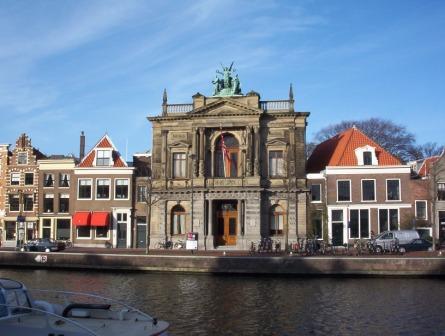
Teylers Museum holds roughly 214,000 objects split between an Art collection (Old Master and Dutch 19th-century drawings and paintings, coins and medals) and a Science collection (physical instruments, fossils, minerals and books), reflecting the two founding societies of Teylers Stichting. Its distinguishing strength is not depth in any one category so much as the survival of the rooms themselves: the Oval Room and the First Painting Gallery are shown substantially as built and fitted, making the museum as much a document of how a late-18th and 19th-century public collection was meant to be experienced as a repository of individual masterpieces.
| Kind | Museum |
|---|---|
| Founded | 1778 |
| City and country |  Haarlem, Netherlands Haarlem, Netherlands |
| Address | Spaarne 16, 2011 CH Haarlem, Netherlands |
| Website | teylersmuseum.nl/en |
| Status | Open, confirmed 18 September 2026 |
| Record last verified | 18 September 2026 |
Visiting
- Hours
- Tue-Sun10:00 to 17:00
- Public holidays (except 1 Jan and 25 Dec)10:00 to 17:00
- Closed
- Monday. 1 January. 25 December.
- Admission
- AdultEUR 18.50
- Child 0-5Freefree
- Child 6-17EUR 2.50
- Young adult 18-24 (incl. CJP)EUR 9.25
- Group (10+ people)EUR 16.50per person
Free entry: National Open Monument Days weekend in September (exact dates vary by year)- Tickets
- tickets.teylersmuseum.nl The museum's own ticket page.
- Do I need to book?
- No. Tickets can be bought at the desk, but booking online in advance guarantees a specific date and entry time
- Address
- Spaarne 16, 2011 CH Haarlem, Netherlands Map
- Website
- teylersmuseum.nl/en
- Telephone
- +31 23 516 0960
- [email protected]
Before you go how long, access, photography, bags, eating, shop
- How long to allow
- The museum's own multimedia tour takes about 50 minutes; visitors who read the Oval Room's instrument labels and take in both fossil rooms and the picture galleries typically spend two to three hours
- Access
- Wheelchair and walker accessible with doors at least 85 cm wide, two wheelchair-accessible restrooms, two loan wheelchairs and portable stools at the entrance, ramps over most level changes, free admission for a personal assistant, and a free audio guide. A few historic rooms have limited access: the Fundatiehuis first floor is reachable only on a guided tour with advance notice. Mobility scooters are not permitted; electric wheelchairs are
- Photography
- Personal photos and video are allowed throughout with a phone or small camera, without flash and without a tripod, except where a room is specifically marked otherwise. Wedding photography and ceremonies are not permitted
- Bags
- Coats must be left in the attended cloakroom. Bags larger than A4 paper are not allowed inside and must also be checked, so large bags and suitcases are best left off-site
- Eating
- On-site cafe reachable through the museum entrance with a valid ticket; reservations can be made online
- Shop
- Museum shop selling gifts, books and postcards; open to visit without a museum ticket
Prices and hours change. We take them from the institution's own pages and print the day we read them, and you can check the current position at the source we used. Confirm before you travel.
What is inside
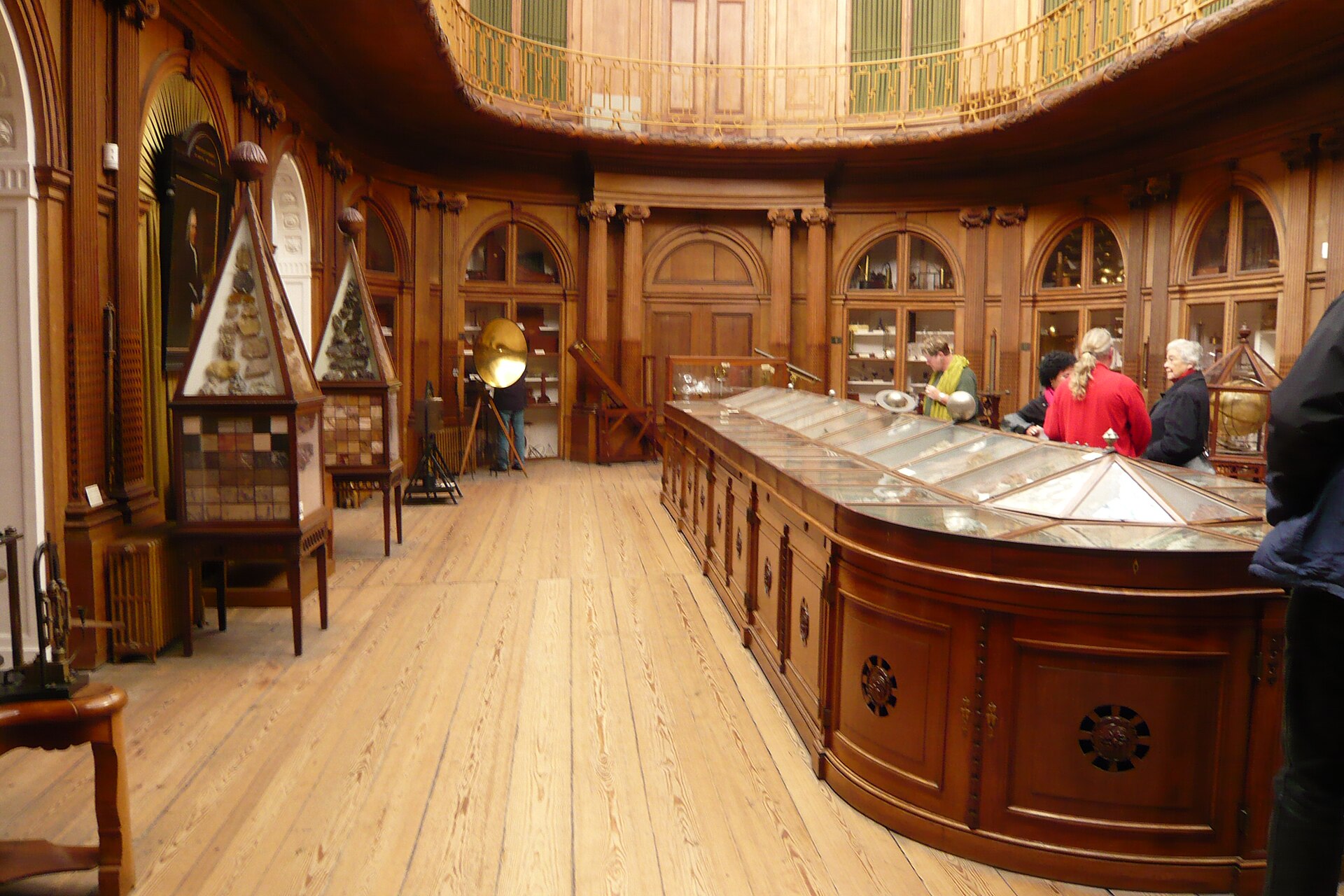
Public domain The Oval Room
The museum's founding 1784 research room, designed by Leendert Viervant: a top-lit, two-storey neoclassical space with a curved gallery of built-in bookcases and, at its centre, a long oak table-cabinet of minerals and fossils. It houses Martin van Marum's large electrostatic generator, once the biggest machine of its kind in the world, and an observatory sits on the roof above it. Restored in 2008-2010.
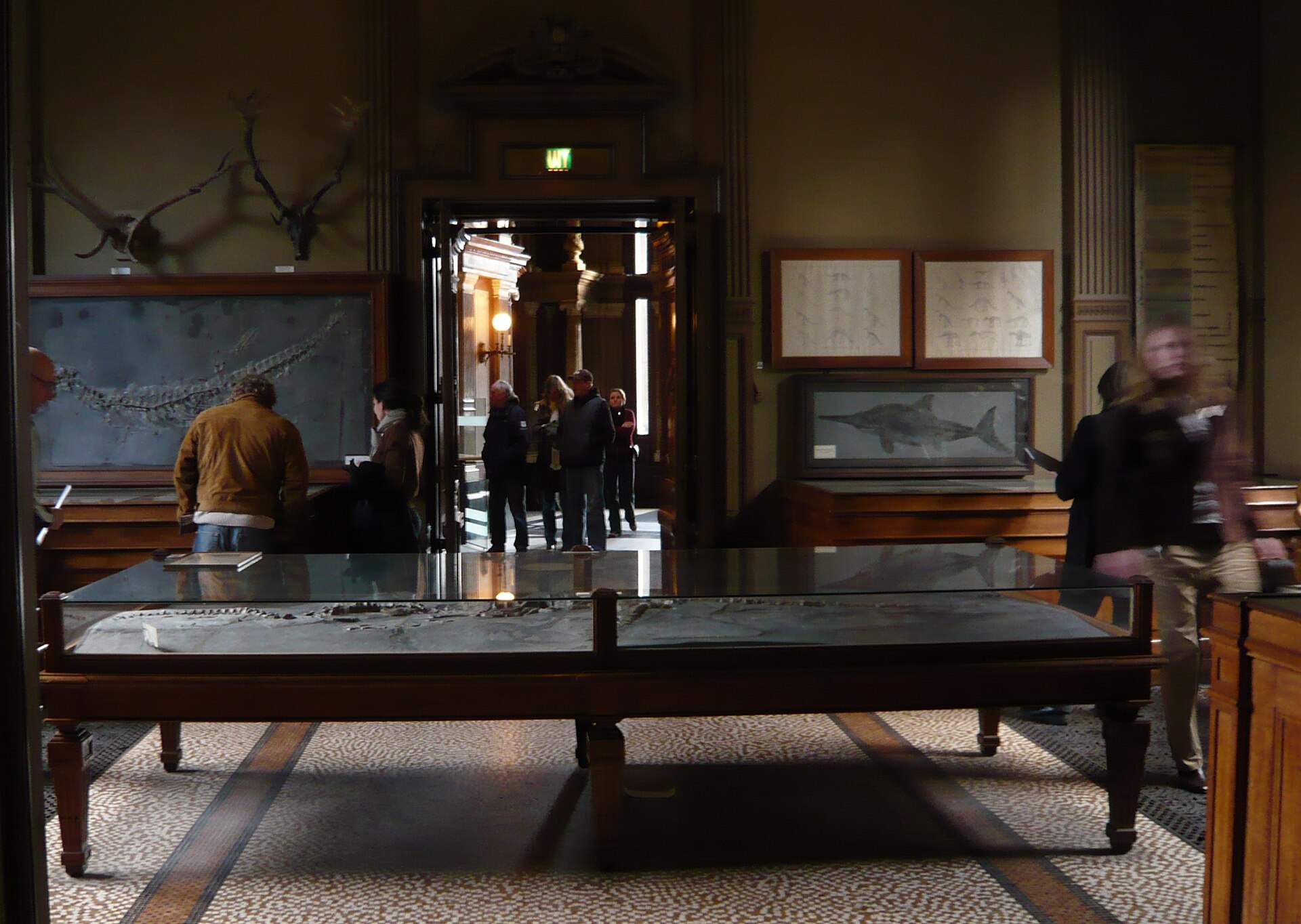
Photograph by Jane023 · CC BY-SA 3.0 Fossil Room I
Part of the 1878-1885 expansion, holding the paleontological collection built up from Martin van Marum's 1784 purchase of Jean-Baptiste Drouin's fossil collection: marine reptile skeletons, a Mosasaurus jaw found near Maastricht in 1766, and the fragmentary skeleton known as the Haarlem specimen, catalogued in 1857 as a pterodactyl, identified as an early Archaeopteryx in 1970, and reassigned to a new genus, Ostromia, in 2017.
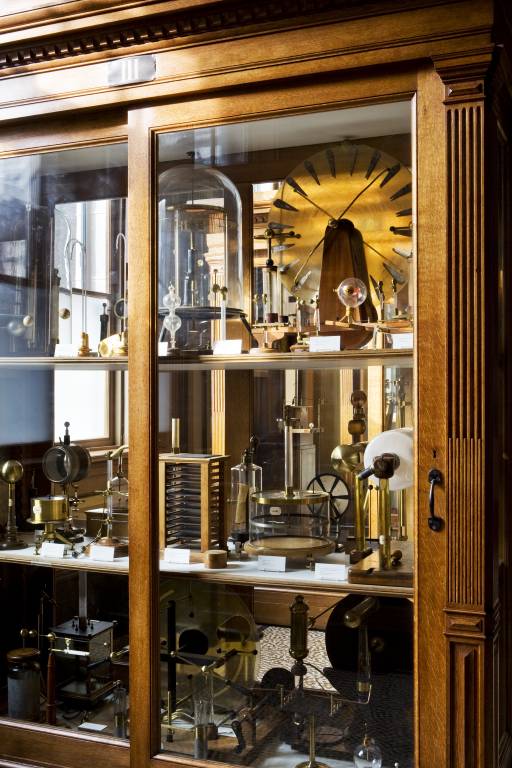
Photograph by Gjjanse · CC BY-SA 3.0 nl The Instrument Room
Built in the 1878-1885 expansion to hold the science collection's apparatus: 18th- to early-20th-century instruments for thermometry, barometry and electricity, including early electrostatic generators, electrometers, an induction machine and what the museum describes as the earliest electric light bulb in the collection.
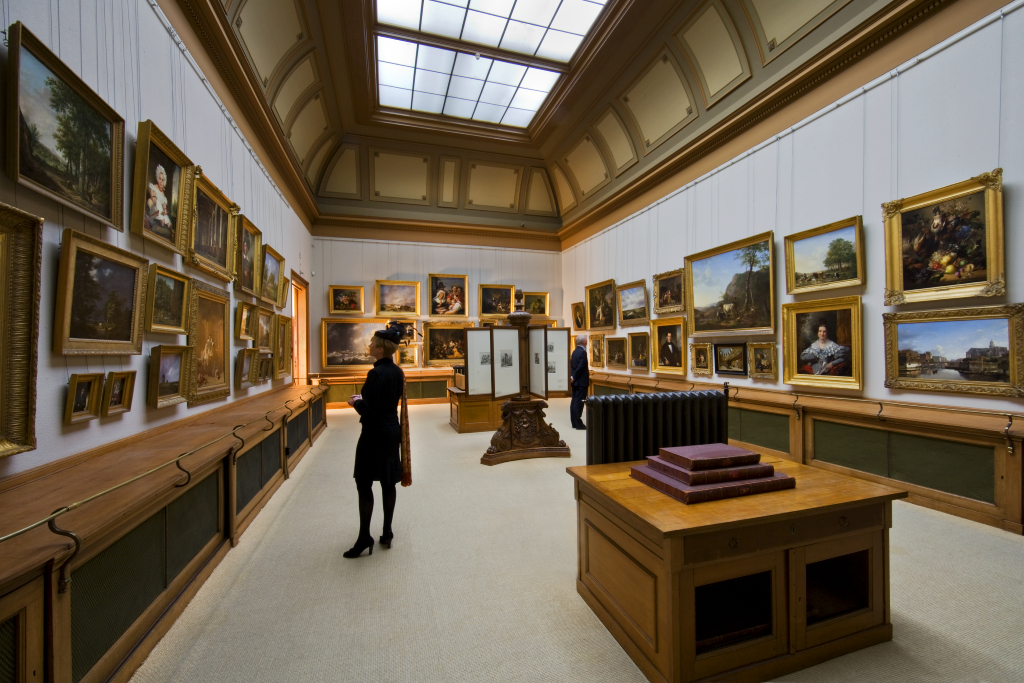
Photograph by Gjjanse · CC BY-SA 3.0 nl First Painting Gallery (Eerste Schilderijenzaal)
Opened in 1838 as the first purpose-built picture gallery in the museum, top-lit and still hung salon-style from dado rail to cornice with 19th-century Dutch Romantic and Hague School painting, alongside facsimile copies standing in for the fragile Old Master drawings kept in storage.
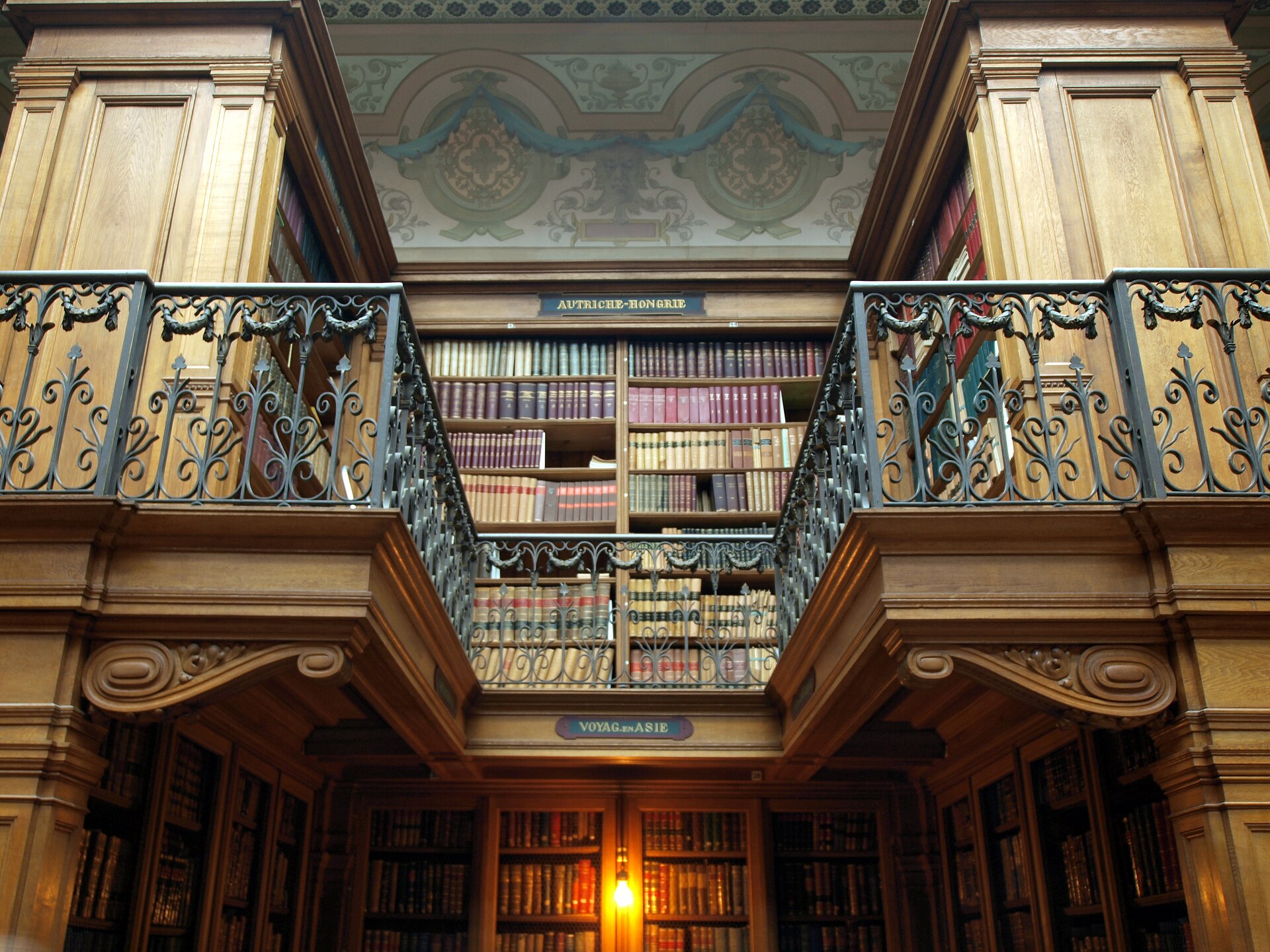
CC0 The Library
Part of the 1878-1885 wing, with twelve built-in bookcases on two levels behind an iron gallery rail, holding the foundation's 18th- and 19th-century encyclopedias, travel books and scientific periodicals, including a complete first edition of Diderot and d'Alembert's Encyclopedie (finished 1780) and a first edition of Audubon's The Birds of America (1827-1838).
Pieter Teyler's house (Fundatiehuis)
The founder's own 18th-century townhouse, forming the museum's original core and opened to regular visitors in 2021 after an eight-year restoration. Its ground floor is among the best-preserved 18th-century domestic interiors in the Netherlands; the first floor is shown only on a guided tour booked in advance.
What to see first
Large Electrostatic Generator
Built for Martin van Marum, Amsterdam, late 18th centuryThe largest machine of its kind in the world when completed; Van Marum used it to run some of the earliest systematic experiments on electricity's effect on gases and metals, and it still stands in the Oval Room it was built for.8
The Haarlem specimen (Ostromia crassipes, formerly identified as Archaeopteryx)
Solnhofen limestone, Late Jurassic, BavariaA fragmentary skeleton catalogued in 1857 as a new pterodactyl, Pterodactylus crassipes; recognized in 1970 by John Ostrom as the earliest-found Archaeopteryx specimen, then reassigned in 2017 by Christian Foth and Oliver Rauhut to a new, related genus named Ostromia in Ostrom's honour. A rare case where the display still records an unsettled scientific argument.14
Mosasaurus jaw
Found in a chalk quarry near Maastricht, 1766Among the earliest scientifically significant vertebrate fossil finds in Europe; acquired by the museum in 1784 as part of Martin van Marum's purchase of Jean-Baptiste Drouin's entire paleontological collection.14
Michelangelo drawings
Michelangelo Buonarroti, part of a 1790 acquisitionBought in 1790 from a Roman aristocratic family in a single purchase that also brought Raphael sheets into the collection, decades before most national museums competed for this material; kept in storage and rotated, with facsimiles shown in the First Painting Gallery.7
Self-portrait in a cap, wide-eyed
Rembrandt van Rijn, etching, 1639A small self-portrait etching from just before Rembrandt's fortunes turned, part of the Old Masters holdings that anchor the art collection.7
Goltzius' Right Hand
Hendrick Goltzius, drawing, 1588A virtuoso drawing of the artist's own right hand, deformed since childhood by a burn, drawn with a technical bravado that dares the viewer to doubt it was made by that hand.7
Peace Medal of Breda
Christoffel Adolphi, 1665-1667Commemorates the 1667 Treaty of Breda ending the Second Anglo-Dutch War; part of a Dutch medals collection the museum's own material describes as without equal elsewhere.7
Encyclopedie ou dictionnaire raisonne des sciences, des arts et des metiers
Edited by Denis Diderot and Jean le Rond d'Alembert, completed 1780A complete set of the founding text of the French Enlightenment, held in the museum's library alongside the scientific periodicals Van Marum himself used.8
The Birds of America
John James Audubon, 1827-1838A first edition of Audubon's double-elephant folio, held in the library among the museum's natural-history and travel literature.8
A cloth merchant's bequest and the birth of a museum
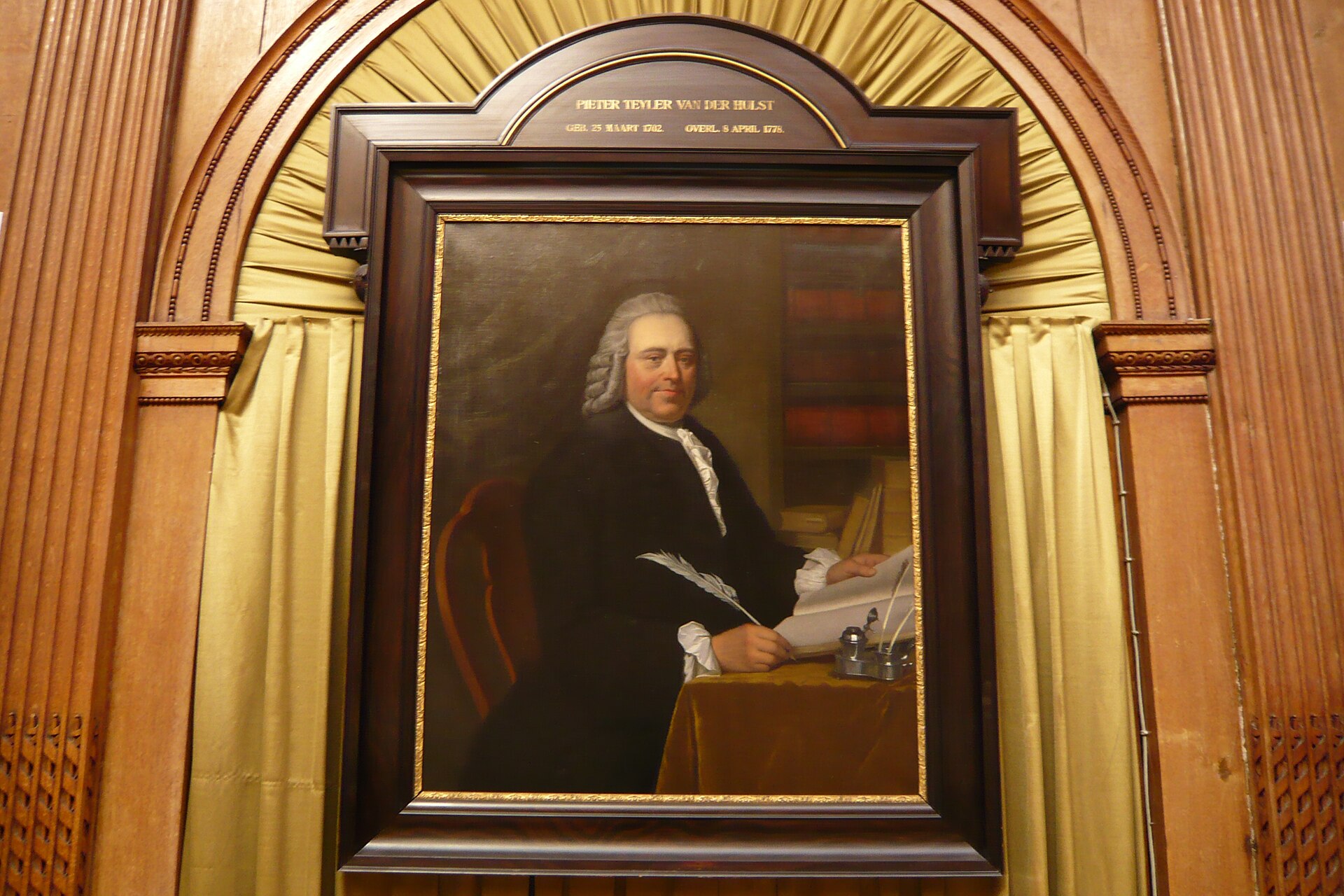
Teylers Museum exists because a Haarlem textile merchant and banker never had children to leave his fortune to. Pieter Teyler van der Hulst, born in 1702 into a family of Scottish descent and raised in the Mennonite faith, spent his life trading cloth and lending money, and read deeply in the ideas of the Enlightenment as he did it. When he died on 8 April 1778, his will set up Teylers Stichting, a foundation charged with using his estate to advance religion, art and science in equal measure. The foundation split its work between two societies: a theological society that still exists, and a second society for physics, poetry, history, drawing and numismatics, whose collecting became the museum.
Teyler's own house on the Spaarne, the Fundatiehuis, became the foundation's seat, and its ground-floor rooms, some of the best-preserved 18th-century domestic interiors in the Netherlands, are still shown on the site today. The directors he left behind did not simply display what he had collected. They appointed Martin van Marum, a physician and chemist, as the foundation's first director, and gave him a budget most contemporary universities did not have. Van Marum spent it on instruments, fossils and minerals as much as on books and prints, and it is his acquisitions, more than Teyler's own, that gave the museum its lasting character as a place where art and experimental science sat under one roof.
The Oval Room: the world's first purpose-built public research space
The museum's founding structure was not a gallery in the ordinary sense. In 1779, a year after Teyler's death, the directors commissioned the Haarlem architect Leendert Viervant to design a room behind the Fundatiehuis where instruments could be tested, demonstrations given, and drawings and coins examined by the public. The result, opened in 1784, is the Oval Room: a top-lit, two-storey space with a curved gallery of built-in bookcases running around its upper level and, at its centre, a long oak table-cabinet made to hold minerals and fossils.
An observatory was raised on the roof at the same time, and Van Marum used both spaces for research as much as for show, most famously to house and operate a purpose-built electrostatic generator that was, when it was completed, the largest in the world. The Oval Room is usually described as the world's oldest surviving purpose-built museum interior still on its original site and largely in its original arrangement, a claim that rests on the fact that later expansions were built onto it rather than through it. It was restored between 2008 and 2010, work that stripped a later patina from Viervant's woodwork and is the reason some of the older photographs of the room look darker than a visit today does. The Netherlands nominated the Oval Room and its collection for UNESCO World Heritage status in 2011; the nomination was withdrawn in 2013.
Growing outward: four wings around one founding room
Every later addition to Teylers Museum was built to protect the Oval Room rather than replace it, which is why the museum reads today as a sequence of distinct rooms from different centuries rather than one continuous modern building. A wing added in 1826 brought a lecture room, a geology gallery and a reading room. The First Painting Gallery followed in 1838, a top-lit hall built specifically to hang the foundation's growing collection of contemporary Dutch painting, and it is still hung the way a 19th-century visitor would have found it, paintings stacked salon-style from dado rail to cornice.
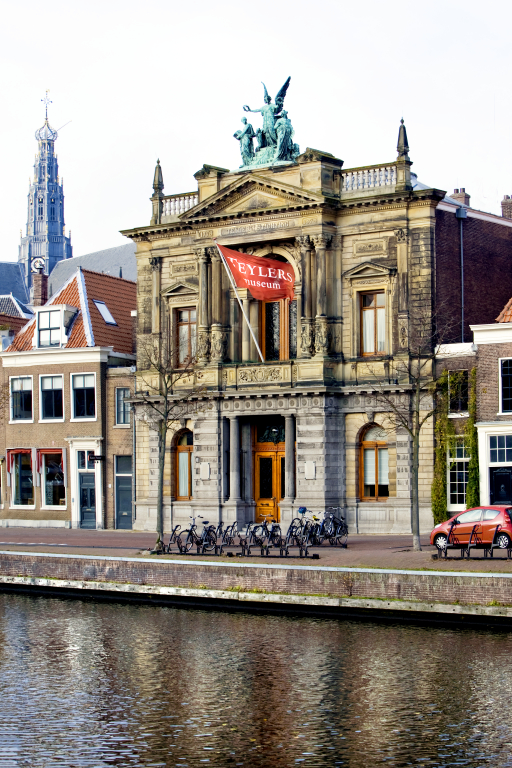
The biggest single expansion came in 1878 to 1885, when the Vienna-trained architect Christian Ulrich gave the museum the grand stone facade on the Spaarne that most visitors now photograph first, along with an Instrument Room, two Fossil Rooms and a Second Painting Gallery behind it. A century later, in 1996, the architect Hubert-Jan Henket added a deliberately modern, transparent wing for temporary exhibitions and a cafe, built so that no historic room would have to be converted to hold either. The most recent phase opened the Fundatiehuis itself to regular visitors in 2021, after an eight-year restoration, extending the public route into Pieter Teyler's own house for the first time. The museum now organises everything behind these walls into two parallel collections, Art and Science, a split that goes back to the two founding societies and still shapes how the galleries are laid out.
Michelangelo, Rembrandt and the drawings cabinet
The art collection's reputation rests less on paintings than on works on paper. In 1790 the museum's directors bought a large group of Italian Old Master drawings from a Roman aristocratic family, a single purchase that brought Michelangelo and Raphael sheets into a Dutch provincial museum decades before most national collections thought to compete for them. Because drawings fade under light, the originals are kept in storage and rotated onto display, with facsimile reproductions shown in their place in the First Painting Gallery so a visitor can still see what hangs where; the museum's own print room handles requests to see specific originals.
The Dutch material is just as strong in its own register: Hendrick Goltzius's 1588 drawing of his own right hand, deformed since childhood by a burn and drawn with the show-off virtuosity of an artist daring the viewer to doubt it was done by that hand, and a small 1639 Rembrandt self-portrait etching, wide-eyed and in a soft cap, from the years just before his fortunes turned. The numismatic cabinet, the part of the collection closest to Teyler's own original interest, holds medals the museum describes as unmatched anywhere else for the Dutch series, among them Christoffel Adolphi's Peace Medal of Breda, struck to mark the 1667 treaty that ended the second Anglo-Dutch war. The 19th-century rooms carry the museum's own later history as a collector, with Hague School and Dutch Romantic landscape painters bought as contemporaries rather than as Old Masters, and a contemporary-art programme, represented by Natasja Kensmil's 2013 painting Metamorphosis, that keeps the collecting going into the present rather than treating it as finished in 1900.
The largest generator in the world, and a fossil misread for a century
The science collection's single most famous object still stands in the Oval Room: Martin van Marum's large electrostatic generator, built for him in Amsterdam and, on its completion, the biggest machine of its kind anywhere in the world. Van Marum used it to run some of the earliest systematic experiments on electricity's effect on gases and metals, work that circulated among physicists across Europe and gave the young museum a research reputation it had not had under Teyler himself.
The fossil rooms hold two objects that matter well beyond Haarlem. A Mosasaurus jaw, dug from a chalk quarry near Maastricht in 1766, is among the earliest scientifically important vertebrate fossil finds in Europe and came to the museum in 1784 as part of Van Marum's purchase of the entire paleontological collection of Jean-Baptiste Drouin. Then there is the specimen known simply as the Haarlem specimen, a fragmentary skeleton of feet, arms and ribs bought from the Solnhofen limestone quarries in Bavaria and catalogued in 1857 as a new species of pterodactyl, Pterodactylus crassipes. It sat under that name, misidentified, for well over a century, until the American paleontologist John Ostrom recognised faint feather impressions the original description had read as wing membrane and identified it in 1970 as an early Archaeopteryx specimen, found years before the London and Berlin skeletons that made the genus famous. The story did not end there: a 2017 re-study by Christian Foth and Oliver Rauhut, published in BMC Evolutionary Biology, concluded the Haarlem bird was not Archaeopteryx after all but a related, older genus, which they named Ostromia in Ostrom's honour. The specimen remains on display in the fossil rooms, a case of a museum label recording an argument that is not fully settled rather than smoothing it into a single sentence. The library adds a different kind of scientific holding: a complete first-edition set of Diderot and d'Alembert's Encyclopedie, finished in 1780, and a first edition of John James Audubon's The Birds of America, shelved among the 18th-century travel and natural-history sets that once informed Van Marum's own research.
Visiting Teylers today
None of this history requires advance planning to see. The museum is open every day except Monday, admission is a single walk-up ticket, and the included multimedia tour runs about 50 minutes, though the rooms reward a much longer stay: a visitor who wants to actually read the Oval Room's instrument labels, work through both fossil rooms and take in the picture galleries is realistically looking at two to three hours, more if the Fundatiehuis tour is added. The practical rules are unfussy rather than restrictive: coats and any bag bigger than A4 paper go into the attended cloakroom, personal photography without flash or tripod is allowed everywhere except where a room is specifically marked otherwise, and the cafe and shop are both reachable without leaving the historic route.
What repeat visitors and first-time ones agree on, going by the volume of independent reviews the museum has accumulated, is that the rooms themselves, not any single object, are what people remember: a 1780s research space and an 1838 picture gallery that were never gutted and modernised, still doing roughly the job they were built for.
What visitors say
Visitors consistently single out the rooms themselves rather than any one object: an intact 1780s research interior and an 1838 picture gallery that were never gutted or modernised, still doing close to the job they were built for. The breadth of one visit, moving between fossils, minerals, instruments and paintings under a single roof, is repeatedly mentioned as unusual for a museum this size. Complaints cluster around a small number of practical points rather than the collection itself.
What is praised, what is criticised
- Praised: the well-preserved 18th- and 19th-century room interiors, above all the Oval Room
- Praised: the free multimedia/audio guide, credited with adding context the wall labels alone do not give
- Praised: the range of the collection, fossils, minerals, instruments, coins and paintings, covered in a single visit
- Criticised: bottled water and bags larger than A4 are not allowed past the cloakroom, which some visitors find inconvenient on a warm day
- Criticised: the museum shop carries relatively few souvenirs tied directly to specific objects in the collection
- Criticised: a minority of visitors find the display style dated next to museums built around interactive or digital presentation
Ratings on other platforms
TripAdvisor: 4.3 from 1,147 ratings, read 18 September 2026
A platform average is a tertiary source: it moves, it is not audited, and we quote no visitor's words.
Questions about Teylers Museum
Where is Teylers Museum?
Spaarne 16, 2011 CH Haarlem, Netherlands.
How much does it cost to visit?
Adult: EUR 18.5; Child 0-5: free; Child 6-17: EUR 2.5; Young adult 18-24 (incl. CJP): EUR 9.25; Group (10+ people): EUR 16.5. As confirmed 18 September 2026.
When is it open?
Tue-Sun 10:00-17:00; Public holidays (except 1 Jan and 25 Dec) 10:00-17:00. Closed: Monday. 1 January. As confirmed 18 September 2026.
What should you see first?
Large Electrostatic Generator (Built for Martin van Marum, Amsterdam, late 18th century); The Haarlem specimen (Ostromia crassipes, formerly identified as Archaeopteryx) (Solnhofen limestone, Late Jurassic, Bavaria); Mosasaurus jaw (Found in a chalk quarry near Maastricht, 1766); Michelangelo drawings (Michelangelo Buonarroti, part of a 1790 acquisition); Self-portrait in a cap, wide-eyed (Rembrandt van Rijn, etching, 1639); Goltzius' Right Hand (Hendrick Goltzius, drawing, 1588).
What we could not confirm
- Whether the Haarlem fossil specimen is best classified as Archaeopteryx or the separate genus Ostromia remains debated among paleontologists since the 2017 re-study; the museum's own display has not resolved this in either direction.
- The museum's own account of the 1790 Michelangelo and Raphael drawings purchase names the sellers only as a Roman aristocratic family; a fuller ownership chain back to the artists has not been published by the museum in the sources checked for this record.
Images
Sources
- 1Teylers Museum, official website, homepage teylersmuseum.nl/en
- 2Teylers Museum, Plan your visit (admission and opening hours) teylersmuseum.nl/en/plan-your-visit
- 3Teylers Museum, Contact page teylersmuseum.nl/en/organization/contact
- 4Teylers Museum, Accessibility teylersmuseum.nl/en/plan-your-visit/accessibility
- 5Teylers Museum, Frequently asked questions teylersmuseum.nl/en/plan-your-visit/faq
- 6Teylers Museum, Collection overview teylersmuseum.nl/en/discover/collection
- 7Teylers Museum, Masterpieces from the Art collection teylersmuseum.nl/en/discover/collection/art
- 8Teylers Museum, The science collection teylersmuseum.nl/en/discover/collection/science
- 9Teylers Museum, The building of Teylers Museum teylersmuseum.nl/en/discover/building
- 10Wikipedia, "Teylers Museum" (tertiary, general history, cross-checked against the museum's own pages) en.wikipedia.org/wiki/Teylers_Museum
- 11Wikidata, Q474563, Teylers Museum (tertiary, identity and coordinates) wikidata.org/wiki/Q474563
- 12Wikimedia Commons, File:Teylersmuseum.JPG, licence and description metadata commons.wikimedia.org/wiki/File:Teylersmuseum.JPG
- 13TripAdvisor, Teylers Museum reviews and rating (tertiary aggregate) tripadvisor.com/Attraction_Review-g188593-d319192-Reviews-Teylers_Museum-Haarlem_North_Holland_Province.html
- 14Deposits Magazine, "Geology museums of mainland Europe: the palaeontological collection at the Teyler's Museum, Haarlem", 20 March 2022 depositsmag.com/2022/03/20/the-palaeontological-collection-at-the-teylers-museum-haarlem-the-netherlands/
- 15Phys.org, "The Archaeopteryx that wasn't", 21 December 2017, on Foth and Rauhut's reclassification of the Haarlem specimen as Ostromia phys.org/news/2017-12-archaeopteryx-wasnt.html
- 16Wikipedia, "Specimens of Archaeopteryx", section on the Haarlem specimen (tertiary) en.wikipedia.org/wiki/Specimens_of_Archaeopteryx
- 17Wikimedia Commons, File:Oval-room-teylers.jpg, licence and description metadata commons.wikimedia.org/wiki/File:Oval-room-teylers.jpg
- 18Wikimedia Commons, File:Teylers museum - Fossil Room I.jpg, licence and description metadata commons.wikimedia.org/wiki/File:Teylers_museum_-_Fossil_Room_I.jpg
- 19Wikimedia Commons, File:Interior Instrument Room Teylers Museum.jpg, licence and description metadata commons.wikimedia.org/wiki/File:Interior_Instrument_Room_Teylers_Museum.jpg
- 20Wikimedia Commons, File:Eerste Schilderijenzaal Teylers Museum (1838).jpg, licence and description metadata commons.wikimedia.org/wiki/File:Eerste_Schilderijenzaal_Teylers_Museum_(1838).jpg
- 21Wikimedia Commons, File:Library at the Teylers museum, photo-1.JPG, licence and description metadata commons.wikimedia.org/wiki/File:Library_at_the_Teylers_museum,_photo-1.JPG
- 22Wikimedia Commons, File:Voorgevel Teylers Museum.jpg, licence and description metadata commons.wikimedia.org/wiki/File:Voorgevel_Teylers_Museum.jpg
- 23Wikimedia Commons, File:Pieter-teyler-van-der-hulst.jpg, licence and description metadata commons.wikimedia.org/wiki/File:Pieter-teyler-van-der-hulst.jpg


.jpg)


