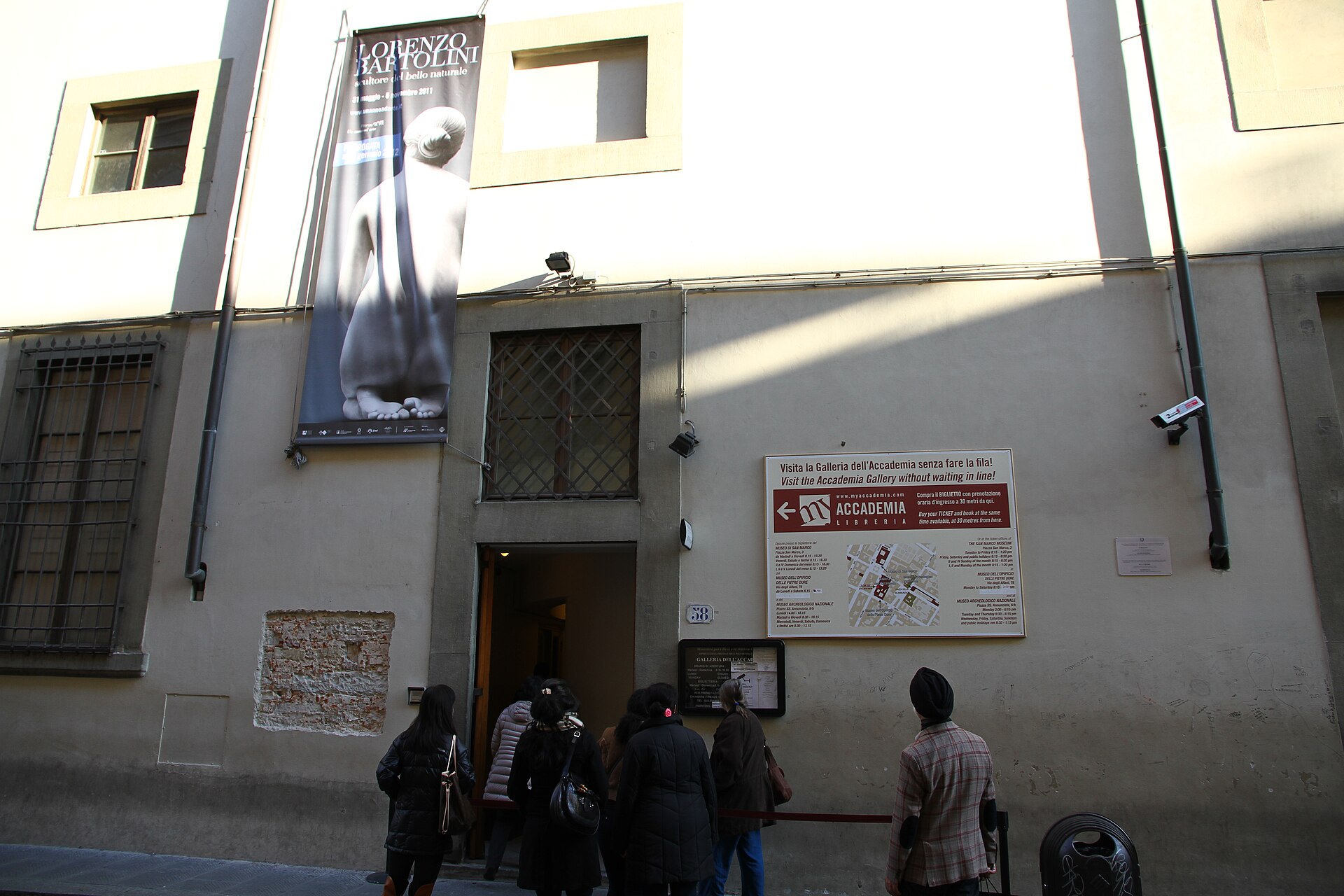
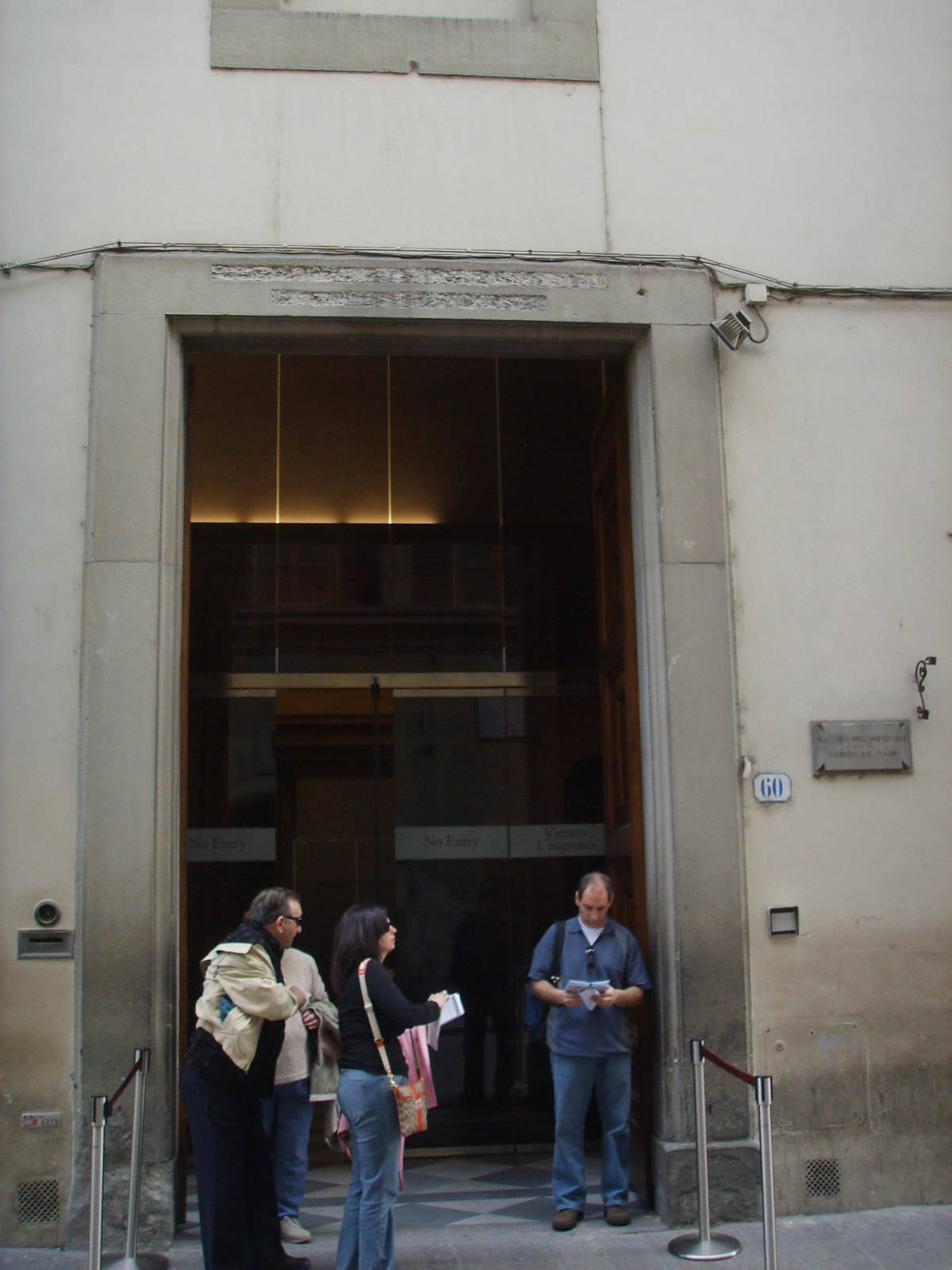
The street entrance of the Galleria dell'Accademia on Via Ricasoli, Florence, with a 2011 exhibition banner for the sculptor Lorenzo Bartolini above the door and the museum's own wayfinding sign at street level.
Photograph by Ctny · CC BY-SA 3.0Galleria dell'Accademia
Museum · Galleria dell'Accademia di Firenze · Founded 1784
Open, admission and hours confirmed 22 August 2026 · 14 sources
On this page 15 sections
ContentsClose
Not an encyclopaedic collection and not trying to be one: this is a Florentine teaching academy's holdings, inherited from suppressed churches and convents across two centuries, built around one 1873 addition that reshaped the whole institution. The gold-ground and early Renaissance paintings, Giotto's workshop, Lorenzo Monaco, Botticelli, Perugino, are genuinely deep for the 13th to 16th centuries, but almost nobody comes for them. What draws over a million and a half visitors a year is a corridor of Michelangelo's unfinished carving, the four Prisoners and St Matthew, that leads directly to the David under its purpose-built dome, plus a separately disputed Pieta on the same route, a full-scale Giambologna clay model, and a small but genuinely rare department of Medici-owned Stradivari and Cristofori instruments that most visitors never reach.
| Local name | Galleria dell'Accademia di Firenze |
|---|---|
| Kind | Museum |
| Founded | 1784 (Grand Duke Pietro Leopoldo reorganised the Accademia delle Arti del Disegno, founded 1563 by Cosimo I de Medici, into the modern Accademia di Belle Arti); the Galleria as a separate museum was established in 1882 |
| City and country |  Florence, Italy Florence, Italy |
| Address | Via Ricasoli 58-60, 50122 Firenze, Italia |
| Website | galleriaaccademiafirenze.it/en |
| Status | Open, confirmed |
| Record last verified |
Visiting
- Hours
- Tuesday to Sunday08:15 to 18:50Last admission 18:20, thirty minutes before closing. Museum closing procedures begin ten minutes before closing time, at which point access to the ground-floor Musical Instruments rooms and the first-floor exhibition rooms is stopped
- MondayClosed, with one stated exception in the 2026 calendar: Monday 6 April 2026, when the museum opens on regular hours and at regular prices
- Closed
- Every Monday except 6 April 2026. 1 January. 25 December.
- Admission
- Regular (walk-in, full price)EUR 20Unchanged since raised from EUR 16.00 to EUR 20.00 on 1 February 2026. A EUR 4.00 reservation fee applies on top of this for phone or advance online booking through Firenze Musei; walk-up admission at the ticket office does not carry the reservation fee but queueing without a booking can run past an hour in season
- Reduced, EU citizens 18-25EUR 2Valid to the 25th birthday, and to citizens of Switzerland, Norway, Liechtenstein, Iceland and Uruguay on the same terms. Plus the EUR 4.00 booking fee if reserved
- Free, under 18FreeUnder-12s must be accompanied by an adult. A long further list of free-admission categories includes EU art-history and conservation students and faculty, teachers, ICOM members, licensed EU tour guides, disabled visitors and one companion, and Ministry of Culture staff, each on presentation of a qualifying document at the ticket office
- 48-hour combined ticket, Accademia + BargelloEUR 26Unchanged since 15 March 2026, covering the Galleria dell'Accademia and the Museo Nazionale del Bargello on one ticket valid 48 hours
- 72-hour combined ticket, 6 museumsEUR 38Unchanged since 15 March 2026: the Accademia, Bargello, Medici Chapels, Palazzo Davanzati, Orsanmichele and Casa Martelli, all on one ticket valid 72 hours
Free entry: 25 April 2026. 2 June 2026. 4 November 2026. First Sunday of every month in 2026. On these days the phone and online booking service is switched off; visitors simply queue at the gate- Tickets
- galleriaaccademiafirenze.it/en/tickets The museum's own ticket page.
- Do I need to book?
- Not compulsory but strongly advised. The museum's own site states plainly that without a reservation the wait for access may be long; a timed online booking through Firenze Musei/B-Ticket carries a EUR 4.00 fee on top of the ticket price
- Address
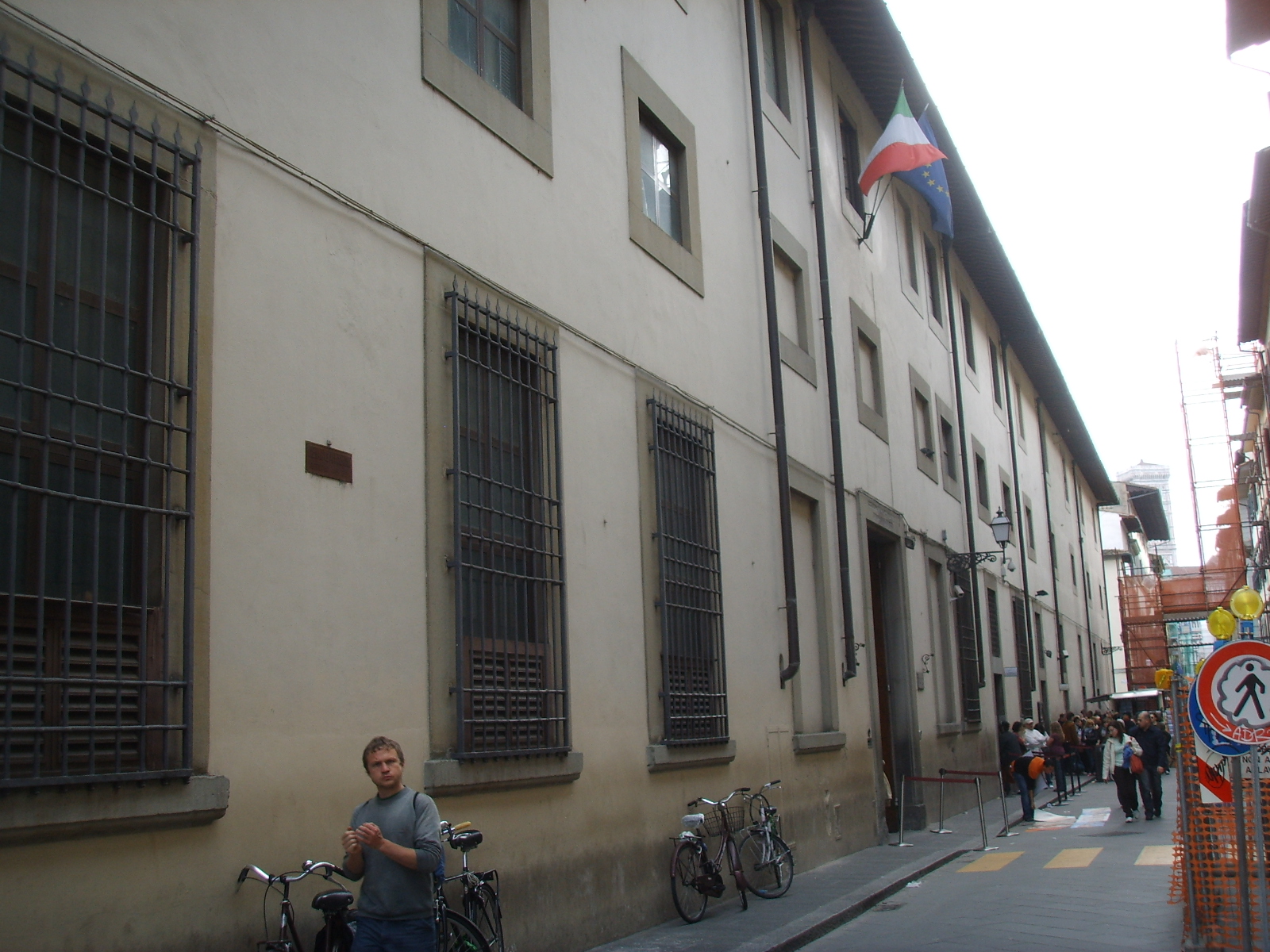
- Via Ricasoli 58-60, 50122 Firenze, Italia MapWalking About 8 minutes on foot from Piazza del Duomo, and about 12 minutes from Firenze Santa Maria Novella railway station; the museum sits in the university quarter on Via Ricasoli, between the Duomo and Piazza San Marco
Bus ATAF city bus routes serving Piazza San Marco and Via Cavour stop within a short walk; the museum's own site gives the address rather than a specific route number - Website
- galleriaaccademiafirenze.it/en
- Telephone
- +39 055 0987100
- [email protected]
Before you go how long, access, photography, bags, eating, shop
- How long to allow
- The building is small next to what it holds: most of a visit concentrates on the short run from the Sala del Colosso through the Galleria dei Prigioni to the Tribuna, which most visitors clear in under an hour, with the gold-ground paintings, the Gipsoteca and the Musical Instruments department seeing far lighter traffic and correspondingly less of most visitors' time
- Access
- Entrance and ticket office are reached from Via Ricasoli 60. Every hall and gallery open to the public is wheelchair accessible, the museum has a lift to the upper floor, and an accessible restroom sits on the ground floor near the lift. Tactile maps are provided on the ground floor (Sala del Colosso) and first floor (Sala 1), and a tactile path for blind and low-vision visitors runs through the ground floor, keyed to Botticelli's Virgin and Child with the Infant St John and Two Angels, the Cassone Adimari panel, Pacino di Bonaguida's Tree of Life and Taddeo Gaddi's Crucifixion
- Photography
- Not stated as restricted on the museum's own visiting-rules page beyond the standard security screening; no cloakroom exists on site (see bags, below)
- Bags
- There is no cloakroom. Visitors go through a security inspection at the entrance; scissors, blades and other metal objects judged dangerous are confiscated at the metal detector and not returned inside the museum, and large bags, backpacks and helmets are refused entry outright rather than checked. Water bottles up to 0.5 litres are allowed. A paid luggage-storage service is available at the MyAccademia shop outside the museum
- Eating
- The museum's own visiting-information page does not list an on-site cafe
- Shop
- Two bookshops on the ground floor. Audioguides for adults and children are rented at the bookshop for EUR 6.00 against a deposited identification document
Prices and hours change. We take them from the institution's own pages and print the day we read them, and you can check the current position at the source we used. Confirm before you travel.
What is inside
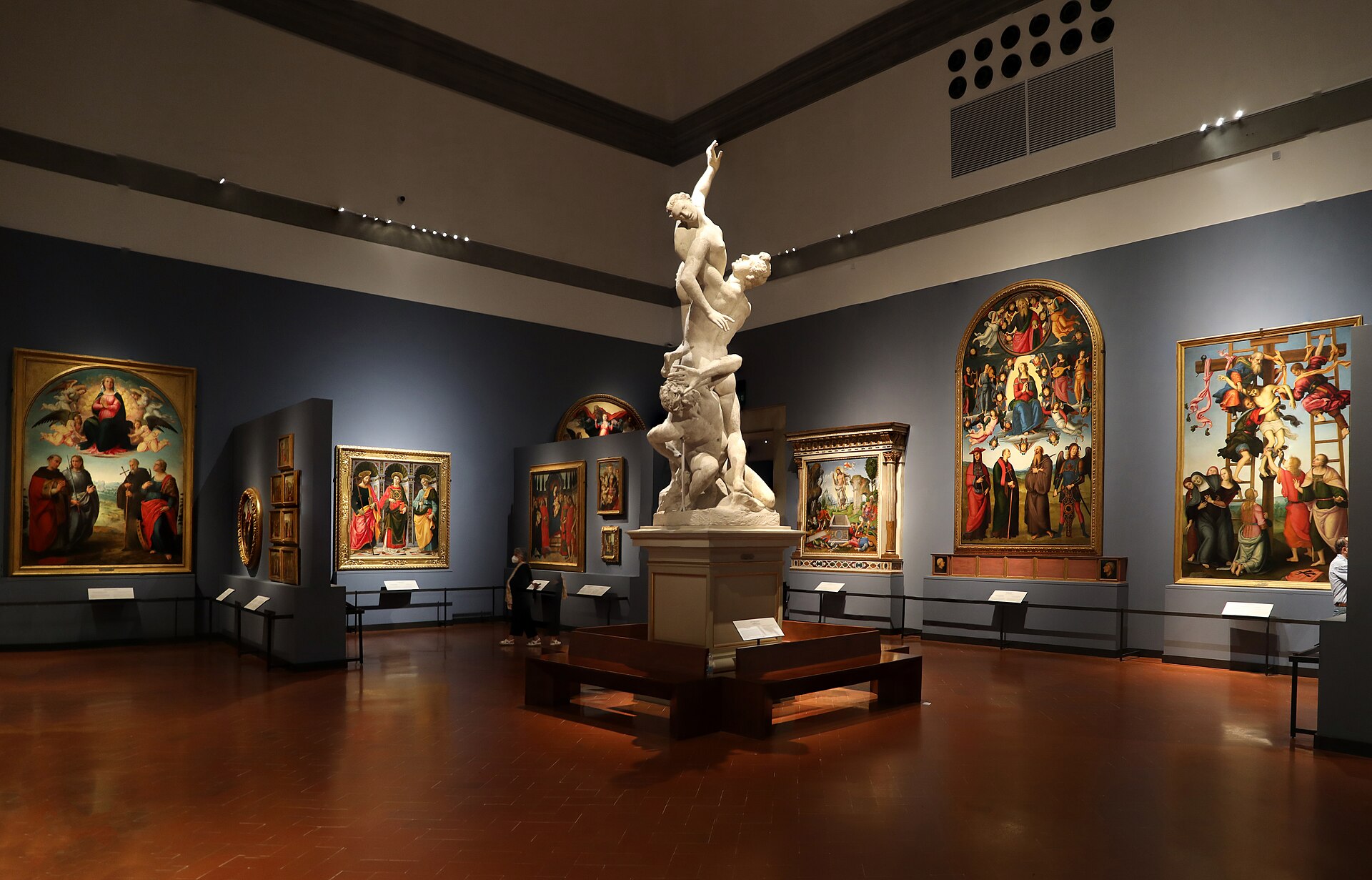
Photograph by Sailko · CC BY-SA 4.0 Sala del Colosso (Hall of the Colossus)
The first room a visitor reaches, and the largest single ground-floor gallery. Its centre is Giambologna's original full-scale clay model for the Rape of the Sabine Women, made in 1582 at 1:1 scale ahead of the marble carved the same year for the Loggia dei Lanzi in Piazza della Signoria; the model itself never left the museum. Around it the walls carry gold-ground and early Renaissance panels, including work by the Master of the Magdalene, Bernardo Daddi, Taddeo Gaddi and Andrea Orcagna, giving the room a second identity as the start of the 13th-to-15th-century painting sequence
Galleria dei Prigioni (Gallery of the Prisoners)
The corridor that leads from the Sala del Colosso to the Tribuna, lined with four of Michelangelo's unfinished marble Prisoners (or Slaves), carved from about 1525 to 1530 for the never-completed tomb of Pope Julius II: the Young Slave, the Bearded Slave, Atlas and the Awakening Slave, each still showing tool marks and rough stone around the emerging figure. The same corridor holds Michelangelo's St Matthew (San Matteo), begun 1505-06 for Florence Cathedral and abandoned at a similar stage, and the Palestrina Pieta, a work whose attribution to Michelangelo is itself disputed (see Open Questions). We could not verify a free-licence photograph of this specific corridor; it renders here as text only
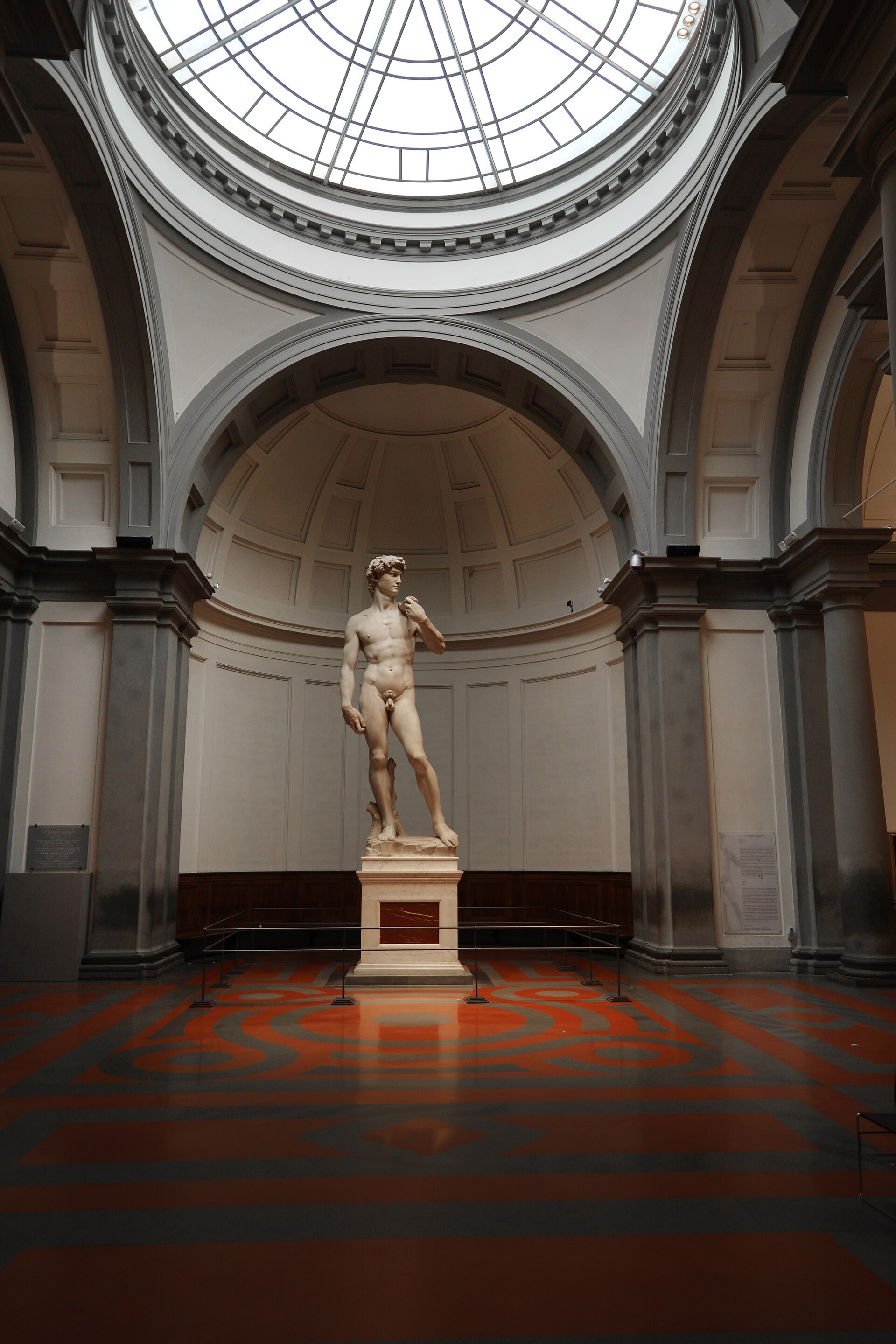
Photograph by Sailko · CC BY-SA 4.0 Tribuna, with the David
A purpose-built rotunda under a skylight dome, designed by the architect Emilio De Fabris specifically to hold Michelangelo's David after its 1873 move from Piazza della Signoria; construction took nine years, during which the statue waited crated in a wooden box. The David, carved 1501-1504 from a single block of Carrara marble already worked and abandoned by two earlier sculptors, stands alone at the centre, lit from above, with a ring of unfinished Michelangelo studies and 16th-century paintings by Fra Bartolomeo, Andrea del Sarto and Pontormo around the base of the rotunda
Gipsoteca Bartolini, in the Salone dell'Ottocento
A single long hall of plaster models, almost all by the neoclassical sculptor Lorenzo Bartolini and his pupil Luigi Pampaloni, both of whom taught or studied at the Accademia di Belle Arti. The plasters are the working models Bartolini used to pass proportions to his marble carvers; several correspond to finished marbles now elsewhere, including his portrait busts, the Demidoff Monument figure and funerary monuments, so the room reads as the back-of-house version of a body of work usually seen only in its finished, public form
Sale 6a-6c: the Duecento, Giotto and Orcagna rooms
Three connected rooms carrying the museum's earliest paintings, 13th- and 14th-century gold-ground work by Pacino di Bonaguida, Giotto and his workshop, Giovanni da Milano and the Orcagna circle: Pacino's Tree of Life, an altarpiece cycle attributed to Giotto's school, and Giottino's Madonna and Child Enthroned among them. These rooms are consistently the least crowded in the building, standing between the Sala del Colosso and the Musical Instruments department on the visitor route rather than on the direct line to the David. We could not verify a free-licence photograph of these specific rooms
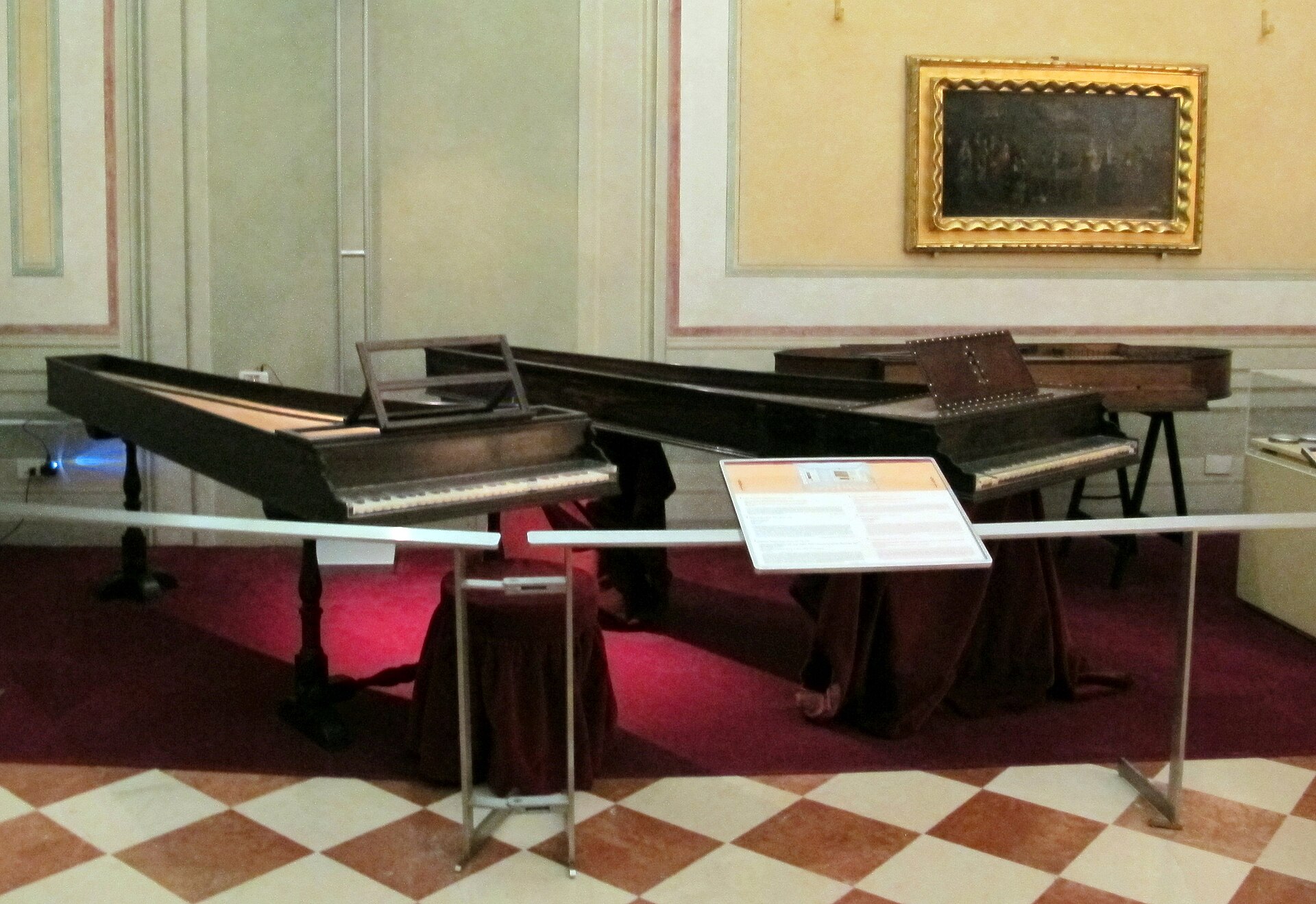
Photograph by Sailko · CC BY 3.0 Museo degli Strumenti Musicali (Museum of Musical Instruments)
A dedicated department, founded in 2001, built around roughly fifty instruments from the private collections of the Medici and Lorraine grand dukes of Tuscany, most of them later held by the Conservatorio Luigi Cherubini of Florence before transfer here. The centrepiece is a tenor viola and a cello made by Antonio Stradivari in 1690, part of a five-piece string quintet built for Grand Prince Ferdinando de' Medici, shown alongside a 1650 Niccolo Amati cello, an oval spinet and a harpsichord by Bartolomeo Cristofori (the inventor of the piano mechanism), and a psaltery carved entirely from different coloured marbles. Multimedia stations let visitors hear recordings of some instruments being played
What to see first
David
Michelangelo Buonarroti, 1501-1504Carved from a single block of Carrara marble that two earlier sculptors, Agostino di Duccio and Antonio Rossellino, had already worked and abandoned as unworkable across the preceding forty years. Moved here from Piazza della Signoria in August 1873 for conservation, into a Tribuna that took nine years to finish, during which the statue sat crated in a wooden box; a full-size marble copy has stood in the original outdoor spot in the piazza since 1910. In 2023 the museum's directorship won a Florence court judgment against the publisher of GQ Italia over an unlicensed commercial image of the statue's face (see narrative), one of the clearest recent tests anywhere of how far a museum can control the commercial use of a public-domain artwork's image.5
The four Prisoners (Slaves)
Michelangelo Buonarroti, c. 1525-1530The Young Slave, Bearded Slave, Atlas and Awakening Slave were carved for the tomb of Pope Julius II, a commission that was cut down repeatedly over decades and never finished as planned; Michelangelo abandoned these four still partly trapped in the block. They are shown deliberately unfinished, tool marks and rough stone left visible, and stand in the corridor a visitor walks directly before reaching the David, which the museum's own room sequence treats as showing Michelangelo's method rather than just his results.5
St Matthew (San Matteo)
Michelangelo Buonarroti, 1505-1506Commissioned for a cycle of twelve apostles for the facade of Florence Cathedral, of which this is the only one Michelangelo ever began. Abandoned unfinished at a stage close to the Prisoners, it is the earliest of his non-finito works in the museum and is shown in the same corridor as the Prisoners rather than with the other early paintings.5
Palestrina Pieta
Attributed to Michelangelo circa 1547-1559; attribution disputed since the mid-1960sFirst recorded in 1756 by the local historian Leonardo Cecconi, who described it in a church in Palestrina and called it, without evidence from Michelangelo's own lifetime, a sketch by Buonarroti. No contemporary source or biographer of Michelangelo ever mentions it, which would be unique among his Pietas if the attribution were secure. Scholars including Henry Thode, Bernard Berenson and Charles de Tolnay rejected the attribution outright around the 400th anniversary of Michelangelo's death in 1964; the current scholarly position leans toward an idea or partial block from Michelangelo's own workshop finished by another hand, possibly Niccolo Menghini. It entered the Galleria's collection in 1939 and stands in the Galleria dei Prigioni, the last sculpture before the Tribuna.9
Full-scale model for the Rape of the Sabine Women
Giambologna, 1582A rare survival: a 1:1 working model in unfired clay, made the same year Giambologna carved the marble version for the Loggia dei Lanzi in Piazza della Signoria. It dominates the Sala del Colosso, the first room on the visitor route, and shows the full-size working stage of a sculpture usually known only from its finished public marble.5
Stradivari tenor viola and cello, 1690
Antonio StradivariTwo surviving pieces of a five-instrument quintet Stradivari built in 1690 for Grand Prince Ferdinando de' Medici, shown in the Museum of Musical Instruments alongside a 1650 Niccolo Amati cello and a Bartolomeo Cristofori harpsichord. Complete or near-complete Stradivari sets made for a single documented patron and still traceable to that commission are rare; multimedia stations in the room let visitors hear recordings of instruments from the same collection being played.5
Virgin and Child with the Infant St John the Baptist and Two Angels
Sandro Botticelli, c. 1465-1470One of the museum's earlier Botticellis and, since the museum's own accessibility programme built a tactile route through the ground floor for blind and low-vision visitors, the first painting on that path, meaning it is one of the very few paintings here with a touch-relief interpretation built specifically around it.5
A teaching academy's collection outgrows its purpose
The Galleria dell'Accademia exists because of an art school, not the other way around. In 1784 the Grand Duke of Tuscany, Pietro Leopoldo, reorganised the Accademia delle Arti del Disegno, founded in 1563 by Cosimo I de Medici as Europe's first formal academy of drawing, into a modern Accademia di Belle Arti, housed in the former Hospital of San Matteo and the convent of San Niccolo di Cafaggio. The teaching collection that grew up around it was enriched twice by state suppression of religious houses, once under Pietro Leopoldo in 1786 and again under Napoleon in 1810, each time redirecting altarpieces and panels from closed churches and convents into the school's holdings rather than into a museum built to receive them. What visitors see today is still substantially that inherited teaching collection, gold-ground and early Renaissance painting assembled to train students rather than to form a public gallery, which is part of why the museum's own room sequence still reads more like a survey of period and technique than a chronological march through masterpieces.
One move, in 1873, made the museum
The event that actually created the museum as it exists is a single transfer. In August 1873 Michelangelo's David was moved here from its original outdoor position in Piazza della Signoria, officially for conservation, after nearly three and a half centuries of open-air weathering since its installation there in 1504. The statue waited nine years, crated in a wooden box, while the architect Emilio De Fabris built the Tribuna, a purpose-designed rotunda under a skylight dome, specifically to receive it. The Galleria dell'Accademia as a distinct museum, separate from the teaching academy that had housed the collection until then, was formally established in 1882, nine years after the move and immediately following the Tribuna's completion. A full-size marble copy has stood in the original Piazza della Signoria spot since 1910, which is why almost every photograph of David outdoors in Florence is not, in fact, of this object.
What the Prisoners are actually showing
The four Prisoners, or Slaves, in the corridor leading to the Tribuna were carved around 1525 to 1530 for the tomb of Pope Julius II, a commission first agreed in 1505 and cut down in scope repeatedly over four decades until the finished monument, in Rome's San Pietro in Vincoli, bears little resemblance to what was first planned. Michelangelo abandoned these four still emerging from the block, tool marks and unworked stone left visible around each figure, and the museum displays them exactly that way rather than as failures to be explained away. St Matthew, in the same corridor, is the same kind of object from earlier in Michelangelo's career: the only survivor of a planned twelve-apostle cycle for Florence Cathedral's facade, begun in 1505 and abandoned at a comparably early stage. Seen together, and seen immediately before the finished David, the corridor makes an argument the museum does not have to state directly: that unfinished autograph work by a documented hand is worth more, and says more about how the work was made, than a smoothed-over completion by someone else's.
A disputed attribution kept on the same route
The Palestrina Pieta, the last sculpture in the corridor before the Tribuna, complicates that argument rather than supporting it. It surfaces in the documentary record only in 1756, when the local historian Leonardo Cecconi described a Pieta then in a church in Palestrina and called it, with no supporting evidence from Michelangelo's own lifetime, a sketch by Buonarroti. No contemporary of Michelangelo's and none of his biographers mention it, which would be unusual to the point of implausible for an autograph work of this scale if the attribution were sound. The sculpture entered the Galleria's collection in 1939 and was widely shown and published as Michelangelo's for roughly two centuries before a cluster of major scholars, Henry Thode, Bernard Berenson and Charles de Tolnay among them, rejected the attribution around 1964, the four-hundredth anniversary of Michelangelo's death. The current scholarly middle ground holds that the piece may originate as an idea or a roughed-out block from Michelangelo's own workshop, later completed by another sculptor, possibly Niccolo Menghini; no consensus exists on how much, if any, of the finished surface is Michelangelo's own hand. The museum displays it under Michelangelo's name in its own collection listing without flagging the dispute on the object label, a case where a visitor's own tools, not the museum's captioning, are the only route to the disagreement.
The museum in court over its own most famous image
In May 2023 a Florence court ruled that the publisher Edizioni Conde Nast had infringed the Galleria's rights over David's image by using a digitally altered version of the statue's face, superimposed with the model Pietro Boselli's using a lenticular printing effect, on the cover of GQ Italia in 2020 without the museum's authorisation. The court found two separate harms: a patrimonial one, the licensing fee the museum was never paid, calculated at EUR 20,000, and a non-pecuniary one, for the manner of the depiction itself, calculated at a further EUR 30,000. According to reporting on the ruling, the court found the publisher had, in its words, debased and humiliated the high symbolic and identity value of the work by turning it into advertising, and grounded the decision in Article 9 of the Italian Constitution, which protects the nation's artistic heritage, rather than in ordinary copyright, since David itself has been in the public domain for centuries. Then-director Cecilie Hollberg called the ruling a great achievement extending beyond the individual case, and Italy's culture minister at the time, Gennaro Sangiuliano, publicly welcomed it. Weeks earlier the museum had separately fined the toy company Ravensburger over an unauthorised puzzle using a different Accademia-held image, Leonardo's Vitruvian Man; that drawing, and that dispute, belong to the Gallerie dell'Accademia in Venice, a different institution under a near-identical name, not to this museum in Florence, and the two should not be read as the same case.
A statue, a school board, and an international response
In March 2023 a sixth-grade art history class at Tallahassee Classical School, a charter school in Florida, was shown an image of the David alongside Botticelli's Birth of Venus as part of a standard Renaissance unit the school had taught for years. A parent-notification letter about the lesson was not sent, one parent who later saw the material compared the nudity to pornography, and the school board's chair gave the school's principal, Hope Carrasquilla, the choice of resigning or being terminated; she resigned. The story reached Florence within days. Director Cecilie Hollberg told the Associated Press she was astonished, and invited Carrasquilla, the board, parents and the whole student body to see, in her words, the purity of the statue for themselves; Florence's mayor extended a separate personal invitation. Carrasquilla travelled to Florence with her family that April and viewed the statue in person. The episode is not primarily a story about this museum, but it put the Accademia's own director in the position of publicly defending a five-centuries-old marble against a charge of obscenity raised eleven hundred kilometres away, which is a stranger kind of institutional pressure than the crowding or funding disputes more usual for a museum this size.
2026: merged into a seven-venue system under a new director
In July 2025 Andreina Contessa, previously director of the Museo Storico and Castello di Miramare park in Trieste, was appointed director general of a newly unified institute combining the Galleria dell'Accademia with the Museo Nazionale del Bargello and five further Florentine sites: the Medici Chapels, Palazzo Davanzati, the Orsanmichele complex, Casa Martelli and, on completion, the former church of San Procolo. The merged system, unveiled in January 2026, holds more than fifty thousand objects across roughly 18,600 square metres of exhibition space and recorded more than three million visitors across its venues in 2025. Contessa has described the union as pursuing shared ticketing and unified hours specifically to rebalance visitor flow away from the most crowded single points, of which the Accademia's David rooms are the clearest example in the whole system, while keeping each site's own specificity intact. The reorganisation carried a price increase across the group from 1 February 2026, the Accademia's own regular ticket rising from EUR 16.00 to EUR 20.00, alongside new 48-hour and 72-hour combined tickets introduced from 15 March 2026 covering two or all six other venues respectively. Whether spreading visitor demand across seven sites actually shortens the queue for the David itself is not yet something the reorganisation's own figures can show, since the change took effect only weeks before this page was researched.
What visitors say
Visitors come for one room and one statue, and most say so directly: the David is described consistently as worth any wait, while the rest of the building, the gold-ground paintings, the Gipsoteca and the Musical Instruments department, is repeatedly described as rushed past or skipped by visitors on a tight schedule. The museum's small physical footprint against very high demand, not the collection itself, is the recurring complaint.
What is praised, what is criticised
- Praised: seeing the David at close range and lit from above in the Tribuna, a room built specifically to stage it, rather than as a distant outdoor copy
- Praised: the Prisoners in the corridor immediately before the David, left visibly unfinished, which visitors and critics alike credit with explaining Michelangelo's carving method better than any label could
- Praised: the speed of a focused visit: once inside, the Sala del Colosso, the Prigioni and the Tribuna can be seen properly well under an hour
- Criticised: the wait without a timed reservation, which the museum's own site says plainly can be long, and which travel guides put at 30 to 90 minutes in peak season
- Criticised: the rest of the collection outside the Michelangelo rooms, several rooms of 13th-to-15th-century gold-ground painting and the Musical Instruments department, which is widely reported as passed through quickly or skipped entirely by visitors focused on the David
- Criticised: the mismatch between the building's 19th-century footprint and 21st-century visitor volume, which is exactly what the January 2026 merger into a seven-venue system with the Bargello was framed as trying to relieve by spreading visitor flow across more sites
Questions about Galleria dell'Accademia
Where is Galleria dell'Accademia?
Via Ricasoli 58-60, 50122 Firenze, Italia.
How much does it cost to visit?
Regular (walk-in, full price): EUR 20; Reduced, EU citizens 18-25: EUR 2; Free, under 18: free; 48-hour combined ticket, Accademia + Bargello: EUR 26; 72-hour combined ticket, 6 museums: EUR 38. As confirmed 22 August 2026.
When is it open?
Tuesday to Sunday 08:15-18:50; Monday closed. Closed: Every Monday except 6 April 2026. 1 January. As confirmed 22 August 2026.
How do you get there?
Walking: About 8 minutes on foot from Piazza del Duomo, and about 12 minutes from Firenze Santa Maria Novella railway station; the museum sits in the university quarter on Via Ricasoli, between the Duomo and Piazza San Marco; Bus: ATAF city bus routes serving Piazza San Marco and Via Cavour stop within a short walk; the museum's own site gives the address rather than a specific route number.
What should you see first?
David (Michelangelo Buonarroti, 1501-1504); The four Prisoners (Slaves) (Michelangelo Buonarroti, c. 1525-1530); St Matthew (San Matteo) (Michelangelo Buonarroti, 1505-1506); Palestrina Pieta (Attributed to Michelangelo circa 1547-1559; attribution disputed since the mid-1960s); Full-scale model for the Rape of the Sabine Women (Giambologna, 1582); Stradivari tenor viola and cello, 1690 (Antonio Stradivari).
What we could not confirm
- The Palestrina Pieta is shown and catalogued under Michelangelo's name, but the attribution has had no scholarly consensus since major figures (Thode, Berenson, Tolnay) rejected it around 1964; the surviving position is that it may be a workshop idea completed by another hand, possibly Niccolo Menghini, and the museum's own gallery labelling does not flag the dispute to a visitor standing in front of it.
- Whether the January 2026 merger into the seven-venue Galleria dell'Accademia di Firenze e Musei del Bargello system actually reduces the queue and crowding at the David rooms, as director Andreina Contessa's stated aim, is not yet demonstrated by any published visitor-flow figures; the change took effect only weeks before this page was researched.
- The museum's own site states both a general last-admission rule (30 minutes before closing, so 18:20) and a closing-procedure rule (ground-floor and first-floor rooms close to entry from 18:40, ten minutes before the museum itself closes); the two are consistent but are stated on different pages rather than reconciled on one.
Images
Sources
- 1Wikidata, Galleria dell'Accademia (Q10855544): label, description as an art museum in Florence, Italy, coordinates 43 46'37"N 11 15'32"E, official website, founder Leopold II, inception 1784. Used to confirm this is the Florence institution and not the Venice Gallerie dell'Accademia (Q338330), a separate item on the same page's own linked media. Fetched and raw-verified 7 August 2026. wikidata.org/wiki/Q10855544
- 2Galleria dell'Accademia di Firenze, official Tickets page: full ticket prices (EUR 20 regular, EUR 2 reduced, free under-18), the EUR 4 reservation fee, the new 48-hour (EUR 26) and 72-hour (EUR 38) combined tickets from 15 March 2026, phone booking number, and customer-support email. Fetched by direct HTTP GET (browser TLS validation on this domain failed on an otherwise-valid certificate; content confirmed via a direct fetch of the raw page) and read in full, 7 August 2026. galleriaaccademiafirenze.it/en/tickets/
- 3Galleria dell'Accademia di Firenze, official Visit page: opening hours (08:15-18:50, last admission 18:20), closed days, free-admission days for 2026, address, accessibility provisions, tactile maps and tactile path, bag and security rules, bookshop and audioguide details, room-by-room museum map (Entrance, Hall of the Colossus, Gallery of the Prisoners, Tribuna with David, Gipsoteca, rooms 6a-6c, Musical Instruments, Temporary Exhibitions), phone and email contacts. Fetched by direct HTTP GET and read in full, 7 August 2026. galleriaaccademiafirenze.it/en/visit/
- 4Galleria dell'Accademia di Firenze, official The Galleria page: founding history (1784 reorganisation of the 1563 Accademia delle Arti del Disegno, 1786 and 1810 suppressions, the August 1873 move of David and Emilio De Fabris's Tribuna, the museum's establishment as a separate institution in 1882) and current staff and directorate listing. Fetched by direct HTTP GET and read in full, 7 August 2026. galleriaaccademiafirenze.it/en/the-galleria/
- 5Galleria dell'Accademia di Firenze, official Collections page: painting, sculpture and musical-instrument department descriptions and named highlight lists, including the Prisoners, St Matthew, the Palestrina Pieta, Giambologna's clay model, the Stradivari tenor viola and cello of 1690, and named paintings by Botticelli, Perugino and others. Fetched by direct HTTP GET and read in full, 7 August 2026. galleriaaccademiafirenze.it/en/collections/
- 6Center for Art Law, 'Protection of Cultural Icons: Implications of the Galleria dell'Accademia v. Edizioni Conde Nast Decision', by Kouros Sadeghi-Nejad, 30 August 2023: the May 2023 Florence court ruling on the unauthorised GQ Italia cover use of David's image, the EUR 20,000 patrimonial and EUR 30,000 non-pecuniary damages, the constitutional reasoning, and director Cecilie Hollberg's and Minister Gennaro Sangiuliano's public responses. Also describes a separate, contemporaneous Ravensburger/Vitruvian Man dispute belonging to the Gallerie dell'Accademia in Venice. Fetched and read in full, 7 August 2026. itsartlaw.org/2023/08/30/case-review-italian-cultural-heritage-copyright
- 7NPR, 'A principal is fired, invited to Italy after students are shown Michelangelo's David', by Juliana Kim, 27 March 2023: the Tallahassee Classical School principal's resignation, director Cecilie Hollberg's statement to the Associated Press and invitation to Florence, and Florence mayor Dario Nardella's separate invitation. Fetched and read in full, 7 August 2026. npr.org/2023/03/27/1166079167/tallahassee-classical-michelangelo-david-principal-fired
- 8Finestre sull'Arte, 'Florence, Accademia Gallery and Bargello reorganize. Here's how', 15 January 2026: the unveiling of the seven-venue Galleria dell'Accademia di Firenze e Musei del Bargello system, director Andreina Contessa's July 2025 appointment, 2025 visitor total of over 3 million, the new combined tickets from 15 March 2026, and the 1 February 2026 price rises across the group including the Accademia's own EUR 16 to EUR 20 change. Fetched and read in full, 7 August 2026. finestresullarte.info/en/museums/florence-accademia-gallery-and-bargello-reorganize-here-s-how
- 9Finestre sull'Arte, 'Palestrina's Pieta: the most famous work not by Michelangelo': the 1756 Cecconi account, the absence of any contemporary source or Michelangelo biographer mentioning the work, its 1939 entry into the Galleria dell'Accademia collection, and the mid-1960s scholarly de-attribution. Fetched 7 August 2026; article partially paywalled beyond the introduction, and only the raw-read introductory portion is used here. finestresullarte.info/en/works-and-artists/palestrina-s-pieta-the-most-famous-work-not-by-michelangelo
- 10Wikimedia Commons, File:Entrance of Galleria dell'Accademia.JPG: description, CC BY-SA 3.0 licence, author Ctny, confirmed by eye as the Via Ricasoli entrance with ACCADEMIA wayfinding signage visible. Used as the lead plate. commons.wikimedia.org/wiki/File:Entrance_of_Galleria_dell%27Accademia.JPG
- 11Wikimedia Commons, File:Firenze, galleria dell'accademia, tribuna del david 01.jpg: CC BY-SA 4.0, author Francesco Bini, confirmed by eye as the Tribuna with the David under its skylight dome. Used as the Tribuna wing plate. commons.wikimedia.org/wiki/File:Firenze,_galleria_dell%27accademia,_tribuna_del_david_01.jpg
- 12Wikimedia Commons, File:Firenze, galleria dell'accademia, sala del colosso, 01,0.jpg: CC BY-SA 4.0, author Francesco Bini, confirmed by eye as the Sala del Colosso with Giambologna's clay model and surrounding panel paintings. Used as the Sala del Colosso wing plate. commons.wikimedia.org/wiki/File:Firenze,_galleria_dell%27accademia,_sala_del_colosso,_01,0.jpg
- 13Wikimedia Commons, File:Bartolini's art studio, Galleria dell'Accademia, Florence, Italy (33506418278).jpg: CC BY-SA 2.0, author Andy Montgomery, camera-location geotag matching the Accademia's own coordinates, confirmed by eye as the Gipsoteca Bartolini plaster-cast hall. Used as the Gipsoteca wing plate. commons.wikimedia.org/wiki/File:Bartolini%E2%80%99s_art_studio,_Galleria_dell%27Accademia,_Florence,_Italy_(33506418278).jpg
- 14Wikimedia Commons, File:Museo degli strumenti musicali, firenze 01.JPG: CC BY 3.0, author Sailko, confirmed by eye as a keyboard-instrument room in the Museo degli Strumenti Musicali. Used as the Musical Instruments wing plate. commons.wikimedia.org/wiki/File:Museo_degli_strumenti_musicali,_firenze_01.JPG


.jpg)
