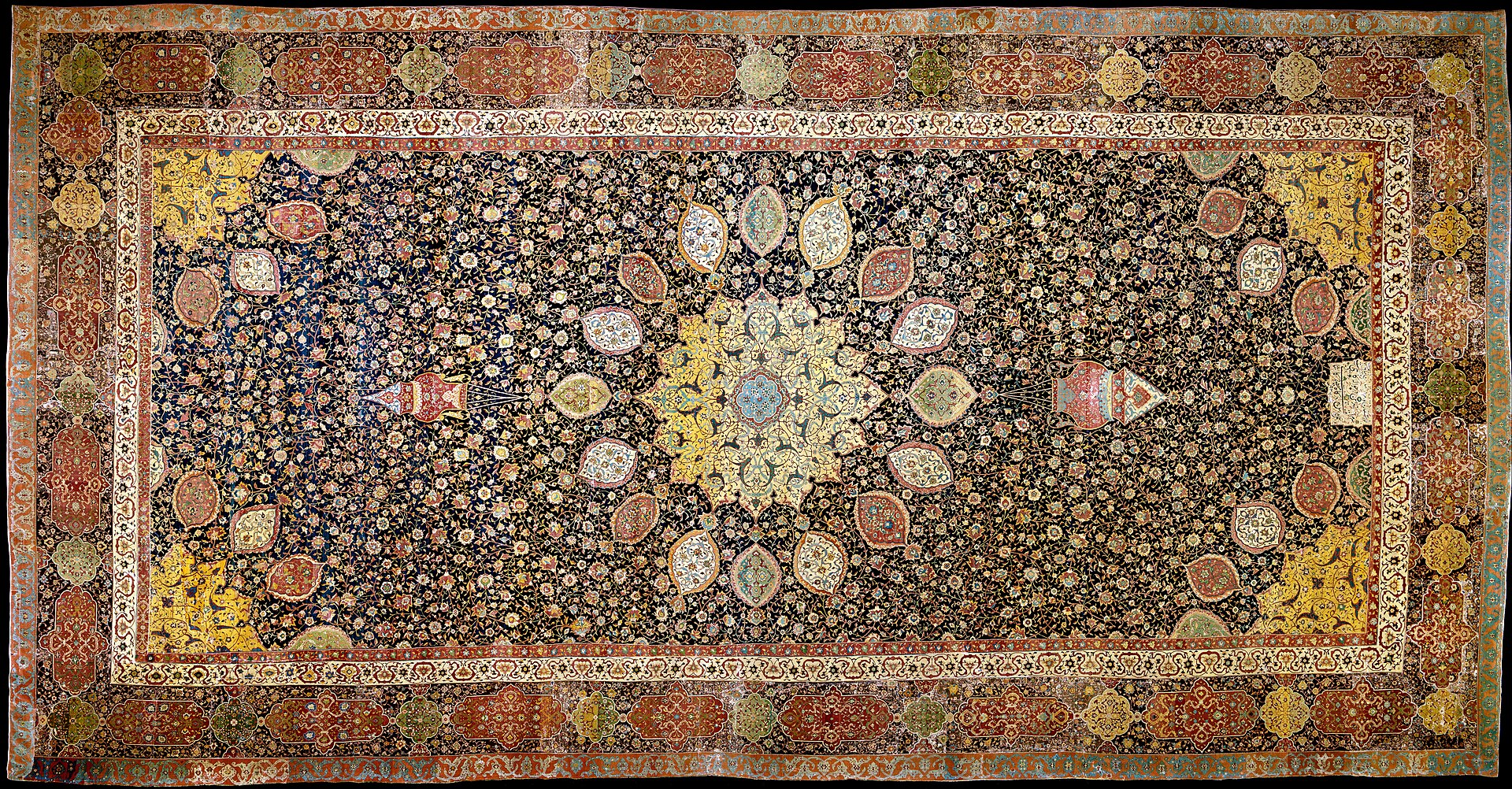
The Ardabil Carpet
946 · Wool knotted pile on a silk warp and weft...
Victoria and Albert Museum, London, Room 42
Iranian, Safavid · active 1539-40
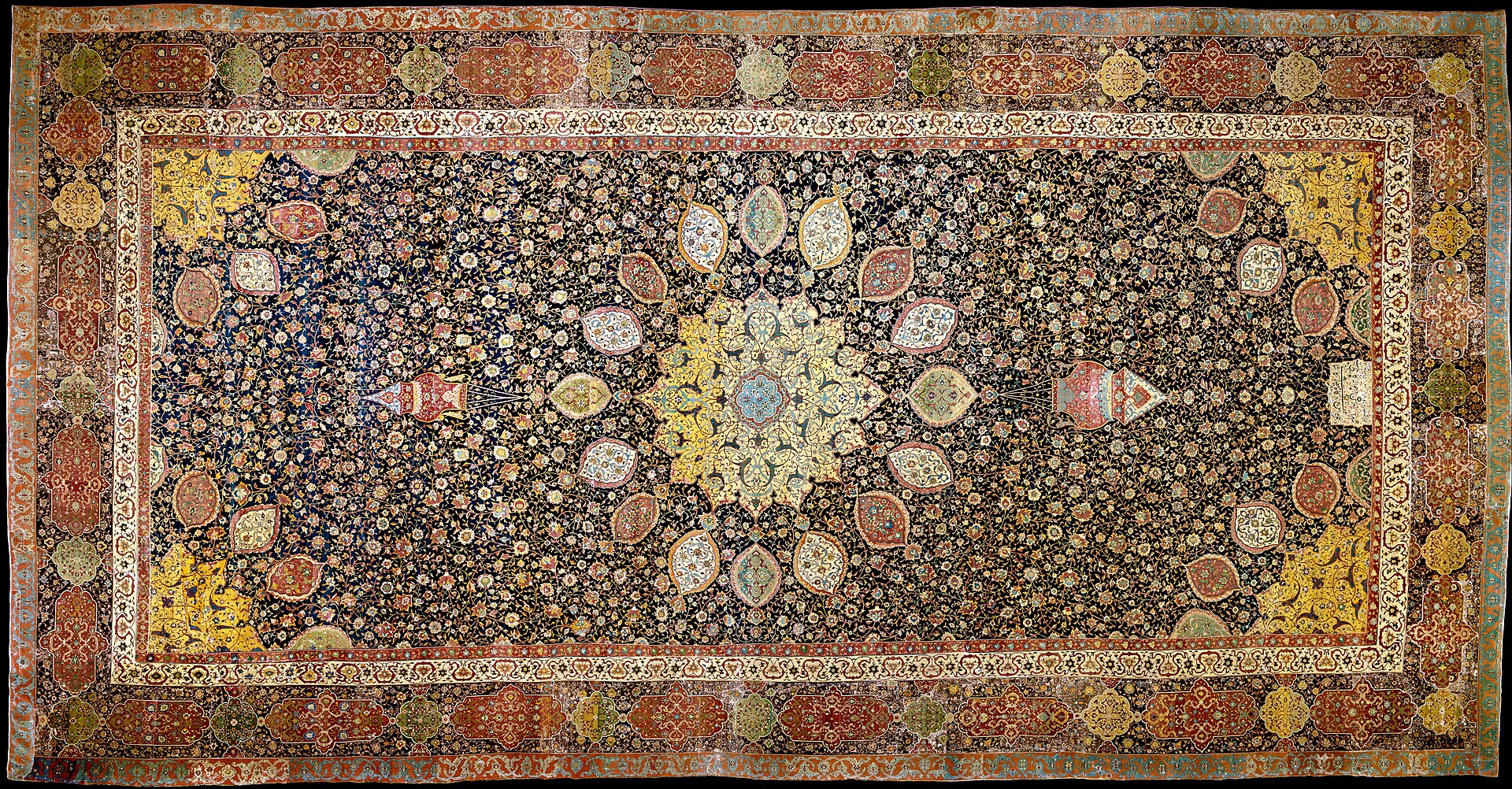
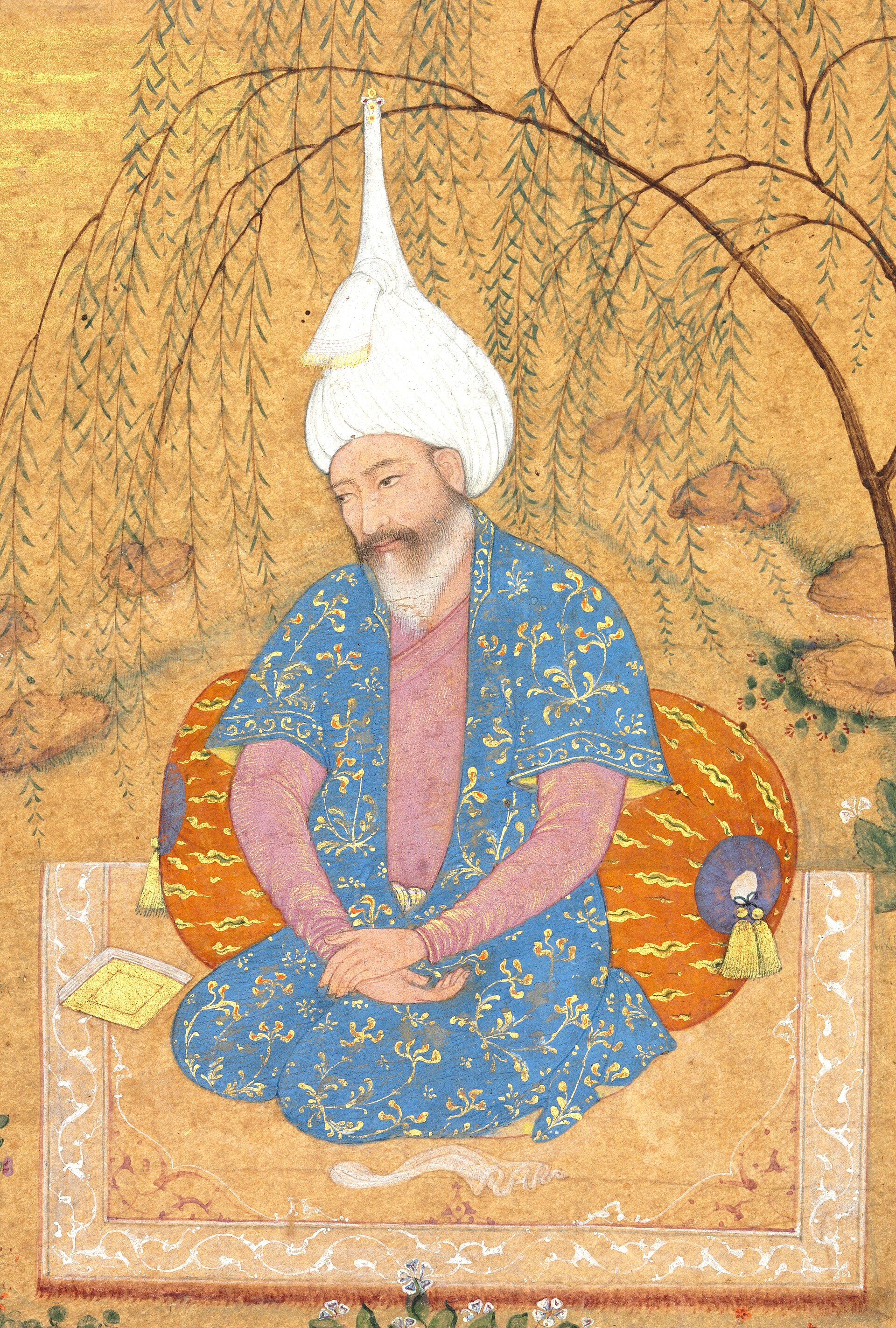
The Ardabil Carpet, Victoria and Albert Museum 272-1893, whole The complete carpet Maqsud's inscription names, photographed flat and face-on. Victoria and Albert Museum 272-1893, dated AH 946 (1539-40). Google Art Project capture, 8029 x 4189 pixels. No verified portrait. No securely identified likeness of this maker is known under a free licence. We do not publish a face we cannot verify.
Victoria and Albert Museum, London| Full name | Maqsud of Kashan (Maqsud Kashani) |
|---|---|
| Worked as | Carpet designer (attributed), Court official (attributed) |
| Nationality | Iranian, Safavid |
| Movement | Safavid court design, Tabriz idiom (attribution debated) |
| In this archive | 1 artwork |
| Sources | 7 cited |
| Last verified |
About this page 1 artwork in the archive · Last verified · 7 sources cited
Maqsud of Kashan is known from four lines of Persian verse knotted into two carpets, and from nothing else. No Safavid chronicle, tax register or court roll cited by either institution that holds his work names him again. What survives is a signature in the old sense, a builder's inscription rather than a modern artist's mark: it names the man answerable for the commission, not necessarily the hand that tied any single knot of it.
The two carpets he signed are the pair usually called the Ardabil carpets, dated by their own inscription to AH 946, and they are, on the reading now followed by both museums that hold them, the earliest Persian pile carpets to carry an explicit year. One is complete and hangs in the Victoria and Albert Museum in London. The other, in the Los Angeles County Museum of Art, was cut apart in the nineteenth century so that pieces of it could complete its twin, which is one reason writing about the Ardabil carpet usually means writing about only half the evidence.
The fact a reader is least likely to already know is that scholars still cannot agree what Maqsud actually did. The Victoria and Albert Museum's own public account says plainly that it is not known who he was, though it is possible he was the designer. The Los Angeles County Museum of Art reads the same four lines more confidently, as the designer who prepared the patterns and oversaw the project. The Encyclopaedia Iranica's entry on the carpets lists courtier, donor, designer, devout man, priest, superintendent of weavers and slave as identities that have all been proposed for him, and says outright that more knowledge of the period might help solve the problem of who he was. Nobody has solved it yet.
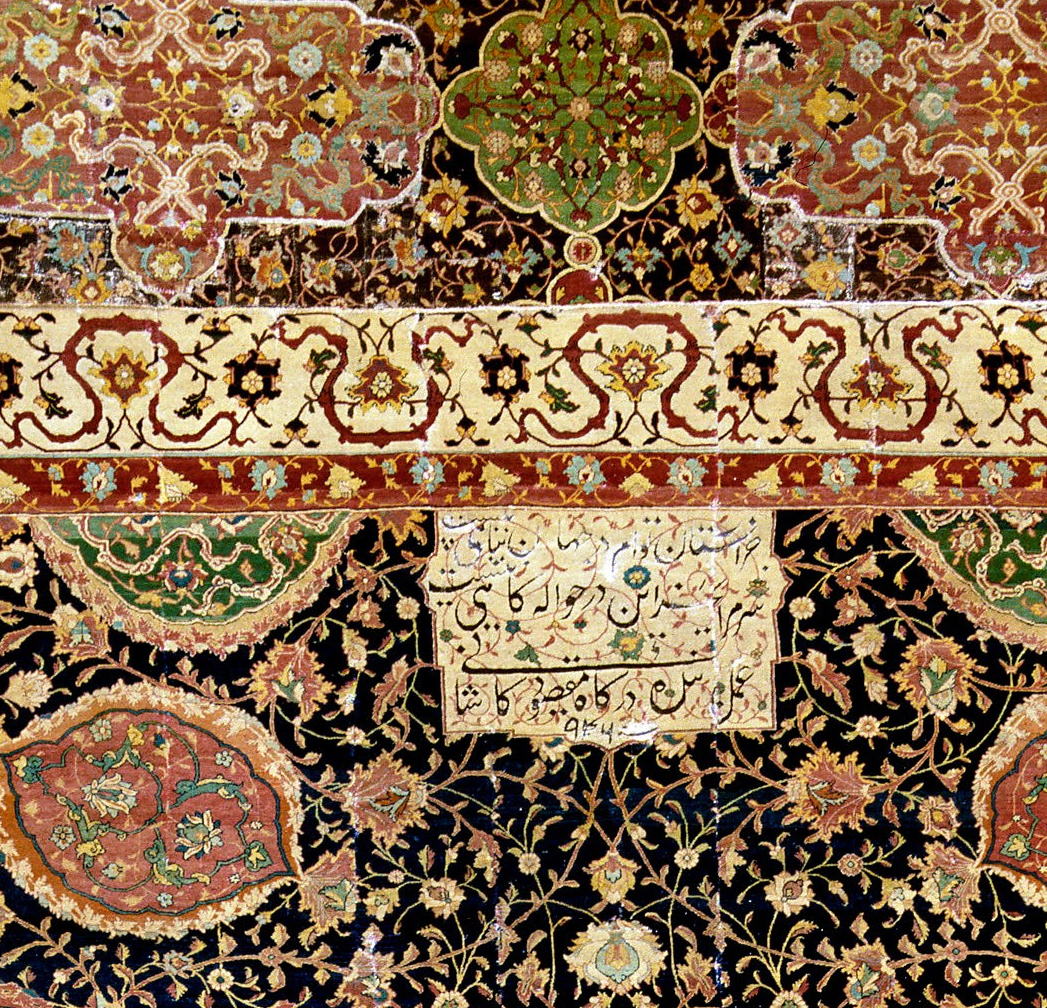
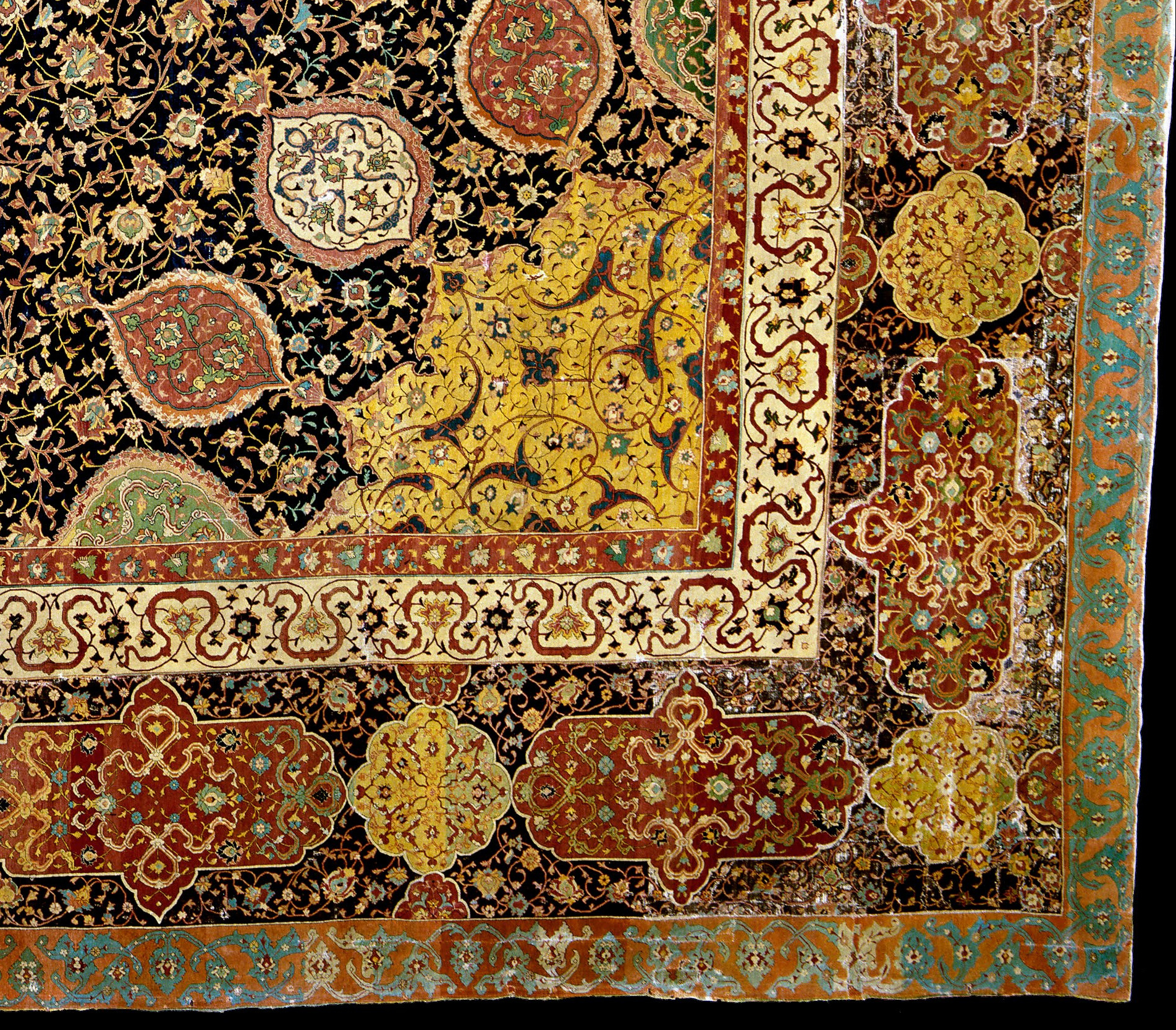
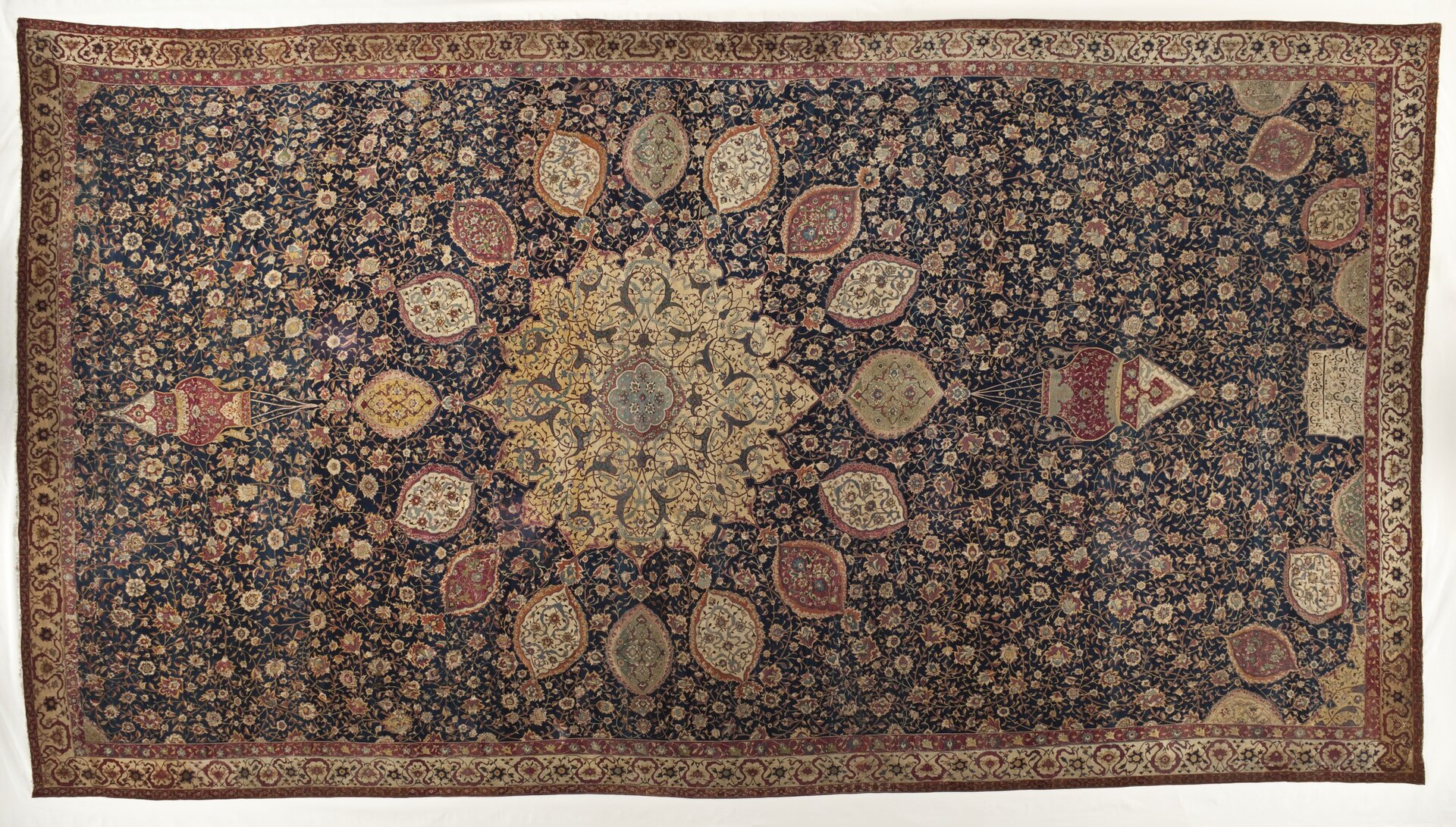
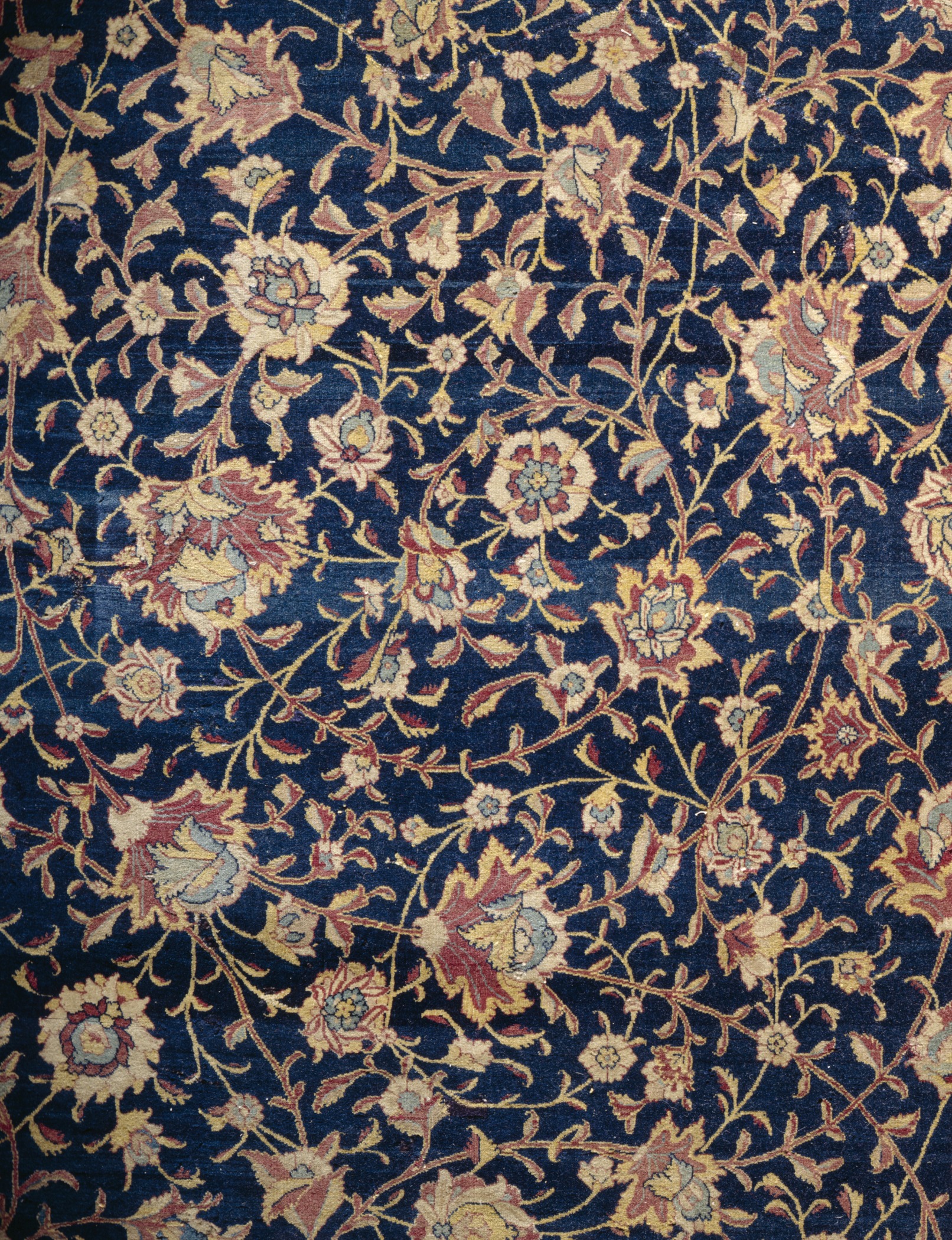
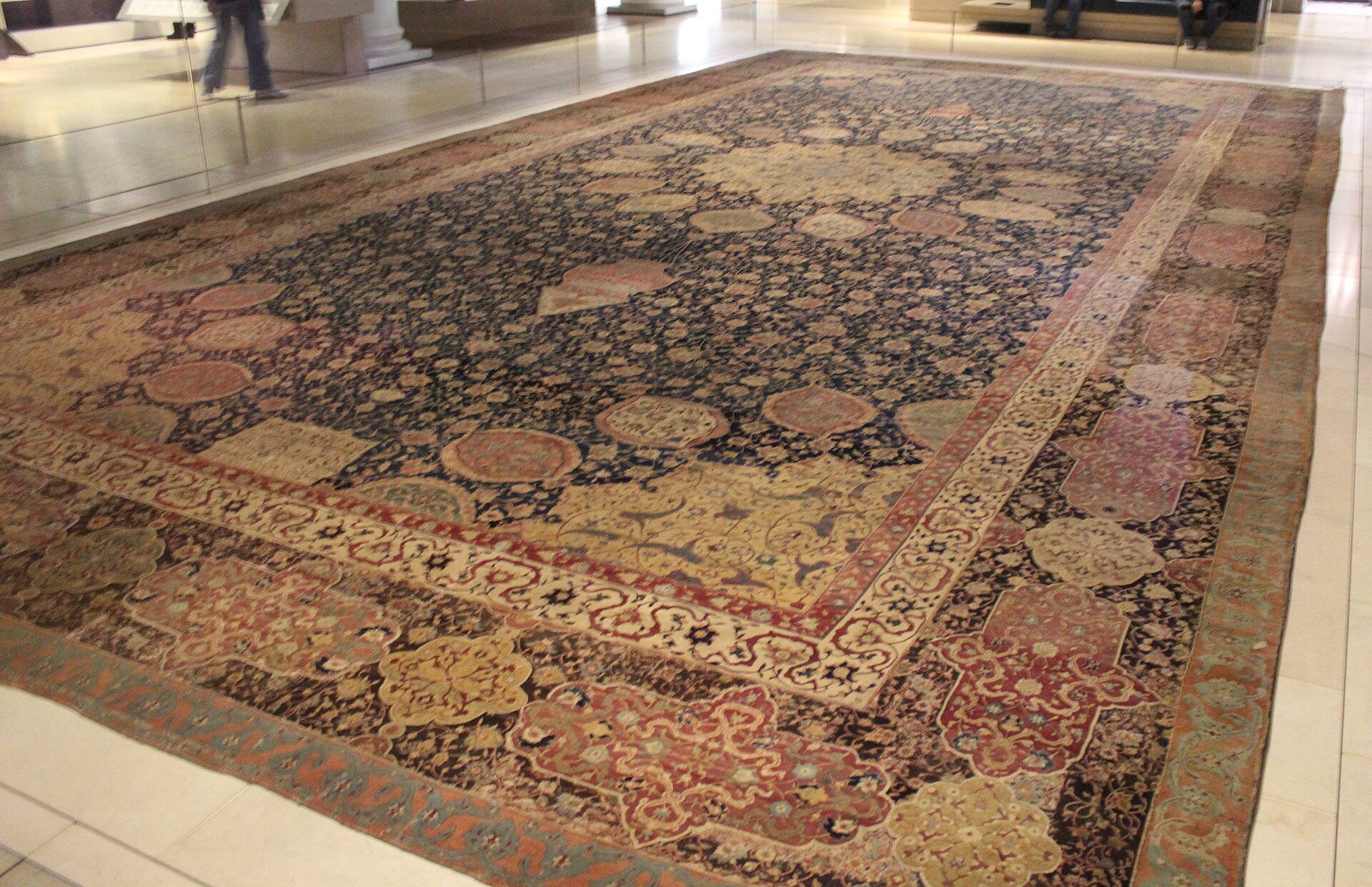
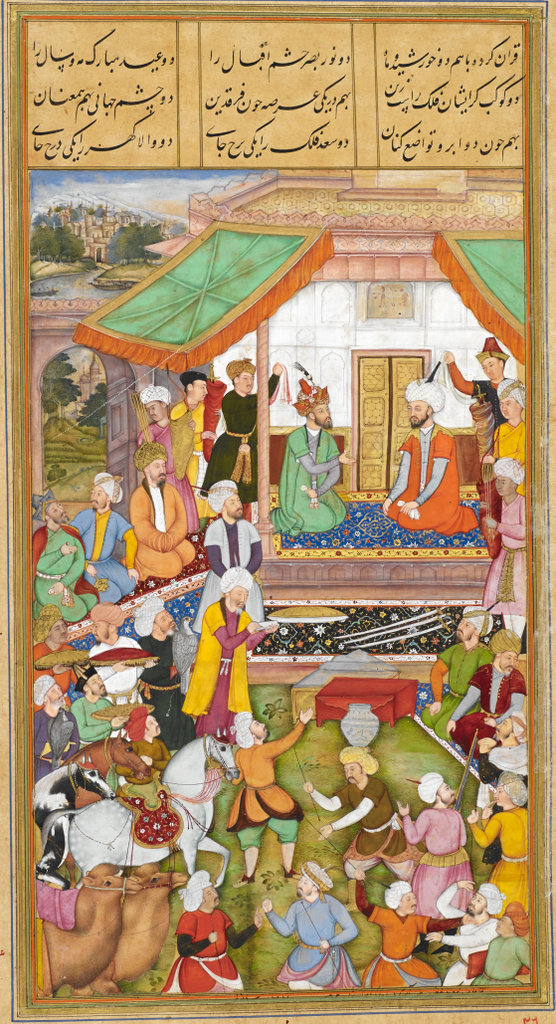
Both Ardabil carpets are completed and knotted with an inscription naming Maqsud of Kashan and dating the work to AH 946, the reading now followed by the Victoria and Albert Museum and the Los Angeles County Museum of Art.12
Shah Tahmasp receives the exiled Mughal emperor Humayun, by the Victoria and Albert Museum's account in the reception hall the carpets were designed to floor; Safavid court artists accompany Humayun back to Mughal India afterward.2
The trading firm Ziegler and Co of Manchester buys the carpet later called the London Ardabil from the shrine of Shaykh Safi al-Din, either directly or through the Tabriz dealer Hildebrand Stevens.2
Vincent Robinson and Co sells the second, uncut carpet to the Chicago and London traction magnate Charles Tyson Yerkes for 80,000 dollars. The same year Robinson's managing director Edward Stebbing publishes the first monograph naming Maqsud in print, reading the inscribed date as AH 942 (1535).12
The South Kensington Museum, now the Victoria and Albert Museum, buys the first carpet for 1,750 pounds by its own accession record, or 2,000 pounds by its own later public article; William Morris, consulted as an Art Referee, calls it of singular perfection and puts 20 pounds of his own into the subscription.23
J. Paul Getty buys the twin from the dealer Joseph Duveen, after it had passed through the estates of Charles Tyson Yerkes and Joseph Raphael De Lamar.12
Getty gives the twin to the Los Angeles County Museum of Art, accession number 53.50.2.4
Rexford Stead publishes the one dedicated monograph on the pair for the Getty Museum, including a knot-count argument that a later Encyclopaedia Iranica entry disputes.16
May Beattie's entry on the two carpets appears in the Encyclopaedia Iranica, crediting R. S. Skelton of the Victoria and Albert Museum with revising the inscribed date from AH 942 to AH 946 and setting out, without resolving, the range of identities proposed for Maqsud.1
The Victoria and Albert Museum opens the Jameel Gallery with the London carpet under a purpose-built case, lit only ten minutes on the hour and ten minutes on the half hour to preserve its colours.23
Nothing Maqsud personally received for the commission is recorded in any source consulted for this page. What the market has paid concerns the two carpets themselves, always as complete objects rather than as individually authenticated works, and always outside the auction room: both left Iran and reached their present museums through private treaty sales and, in the end, an outright gift, never under the hammer.
| Date | Sale | Work | Result | Note |
|---|---|---|---|---|
| 1893-03 | Private treaty, Vincent J. Robinson and Co to the South Kensington Museum | The Ardabil Carpet (272-1893) | Hammer 1,750 pounds (V&A catalogue record) or 2,000 pounds (V&A public article) With premium None. Not an auction; a private treaty purchase raised by public subscription after an opening offer of 1,500 pounds was refused. GBP | Both figures are currently published by the same institution and this record does not average them. |
| 1892 | Private sale, Vincent J. Robinson and Co to Charles Tyson Yerkes | The twin carpet, later Los Angeles County Museum of Art 53.50.2 | Hammer 80,000 dollars With premium None. Not an auction. USD | Per the Victoria and Albert Museum's catalogue record, reportedly on condition the carpet not return to Britain. |
| 1938 | Private sale, Joseph Duveen to J. Paul Getty | The twin carpet, later Los Angeles County Museum of Art 53.50.2 | Hammer Reported c. 70,000 dollars (Wikipedia, unconfirmed) With premium None. Not an auction. USD | This figure could not be confirmed against the Getty's own record in this pass and is flagged tertiary pending a primary Getty or LACMA source. The same account reports an unaccepted approach from agents for King Farouk of Egypt offering 250,000 dollars for the carpet as a wedding gift; that was an offer, not a sale, and is recorded here as reported, not confirmed. |
Hammer is the price at which the bidding stopped; with premium adds the fee the house charges the buyer on top. Hammer price and buyer's premium in the glossary.
| Institution | City | Holdings | Note |
|---|---|---|---|
| Victoria and Albert Museum | London | The complete carpet, 272-1893, on permanent display in Room 42, the Jameel Gallery, in a purpose-built case since 2006. | Lit only ten minutes on the hour and ten minutes on the half hour, twenty minutes in every sixty, to preserve its colours; otherwise kept in near darkness. |
| Los Angeles County Museum of Art | Los Angeles | The cut twin, 53.50.2, on view in the David Geffen Galleries in a dedicated Persianate arts display. | The carpet that was cut to complete the other one; smaller in both directions, with a replacement outer border, but its central medallion, both mosque lamps and Maqsud's inscription panel are intact. Shown as a standalone subject in LACMA's own Tale of Two Carpets, 2009-2010, and in the touring exhibition Gifts of the Sultans, LACMA, Houston and Doha, 2011-2012. |
The signature reads, transliterated, amal-e banda-ye dargah Maqsud Kashani, sana 946: the work of the servant of the court (or of the threshold), Maqsud Kashani, year 946.
The signature reads, transliterated, amal-e banda-ye dargah Maqsud Kashani, sana 946: the work of the servant of the court (or of the threshold), Maqsud Kashani, year 946. It sits below two lines from a ghazal by Hafiz, knotted into an ivory-ground cartouche at one end of the field, on both carpets.
May Beattie, writing the Encyclopaedia Iranica's entry on the carpets, makes the point that decides everything that follows: in an inscription of this kind the word amal-e, the work of, need not be taken literally. Beattie lists the identities proposed for Maqsud in the literature without settling on one: a courtier, a donor, a designer, a devout man, a priest, a superintendent of weavers, a slave. The grammar of his own signature does not tell a reader which of these he was, and nothing outside the carpets does either.
The two institutions that hold his work read the same sixteen words differently.
The two institutions that hold his work read the same sixteen words differently. The Victoria and Albert Museum's public account states it is not known who Maqsud of Kashan was, though it is possible he was the designer. The Los Angeles County Museum of Art is more definite: probably the designer who prepared the patterns and oversaw the project, and, further, probably the person who chose the Hafiz couplet inscribed above his own name.
Neither museum claims he tied a single knot. Both agree servant of the court is a formula of humility rather than a description of bondage. Where they part is confidence: one keeps the question open, the other answers it. A reader comparing the two catalogue entries side by side is watching two expert institutions reach different comfort levels with exactly the same evidence.
Edward Stebbing, the dealer who first published the London carpet in 1892 and again in a subscription edition of 1893, read the inscribed year as AH 942, equivalent to 1535, and translated the...
Edward Stebbing, the dealer who first published the London carpet in 1892 and again in a subscription edition of 1893, read the inscribed year as AH 942, equivalent to 1535, and translated the signature as the work of the slave of this Holy Place. That reading stood in print for decades. R. S. Skelton of the Victoria and Albert Museum later revised it to AH 946, 1539-40, the year both museums now give. Beattie records that the earlier, wrong date went on being repeated in other publications after Skelton's correction.
The four-year difference is not decoration. On the corrected date of AH 946, the Ardabil pair is, on current scholarship, the earliest Persian pile carpet to carry an explicit year, three years ahead of the Poldi Pezzoli hunting carpet in Milan, dated AH 949 (1542). On Stebbing's original, uncorrected reading of AH 942 the margin would have been seven years rather than three: either reading keeps the Ardabil pair ahead of the Poldi Pezzoli carpet, so the correction does not create or remove the priority claim. What it changes is the Gregorian year given for the object, 1539-40 rather than 1535, and confidence in the reading itself. A single misread digit in an 1892 sale catalogue nonetheless shaped how this object was dated in print for the next sixty years.
Kashani is a nisba, a name recording origin or family rather than an address.
Kashani is a nisba, a name recording origin or family rather than an address. It places Maqsud, or his family, at Kashan, a city with its own long weaving tradition. Beattie finds the connection thinner than the name suggests: little in the design or colour of either carpet relates them to the carpets normally attributed to Kashan itself.
The design vocabulary points elsewhere. The Victoria and Albert Museum traces the medallion-and-corner scheme directly to manuscript illumination and bookbinding produced in the same period, in the court workshops usually located at Tabriz, the Safavid capital. A separate argument, made by the scholar M. S. Dimand and reported in the Encyclopaedia Iranica, holds that whoever designed the Ardabil pair must have known Herat-derived motifs current in late Timurid book arts, and on the strength of the carpets' restrained colour scheme concludes the pair was woven in a Tabriz workshop. Where the loom actually stood is not documented. The name says Kashan. The design argues Tabriz. Nobody has reconciled the two.
The Los Angeles County Museum of Art's proposal that Maqsud, as designer, would also have chosen the Hafiz couplet above his own name turns a literary borrowing into part of his design work rather...
The Los Angeles County Museum of Art's proposal that Maqsud, as designer, would also have chosen the Hafiz couplet above his own name turns a literary borrowing into part of his design work rather than a client's instruction. The couplet itself carries a documented double meaning. Sheila Blair's chapter on the carpets, in Text and Image in Medieval Persian Art, is built around the reading that astan, threshold, names a shrine and can also stand for a ruler, so the same lines can be read as addressing both the shrine of Shaykh Safi al-Din at Ardabil and Shah Tahmasp at once. Full access to Blair's argument was blocked behind the publisher's paywall past its opening pages in this pass, which cover only the carpets' materials and dimensions before the paywall cuts in; the shrine-and-ruler double meaning itself is confirmed independently, in the same two-part reading, in the Los Angeles County Museum of Art's own public account of the inscription.
Shah Tahmasp was in the middle of expanding the shrine complex built around his ancestor Shaykh Safi al-Din, founder of the Safavid family's own Sufi order, when the pair was woven. A carpet whose signature line is a plea for refuge at a threshold, laid in a hall built to extend that same shrine, is a devotional object and a piece of dynastic argument in the same four words. This record treats the belief as belief: whoever commissioned or designed it meant the plea literally, and it is documented that the shrine it names was Tahmasp's own family foundation.
Both museums treat the two carpets as one commission executed in parallel.
Both museums treat the two carpets as one commission executed in parallel. The Los Angeles County Museum of Art proposes the pair were woven simultaneously on back-to-back looms, and the Victoria and Albert Museum's own published knot counts for the two carpets, 340 per square inch on the London carpet against 350 on the Los Angeles one, are close enough for the museum to call that near-parity support for one team working to one cartoon at one time.
May Beattie's Encyclopaedia Iranica entry complicates that picture rather than repeating it. Citing a side-by-side examination of both carpets at the Victoria and Albert Museum in 1972, she records a wider gap than the museums' current figures: 297 to 324 knots per square inch on the London carpet against 380 to 420 on the Los Angeles one. Rexford Stead's 1974 Getty monograph used that same gap, at second hand through Beattie's summary, to argue the Los Angeles carpet originally held some two million more knots than the London one. Beattie calls the inference not credible: two carpets worked from the same cartoon carry the same total number of knots whatever their final size, so a more tightly knotted carpet simply comes out smaller for an identical knot count. On her reading the density difference is not evidence against a shared cartoon, it is the reason the two carpets are no longer the same size. Stead's monograph itself could not be read at source in this pass; the Getty's own web page for it, checked again by direct fetch and in the in-app browser, still returns a JavaScript-only shell that gives the book's bibliographic details, author, date and fifty pages, but none of its text. The knot-count dispute is recorded here as Stead's reading against Beattie's, not as a settled point.
Before the Victoria and Albert Museum bought the London carpet in 1893, the dealers Vincent Robinson and Co had a complete carpet to sell and a damaged one, and made the complete one out of both.
Before the Victoria and Albert Museum bought the London carpet in 1893, the dealers Vincent Robinson and Co had a complete carpet to sell and a damaged one, and made the complete one out of both. The Los Angeles County Museum of Art's own catalogue states that the outer borders and a section of the lower field are believed to have been removed from its carpet to repair the one now in London, which then received a replacement border of its own.
Maqsud's signature survived that operation on both remnants. The border was cut away, part of the field went with it and the corner medallions on the Los Angeles carpet are only partially preserved, but the ivory cartouche naming him and dating the work stayed knotted into the field on both halves of what had been one commission. Whatever else was lost to the nineteenth-century carpet trade, his name was not.
Every account of these carpets, including the one on this site, calls them the Ardabil carpets because they were reported to have come from the shrine of Shaykh Safi al-Din there.
Every account of these carpets, including the one on this site, calls them the Ardabil carpets because they were reported to have come from the shrine of Shaykh Safi al-Din there. Beattie's account of the documentary record is more cautious than the popular name suggests. A. F. Kendrick of the Victoria and Albert Museum, in a 1914 letter on file at the museum, was already aware that the shrine at Ardabil, apart from its courtyard, did not have space enough for carpets this size. Surviving eighteenth-century inventories of the shrine's contents do not obviously list a pair answering to these.
Beattie sets out a rival proposal that has drawn attention since: that the carpets, or at least the Los Angeles one, may have come instead from the shrine of Imam Reza at Mashhad, whose Gowhar Shad mosque sanctuary is large enough, on a measured plan, to take the pair laid end to end. Neither proposal is proven. What is documented is only that the carpets were reported to come from Ardabil by the men who sold them, that at least one museum official doubted the shrine could have held them as early as 1914, and that a named alternative site remains on the table more than a century later.
No other carpet, textile or object bearing Maqsud's name has been identified in the literature cited by the Victoria and Albert Museum, the Los Angeles County Museum of Art or the Encyclopaedia...
No other carpet, textile or object bearing Maqsud's name has been identified in the literature cited by the Victoria and Albert Museum, the Los Angeles County Museum of Art or the Encyclopaedia Iranica entry on the carpets. His attributed body of work is exactly two carpets and the fragments cut from them during their nineteenth-century repair. There is no drawing, no letter, no inventory entry and no later reference to check his signature against.
That absence is itself a form of evidence about how court carpet commissions of this kind were recorded. A named supervisor or designer of a single royal commission did not necessarily generate a paper trail beyond the object itself, and Maqsud's case is the extreme version: the object is the entire archive.
Edward Stebbing published Maqsud's inscription to the London public in 1892, in a booklet titled The Holy Carpet of the Mosque at Ardebil, timed to help sell the carpet he was handling.
Edward Stebbing published Maqsud's inscription to the London public in 1892, in a booklet titled The Holy Carpet of the Mosque at Ardebil, timed to help sell the carpet he was handling. The Times covered the carpet the same year. The marketing worked: the object, and the name knotted into it, has been reproduced and discussed continuously since, while the dealers, the tycoons and the museum committees who passed the carpets from hand to hand between 1888 and 1953 are now footnotes to it.
The London carpet can now be examined at a level of detail nineteenth-century scholars could not have had. The Victoria and Albert Museum publishes an open IIIF manifest and a gigapixel Google Art Project capture of it, so the inscription cartouche itself can be read at deep zoom by anyone, without permission or fee. No equivalent open image resource for the Los Angeles carpet was found in this pass. The carpet that was cut to complete the other one remains the harder of the two for a student to study closely, four hundred and eighty years after Maqsud's name was knotted into both.
Workshop objects of this period usually erase the people who actually made them in favour of a patron or a named supervisor, and this case is not an exception to that pattern.
Workshop objects of this period usually erase the people who actually made them in favour of a patron or a named supervisor, and this case is not an exception to that pattern. Both museums agree the tens of millions of knots in the two carpets were tied by weavers who are not named anywhere in the surviving record. What makes Maqsud's case unusual is not that the workers are anonymous, which is ordinary, but that the one name preserved may itself belong to a supervisor rather than a craftsman, so the erasure and the attribution puzzle sit on top of each other. A reader looking for the maker's hand in the ordinary sense, the person who actually passed wool through silk warp fifty million times, will not find him in this record, or in any other consulted for it.
Carpet designer (attributed); Court official (attributed). active 1539-40.
Victoria and Albert Museum (London); Los Angeles County Museum of Art (Los Angeles).
Nothing Maqsud personally received for the commission is recorded in any source consulted for this page. What the market has paid concerns the two carpets themselves, always as complete objects rather than as individually authenticated works, and always outside the auction room: both left Iran and reached their present museums through private treaty sales and, in the end, an outright gift, never under the hammer.
Who was Maqsud of Kashan. The Encyclopaedia Iranica lists courtier, donor, designer, devout man, priest, superintendent of weavers and slave as identities proposed in the literature, and states plainly that the problem is unsolved.
An accession number dates a museum's custody, not the object. Five institutions in this archive use five incompatible formats...
9 min read
Twenty-nine of 250 records in this archive name why an object came to market: death duties, gambling debts, a bankruptcy, a...
8 min read
Of 257 published records, 156 carry an accepted attribution and two carry one the object itself documents.
10 min read
Ten objects in this archive were bought, or fought for, by public subscription between 1892 and 2025.
10 min read
2,592 technical facts wear 1,598 different labels and 1,754 ticket prices wear 1,355.
10 min read
The 28 longest institutional ownership links in this archive run 7,434 years between them. Three end in a completed sale.
13 min read
Last verified
One artwork and its story every Tuesday, with the picture: who owned it, what it made, and what closes soon in the exhibition calendar. No promotion, and nothing we cannot cite.
We send one email to confirm the address and keep nothing else. Every letter carries a one-click unsubscribe. How we handle your data.