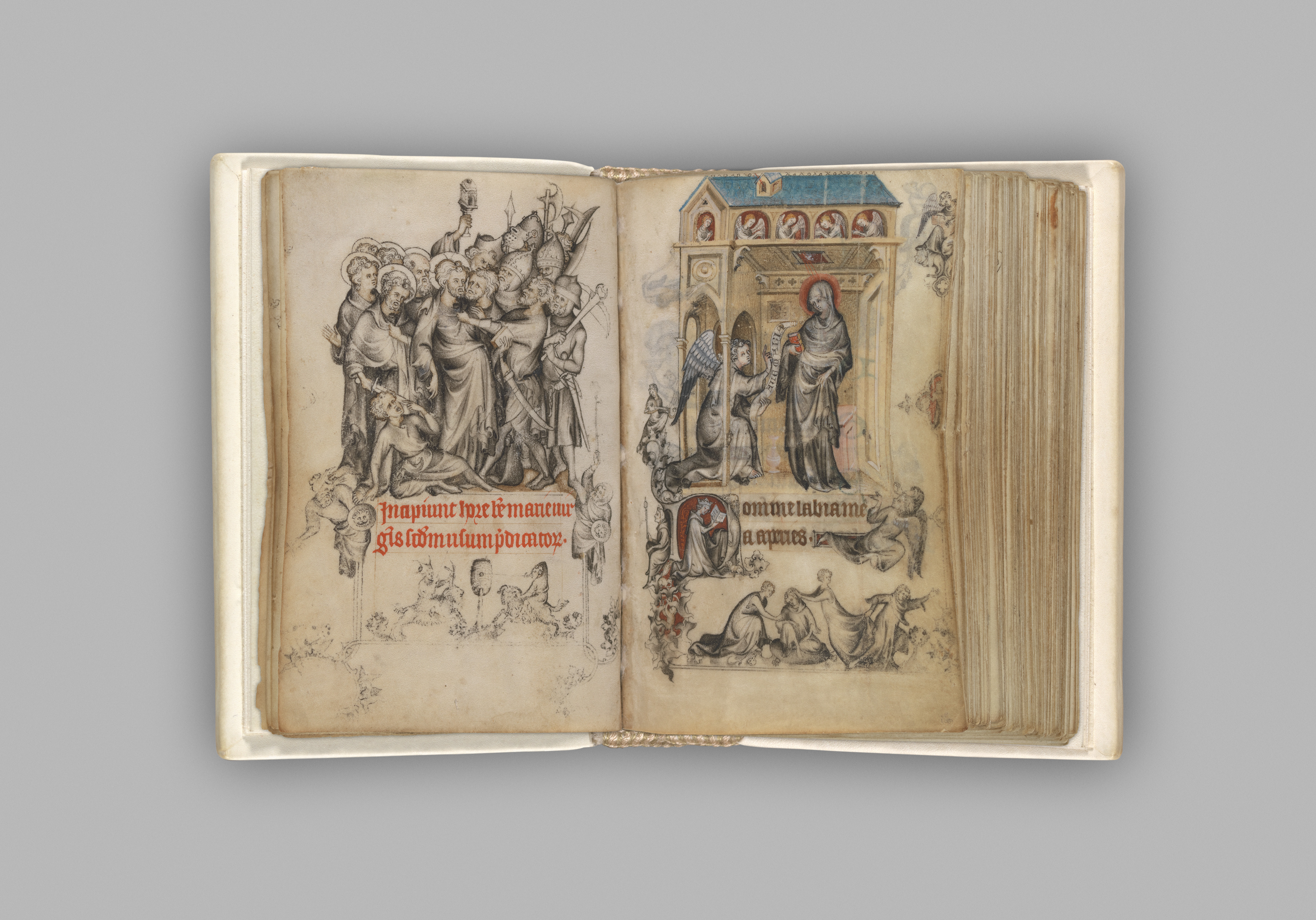
The Hours of Jeanne d'Evreux, Queen of France
c. 1324-1328 · Grisaille
The Cloisters, The Metropolitan Museum of Art
 French (Parisian) · 1319-1334
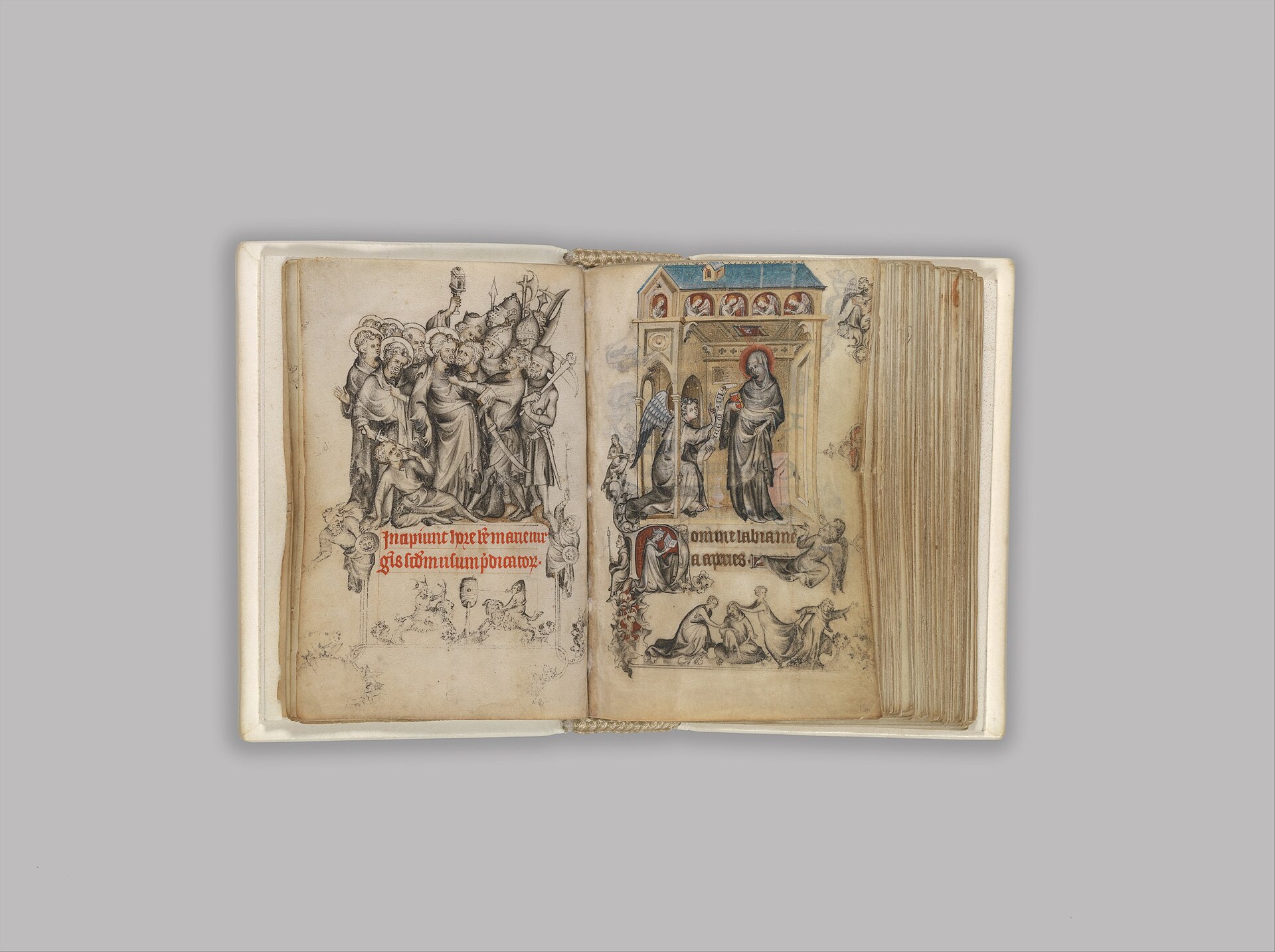
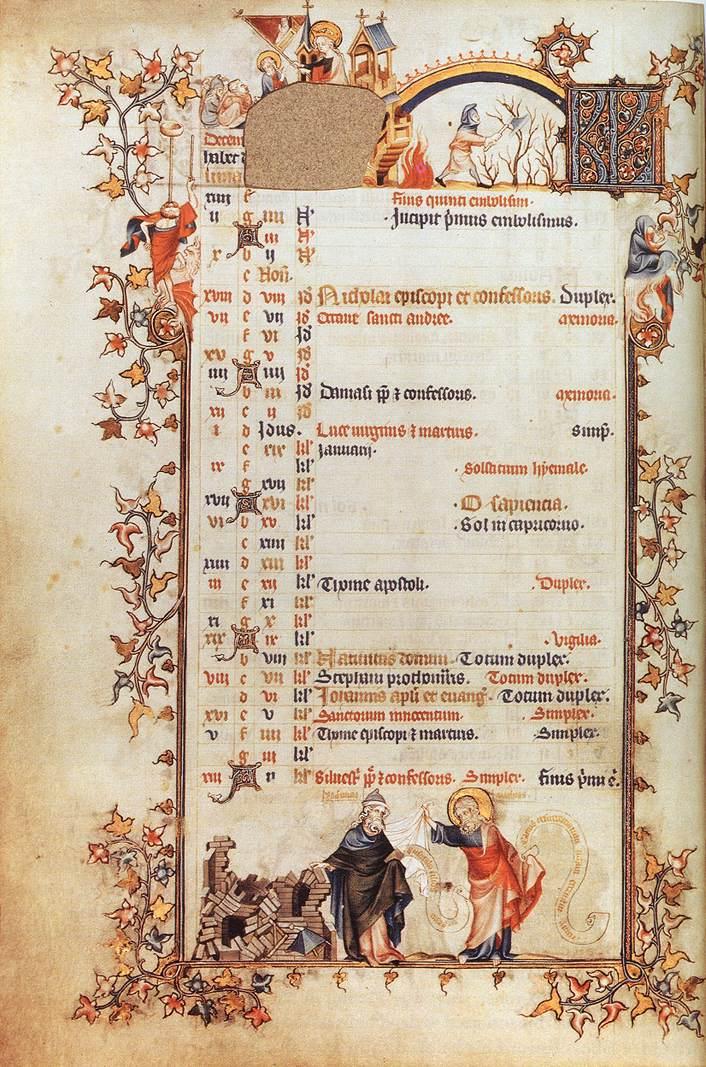
The Hours of Jeanne d'Evreux, open The manuscript scholars treat as most securely Pucelle's own hand, photographed open by the Metropolitan Museum. Reused from this site's own record for the object, where the licence and object identification were verified against the Museum's collection database. No verified portrait. No portrait of Jean Pucelle survives, and none could plausibly have been made. Illuminators of his period and standing were craftsmen paid by the piece, not subjects of portraiture; named individual illuminators are themselves rare in this material, which is exactly why his name is worth having at all. What does survive, and is itself notable, is his own name in two independent documents written at the time the work was done: the scribe Robert Billyng's 1327 colophon naming him among the Billyng Bible's illuminators, and his own payment notes in the Belleville Breviary, where he appears not as a sitter but as an employer, paying Mahiet, Ancelot and J. Chevrier for their work. This record does not substitute a picture of his handwriting or his patrons for a likeness of the man; it states plainly that no likeness exists.
The Cloisters, The Metropolitan Museum of Art, New York, 54.1.2; The Cloisters Collection, 1954| Full name | Jean Pucelle (also recorded as Jehan Pucele, Jehan Pucelle) |
|---|---|
| Worked as | Illuminator, Manuscript painter, Seal designer |
| Died | 1334 |
| Nationality | French (Parisian) |
| Movement | Parisian Gothic court illumination |
| In this archive | 1 artwork |
| Sources | 19 cited |
| Last verified |
About this page 1 artwork in the archive · Last verified · 19 sources cited
Jean Pucelle is one of the very few illuminators of fourteenth-century Paris who has a name at all. Almost everyone who painted a medieval manuscript did so without signing it, so the ordinary condition of this material is anonymity: a hand, a workshop, a 'Master of' invented by a modern cataloguer to stand in for a person nobody recorded. Pucelle is the exception, and the exception is thinner than it looks. He signed nothing in any surviving book. What exists instead is a scribe's colophon in one Bible naming him among three illuminators, a handful of tax and confraternity entries that put a Paris property-owner of this name in the 1320s, and a queen's will, written the year before her own death, that credits him with a prayer book by name. Everything else scholars have built on top of that, including the picture of him as the artist who brought Sienese space and modelling into French painting, is argument constructed from those few anchors outward.
What the documents do give, unusually for this period, is a glimpse of him as a business. A payment note in his own accounts, entered in a manuscript he illuminated for a Parisian patron, records him paying a named subordinate for finished work: the earliest surviving instance in French illumination of a head of workshop's own ledger surviving inside the object it paid for. Most of what is written about Pucelle treats him as a single sensibility, the hand that painted grisaille figures with a new sense of weight and depth. The account entry is a reminder that he also ran a shop.
No birth date or birthplace for Pucelle is documented in any source consulted for this record; his working life is known only from its documented middle and end.69
A Paris illuminator named Jean Pucelle appears in the surviving accounts of the confraternity of Saint-Jacques-aux-Pelerins, which also credits him with designing its great seal.13
Pucelle is recorded as a property-owner in the Parisian tax rolls, the livres de la taille, the closest thing to a fiscal record of his working life.13
The Belleville Breviary is painted in Paris; the production window is fixed by internal liturgical evidence, after the Dominicans adopted Corpus Christi in 1323 and before they adopted the office of Thomas Aquinas in 1326, which the manuscript's sanctoral lacks.4
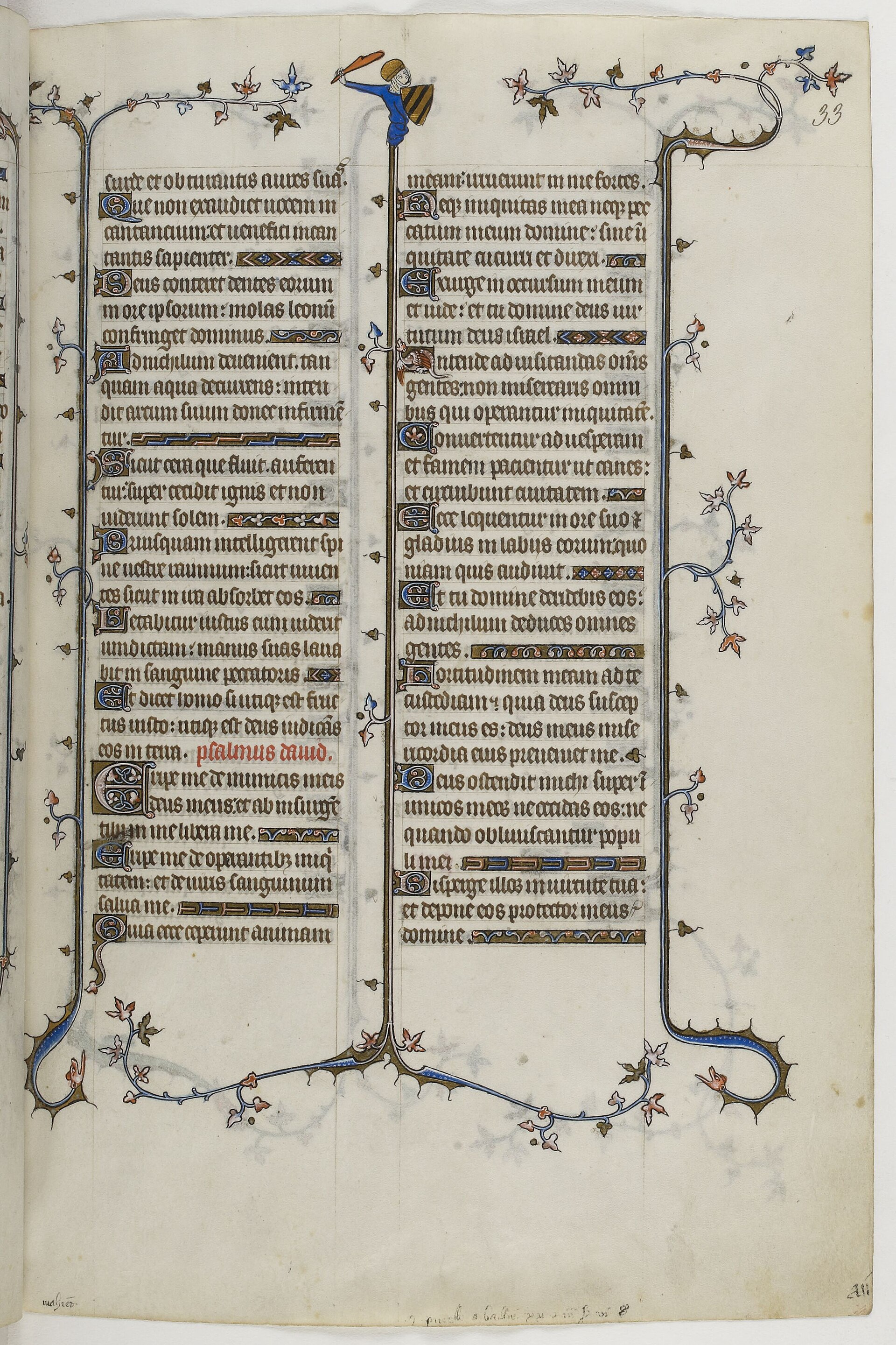
Payment notes entered in the Belleville Breviary itself record Pucelle paying the illuminators Mahiet, Ancelot and J. Chevrier for their work on the book.4
Charles IV of France marries Jeanne d'Evreux as his third wife.17
The Hours of Jeanne d'Evreux is painted for the queen, on the accepted identification a commission from Charles IV himself.12
The Bible of Robert de Billyng is completed; its scribe's colophon names Jean Pucelle among three illuminators, the only contemporary document to record his name in connection with a specific surviving book.6
Charles IV dies without a surviving son, ending the direct Capetian line.1
Jean Le Noir, later identified as a pupil of Pucelle, is first documented, in the service of Yolande of Flanders, Countess of Bar, three years before Pucelle's own death.8
Pucelle's death is generally placed in this year, the end point of his documented working life in the archival record.9
The Psalter of Bonne of Luxembourg is painted, at least fourteen years after Pucelle's death, in a manner close enough to his own that it was once read as his work before being reassigned to Jean Le Noir.8
Jeanne d'Evreux dies; her will bequeaths to Charles V a small prayer book which Pucelle illuminated, the sentence usually used to identify her book of hours.12
The Hours of Jeanne d'Evreux is catalogued in the library of Jean, Duke of Berry as les Heures de Pucelle, the earliest instance of the artist's name being attached to the book in a documentary source.14
Leopold Delisle is the first to discuss the Belleville Breviary's payment notes to Mahiet, Ancelot and J. Chevrier in print.5
Kathleen Morand publishes her re-examination of the evidence for Pucelle's hand in the Hours of Jeanne d'Evreux in The Burlington Magazine, followed by the first monograph devoted to him in 1962.11
The Metropolitan Museum's own Bulletin publishes Florens Deuchler's Jean Pucelle, Facts and Fictions and Elizabeth Flinn's dissent from the will identification in the same issue.910
Lilian Randall publishes her reading of the marginal game facing the Betrayal and Annunciation opening of the Hours of Jeanne d'Evreux in Speculum.16
Christopher de Hamel identifies the historiated initials of the St Albans Bible as executed in the style of Jean Pucelle, an attribution to his circle rather than his own hand.5
Karen Gould publishes her study connecting Pucelle's figure style to the sculpture of Strasbourg Cathedral in The Art Bulletin.12
Gerald Guest publishes his reading of the Saint Louis charity scenes and their excluded marginal beggars in Viator.15
Joan Holladay publishes her study of Jeanne d'Evreux and other fourteenth-century French queens as book collectors in the Journal of Medieval History.17
Marc Gil argues for a Capetian or Valois family patron for the Belleville Breviary rather than Jeanne de Belleville, reopening a question that had stood since Delisle.4
Sabine Maffre proposes the Belleville Breviary as a royal commission initiated by Charles IV himself, prompted in part by the library's 2016 acquisition of a related breviary made for Louis X.4
No manuscript securely attributed to Pucelle's own hand has ever come to public auction. All three works given to him with real confidence are institutional property, in the Metropolitan Museum and the Bibliotheque nationale de France, and none of the sources consulted for this record documents a prior open-market sale of any of them. What the market has traded is material from his wider circle: leaves cut from the St Albans Bible, whose initials are placed in Pucelle's style rather than attributed to his own hand, passed through Sotheby's, Christie's, Bonham's and Dreweatts across the 2010s as the volume was broken apart. This record has not located a documented hammer price, currency and premium for an individual leaf to the standard this site requires, and records that gap rather than filling it.
| Institution | City | Holdings | Note |
|---|---|---|---|
| The Cloisters, The Metropolitan Museum of Art | New York | The Hours of Jeanne d'Evreux, Queen of France, accession 54.1.2, acquired 1954. On public display. | The manuscript scholars treat as most securely Pucelle's own hand. |
| Bibliotheque nationale de France, Departement des Manuscrits | Paris | The Belleville Breviary (MS lat. 10483-10484) and the Bible of Robert de Billyng (MS lat. 11935), which carries the only contemporary document naming Pucelle. | Access to the originals is exceptional and requires the department's authorisation; digitised openings are available through Gallica. |
No painting or drawing carries Pucelle's signature.
No painting or drawing carries Pucelle's signature. The single document that ties his name to a specific surviving book with no argument required is a colophon written by the scribe of a Bible, not by Pucelle himself. Everything before and after that one document is inference: stylistic comparison, later inventory descriptions, and a will written decades after the work was done. Florens Deuchler's 1971 essay on the artist, pointedly titled Facts and Fictions, states the problem as plainly as it has ever been stated: we call him Jean Pucelle, although we do not know who he was in any full biographical sense.
That is not a reason to distrust the name. It is a reason to be precise about what kind of fact each claim about him actually is. This page follows the same grading used everywhere else on this site: a documentary anchor is treated as documented, a named scholar's case is treated as argued and credited to that scholar, and a resemblance is treated as speculation and labelled as such.
The Bible of Robert de Billyng, now Bibliotheque nationale de France MS lat.
The Bible of Robert de Billyng, now Bibliotheque nationale de France MS lat. 11935, was completed in Paris in 1327. Its scribe, an Englishman named Robert Billyng, wrote a colophon recording that Jehan Pucelle, Anciau de Cens and Jacquet Maci illuminated the book. It is the only surviving instance of Pucelle's name appearing in a document written at the time the work was produced, rather than in a later inventory or a scholar's later argument. Every other attribution to Pucelle, including the two other manuscripts treated as most securely his, is built outward from the credibility this one line gives the name.
The colophon also does something else that is easy to miss: it names three illuminators for one Bible, not one. Anciau de Cens is the same man who reappears, under the spelling Ancelot, in a completely different manuscript's own payment records a few years later. A name that surfaces twice, in two unrelated documents, for two different jobs, is the closest thing this material offers to a career.
Manuscript production in fourteenth-century Paris was rarely the work of one person sitting alone with a brush.
Manuscript production in fourteenth-century Paris was rarely the work of one person sitting alone with a brush. A large commission needed a scribe to copy the text, a penflourisher for the minor initials, a border decorator, and one or more painters for the historiated initials and full miniatures, and behind all of them stood a libraire, a bookseller-entrepreneur who took the commission from a client and subcontracted each stage to specialists in his own network. The system has been reconstructed in detail by Erik Kwakkel from the accounts and payment notes that survive in several Parisian books of the period, Pucelle's own among them.
Pucelle operated inside exactly this system, and the documentary record shows him on both sides of it: named as one of several illuminators paid to execute someone else's commission in the Billyng Bible, and recorded as the one doing the paying, as head of his own team, in another book a few years later. Christopher de Hamel identified the historiated initials of a separate manuscript, the so-called St Albans Bible, as executed in the style of the Parisian illuminator Jean Pucelle in 1981, on stylistic grounds alone; the book itself required at least four distinct hands working in sequence, a scribe, a border decorator, a penflourisher and an illuminator, coordinated by a libraire whose own name the surviving evidence does not give.
The clearest surviving evidence of Pucelle as an employer, rather than only a painter, sits in the margins of the Belleville Breviary, a two-volume Dominican breviary painted in Paris between 1323...
The clearest surviving evidence of Pucelle as an employer, rather than only a painter, sits in the margins of the Belleville Breviary, a two-volume Dominican breviary painted in Paris between 1323 and 1326 and now Bibliotheque nationale de France MS lat. 10483-10484. Several pages of the first volume carry brief payment notes in a contemporary hand, first discussed in print by Leopold Delisle in 1884 and confirmed since in the library's own catalogue of the manuscript. On folio 33 the note reads, in the original French, 'Mahiet. J. Pucelle a baille XX et III s. VId', meaning that Pucelle paid an illuminator named Mahiet twenty-three sous and six deniers. Two further notes pay an illuminator called Ancelot, on folio 62, and one called J. Chevrier, on folio 300, each for a single piece of work.
The Bibliotheque nationale's own cataloguing states plainly what the entries add up to: one of them shows Jean Pucelle acting as chef d'atelier, head of workshop, paying the illuminators of his own team. This is not stylistic inference. It is a tradesman's ledger entry that happens to survive because nobody ever cut it out of the book. Mahiet has been proposed as the same man as Mathieu le Vavasseur, a sworn bookseller of the University of Paris with a shop on the Rue Neuve-Notre-Dame, an identification credited to Francois Avril. It is disputed rather than settled: manuscripts attributed to the same hand under the working label Master of the Vies de Saint Louis read stylistically as Picard rather than Norman, which sits awkwardly with le Vavasseur's own documented background.
Pucelle's most consistent technical signature is grisaille, camaieu gris: figures built up in washes and highlights of grey and white, with colour reserved for small accents and gold leaf used...
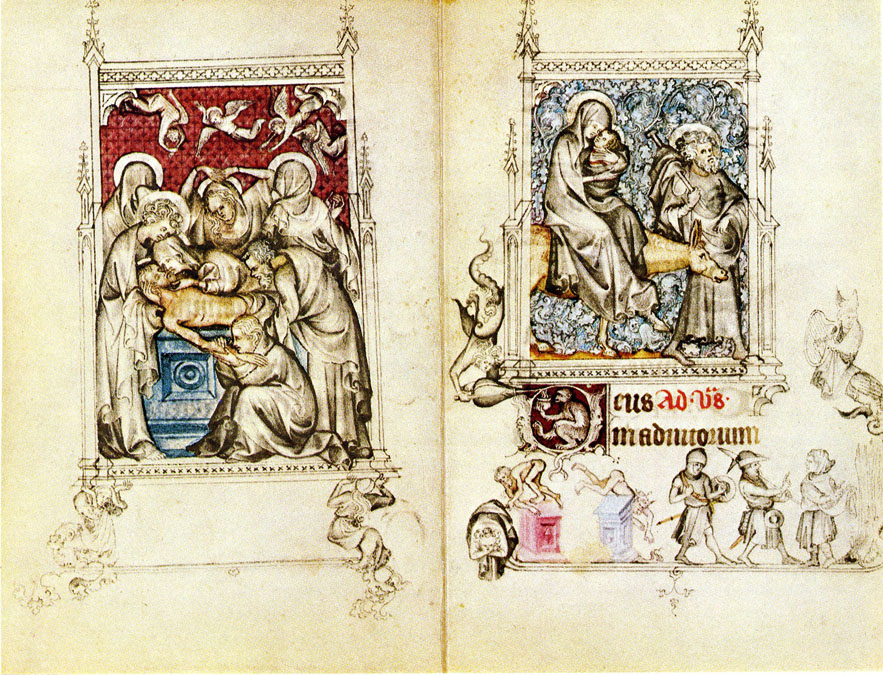
Pucelle's most consistent technical signature is grisaille, camaieu gris: figures built up in washes and highlights of grey and white, with colour reserved for small accents and gold leaf used sparingly rather than as a ground. The effect is sculptural rather than flat, closer to a small carved relief than to the coloured, gold-grounded painting that was the default register of luxury in the period. That is worth stating plainly, because it runs against the obvious assumption: a grisaille miniature for a queen was not a cheaper miniature. It removed colour as a competing signal on purpose, in an object expensive enough to afford full colour and gold throughout, and left modelling in light and shade to do the work that colour usually does.
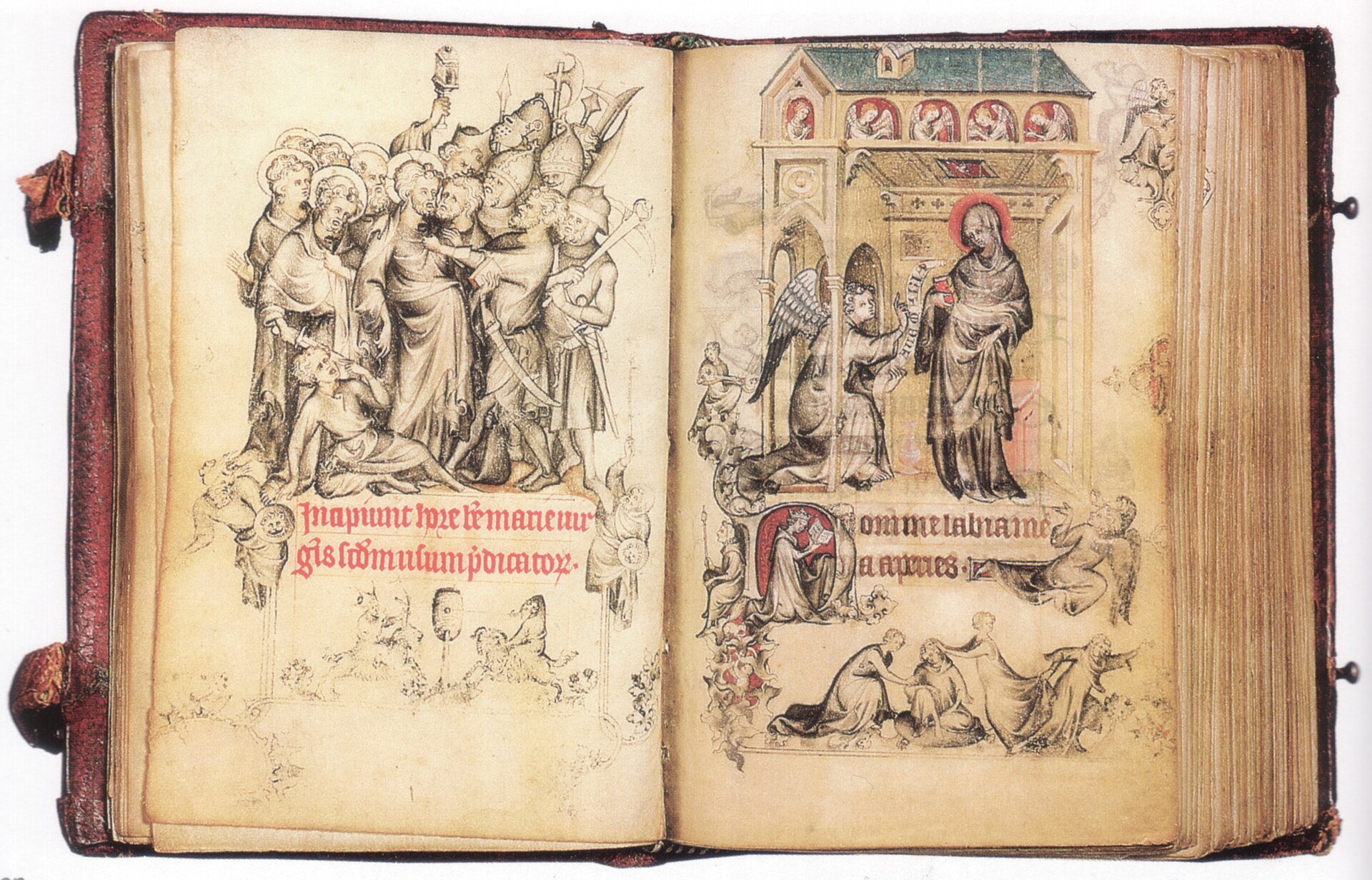
The manuscript where this technique is argued to be most completely his own hand, with least workshop intervention, is the Hours of Jeanne d'Evreux, painted in Paris around 1324 to 1328 for the queen consort of Charles IV and now at the Cloisters, the Metropolitan Museum's medieval branch in New York. Kathleen Morand's 1961 re-examination of the evidence, developed further in her 1962 monograph, the first devoted to Pucelle, calls it the only manuscript we are certain was entirely executed by the hand of Pucelle. Deuchler and, following him, Elizabeth Flinn, writing in the same 1971 issue of the Metropolitan Museum's own Bulletin, took the opposite position: that too little is documented about Pucelle the man to treat any single-hand claim as secure, this manuscript included. Both positions were published by the institution that now owns the object, which is itself worth noting: the doubt was not raised by a rival, it was raised by the Museum's own scholars.
Pucelle's figures carry weight on a hip or a foot, occupy interiors suggested by receding architecture rather than a flat gold field, and read as physically credible in a way that the flat, linear...
Pucelle's figures carry weight on a hip or a foot, occupy interiors suggested by receding architecture rather than a flat gold field, and read as physically credible in a way that the flat, linear Parisian illumination before him does not. Scholarship since the mid-twentieth century traces this to contact, direct or indirect, with Italian trecento painting. Morand and later writers point to passages that recall Duccio's Maesta, completed in Siena in 1311, close enough in date that a Parisian illuminator could plausibly have encountered it, or drawings and other objects derived from it, through the luxury trade that connected Italy and France in the period. The Bibliotheque nationale's own stylistic notes on the Belleville Breviary describe the multiplication of architectural elements treated in the Italian manner across that manuscript too, which means the Italian current in Pucelle's work is not confined to the one book usually cited for it.
Karen Gould's 1992 study adds a second, non-Italian source for the same modelled figure style: the sculpture of Strasbourg Cathedral. Gould argues that specific figures and iconographic choices in Pucelle's manuscripts draw directly on the Strasbourg carvings, and proposes further that Pucelle himself may have designed the south narthex window there, a claim that would put him working across stone, glass and vellum rather than only in one medium. That proposal has not displaced the Italian reading; the two are not mutually exclusive, and neither is settled. What is documented is the effect, a three-dimensional figure that is new in Parisian illumination when Pucelle's books appear. How he got there, by way of Siena or Strasbourg or both, is argued, not proven, and this page keeps it that way.
Close to seven hundred images run through the margins and initials of the Hours of Jeanne d'Evreux: bishops, beggars, street dancers, musicians, apes, rabbits, dogs and invented hybrid creatures, the...
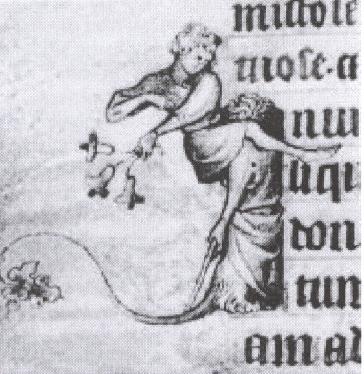
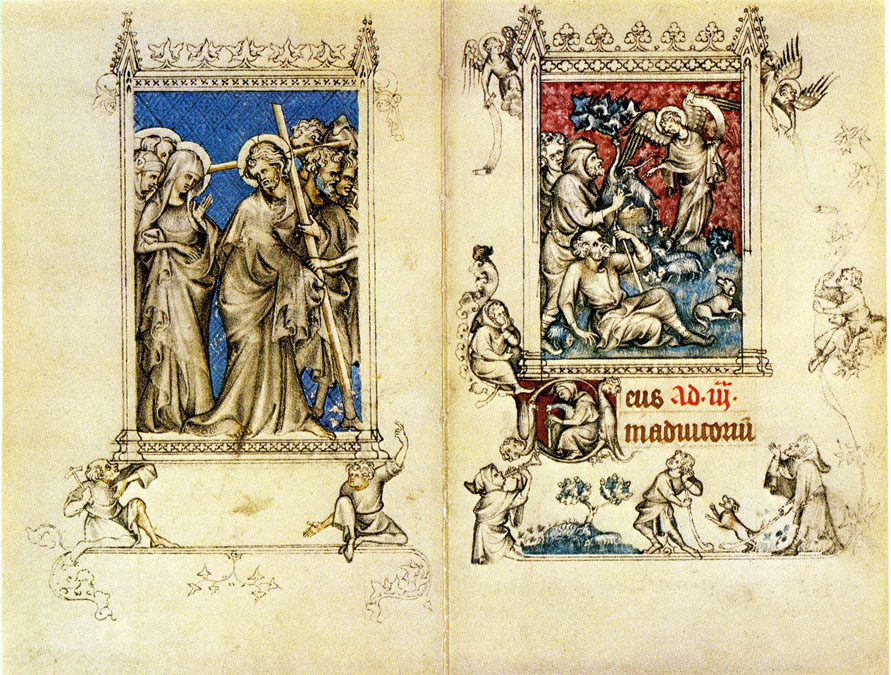
Close to seven hundred images run through the margins and initials of the Hours of Jeanne d'Evreux: bishops, beggars, street dancers, musicians, apes, rabbits, dogs and invented hybrid creatures, the standard repertoire of Gothic marginalia but unusually dense for so small a book. Two scholars have argued, independently and for different openings, that specific marginal scenes are not filler but carry a considered relationship to the miniature above them.
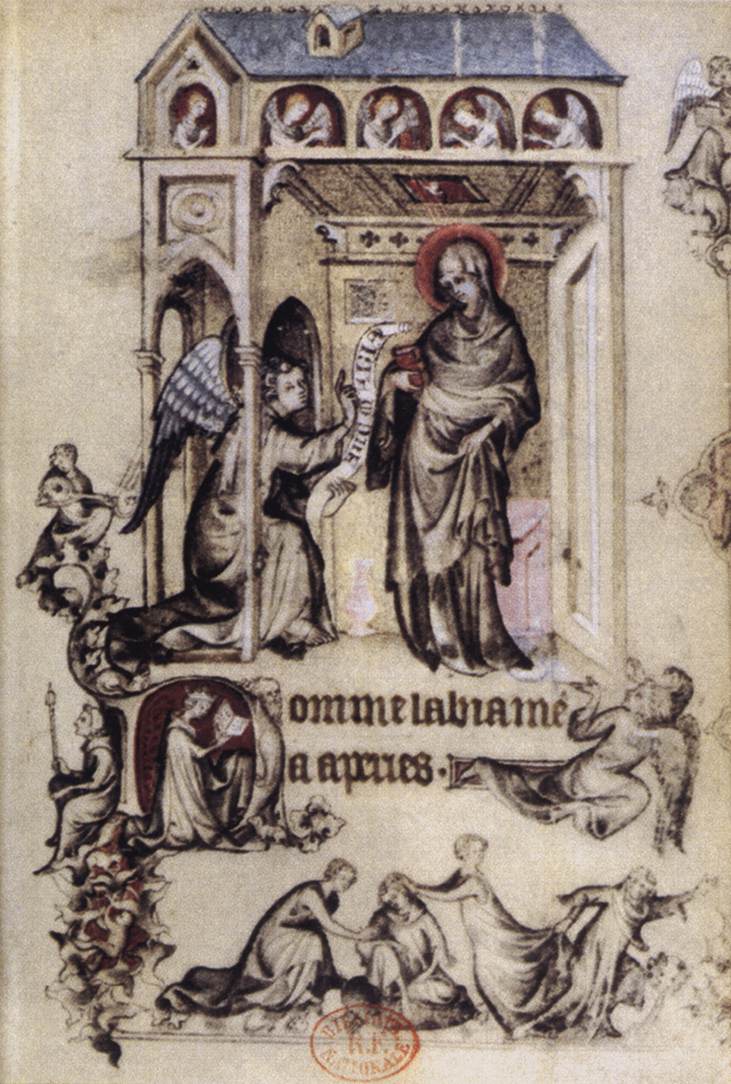
Lilian Randall's 1972 study identifies the opening at folios 15 verso and 16 recto: the Betrayal of Christ on the left facing the Annunciation on the right, with the queen's own likeness painted into the initial beneath the Annunciation, holding up a small book in an image of herself at prayer. In the margin below, a group of young people play a game in which one figure is teased and chased by the others, set directly opposite an image of Christ seized and pursued by armed men. Randall's reading is demonstrated opening by opening rather than asserted as a universal key; most of the marginalia in a book this size is exactly what it looks like, the fashionable ornamental vocabulary expected in a luxury commission, and this record does not manufacture a hidden reading where none has been argued.
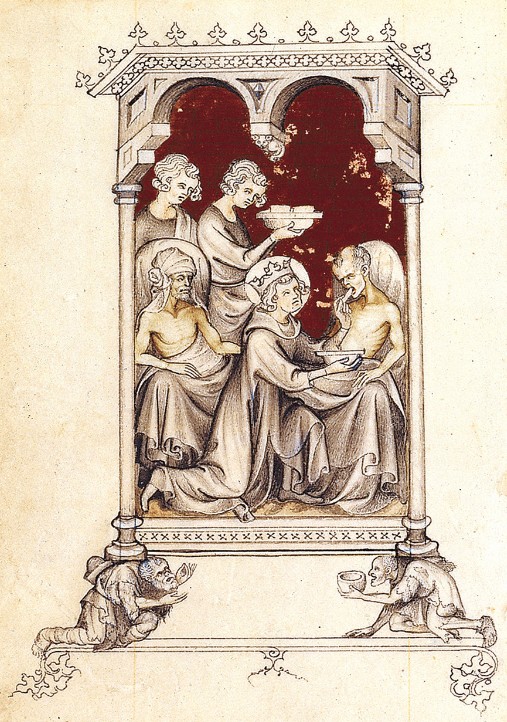
Gerald Guest's 1995 study takes up a different set of openings, the three scenes from the life of the newly canonised Louis IX shown giving alms and food to the poor. Guest argues that the beggars painted in the margins beneath these scenes are placed, repeatedly, at the very edge of the frame, receiving nothing from the royal charity taking place within it, and reads the pairing as a fourteenth-century visual discourse on who counted as a deserving object of charity and who did not. Guest is careful to frame this as something the pictures do, not as a claim about what Pucelle or his patron privately believed, and this page follows him in that distinction.
The Belleville Breviary carries something rarer than a marginal drollery: a written explanation of its own programme.
The Belleville Breviary carries something rarer than a marginal drollery: a written explanation of its own programme. At the head of the first volume, a three-leaf introduction states, in its own rubric, that it sets out the images of the figures that are in the calendar and the psalter, and is properly the concordance of the Old Testament and the New. To carry that concordance through the calendar itself, an apostle and a prophet were painted at the foot of each calendar page, each holding a scroll, one inscribed with a prophetic citation and the other with an article of the Creed, matching the twelve months of the year to the articles of the Creed. Only two of these calendar leaves now survive, one in each volume, covering November and December in the first volume and January and February in the second; the rest of the calendar cycle is lost. This is not a modern reading imposed on the pictures; it is the manuscript's own stated purpose, and it survives specifically because the volume was made for Dominican use, a religious order whose books of this period are unusually explicit about the doctrinal work their images were commissioned to do.
Nothing in the sources consulted for this record identifies the Dominican theologian who is credited with devising the scheme, and this record does not invent a name for him. What can be said is narrower and more useful: where a marginal drollery elsewhere in Pucelle's work has to be argued into meaning something, this programme states its own meaning in words, on the page, in the fourteenth century.
The Belleville Breviary's gilded clasps once carried the arms of Belleville, and it was on that heraldic evidence that Leopold Delisle identified its first owner as Jeanne de Belleville, wife first...
The Belleville Breviary's gilded clasps once carried the arms of Belleville, and it was on that heraldic evidence that Leopold Delisle identified its first owner as Jeanne de Belleville, wife first of Geoffroy VII de Chateaubriant and then, after 1330, of Olivier IV de Clisson, one of the Breton and Norman lords who rebelled against Philip VI in 1343. That identification held for more than a century as the standard account.
It has since been reopened. The Bibliotheque nationale's own catalogue records that the question of the original patron has recently drawn renewed scholarly attention, around a hypothesis, argued by Marc Gil in 2013, of a commission from a family closely tied first to the Capetian and then to the Valois royal line. A related acquisition by the library in 2016, a previously unknown breviary commissioned by Louis X, prompted Sabine Maffre to propose in 2022 that the Belleville Breviary itself may have been a royal commission initiated by Charles IV, the same king who a few years later had the Hours of Jeanne d'Evreux made for his own queen. Neither Gil's nor Maffre's argument has displaced Delisle's heraldic identification as the standard account; both are argued positions from named scholars, not settled fact, and this record states them as such rather than picking a winner.
Pucelle's documented working life ends with his death in 1334.
Pucelle's documented working life ends with his death in 1334. His visual manner did not. A number of manuscripts painted after that date, most prominently the Psalter of Bonne of Luxembourg, made around 1348 to 1349 and now at the Cloisters, were for a time associated with Pucelle himself on stylistic grounds, because their grisaille figures and modelled space continue his manner closely enough to read, at first glance, as his own work. The dates make that impossible: the Psalter was painted at least fourteen years after Pucelle's documented death.
The corpus has since been reassigned to Jean Le Noir, a documented Parisian illuminator active by 1331 and into the 1380s, who worked for Yolande of Flanders, for Charles V after his accession in 1364, and for Jean, Duke of Berry, at Bourges in the early 1370s, with his daughter Bourgot assisting on much of the later work. Le Noir is documented independently of any claim about Pucelle; he is not a name invented to solve the dating problem, he is a separately attested artist whose own career happens to explain why a workshop manner kept producing books in Pucelle's style for half a century after Pucelle himself could no longer have painted them.
No manuscript securely attributed to Pucelle's own hand has ever been sold at public auction.
No manuscript securely attributed to Pucelle's own hand has ever been sold at public auction. All three of the works given to him with real confidence, the Hours of Jeanne d'Evreux, the Belleville Breviary and his share of the Billyng Bible, have been institutional property, in the Metropolitan Museum and the Bibliotheque nationale de France, since before the modern manuscript market as it now operates existed, and none of the sources consulted for this record documents a prior sale of any of them on the open market either.
What the market has traded instead is material in his circle rather than his hand: individual leaves cut from the St Albans Bible, the manuscript whose initials Christopher de Hamel placed in the style of Jean Pucelle rather than attributing to him personally, have passed through Sotheby's, Christie's, Bonham's and Dreweatts in the 2010s as the book was broken apart and dispersed leaf by leaf. This record has not located a documented hammer price for any individual St Albans Bible leaf with its currency and premium recorded to the standard this site requires, and states that gap here rather than filling it with an unsourced figure.
Illuminator; Manuscript painter; Seal designer. documented active 1319-1334, d. 1334.
Died 1334.
The Psalter of Bonne of Luxembourg, misdated to Pucelle's own lifetime. Painted around 1348 to 1349, at least fourteen years after Pucelle's documented death in 1334, the Psalter's grisaille figures and modelled space continue his manner closely enough that it and related manuscripts were for a time read as his own work.
The Cloisters, The Metropolitan Museum of Art (New York); Bibliotheque nationale de France, Departement des Manuscrits (Paris).
No manuscript securely attributed to Pucelle's own hand has ever come to public auction. All three works given to him with real confidence are institutional property, in the Metropolitan Museum and the Bibliotheque nationale de France, and none of the sources consulted for this record documents a prior open-market sale of any of them.
Where and when was Pucelle born, and who trained him? No source consulted for this record documents either fact.
Of 35 objects this archive has researched but does not publish, 27 already carry licensed photographs.
9 min read
One family name appears in nine records in this archive across seven object classes.
9 min read
A restitution is itself an undocumented transfer. This archive holds an object delivered to a family that had never owned it, a...
12 min read
16 of the 18 manuscripts and printed books in this archive wear a binding a later owner paid for.
10 min read
Breguet No. 160 is called the Marie-Antoinette. Nothing from the queen's lifetime connects her to it: the firm's records call it...
10 min read
Last verified
One artwork and its story every Tuesday, with the picture: who owned it, what it made, and what closes soon in the exhibition calendar. No promotion, and nothing we cannot cite.
We send one email to confirm the address and keep nothing else. Every letter carries a one-click unsubscribe. How we handle your data.