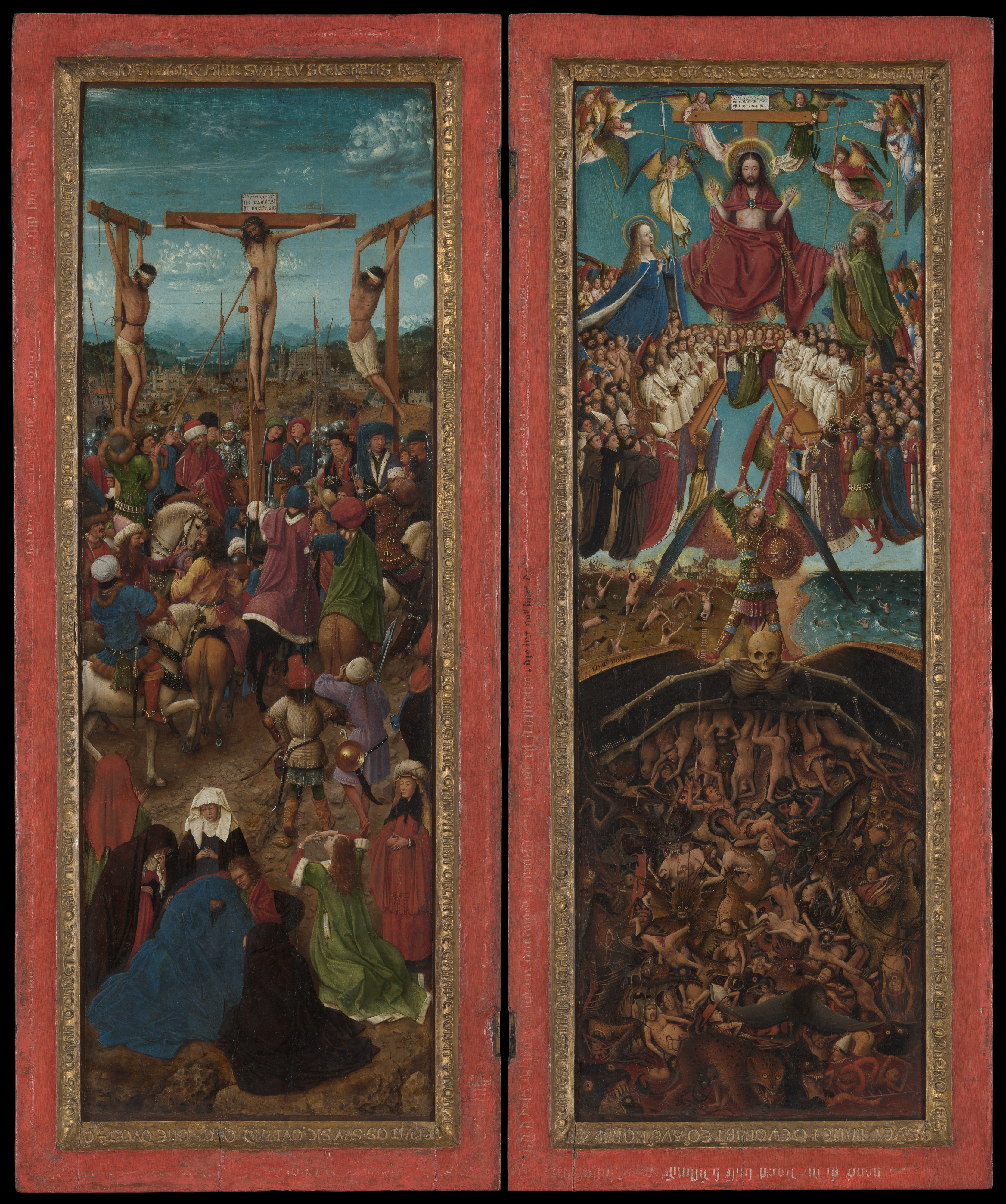
The Crucifixion; The Last Judgment
ca. 1436-38 · Oil on canvas
The Metropolitan Museum of Art, New York
 1390-1441
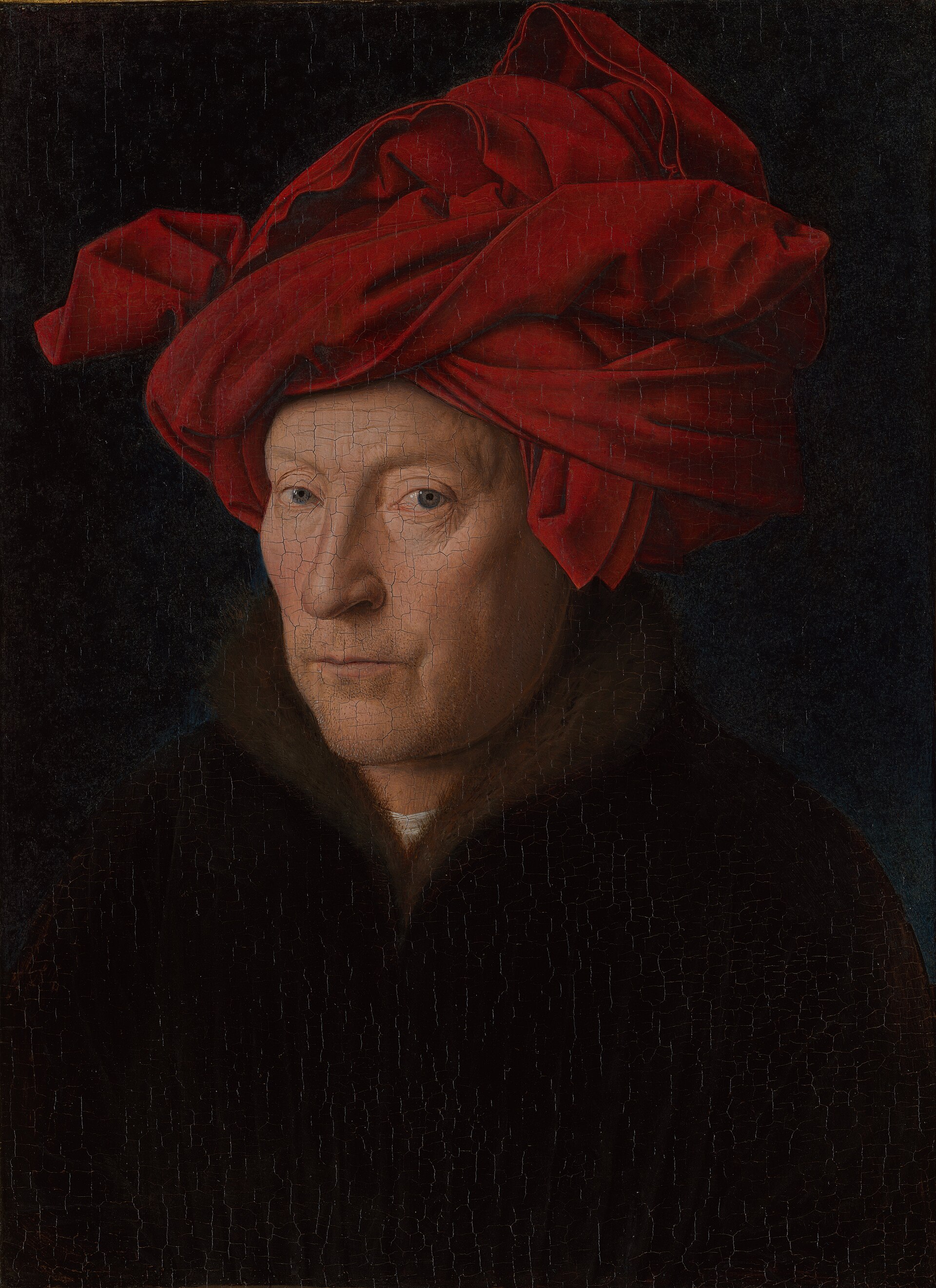
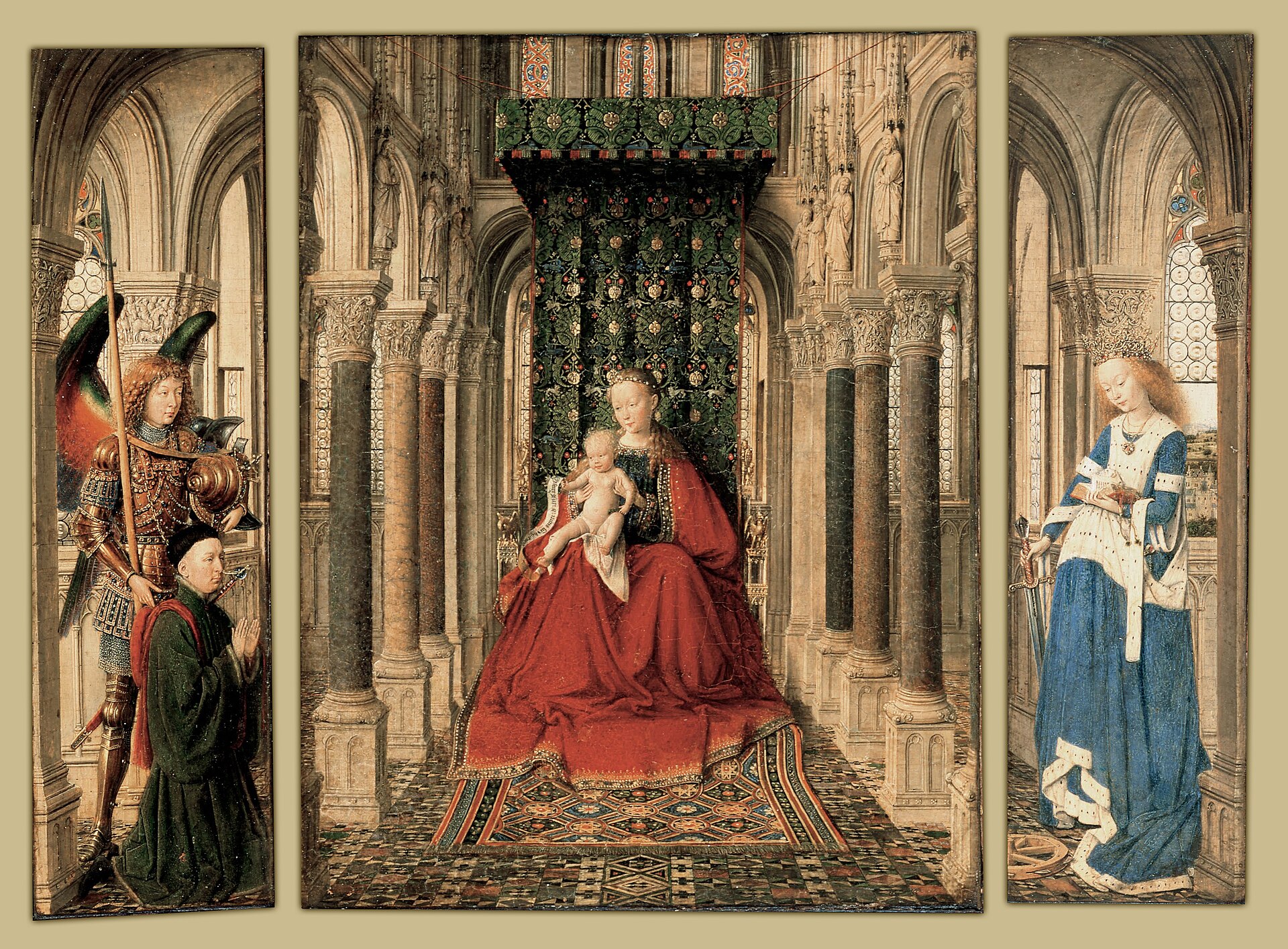
Signed and dated on the original frame, 21 October 1433, with the motto ALS ICH KAN in Greek lettering. The National Gallery's own catalogue calls the sitter almost certainly Van Eyck himself, citing the direct, mirror-like gaze and the unusual prominence of the frame's motto, but no other confirmed likeness of Van Eyck survives to compare it against, so the identification, though very widely accepted, remains an inference rather than a documented fact.
National Gallery, London| Worked as | Painter, Court painter and diplomat to Philip the Good, Duke of Burgundy |
|---|---|
| Born | c. 1390 (possibly as early as c. 1380 · Maaseik (then Maaseyck), prince-bishopric of Liege |
| Died | 1441 (9 July is the date most often cited · Bruges |
| Nationality | Netherlandish (County of Flanders, Burgundian Netherlands) |
| Movement | Early Netherlandish painting (Ars Nova) |
| In this archive | 1 artwork |
| Sources | 17 cited |
| Last verified | 17 September 2026 |
About this page 1 artwork in the archive · Last verified 17 September 2026 · 17 sources cited
Jan van Eyck is the earliest Netherlandish painter whose individual hand can be identified with real confidence, and almost the only one of his generation who wanted it that way: he signed and dated his pictures at a time when signing a panel was not yet customary, and attached to several of them a personal motto, ALS ICH KAN, as close to a maker's mark as fifteenth-century painting allows. The corpus that habit makes possible is tiny, perhaps twenty to twenty-five paintings now generally accepted as his own hand out of a much larger number once given to him, and nearly the entire group sits in museums and churches; no autograph panel is known to have come to public auction in the modern era. What survives instead is an unusually well-documented court career in the service of Philip the Good of Burgundy, one that paid him to be ready rather than to produce, sent him on missions the Burgundian accounts describe only as far and secret journeys, and left a single altarpiece, at Ghent, with a theft and recovery history that runs from Napoleon's soldiers to a panel still missing today.
The claim most readers reach for first, that he invented oil painting, is false and has been known to be false for well over a century. What he actually did with an already old medium, building faces and fabrics from glazes thin enough to let light pass through and reflect back out, is the better documented and more interesting story. This page follows both threads: what can be shown to be his, and how thin the evidence sometimes is even for the paintings nobody disputes.
Presumed birth at Maaseik, prince-bishopric of Liege; the exact year is not documented.214
Recorded working for John of Bavaria, ruler of Holland, at The Hague, with one assistant.2
Two assistants recorded in his workshop.2
John of Bavaria dies; Van Eyck immediately enters the service of Philip the Good, Duke of Burgundy, as court painter and varlet de chambre.2
Based at Lille while in Burgundian service.2
Undertakes a pilgrimage on Philip the Good's behalf; his brother Hubert dies, leaving the Ghent Altarpiece unfinished.25
Travels to Portugal on a Burgundian diplomatic mission and paints a portrait, now lost, of Isabella of Portugal ahead of her marriage to Philip the Good.214
Established in Bruges, where he remains until his death.2
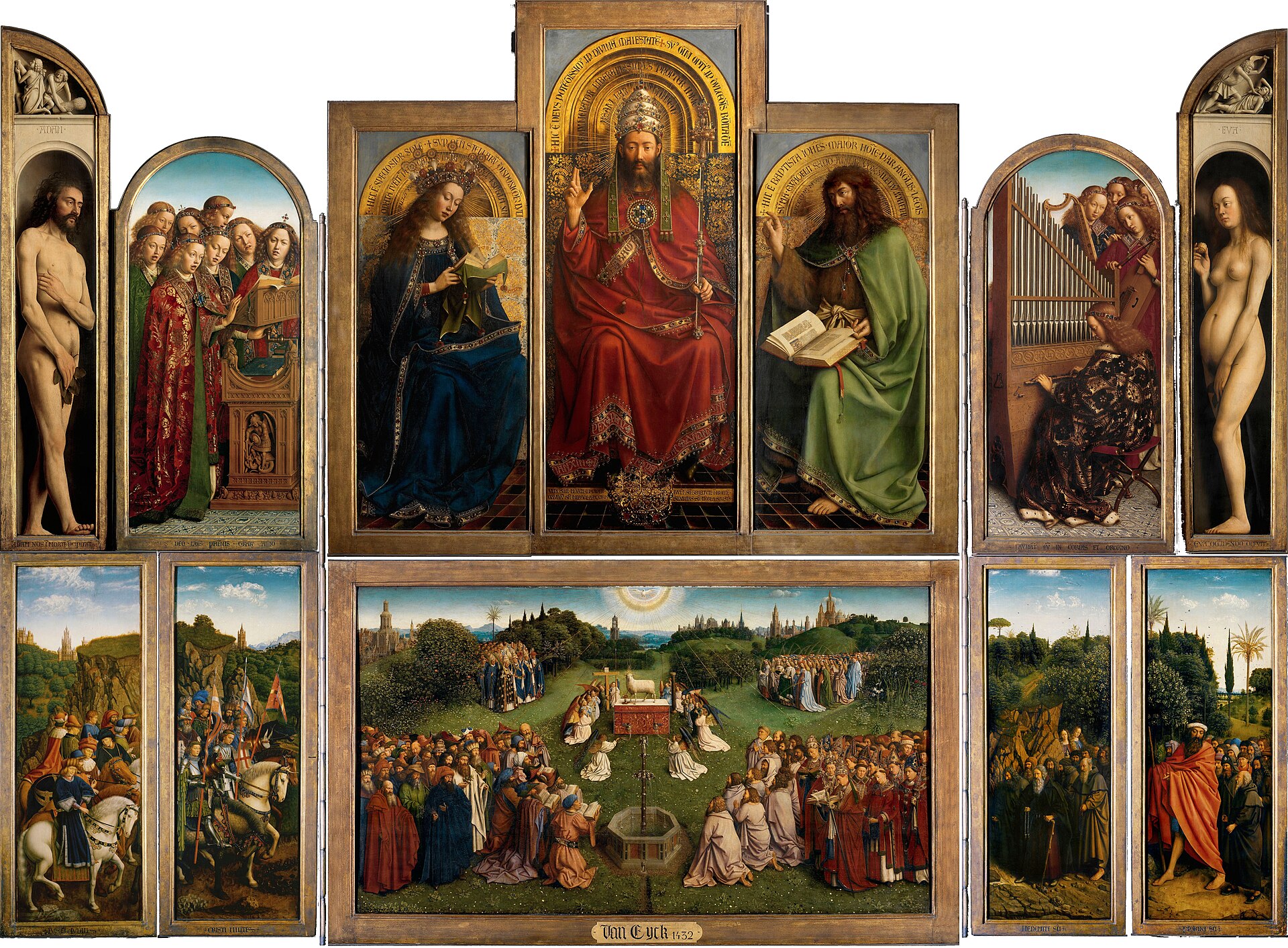
The Ghent Altarpiece is dedicated in the chantry chapel of Joos Vijd and Elisabeth Borluut, Church of Saint John, Ghent, now Saint Bavo's Cathedral; its frame quatrain credits Hubert van Eyck with beginning the work and Jan with completing it.45
Signs and dates, 21 October, the small panel Portrait of a Man, now generally accepted as a self portrait.1
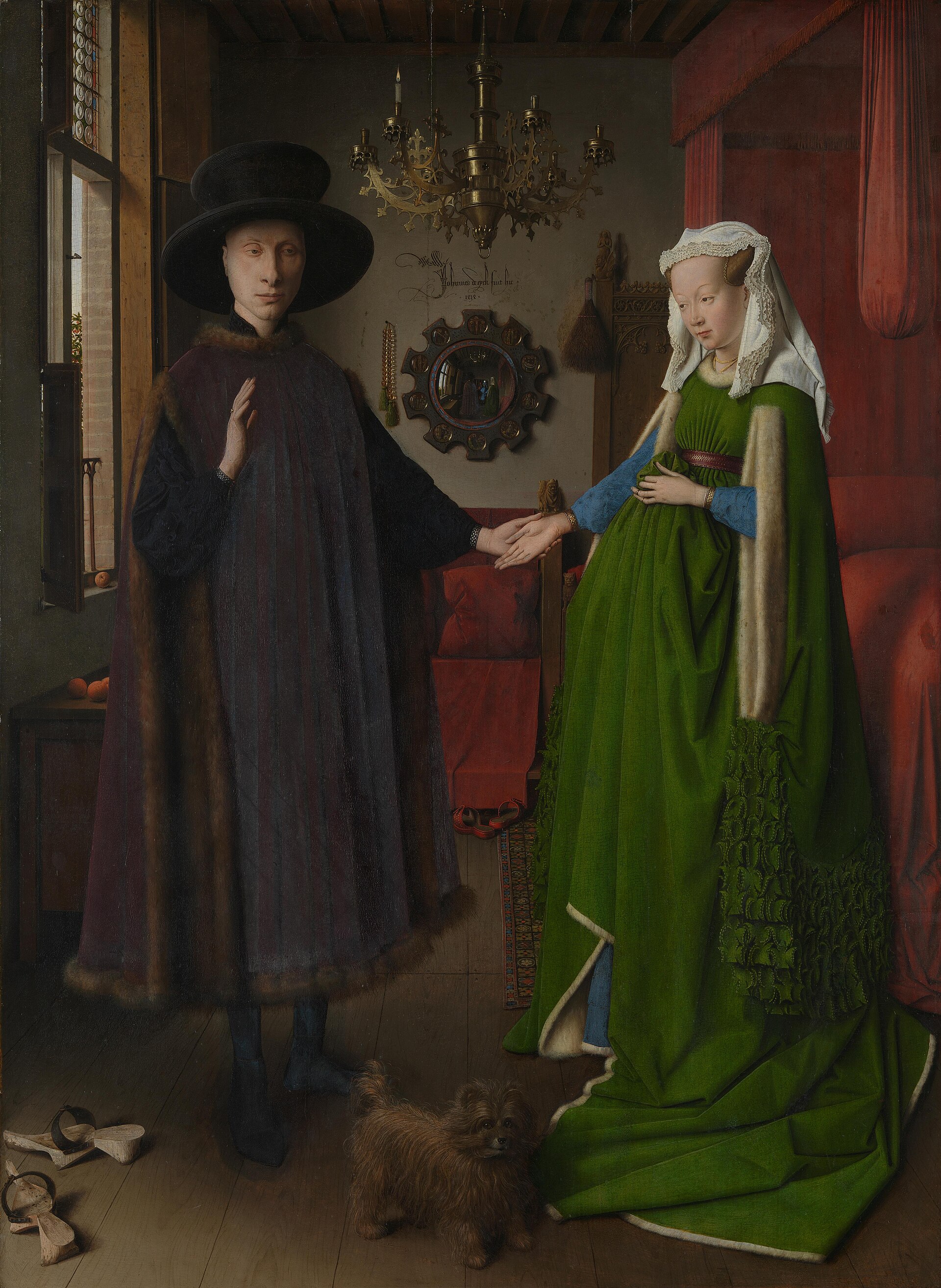
Signs and dates the double portrait of Giovanni(?) Arnolfini and his wife; the same year his Burgundian salary is raised 720 percent, to 360 livres of 40 gros, and converted to a life pension.23
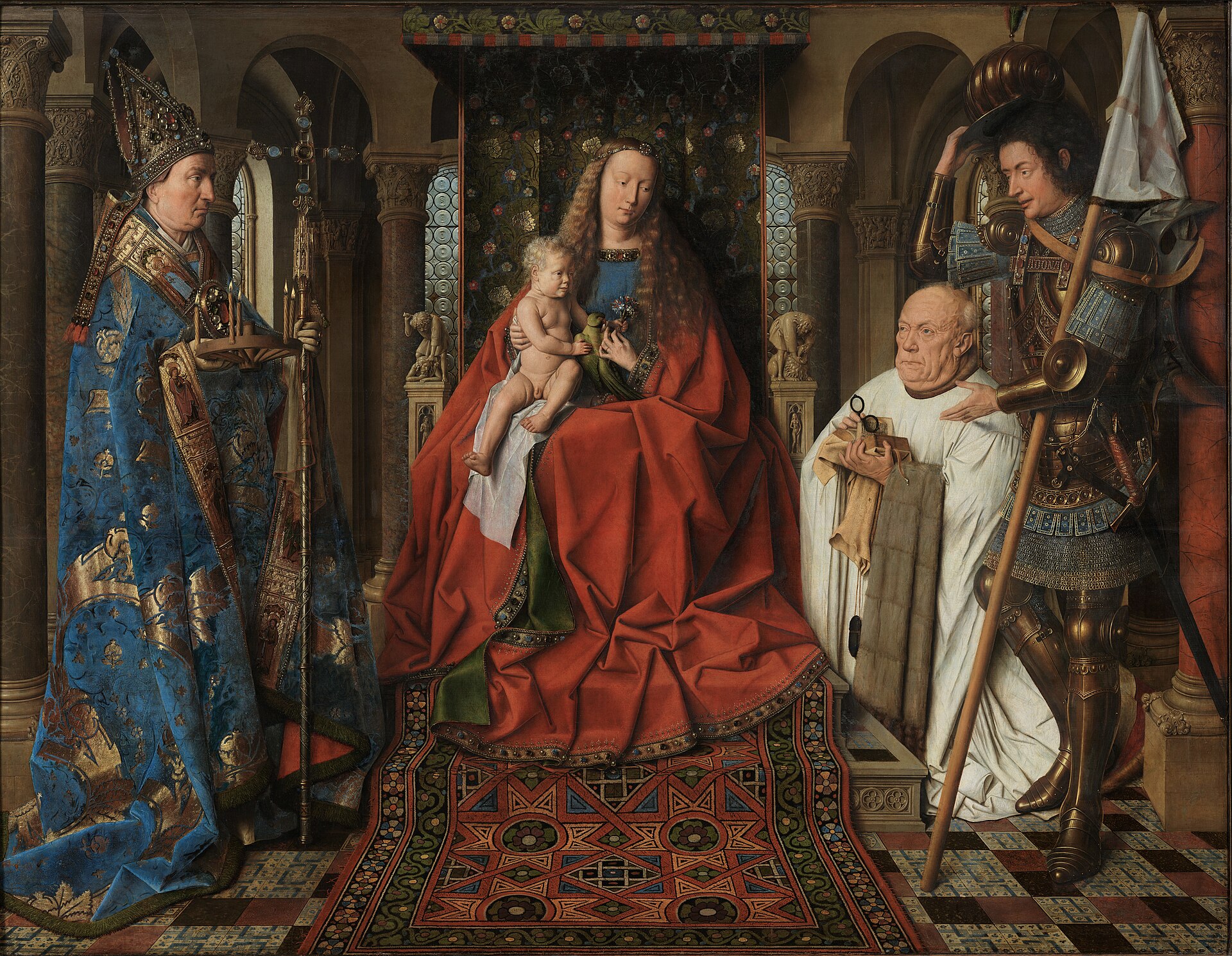
Signs and dates the portrait of the goldsmith Jan de Leeuw and the Virgin and Child with Canon van der Paele, the latter for the canon's own chantry chapel at Saint Donatian's, Bruges.2
Signs and dates the small triptych now in Dresden and a brush drawing of Saint Barbara.2
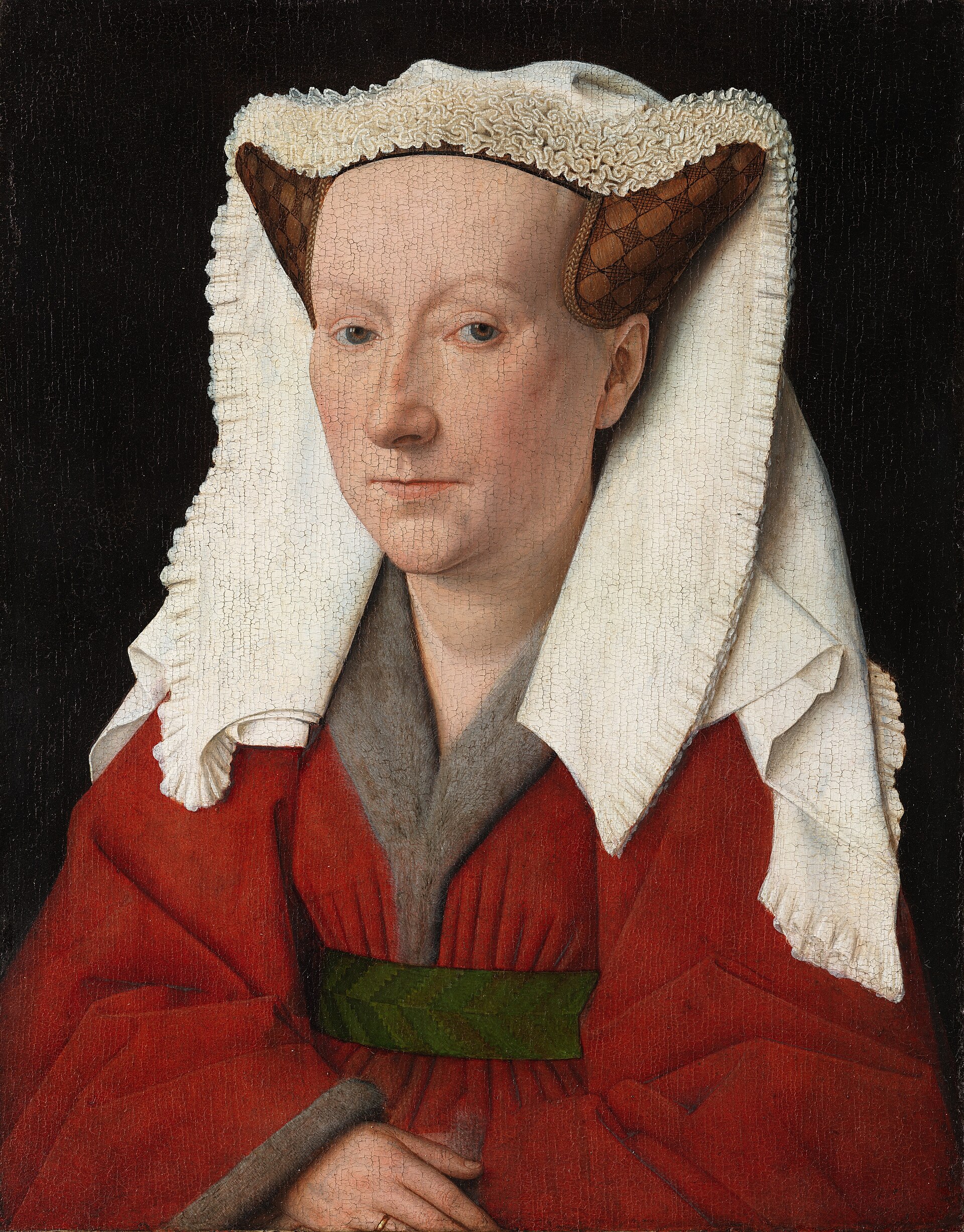
Signs and dates the Virgin of the Fountain and the portrait of his wife Margaret.2
Dies at Bruges; 9 July is the date most often cited, though Lorne Campbell's National Gallery catalogue gives June.214
The Italian humanist Bartolomeo Fazio writes of Van Eyck, by then fifteen years dead, as the principal painter of his century, the earliest substantial written appraisal by a contemporary.2
Four central panels of the Ghent Altarpiece are looted by French revolutionary forces to the Louvre and returned to Ghent after Waterloo, a gift from the restored king Louis XVIII.10
The cathedral's own churchwardens sell the altarpiece's side wings; the panels pass through the dealer Nieuwenhuys and the collector Edward Solly to the Prussian state, hang in Berlin, and are ceded back to Belgium under the Treaty of Versailles.1011
The Just Judges panel is stolen from Saint Bavo's Cathedral; it has never been recovered.8
The altarpiece is seized by German forces en route to safekeeping in France, moved via Pau and Neuschwanstein Castle to the Altaussee salt mine in Austria, and recovered there by Allied Monuments Men in May 1945.910
KIK-IRPA's technical study confirms the Ghent Altarpiece frame quatrain is authentic and identifies Hubert van Eyck's hand in an underlying paint layer of the central panel.4
The AI firm Art Recognition disputes the attribution of two Saint Francis Receiving the Stigmata panels; Ghent University specialist Maximiliaan Martens publicly challenges the finding.6
There is effectively no auction market for Jan van Eyck, because there is effectively no supply. The accepted corpus, on the highest current estimate, runs to about twenty-five paintings, and nearly all of them have been in museum or church ownership for centuries; no autograph panel is known to the sources consulted to have been offered at public auction in the modern era. The auction aggregator Invaluable lists dozens of items catalogued under his name, and without exception the ones actually examined are qualified: 'after Jan van Eyck', 'follower of', 'circle of', the German 'Umkreis des' (circle of), or are prints and photomechanical reproductions of his compositions made centuries later. None is offered as an autograph work. The absence is itself the finding: there is no comparable sale to cite, because the market this page's readers use to price other names simply does not operate on this one.
| Institution | City | Holdings | Note |
|---|---|---|---|
| National Gallery | London | Portrait of a Man (Self Portrait?), 1433; Portrait of Giovanni(?) Arnolfini and his Wife, 1434 | Holds the fullest published documentary catalogue of its two paintings, by Lorne Campbell. |
| Groeningemuseum | Bruges | Virgin and Child with Canon van der Paele, 1436; Portrait of Margaret van Eyck, 1439 | Bruges was Van Eyck's home from 1431 until his death in 1441. |
| Saint Bavo's Cathedral | Ghent | The Ghent Altarpiece (Adoration of the Mystic Lamb), dedicated 1432 | Shown in a dedicated visitor chapel since restoration; the Just Judges panel is a modern replacement, the original still missing since 1934. |
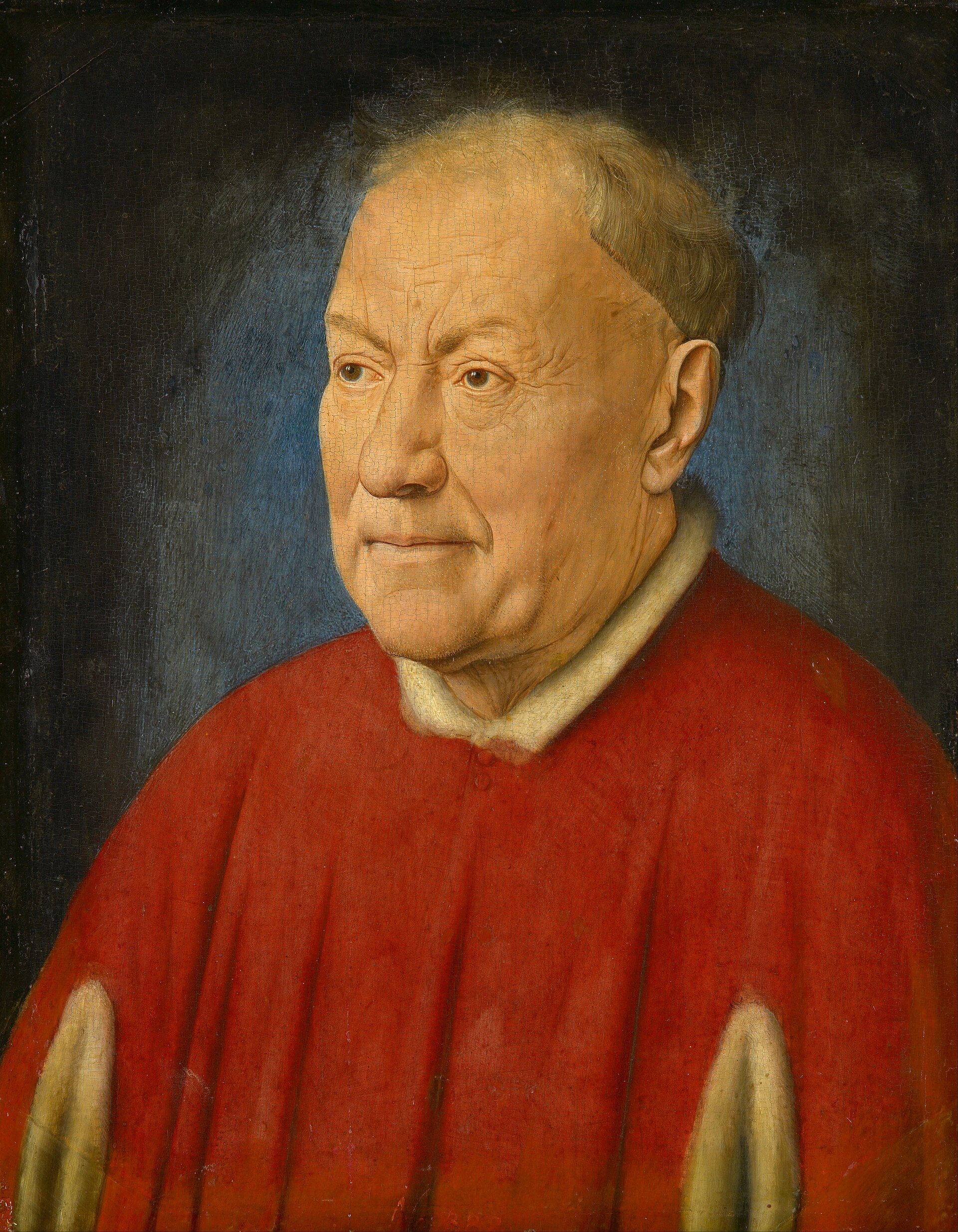
| Kunsthistorisches Museum | Vienna | Portrait of Cardinal Niccolo Albergati; Portrait of Jan de Leeuw, 1436 | |
| Gemaldegalerie, Staatliche Museen | Berlin | Portrait of Baudouin de Lannoy | The Berlin collection also held the Ghent Altarpiece's wings between 1821 and 1920. |
| Gemaldegalerie Alte Meister | Dresden | Small triptych of the Virgin and Child, Saint Michael and Saint Catherine, 1437; the silverpoint study for the Albergati portrait | |
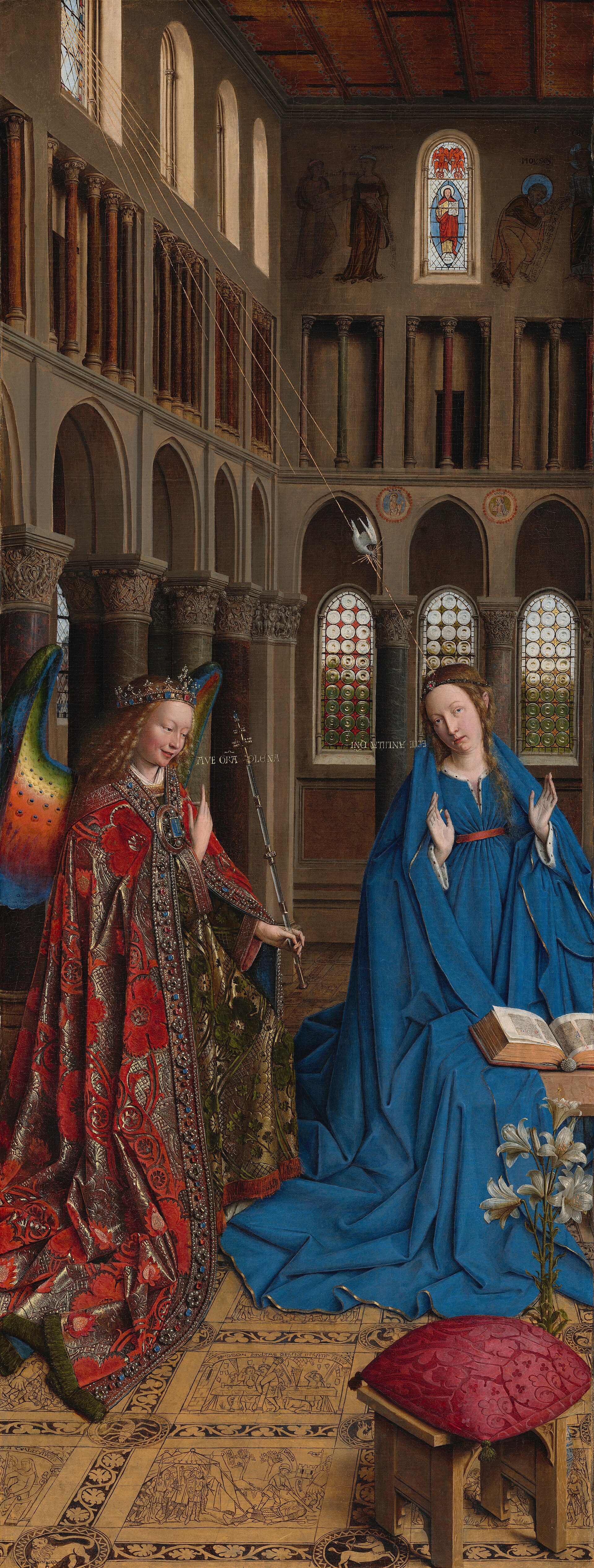
| National Gallery of Art | Washington, DC | The Annunciation, c. 1434-1436 | The only signed or firmly attributed Van Eyck painting in the United States. |
Of the major Early Netherlandish painters working in the 1420s and 1430s, Jan van Eyck is close to alone in habitually signing and dating his own pictures.
Of the major Early Netherlandish painters working in the 1420s and 1430s, Jan van Eyck is close to alone in habitually signing and dating his own pictures. Nine surviving works carry his authentic signature and a firm date (eight paintings and one drawing): the Leal Souvenir of 1432, the probable self portrait of 1433, the double portrait of Giovanni(?) Arnolfini and his wife of 1434, the portrait of the goldsmith Jan de Leeuw of 1436, the Virgin and Child with Canon van der Paele also of 1436, the small triptych now in Dresden of 1437, a brush drawing of Saint Barbara also dated 1437, the Virgin of the Fountain of 1439, and the portrait of his own wife Margaret, also 1439. Several more pictures were probably signed on frames now lost, and one or two works named as his in early written sources survive only in later copies.
That habit of signing is the reason this page, and every serious study of Van Eyck, can speak with any confidence at all. Where a Netherlandish panel of the same decade carries no signature, attribution to him rests on style and technical comparison against this small signed core, and specialists disagree constantly about exactly where his own hand stops and his workshop's begins.
Van Eyck's early career is undocumented; nothing certain is known of his training, or of any picture he produced before 1432.
Van Eyck's early career is undocumented; nothing certain is known of his training, or of any picture he produced before 1432. The paper trail begins in 1422, when he is recorded working for John of Bavaria, ruler of Holland, at The Hague, with one assistant; by 1424 he had two. When John of Bavaria died in 1425, Van Eyck immediately entered the service of Philip the Good, Duke of Burgundy, who made him varlet de chambre, treated him, in the surviving accounts, with marked consideration, and paid him a fixed salary precisely so that he did not have to work to commission and could paint for the Duke whenever it pleased him. In 1434 that salary was raised by 720 percent, to 360 livres of 40 gros a year, and converted into a life pension.
Alongside the painting, Philip sent him on missions the Burgundian court accounts describe only as certain far and secret journeys, their actual purpose left unrecorded. The one mission whose purpose is documented took him to Portugal in 1428 and 1429, where he painted a portrait of Isabella of Portugal ahead of her marriage to Philip; the portrait itself does not survive and is known only through later copies. Van Eyck was based at Lille between 1425 and 1428 and had settled in Bruges by 1431, where he remained until his death.
The frame of the Ghent Altarpiece carries a Latin quatrain, rediscovered on the frame at the Berlin museum in 1823, that names both brothers: the painter Hubert van Eyck, a greater man than whom none...
The frame of the Ghent Altarpiece carries a Latin quatrain, rediscovered on the frame at the Berlin museum in 1823, that names both brothers: the painter Hubert van Eyck, a greater man than whom none was found, began this work; his brother Jan, second in art, completed the heavy task at the expense of Joos Vijd, dated 6 May 1432. For generations the verse's authenticity was itself disputed, since a text that so neatly explains the work's authorship and patronage was also exactly the kind of addition a later owner might have made to raise its value. That question was resolved, not merely argued, in 2020: an interdisciplinary technical study by the Belgian heritage institute KIK-IRPA, using infrared reflectography, macro X-ray fluorescence and other imaging methods, found the inscription's execution and layout consistent with Van Eyck's own working practice, and identified an earlier, different composition beneath the paint of the central panel's landscape that the researchers attribute stylistically to Hubert.
Dendrochronology complicates the neat two-brother story the quatrain seems to tell. Tree-ring analysis of the wing panels shows the wood was felled around 1421; allowing the decade or more oak needs to season before a painter would use it, the wings themselves were probably not paintable until after Hubert's death in 1426, which rules his hand out of large parts of them regardless of what the inscription claims for the altarpiece as a whole. No scholar has managed to divide the finished work panel by panel between the two brothers with any precision, and the Metropolitan Museum's own published account of the altarpiece states plainly that no one has ever convincingly distinguished their respective shares.
The altarpiece was never a free-standing public monument.
The altarpiece was never a free-standing public monument. It was installed above the altar of a chantry chapel that the wealthy Ghent patrician Joos Vijd and his wife Elisabeth Borluut had founded and endowed, in what was then the parish church of Saint John and is now Saint Bavo's Cathedral, and its purpose was liturgical: to stand behind the daily masses the couple had paid to have said there in perpetuity, for their own souls and their ancestors'. The painted programme reflects that function directly. At the centre of the lower register a lamb, its blood flowing into a chalice, stands for the Eucharistic sacrifice re-enacted at every one of those masses, and a stream of water flowing from a fountain in the same panel is painted running downward toward the position of the real altar beneath it, connecting the painted Fountain of Life to the actual liturgy performed in front of the panel.
The theological programme draws in part on the liturgy for All Saints' Day, which itself draws on the Book of Revelation's vision of the redeemed multitude adoring the Lamb, but no single text accounts for the whole scheme; whoever assembled the programme, Van Eyck himself or a theological adviser working with him, combined several sources rather than illustrating one. That is a documented finding about how the commission was put together, not a hidden message: Joos Vijd's motive, buying perpetual prayer for his soul through an altarpiece as costly and as permanent as this one, is exactly the kind of ordinary, stated late-medieval religious transaction the period's own will and foundation documents describe everywhere. Nothing in the sources consulted argues for a programme beyond that.
The small picture long called Man in a Red Turban and now catalogued by the National Gallery simply as Portrait of a Man (Self Portrait?) is signed and dated on its original frame, in Latin, 21...
The small picture long called Man in a Red Turban and now catalogued by the National Gallery simply as Portrait of a Man (Self Portrait?) is signed and dated on its original frame, in Latin, 21 October 1433, and carries Van Eyck's motto ALS ICH KAN in Greek lettering, unusually prominent even for a painter who used the motto elsewhere. The National Gallery's own published position is that this face is almost certainly Van Eyck's own: no other confirmed likeness of him survives to check it against, but the sitter appears to be craning forward with each eye looking in a slightly different direction, consistent with a painter working from his own reflection, and infrared examination shows the artist adjusting the drawing as he worked, in particular exaggerating the nose toward a three-quarter angle, a device the Gallery's own technical notes call typical of how Van Eyck made a face more recognisable.
The identification is accepted by the great majority of specialists but remains, honestly stated, an inference from internal evidence rather than a document naming the sitter. No rival portrait has ever been proposed as the real self portrait, and a seventeenth-century provenance note for this exact panel already misidentified the sitter as a Burgundian nobleman, evidence of how quickly and how far a portrait's identity can drift even for a painting this thoroughly documented.
The claim that Van Eyck invented oil painting is false, and has been known to be false among specialists for well over a century; instructions for painting in oil appear in Theophilus's treatise On...
The claim that Van Eyck invented oil painting is false, and has been known to be false among specialists for well over a century; instructions for painting in oil appear in Theophilus's treatise On Diverse Arts as early as around 1125, three centuries before Van Eyck was born. The myth traces to Giorgio Vasari's Lives of the Artists in the sixteenth century, and the National Gallery's own current catalogue still frames the claim as something Van Eyck 'was for centuries regarded' as having done, precisely in order to correct it.
What Van Eyck actually did with an already old medium is better documented and more interesting. He built faces and fabrics from repeated thin, part-transparent glazes over a bright white chalk ground, letting light pass through the coloured layers and reflect back off the white beneath them, an effect egg tempera cannot reproduce and that gives his surfaces their characteristic saturated, jewel-like colour. Technical examination of the 1433 self portrait shows the apparent finish is deceptive: the stubble on the sitter's chin, which reads as almost photographically precise at normal viewing distance, resolves under magnification into individual dabbed spots of paint, darker brown ones laid first and near-white ones added over them, worked quickly rather than laboured over. For at least one sitter, Cardinal Niccolo Albergati, Van Eyck is known to have made a silverpoint drawing from life, now in Dresden, annotated with notes on the sitter's colouring, and to have used it to complete the painted portrait afterward, without the cardinal present. Of Van Eyck's drawn work only three sheets survive at all, so this single documented case is close to the only direct evidence of how he actually worked from a sitter.
The double portrait signed and dated 1434, showing a man and woman joining hands in a Bruges bedchamber, is usually called the Arnolfini Portrait, but the identity of the couple has changed at least...
The double portrait signed and dated 1434, showing a man and woman joining hands in a Bruges bedchamber, is usually called the Arnolfini Portrait, but the identity of the couple has changed at least once in the modern literature and the change matters to how the picture is read. The earliest known description, an inventory of Margaret of Austria's paintings taken at Mechelen on 17 July 1516, calls it a picture of 'Hernoul le Fin with his wife'; a later inventory of the same collection gives the name as 'Arnoult Fin'. In 1857 the historians Crowe and Cavalcaselle proposed that these names were corruptions of 'Arnolfini', the surname of a Lucchese merchant family active in Bruges, and in 1861 the scholar W.H.J. Weale identified the sitter as Giovanni di Arrigo Arnolfini and his wife as Giovanna Cenami. That identification was repeated for well over a century.
It is also demonstrably wrong on the wife's side, and probably wrong on the husband's too. Burgundian ducal accounts discovered in the 1990s record a gift Philip the Good gave Giovanni di Arrigo Arnolfini on his wedding day, and date that wedding to 1447, thirteen years after the portrait was painted; his wife cannot have sat for a picture made before their marriage. Lorne Campbell's 1998 National Gallery catalogue argues instead for a cousin, Giovanni di Nicolao Arnolfini, who married Costanza Trenta in 1426. Costanza's own mother, writing home to Lucca in February 1433, already refers to her daughter as dead, meaning that if this identification is right, the woman in the 1434 portrait had probably died before it was painted. That fact underlies a real and unresolved scholarly dispute: Erwin Panofsky, in a 1934 study, read the joined hands and Van Eyck's inscription 'Jan van Eyck was here' as the record of a marriage witnessed by the painter himself; Margaret Koster, writing in 2003, read the same joined hands as a widower still holding a dead wife's hand, pointing to the unlit, guttered candle above the woman's head and the funerary associations of the dog as support for a memorial rather than a marriage reading; Margaret Carroll has argued for a third reading again, a legal record of a wife's delegated authority over her husband's business during his absence. None of the three is settled, and the sitters' names took over a century to even partly correct.
How many paintings actually survive by Van Eyck's own hand depends on who is asked and when.
How many paintings actually survive by Van Eyck's own hand depends on who is asked and when. Around forty pictures were seriously treated as autograph as recently as the mid-1980s; roughly ten of those have since been reclassified, on technical and connoisseurship grounds, as workshop production rather than the master's own hand, a correction that has run gradually across decades rather than arriving as a single revision. Lorne Campbell's 1998 National Gallery catalogue will only commit, in print, to the nine paintings that carry Van Eyck's own signature and a firm date, calling that the secure floor beneath a wider and more argued total. The KIK-IRPA-run Closer to Van Eyck project, an open-access high-resolution imaging platform launched in January 2020, makes available what it describes as almost the whole accepted oeuvre, in practice close to twenty-two paintings drawn from participating museums. Speaking to Artnet News in February 2026, the Ghent University Van Eyck specialist Maximiliaan Martens gave the working figure as around twenty-five.
There is no single body that rules on Van Eyck attribution the way an artist's foundation or estate committee might for a modern painter. What functions as authority is the working consensus of a small number of named specialists and institutions, chiefly KIK-IRPA, which controls the Ghent Altarpiece's own technical record, and the National Gallery's conservation and documentary research under Campbell. That consensus model was tested directly in 2026, when a commercial AI attribution firm published a finding outside it.
There is effectively no auction market for Jan van Eyck, and the reason is supply rather than demand.
There is effectively no auction market for Jan van Eyck, and the reason is supply rather than demand. On the highest current estimate the accepted corpus runs to about twenty-five paintings, nearly all of which have been in museum, cathedral or royal collections for centuries; the sources consulted for this page turned up no record of an autograph panel being offered at public auction in the modern era. The auction aggregator Invaluable lists several dozen items catalogued under Van Eyck's name; every one actually examined for this page carries a qualifying phrase, 'after Jan van Eyck', 'follower of', 'circle of', the German 'Umkreis des' (circle of), or is a photomechanical print or engraved reproduction of one of his compositions made centuries later. Not one is offered as an autograph painting.
That absence is worth stating plainly rather than working around. A page built to answer what an artist makes at auction has, for this artist, no genuine sale to report, and inventing a comparable would be worse than leaving the section empty.
No single work in this archive has a more eventful survival than the Ghent Altarpiece.
No single work in this archive has a more eventful survival than the Ghent Altarpiece. French revolutionary troops looted four of its central panels in 1794 and displayed them at the Louvre; they were returned to Ghent only in 1815, after Waterloo, a gift from the restored French king Louis XVIII. The following year the cathedral's own churchwardens, judging the side wings dispensable next to the four central panels, sold them to the dealer L.J. Nieuwenhuys for 3,000 guilders, holding back only the Adam and Eve panels, which had already been in storage for decades on grounds of their nudity. Nieuwenhuys sold the wings on to the English timber merchant Edward Solly, whose collection passed to the Prussian state in 1821; they hung in Berlin, latterly in the Kaiser Friedrich Museum, until the Treaty of Versailles required Germany to cede them back to Belgium as war reparations in 1920, the first time in over a century the full altarpiece stood together in Ghent.
It did not stay safe for long. On the night of 10 April 1934 a thief removed the lower left panel, the Just Judges, from the cathedral; its reverse, a grisaille Saint John the Baptist, was left at Ghent's railway station as a gesture of good faith while a series of ransom notes demanded one million Belgian francs. The stockbroker Arsene Goedertier, generally accepted as the culprit on the strength of a deathbed statement in November 1934, said he alone knew where the panel was and died without saying so. The Just Judges has never been recovered; a Ghent police detective remains formally assigned to the case. In May 1940 the altarpiece was evacuated toward the south of France for safekeeping but was intercepted by German forces, who moved it first to Pau, then to Neuschwanstein Castle in 1942, and finally into the vast repository the Nazi state had established in the Altaussee salt mine in Austria, alongside thousands of other looted works intended for Hitler's planned museum at Linz. As Allied forces closed in during 1945, a regional Nazi official had explosives placed in the mine's tunnels under cover of crates marked as marble; the mine's own director had them removed before the charges could be used, and Allied Monuments Men recovered the altarpiece from the mine that May, among an estimated 6,500 other looted artworks stored there.
The newest chapter in Van Eyck attribution does not involve a physical forgery at all.
The newest chapter in Van Eyck attribution does not involve a physical forgery at all. In February 2026 the Swiss firm Art Recognition published a stylometric AI analysis concluding that the two surviving versions of Saint Francis Receiving the Stigmata, held by the Royal Museums of Turin and the Philadelphia Museum of Art, are not autograph, with 86 and 91 percent confidence respectively. The claim was disputed immediately and specifically by Maximiliaan Martens of Ghent University, who argued that Van Eyck's brushwork is barely visible even under microscopic study, making it a poor candidate for the kind of stroke-level pattern the model claimed to detect; that no peer-reviewed paper describing Art Recognition's method had been published; and that a training corpus of roughly twenty-five paintings, some damaged or overpainted across nearly six centuries, is too small a dataset by conventional machine-learning standards however thoroughly it is examined. Art Recognition's chief executive said the Van Eyck specialist Till-Holger Borchert had been consulted in building the model's dataset and that a peer-reviewed paper was in preparation.
As of the sources consulted for this page, neither museum has changed its catalogue attribution and the dispute is unresolved. It is included here not as a verdict but as a live demonstration of exactly how thin the evidence for any single addition to, or subtraction from, Van Eyck's corpus actually is, and of how contested even a change proposed by named specialists can remain.
Van Eyck ran a workshop from at least 1422, when he had a single assistant, growing to perhaps five workers by the early 1430s, though the National Gallery's own technical study of the Arnolfini...
Van Eyck ran a workshop from at least 1422, when he had a single assistant, growing to perhaps five workers by the early 1430s, though the National Gallery's own technical study of the Arnolfini double portrait finds no evidence that assistants made any significant contribution to that particular panel. Only one collaborator is named with any confidence in the documentary record at all: the anonymous illuminator called Hand G, responsible for several of the finest miniatures in the Turin-Milan Hours, whom some specialists identify with Van Eyck himself and others with a distinct, highly accomplished follower working in his immediate circle. The question has never been settled either way.
Van Eyck died at Bruges in 1441. His brother Lambert, active as a painter between 1431 and 1442, is recorded overseeing the workshop afterward, apparently in partnership with Van Eyck's widow Margaret. At least two pictures begun in the workshop were finished by other hands after his death using his own designs, among them the Ince Hall Madonna and the Saint Jerome in His Study; a further painting, Woman Bathing, is known today only through later copies, the original itself lost. No specialist, apprentice or workshop assistant beyond Lambert and the disputed Hand G is named in the sources consulted, which is itself the honest limit of what the record shows about who actually helped make the pictures signed with one man's motto.
Painter; Court painter and diplomat to Philip the Good, Duke of Burgundy. c. 1390-1441.
Born c. 1390 (possibly as early as c. 1380; not documented), Maaseik (then Maaseyck), prince-bishopric of Liege; died 1441 (9 July is the date most often cited; Lorne Campbell's National Gallery catalogue, working from the same class of primary document, gives June), Bruges.
Two Saint Francis of Assisi panels, Turin and Philadelphia, disputed February 2026. The Swiss firm Art Recognition published a stylometric AI analysis concluding that the two surviving versions of Saint Francis Receiving the Stigmata, in the Royal Museums of Turin and the Philadelphia Museum of Art, are not by Van Eyck's hand, with 86 and 91 percent confidence respectively.
National Gallery (London); Groeningemuseum (Bruges); Saint Bavo's Cathedral (Ghent); Kunsthistorisches Museum (Vienna); Gemaldegalerie, Staatliche Museen (Berlin); Gemaldegalerie Alte Meister (Dresden).
There is effectively no auction market for Jan van Eyck, because there is effectively no supply. The accepted corpus, on the highest current estimate, runs to about twenty-five paintings, and nearly all of them have been in museum or church ownership for centuries; no autograph panel is known to the sources consulted to have been offered at public auction in the modern era.
Where exactly the dividing line runs between Hubert's and Jan's contributions to the Ghent Altarpiece. Dendrochronology rules Hubert out of large parts of the wings, but no scholar has divided the finished work panel by panel with any precision.
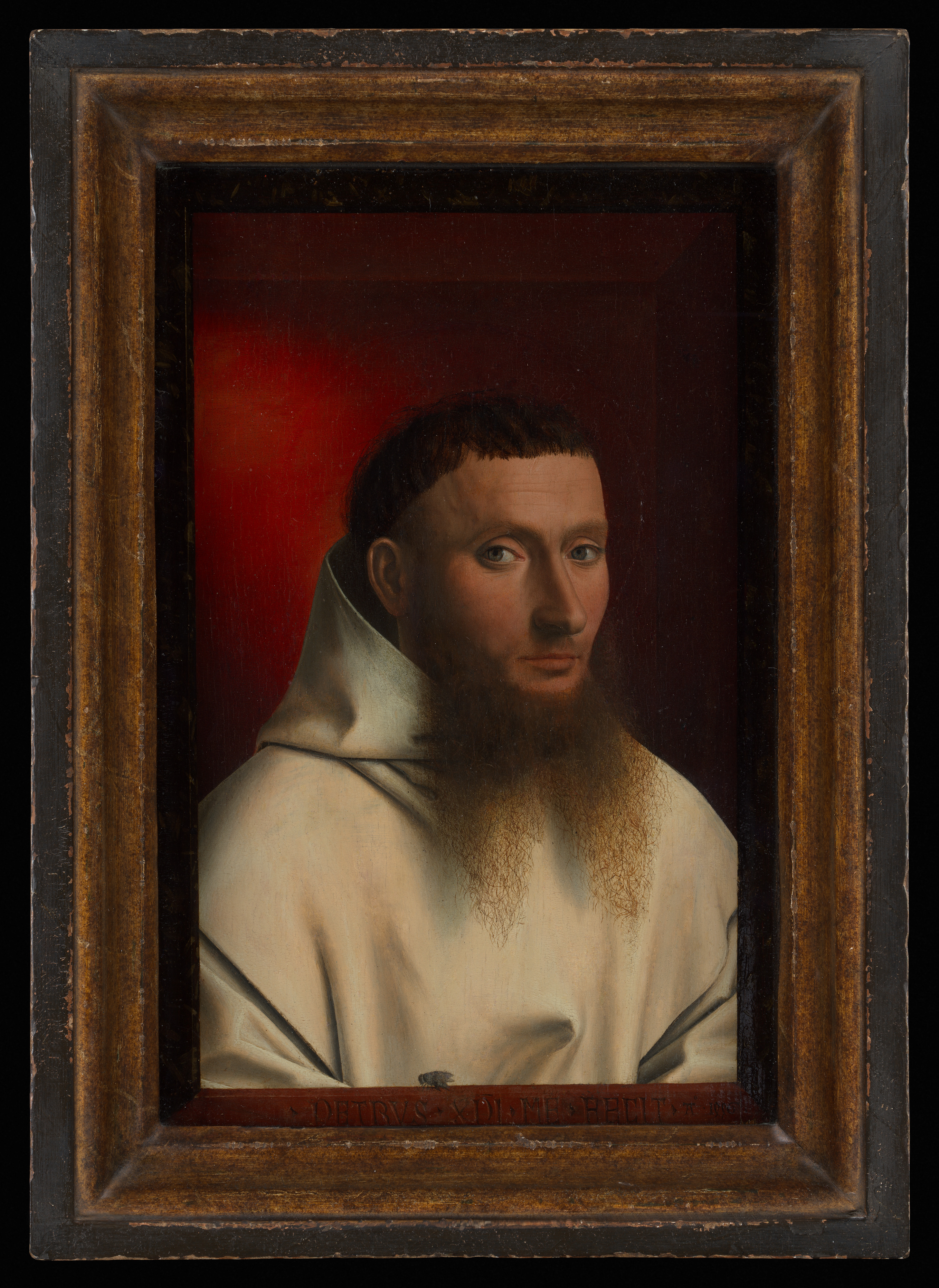 Shown: The Crucifixion; The Last Judgment, Jan van Eyck
In February an algorithm scored two van Eycks negative; in March the Rijksmuseum published a Rembrandt.
8 min read
Thirty-two objects in this archive were bought on the income of six named endowment funds, and in every case the person named had...
10 min read
Eight records in this archive carry a museum or a state as the seller. The Bodleian sold its First Folio as a duplicate and paid...
11 min read
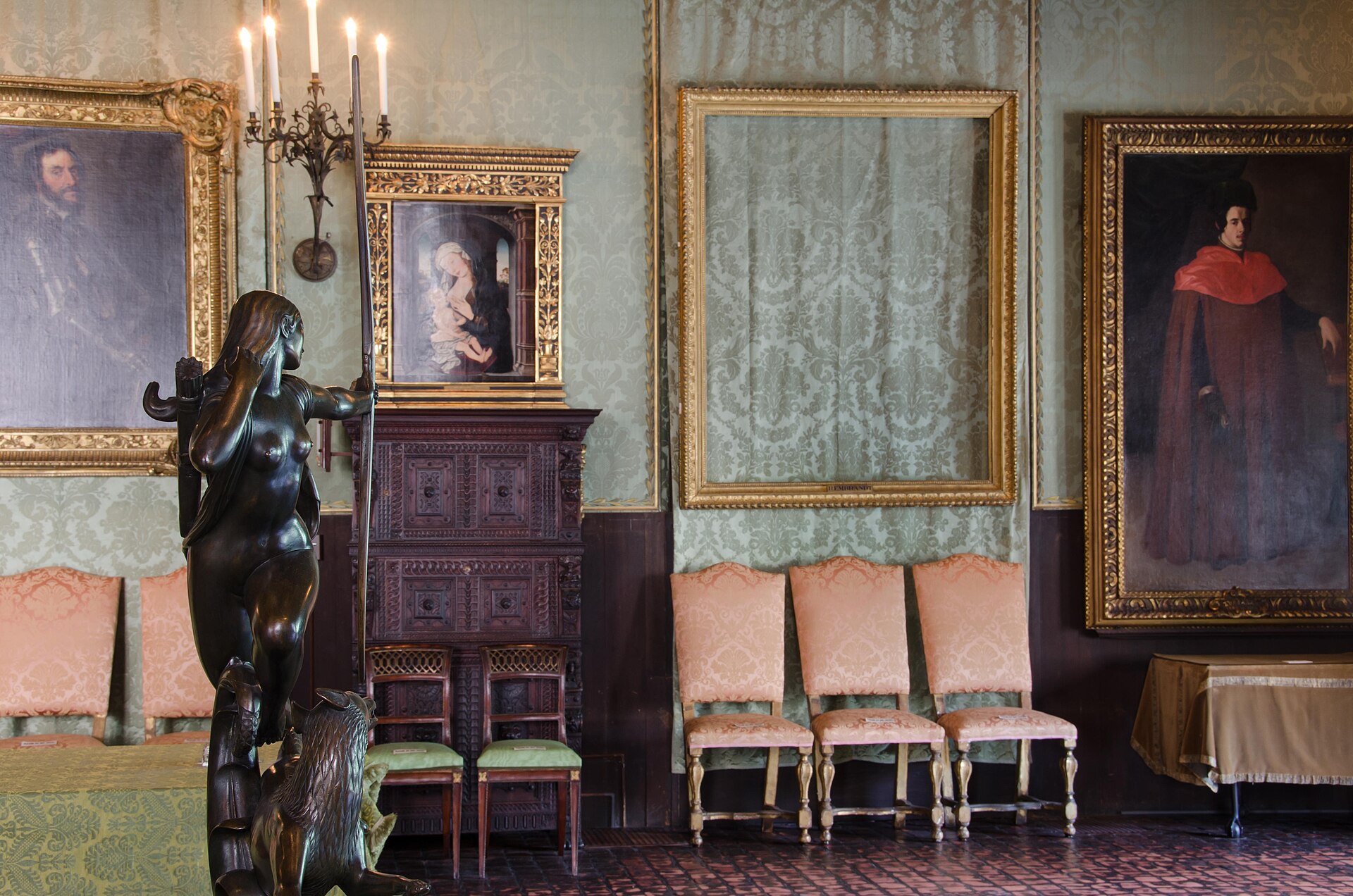
Ten records carry evidence on a frame. Van Eyck's integral frames date the panels to 1410-1440; a 1970 loan label on a frame in...
10 min read
Last verified 17 September 2026
One artwork and its story every Tuesday, with the picture: who owned it, what it made, and what closes soon in the exhibition calendar. No promotion, and nothing we cannot cite.
We send one email to confirm the address and keep nothing else. Every letter carries a one-click unsubscribe. How we handle your data.