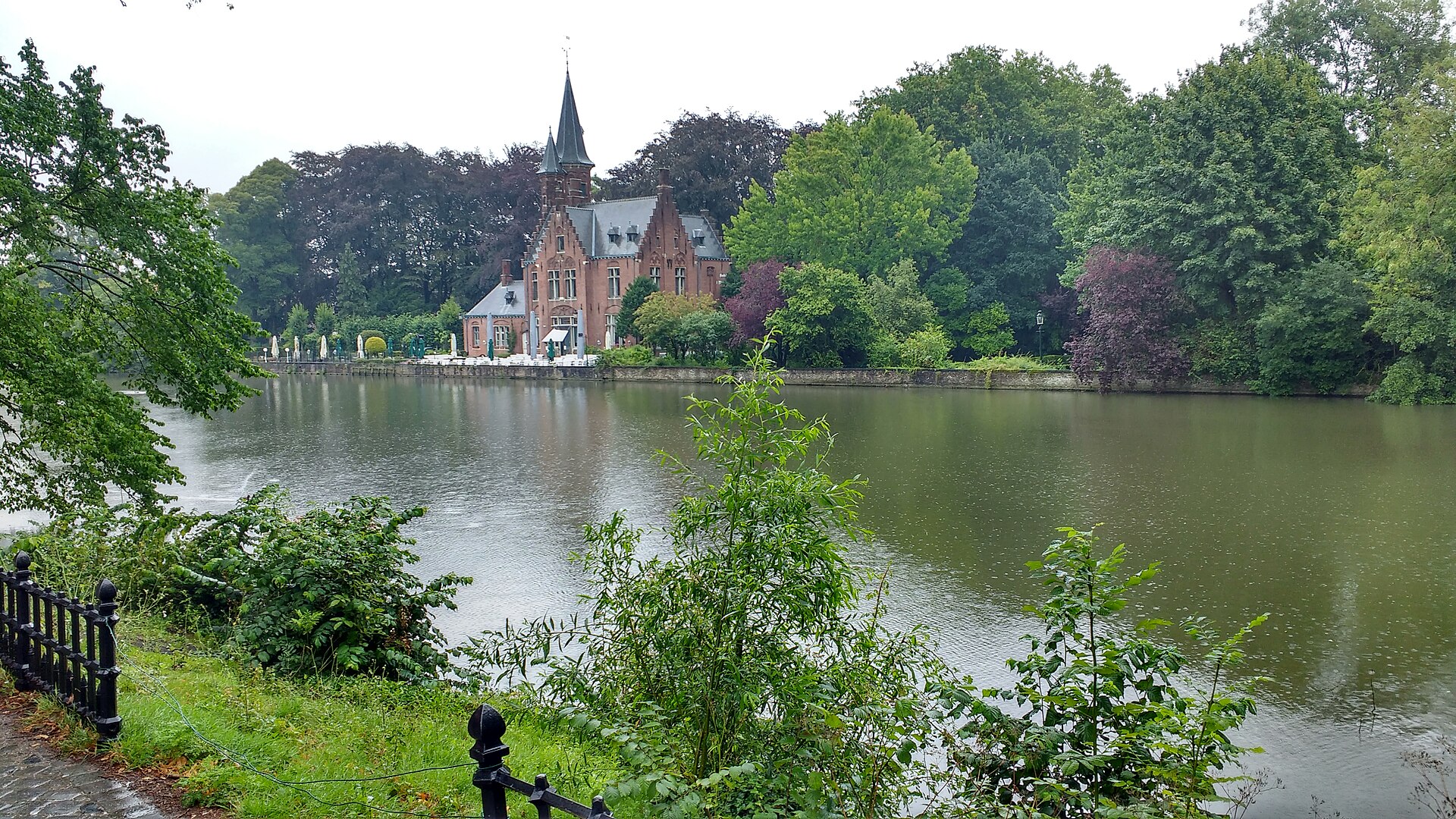
The Groeningemuseum on Dijver, Bruges.
Fernando Losada Rodriguez · Photograph by Drow male · CC BY-SA 4.0On this page 15 sections
ContentsClose
The Groeningemuseum's strength is depth in a single, tightly bounded area rather than breadth: its holding of fifteenth and sixteenth-century Bruges painting, assembled involuntarily out of French Revolutionary confiscation and partial return rather than purchase, is judged one of the finest concentrations of Flemish Primitive painting anywhere, built around works by Jan van Eyck, Hans Memling, Gerard David, Hugo van der Goes and Hieronymus Bosch that were made for the city that still holds them. The later rooms, carrying the collection through Neoclassicism, Symbolism, Flemish Expressionism and into Magritte and Broodthaers, are real holdings rather than filler, but they are not what a reader is coming to Bruges to see, and the museum does not pretend otherwise.
| Kind | Museum |
|---|---|
| Founded | 1930 |
| City and country |  Bruges, Belgium Bruges, Belgium |
| Address | Dijver 12, 8000 Bruges, Belgium |
| Website | museabrugge.be/bezoek-onze-musea/onze-musea-en-monumenten/groeningemuseum |
| Status | Open, confirmed |
| Record last verified |
Visiting
- Hours
- Tue-Sun10:00 to 18:001 April to 2 November
- Tue-Sun09:30 to 17:003 November to 31 March
- Closed
- Monday, year-round, except Easter Monday and Whit Monday. 25 December. 1 January.
- Admission
- StandardEUR 15
- Under 26EUR 13
- 13 to 17EUR 7
- Under 13Freefree
- Tickets
- museabrugge.be/en/visit/locations/groeningemu... The museum's own ticket page.
- Do I need to book?
- Not required for individuals but a timed slot is recommended; a group visit must be booked in advance
- Address
- Dijver 12, 8000 Bruges, Belgium MapBus Stop Brugge Dijver, lines 1, 4, 6, 11, 12, 14 and 16 from Bruges railway station
Walk About 20 to 25 minutes from Bruges railway station through the historic centre - Website
- museabrugge.be/bezoek-onze-musea/onze-musea-en-monumenten/groeningemuseum
- Telephone
- +32 50 44 87 43
- [email protected]
Before you go how long, access, photography, bags, eating, shop
- How long to allow
- Most visitors take 60 to 90 minutes; the museum is compact enough that some see the highlights in 20 to 30 minutes
- Access
- Ramped entrance and wheelchair access with assistance; an adapted toilet not suited to electric wheelchairs; free folding chairs and push wheelchairs at rest points; free EnChroma glasses for colour-blind visitors; the audio tour is available as text
- Eating
- No dedicated museum cafe is listed on the official visit page
- Shop
- Museum shop on site
Prices and hours change. We take them from the institution's own pages and print the day we read them, and you can check the current position at the source we used. Confirm before you travel.
What is inside
The Flemish Primitives
The founding holding: Jan van Eyck's Madonna with Canon Joris van der Paele and his Portrait of Margareta van Eyck, Hans Memling's Moreel Triptych and his two Annunciation wings, and panels by Gerard David and Petrus Christus. These are the paintings that survived the French confiscations of 1794 and the partial repatriation of 1816.
Moralising panels for the town hall
Hieronymus Bosch's Last Judgement, Gerard David's Judgement of Cambyses and Jan Provoost's Last Judgement, three works originally commissioned for Bruges civic buildings to remind sitting magistrates of the penalties for corruption.
Renaissance, Baroque and Bruges Neoclassicism
Sixteenth and seventeenth-century painting by Ambrosius Benson, Lancelot Blondeel and Pieter Brueghel the Younger, followed by the Neoclassical Bruges school of Joseph-Benoit Suvee, Joseph Denis Odevaere and Joseph Ducq, including Odevaere's Lord Byron on his Deathbed.
Symbolism and Flemish Expressionism
Fernand Khnopff's Symbolist Secret-Reflet, and the Sint-Martens-Latem Expressionists who followed a generation later: Constant Permeke, Gustave De Smet, Gustave Van de Woestyne and Jean Brusselmans.
Surrealism and post-war Belgian art
Rene Magritte's L'Attentat, work by Roger Raveel and Raoul De Keyser, and the museum's holding of Marcel Broodthaers's printed editions, carrying the collection to the late twentieth century.
What to see first
Madonna with Canon Joris van der Paele
Jan van Eyck, 1436Considered the collection's single greatest object: an oil panel of extreme technical control, with the donor canon kneeling before the Virgin inside a rendered interior detailed enough to be read as a record of a real space.5
The Last Judgement
Hieronymus Bosch, after 1486One of three surviving Last Judgement compositions attributed to Bosch and his workshop, painted as a triptych for a Bruges patron rather than the town hall commissions beside it.5
The Judgement of Cambyses
Gerard David, 1498A two-panel civic commission for the Bruges aldermen's chamber, showing the flaying of a corrupt judge; intended as a standing warning to the magistrates who sat beneath it.8
Death of the Virgin
Hugo van der Goes, c. 1472-1480A late work by one of the most technically and psychologically ambitious of the Bruges-trained primitives, showing Christ receiving Mary's soul as the apostles gather around her deathbed.5
Portrait of Margareta van Eyck
Jan van Eyck, 1439Among the earliest surviving independent portraits of a named, non-royal woman in European painting, believed to show the painter's own wife without idealisation.8
Moreel Triptych
Hans Memling, 1484A large altarpiece commissioned for a Bruges chapel, with Saint Christopher carrying the infant Christ at the centre and the donor family portrayed on the wings.8
Annunciation (two grisaille wings)
Hans Memling, c. 1467-1470Sold by Bruges collector Emile Renders to Hermann Goering in 1941 for payment in gold bars, recovered from the Goering collection in Germany in 1947, and transferred to Bruges as Belgian state property in 1952; the museum's own research describes the panels as carrying a wartime taint even though they were not looted from a Jewish owner.10
Lord Byron on his Deathbed
Joseph-Denis Odevaere, 1826A Neoclassical history painting of the poet's death during the Greek War of Independence, by the Bruges painter who had earlier helped recover artworks confiscated during the French occupation.8
Secret-Reflet
Fernand Khnopff, 1902A Symbolist work built around a mirror and a hidden second image, characteristic of Khnopff's interest in concealment and doubled meaning.8
L'Attentat
Rene Magritte, 1932A Surrealist composition combining a framed sky, a bell and a fragmented body, representative of the museum's move into twentieth-century Belgian modernism.8
Exhibitions on now
- On now16 Jun to 26 Oct 2026Confirmed · check before you travel
An abbey site, and a museum built from confiscation
The Groeningemuseum stands on the grounds of the former Eekhout Abbey. The collection it now houses did not begin as a museum acquisition programme but as an act of forced consolidation. When French revolutionary forces occupied the Southern Netherlands in 1794, they confiscated roughly two hundred paintings from Bruges churches and religious houses, including major works by Jan van Eyck and Hans Memling, and shipped a large share of them toward Paris. What did not travel found a temporary home in the former Duinen Abbey, where the Bruges Academy set up the Musee de l'Ecole Centrale du Departement de la Lys in 1797 to hold roughly five hundred seized works.
Restitution began in 1816, when several of the confiscated paintings were returned to Bruges under the neoclassical painter Joseph Odevaere, re-joining the Academy's holdings. An 1824 commission inventoried what the city still held, and in 1828 the Academy asked to consolidate the paintings by Gerard David, Hugo van der Goes and Jan Provoost that had come back into a single core collection. That core, assembled from confiscation and partial return rather than purchase, is what the Groeningemuseum still calls its Flemish Primitives collection. The present Art Deco building, designed by the architect Joseph Vierin, opened on the same site in 1930.
The Englishman who rescued the reputation of the Bruges primitives
For much of the nineteenth century the painters now central to the collection were not treated as major artists. The English scholar W. H. James Weale changed that. His 1861 catalogue described around 144 paintings held in Bruges and reintegrated painters who had fallen out of critical attention, Gerard David and Jan Provoost among them, back into an art-historical record that had mostly forgotten them. Weale is credited as the rediscoverer of the Flemish Primitives in the modern sense of the term, and the scholarly foundation he laid is the reason the Groeningemuseum's fifteenth-century holding is read today as a coherent school rather than a set of isolated survivals.
The museum did not become a fully professional research institution immediately. It was only in 1954, with the appointment of Aquilin Janssens de Bisthoven as its first academically trained director, that the Groeningemuseum took on the curatorial and research role it holds now. Acquisition has continued since: a seventeenth-century copy after van Eyck entered the collection in 2007, and three panels from the Retable of Saint Nicholas were added in 2008, both additions the museum frames as extending rather than replacing the nineteenth-century core.
Painted for a courtroom, not a gallery wall
Several of the museum's best-known works were not made as devotional or decorative objects at all but as instruments of civic government. Gerard David's Judgement of Cambyses, painted in 1498 for the Bruges aldermen's chamber, shows the flaying of a corrupt judge in explicit detail; it was meant to hang where sitting magistrates would see it and take the warning personally. Jan Provoost's Last Judgement of 1525 served a related purpose for the town hall, reminding the officials who worked beneath it of the judgement awaiting them. Hieronymus Bosch's Last Judgement, painted after 1486, is one of three surviving Last Judgement compositions associated with Bosch and his workshop, though it was made for a private patron rather than a civic body. Seeing the three together, as the Groeningemuseum's hang allows, makes the difference between private devotional painting and public civic instruction unusually legible in one room.
Six centuries under one roof
Beyond the fifteenth-century core, the museum's declared range runs from Jan van Eyck to Marcel Broodthaers, and the rooms are organised to carry a visitor through that span without a break in continuity. Sixteenth and seventeenth-century painting by Ambrosius Benson, Lancelot Blondeel and Pieter Brueghel the Younger leads into the Bruges Neoclassical school of Joseph-Benoit Suvee, Joseph Denis Odevaere and Joseph Ducq, whose Lord Byron on his Deathbed is one of the museum's more theatrical set pieces. The nineteenth century closes with Symbolism, represented by Fernand Khnopff's Secret-Reflet, before the collection turns to the Flemish Expressionists who worked in and around the artists' village of Sint-Martens-Latem before the First World War: Constant Permeke, Gustave De Smet, Gustave Van de Woestyne and Jean Brusselmans. The twentieth century closes with Rene Magritte's Surrealist L'Attentat, work by Roger Raveel and Raoul De Keyser, and a holding of Marcel Broodthaers's printed publications, which brings the museum's declared six centuries to their most recent edge.
A wartime taint the museum states plainly
The Groeningemuseum's own published research does not smooth over the wartime history of one of its Memling pairs. The two grisaille Annunciation wings, painted around 1467 to 1470, were bought in London in 1939 by the Bruges banker and collector Emile Renders from an English private owner who was selling under the pressure of the coming war. Two years later Renders sold the same panels, along with roughly twenty other works, to the Nazi leader Hermann Goering, arranged through the German dealer Aloys Miedl, and was paid in gold bars. The museum's account is explicit that the wings were not looted from a Jewish owner, which separates them from the worst category of wartime seizure, but states just as plainly that they nevertheless carry what it calls a wartime taint. The panels were recovered from the former Goering collection in Germany in 1947. A postwar investigation concluded that Renders was not a victim of the sale, so the Annunciation wings passed to the Belgian state rather than back to him, and the Department of Economic Recovery transferred them to Bruges in 1952, where they remain on view beside the museum's other Memling holdings. Publishing that chain of ownership without softening it is exactly the kind of self-disclosure a reader doing diligence on the collection should be able to find, and the museum makes it available on its own site rather than leaving it to outside research.
Visiting today
The Groeningemuseum keeps a small footprint by design. It runs Tuesday to Sunday, from ten in the morning to six in the evening between 1 April and 2 November, and from half past nine to five for the rest of the year, closed on Mondays except for Easter Monday and Whit Monday. Standard admission is 15 euros, with reduced rates for visitors under 26 and under 18 and free entry under 13. Most visitors report needing sixty to ninety minutes to see the collection properly, though the museum is compact enough that a fast circuit of the best-known panels can be done in twenty to thirty minutes, which is also the basis of the most common visitor complaint: that the museum is small for the price of entry. The building itself is wheelchair accessible with assistance through a ramped entrance, and the museum offers free EnChroma glasses for colour-blind visitors and a text version of its audio guide.
What visitors say
Visitors consistently describe the Groeningemuseum as one of the best small art museums in Bruges: a compact, well-lit run of rooms that lets the Flemish Primitives be studied at close range rather than glimpsed past a crowd, with clear multilingual labelling throughout.
What is praised, what is criticised
- Praised: The depth and quality of the Flemish Primitives collection, above all van Eyck's Madonna with Canon van der Paele
- Praised: The manageable scale of the museum, which lets a visit stay focused rather than becoming exhausting
- Praised: Calm, uncrowded galleries and clear multilingual wall texts that support close looking
- Criticised: The museum is small relative to its 15 euro standard admission, and some visitors feel the visit is over too quickly
Ratings on other platforms
Tripadvisor: 4.3 from 1,752 ratings, read 26 August 2026
A platform average is a tertiary source: it moves, it is not audited, and we quote no visitor's words.
Questions about Groeningemuseum
Where is Groeningemuseum?
Dijver 12, 8000 Bruges, Belgium.
How much does it cost to visit?
Standard: EUR 15; Under 26: EUR 13; 13 to 17: EUR 7; Under 13: free. As confirmed 26 August 2026.
When is it open?
Tue-Sun 10:00-18:00; Tue-Sun 09:30-17:00. Closed: Monday, year-round, except Easter Monday and Whit Monday. 25 December. As confirmed 26 August 2026.
How do you get there?
Bus: Stop Brugge Dijver, lines 1, 4, 6, 11, 12, 14 and 16 from Bruges railway station; Walk: About 20 to 25 minutes from Bruges railway station through the historic centre.
What should you see first?
Madonna with Canon Joris van der Paele (Jan van Eyck, 1436); The Last Judgement (Hieronymus Bosch, after 1486); The Judgement of Cambyses (Gerard David, 1498); Death of the Virgin (Hugo van der Goes, c. 1472-1480); Portrait of Margareta van Eyck (Jan van Eyck, 1439); Moreel Triptych (Hans Memling, 1484).
What we could not confirm
- The exact attribution split between Bosch and his workshop on the Last Judgement is treated as settled by the museum's own display but is not without scholarly debate elsewhere in Bosch studies.
- The museum's own published account of the Memling Annunciation wings does not say whether any claim was ever made by the estate of the English owner who sold to Renders in 1939 under wartime pressure, only that the panels were not looted from Jewish ownership.
Images
Sources
- 1Wikimedia Commons, Category:Groeningemuseum commons.wikimedia.org/wiki/Category:Groeningemuseum
- 2Wikimedia Commons, File:Groeningemuseum.001 - Brugge.jpg, licence and file page commons.wikimedia.org/wiki/File:Groeningemuseum.001_-_Brugge.jpg
- 3Musea Brugge, official visit page for the Groeningemuseum (hours, admission, accessibility) museabrugge.be/en/visit/locations/groeningemuseum
- 4Musea Brugge, general visit information museabrugge.be/en/visit
- 5Wikipedia, Groeningemuseum (, for identity, coordinates and general history) en.wikipedia.org/wiki/Groeningemuseum
- 6Vlaamse Kunstcollectie / Flemish Primitives online, Groeninge Museum Bruges, collection development history vlaamseprimitieven.vlaamsekunstcollectie.be/en/sources/collections-development/groeninge-museum-bruges/
- 7Visit Bruges (official city tourism site), Groeningemuseum listing visitbruges.be/en/groeningemuseum-groeninge-museum
- 8Art-Facts, Top famous paintings at the Groeningemuseum art-facts.com/groeningemuseum-bruges-paintings/
- 9Tripadvisor, Groeningemuseum reviews and aggregate rating () tripadvisor.com/Attraction_Review-g188671-d243491-Reviews-Groeningemuseum-Bruges_West_Flanders_Province.html
- 10Musea Brugge, museum research page on the Memling Annunciation wings and their wartime history museabrugge.be/en/collection/research/memling-met-oorlogsverleden
- 11CODART, museum guide entry for the Groeningemuseum codart.nl/guide/museums/groeningemuseum-musea-brugge/
